France says it cannot deliver Mistral warship to Russia over Ukraine
RT | September 3, 2014
France has suspended delivery of the first of two Mistral helicopter carrier ships to Russia, due to events in eastern Ukraine.
“The situation is serious. Russia’s recent actions in the east of Ukraine contravene the fundamental principles of European security,” said a statement from the office of President Francois Hollande.
“The president of the Republic has concluded that despite the prospect of ceasefire, which has yet to be confirmed and put in place, the conditions under which France could authorise the delivery of the first helicopter carrier are not in place.”
The office informed AFP that the suspension would be next reviewed before November.
“Legally, nothing has changed and the contract is still in force, and the first vessel is still due for delivery on November 1. But a political decision has been taken. The President is saying that if nothing changes, he cannot allow the delivery to go through,” one of Hollande’s representatives told Russia’s RIA news agency.
As the rift over Ukraine has widened, Russian officials have repeatedly said that they would accept the French government’s failure to deliver the ships, as long as it paid the penalty for breaking the contract, which, could potentially exceed the cost of the ships themselves.
“This is not a tragedy, though of course the news is unpleasant. It will not affect our armament plans. We will act in accordance with international laws and the statutes of the contract,” said Russian Deputy Defense Minister Yuri Borisov, in a statement.
The two ships were commissioned by Russia in 2011 at a cost of $1.6 billion. The first of these, the Vladivostok, was due to come into service at the end of this year, with the second, the Sevastopol, due to be completed in 2015.
France’s suspension does not fall under the sectoral sanctions the EU and the US imposed upon Russia for purported meddling in the armed conflict in eastern Ukraine, introduced last month. That raft of sanctions did not cover deals signed before their imposition.
But it could be covered under new sanctions sanctions the EU is expected to introduce this week, which may earn France a temporary reprieve from compensation under the terms of the contract.
While Moscow officials earlier admitted that in terms of efficiency and versatility the cutting-edge Mistral has no equivalent in the Russian Navy, the deal was always considered controversial, as France was a Cold War adversary, and is a founding member of NATO.
Indeed, there had been speculation of NATO taking over the Mistral order from Russia, following a proposal from a group of US congressmen back in May. Earlier this week, the Alliance chief Anders Fogh Rasmussen did not rule out the possibility, but said that it “remains a national decision, not for NATO to interfere.” In the aftermath of the announcement from Hollande, NATO maintained that it wasn’t forcing France to suspend the sale.
Previously US President Barack Obama said France should “press the pause button” on the deal, while fighting in Ukraine is in progress.
Previously, French officials resisted, citing concerns over reputational damage, and saying that the financial penalties might hurt Paris more than Moscow. Even if France does now decide to sell the ships to someone else, it will have to refit them, as every aspect, from the helicopter pads to hull alloys is custom-made to Russian specifications.
What would real proof look like?
By Patrick Armstrong | US-Russia.org | August 31, 2014
Once again the headlines shout that Russia has invaded Ukraine. Once again NATO offers blurry satellite shots from a commercial service for evidence. Here are June’s “invasion” satellite photos. This month’s “invasion” satellite photos are here. Again from a commercial source, Digital Globe. Photo 1: some “Russian” SPGs in Ukraine (everybody uses “Russian” ie Soviet equipment and the rebels have captured quite a lot). Photo 2: Some deployed artillery in Ukraine (ludicrously explained as how “trained military professionals” would deploy it. Hasn’t anyone in NATO HQ realised that the east Ukrainian rebels are pretty competent?) Photo 3: A Russian base with stuff in it and without stuff in it (but aren’t we continually told about the Russian “buildup on the border”, always alarming, always threatening, whatever the numbers: “very, very sizable” in March, 40K in April, 12K in July, 20K in August. One should not be surprised that there’s some variance of equipment at a given base over time). Photo 4 and 5: Some guns in Russia pointing towards Ukraine (where, by the way, as NATO intelligence may know, there is a war going on with occasional firing into Russia. All military are trained to expect the worst.) And, by the way, if Russia did invade, don’t you think it would do it in strength rather than a couple of tanks here and a gun or two there? No wonder the Russians are laughing at this “evidence”; this isn’t evidence of anything except how gullible NATO thinks its taxpayers are.
Its time to consider what real evidence would look like. The United States has spent billions and billions of dollars on intelligence-gathering equipment; and supposedly has more assets than anyone else has ever had or dreamed of having. So, given this vast array of sophisticated devices which, one has to assume, have been watching Ukraine and western Russia for months, what would real evidence of a Russian invasion of Ukraine look like?
We would see a series of photographs, maybe even a continuous moving picture, perhaps backed up by intercepted communications, of Russian equipment forming up in a base. We would follow that column, photo by photo, moving towards Ukraine. We would watch that column, photo by photo, as it crossed the frontier and deployed. We should also have photos of Russian artillery actually firing – after all, the guns they show are right out in the open and artillery doesn’t fire single shots. If the Russians were actually firing across the border regularly, there would be real satellite evidence showing it. That is what real proof would look like and that is what these pathetic efforts are not. Although they are negative evidence: if NATO had real evidence, we’d see it 24/7; this paltry effort demonstrates that it does not.
It’s all reminiscent of the two British reporters who said they saw Russian armour head across the border into Ukraine a couple of weeks ago, My smart phone has a camera and it has GPS too and there’s lots of map software available (I recommend City Maps 2Go, download Rostov Oblast. I’m sure their newspapers would stand the $3 it costs). A real report would have said this is the time, this is where we are, this is what we saw, here’s photos. But oops, whaddaya know! they forgot to take their smart phones with them. Gee, so we have to trust them and take their word for it.
WELL, I DON’T TRUST THEM.
And I don’t trust NATO and its pitiful commercial images, I don’t trust reporters who “forget” to record things and I don’t trust Marie Harf and her “social media and common sense”.
As Paul Craig Roberts puts it: “The latest Washington lie, this one coming from NATO, is that Russia has invaded Ukraine with 1,000 troops and self-propelled artillery. How do we know that this is a lie? Is it because we have heard nothing but lies about Russia from NATO, from US ambassador to the UN Samantha Power, from assistant secretary of state Victoria Nuland, from Obama and his entire regime of pathological liars, and from the British, German, and French governments along with the BBC and the entirety of the Western media?”
Patrick Armstrong is a former political counselor at Canadian Embassy in Moscow.
Who’s Telling the ‘Big Lie’ on Ukraine?
By Robert Parry | Consortium News | September 2, 2014
If you wonder how the world could stumble into World War III – much as it did into World War I a century ago – all you need to do is look at the madness that has enveloped virtually the entire U.S. political/media structure over Ukraine where a false narrative of white hats vs. black hats took hold early and has proved impervious to facts or reason.
The original lie behind Official Washington’s latest “group think” was that Russian President Vladimir Putin instigated the crisis in Ukraine as part of some diabolical scheme to reclaim the territory of the defunct Soviet Union, including Estonia and other Baltic states. Though not a shred of U.S. intelligence supported this scenario, all the “smart people” of Washington just “knew” it to be true.
Yet, the once-acknowledged – though soon forgotten – reality was that the crisis was provoked last year by the European Union proposing an association agreement with Ukraine while U.S. neocons and other hawkish politicos and pundits envisioned using the Ukraine gambit as a way to undermine Putin inside Russia.
The plan was even announced by U.S. neocons such as National Endowment for Democracy President Carl Gershman who took to the op-ed page of the Washington Post nearly a year ago to call Ukraine “the biggest prize” and an important interim step toward eventually toppling Putin in Russia.
Gershman, whose NED is funded by the U.S. Congress, wrote: “Ukraine’s choice to join Europe will accelerate the demise of the ideology of Russian imperialism that Putin represents. … Russians, too, face a choice, and Putin may find himself on the losing end not just in the near abroad but within Russia itself.”
In other words, from the start, Putin was the target of the Ukraine initiative, not the instigator. But even if you choose to ignore Gershman’s clear intent, you would have to concoct a bizarre conspiracy theory to support the conventional wisdom about Putin’s grand plan.
To believe that Putin was indeed the mastermind of the crisis, you would have to think that he somehow arranged to have the EU offer the association agreement last year, then got the International Monetary Fund to attach such draconian “reforms” that Ukrainian President Viktor Yanukovych backed away from the deal.
Then, Putin had to organize mass demonstrations at Kiev’s Maidan square against Yanukovych while readying neo-Nazi militias to act as the muscle to finally overthrow the elected president and replace him with a regime dominated by far-right Ukrainian nationalists and U.S.-favored technocrats. Next, Putin had to get the new government to take provocative actions against ethnic Russians in the east, including threatening to outlaw Russian as an official language.
And throw into this storyline that Putin – all the while – was acting like he was trying to help Yanukovych defuse the crisis and even acquiesced to Yanukovych agreeing on Feb. 21 to accept an agreement brokered by three European countries calling for early Ukrainian elections that could vote him out of office. Instead, Putin was supposedly ordering neo-Nazi militias to oust Yanukovych in a Feb. 22 putsch, all the better to create the current crisis.
While such a fanciful scenario would make the most extreme conspiracy theorist blush, this narrative was embraced by prominent U.S. politicians, including ex-Secretary of State Hillary Clinton, and “journalists” from the New York Times to CNN. They all agreed that Putin was a madman on a mission of unchecked aggression against his neighbors with the goal of reconstituting the Russian Empire. Clinton even compared him to Adolf Hitler.
This founding false narrative was then embroidered by a consistent pattern of distorted U.S. reporting as the crisis unfolded. Indeed, for the past eight months, we have seen arguably the most one-sided coverage of a major international crisis in memory, although there were other crazed MSM stampedes, such as Iraq’s non-existent WMD in 2002-03, Iran’s supposed nuclear bomb project for most of the past decade, Libya’s “humanitarian crisis” of 2011, and Syria’s sarin gas attack in 2013.
But the hysteria over Ukraine – with U.S. officials and editorialists now trying to rally a NATO military response to Russia’s alleged “invasion” of Ukraine – raises the prospect of a nuclear confrontation that could end all life on the planet.
The ‘Big Lie’ of the ‘Big Lie’
This madness reached new heights with a Sept. 1 editorial in the neoconservative Washington Post, which led many of the earlier misguided stampedes and was famously wrong in asserting that Iraq’s concealment of WMD was a “flat fact.” In its new editorial, the Post reprised many of the key elements of the false Ukraine narrative in the Orwellian context of accusing Russia of deceiving its own people.
The “through-the-looking-glass” quality of the Post’s editorial was to tell the “Big Lie” while accusing Putin of telling the “Big Lie.” The editorial began with the original myth about the aggression waged by Putin whose “bitter resentment at the Soviet empire’s collapse metastasized into seething Russian nationalism. …
“In prosecuting his widening war in Ukraine, he has also resurrected the tyranny of the Big Lie, using state-controlled media to twist the truth so grotesquely that most Russians are in the dark — or profoundly misinformed — about events in their neighbor to the west. …
“In support of those Russian-sponsored militias in eastern Ukraine, now backed by growing ranks of Russian troops and weapons, Moscow has created a fantasy that plays on Russian victimization. By this rendering, the forces backing Ukraine’s government in Kiev are fascists and neo-Nazis, a portrayal that Mr. Putin personally advanced on Friday, when he likened the Ukrainian army’s attempts to regain its own territory to the Nazi siege of Leningrad in World War II, an appeal meant to inflame Russians’ already overheated nationalist emotions.”
The Post continued: “Against the extensive propaganda instruments available to Mr. Putin’s authoritarian regime, the West can promote a fair and factual version of events, but there’s little it can do to make ordinary Russians believe it. Even in a country with relatively unfettered access to the Internet, the monopolistic power of state-controlled media is a potent weapon in the hands of a tyrant.
“Mr. Putin’s Big Lie shows why it is important to support a free press where it still exists and outlets like Radio Free Europe that bring the truth to people who need it.”
Yet the truth is that the U.S. mainstream news media’s distortion of the Ukraine crisis is something that a real totalitarian could only dream about. Virtually absent from major U.S. news outlets – across the political spectrum – has been any significant effort to tell the other side of the story or to point out the many times when the West’s “fair and factual version of events” has been false or deceptive, starting with the issue of who started this crisis.
Blinded to Neo-Nazis
In another example, the Post and other mainstream U.S. outlets have ridiculed the idea that neo-Nazis played any significant role in the putsch that ousted Yanukovych on Feb. 22 or in the Kiev regime’s brutal offensive against the ethnic Russians of eastern Ukraine.
However, occasionally, the inconvenient truth has slipped through. For instance, shortly after the February coup, the BBC described how the neo-Nazis spearheaded the violent seizure of government buildings to drive Yanukovych from power and were then rewarded with four ministries in the regime that was cobbled together in the coup’s aftermath.
When ethnic Russians in the south and east resisted the edicts from the new powers in Kiev, some neo-Nazi militias were incorporated into the National Guard and dispatched to the front lines as storm troopers eager to fight and kill people whom some considered “Untermenschen” or sub-human.
Even the New York Times, which has been among the most egregious violators of journalistic ethics in covering the Ukraine crisis, took note of Kiev’s neo-Nazi militias carrying Nazi banners while leading attacks on eastern cities – albeit with this embarrassing reality consigned to the last three paragraphs of a long Times story on a different topic. [See Consortiumnews.com’s “NYT Discovers Ukraine’s Neo-Nazis at War.”]
Later, the conservative London Telegraph wrote a much more detailed story about how the Kiev regime had consciously recruited these dedicated storm troopers, who carried the Wolfsangel symbol favored by Hitler’s SS, to lead street fighting in eastern cities that were first softened up by army artillery. [See Consortiumnews.com’s “Ignoring Ukraine’s Neo-Nazi Storm Troopers.”]
You might think that unleashing Nazi storm troopers on a European population for the first time since World War II would be a big story – given how much coverage is given to far less significant eruptions of neo-Nazi sentiment in Europe – but this ugly reality in Ukraine disappeared quickly into the U.S. media’s memory hole. It didn’t fit the preferred good guy/bad guy narrative, with the Kiev regime the good guys and Putin the bad guy.
Now, the Washington Post has gone a step further dismissing Putin’s reference to the nasty violence inflicted by Kiev’s neo-Nazi battalions as part of Putin’s “Big Lie.” The Post is telling its readers that any reference to these neo-Nazis is just a “fantasy.”
Even more disturbing, the mainstream U.S. news media and Washington’s entire political class continue to ignore the Kiev government’s killing of thousands of ethnic Russians, including children and other non-combatants. The “responsibility to protect” crowd has suddenly lost its voice. Or, all the deaths are somehow blamed on Putin for supposedly having provoked the Ukraine crisis in the first place.
A Mysterious ‘Invasion’
And now there’s the curious case of Russia’s alleged “invasion” of Ukraine, another alarmist claim trumpeted by the Kiev regime and echoed by NATO hardliners and the MSM.
While I’m told that Russia did provide some light weapons to the rebels early in the struggle so they could defend themselves and their territory – and a number of Russian nationalists have crossed the border to join the fight – the claims of an overt “invasion” with tanks, artillery and truck convoys have been backed up by scant intelligence.
One former U.S. intelligence official who has examined the evidence said the intelligence to support the claims of a significant Russian invasion amounted to “virtually nothing.” Instead, it appears that the ethnic Russian rebels may have evolved into a more effective fighting force than many in the West thought. They are, after all, fighting on their home turf for their futures.
Concerned about the latest rush to judgment about the “invasion,” the Veteran Intelligence Professionals for Sanity, a group of former U.S. intelligence officials and analysts, took the unusual step of sending a memo to German Chancellor Angela Merkel warning her of a possible replay of the false claims that led to the Iraq War.
“You need to know,” the group wrote, “that accusations of a major Russian ‘invasion’ of Ukraine appear not to be supported by reliable intelligence. Rather, the ‘intelligence’ seems to be of the same dubious, politically ‘fixed’ kind used 12 years ago to ‘justify’ the U.S.-led attack on Iraq.”
But these doubts and concerns are not reflected in the Post’s editorial or other MSM accounts of the dangerous Ukraine crisis. Indeed, Americans who rely on these powerful news outlets for their information are as sheltered from reality as anyone living in a totalitarian society.
~
Investigative reporter Robert Parry broke many of the Iran-Contra stories for The Associated Press and Newsweek in the 1980s. You can buy his new book, America’s Stolen Narrative, either in print here or as an e-book (from Amazon and barnesandnoble.com).
US prepares military drill in W. Ukraine for mid-September
RT | September 3, 2014
The US and its allies are preparing to stage a military exercise in western Ukraine, close to the Polish border, in mid-September. The joint drill will involve over 1,000 troops from the US and Europe, as well as from Ukraine.
Initially planned for mid-July, the exercise – code-named ‘Rapid Trident’ – was halted due to a significant escalation in the conflict between Kiev and the southeastern regions of Ukraine.
Now, as the fighting between the two sides continues, the US Army’s European Command (EUCOM) plans to go ahead and stage the exercise on September 16-26.
“At the moment, we are still planning for [the exercise] to go ahead,” US Navy Captain Gregory Hicks, spokesman for EUCOM, announced on Tuesday.
The annual exercise will take place at Yavoriv training center in the city of Lvov, near Ukraine’s border with Poland.
Around 200 US personnel will be involved in the drill, as well as 1,100 others from Ukraine, Azerbaijan, Britain, Canada, Georgia, Germany, Latvia, Lithuania, Moldova, Norway, Poland, Romania, and Spain, EUCOM said.
In addition to staging air force exercises, the United States is moving tanks and 600 troops to Poland and the Baltic states of Estonia, Latvia, and Lithuania for joint maneuvers in October, Reuters reports. The new deployment will replace a more lightly armed force of paratroopers.
Rapid Trident 2014 is designed to “promote regional stability and security, strengthen partnership capacity and foster trust while improving interoperability between the land forces of Ukraine, and NATO and partner nations,” according to the US Forces in Europe website.
The exercise will be mainly focused on command post drills, patrolling, and dealing with improvised explosive devices.
Despite the involvement of many NATO members, Rapid Trident is not formally a NATO drill.
The Ukrainian-American exercises have taken place in Lvov since 2006 under the framework of NATO’s broader ‘Partnership for Peace,’ which Ukraine is part of.
This year’s drill will mean the first significant deployment of US troops and other personnel to Ukraine since the crisis erupted.
Last year’s Rapid Trident, which focused on “airborne and air-mobile infantry operations,” according to a report on the Rapid Trident website, brought together 17 NATO countries for joint exercises.
The announcement comes just two days before the NATO 2014 summit is set to open in Wales. The alliance’s expansion to Eastern Europe is expected to become one of the main discussions and the 28-member bloc expects, despite internal opposition, to agree on the “more visible NATO presence in the East.”
The White House said the US and its allies are set to discuss plans to significantly increase the readiness of NATO response forces.
White House spokesman Josh Earnest told reporters that the meetings within the summit are expected to involve discussions on potential trainings, exercises, and other issues regarding infrastructure and other needs in Eastern Europe.
Back in June, US President Barack Obama pledged to invest $1 billion in stepping up America’s military presence in Eastern Europe amid the Ukraine crisis. Also that month, Washington vowed additional military help to Ukraine, as well as the potential training of its law enforcement and military personnel.
Where do Ukraine’s rebels get arms from? Old Soviet bases, says Russia’s top brass
RT | August 30, 2014
Russia is not waging war in Ukraine’s east, and is not supplying rebels with military equipment, according to Russian deputy defense minister Anatoly Antonov. The anti-Kiev forces get their arms at old Soviet storages – same as government troops do.
“Surely, Russia doesn’t wage any war. Vladimir Putin’s policy is aimed at not allowing the situation to develop according to the worst-case scenario. There are, unfortunately, forces that try to push two peoples against each other to start a real war between Russia and Ukraine,” Antonov said, speaking with journalists in Slovakia.
Addressing the claims that Russia supplies weapons to the eastern Ukrainian self-defense forces, he explained where the militia may get their weaponry from.
“First, one shouldn’t forget that Ukraine used to be a part of the Soviet Union. There were many weapon storages on the territory of the Soviet Union, so when Ukraine and Russia became independent states, clearly some storages remained on Ukrainian territory.”
“Currently, in the region engulfed by this disaster, by the bloodshed, where the “punishment” operation is being carried out by Kiev against its own people, some of these storages have been seized by the self-defense forces. That’s why saying that Russians supplied the weapons to Lugansk and Donetsk is simply incorrect. Look at the Ukrainian army’s weaponry. It’s fighting with the Russian weapons – or, more precisely, with Soviet weapons,” Antonov said.
Another source is operational trophies, the deputy defense minister said. “The self-defense forces seize large amounts of National Guard’s and the Ukrainian army’s weapons. Hundreds of Ukrainian soldiers fled into Russia, leaving the weapons they used to own,” he added.
The cost of the war – be it “anti-terrorist operation” as Kiev puts it or a “military operation for protecting East Ukraine civilians” as the rebel forces have it – comes at a cost. To Russia, it is a stream of refugees, who “didn’t enter our territory just to “visit their grannies”,” Antonov said.
More than 130,000 Ukrainians have asked for either refugee status or temporary asylum in Russia since the conflict in the country’s east started in April, according to the Federal Migration Service, while some 820,000 Ukrainian citizens have moved to Russia.
“Those who come to Russia need to be given medical aid, provided with a job… There is no lighting, morgues and the sewage doesn’t function, there is no water, the people choke because of the unbelievable damage that the Kiev government has done. In this situation, we couldn’t be uninvolved…” Antonov said.
If Moscow sends anything to Ukraine, it is supplies to civilians caught up in turmoil as Ukraine’s east is plunging into a humanitarian crisis. Cities in Donetsk have been without water and electricity for weeks now, there are food shortages and it is hard to leave the conflict zone.
“What do we send there? We send wheat, buckwheat, medical supplies, mini electricity stations to ensure there is electricity at least in hospitals… That’s what we send!” Antonov stressed. “It was said that we would use those trucks to carry out some military intervention. I would like to say openly: it’s all nonsense. It was all counted: the number of trucks which came to Lugansk exactly corresponded with the number of those which returned to Russia, empty.”
Since April, almost 2,000 people, many of them civilians, have been killed in the fighting. Over 130,000 people have been declared internally displaced, according to the UN, while the number of those who have fled into Russia is nearing a million, according to the Russia’s government.
Declared missing: Russian diplomats detained in Kiev under dubious pretext
RT | August 30, 2014
A group of Russian embassy employees, detained in Kiev under a completely false pretext, have been declared missing by the embassy, after the Russian Foreign Ministry’s call for their immediate release was ignored by Ukrainian authorities.
Two Russian diplomats – 3rd Secretary of the Embassy Andrey Golovanov and attaché Mikhail Shorin – were detained by Kiev police earlier this week, despite carrying diplomatic passports. While the Ukrainian Foreign Ministry admitted their detention, the Interior Ministry later denied the incident.
“In connection with such contradictory reports from Ukrainian authorities, the Russian Embassy in Ukraine is forced to officially declare the disappearance of [Golovanov and Shorin] of the territory of Ukraine,” Russia’s embassy said in a statement on Friday.
Two men who were detained near a café in Kiev were carrying “hand grenades” and had documents “resembling” Russian diplomatic passports, Ukrainian Foreign Ministry claimed in an official note on August 27.
The pretext for their detention is clearly fabricated, the Russian FM said in response, demanding the immediate release of the diplomatic staff.
“Despite showing their diplomatic passports, they were detained under a completely false pretext,” the statement said.
“We demand the immediate release of the embassy staff members and prevention of any future violations of international conventions on diplomatic immunity,” the ministry added.
NATO planning rapid-deployment force of 10,000 troops to counter Russia – report
RT | August 30, 2014
NATO is reportedly working towards the creation of an expeditionary force composed of 10,000 troops from seven different member states as a result of escalating tensions with Russia over the conflict in Ukraine.
According to the Financial Times,the force’s creation will be spearheaded by Britain and involve contributions from Denmark, Latvia, Estonia, Lithuania, Norway, and the Netherlands. Canada is also interested in joining the group, but it’s not known what its final decision will be.
Although no formal announcement has been made, British Prime Minister David Cameron is expected to declare its formation at the upcoming NATO summit in Wales on September 4th.
Many specifics have yet to be worked out or announced, but planners are reportedly implementing ways to increase the number of soldiers involved even more if necessary. Air and naval units will be integrated into the group, as well as ground troops led by British commanders.
As noted by the Times, the creation of the force comes as a response to Russia’s involvement in the ongoing Ukrainian crisis, with the ultimate goal being to “create a fully functioning, division-sized force for rapid deployment and regular, frequent exercises.” NATO has accused Russia of deploying more than 1,000 troops into Ukraine to bolster separatists in the eastern part of the country.
Russia, however, insists that it does not have troops operating inside of Ukraine and has dismissed NATO’s assertions.
Despite the fact that NATO has opted not to act militarily in Ukraine – unnamed sources told Foreign Policy on Friday that there are no plans to confront Russia with anything more than stronger sanctions – Jonathan Eyal of the London-based Royal United Services Institute said the group needs to demonstrate that its eastern European members are just as integral to the alliance as other states.
“We need to end the idea of different zones of security in Europe,” he told the Financial Times. “We need to be talking about prepositioning, regular rotation of troops and making it very clear that we do not accept that the eastern Europeans are in some different category of membership of NATO.”
The revelation also arrives just a few days after NATO’s Secretary-General Anders Fogh Rasmussen expressed interest in forming “a more visible presence” in Eastern Europe in the form of facilities capable of rapidly receiving “response forces” needed to counter Russia.
For his part, Russia’s envoy to NATO, Aleksandr Grushko, said any attempt to push stretch further into the region would impact Moscow’s own security planning.
Ukraine moves to drop non-aligned status, apply for NATO membership
RT | August 29, 2014
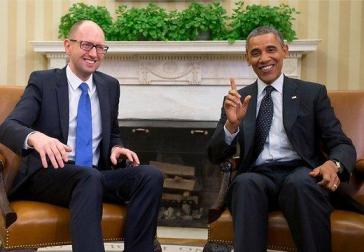
Ukraine’s Cabinet has asked the country’s parliament to consider dropping the country’s non-aligned status and seek membership of NATO.
Prime Minister Arseny Yatsenyuk’s government submitted to the parliament, the Verkhovna Rada, a draft bill that would cancel Ukraine’s non-aligned status and revive the country’s quest to join NATO – a path ditched by ousted President Viktor Yanukovich in 2010.
The move followed a decision by Ukraine’s National Security and Defense Council. It also coincided with an emergency meeting of NATO ambassadors in Brussels to discuss the ongoing crisis in east Ukraine.
If passed, the law would ban Ukraine from joining any political unions which would prevent it from eventually achieving “its key and sole goal” – membership in the European Union, Yatsenyuk said, the government’s press service said in a statement.
Following the adoption of the law, Ukraine will be forbidden from being a member of the Eurasian Customs Union and Eurasian Economic Community, and any other unions “which are in essence nothing but Russia’s Soviet Union,” Yatsenyuk stated.
The premier asked President Petro Poroshenko to classify the draft bill as urgent and called on the parliament to immediately consider it.
Defense Minister Arsen Avakov praised the decision as a “very correct one.”
“If the parliament approves it, the path to NATO will be open,” Avakov said on his Facebook page. “Only madmen would counter such a decision in the current situation.”
NATO said it would respect Kiev’s possible decision to seek membership of the military alliance.
“This is a fundamental principle that each and every nation has an inherent right to decide itself, on its security policies and its alliance affiliations,” the bloc’s chief, Anders Fogh Rasmussen, told the media at an extraordinary meeting of the NATO-Ukraine Commission.
He indicated that the military alliance would be open to discussing Ukraine’s application if it meets the conditions for membership.
“I am not going to interfere with political discussions in Ukraine, but let me remind you of NATO’s decision taken at the Bucharest Summit in 2008 according to which Ukraine will become a member of NATO, provided of course that Ukraine so wishes and provided that Ukraine fulfils the necessary criteria,” he said.
However, the issue was not discussed at Friday’s gathering in Brussels, Rasmussen added.
Washington piles lie upon lie
By Paul Craig Roberts | Press TV | August 29, 2014
The latest Washington lie, this one coming from NATO, is that Russia has invaded Ukraine with 1,000 troops and self-propelled artillery.
How do we know that this is a lie? Is it because we have heard nothing but lies about Russia from NATO, from US ambassador to the UN Samantha Power, from assistant secretary of state Victoria Nuland, from Obama and his entire regime of pathological liars, and from the British, German, and French governments along with the BBC and the entirety of the Western media?
This, of course, is a good reason for knowing that the latest Western propaganda is a lie. Those who are pathological liars don’t suddenly start telling the truth.
But there are even better reasons for understanding that Russia has not invaded Ukraine with 1,000 troops.
One reason is that Putin has invested heavily in diplomacy backed by non-provocative behavior. He would not risk his bet on diplomacy by sending in troops too few in numbers to have a decisive effect on the outcome.
Another reason is that if Putin decides he has no alternative to sending the Russian military to protect the Russian residents in eastern and southern Ukraine, Putin will send in enough troops to do the job quickly as he did in Georgia when the American- and Israeli-trained Georgian army invaded South Ossetia and was destroyed in a few hours by the Russian response. If you hear that 100,000 Russian troops accompanied by air cover have invaded Ukraine, it would be a more believable claim.
A third reason is that the Russian military does not need to send troops into Ukraine in order to stop the bombing and artillery shelling of the Russian populations by Washington’s puppet government in Kiev. The Russian air force can easily and quickly destroy the Ukrainian air force and artillery and, thereby, stop the Ukrainian attack on the secessionist provinces.
It was only two weeks ago that a fabricated report spread by the Guardian and the BBC that a Russian armored convoy entered Ukraine and was destroyed by the Ukrainian military. And two weeks prior to that, we had the hoax of the satellite images allegedly released by the US State Department that the corrupt US ambassador in Kiev spread around the world on social media allegedly showing that Russian forces were firing into Ukraine. One or two weeks from now we will have another lie, and another a week or two after that, and so on.
The cumulative effect of lie piled upon lie for most people is to build the view that the Russians are up to no good. Once this view is established, Western governments can take more serious moves against Russia.
The alleged entry of 1,000 Russian soldiers into Ukraine has been declared by NATO Brigadier General Niko Tak to be a “significant escalation in Russia’s military interference in Ukraine.” The champion liar Samantha Power told the US Security Council that “Russia has to stop lying.” The UK ambassador to the UN said that Russia was guilty of “a clear violation of sovereign Ukrainian territory.” UK prime minister Cameron warned Russia of “further consequences.” German chancellor Merkel announced that there would be more sanctions. A German Security Council advisor declared that “war with Russia is an option.” Polish foreign minister Sikorski called it Russian aggression that required international action. French president Hollande declared Russia’s behavior to be “intolerable.” Ukraine’s security council imposed mandatory conscription.
This suicidal drive toward war with Russia by Europe’s leaders is based entirely on a transparent lie that 1,000 Russian troops crossed into Ukraine.
Of course, the Western media followed in lock-step. The BBC, CNN, and Die Welt are among the most reckless and irresponsible.
The mountain of lies piled up by Western governments and media has obscured the true story. The US government orchestrated the overthrow of the elected government in Ukraine and imposed a US puppet in Kiev. Washington’s puppet government began issuing threats and committing violent acts against the Russian populations in the former Russian territories that Soviet leaders attached to Ukraine. The Russian people in eastern and southern Ukraine resisted the threat brought to them by Washington’s puppet government in Kiev.
Washington continually accuses the Russian government of supporting the people in the territories that have voted their separation from Ukraine. There would be no war, Washington alleges, except for Russian support. But, of course, Washington could easily stop the violence by ordering its puppet government in Kiev to stop the bombing and shelling of the former Russian provinces. If Russia can tell the “separatists” not to fight, Washington can tell Kiev not to fight.
The only possible conclusion from the facts is that Washington is determined to involve Europe in a war with Russia or at least in an armed standoff in order to break up Europe’s political and economic relations with Russia.
Europe’s leaders are going along with this because European countries, except for Charles de Gaulle’s France, have not had independent foreign policies since the end of World War II. They follow Washington’s lead and are well paid for doing so.
The inability of Europe to produce independent leadership dooms Russian President Putin’s diplomacy to failure. If European capitals cannot make decisions independently of Washington, there is no scope for Putin’s diplomacy.
Notice that the very day after Putin met with Washington’s Ukrainian vassal in an effort to resolve the situation, the new lie of Russian invasion was issued in order to ensure that no good can come of the meeting in which Putin invested his time and energy.
Washington’s only interest is in hegemony. Washington has no interest in resolving the situation that Washington itself created in order to bring discomfort and confusion to Russia. With the caveat that the situation could be resolved by Ukrainian economic collapse, otherwise the longer Putin waits to resolve the situation by force, the more difficult the task will be.
Pro-Russians allow trapped Ukrainian troops to escape
Press TV – August 29, 2014
A leader of pro-Russian forces in eastern Ukraine says he has agreed to allow the government forces trapped in the conflict zone to escape through a “humanitarian corridor.”
Alexander Zakharchenko, a leader of pro-Moscow forces, told Rossiya 24 TV channel on Friday that he had agreed to offer a “humanitarian corridor” for the encircled Ukrainian troops to leave the battlefield in the restive eastern parts.
However, Zakharchenko added that Kiev’s forces should abandon their armored vehicles and ammunition before leaving.
His comments come after a statement by Russian President Vladimir Putin calling on the pro-Moscow protesters to allow Ukrainian soldiers to flee the coastal town of Novoazovsk captured by pro-Russians on Wednesday.
“I call on the rebel forces to open a humanitarian corridor for the Ukrainian troops who are surrounded, so as to avoid unnecessary casualties and to give them the opportunity to withdraw from the zone of operations,” Putin said on Thursday.
The collapse of Novoazovsk is seen as a major victory for pro-Moscow fighters in eastern Ukraine. The key resort town on the Azov Sea lies along the road linking Russia to Ukraine’s port city of Mariupol and onto Crimea, which rejoined Russia in a popular referendum in March.
After weeks of military operations that have seen government forces push deep into the last bastions of pro-Russians, the tide appears to be turning once again in the four-month conflict.
Kiev has called on the North Atlantic Treaty Organization (NATO) for help.
Ukraine’s mainly Russian-speaking regions in the east have witnessed deadly clashes between pro-Moscow forces and the Ukrainian army since Kiev launched military operations to silence pro-Russians in mid-April.
The turmoil in eastern Ukraine has so far taken the lives of more than 2,000 people, according to the UN.
Russian gas sector should not be sanctioned – EU energy chief
RT | August 28, 2014
Russian gas sector should not be subjected to EU sanctions despite the situation in Ukraine, EU Energy Commissioner Gunther Oettinger said Thursday.
“Gas is not a suitable sector for sanctions, as in this case everyone will lose – Russia, Ukraine and the European Union,” RIA Novosti cites Oettinger as saying.
EU Energy Commissioner insisted on a quick resolution of the gas dispute between Russia and Ukraine.
“We need a solution that prevents an escalation between Ukraine and Russia,” he told German broadcaster ARD. “We need Ukraine as a transit country. Ukraine needs gas in winter. In a long and cold winter, Ukraine will not have enough stored gas of its own.”
He also acknowledged that in case Ukraine is left without gas supplies in winter it may steal Russian transit gas on its way to the West.
According to Oettinger by the end of October the European Union should develop a concept that provides each bloc member with warm homes, financing of infrastructure and maintenance of industry for the period from November to March.
On Friday, Oettinger is expected to meet with Russian Energy Minister Aleksander Novak to discuss future Russian gas deliveries to Europe.
The agenda includes talks about safe transit of Russian gas to Europe via Ukraine, legal and technical aspects of the South Stream project, Gazprom’s access to the full capacity of the OPAL pipeline and issues related to the continuation of the Russia-EU Energy Dialogue, the Russian Energy Ministry said in a statement Monday.
Featured Video
No Vote, No Representation, No State: Democracy, Israeli Style
or go to
Aletho News Archives – Video-Images
From the Archives
Sanctions, War and the Policy of Dual Containment
By SASAN FAYAZMANESH | March 17, 2008
It is now nearly three decades since the Unites States adopted the policy of dual containment of Iran and Iraq. While much has been written about the containment of Iraq, there has been very little in-depth analysis of this policy when it comes to Iran. In a book that is going to be released on March 31, 2008, entitled The United States and Iran: Sanctions, Wars and the Policy of Dual Containment (Routledge), I attempt to address this shortcoming by investigating when and why the US policy of containment of Iran came about, how it evolved, and where it stands today.[1] To the extent that Israel has been involved in US policy making, the study will also include the role that Israel has played in the containment of Iran. Also, since the fate of Iran has been inextricably linked to that of Iraq, occasionally the investigation will overlap with the containment of Iraq.
The policy of dual containment of Iran and Iraq originated during the Carter Administration, but it was not until the Clinton Administration that the expression “dual containment” became popular. … continue
Blog Roll
 Aletho News
- No Vote, No Representation, No State: Democracy, Israeli Style
- Zionist Bought Senate Blocks Information About American Citizens Killed By Israel
- While Gaza dominates the UN, these are the people keeping it alive
- New Report: “Scholasticide and Genocide in Gaza: Assessment, Testimonies and Legal Analysis”
- ‘THAAD Delusion’: Iran war exposes US missile shield limits – The Atlantic
- Moscow issues warning to NATO over Russian exclave
- Yes, the Iran war has destroyed Trump’s presidency
- The fallacy of US delusions about Iran’s economic collapse
- Hezbollah denies Syria cell link, warns of Israeli plan to sow discord
- The legacy of US sanctions, war, and occupation in Iraq
- If Americans Knew
- Mamdani releases plan to combat antisemitism and hate crimes in New York City
- Iran’s Revolutionary Guards Publish Letter to the American People
- DMFI launches $1 million ad campaign supporting Virginia’s Elaine Luria
- US Senate blocks resolution seeking report on Americans killed by Israel
- Israeli Attacks Kill Ten Palestinians in Gaza
- Massacre at Minab: The School That Became a Grave
- Israeli media: The IDF Shows It Doesn’t Turn a Blind Eye; It Actively Emboldens Settler Havoc
- As settlers ravage West Bank, Israeli forces kill 10 in Gaza – Daily Update
- New Report: “Scholasticide and Genocide in Gaza: Assessment, Testimonies and Legal Analysis”
- Ex-Biden officials are desperate for a Gaza scapegoat
- No Tricks Zone
- Green Energy Debacle: German Expert Professor Fritz Vahrenholt Warns Of Severe Economic And Social Consequences
- Two More Paleo Reconstructions Affirm Meters-Higher Sea Levels Across Ireland, Brazil 7000-6000 Years Ago
- New Study: Earth And Venus Surface Warmth Largely Explained By Convection And Lapse Rate, Not CO2 Or Radiation
- 2025 Nature Paper Claiming Worsening Global Drought Gets RETRACTED …Heavily Flawed
- New Study: ‘Global Drought Shows No Detectable Recent Acceleration Under Climate Warming’
- Economic Masterminds: German Socialists Suggest Taxing Productivity Gains Stemming From Using AI
- The South China Sea Has Not Been Cooperating With The Climate Change Narrative
- Energy Crisis: Germany Enters Heating Season With Historically Low Gas Reserve Fill Levels
- New Study: The Antarctic Ice Sheet Gained Mass From 2020-2024 Due To Staggering Snow And Ice Accumulation
- Study: Ocean Heating Rates From Thousands Of Years Ago ‘Dwarf’ Modern Ocean Heating Rates

