Who was Maidan snipers’ mastermind?

Andriy Parubiy
By Adam Larson | Oriental Review | May 29, 2014
The probe into the Maidan “snipers problem” – by the new Ukrainian government underwritten by it – continues. On May 13, the fascinating interim findings were partly revealed, at a press conference called by parliamentary investigation head Gennady Moskal. Bullet forensics exonerated the previously blamed Berkut security force. Something in the findings also placed the unidentified shooters somewhere – unspecified – among “the ranks of the protesters.” It could even have been the EuroMaidan militants, he admitted, but MP Moskal thought infiltrators from the government’s security service SBU made more sense.
He predicted decades of debate with no resolution, and a week later he announced that a number of key documents were destroyed, complicating the search. But whatever led the investigators to this apparently dead-end admission, it seemed like a break in the script that put the snipers in areas secured by the government of then-president Viktor Yanukovych. For those following the details, the May 13 revelation seemed like a bit of realism creeping in.
But then the current Secretary of the National Security and Defense Council – Andriy Parubiy – stepped forward, hinting at a divergent probe delving further into fantasy. His investigation blames Russia and Vladimir Putin for the snipers, even though it was Parubiy – not Putin – who was supposed to secure the “EuroMaidan” where, the evidence increasingly says, the problem snipers operated.
Sniper Commandant?
While he insists he’s not a fascist, Andriy Parubiy co-founded the Nazi-inspired Social National party, now Svoboda, in the 1990s. Outwardly, he went mainstream early on, and joined Yulia Tymoshenko’s Fatherland party, running security operations on the Maidan for the 2004 “Orange Revolution.”
In 2013-14’s more violent regime-change “protests,” he was given the same responsibility. As Euromaidan Commandant and head of the Self-Defense Committee, he was in charge of security for areas where the mob’s authority had overridden the government’s.
We now know (partly from MP Moskal) that – on the pivotal day of February 20, which will remain the main focus of this report – sniper shots first hit police forces, and came from buildings Parubiy controlled. Ukraine’s previous head of the Security Service (SBU) Alexander Yakimenko said so in March, after fleeing to Russia. When the Commandant proved unable to stop the sniping, which everyone claimed to be against, Yakimenko says he offered to send in a unit to help. He only needed a guarantee his men wouldn’t be shot by Parubiy’s, but he says that was denied. From all this, the SBU chief deduced the snipers were under Parubiy’s command and protection.
In truth, this failure to stop the killing could be due to malice, or incompetence, or some mix. Whatever the case, the resulting bloodshed was all but necessary for the Kiev Cabal to finally take over. And considering his eminent competence, they made Parubiy security chief for all of Ukraine as soon as they could.
Sniper Investigator?
Reports from early March, before the Yakimenko accusations, spoke of a parliamentary investigation Parubiy himself was selected to lead. The apparent conflict of interest may, or may not, be why MP Moskal now seems to be in charge of that.
But in a May 21 interview for Euractiv, Parubiy speaks of a probe that sounds different, a probe blaming Russian Special forces – Spetsnaz – for penetrating his security cordon. Asked about the snipers, with the note “you must have first-hand information,” he sidestepped his own direct knowledge and told Euractiv:
“Now that we are conducting investigations, we have found that 18 Spetsnaz, including snipers, were in Maidan. The investigation will reveal from which points they were shooting, but I can already say that they did everything they could to spill blood and provoke civil unrest.”
…
“We have a working hypothesis which would be confirmed or rejected by the investigation, that in the most difficult days they shot equally – at Berkut and at the Maidan activists. Their aim was to instigate a more violent civic unrest … that Russia could warm its hands at this fire.”
…
“We know that Russian snipers shot at both sides.”
As Washington’s Blog noted in March, “everyone agrees that the snipers were false flag terrorists sowing chaos and confusion. … they only disagree about who the responsible party is.” This is another example, and (as we’ll see) the worst theory yet. And just look at who is trying to feed it to us.
Master Thug
From February 18-20, security forces and civilians were, as Parubiy says, killed somewhat “equally” by these snipers to create “violent civic unrest.” But there was a telling pattern to how different parts of that were timed.
First, consider how ten unarmed policemen were shot dead the night of February 18th, forcing a decision to bring in armed security forces. That allowed later killings to be realistically blamed on them, as happened. (Were these the same provocateurs present a day and a half later, or a different shift?)
By the 20th, a force was assembled on the Maidan adequate to stomp the police out by noon and shoot the Berkut out of their nearest posts by 12:45. They even blocked the train bringing in the Army support, and readied to march up to the central government’s buildings and stomp whomever they wished. This force was under Parubiy’s leadership no later than his announcement early on the 21st that “all the leaders of the hundreds are declaring their consent to coordinated action, including the hundreds of the Right Sector … We’re in control of Kiev. We have seized control of the government quarter.”
It was only at that shift in power that the Parubiy “Spetsnaz snipers” unleashed their main killing spree. On video and within bare minutes, they picked off at least 30 unarmed civilians sent in behind the Hotel Ukraine, to top off “Heaven’s Hundred.” That is, this un-ambiguous, unforgivable “Yanukovych crime” was delivered as soon as the natural punishment for it had been placed.
Commandant Parubiy, who oversaw the distribution and timing of much of that violence, couldn’t deny its pattern helped them, as he said to Euractiv, “oust Yanukovich.” That prompted the question:
Q: So you recognize that you ousted Yanukovich?
A: Yes. He ran away.
Q: But he ran away because he was afraid for his life?
A: Yes of course. After so many deaths and such national tension, he understood that if he didn’t run away, the personal consequences could be very bad.
Under this plausible threat, the president fled. An 1:36 pm announcement from the Maidan ordered members of Parliament to meet at 3:00 to vote him out for good. They were given “a guarantee that the Parliament would not be stormed during the session.” The “hundreds” just snatched that option, but promised not to use it – unless maybe they were provoked by a wrong vote. In the end most of Parliament was willing to show up on the 22nd instead, and those agreed unanimously to impeach Yanukovych – and not be stomped. After all, Parubiy’s Maidan machine still controlled Kiev.
Confirming Yakimenko’s Charges
When he spoke on May 13, investigation head Gennady Moskal did not specify any sniper perches, just implied that they were behind the lines Parubiy was in charge of. By noon on the 20th, this had expanded to include at least the Maidan at large, the Trade Unions Hall (Maidan HQ), the Conservatory, and Hotel Ukraine. The October Palace and unknown other buildings fell into his hands just after noon.
 Former SBU chief Yakimenko said in March the first shots “came from the Philharmonic Hall,” probably meaning the (musical) Conservatory. After that, “many have witnessed 20 people leaving the building” with their sniper gear in bags. These “split into two groups – 10 men each.” One of these “took a position at the Ukraine hotel,” right next-door, and “the Security Service lost track” of the other sniper team.
Parubiy must know by now where the snipers were, but he doesn’t want to tell us yet. The probe “will reveal from which points they were shooting,” he promises.
Yakimenko said “no weapons could be brought to Maidan without Parubiy’s permission. Hand guns, rifles, scopes – he had to agree to all of that.”
In one report, Parubiy gave a rough count of those armed with handguns – about 100. But he said “those people are not ours, they are unorganized,” just like the snipers. “This is kind of a problem.” This when he also said “we created a headquarters in the Maidan and we will not tolerate any action without coordinating with it.”
As mentioned above, Yakimenko says he offered to help Parubiy flush out the gunmen, but was rebuffed. If true, that suggests either a criminal denial of his incompetence, or the commandant’s active approval of the killing.
The SBU chief has a 20-man sniper team in Parubiy’s turf. The man who would know might refer to the same group when he speaks of “18 Spetsnaz, including snipers.” Maybe 20 was a visual estimate, and the “Russians” split up into groups of nine?
One might expect Parubiy to be embarrassed that his own secured buildings were so infiltrated, but he puts the villains “in Maidan.” The original claims of February had the snipers in or on government-held buildings further southeast. Why can’t he just say that now? Why openly claim such a humiliating security breach unless the alternative is even worse?
Parubiy even claims he failed to stop the snipers on the way back out. After sneaking in and unleashing this mayhem, they walked away from the Maidan undetected, and “I think they escaped from Ukraine,” he told Euractiv.
But it was reported at the time that two snipers were caught by his teams, one at least in the Hotel Ukraine. At mid-day on the 20th, an official tweet said, “members of Maidan Self-Defense captured one of the snipers. He is currently in Maidan headquarters.” But a different “Maidan commandant” – Stepan Kubiv – said he was just there and didn’t hear any such thing. A message of the 21st said a “sniper was caught on the 10th floor of the Hotel Ukraina … Personality to be identified,” but it never was. A later one heard that “maidan activists caught two snipers” total, but the source said nothing about their fate or identities.
If they were caught red-handed, why doesn’t Parubiy mention these snipers now? Did they even exist, outside these vague reports? Were they real, but managed to escape? Or did Parubiy order them released? The balance of reasons suggests the killers were under his command and protection, as Yakimenko said, and as the evidence always suggested.
Clearly Commandant Parubiy, of the February “Failures,” is not the best one to be speaking about the Maidan snipers. Expect the May interview to be his last word on that bloodshed.
Postscript: “Ensuring Peace and Safety”
In more promising areas, Andriy Parubiy remains the go-to guy. As the head of Ukraine’s National Security and Defense Council, he’s now tasked with the brutal and confusing “anti–terrorist” operation in eastern Ukraine, and apparently in Odessa. This he wages with a “National Guard” that grew out of his murky Maidan machine, against those Ukrainians who dare to vote against the Kiev Cabal, pushing Ukraine deeper into civil war territory with violence he always blames on “Russian terrorists.”
Helping overturn two popular votes for Yanukovych, ensuring a third overthrow will never be needed, plus his new “security” work, has earned Parubiy friends in the “Democratic” West. He spoke to Euractiv while in Brussels, he said, “to participate in a session of the Ukraine-NATO working group” regarding the Russian “hybrid war” against Ukraine. As he explained it:
“When we speak about fighting terrorists, the best way is to find their centre of coordination, of financing. In this case, this centre is one person, it is Putin. That’s why I say – we have no crisis in Slavyansk, in Donetsk, in Luhansk. We have a crisis in Putin’s head. … if Putin succeeds in Ukraine, nobody can tell where his tanks will be tomorrow. … To stop Putin is not only Ukraine’s major goal. It should be the goal of the entire civilized world.”
In Parubiy’s dangerously unhinged thinking, even the massacre at the Trade Unions building in Odessa on May 2 “was a classic provocation in which pro-Russian groups had to seize the administration buildings in the same way it happened in Donetsk and Luhansk.” But this time, the anti-Putsch activists were clearly chased in, and followed in, by an ultra-nationalist lynch mob. He also contradicts himself by claiming the building was already “a kind of headquarters for the separatists,” where “the substance that provoked the blaze” was brought in by them “a long time ago.”
That’s why, he says, “when Molotov cocktails were thrown from the fourth floor at the participants of the Ukrainian rally, the substance inflamed” and an “explosion happened.”
Of course, on-site video and photos prove this was terrorism, and it seems the mob torched the building largely to hide their brutal murder of perhaps 272 citizens. That Parubiy was there to help coordinate it, after attending a top-level April 24 meeting to plan the Odessa “counter-terrorist” operation, makes it seem like state-sponsored terrorism. A former deputy head of the Odessa police, now fled to Donetsk, blames Parubiy for personally organizing the massacre. He was seen there on April 29th, delivering bulletproof vests to one Mykola Volkov – a criminal deputized as a “sotnik” (the term used for commanders of “hundreds” on the Maidan). Volkov was later seen shooting a pistol at the Trade Unions building, wearing a bulletproof vest, and phoning in a false story – possibly to Parubiy himself.
With Ukrainians all united but Moscow’s agents everywhere, the “security” chief told Euractiv, they needed an “overhaul” of “the entire security and defense sector,” and maybe civil society too, including “criminal groups” and “ethnic groups.”
The NATO allies had just heard the same and understood, promising “extensive support to the Ukrainian delegation” – including this false-flagging fascist thug – considering their “crucial role in ensuring peace and safety in Europe and the world.” Further, they “expressed readiness” to help in “reform” of the Parubiy’s defense and security sectors.
Events in Odessa, Maruipol, and elsewhere might have convinced the Cabal’s double-speaking Western allies that civil society “overhauls” are best left to Parubiy and his “Ukrainian rally” types.
Shells hit school, kindergarten in Slavyansk amid Ukraine military op
RT | May 28, 2014
A school and a kindergarten have been shelled in Slavyansk as the city becomes increasingly unsafe in the intensified Kiev military campaign. At least 9 civilians were injured in Wednesday’s shelling incidents, including a child.
Ukrainian mortar shells have for weeks been raining down on the checkpoints and positions of the Slavyansk self-defense, but much of the shelling occurred outside the city. Italian journalist Andrea Rocchelli and his Russian interpreter, veteran human rights activist Andrey Mironov, were almost “torn to pieces” in one such shelling.
However, this week the battleground apparently moved right into civilian quarters of Slavyansk, as shells started hitting residential blocks and nearby buildings, killing three people on Monday.
On Wednesday, there was a shocking reminder of how the situation might unfold if the new president-elect Petro Poroshenko pushes on with the military operation in the region, as shells struck the city’s streets, yards, a school and a kindergarten.
RT talked to a male schoolteacher from Slavyansk school number 13, who asked not to be named.
“Around midday there was a loud explosion in the school, and I fell to the floor, taking cover,” the teacher told RT over the phone.
The man said that he rushed to the corridor to assemble all the teachers and children in the school and take them to a safe place. Clouds of dust were billowing on one side of the building.
According to the teacher, it turned out that the shell exploded right above the school hall, where children are usually gathered for festive events, and part of the roof “was simply blown away.”
Luckily, no children were in the hall at the time. All the pupils and teachers were quickly evacuated to the basement.
It was not immediately clear, if there were any casualties in the kindergarten or other places shelled in Slavyansk, but the Rossiya-24 channel reported that 9 people were injured in total, including a 4-year-old boy. The channel’s crew narrowly escaped a direct hit by a mortar shell, as it fell “literally next to our car.”
Photos of the sites of Wednesday’s mortar attacks emerged on social media, showing partially destroyed buildings, craters in the roads, and what appeared to be blood.
The Kiev forces quickly laid the blame on self-defense units, which they refer to as “terrorists.”
“Currently, we are confirming the information on the terrorists’ shelling of the residential quarters and the territory of the school in Slavyansk,” the commander of Kiev’s military operation in southeastern Ukraine, Vladislav Seleznyov, wrote on his Facebook page.
Meanwhile, several funerals of those killed in Monday’s shelling were held in Slavyansk on Wednesday. According to the latest reports, four people have died from shrapnel wounds since then.
The shelling damaged a block of flats and a dormitory in the city’s teachers’ college, shattering glass in the windows of the college. Power lines and, reportedly, a city water pipeline were damaged and disrupted by the blasts.
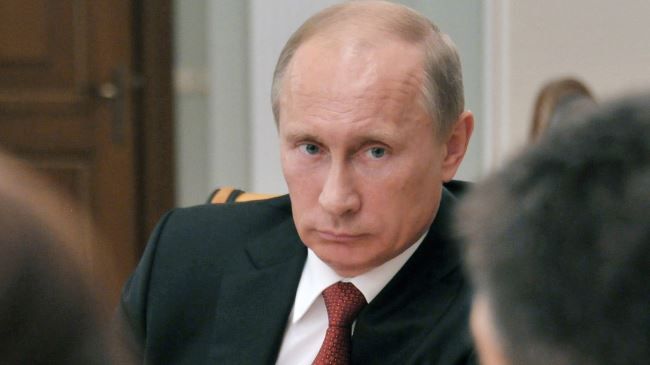
Putin to Kiev: End violence against people
Press TV – May 27, 2014
Russia has called on Ukraine to put an end to violence against people after dozens of civilians were killed in clashes in the main airport of the self-proclaimed Republic of Donetsk.
Russian President Vladimir Putin on Tuesday called for an immediate end to military operations in eastern Ukraine, accusing Kiev of carrying out “punitive” operations against the citizens.
Putin “underlined the need for an immediate end to the military’s punitive operation in southeastern regions and the establishment of peaceful dialogue between Kiev and regional representatives,” the Kremlin said in a statement.
This is while Kiev said it has regained control of the main airport in Donetsk.
Ukraine Interior Minister Arsen Avakov said the airport is now under full government control following a day of fierce clashes.
Meanwhile, Donetsk Mayor Oleksandr Lukyanchenko said 40 people, including two civilians, have been killed in the airport clashes.
On Monday, pro-Russia protesters moved to seize the airport.
The Ukrainian army used combat jets and helicopter gunships to repel the move.
The government in Kiev has been staging military operations since mid-April in the eastern and southern regions in a bid to root out pro-Moscow demonstrations.
Ukraine’s President-elect Petro Poroshenko pledged on Monday to put an end to the war and bring peace to the former Soviet state. The 48-year-old chocolate tycoon has also ruled out negotiations with pro-Russian activists, vowing to continue military operations in the country’s southeastern provinces.
The business behind Ukraine’s new billionaire president
RT | May 26, 2014
One of Ukraine’s richest men, newly elected President Pyotr Poroshenko, has a long history of mixing business with politics. The tycoon has vowed to give up his business interests, and campaigned to align closer to Europe.
In 1991, the Odessa native took over an old state-run sweet factory shortly after the Soviet Union collapsed, and now the ‘Roshen’ candy company has made the 48-year old one of the country’s richest men, with his fortune estimated at $1.3 billion by Forbes.
He will be in charge of reviving Ukraine’s moribund economy, which has been in free-fall for the better part of a year. Poroshenko will have to juggle huge debts, a nearly empty treasury, and a sinking investment climate.
Primarily Poroshenko will be tasked with helping Ukraine manage its $17 billion International Monetary Fund aid program, which will likely include unpopular austerity measures like gas subsidy cuts. Ukraine has been promised over $27 billion in economic aid from various sources, including the European Commission, World Bank, and the United States government.
The chocolate tycoon has expressed his willingness to mend ties with Russia, even after it imposed a ban on the sale of his chocolate, as well as shut down one of his warehouses in southern Russia on criminal charges.
However, Poroshenko has vowed to unite the unruly east, which has deep business and cultural ties to Russia. His company, Rosen, though it wants to focus on the European market, is deeply rooted in the east. Rosen operates confectionery factories in Kiev, Vinnytsia, Mariupol, and Kremenchuk, the Bershadmoloko dairy producer, a stud farm in Ukraine and confectionary facilities in Klaipeda, Lithuania and Lipetsk, Russia
“I assure you, as soon as we’ll achieve stability in the east and these problems in Ukraine will be solved, the investment boom will immediately begin,” Poroshenko declared at a press conference in Zaporozhye on May 18.
Poroshenko has worked across the political spectrum. Originally, he served in pro-Russian governments, and then he played a big role in the 2004-2005 ‘Orange Revolution’ along with Yulia Tymoshenko, which ended up bringing Viktor Yushchenko to the presidency. Later, in 2012, he served as an economics minister to Viktor Yanukovich, but when Yanukovich was ousted, he sided with the Maidan.
The expert’s opinion “Petro Poroshenko is a bright representative of the Ukrainian oligarchy. He was actively participating in the financing of Maidan and he has a certain support abroad,” Andrey Pilko, the director of the Eurasian communication center told RT by phone.
Poroshenko’s program is aimed “to provide Ukrainian production access to the world markets. To sign the economic part of the free trade agreement with EU, and to implement its provisions in a short time…The agrarian side may become a breakout point for the Ukrainian economy”.
Poroshenko described relations with Russia as “the most difficult”.
“I don’t remember such a crisis between our countries for the last 200 years. Nevertheless, the negotiations are progressing it is the Geneva format. I think that today we can conduct negotiations with Russia involving the US, EU and in other formats,” the billionaire said.
He also promised to sell-off his business if he won the presidency.
“I would like to put an example to others when the elected president publicly sells business assets belonging to him in order to achieve a complete concentration on state service,” Poroshenko said.
However, he remarked that he does not see any problems when a successful businessman begins making policy, “when he is the person who has experience in the real economy, who has created jobs. Who is the largest taxpayer and is able to build factories and plants and applies the experience to lift the economy and the country”.
‘Ukraine must pay gas debts’ – EU Energy Commissioner
RT | May 26, 2014
EU Energy Commissioner Guenther Oettinger said Ukraine needs to begin repaying its $3.5 billion gas debt to Russia and proposed a fair ‘market price’ of between $200-$400 per 1,000 cubic meters to resolve the dispute.
“The bills are on the table, and they must be paid,” Oettinger said on German radio station SWR on Monday after holding talks in Berlin with Russian Energy Minister Alexander Novak and Gazprom Deputy CEO Aleksandr Medvedev.
Oettinger suggests Ukraine use some of the $3.2 billion from its first IMF aid tranche and other EU assistance programs to start paying off its debt to Gazprom.
Ukraine owes Russian state-owned Gazprom more than $3.5 billion, as it has not paid its gas bills in full since July 2013. Russia has even given Ukraine 10 billion cubic meters of gas free of charge, as much as Russia delivers to Poland in a year.
President Vladimir Putin said that Russia is only ready to discuss a new gas discount for Ukraine once it starts paying off its debt.
Oettinger said that a “fair and suitable market price” to resolve the dispute would be between $200-$400, which the commissioner considers “common for the European market.”
Kiev has said it is ready to pay Russia as long as Gazprom lowers its current rate of $485 per 1,0000 cubic meters. The price climbed when Gazprom canceled two gas discounts from the $268.50 per 1,000 cubic meters rate it paid in the first three months of 2014.
After June 1, Ukraine will have to prepay for any gas deliveries, as Gazprom said it won’t let any more debt accumulate.
“There are some barriers to indulgence, some things we cannot afford,” Russian President Vladimir Putin said speaking at the 18th annual St. Petersburg Economic Forum on Saturday.
Europe sources about one third of its total energy supply from Russia, 50 percent of which flows through Ukraine. Any possible disruption therefore not only affects the pipeline host country, but all of Europe.
“We all know who is to blame – the transit country, Ukraine has abused its position. Ukraine insists on benefits it is not entitled to,” Putin said at the forum on Saturday.
Oettinger has been a major player in brokering a deal between the two embittered nations, but so far no concrete negotiation has been reached.
Three foreign journalists caught in violence near Slavyansk, two possibly dead – reports
RT | May 24, 2014
An Italian reporter and his interpreter may have been shot dead and a French photographer has been wounded near the city of Slavyansk, in eastern Ukraine, as their car came under fire, Russian media report.
The injured French journalist identified as William Roguelon has been taken to a local hospital where he received treatment and managed to leave the facility on his own.
Roguelon, from the hospital reached Agence France Presse (AFP) and described how out of nowhere their vehicle was bombarded with mortar shells.
“Before that we heard Kalashnikov shots,” Roguelon was quoted by the Italian tgcom24. “Then the mortar shells rained down all around,” he said claiming to have heard up 60 explosions as they tried to hide in the “middle of a ditch.”
The man, who works as a freelance photographer, has told Russian media that after the shooting he saw his Italian colleagues lying on the ground not moving, Rossiya 24 channel reported.
“In the village of Andreyevka, not far from Slavyansk, an Italian journalist and his interpreter have been shot dead and a French correspondent wounded. Their car came under fire,” a source from the self-defense forces has told RIA Novosti.
The area around the city of Slavyansk has been gripped by violence on Saturday, a day before the scheduled presidential election. Shooting was reported in the village of Semyonovka, where a psychiatric hospital has been partly ruined in a fight between Kiev troops and self-defense forces. Witnesses said a shell hit the roof of the hospital.
According to reports, shooting, artillery and machine-gun fire have been heard in the outskirts of Semyonovka starting Friday night.
Shell-holes can be seen in the ground all around the village. Smoke was reportedly seen billowing from at least three locations in Slavyansk on Saturday.
Update May 25th:
Fascism or the Bankruptcy of the Left?
The anti-EU movement spreads all over Europe… apart from Ukraine*
By TAKIS FOTOPOULOS | The International Journal of INCLUSIVE DEMOCRACY, Vol. 9, Nos. 1/2 (2013)
The events in Ukraine have been instructive, even though the mass media of the Transnational Elite (TE) have created the false impression that there has been a popular “revolution” there by cretins fighting for their right to become the TE’s slaves within the EU, so that they may starve like the Greek people! But I will not dwell here on the orange “revolution” that has just been staged in this country by the pro-western bourgeoisie and petty bourgeoisie of Kiev, with the decisive assistance of the provocateurs of the TE’s intelligence services who organized it[1], but rather on the two main lessons to be learned from it, which are especially important for all European peoples and, in particular, for the Greek people.
Firstly, social struggle in the era of neoliberal globalization can no longer be just a struggle for social liberation, as obsolete Marxists still believe today and some Trotskyites have always believed even during the Nazi occupation when they called upon German workers in the Nazi army to fraternize with occupied workers, while some “Marxists” and “anarchists” today still call for similar fraternization between the Zionist occupiers in Israel and the occupied Palestinians! The struggle for social liberation today must, first and foremost, be a struggle for national liberation. This becomes obvious when one considers the fact that, when a country (not belonging to the TE, i.e. mainly the “G7”) is incorporated into neoliberal globalization, it loses every trace of economic and, consequently, national sovereignty. This is why the struggle for social liberation today is inconceivable unless it has already gone through national liberation. The occupying troops that are now destroying and plundering Greece (or Portugal, Spain and Italy) and its weakest social strata (with the full cooperation of a small, local privileged elite which controls the media, the political parties, the “Left” intelligentsia etc.) are not a regular army in uniform and with lethal weapons of physical violence at their disposal, but an economic army in suits, possessing equally lethal instruments of economic violence, as well as the means to justify it.
Secondly, the target of social struggle today can only be neoliberal globalization, which is managed by a TE ensuring that only its own bogus revolutions succeed (the orange “revolutions” in Eastern Europe in the past[2] and today, or the pseudo-uprisings in Libya,[3] Syria, etc.) while even the attempted uprisings of the TE’s victims in Greece and elsewhere are suppressed in the most brutal way as soon as they occur – and yet Baroness Ashton finds nothing wrong with this, nor does she detect any violation of human rights occurring. Similarly, the peoples who resist being integrated into neoliberal globalization are condemned to remorseless slaughter, as the Libyan and Syrian people have been. Nevertheless, the impudent Barroso did not hesitate to declare that human rights had been violated in Ukraine when the police dared to beat “protesters” who attacked government buildings with bulldozers, “forgetting” that such conduct in any other “democratic” EU country would have sent many to the morgue!
In other words, contrary to the misleading propaganda of the degenerate “Left”, globalization is not a chimera, or just a continuation of the internationalization of the market economy taking place at the beginning of the last century, but, rather, a systemic phenomenon which can only be neoliberal within the capitalist system, as can easily be shown. Similarly, neoliberalism is neither a doctrine (of “shock” and similar fairy tales)[4] nor the bad policy making of certain “bad” neoliberal politicians and economists. It is simply the ideology of globalization. Neoliberal globalization is, in other words, the necessary institutional framework that ensures the opening and liberalization of the markets (capital, goods and labor), which is required for the effective operation of the transnational corporations that currently control the globalized economy.
On the basis of this analytical framework it is not surprising that an unprecedented mass movement “from below” is currently spreading throughout Europe, challenging the EU directly but also neoliberal globalization indirectly. This movement is essentially comprised of the victims of globalization who are driven to mass unemployment and poverty, as well as to homelessness, starvation or even suicide. These popular strata sooner or later become aware of the fraud of the degenerate “Left”, which consciously misleads them by claiming that the current disaster could be overcome even within the EU, despite the loss of economic and national sovereignty. Then, these strata inevitably turn to nationalist movements of all kinds, since these are the only ones that raise the anti-EU flag: from patriotic to neo-Nazi movements – depending on the local conditions. But this nationalism, which both the Transnational and Zionist elites condemn with such disgust (at the very moment when the strongest nationalist state today is the Zionist one!), has little to do with the prewar aggressive nationalism that led to two World Wars. It is a new kind of nationalism which is fundamentally defensive and does not aim to conquer new “vital space” etc. like the pre-WWII nationalism. Above all, it aims to “protect” national sovereignty (national culture, domestic labor, etc.) that is under threat from the opening and liberalization of the markets imposed by globalization.
The main reason that these popular strata have been turning to nationalist movements is, therefore, not that they have suddenly become fascist (as the TE claims in an attempt to defame them); it is the bankruptcy of the degenerate “Left” which, rather than raising the anti-EU flag in place of the nationalists to promote a struggle for social and national liberation, is engaged in “antifascist” struggles together with privileged “leftists”. It is not surprising, then, that this “Left” implicitly consents to the passing of “anti-fascist” legislation, as required by the Transnational and Zionist elites, so that it may effectively ban such movements that threaten its hegemony. In Greece, for instance, a so-called “anti-racist” bill is now being passed through Parliament, which effectively bans freedom of thought (not action!). This bill means, for example, that if somebody supported the national liberation struggle of the Syrian Baathist leadership against the TE and the criminals, pretending to be rebels, who have destroyed this country, s/he might end up in jail for supporting war crimes against humanity. This is based on a very recent utterly biased report by the well known instrument of the TE, the UN Human Rights Commission, which asserted that as Navi Pillay, the UN’s human rights chief, said there is “massive evidence … [of] very serious crimes, war crimes, crimes against humanity” and that “the evidence indicates responsibility at the highest level of government, including the head of state”.[5] Of course, neither this committee nor Navi Pillay who once said that “the Commissioner is the voice of the victim everywhere,”[6] nor its blood brothers among the NGOs for human rights (Amnesty International, Human Right Watch, etc.) have ever dreamed of declaring the arch-criminals Bush, Blair et al. to be guilty of war crimes, even though they are responsible for the deaths of millions of people. Presumably, the millions of people killed or maimed by war criminals like them are not victims, according to Mrs Pillay’s definition of a victim!
However, the Greek “Left”, i.e. the SYRIZA party, instead of mobilizing the people against this unashamedly fascist law, has quietly consented to it by merely abstaining from voting (only the Greek Communist Party and the ultra-nationalist Golden Dawn party voted against it). It should be noted that SYRIZA, together with its leader, Alexis Tsipras – who has been heavily promoted by the media of the TE – is destined by the same elites to succeed the present parliamentary junta in implementing the same policies but under a “Left” cover. Yet the sordid professional politicians who voted in favor of this openly fascist law dare to speak of democracy and the fight against fascism. This blatant bankruptcy of the “Left” is yet another major reason why a mass popular Front is needed in Greece and in all other countries which have fallen victim to the TE that administers neoliberal globalization, as I stressed in my last article.[7]
* This is an expanded edited version of an article by Takis Fotopoulos under the same title published in the Athens daily Eleftherotypia (8/12/213).
[1] See e.g. Stephen Lendman, “Ukraine: Orange Revolution 2.0?,” Global Research (6/12/2013).
[2] Takis Fotopoulos, “The Ukrainian Crisis and the Transnational Elite,” The International Journal of INCLUSIVE DEMOCRACY, vol.1, no.4 (July 2005).
[3] Takis Fotopoulos, “The Pseudo-Revolution in Libya and the Degenerate Left,” Part I & Part II, The International Journal of INCLUSIVE DEMOCRACY, Vol. 7, No. 1 (Winter-Spring 2011).
[4] See e.g. Naomi Klein, The Shock Doctrine (Penguin, 2007).
[5] Ian Black, “Assad implicated in Syrian war crimes, says UN,” The Guardian (3/12/2013).
[6] Jonah Fisher, “Profile: New UN human rights chief,” BBC News (28/7/2008).
[7] Takis Fotopoulos, “Globalization and the End of the Left-Right Divide” (Part I), The International Journal of INCLUSIVE DEMOCRACY, Vol. 8, Nos. 3/4 (Fall 2012-Winter 2013).
The Chinese-Russian ‘Power of Siberia’ … thanks to EU, US foot-in-mouth
By Dmitry Babich | The BRICS Post | May 22, 2014
The Russian press is rarely unanimous in its opinions, but there are two points in today’s coverage of the Russia-China gas deal where all the experts agree.
First, it is not yet clear whether the new deal is a boon for Russia.
But it is certainly a huge failure for the US and the European Union, who lose out on Eastern Siberia’s gas.
Second, in light of the sharp deterioration of Russia’s relations with the West because of the mishandled Western-supported “revolution” in Ukraine, the deal with China now becomes a strategic necessity for Moscow.
The West’s hostile attitudes toward both Russia and China (during his Asia tour last month, US President Barack Obama sided 100 per cent with Japan and the Philippines in their maritime disputes with China), pushed Beijing and Moscow closer together.
The Russo-Chinese contract, which had been in the works for 10 years, was finalized at 4 O’clock in the morning on Wednesday, on the second day of the visit to Beijing by Russian President Vladimir Putin.
It became a dramatic ending to several months of marathon negotiations.
The new contract is supposed to determine the next 30 years of Russo-Chinese cooperation in developing the Russian natural gas fields in Siberia (the eastern part of Russia) and the Russian Far East.
According to the words of Alexei Miller, the head of Russia’s largest gas company, Gazprom, the total cost of the contract is $400 billion.
The volume of gas to be delivered is estimated at a gargantuan amount of over 1 trillion cubic metres. Mr. Miller refused to reveal the price tag, as it is usually done after signing these sorts of deals.
He simply said it was a “commercial secret” for the moment.
“The Force of Siberia”
Nevertheless, most experts agree that Russia has been lucky to sign the deal.
The competition among countries willing to supply energy to China is very intense.
In the ten years that have passed since the start of Russo-Chinese negotiations on the deal, Beijing managed to sign contracts with several Central Asian states, including Turkmenistan, a country boasting gas deposits second only to Russia’s in the former Soviet Union.
Experts estimate an average price of $387 per thousand cubic metres for the 38 billion cubic meters of gas Russia is going to supply to China in the first years of deliveries beginning in 2018.
The deliveries will start once the construction of the pipeline nicknamed “The Force of Siberia” has been completed.
The pipeline is supposed to connect the Russian gas reserves in Eastern and possibly (in future) Western Siberia with the Chinese border.
The project will require investments, which both Russia and China agreed to provide.
The Russian participation is estimated at $55 billion and the Chinese are expected to add $22 billion.
Alexander Birman, a journalist specializing in energy issues, writes in the respected Russian daily Izvestia that the Chinese leader Xi Jinping showed a certain nicety to his Russian counterpart, since he did not pressure Moscow given its deteriorated ties with the EU and US.
“If the West had started applying the so called “sector-geared” economic sanctions, targeting Russia’s energy companies – if such sanctions had been applied, even the price of $350 [per thousand cubic metres of gas] would look good to Gazprom [Russia’s leading energy provider],” he writes of the gas deal.
However, Birman notes that the current standoff between Russia and the West is hurting first and foremost the West’s long-term interests.
(This standoff was made possible by the coup d’etat in Ukraine at the end of February when the legally elected president Viktor Yanukovich was toppled by crowds of pro-Western protesters in the Ukrainian capital Kiev.)
“Having assured for itself the supply of cheap energy, China will reaffirm its position as the world’s most competitive cost-cutting workshop,” Birman writes.
Obama, the pro-Russian lobbyist?
For Russia, diversifying the directions of its gas supplies has become a vital necessity.
The gas deal opens a market corridor for Gazprom to potentially access Asian super guzzlers Japan and South Korea, and allow it to become a player in the Liquefied Natural Gas (LNG) sector.
This is particularly poignant when considering that EU ministers day and night publicize how they want to decrease their “energy dependence” on Russia.
The Soviet Union and Russia have maintained a good reputation with the West since they began supplying gas to Western Europe in the 1960s.
There was a ‘pause’ only once in the winter of 2008-2009, when the Ukrainian authorities stole the Russian gas destined for Western Europe.
Despite this reputation, however, EU member countries make no secret of their preference for gas from Qatar, Algeria, Norway or even the US, where fracking technology has led to a surplus of gas at the domestic market.
“Politically, the Russo-Chinese contract is a success,” says Grigory Vygon, the Director of the Energy Center of the prestigious Skolkovo Business School, near Moscow.
“The Ukrainian risks and the position of Europe make diversification a vital necessity.”
One could add that Obama revealed himself (inadvertently) to be the best lobbyist for Russo-Chinese rapprochement during his recent visits to countries having territorial disputes with China.
By directly supporting the “revolution” in Kiev and by lending support to all of China’s challengers in the South China Sea and East China Sea, Obama helped Moscow and Beijing to bridge during their intense negotiations the gap in desired prices for their mammoth deal.
~
Dmitry Babich is a senior journalist based in Moscow who has worked with the Komsomolskaya Pravda newspaper, Moscow News and Ria Novosti. He is currently a political analyst for Voice of Russia.
Capitalists, Technocrats and Fanatics: The Ascent of a New Power Bloc
By James Petras :: 05.21.2014
Introduction
The sweeping electoral victory of the Bharatiya Janata Party (BJP) in India is the latest expression of the world-wide advance of a new power bloc which promises to impose a New World Order harnessing ethno-religious fanaticism and narrowly trained technocrats to capitalist absolutism.
The far-right is no longer at the margins of western political discourse. It is center-stage. It is no longer dependent on contributions by local militants; it receives financing from the biggest global corporations. It is no longer dismissed by the mass media. It receives feature coverage, highlighting its ‘dynamic and transformative’ leadership.
Today capitalists everywhere confront great uncertainty, as markets crash and endemic corruption at the highest levels erode competitive markets. Throughout the world, large majorities of the labor force question, challenge and resist the massive transfers of public wealth to an ever reduced oligarchy. Electoral politics no longer define the context for political opposition.
Capitalism, neither in theory nor practice, advances through reason and prosperity. It relies on executive fiats, media manipulation and arbitrary police state intrusions. It increasingly relies on death squads dubbed “Special Forces” and a ‘reserve army’ of para-military fanatics.
The new power bloc is the merger of big business, the wealthy professional classes, upwardly mobile, elite trained technocrats and cadres of ethno-religious fanatics who mobilize the masses.
Capitalism and imperialism advances by uprooting millions, destroying local communities and economies, undermining local trade and production, exploiting labor and repressing social solidarity. Everywhere it erodes community and class solidarity.
Ethno-Religious Fanatics and Elite Technocrats
Today capitalism depends on two seemingly disparate forces. The irrational appeal of ethno-religious supremacists and narrowly trained elite technocrats to advance the rule of capital. Ethno-religious fanatics seek to promote bonds between the corporate-warlord elite and the masses, by appealing to their ‘common’ religious ethnic identities.
The technocrats serve the elite by developing the information systems, formulating the images and messages deceiving and manipulating the masses and designing their economic programs.
The political leaders meet with the corporate elite and warlords to set the political-economic agenda, deciding when to rely on the technocrats and when to moderate or unleash the ethno-religious fanatics.
Imperialism operates via the marriage of science and ethno-religious fanaticism- and both are harnessed to capitalist domination and exploitation.
India: Billionaires, Hindu Fascists and IT “Savants”
The election of Narendra Modi, leader of the BJP and long-time member of the Hindu fascist Rashtriya Swayamsevak Sangh (RSS) para-military organization was based on three essential components:
(1) Multi-billion rupee funding from corporate India at home and abroad.
(2) Thousands of upwardly mobile IT technocrats mounting a massive propaganda campaign.
(3) Hundreds of thousands of RSS activists spreading the “Hindutva” racist doctrine among millions of villagers.
The Modi regime promises his capitalist backers that he will “open India”– namely end the land reserves of the tribes, convert farmland to industrial parks, deregulate labor and environmental controls.
To the Brahmin elite he promises to end compensatory quotas for lower castes, the untouchables, the minorities and Muslims. For the Hindu fascists he promises more temples. For foreign capitalists he promises entry into all formerly protected economic sectors. For the US, Modi promises closer working relations against China, Russia and Iran… The BJP’s ethno-religious Hindu fanaticism resonates with Israel’s notion of a “pure”Jewish state. Modi and Netanyahu have longstanding ties and promise close working relations based on similar ethno-racist doctrines.
Turkey: The Transition to Islamic-Capitalist Authoritarianism
Turkey under the rule of Erdogan’s Justice and Development Party has moved decisively toward one-man rule: linking Islam to big capital and police state repression. Erdogan’s ‘triple alliance’ is intent on unleashing mega-capitalist projects, based on the privatization of public spaces and the dispossession of popular neighborhoods. He opened the door to unregulated privatization of mines, communications, banks – leading to exponential growth of profits and the decline of employment security and a rising toll of worker deaths. Erdogan has shed the mask of ‘moderate Islam’ and embraced the jihadist mercenaries invading Syria and legislation expanding religious prerogatives in secular life. Erdogan has launched massive purges of journalists, public officials, civil servants, judges and military officers. He has replaced them with ‘party loyalists’; Erdogan fanatics!
Erdogan has recruited a small army of technocrats who design his mega projects and provide the political infrastructure and programs for his electoral campaigns. Technocrats provide a development agenda that accommodates the foreign and domestic crony corporate elite.
The Anatolian Islamists, small and medium provincial business elite, form the mass base – mobilizing voters, by appealing to chauvinist and ethnocentric beliefs. Erdogan’s repressive, Islamist, capitalist regime’s embrace of the “free market” has been sharply challenged especially in light of the worst mining massacre in Turkish history: the killing of over 300 miners due to corporate negligence and regime complicity. Class polarization threatens the advance of Turkish fascism.
Israel and the “Jewish State”: Billionaires , Ethno-Religious Fanatics and Technocrats
Israel, according to its influential promoters in the US, is a ‘model democracy’. The public pronouncements and the actions of its leaders thoroughly refute that notion. The driving force of Israeli politics is the idea of dispossessing and expelling all Palestinians and converting Israel into a ‘pure’ Jewish state. For decades Israel, funded and colonized by the diaspora, have violently seized Palestinian lands, dispossessed millions and are in the process of Judaizing what remains of the remnant in the “Occupied Territories”.
The Israeli economy is dominated by billionaires. Its “society” is permeated by a highly militarized state. Its highly educated technocrats serve the military-industrial and ethno-religious elite. Big business shares power with both.
High tech Israeli’s apply their knowledge to furthering the high growth, military industrial complex. Medical specialists participate in testing the endurance of Palestinian prisoners undergoing torture (“interrogation”). Highly trained psychologists engage in psych-warfare to gain collaborators among vulnerable Palestinian families. Economists and political scientists, with advanced degrees from prestigious US and British universities (and ‘dual citizenship’) formulate policies furthering the land grabs of neo-fascist settlers. Israel’s best known novelist, Amos Oz condemned the neo-fascist settlers who defecate on the embers of burnt-out mosques.
Billionaire real estate moguls bid up house prices and rents “forcing” many “progressive” Israelies, who occasionally protest, to take the easy road of moving into apartments built on land illegally and violently seized from dispossessed Palestinians. ‘Progressives’ join neo-fascist vigilantes in common colonial settlements. Prestigious urbanologists further the goals of crude ethno-racist political leaders by designing new housing in Occupied Lands. Prominent social scientists trade on their US education to promote Mid-East wars designed by vulgar warlords. Building the Euro American Empire: Riff-Raff of the World Unite!
Empire building is a dirty business. And while the political leaders directing it, feign respectability and are adept at rolling out the moral platitudes and high purposes, the ‘combatants’ they employ are a most unsavory lot of armed thugs, journalistic verbal assassins and highly respected international jurists who prey on victims and exonerate imperial criminals.
In recent years Euro-American warlords have employed “the scum of the slaughterhouse” to destroy political adversaries in Libya, Syria and the Ukraine.
In Libya lacking any semblance of a respectable middle-class democratic proxy, the Euro-American empire builders armed and financed murderous tribal bands, notorious jihadist terrorists, contrabandist groups, arms and drug smugglers. The Euro-Americans counted on a pocketful of educated stooges holed up in London to subdue the thugs, privatize Libya’s oil fields and convert the country into a recruiting ground and launch pad for exporting armed mercenaries for other imperial missions.
The Libyan riff-raff were not satisfied with a paycheck and facile dismissal: they murdered their US paymaster, chased the technocrats back to Europe and set-up rival fiefdoms. Gadhafi was murdered, but so went Libya as a modern viable state. The arranged marriage of Euro-American empire builders, western educated technocrats and the armed riff-raff was never consummated. In the end the entire imperial venture ended up as a petty squabble in the American Congress over who was responsible for the murder of the US Ambassador in Benghazi.
The Euro-American-Saudi proxy war against Syria follows the Libyan script. Thousands of Islamic fundamentalists are financed, armed, trained and transported from bases in Turkey, Jordan, Saudi Arabia, Iraq and Libya to violently overthrow the Bashar Assad government in Syria. The world’s most retrograde fundamentalists travel to the Euro-American training bases in Jordan and Turkey and then proceed to invade Syria, seizing towns, executing thousands of alleged ‘regime loyalists’ and planting car bombs in densely populated city centers.
The fundamentalist influx soon overwhelmed the London based liberals and their armed groups.
The jihadist terrorists fragmented into warring groups fighting over the Syrian oil fields. Hundreds were killed and thousands fled to Government controlled regions. Euro-US strategists, having lost their original liberal mercenaries, turned toward one or another of the fundamentalist groups. No longer in control of the ‘politics’ of the terrorists, Euro-US strategists sought to inflect the maximum destruction on Syrian society. Rejecting a negotiated settlement, the Euro-US strategists turned their backs on the internal political opposition challenging Assad via presidential elections.
In the Ukraine, the Euro-Americans backed a junta of servile neo-liberal technocrats, oligarchical kleptocrats and neo-Nazis, dubbed Svoboda and the Right Sector. The latter were the “shock troops” to overthrow the elected government, massacre the federalist democrats in Odessa and the eastern Ukraine, and back the junta appointed oligarchs serving as “governors”.
The entire western mass media white-washed the savage assaults carried out by the neo-Nazis in propping up the Kiev junta. The powerful presence of the neo-fascists in key ministries, their strategic role as front line fighters attacking eastern cities controlled by pro-democracy militants, establishes them as central actors in converting the Ukraine into a military outpost of NATO.
Euro-America Empire Building and the Role of Riff-Raff
Everywhere the Euro-American imperialists choose to expand – they rely on the ‘scum of the earth’: tribal gangs in Libya, fundamentalist terrorists in Syria, neo-Nazis in the Ukraine.
Is it by choice or necessity? Clearly few consequential democrats would lend themselves to the predatory and destructive assaults on existing regimes which Euro-US strategists design. In the course of imperial wars, the local producers, workers, ordinary citizens would “self-destroy”, whatever the outcome. Hence the empire builders look toward ‘marginal groups’, those with no stake in society or economy. Those alienated from any primary or secondary groups. Footloose fundamentalists fit that bill – provided they are paid, armed and allowed to carry their own ideological baggage. Neo-Nazis hostile to democracy have no qualms about serving empire builders who share their ideological hostility to democrats, socialists, federalists and culturally ‘diverse’ societies and states. So they are targeted for recruitment by the empire builders.
The riff-raff consider themselves ‘strategic allies’ of the Euro-American empire builders. The latter, however, have no strategic allies – only strategic interests. Their tactical alliances with the riff-raff endure until they secure control over the state and eliminate their adversaries. Then the imperialists seek to demote, co-opt, marginalize or eliminate their ‘inconvenient’ riff-raff allies. The falling out comes about when the fundamentalists and neo-Nazis seek to restrict capital, especially foreign capital and impose restrictions on imperial control over resources and territory. At first the empire builders seek ‘opportunists’ among the riff-raff, those willing to sacrifice their ‘ideals’ for money and office. Those who refuse are relegated to secondary positions distant from strategic decision-making or to remote outposts. Those who resist are assassinated or jailed. The disposal of the riff-raff serves the empire on two counts. It provides the client regime with a fig leaf of respectability and disarms western critics targeting the extremist component of the junta.
The riff-raff, however, with arms, fighting experience and financing, in the course of struggle, gains confidence in its own power. They do not easily submit to Euro-US strategies. They also have ‘strategic plans’ of their own, in which they seek political power to further their ideological agenda and enrich their followers.
The riff-raff, want to ‘transition’ from shock troops of empire into rulers in their own right. Hence the assaults on the US embassy in Libya, the assassination of Euro-American proxies in Syria, Right Sector riots against the Kiev junta.
Conclusion
A new power bloc is emerging on a global scale. It is already flexing its muscles. It has come to power in India, Turkey, Ukraine and Israel. It brings together big business, technocrats and ethno-religious fascists. They promote unrestrained capitalist expansion in association with Euro-American imperialism.
Scientists, economists, and IT specialists design the programs and plans to realize the profits of local and foreign capitalists. The ethno-fascists mobilize the ‘masses’ to attack minorities and class organizations threatening high rates of returns.
The Euro-Americans contribute to this ‘new power bloc’ by promoting their own ‘troika’ made up of ‘neo-liberal clients’, fundamentalists and neo-Nazis to overthrow nationalist adversaries. The advance of imperialism and capitalism in the 21st century is based on the harnessing of the most advanced technology and up-to-date media outlets with the most retrograde political and social leaders and ideologies.
Kiev denies OSCE mission access to LifeNews detained journalists
RT | May 21, 2014
Ukrainian authorities are not letting the OSCE special monitoring mission visit the detained journalists from Russia’s LifeNews channel, Andrey Kelin, Russia’s permanent representative to the organization, said.
“At our request, the OSCE mission is demanding a meeting with the journalists, but the Kiev authorities forbid them from doing,” Kelin told ITAR-TASS news agency.
Russia will continue pushing for action on the part of the OSCE (Organization for Security and Co-operation in Europe) aimed at releasing the LifeNews crew, he added.
According to the representative, the situation around journalists, Oleg Sidyakin and Marat Saichenko, “continues to deteriorate.”
“We know that they’re accused of terrorism, with other far-fetched charges being pressed against them,” he explained.
Russia intends to raise the issue of “grave violation of the rights of journalists in Ukraine” at a meeting of the OSCE Permanent Council on Thursday, he stressed, adding that the “same question will be asked by delegations from other countries as well.”
Russia’s permanent mission has passed the address from the country’s National Broadcasting Association to the OSCE leadership, in which the violations against Russian journalists by Kiev’s coup-imposed government are described, Kelin said.
There are more and more concerns about the obstruction of the media in Ukraine in anticipation of the presidential election in the country on May 25, he concluded.
Sidyakin and Saichenko were detained on Sunday soon after they released a scandalous video, which showed a UN-marked helicopter being used by the Ukrainian army in a military operation in the rebelling eastern regions.
On Tuesday, RT’s contributor Graham Phillips was arrested by Ukrainian forces at a checkpoint in the city of Mariupol. He was released after almost 36 hours of detention by various Kiev security forces.
On Monday, The OSCE’s representative on freedom of the media, Dunja Mijatovic, has addressed Kiev in a letter, urging it to “stop intimidating and threatening members of the media” and release the journalists.
In the last couple of days, journalists from various Russian media outlets were also prevented from entering Ukraine, including Zvezda, NTV, Channel One and TVC channels as well as a crew from RT’s Arabic channel.
Ukraine and Syria: Elections at the Barrels of US-NATO Guns?
By Felicity Arbuthnot | Dissident Voice | May 20, 2014
Hypocrisy, the most protected of vices.
— Moliere, 1672-1673
On Sunday May 11th, Ukraine’s referenda in the country’s eastern Donetsk and Luhansk provinces were met with verbal condemnation from the US – accusations of the electorate voting “at the barrel of a gun”, in reportedly a near 90% turn out, nearly 90% in Donetsk voting for political independence from Kiev and 96.2% in Luhansk in favour of self rule.
Many did indeed vote at the barrels of guns – held by those sent by the US-UK-EU-NATO allies in the $5 Billion US coup in the capitol, Kiev, which replaced the elected government. Their actions “resulted in several deaths.”
The two regions followed Crimea, who on March 16th, voted by near 93% to cede to Russia in an over 80% turnout.
However, as barrels of guns go, they surely don’t get bigger than those focused on the voters in the Ukraine national election on Sunday, May 25th.
The US war ship the Vella Gulf is expected to arrive in the Black Sea “on the eve of Presidential elections”, with American diplomats stressing “that the United States wanted to support the actions of the new Ukrainian authorities through the presence of US warships in the Black Sea.”
In “support” of the elections, “The Vella Gulf is armed with Tomahawk cruise missiles, ACPOK, and antisubmarine and anti-aircraft Standard-2 and Standard-3 missiles. The ship carries the total of 122 missiles on board. The vessel also has two multipurpose helicopters.”
It is also “a guided missile cruiser built for open-ocean warfare and long-range attacks on targets inland …”
That should bring the voters out!
Further: “The American Aegis guided missile cruiser will be in the Black Sea in time for the Ukrainian presidential elections on May 25 …” Additionally: “… the French Navy’s intelligence ship, Dupuy de Lome, (is) currently in the waters off Bulgaria’s port city of Varna. (It is) designed for radar monitoring and capable of intercepting communications, including phone calls and e-mails …”
However, if the people of Ukraine survive US missile driven backing for “democracy”, the people of Syria may face an even bigger challenge as they hold their Presidential election just nine days later.
On the day of the Ukraine elections, Operation “Eager Lion” kicks off in Syria’s neighbour, Jordan, in a “military training drill” involving 24 countries “organized by the Jordan Armed Forces, in co-operation with the US Army.” Read: organized by the US at every level. The “training drill” just happens to run from May 25th to June 10th, thus taking in the day of Syria’s elections on June 3rd. The distance between Jordan’s capitol, Amman and Syria’s capitol Damascus is a mere 109 miles. The Jordan-Syrian border is a mere hop, skip and jump away.
Of the same named exercise last year, Natowatch.org called it: “A NATO exercise in all but name.”
Equipment to be utilized this year seems unavailable, but in last year’s smaller exercise, with 18 nations taking part, just some major equipment included “amphibious assault ships (and numbers of) AV-B Harrier II, C130 Hercules, F18 Hornet, F16 Falcon, Patriot missile system and the V-22 Osprey tilt rotor aircraft … “
This year, though, we do learn (mark carefully) that: “The land component includes a mixture of special operations forces and Marines from the 26th Marine Expeditionary Unit, which played a role in Operation Odyssey Dawn to enforce the no-fly zone over Libya in March 2011.”
We know what happened to Libya.
“Ground, air and naval forces” will be deployed. The US also now has one thousand troops (including special operations?) deployed in Jordan long term.
In April last year in another eighteen country silly named operation in Qatar, operation Eagle Resolve, according to the US Department of Defence, included every country in the region except Syria and Iran. “Everyone else had representation.” Syria and Iran, of course, were on the Pentagon list, after September 11th, 2001 of “Seven countries” to be “taken out in five years.” They are behind, but clearly still working on it under the Nobel Prize winning and more recently the “Ambassador for Humanity” awarded US President.
Search engines explain that the names of US military exercises and operations are long pondered over to make them meaningful, assertive, ringing of authority, control and dominance. “Eager Lion” has all the authority of a bully taunting in a reception class school playground. “Assad” in Arabic translates as “Lion.” To quote Peter Ustinov again: “When we were five, we all wanted to be Generals.” Pathetic.
Featured Video
No Vote, No Representation, No State: Democracy, Israeli Style
or go to
Aletho News Archives – Video-Images
From the Archives
Sanctions, War and the Policy of Dual Containment
By SASAN FAYAZMANESH | March 17, 2008
It is now nearly three decades since the Unites States adopted the policy of dual containment of Iran and Iraq. While much has been written about the containment of Iraq, there has been very little in-depth analysis of this policy when it comes to Iran. In a book that is going to be released on March 31, 2008, entitled The United States and Iran: Sanctions, Wars and the Policy of Dual Containment (Routledge), I attempt to address this shortcoming by investigating when and why the US policy of containment of Iran came about, how it evolved, and where it stands today.[1] To the extent that Israel has been involved in US policy making, the study will also include the role that Israel has played in the containment of Iran. Also, since the fate of Iran has been inextricably linked to that of Iraq, occasionally the investigation will overlap with the containment of Iraq.
The policy of dual containment of Iran and Iraq originated during the Carter Administration, but it was not until the Clinton Administration that the expression “dual containment” became popular. … continue
Blog Roll
 Aletho News
- Europe’s Establishment Is Embracing War – and Losing Voters
- NATO chief advocates war of aggression
- No Vote, No Representation, No State: Democracy, Israeli Style
- Zionist Bought Senate Blocks Information About American Citizens Killed By Israel
- While Gaza dominates the UN, these are the people keeping it alive
- New Report: “Scholasticide and Genocide in Gaza: Assessment, Testimonies and Legal Analysis”
- ‘THAAD Delusion’: Iran war exposes US missile shield limits – The Atlantic
- Moscow issues warning to NATO over Russian exclave
- Yes, the Iran war has destroyed Trump’s presidency
- The fallacy of US delusions about Iran’s economic collapse
- If Americans Knew
- Inside Lebanon’s 200-page dossier on Israeli war crimes
- Flydubai, genocide, settler violence, Trump abuse of power to deport – Daily Update
- Counting Antisemitic Incidents: What the ADL Audit Reveals — and Obscures
- Mamdani releases plan to combat antisemitism and hate crimes in New York City
- Iran’s Revolutionary Guards Publish Letter to the American People
- DMFI launches $1 million ad campaign supporting Virginia’s Elaine Luria
- US Senate blocks resolution seeking report on Americans killed by Israel
- Israeli Attacks Kill Ten Palestinians in Gaza
- Massacre at Minab: The School That Became a Grave
- Israeli media: The IDF Shows It Doesn’t Turn a Blind Eye; It Actively Emboldens Settler Havoc
- No Tricks Zone
- Green Energy Debacle: German Expert Professor Fritz Vahrenholt Warns Of Severe Economic And Social Consequences
- Two More Paleo Reconstructions Affirm Meters-Higher Sea Levels Across Ireland, Brazil 7000-6000 Years Ago
- New Study: Earth And Venus Surface Warmth Largely Explained By Convection And Lapse Rate, Not CO2 Or Radiation
- 2025 Nature Paper Claiming Worsening Global Drought Gets RETRACTED …Heavily Flawed
- New Study: ‘Global Drought Shows No Detectable Recent Acceleration Under Climate Warming’
- Economic Masterminds: German Socialists Suggest Taxing Productivity Gains Stemming From Using AI
- The South China Sea Has Not Been Cooperating With The Climate Change Narrative
- Energy Crisis: Germany Enters Heating Season With Historically Low Gas Reserve Fill Levels
- New Study: The Antarctic Ice Sheet Gained Mass From 2020-2024 Due To Staggering Snow And Ice Accumulation
- Study: Ocean Heating Rates From Thousands Of Years Ago ‘Dwarf’ Modern Ocean Heating Rates

