Moscow Demands Immediate UN Probe Into Use Of Incendiary Bombs in Ukraine
nsnbc | June 12, 2014
Moscow is demanding an immediate UN probe into Kiev’s use of outlawed incendiary bombs in Ukraine’s rebelling southeastern regions. Moscow will present a draft resolution to the UN Security Council, urging the observation of the OSCE roadmap for Ukraine.
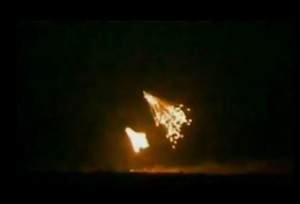
The calls come after yesterday’s use of banned incendiary bombs in the village of Semenovka near the Ukraine’s eastern city of Slavyansk. Eyewitnesses to the bombings reported the use of white phosphor bombs on Wednesday night. The Russian RIA Novosty quotes the local self-defense headquarters on Thursday, saying that Semenkova came under an attack that apparently involved fire bombs. The bombs exploded right above the village and split into smoldering fragments, reported eyewitnesses.
The use of phosphor bombs is internationally banned. The burning substance can’t be extinguished and burns through flesh and bones if a person has been hit by the substance. The Itar-Tass news agency quotes Russia’s Foreign Minister Sergey Lavrov as saying:
“We have ordered to our Ambassador to UN Vitaly Churkin to present to the Security Council a draft resolution on the situation in Ukraine, as we are very concerned by the lack of any progress in the efforts to stop the violence, to stop the war, beginning from the end of the punitive operation”.
“In this resolution we have focused on the fact it is necessary to insist the Ukrainian side began implementing the OSCE roadmap, based on the Geneva statement of April 17, and which was presented after the talks with Russia’s President Vladimir Putin, … It is a very important moment, as, we see, there are clear attempts to distance from the balanced and fair character of the approaches in the roadmap, and there are attempts to promote certain unilateral plans, which would ignore interests of Ukraine’s southeast.”
Lavrov stressed that only an equal-rights dialog, a complete consideration of interests of all of Ukraine’s regions without exceptions, and a dialog that also includes discussions about constitutional reform, may result in stability and an improvement of the situation in Ukraine.
The draft resolution expresses Russia’s concerns about the continuing violence and the killing of civilians, the destruction of infrastructure, residential areas, as well as attacks against convoys. Lavrov added that Russia does not speak about sending peace keepers and that Moscow still believes President Poroshenko has credibility.
Moscow does, however, demand an immediate and full investigation into the use of incendiary bombs and other prohibited weapons in Ukraine. Lavrov stressed “We are concerned to hear reports that the Ukrainian military forces use incendiary bombs and some other indiscriminate weapons. These reports should be investigated, immediately”.
Sikorski and Dziewulski: The Strategy and Tactics of the Neo-Commonwealth
By Andrew Korybko | Oriental Review | June 10, 2014
As the war in the southeast of (former) Ukraine rages on, more proof is emerging of active Polish participation there. This participation has thus far been indirect (i.e. no official Polish military units), although this does not mean that it is no less lethal. Not only has Poland been complicit in training urban terrorists in the run-up to the EuroMaidan chaos, but it has also sent loads of mercenaries to forcibly put down the anti-coup protesters rising up against the junta. Now, photographic proof linking Poland to the Ukrainian madness has arisen. Jerzy Dziewulski, the security advisor to former Polish President Aleksander Kwasniewski, was photographed last week with Turchynov in Slavyansk. Dziewulski is a notorious counter-terrorism expert, having been trained in the US, Israel, France, and Germany, and he currently runs his own private ‘security’ organization. Despite Sikorski playing dumb about the presence of Polish mercenaries in Ukraine and saying he’d “report the fact to the country’s prosecution office”, Dziewulski’s photo with Turchynov proves that he is lying. In reality, Sikorski and Dziewulski represent Poland’s strategic and tactical interference in Ukraine’s civil conflict, and one can no longer be separated from the other.

Reports of mercenary teams operating in (former) Ukraine started sprouting up on the eve of the Kievan junta’s punitive operation in April, but only recently has proof begun to emerge of Poland’s contribution to this force. The late-May report about Polish mercenaries being shipped to Ukraine was almost immediately challenged by Sikorski, despite Russia’s Deputy Foreign Minister stressing that foreign mercenaries, “particularly from Poland”, are active on the ground. Sikorski is now just as easily dismissing the actual capturing of these mercenaries and their Polish commanders, with the Polish Foreign Ministry simply stating that such information is “black propaganda”. This shouldn’t come as a surprise since Sikorski is on record nearly a week prior speaking about the illegality of these mercenaries in the first place, and thus, he will never confirm that they exist. Now that the photo of Dziewulski (dressed in full combat fatigues, helmet, and appearing to have a pistol holstered to his chest) with Turchynov in Slavyansk has hit the internet, it is impossible to deny Poland’s participation in that conflict zone.
To properly understand the significance of the photo in catching the Polish government red-handed, a few words must be said about Dziewulski. As taken from his website, he is an anti-terrorism expert who founded Poland’s Commission for Special Services (special forces). He is licensed in mine warfare, pyrotechnics, and as a sniper. He underwent operational training in Israel, the US, Germany, and France, even training with the State Department and the Bureau of Alcohol, Tobacco, and Firearms during his time in America. He advertises himself as the premier expert on all things related to security, including the use of security companies (read: private military companies) and the “customization of security plans” (read: directing the mercenary offensives). Considering his previous intimate association with Kwasniewski, it is highly probable that he is an important cog in Poland’s national security complex. This makes it all the less likely that Sikorski would not know about such a high-profile government-connected individual’s militant involvement in a festering conflict next door.

What has transpired is that Sikorski and Dziewulski have commandeered Polish policy towards Ukraine and now present a unified two-pronged offensive against the people in Donbass. Sikorski, maneuvering for the EU’s top foreign policy spot, has almost completely overshadowed Poland’s own Prime Minister, whom 69% of Europeans can’t even recognize. Sikorski’s approach is to present the high-level strategy that Poland uses to advance its interests in the lands of the former Polish-Lithuanian Commonwealth (the revival of which the Yanukovich-era head of Ukraine’s security services credits as motivating Polish participation in the February coup). Dziewulski represents a more underhanded and, prior to the photo’s publication, covert approach towards the east. He is the on-the-ground militant power that tactically carries out Sikorski’s strategy. His extensive previous experience could even possibly mean that it is he who is controlling the legions of mercenaries scouring Donbass (and thus responsible for any war crimes carried out by them. After all, it is not likely that Turchynov would waste his time being photographed with an insignificant (which we know Dziewulski is not) figure near the front lines of his offensive. Sikorski and Dziewulski together thus form a unified and aggressive combination of ‘brains and brawn’ that represent the arm and hammer of the ‘Slavic Turkey’s’ Neo-Commonwealth plans.
Andrew Korybko is the American Master’s Degree student at the Moscow State University of International Relations (MGIMO).
Ukraine President Once Agent for U.S. State Department
By Michael Collins | The People’s Voice | June 9, 2014
Is he still working for his former masters in Washington, DC?

Two diplomatic messages from the WikiLeaks Public Library on U.S. Diplomacy indicate that newly elected President of Ukraine, Petro Poroshenko was an agent for United States State Department. A confidential message from the U.S. Embassy in Kiev on April 29, 2006 mentions the newly elected Ukraine president twice.
“During an April 28 meeting with Ambassador, Our Ukraine (OU) insider Petro Poroshenko emphatically denied he was using his influence with the Prosecutor General to put pressure on Tymoshenko lieutenant Oleksandr.”
“During an April 28 meeting with Ambassador, Our Ukraine (OU) insider Petro Poroshenko denied that he was behind Prosecutor General Oleksandr Medvedko’s recent decision to issue an arrest warrant for Tymoshenko lieutenant Oleksandr Turchynov. … [to] question him about the alleged destruction of SBU [Ukraine intel] files on organized crime figure Seymon Mogilievich.” [Russian Mafia Boss of Bosses] WikiLeaks Public Library of U.S. Diplomacy
The motivation for alleged destruction of files appeared in an embassy message from April 14, 2006.
“– The files contained information about Tymoshenko’s cooperation with Mogilievich when she ran United Energy Systems in the mid-late 1990s.” WikiLeaks
Yulia Tymoshenko, an aspiring oligarch, is the darling of the both the Bush and Obama administrations for her role in the 2004 Orange Revolution that brought the first modern anti-Russian Ukraine government to power. She helped negotiate the natural gas deals between Ukraine and Russia.
Another mention of Poroshenko made it clear that the State Department saw the future value of Poroshenko’s insider role.
“OU-insider Petro Poroshenko was in the running for the PM job.” WikiLeaks
Secretary of State Hillary Clinton met with the current president in 2009 when he served as Ukraine Foreign Minister. The content of the meeting was described in a confidential message from the U.S. Embassy in Kiev on December 18, 2009:
[Speaking to Ukraine Foreign Minister Petro Poroshenko] “She [Secretary of State Clinton] emphasized that the United States envisioned multiple pathways to NATO membership.” WikiLeaks
Since he was doing his work in secret, and he was “our insider,” it follows that Poroshenko played the role of agent: ” someone hired or recruited by an intelligence agency to do its bidding. The person to whom the agent reports — the actual agency employee–is known as an operative.” Encyclopedia of Espionage, Intelligence, and Security
Poroshenko is a Ukrainian oligarch, one of the fifty or so wealthiest citizens who run the country. It is unlikely the president got cash for his services but highly likely that he extracted financial advantage as a result.
Amidst the chaos and ruin visited upon Ukraine, Poroshenko’s recent election may mean a full synchronization of U.S. – Ukraine policies regarding the eastern regions where citizens of Ukraine are subject to bombardment by land an air in their towns and cities.
False Hope at D-Day Gathering?
At the recent D-Day commemoration in France, German Chancellor Angela Merkel and French President Francois Holland arranged a fifteen-minute meeting between Russian President Vladimir Putin and the newly elected Ukrainian president. Both leaders agreed that military actions must stop and set up a date for meetings to accomplish that goal. Putin went beyond military settlement by offering Ukraine its former discounts on Russian gas.
According to the Guardian, “Putin said he welcomed Poroshenko’s call for an end to the bloodshed and liked his approach to settling the crisis but wanted to wait until the Ukrainian leader could deliver it in detail to the nation.” (Authors emphasis) Poroshenko delivered some detail to the nation but it wasn’t what Putin wanted to hear in order to move forward. The inauguration speech in Kiev included the new president’s desire to sign the European Union (EU) association agreement and seek full integration into the EU, which implies NATO membership.
“Dear friends, my pen is already in my hands. I am ready now. As soon as the EU takes a relevant decision, the signature of the Ukrainian president will immediately appear under this document. We see the association agreement as only the first step towards Ukraine’s fully-fledged membership in the European Union ” Petro Poroshenko, June 7
As Poroshenko spoke, “Residents [of Slavyansk, eastern Ukraine] said the sounds of shelling reverberated around the city on Friday.” ABC, June 7
Which Poroshenko can we believe? The president who worked for the U.S. as “Our Ukraine insider” or the elected head of a sovereign state engaged in honest diplomacy?
Right now, it’s safe to stick with the bellicose rhetoric of the inaugural speech. In a heavily documented report, RT showed the handiwork of President Poroshenko’s troops in Slavyansk – eight dead yesterday from aerial bombardment of the separatist occupied city administrative building.
“Death and destruction is reported in eastern Ukraine as Kiev’s artillery has resumed shelling the rebellious city of Slavyansk. Locals tell RT they have been without running water and power for days, and that hope is fading.” RT, June 8
The $5 billion spent to get a U.S. friendly government in the Ukraine worked. “Our Ukraine insider,” Petro Poroshenko is president. He was informed five years ago that the U.S. wanted Ukraine in NATO, and he no doubt heard Vice President Joseph Biden’s speech in Kiev. Without a vote by Congress or a valid treaty, Biden assured the then coup-run government that our government would be there to help.
U.S. will stand by Ukraine in face of Russian aggression, Biden says
“I came here to Kiev to let you know, Mr. Prime Minister, and every Ukrainian know that the United States stands with you and is working to support all Ukrainians seeking a better future. You should know that you will not walk this road alone. We will walk it with you.” Vice President Joseph Biden, April 22
The players and plans have been in place for years and it’s all paid off. The White House and their masters finally have their insider in place in charge of Ukraine. It’s worth listening to the assessment of former U.S. Ambassador to Ukraine John E. Herbst and his Deputy around the time they handled Poroshenko. The ambassador saw him as a “disgraced oligarch” and his deputy pointed out that “Poroshenko was tainted by credible corruption allegations.”
Spreading brand democracy around the world is a tough job. Somebody’s got to do it.
(Image: Global Panorama)
Ukraine partially closes border with Russia in Donetsk, Lugansk regions
ITAR-TASS | June 6, 2014
KIEV – Ukraine’s government has closed several checkpoints on the border with Russia in the Lugansk and Donetsk regions, explaining the measure by public security considerations.
“To prevent the emergence of threats to the population’s life or health as a result of dangerous events taking place in certain areas, the cabinet agreed with the State Border Service’s proposal to stop the operation of checkpoints,” the government press service said in a press release on Thursday.
In Ukraine’s Lugansk region, the operation of the following checkpoints has been stopped: Dolzhansky, Chervonopartizansk, Krasnaya Mogila, Novoborovtsy and Severny. In the Donetsk region, the Marinovka checkpoint will be closed.
The Ukrainian government has instructed the Foreign Ministry to inform Russia about the decision.
Slavyansk under fire, without water and power as Kiev troops resume shelling
RT | June 08, 2014

Slavyansk residents take shelter in the basement of their house during a heavy artillery shelling on June 8, 2014. (RIA Novosti / Andrey Stenin)
Death and destruction is reported in eastern Ukraine as Kiev’s artillery has resumed shelling the rebellious city of Slavyansk. Locals tell RT they have been without running water and power for days, and that hope is fading.
“The shells broke just near the central square. They hit residential houses, a furniture factory, a cafe and communications post,” an unnamed representative of the local city council told Itar-Tass. “There are victims among the civilians and some people received shrapnel wounds.”
“At this time there were many people in the center because of the Pentecost Mass in the nearby church has just ended,” the source added.
Four people were killed in the result of the shelling, a small girl among them. Seven people were taken to hospital with injuries, RT’s correspondent Andrey Krasnoschyokov reports from the scene.
Kiev’s artillery also has hit a gas pipe in the city, but there was no explosion threat, the city council told RIA Novosti. Another shell struck a petrol station outside Slavyansk, and a blast and fire followed.
Slavyansk residents say their spirits are getting lower, as the city is completely surrounded by Kiev’s armed forces and there is constant shooting and shelling while evacuation is hindered.
“Slavyansk has been attacked by massive shelling overnight,” a local resident told RT, adding that the shelling never stops.
As the man was speaking to RT in the morning, he saw massive columns of smoke coming from the city outskirts. The sounds of shelling were heard distinctly over the phone.
The city is preparing to survive without drinking water and electricity.
“Residents are living a third day without water, some people even the fifth… Half [of the city population] doesn’t have electricity,” the man said.
As shops ran out of drinking water supplies too, Twitter images showed that residents had started scooping the remaining water out of fountains.
According to RT’s witness, those water and electricity lines that have been broken are located in the “war zones,” where most of the fighting takes place, that’s why it is almost impossible to repair them.
“There is an impression that [Kiev forces] are striking in the vicinity of high-voltage lines to disrupt them and leave the city without water and electricity,” he added.
‘Slavyansk is a total nightmare’
Slavyansk residents are leaving the besieged city with shells whistling above their heads, local driver Vladimir, who evacuates at least 10 residents a day, told RT.
“This is a total nightmare what is happening in Slavyansk. They [Kiev troops] only let women and children leave the city – they are forced to walk through the checkpoints,” Vladimir says. “Men are not allowed to leave or enter the city.”
Vladimir, who literally drives through never-ending gunfire, says Slavyansk residents are mostly seeking refuge in Crimea or in nearby regions.
Meanwhile, Ukraine’s National Guard has begun artillery fire in the outskirts of Slavyansk, according to a video released on YouTube. The footage shows a huge amount of smoke coming from the hill on the outskirts.
Kiev authorities have recently intensified what Kiev calls an “anti-terrorist” operation with a massive artillery attack on Slavyansk. The plan was to conduct a “clean-up” of Donetsk and Lugansk regions ahead of the presidential inauguration held on June 7.
US sending military advisers to Ukraine
Press TV – June 7, 2014
The US Defense Department will send American military advisers to Ukraine in order to build “defense institutions” in the country.
Pentagon spokeswoman Eileen Lainez said the two countries could strengthen “long-term defense cooperation to help Ukraine build highly effective armed forces and defense institutions.”
She added that the Pentagon considers sending its military advisers “a first step” toward helping to “shape and establish an enduring program for future US efforts to support the Ukrainian military through training, education, and assistance.”
“We are committed fully to getting the assistance to Ukraine as quickly as possible,” Lainez was quoted as saying by Military Times.
Earlier this week, US President Barack Obama promised to provide Kiev with an additional 5 million dollars in military aid including the training of its law enforcement and army personnel.
Since March, the United States has approved more than 23 million dollars in security assistance to Ukraine.
President Obama has pledged to invest one billion dollars on stepping up the US military presence in Eastern Europe.
“Our focus continues to be on supporting Ukraine economically and diplomatically,” Lainez said.
“As the president has said, we do not see a military solution to this crisis. Throughout the review, we’re looking at items with the intent that whatever is approved will stabilize the situation in Ukraine.”
Russian Zvezda TV journalists missing near besieged Slavyansk
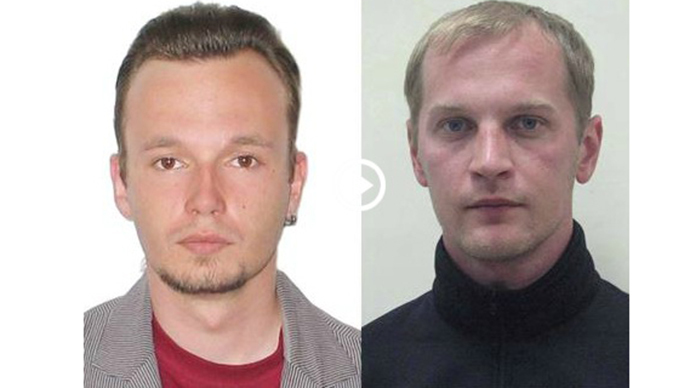
Andrey Sushenkov and Anton Malyshev (Photo courtesy of tvzvezda.ru)
RT | June 6, 2014
Two journalists from Russian TV channel Zvezda have gone missing after a search by Ukraine’s National Guard at a military checkpoint near the city of Slavyansk. In the meantime Ukraine armed forces continue their artillery assault on the city.
Video operator Andrey Suchenkov and sound engineer Anton Malyshev have been unreachable since Friday afternoon, Zvezda TV announced on its website.
“At the approaches to Slavyansk we got in touch by phone. They said National Guards were searching them and they would call back as soon as the search is over. Since then their numbers are unobtainable,” said Zvezda correspondent Evgeniy Davydov, who was in touch with the crew during their stay in Ukraine.
Last time Davydov managed to contact the missing journalists was at 14:30 GMT while they were near Balbasovka village some 20 kilometers from Slavyansk.
“We also can’t contact their driver – a citizen of Slavyansk,” he added.
This is not the first time Russian journalists working in Ukraine disappear after encountering the National Guard.
On May 18, two Russian journalists working for LifeNews TV channel – reporter Oleg Sidyakin and cameraman Marat Saichenko – were captured by Kiev forces near the eastern city of Kramatorsk. Initially accused of “aiding the terrorist groups,” they were released a week later – without any charges pressed or evidence of their misconduct provided – after a wave of outrage by rights groups and Russian politicians and media.
An RT journalist reporting from Ukraine, Graham Phillips, was also detained after a search by the National Guard last month and questioned by various Kiev security forces for over 36 hours before being released.
The area around Slavyansk is gripped by increased violence after Kiev intensified what it calls an ‘anti-terrorist’ operation against anti-government activists and militia who have taken control of the eastern regions of the country as a mark of protest against the Kiev authorities.
See also:
Ukrainian MP kicks out Russian journos from parliament, calls them ‘spies’ (VIDEO)
Kiev’s Use of Heavy Weapons in Crackdown Violates International Law – Russia
RIA Novosti – 05/06/2014
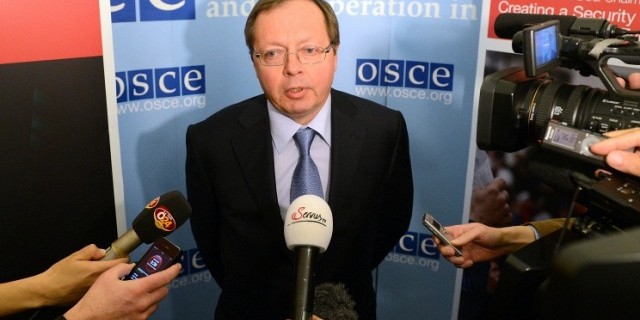
VIENNA – Moscow has raised the issue of Kiev using heavy armaments in its special operations against independence supporters in eastern Ukraine at OSCE session, Russia’s envoy Andrei Kelin said on Wednesday.
“The punitive operation led by Ukrainian forces reflects signs of an international human rights violation, in particular, of the Geneva convention of 1949,” Kelin said.
“We drew attention to the tragic outcome of an operation in the Donbas [in eastern Ukraine], a barbaric shelling of a building of the Luhansk local administration,” he added.
He referred to reports claiming the Ukrainian military had used exploding bullets, cluster bombs and artillery.
 “There are reports on the use of inhumane weapons – exploding bullets, cluster bombs – and the shelling of civilian targets in Ukraine. If they are confirmed, such acts have to be treated as war crimes. If it is proven that Right Sector killed the wounded in a Krasnyi Lyman hospital, there are no words to justify such an action,” Kelin said.
The envoy added that the latest report from the OSCE’s Special Monitoring Mission to Ukraine confirmed pro-Kiev forces had been using tanks, artillery and aircraft in its special operations.
“We asked a lot of questions, but Ukraine’s permanent representative [to the OSCE] gave no answers, aside from the usual attempts to shift responsibility to Russia,” Kelin added.
The town of Krasnyi Lyman, located to the southeast of Slaviansk in Donetsk Region, was heavily shelled by the Ukrainian army during Kiev’s military operation Tuesday. Ukrainian armed forces allegedly killed more than 25 wounded people in a local hospital, as the National Guard seized the town from the local defense forces following the shelling.
In mid-April, Ukraine’s interim government launched a special operation to crack down on the independence movements, but failed to gain control over the self-proclaimed independent republics in the eastern part of country. The operation has led to violent clashes and dozens of casualties in Slaviansk, Kramatorsk and Mariupol. Moscow has described the operation as a punitive act and urged Kiev to end the violence.
Obama pledges $1bn for more troops, military drills in E. Europe
RT | June 3, 2014
President Obama has announced a plan to invest $1 billion in stepping up its military presence in Eastern Europe amid the Ukrainian crisis. The White House will send more troops and equipment to the region to “reaffirm” its commitment to NATO allies.
Speaking at a news conference in Warsaw, Obama said America was stepping up its partnership with countries in Eastern Europe with a view to bolstering security. The moves are aimed at upping the pressure on Russia, which Washington has accused of inciting unrest in Ukraine.
In line with the plans, Obama will ask Congress to provide up to $1 billion to finance the deployment of more troops and equipment.
“Under this effort, and with the support of Congress, the United States will preposition more equipment in Europe,” Obama said at the Polish capital’s Belweder Palace.
Earlier in the day Obama met with US and Polish air personnel in Warsaw and said the US had already begun rotating additional soldiers in the region.
“Given the situation in Ukraine right now, we have also increased our American presence. We’ve begun rotating additional ground troops and F-16 aircraft into Poland… to help our forces support NATO air missions,” said Obama, calling the commitment to NATO allies in Europe “the cornerstone of our own security.”
Obama called on Moscow to refrain from further provocation in Ukraine and said it has a responsibility to work constructively with the new government in Kiev. He added that the troop buildup in Eastern Europe was not meant to threaten Russia, but “rebuilding trust may take some time.”
The American president will meet with newly-elected Ukrainian President Petro Poroshenko during his two-day stay in Poland.
Polish President Bronislaw Komorowski praised Washington’s plans to beef up military forces in the region.
“We welcome them as an announcement of a real return by NATO to standing very strongly by the basis of the alliance, which is Article 5, which speaks about the collective defense of the countries’ territories,” Komorowski said.
Russia has decried the increase in NATO troops close to its border as a blatant provocation and accused the organization of fueling violence in Ukraine. Moscow has said it is ready for dialogue with Poroshenko, but has urged the newly elected President to halt the “anti-terror operation” in the east of Ukraine.
“NATO is providing Kiev – a member of its Partnership for Peace program – with technical assistance, thus encouraging the prolongation of its use of force. Thus the Alliance accepts a part of the responsibility for the escalation of the situation, and the collapse of diplomatic negotiations,” said Aleksandr Grushko, Russia’s envoy to NATO.
Thus far the US has deployed 600 troops for military drills in Estonia, Latvia, Lithuania, Estonia and Poland.
181 people killed, 293 injured in Kiev military op in eastern Ukraine
RT | June 3, 2014
Kiev’s military operation in eastern Ukraine has left 181 people killed, including 59 of ruling regime troops, and 293 injured, according to the country’s Prosecutor General.
Oleg Makhnitsky announced the recent figures at a press conference. However, it was not clear whether the death toll included casualties among self-defense forces.
The Prosecutor General has also added that over 220 people have been abducted, including 12 foreign citizens, since the uprising started in Lugansk and Donetsk Regions.
“Six hundred and seventy-five criminal enterprises connected with subversive activities, terrorist acts, and violation of the territorial integrity of Ukraine are currently being investigated,” Makhnitsky told the media.
Kiev has been conducting its “anti-terrorist operation” in eastern Ukraine since April, following a mass uprising against the coup-appointed government, demanding broader independence from the capital.
Following the May 11 referendums, in which the Lugansk People’s Republic and Donetsk People’s Republic voted for the two regions’ independence and proclaimed themselves sovereign states, the military operation by Kiev troops has intensified.
The day after the presidential elections on May 25, the likely winner, billionaire Petro Poroshenko, announced that the military operation in the southeast of the country would continue, demanding “it must be more effective, and military units must be better equipped.”
Just a few hours after the early results of the elections were announced, Ukrainian troops stepped up their military activity and deployed fighter jets and helicopters at Donetsk International Airport in an attempt to win it back from self-defense forces.
More than 50 civilians and as many self-defense troops were killed in the subsequent clashes, local militia estimated.
On Wednesday, May 28, Kiev troops targeted civilian quarters of Slavyansk, for the first time shelling one of the city’s schools and a kindergarten.
All the pupils and teachers were quickly evacuated from the school as the shell hit the roof and exploded right above the hall where children played.
The shelling also damaged a block of flats and a dormitory in the city’s teachers’ college, shattering glass in the windows of the college.
Shortly afterwards, the Ukrainian military shelled a children’s hospital, also in Slavyansk.
This past weekend, over a thousand people rallied in Donetsk demanding that children be protected from Kiev’s assault.
The Kiev forces quickly blamed the violence on self-defense units, which they refer to as “terrorists.”
NATO encouraging Kiev to use force: Russian envoy

Russian envoy to NATO Alexander Grushko
Press TV – June 2, 2014
Russia’s envoy to the North Atlantic Treaty Organization (NATO) says the western military alliance is “encouraging” the Kiev authorities to use force against pro-Moscow activists in eastern Ukraine.
Alexander Grushko made the remarks in a meeting with ambassadors of NATO member states in the Belgian capital of Brussels on Monday, Russia’s Ria Novosti news agency reported.
“NATO is providing Kiev … with technical support, thus encouraging the continuation of forceful actions,” Grushko said.
The Russian official also accused NATO of adding to tensions in the eastern Ukrainian provinces by conducting “unprecedented” activities near Russia’s borders.
He further noted that the military alliance is hampering efforts to find a peaceful solution to the current turmoil in the former Soviet state.
On May 6, NATO launched military drills in Estonia with a record-breaking number of 6,000 troops from a number of allied countries, including the US, the UK, Latvia and Lithuania. The alliance has also deployed fighter jets and naval vessels to Lithuania and Poland as well as to Romania.
Tensions between Russia and the West heightened after Ukraine’s Autonomous Republic of Crimea integrated into the Russian Federation following a referendum on March 16.
The United States and its European allies accuse Moscow of destabilizing Ukraine and have slapped a number of sanctions against Russian and pro-Russia figures.
Russia, however, rejects the accusation, saying the pro-Moscow protests in Ukraine began spontaneously against the new interim government in Kiev.
Le Pen on Ukraine crisis: US pursuing own interests, not those of EU
RT | June 1, 2014
The EU is responsible for the developments in Ukraine, French right-wing leader Marine Le Pen said in an interview, stressing the bloc should have its own opinion on global events and not slavishly follow the America’s lead.
“The EU added fuel to the fire by offering the partnership to the country where half of the population is looking to the East,” Le Pen told Der Spiegel newspaper.
Le Pen said she supports federalization in crisis-torn Ukraine, where the coup-appointed government has launched a massive military operation in the country’s eastern regions. The offensive has already claimed dozens of lives, both among the militias and local civilians. Schools, a kindergarten and hospitals in several cities have come under fire.
The French leader warned the EU against falling into Washington’s steps, as those have nothing to do with Europe’s interests.
“The United States is trying to expand their influence in the world and first of all in Europe. They are pursuing their own interests, not ours,” Le Pen said.
She went as far as to call the EU “an anti-democratic monster,” where people’s right to self-determination is stolen.
“I want to stop it [the EU] getting fatter, continuing to breathe, touching everything with its paws and reaching into all areas of our legislation with its tentacles,” she said.
Earlier Le Pen repeatedly stated that Russia is being unfairly “demonized” and that the campaign against the Russian political administration has been cooked up at the highest levels of EU leadership, with the implicit support of the US.
“I am surprised a Cold War on Russia has been declared in the European Union,” she said at a meeting with Russia’s State Duma speaker Sergey Naryshkin in April. “It’s not in line with traditional, friendly relations, or with the economic interests of our country or EU countries and harms future relations.”
Le Pen’s National Front far-right party in France has been steadily gaining popularity and scored a triumphant success in the latest EU elections by gaining around 25 percent of the votes.
Featured Video
No Vote, No Representation, No State: Democracy, Israeli Style
or go to
Aletho News Archives – Video-Images
From the Archives
Sanctions, War and the Policy of Dual Containment
By SASAN FAYAZMANESH | March 17, 2008
It is now nearly three decades since the Unites States adopted the policy of dual containment of Iran and Iraq. While much has been written about the containment of Iraq, there has been very little in-depth analysis of this policy when it comes to Iran. In a book that is going to be released on March 31, 2008, entitled The United States and Iran: Sanctions, Wars and the Policy of Dual Containment (Routledge), I attempt to address this shortcoming by investigating when and why the US policy of containment of Iran came about, how it evolved, and where it stands today.[1] To the extent that Israel has been involved in US policy making, the study will also include the role that Israel has played in the containment of Iran. Also, since the fate of Iran has been inextricably linked to that of Iraq, occasionally the investigation will overlap with the containment of Iraq.
The policy of dual containment of Iran and Iraq originated during the Carter Administration, but it was not until the Clinton Administration that the expression “dual containment” became popular. … continue
Blog Roll
 Aletho News
- Europe’s Establishment Is Embracing War – and Losing Voters
- NATO chief advocates war of aggression
- No Vote, No Representation, No State: Democracy, Israeli Style
- Zionist Bought Senate Blocks Information About American Citizens Killed By Israel
- While Gaza dominates the UN, these are the people keeping it alive
- New Report: “Scholasticide and Genocide in Gaza: Assessment, Testimonies and Legal Analysis”
- ‘THAAD Delusion’: Iran war exposes US missile shield limits – The Atlantic
- Moscow issues warning to NATO over Russian exclave
- Yes, the Iran war has destroyed Trump’s presidency
- The fallacy of US delusions about Iran’s economic collapse
- If Americans Knew
- Mamdani releases plan to combat antisemitism and hate crimes in New York City
- Iran’s Revolutionary Guards Publish Letter to the American People
- DMFI launches $1 million ad campaign supporting Virginia’s Elaine Luria
- US Senate blocks resolution seeking report on Americans killed by Israel
- Israeli Attacks Kill Ten Palestinians in Gaza
- Massacre at Minab: The School That Became a Grave
- Israeli media: The IDF Shows It Doesn’t Turn a Blind Eye; It Actively Emboldens Settler Havoc
- As settlers ravage West Bank, Israeli forces kill 10 in Gaza – Daily Update
- New Report: “Scholasticide and Genocide in Gaza: Assessment, Testimonies and Legal Analysis”
- Ex-Biden officials are desperate for a Gaza scapegoat
- No Tricks Zone
- Green Energy Debacle: German Expert Professor Fritz Vahrenholt Warns Of Severe Economic And Social Consequences
- Two More Paleo Reconstructions Affirm Meters-Higher Sea Levels Across Ireland, Brazil 7000-6000 Years Ago
- New Study: Earth And Venus Surface Warmth Largely Explained By Convection And Lapse Rate, Not CO2 Or Radiation
- 2025 Nature Paper Claiming Worsening Global Drought Gets RETRACTED …Heavily Flawed
- New Study: ‘Global Drought Shows No Detectable Recent Acceleration Under Climate Warming’
- Economic Masterminds: German Socialists Suggest Taxing Productivity Gains Stemming From Using AI
- The South China Sea Has Not Been Cooperating With The Climate Change Narrative
- Energy Crisis: Germany Enters Heating Season With Historically Low Gas Reserve Fill Levels
- New Study: The Antarctic Ice Sheet Gained Mass From 2020-2024 Due To Staggering Snow And Ice Accumulation
- Study: Ocean Heating Rates From Thousands Of Years Ago ‘Dwarf’ Modern Ocean Heating Rates

