NYT Revamps Its False Ukraine Narrative
By Robert Parry | Consortium News | June 26, 2014
It’s always interesting when the New York Times promotes a false narrative – as it has on Ukraine by blaming the crisis all on “Russian aggression” – and then has to shift its storyline when events move in a different direction, like President Vladimir Putin’s recent peacemaking initiatives.
On Thursday, the Times explained Putin’s call for an extended ceasefire as a case of him caving in to U.S. pressure. Correspondents Andrew Roth and David S. Herszenhorn wrote:
“Faced with the threat of additional economic sanctions from Washington, President Vladimir V. Putin of Russia discussed an extension of the cease-fire, which is to expire on Friday, in a telephone call with Chancellor Angela Merkel of Germany, President François Hollande of France and Ukraine’s new president, Petro O. Poroshenko.”
The article then continued the tough-guy, ultimatum-threatening chest-pounding that has become de rigueur for the State Department and the mainstream U.S. news media. The Times article noted:
“The Obama administration has drawn up plans to escalate sanctions against Russia if it does not back the current peace plan by halting the flow of weapons and fighters across the Russian border. The sanctions could target some of Russia’s largest banks, or energy and defense firms.”
The Times also reported, without skepticism, the unverified allegations that the Russian government is supplying heavy weapons to the eastern Ukrainian separatists who rebelled after violent protests by western Ukrainians ousted elected President Viktor Yanukovych on Feb. 22.
The U.S. government has repeatedly made allegations about “Russian aggression” in eastern Ukraine but has failed to present any verifiable proof to support the claims. One State Department attempt, which involved getting the Times to run a lead article citing photos purportedly proving that Russian military personnel were operating in Ukraine, collapsed under scrutiny and was later retracted by the Times.
Nevertheless, the Times still conveys the State Department’s claims without noting the absence of evidence, itself evidence of the Times’ unstinting bias in its coverage of the Ukraine crisis. For instance, the Times reported:
“On Wednesday, Secretary of State John Kerry began a news conference at NATO in Brussels by calling for Mr. Putin ‘to stop the flow of weapons and fighters across the border.’ Mr. Kerry said that the missile launcher that brought down the [Ukrainian military] helicopter on Tuesday was Russian-made and urged Mr. Putin to call for separatist forces to lay down their arms. A senior administration official said Friday that several tanks under rebel possession had come from Russia.”
Normally, when one party in a dispute makes an allegation and fails to provide meaningful evidence to support it, news organizations add something like: “However, the claim could not be independently verified” or the Times might have noted that “similar claims by the State Department in the past have proven to be false.”
But the Times simply can’t seem to deviate from its four-month display of an extraordinary lack of balance, which brings us back to the Times’ attempt to explain Putin’s peacemaking as a development that could only be explained as him caving in to U.S. pressure. [For more on the Times’ bias, see Consortiumnews.com’s “NYT’s One-Sided Ukraine Narrative.” For more on Herszenhorn’s bias, see “Ukraine, Through the US Looking Glass.”]
Putin’s Thinking
There is, of course, an alternative explanation for Putin’s recent behavior: that he never sought the Ukraine crisis and surely did not plan it; it resulted, in part, from U.S. and European provocations designed to put Putin in a corner in his own corner of the world; Putin reacted to this Western maneuver but was always willing to compromise as long as the end result was not a strategic threat to Russia.
I’m told that Putin, like many historic Russian leaders, has wanted to see Russia accepted as a member of the First World and took personal pride in helping President Barack Obama defuse crises in Syria and Iran last year. Arguably, it was Putin’s assistance on those crises that made him a target of Washington’s still influential neocons who had hoped instead for U.S. bombing campaigns against Syria and Iran.
By late September 2013 – on the heels of Obama rejecting plans to bomb Syria – leading neocons, such as National Endowment for Democracy President Carl Gershman, identified Ukraine as a key piece on the chessboard to checkmate Putin. [See Consortiumnews.com’s “What Neocons Want from Ukraine Crisis.”]
The Ukraine crisis really emerged from the European Union’s offer of an association agreement that President Yanukovych was initially inclined to accept. But it was accompanied by harsh austerity demands from the International Monetary Fund, which would have made the hard life for the average Ukrainian even harder.
Because of those IMF demands and a more generous $15 billion loan offer from Russia, Yanukovych backed away from the EU association, angering many western Ukrainians and creating an opening for U.S. neocons, such as Assistant Secretary of State for European Affairs Victoria Nuland and Sen. John McCain, to urge on protests to unseat Yanukovych.
In February, as the Ukraine crisis worsened, Putin was preoccupied with the Winter Olympics in Sochi, but he went along with a compromise plan on Feb. 21 in which Yanukovych agreed to reduced powers and early elections (so he could be voted out of office) as well as to pull back the police. That opened the way for violent attacks by neo-Nazi militias who overran government buildings on Feb. 22 and forced Yanukovych and his officials to flee for their lives.
With the U.S. State Department endorsing the coup as “legitimate,” a right-wing government quickly took shape under the leadership of Nuland’s hand-picked prime minister, Arseniy Yatsenyuk. Four ministries were given to the neo-Nazis in appreciation of their key role in the coup, including the appointment of Andriy Parubiy as chief of national security.
The new regime immediately displayed hostility toward the ethnic Russians in the east and south, including sending wealthy “oligarchs” to serve as the new regional governors and dispatching neo-Nazi militias – reconstituted as the National Guard – to crackdown on dissent.
The regional government of Crimea, a longtime part of Russia and home of the Russian naval base at Sevastopol, organized a referendum to secede from Ukraine and to rejoin Russia, a move supported by Putin and aided by the thousands of Russian troops already in Crimea under a basing agreement with Ukraine.
Crimea’s secession was treated by the mainstream U.S. media as a Russian “invasion” and an act of “aggression,” though the reunification with Russia clearly had overwhelming support from the people of Crimea as expressed in the referendum and in opinion polls.
Still, across Official Washington, the narrative took hold that Putin had ginned up the Ukraine crisis so he could seize territory and begin to reconstitute the old Soviet Union. Right-wing and neocon pundits raised the specter of Putin attacking the Baltic states. The U.S. news media lost all perspective on the actual events in Ukraine.
The reality was that Putin was reacting to a Western provocation on his border, a coup d’etat to pry Ukraine away from its traditional relationship with its neighbor Russia and into the embrace of the European Union and NATO. Putin himself noted the threat to Russian national security if NATO’s nuclear-missile-bearing ships were berthed in Sevastopol.
From the beginning, Putin hoped to resolve this crisis through discussions with his erstwhile collaborator, Barack Obama, but – with the U.S. media in a frenzy demonizing Putin – Obama would not even come to the phone at first, I’m told. Afraid of being called “weak,” Obama followed the lead of the State Department’s hawks who were lusting for Cold War II.
Gradually, with Europe’s fragile economic recovery at risk if Russia’s natural gas supplies were disrupted, cooler heads began to prevail. Obama eventually took Putin’s phone calls and the two met face-to-face during the ceremonies around the 70th anniversary of D-Day in France. Putin also viewed chocolate manufacturer Petro Poroshenko as a reasonable choice to fill the slot of Ukraine’s new president.
Poroshenko and Putin found common ground in their desire to deescalate the crisis although neither leader has been able to fully control the hardliners, not Poroshenko in trying to rein in the Right Sektor which has taken a lead role in killing ethnic Russians in Odessa and other cities, nor Putin in convincing the separatists that they have a future in the post-coup Ukraine.
But Putin continues to signal support for Poroshenko’s stated intent to respect the rights of eastern Ukrainians by offering more self-rule and respecting their use of Russian as an official language. In a sign of good faith, Putin has even sought to rescind the permission from the Russian legislature to intervene militarily to protect ethnic Russians in Ukraine.
However, these developments created a dilemma for the New York Times and the rest of the mainstream U.S. news media. If the Ukraine crisis had been just an excuse for Putin to seize territory and revive the “Russian empire,” why would he be so eager to work out a peaceful settlement? The opposite should be true. If the MSM had it right, Putin would be escalating the crisis.
So, we now have this new version: Yes, Putin precipitated the Ukraine crisis so he could conquer Eastern Europe. But he backed down because of tough talk from Official Washington (including on the MSM’s op-ed pages). In other words, the MSM had it right but tough-guy-ism and the threat of sanctions scared Putin into retreat.
That this analysis makes little sense – since it was the European Union that was most unnerved by the prospects of U.S.-driven sanctions disrupting Russia’s natural gas supplies and plunging the Continent into a recessionary relapse – was of little regard to the U.S. press corps. The new false narrative was simply a necessary way to cover for the old false narrative.
It could never be acknowledged that the New York Times and the other esteemed U.S. journals had gotten another major international story wrong, that another “group think” had led the MSM down another rabbit hole of mistakes and misunderstanding. Instead, all that was needed was some creative tinkering with the storyline.
~
Investigative reporter Robert Parry broke many of the Iran-Contra stories for The Associated Press and Newsweek in the 1980s. You can buy his new book, America’s Stolen Narrative, either in print here or as an e-book (from Amazon and barnesandnoble.com).
Bulgaria: South Stream doesn’t breach EU laws
RT | June 26, 2014
Bulgarian officials say the construction of the Russian-led South Stream gas pipeline does not breach EU legislation. The European Commission is concerned the agreement between Russia and Bulgaria violates EU competition law.
The Bulgarian government stood by its position on the legality of the pipeline in a Wednesday statement, ITAR-TASS reports. The agreement on South Stream construction signed in 2008 did not provide any exclusive rights, concessions, or tendering for the South Stream Bulgaria Company which is the owner of the pipeline, and therefore it does not violate EU law, it said.
“With its position the government presents arguments and motives in support of the decisions the Bulgarian nation has taken and which were the subject of concern at the EU Commission,” Reuters quotes the official statement.
Bulgaria will put these arguments at the Brussels summit on Friday, but the decision of the commission whether to accept or reject them may end up in full infringement proceedings and possible fines against Sofia, Reuters says.
According to Gunther Oettinger, the European Commissioner for Energy, the construction process should be suspended until, “it completely corresponds to the requirements of the European Union.”
On Tuesday Austria, another strong defender of the pipeline, signed a deal to construct a South Stream arm on its territory, thus showing its firm commitment.
The 2,446 km South Stream pipeline will stretch across southern and central Europe via the Black Sea, bypassing Ukraine and reducing the country’s importance as a gas transit route. 64 billion cubic meters of gas will be transported annually.
Gazprom has said the project, estimated to cost $45 billion, can be completed without any funding from international partners.
Austria and Russia sign South Stream gas pipeline treaty
RT | June 24, 2014
Russia and Austria have agreed on a joint company to construct the Austrian arm of the $45 billion South Stream gas pipeline project, which is expected to deliver 32 billion cubic meters of Russian gas to the country, bypassing Ukraine.
At Tuesday’s meeting in Vienna, the creation of South Stream Austria was announced. The company will be 50 percent owned by Gazprom, Russia’s largest gas producer, and 50 percent by Austria’s OMV Group, the country’s largest oil and gas company.
Construction on the Austrian section is expected to begin in 2015 and that the first deliveries will start in 2017, reaching full capacity in January 2018.
OMV spokesman Robert Lechner was more optimistic, and said the first South Stream deliveries could come as early as 2016.
In April, Gazprom and the OMV Group signed a memorandum to implement the South Stream project in Austria.
At Tuesday’s meeting in Vienna, OMV CEO Gerhard Roiss said that South Stream fully complies with EU legislation.
“This project- investment in European energy security- will fully comply with EU legislation,” Roiss said, as quoted by ITAR-ITASS.
There has been controversy over South Stream, as is it needs EU approval so that it doesn’t violate Europe’s ‘Third Energy Package’, which says a company cannot both own and operate pipelines within the European Union.
Bulgaria and Serbia, countries nearly 100 percent dependent on Russian gas, have faced pressure from the EU to halt construction.
Ahead of Putin’s visit to Vienna, Austrian ministers said they remained committed to Russia’s South Stream project and that they plan to speed it up.

The geopolitical conflict in Ukraine has also complicated the South Stream project, as EU energy lobbying groups are campaigning against the project, to lessen Europe’s dependence on Russia.
“So far [Austria, Ed,] takes a very clear position, avoiding pressure from the European Commission and in general, public opinion in Europe that wants to halt or even stop the project. At the same time it [Austria, Ed] has enough political clout to promote this project. It’s not Bulgaria, which on its own cannot defend itself,” Fyodor Lukyanov, Chairman of Russia’s Council on Foreign and Defense Policy, said on Monday.
South Stream will deliver gas to Europe bypassing Ukraine, which is seen as an unreliable transit state.
After switching Ukraine to a prepayment system, Russia and Gazprom fear Ukraine will start to siphon gas supplies headed towards Europe, as the country did in 2006 and 2009. Miller worries Ukraine may resort to this tactic in winter, once it runs out of its underground storage supplies of natural gas.
“If Ukraine begins to siphon off gas, we will increase supplies via North Stream, and maximize the load through Yamal-Europe,” Aleksey Miller, CEO of Gazprom, said Tuesday in Vienna.
The 2,446 km pipeline will stretch across southern and central Europe and will transport over 64 billion cubic meters of natural gas to Europe per year.
Gazprom has said the project, estimated to cost $45 billion, can be completed without any funding from international partners.
Gazprom is Russia’s largest producer of natural gas and provides roughly one third of Europe’s gas needs.
The head of the Russian Duma’s International Affairs Committee, Aleksey Puskhov, wrote on Twitter on Tuesday that “Ukraine is in a long-term phase of unpredictability. Thus, South Stream is the only guarantee of uninterrupted gas supply to Europe.”
Putin asks Upper House to repeal decision allowing to use military force in Ukraine
RT | June 24, 2014

Russian President Vladimir Putin (RIA Novosti / Aleksey Nikolskyi)
President Vladimir Putin has proposed that the upper house call off the March 1 resolution allowing the head of state to use the armed forces on the territory of Ukraine, said presidential press secretary Dmitry Peskov.
“Because of the beginning of the three-party talks to settle down the situation in the eastern parts of Ukraine, the head of state has addressed to the Federation Council to repeal the resolution on the use of Russian armed forces on the territory of Ukraine,” ITAR-TASS cited Peskov as saying.
The president sent an address to Federation Council Valentina Matvienko today morning, ahead of leaving on official visit to Vienna.
Deputy Head of the Federation Council’s International Committee Andrey Klimov confirmed the upper house will back Putin’s proposal and repeal the resolution on Wednesday, June 25.
The Federation Council’s resolution of March 1 agreed on the president‘s right to use military force on the territory of the neighboring Ukraine “until the normalization of the social and political situation in that country.”
The resolution was adopted following a presidential address demanding security be maintained “for citizens of the Russian Federation, our compatriots and personnel of the Russian contingent deployed in accordance with international agreements on the territory of the Autonomous Crimea Republic of Ukraine.”
The resolution was adopted in accordance of the first part of the Article 102 of the Constitution of the Russian Federation.
On Monday evening, the leader of the self-proclaimed Donetsk People’s Republic in eastern Ukraine agreed to a ceasefire in the region until 10am local time on Friday. He stressed that the self-defense force’s ceasefire will come only as a reciprocal move.
Earlier, Ukrainian President Petro Poroshenko laid out his plan to deescalate the conflict, announcing a unilateral ceasefire from June 20 until June 27, the day Kiev plans to sign the EU Association agreement. On Sunday he issued a warning, stating that he had an alternative “detailed plan” of regaining control over south-eastern Ukraine, should his current proposal for a truce fail to bring results.
Despite the “unilateral ceasefire” announced by Kiev the fighting in eastern Ukraine continued, and there have been clashes in some areas, the Lugansk People’s Republic said in a statement. It was reported that an artillery shell hit the roof of a kindergarten in Kramatorsk, partly destroying the building. At the same time, self-defense troops of the Donetsk People’s Republic targeted Ukrainian armed forces positions at Karachun Mountain, Itar-Tass reports.
Poroshenko warns of ‘detailed Plan B’ if Ukraine ceasefire fails
RT | June 22, 2014
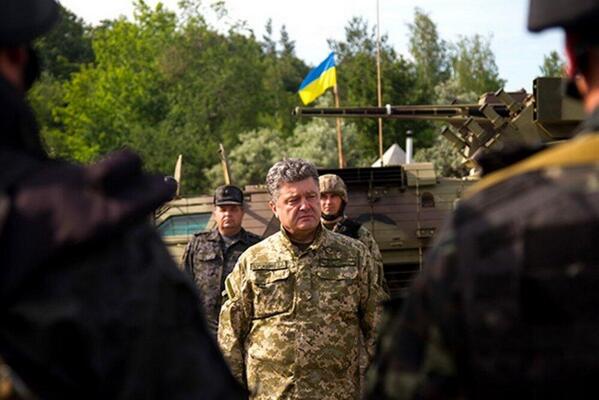
If his current proposal for a truce, which came into force on Friday, fails to bring results, Ukraine’s newly elected president Petro Poroshenko warns he has an alternative “detailed plan” of regaining control over south-eastern Ukraine.
“Peaceful scenario – it is our plan A,” Poroshenko said in a statement on his website. “But those who expect to use the peace talks only to gain time to regroup, should know that we have a detailed plan B. I am not going to talk about it now, because I believe that our peace plan will work.”
The ceasefire in eastern Ukraine took effect on June 20 and will last until June 27, the day Kiev plans to sign the EU Association agreement.
However, “the military will be given the right to return fire if Ukrainian army units or peaceful civilians are attacked,” Poroshenko said in his decree. Since then, the tensions have slightly eased in some areas, but the Ukrainian army is still using artillery and the air force in sporadic clashes with anti-Kiev militias.
Poroshenko claims the ceasefire is designed to enable local self-defence militias to lay down their arms and flee the country, or be destroyed. He also, while drafting the plan with Kiev-appointed governors of the defiant regions, rejected any possibility of negotiations with representatives of anti-Kiev forces.
While welcoming Kiev’s ceasefire efforts, the Russian president said the current peace plan on the table “should not take the form of an ultimatum to militia groups,” according to the Kremlin statement. It’s not enough to just put hostilities on pause, but vital to immediately start “constructive negotiations” to reach a viable compromise between the parties to the conflict.
“Russia notes that the proposed plan will not be viable or realistic if no practical steps are taken to commence the negotiation process,” the statement reads, shedding doubt that it would work as “the confrontation continues and shells from the Ukrainian side land and explode on the Russian territory.”
Meanwhile, Russian Foreign Minister Sergei Lavrov has said that most clauses of President Poroshenko’s peace plan look more like an ultimatum to the militias in Donetsk and Lugansk regions rather than an invitation to dialogue.
“The plan lacks the key thing – a proposal to start dialogue. This is a drastic departure from the Geneva statement of April 17 which is still supported by all of our Western partners, the United States, the European Union and the Ukrainian authorities or at least they say so,” Lavrov said, reports Itar-Tass.
Lavrov once again highlighted that Moscow is alarmed that Kiev continues the shelling, which now impact Russian border crossings with Ukraine.
“We are very much alarmed and worried by the fact that simultaneously with the announcement of the peace plan, a military operation was stepped up, which resulted in people wounded on the Russian side,” he said.
READ MORE: Russian checkpoint on Ukraine border comes under fire
OPINION: Ukraine peace plan is ‘Poroshenko’s PR move in a form of ultimatum’
Poroshenko calls for unilateral ceasefire in E. Ukraine
RT | June 18, 2014
Ukrainian President Petro Poroshenko has announced a ceasefire plan for government troops in the East of the country. The move comes after a telephone conversation with Russian President Vladimir Putin which allegedly discussed a ceasefire.
As part of the proposed plan, Poroshenko is calling for all pro-federalization forces in the region to lay down their arms.
“The plan will begin with my order for a unilateral cease-fire,” he said, while refraining from mentioning when he would give the order. Poroshenko, who was elected president in a May 25 vote boycotted by many voters in eastern Ukraine, stressed that all parties involved in the conflict in eastern Ukraine must adhere to the plan, Interfax news agency reported.
The president said that Ukraine would also close its border with Russia, as the Kiev government claims that pro-federalization forces are being sent reinforcements from neighboring Russia.
“There is a big risk that criminals may take advantage of the ceasefire,” Poroshenko said. He added that an amnesty would be offered to those who had not committed crimes against Ukraine during the ongoing conflict in the east of the country, while so-called “mercenaries” will be given the chance to leave the country.
Poroshenko’s government believes that most of the violence in eastern Ukraine has been caused by Russian mercenaries, something which Moscow categorically denies. The Russian government has condemned the deployment of Kiev’s punitive “anti-terrorist” operation in eastern Ukraine and urged the Ukrainian government to withdraw their troops on a number of occasions.
The call for a ceasefire follows a telephone call between the Russian and Ukrainian presidents that took place Tuesday. The Ukrainian government confirmed that a ceasefire had been discussed, as well as a number of measures to facilitate its implementation.
“The president held phone talks with the Russian president in the context of implementing the Ukrainian president’s peace plan, including in relation to the de-escalation of the situation in the Donetsk and Lugansk regions,” the Ukrainian statement said.
Last week, Russia told the Ukrainian government that negotiations between the two countries over the tumultuous East are impossible amid the “thunder of cannons and artillery fire.”
Russia has also called on Ukraine to address the “deliberate endangerment” of journalists in the region following the death of Russian journalists Igor Kornelyuk and Anton Voloshin on Tuesday.
According to UN calculations, at least 356 people have been killed in the regions of Lugansk and Donesk since Kiev’s “anti-terror” operation began. Since Kiev’s deployment of government troops, violence has escalated in the region, with daily reports of clashes between anti-government activists and soldiers.
Zvezda TV crew freed after harsh interrogation, ransom demands by Ukraine radicals
RT | June 17, 2014
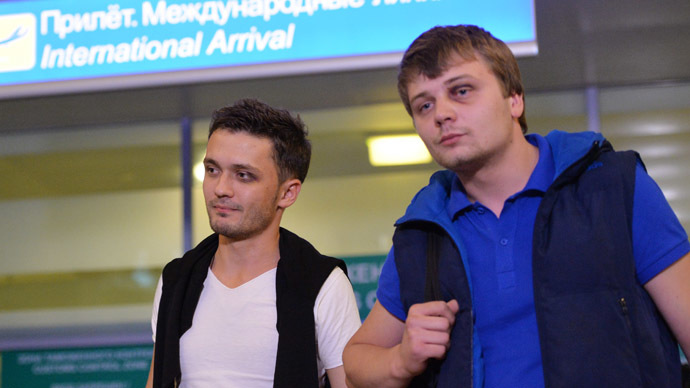
Zvezda TV channel correspondent Evgeny Davydov, left, and sound engineer Nikita Konashenkov who were detained in Dnepropetrovsk are welcomed on their arrival at Moscow’s Sheremetyevo airport after their release. (RIA Novosti/Alexey Kudenko)
Reporters from Russia’s Zvezda TV channel have been freed from captivity in Ukraine, where Right Sector fighters detained, interrogated, and beat them for ransom. Risking their lives, they didn’t turn off their phones, which was crucial for their release.
A plane carrying Evgeny Davydov and Nikita Konashenkov landed at Moscow’s Sheremetyevo Airport at 15:44 GMT on Monday. A few hours before their arrival in the Russian capital, the two journalists were handed over to Russian naval attaché Eduard Belashev in the city of Dnepropetrovsk.
The journalists spent two days in captivity, and were subjected to long questioning, intimidation, and beatings.
Recent images of the two men show the areas around their eyes covered in bruises. Their colleagues say that Davydov has complained of pain in his ear and partial hearing loss.
Zvezda TV channel has shared details of the reporters’ detention and release. The channel’s head, Aleksey Pimanov, said that Davydov and Konashenkov were freed due to “diplomatic efforts.” The station’s management sent pleas to new Ukrainian President Petro Poroshenko, the Security Service of Ukraine (SBU), and the Ukrainian judiciary demanding the journalists’ immediate release.
The Russian Foreign Ministry called the release “good news” and the “result of persistent work of all of our structures with the active participation and support of the Russian media.” Moscow says the “illegal practice of detaining journalists in Ukraine” must stop, and that the right to peaceful and objective press coverage of events in Ukraine must be safeguarded.
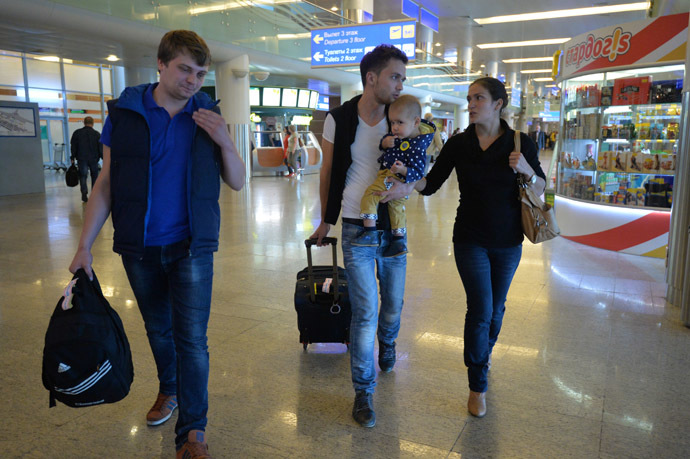
Zvezda TV channel correspondent Evgeny Davydov, center, with his family and sound engineer Nikita Konashenkov on their arrival at Moscow’s Sheremetyevo airport. (RIA Novosti/Alexey Kudenko)
The reporters were detained on June 14 while on their way to the airport. Saturday was meant to be the last day of their business trip in turbulent Ukraine and they were expected to fly home. They had been in Ukraine for over a month.
Constantly on the phone with Zvezda TV channel’s editors, Evgeny and Nikita successfully passed several checkpoints. However, they were stopped and detained at a post of the Ukrainian National Guard near Pokrovskoye, and the connection with the reporters was temporarily lost.
Zvezda journalists in Moscow launched a massive operation trying to find their colleagues. Both the Right Sector and the Ukrainian Security Service (SBU) refused to comment on the detentions.
Eventually, the channel managed to determine the address of where Evgeny and Nikita were being held. This finding showed that Right Sector fighters were behind the detention – the building is shared by the SBU and the radical group. As Zvezda journalists found out later, the man who interrogated their detained colleagues was Maksim Miroshnichenko, the Right Sector’s press secretary in Dnepropetrovsk.
During the interrogation process, the journalists kept one of their phones constantly connected to the channel’s headquarters. The recording will now be transferred to authorities, who will launch a torture case. The use of force against the reporters can be heard on the recording.
Throughout the questioning, which was full of cursing, Miroshnichenko reportedly tried to force the journalists to admit they lied about the true purpose of their visit. Under pressure, the interrogators forced the Russian crew to denounce their reporting on the use of white phosphorus by the Ukrainian military in an aerial assault on the outskirts of Slavyansk on Thursday.
After the channel managed to determine the journalists’ whereabouts, representatives of the Right Sector contacted Zvezda demanding a US$200,000 ransom for the reporters, who they called “scum.” Failure to provide the money would result in consequences, with the captors sending a message to family members that the journalists would be “kept for some 10 years.”
On Monday, a YouTube video surfaced showing Davydov and Konashenkov with bruises on their faces. In the footage, the two are seemingly being forced to say they have “no complaints” about their treatment by the Right Sector, and that the visible hemorrhages on their bodies were caused by a fight with a colleague.
Their documents also surfaced on the internet, showing they were accredited by the Central Election Commission of Ukraine. But, in violation of all norms of international law and the Geneva Convention, the reporters were forced to sign statements which falsely declared their lack of professional ethics.
“Everything is done on the orders of the Kremlin in order to use this information in international politics to the detriment of Ukraine,” Davydov’s forced statement allegedly read.
Konashenkov’s written testament apparently claimed that they covered Ukrainian roadblocks, “also on Moscow’s orders,” in order to make “untrue photographs.”
Upon their safe return to Russia, the journalists were taken to hospital for treatment. Before they boarded the ambulance, they gave a few comments to the press crew that greeted them at the airport. They thanked the Russian authorities and media channels for helping secure their release. They also briefly shared the details of their abduction.
“We were traveling from Donetsk to Dnepropetrovsk. We had a direct return flight from Dnepropetrovsk to Moscow on Saturday. About 120 km from Dnepropetrovsk, we were stopped at a roadblock. This was the National Guard’s checkpoint. They stopped us, asked us for our documents, checked all our personal possessions, examining everything,” the duo told journalists.
“Seeing our Russian passports and that we are Zvezda TV staff, their face expressions changed. They smirked and said that they have a jackpot in their hands. They abducted us, blindfolded us, and placed us in a car, before driving us somewhere to a field, then to some base. They threw us in a cellar.”
A press conference with Konashenkov and Davydov is scheduled to take place later on Tuesday.
Russian journalists from a range of media outlets have been repeatedly detained during the conflict in eastern Ukraine. Another set of Zvezda crew members were abducted two weeks ago and released after several days of interrogation on accusations of espionage. RT contributor and UK national Graham Phillips was detained for over 36 hours by Kiev military forces back in May. Earlier, two Russian journalists working for LifeNews TV channel were also captured by Kiev forces, forced on their knees at gunpoint and taken to Kiev for interrogations which lasted almost one week.
Russia now enemy, so we’ll help Ukraine build up military – NATO chief
RT | June 15, 2014
NATO is preparing a package deal to ramp up the Ukrainian military because it ‘must adapt’ to Russia viewing it as an enemy, the outgoing chief of the military bloc said.
The deal would be submitted to foreign ministers of members states later this month, NATO Secretary-General Anders Fogh Rasmussen told El Pais in an interview. He declined to go into detail, but said it provides for defense industry reform and modernization of the Ukrainian military.
The alliance may also facilitate cooperation with Ukraine over military training, although whatever exercises of NATO member troops would be held in Ukraine is up to individual countries, Rasmussen said.
“We must adapt to the fact that Russia now considers us its adversary,” he explained.
The help that NATO plans to give Ukrainian military comes as the said military are used in a bloody crackdown on the defiant eastern provinces, where local militias defend cities from daily artillery shelling and airstrikes.
Kiev regards the militias as Russia-backed terrorists and refuses any kind of negotiation with them. NATO shares the view, accusing Russia of funneling heavy weapons into Ukraine across the border, although so far no solid evidence of such actions was presented.
The alliance itself is experiencing a sort of revival playing the ‘Russian threat’ card to justify the build-up of troops in Central and Eastern Europe. Moscow sees such deployments as provocative and confirming NATO’s aggressive stance towards Russia.
NATO claims that it has been cooperating with Russia in every way until the Ukrainian crisis sparked the cold war hostilities again. It’s not quite true, considering the alliance’s expansion eastwards in Europe and its plans to deploy a system of anti-ballistic missile defense closer to Russian borders. Both have been done against Russia’s objections that such moves compromise Russian national security.
Moscow outraged at Ukraine’s National Guard for detaining 2 more Russian journalists
RT | June 14, 2014
Russia’s Foreign Ministry is demanding the immediate release of two Russian journalists detained in eastern Ukraine by the National Guard on their way to Dnepropetrovsk Airport.
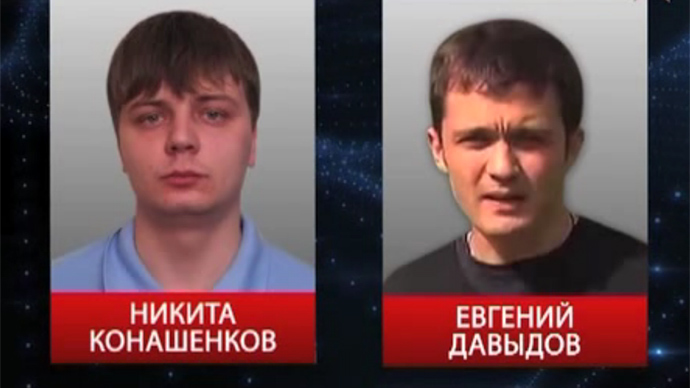
“Unidentified men” detained correspondent Evgeny Davydov and sound engineer Nikita Konashenkov at around 5 p.m. local time in the Donetsk region on Saturday, Zvezda TV channel reported. The two were on their way to Dnepropetrovsk Airport for a flight back to Moscow.
The journalists are now being held captive in the Ministry of Justice building in Dnepropetrovsk, according to Zvezda.
“Journalists of Zvezda TV channel were again detained several hours ago on the territory of Ukraine. This is the second time this week. According to our preliminary data, the guys are in the region of the city administration of Dnepropetrovsk,” said Alexey Pimenov, head of media holding company Krasnaya Zvezda.
The Russian channel is demanding that Ukrainian President Petro Poroshenko and the Ukrainian Security Service “immediately release our employees who were on an official business trip.”
The Russian Foreign Ministry also called for the release of the journalists. The ministry said the arrest was carried out by the National Guard. Moscow also slammed Ukraine for “continuing to encroach upon the rights of Russian mass media.”
Earlier in June, the National Guard detained two journalists from Zvezda – video operator Andrey Sushenkov and sound engineer Anton Malyshev – at a military roadblock near the city of Slavyansk. According to their driver, they were blindfolded and handcuffed during a routine check, and then taken to an undisclosed location. They were held captive for two days on accusations of espionage.
Russian journalists from a range of media outlets have been detained during the conflict in eastern Ukraine. Two Russian journalists working for LifeNews TV channel – reporter Oleg Sidyakin and cameraman Marat Saichenko – were captured by Kiev forces in May near the eastern city of Kramatorsk. Following their detention, a video appeared showing Ukrainian troops holding the men at gunpoint and forcing them to get down on their knees. They were investigated under charges of “aiding terrorist groups,” according to Ukraine’s National Security and Defense Council.
RT contributor and UK national Graham Phillips was detained by Kiev military forces at a checkpoint in the city of Mariupol on May 20. He was transferred to army barracks and interrogated by Ukrainian security forces. He was released after 36 hours.
There have also been reports that Ukrainian troops have fired at people with cameras, as well as people wearing press vests. On May 9, a Ruptly cameraman was seriously wounded during an armed assault by Kiev’s army on the Mariupol police headquarters.
Russia’s commissioner for human rights, Ella Pamfilova, told RT in May that she is confused by the fact that international human rights organizations are ignoring the violations of journalists’ rights that are taking place in Ukraine.
“I am perplexed and confused that the organizations highly respected by me, including international journalist and ‘Without Borders’ organizations… are suddenly bashfully closing their eyes or ignoring the rights violations of not only Russian journalists on Ukraine’s territory.”
Ukraine to halt gas imports from Russia
The BRICS Post | June 14, 2014
Ukrainian Prime Minister Arseny Yatsenyuk has ordered a halt to natural gas imports from Russia from June 16 after the two countries failed to resolve their gas price dispute, the Ukrainian government said Friday.
“By its deliberate unilateral refusal to settle the conflict, Russia has been undermining the energy security of Ukraine and the European Union,” Yatsenyuk was quoted by the government press agency.
Yatsenyuk had also instructed the country’s Justice Ministry and state-run energy company Naftogaz to complete preparations to file a lawsuit with the Stockholm arbitration court over the dispute, the press service said in a statement.
Moreover, he asked the National Regulatory Commission to set “economically justified” tariffs for the transit of Russian gas through Ukrainian territory, it said.
Earlier in the day, Naftogaz Chairman Andrey Kobolev said Kiev was ready to compromise with Russia on gas issues, offering to pay a “compromise temporary price” of $326 per 1,000 cubic meters for Russian gas deliveries for the next 18 months.
Moscow currently charges Ukraine $485, but Kiev claims a fair price would be $268.
The two sides have been locked in dispute for three years over a 2009 contract, under which they agreed to tie the price of gas to the international spot price for oil.
Maenwhile, the Russian Foreign Ministry sent a note of protest to Ukraine over alleged border violation by Ukrainian soldiers, an official statement said Friday.
“The state border was violated by armed units, as infantry fighting vehicles crossed the border. An attempt was made to defy Russian border guards’ orders,” Kremlin spokesman Dmitry Peskov said on Friday.
An infantry fighting vehicle of Ukrainian armed forces crossed the Russian state border in the Rostov region of southwestern Russia earlier in the day, according to the Itar-Tass news agency. Russian border guards detained the vehicle and its crewmen retreated. No arms was used and no casualties reported.
An investigation is underway although Kiev is yet to respond to the Russian reports.
Featured Video
No Vote, No Representation, No State: Democracy, Israeli Style
or go to
Aletho News Archives – Video-Images
From the Archives
Sanctions, War and the Policy of Dual Containment
By SASAN FAYAZMANESH | March 17, 2008
It is now nearly three decades since the Unites States adopted the policy of dual containment of Iran and Iraq. While much has been written about the containment of Iraq, there has been very little in-depth analysis of this policy when it comes to Iran. In a book that is going to be released on March 31, 2008, entitled The United States and Iran: Sanctions, Wars and the Policy of Dual Containment (Routledge), I attempt to address this shortcoming by investigating when and why the US policy of containment of Iran came about, how it evolved, and where it stands today.[1] To the extent that Israel has been involved in US policy making, the study will also include the role that Israel has played in the containment of Iran. Also, since the fate of Iran has been inextricably linked to that of Iraq, occasionally the investigation will overlap with the containment of Iraq.
The policy of dual containment of Iran and Iraq originated during the Carter Administration, but it was not until the Clinton Administration that the expression “dual containment” became popular. … continue
Blog Roll
 Aletho News
- Europe’s Establishment Is Embracing War – and Losing Voters
- NATO chief advocates war of aggression
- No Vote, No Representation, No State: Democracy, Israeli Style
- Zionist Bought Senate Blocks Information About American Citizens Killed By Israel
- While Gaza dominates the UN, these are the people keeping it alive
- New Report: “Scholasticide and Genocide in Gaza: Assessment, Testimonies and Legal Analysis”
- ‘THAAD Delusion’: Iran war exposes US missile shield limits – The Atlantic
- Moscow issues warning to NATO over Russian exclave
- Yes, the Iran war has destroyed Trump’s presidency
- The fallacy of US delusions about Iran’s economic collapse
- If Americans Knew
- Mamdani releases plan to combat antisemitism and hate crimes in New York City
- Iran’s Revolutionary Guards Publish Letter to the American People
- DMFI launches $1 million ad campaign supporting Virginia’s Elaine Luria
- US Senate blocks resolution seeking report on Americans killed by Israel
- Israeli Attacks Kill Ten Palestinians in Gaza
- Massacre at Minab: The School That Became a Grave
- Israeli media: The IDF Shows It Doesn’t Turn a Blind Eye; It Actively Emboldens Settler Havoc
- As settlers ravage West Bank, Israeli forces kill 10 in Gaza – Daily Update
- New Report: “Scholasticide and Genocide in Gaza: Assessment, Testimonies and Legal Analysis”
- Ex-Biden officials are desperate for a Gaza scapegoat
- No Tricks Zone
- Green Energy Debacle: German Expert Professor Fritz Vahrenholt Warns Of Severe Economic And Social Consequences
- Two More Paleo Reconstructions Affirm Meters-Higher Sea Levels Across Ireland, Brazil 7000-6000 Years Ago
- New Study: Earth And Venus Surface Warmth Largely Explained By Convection And Lapse Rate, Not CO2 Or Radiation
- 2025 Nature Paper Claiming Worsening Global Drought Gets RETRACTED …Heavily Flawed
- New Study: ‘Global Drought Shows No Detectable Recent Acceleration Under Climate Warming’
- Economic Masterminds: German Socialists Suggest Taxing Productivity Gains Stemming From Using AI
- The South China Sea Has Not Been Cooperating With The Climate Change Narrative
- Energy Crisis: Germany Enters Heating Season With Historically Low Gas Reserve Fill Levels
- New Study: The Antarctic Ice Sheet Gained Mass From 2020-2024 Due To Staggering Snow And Ice Accumulation
- Study: Ocean Heating Rates From Thousands Of Years Ago ‘Dwarf’ Modern Ocean Heating Rates

