Kiev deployed powerful surface-to-air missile systems to E. Ukraine ahead of the Malaysian plane crash – reports
RT | July 17, 2014
The Ukrainian military reportedly deployed a battery of Buk surface-to-air missile systems, capable of bringing down high-flying jets, to the Donetsk region the day before the Malaysian passenger plane crashed in the area.
Itar-Tass and Interfax news agencies are citing a source familiar with the issue, who said that another battery of Buk systems is currently being prepared for shipment to Donetsk region from the Ukrainian city of Kharkov.
The Donetsk region remains the scene of heavy fighting between government troops and the forces of the opposition, which refused to recognize the regime change in Kiev and demand federalization.
A Malaysian Airlines aircraft en route from Amsterdam to Malaysia crashed in Eastern Ukraine – not far from the Russian border – on Thursday.
There were reportedly 280 people and 15 crew members on board the Boeing-777 plane, who reportedly all died in the crash.
There were unconfirmed reports the Malaysian plane was travelling at an altitude of over 10,000 meters when it was allegedly hit by a missile.
There’s no way that the self-defense forces in Donetsk Region are in possession of such complex weaponry, he stressed.
Only S-300 and Buk surface-to-air missile systems are capable of hitting targets at such altitude, the source said.
Buk (Blume) is a family of self-propelled, medium-range surface-to-air missile systems developed by the former USSR and Russia to engage targets at an altitude of up to 30 kilometers.
Chances are high that the Malaysian plane was really downed by the Ukrainian anti-aircraft defense, Yury Karash, pilot and aviation expert, told RT.
“A Boeing-777 is an extremely reliable piece of machinery. Modern planes don’t just crash with no reason,” he said. “Let us recall how a Ukrainian missile downed Russian TU-154 aircraft ten years ago. I can’t completely exclude the possibility the Boeing-777 was also hit by a missile.”
“I don’t know who could’ve shot it down. But I can allege that it was most likely the Ukrainian armed forces: simply because its military – anti-aircraft defense, in particular – are, unfortunately, unqualified. As judging by the overall state of the Ukrainian armed forces, insufficient attention has been paid to their training,” Karash added.
Reports in the Western media hurried to blame the self-defense forces of the People’s Republic of Donetsk for bringing the plane down.
The claims were denied by the representatives of the Donetsk People’s Republic, saying that it’s the Ukrainian military, which destroyed the aircraft.
“We simply don’t have such air defense systems. Our man-portable air defense systems have a firing range 3,000 – 4,000 meters. The Boeing was flying at a much higher altitude,” Sergey Kavtaradze, special representative for the prime minister of the Donetsk People’s Republic, explained.
Kavtaradze also expressed condolences to the relatives of all of those who lost their lives in the tragedy.
E. Ukraine open to ‘any dialogue’, wants to stop war ASAP – opposition leader
RT | July 16, 2014

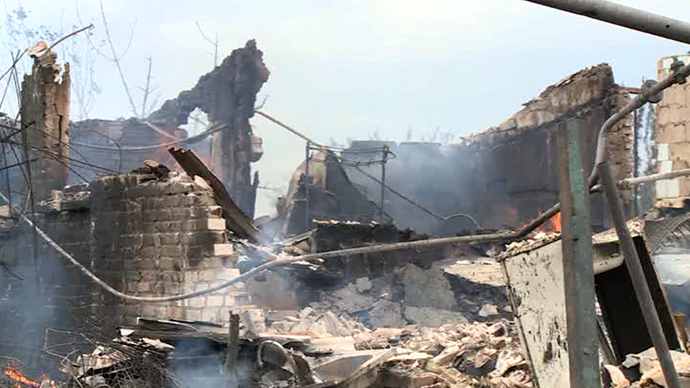
A local resident near a house destroyed in the Ukrainian army’s artillery attack on Lugansk.(RIA Novosti / Mikhail Voskresenskiy)
Eastern Ukraine leaders want to stop war as soon as possible and are open to any dialogue, Donetsk People’s Republic PM Aleksandr Boroday said. He denied that they “ignored” a video conference with the Kiev side and mediators as reported by the OSCE.
Earlier on Wednesday one of Donetsk People’s Republic’s Vice Premiers reached an agreement with the OSCE mission about consultations via video link to be held on July 17, he added.
“I hope that they [consultations] will really take place. The format of these consultations we will discuss tonight [Wednesday night],” Aleksandr Boroday told Rossiya-1 TV channel.
“Literally an hour ago one of the representatives of our government, vice-PM Andrey Purgin, visited the OSCE mission and reached an agreement to hold this kind of consultation, not negotiations, I stress, tomorrow, possibly, in a videoconference format,” Boroday said.
Purgin has confirmed to Rossiya-24 TV that the talks will take place on Thursday. He said that he is going to represent Donestk region and Aleksey Koryakin, Chairman of the Supreme Council, will be taking part on behalf of Lugansk region.
Earlier, on July 15, the OSCE said that a video conference, involving opposition and the contact group, scheduled for that day “did not materialize”. The organization voiced concerns “about the fact that since June 27 [second round of trilateral consultations], no such consultations have taken place.”

Prime Minister of the Donetsk People’s Republic Alexander Boroday.(RIA Novosti / Mikhail Voskresenskiy)
The Trilateral Contact Group involves senior representatives of Ukraine, the Russian Federation and OSCE members.
However, leaders of Lugansk and Donetsk say that they were not informed about the consultations and only learned about it from the OSCE’s statement that post factum accused them of ignoring the conference.
“We are really open to any kind of dialogue. Yes, we have significant military success, but with all that we really want to stop the war as soon as possible,” Boroday said.
But Boroday claims that Kiev has made no attempt to organize talks or consultations with the opposition in the east.
“OSCE representatives, some journalists and public men called me – everyone wanted to know when those consultations would take place,” he says. “But, actually, there were no attempts from Kiev to [organize] talks or consultations. I personally called Mr. Medvedchuk [leader of “Ukrainian Choice” political organization] and asked if there were going to be any kind of consultations. He said he was himself reading about that in newspapers.”
On June 27, the second round of trilateral consultations on implementing Ukrainian President Petro Poroshenko’s plan to restore peace to Ukraine’s south eastern regions took place.
The second round of consultations, followed the similar meeting between Ukrainian, Russian and OSCE representatives in Donetsk on June 23, when peaceful settlement of the conflict was discussed. The meeting was also attended by the former president of Ukraine Leonid Kuchma and aimed at defining stages of a peace plan.
Ukraine to use science funding for weapons production – Poroshenko
RT | July 9, 2014
 Ukrainian President Petro Poroshenko said he will reduce the country’s “useless” science programs to finance the production of drones and precision weapons.
“There will be no more spending of billions of people’s money, taxpayers’ money on useless research programs, which were used as a tool for theft,” said a statement published on the president’s website early on Wednesday.
“Today, Ukrainian production will be busy making precision weapons systems, Ukrainian drones, everything Ukrainian army needs, starting with bullet proof vests and ending with thermographic cameras,” he said.
The president added that the army’s experience in fighting against self-defense forces in the east of the country will be used when making production decisions.
The Ukrainian military has been fighting against anti-Kiev forces in the east since April.
Some of the latest developments include Ukrainian President Petro Poroshenko confirming plans to “liberate” the eastern cities of Lugansk and Donetsk, the two biggest towns in the country’s east controlled by self-defense forces.
Last week, the army shelled the village of Kondrashovka, killing 12 civilians including a five-year-old.
Same old, same old: New Ukraine prosecutor wants Maidan activists dispersed
RT | July 9, 2014
Hundreds of activists on Kiev’s Maidan must leave and free seized buildings, Ukraine’s prosecutor general has said. He urged law enforcers to intervene and did not rule out forceful eviction from Independence Square, if activists show resistance.
Security forces will be authorized to take measures if activists do not leave the city center “today, tomorrow or in the near future,” Vitaly Yarema, the prosecutor general, said at a briefing on Wednesday.
“I am appealing to the interior minister and the head of the [Ukrainian Security Service] SBU to take urgent measures. I demand that captured buildings be immediately vacated,” Yarema said. He added that in case those demands are not met, “criminal responsibility will follow” as the seizing of buildings is a crime.
“They want to turn the symbol of the revolution into a caricature,” he added.
Kiev’s Independence Square was the main protester hotspots where pro-EU activists have been demonstrating since November 21, 2013. While the majority of activists left, there are up to 1,000 people still on Maidan, according to Kiev’s newly-elected mayor, Vitaly Klitschko.
The prosecutor general said that law-enforcement bodies should take measures to restore order in the capital’s central districts as crime there was getting worse.
There are 19 buildings, including administrative offices and hotels, which remain under the protesters’ control. According to Yarema’s information, nearly 500 activists are living in the seized offices.
“Instead of protecting the country, defending its independence in the East or working for the country’s benefit, imposters are engaged in direct extortion and banditry,” he said.
On Wednesday, it was reported that over 60 pieces of art worth $185,000 had gone missing from the Ukrainian Museum of National History, which is in the Ukrainian house, international exhibition and convention center. This building is currently in the control of the activists
When asked about the possibility of using force while evicting the so-called euromaidan encampment, Yarema replied: “The option of force is possible. If there is armed resistance, police officers have the right to use their weapons.”
At the same time, he assured journalists that “there will be no confrontation” and people would only be detained if they offer resistance to police.
Responding to the prosecutor general’s demands, Vitaly Klitschko said the use of force is “an extreme” measure, which he had never considered.
“The forcible dispersal of Maidan, I am sure, can only be an extreme step. I do not consider this and never have. I am sure that we need to communicate so that people leave,” he said.
Klitschko agreed that activists should leave so at least traffic could be restored along the city’s main Khreschatyk Street.
He stressed that he has been receiving “a large number” complaints filed by Kiev residents because the “blockade of the main artery of the center of Kiev, Khreschatyk, is paralyzing the work of the entire city.”
Moreover, gunshots and explosions can be heard coming from the encampment from time to time.
Kiev’s authorities have suggested that Maidan activists leave the city’s main square and move to some location outside Kiev. However, this proposal was rejected.
Klitschko said that a joint decision on “eviction of Maidan” will be taken in the coming weeks.
Elected Kiev’s mayor back in May, Klitschko has so far failed to reach any agreement with activists occupying Maidan.
One of Klitschko first public statements after securing his post was a call for them to leave.
“The key goal of the Maidan – ousting the dictator – has been reached, so the barricades should be dismantled,” he said back in May.
However, Klitschko’s call provoked mass protests as activists criticized Klitshchko for not taking into account their opinion on whether Maidan should be dismantled or not.
They threatened to start “a third Maidan” (following the 2004 protest during the “orange revolution” and the second one in November 2013-February 2014), unless the order to dismantle the barricades in the Ukrainian capital is rescinded.
That was when Vitaly Klitschko quickly changed his rhetoric, saying that Maidan should itself determine its future.
US defends Kiev’s use of airstrikes
RT | July 8, 2014
The US State Department has defended Kiev’s right to use airstrikes against civilians in eastern Ukraine explaining that it is defending the country.
“The government of Ukraine is defending the country of Ukraine and I think they have every right to do that as does the international community,” State Department spokeswoman Jen Psaki said in response to RT’s Gayane Chichakyan’s question about Ukrainian air force strikes in eastern Ukraine.
“The people of Ukraine have the right to live in peace and security without Russian-backed separatists attacking their homes and going into buildings and I think that is where the root cause of this is and we shouldn’t forget that fact,” Psaki added during the briefing on Monday.
Despite the horrific footage of eastern Ukrainian villages and towns being shelled by the Ukrainian air force, the State Department continues to stand behind Kiev’s actions, saying that all those killings are the fault of anti-Kiev forces.
“To be clear, on the ground the reports that we’ve seen and the vast majority of people who are reporting from the ground are reporting that the Russian-backed separatists are the ones who are not only engaged in violence and efforts to take over buildings and attack people and innocent civilians and they have no place doing that in a country that is a sovereign country like Ukraine.”
Just last week, 12 civilians were killed including a five-year old in the eastern Ukrainian village of Kondrashovka, which was shelled by Kiev troops. At least five shells hit the settlement, destroying an entire street in the peaceful Lugansk region community, 25km from the city of Lugansk.
Aside from approving Kiev’s actions, the US State Department denied reports on the number of refugees fleeing the conflict in eastern Ukraine to Russia, including UN’s statistics.
UN High Commissioner for Refugees (UNHCR) stated that the number of Ukrainian refugees in Russia has reached 110,000 people, while 54,400 others have been internally displaced. In response, the State Department’s spokesperson Maria Harf said she cannot confirm this data, and thus can’t consider it reliable.
NATO arming Ukraine with Soviet weapons
RT | July 4, 2014
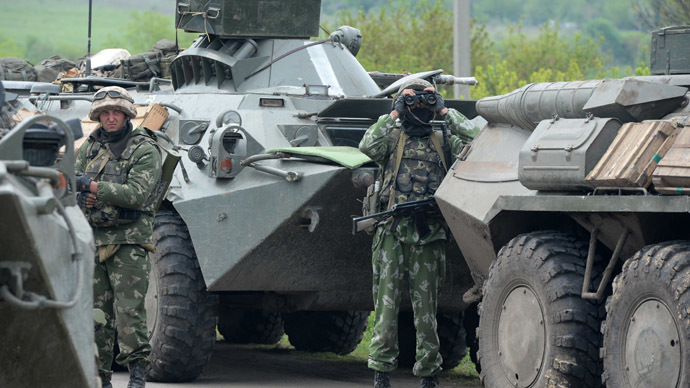
NATO’s newest Eastern European members are handing over their Soviet arms stockpiles to the Ukrainian army, Russia’s Deputy PM Dmitry Rogozin says, adding that the alliance is in danger of pouring gasoline on the flames of that country’s civil war.
Rogozin, who supervises the Russian military industry, has tweeted that NATO is asking its newest members to get rid of operable Soviet military equipment and send it to Ukraine, to aid the miserable state of the country’s military hardware.
“In turn, the US is ready to compensate for the “losses” of the newly co-opted NATO member states. The American military-industrial complex must be happy,” Rogozin wrote in his Twitter account.
“By the way, this is NATO’s commonplace to put out civil wars’ fire with aviation kerosene,” Rogozin added.
Over the months of Ukraine’s hot political crisis, NATO member states, primarily the US, announced they are planning non-lethal aid to Ukrainian troops, supplying uniforms and tents, and even promising to deploy a number of military instructors to train the Ukrainian army to fight the adherents of federalization of the country in Eastern Ukraine.
Political commentator Mikhail Rostovsky told RIA Novosti news agency that the “US and EU are thinking not about Ukraine but about the neutralization of Russia.”
Rostovsky compared the current policies of the European and American leaders with that of British PM Margaret Thatcher and French President François Mitterrand towards the reunification of East and West Germany in 1990.
Speaking loudly about “the European choice for Ukraine,” the EU and US politicians are essentially seeking ways to drive a wedge between Moscow and Kiev to neutralize what they regard as Russia’s possible “imperial ambitions,” Rostovsky said. “We’re dealing with politics dictated by fear: God forbid the Kremlin’s imperial instincts got awakened! This is a matter of principle to deny the Kremlin such an opportunity and break Ukraine away from Russia.”
Rostovsky said he fully agreed with German Foreign Minister Frank-Walter Steinmeier, who told Der Spiegel in late April that Europe has slid “into the worst crisis since the end of the Cold War.”
“Those who can remember the fall of the Berlin Wall know what we’ve accomplished over the past 25 years. The gains we’ve made almost everywhere in Europe in terms of peace, freedom and prosperity are now at risk,” Steinmeier said, adding that that it was important to take “every measure to prevent things [in Ukraine] from getting worse.”
Putin to West: Stop turning world into ‘global barracks,’ dictating rules to others
RT | July 1, 2014
Russia’s president has blamed the turmoil in Ukraine on the country’s newly-elected leader Petro Poroshenko. Vladimir Putin also criticized the West for its intention to turn the planet into a “global barracks.”
Russia’s president has laid the blame for the ongoing turmoil between Kiev and south-eastern regions squarely at the feet of Petro Poroshenko, after the Ukrainian leader terminated the ceasefire.
He has stressed that Russia and European partners could not convince Poroshenko to not take the path of violence, which can’t lead to peace.
“Unfortunately, President Poroshenko has made the decision to resume military actions, and we – meaning myself and my colleagues in Europe – could not convince him that the way to reliable, firm and long-term peace can’t lie through war,” Putin said. “So far, Petro Poroshenko had no direct relation to orders to take military action. Now he has taken on this responsibility in full. Not only military, but also political, more importantly.”
On Monday, the leaders of Russia, France, Germany and Ukraine held a phone call in which Putin stressed the need to prolong the ceasefire and the creation of “a reliable mechanism for monitoring compliance with it and the OSCE [Organization for Security and Cooperation in Europe] should play an active role.”
Russia offered that checkpoints on the Russian side should be monitored by representatives of the Ukrainian Border service as well as OSCE observers for “the joint control of the border.”
As the violent conflict continues in the east of Ukraine and the number of refugees fleeing to Russia grows, Putin vowed to provide help to everyone who needs it.
“Everything that’s going on in Ukraine is of course the internal business of Ukrainian government, but we are painfully sorry that people die, civilians,” Putin said. He added that the killing of journalists was “absolutely unacceptable.”
“In my opinion, there is a deliberate attempt to eliminate representatives of the press going on. It concerns both Russian and foreign journalists,” the president said.
Speaking in front of ambassadors on Tuesday, Putin expressed hope that Western partners will stop imposing their principles on other countries.
“I hope pragmatism will still prevail. The West will get rid of ambitions, pursuits to establish a ‘world barracks’ – to arrange all according to ranks, to impose uniform rules of behavior and life of society,” Putin said.
“I hope the West will start building relations based on equal rights, mutual respect and mutual consideration of interests.”
Putin recalled the situation with France and the delivery of the Mistral-class ships that was agreed between Moscow and Paris, but was jeopardized in March.
“We know about the pressure that our American partners put on the French so that they would not deliver the Mistral [ships] to Russia,” Putin said. “And we know that [they] hinted that if the French don’t deliver Mistral, sanctions on banks will be gradually removed, or at least minimized. What is this, if not blackmail?”
Russia is ready to have dialogue with the US only on the basis of equality, Putin added.
“We are not going to stop our relations with the US. The bilateral relations are not in the best shape, that is true. But this – and I want to emphasize – is not Russia’s fault,” he told diplomats.
Speaking about international relations, Putin stressed that Russia always tried to be “predictable, to do business on an equal basis”, however, in return, its interests were quite often ignored.
Cameraman for Russia’s top broadcaster killed in E. Ukraine
RT | June 29, 2014
A cameraman for Russia’s Channel One TV station died from injuries after being shot by Kiev troops in the eastern Ukrainian city of Donetsk, said the broadcaster’s press service.
“Our colleague Anatoly Klyan died tonight… he was fatally wounded in the stomach. He was 68-years-old,” Channel One said on air.
Klyan, along with a few other journalists, boarded a bus full of women – mostly mothers – who were traveling to a military base in Donetsk to demand that their sons be dismissed from the unit and allowed to go home, Kulbatskaya added.
When the bus reached its destination, shots were fired from the base and that is when the cameraman was injured.
 Klyan died in the ambulance on the way to the hospital, DNR’s First Deputy Prime Minister Andrey Purgin told RIA Novosti, adding that the driver of the bus was wounded in the neck and is currently in hospital.
A crew from Channel One confirmed to RT’s Maria Finoshina – currently in Lugansk – that Klyan was, in fact, shot and killed.
“We have been able to speak with these journalists and they called their colleagues in Donetsk and this information is now confirmed,” Finoshina said.
She described the victim filming with his crew at one of the military bases in Donetsk when the shooting took place.
“We know the journalists finished their work and they were smoking cigarettes at the moment when suddenly shooting started. It is very hard to say exactly who was firing, but we hear information that this particular bus and its passengers were targeted,” she said.
“The bus that was also carrying the mothers of self-defense fighters. They were heading towards this military base currently controlled by the Ukrainian military to start negotiations over their sons.”
Another team of Russian journalists also came under attack on Sunday. A LifeNews crew was fired at near a Donetsk military base, Kulbatskaya said. Their car was fired at from a grenade launcher. No one was injured in the attack.
The ceasefire between Kiev and self-defense forces in eastern Ukraine expires at 22:00 (19:00 GMT) on Monday.
Journalists under attack
This latest death comes after a number of journalists were killed during the coverage of events in eastern Ukraine.
Earlier in June, Rossiya TV journalist Igor Kornelyuk and his colleague, sound engineer Anton Voloshin, were killed in shelling. They were the first Russian journalists to die while on professional duty in Ukraine, since the coup in Kiev and the beginning of civil unrest in eastern regions began.
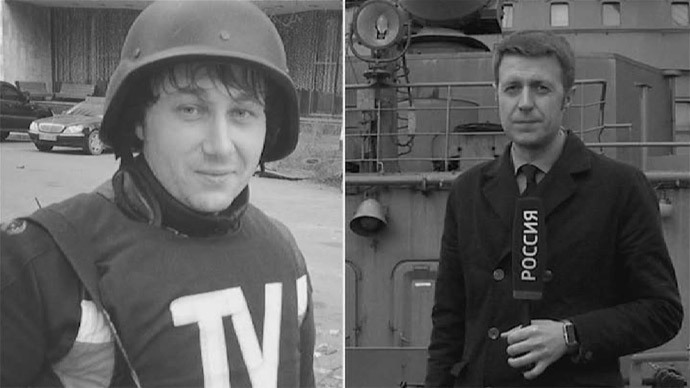
Rossiya TV journalist Igor Kornelyuk (R) and sound engineer Anton Voloshin (L)
They were working on a report covering Ukrainian refugees fleeing the town of Metallist in Lugansk region when they were hit with mortar shells.
There have also been numerous cases where journalists have been attacked, shot at, and detained while reporting on the crisis in eastern Ukraine.
For example, on June 16 a group of journalists came under fire while reporting from Slavyansk’s outskirts. One of the journalists was Ruptly correspondent Andrey Krasnoshchyokov.
On June 14, Zvezda TV channel said two of its journalists had been detained.
A Channel One crew was also fired at on June 11 while covering events in the village of Semenovka, located near Slavyansk.
In another incident, RT contributor and UK national Graham Phillips was detained by Kiev military forces at a checkpoint in the city of Mariupol on May 20. He was transferred to army barracks and interrogated by Ukrainian security forces. He was released after 36 hours.
Fedor Zavaleykov, a 23-year-old Ruptly cameraman, was wounded during fighting in Mariupol on May 9.
War is Our Business and Business Looks Good
By Edward S. Herman | Z Magazine | June 28, 2014
It is enlightening to see how pugnacious the U.S. establishment, led by the Peace Laureate, has been in dealing with the Ukraine crisis. The crisis arguably began when the Yanukovich government rejected an EU bailout program in favor of one offered by Russia. The mainstream media (MSM) have virtually suppressed the fact that the EU proposal was not only less generous than the one offered by Russia, but that whereas the Russian plan did not preclude further Ukrainian deals with the EU the EU plan would have required a cut-off of further Russian arrangements. And whereas the Russian deal had no military clauses, that of the EU required that Ukraine affiliate with NATO. Insofar as the MSM dealt with this set of offers they not only suppressed the exclusionary and militarized character of the EU offer, they tended to view the Russian deal as an improper use of economic leverage, “bludgeoning,” but the EU proposal was “constructive and reasonable” (Ed., NYT, Nov. 20, 2014). Double standards seem to be fully internalized within the U.S. establishment.
The protests that ensued in Ukraine were surely based in part on real grievances against a corrupt government, but they were also pushed along by rightwing groups and by U.S. and allied encouragement and support that increasingly had an anti-Russian and pro-accelerated-regime-change flavor. They also increased in level of violence. The sniper killings of police and protesters in Maidan on February 21, 2014 brought the crisis to a new head. This violence overlapped with and eventually terminated a negotiated settlement of the struggle brokered by EU members that would have ended the violence, created an interim government and required elections by December. The accelerated violence ended this transitional plan, which was replaced by a coup takeover, along with the forced flight of Victor Yanukovich.
There is credible evidence that the sniper shootings of both protesters and police were carried out by a segment of the protesters in a false-flag operation that worked exceedingly well, “government” violence serving as one ground for the ouster of Yanukovich. Most telling was the intercepted phone message between Estonia’s Minister of Foreign Affairs Urmas Paet and EU Foreign Policy chief Catherine Upton in which Paet regretfully reported compelling evidence that the shots killing both police and protesters came from a segment of the protesters. This account was almost entirely suppressed in the MSM; for example, the New York Times never mentioned it once through the following two months. It is also enlightening that the protesters at Maidan were never called “militants” in the MSM, although a major and effective segment was armed and violent—that term was reserved for protesters in Eastern Ukraine, who were commonly designated “pro-Russian” as well as militants.
There is also every reason to believe that the coup and establishment of a right wing and anti-Russian government were encouraged and actively supported by U.S. officials. Victoria Nuland’s intercepted “fuck the EU” words express her hostility to a group that, while generally compliant and subservient, departed from neocon plans for a proper government in Kiev headed by somebody like “Yats.” So she would surely have been pleased when the EU-supported February compromise plan was ended by the violence and coup. The U.S. support of the coup government has been enthusiastic and unqualified, and whereas Kerry and company delayed recognition of the elected government of Maduro in Venezuela, and have strongly urged him to dialogue and negotiate with the Venezuelan protesters—in fact, threatening him if he doesn’t — Kerry and company have not done the same in Ukraine where the Kiev government forces have slowly escalated their attacks on the Eastern Ukraine, but not on “protesters,” only on “militants!”
The Kiev government’s military is now using jets and helicopters to bomb targets in the East and heavy artillery and mortars in its ground operations. Its targets have included hospitals and schools, and as of June 8 civilian casualties have been in the hundreds. A dramatic massacre of 40 or more pro-Russian protesters in Odessa on May 2 by a well-organized cadre of neo-Nazi supporters, possibly agents of the Kiev government, was an early high point in this pacification campaign. No investigation of this slaughter has been mounted by the Kiev government or “international community” and it has not interfered in the slightest with Western support of Kiev. In parallel the MSM have treated it in very low key. (The New York Times buried this incident in a back page continuation of a story on “Deadly Clashes Erupt in Ukraine,” May 5, which succeeds in covering up the affiliation of the killers.) Kerry has been silent, though we may imagine his certain frenzy if Maduro’s agents had carried out a similar action in Venezuela. Recall the “Racak massacre,” where the deaths of 40 alleged victims of the Serb military created an international frenzy; but in that case the United States needed a casus belli, whereas in the Odessa case there is a pacification war already in process by a U.S. client, so MSM silence is in order.
It is an interesting feature of media coverage of the Ukraine crisis that there is a regular focus on alleged or possible Russian aid, control of and participation in the actions of the protesters/militants/insurgents in Eastern Ukraine. This was evident in the Times’s gullible acceptance of a claim that photos of insurgents included a Russian pictured in Russia, later acknowledged to be problematic (Andrew Higgins, Michael Gordon and Andrew Kramer, “Photos Link Masked Men in East Ukraine to Russia,” NYT, April 20, 2014); and in another lead article which was almost entirely speculation (Sabrina Tavernise, “In Ukraine Kremlin Leaves No Fingerprints,” NYT, June 1, 2014.). But this interest in foreign intrusion in Ukraine affairs, with the implication of wrong-doing, does not extend to evidence of U.S. and other NATO power aid and control. Visits by Biden, Cain, Nuland and intelligence and Pentagon figures are sometimes mentioned, but the scope and character of aid and advice, of U.S. “fingerprints,” is not discussed and seems to be of little interest. It is, in fact, normalized, so that as with the aid plans in which Russian proposals are “bludgeons” but U.S.-EU plans are “constructive and reasonable” the double standard is in good working order here as well.
Isn’t there a danger that Russia will enter this war on behalf of the pro-Russian majority of the eastern part of Ukraine now under assault? Possibly, but not likely, as Putin is well aware that the Obama-neocon-military-industrial complex crowd would welcome this and would use it, at minimum, as a means of further dividing Russia from the EU powers, further militarizing U.S. clients and allies, and firming up the MIC’s command of the U.S. national budget. Certainly there are important forces in this country that would love to see a war with Russia, and it is notable how common are political comments, criticisms and regrets at Obama’s weak response to Russian “aggression” (e.g., David Sanger, “Obama Policy Is put to Test: Global Crises Challenge a Strategy of Caution,” NYT, March 17, 2014). But so far Putin refuses to bite.
In response to this pressure from the powerful war-loving and war-making U.S. constituencies, Obama has been furiously denouncing Russia and has hastened to exclude it from the G-8, impose sanctions and penalties on the villain state, increase U.S. troops and press military aid on the near-Russia states allegedly terrified at the Russian threat, carry out training exercises and maneuvers with these allies and clients, assure them of the sacredness of our commitment to their security, and press these states and major allies to increase their military budgets. One thing he hasn’t done is to restrain his Kiev client in dealing with the insurgents in eastern Ukraine. Another is engaging Putin in an attempt at a settlement. Putin has stressed the importance of a constitutional formation of a Ukraine federation in which a still intact Ukraine would allow significant autonomy to the Eastern provinces. There was a Geneva meeting and joint statement on April 17 in which all sides pledged a de-escalation effort, disarming irregulars, and constitutional reform. But it was weak, without enforcement mechanisms, and had no effect. The most important requirement for de-escalation would be the termination of what is clearly a Kiev pacification program for Eastern Ukraine. That is not happening, because Obama doesn’t want it to happen. In fact, he takes the position that it is up to Russia to curb the separatists in East Ukraine, and he has gotten his G-7 puppies to agree to give Russia a deadline to do this, or face more severe penalties.
This situation calls to mind Gareth Porter’s analysis of the “perils of dominance,” where he argued that the Vietnam war occurred and became a very large one because U.S. officials thought that with their overwhelming military superiority North Vietnam and its allies in the south would surrender and accept U.S. terms—most importantly a U.S. controlled South Vietnam—as military escalation took place and a growing toll was imposed on the Vietnamese (see his Perils of Dominance: Imbalance of Power and the Road to War in Vietnam). It didn’t work. In the Ukraine context the United States once again has a militarily dominant position. On its own and through its NATO arm it has encircled Russia with satellites established in violation of the 1990 promise of James Baker and Hans-Dietrch Genscher to Mikhail Gorbachev to not move eastward “one inch,” and it has placed anti-missile weapons right on Russia’s borders. And now it has engineered a coup in Ukraine that empowered a government openly hostile to Russia and threatening both the well-being of Russian-speaking Ukrainians and the control of the major Russian naval base in Crimea. Putin’s action in reincorporating Crimea into Russia was an inevitable defensive reaction to a serious threat to Russian national security. But it may have surprised the Obama team, just as the Vietnamese refusal to accept surrender terms may have surprised the Johnson administration. Continuing to push the Vietnamese by escalation didn’t work, although it did kill and injure millions and ended the Vietnamese alternative way. Continuing and escalating actions against Russia in 2014 may involve a higher risk for the real aggressor and for the world, but there are real spinoff benefits to Lockheed and other members of the MIC.
Who Violated Ukraine’s Sovereignty?
By Ray McGovern | Consortium News | June 28, 2014
Did Russia’s annexation of Crimea on March violate the 1994 Budapest agreement among Ukraine, Russia, Great Britain and the U.S.? Specifically, in Paragraph One, Ukraine agreed to remove all nuclear weapons from its territory in return for a commitment by Russia, Britain and the U.S. “to respect the independence and sovereignty and existing borders of Ukraine?”
I’m no lawyer, but I can read the words. And, taken literally, the answer seems to be Yes – despite a host of extenuating circumstances that can be adduced to explain why Crimea rejoined Russia, including the alarm among Crimean leaders over the unconstitutional ouster of Ukraine’s elected president and the Russian government’s fear about the possible berthing of NATO’s nuclear-missile warships at the naval base at Sebastopol.
But there’s also the item in Paragraph Three in which Russia, the UK, and the U.S. also commit “to refrain from economic coercion designed to subordinate to their own interest the exercise by the Ukraine of the rights inherent in its sovereignty.”
Might the EU’s take-it-or-leave-it proposal last fall offering Ukraine “associate” status in return for draconian economic austerity imposed on the Ukrainian people come under the rubric of the “economic coercion” prohibited at Budapest? An arguable Yes, it seems to me.
Some will try to dismiss President Viktor Yanukovych’s ill-fated rejection of these International Monetary Fund demands to make the hard lives of average Ukrainians even harder as “history,” now that the EU and Ukraine’s replacement President Petro Poroshenko signed on June 27 that “associate” status agreement – the same agreement that Yanukovich rejected in favor of what appeared to be a better deal from Russia.
Was Yanukovich also under pressure from Moscow to maintain Ukraine’s historic, cultural and economic ties to Russia? Of course. Putin reportedly weighed in heavily with Yanukovich last October and early November when U.S. and EU diplomats were pressuring the Ukrainian president as well.
But did Yanukovich expect to be overthrown if he opted for Moscow’s offer? If he did not, he sorely underestimated what $5 billion in U.S. “democracy promotion” can buy. After Yanukovych’s decision, American neoconservatives – the likes of National Endowment for Democracy President Carl Gershman and Assistant Secretary of State for European Affairs Victoria Nuland – pulled out all the stops to enable Ukraine to fulfill what Nuland called its “European aspirations.”
The central problem confronting Ukraine, however, was not whether it leaned toward Europe or toward Russia. It was that after the collapse of the Soviet Union in 1991, some ruthless businessmen used their insider connections to snap up (or “privatize”) the natural and industrial resources of the country. These handful of “oligarchs” then corrupted the political process, buying off politicians from both pro-EU and pro-Moscow perspectives.
Last fall, Yanukovych, who was elected from a political base in the more industrial Russian-ethnic east, was looking for how to bail Ukraine out of the financial and economic crisis that it was facing amid widespread unemployment and the hangover from the Great Recession.
In a layman’s way of understanding what happened in Ukraine, Yanukovych issued what in the consulting world is called a Request for Proposal (RFP), i.e., a feeler to see who could offer the most promising plan for helping Ukraine escape insolvency. After initially tilting toward the EU proposal (before he learned of its draconian IMF small print), he later shifted to the less onerous offer from Russia.
In the world of contractors and RFPs, there are orderly procedures for firms whose bids are turned down to contest the selection of the eventual winner. But I know of no case where one of the losing firms turned around and violently removed the leadership of the RFP-issuing institution, installed new leadership and got the contract.
Abortive Feb. 21 Agreement
And, in assessing which side – the U.S./EU or Russia – is in the wrong on Ukraine, there was also the agreement, facilitated on Feb. 21 by the foreign ministers of Poland, Germany and France, in which then-President Yanukovich acceded to demands from the opposition by accepting limits on his powers and agreeing to early elections to vote him out of office.
Yanukovych also fatefully agreed to pull back the police, opening the way for right-wing militias, including neo-Nazis, to seize government buildings and force Yanukovych and his government officials to flee for their lives. With these paramilitary forces patrolling government offices, what was left of the Parliament voted to replace Yanukovych and install a new regime, giving four ministries to the far right and the neo-Nazis in recognition of their crucial role.
As the U.S. and the EU hailed the “legitimacy” of this new regime — with Nuland’s hand-picked leader Arseniy Yatsenyuk appointed as the new prime minister – the Western “mainstream media” quickly forgot the Feb. 21 agreement (surprise, surprise!). But Russian President Vladimir Putin had a personal representative there, Russian Human Rights Commissioner Vladimir Lukin.
Yet, because the MSM was already parading Putin (and Yanukovych) around the op-ed pages and talks shows as the black-hatted villains of the Ukraine saga, few Americans got to hear Putin’s perception of what happened, as he explained at a Moscow press conference ten days after Yanukovich was overthrown:
“First of all, my assessment of what happened in Kiev and in Ukraine in general. … This was an unconstitutional takeover, an armed seizure of power. Does anyone question this? Nobody does. … The question is why this was done? …
“President Yanukovich, through the mediation of the foreign ministers of three European countries – Poland, Germany and France – and in the presence of my representative signed an agreement with the opposition on Feb. 21. I would like to stress that under that agreement (I am not saying this was good or bad, just stating the fact) Mr. Yanukovich actually handed over power. He agreed to all the opposition’s demands: he agreed to early parliamentary elections, to early presidential elections, and to return to the 2004 Constitution, as demanded by the opposition.
“He gave a positive response to our request, the request of western countries and, first of all, of the opposition not to use force. … he issued orders to withdraw all police forces from the capital, and they complied. He went to Kharkov to attend an event, and as soon as he left, instead of releasing the occupied administrative buildings, they [the opposition] immediately occupied the President’s residence and the Government building – all that instead of acting on the agreement.
“I ask myself, what was the purpose of all this? … He had in fact given up his power already; and as I believe, as I told him, he had no chance of being re-elected. … What was the purpose of all those illegal, unconstitutional actions, why did they have to create this chaos in the country? Armed and masked militants are still roaming the streets of Kiev. …
“If you want, I can tell you even more. He [Yanukovich] called me on the phone and I told him not to do it. I said, ‘You will have anarchy, you will have chaos in the capital. Think about the people.’ But he did it anyway. And as soon as he did it, his office was seized, and that of the government, and the chaos I had warned him about and which continues to this day, erupted.”
If Putin’s account of how the Feb. 21 agreement was violated the very next day is accurate, and by almost all indications it is, then we have the anatomy of an undisguised putsch – an unconstitutional overthrow of a duly elected president of a sovereign state. The apparent aim, to install a government friendlier to the EU, is relevant but not essential here. The fact of the coup is essential.
Guaranteeing Ukraine’s Sovereignty
Friday’s lead editorial in the neocon flagship Washington Post, “Potemkin drawdown: The West must hold Russia to a real withdrawal from Ukraine,” charged that “the rebellion in the east is manufactured by Russia to undermine Ukraine’s sovereignty. The United States and Britain guaranteed support for that sovereignty in 1994 when Ukraine gave up its nuclear weapons.”
That claim brought my thoughts back to a conference of distinguished scholars at the U.S.–Russia Forum in the Hart Senate office building on June 16. With Professors Stephen Cohen and Robert Legvold presenting, it was the most sensible discussion of the Ukraine imbroglio that I have witnessed to date.
The point was made that Russia had violated the Budapest agreement in annexing Ukraine. But were the Russians the only culprits? What about the rest of the story? Russia, the UK and the U.S. all pledged “to respect the independence and sovereignty and existing borders of Ukraine?” Okay. Gotcha on Putin considering the “existing borders.”
But what about the political destabilization supported by the U.S. government, including the $5 billion that Assistant Secretary of State Nuland publicly announced had been invested in Ukraine’s “European aspirations” – or the scores of projects financed by the U.S.-funded National Endowment for Democracy, training activists, supporting “journalists” and organizing business and political groups.
During the crisis, U.S. officials even showed up in Kiev’s Maidan square to urge on the protesters seeking to overthrow Yanukovych. Sen. John McCain gave a speech on a platform of the right-wing Svoboda party under a banner hailing the late Nazi collaborator Stepan Bandera. Nuland went so far as to pass out cookies to the demonstrators and discuss with the U.S. ambassador to Ukraine who should be take over after Yanukovych was ousted.
How does this overt and covert interference square with the Budapest pledge “to respect the independence and sovereignty … of Ukraine?” And how do the strong-arm tactics of the EU square with the commitment “to refrain from economic coercion designed to subordinate to their own interest the exercise by the Ukraine of the rights inherent in its sovereignty?”
Luckily, at the U.S.-Russia Forum, I was able to go first during the Q and A. [To see my question and the answer, click on https://www.youtube.com/watch?v=p8iH50BR0EQ and go to the 2:01:00 point near the end.]
I said: “I have a brief question having to do with the Budapest agreement and also in the perspective of Vladimir Putin being more in a reactive mode than anything else. He’s been accused, of course, of violating that agreement because of the Crimea [annexation].
“I’m wondering, if you look at the putsch, if you look at the coup d’etat of Feb. 22nd, supported to the tune of $5 billion by outside forces over the course of several years, of course, could that not also be regarded as a violation of the Budapest memorandum?”
Columbia University Professor Legvold’s answer was, I think, instructive – instinctive, perhaps. His first thought was to associate my point with an argument the Russians have made. For many listeners, that might put me in the category of some kind of apologist for Putin. I know Legvold well enough to doubt this was his intent. But still: Is Putin’s account of the Feb. 21-22 events to be dismissed out of hand simply because it is from Putin?
The main takeaway for me from the forum was the Cohen-Legvold common assertion that we have already entered a New Cold War. Cohen was very direct in exposing the extraordinary abuse regularly accorded to scholars and specialists who try to discern and explain honestly Moscow’s point of view.
Legvold suggested it would be “naïve” not to recognize that the new Cold War is already upon us, that it will be “immensely expensive and immensely dangerous,” and that all of us need to do whatever we can to make it “short and shallow.”
That endeavor of averting the costs and the risks of Cold War II might well start with a truthful narrative of what happened, not the one-sided account that the American people have been seeing and hearing in the U.S. media.
Ukraine and EU sign free trade zone deal
RT | June 27, 2014
Ukraine has signed the economic part of the Association Agreement with the EU, with Georgia and Moldova also joining the pact, even though big economic risks lie ahead.
The signing of the economic part of the agreement comes after 8 months of violent unrest in Ukraine, which broke out in Kiev and spread across the country in November after then-President Viktor Yanukovich decided to reject the trade agreement in favor of trilateral talks.
The document contains 31 signatures – Ukraine, all 28 EU member states, as well as that of the President of the European Council Herman Van Rompuy, and European Commission President Jose Manuel Barroso. The agreement will only come into force when it is ratified by every national parliament in the EU. It is expected that the ratification process will be complete by this fall.
Georgia and Moldova also signed both political and economic parts of the Association Agreement. Ukraine signed a political part of the agreement in March, shortly after Crimea rejoined Russia.
“By signing the association agreement, Ukraine, like European nation, which shares the same rules of law, stresses its sovereign choice to become a member of the EU Association Agreement in the future,” said Ukraine’s President Poroshenko before the signing ceremony. The Ukrainian President sees the trade document as a stepping stone to eventual EU statehood.
Friday signing the Free Trade Agreement will open up trade barriers between the former Soviet states, but doesn’t guarantee them EU membership, a main goal of the three governments.
“It is their sovereign right, but the Russian Federation will have to take measures in case it negatively effects the local market,” Dmitry Peskov, Putin’s spokesperson said, commenting on the agreements signed between the EU and Ukraine, Georgia and Moldova.
Russia has warned these “measures” could include $500 billion in lost trade and possible bans on Ukrainian imports.
“There is no economic growth to be had by suddenly having western European goods dumped at low cost on your marketplace,” Patrick Young, an expert on emerging markets, told RT.
In order to fully implement the free trade zone, it could cost Ukraine’s already fragile economy an additional $104 billion, according to a previous estimate by Yanukovich. This will include adopting hundreds of new trade laws and thousands of new laws to comply with EU standards.
In 2013, EU exports to Ukraine were worth $33 billion (23.9 billion euro), dominated by industrial equipment, chemicals, and manufactured goods.
Ukraine exported 13.8 billion euro worth of goods to the EU, mostly materials like iron, steel, and minerals. Agricultural and food products are also substantial exports.
The Association Agreement and Deep and Comprehensive Free Trade Area (DCFTA) will replace the current Partnership and Cooperation Agreement Ukraine signed with the EU in 1998.
Eastern Ukraine, which rejects the new Ukrainian government’s authority, is skeptical of Kiev’s European ambition, as is the EU itself.
“EU is not ready to integrate at this stage a country like Ukraine,” Jose Barroso, President of the European Commission said before the talks.
Brussels started the Eastern Partnership initiative to incorporate six former Soviet Republics into the EU free trade zone. Ukraine, Moldova, and Georgia have followed Poland’s example, whereas Armenia, Belarus, and Azerbaijan are likely to opt for closer trade links with Russia.
Trilateral trade talks between the EU, Russia, and Ukraine will take place on July 11. Russia has made it very clear that by signing the trade agreement Ukraine can no longer enter the Eurasian Customs Union, which already includes Belarus and Kazakhstan.
Featured Video
No Vote, No Representation, No State: Democracy, Israeli Style
or go to
Aletho News Archives – Video-Images
From the Archives
Sanctions, War and the Policy of Dual Containment
By SASAN FAYAZMANESH | March 17, 2008
It is now nearly three decades since the Unites States adopted the policy of dual containment of Iran and Iraq. While much has been written about the containment of Iraq, there has been very little in-depth analysis of this policy when it comes to Iran. In a book that is going to be released on March 31, 2008, entitled The United States and Iran: Sanctions, Wars and the Policy of Dual Containment (Routledge), I attempt to address this shortcoming by investigating when and why the US policy of containment of Iran came about, how it evolved, and where it stands today.[1] To the extent that Israel has been involved in US policy making, the study will also include the role that Israel has played in the containment of Iran. Also, since the fate of Iran has been inextricably linked to that of Iraq, occasionally the investigation will overlap with the containment of Iraq.
The policy of dual containment of Iran and Iraq originated during the Carter Administration, but it was not until the Clinton Administration that the expression “dual containment” became popular. … continue
Blog Roll
 Aletho News
- Europe’s Establishment Is Embracing War – and Losing Voters
- NATO chief advocates war of aggression
- No Vote, No Representation, No State: Democracy, Israeli Style
- Zionist Bought Senate Blocks Information About American Citizens Killed By Israel
- While Gaza dominates the UN, these are the people keeping it alive
- New Report: “Scholasticide and Genocide in Gaza: Assessment, Testimonies and Legal Analysis”
- ‘THAAD Delusion’: Iran war exposes US missile shield limits – The Atlantic
- Moscow issues warning to NATO over Russian exclave
- Yes, the Iran war has destroyed Trump’s presidency
- The fallacy of US delusions about Iran’s economic collapse
- If Americans Knew
- Mamdani releases plan to combat antisemitism and hate crimes in New York City
- Iran’s Revolutionary Guards Publish Letter to the American People
- DMFI launches $1 million ad campaign supporting Virginia’s Elaine Luria
- US Senate blocks resolution seeking report on Americans killed by Israel
- Israeli Attacks Kill Ten Palestinians in Gaza
- Massacre at Minab: The School That Became a Grave
- Israeli media: The IDF Shows It Doesn’t Turn a Blind Eye; It Actively Emboldens Settler Havoc
- As settlers ravage West Bank, Israeli forces kill 10 in Gaza – Daily Update
- New Report: “Scholasticide and Genocide in Gaza: Assessment, Testimonies and Legal Analysis”
- Ex-Biden officials are desperate for a Gaza scapegoat
- No Tricks Zone
- Green Energy Debacle: German Expert Professor Fritz Vahrenholt Warns Of Severe Economic And Social Consequences
- Two More Paleo Reconstructions Affirm Meters-Higher Sea Levels Across Ireland, Brazil 7000-6000 Years Ago
- New Study: Earth And Venus Surface Warmth Largely Explained By Convection And Lapse Rate, Not CO2 Or Radiation
- 2025 Nature Paper Claiming Worsening Global Drought Gets RETRACTED …Heavily Flawed
- New Study: ‘Global Drought Shows No Detectable Recent Acceleration Under Climate Warming’
- Economic Masterminds: German Socialists Suggest Taxing Productivity Gains Stemming From Using AI
- The South China Sea Has Not Been Cooperating With The Climate Change Narrative
- Energy Crisis: Germany Enters Heating Season With Historically Low Gas Reserve Fill Levels
- New Study: The Antarctic Ice Sheet Gained Mass From 2020-2024 Due To Staggering Snow And Ice Accumulation
- Study: Ocean Heating Rates From Thousands Of Years Ago ‘Dwarf’ Modern Ocean Heating Rates

