Over 20 killed, 80 injured in ‘worst’ shelling of Lugansk by Ukrainian forces
RT | July 26, 2014
At least 24 civilians were killed and another 85 injured as the city of Lugansk in eastern Ukraine was heavily shelled by Kiev forces on Friday and Saturday, media reported.
The bombardment of the city, home to over 400,000 people, began at around 06:00 PM local time on Friday and went on during the night and through Saturday morning.
Kiev forces hit 22 buildings, including a school and a kindergarten. Self-defense forces told the LifeNews Channel that 24 have died, adding that the death toll may rise as shelling of the city continues.
An eyewitness told RT that around 10 people were killed at a bus stop in the Yubileynoe village, which is also a part of Lugansk.
“Peaceful civilians were torn into pieces at the bus stop,” Viktor said, adding that the attack by Kiev forces was “aimed exclusively at the civilian population.”
“They’re targeting private houses… There are no checkpoints, no troops, no self-defense forces there,” he said.

The press service of the self-proclaimed Lugansk People’s Republic claimed that government forces used mortars and heavy artillery in their assault. Five people died on Friday and 15 more on Saturday.
“It was the worst shelling of Lugansk that I’ve ever seen,” said Aleksey Toporov from the Lugansk People’s Republic, as cited by the Russkaya Vesna website.
Shelling over night has damaged several power lines, said Manolisa Pilavova, first deputy mayor of Lugansk.
“At the moment, about 60 percent of people are without electricity,” Pilavova told Interfax-Ukraine.
The intensity of Ukrainian fire decreased midday on Saturday, after self-defense forces counter-attacked Ukrainian military positions in the Lugansk airport, the press service of the Lugansk People’s Republic said. Airborn units, who were stationed there, suffered “serious damage.”

Kiev’s military crackdown on the southeast of Ukraine started in mid-April, after residents in the Donetsk and Lugansk regions refused to recognize the coup-imposed authorities in Kiev and demanded federalization.
The Ukrainian military and National Guard resorted to airstrikes and shelling in their struggle against self-defense forces in Donetsk and Lugansk.
On July 10, Ukraine’s deputy health minister said 478 civilians have been killed in the conflict, with nearly 1,400 people receiving injuries, but the death toll has surely in
creased drastically since then.
Journalist captured in E. Ukraine released, RT stringer remains hostage
RT | July 24, 2014

Graham Phillips (Photo from grahamwphillips.com)
A journalist released from the ANNA news agency, who was captured along with RT contributor Graham Phillips, told RT that they were taken hostage by the Ukrainian army and tortured and beaten. Phillips’ fate remains unknown.
ANNA news agency cameraman, Vadim Aksyonov, has been released while RT contributor Graham Phillips, a UK national, is being held captive, ANNA news told RT.
According to the ANNA news press service, Aksyonov who was released about 3 hours ago is in “terrible state” as he hasn’t slept for a day and was tortured.
The journalist told RT how he and his colleague – RT contributor Graham Phillips were taken hostages.
“We were captured in [Donetsk] airport. Graham [Phillips] ran to the parking, I ran after him. Then we were taken by people with guns,” Aksyonov told RT.
Vadim Aksyonov said he is sure that the Ukrainian army was behind their kidnapping as they were wearing its insignia.
When they were taken to the cells at some checkpoint, they were tortured and beaten, he added.
“At first we were kept together, then separately. I heard him [Phillips] screaming from pain and he heard me screaming, too,” he told RT.
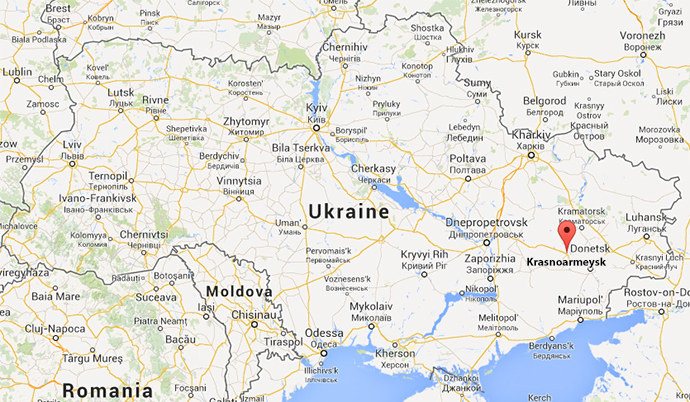
According to Aksyonov, their captors then took them somewhere. He heard that Phillips was dropped in the city of Krasnoarmeisk, in the Donetsk Region of eastern Ukraine.
Aksyonov thinks that Graham Philips might be taken to either Kiev, Ukraine’s capital, or Zaporizhie, a city in southern Ukraine which borders on the Donetsk Region, or to the city of Uzhhorod in western Ukraine.
The agency still hasn’t reveal the fate of two other hostages – an employee of the press service of the self-proclaimed Donetsk People’s Republic, and possibly an acquaintance of Phillips, who accompanied the journalist to the airport.
Phillips has been reporting about the developments in Ukraine for several months now. According to research from Brandwatch social networks monitor, he has become the most popular author in Twitter reporting on the situation in Ukraine.
It is not the first time, the RT contributor has been taken hostage. He was detained once at a checkpoint in Mariupol and held captive by Kiev military for over 36 hours in May.
Journalists from a range of media outlets have come under fire, some of them even detained, during the conflict in eastern Ukraine. There have also been reports that Ukrainian troops have fired at people with cameras, as well as people wearing press vests.
Russian journalists have been captured by Kiev’s forces throughout the conflict in eastern Ukraine.
In June, journalists from Russia’s Zvezda TV channel spent two days in captivity, after being detained by the Ukrainian National Guard.
In May, two LifeNews journalists were taken hostage for two days by the National Guard, prompting an online #SaveOurGuys campaign.
Several journalists have also been killed while covering the unrest in eastern Ukraine.
In June, a Russian cameraman from Channel One TV, Anatoly Klyan, was shot by Kiev forces in Donetsk. Also in June, Rossiya TV journalist Igor Kornelyuk and his colleague, sound engineer Anton Voloshin, were killed in shelling near Lugansk.
In May, Italian journalist Andrea Rocchelli and his Russian interpreter Andrey Mironov were killed when they were caught in a mortar attack close to the village of Andreevka, a couple of kilometers from Slavyansk.
Kiev sabotaging probe into downed Malaysian plane – self-defense leader
RT | July 24, 2014
Kiev is not interested in a fair and unbiased investigation into the downing of the Malaysian plane over Ukraine, so it is sabotaging the work of international experts, one of the self-defense forces leaders said on Wednesday.
Kiev’s authorities have been obstructing the international investigation into the crash of the Malaysia Airlines plane since day one, Deputy Prime Minister of People’s Republic of Donetsk Andrey Purgin told Russia-24 TV channel on Wednesday.
Purgin said it became clear that Kiev is sabotaging the probe two days after the incident, when international experts were not let into the area, as Kiev claimed it could not guarantee their safety.
Kiev simply refused to accompany the international experts, Purgin stated. The Malaysian group of experts made it down to the crash alone, with no security from Kiev.
It took four days for international experts to gain access to the site. The reason is that even after Ukrainian President Petro Poroshenko announced a 40-kilometer ceasefire zone around the crash site, Malaysian experts came under heavy shelling from the Ukrainian army while making their way within the ceasefire zone.
The Boeing 777-200ER, which was on a scheduled flight from Amsterdam to Kuala Lumpur with 298 passengers and crew on board, was shot down over Ukraine on July 17. There were no survivors.
Kiev authorities have accused the militia of being behind the catastrophe. However, the militia stressed that it doesn’t possess the means to shoot down an aircraft at such an altitude.
Following the crash, the dead bodies were left under 30C heat, as self-defense forces were pressured by the OSCE not to move the bodies until the international experts arrived, the Donetsk People’s Republic’s Prime Minister Aleksandr Boroday told BBC.
“We waited a day, two, three – but no experts,” Boroday said. “They were all sitting in Kiev.” To keep the dead bodies laying there became “absurd” and “inhumane,” he added.
The Ukrainian militia handed over to Malaysian experts the black boxes from the plane on Tuesday. Investigators say they have found no evidence that the black box recorder was tampered with.
Read more: Ukrainian militia hand over MH17 flight recorders to Malaysia
The Dutch Safety Board said it has taken charge of the international investigation. It will coordinate a team of 24 investigators from Ukraine, Malaysia, Russia, Germany, the United States, the United Kingdom, Australia, and the International Civil Aviation Organization (ICAO). It added that four Dutch investigators are currently operating in Ukraine.
The bodies of the first victims from Malaysia Airlines flight MH17 arrived back in the Netherlands on Wednesday.
A day earlier, the UN Security Council condemned the downing of Malaysia Airlines flight MH17 and called for an international probe into the incident in a unanimously adopted resolution.
European Killers Enjoy Fascist ‘Safari’ in Ukraine

By Nikolai MALISHEVSKI | Strategic Culture foundation | 23.07.2014
The self-defense forces of the Donetsk People’s Republic reported the elimination of two enemy’s block posts in the area of Donetsk in the first half of July. According to their Minister of Defense Igor Strelkov, one of them was defended by people in NATO combat fatigue who were foreign passport holders.
It’s not only the hired personnel of Western private military contractors who do their job by killing for money. There are also people who go to Ukraine to get pleasure and are ready to pay for it.
Stan Patton, soldier of fortune, Blackwater, shares a quotation in his Twitter saying what the prices are: a shot of howitzers – $ 100 from the tank – $ 200, a shot in the village is priced at U.S. $ 350…
The Kiev regime converts the battle area into an entertainment place – firing range for blood thirsty foreign tourists, the government is even involved in advertising business. The clients don’t hide their passion for this kind of fun and even show it off. Here are some of them: Mikael Skillt is a Swedish sniper, with seven years’ experience in the Swedish Army and the Swedish National Guard. He is currently fighting with the Azov Battalion, a pro-Ukrainian volunteer armed group in eastern Ukraine. He is known to be dangerous to the rebels: reportedly there is a bounty of nearly $7,000 (£4,090; 5,150 euros) on his head. Don. Francesco Fontana – one of several hundred Western adventurers who flew to Ukraine and said in his video that he always dreamed to have a chance to kill people without responsibility.
Italian IL Giornale correspondent Fausto Biloslavo writes that foreigners are welcome to join the battalion of Azov established by Ukrainian homosexual MP Oleg Lyashko. There are volunteers from Italy, Sweden. Finland, Norway, France and Baltic States. International rabble gets on Ukraine thanks to the skillful recruiter – 46-year-old Frenchman Gaston Besson. He advertises on the Internet with an offer to take part in the bloody ‘safari’ in Ukraine. “We invite you to join a battalion of Azov. No payment. We are ready to meet you in Kiev. From you I need information about your family and social situation. Let us know if you are ready to participate in the battles themselves, or will train young soldiers. Upon arrival in Kiev, you will get the contact number of our English-speaking employee. Sleeping, eating, and so on – on our base in the south-east,” – said the ad. A native of Mexico, he served in the French commando and special forces in Southeast Asia. Member of three coups and two wars. Laos, Burma, Suriname… In 1991, the same mercenary killed Serbs in Croatia, then – in Bosnia.
“People come from many different countries. Finland, Norway, Sweden, England, France, Italy… We do not take the fanatics and extremists. We need people with military experience, professionals. We are not for NATO or for the European Union; we have no interest in politics. Every day I get about 15 letters from those who want to come to Ukraine to fight. We all understand that there is a war, and every day you can be hurt or killed,” – says Gaston Besson.
The U.S. attracts these masters of dirty work to all the hot spots – Afghanistan, Iraq, and Syria. The presence of American advisers in Ukraine is accompanied by the appearance of foreign mercenaries and the south-east part of the country.
Gaston says he is not a mercenary, or even a secret agent. He is not hiding. He sees himself as a revolutionary and an idealist having gone through two war and the uprisings in Croatia, Bosnia, Burma, Laos and Surinam. It’s his experience in former Yugoslavia that is important. It gives clue to what is done and why in Ukraine. Twenty years ago Yugoslavia was partitioned.
Back then, the Sunday Mirror did the same thing its Italian colleagues do today. Some advertisements of a tourist company were published and repeated in neo-fascist outlets and on theInternet. The hunting tours were arranged by British mercenaries with combat experience in Croatia. They were reported to launch branches in Munich and Zagreb and the business was flourishing.
Europeans were offered to hunt civilians in Serbian Krajina and Croatia. The price was $3000 (1995). Hunters were offered bullet-proof jackets, ammunition and rifles with optical guidance. Hunters – ‘international brigades of Croatian army’ guaranteed security. Rape and plundering were offered for special pay. The clients were mainly ethnic Croats from Australia, Germany, Canada, Switzerland and Austria, as well as European felons and Neo-Nazi. Gaston Besson started his business and combat experience there to continue to do what he likes most in Ukraine now.
What do these war dogs need? The Croatian army and the Ukrainian military don’t put them on the payroll. But in Croatia the ‘international brigades warriors’ got booty making many of them rich in no time. In 1994 the war was raging. German police was involved in investigations trying to find out how come this had nothings before the war all of a sudden started to buy land, equity, establish companies employing European neo-fascists. It was an open secret: plundering and arms trade and drug dealings.
What did Croats need mercenaries for? They almost made no contribution as fighters. They were needed for the very same thing the Ukrainian regime needs them now. Hunting and shooting does bring in certain profit. But it’s not the main thing. They protect the officials from accusations of being involved in genocide. The government can say the regular armed forces are not involved in plundering and expulsions. 20 years ago European politicians approached Former Croatian Foreign Minister Mate Granić with demands to stop ethnic cleansing and providing the people with opportunity to get back home. Back then he smiled and said that the responsibility lied with «private» people from Europe who were not members of regular military.
10 more questions Russian military pose to Ukraine, US over MH17 crash
RT | July 21, 2014
Russia has released military monitoring data, which shows Kiev military jets tracking the MH17 plane shortly before the crash – and posed yet another set of questions to Ukraine and the US over the circumstances of the tragedy.
Military officials – chief of General Staff of the Armed Forces Lt. Gen. Andrey Kartopolov and chief of the Air Force Main Staff Lt. Gen. Igor Makushev – posed a number of questions to Kiev and Washington concerning the possible causes of the catastrophe in Eastern Ukraine that killed almost 300 people last Thursday.
1. Why did the MH17 plane leave the international corridor?
“Please note that the plane stayed within the corridor until it reached Donetsk but then it deviated from the route to the north,” said Kartopolov.
2. Was MH17 leaving the route a navigation mistake or was the crew following instructions by Ukrainian air traffic controllers in Dnepropetrovsk?
“The maximum deviation from the left border of the corridor was 14 km. Following that, we can see the plane maneuvering to return to the corridor, yet the Malaysian crew did not get a chance to complete the maneuver. At 17.20, the plane began to lose speed, and at 17.23 it disappeared from Russian radars.”
3. Why was a large group of air defense systems deployed to the militia-held area if the self-defense forces have no planes?
“As far as we know, the Ukrainian military had three or four air defense battalions equipped with Buk-M1 SAM systems deployed in the vicinity of Donetsk on the day of the crash. This system is capable of hitting targets within the range of 35 km at the altitude of up to 22 km.”
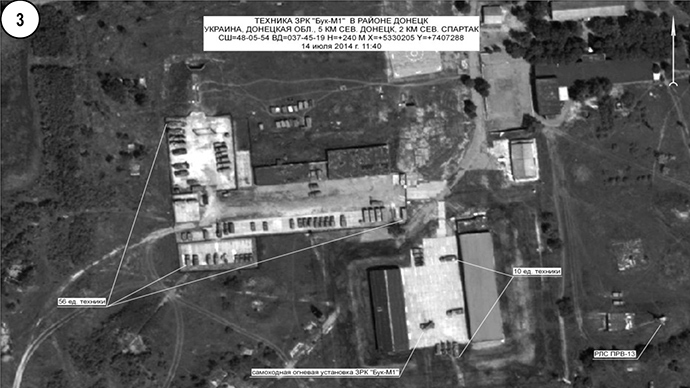
Buk missile defense units in Donetsk Region, 5km north of Donetsk city, on July 14, 2014. (RIA Novosti)
4. Why did Kiev deploy Buk missile system right next to the militia-controlled area straight ahead of the tragedy?
“We have satellite photos of the places where Ukraine had its air defense units deployed in the southeastern parts of the country. The first three photos were made on July 14. The first photo shows Buk launchers 8 km northwest of Lugansk. You can clearly see a TELAR and two TELs. The second photo shows radars 5 km north of Donetsk. You can see two TARs along with other equipment and technical structures. The third photo shows air defense systems north of Donetsk. You can clearly see a TELAR launcher and about 60 military and auxiliary vehicles, tents for vehicles and other structures.
“Here’s a photo of the same area made on July 17. Please note that the launcher has disappeared. The fifth photo shows a battery of Buk missiles at the village of Zaroshchenskoye 50 km east of Donetsk and 8 km south of Shakhtyorsk on the morning of the same day. The sixth photo shows the same area on July 18. As you can see, the battery has left.”
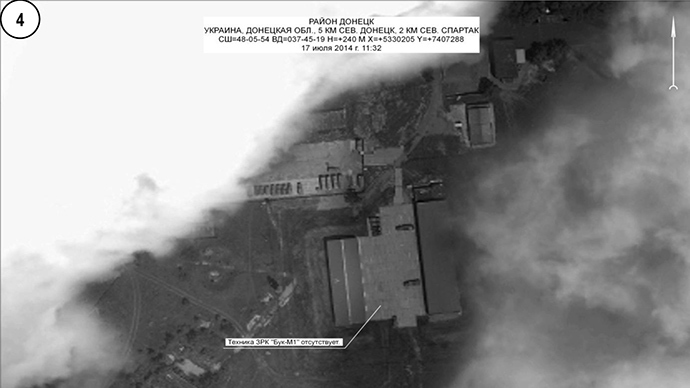
No Buk missile defense units in Donetsk Region, 5km north of Donetsk city, on July 17, 2014. (RIA Novosti)
5. On the day of the crash Kiev increased activity on its Kupol-M1 9S18 radars, which are components of the Buk system in the area. Why?
“Also, July 17 saw increased activity on the part of Ukraine’s Kupol-M1 9S18 radars, which are part of the Buk system. Here on this chart you see that there were seven radars operating on July 15, eight radars operating on July 16, and nine radars operating on July 17 in the area. Then, starting with July 18, the intensity of radar activities radically decreased, and now there are no more than two or three radars operating a day. The reason behind this is yet to be found.”
6. What was a military plane doing on the route intended for civilian flights?
“There were three civilian planes in the area performing their regular flights at this time. There was a flight from Copenhagen to Singapore at 17:17, there was a flight from Paris to Taipei at 17:24, and then there was the flight from Amsterdam to Kuala Lumpur.”
“Also, Russian monitoring systems registered that there was a Ukrainian Air Force jet, probably Su-25, climbing and approaching the Malaysian Boeing.”
“The Su-25 was 3-5 km away from the Malaysian plane. Su-25 is capable of climbing to the altitude of 10,000 meters for a short period of time. Its standard armament includes R60 air-to-air missiles, which are capable of locking and hitting targets from 12 km and which are guaranteed to hit the target from the distance of 5 km.”
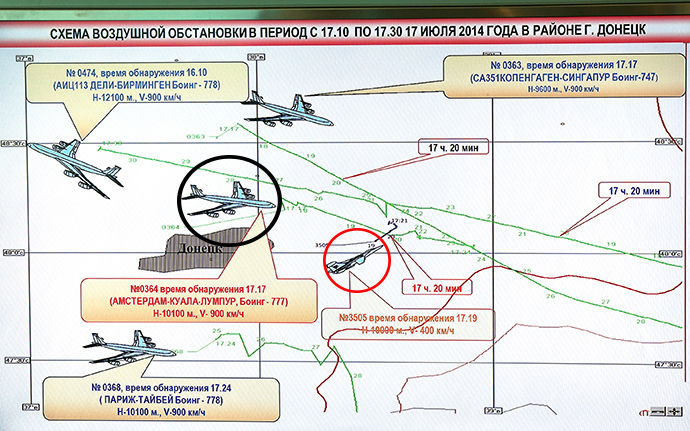
(RIA Novosti / Vadim Savitsky)
7. Why was the military jet flying at almost the same time and the same altitude with a passenger plane?
“At 17:21’35, with [the Boeing’s] velocity having dropped to 200 kilometers per hour, a new mark detecting an airborne object appears at the spot of the Boeing’s destruction. This new airborne object was continuously detected for the duration of four minutes by the radar stations Ust-Donetsk and Buturinskaya. An air traffic controller requested the characteristics of the new airborne object, but was unable to get any readings on its parameters – most likely due to the fact that the new aircraft was not equipped with a secondary surveillance radar transponder, which is a distinctive feature of military aircraft,” said Makushev.
“Detecting the new aircraft became possible as it started to ascend. Further changes in the airborne object’s coordinates suggest that it was hovering above the Boeing 777’s crash site, monitoring of the situation.
“Ukrainian officials earlier claimed that there were no Ukrainian military aircraft in the area of the crash that day. As you can see, that is not true.”
8. Where did the launcher – from the video circulated by Western media and showing a Buk system being moved allegedly from Ukraine to Russia – come from? As the video was made on the territory controlled by Kiev, where was the launcher being transported?
“I’d like to say that the information we have presented here is based on objective and reliable data from various technical systems – unlike the groundless accusations made against Russia,” said Kartopolov.
“For example, media circulated a video supposedly showing a Buk system being moved from Ukraine to Russia. This is clearly a fabrication. This video was made in the town of Krasnoarmeisk, as evidenced by the billboard you see in the background, advertising a car dealership at 34 Dnepropetrovsk Street. Krasnoarmeysk has been controlled by the Ukrainian military since May 11.”
9. Where is it right now? Why are some of the missiles missing on the launcher? When was the last time a missile was launched from it?

Screenshot from video posted on Ukraine’s Ministry of Interior account, showing a Buk system supposedly being moved from Ukraine to Russia with two out of three missiles.
10. Why haven’t US officials revealed the evidence supporting claims that the MH17 was shot down by a missile launched by the militia?
“US officials claim they have satellite photographs proving the Malaysian airliner was shot down by a missile launched by the militia. But no one has seen these photographs so far. As far as we know, there was indeed a US satellite flying over southeastern Ukraine on July 17 from 17:06 to 17:21 Moscow time.
“This satellite is part of an experimental system designed to track and monitor the launches of missiles of various ranges. If our US colleagues have imagery from this satellite, they should release it for the international community to examine it in detail. This may be a coincidence, but the US satellite flew over Ukraine at exactly the same time when the Malaysian airliner crashed.”

This is not the first time Russia brings up questions on the plane crash. No explanations have followed with Kiev insisting they have full evidence of Russia being behind the attack, but so far only releasing tapes.
The USA, putting the blame on the self-defense forces, has yet refused to release any intelligence material. On Monday State Department Deputy Spokesperson Marie Harf described Russia’s statements as “propaganda and misinformation” – but when reporters asked her whether Washington would be releasing their intelligence and satellite data, Harf only replied “maybe.” So far the US has been backing its statements by social media and “common sense.”
If You Believed the US Secretary of State’s Poison Gas Lie, You’ll Love His Latest One
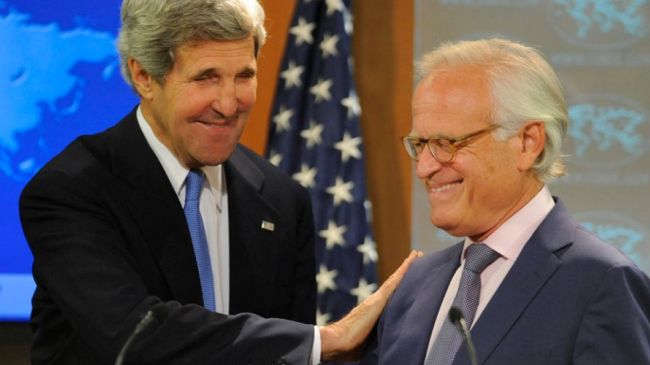
By Dave Lindorff | This Can’t Be Happening! | July 20, 2014
If the best the US can do to pin the blame for the Malaysia Flight 17 downing on Russia is to have Secretary of State John Kerry say that “circumstantial evidence” points to Moscow being behind it, we can be pretty certain it was not Russia at all.
Kerry’s credibility on such matters has been in the toilet since last August when he claimed during last year’s furor and push for war against Syria’s Basher al Assad that he had seen “clear and compelling evidence” that the Syrian government had used poison gas against its own people. That “evidence” turned out (clearly with Kerry’s knowledge) to have been ginned up, falsified and staged, and in the end it was evident that Syria had not been the guilty party. Had Kerry and the White House succeeded in duping the world and the American people the way President George W. Bush and VP Dick Cheney succeeded in duping them about Iraq’s “WMDs,” an armada of US planes and ships already in position around Syria would have begun a massive aerial bombardment of Syria sparking a whole new war in the Middle East, even as Iraq was already in the throes of a civil war.
Fortunately, John Kerry’s and the accommodating US corporate media’s lies that time were exposed, and that bloody catastrophe was averted.
Now, undeterred by that first attempt at a full-blown campaign of lies, Kerry and the Obama White House are at it again, trying to falsify a casus belli against Russia by blaming Moscow for the downing of a civilian airliner that killed 298 people.
The problem for Kerry and Washington’s warmongers is that the story they’re selling is ludicrous.
Ukraine’s military has a hundred or so Buk anti-aircraft missiles and dozens of mobile launchers which have been seen in a Kiev parade
Why on earth would the Russians (who have been scrupulously avoiding getting involved in the Ukraine fighting), have provided the separatist rebels in eastern Ukraine with Buk missiles capable of downing high-altitude planes? Such aircraft pose no threat to the rebels. What they fear is the Ukraine military’s ground attack aircraft and bombers, and their helicopter gunships and troop transport planes. And they already have demonstrated that they’ve got the weapons to deal with those, in the form of shoulder-fired, wire-guided missiles — weapons that don’t have the capability to down aircraft flying at anywhere near 33,000 feet.
The answer to that question is that Russia would gain nothing, and would stand to lose a lot by contributing to the downing of a civilian aircraft. In fact, we can see, in the desperate effort by Kerry to pin the blame on Russia, exactly whey they would never have wanted to do such a thing.
That goes for the separatist rebels, too. The last thing they would want would be to give reluctant NATO allies of the US in Europe a reason to join the war-mongering campaign of the US in backing the Ukrainian government’s “anti-terrorist” campaign against them. After all, the separatists have actually been doing pretty well at stymieing the Ukrainian military as it is. In addition, increasing numbers of Ukrainians in western Ukraine are growing frustrated with the corruption, incompetence and war-making of their government. How do the rebels then gain by angering Western European nations and the Ukrainian people? Answer: They don’t.
Indeed the only parties who could conceivably gain by the downing of a civilian airliner would be the US and Ukraine, if they thought they could manage to pin the blame on the Russians and/or the separatist rebels. (For those who find it hard to swallow the idea that the US would deliberately shoot down a plane carrying 298 civilians in order to get a war going, there is another theory out there: that the Ukrainians — or some rogue element of the Ukraine military — thought the plane was Russian President Vladimir Putin’s own “Air Force One” carrying him back from the Brazil World Cup. In fact the flight paths of the two plans actually intersected within a fairly short time frame according to some reports.)
Meanwhile, it has already been demonstrated that the “evidence” that the US and Ukraine are citing — an electronic communication allegedly between a rebel and a Russian general referring to the downing of Malaysian Flight 17, was made a day before the downing happened (a point not mentioned in the breathless corporate media reports). That sounds like something the CIA would have had a hand in, as many believe it did in the also bogus “notice” earlier this year allegedly calling on Jews in eastern Ukraine to register with rebel authorities. As for the claim that the rebels had in their possession a Buk missile launcher, and that it came from Russia, this is highly dubious. First of all, as mentioned, there was no reason for Russia to provide such a weapon to the rebels. Second, if the rebels, often described as a rag-tag group, ever got such sophisticated weapons, they would not have had the training to use it. Kerry is also saying that the US “has the trajectory” of a missile fired by a Buk launcher in rebel-held territory “near the scene of the crash,” but of course, he also said the US “had the trajectories” of the poison gas rockets and that they came from a Syrian military installation–a claim that later proved false.
On the other hand, Ukraine’s military is known to possess several dozen mobile Buk missile launchers in its arsenal, and some of these were known to have been moved into eastern Ukraine. Why Ukraine’s military would have done this, when the rebels have no air force, is a good question — one which the Russians are asking (but which the US corporate media have not bothered to speculate about).
So we have Kerry’s lies and the lies of other US government officials, backed by the same complicit and propagandistic US media that ran with their lies so unquestioningly in the Syria poison gas incident, with little but the alternative media and some of the foreign media to rely on for more honest and forthright investigation into this case. And we have the Ukrainian government, which has been charging all along, against all logic, that the pro-Russian rebels in eastern Ukraine are all “terrorists,” also claiming that it’s the Russians and the rebels who did the deed.
No doubt it will be a while before the truth comes out about this story. In the meantime, the best evidence that it was not the Russians and the rebels in Ukraine who shot down the plane is that Secretary of State Kerry is trying to convince us all that they did it.
Meanwhile everyone would do well to calm down and heed the warning of former CIA analyst Ray McGovern, a 27-year Agency veteran, now retired, who points to the campaign of lies orchestrated during the early Reagan administration concerning the Russian shoot-down of a Korean 747 back in 1983. While the Reagan White House and the Pentagon knew from captured radio transmissions between the Russian fighter pilot and his base that he made efforts to warn the Korean plane to land, including the firing of tracer bullets in the dark sky, and knew that he had become convinced he was dealing with a US military spy plane flying over a highly secret part of Russia’s western defenses, before he fired a missile to shoot it down, McGovern says they doctored those tapes to make it look like he had done the opposite, heartlessly shooting down a civilian plane on orders from Moscow. The goal of this official Washington lie, McGovern says, was to incite American hatred against the Soviet Union, which had been waning since the end of the Vietnam War.
McGovern also suggests that the US government covered up the true cause of the downing of TWA Flight 800 off Long Island in 1996, which he says may well have been caused by an errant US missile, and not, as claimed, by a spark in a fuel tank.
McGovern’s advice in this current campaign of deceit: “There is, sadly,…reason to kick the tires of any fancy truck carrying ‘intelligence’ offered by the U.S. with respect to the Malaysian Airline shoot-down.”
Amnesty International and the War in Ukraine
By VLADISLAV GULEVICH | CounterPunch | July 21, 2014
Amnesty International recently released a report on “stomach-turning” violence in Eastern Ukraine (“Abduction and Tortures in Eastern Ukraine,” – see for example BBC coverage here). According to the report, the acts of violence are perpetrated chiefly by pro-Russian separatist groups.
The Amnesty International report and its conclusion about rebel responsibility for the majority of violence does’t hold water and has little in common with reality. The violence in Ukraine in general is not properly analyzed, and the report is quite biased. Rather than the rebels, it is the Ukrainian army and the pro-EuroMaidan forces that are responsible for the abductions and abuses.
Firstly, rebels in Eastern Ukraine enjoy almost 100% support of the local population. There is no need for them to commit any kind of violence targeting the locals. The Ukrainian army, on the contrary, is viewed as a cruel enemy and Ukrainian soldiers feel the animosity of the locals. Simple logic would argue that it is the army that has felt the need to repress its local adversaries through violence. Moreover, it suffices to speak with any of the thousands of refugees from Eastern Ukraine and listen to their stories about the barbaric methods used by the army to break the resistance, to be persuaded that the Ukrainian army bears the responsibility for the majority of kidnappings and tortures.
Secondly, it’s well known that EuroMaidan was supported by Ukrainian neo-Nazi organizations. After the success of EuroMaidan its leaders enrolled their neo-Nazi supporters into newly formed police and National Guard battalions (“Azov”, “Donbas” and so on). From time to time foreign media speak of the neo-Nazi background of such Ukrainian military units, but most of the time this fact is hidden. It’s hard to expect any respect for human rights or any other kind of law observance from these soldiers.
The facts show that EuroMaidan authorities started the terror campaign promptly after toppling the former government, that is to say long before the start of the war. The spiral of violence raging now in Eastern Ukraine is the sequel of the geopolitical drama called EuroMaidan.
In addition, to see the whole scale of violence in Ukraine one should gather information about abductions, tortures and other ill-treatment throughout the country and not only in Eastern Ukraine. And the time period should be enlarged: it’s necessary to take into consideration all of the violence perpetrated since the victory of EuroMaidan and not only since the beginning of the hostilities.
When the new post-EuroMaidan government was formed it unleashed unprecedented repressive measures, which became more and more stringent and violent. Policemen and their families were the first targets. They were threatened anonymously, their apartments burnt and some policemen killed.
Not only were policemen tracked down, but any conspicuous person loyal to the previous government. Unacceptable newspapers were forcibly closed, independent journalists arrested. The most radical pro-European movement, “Right Sector,” put forward the idea that “the revolution continues and we will hunt down the enemies of the revolution”. After that civic activists were subjected to brutal attacks and the most active of them were arrested. Now Kiev goes even further. Following the example of the US in Iraq, the Ukrainian authorities are producing playing cards with faces of the rebel commanders as well as faces of “wrong” journalists, for the soldiers in Eastern Ukraine. The army must either arrest or kill them.
After EuroMaidan, Ukraine is a country full of political prisoners. The number of well-known journalists and writers who have had to escape from the country is rather high: Alexander Chalenko, Rostislav Ishchenko, Vladimir Rogov, myself, and many others. Even high-ranking Congressmen of the Ukrainian parliament, such as the anti-EuroMaidan politician Oleg Tsarov, have had to leave Ukraine under the threat of arrest. Before fleeing Tsarov was attacked by a crowd of EuroMaidan activists and savagely beaten. The video of the attack as well as Tsarov with torn clothes and bruises was shown on TV. His house in Dnepropetrovsk was burnt by Molotov cocktails thrown by well-known “unknown” perpetrators.
Now Tsarov gives juridical assistance to police officers and civil activists persecuted by the new authorities. According to Tsarov, many people are being arrested throughout Ukraine and prisons are filled with political prisoners. The latest case has been the arrest of Alexander Samoylov, the vice-rector of International Slavonic University in Charkov. The picture of Samoylov beaten, with black bruises around his eyes, is circulating on the internet.
The violence against ideological rivals has turned into political advertising for the Ukrainian politicians supporting EuroMaidan, aimed toward dissuasion. Congressmen from the well-known xenophobic nationalistic party Svoboda forcibly entered the office of the Ukrainian National TV Channel director, beat him and forced him to resign. They disliked how the TV channel covered the Crimean conflict between Moscow and Kiev.
Notorious congressman and leader of the Radical party Oleg Liashko is famous for his PR actions in the zone of hostilities. He often shows up there accompanied by a large number of bodyguards and demonstrates his attitude towards the population of Eastern Ukraine. There are many videos showing Liashko humiliating his opponents and threatening to kill them — like in this video where Liashko and his bodyguards rudely force a local deputy in Slawiansk to resign and threaten to lynch him in a town square – or threatening to throw them into prison, like in this video where Liashko interrogates a 68-year old man with a sack on his head and threatens to keep him in prison until death.
It’s worth mentioning that in March 2014, a month before the beginning of hostilities between Kiev and the rebel provinces, and when dialogue was still possible, Liashko ordered one of the Eastern Ukrainian leaders, Arsen Klinchaev, to be arrested. This was carried out in a rude and humiliating manner and Liashko himself took part in the action. Klinchaev was arrested in his office and not with arms in hand, but was treated like a dangerous terrorist.
Instead of dialogue, Kiev has chosen violence.
Vladislav Gulevich is a Ukrainian journalist and political analyst who has recently fled to Russia. He can be reached at kwonltd@rambler.ru.
Putin: Taskforce at Malaysia MH17 crash site not enough, full-scale international team needed
RT | July 20, 2014
The tragic Malaysian MH17 flight crash must not be politicised and the international experts on the scene should be able to carry out their work in complete safety, Russian President Vladimir Putin said.
“There are already representatives of Donetsk and Lugansk working there, as well as representatives of the emergencies ministry of Ukraine and others. But this is not enough,” Putin said officially commenting on the tragic event on Sunday.
“This task force is not enough,” Putin emphasized. “We need more, we need a fully representative group of experts to be working at the site under the guidance of ICAO, the relevant international commission.”
“We must do everything to provide security for the international experts on the site of the tragedy,” Putin stressed, adding that Russia will also do everything in its power to help shift the Ukrainian conflict from a military phase into a political discussion.
“We need to do everything to provide its [ICAO commission’s] safety, to provide the humanitarian corridors necessary for its work,” Putin added.
“In the meantime, nobody should and has no right to use this tragedy to achieve their ‘narrowly selfish’ political goals,” Putin stated.
“We repeatedly called upon all conflicting sides to stop the bloodshed immediately and sit down at the negotiating table,” the President reminded. “I can say with confidence that if military operations were not resumed on June 28 in eastern Ukraine, this tragedy wouldn’t have happened.”
In the meantime, Russia has introduced its own draft resolution to the UN Security Council calling for an impartial investigation of Malaysia Airlines MH17 crash in Ukraine, Russia’s ambassador to UN Vitaly Churkin said.
‘Yes, we did it,” Churkin told reported answering the question about Russia’s draft. “Just to show what we are talking about. The difference is that in our draft it is absolutely clear it is indeed an impartial international investigation under the under the guidance of ICAO.”
According to the latest figures from the Donetsk authorities, 247 out of 298 bodies have been recovered from the crash site. OSCE confirmed that a train with bodies of the victims is being stationed at a railway station in Torez and is set to depart for Donetsk. The bodies are being kept in especially refrigerated cars.
A team of ISCE experts and four Ukrainian forensics analysts are the only experts who have so far reached the area and are working on the investigation. A team of 12 Malaysian experts is yet to arrive at the crash site. Experts from other European nations, including the Netherlands, France, Germany and the UK are en route to Donetsk.
The OSCE team has claimed that the black boxes have not been recovered, yet Aleksandr Boroday, the republic’s prime minister, told reporters that DPR might potentially be in possession of the MH17 black boxes. “What we have is just some components of the plane. We are not experts; we think that they may be black boxes but we’re not sure.”
Airline Horror Spurs New Rush to Judgment
By Robert Parry | Consortium News | July 19, 2014
Despite doubts within the U.S. intelligence community, the Obama administration and the mainstream U.S. news media are charging off toward another rush to judgment blaming Ukrainian rebels and the Russian government for the shoot-down of a Malaysia Airlines plane, much as occurred last summer regarding a still-mysterious sarin gas attack in Syria.
In both cases, rather than let independent investigators sort out the facts, President Barack Obama’s ever-aggressive State Department and the major U.S. media simply accepted that the designated villains of those two crises – Bashar al-Assad in Syria and Russian President Vladimir Putin on Ukraine – were the guilty parties. Yet, some U.S. intelligence analysts dissented from both snap conventional wisdoms.
Regarding the shoot-down of the Malaysian jetliner on Thursday, I’m told that some CIA analysts cite U.S. satellite reconnaissance photos suggesting that the anti-aircraft missile that brought down Flight 17 was fired by Ukrainian troops from a government battery, not by ethnic Russian rebels who have been resisting the regime in Kiev since elected President Viktor Yanukovych was overthrown on Feb. 22.
According to a source briefed on the tentative findings, the soldiers manning the battery appeared to be wearing Ukrainian uniforms and may have been drinking, since what looked like beer bottles were scattered around the site. But the source added that the information was still incomplete and the analysts did not rule out the possibility of rebel responsibility.
A contrary emphasis has been given to the Washington Post and other mainstream U.S. outlets. On Saturday, the Post reported that “on Friday, U.S. officials said a preliminary intelligence assessment indicated the airliner was blown up by an SA-11 surface-to-air missile fired by the separatists.” But the objectivity of the Obama administration, which has staunchly supported the coup regime, is in question as are the precise reasons for its judgments.
Even before the Feb. 22 coup, senior administration officials, including Assistant Secretary of State Victoria Nuland and U.S. Ambassador to Ukraine Geoffrey Pyatt, were openly encouraging protesters seeking the overthrow of Yanukovych. Nuland went so far as to pass out cookies to the demonstrators and discuss with Pyatt who should be appointed once Yanukovych was removed.
After Yanukovych and his officials were forced to flee in the face of mass protests and violent attacks by neo-Nazi militias, the State Department was quick to declare the new government “legitimate” and welcomed Nuland’s favorite, Arseniy Yatsenyuk, as the new prime minister.
As events have unfolded since then, including Crimea’s secession to join Russia and bloody attacks directed at ethnic Russians in Odessa and elsewhere, the Obama administration has consistently taken the side of the Kiev regime and bashed Moscow.
And, since Thursday, when the Malaysian plane was shot down killing 298 people, the Ukrainian government and the Obama administration have pointed the finger of blame at the rebels and the Russian government, albeit without the benefit of a serious investigation that is only now beginning.
One of the administration’s points has been that the Buk anti-aircraft missile system, which was apparently used to shoot down the plane, was “Russian made.” But the point is rather silly since nearly all Ukrainian military weaponry is “Russian made.” Ukraine, after all, was part of the Soviet Union until 1991 and has continued to use mostly Russian military equipment.
It’s also not clear how the U.S. government ascertained that the missile was an SA-11 as opposed to other versions of the Buk missile system.
Slanting the Case
Virtually everything that U.S. officials have said appears designed to tilt suspicions toward the Russians and the rebels – and away from government forces. Referring ominously to the sophistication of the SA-11, U.S. Ambassador to the United Nations Samantha Power declared, “We cannot rule out Russian technical assistance.” But that phrasing supposedly means that the administration can’t rule it in either.
Still, in reading between the lines of the mainstream U.S. press accounts, it’s possible to see where some of the gaps are regarding the supposed Russian hand in Thursday’s tragedy. For instance, the Post’s Craig Whitlock reported that Air Force Gen. Philip M. Breedlove, U.S. commander of NATO forces in Europe, said last month that “We have not seen any of the [Russian] air-defense vehicles across the border yet.”
Since these Buk missile systems are large and must be transported on trucks, it would be difficult to conceal their presence from U.S. aerial surveillance which has been concentrating intensely on the Ukraine-Russia border in recent months.
The Post also reported that “Rear Adm. John Kirby, the Pentagon press secretary, said defense officials could not point to specific evidence that an SA-11 surface-to-air missile system had been transported from Russia into eastern Ukraine.”
In other words, the mystery is still not solved. It may be that the rebels – facing heavy bombardment from the Ukrainian air force – convinced the Russians to provide more advanced anti-aircraft weapons than the shoulder-fired missiles that the rebels have used to bring down some Ukrainian military planes.
It’s possible, too, that a rebel detachment mistook the civilian airliner for a military plane or even that someone in the Russian military launched the fateful rocket at the plane heading toward Russian airspace.
But both the Russian government and the rebels dispute those scenarios. The rebels say they don’t have missiles that can reach the 33,000-foot altitude of the Malaysian airliner. Besides denying a hand in the tragedy, the Russians claim that the Ukrainian military did have Buk anti-aircraft systems in eastern Ukraine and that the radar of one battery was active on the day of the crash.
The Russian Defense Ministry stated that “The Russian equipment detected throughout July 17 the activity of a Kupol radar, deployed as part of a Buk-M1 battery near Styla [a village some 30 kilometers south of Donetsk],” according to an RT report.
So, the other alternative remains in play, that a Ukrainian military unit – possibly a poorly supervised bunch – fired the missile intentionally or by accident. Why the Ukrainian military would intentionally have aimed at a plane flying eastward toward Russia is hard to comprehend, however.
A Propaganda Replay?
But perhaps the larger point is that both the Obama administration and the U.S. press corps should stop this pattern of rushing to judgments. It’s as if they’re obsessed with waging “information warfare” – i.e., justifying hostilities toward some adversarial nation – rather than responsibly informing the American people.
We saw this phenomenon in 2002-03 as nearly the entire Washington press corps clambered onboard President George W. Bush’s propaganda bandwagon into an aggressive war against Iraq. That pattern almost repeated itself last summer when a similar rush to judgment occurred around a sarin gas attack outside Damascus, Syria, on Aug. 21.
Though the evidence was murky, there was a stampede to assume that the Assad government was behind the attack. While blaming the Syrian army, the U.S. press ignored the possibility that the attack was a provocation committed by radical jihadist rebels who were hoping that U.S. air power could turn the tide of the war in their favor.
Rather than carefully weigh the complex evidence, the State Department and Secretary of State John Kerry tried to spur President Obama into a quick decision to bomb Syrian government targets. Kerry delivered a belligerent speech on Aug. 30 and the administration released what it called a “Government Assessment” supposedly proving the case.
But this four-page white paper contained no verifiable evidence supporting its accusations and it soon became clear that the report had excluded dissents that some U.S. intelligence analysts would have attached to a more formal paper prepared by the intelligence community.
Despite the war hysteria then gripping Official Washington, President Obama rejected war at the last moment and – with the help of Russian President Putin – was able to negotiate a resolution of the crisis in which Assad surrendered Syria’s chemical weapons while still denying a hand in the sarin gas attack.
The mainstream U.S. press, especially the New York Times, and some non-governmental organizations, such as Human Rights Watch, continued pushing the theme of the Syrian government’s guilt. HRW and the Times teamed up for a major story that purported to show the flight paths of two sarin-laden missiles vectoring back to a Syrian military base 9.5 kilometers away.
For a time, this report was treated as the slam-dunk evidence proving the case against Assad, until it turned out that only one of the rockets carried sarin and the maximum range of the one that did have sarin was only about two kilometers.
Despite knowing these weaknesses in the case, President Obama stood by his State Department hawks by reading a speech to the UN General Assembly on Sept. 24 in which he declared: “It’s an insult to human reason and to the legitimacy of this institution to suggest that anyone other than the regime carried out this attack.”
In watching Obama’s address, I was struck by how casually he lied. He knew better than almost anyone that some of his senior intelligence analysts were among those doubting the Syrian government’s guilt. Yet, he suggested that anyone who wasn’t onboard the propaganda train was crazy.
Since then, investigative journalist Seymour Hersh has revealed other evidence indicating that the sarin attack may indeed have been a rebel provocation meant to push Obama over the “red line” that he had drawn about not tolerating chemical weapons use.
Now, we are seeing a repeat performance in which Obama understands the doubts about the identity of who fired the missile that brought down the Malaysian airliner but is pushing the suspicions in a way designed to whip up animosity toward Russia and President Putin.
Obama may think this is a smart play because he can posture as tough when many of his political enemies portray him as weak. He also buys himself some P.R. protection in case it turns out that the ethnic Russian rebels and/or the Russian military do share the blame for the tragedy. He can claim to have been out front in making the accusations.
But there is a dangerous downside to creating a public hysteria about nuclear-armed Russia. As we have seen already in Ukraine, events can spiral out of control in unpredictable ways.
Assistant Secretary Nuland and other State Department hawks probably thought they were building their careers when they encouraged the Feb. 22 coup – and they may well be right about advancing their status in Official Washington at least. But they also thawed out long-frozen animosities between the “ethnically pure” Ukrainians in the west and the ethnic Russians in the east.
Those tensions – many dating back to World War II and before – have now become searing hatreds with hundreds of dead on both sides. The nasty, little Ukrainian civil war also made Thursday’s horror possible.
But even greater calamities could lie ahead if the State Department’s “anti-diplomats” succeed in reigniting the Cold War. The crash of Malaysian Airlines Flight 17 should be a warning about the dangers of international brinkmanship.
~
Investigative reporter Robert Parry broke many of the Iran-Contra stories for The Associated Press and Newsweek in the 1980s. You can buy his new book, America’s Stolen Narrative, either in print here or as an e-book (from Amazon and barnesandnoble.com).
Putin: Thorough investigation of Malaysian airliner tragedy in Ukraine required
RT | July 18, 2014
The crash of a Malaysian Airlines plane in eastern Ukraine must be investigated thoroughly and objectively, Russian President Putin said in a statement. The tragedy underlines the urgent need for a peaceful resolution of the armed conflict in Ukraine.
Putin’s statement came after he contacted Dutch Prime Minister Mark Rutte to express condolences over the deaths of his fellow citizens in the disaster.
The majority of the passengers of the ill-fated flight, which was apparently shot down over the war zone in eastern Ukraine on Thursday, were from the Netherlands.
Earlier the Interstate Aviation Committee (IAC), a Russia-based international body tasked with investigation of all civil aircraft incidents in most former Soviet republics, including Ukraine, called for the formation of an international investigative group under the aegis of the International Civil Aviation Organization (ICAO), a UN body, to investigate the incident.
The IAC said such a group should be handed over MH17 flight recorders, which are currently being recovered in Ukraine’s Donetsk Region.
So far two flight recorders from the plane have been reportedly recovered in the region currently controlled by the militia forces. Some militia officials said they intended to hand them over to Moscow because they didn’t trust Kiev to properly investigate the incident.
The probe into the loss of the Boeing-777 is bound to be a politically loaded one. There was no official confirmation that the plane was shot down rather than crashed from a different cause, but the parties involved are already trading blame for the tragedy.
Both the Ukrainian military and the militias fighting against Kiev denied shooting at the plane and stated that they had no capability to take down an aircraft flying 10,000 meters high.
Some politicians and Western media are pointing fingers at Russia, alleging that it is responsible for the Malaysia Airlines plane’s loss. They claim Moscow could have provided a missile launcher, which the Ukrainian militia used to take down the plane.
Kiev in the past few days accused the Russian military of several direct attacks in its territory, including an airstrike, which militia reported as conducted by the Ukrainian military, and a downing of a Ukrainian military plane, which militia claimed was their doing. The Russian military called the accusations absurd.
Hours after the crash of the Boeing 777 was reported, Kiev published what it called intercepted communications between militia officers and their Russian handler to apparently discuss the take-down of a civilian aircraft by the militia. The militia labeled the recording “an amateurish fake.”
There were almost 300 people on board Malaysia Airlines flight 17, which was flying from Amsterdam to Kuala Lumpur, including 283 passengers and 15 crewmembers. In addition to Dutch travelers and Malaysian crew, there were Australians, Indonesians and citizens of several other countries. Nobody survived the crash.
Ukrainian Buk battery radar was operational when Malaysian plane downed – Moscow
RT | July 18, 2014
On Thursday, when a Malaysian Airlines plane was apparently shot down over Ukraine, a Ukrainian Buk anti-aircraft missile battery was operational in the region, the Russian Defense Ministry said, contradicting Kiev’s statements.
The battery was deployed at a site from which it could have fired a missile at the airliner, the ministry said in a statement. It said radiation from the battery’s radar was detected by the Russian military.
“The Russian equipment detected throughout July 17 the activity of a Kupol radar, deployed as part of a Buk-M1 battery near Styla [a village some 30km south of Donetsk],” the ministry said in a statement.
The ministry said the radar could be providing tracking information to another battery deployed in the region, which was at a firing distance from the plane’s flight path.
Earlier Kiev said it could not have fired a missile at the passing civilian plane because it had no Buk missile launchers deployed in the region. At the same time the Ukrainians said the militias had no Buk systems in their hands, according to a statement from the country’s Prosecutor General.
The Malaysian Airlines flight MH17 carrying almost 300 people on board crashed on Thursday as it was flying over Ukraine’s Donetsk Region. The plane was apparently shot down by a surface-to-air missile, although both Kiev and the local militias fighting against it deny responsibility. A flurry of condemnations and calls for a swift investigation followed the disaster.
Featured Video
No Vote, No Representation, No State: Democracy, Israeli Style
or go to
Aletho News Archives – Video-Images
From the Archives
Sanctions, War and the Policy of Dual Containment
By SASAN FAYAZMANESH | March 17, 2008
It is now nearly three decades since the Unites States adopted the policy of dual containment of Iran and Iraq. While much has been written about the containment of Iraq, there has been very little in-depth analysis of this policy when it comes to Iran. In a book that is going to be released on March 31, 2008, entitled The United States and Iran: Sanctions, Wars and the Policy of Dual Containment (Routledge), I attempt to address this shortcoming by investigating when and why the US policy of containment of Iran came about, how it evolved, and where it stands today.[1] To the extent that Israel has been involved in US policy making, the study will also include the role that Israel has played in the containment of Iran. Also, since the fate of Iran has been inextricably linked to that of Iraq, occasionally the investigation will overlap with the containment of Iraq.
The policy of dual containment of Iran and Iraq originated during the Carter Administration, but it was not until the Clinton Administration that the expression “dual containment” became popular. … continue
Blog Roll
 Aletho News
- Europe’s Establishment Is Embracing War – and Losing Voters
- NATO chief advocates war of aggression
- No Vote, No Representation, No State: Democracy, Israeli Style
- Zionist Bought Senate Blocks Information About American Citizens Killed By Israel
- While Gaza dominates the UN, these are the people keeping it alive
- New Report: “Scholasticide and Genocide in Gaza: Assessment, Testimonies and Legal Analysis”
- ‘THAAD Delusion’: Iran war exposes US missile shield limits – The Atlantic
- Moscow issues warning to NATO over Russian exclave
- Yes, the Iran war has destroyed Trump’s presidency
- The fallacy of US delusions about Iran’s economic collapse
- If Americans Knew
- Mamdani releases plan to combat antisemitism and hate crimes in New York City
- Iran’s Revolutionary Guards Publish Letter to the American People
- DMFI launches $1 million ad campaign supporting Virginia’s Elaine Luria
- US Senate blocks resolution seeking report on Americans killed by Israel
- Israeli Attacks Kill Ten Palestinians in Gaza
- Massacre at Minab: The School That Became a Grave
- Israeli media: The IDF Shows It Doesn’t Turn a Blind Eye; It Actively Emboldens Settler Havoc
- As settlers ravage West Bank, Israeli forces kill 10 in Gaza – Daily Update
- New Report: “Scholasticide and Genocide in Gaza: Assessment, Testimonies and Legal Analysis”
- Ex-Biden officials are desperate for a Gaza scapegoat
- No Tricks Zone
- Green Energy Debacle: German Expert Professor Fritz Vahrenholt Warns Of Severe Economic And Social Consequences
- Two More Paleo Reconstructions Affirm Meters-Higher Sea Levels Across Ireland, Brazil 7000-6000 Years Ago
- New Study: Earth And Venus Surface Warmth Largely Explained By Convection And Lapse Rate, Not CO2 Or Radiation
- 2025 Nature Paper Claiming Worsening Global Drought Gets RETRACTED …Heavily Flawed
- New Study: ‘Global Drought Shows No Detectable Recent Acceleration Under Climate Warming’
- Economic Masterminds: German Socialists Suggest Taxing Productivity Gains Stemming From Using AI
- The South China Sea Has Not Been Cooperating With The Climate Change Narrative
- Energy Crisis: Germany Enters Heating Season With Historically Low Gas Reserve Fill Levels
- New Study: The Antarctic Ice Sheet Gained Mass From 2020-2024 Due To Staggering Snow And Ice Accumulation
- Study: Ocean Heating Rates From Thousands Of Years Ago ‘Dwarf’ Modern Ocean Heating Rates

