Austria and Russia sign South Stream gas pipeline treaty
RT | June 24, 2014
Russia and Austria have agreed on a joint company to construct the Austrian arm of the $45 billion South Stream gas pipeline project, which is expected to deliver 32 billion cubic meters of Russian gas to the country, bypassing Ukraine.
At Tuesday’s meeting in Vienna, the creation of South Stream Austria was announced. The company will be 50 percent owned by Gazprom, Russia’s largest gas producer, and 50 percent by Austria’s OMV Group, the country’s largest oil and gas company.
Construction on the Austrian section is expected to begin in 2015 and that the first deliveries will start in 2017, reaching full capacity in January 2018.
OMV spokesman Robert Lechner was more optimistic, and said the first South Stream deliveries could come as early as 2016.
In April, Gazprom and the OMV Group signed a memorandum to implement the South Stream project in Austria.
At Tuesday’s meeting in Vienna, OMV CEO Gerhard Roiss said that South Stream fully complies with EU legislation.
“This project- investment in European energy security- will fully comply with EU legislation,” Roiss said, as quoted by ITAR-ITASS.
There has been controversy over South Stream, as is it needs EU approval so that it doesn’t violate Europe’s ‘Third Energy Package’, which says a company cannot both own and operate pipelines within the European Union.
Bulgaria and Serbia, countries nearly 100 percent dependent on Russian gas, have faced pressure from the EU to halt construction.
Ahead of Putin’s visit to Vienna, Austrian ministers said they remained committed to Russia’s South Stream project and that they plan to speed it up.

The geopolitical conflict in Ukraine has also complicated the South Stream project, as EU energy lobbying groups are campaigning against the project, to lessen Europe’s dependence on Russia.
“So far [Austria, Ed,] takes a very clear position, avoiding pressure from the European Commission and in general, public opinion in Europe that wants to halt or even stop the project. At the same time it [Austria, Ed] has enough political clout to promote this project. It’s not Bulgaria, which on its own cannot defend itself,” Fyodor Lukyanov, Chairman of Russia’s Council on Foreign and Defense Policy, said on Monday.
South Stream will deliver gas to Europe bypassing Ukraine, which is seen as an unreliable transit state.
After switching Ukraine to a prepayment system, Russia and Gazprom fear Ukraine will start to siphon gas supplies headed towards Europe, as the country did in 2006 and 2009. Miller worries Ukraine may resort to this tactic in winter, once it runs out of its underground storage supplies of natural gas.
“If Ukraine begins to siphon off gas, we will increase supplies via North Stream, and maximize the load through Yamal-Europe,” Aleksey Miller, CEO of Gazprom, said Tuesday in Vienna.
The 2,446 km pipeline will stretch across southern and central Europe and will transport over 64 billion cubic meters of natural gas to Europe per year.
Gazprom has said the project, estimated to cost $45 billion, can be completed without any funding from international partners.
Gazprom is Russia’s largest producer of natural gas and provides roughly one third of Europe’s gas needs.
The head of the Russian Duma’s International Affairs Committee, Aleksey Puskhov, wrote on Twitter on Tuesday that “Ukraine is in a long-term phase of unpredictability. Thus, South Stream is the only guarantee of uninterrupted gas supply to Europe.”
Putin asks Upper House to repeal decision allowing to use military force in Ukraine
RT | June 24, 2014

Russian President Vladimir Putin (RIA Novosti / Aleksey Nikolskyi)
President Vladimir Putin has proposed that the upper house call off the March 1 resolution allowing the head of state to use the armed forces on the territory of Ukraine, said presidential press secretary Dmitry Peskov.
“Because of the beginning of the three-party talks to settle down the situation in the eastern parts of Ukraine, the head of state has addressed to the Federation Council to repeal the resolution on the use of Russian armed forces on the territory of Ukraine,” ITAR-TASS cited Peskov as saying.
The president sent an address to Federation Council Valentina Matvienko today morning, ahead of leaving on official visit to Vienna.
Deputy Head of the Federation Council’s International Committee Andrey Klimov confirmed the upper house will back Putin’s proposal and repeal the resolution on Wednesday, June 25.
The Federation Council’s resolution of March 1 agreed on the president‘s right to use military force on the territory of the neighboring Ukraine “until the normalization of the social and political situation in that country.”
The resolution was adopted following a presidential address demanding security be maintained “for citizens of the Russian Federation, our compatriots and personnel of the Russian contingent deployed in accordance with international agreements on the territory of the Autonomous Crimea Republic of Ukraine.”
The resolution was adopted in accordance of the first part of the Article 102 of the Constitution of the Russian Federation.
On Monday evening, the leader of the self-proclaimed Donetsk People’s Republic in eastern Ukraine agreed to a ceasefire in the region until 10am local time on Friday. He stressed that the self-defense force’s ceasefire will come only as a reciprocal move.
Earlier, Ukrainian President Petro Poroshenko laid out his plan to deescalate the conflict, announcing a unilateral ceasefire from June 20 until June 27, the day Kiev plans to sign the EU Association agreement. On Sunday he issued a warning, stating that he had an alternative “detailed plan” of regaining control over south-eastern Ukraine, should his current proposal for a truce fail to bring results.
Despite the “unilateral ceasefire” announced by Kiev the fighting in eastern Ukraine continued, and there have been clashes in some areas, the Lugansk People’s Republic said in a statement. It was reported that an artillery shell hit the roof of a kindergarten in Kramatorsk, partly destroying the building. At the same time, self-defense troops of the Donetsk People’s Republic targeted Ukrainian armed forces positions at Karachun Mountain, Itar-Tass reports.
Poroshenko warns of ‘detailed Plan B’ if Ukraine ceasefire fails
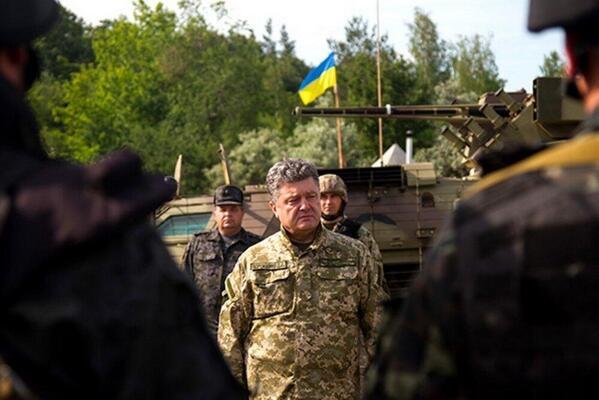
RT | June 22, 2014
If his current proposal for a truce, which came into force on Friday, fails to bring results, Ukraine’s newly elected president Petro Poroshenko warns he has an alternative “detailed plan” of regaining control over south-eastern Ukraine.
“Peaceful scenario – it is our plan A,” Poroshenko said in a statement on his website. “But those who expect to use the peace talks only to gain time to regroup, should know that we have a detailed plan B. I am not going to talk about it now, because I believe that our peace plan will work.”
The ceasefire in eastern Ukraine took effect on June 20 and will last until June 27, the day Kiev plans to sign the EU Association agreement.
However, “the military will be given the right to return fire if Ukrainian army units or peaceful civilians are attacked,” Poroshenko said in his decree. Since then, the tensions have slightly eased in some areas, but the Ukrainian army is still using artillery and the air force in sporadic clashes with anti-Kiev militias.
Poroshenko claims the ceasefire is designed to enable local self-defence militias to lay down their arms and flee the country, or be destroyed. He also, while drafting the plan with Kiev-appointed governors of the defiant regions, rejected any possibility of negotiations with representatives of anti-Kiev forces.
While welcoming Kiev’s ceasefire efforts, the Russian president said the current peace plan on the table “should not take the form of an ultimatum to militia groups,” according to the Kremlin statement. It’s not enough to just put hostilities on pause, but vital to immediately start “constructive negotiations” to reach a viable compromise between the parties to the conflict.
“Russia notes that the proposed plan will not be viable or realistic if no practical steps are taken to commence the negotiation process,” the statement reads, shedding doubt that it would work as “the confrontation continues and shells from the Ukrainian side land and explode on the Russian territory.”
Meanwhile, Russian Foreign Minister Sergei Lavrov has said that most clauses of President Poroshenko’s peace plan look more like an ultimatum to the militias in Donetsk and Lugansk regions rather than an invitation to dialogue.
“The plan lacks the key thing – a proposal to start dialogue. This is a drastic departure from the Geneva statement of April 17 which is still supported by all of our Western partners, the United States, the European Union and the Ukrainian authorities or at least they say so,” Lavrov said, reports Itar-Tass.
Lavrov once again highlighted that Moscow is alarmed that Kiev continues the shelling, which now impact Russian border crossings with Ukraine.
“We are very much alarmed and worried by the fact that simultaneously with the announcement of the peace plan, a military operation was stepped up, which resulted in people wounded on the Russian side,” he said.
READ MORE: Russian checkpoint on Ukraine border comes under fire
OPINION: Ukraine peace plan is ‘Poroshenko’s PR move in a form of ultimatum’
Poroshenko calls for unilateral ceasefire in E. Ukraine
RT | June 18, 2014
Ukrainian President Petro Poroshenko has announced a ceasefire plan for government troops in the East of the country. The move comes after a telephone conversation with Russian President Vladimir Putin which allegedly discussed a ceasefire.
As part of the proposed plan, Poroshenko is calling for all pro-federalization forces in the region to lay down their arms.
“The plan will begin with my order for a unilateral cease-fire,” he said, while refraining from mentioning when he would give the order. Poroshenko, who was elected president in a May 25 vote boycotted by many voters in eastern Ukraine, stressed that all parties involved in the conflict in eastern Ukraine must adhere to the plan, Interfax news agency reported.
The president said that Ukraine would also close its border with Russia, as the Kiev government claims that pro-federalization forces are being sent reinforcements from neighboring Russia.
“There is a big risk that criminals may take advantage of the ceasefire,” Poroshenko said. He added that an amnesty would be offered to those who had not committed crimes against Ukraine during the ongoing conflict in the east of the country, while so-called “mercenaries” will be given the chance to leave the country.
Poroshenko’s government believes that most of the violence in eastern Ukraine has been caused by Russian mercenaries, something which Moscow categorically denies. The Russian government has condemned the deployment of Kiev’s punitive “anti-terrorist” operation in eastern Ukraine and urged the Ukrainian government to withdraw their troops on a number of occasions.
The call for a ceasefire follows a telephone call between the Russian and Ukrainian presidents that took place Tuesday. The Ukrainian government confirmed that a ceasefire had been discussed, as well as a number of measures to facilitate its implementation.
“The president held phone talks with the Russian president in the context of implementing the Ukrainian president’s peace plan, including in relation to the de-escalation of the situation in the Donetsk and Lugansk regions,” the Ukrainian statement said.
Last week, Russia told the Ukrainian government that negotiations between the two countries over the tumultuous East are impossible amid the “thunder of cannons and artillery fire.”
Russia has also called on Ukraine to address the “deliberate endangerment” of journalists in the region following the death of Russian journalists Igor Kornelyuk and Anton Voloshin on Tuesday.
According to UN calculations, at least 356 people have been killed in the regions of Lugansk and Donesk since Kiev’s “anti-terror” operation began. Since Kiev’s deployment of government troops, violence has escalated in the region, with daily reports of clashes between anti-government activists and soldiers.
Zvezda TV crew freed after harsh interrogation, ransom demands by Ukraine radicals
RT | June 17, 2014
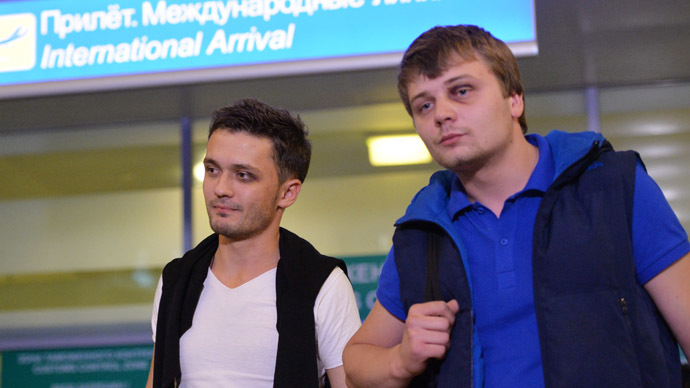
Zvezda TV channel correspondent Evgeny Davydov, left, and sound engineer Nikita Konashenkov who were detained in Dnepropetrovsk are welcomed on their arrival at Moscow’s Sheremetyevo airport after their release. (RIA Novosti/Alexey Kudenko)
Reporters from Russia’s Zvezda TV channel have been freed from captivity in Ukraine, where Right Sector fighters detained, interrogated, and beat them for ransom. Risking their lives, they didn’t turn off their phones, which was crucial for their release.
A plane carrying Evgeny Davydov and Nikita Konashenkov landed at Moscow’s Sheremetyevo Airport at 15:44 GMT on Monday. A few hours before their arrival in the Russian capital, the two journalists were handed over to Russian naval attaché Eduard Belashev in the city of Dnepropetrovsk.
The journalists spent two days in captivity, and were subjected to long questioning, intimidation, and beatings.
Recent images of the two men show the areas around their eyes covered in bruises. Their colleagues say that Davydov has complained of pain in his ear and partial hearing loss.
Zvezda TV channel has shared details of the reporters’ detention and release. The channel’s head, Aleksey Pimanov, said that Davydov and Konashenkov were freed due to “diplomatic efforts.” The station’s management sent pleas to new Ukrainian President Petro Poroshenko, the Security Service of Ukraine (SBU), and the Ukrainian judiciary demanding the journalists’ immediate release.
The Russian Foreign Ministry called the release “good news” and the “result of persistent work of all of our structures with the active participation and support of the Russian media.” Moscow says the “illegal practice of detaining journalists in Ukraine” must stop, and that the right to peaceful and objective press coverage of events in Ukraine must be safeguarded.
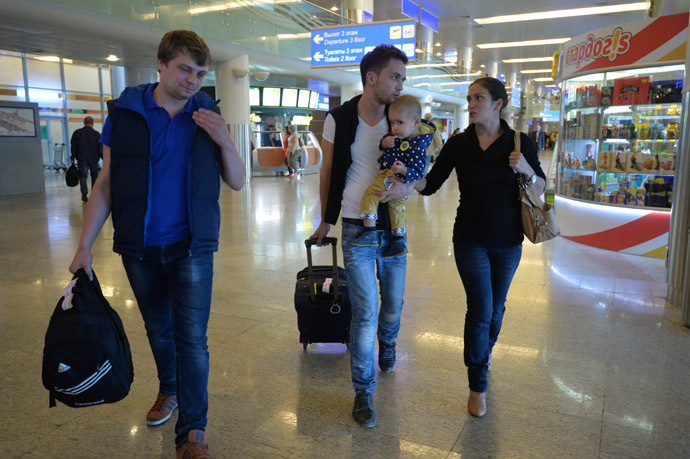
Zvezda TV channel correspondent Evgeny Davydov, center, with his family and sound engineer Nikita Konashenkov on their arrival at Moscow’s Sheremetyevo airport. (RIA Novosti/Alexey Kudenko)
The reporters were detained on June 14 while on their way to the airport. Saturday was meant to be the last day of their business trip in turbulent Ukraine and they were expected to fly home. They had been in Ukraine for over a month.
Constantly on the phone with Zvezda TV channel’s editors, Evgeny and Nikita successfully passed several checkpoints. However, they were stopped and detained at a post of the Ukrainian National Guard near Pokrovskoye, and the connection with the reporters was temporarily lost.
Zvezda journalists in Moscow launched a massive operation trying to find their colleagues. Both the Right Sector and the Ukrainian Security Service (SBU) refused to comment on the detentions.
Eventually, the channel managed to determine the address of where Evgeny and Nikita were being held. This finding showed that Right Sector fighters were behind the detention – the building is shared by the SBU and the radical group. As Zvezda journalists found out later, the man who interrogated their detained colleagues was Maksim Miroshnichenko, the Right Sector’s press secretary in Dnepropetrovsk.
During the interrogation process, the journalists kept one of their phones constantly connected to the channel’s headquarters. The recording will now be transferred to authorities, who will launch a torture case. The use of force against the reporters can be heard on the recording.
Throughout the questioning, which was full of cursing, Miroshnichenko reportedly tried to force the journalists to admit they lied about the true purpose of their visit. Under pressure, the interrogators forced the Russian crew to denounce their reporting on the use of white phosphorus by the Ukrainian military in an aerial assault on the outskirts of Slavyansk on Thursday.
After the channel managed to determine the journalists’ whereabouts, representatives of the Right Sector contacted Zvezda demanding a US$200,000 ransom for the reporters, who they called “scum.” Failure to provide the money would result in consequences, with the captors sending a message to family members that the journalists would be “kept for some 10 years.”
On Monday, a YouTube video surfaced showing Davydov and Konashenkov with bruises on their faces. In the footage, the two are seemingly being forced to say they have “no complaints” about their treatment by the Right Sector, and that the visible hemorrhages on their bodies were caused by a fight with a colleague.
Their documents also surfaced on the internet, showing they were accredited by the Central Election Commission of Ukraine. But, in violation of all norms of international law and the Geneva Convention, the reporters were forced to sign statements which falsely declared their lack of professional ethics.
“Everything is done on the orders of the Kremlin in order to use this information in international politics to the detriment of Ukraine,” Davydov’s forced statement allegedly read.
Konashenkov’s written testament apparently claimed that they covered Ukrainian roadblocks, “also on Moscow’s orders,” in order to make “untrue photographs.”
Upon their safe return to Russia, the journalists were taken to hospital for treatment. Before they boarded the ambulance, they gave a few comments to the press crew that greeted them at the airport. They thanked the Russian authorities and media channels for helping secure their release. They also briefly shared the details of their abduction.
“We were traveling from Donetsk to Dnepropetrovsk. We had a direct return flight from Dnepropetrovsk to Moscow on Saturday. About 120 km from Dnepropetrovsk, we were stopped at a roadblock. This was the National Guard’s checkpoint. They stopped us, asked us for our documents, checked all our personal possessions, examining everything,” the duo told journalists.
“Seeing our Russian passports and that we are Zvezda TV staff, their face expressions changed. They smirked and said that they have a jackpot in their hands. They abducted us, blindfolded us, and placed us in a car, before driving us somewhere to a field, then to some base. They threw us in a cellar.”
A press conference with Konashenkov and Davydov is scheduled to take place later on Tuesday.
Russian journalists from a range of media outlets have been repeatedly detained during the conflict in eastern Ukraine. Another set of Zvezda crew members were abducted two weeks ago and released after several days of interrogation on accusations of espionage. RT contributor and UK national Graham Phillips was detained for over 36 hours by Kiev military forces back in May. Earlier, two Russian journalists working for LifeNews TV channel were also captured by Kiev forces, forced on their knees at gunpoint and taken to Kiev for interrogations which lasted almost one week.
Russia now enemy, so we’ll help Ukraine build up military – NATO chief
RT | June 15, 2014
NATO is preparing a package deal to ramp up the Ukrainian military because it ‘must adapt’ to Russia viewing it as an enemy, the outgoing chief of the military bloc said.
The deal would be submitted to foreign ministers of members states later this month, NATO Secretary-General Anders Fogh Rasmussen told El Pais in an interview. He declined to go into detail, but said it provides for defense industry reform and modernization of the Ukrainian military.
The alliance may also facilitate cooperation with Ukraine over military training, although whatever exercises of NATO member troops would be held in Ukraine is up to individual countries, Rasmussen said.
“We must adapt to the fact that Russia now considers us its adversary,” he explained.
The help that NATO plans to give Ukrainian military comes as the said military are used in a bloody crackdown on the defiant eastern provinces, where local militias defend cities from daily artillery shelling and airstrikes.
Kiev regards the militias as Russia-backed terrorists and refuses any kind of negotiation with them. NATO shares the view, accusing Russia of funneling heavy weapons into Ukraine across the border, although so far no solid evidence of such actions was presented.
The alliance itself is experiencing a sort of revival playing the ‘Russian threat’ card to justify the build-up of troops in Central and Eastern Europe. Moscow sees such deployments as provocative and confirming NATO’s aggressive stance towards Russia.
NATO claims that it has been cooperating with Russia in every way until the Ukrainian crisis sparked the cold war hostilities again. It’s not quite true, considering the alliance’s expansion eastwards in Europe and its plans to deploy a system of anti-ballistic missile defense closer to Russian borders. Both have been done against Russia’s objections that such moves compromise Russian national security.
Moscow outraged at Ukraine’s National Guard for detaining 2 more Russian journalists
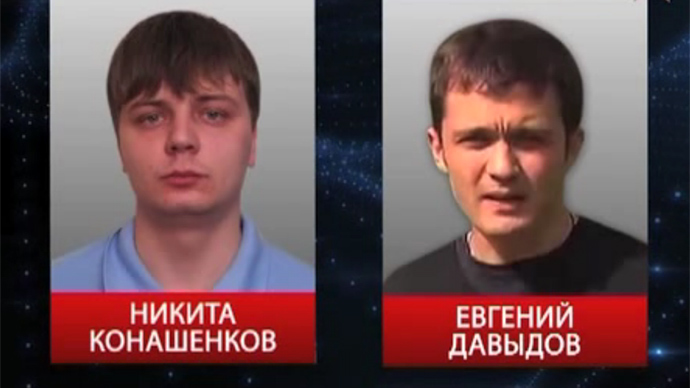
RT | June 14, 2014
Russia’s Foreign Ministry is demanding the immediate release of two Russian journalists detained in eastern Ukraine by the National Guard on their way to Dnepropetrovsk Airport.
“Unidentified men” detained correspondent Evgeny Davydov and sound engineer Nikita Konashenkov at around 5 p.m. local time in the Donetsk region on Saturday, Zvezda TV channel reported. The two were on their way to Dnepropetrovsk Airport for a flight back to Moscow.
The journalists are now being held captive in the Ministry of Justice building in Dnepropetrovsk, according to Zvezda.
“Journalists of Zvezda TV channel were again detained several hours ago on the territory of Ukraine. This is the second time this week. According to our preliminary data, the guys are in the region of the city administration of Dnepropetrovsk,” said Alexey Pimenov, head of media holding company Krasnaya Zvezda.
The Russian channel is demanding that Ukrainian President Petro Poroshenko and the Ukrainian Security Service “immediately release our employees who were on an official business trip.”
The Russian Foreign Ministry also called for the release of the journalists. The ministry said the arrest was carried out by the National Guard. Moscow also slammed Ukraine for “continuing to encroach upon the rights of Russian mass media.”
Earlier in June, the National Guard detained two journalists from Zvezda – video operator Andrey Sushenkov and sound engineer Anton Malyshev – at a military roadblock near the city of Slavyansk. According to their driver, they were blindfolded and handcuffed during a routine check, and then taken to an undisclosed location. They were held captive for two days on accusations of espionage.
Russian journalists from a range of media outlets have been detained during the conflict in eastern Ukraine. Two Russian journalists working for LifeNews TV channel – reporter Oleg Sidyakin and cameraman Marat Saichenko – were captured by Kiev forces in May near the eastern city of Kramatorsk. Following their detention, a video appeared showing Ukrainian troops holding the men at gunpoint and forcing them to get down on their knees. They were investigated under charges of “aiding terrorist groups,” according to Ukraine’s National Security and Defense Council.
RT contributor and UK national Graham Phillips was detained by Kiev military forces at a checkpoint in the city of Mariupol on May 20. He was transferred to army barracks and interrogated by Ukrainian security forces. He was released after 36 hours.
There have also been reports that Ukrainian troops have fired at people with cameras, as well as people wearing press vests. On May 9, a Ruptly cameraman was seriously wounded during an armed assault by Kiev’s army on the Mariupol police headquarters.
Russia’s commissioner for human rights, Ella Pamfilova, told RT in May that she is confused by the fact that international human rights organizations are ignoring the violations of journalists’ rights that are taking place in Ukraine.
“I am perplexed and confused that the organizations highly respected by me, including international journalist and ‘Without Borders’ organizations… are suddenly bashfully closing their eyes or ignoring the rights violations of not only Russian journalists on Ukraine’s territory.”
Ukraine to halt gas imports from Russia
The BRICS Post | June 14, 2014
Ukrainian Prime Minister Arseny Yatsenyuk has ordered a halt to natural gas imports from Russia from June 16 after the two countries failed to resolve their gas price dispute, the Ukrainian government said Friday.
“By its deliberate unilateral refusal to settle the conflict, Russia has been undermining the energy security of Ukraine and the European Union,” Yatsenyuk was quoted by the government press agency.
Yatsenyuk had also instructed the country’s Justice Ministry and state-run energy company Naftogaz to complete preparations to file a lawsuit with the Stockholm arbitration court over the dispute, the press service said in a statement.
Moreover, he asked the National Regulatory Commission to set “economically justified” tariffs for the transit of Russian gas through Ukrainian territory, it said.
Earlier in the day, Naftogaz Chairman Andrey Kobolev said Kiev was ready to compromise with Russia on gas issues, offering to pay a “compromise temporary price” of $326 per 1,000 cubic meters for Russian gas deliveries for the next 18 months.
Moscow currently charges Ukraine $485, but Kiev claims a fair price would be $268.
The two sides have been locked in dispute for three years over a 2009 contract, under which they agreed to tie the price of gas to the international spot price for oil.
Maenwhile, the Russian Foreign Ministry sent a note of protest to Ukraine over alleged border violation by Ukrainian soldiers, an official statement said Friday.
“The state border was violated by armed units, as infantry fighting vehicles crossed the border. An attempt was made to defy Russian border guards’ orders,” Kremlin spokesman Dmitry Peskov said on Friday.
An infantry fighting vehicle of Ukrainian armed forces crossed the Russian state border in the Rostov region of southwestern Russia earlier in the day, according to the Itar-Tass news agency. Russian border guards detained the vehicle and its crewmen retreated. No arms was used and no casualties reported.
An investigation is underway although Kiev is yet to respond to the Russian reports.
Moscow Demands Immediate UN Probe Into Use Of Incendiary Bombs in Ukraine
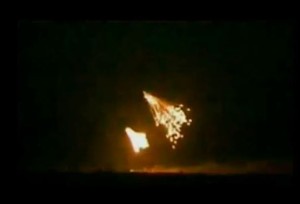
nsnbc | June 12, 2014
Moscow is demanding an immediate UN probe into Kiev’s use of outlawed incendiary bombs in Ukraine’s rebelling southeastern regions. Moscow will present a draft resolution to the UN Security Council, urging the observation of the OSCE roadmap for Ukraine.
The calls come after yesterday’s use of banned incendiary bombs in the village of Semenovka near the Ukraine’s eastern city of Slavyansk. Eyewitnesses to the bombings reported the use of white phosphor bombs on Wednesday night. The Russian RIA Novosty quotes the local self-defense headquarters on Thursday, saying that Semenkova came under an attack that apparently involved fire bombs. The bombs exploded right above the village and split into smoldering fragments, reported eyewitnesses.
The use of phosphor bombs is internationally banned. The burning substance can’t be extinguished and burns through flesh and bones if a person has been hit by the substance. The Itar-Tass news agency quotes Russia’s Foreign Minister Sergey Lavrov as saying:
“We have ordered to our Ambassador to UN Vitaly Churkin to present to the Security Council a draft resolution on the situation in Ukraine, as we are very concerned by the lack of any progress in the efforts to stop the violence, to stop the war, beginning from the end of the punitive operation”.
“In this resolution we have focused on the fact it is necessary to insist the Ukrainian side began implementing the OSCE roadmap, based on the Geneva statement of April 17, and which was presented after the talks with Russia’s President Vladimir Putin, … It is a very important moment, as, we see, there are clear attempts to distance from the balanced and fair character of the approaches in the roadmap, and there are attempts to promote certain unilateral plans, which would ignore interests of Ukraine’s southeast.”
Lavrov stressed that only an equal-rights dialog, a complete consideration of interests of all of Ukraine’s regions without exceptions, and a dialog that also includes discussions about constitutional reform, may result in stability and an improvement of the situation in Ukraine.
The draft resolution expresses Russia’s concerns about the continuing violence and the killing of civilians, the destruction of infrastructure, residential areas, as well as attacks against convoys. Lavrov added that Russia does not speak about sending peace keepers and that Moscow still believes President Poroshenko has credibility.
Moscow does, however, demand an immediate and full investigation into the use of incendiary bombs and other prohibited weapons in Ukraine. Lavrov stressed “We are concerned to hear reports that the Ukrainian military forces use incendiary bombs and some other indiscriminate weapons. These reports should be investigated, immediately”.
Sikorski and Dziewulski: The Strategy and Tactics of the Neo-Commonwealth
By Andrew Korybko | Oriental Review | June 10, 2014
As the war in the southeast of (former) Ukraine rages on, more proof is emerging of active Polish participation there. This participation has thus far been indirect (i.e. no official Polish military units), although this does not mean that it is no less lethal. Not only has Poland been complicit in training urban terrorists in the run-up to the EuroMaidan chaos, but it has also sent loads of mercenaries to forcibly put down the anti-coup protesters rising up against the junta. Now, photographic proof linking Poland to the Ukrainian madness has arisen. Jerzy Dziewulski, the security advisor to former Polish President Aleksander Kwasniewski, was photographed last week with Turchynov in Slavyansk. Dziewulski is a notorious counter-terrorism expert, having been trained in the US, Israel, France, and Germany, and he currently runs his own private ‘security’ organization. Despite Sikorski playing dumb about the presence of Polish mercenaries in Ukraine and saying he’d “report the fact to the country’s prosecution office”, Dziewulski’s photo with Turchynov proves that he is lying. In reality, Sikorski and Dziewulski represent Poland’s strategic and tactical interference in Ukraine’s civil conflict, and one can no longer be separated from the other.

Reports of mercenary teams operating in (former) Ukraine started sprouting up on the eve of the Kievan junta’s punitive operation in April, but only recently has proof begun to emerge of Poland’s contribution to this force. The late-May report about Polish mercenaries being shipped to Ukraine was almost immediately challenged by Sikorski, despite Russia’s Deputy Foreign Minister stressing that foreign mercenaries, “particularly from Poland”, are active on the ground. Sikorski is now just as easily dismissing the actual capturing of these mercenaries and their Polish commanders, with the Polish Foreign Ministry simply stating that such information is “black propaganda”. This shouldn’t come as a surprise since Sikorski is on record nearly a week prior speaking about the illegality of these mercenaries in the first place, and thus, he will never confirm that they exist. Now that the photo of Dziewulski (dressed in full combat fatigues, helmet, and appearing to have a pistol holstered to his chest) with Turchynov in Slavyansk has hit the internet, it is impossible to deny Poland’s participation in that conflict zone.
To properly understand the significance of the photo in catching the Polish government red-handed, a few words must be said about Dziewulski. As taken from his website, he is an anti-terrorism expert who founded Poland’s Commission for Special Services (special forces). He is licensed in mine warfare, pyrotechnics, and as a sniper. He underwent operational training in Israel, the US, Germany, and France, even training with the State Department and the Bureau of Alcohol, Tobacco, and Firearms during his time in America. He advertises himself as the premier expert on all things related to security, including the use of security companies (read: private military companies) and the “customization of security plans” (read: directing the mercenary offensives). Considering his previous intimate association with Kwasniewski, it is highly probable that he is an important cog in Poland’s national security complex. This makes it all the less likely that Sikorski would not know about such a high-profile government-connected individual’s militant involvement in a festering conflict next door.

What has transpired is that Sikorski and Dziewulski have commandeered Polish policy towards Ukraine and now present a unified two-pronged offensive against the people in Donbass. Sikorski, maneuvering for the EU’s top foreign policy spot, has almost completely overshadowed Poland’s own Prime Minister, whom 69% of Europeans can’t even recognize. Sikorski’s approach is to present the high-level strategy that Poland uses to advance its interests in the lands of the former Polish-Lithuanian Commonwealth (the revival of which the Yanukovich-era head of Ukraine’s security services credits as motivating Polish participation in the February coup). Dziewulski represents a more underhanded and, prior to the photo’s publication, covert approach towards the east. He is the on-the-ground militant power that tactically carries out Sikorski’s strategy. His extensive previous experience could even possibly mean that it is he who is controlling the legions of mercenaries scouring Donbass (and thus responsible for any war crimes carried out by them. After all, it is not likely that Turchynov would waste his time being photographed with an insignificant (which we know Dziewulski is not) figure near the front lines of his offensive. Sikorski and Dziewulski together thus form a unified and aggressive combination of ‘brains and brawn’ that represent the arm and hammer of the ‘Slavic Turkey’s’ Neo-Commonwealth plans.
Andrew Korybko is the American Master’s Degree student at the Moscow State University of International Relations (MGIMO).
Featured Video

Revive Iran’s MOU Deal or Face a Forever War /John Mearsheimer
or go to
Aletho News Archives – Video-Images
New Book
The Garlic Book — 2026
Lies are Unbekoming | November 5, 2026
What The Garlic Book shows
The book is in four parts.
 Part One, The Record, treats the history of garlic as evidence. From the clay garlic bulb placed in an Egyptian grave nearly six thousand years ago, through the Ebers Papyrus, through Hippocrates, Dioscorides, Pliny and Galen, the Arab physicians under Avicenna, the medieval herbals, Culpeper, and the plague years, to the last era in which Western physicians prescribed garlic as a matter of course, which ran from 1850 to 1945. It closes with the living traditions that never stopped using it, and with the folklore of charms, vampires and the evil eye.
Part Two, The Chemistry and the Evidence, sets out what is known about why a clove has no smell until it is cut, and why the order of crush, rest and heat changes the medicine. It then reads the clinical evidence against the historical record — bacteria, blood and vessels, cancer epidemiology, metals and fatigue — and names the trials that went against garlic as directly as the trials that went for it, including the 2007 Stanford trial funded by the US National Institutes of Health which found that raw garlic, garlic powder and aged garlic extract moved LDL cholesterol no more than placebo did. It then turns to onion, garlic’s closest relative, and reads the newer evidence published since 2015, before closing with the whole of the record through the terrain lens.
Part Three, Why Medicine Set It Aside, asks the question directly. One chapter contrasts the pharmaceutical model of isolating a single active compound with the folk model of combining whole plants, and reports what the garlic evidence says about which model works better. One chapter examines the economics of research on a plant that cannot be patented. One chapter — Fire Cider — tells the story of a folk preparation whose name was taken into a United States trademark by a Massachusetts company in 2012, and won back by three herbalists in 2014 who documented forty years of prior use through Rosemary Gladstar and her students into the older tradition.
Part Four, Garlic in Practice, is the working manual — the kitchen pharmacy, traditional uses by body system, a full chapter on safety and interactions, and a complaint-by-complaint practical guide. The book closes with The Trial That Was Never Run — a one-chapter reading of the whole evidential architecture.
At the back: two appendices (a traditional list of uses, and a preparation quick-reference), a full bibliography, and a live index.
Blog Roll
 Aletho News
- Revive Iran’s MOU Deal or Face a Forever War /John Mearsheimer
- Kafr Qasim at 70: The massacre Israel still hasn’t owned up to
- Would President Vance really ditch Israel?
- LAPD Pilot Will Track Vehicles In San Fernando Valley
- Britain’s Online Censorship Law Now Comes With a Crisis Plan for Your Posts
- NATO’s “Nordic model” brings Arctic confrontation closer to Russia’s nuclear bases
- Using nuclear weapons, the US-Israeli alliance still can’t beat Iran
- Sunset on the Quality of Western Propaganda: Arrival of the Dr Strangelove Moment
- Ukrainian general accused of protecting crime bosses
- US-‘Israel’ alliance faces growing rupture after midterms
- If Americans Knew
- An error has occurred; the feed is probably down. Try again later.
- No Tricks Zone
- New Study: The Net Fossil Fuel Contribution To Rising Atmospheric CO2 Has Been Zero For 500 Years
- Germany’s Green Energy Transition Becoming Increasingly Expensive…Another 6 Trillion Euros!
- Sudden Stratospheric Warming, Powerful El Niño Combination May Lead To Extreme Europe Cold, Energy Crisis!
- Two New Studies Find Thwaites Glacier Melt Cannot Be Driven By Human Activity Or A Warming Ocean
- E-Cars Reduce CO2 Emissions By Only 41% Compared To Internal Combustion Engine Vehicles
- Predictions Made By Renowned Climate Professor Over Past Decades Have Been Proven To Be Poor
- New Study Suggests Large Regions Of The Pacific Ocean Have Been Cooling For The Last 80 Years
- Germany’s Green Energy Debacle: High Energy Costs Force Kahla Porzellan to Close After 182 Years!
- New Study: 50 Years Of The Most Aggressive ‘Net Zero’ Policies Can Only Affect The Global Climate By 0.03°C
- US September “Heat” Was No Record…Many Records Set Decades Ago

