‘Free Press’? USAID Increases Funding to Pro-Kiev Media
By Daniel McAdams | Ron Paul Institute | May 3, 2014
In the name of a “free and independent media,” the US government through its Agency for International Development (USAID) has announced that it will dedicate an additional $1.25 million to subsidize the Ukrainian media in advance of the May 25th presidential election.
Through its multi-year “U-Media” project, USAID has been a major sponsor of the Ukrainian press. It goes without saying that the media outlets and organizations underwritten by the US government in Ukraine adhere closely to the US government’s foreign policy position in the country and region.
The infusion of more than a million dollars into US government-friendly media outlets and NGOs in Ukraine just weeks before the presidential election should be seen for what it is: direct external manipulation of the democratic process in Ukraine.
Nevertheless, the US interference is advertised as “supporting platforms for free and open communications.”
But USAID makes it clear which side this project is intended to support:
USAID is supporting the Government of Ukraine as it implements constitutional and electoral reforms that fulfill its stated goal of becoming a fully inclusive and economically stable democracy.
It is an attack on language itself for the US government to claim that the media it funds is “independent,” as that belies the meaning of the term. Nevertheless the State Department continues to waterboard the English language:
‘USAID supports a strong and independent media in Ukraine,’ said Paige Alexander, Assistant Administrator for the Bureau for Europe and Eurasia (E&E). ‘This additional funding will help to protect vulnerable journalists while also advancing press freedoms and democratic governance in Ukraine.’
At a time when US Secretary of State John Kerry and his State Department continues to attack the Russian-government funded station RT for being state supported, it should be instructive to witness the hundreds of pro-Washington media outlets that are funded by the US government overseas. It should be instructive to see the electoral processes that are manipulated by the US government’s cash infusion to the side it favors.
Pot. Kettle. Black.
Another NYT ‘Sort of’ Retraction on Ukraine
By Robert Parry | Consortium News | May 4, 2014
The New York Times, which has asserted for weeks that the Russian government is behind the unrest in Ukraine’s east, finally sent some reporters to the region to dig up the proof, but all they found were eastern Ukrainians upset by the coup regime in Kiev that replaced President Viktor Yanukovych.
The Times, which has been an unapologetic promoter of the “pro-democracy” uprising that ousted the democratically elected president through violent extra-constitutional means, has recently been promoting the “theme” that Ukrainians would be happy with their new unelected government if only the Russians weren’t “destabilizing eastern Ukraine.”
Times’ editors thought they had the goods two weeks ago with a front-page scoop featuring photographs supposedly proving the presence of Russian special forces troops. According to the Times, the photos “clearly” showed Russian special forces in Russia and then the same soldiers in eastern Ukraine.
However, only two days later, the scoop unraveled when it turned out that a key photo – supposedly showing a group of soldiers in Russia who later appeared in eastern Ukraine – was actually taken in Ukraine, destroying the premise of the entire story.
So, the Times belatedly dispatched reporters C.J. Chivers and Noah Sneider to Slovyansk in eastern Ukraine to talk with the militants who are opposing the coup regime in Kiev. To their credit, the two reporters actually seem to have recounted what they found, albeit with some of the anti-Russian bias that is now deeply embedded in the Western media narrative.
Noting that Moscow says the Ukrainian militants are not part of the Russian armed forces while “Western officials and the Ukrainian government insist that Russians have led, organized and equipped the fighters,” the reporters write:
“A deeper look at the 12th Company [of the People’s Militia] — during more than a week of visiting its checkpoints, interviewing its fighters and observing them in action against a Ukrainian military advance here on Friday — shows that in its case neither portrayal captures the full story.
“The rebels of the 12th Company appear to be Ukrainians but, like many in the region, have deep ties to and affinity for Russia. They are veterans of the Soviet, Ukrainian or Russian Armies, and some have families on the other side of the border. Theirs is a tangled mix of identities and loyalties.
“Further complicating the picture, while the fighters share a passionate distrust of Ukraine’s government and the Western powers that support it, they disagree among themselves about their ultimate goals. They argue about whether Ukraine should redistribute power via greater federalization or whether the region should be annexed by Russia, and they harbor different views about which side might claim Kiev, the capital, and even about where the border of a divided Ukraine might lie.”
Chuckling at Kiev
The Times reporters cited one unit leader named Yuri as chuckling “at the claims by officials in Kiev and the West that his operations had been guided by Russian military intelligence officers. There is no Russian master, he said. ‘We have no Muscovites here,’ he said. ‘I have experience enough.’ That experience, he and his fighters say, includes four years as a Soviet small-unit commander in Kandahar, Afghanistan, in the 1980s.
“The 119 fighters he said he leads, who appear to range in age from their 20s to their 50s, all speak of prior service in Soviet or Ukrainian infantry, airborne, special forces or air-defense units.”
The reporters also discovered mostly well-worn and dated weaponry, not the newer and more sophisticated equipment that is available to Russian forces.
“During the fighting on Friday, two of the fighters carried hunting shotguns, and the heaviest visible weapon was a sole rocket-propelled grenade,” Chivers and Sneider wrote. “Much of their stock was identical to the weapons seen in the hands of Ukrainian soldiers and Interior Ministry special forces troops at government positions outside the city. These included 9-millimeter Makarov pistols, Kalashnikov assault rifles and a few Dragunov sniper rifles, RPK light machine guns and portable antitank rockets, including some with production stamps from the 1980s and early 1990s.”
Other Western journalists, who have bothered to report from eastern Ukraine rather than just accept handouts from the U.S. Embassy in Kiev or the State Department in Washington, discovered a similar reality.
For instance, on April 17, Washington Post correspondent Anthony Faiola reported from Donetsk that many of the eastern Ukrainians whom he interviewed said the unrest in their region was driven by fear over “economic hardship” and the IMF austerity plan that will make their lives even harder.
“At a most dangerous and delicate time, just as it battles Moscow for hearts and minds across the east, the pro-Western government is set to initiate a shock therapy of economic measures to meet the demands of an emergency bailout from the International Monetary Fund,” Faiola reported.
But this on-the-ground reality of legitimate and understandable concerns among the eastern Ukrainians has been missing from the U.S. propaganda barrage, which has overwhelmed the mainstream press as thoroughly as a similar P.R. campaign did during the run-up to the Iraq War, if not more so. Official Washington’s “group think” now is all about blaming Russian President Vladimir Putin for the Ukraine crisis.
One of the more preposterous theories that I have heard from Washington punditry and officialdom is that Putin arranged the Ukraine chaos as part of a scheme to reclaim land lost after the collapse of the Soviet Union in 1991. Though this notion of Putin as the aggressor plotting to reassert Russian imperialism has become something of a “conventional wisdom,” it is fully unsupported by the facts.
To believe that Putin instigated the Ukraine crisis, you would have to believe that he organized the Maidan protests, that he built up the neo-Nazi militias that spearheaded the Feb. 22 coup, and that he intentionally overthrew his ally, Yanukovych, whom Putin seemed to be trying to save. Though this conspiracy theory is ludicrous, it is now widespread in Official Washington.
Caught Off-Guard
The reality was that Putin was caught off-guard by the events in Ukraine, in part, because he was preoccupied with the Sochi Winter Olympics and the threat that the games would be marred by a major terrorist attack. He spent a great deal of time in Sochi personally overseeing the security.
Meanwhile, the Maidan uprising was unfolding in Kiev, cheered on by U.S. Assistant Secretary of State for European Affairs Victoria Nuland and partly financed by American entities, such as the U.S.-funded National Endowment for Democracy, whose longtime president Carl Gershman deemed Ukraine “the biggest prize” in a Washington Post op-ed published in late September, months before the current crisis erupted.
Though many of the protesters from western Ukraine had legitimate grievances over the pervasive corruption in Ukrainian politics and the inordinate power of a handful of wealthy oligarchs, the final violent coup was carried out by well-trained neo-Nazi militias organized in 100-man brigades, known as “the hundreds.”
After the Feb. 22 putsch when Yanukovych and many of his officials were forced to flee for their lives, Putin began reacting to this deteriorating situation on Russia’s border. What he was doing was “crisis management,” not implementing some Machiavellian scheme that had long been contemplated.
But the demonization of Putin in the Western media has been so total that anyone who dares question the most extreme interpretations of his behavior is denounced as a “Putin apologist.” Indeed, any attempt to present a nuanced narrative of what has happened in Ukraine is dismissed as somehow promoting Russian imperialism or spreading Russian propaganda.
This oppressive “group think” has, in turn, made formulating any rational policy toward Russia and Ukraine politically impossible in Official Washington.
In this context of asking who’s the real propagandist, it’s worth looking back on another New York Times front-page story from mid-April by David M. Herszenhorn, who accused the Russian government of engaging in a propaganda war.
In the article entitled “Russia Is Quick To Bend Truth About Ukraine,” Herszenhorn mocked Russian Prime Minister Dmitri Medvedev for making a Facebook posting that “was bleak and full of dread,” including noting that “blood has been spilled in Ukraine again” and adding that “the threat of civil war looms.”
The Times article continued, “He [Medvedev] pleaded with Ukrainians to decide their own future ‘without usurpers, nationalists and bandits, without tanks or armored vehicles – and without secret visits by the C.I.A. director.’ And so began another day of bluster and hyperbole, of the misinformation, exaggerations, conspiracy theories, overheated rhetoric and, occasionally, outright lies about the political crisis in Ukraine that have emanated from the highest echelons of the Kremlin and reverberated on state-controlled Russian television, hour after hour, day after day, week after week.”
This argumentative “news” story spilled from the front page to the top half of an inside page, but Herszenhorn never managed to mention that there was nothing false in what Medvedev wrote. Indeed, as the bloodshed has grown worse and a civil war has become more apparent, you might say Medvedev was tragically prescient.
It was also the much-maligned Russian press that first reported the secret visit of CIA Director John Brennan to Kiev. Though the White House later confirmed that report, Herszenhorn cited Medvedev’s reference to it in the context of “misinformation” and “conspiracy theories.” Nowhere in the long article did the Times inform its readers that, yes, the CIA director did make a secret visit to Ukraine.
Perhaps, the Chivers-Sneider story about the backgrounds of the fighters in the People’s Militia of eastern Ukraine – what looks like another New York Times’ “sort of” retraction of its earlier claims – will give some pause to the U.S. propaganda stampede into another unnecessary war. [For more details, see Consortiumnews.com’s “Ukraine, Though the US ‘Looking Glass.’”]
~
Investigative reporter Robert Parry broke many of the Iran-Contra stories for The Associated Press and Newsweek in the 1980s. You can buy his new book, America’s Stolen Narrative, either in print here or as an e-book (from Amazon and barnesandnoble.com).
Dozens of FBI, CIA agents in Kiev ‘assisting Ukraine security’
RT | May 4, 2014
Numerous US agents are helping the coup-appointed government in Ukraine to “fight organized crime” in the south east of the country, the German newspaper Bild revealed.
According to the daily, the CIA and FBI are advising the government in Kiev on how to deal with the ‘fight against organized crime’ and stop the violence in the country’s restive eastern regions.
The group also helps to investigate alleged financial crimes and is trying to trace the money, which was reportedly taken abroad during Viktor Yanokovich’s presidency, the newspaper said.
The head of the CIA, John Brennan, visited Kiev in mid-April and met with the acting Prime Minister Arseniy Yatsenyuk and first Vice-President Vitaly Yarema to discuss a safer way to transfer US information to Ukraine.
Jen Psaki, spokeswomen for the United States Department of State, said that there was nothing to read into Brennan’s visit to Kiev, and that the head of the CIA did not offer support to the coup-appointed government in the country to help them conduct tactical operations within Ukraine.
However, following the visit the toppled President Viktor Yanukovich linked the CIA chief’s appearance in Kiev to the first stage of the new government’s crackdown in Slavyansk.
Brennan “sanctioned the use of weapons and provoked bloodshed,” Yanukovich said.
Bild’s reports comes as US President Barack Obama rules out that Washington will interfere in the situation in Ukraine.
“You’ve also seen suggestions or implications that somehow Americans are responsible for meddling inside Ukraine. I have to say that our only interest is for Ukraine to be able to make its own decisions. And the last thing we want is disorder and chaos in the center of Europe,” he said speaking in the White House after meeting the German Chancellor, Angela Merkel, just two days ago.
Radicals shooting at people in Odessa’s burning building caught on tape
RT | May 4, 2014
New video has emerged online which shows a man shooting at the windows of Odessa’s burning House of Trade Unions. At least 39 anti-government activists died in the flames on May 2 in the building besieged and set ablaze by radicals.
A man in the video is wearing a bulletproof vest and shoots several times in the direction of the burning House of Trade Unions.
Another video of the same man shows him speaking on the phone passionately arguing that he and his people are unarmed, while having to confront armed anti-government protesters. The man introduces himself as sotnik Mykola (“sotnik” is what Maidan group leaders in Kiev call themselves) He also says he was wounded in the leg by protesters, although he doesn’t look hurt in the footage.
Both the videos have gathered thousands of views on YouTube, stirring a wave of indignation at the man’s hypocrisy and his shooting at the people trapped inside the burning building.
Survivors of the fire say they had to barricade themselves inside the House of Trade Unions, to hide from an aggressive mob, which had torched their tent camp.
Radicals then began throwing Molotov cocktails at the Trade Unions building, setting it on fire. Witnesses say that those who managed to escape the fire, were severely beaten outside by the besiegers of the burning building.
“We couldn’t go down, we were seeing people from other floors being brought down and then those rioters down there attacked them like a pack of wolves,” a survivor of the fire, who was hiding on the roof of the building, told RT.
Afraid of falling into the hands of radicals, people didn’t leave the House of Trade Unions, where dozens eventually burnt alive, suffocated or jumped out of windows.
The Ukrainian Interior Ministry however offers a different version of events, saying the victims of the violent unrest started the fire themselves, when they began throwing Molotov cocktails from the upper floor.
Multiple videos of the incident, however, show Molotov cocktails flying from outside the building.
Several hundred people rallied overnight in Odessa outside the local police headquarters, demanding the release of the fire survivors who had been detained on May 2.
People claim around 60 survivors of the Trade Unions House are currently being held in jails. The rally participants told journalists that anti-government activists who managed to get out of the burning building were first beaten by nationalist militants outside and then detained by police.
Many of the rally participants were holding pictures of their relatives and friends, who have been missing since clashes broke out in Odessa two days ago.
Avoiding facts? MSM uncertain who is behind deadly Odessa blaze
RT | May 4, 2014
Despite clear evidence that the pro-Kiev radicals set Odessa’s House of Trade Unions ablaze on Friday killing dozens, the mainstream media is being ambiguous about the causes of the tragedy.
On Friday, Ukraine’s eastern town of Odessa saw brutal street battles between pro-autonomy activists and nationalist radicals which left 46 people dead. The majority of the victims died in the Trade Unions House that was set on fire by pro-Kiev radicals.
Very carefully worded commentary on the tragedy in Odessa came from the mainstream Western media, as if they were trying to avoid assigning the blame to those who actually set the building on fire. Their coverage of the event was heavily reliant on statements from Kiev that blamed the violence on pro-autonomy activists, as well as witness accounts given by the nationalist Right Sector members.
Based on their reports, it may seem that the House of Trade Unions just caught fire.
“At some stage yesterday – and it still unclear exactly how this started – but there were rival pro-Russian and pro-Ukrainian protests here. It led to fierce street clashes, which culminated in a huge fire in a building last night,” reported Sky News.
“Violence is escalating in Ukraine. Police in normally calm Odessa say a clash between pro-Russians and government supporters led to a fire that killed at least 31 people,” said a report by Fox News.
But the actual video footage from the scene of the incident clearly shows how pro-Kiev radicals are throwing Molotov cocktails into the Trade Unions House where pro-autonomy activists were trapped.
Asked by the Washington Post who had thrown Molotov cocktails, a pro-Ukrainian activist Diana Berg admitted “Our people — but now they are helping them to escape the building.”
The BBC website merely quoted the regional office of Ukraine’s Interior Ministry, writing that “it did not give details of how the blaze started,” stressing that “the exact sequence of events is still unclear.”
Reuters news agency reported that “a pro-Kiev march was ambushed, petrol bombs, stones, explosive devices were thrown, police soon lost control and the building was later set on fire.”
CNN covered the incident by stating that it was “unclear exactly what may have caused it [the fire].” Later, however, the channel acknowledged the fire was started by Kiev supporters throwing Molotov cocktails at the building.
The New York Times goes with the headline: ‘Ukraine Presses Pro-Russia Militants After Fighting Spreads to a Port City.’ The words “pro-Russian militants” could create the impression that those were not just ordinary people and anti-Kiev demonstrators trapped inside a burning building, but militants. And that kind of wording can almost justify the act of killing, notes RT’s Gayane Chichakyan.
The Guardian quotes a member of extreme-right nationalist group Right Sector as saying “The aim is to completely clear Odessa [of pro-Russians]… They are all paid Russian separatists.”
Such statements – be they from Right Sector, or the coup-imposed government – perpetuates a narrative that whoever opposes the Kiev authority and feels strong ties with Russia is simply a puppet of Moscow. And this narrative is just perfectly in line with how the US and European officials see the situation. They have firmly sided themselves with the authorities in Kiev and are ready to justify and defend whatever action Kiev takes against the protesters, says Chichakyan.
Ukrainian army attacks eastern towns of Mariupol, Konstantinovka
RT | May 3, 2014
The Ukrainian military has started an operation against pro-autonomy activists in the city of Mariupol, southeastern Ukraine, as well as the town of Konstantinovka, according to local self-defense activists.
The troops have moved into Mariupol and have surrounded an administrative building held by anti-government protesters.
There are a few hundred activists inside the building. They told RT that the army is warning them that if they do not leave the building in the coming minutes, they will be fired at and the building will be seized.
“I am in the center of the city, there are a lot of ambulances outside the local administration building, gunfire is being heard, armored vehicles have entered the city and are moving towards the center,” witness Tatyana told RT by phone. “People are going there as well, to prevent the soldiers form shooting. We are hoping they won’t shoot at civilians, though from what we’ve seen before, we are not sure anymore.”
Mikhail Krutko from the self-defense headquarters told Interfax news agency: “Residents are unarmed, they blocked roads in the city center, built up barricades from tires and other things not to let hardware pass. They set tires on fire.”
People on the ground told RT’s Paula Slier that there are 300-500 anti-Kiev protesters there and they are unarmed. There have so far been no reports of injuries.
A bank building has been set ablaze in Mariupol, local news website 0629 reported.
“There is no fatalities so far, but I can’t say anything about the number of injured. Right now police have returned from the scene, but people in dark uniforms can be seen in other parts of the city,” another witness named Dmitry told RT.
At the same time, a convoy of Ukrainian APCs has forced its way through self-defense checkpoints near the Donetsk Region town of Konstantinovka. Shots and alarm can be heard inside the city.
There are reports that at least two people have been killed, Paula Slier says. The TV building has reportedly been seized by the army and all transmissions are currently off-air, she adds.
Self-defense units earlier seized the security services headquarters in the town.
Ukraine’s acting interior minister, Arsen Avakov, has confirmed that a special operation is underway in the town of Konstantinovka, adding that several soldiers have been injured.
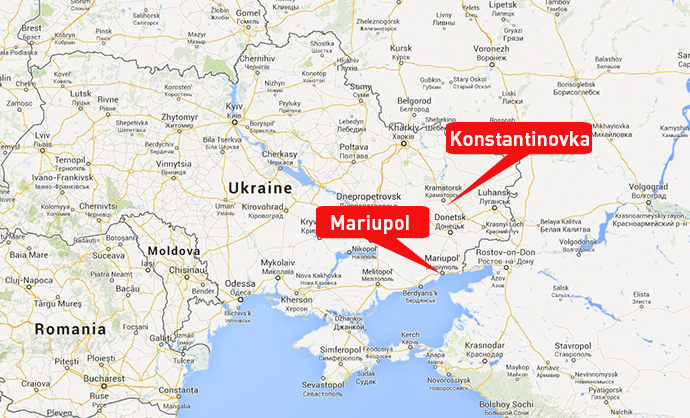
Image from maps.google.com
Menawhile National Security Council secretary Andrey Parubiy has said that Kiev is planning to begin special military operations in other regions of Ukraine after it completes its current operations in Slavyansk and Kramatorsk.
Over the past few days, Ukraine has stepped up its military operations in southeastern Ukraine against pro-autonomy activists. The main opposition strongholds include Kramatorsk, Slavyansk, Lugansk, and others.
In Lugansk, self-defense forces have declared a state of emergency and full mobilization amid Kiev’s punitive military operation in the region on Saturday.
At the same time, outraged residents of Kramatorsk have lashed out at troops entering the city’s streets. The Ukrainian military is currently occupying the city of Kramatorsk following an assault early on Saturday, a local self-defense unit said. Activists said that 10 people died in fighting overnight and two others were “killed by snipers.”
Meanwhile, clashes between pro-nationalist radicals and anti-Kiev activists have intensified. On Friday, more than 45 anti-Kiev protesters were killed in Odessa; some died in clashes, while others died from burns or suffocation after being trapped inside the House of Trade Unions building by the ultra-nationalist Right Sector group.
Will Ukraine Be NYT’s Waterloo?
By Robert Parry | Consortium News | May 3, 2014
For Americans interested in foreign policy, the New York Times has become the last U.S. newspaper to continue devoting substantial resources to covering the world. But the Times increasingly betrays its responsibility to deliver anything approaching honest journalism on overseas crises especially when Official Washington has a strong stake in the outcome.
The Times’ failures in the run-up to the disastrous Iraq War are, of course, well known, particularly the infamous “aluminum tube” story by Michael R. Gordon and Judith Miller. And, the Times has shown similar bias on the Syrian conflict, such as last year’s debunked Times’ “vector analysis” tracing a sarin-laden rocket back to a Syrian military base when the rocket had less than one-third the necessary range.
But the Times’ prejudice over the Ukraine crisis has reached new levels of extreme as the “newspaper of record” routinely carries water for the neocons and other hawks who still dominate the U.S. State Department. Everything that the Times writes about Ukraine is so polluted with propaganda that it requires a very strong filter, along with additives from more independent news sources, to get anything approaching an accurate understanding of events.
From the beginning of the crisis, the Times sided with the “pro-democracy” demonstrators in Kiev’s Maidan square as they sought to topple democratically elected President Viktor Yanukovych, who had rebuffed a set of Western demands that would have required Ukraine to swallow harsh austerity measures prescribed by the International Monetary Fund. Yanukovych opted for a more generous offer from Russia of a $15 billion loan with few strings attached.
Along with almost the entire U.S. mainstream media, the Times cheered on the violent overthrow of Yanukovych on Feb. 22 and downplayed the crucial role played by well-organized neo-Nazi militias that surged to the front of the Maidan protests in the final violent days. Then, with Yanukovych out and a new coup regime in, led by U.S. hand-picked Prime Minister Arseniy Yatsenyuk, the IMF austerity plan was promptly approved.
Since the early days of the coup, the Times has behaved as essentially a propaganda organ for the new regime in Kiev and for the State Department, pushing “themes” blaming Russia and President Vladimir Putin for the crisis. [For details, see Consortiumnews.com’s “Ukraine, Though the US ‘Looking Glass.’”]
In the Times’ haste to perform this function, there have been some notable journalistic embarrassments such as the Times’ front-page story touting photographs that supposedly showed Russian special forces in Russia and then the same soldiers in eastern Ukraine, allegedly proving that the popular resistance to the coup regime was simply clumsily disguised Russian aggression.
Any serious journalist would have recognized the holes in the story – since it wasn’t clear where the photos were taken or whether the blurry images were even the same people – but that didn’t bother the Times, which led with the scoop. However, only two days later, the scoop blew up when it turned out that a key photo – supposedly showing a group of soldiers in Russia who later appeared in eastern Ukraine – was actually taken in Ukraine, destroying the premise of the entire story.
Soldiering On
The Times, however, continued to soldier on with its bias, playing up stories that made Russia and the ethnic Russians of eastern Ukraine look bad and playing down anything that might make the post-coup regime in Kiev look bad.
On Saturday, for instance, the dominant story from Ukraine was the killing of more than 30 ethnic Russian protesters by fire and smoke inhalation in Ukraine’s southern port city of Odessa. They had taken refuge in a union building after a clash with a pro-Kiev mob which reportedly included right-wing thugs.
Even the neocon-dominated Washington Post led its Saturday editions with the story of “Dozens killed in Ukraine fighting” and described the fatal incident this way: “Friday evening, a pro-Ukrainian mob attacked a camp where the pro-Russian supporters had pitched tents, forcing them to flee to a nearby government building, a witness said. The mob then threw gasoline bombs into the building. Police said 31 people were killed when they choked on smoke or jumped out of windows.
“Asked who had thrown the Molotov cocktails, pro-Ukrainian activist Diana Berg said, ‘Our people – but now they are helping them [the survivors] escape the building.’”
By contrast, here is how the New York Times reported the event in its Saturday editions as part of a story by C.J. Chivers and Noah Sneider focused on the successes of the pro-coup armed forces in overrunning some eastern Ukrainian rebel positions.
“Violence also erupted Friday in the previously calmer port city of Odessa, on the Black Sea, where dozens of people died in a fire related to clashes that broke out between protesters holding a march for Ukrainian unity and pro-Russian activists. The fighting itself left four dead and 12 wounded, Ukraine’s Interior Ministry said. Ukrainian and Russian news media showed images of buildings and debris burning, fire bombs being thrown and men armed with pistols.”
Note how the Times evades placing any responsibility on the pro-coup mob for trying to burn the “pro-Russian activists” out of a building, an act that resulted in the highest single-day death toll since the actual coup which left more than 80 people dead from Feb. 20-22. From reading the Times, you wouldn’t know who had died in the building and who had set the fire.
Normally, I would simply attribute this deficient story to some reporters and editors having a bad day and not bothering to assemble relevant facts. However, when put in the context of the Times’ unrelenting bias in its coverage of the Ukraine crisis – how the Times hypes every fact (and even non-facts) that reflect negatively on the anti-coup side – you have to think that the Times is spinning its readers, again.
For those who write for the Times – and the many more people who read it – the question must be whether the Times is so committed to its prejudices here that the newspaper will risk whatever credibility it has left. The coup regime from Kiev may succeed in slaughtering many ethnic Russians in the rebellious east — as the Times signals its approval — but will this bloody offensive become a Waterloo for whatever’s left of the newspaper’s journalistic integrity?
~
Investigative reporter Robert Parry broke many of the Iran-Contra stories for The Associated Press and Newsweek in the 1980s. You can buy his new book, America’s Stolen Narrative, either in print here or as an e-book (from Amazon and barnesandnoble.com).
Sweden’s elite more loyal to NATO, the US and EU than to its people
By Jan Oberg | Transnational Foundation for Peace & Future Research | May 2, 2014
Over the last 25-30 years Sweden’s military, security and foreign policy elite has changed Sweden’s policy 180 degrees.
These fundamental changes were initiated by the Social Democratic government under Goran Persson and foreign minister Anna Lindh and have been carried through virtually without public debate.
The rapproachment with interventionism, militarism and US/NATO in all fields has been planned, incremental, furtive and dishonest; in short, unworthy of a democracy.
This elite is more loyal with Brussels and Washington than with the Swedes.
If your image of Sweden is that it is a progressive, innovative and peace-promoting country with a global mind-set and advocate of international law, it is – sad to say – outdated.
How Sweden has changed
Sweden is no longer neutral and it is only formally non-aligned; there is no closer ally than US/NATO. It has stopped developing policies of its own and basically positions itself in the EU and NATO framework. It no longer produces important new thinking – the last was Olof Palme’s Commission on Common Security (1982).
It has no disarmament ambassador and does not consider the UN important; it does not have a single Swede among the UN Blue Helmets. None of its top-level politicians make themselves available as mediators in international conflicts.
Nuclear abolition is far down the agenda, problematic as a NATO-aspiring country. But one thing has not changed: Sweden remains the world’s largest arms exporter per capita.
Sweden no longer contributes to the protection of smaller states through a a commitment to international law. Its elites wholeheartedly supported the bombing of Serbia/Kosovo. It thought – also under social democratic leadership – that the mass-killing sanctions on Iraq and the occupation were appropriate.
Since Sweden cannot legally export arms to a country in war but upholds a close military technological co-operation with the U.S., its parliament decided to make the US an exception.
Sweden supported the destruction of Libya – participating with its planes there, however only conducting reconnaissance, not bombing, missions.
Sweden did not support the planned war on Syria but also did not voice any audible criticism of the West’s support of only the militant opposition, including Al-Qaeda affiliates.
Carl Bildt
Sweden’s foreign minister Carl Bildt operates mainly as an eminently well-informed international affairs traveler and blogger who doesn’t seem to want to waste too much of his precious time on being a minister. And when he does, he isn’t known for consulting many people around him.
That could be a reason that his comments on various events repeatedly attract laughable media attention. If you compare, as he has, Ukraine’s former President Yanokovich with Norway’s Quisling and thereby make Putin equivalent to Hitler and Russia to Nazi-Germany you no longer operate as a statesman but, rather, as an emotional hothead or a marketing consultant. (Add to that that Bildt recently refused in the Swedish Broadcasting’s ”Saturday Interview” to distance himself from neo-Nazi elements in Kiev).
Bildt’s simplifying, twisted interpretation of Georgia 2008 is revealing of his biased emotionality where earlier – for instance during his position as High Rep in Bosnia – he deserved respect for operating in an intellectually sober manner.
If you don’t have your own thinking and policies, Russophobic platitudes is all you need. And it qualifies for CNN’s Christiane Amanpour.
Sweden is heading for NATO membership
Here follow a few recent events/news which emphasize further the deplorable path Sweden – its elites rather than its people – have decided to follow.
1. Sweden’s security political elite these years ”considers broader alliances with NATO and the EU” as Defence News recently informed us.
How enigmatic! After having been neutral and non-aligned during tough confrontation and tension in the Cold War years, Sweden now needs to join NATO when there is no single analysis anywhere that makes it likely that Sweden, in the foreseeable future, will be faced with a threat.
While the intelligent security and defence discourse is now about human security, the environment and high-tech challenges, Sweden’s elites talk about defence as weapons only.
This is dangerous ”group think” steered by bureaucratic vested interests and paid for by tax payers who are de facto threatened more by these interests than by Putin. A reality check would lead to a reality chock.
Cruise missiles for “deterrence”
2. Swedish planes shall now, in the light of a conveniently hysteric interpretation of the crisis in Ukraine, equip its planes with cruise missiles. (Defense News)
Incredibly, decisions like this are taken with the intellectually sloppy mantra that it adds to the country’s ‘deterrence’ capacity.
The security priesthood of the country consists of some researchers of military affairs at huge, well-financed state institutes in close contact with politicians and the military to whom military-loyal journalists have close bonds. Everybody, follow the party line! Saty in the box! Don’t challenge the domain assumptions!
Sweden now jumps on a sinking ship
The country that once did something for a better world, has joined the militarist world. In a time when both NATO and the US is getting weaker, Sweden’s elite foolishly plans to put all Sweden’s eggs there.
It has no policy vis-a-vis, say, the BRICS countries or any vision of the world in 20 years to navigate towards. It has no ideals, values or commitments, only a ”follow-the-US/NATO and EU” flock mentality.
The US Ambassador is invited to blackmail
3. The US ambassador to Sweden, Mark Brzezinski, recently told Sweden to join NATO, otherwise it won’t get any help in the event of an attack – in short, Mafiosi blackmailing disguised as deep concern and generous offer to bring (conditional, however) help. This was revealed by the conservative Swedish daily, Svenska Dagbladet, Google translation here.
How many – and which – ambassador’s are given the opportunity to speak directly to all parties of the Swedish parliament?
The message is pure blackmail – and based on fearology – because everybody knows that should Russia attack anyone, Sweden would not be the first target and it would be in the interest of NATO to control Swedish territory before any spreading of Russian forces from somewhere else to the Nordic area.
In short, NATO’s interests in Sweden are much larger than Sweden’s in NATO. Whatever one may think of these fantasies, they are just that: No one has thought up a credible scenario for how Sweden would be invaded by Russia and remain defenceless.
If one of largest militaries per capita can’t defend its people there is something wrong with it
But this is the military-fundamentalist propaganda the Swedes are the target of these years: We must join NATO because we have such a weak defence that we can’t defend ourselves!
The liberal party’s defence spokesman, Allan Widman, recently stated this in a manner indicative of the low intellectual level of defence discussions here: ”I can only state the fact that Russia is about 140 million people and Sweden is 9 million. We won’t be able to manage serious challenges from outside on our own…”
Now if the Swedish military can’t provide any protection of the 9 million Swedes with a budget of 8 billion dollars (among the 10% highest per capita in the world) at its disposal, it’s time to ask how inefficient and cost-maximising it can be without its leadership being fired.
4. Just this week it was decided that AWACS planes can pass through Swedish airspace in connection with its Ukraine crisis missions.
5. Sweden (and Finland) is discussing how to receive military aid, including troops, from NATO (see Dagens Nyheter April 27, 2014). This goes beyond what NATO members Denmark, Norway and Iceland have ever accepted. And Sweden is not a NATO member! (You may see a petition against this here)
It’s time to begin to think
Take the money, prestige, privileges and funds from the Military-Industrial-Media-Academic Complexes – MIMAC – of the world – and in Sweden too – and force them to think:
• Think for the common good and not for their vested interests.
• Think for the world and not for their parochial psycho-political nationalism.
• Think of the people’s human security and make violence-prevention the top goal.
• Think first of non-violent policies and use militry as the last resort in accordance with the UN Charter.
• Think as you should in a democracy, with the people, for the people and by the people.
As long as all you have on your shelves is fighter planes, the world’s problems will be seen as bombing missions.
And that’s when peace, co-operation and mutual understanding is dropped and cold – even warm – wars become ”realistic”. This must not be Sweden’s future.
Contact:
Dr. Jan Oberg, TFF director
0046 738 525200
SUSTAINED AND ABSOLUTE INCOMPETENCE
Da Russophile | May 1, 2014
Monday 21st: front page story on NYT “Photos Link Masked Men in East Ukraine to Russia”, ah hah! proof at last!; a bit of doubt surfaces on Wednesday; entire story trashed Thursday: “Aftermath of Ukraine Photo Story Shows Need for More Caution”. When I was a kid, CIA confections lasted a lot longer than a couple of days. So, into the bin along with the Jewish registration letter, captured “OSCE observers” and soon to be followed by the new intercepts. All I see from Washington is desperation piled on incompetence: none of this has turned out the way it was supposed to and no one has any idea of what to do next. So turn the volume up, desperately clutch at any story, hysterically accuse RT of propaganda when all it’s doing is accurately quoting you, announce more sanctions based on the dopey assumption that Putin has billions stashed in the West and move military forces to irrelevant places like Poland or Romania. The Micawber school of diplomacy.
- “Containment” is the new mantra for dealing with Russia in Washington these days. But has anyone there read the original? (Original telegram, subsequent article). Apart from the fact that George Kennan was strongly against NATO expansion, which is one of the two Original Sins of today’s Ukrainian catastrophe, the conditions Kennan saw in 1946 simply do not apply today. In essence Kennan was arguing that the inner constructions and logical implications of the Marxist-Leninist ideology did not correspond well with reality and therefore, over the long haul, it would not survive. Assuming that the USA would survive because it was better connected to reality, he expected the USA to outlast the USSR, given patience and prudence. This proved correct over the next half-century. Who believes this to be the case today other than the few crazies who still think Marxism-Leninism rules in Russia? And, speaking of perception of reality, one might compare any statement by Lavrov with Slaughter’s article below or any bloviation from Kerry. Or, thinking long-term as Kennan did, who can be confident that the USA will be Number One in 50 years? Or 25? Or even 10? They say China is about to become the premier economy this year. Deng’s reforms began only 35 years ago… What will the world look like in another 35?
- To give you an idea of the level of impassioned lunacy in Washington these days, read “Stopping Russia Starts in Syria”. Essentially the argument is that Obama should bomb Syria in order to show Putin he is serious about using force. Or something. “Striking Syria might not end the civil war there, but it could prevent the eruption of a new one in Ukraine”. Gibbering nonsense, eh? And incoherently erected on idiotic assumptions. But the author is not some bizarro from the outer fringes of the Net; it is Anne-Marie Slaughter, academic and quondam director of policy planning in the US State Department and now President of the New America Foundation. Mainstream madness.
KIEV’S WEAKNESS
Another US official visits, another “anti-terrorist operation”, another fizzle. This piece (rather poorly translated) gives a clue why. We have already seen in previous events that what remains of the Ukrainian Armed Forces are unwilling to get involved – even the supposedly elite airborne forces handed over their weapons rather than shoot. The so-called special forces are no better. The local police sympathise with the rebels. Now we see the ineffectiveness of the new “National Guard” made up of western Ukrainian nationalists: not even they, under-equipped, unfed and unpaid, are willing or competent. Kiev simply hasn’t got anyone to do its will no matter how much Biden and Brennan might prod it. And a couple of nights ago a riot between two different flavours of super-nationalists in Kiev itself. “Ukraine” no longer exists; Washington and Brussels have broken it in half.
NAVY
Russia has handed over to Ukraine 13 of the 70 Ukrainian Navy warships it acquired when their crews switched sides.
CONSEQUENCES
Debka (which I regard as not always wrong) claims Putin has approved the sale of the S-400 SAM system to China. Said to be pretty advanced; here’s some marketing porn for it. And other signs of closeness: big investment, naval exercise. The first fruits of the many unintended consequences of Victoria Nuland’s grand scheme.
© Patrick Armstrong Analysis, Ottawa, Canada (http://www.russiaotherpointsofview.com/ http://us-russia.org/)
IMF gives green light for $17 bn Ukraine aid package
RT | April 30, 2014
The International Monetary Fund has approved a two-year $17.1 billion loan package for Ukraine. The immediate disbursement of $3.2 billion will allow Ukraine to avoid a potential debt default.
The IMF’s 24-member board agreed to the two-year program to aid Ukraine’s troubled economy on Wednesday.
The approval gives the green light for the immediate release of $3.2 billion to Ukraine, which will allow the nation not to fall into default, Reuters reports. More than half of that money will be dedicated to supporting the country’s budget.
The package will open up loans from other donors totaling around $15 billion. The goal is for Ukraine to use the money to stabilize its economy.
“The authorities’ economic program supported by the Fund aims to restore macroeconomic stability, strengthen economic governance and transparency, and launch sound and sustainable economic growth, while protecting the most vulnerable,” the IMF said in a statement.
IMF managing director Christine Lagarde commented on the aid package, stating that the plan may come with geopolitical and implementation risks.
“On the implementation front, we are taking all the precautions we can in order to mitigate those risks,” Lagarde told reporters on Wednesday. “On the geopolitical front, clearly the bilateral international support, and the cooperation of all parties, will be extremely helpful to reinforce the position of the economy of Ukraine.”
“We believe that Ukraine has an opportunity to seize the moment, to break away from previous practices, both from the fiscal, from the monetary, and from the governance point of view,” Lagarde added.
Ukraine’s crisis was exacerbated after months of anti-government protests and Crimea’s referendum to join Russia.
The country’s economy is forecast to contract by three percent due to the chaos and lack of order, according to Ukrainian authorities. The nation’s output dropped 1.1 percent in the first quarter of 2014.
The ongoing protests, especially in the east of the country, are not helping the nation get its economy back on track. In fact, Ukraine’s acting President Aleksandr Turchinov said on Wednesday that Kiev’s government cannot control the situation in the east of the country, and called to speed up the creation of regional militias loyal to Kiev.
In return for the aid package, Ukraine promised to implement a number of reforms, including increasing gas prices by more than 50 percent for domestic households.
Earlier in April, Ukraine’s finance minister, Oleksandr Shlapak, said that paying off debt to Russia would not be a top priority for Ukraine when it secured its first tranche of International Monetary (IMF) bailout cash.
Ukraine’s total debt to Russia, including the $2.2 billion bill for gas, now stands at $16.6 billion, Prime Minister Dmitry Medvedev said.
Trans-Atlantic global leadership at stake in Ukraine – Kerry
“NATO, the planet’s strongest alliance… can absolutely take advantage of the opportunities that are presented by crisis”
RT | April 30, 2014
NATO must return to its original goal of fending off Russia, seizing the chance presented by the Ukrainian crisis to sever Europe from Moscow and move it closer to America, the US secretary of state said. Or else the bloc’s global leadership may be lost.
John Kerry delivered the confrontational call in a speech to the Atlantic Council think tank in Washington, DC. He said the stand-off in Ukraine had resulted from a “uniquely personally-driven set of choices” and is “a wake-up call” for NATO. He added that now the military bloc must turn the page on two decades of focusing on expeditionary operations and take a stand against “Putin’s Russia.”
“After two decades of focusing primarily on our expeditionary missions, the crisis in Ukraine now call us back to the work that this alliance was originally created to perform,” Kerry told the audience.
NATO’s original purpose was to oppose the Communist Soviet Union, giving the West the military backbone to the ideologically-driven stand-off with the East. Kerry described it as “to defend alliance territory and advance trans-Atlantic security.”
“Today, Putin’s Russia is playing by a different set of rules,” the secretary stated. “Through its occupation of Crimea and its subsequent destabilization of eastern Ukraine, Russia seeks to change the security landscape of Eastern and Central Europe.”
“Together we have to push back against those who try to change sovereign border by force. Together we have to support those who simply want to live as we do,” he added.
Kerry didn’t mention NATO’s own operations against Yugoslavia, which helped change sovereign borders in Europe. But he said NATO must not allow that the situation continue to develop as it is, because Russia is challenging the position NATO members have held since the end of the Cold War.
“Our entire model of global leadership is at stake. If we stand together, if we draw strength from the example of the past and refuse to be complacent in the present, then I am confident that NATO, the planet’s strongest alliance, can meet the challenges, can absolutely take advantage of the opportunities that are presented by crisis,” he stressed.
Kerry suggested three points on how trans-Atlantic partners can preserve their leadership and contain Russia. He said all NATO members must comply with the alliance’s benchmark of 2 percent GDP defense spending, which is not observed by many European members of the alliance, including European economic powerhouse Germany.
“Clearly, not all allies are going to meet the NATO benchmark of 2 percent of GDP overnight or even next year,” Kerry said. “But it’s time for allies, who are below that level to make credible commitments to increase their spending on defense over the next five years.”
NATO members must also help Europe reduce its dependence on Russian energy and develop economic ties with America by speeding down the pipeline the Trans-Atlantic Trade and Investment Partnership Agreement, Kerry said.
The agreement would certainly give more access to European markets to some US corporations, as it would require freeing up European regulations on things like fracking, GMOs, copyright and finance.
Kerry’s policy remarks are in line with those made recently by some other members of the US political establishment. For example Senator John McCain, one of the most vocal critics of Russia, went on the same lines of presenting Russia’s stance on Ukraine a personal choice by President Vladimir Putin and calling for more defense spending in Europe in his speech at Vilnius University, Lithuania, on Wednesday last week.
“Considering what President Putin is doing right now in Ukraine, it is more important than ever for every NATO ally to spend at least 2 percent of its GDP on defense,” McCain said. “I’m pleased that Lithuania has pledged and is planning to do this, and the sooner you follow through on that commitment the better.”
The US and Russia have been trading accusations of meddling with Ukrainian crisis lately. Washington says Moscow is sowing dissent in eastern Ukraine, fanning up anti-government protests there. Russia says the US sponsored the February coup in Kiev, which brought into power the current Ukrainian central authorities and has been playing a dominant role in defining the policies of the new government.
Featured Video
No Vote, No Representation, No State: Democracy, Israeli Style
or go to
Aletho News Archives – Video-Images
From the Archives
Sanctions, War and the Policy of Dual Containment
By SASAN FAYAZMANESH | March 17, 2008
It is now nearly three decades since the Unites States adopted the policy of dual containment of Iran and Iraq. While much has been written about the containment of Iraq, there has been very little in-depth analysis of this policy when it comes to Iran. In a book that is going to be released on March 31, 2008, entitled The United States and Iran: Sanctions, Wars and the Policy of Dual Containment (Routledge), I attempt to address this shortcoming by investigating when and why the US policy of containment of Iran came about, how it evolved, and where it stands today.[1] To the extent that Israel has been involved in US policy making, the study will also include the role that Israel has played in the containment of Iran. Also, since the fate of Iran has been inextricably linked to that of Iraq, occasionally the investigation will overlap with the containment of Iraq.
The policy of dual containment of Iran and Iraq originated during the Carter Administration, but it was not until the Clinton Administration that the expression “dual containment” became popular. … continue
Blog Roll
 Aletho News
- How Israel destabilizes the Middle East: Denying sovereignty and the right to exist
- Europe’s Establishment Is Embracing War – and Losing Voters
- NATO chief advocates war of aggression
- No Vote, No Representation, No State: Democracy, Israeli Style
- Zionist Bought Senate Blocks Information About American Citizens Killed By Israel
- While Gaza dominates the UN, these are the people keeping it alive
- New Report: “Scholasticide and Genocide in Gaza: Assessment, Testimonies and Legal Analysis”
- ‘THAAD Delusion’: Iran war exposes US missile shield limits – The Atlantic
- Moscow issues warning to NATO over Russian exclave
- Yes, the Iran war has destroyed Trump’s presidency
- If Americans Knew
- Israeli former leaders and security chiefs threaten legal action over ‘Jewish terrorism’
- Israel map in LA Times ad includes all land from the river to the sea
- Inside Lebanon’s 200-page dossier on Israeli war crimes
- Flydubai, genocide, settler violence, Trump abuse of power to deport – Daily Update
- Counting Antisemitic Incidents: What the ADL Audit Reveals — and Obscures
- Mamdani releases plan to combat antisemitism and hate crimes in New York City
- Iran’s Revolutionary Guards Publish Letter to the American People
- DMFI launches $1 million ad campaign supporting Virginia’s Elaine Luria
- US Senate blocks resolution seeking report on Americans killed by Israel
- Israeli Attacks Kill Ten Palestinians in Gaza
- No Tricks Zone
- Green Energy Debacle: German Expert Professor Fritz Vahrenholt Warns Of Severe Economic And Social Consequences
- Two More Paleo Reconstructions Affirm Meters-Higher Sea Levels Across Ireland, Brazil 7000-6000 Years Ago
- New Study: Earth And Venus Surface Warmth Largely Explained By Convection And Lapse Rate, Not CO2 Or Radiation
- 2025 Nature Paper Claiming Worsening Global Drought Gets RETRACTED …Heavily Flawed
- New Study: ‘Global Drought Shows No Detectable Recent Acceleration Under Climate Warming’
- Economic Masterminds: German Socialists Suggest Taxing Productivity Gains Stemming From Using AI
- The South China Sea Has Not Been Cooperating With The Climate Change Narrative
- Energy Crisis: Germany Enters Heating Season With Historically Low Gas Reserve Fill Levels
- New Study: The Antarctic Ice Sheet Gained Mass From 2020-2024 Due To Staggering Snow And Ice Accumulation
- Study: Ocean Heating Rates From Thousands Of Years Ago ‘Dwarf’ Modern Ocean Heating Rates


