WHY CONSTITUTIONAL TALKS IN THE UKRAINE SHOULD START NOW
Da Russophile | April 22, 2014
The US, Kiev, their EU allies and their media echo chamber are up to their invariable game of rewriting last week’s Geneva Statement to mean not what it says but what they want it to say.
To repeat the Geneva Statement contains NO time line (see my previous post where I discussed what the Geneva Statement actually says). It does NOT require buildings and public places in the east to be evacuated before buildings and public places in the west. It does not require people in the east to disarm before people disarm in the west. Above all it does NOT require the vacation of buildings and public places in the east and the disarmament of the people there before the start of negotiations on constitutional change or make the vacation of buildings and public places in the east or the disarmament of the people there a pre condition for the start of the negotiations on constitutional change.
I make this point because that is how Kiev and its present supporters are currently trying to misrepresent the Geneva Statement. Needless to say if the buildings and public spaces in the east were vacated and the people there disarmed the pressure there currently is to start serious negotiations on constitutional change would abate with the strong probability that negotiations would then never take place at all. In reality there is nothing in the Geneva Statement that says that negotiations cannot start right away whilst the buildings and public places in the east remain occupied and the people there remain armed with the buildings and public places in the east (and the west) and the people in the east (and the west) disarming as part of an overall settlement achieved as a result of the negotiations. Given the history of broken agreements on the part of Kiev and its western sponsors (eg. the 21st February 2014 agreement) the continuing mobilisation of the people of the east whilst the negotiations are underway and until an agreement is reached and secured would seem to be a basic precaution.
I would remind everybody that the people who currently form the regime consistently refused to vacate Maidan whilst they were negotiating with Yanukovitch and he (wrongly in my opinion) never insisted that they do so.
I make this point because so far there is no sign from Kiev of any attempt to begin negotiations at all. We have not even had the announcement of a negotiating team or discussions about the venue for talks. Instead Kiev and the US administration are hiding behind the continuing occupation of the buildings and public spaces in the east and the presence of armed men there as a pretext for not starting talks. It needs to be said clearly and unequivocally that this is a false pretext and that there is no reason or excuse to delay the start of talks on constitutional change which is the overriding priority at the moment if this crisis is to be brought to a peaceful and satisfactory end.
Another NYT-Michael Gordon Special?
By Robert Parry | Consortium News | April 21, 2014
There is now a pattern to New York Times “investigative” stories that seek to pin the blame on some nefarious foreign enemy, as in the 2002 article on Iraq buying aluminum tubes for nuclear centrifuges; the 2013 “vector analysis” tracing sarin-laden rockets to a Syrian military base; and now a photographic analysis proving that Russian soldiers are behind unrest in eastern Ukraine.
All these stories draw hard conclusions from very murky evidence while ignoring or brushing aside alternative explanations. They also pile up supportive acclamations for their conclusions from self-interested sources while treating any doubters as rubes. And, these three articles all involved reporter Michael R. Gordon.
The infamous aluminum tube story of Sept. 8, 2002, which Gordon co-wrote with Judith Miller, relied on U.S. intelligence sources and Iraqi defectors to frighten Americans with images of “mushroom clouds” if they didn’t support President George W. Bush’s invasion of Iraq. The timing played perfectly into the administration’s advertising “rollout” for the Iraq War.
Of course, the story turned out to be false and to have unfairly downplayed skeptics of the nuclear-centrifuge scenario. The aluminum tubes actually were meant for artillery, not for centrifuges. But the article provided a great impetus toward the Iraq War, which ended up killing nearly 4,500 U.S. soldiers and hundreds of thousands of Iraqis.
Gordon’s co-author, Judith Miller, became the only U.S. journalist known to have lost a job over the reckless and shoddy reporting that contributed to the Iraq disaster. For his part, Gordon continued serving as a respected Pentagon correspondent.
Gordon’s name also showed up in a supporting role on the Times’ botched “vector analysis” of Sept. 17, 2013, which nearly helped get the United States into another Mideast war, with Syria. That story traced the flight paths of two rockets, recovered in suburbs of Damascus after the Aug. 21 sarin gas attack, back to a Syrian military base 9.5 kilometers away.
The article became the “slam-dunk” evidence that the Syrian government was lying when it denied launching the sarin attack that killed several hundred people.
However, like the aluminum tube story, the Times’ ”vector analysis” also ignored contrary evidence, such as the unreliability of one azimuth from a rocket that landed in Moadamiya because it had struck a building in its descent. That rocket also was found to contain no sarin, so it’s inclusion in the vectoring of two sarin-laden rockets made no sense.
But the Times’ story ultimately fell apart when rocket scientists analyzed the one sarin-laden rocket that had landed in the Zamalka area and determined that it had a maximum range of about two kilometers, meaning that it could not have originated from the Syrian military base.
C.J. Chivers, one of the co-authors of the article, waited until Dec. 28 to publish a halfhearted semi-retraction. [See Consortiumnews.com’s “NYT Backs Off Its Syria-Sarin Analysis.”]
Grainy Photos
Now, the New York Times has led its Monday editions with an article supposedly proving that Russian military special forces are secretly directing the popular uprisings in eastern Ukraine in resistance to the Kiev regime, which took power after the violent overthrow of elected President Viktor Yanukovych on Feb. 22.
The Times based its story on grainy photographs provided by the Kiev regime supposedly showing the same armed “green men” involved in actions with the Russian military earlier and now with the pro-Russian protesters who have seized government buildings in towns in eastern Ukraine.

From the New York Times graphic package of photos in support of its article accusing Russia of sending special forces soldiers into eastern Ukraine
The Times reported:
“Now, photographs and descriptions from eastern Ukraine endorsed by the Obama administration on Sunday suggest that many of the green men are indeed Russian military and intelligence forces — equipped in the same fashion as Russian special operations troops involved in annexing the Crimea region in February. Some of the men photographed in Ukraine have been identified in other photos clearly taken among Russian troops in other settings.”
The Times apparently accepts the photos as legitimate in terms of where and when they were taken, but that requires first trusting the source, the post-coup regime in Kiev which has a strong motive for making this argument as a prelude to violently crushing the eastern Ukrainian protests.
Secondly, one has to believe that the fuzzy photographs of the circled faces are the same individuals. They may be, but it is difficult to be sure from what is displayed. The principal figure shown is a man with a long beard and a cap sometimes pulled down over his forehead. He could be a Russian special forces soldier or a character from “Duck Dynasty.”
And the resemblance of some uniforms to those worn by Russian soldiers is also circumstantial, since military gear often looks similar or it could have been sold to civilians, or the men could be veterans who kept their old uniforms after leaving the military. The fact that these men are adept at handling weapons also could mean that they have prior military experience, not that they are still active.
For the Times to cite the Obama administration’s endorsement of the Kiev regime’s claims as some kind of verification is also silly. Anyone who has followed the Ukraine crisis knows that the U.S. government is wholeheartedly on the side of the post-coup regime, trumpeting its propaganda and dismissing any counterclaims from the Yanukovych camp or from Moscow.
Masked Men
There’s other silliness in the Times article, such as the notion that the Russians are unusual in “masking” their special forces when U.S. military and intelligence services have been doing the same for decades. In contradicting Russian denials that the Kremlin has dispatched undercover soldiers, the Times wrote:
“But masking the identity of its forces, and clouding the possibilities for international denunciation, is a central part of the Russian strategy, developed over years of conflict in the former Soviet sphere, Ukrainian and American officials say.”
Is it possible that the Times’ reporters, including Pentagon correspondent Gordon, don’t know that U.S. Special Forces and CIA officers routinely grow beards and wear local garb to blend in when they are operating in places like Afghanistan, Iraq, Central America, etc.?
When I was covering Central America policy in the 1980s, I knew American mercenaries, including former U.S. Special Forces soldiers, who provided training and other assistance to the region’s security forces. Sometimes, these veterans coordinated their actions with the U.S. government and sometimes they were simply making money.
More recently, there have been the various permutations of Blackwater, a private security firm that employs former U.S. military personnel and makes them available to governments around the world, sometimes in support of American interests but sometimes not.
All these are factors that should be considered when making claims about whether military men who show up in Kiev or eastern Ukraine or anywhere else are on assignment for a specific government or are working for a local “oligarch” or are simply inspired by nationalism. But these nuances are missing from the Times story as it jumps to its preferred conclusion.
Plus, you have to wonder how skillful the Russians really are at “masking” if they have their special forces troops wear uniforms that can be so easily traced back to Russia.
That is not to say that these “green men” might not be Russian special forces. I have one longtime source who is convinced that they are Russian soldiers (though he has not seen any proof), and another source who insists that the Russian government did not want the uprisings in eastern Ukraine and did not dispatch these men.
But the Times should have learned from its previous blunders and taken care to include alternative scenarios or point to evidentiary holes in what the Kiev regime claimed. Instead, the Times has again acted like a prosecutor determined to make a case, not a fair-minded judge weighing the evidence.
It is also an indictment of the Times’ professionalism that this newspaper of record can’t seem to detect neo-Nazis in the post-coup regime, when some have open histories of pro-Nazi behavior, while it goes to dubious lengths to discredit the eastern Ukrainians who are resisting the imposition of authority from an unelected administration in Kiev.
Just like the “aluminum tube” story that justified killing so many Iraqis and the “vector analysis” that almost unleashed a devastating U.S. bombing campaign on Syria, the Times’ “green men” piece may be the prelude to a bloodbath in eastern Ukraine. [For more on the U.S. propaganda, see “Ukraine. Through the US ‘Looking Glass.’”]
~
Investigative reporter Robert Parry broke many of the Iran-Contra stories for The Associated Press and Newsweek in the 1980s. You can buy his new book, America’s Stolen Narrative, either in print here or as an e-book (from Amazon and barnesandnoble.com).
Lavrov: US should face responsibility for powers it installed in Kiev
RT | April 21, 2014
The Russian Foreign Minister says the US should take responsibility for those whom they put in power instead issuing ultimatums to Moscow.
“Before giving us ultimatums, demanding that we fulfill demands within two or three days with the threat of sanctions, we would urgently call on our American partners to fully accept responsibility for those who they brought to power,” said Lavrov during a press conference with his colleague from Mozambique, Oldemiro Baloi.
All attempts to isolate Russia will lead to a dead end because Russia is “a big, independent power that knows what it wants,” he added
Meanwhile, the Russian FM also criticized statements from Western countries and Kiev’s authorities, which “invent possible and impossible arguments against Russia,” claiming that a large amount of Russian arms in the conflict zones proves Russian interference in Ukrainian affairs.
He called the statements absurd as Ukraine has traditionally used Russian-made arms.
“This statement is ludicrous. Everyone has Russian arms in Ukraine,” Lavrov said.
Meanwhile, he also said that TV outlets have reported that US arms were also found in Ukraine and illegal armed groups, not the Ukrainian army were in possession of these American arms.
Speaking about the crisis situation in eastern Ukraine and Kiev’s crackdown on the Donetsk region, Lavrov also said that Kiev authorities don’t want or maybe cannot control the extremists who continue to control the situation in the country.
“The authorities are doing nothing, not even lifting a finger, to address the causes behind this deep internal crisis in Ukraine,” he said.
Meanwhile, Lavrov also said that the Kiev coup-appointed government has violated the Geneva agreements of April 17, after the four-sided talks between the EU, the US, Russia and Ukraine.
“The Pravy Sektor (Right Sector) group has been “running the show” in the streets of central and western Ukraine and is trying to affect eastern regions,” he said, adding that buildings in Kiev seized by the protesters haven’t been freed and the streets haven’t been cleared.
“However, Kiev authorities say that “Maidan” is acting legally which is totally inadmissible,” he said.
Meanwhile, the attack by militants on the checkpoint in the eastern Ukrainian city of Slavyansk on Easter Sunday is a crime beneficial only for those who want to derail the Geneva agreements, said the Russian FM.
“The fact that extremists started to shoot at unarmed civilians is unacceptable,” he added.
Meanwhile, he also criticized the attitude of Kiev to foreign journalists in Ukraine as journalists in the country are being arrested and the authorities won’t let them into the regions for them to observe what is happening.
He also stressed that one of the Geneva agreement’s points is to amnesty political prisoners and participants in the protests.
“Instead of releasing the Donetsk governor, Pavel Gubarev, Kiev authorities continue to arrest activists in southeastern Ukraine,” said Lavrov.
According to Lavrov, the Kiev authorities are still spinning out the implementation of constitutional reform in the country.
“Why were they waiting for so long to speak about the necessity of constitutional reform? Why are they spinning out the process?” he asked at the conference.
Lavrov also stressed the necessity of restoring order in the crisis-torn country. By this he meant stopping extremism and religious intolerance, starting constitutional dialogue and disarming the illegally armed groups.
Russia on Eastern Ukraine shooting: Kiev must fulfill Geneva de-escalation pledge
RT | April 20, 2014
The Russian Foreign Ministry expressed outrage over the deadly gun battle on Saturday night in the protester-held city of Slavyansk in eastern Ukraine. It said Kiev must deliver on its commitment to de-escalate the violence.
Russia, Ukraine, the US and the EU agreed this week in Geneva on a roadmap to calm tension down in protest-gripped eastern Ukraine. The agreement includes disarmaming paramilitary groups on both sides of the conflict.
Yet on Saturday night an apparent raid by a Right Sector radical paramilitary unit ended with up to 6 people killed in Slavyansk, a city in Ukraine’s Donetsk region controlled by anti-Kiev protesters.
Moscow condemned the violence on Sunday and said it indicates Kiev’s unwillingness to implement the Geneva agreement.
“The Russian side is outraged with the provocation, which indicates that Kiev is unwilling to put in check and disarm nationalists and extremists,” the ministry said in a statement.
The ministry added that Moscow “insists on the strict implementation by the Ukrainian side of its commitments to de-escalate the situation in southeastern Ukraine.”
The Geneva document agreed on Thursday after marathon negotiations is aimed at defusing the Ukrainian political crisis. In addition to disarming paramilitary groups, it provides for an amnesty for protesters not involved in violent crimes and preparation of constitutional reform to provide greater autonomy for Ukrainian regions.
Putin calls on EU for joint aid to Ukraine
BRICS Post | April 19, 2014
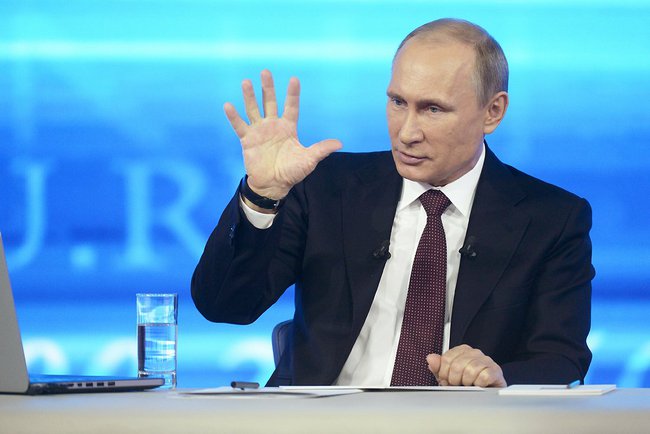
Russian President Vladimir Putin on Saturday called on all European states concerned to join efforts to keep the Ukrainian economy afloat.
“We do not want to undermine the Ukrainian economy or to call the reliability of [gas] transits to Europe into question. That’s why we call on all European states, all countries interested in supporting the Ukrainian economy to join the process of helping Ukraine and to flesh out measures to finance the budget,” said Putin.
The Russian President said on Saturday he currently saw no obstacles to bringing relations between Moscow and the West back to normal.
The Russian president, who appeared on the Vesti v Subbotu (Vesti on Saturday) TV show, was asked by its host Sergey Brilev about whether the relations between Russia and the West, which sank to record lows amid the ongoing political crisis in Ukraine, can improve by the end of the year.
“It depends on our partners,” Putin replied.
“I think that currently there is nothing to prevent us from normalizing [the relations] and [returning to] normal cooperation,” he continued.
The Russian Foreign Ministry has earlier condemned as “hypocrisy” attempts by the West to justify violent acts during pro-European rallies in Ukraine earlier this year, at the same time accusing pro-federalization protesters in the east of terrorism.
Russian journalist detained, questioned for 15 hours by Ukraine law enforcement
RT | April 17, 2014
A journalist for Russia’s LifeNews has been released after being detained and questioned for 15 hours by Ukraine law enforcement. Police allegedly “kicked” the reporter and “other peaceful civilians” during an armed confrontation in Mariupol on Wednesday.
Kristina Babayeva was detained following an armed confrontation between anti-government protesters and soldiers stationed at a military base in the eastern Ukrainian city of Mariupol on Wednesday. Her colleague, camerawoman Maria Povalyaeva, still remains at the local police station.
“She is being actively interrogated,” Babayeva told RT.
Babayeva said she was working at the scene when the shooting began. She said the Ukrainian Security Service (SBU) and police then “launched an operation,” throwing her and other peaceful civilians on the ground.
“Many were kicked, including me. They were talking to us really harshly and said that if we moved a finger they would shoot to kill,” the journalist said, adding that she received several bruises.
According to the reporter, there was “total chaos” and police were shooting in different directions. Once anyone flashed a torch, they “fired at that direction without a warning,” Babayeva said, adding that real bullets were used – not rubber ones.
People were kept on the ground, their faces down, for about half an hour, before they were placed in a van to be taken to a local police station, Babayeva said.
She was questioned for 15 hours by the SBU and police officers, who attempted to accuse her of complicity in the armed seizure of the military base located in the turbulent Donetsk region.
Babayeva said police were aware that she is a Russian journalist and saw all her documents, seized her microphone, and two phones.
“They saw that I had made calls to activist – on the eve of the incident we were filming a report near the city council building. That’s why they accused me in complicity to the armed seizure, as they put it,” she said.
No violence was used against her at the police station, she said.
According to LifeNews, the journalist demanded that she be provided with a lawyer and given an opportunity to speak to a Russian consul, but law enforcers refused to do so.
‘Letter to Jews’, Kerry cited, appears to be fake
RT | April 18, 2014
A letter urging the Jews of Donetsk to get registered, which the US Secretary of State cited in Geneva, is a fake says a man whose signature appears on the communication.
Following the four-side meeting on the Ukrainian crisis in Geneva on Wednesday, John Kerry lashed out at a letter that was allegedly sent to Jewish citizens in Ukraine’s eastern town of Donetsk, asking them to register and report all their property, or be stripped of citizenship and face expulsion.
“In year 2014, after all of the miles traveled in all the journey of history, this is not just intolerable, it’s grotesque… beyond unacceptable,” he stated.
Images of the letter have been circulating online.
The letter was stamped and signed by Denis Pushilin, who was identified on it as the “People’s Governor.”
However, Pushilin denied he had anything to do with the letter, claiming it was a fake.
“There are similar letters not only addressed to Jews, but also to businessmen, foreign students, people of certain other occupations,” he told RT. “This is actually a fake, and not a good one. There’s a sign “People’s Governor”. First of all, no one calls me by that title, no one elected me. Secondly, the stamp is the former mayor’s. Everything’s photoshopped.”
Although the letter’s authenticity is questionable, the fact that it was mentioned by a top US official has quickly sent the “Letter to Jews” story viral. It struck a very sensitive chord with audiences worldwide and cast a grave shadow over anti-government protesters in Donetsk.
Meanwhile, a Ukrainian MP who has visited the turbulent region, Boris Kolesnikov of the Party of Regions, has urged that information coming from Ukraine should be double-checked.
He believes that Ukrainian law enforcement agencies aren’t being totally honest when they describe the people participating in the protests and claim there are Russian servicemen among them.
Kolesnikov specifically referred to a video which earlier appeared online. In it a man in a military uniform told police officers, who switched sides in the city of Gorlovka and joined protesters, that he was Russian lieutenant-colonel from Simpheropol, Crimea. The man was later identified by Gorlovka residents as the former director of a local cemetery.
“Officially, I’ve only seen one Russian serviceman,” Kolesnikov said. “The next day he appeared to be the ex-director of the Gorlovka cemetery, fired 2 years ago for selling 38 fences, stealing a monument and extorting money from old women for new graves. There are Interior Ministry and intelligence services in the country, which should give us truthful information.”
He added it was quite obvious that the protesters in Donetsk did not represent any danger to civilians and called for negotiations with the activists. These talks would explain Kiev’s position and that the government is ready to make amendments to the constitution.
The US appears to be relying on information from Kiev, while ignoring alternative points of view. And so it seems that a top US official picked up and railed about a letter of questionable authenticity.
Earlier in April, spokesperson for the US Department of State, Jen Psaki, said that protest events in eastern Ukraine “appeared to be a carefully orchestrated campaign with Russian support.”
She was then asked if the department was only relying on Kiev in its assessment of the situation, or was using some independent sources.
“Well, of course we remain very closely in touch with the Ukrainian Government, and that’s who we work closely with, and of course, they are on the ground, so their information is often very relevant and current,” was the reply.
DECONSTRUCTING THE RESULT OF THE FOUR PARTY TALKS
By Anatoly Karlin | Da Russophile | April 18, 2014
The media refers to the document that emerged out of today’s four party talks as an “agreement”. This is not strictly correct. The text of the document is here.
As its text makes clear what this document is in reality is not an an agreement to settle the Ukrainian crisis or even an outline of such an agreement but rather a statement of basic principles around which an agreement should be negotiated. The real agreement (if it comes about) will emerge from negotiations based on the principles set out in this document.
A number of points:
1. Kiev’s claims to the contrary notwithstanding, the statement that “all sides must refrain from all violence, intimidation and provocative actions” clearly rules out the “anti terrorist operation” in the eastern Ukraine that Kiev launched on Sunday;
2. As Lavrov has correctly pointed out the provisions in the third paragraph that require the disarmament and dissolution of armed groups is clearly intended to refer as much to Right Sector and the Maidan Self Defence Force as it does to the protesters in the east. Note specifically that the statement calls for a general amnesty except for those who have committed capital crimes (ie. murder). So far no protesters in the east have murdered anyone. Even Kiev admits that none of its soldiers have so far been killed. The same obviously cannot be said of Right Sector and of the Maidan Self Defence Force even if one disregards their likely responsibility for the sniper killings in Kiev on 20th February 2014;
3. The document clearly refers to Maidan itself, which it says must be cleared. Specifically alongside illegally occupied buildings the document refers to “all illegally occupied streets, squares and other public places in Ukrainian cities”. The reference to “squares” clearly is intended to refer to Maidan, which the militants in Kiev have said they will continue to occupy at least until the elections on 25th May 2014 and even beyond;
4. Importantly there is NO time line in the document. There is no demand therefore that buildings be evacuated by any particular date or time. That has to be agreed and coordinated with the OSCE monitors on the ground. The people in the eastern Ukraine are therefore entirely within their rights to stay in the buildings at the moment until a timeline is agreed with the OSCE monitors, one requirement of which will surely be parallel evacuations of occupied squares and buildings in Kiev and the west including Maidan.
5. The referral to the OSCE as the enforcement and mediation agency between the regime and its opponents gives Russia a formal role in the process since it is a member of the OSCE. By contrast the negotiations which took place before 21st February 2014 were negotiated and mediated by the EU of which Russia is not a member;
6. The reference to the fact that in the negotiations concerning constitutional changes there should be “outreach to all the Ukraine’s regions and constituencies” (note especially use of the word “constituencies”) gives a role to the protesters in the east in the negotiations and not just to those formal official bodies currently recognised by Kiev.
This document on its face therefore represents a shift towards the Russian/east Ukrainian side. Indeed it basically sets out principles Russia has been arguing for ever since Yanukovitch was deposed on 22nd February 2014.
Unfortunately that does not mean this road map is going to be successfully followed. Already Kiev is trying to argue that the “anti terrorist operation” it has ordered is somehow exempt from it (it isn’t) whilst the US is threatening to impose more sanctions on Russia if following the weekend Russia fails to impose pressure on the eastern Ukrainians to evacuate buildings they occupy without the US undertaking to put any corresponding pressure on its clients in Kiev (shades of Syria here). It is very easy to see how the US and its allies could then blame Russia for the failure of the road map whilst having caused that failure themselves.
However the Russians do have a number of strong cards to play of their own:
1. The growing unrest in the Donbass, which will almost certainly spread to more regions of the eastern Ukraine unless some serious concessions are made. The events of the last few days have exposed Kiev’s difficulties in suppressing this unrest. Significantly no further step in pursuit of the “anti terrorist operation” seems to have been taken today as Kiev reels from the military defections of yesterday;
2. Russia as Putin pointedly reminded everybody in his television marathon today can always refuse to recognise the results of the Presidential elections on 25th May 2014 if the negotiations are failing to make progress and also has authority from the Federation Council to send troops into the eastern Ukraine if the situation there deteriorates further. A refusal to recognise the results of the election will further undermine the legitimacy of whoever is elected. It is now clear that there will be no significant military resistance from forces loyal to Kiev if the Russian army moves into the eastern Ukraine. If that happens the likelihood is that Kiev will lose the eastern Ukraine forever (note Putin’s pointed reference to “Novorossiya” in his television marathon today) – a nightmare scenario for both Kiev and the west though not one Russia is pursuing at the moment;
3. It is now clear that without Russia’s assistance the possibility of stabilising the Ukraine’s economy quite simply does not exist. The last paragraph specifically refers to the importance of the Ukraine “financial and economic stability” to “the participants” and says “the participants…. would be ready to discuss additional support as the above steps are implemented”. The most important of the “participants” in this regard is Russia. It bears repeating (as Putin has recently pointed out) that Russia is the only participant so far providing any economic assistance to the Ukraine at all. The US is only offering $1 billion in loan guarantees and the EU is offering just 1.6 billion euros none of which have so far been provided. What this document in effect therefore says is that whilst Russia is prepared to assist in the stabilisation of the Ukraine’s economy its help is conditional on the fulfilment of the provisions of the road map;
4. It is becoming increasingly clear that there is growing resistance within the EU to further sanctions against Russia. The fact that a process has now been launched to settle this crisis will redouble European reluctance to introduce more sanctions and will increase pressure within the EU for the process to be treated seriously so that it can succeed.
In conclusion, we are not out of the woods or anywhere close. This is not the beginning of the end of the crisis. But we may be a small step closer to that point. A lot will depend on what happens next and the key decisions will be made on the ground in the Ukraine itself.
Lavrov: Russia, US, EU, Ukraine agree on de-escalation roadmap
RT | April 17, 2014
Russia, the US, the EU and Ukraine have adopted a joint document on the de-escalation of the Ukraine crisis, Russian Foreign Minister Sergey Lavrov said, after talks in Geneva. It calls for all illegal armed groups to lay down arms and a wide amnesty.
The document calls for an “immediate start of a nationwide national dialogue within the framework of the constitutional process, which must be inclusive and accountable,” Lavrov said.
The most important agreement reached during the talks, according to Lavrov, states that the Ukrainian crisis “must be resolved by the Ukrainians themselves concerning an end to the conflict” including those related to “detaining protesters, occupying buildings” and, in the long run “the start of true constitutional reform.”
“Among the steps that have to be taken are: the disarmament of all the illegal armed groups, and the return of all the occupied administrative buildings,” Lavrov told journalists at the Thursday briefing.
“An amnesty for all the protesters must take place, except of those who committed grave crimes,” the Foreign Minister added.
The issue of illegal armed groups and seized buildings concerns all the regions of Ukraine, Lavrov stressed.
“It is impossible to solve the problem of illegally seized buildings in one region of Ukraine when the illegally seized buildings are not freed in another,” he said.
“Those who took power in Kiev as a result of a coup – if they consider themselves as representing the interests of all the Ukrainians – must show the initiative, extend a friendly hand to the regions, listen to their concerns, and sit down with them at the negotiation table,” Lavrov said.
Lavrov said the document does not give any guidelines on the future political system of Ukraine.
“We did not use any terms… There are federations where the rights of the regions are limited, and there are unitary states in name only where the regions have broad authority,” he explained.
The goal of the meeting was to send a signal to the Ukrainians that they are responsible for stability in the country and must ensure that “each region can protect its history and language,” Lavrov stressed.
“Only then will Ukraine be a strong state, a proverbial bridge between the East and the West,” Lavrov said.
The Russian side on Thursday provided US and EU representatives with documents passed on from south-eastern Ukrainians, which contain “a thorough vision of how their interests should be reflected in the new [Ukrainian] constitution.”
The OSCE’s (Organization for Security and Co-operation in Europe) monitoring mission must play “the leading role” in assisting the Ukrainian authorities to resolve the crisis, Lavrov stressed, adding that Russia “will support” the mission’s work.
The Geneva meeting has given Russia “hopes” that “the US and the EU are genuinely interested in a trilateral cooperation with Russia aimed at convincing the Ukrainian to sit down at the negotiation table,” Lavrov said.
According to the Russian top diplomat, the Americans now have a “decisive influence” on the Kiev authorities, which should be used for resolving the crisis.
Russia “does not want to send any troops to Ukraine,” Lavrov stressed, answering journalists’ questions. Moscow’s chief concern is that the rights of all the Ukrainian regions, including those with Russian-speaking majorities, must be taken into account in the constitutional reform.
“We have absolutely no wish to send our troops to Ukraine, to the territory of a friendly state, to the land of a brotherly nation. This is against the fundamental interests of the Russian Federation,” Lavrov said.
Calling the recent NATO statements on Ukraine’s neutrality “unacceptable,” Lavrov stressed that pushing for changes in the country’s non-aligned status will “undermine the efforts to resolve the crisis” in Ukraine.
“The fact that Ukraine has chosen non-aligned status and enshrined it in its law must be respected by all and there should not be any attempts to doubt it or to erode its meaning,” the Russian Foreign Minister stressed.
Ahead of the quadrilateral talks, Lavrov met US Secretary of State John Kerry, while EU foreign affairs chief Catherine Ashton saw Ukraine’s acting Foreign Minister Andrey Deshchytsa. Both meetings were held behind closed doors.
Poland’s Participation in the Ukrainian Pandemonium
By Andrew Korybko | Oriental Review | April 17, 2014
Polish media outlet Nie has published a bombshell account about direct Polish involvement in Ukraine’s destabilization. Its source alleges that the Polish Foreign Ministry had invited Ukrainian militants into the country and trained them outside of Warsaw in September 2013. Considering the destructive actions and fatalities they would later be responsible for during the EuroMaidan riots, such a connection would directly link Warsaw to the pandemonium. It would also implicate Poland in being the “Slavic Turkey” of NATO in Eastern Europe. The impact of Nie’s reporting can also affect domestic Polish politics, as it would prove that the political elite misled members of Parliament, which could later have direct political repercussions for Tusk’s ironically named “Law and Justice Party”. This scandal serves to highlight that Poland is starting to emulate the methods of its invited neo-colonial headmaster, the US, thereby deepening the puppet-master relationship between Warsaw and Washington.
According to the report, 86 Euromaidan militants, some of whom appeared to be over 40 years old, came to Poland under the invitation of the Ministry of Foreign Affairs. The pretext for plausible deniability was that they were in the country to promote cooperation between the Warsaw University of Technology and the National Technical University in Kiev. In reality, however, these individuals were whisked away to Legionowo, a town on the outskirts of Warsaw. There, at the police training center, they spent four weeks engaged in a regiment of destabilization training.

The source goes on to state that pictures of the participants show them clothed in Nazi regalia and tattoos, with their Polish military instructors lacking any outward identification as such. At the facility, militants learned the following techniques: crowd management; target identification; tactics; leadership; behavioural management under stressful conditions; protection against police gasses; building barricades; and importantly, they engaged in shooting classes, which incidentally included sniper rifles. Quite clearly, the “students” who came to Warsaw were there for war, not academic work, and their training there resulted in the christening of Bandera’s spiritual descendants.
These revelations underline how the EuroMaidan militants had prior Western-backed training, and that Poland was chosen as the location for their instruction. Through its direct involvement and support in training the radicals, Poland is quickly living up to its reputation as NATO’s most important frontline state. When the Polish Sejm voted in early December, 2013 to show its “full solidarity with the citizens of Ukraine, who with great determination show the world their desire to ensure their country’s full membership in the EU”, little did they know that the violent vanguard which had just days before thrown Molotov cocktails and attacked police officers likely acquired their tactics less than an hour’s drive from where they had cast their vote. Most members of parliament likely did not have a clue that their government was training those violent elements and would be shocked to know that this was the case.
The ultimate irony is that Poland is training fighters who honor a man that glorified in ethnically cleansing Poles from Ukraine in the most horrendous ways imaginable during World War II. For all of its blaring patriotism and nationalist sentiment, the Polish government is actually working against its long-term interests by backing such radical anti-Polish elements right next door. This “Bandera Brinksmanship” reminds one of the US’ foreign policy mentality of allying with and building dangerous radical forces that may later come back to harm them (i.e. Al Qaeda in the Soviet’s Afghan conflict and the Libyan and Syrian-based international jihadis of today). Through its greedy and nationalistically minded cooperation with the US in seeking to de-facto resurrect the Polish-Lithuanian Commonwealth, Poland has abandoned its European principles and blindly set itself on becoming America’s bulldog in Eastern Europe.
Andrew Korybko is the American Master’s Degree student at the Moscow State University of International Relations (MGIMO).
EU spy chief rules out Russian military presence in Ukraine
RT | April 16, 2014
There is no large Russian military presence in East Ukraine, head of EU intelligence, Commodore Georgij Alafuzoff, has said. The spy chief has dismissed multiple accusations from the West alleging Russian involvement in the unrest in the region.
In an interview with Finnish national news broadcaster, Yle, Alafuzoff said the Russian military had nothing to do with the seizing of government buildings in eastern Ukraine.
“In my opinion, it’s mostly people who live in the region who are not satisfied with the current state of affairs,” said Alafuzoff, referring to the situation in East Ukraine. He went on to say that the people are worried for the welfare of those who speak Russian as their first language in the region.
Alafuzoff echoed the words of the Russian government which has categorically denied interfering in the ongoing unrest. Russian Foreign Minister Sergey Lavrov said in a press conference on Monday that Moscow is not interested in destabilizing Ukraine and wants the country to remain united.
Anti-Kiev activists in the southeast of Ukraine have seized local government buildings as a mark of protest against the coup-appointed Ukrainian government. In response to the unrest, Ukraine’s interim President Aleksandr Turchinov announced the beginning of an “anti-terrorist” operation in eastern Ukraine.
On Tuesday, military hardware and troops began to mass on the outskirts of the eastern city of Slavyansk. Sightings of groups of military vehicles have been reported in the neighboring Kharkov and Lugansk regions, where pro-Russian and anti-Kiev sentiment is high.
Moscow has condemned Kiev’s operation as “anti-constitutional” and “criminal” and indicative of the government’s unwillingness to open dialogue with the regions.
“We are deeply concerned over the military operation launched by the Ukrainian Special Forces with support by the army. There have already been victims,” the Russian Foreign Ministry said in a statement on Tuesday.
Anti-Kiev sentiment is, meanwhile, spreading across Ukraine. On Wednesday the anti-Maidan movement in the city of Odessa called for a day of protests and declared the creation of a “people’s republic” in the region.
“From this day on, the Odessa region is declared the Odessa People’s Republic where the power belongs only to the people who live there. Tomorrow at 4pm [13:00 GMT] Odessa should grind to a halt, literally!” read a message on the Odessa Anti-Maidan movement’s website.
The protest movement in southeast Ukraine is rejecting Kiev’s coup-appointed government that was established in February following weeks of violent protests.
Kiev to launch ‘full-scale’ military op as massive protests grip eastern Ukraine
RT | April 13, 2014
Thousands of pro-autonomy demonstrators rallied across eastern Ukraine, with the coup-imposed president in Kiev threatening to use military against the activists if they don’t clear the seized government buildings by Monday morning.
Over 10,000 people have taken part in protests in different town and villages of the Donetsk Region in Ukraine, the local administration said.
In the region’s capital, Donetsk, the local government headquarters still remain under the anti-Maidan activists’ control. Sunday, one of the leaders of the recently-declared Donetsk People’s Republic, Denis Pushilin, once again stressed the urgent need “to send activists, who’ll prepare a referendum, to different towns of the Donetsk region” as he spoke at a rally in city’s center.
The recruitment of volunteers, eager to travel to Slavyansk and other towns in eastern Ukraine where “an anti-terrorist operation” against the protestors by the Ukrainian security forces is underway, also took place during the rally. Over 100 people volunteered by mid-day Sunday, with buses already prepared to take them to their destinations.
Hundreds also gathered for rallies in support of federalization in Druzhovka, Debaltsevo and other Donbas towns.
According to Ukrainian media, the city authorities in Zhdanovsk and Kirovsk have expressed readiness to start talks on the recognition of the legitimacy of the Donetsk People’s Republic.
A rally in Mariupol in south-east of the country resulted in the seizure of city council by the pro-Russian protesters, ITAR-TASS news agency reports. Over 1,000 demonstrators, who chanted “Slavyansk, we’re with you!” and “Referendum,” have forced the police, guarding the building, to retreat.
Some 1,500-2,000 people are out in the square in front of the office Security Service of Ukraine (SBU) in Lugansk, which is held by the protestors for several days now. According to Rossiya 24 channel, the majority of the city’s police have switched to the side of the demonstrators, supporting their push for federalization.
Kharkov tensions
Meanwhile, dozens asked for medical assistance in Ukraine’s second-largest city, Kharkov, after the pro-federalization demonstrators clashed with the Maidan activists. The rallies of two antagonistic sides, which saw a joint turnout of around 3,000, were staged in the city simultaneously, with the police being unable to prevent provocations.
“50 people required medical aid. Around 10 of them were taken to city hospitals. The doctors are speaking of minor or moderate injuries. Among the wounded there’s one policeman,” the local law enforcement authorities said.
Baseball bats, sticks, stones and stun grenades were used by both sides during the scuffle, Moskovsky Komsomolets newspaper reports.
Kiev issues new ultimatum
In the capital, Ukraine’s Security Council convened for an urgent session following the events in Slavyansk. A decision was taken to launch “a large scale” operation, “with the involvement of the military,” Ukraine’s coup-imposed president, Aleksandr Turchinov, said in a televised address.
Later he said that the operation in the east will involve a non-regular regiment consisting of 350 reservists.
According to Turchinov, the anti-Maidan activists must lay down their arms and abandon the administrative offices they have occupied till Monday morning if they want to avoid prosecution.
Turchinov also said the new authorities in Kiev are ready to consider giving more powers to the region. Earlier parliament-appointed Prime Minister Arseny Yatsenyuk pledged to push through a law allowing regional referendums in the country.
The order to use military against the pro-federalization protesters in eastern Ukraine by coup-imposed president, Aleksandr Turchinov, is “criminal” in its nature, the Russian Foreign Ministry said in a statement.
Earlier on Sunday, a gun flight reportedly broke out at a checkpoint, which was established by protesters on the outskirts of the city of Slavyansk.
Reports on those killed and wounded kept streaming in all day, but lacked consistency and could not be independently verified. According to interim Interior Minister Arsen Avakov, one of the troops from Kiev was killed and five others were injured in the skirmish.
Protesters in Slavyansk said one person was killed and two others injured on their side, adding that two of the Kiev troops were killed.
Unrest has gripped eastern – Russian speaking – parts of Ukraine after pro-EU protests in Kiev ousted president, Viktor Yanukovich, back in February.
Following the accession of the Republic of Crime to Russia, people in Donetsk, Kharkov, Lugansk and other cities are also calling for a referendum to decide their future as part of Ukraine.
Featured Video
No Vote, No Representation, No State: Democracy, Israeli Style
or go to
Aletho News Archives – Video-Images
From the Archives
Sanctions, War and the Policy of Dual Containment
By SASAN FAYAZMANESH | March 17, 2008
It is now nearly three decades since the Unites States adopted the policy of dual containment of Iran and Iraq. While much has been written about the containment of Iraq, there has been very little in-depth analysis of this policy when it comes to Iran. In a book that is going to be released on March 31, 2008, entitled The United States and Iran: Sanctions, Wars and the Policy of Dual Containment (Routledge), I attempt to address this shortcoming by investigating when and why the US policy of containment of Iran came about, how it evolved, and where it stands today.[1] To the extent that Israel has been involved in US policy making, the study will also include the role that Israel has played in the containment of Iran. Also, since the fate of Iran has been inextricably linked to that of Iraq, occasionally the investigation will overlap with the containment of Iraq.
The policy of dual containment of Iran and Iraq originated during the Carter Administration, but it was not until the Clinton Administration that the expression “dual containment” became popular. … continue
Blog Roll
 Aletho News
- Americans are paying the price to preserve Israel’s nuclear hegemony
- Resistance factions are necessary to ensure a permanent US Iraq withdrawal
- How Israel destabilizes the Middle East: Denying sovereignty and the right to exist
- Europe’s Establishment Is Embracing War – and Losing Voters
- NATO chief advocates war of aggression
- No Vote, No Representation, No State: Democracy, Israeli Style
- Zionist Bought Senate Blocks Information About American Citizens Killed By Israel
- While Gaza dominates the UN, these are the people keeping it alive
- New Report: “Scholasticide and Genocide in Gaza: Assessment, Testimonies and Legal Analysis”
- ‘THAAD Delusion’: Iran war exposes US missile shield limits – The Atlantic
- If Americans Knew
- Eight Palestinians Killed in Israeli Attacks on Gaza
- Israeli former leaders and security chiefs threaten legal action over ‘Jewish terrorism’
- Israel map in LA Times ad includes all land from the river to the sea
- Inside Lebanon’s 200-page dossier on Israeli war crimes
- Flydubai, genocide, settler violence, Trump abuse of power to deport – Daily Update
- Counting Antisemitic Incidents: What the ADL Audit Reveals — and Obscures
- Mamdani releases plan to combat antisemitism and hate crimes in New York City
- Iran’s Revolutionary Guards Publish Letter to the American People
- DMFI launches $1 million ad campaign supporting Virginia’s Elaine Luria
- US Senate blocks resolution seeking report on Americans killed by Israel
- No Tricks Zone
- Green Energy Debacle: German Expert Professor Fritz Vahrenholt Warns Of Severe Economic And Social Consequences
- Two More Paleo Reconstructions Affirm Meters-Higher Sea Levels Across Ireland, Brazil 7000-6000 Years Ago
- New Study: Earth And Venus Surface Warmth Largely Explained By Convection And Lapse Rate, Not CO2 Or Radiation
- 2025 Nature Paper Claiming Worsening Global Drought Gets RETRACTED …Heavily Flawed
- New Study: ‘Global Drought Shows No Detectable Recent Acceleration Under Climate Warming’
- Economic Masterminds: German Socialists Suggest Taxing Productivity Gains Stemming From Using AI
- The South China Sea Has Not Been Cooperating With The Climate Change Narrative
- Energy Crisis: Germany Enters Heating Season With Historically Low Gas Reserve Fill Levels
- New Study: The Antarctic Ice Sheet Gained Mass From 2020-2024 Due To Staggering Snow And Ice Accumulation
- Study: Ocean Heating Rates From Thousands Of Years Ago ‘Dwarf’ Modern Ocean Heating Rates

