West ignores results of int’l missions that found no troop build-up near Ukraine borders – Moscow
RT | March 28, 2014
Russia has denied any troop build-up on the Ukraine border, a claim voiced by President Barack Obama and Kiev officials. Moscow slammed the West for ignoring the results of recent fact-finding missions for the sake of political expediency.
On Friday Obama urged Russia to pull back “a range of troops,” which he said, “we have seen […] massing along that border under the guise of military exercises.”
“But these are not what Russia would normally be doing,” Obama said, speaking with CBS on his trip to Rome.
He then suggested that the troop build-up could be “just an effort to intimidate Ukraine.”
“It may be that they’ve got additional plans,” Obama said.
The US president’s comments came the day after a Ukrainian security official told Executive Vice President of the US-Atlantic Council Damon Wilson that “almost 100,000 soldiers are stationed on the borders of Ukraine and in the direction … of Kharkov, Donetsk.”
“Russian troops are not only in Crimea, they are along all Ukrainian borders. They’re in the south, they’re in the east and in the north,” Andrey Parubiy, one of the so-called Maidan “commandants” who has been appointed chairman of Ukraine’s Security Council, told the Atlantic Council during a web conference Thursday.
Parubiy expressed his worry that continental Ukraine might “see a huge attack” on its territory.
“We are getting ready for it,” he said.
In the past few days, Western media has extensively reported that Russia is positioning its troops in Crimea and along the Ukrainian border. Some of the major news outlets speculated that Russian troops “appeared to be concealing their positions, trying to cloak their equipment, and establishing supply lines.”
Responding to those accusations, Russia’s Foreign Ministry issued a statement, in which it recalled four probes in March by foreign missions in Russia of regions bordering Ukraine.
The ministry said that “even Ukrainian inspectors” agreed that “there were no major military activities being carried out.”
The four international missions included representatives of Latvia, Germany, Switzerland, Finland, Estonia, Belgium, France and Ukraine. None of the missions “found ‘aggressive preparations’ and have not recorded any military activities, aside from the previously declared,” the statement said.
“Opportunities to conduct such activities were provided to all those who wished to get acquainted with the real situation in the border with Ukraine regions,” the ministry said.
The statement emphasized that “even Ukrainian inspectors” agreed that “there were no major military activities being carried out.”
“The result of this was the official reports submitted to all OSCE member states. The objective information contained in those reports, in our view, should have become a subject of an impartial analysis and basis for further conclusions,” the statement said.
This, however, is not the case here, the ministry said.
As another proof that there are no additional Russian troops and active military preparations, the Foreign Ministry referred to recent observation flights by American and German inspectors.
“The official results of those flights will be known later, after the processing of photographic materials. However, one can assume that if signs of large concentration of the armed forces were spotted from the air, our partners would not wait to present the ‘evidence’. Hence, it simply does not exist,” the ministry said.
Russia’s Foreign Ministry also questioned the objectivity of Western politicians.
“Is objective information collected by military inspectors not provided to the political leadership [of Western countries]? Or are these leaders, yielding to their emotions, inclined to ignore the facts in order to satisfy their own political tastes and preferences?” the ministry said.
Related article

The Danger of False Narrative
By Robert Parry | Consortium News | March 27, 2014
The American people got a nasty taste of the danger that can come with false narrative when they were suckered into the Iraq War based on bogus claims that Saddam Hussein was hiding weapons of mass destruction that he planned to share with al-Qaeda.
Nearly 4,500 U.S. soldiers died in the conflict along with hundreds thousands of Iraqis. The war’s total financial cost probably exceeded $1 trillion, a vast sum that siphoned off America’s economic vitality and forced cutbacks in everything from education to road repair. Plus, the war ended up creating an Iraqi base for al-Qaeda terrorists that had not existed before.
But perhaps an even more dangerous problem coming out of the Iraq War was that almost no one in Official Washington who pushed the false narrative – whether in politics or in the press – was held accountable in any meaningful way. Many of the same pols and pundits remain in place today, pushing similar false narratives on new crises, from Ukraine to Syria to Iran.
Those false narratives – and their cumulative effect on policy-making – now represent a clear and present danger to the Republic and, indeed, to the world. The United States, after all, is the preeminent superpower with unprecedented means for delivering death and destruction. But almost nothing is being done to address this enduring American crisis of deception.
Today, Official Washington is marching in lockstep just as it did in 2002-03 when it enforced the misguided consensus on Iraq’s WMD. The latest case is Ukraine where Russian President Vladimir Putin is accused of committing “aggression” to expand Russian territory at the expense of noble ”democratic” reformers in Kiev.
Not only is this the dominant storyline in the U.S. media; it is virtually the only narrative permitted in the mainstream press. But the real narrative is that the United States and the European Union provoked this crisis by trying to take Ukraine out of its traditional sphere of influence, Russia, and put it in to a new association with the EU.
While there’s nothing inherently wrong with Ukraine joining with the EU or staying with Russia (or a combination of the two) – depending on the will of the people and their elected representatives – this latest U.S./EU plan was motivated, at least in part, by hostility toward Russia.
That attitude was expressed in a Sept. 26, 2013, op-ed in the Washington Post by Carl Gershman, the neoconservative president of the National Endowment for Democracy, which doles out more than $100 million in U.S. funds a year to help organize “activists,” support “journalists” and finance programs that can be used to destabilize targeted governments.
Gershman, whose job amounts to being a neocon paymaster, expressed antagonism toward Russia in the op-ed and identified Ukraine as “the biggest prize,” the capture of which could ultimately lead to the ouster of Putin, who “may find himself on the losing end not just in the near abroad but within Russia itself.”
The NED, which was founded in 1983 to do in relative openness what the CIA had long done in secret, listed 65 projects that it was financing in Ukraine, using U.S. taxpayers’ money. In other words, Gershman’s op-ed reflected U.S. policy – at least inside the State Department’s still-neocon-dominated bureaucracy – which viewed the EU’s snatching of Ukraine from Russia’s embrace as a way to weaken Russia and hurt Putin.
‘European Aspirations’
Later, as the Ukrainian crisis unfolded, another neocon, Assistant Secretary of State for European Affairs Victoria Nuland, reminded Ukrainian businessmen that the United States had invested $5 billion in their “European aspirations,” implying that the U.S. expected something for all this money.
You might wonder why the American taxpayers should spend $5 billion on the “European aspirations” of Ukraine when there are so many needs at home, but a more relevant question may be: Why is the United States spending that much money to stir up trouble on Russia’s border? The Cold War is over but the hostility continues.
Former Defense Secretary Robert Gates described this thinking in his memoir, Duty, explaining the view of President George H.W. Bush’s Defense Secretary Dick Cheney: “When the Soviet Union was collapsing in late 1991, Dick wanted to see the dismantlement not only of the Soviet Union and the Russian empire but of Russia itself, so it could never again be a threat to the rest of the world.”
As Vice President, Cheney and the neocons around him pursued a similar strategy during George W. Bush’s presidency, expanding NATO aggressively to the east and backing anti-Russian regimes in the region including the hardline Georgian government, which provoked a military confrontation with Moscow in 2008.
Since President Barack Obama never took full control of his foreign policy apparatus – leaving the Bush Family apparatchik Gates at Defense and naming neocon-leaning Democrat Hillary Clinton as Secretary of State – the bureaucratic momentum toward confronting Russia continued. Indeed, the elevation of operatives like Nuland, the wife of prominent neocon Robert Kagan, gave new impetus to the anti-Russian strategy.
Secretary of State John Kerry, who got his “dream job” last year with the considerable help of his neocon chum Sen. John McCain, has acted as a kind of sock puppet for this neocon-dominated State Department bureaucracy.
Either because he is overly focused on his legacy-building initiative of an Israeli-Palestinian peace deal or because he has long since sold out his anti-war philosophy from the Vietnam War era, Kerry has repeatedly taken the side of the hawks: on Syria, Iran and now Ukraine.
On Syria and Iran, it was largely the behind-the-scenes cooperation between Obama and Putin that tamped down those crises last year and opened a pathway for diplomacy – much to the chagrin of the neocons who favored heightened confrontations, U.S. military strikes and “regime change.” Thus, it became a neocon priority to divide Obama from Putin. Ukraine became the wedge.
The Crisis
The Ukrainian crisis took a decisive turn on Nov. 21, 2013, when President Viktor Yanukovych rebuffed a deal offered by the EU and the International Monetary Fund because it would have imposed harsh austerity on the already suffering Ukrainian people. Yanukovych opted instead for a more generous aid package of $15 billion from Russia, with few strings attached.
But Yanukovych’s turning away from the EU infuriated the U.S. State Department as well as pro-European demonstrators who filled the Maidan square in Kiev. The protests reflected the more anti-Russian attitudes of western Ukraine, where Kiev is located, but not the more pro-Russian feelings of eastern and southern Ukraine, Yanukovych’s strongholds that accounted for his electoral victory in 2010.
Though the Maidan protests involved hundreds of thousands of Ukrainians simply eager for a better life and a less corrupt government, some of the most militant factions came from far-right parties, like Svoboda, and even neo-Nazi militias from the Right Sektor. When protesters seized City Hall, Nazi symbols and a Confederate battle flag were put on display.
As the protests grew angrier, U.S. officials, including Assistant Secretary Nuland and Sen. McCain, openly sided with the demonstrators despite banners honoring Stepan Bandera, a World War II-era fascist whose paramilitary forces collaborated with the Nazis in the extermination of Poles and Jews. Nuland passed out cookies and McCain stood shoulder to shoulder with right-wing Ukrainian nationalists. [For more on the role of Ukrainian neo-Nazis, watch this report from the BBC.]
On Feb. 20, the violence intensified as mysterious snipers fired on both protesters and police. As police fought back, neo-Nazi militias hurled Molotov cocktails. More than 80 people were killed including more than a dozen police officers, but the U.S. press blamed the Yanukovych government for the violence, portraying the demonstrators as innocent victims.
Official Washington’s narrative was set. Yanukovych, who had been something of a hero when he was moving toward the EU agreement in the early fall, became a villain after he decided that the IMF’s demands were too severe and especially after he accepted the deal from Putin. The Russian president was undergoing his own demonization in the U.S. news media, including an extraordinary denunciation by NBC at the end of the Sochi Winter Olympics.
In the U.S. media’s black-and-white scenario, the “pro-democracy” demonstrators in the Maidan were the good guys who were fired upon by the bad-guy police. The New York Times even stopped reporting that some of those killed were police, instead presenting the more pleasing but phony narrative that “more than 80 protesters were shot to death by the police as an uprising spiraled out of control in mid-February.”
To this day, the identity of the snipers who touched off the conflagration remains in serious doubt. I was told at the time that some U.S. intelligence analysts believed the shooters were associated with the far-right opposition groups, not with the Yanukovych government.
That analysis gained support when a phone call surfaced between Estonia’s Foreign Minister Urmas Paet and European Union foreign affairs chief Catherine Ashton, Paet reported on a conversation that he had with a doctor in Kiev who said the sniper fire that killed protesters was the same that killed police officers.
As reported by the UK Guardian, “During the conversation, Paet quoted a woman named Olga – who the Russian media identified her as Olga Bogomolets, a doctor – blaming snipers from the opposition shooting the protesters.”
Paet said, “What was quite disturbing, this same Olga told that, well, all the evidence shows that people who were killed by snipers from both sides, among policemen and people from the streets, that they were the same snipers killing people from both sides.
“So she also showed me some photos, she said that as medical doctor, she can say it is the same handwriting, the same type of bullets, and it’s really disturbing that now the new coalition, that they don’t want to investigate what exactly happened. … So there is a stronger and stronger understanding that behind snipers it was not Yanukovych, it was somebody from the new coalition.”
Ashton replied: “I think we do want to investigate. I didn’t pick that up, that’s interesting. Gosh.”
Though this exchange does not prove that the opposition used snipers to provoke the violence, it is relevant information that could have altered how Americans viewed the worsening crisis in Ukraine. However, except for an on-the-scene report from CNN with the same doctor, the Paet-Ashton phone call disappeared into the U.S. media’s black hole reserved for information that doesn’t fit with a preferred narrative.
Black Hats/White Hats
So, with giant black hats glued onto Yanukovych and Putin and white hats on the protesters, the inspiring but false U.S. narrative played out in heroic fashion, with only passing reference to the efforts by Yanukovych to make concessions and satisfy the protesters’ demands.
On Feb. 21, Yanukovych tried to defuse the violence by signing an agreement with three European countries in which he accepted reduced powers, moved up elections so he could be voted out of office, and pulled back the police. That last step, however, opened the way for the neo-Nazi militias to seize government buildings and force Yanukovych to flee for his life.
Then, on Feb. 22, under the watchful eye of these modern-day storm troopers, a rump parliament – in violation of constitutional procedures – voted to impeach Yanukovych, who reemerged in Russia to denounce the actions as a coup.
Despite this highly irregular process, the U.S. government – following the lead of the State Department bureaucracy – immediately recognized the new leadership as Ukraine’s “legitimate” government. Putin later appealed to Obama in support of the Feb. 21 agreement but was told the ouster of Yanukovych and the installation of the U.S.-backed government were a fait accompli.
The rump parliament in Kiev also accused Yanukovych of mass murder in connection with the shootings in the Maidan — an accusation that got widespread play in the U.S. media – although curiously the new regime also decided not to pursue an investigation into the identity of the mysterious snipers, a point that drew no U.S. media interest.
And, a new law was passed in line with the desires of right-wing Ukrainian nationalists to eliminate Russian as one of the country’s official languages. New government leaders also were dispatched to the Russian-ethnic regions to take charge, moves that, in turn, prompted resistance from Russian-ethnic citizens in the east and south.
It was in this context – and with appeals from Yanukovych and ethnic Russians for help – that Putin got permission from the Duma to intervene militarily if necessary. Russian troops, already stationed in bases in Crimea, moved to block the Kiev regime from asserting its authority in that strategic Black Sea peninsula.
Amidst this political chaos, the Crimean parliament voted to break away from Ukraine and join Russia, putting the question to a popular vote on March 16. Not surprisingly, given the failed Ukrainian state, its inability to pay for basic services, and Crimea’s historic ties to Russia, Crimean voters approved the switch overwhelmingly. Exit polls showed about a 93 percent majority, just three points less than the official results.
Russia then moved to formally reclaim Crimea, which had been part of Russia dating back to the 1700s, while also massing troops along the borders of eastern Ukraine, presumably as a warning to the Kiev regime not to crush popular resistance to the anti-Yanukovych coup.
A Divergent Narrative
So, the factual narrative suggests that the Ukrainian crisis was stoked by elements of the U.S. government, both in the State Department and in Congress, encouraging and exploiting popular resentments in western Ukraine. The goal was to pull Ukraine out of Russia’s orbit and put it into the EU’s gravitational pull.
When Yanukovych balked at IMF’s demands, a process of “regime change” was put in motion with the U.S. and EU even turning their backs on the Feb. 21 agreement in which Yanukovych made a series of concessions negotiated by European countries. The deal was cast aside in a matter of hours with no attempt by the West to uphold its terms.
Meanwhile, Putin, who was tied up with the Sochi Olympics and obsessed over fears that it would be targeted by Islamist terrorists, appears to have been caught off-guard by the events in Ukraine. He then reacted to the alarming developments on Russia’s border, including the emergence of neo-Nazis as prominent figures in the coup regime in Kiev.
In other words, a logical – and indeed realistic – way to see the Ukraine-Crimea crisis is that Putin was largely responding to events that were outside his control. And that is important to understand, because that would mean that Putin was not the aggressor spoiling for a fight.
If there was premeditation, it was coming from the West and particularly from the neocons who remain highly influential in Official Washington. The neocons also had motive to go after Putin, since he helped Obama use diplomacy to quiet down dangerous crises with Syria and Iran while the neocons were pushing for more confrontation and U.S. military strikes.
But how did the U.S. news media present the Ukraine story to the American people?
First, there was the simplistic and misleading depiction of the pro-EU demonstrations as “democratic” when they mostly reflected the discontent of the pro-European population of western Ukraine, not the views of the more pro-Russian Ukrainians in the east and south who had pushed Yanukovych to victory in the 2010 election. Last time I checked, “democracy” referred to rule by the majority, not mob rule.
Then, despite the newsworthiness of the neo-Nazi role in the protests, the U.S. news media blacked-out these brown shirts because that ugly reality undercut the pleasing good-guys-vs.-bad-guys storyline. Then, when the snipers opened fire on protesters and policemen, the U.S. news media jumped to the conclusion that the killers were working for Yanukovych because that, too, fit with the desired narrative.
The violent overthrow of the democratically elected Yanukovych was hailed as an expression of “democracy,” again with the crucial role of the neo-Nazi militias largely airbrushed from the picture. The unanimous and near unanimous parliamentary votes that followed – as storm troopers patrolled the halls of government buildings – were further cited as evidence of “democracy” and “reform.”
The anger and fear of Ukrainians in the east and south were dismissed as Russian “propaganda” and Crimea’s move to extract itself from this political chaos was denounced as Russian “aggression.” U.S. news outlets casually denounced Putin as a “thug.” Washington Post columnist George F. Will called Putin “Stalin’s spawn.”
Former Secretary of State Clinton cited the Crimea situation to compare Putin to Hitler and to suggest that Putin was intent on recreating the old Soviet empire, though Crimea is only 10,000 square miles, about one-tenth of one percent the size of the old Soviet Union.
And, it wasn’t just that some or nearly all mainstream U.S. news organizations adopted this one-sided and misguided narrative. It was a consensus throughout all major U.S. news outlets. With a uniformity that one would normally associate with a totalitarian state, no competing narrative was permitted in the Big Media, regardless of the actual facts.
Whenever any of the more complex reality was included in a story, it was presented as Russian claims that were then followed by argumentative challenges. Yet, when U.S. officials made preposterous remarks about how uncivilized it was to violate another country’s sovereignty, the hypocrisy of their points went uncontested.
For instance, Secretary of State Kerry denounced Putin’s intervention in Crimea by declaring, “you just don’t in the 21st Century behave in 19th Century fashion by invading another country on completely trumped-up pretext.” But you had to look on the Internet to find any writer who dared note Kerry’s breathtaking double standard, since he voted in 2002 to authorize the U.S. invasion of Iraq in pursuit of hidden WMD stockpiles that didn’t exist.
This cognitive dissonance pervaded the U.S. press and the political debate over Ukraine and Crimea. The long history of U.S. interventions in foreign countries – almost always in violation of international law – was forgotten, except for the rare occasion when some Russian “claim” about American hypocrisy was cited and then swatted down. [See Consortiumnews.com’s “America’s Staggering Hypocrisy.”]
Careerism Prevails
Having worked many years in the mainstream U.S. news media, I fully understand how this process works and why it happens. Amid the patriotic chest-thumping that usually accompanies a U.S. military operation or American righteous outrage over some other nation’s actions, it is dangerous for your career to go against the flag-waving.
But it’s always been my view that such self-censorship is faux patriotism, as much as the happy story-lines are false narratives. Even if many Americans don’t want the truth, it is still the job of journalists to give them the truth. Otherwise, the U.S. democratic process is distorted and made dangerous.
Propaganda leads to bad policies as politicians – even when they know better – start parroting the errant conventional wisdom. We’ve seen this now with President Obama who – more than anyone – realizes the value of Putin’s cooperation on Syria and Iran but now must join in denouncing the Russian president and demanding sanctions.
Obama also surely knows that Yanukovych’s ouster violated both Ukraine’s constitution and principles of democracy, but he pretends otherwise. And, he knows that Crimea’s secession reflected the will of the people, but he must insist that their vote was illegitimate.
At a March 25 news conference in the Netherlands, Obama toed the line of the hypocritical false narrative. He declared, “we have said consistently throughout this process is that it is up to the Ukrainian people to make their own decisions about how they organize themselves and who they interact with.” He then added that the Crimean referendum was “sloppily organized over the course of two weeks” and thus a sham.
If Obama were telling the truth, he would have noted that Yanukovych – for all his faults – was democratically elected in a process that was deemed fair by international observers. Obama would have acknowledged that Yanukovych agreed on Feb. 21 to a process that would have allowed for an orderly and legal process for his replacement.
Obama would have admitted, too, that the violent coup and the actions of the rump parliament in Kiev were both illegal and, indeed, “sloppily organized” – and that the U.S. government acted hastily in recognizing this coup regime. But double standards seem to be the only standards these days in Official Washington.
What is perhaps tragic about Obama is that he does know better. He is not a stupid man. But he doesn’t dare go against the grain for fear of being denounced as “naïve” about Putin or “weak” in not facing down “Russian aggression.” So, he reads the lines that have been, in effect, dictated by neocons within his own administration.
I’m told that Obama, like Putin, was caught off-guard by the Ukraine crisis. But Obama’s unwillingness or inability to recast the false narrative left him with no political choice but to join in the Putin-bashing. That, in turn, means that Putin won’t be there to help Obama navigate around future U.S. war plans that the neocons have in mind for Syria and Iran.
Indeed, neutralizing the Obama-Putin relationship may have been the chief reason why the neocons were so eager to stoke the Ukrainian fires — and it shows how false narratives can get people killed.
Related article

Ukraine parliament passes austerity bill required by IMF
RT | March 28, 2014
The Ukrainian parliament has adopted an anti-crisis bill proposed by the IMF to secure an international financial aid package. Ordinary Ukrainians will have to tighten their belts to help the coup-installed government keep the collapsing economy afloat.
It took two readings of the bill for 246 MPs out of 321 registered to approve the austerity measures outlined in the legislation dubbed “On prevention of financial catastrophe and creation of prerequisites for economic growth.”
Ahead of the vote, Ukrainian self-imposed Prime Minister Arseny Yatsenyuk told the Parliament that it had “no other choice but to accept the IMF offer,” as country fiscal gap in 2014 is projected to reach $26 billion. Ukraine’s Finance Ministry says it needs $35 billion over the next two years to avoid default.
“The country is on the edge of economic and financial bankruptcy,” Yatsenyuk said. “This package of laws is very unpopular, very difficult, very tough. Reforms that should have been done in the past 20 years.”
It is ordinary Ukrainians who will suffer the most under the new austerity measures as the floating national currency is likely to push up inflation, while spike in domestic gas prices will impact every household. Under the IMF conditions Kiev has to cut the budget deficit, increase retail energy tariffs, and shift to a flexible exchange rate.
The state-owned energy company Naftogaz already said that it will increase household gas prices by 50 percent starting May 1, while utility companies will see a 40 percent rise as of July. According to estimates, this year Ukraine’s economy will contract by 3 percent while inflation will rise to 14 percent. The government is not planning to raise minimum wages in response to inflation.
The law adopted on Thursday, in particular, introduces a permanent application of the basic rate of corporate income tax at 18 percent and VAT at 20 percent, according to RBC-Ukraine. The government will also cancel the VAT refund for grain exporters.
The bill also introduces a 15 percent tax rate on pension payments if they exceed 10 thousand hryvnas (about $900). This tax, however, won’t really hurt an ordinary Ukrainian pensioner since an average pension in Ukraine is $160 – which may be further cut by 50% for those still working.
A progressive personal income taxation scale has also been installed to charge individuals 15, 17, 20 and 25 percent depending on their earnings. Those persons who make over 1 million hryvnas will be charged 25 percent income tax.
Car enthusiasts will also suffer as taxes on new cars and motorcycles with engine capacity exceeding 0.5 liters will also be doubled. Those who shop online and use overseas retailers will now see lowering of the limit on tax-free imports from 300 to 150 euros.
Excise taxes on alcohol and tobacco will also go up. In 2014 spirits price will see a 39 percent increase, while tobacco products will see a rise of 31.5 percent. Beer lovers will suffer the most with a 42.5 percent rise.
The legislation also reduces the total number of personnel in law enforcement agencies. Almost 80,000 people will be dismissed in the Ministry of Internal Affairs, Security Service, the Office of the State Guard, and the prosecutor’s office.
The International Monetary Fund has agreed to throw Ukraine’s sinking economy a lifeline provided the country adopts severe austerity measures. According to a preliminary agreement announced by the IMF, it would provide Kiev between $14 and $18 billion in loans over the next two years. Pending final approval by the IMF’s board, Ukraine could get their hands on the first installment as early as April.
“The mission has reached a staff-level agreement with the authorities of Ukraine on an economic reform program that can be supported by a two-year Stand-By Arrangement (SBA) with the IMF,” the Fund said in a press release.
A successful deal with the IMF is expected to unleash further $10 billion in loans from other international partners, including the EU and the US. The World Bank is also considering the possibility of providing Ukraine with $1 to $3 billion. Canada, Japan and Poland are also contemplating financial aid.
“The financial support from the broader international community that the program will unlock amounts to US$27 billion over the next two years. Of this, assistance from the IMF will range between US$14-18 billion, with the precise amount to be determined once reforms are in place,” the IMF said.
In Washington, both the Senate and House of Representatives passed a bill on Thursday to provide a $1 billion loan guarantee aid to Ukraine. In addition the Senate bill includes $50 million for democracy building and $100 million for enhanced security cooperation.
“This significant support will help stabilise the economy and meet the needs of Ukrainian people over the long term because it provides the prospect for true growth,” US President Barack Obama said in Rome.
Despite the promised injection of cash into Ukraine, Nikolay Gueorguiev, IMF Mission Chief for Ukraine said that “Nonetheless, the economic outlook remains difficult, with the economy falling back into recession,” he said cited by Kyivpost. “With no current market access, large foreign debt repayments loom in 2014-2015.”
Moscow Slams Closure of Russian TV in Ukraine
RIA Novosti | March 25, 2014
MOSCOW – A ruling by a Ukrainian court to suspend broadcasts of four Russian TV channels in Ukraine is an attack against human rights and media freedom, a senior Russian diplomat said on Tuesday.
The District Administrative Court in Kiev ruled to suspend broadcasts of Russia’s Rossiya 24, Channel One, RTR Planeta, and NTV-World in Ukraine pending hearings on a permanent ban.
“Undoubtedly, this should be viewed only as an infringement on democratic freedoms and as a violation of Ukraine’s international obligations. Certainly, millions of [Russian-speaking] residents of this country have the right to watch [Russian] TV and have access to [other] Russian-language media,” said Konstantin Dolgov, the Russian foreign ministry’s point man on human rights.
“Forces that came into power in Kiev as a result of an anti-constitutional coup, have declared their commitment to basic human rights and freedoms, to principles of democracy. Naturally, this announcement contradicts such statements,” Dolgov said.
Ukraine is split into Russian-speaking east and Ukrainian-speaking west.
National Television and Radio Broadcasting Council of Ukraine has ordered cable and satellite TV service providers to exclude Russian TV channels, popular among Russian speakers in eastern Ukraine, from their packages.
The watchdog said the Russian channels’ coverage of the recent events in Ukraine, including the political crisis and Crimea’s reunification with Russia, harms national security.
OSCE Representative on Freedom of the Media Dunja Mijatovic condemned the move in mid-March, saying that that “banning programming without a legal basis is a form of censorship; national security concerns should not be used at the expense of media freedom.”
Related articles


US ‘Democracy Promotion’ Destroys Democracy Overseas
By Ron Paul| March 23, 2014
It was almost ten years ago when, before the House International Relations Committee, I objected to the US Government funding NGOs to meddle in the internal affairs of Ukraine. At the time the “Orange Revolution” had forced a regime change in Ukraine with the help of millions of dollars from Washington.
At that time I told the Committee:
We do not know exactly how many millions—or tens of millions—of dollars the United States government spent on the presidential election in Ukraine. We do know that much of that money was targeted to assist one particular candidate, and that through a series of cut-out non-governmental organizations (NGOs)—both American and Ukrainian—millions of dollars ended up in support of the presidential candidate…
I was worried about millions of dollars that the US government-funded National Endowment for Democracy (NED) and its various related organizations spent to meddle in Ukraine’s internal affairs. But it turns out that was only the tip of the iceberg.
Last December, US Assistant Secretary of State Victoria Nuland gave a speech in which she admitted that since 1991 the US government has:
[I]nvested more than 5 billion dollars to help Ukraine…in the development of democratic institutions and skills in promoting civil society and a good form of government.
This is the same State Department official who was caught on tape just recently planning in detail the overthrow of the Ukrainian government.
That five billion dollars appears to have bought a revolution in Ukraine. But what do the US taxpayers get, who were forced to pay for this interventionism? Nothing good. Ukraine is a bankrupt country that will need tens of billions of dollars to survive the year. Already the US-selected prime minister has made a trip to Washington to ask for more money.
And what will the Ukrainians get? Their democracy has been undermined by the US-backed coup in Kiev. In democracies, power is transferred peacefully through elections, not seized by rebels in the streets. At least it used to be.
The IMF will descend on Ukraine to implement yet another of its failed rescue plans, which enrich the well-connected and international bankers at the expense of the local population. The IMF adds debt, organizes sweetheart deals for foreign corporations, and demands that the local population accept “austerity” in exchange for “reform” that never seems to produce the promised results.
The groundwork for this disaster has been laid by NED, USAID, and the army of NGOs they have funded over the years in Ukraine.
Supporters of NED and its related organizations will argue that nothing is wrong with sending US dollars to “promote democracy” overseas. The fact is, however, that NED, USAID, and the others have nothing to do with promoting democracy and everything to do with destroying democracy.
It is not democracy to send in billions of dollars to push regime change overseas. It isn’t democracy to send in the NGOs to re-write laws and the constitution in places like Ukraine. It is none of our business.
How should we promote democracy overseas? First, we should stop the real isolationists — those who seek to impose sanctions and blockades and restrictions that impede our engagement overseas. We can promote democracy with a US private sector that engages overseas. A society that prospers through increased trade ties with the US will be far more likely to adopt practices and policies that continue that prosperity and encourage peace.
In 2005, arguing against funding NED in the US foreign assistance authorization bill, I said:
The National Endowment for Democracy…has very little to do with democracy. It is an organization that uses US tax money to actually subvert democracy, by showering funding on favored political parties or movements overseas. It underwrites color-coded ‘people’s revolutions’ overseas that look more like pages out of Lenin’s writings on stealing power than genuine indigenous democratic movements.
Sadly, matters are even worse now. To promote democracy overseas, NED and all other meddling US government funded NGOs should be disbanded immediately.
Related article
European inspectors report no Russian military build-up on Ukraine border
Voice of Russia | March 23, 2014
Watchdogs from several European countries have noticed no indication of a massive build-up of Russian military that would threaten the security of neighboring states, Russian Deputy Defense Minister Anatoly Antonov said Sunday.
According to Mr. Antonov, as many as seven inspection groups paid visits to Russian border territories over the past month. “Our facilities and deployment areas along the Russian-Ukrainian border were twice checked by the Ukrainian military,” he noted.
Monitors from the US, Canada, Germany, France, Switzerland, Poland, Latvia, Estonia and Finland scrutinized Russia’s military camps stationed on its borders with neighboring nations. “It must have been a simple ‘coincidence’ that the majority of these [missions] focused on the regions near the Ukrainian border,” Mr. Antonov noted.
“We were as transparent as it comes and let our partners inspect all facilities they wanted. We have nothing to hide,” the defense chief pointed out.
The Russian military went as far as allowing EU and NATO watchdogs to interrogate Russian command, takes photos of bases where personnel and military hardware were stationed and accompany them during their routine maneuvers.
“The conclusion that our partners came to after the final briefing, which is a compulsory inspection procedure, was unanimous: Russian armed forces are not involved in any manner of unannounced military maneuvers that would endanger the security of neighboring states,” Antonov underscored.
The Russian deputy defense minister urged Ukrainian and European watchdogs to update their corresponding governments on the actual situation on the Russian borders, saying a clearer picture would certainly de-escalate the situation in the region.
Related article
Crimean self-defense squads enter Belbek airbase
RT | March 22, 2014
Crimean self-defense forces have surrounded Belbek airbase near Sevastopol after Ukrainian troops inside refused to lay down their arms and leave the base in accordance to the Crimean prime minister’s order.
The self-defense squads are now in control of the airbase while the Ukrainian troops have been given an opportunity to leave, Dmitry Osipenko, a journalist for Sevastopol news website ForPost who was present at the scene, told RT.
The commander of the airbase, Yuliy Mamchur, has been escorted to negotiations with Crimean authorities.
“After they refused [to leave the base] the Sevastopol self-defense troops tried to enter the territory of the base,” while gunfire was heard at the scene. “According to my information nobody was injured, but I’m not sure,” said Osipenko.
Osipenko claimed the gunfire was coming from the side of the Ukrainian troops. However, it is unclear who was shooting. “The self-defense forces hid behind cars and then a car rammed the gate [of the airbase],” he said.
He stated that apart from the self-defense squads, Sevastopol Cossaks were present.
The move follows the March 16 all-Crimean referendum which resulted in over 96 percent of voters opting for the autonomous republic to join Russia. Eighty-three percent of the Crimeans took part in the vote. The decision was sparked by bloody protests in Kiev that resulted in the ousting of President Viktor Yanukovich and fears that the unrest might spread to Crimea.
Russia finalized the legal process of taking Crimea under its sovereignty on Friday, with President Vladimir Putin signing a law amending the Russian constitution to reflect the transition.
‘We are being abandoned’
Though Crimea is no longer part of Ukraine, Kiev authorities have not yet officially ordered Ukrainian troops to leave their bases in Crimea.
Ukrainian military troops stationed at Belbek criticized their leadership for abandoning them in a post on the airbase’s blog.
“We are being abandoned – most sadly by our own government,” it reads. “The most dangerous enemy appeared to be our leadership and our government.”
“Today I’ve found an interview with Acting Minister of Defense [Igor] Tenyukh where he says he maintains contact with all troops on the territory of the Autonomous Republic of Crimea, that all relevant orders were given and the situation is under control. There were only two orders – ‘remain in place’ and ‘[you are ] allowed to use weapons.’ That’s it!”
“What is expected [of us] in case of an assault?” the military asked. ”There were no clear answers given to us.”
Meanwhile, most US financial assistance to Ukraine will focus on the formation and maintenance of the new military – the National Guard, said a source from the Ukrainian Ministry of Defense, as cited by Itar-Tass.
“Kiev is not planning to fund the army or navy which are in a deplorable state,” the source said.
The National Guard, the custodian of the coup-imposed government, is already in formation and will be comprised of 60,000 men and women from former and current Ukrainian troops and volunteers from Maidan self-defense squads. It will be appointed by the parliament upon the recommendation of the acting president.
Visa, MasterCard Freeze Cards at Sanctioned Russian Banks
RIA Novosti | March 21, 2014
MOSCOW – US-based Visa Inc. and MasterCard Inc. have stopped processing payments by cardholders at Russian banks targeted by the United States for financial sanctions on Thursday, a number of Russian banks said Friday.
The news signaled the first impact on ordinary Russian citizens by a series of Western sanctions against Russia over the ongoing situation in Ukraine, the greatest geopolitical showdown between Russia and the West since the end of the Cold War.
Earlier sanctions had been restricted to targeting high-level officials.
Several banks reported that customer cards were being declined for payment and that they had received no advance notification of the changes. Customer deposits remained unaffected.
Visa confirmed Friday that it had blocked cards issued by four Russian banks for use on its payment network for online or retail purchases.
Visa said the list of the banks facing sanctions announced by the US Treasury on Thursday includes Rossiya Bank, SMP Bank, Sobinbank and Investcapitalbank, the latter two being part of Rossiya Bank.
“The management of Rossiya Bank understands the difficulties experienced by clients in this situation, and assures them that everything possible is being done to help,” Rossiya Bank said in a statement on its website.
The bank added that customers could still withdraw cash from the bank’s ATMs without difficulties, as well as those owned by partner banks.
Sobinbank said that its call centers had been swamped by customers who were abroad and suddenly found their cards were not working.
SMP Bank is majority owned by brothers Arkady and Boris Rotenberg, who were both named on the US sanctions list.
“All other operations, including the issuance of deposits and making payments remain unaffected and without any restrictions,” SMP Bank said in a statement, adding that it has no assets in the United States.
The US and EU announced asset freezes and travel bans targeting a number of Russian officials close to Putin on Monday, following a referendum in Crimea that saw voters overwhelmingly support reunification with Russia after 60 years as part of Ukraine.
Those lists were expanded – including the addition of Rossiya Bank to the US list – following the ratification of the reunification treaty by Russia’s lower house of parliament Thursday.
Russian President Vladimir Putin warned earlier this month that sanctions against Russia threatened to cause mutual damage in the modern, integrated global economy.
Leaders in Crimea refused to recognize the legitimacy of the government in Kiev that came to power amid often violent protests last month, instead seeking reunification with Russia.
Kiev, EU sign ‘political provisions’ of association deal
Press TV – March 21, 2014
European Council President Herman Van Rompuy says Ukraine’s interim government has signed the “political” provisions of an association agreement with the EU.
“Signing [the] political part [of the] EU-Ukraine Association Agreement symbolizes [the] importance of relations [and] will to take it further,” Van Rompuy said in message on his Twitter account on Friday.
The 28-nation bloc and the new Ukrainian government signed the core chapters of the Association Agreement on the sidelines of a meeting of EU leaders in Brussels on Thursday.
The document reportedly carries the signatures of Van Rompuy, Ukraine’s interim Prime Minister Arseniy Yatsenyuk, European Commission President Jose Manuel Barroso as well as the heads of the 28-nation bloc.
The association agreement between the EU and Ukraine was initially to be signed last November. However, Ukraine’s then president, Viktor Yanukovych, refrained from signing the deal in favor of closer ties with neighboring Russia.
Yanukovych’s refusal to sign the accord triggered turmoil in the country, with months of unrest that led to the ouster of Yanukovych on February 23. He has travelled to Russia, where he was given sanctuary.
On March 11, Yanukovych said in a public statement that he is still Ukraine’s legitimate president and commander-in-chief. The ousted president also stated that he has never fled his country and promised to return.
Related article

Washington Post’s Anti-Putin ‘Group Think’
By Robert Parry | Consortium News | March 20, 2014
Not since Feb. 6, 2003, the day after Secretary of State Colin Powell wowed the world with his slam-dunk speech “proving” that Iraq was hiding WMD, has the Washington Post’s editorial section shown this unity of “group think.” On Thursday, the Post presented a solid phalanx of denunciations directed at Russian President Vladimir Putin.
Across the two editorial pages, Post writers and columnists stood, shoulder to shoulder, beating their chests about Putin as evil, mad or both. “A dangerous Russian doctrine,” screamed the lead editorial. “An elemental fear” was the headline of a George F. Will column. “Making Russia pay” was the goal of Sen. Marco Rubio’s opinion article. “Putin’s fantasy world” was explored by editorialist Charles Lane.
The one slightly out-of-step pundit was E.J. Dionne Jr. whose column – ”Can Crimea bring us together?” – agreed on Putin’s dastardly behavior but added the discordant note that most Americans weren’t onboard and didn’t want their government to “get too involved” in the dispute over Ukraine and Crimea.
All the other opinion articles marched in lockstep to the theme that Putin was crazy and delusional. The Post’s lead editorial favorably quoted Secretary of State John Kerry as saying that Putin’s speech about the Ukraine crisis “just didn’t jibe with reality.”
This was the same John Kerry, who earlier in the Ukraine crisis, denounced Putin’s intervention in Crimea by declaring that “you just don’t in the 21st Century behave in 19th Century fashion by invading another country on completely trumped-up pretext.” Kerry, of course, voted in 2002 to authorize the U.S. invasion of Iraq in pursuit of hidden WMD stockpiles that didn’t exist.
However, what now should be painfully clear is that since almost no one in Official Washington paid any serious price for following neocon propaganda into the Iraq War a decade ago, the same patterns continue to assert and reassert themselves in other crises a decade or more later, often executed by the same people.
The Washington Post’s editorial page is run by literally the same people who ran it when all those Post’s opinion leaders were standing with the estimable Colin Powell on Feb. 6, 2003, and asserting the existence of Iraq’s WMD as “flat fact.” Fred Hiatt is still the editorial-page editor and Jackson Diehl is still his deputy.
Putin’s Thoughtful Address
Yet, contrary to the Post’s latest “group think,” Putin delivered a rather remarkable, even insightful speech on Tuesday, explaining Russia’s not unreasonable view of recent history. Recognizing the actual U.S. approach to the world – not the fairy-tale one favored by Kerry and the Post – Putin said:
“Like a mirror, the situation in Ukraine reflects what is going on and what has been happening in the world over the past several decades. After the dissolution of bipolarity on the planet [i.e. the collapse of the Soviet Union in 1991], we no longer have stability. Key international institutions are not getting any stronger; on the contrary, in many cases, they are sadly degrading.
“Our western partners, led by the United States of America, prefer not to be guided by international law in their practical policies, but by the rule of the gun. They have come to believe in their exclusivity and exceptionalism, that they can decide the destinies of the world, that only they can ever be right.
“They act as they please: here and there, they use force against sovereign states, building coalitions based on the principle ‘If you are not with us, you are against us.’ To make this aggression look legitimate, they force the necessary resolutions from international organizations, and if for some reason this does not work, they simply ignore the UN Security Council and the UN overall.”
Nothing in that key passage of Putin’s speech is crazy. He is stating the reality of the current era, though one could argue that this U.S. aggressive behavior was occurring during the Cold War as well. Really, since World War II, Washington has been in the business of routinely subverting troublesome governments (including overthrowing democratically elected leaders) and invading countries (that for some reason got in Washington’s way).
It is a challenge to list all the examples of U.S. interventions abroad, both in America’s “backyard” (Guatemala, Cuba, Chile, Nicaragua, Grenada, Haiti, Venezuela, Honduras, etc.) and in far-flung parts of the world (Iran, Vietnam, Laos, Cambodia, Congo, Lebanon, Serbia, Afghanistan, Pakistan, Iraq, Yemen, Somalia, Libya, etc.). These actions – usually outside international law and in violation of those nations’ sovereignty – have continued into the current century and the current administration.
It’s also true that the United States has behaved harshly toward Russia during much of the post-Cold War era, reneging on an understanding with Soviet President Mikhail Gorbachev that his concessions to President George H.W. Bush regarding German reunification and Eastern Europe would not be exploited by the U.S. government.
Yet, the U.S. government and corporate America moved aggressively against Russia in the post-Soviet era, helping to plunder Russia’s resources and pushing the frontlines of NATO right up to Russia’s borders. For all his autocratic faults, Putin has moved to put a stop to these encroachments against Russian national interests.
Offending the Neocons
Putin also has helped President Barack Obama extricate the United States from dangerous situations in Syria and Iran – while the neocons and Washington Post’s editorialists were pounding the drums for more confrontation and war.
And, therein may lie the problem for Putin. He has become a major impediment to the grand neocon vision of “regime change” across the Middle East in any country considered hostile to Israel. That vision was disrupted by the disaster that the American people confronted in the Iraq War, but the vision remains.
Putin also is an obstacle to the even grander vision of global “full-spectrum dominance,” a concept developed by neocons in the two Bush administrations, the theory that the United States should prevent any geopolitical rival from ever emerging again. [See Consortiumnews.com’s “Bush’s Grim Vision.”]
Thus, Putin must be portrayed as unstable and dangerous even though much of his account of the Ukraine crisis fits with what many on-the-ground reporters observed in real time. Indeed, many of the key facts are not in serious dispute despite the distortions and omissions that have permeated the U.S. mainstream press.
For instance, there’s no factual dispute that Viktor Yanukovych was Ukraine’s democratically elected president. Nor is there an argument about him having agreed to a European-negotiated deal on Feb. 21, which included him surrendering much of his power and moving up elections so he could be voted out of office.
After that agreement – and Yanukovych’s order to pull back the police in the face of violent street demonstrations – it was widely reported that neo-Nazi militias spearheaded the Feb. 22 coup d’etat which forced Yanukovych to flee. And no one is credibly saying Ukraine’s constitutional rules were followed when a rump parliament stripped him of the presidency.
Nor is there any serious doubt that the people of Crimea, which has historically been part of Russia, voted overwhelmingly on Sunday to separate from the coup regime now governing Ukraine. The difference between exit polls and the official results was 93 percent in the exit polls and 96 percent in the final tally.
Only in the neocon-dominated and propaganda-soaked U.S. news media is this factual narrative in dispute – and mostly by ignoring or ridiculing it.
American Hypocrisy
However, when Putin politely takes note of these realities, he is deemed by the Washington Post’s editorialists to be a madman. To hammer that point, the Post turned to one of its longtime neocon writers, Charles Lane, known for his skills at bending reality into whatever shape is needed.
In his column, Lane not only denied the reality of modern American interventionism but cleverly accused Putin of doing what Lane was actually doing, twisting the truth.
“Putin presented a legal and historical argument so tendentious and so logically tangled – so unappealing to anyone but Russian nationalists such as those who packed the Kremlin to applaud him – that it seemed intended less to refute contrary arguments than to bury them under a rhetorical avalanche,” Lane wrote.
Lane then suggested that Putin must be delusional. “The biggest problem with this cover story is that Putin may actually believe it,” Lane wrote.
Lane also was offended that – when Putin later spoke to a crowd in Red Square – he concluded his remarks by saying “Long live Russia!” But why that is so objectionable coming from a Russian politician is hard to fathom. President Obama – and other U.S. politicians – routinely close their remarks with the words, “God bless the United States of America!”
But double standards have always been part of Charles Lane’s repertoire, at least since I knew him as a fellow correspondent for Newsweek in the late 1980s. Before Lane arrived at the magazine, Newsweek had distinguished itself with some quality reporting that belied the Reagan administration’s propaganda themes in Central America.
That, however, upset Newsweek’s executive editor Maynard Parker, who was a strong supporter of U.S. interventionism and sympathized with President Ronald Reagan’s aggressive policies in Central America. So, a shake-up was ordered of Newsweek’s Central America staff.
To give Parker the more supportive coverage he wanted, Lane was brought onboard and dispatched to replace experienced reporters in Central America. Lane soon began getting Newsweek’s field coverage in line with Reagan’s propaganda themes.
But I kept messing up the desired harmony by debunking these stories from Washington. This dynamic was unusual since it’s more typical for reporters in the field to challenge the U.S. government’s propaganda while journalists tied to the insular world of Washington tend to be seduced by access and to endorse the official line.
But the situation at Newsweek was reversed. Lane pushed the propaganda themes that he was fed from the U.S. embassies in Central America and I challenged them with my reporting in Washington. The situation led Lane to seek me out during one of his visits to Washington.
We had lunch at Scholl’s cafeteria near Newsweek’s Washington office on Pennsylvania Avenue. As we sat down, Lane turned to me and, rather defensively, accused me of viewing him as “an embassy boy,” i.e. someone who carried propaganda water for the U.S. embassies.
I was a bit nonplussed since I had never exactly put it that way, but it wasn’t far from what I actually thought. I responded by trying to avoid any pejorative phrasing but stressing my concern that we shouldn’t let the Reagan administration get away with misleading the American people – and Newsweek’s readers.
As it turned out, however, I was on the losing side of that debate. Lane had the support of executive editor Parker, who favored an aggressive application of U.S. power abroad and didn’t like his reporters undermining those efforts. Like some other young journalists of that era, Lane either shared that world view or knew what was needed to build his career.
Lane did succeed in making a profitable career for himself. He scored high-profile gigs as the editor of the neocon New Republic (though his tenure was tarnished by the Stephen Glass fabrication scandal) and as a regular guest on Fox News. He’s also found steady employment as an editorialist for the Washington Post.
Now, Lane and other Post columnists have made it clear who Official Washington’s new villain is and who must be loudly hissed: Vladimir Putin.
Related article
Neocons’ Ukraine-Syria-Iran Gambit
By Robert Parry | Consortium News | March 19, 2014
You might think that policymakers with so many bloody fiascos on their résumés as the U.S. neocons, including the catastrophic Iraq War, would admit their incompetence and return home to sell insurance or maybe work in a fast-food restaurant. Anything but directing the geopolitical decisions of the world’s leading superpower.
But Official Washington’s neocons are nothing if not relentless and resilient. They are also well-funded and well-connected. So they won’t do the honorable thing and disappear. They keep hatching new schemes and strategies to keep the world stirred up and to keep their vision of world domination – and particularly “regime change” in the Middle East – alive.
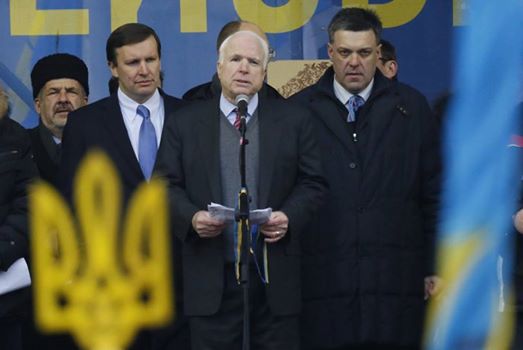
Sen. John McCain appearing with Ukrainian rightists at a rally in Kiev.
Now, the neocons have stoked a confrontation over Ukraine, involving two nuclear-armed states, the United States and Russia. But – even if nuclear weapons don’t come into play – the neocons have succeeded in estranging U.S. President Barack Obama from Russian President Vladimir Putin and sabotaging the pair’s crucial cooperation on Iran and Syria, which may have been the point all along.
Though the Ukraine crisis has roots going back decades, the chronology of the recent uprising — and the neocon interest in it – meshes neatly with neocon fury over Obama and Putin working together to avert a U.S. military strike against Syria last summer and then brokering an interim nuclear agreement with Iran last fall that effectively took a U.S. bombing campaign against Iran off the table.
With those two top Israeli priorities – U.S. military attacks on Syria and Iran – sidetracked, the American neocons began activating their influential media and political networks to counteract the Obama-Putin teamwork. The neocon wedge to splinter Obama away from Putin was driven into Ukraine.
Operating out of neocon enclaves in the U.S. State Department and at U.S.-funded non-governmental organizations, led by the National Endowment for Democracy, neocon operatives targeted Ukraine even before the recent political unrest began shaking apart the country’s fragile ethnic and ideological cohesion.
Last September, as the prospects for a U.S. military strike against Syria were fading thanks to Putin, NED president Carl Gershman, who is something of a neocon paymaster controlling more than $100 million in congressionally approved funding each year, took to the pages of the neocon-flagship Washington Post and wrote that Ukraine was now “the biggest prize.”
But Gershman added that Ukraine was really only an interim step to an even bigger prize, the removal of the strong-willed and independent-minded Putin, who, Gershman added, “may find himself on the losing end not just in the near abroad [i.e. Ukraine] but within Russia itself.” In other words, the new hope was for “regime change” in Kiev and Moscow.
Putin had made himself a major annoyance in Neocon World, particularly with his diplomacy on Syria that defused a crisis over a Sarin attack outside Damascus on Aug. 21, 2013. Despite the attack’s mysterious origins – and the absence of any clear evidence proving the Syrian government’s guilt – the U.S. State Department and the U.S. news media rushed to the judgment that Syrian President Bashar al-Assad did it.
Politicians and pundits baited Obama with claims that Assad had brazenly crossed Obama’s “red line” by using chemical weapons and that U.S. “credibility” now demanded military retaliation. A longtime Israeli/neocon goal, “regime change” in Syria, seemed within reach.
But Putin brokered a deal in which Assad agreed to surrender Syria’s chemical weapons arsenal (even as he continued to deny any role in the Sarin attack). The arrangement was a huge letdown for the neocons and Israeli officials who had been drooling over the prospect that a U.S. bombing campaign would bring Assad to his knees and deliver a strategic blow against Iran, Israel’s current chief enemy.
Putin then further offended the neocons and the Israeli government by helping to facilitate an interim nuclear deal with Iran, making another neocon/Israeli priority, a U.S. war against Iran, less likely.
Putting Putin in Play
So, the troublesome Putin had to be put in play. And, NED’s Gershman was quick to note a key Russian vulnerability, neighboring Ukraine, where a democratically elected but corrupt president, Viktor Yanukovych, was struggling with a terrible economy and weighing whether to accept a European aid offer, which came with many austerity strings attached, or work out a more generous deal with Russia.
There was already a strong U.S.-organized political/media apparatus in place for destabilizing Ukraine’s government. Gershman’s NED had 65 projects operating in the country – training “activists,” supporting “journalists” and organizing business groups, according to its latest report. (NED was created in 1983 to do in relative openness what the CIA had long done in secret, nurture pro-U.S. operatives under the umbrella of “promoting democracy.”)
So, when Yanukovych opted for Russia’s more generous $15 billion aid package, the roof fell in on him. In a speech to Ukrainian business leaders last December, Assistant Secretary of State for European Affairs, Victoria Nuland, a neocon holdover and the wife of prominent neocon Robert Kagan, reminded the group that the U.S. had invested $5 billion in Ukraine’s “European aspirations.”
Then, urged on by Nuland and neocon Sen. John McCain, protests in the capital of Kiev turned increasingly violent with neo-Nazi militias moving to the fore. Unidentified snipers opened fire on protesters and police, touching off fiery clashes that killed some 80 people (including about a dozen police officers).
On Feb. 21, in a desperate attempt to tamp down the violence, Yanukovych signed an agreement brokered by European countries. He agreed to surrender many of his powers, to hold early elections (so he could be voted out of office), and pull back the police. That last step, however, opened the way for the neo-Nazi militias to overrun government buildings and force Yanukovych to flee for his life.
With these modern-day storm troopers controlling key buildings – and brutalizing Yanukovych supporters – a rump Ukrainian parliament voted, in an extra-constitutional fashion, to remove Yanukovych from office. This coup-installed regime, with far-right parties controlling four ministries including defense, received immediate U.S. and European Union recognition as Ukraine’s “legitimate” government.
As remarkable – and newsworthy – as it was that a government on the European continent included Nazis in the executive branch for the first time since World War II, the U.S. news media performed as it did before the Iraq War and during various other international crises. It essentially presented the neocon-preferred narrative and treated the presence of the neo-Nazis as some kind of urban legend.
Virtually across the board, from Fox News to MSNBC, from the Washington Post to the New York Times, the U.S. press corps fell in line, painting Yanukovych and Putin as the “black-hat” villains and the coup regime as the “white-hat” good guys, which required, of course, whiting out the neo-Nazi “brown shirts.”
Neocon Expediency
Some neocon defenders have challenged my reporting that U.S. neocons played a significant role in the Ukrainian putsch. One argument is that the neocons, who regard the U.S.-Israeli bond as inviolable, would not knowingly collaborate with neo-Nazis given the history of the Holocaust (and indeed the role of Ukrainian Nazi collaborators in extermination campaigns against Poles and Jews).
But the neocons have frequently struck alliances of convenience with some of the most unsavory – and indeed anti-Semitic – forces on earth, dating back to the Reagan administration and its collaboration with Latin American “death squad” regimes, including work with the World Anti-Communist League that included not only neo-Nazis but aging real Nazis.
More recently in Syria, U.S. neocons (and Israeli leaders) are so focused on ousting Assad, an ally of hated Iran, that they have cooperated with Saudi Arabia’s Sunni monarchy (known for its gross anti-Semitism). Israeli officials have even expressed a preference for Saudi-backed Sunni extremists winning in Syria if that is the only way to get rid of Assad and hurt his allies in Iran and Lebanon’s Hezbollah.
Last September, Israel’s Ambassador to the United States Michael Oren told the Jerusalem Post that Israel so wanted Assad out and his Iranian backers weakened, that Israel would accept al-Qaeda operatives taking power in Syria.
“The greatest danger to Israel is by the strategic arc that extends from Tehran, to Damascus to Beirut. And we saw the Assad regime as the keystone in that arc,” Oren said in the interview. “We always wanted Bashar Assad to go, we always preferred the bad guys who weren’t backed by Iran to the bad guys who were backed by Iran.”
Oren said that was Israel’s view even if the other “bad guys” were affiliated with al-Qaeda.
Oren, who was Israel’s point man in dealing with Official Washington’s neocons, is considered very close to Israeli Prime Minister Benjamin Netanyahu and reflects his views. For decades, U.S. neocons have supported Netanyahu and his hardline Likud Party, including as strategists on his 1996 campaign for prime minister when neocons such as Richard Perle and Douglas Feith developed the original “regime change” strategy. [For details, see Consortiumnews.com’s “The Mysterious Why of the Iraq War.”]
In other words, Israel and its U.S. neocon supporters have been willing to collaborate with extreme right-wing and even anti-Semitic forces if that advances their key geopolitical goals, such as maneuvering the U.S. government into military confrontations with Syria and Iran.
So, while it may be fair to assume that neocons like Nuland and McCain would have preferred that the Ukraine coup had been spearheaded by militants who weren’t neo-Nazis – or, for that matter, that the Syrian rebels were not so dominated by al-Qaeda-affiliated extremists – the neocons (and their Israeli allies) see these tactical collaborations as sometimes necessary to achieve overarching strategic priorities.
And, since their current strategic necessity is to scuttle the fragile negotiations over Syria and Iran, which otherwise might negate the possibility of U.S. military strikes against those two countries, the Putin-Obama collaboration had to go.
By spurring on the violent overthrow of Ukraine’s elected president, the neocons helped touch off a cascade of events – now including Crimea’s secession from Ukraine and its annexation by Russia – that have raised tensions and provoked Western retaliation against Russia. The crisis also has made the continued Obama-Putin teamwork on Syria and Iran extremely difficult, if not impossible.
Like other neocon-engineered schemes, there will surely be much collateral damage in this latest one. For instance, if the tit-for-tat economic retaliations escalate – and Russian gas supplies are disrupted – Europe’s fragile recovery could be tipped back into recession, with harmful consequences for the U.S. economy, too.
There’s also the certainty that congressional war hawks and neocon pundits will press for increased U.S. military spending and aggressive tactics elsewhere in the world to punish Putin, meaning even less money and attention for domestic programs or deficit reduction. Obama’s “nation-building at home” will be forgotten.
But the neocons have long made it clear that their vision for the world – one of America’s “full-spectrum dominance” and “regime change” in Middle Eastern countries opposed to Israel – overrides all other national priorities. And as long as the neocons face no accountability for the havoc that they wreak, they will continue working Washington’s corridors of power, not selling insurance or flipping hamburgers.
Violence and Terror: The Ukrainian and Colombian Road to Empire Building
By James Petras | The People’s Voice | March 19, 2014
Introduction
The two paths to 21st century empire-building-via-proxies are illustrated through the violent seizure of power in the Ukraine by a US-backed junta and the electoral gains of the US-backed Colombian war lord, Alvaro Uribe. We will describe the ‘mechanics’ of US intervention in the domestic politics of these two countries and their profound external effects – that is how they enhance imperial power on a continent-wide basis.
Political Intervention and Proxy Regimes: Ukraine
The conversion of the Ukraine into a US-EU vassal state has been a prolonged process which involved large scale, long term financing, indoctrination and recruitment of cadres, organization and training of politicos and street fighters and, above all, a capacity to combine direct action with electoral politics.
Seizing power is a high stakes game for empire: (1) Ukraine, in the hands of clients, provides a NATO with a military springboard into the heart of the Russian Federation; (2) Ukraine’s industrial and agricultural resources provide a source of enormous wealth for Western investors and (3) Ukraine is a strategic region for penetrating the Caucuses and beyond.
Washington invested over $5 billion dollars in client-building, mostly in ‘Western Ukraine’, especially in and around Kiev, focusing on ‘civil society groups’ and malleable political parties and leaders. By 2004, the initial US political ‘investment’ in regime change culminated in the so-called ‘Orange Revolution’ which installed a short-lived pro-US-EU regime. This, however, quickly degenerated amidst major corruption scandals, mismanagement and oligarchical pillage of the national treasury and public resources leading to the conviction of the former-Vice President and the demise of the regime. New elections produced a new regime, which attempted to secure ties with both the EU and Russia via economic agreements, while retaining many of the odious features (gross endemic corruption) of the previous regime. The US and EU, having lost thru democratic elections, relaunched their ‘direct action organizations’ with a new radical agenda. Neo-fascists seized power and established a dictatorial junta through violent demonstrations, vandalism, armed assaults and mob action. The composition of the new post-coup junta reflected two sides of the US-backed political organizations: (1) neo-liberal politicos for managing economic policy and forging closer ties with NATO, (2) and neo-fascists/violent nationalists to impose order by force and fist, and crush pro-Russian Crimean ‘autonomists’ and ethnic Russians and other minorities, especially in the industrialized south and east.
Whatever else may ensue, the coup and the resultant junta is fully subordinated to and dependent on the will of Washington: claims of Ukrainian ‘independence’ notwithstanding. The junta proceeded to purge the elected and appointed government officials affiliated with the political parties of the previous democratic regime and to persecute its supporters. Their purpose is to ensure that subsequent managed elections will provide a pretense of legitimacy, and elections will be limited to two sets of imperial clients: the neo-liberals, (self-styled “moderates”) and the neo-fascists dubbed as “nationalists”.
Ukraine’s road to imperialist power via a collaborator regime illustrates the various instruments of empire building: (1) the use of imperial state funds, channeled through NGOs, to political front groups and the build-up of a ‘mass base’ in civil society; (2) the financing of mass direct action leading to a coup (‘regime change’); (3) the imposition of neo-liberal policies by the client regime; (4) imperial financing of the re-organization and regroupment of mass direct action groups after the demise of the first client regime; (5) the transition from protest to violent direct action as the major backdrop to the extremist sectors (neo-fascists) organizing the seizure of power and purge of the opposition; (6) organizing an ‘international media campaign’ to prop up the new junta while demonizing domestic and international opposition (Russia) and (7) political power centralized in the hands of the junta, convoking “managed elections” limited to the victory of one or the other pro-imperial pro-junta candidates.
In summary, empire-builders operate on several/levels: violent and electoral; social and political; and with selected incumbents and rivals committed to one strategic aim: the seizure of state power and the conversion of the ruling elite into willing vassals of empire.
Columbia’s Deathsquad Democracy: Centerpiece of the Imperial Advance in Latin America
In the face of a continent-wide decline of US influence in Latin America, Colombia stands out as a constant bulwark of US imperial interests: (1) Colombia signed a free trade agreement with the US; (2) provided seven military bases and invited thousands of US counter-insurgency operatives; and (3) collaborated in building large-scale paramilitary death squads prepared for cross border raids against Washington’s arch enemy Venezuela.
Colombia’s ruling oligarchy and military have been able to resist the wave of massive democratic, national and popular social upheavals and electoral victories that gave rise to the post-neo-liberal states in Brazil, Argentina, Venezuela, Ecuador, Bolivia, Paraguay and Uruguay.
While Latin America has moved toward ‘regional organizations’ excluding the US, Colombia strengthened its ties to the US through bilateral agreements. While Latin America reduced its dependence on US markets, Colombia expanded its commercial ties. While Latin America reduced their military ties to the Pentagon, Colombia tightened them. While Latin America moved toward greater social inclusion by increasing taxes on foreign multinational corporations, Colombia lowered corporate taxes. While Latin America expanded land settlements for its landless rural populations, Colombia displaced over 4 million peasants as part of the US-designed ‘scorched earth’ counter-insurgency policy.
Colombia’s “exceptional” unwavering submission to US imperial interests is rooted in several large-scale, long-term programs developed in Washington. In 2000, President ‘Bill’ Clinton committed the US to a $6 billion dollar counter-insurgency program (Plan Colombia) which greatly increased the brutal repressive capacity of the Colombian elite to confront the popular grass roots movements of peasants and workers. Along with arms and training, US Special Forces and ideologues entered Colombia to develop military and paramilitary terror operations – aimed primarily at penetrating and decimating political opposition and civil society social movements and assassinating activists and leaders. The US-backed Alvaro Uribe, notorious narco-trafficker and the very personification of a ruthless imperial vassal, became president over a ‘Death-Squad Democracy’.
President Uribe further militarized Colombian society, savaged civil society movements and crushed any possibility of a popular democratic revival, such as were occurring throughout the rest of Latin America. Thousands of activists, trade unionists, human rights workers and peasants were murdered, tortured and jailed.
The ‘Colombian System’ combined the systematic use of para-militarism (death squads) to smash local and regional trade union and peasant opposition and the technification and massification of the military (over 300,000 soldiers) in fighting the popular insurgency and ‘emptying the countryside’ of rebel sympathizers. Large-scale multi-billion dollar drug trafficking and money laundering formed the ‘financial glue’ to cement a tight relationship among oligarchs, politicos, bankers and US counter-insurgency advisers – creating a terrifying high-tech police state bordering Venezuela, Ecuador and Brazil – countries with substantial popular mass movements.
The same state terror machinery, which decimated the pro-democracy social movements, has protected, promoted and participated in ‘stage-managed elections’, the hallmark of Colombia as a “death squad democracy”.
Elections are held under a vast overlapping network of military bases, where death squads and drug traffickers occupied towns and villages intimidating, terrorizing and ‘corrupting’ the electorate. The only ‘safe’ protest in this repressive atmosphere has been voter abstention. Electoral outcomes are pre-ordained: oligarchs never lose in death squad democracies, they are the empire’s most trusted vassals.
The cumulative effects of the decade and a half-long bloody purge of Colombian civil society by Presidents Uribe and his successor, Santos, have been to eliminate any consequential electoral opposition. Washington has achieved its ideal: a stable vassal state; a large-scale and obedient military; an oligarchy tied to US corporate elites; and a tightly-controlled ‘electoral’ system that never permits the election of a genuine opponent.
The March 2014 Colombian elections brilliantly illustrate the success of US strategic intervention in collaboration with the oligarchy: The vast majority of the electorate, over two-thirds, abstained, demonstrating the absence of any real legitimacy among the eligible voters. Among those who ‘voted’, ten percent submitted ‘spoiled’ or blank ballots. Voter abstention and ballot-spoilage was especially high in the rural regions and working class areas which had been subject to state terror.
Given the intense state repression, the mass of voters decided that no authentic pro-democracy party would have any chance and so refused to legitimize the process. The 30% who actually voted were largely urban middle and upper class Colombians and residents in some rural areas completely controlled by narco-terrorists and the military where ‘voting’ may have been ‘compulsory’. Of a total of 32 million eligible voters in Colombia, 18 million abstained and another 2.3 million submitted spoiled ballots. The two dominant oligarchical coalitions led by President Santos and ex-President Uribe received only 2.2 million and 2.05 million votes respectively, a fraction of the number who abstained (14 million). In this widely scorned electoral farce, the center-left and left parties made a miserable showing. Colombia’s electoral system puts a propaganda veneer on a dangerous, highly-militarized vassal state primed to play a strategic role in US plans to “reconquer” Latin America.
Two decades of systematic terror, financed by a six-billion dollar militarization program, has guaranteed that Washington will not encounter any substantial opposition in the legislature or presidential palace in Bogota. This is the ‘acrid, gunpowder-tinged smell of success’ for US policymakers: violence is the midwife of the vassal state. Colombia has been turned into the springboard for developing a US-centered trade bloc and a military alliance to undermine Venezuela’s Bolivarian regional alliances, such as ALBA and Petro Caribe as well as Venezuela’s national security. Bogota will try to influence neighboring right and center-left regimes pushing them to embrace of the US Empire against Venezuela.
Conclusion
Large-scale, long-term subversion and organization in Ukraine and Colombia, as well as the funding of paramilitary and civil society organizations (NGO) has enabled Washington to: (1) construct strategic allies, (2) build ties to oligarchs, malleable politicians and paramilitary thugs and (3) apply political terrorism for their seizure of state power. The imperial planners have thus created “model states” – devoid of consequential opponents and ‘open’ to sham elections among rival vassal politicians.
Coups and juntas, orchestrated by longstanding political proxies, and highly militarized states run by ‘Death Squad Executives’ are all legitimized by electoral systems designed to expand and strengthen imperial power.
By rendering democratic processes and peaceful popular reforms impossible and by overthrowing independent, democratically elected governments, Washington is making wars and violent upheavals inevitable.
-###-
James Petras is a Bartle Professor (Emeritus) of Sociology at Binghamton University, New York. He is the author of 64 books published in 29 languages, and over 560 articles in professional journals, including the American Sociological Review, British Journal of Sociology, Social Research, Journal of Contemporary Asia, and Journal of Peasant Studies.
Featured Video
Can the U.S. Afford to Annihilate Iran?
or go to
Aletho News Archives – Video-Images
Book Review
The Genetic Deception — now in paperback (Second Edition)
Lies are Unbekoming | October 2, 2026
The genes the field promised were never there.
The genetic story of disease is a cover story.
The twenty-first century runs on it. Paediatric clinics. Cancer centres. Forensic laboratories. Family-planning counsel. It is used to explain illness, to assign blame, to foreclose questions. It protects the industries whose products and practices are what actually caused the harm.
It isn’t true.
In 2010, Jonathan Latham and Allison Wilson looked at over seven hundred genome-wide association studies covering some eighty common diseases. The genes the field had promised were not there. The field invented a term, “missing heritability”, to explain the absence, and has quietly worked to bury the finding ever since.
The Genetic Deception is a book about what Latham and Wilson found. What the field did with it. And what the public was told instead. … continue
Blog Roll
 Aletho News
- Fatuous False Flags
- Are Europe’s Smallest Nations Dragging the Continent into War?
- EU draws up contingency plans for possible Merz exit
- G7 caves to US blackmail, announces ‘massive’ release of diesel reserves
- Reporting of the RAF Fairford arrests blows the idea of a ‘free press’ out of the water
- US increasing Middle East military buildup – AP
- Flydubai scenario: Netanyahu’s plot to drag US to war with Iran, stay in power
- The Genetic Deception — now in paperback (Second Edition)
- Can the U.S. Afford to Annihilate Iran? /Seyed M. Marandi
- Elmo Sold mRNA Jabs to Your Toddler. Now They Are “Off-Label.”
- If Americans Knew
- The Israeli Right Portrays Islam as Murderous. It Serves a Political Purpose
- Jordan Has Had Enough: King Abdullah’s Scathing Warning to Israel
- Israeli Colonizers (i.e. Settlers) Kill Palestinian Man Near Salfit
- New Google Maps images reveal massive scale of devastation in Gaza
- Jewish supremacy, anti-Palestinian bigotry on display in Israel – Daily Update
- Israeli Soldiers Abduct At Least 22 Across Occupied West Bank
- Eight Palestinians Killed in Israeli Attacks on Gaza
- Israeli former leaders and security chiefs threaten legal action over ‘Jewish terrorism’
- Israel map in LA Times ad includes all land from the river to the sea
- Inside Lebanon’s 200-page dossier on Israeli war crimes
- No Tricks Zone
- Green Energy Debacle: German Expert Professor Fritz Vahrenholt Warns Of Severe Economic And Social Consequences
- Two More Paleo Reconstructions Affirm Meters-Higher Sea Levels Across Ireland, Brazil 7000-6000 Years Ago
- New Study: Earth And Venus Surface Warmth Largely Explained By Convection And Lapse Rate, Not CO2 Or Radiation
- 2025 Nature Paper Claiming Worsening Global Drought Gets RETRACTED …Heavily Flawed
- New Study: ‘Global Drought Shows No Detectable Recent Acceleration Under Climate Warming’
- Economic Masterminds: German Socialists Suggest Taxing Productivity Gains Stemming From Using AI
- The South China Sea Has Not Been Cooperating With The Climate Change Narrative
- Energy Crisis: Germany Enters Heating Season With Historically Low Gas Reserve Fill Levels
- New Study: The Antarctic Ice Sheet Gained Mass From 2020-2024 Due To Staggering Snow And Ice Accumulation
- Study: Ocean Heating Rates From Thousands Of Years Ago ‘Dwarf’ Modern Ocean Heating Rates

