Here’s why the West has so far failed to start World War III
By Tarik Cyril Amar | RT | March 31, 2025
Under the title ‘The Partnership: The Secret History of the War in Ukraine’, the New York Times published a long exposé that has made a splash. It is a long article advertised – with a lumbering clunkiness that betrays cramping politics – as the “untold story of America’s hidden role in Ukrainian military operations against Russia’s invading armies.”
And it clearly aspires to be sensational: A revelation with a whiff of the famous Pentagon Papers that, when leaked to the same New York Times and the Washington Post in 1971, revealed what a mass-murderous fiasco America’s Vietnam War really was.
Yet, in reality, this time the New York Times is offering something less impressive by magnitudes. And the issue is not that the Pentagon Papers were longer. What really makes ‘The Partnership’ so underwhelming are two features: It is embarrassingly conformist, reading like a long exercise in rooting for the home team, the US, by access journalism: Based on hundreds of interviews with movers and shakers, this is really the kind of ‘investigation’ that boils down to giving everyone interviewed a platform for justifying themselves as good as they can and as much as they like.
With important exceptions. For the key strategy of exculpation is simple. Once you see through the rather silly group-therapy jargon of a tragic erosion of ‘trust’ and sad misunderstandings, it is the Ukrainians that get the blame for the US not winning its war against Russia, in their country and over their dead bodies.
Because one fundamental conceit of ‘The Partnership’ is that the war could have been won by the West, through Ukraine. What seems to never even have entered the author’s mind is the simple fact that this was always an absurd undertaking. Accordingly, the other thing that hardly makes it onto his radar screen is the crucial importance of Russia’s political and military actions and reactions.
This, hence, is an article that, in effect, explains losing a war against Russia without ever noticing that this may have happened because the Russians were winning it. In that sense, it stands in a long tradition: Regarding Napoleon’s failed campaign of 1812 and Hitler’s crash between 1941 and 1945, all too many contemporary and later Western observers have made the same mistake: For them it’s always the weather, the roads (or their absence), the timing, and the mistakes of Russia’s opponents. Yet it’s never – the Russians. This reflects old, persistent, and massive prejudices about Russia that the West cannot let go of. And, in the end, it is always the West which ends up suffering from them the most.
In the case of the Ukraine conflict, the main scapegoats, in the version of ‘The Partnership’, are now Vladimir Zelensky and his protégé and commander-in-chief General Aleksandr Syrsky, but there is room for devastating side swipes at Syrsky’s old rival Valery Zaluzhny and a few lesser lights as well.
Perhaps the only Ukrainian officer who looks consistently good in ‘The Partnership’ is Mikhail Zabrodsky, that is, the one – surprise, surprise – who worked most closely with the Americans and even had a knack of flatteringly imitating their Civil War maneuvers. Another, less prominent recipient of condescending praise is General Yury Sodol. He is singled out as an “eager consumer” of American advice who, of course, ends up succeeding where less compliant pupils fail.
Zabrodsky and Sodol may very well be decent officers who do not deserve this offensively patronizing praise. Zelensky, Syrsky, and Zaluzhny certainly deserve plenty of very harsh criticism. Indeed, they deserve being tried. But constructing a stab-in-the-back legend around them, in which Ukrainians get blamed the most for making the US lose a war that the West provoked is perverse. As perverse as the latest attempts by Washington to turn Ukraine into a raw materials colony, as a reward for being such an obedient proxy.
With all its fundamental flaws, there are intriguing details in ‘The Partnership’. They include, for instance, a European intelligence chief openly acknowledging – as early as spring 2022 – that NATO officers had become “part of the kill chain,” that is, of killing Russians who they were not, actually, officially at war with.
Or that, contrary to what some believe, Westerners did not overestimate but underestimate Russian abilities from the beginning of the war: In the spring of 2022, Russia rapidly surged “additional forces east and south” in less than three weeks, while American officers had assumed they would need months. In a similar spirit of blinding arrogance, General Christopher Cavoli – in essence, Washington’s military viceroy in Europe and a key figure in boosting the war against Russia – felt that Ukrainian troops did not have to be as good as the British and Americans, just better than Russians. Those daft, self-damaging prejudices again.
The New York Times’ “untold story” is also extremely predictable. Despite all the detail, nothing in ‘The Partnership’ is surprising, at least nothing important. What this sensationally unsensational investigation really does is confirm what everyone not fully sedated by Western information warfare already knew: In the Ukraine conflict, Russia has not merely – if that is the word – been fighting Ukraine supported by the West but Ukraine and the West.
Some may think the above is a distinction that doesn’t make a difference. But that would be a mistake. Indeed, it’s the kind of distinction that can make a to-be-or-not-to-be difference, even on a planetary scale.
That’s because Moscow fighting Ukraine, while the latter is receiving Western support, means Russia having to overcome a Western attempt to defeat it by proxy war. But fighting Ukraine and the West means Russia has been at war with an international coalition, whose members have all attacked it directly. And the logical and legitimate response to that would have been to attack them all in return. That scenario would have been called World War III.
‘The Partnership’ shows in detail that the West did not merely support Ukraine indirectly. Instead, again and again, it helped not only with intelligence Ukraine could not have gathered on its own but with direct involvement in not only supplying arms but planning campaigns and firing weapons that produced massive Russian casualties. Again, Moscow has said this was the case for a long time. And Moscow was right.
This is why, by the way, the British Telegraph has gotten one thing very wrong in its coverage of ‘The Partnership’: The details of American involvement now revealed are not, actually, “likely to anger the Kremlin.” At least, they are not going to make it angrier than before, because Russia is certain to have long known about just how much the US and others – first of all Britain, France, Poland, and the Baltics – have contributed, directly and hands-on, to killing Russians.
Indeed, if there is one important takeaway from the New York Times’ proud exposé of the extremely unsurprising, it is that the term ‘proxy war’ is both fundamentally correct and insufficient. On the one hand, it perfectly fits the relationship between Ukraine and its Western ‘supporters’: The Zelensky regime has sold the country as a whole and hundreds of thousands of Ukrainian lives to the West. The West has used them to wage war on Russia in pursuit of one overarching geopolitical aim of its own: To inflict a ‘strategic defeat’ on Russia – that is, a permanent demotion to second-rate, de facto non-sovereign status.
The above is not news, except perhaps for the many brainwashed by Western information warriors from historian-turned-war-apostle Tim Snyder to lowlier X agitators with Ukrainian flags and sunflowers in their profiles.
What is also less than stunning but a little more interesting is that, on the other side, the term proxy war is still misleadingly benign. The key criterion for a war being by proxy – and not its opposite, which is, of course, direct – is, after all, that major powers using proxies limit themselves to indirect support. It is true that in theory and historical practice that does not entirely rule out adding some limited direct action as well.
And yet, in the case of the Ukraine conflict, the US and other Western nations – and don’t overlook the fact that ‘The Partnership’ hardly addresses all the black ops also conducted by them and their mercenaries – have clearly, blatantly gone beyond proxy war. In reality, the West has been waging war on Russia for years now.
That means that two things are true: The West almost started World War III. And the reason it has not – not yet, at least – is Moscow’s unusual restraint, which, believe it or not, has actually saved the world.
Here’s a thought experiment: Imagine the US fighting Canada and Mexico (and maybe Greenland) and learning that Russian officers are crucial in firing devastating mass-casualty strikes at its troops. What do you think would happen? Exactly. And that it has not happened during the Ukraine War is due to Moscow being the adult in the room. This should make you think.
Tarik Cyril Amar is a historian from Germany working at Koç University, Istanbul, on Russia, Ukraine, and Eastern Europe, the history of World War II, the cultural Cold War, and the politics of memory
Trump-Putin parley is a bit under the weather
By M. K. BHADRAKUMAR | Indian Punchline | March 31, 2025
The Kremlin apparently came to the conclusion last week that it was about time to do some plain-speaking that US president Donald Trump’s quest for a 30-day ceasefire in the Ukraine war was a non-starter. Over the weekend, in a series of remarks, Trump reacted sharply that he’s “very angry” with President Vladimir Putin over his approach to the proposed ceasefire and threatened to levy tariffs on Moscow’s oil exports if the Russian leader does not agree to a truce within a month.
Trump is either incapable or unwilling to accept that neither Russians nor Ukrainians have their heart in the ceasefire deal (for different reasons, though) even while paying lip service to it, as each wants to have Trump on its side.
Unlike Ukrainians who are blasé about their desire to continue to wage the war until Russian forces vacate their territories in the east (knowing that may never happen), Russians are savvy operators who prioritise the unfinished business of the war while playing their part in the diplomatic circuit.
Actually, Russians are in two minds whether the war could end once their military gains total control over Donbass, or, should they also take control of Odessa, Nikolaev, Dnipropetrovsk, Kharkov, etc. to create a security zone roughly, along the Dniepr River, and, let the UN figure out the future of the rump state of Ukraine. (See my blog A Third Way to end the war in Ukraine, Indian Punchline, March 29, 2025.)
Such is the backlog of the West’s betrayals and repudiation of agreements, including during first term, that Russia may come to estimate that its best security guarantee for durable peace lies in creating solid facts on the ground.
Trump will do well to read the extraordinary report featured in the New York Times dated March 29, 2025 titled The Partnership: The Secret History of the War in Ukraine. It is a doctored version of the untold story of America’s hidden role in Ukrainian military operations against Russia but the main thing is that it confirms the Russian allegation that this has been a proxy war kick-started by the US with great deliberateness.
Suffice to say, Trump’s claim to be a good Samaritan with a bleeding heart who wants the war to end, et al, won’t fly. On the other hand, Putin is nonetheless keen on establishing a good personal rapport with Trump and anchor a meaningful US-Russia partnership on it, realistic enough to accept that Trump is as good an American president as Russia would ever get.
That said, Putin is also unwavering that in order for peace to be durable, conditions must be created first where he needs Trump’s understanding, although Russian people are deeply sceptical about any US mediation.
Trump refused to say if there was any deadline for Russia to agree to a ceasefire in Ukraine, but he told reporters on board Air Force One yesterday, “It’s a psychological deadline. If I think they’re [Russians] tapping us along, I will not be happy about it.”
On the contrary, Russians have been as transparent as they could in the prevailing climate of deep distrust — and no real effort has yet begun to address the root causes of the conflict.
The Russian negotiator Grigory Karasin, an accomplished career diplomat and deputy foreign minister and currently a senator heading the foreign affairs committee of the upper-house Federation Council, who was the negotiator at the expert group negotiations at Riyadh last Monday, said over the weekend with great candour on Russia’s national television that the 12-hour talks “haven’t led to any radical breakthrough yet, but the opportunities are there. It would have been naive to expect any breakthroughs.”
Karasin claimed that the US negotiators, including senior National Security Council director Andrew Peek and State Department policy planning chief Michael Anton, initially presented “proposals that are unacceptable to Russia.”
“But then, in my opinion… they realised that a team of civilised, reasoned interlocutors was sitting in front of them,” he said, describing the talks as having had a “good atmosphere” despite the lack of progress.
Importantly, Karasin said he expects US-Russian negotiations on Ukraine to continue at least until the end of 2025 or beyond.
We will never know how accurate was the feedback Trump received from the inconclusive negotiations in Riyadh. Clearly, the US has since resiled from the understanding given to the Russian side in regard of waiving the sanctions for the export of Russian food and fertilisers to the world market, facilitate the payments system and provide other underpinnings needed.
Karasin’s glasnost was apparently not music to Trump’s ears. Nonetheless, good sense prevailed finally, as Trump signalled his intentions to talk to Putin.
Will that help? Putin said as recently as last week that Russia’s interests will not be bartered away. Even if Trump were to now decide to join hands with the UK and France to lead the “coalition of the willing” to continue the Ukraine war, it is unlikely Putin will budge on Russia’s core interests.
However, Trump’s real predicament is something else. He had a choice to decouple the US from the war. But then, he was also swayed by the Wall Street’s obsessive interest in Ukraine being a honeypot, which of course is incompatible with his known aversion to assuming the obligations and responsibilities of a de facto colonial power in a faraway land 10,000 kms away.
The result is, Ukrainians have lost respect for him. Zelensky hit out on Friday, saying, “Ukraine has received the new draft agreement on natural resources from the US, which is totally different from the previous framework agreement. Ukraine will not recognise the United States military aid as a debt. We are grateful for support but it’s not a loan.”
Wall Street Journal reported on the new revised draft document sent to Kiev from Washington, which insists on Zelensky signing an agreement giving the American companies control over key economic projects. In particular, the US seeks the right to be the first to participate in Ukraine’s infrastructure projects and mining programs, including rare-earth metals and construction of ports.
The fund, managed primarily by US representatives, will channel the profits to pay off the cost of military aid provided by Washington to Kiev. If the agreement is signed, Ukraine will have 45 days to submit a list of projects for consideration by the fund.
Britain’s Daily Telegraph reported that under the latest version of the deal, the US would control half of Ukraine’s oil and gas reserves, its metals and much of its infrastructure, including railways, ports, pipelines and refineries, through a joint investment fund. The US plans to receive all profits until Ukraine pays it at least $100 billion in compensation for military aid, with a 4% surcharge. Kiev will start receiving 50% of the profits only after the debt is repaid.
The newspaper added that the new fund will be registered in the state of Delaware but will operate under the jurisdiction of New York. And the US will have the right to veto the sale of Ukrainian resources to third countries and the prerogative to check the accounts of any Ukrainian agency involved.
Trump has fallen between two stools. Ukraine is highly unlikely to accept the deal with the US. Also, trust Russian ingenuity to make a counter offer in business relationship to Trump that he can’t refuse. In sum, Trump’s attempt to enhance trust with Putin was indeed the right approach. And Putin reciprocated in earnestness.
Indeed, their parley made some headway until it came under weather, thanks to the mercantile considerations in play regarding Ukraine’s resources, which require that the war must be put to sudden death. Whereas, such wars have their own dynamics too.
ECHR Finds Ukraine Responsible for Odessa Massacre
By Kit Klarenberg | March 30, 2025
On March 13th, a bombshell judgment by the European Court of Human Rights found the Ukrainian government guilty of grave human rights breaches over the May 2nd 2014 Odessa massacre, in which dozens of Russian-speaking anti-Maidan activists were forced into the city’s Trade Unions House and burned alive by violent ultranationalist thugs. The explosive findings unambiguously uncover a concerted conspiracy by Ukrainian authorities to facilitate and exacerbate the grotesque killing, then insulate its perpetrators, and officials and state agencies which helped it happen, from justice.
In all, 42 people were killed and hundreds injured as a result of the blaze, a bloody bookend to the so-called “Maidan revolution” that saw Ukraine’s democratically-elected president Viktor Yanukovych deposed in a Western-orchestrated coup months earlier. Ever since Ukrainian officials and legacy media outlets have consistently framed the deaths as a tragic accident, with some figures even blaming anti-Maidan protesters themselves for starting the blaze. That notion is comprehensively incinerated by the verdict, which was delivered by a team of seven European judges, including a Ukrainian.
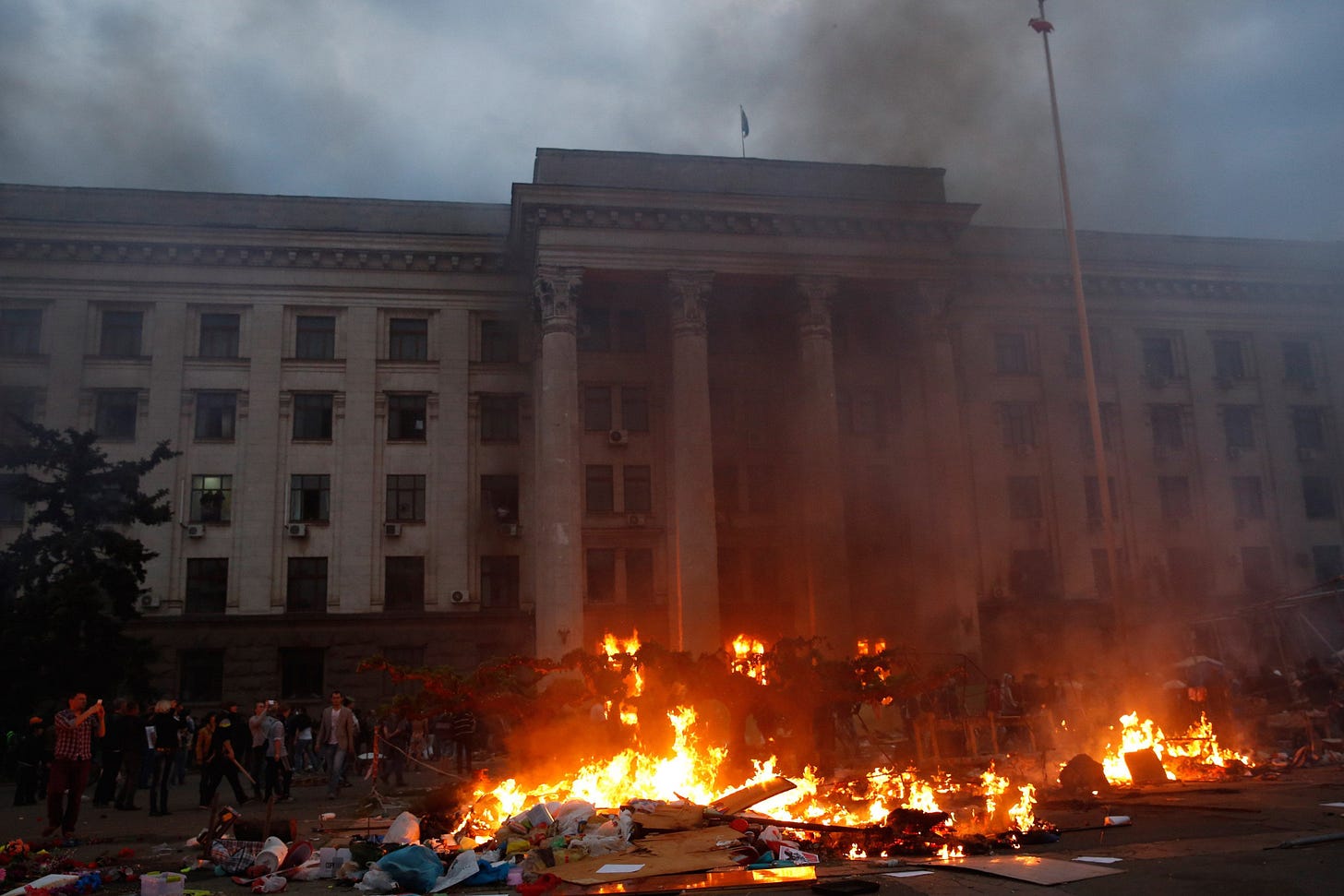
The May 2nd 2014 Odessa massacre
“Relevant authorities’ failure to do everything that could reasonably be expected of them to prevent the violence in Odessa… to stop that violence after its outbreak, to ensure timely rescue measures for people trapped in the fire, and to institute and conduct an effective investigation into the events” means Kiev was found guilty of egregious European Convention on Human Rights breaches. Moreover, numerous incendiary passages make clear industrial scale “negligence” by officials on the day, and ever after, “went beyond an error of judgment or carelessness.”
For example, the ECHR found deployment of fire engines to the site was “deliberately delayed for 40 minutes” – the local fire station being just one kilometer away – and police stood by passively as the building and its occupants burned, refusing to “help evacuate people… promptly and safely.” Moreover, Ukrainian authorities made “no efforts whatsoever” or “any meaningful attempt” to prevent or disrupt the skirmishes between pro- and anti-Maidan activists that prefaced the deadly inferno, despite knowing in advance such clashes were impending on the day.
While stopping short of charging that Ukrainian authorities actively wished for the anti-Maidan activists trapped in the burning building to die, this conclusion is ineluctable based on the ECHR’s findings. So too the apparent immunity from prosecution for implicated officials and ultranationalist perpetrators, and Kiev’s failure to act on “extensive photographic and video evidence” indicating precisely who was responsible for “firing shots during the clashes,” setting the building ablaze, and “assaulting the fire victims” who managed to escape.
The case was brought by 25 people who lost family members in the Neo-Nazi arson attack and clashes that preceded it, and three who survived the fire “with various injuries”. The ECHR has demanded Ukraine pay them just 15,000 euros each in damages. In an even greater affront to justice, the damning ruling stops short of exposing the full reality of the Odessa slaughter, indicting the Western-supported Neo-Nazi elements responsible, and their intimate ties to the February 2014 Maidan Square false flag sniper massacre.
‘Explicit Order’
Once the Maidan protests commenced in Ukraine in November 2013, tensions began steadily brewing between Odessa’s sizable Russian-speaking population and Ukrainian nationalists within and without the city. As the ECHR ruling notes, “while violent incidents had overall remained rare… the situation was volatile and implied a constant risk of escalation.” In March 2014, anti-Maidan activists set up a tent camp in Kulykove Pole Square, and began calling for a referendum on the establishment of an “Odessa Autonomous Republic”.
The next month, supporters of Odesa Chornomorets and Kharkiv Metalist football clubs announced a rally “For a United Ukraine” on May 2, before a scheduled match. Shortly thereafter, the ECHR records “anti-Maidan posts began to appear on social media describing the event as a Nazi march and calling for people to prevent it.” While branded Russian “disinformation” in the ruling, hooligans associated with both clubs had overt Neo-Nazi sympathies and associations, and well-established reputations for violence. They later formed the notorious Azov Battalion.
Fearing their tent encampment would be attacked, anti-Maidan activists resolved to disrupt the “pro-unity march” before it reached them. The ECHR reveals Ukraine’s security services and cybercrime unit had substantive intelligence indicating “violence, clashes and disorder” were certain on the day. Yet, authorities “ignored the available intelligence and the relevant warning signs”, and undertook no actions or “proper measures” to “stamp out any provocation”, such as implementing “enhanced security in the relevant areas.”
So it was on the afternoon of May 2nd 2014, “as soon as the march began,” anti-Maidan activists confronted the demonstrators, and violent clashes erupted. At roughly 17:45, in the precise manner of the Maidan Square sniper false flag massacre three months earlier, multiple anti-Maidan activists were fatally shot “by someone standing on a nearby balcony”, using “a hunting gun.” Subsequently, “pro-unity protesters… gained the upper hand in the clashes,” and charged towards Kulykove Pole square.
Anti-Maidan activists duly “took refuge” in Trade Unions House, a five-storey building overlooking the square, while their ultranationalist adversaries “started setting fire to the tents.” Gunfire and Molotov cocktails were “reportedly” exchanged by both sides, and before long, the building was ablaze. “Numerous calls” were made to the local fire brigade, including by police, “to no avail.” Mysteriously, its chief had “instructed his staff not to send any fire engines to Kulykove Pole without his explicit order,” so none were dispatched.
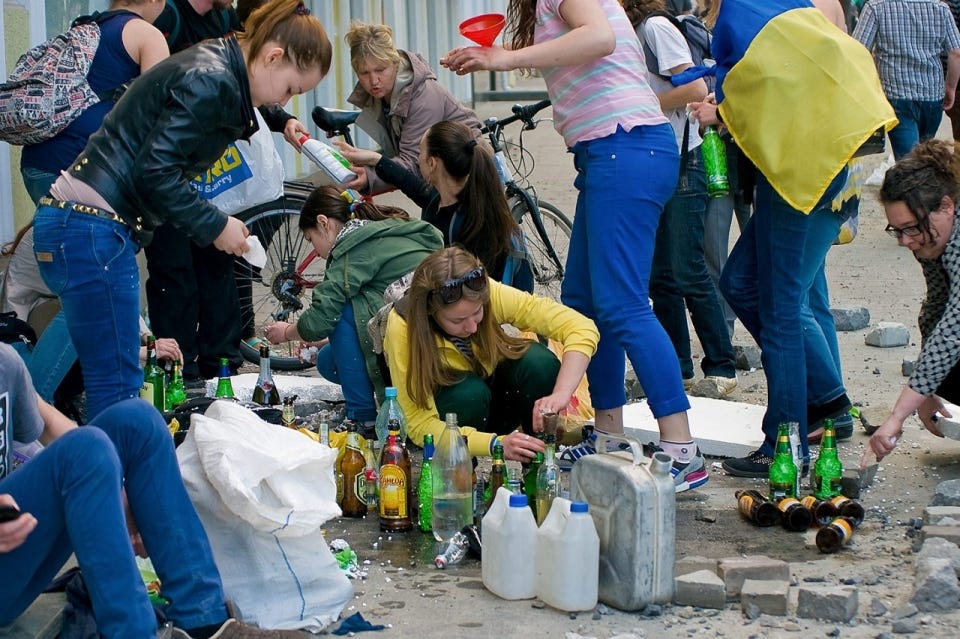
Wives and girlfriends of Neo-Nazis prepare Molotov cocktails for the attack
Several people trapped in the building tried to escape by jumping from its upper windows – some survived, but others died. “Video footage shows pro-unity protesters attacking people who had jumped or had fallen,” the ECHR notes. It was not until 20:30 that firefighters finally entered the building and extinguished the blaze. Police then arrested 63 surviving activists “still inside the building or on the roof.” They were released two days later, after a several hundred-strong group of anti-Maidan protesters “stormed the local police station where they were being held.”
‘Serious Defects’
The litany of security failures and industrial scale negligence by authorities on the day was greatly aggravated by “local prosecutors, law enforcement, and military officers” not being “contactable for a large part or all of time [sic],” as they were coincidentally attending a meeting with Ukraine’s Deputy Prosecutor General. The ECHR “found the attitude and passivity of those officials inexplicable,” apparently unwilling to consider the obvious possibility they purposefully made themselves incommunicado to ensure maximum mayhem and bloodshed, while insulating themselves from legal repercussions.
Still, the ECHR ruled “relevant” Ukrainian authorities “had not done everything they reasonably could to prevent the violence” or “what could reasonably be expected of them to save people’s lives,” therefore finding Kiev committed “violations of the substantive aspect of Article 2” of the European Convention on Human Rights. The Court also concluded authorities “failed to institute and conduct an effective investigation into the events in Odessa” – “a violation of the procedural aspect of Article 2”.
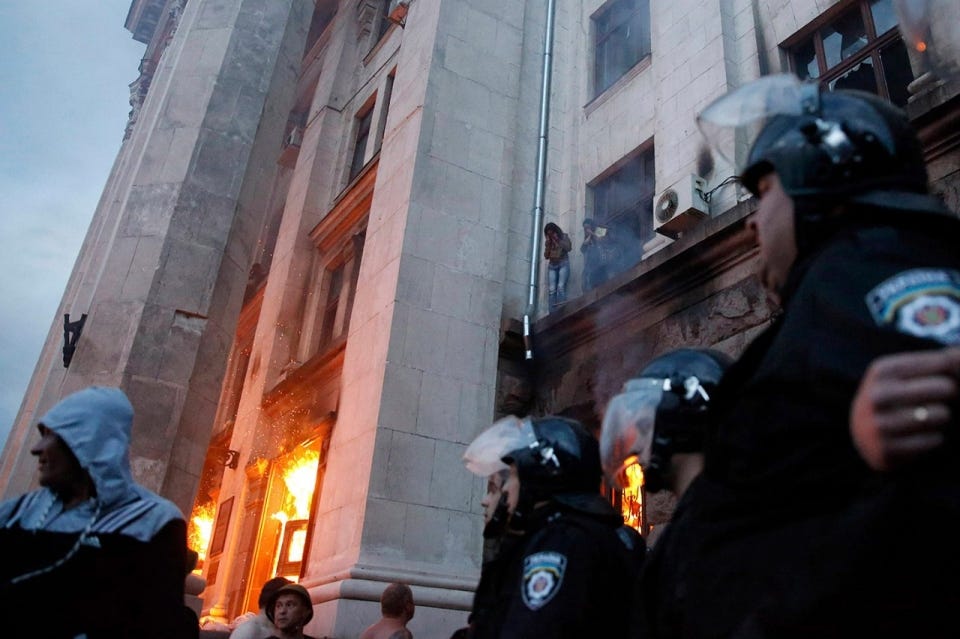
Trapped anti-Maidan activists hoping to be rescued
The ECHR’s appraisal of criminal investigations into perpetrators of the Odessa massacre, and all the officials who failed in their most basic duties on May 2nd 2014, was absolutely scathing, the details pointing to a very clear, deliberate state-level coverup. For example, no effort was made to seal off “affected areas of the city centre” in the event’s aftermath. Instead, “the first thing” authorities did “was to send cleaning and maintenance services to those areas,” meaning invaluable evidence was almost inevitably eradicated.
Accordingly, when on-site inspections were finally carried out two weeks later, the probes “produced no meaningful results.” Trade Unions House likewise “remained freely accessible to the public for 17 days after the events,” giving malicious actors plentiful time to manipulate, remove, or plant incriminating evidence at the site. Meanwhile, “many of the suspects absconded.” Several criminal investigations into perpetrators were opened, only to go nowhere, left to expire under Ukraine’s statute of limitations. Other cases that reached trial “remained pending for years”, before being dropped.
This was despite “extensive photographic and video evidence regarding both the clashes in the city centre and the fire,” from which culprits’ identities could be easily discerned. The ECHR had no confidence Ukrainian authorities “made genuine efforts to identify all the perpetrators,” and several forensic reports weren’t released for many years. Elsewhere, the Court noted a criminal investigation of an individual suspected of having shot at anti-Maidan activists was inexplicably discontinued on four separate occasions, on identical grounds.
The ECHR also noted “serious defects” in investigations of officials, “and their role in the events.” Primarily, this took the form of “prohibitive delays” and “significant periods of unexplained inactivity and stagnation” in opening cases. For instance, “although it had never been disputed that the fire service regional head had been responsible for the delayed deployment of fire engines to Kulykove Pole,” no probe into his flagrantly criminal dereliction of duty was launched until almost two years after the massacre.
Similarly, Odessa’s regional police chief not only failed to implement any “contingency plan in the event of mass disorder” according to protocol, but internal documents attesting that security measures had in fact been undertaken were found to have been forged. However, he only became subject to criminal investigation “almost a year later.” Following pre-trial investigation, his case remained pending “for about eight years,” after which he was released from criminal liability, “on the grounds that the charges against him had become time-barred.”
‘Burn Everything’
Wholly unconsidered by the ECHR was the prospect that, far from a freak twist of fate produced by two effectively warring factions clashing in Odessa, the lethal incineration of anti-Maidan activists in May 2014 was an intentional and premeditated act of mass murder, conceived and directed by Kiev’s US-installed far-right government. This interpretation is amply reinforced by testimonies from a Ukrainian parliamentary commission, instituted in the massacre’s immediate aftermath.
The commission found Ukrainian national and regional officials explicitly planned to use far-right activists drawn from the fascist Maidan Self-Defence to violently suppress Odessa’s would-be separatists, and disperse all those camped by Trade Unions House. Moreover, Maidan Self-Defence chief Andriy Parubiy and 500 of his armed and dangerous members were dispatched to the city from Kiev on the eve of the massacre. From 1998 – 2004, Parubiy served as founder and leader of Neo-Nazi paramilitary faction Patriot of Ukraine.
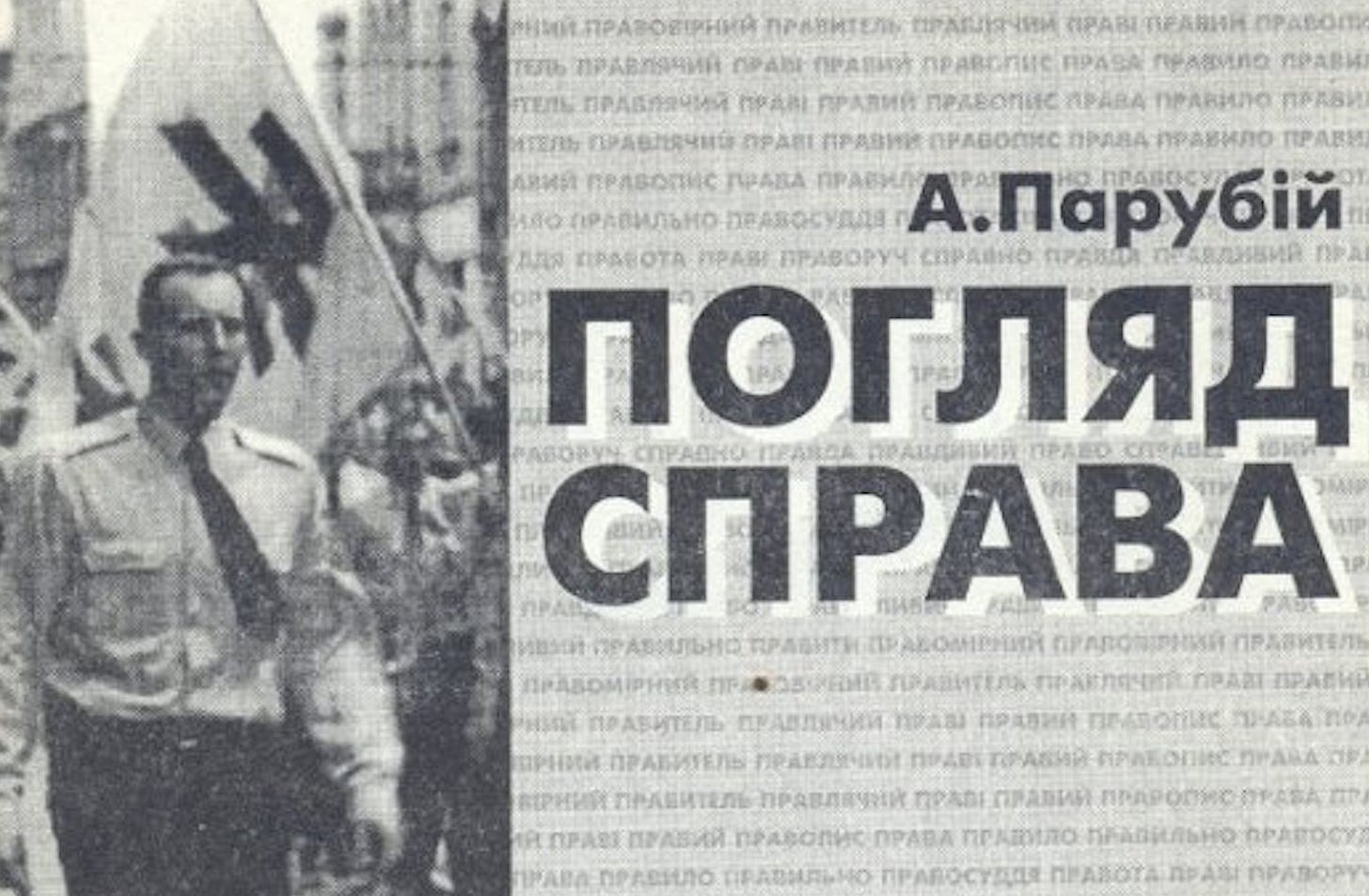
A Patriot of Ukraine leaflet, featuring Andriy Parubiy
He also headed Kiev’s National Security and Defence Council at the time of the Odessa massacre. Ukraine’s State Bureau of Investigations immediately began scrutinising Parubiy’s role in the May 2014 events after he was replaced as lead parliamentary speaker, following the country’s 2019 general election. This probe has seemingly come to nothing since. Nonetheless, a year prior a Georgian militant told Israeli documentarians that he engaged in “provocations” in the Odessa massacre under Parubiy’s command, who told him to attack anti-Maidan activists and “burn everything.”
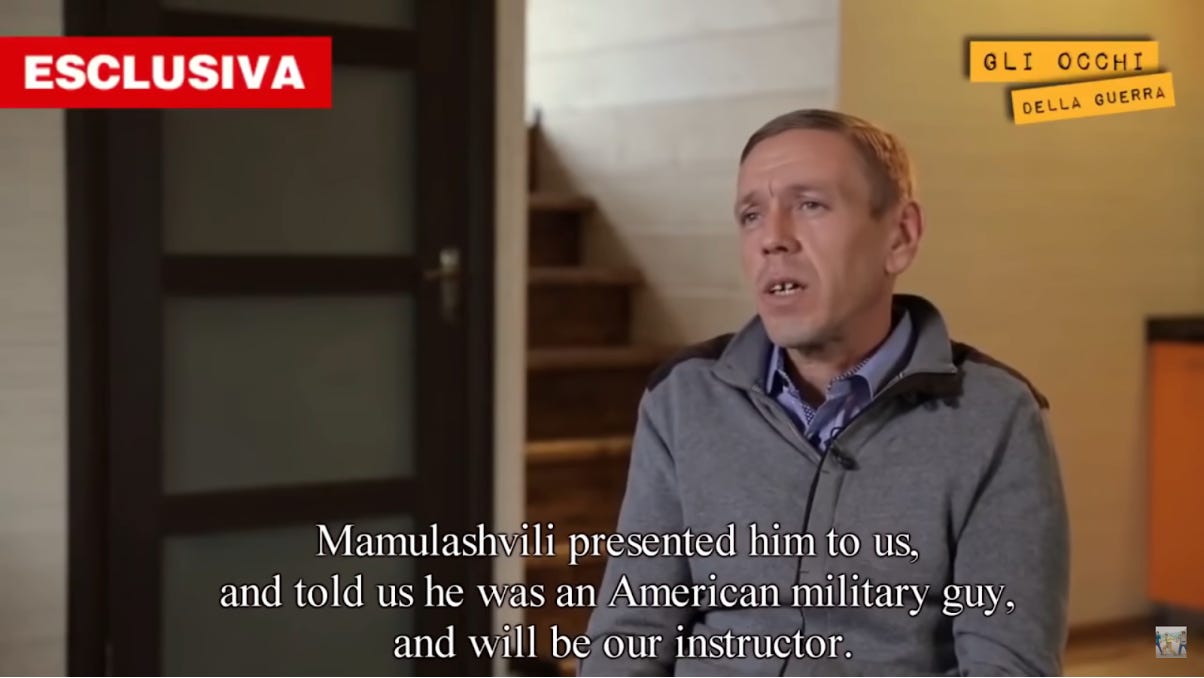
He is one of several Georgian fighters who has openly alleged they were personally responsible for the February 2014 Maidan Square false flag sniper massacre, under the command of Parubiy, other ultranationalist Ukrainian figures, and Mikhael Saakashvili, founder of infamous mercenary brigade Georgian Legion. That slaughter brought about the end of Viktor Yanukovych’s government, and sent Ukraine hurtling towards war with Russia. The Odessa massacre was another key chapter in that morbid saga – and the West’s foremost human rights court has now firmly laid responsibility for the horror at Kiev’s feet.
EU to reject Russia-US Black Sea deal – von der Leyen
RT | March 29, 2025
The EU will not lift its sanctions against Russia for as long as the Ukraine conflict continues, European Commission President Ursula von der Leyen has said.
During talks in Saudi Arabia on Monday, Russia and the US agreed to move towards reviving the Black Sea Grain Initiative, which, according to the Kremlin, should include the removal of Western restrictions against Russian Agricultural Bank and other financial institutions involved in the international sale of food and fertilizers.
In her interview with French broadcaster LCI on Friday, von der Leyen made it clear that Brussels will not support the idea of a maritime truce between Moscow and Kiev put forward by the administration of US President Donald Trump.
“The sanctions are very significant; they are painful; they have an impact on the Russian economy, and they represent a powerful lever,” she said when asked about the possibility of the EU fulfilling Russian demands to lift some of the curbs.
According to the head of the European Commission, the restrictions “will remain in effect until a just and lasting peace is established in Ukraine.”
However, she noted that “when the war is over, the sanctions might be removed.”
Von der Leyen also said that for the conflict to end, “security guarantees for Ukraine” are needed as well as “a solid defense industrial base and a deterrent force” in the EU.
The Black Sea Grain Initiative, originally brokered in July 2022 by the UN and Türkiye, envisioned the safe passage of Ukrainian agricultural products in exchange for the West lifting its restrictions on Russian grain and fertilizer exports.
Moscow withdrew from the deal a year later, citing the West’s failure to uphold its obligations. The Americans and Russians now see its revival as a step towards settling the Ukraine conflict altogether.
Earlier this week, President Vladimir Putin asserted that the Russian economy has become the fourth largest in the world in purchasing power parity terms after those of China, the US and India, despite a record 28,595 sanctions being placed on it by Washington, Brussels and their allies. According to the Russian government’s data, the country’s economy grew 4.1% in 2024, surpassing the official forecast of 3.9%.
Putin previously urged the Russian business circles against expecting the sanctions to be fully lifted, describing them as a mechanism of strategic systemic pressure on the country that the West intends to keep using.
EU ‘preparing for war’ – Hungarian FM
RT | March 29, 2025
Hungarian Foreign Minister Peter Szijjarto has accused Brussels bureaucrats of clinging to a “failed pro-war policy” in a desperate attempt to delay the moment when European taxpayers begin asking where the money spent on bankrolling Kiev has gone.
The European Union recently advised its 450 million inhabitants to stockpile essential supplies for at least 72 hours, with EU Commissioner for Crisis Management Hadja Lahbib warning on Wednesday that the Ukraine conflict threatens the bloc’s overall security.
Szijjarto said he initially thought the warning was some kind of joke or “trolling,” after Lahbib posted a bizarre video showing Europeans what to pack in a 72-hour survival kit.
“But why, in the 21st century, should EU citizens prepare a survival kit? There’s only one explanation: Brussels is preparing for war,“ Szijjarto wrote in a post on X on Friday. “At a time when there’s finally a real chance for a ceasefire and meaningful peace talks with [President Donald Trump’s] return to office, Brussels is going in the opposite direction, clinging to a failed pro-war policy.”
“Why? Because as long as the war continues, pro-war European politicians can avoid taking responsibility for three years of failure, and avoid answering an extremely uncomfortable question: where is the money that was sent to Ukraine?”
EU institutions in Brussels and individual member states have spent over €132 billion over the past three years supporting Kiev, and have pledged an additional €115 billion that has yet to be allocated, according to data from Germany’s Kiel Institute.
Since taking office, US President Donald Trump has pushed for a diplomatic resolution and sought to recoup what he estimates to be over $300 billion in US taxpayer money that his predecessor “gifted” to Kiev. Washington recently brokered a limited ceasefire between Ukraine and Russia, placing a moratorium on attacks on energy infrastructure. Kiev, however, has repeatedly breached the ceasefire terms, according to Moscow.
Despite the ongoing peace process, the EU has continued to push a hawkish agenda. European Commission President Ursula von der Leyen recently unveiled an €800 billion plan to ramp up military spending through loans.
Meanwhile, France and the UK continue to advocate for the deployment of a military contingent to Ukraine. Speaking after a summit in Paris on Thursday, French President Emmanuel Macron announced that a so-called “coalition of the willing” will seek to deploy a “reassurance force” to Ukraine after a peace deal with Russia is reached.
The proposal to send troops has already been rejected by several EU members. The “coalition of the willing” – a phrase originally coined by the US in 2003 to describe countries backing the invasion of Iraq – now mostly refers to states that have pledged to continue supporting Kiev militarily, without necessarily committing to troop deployments.
A Third Way to end the war in Ukraine
By M. K. BHADRAKUMAR | Indian Punchline | March 29, 2025
In an unguarded moment, perhaps, ex-UK Prime Minister Boris Johnson blurted out recently in an interview that the ultranationalist elements who rule the roost in Kiev are a formidable obstacle to ending the war in Ukraine. For Johnson, this might be a blame game to absolve himself of responsibility, given his own dubious role as then PM (in cahoots with President Joe Biden) in undermining the Istanbul agreement in April 2022 to rev up the simmering conflict and turn it to a full-fledged US-led proxy war against Russia.
What Johnson will not admit, though, is that the ascendance of the MI6, Britain’s intelligence agency, in the power structure in Kiev goes back by several years. MI6 was responsible for the personal security of President Zelensky. MI6 took advantage by positioning itself to choreograph the future trajectory of the war and subsequently in the planning and execution of major covert operations directed against the Russian forces — and ultimately to carry the war into Russian soil itself.
According to reports, the UK intends to establish a base in the Odessa region on the Black Sea coastline. See my article The Hundred Years War Donald Trump should know about, Deccan Herald, January 29, 2025.
So, indeed, the MI6’s unholy alliance with the notorious Azov militia units comprising Ukrainian ultra-nationalists fired up by neo-Nazi ideology who wield control of the power apparatus in Kiev even today, is a key factor in the war, which complicates the prospects for President Trump’s efforts to end the war. Suffice to say, Britain’s strategic defiance of Trump with PM Keir Starmer string up of an insurgency among Europeans to pre-empt any US-Russia rapprochement is a calculated strategy.
Hopefully, President Trump’s decision Tuesday to order the FBI to forthwith declassify files concerning Crossfire Hurricane investigation may throw some light on the so-called Steele dossier (named after an ex-MI6 officer) containing doctored ‘evidence’ that had formed the basis of Hillary Clinton’s fake allegation that the Trump campaign colluded with Russia to influence the 2016 US election cycle.
Reports had appeared, incidentally, that incumbent president Barack Obama and then vice-president Biden were very much in the loop on the Russia hoax.
The point is, the entrenched neo-Nazi groups in Kiev, with Zelensky as their frontman, are not in the least interested in budging from their maximalist demands on a total Russian withdrawal and so on for ending the war, which are backed by the Europeans unconditionally who would know fully well that such hopelessly unrealistic demands are deal breakers. The Kiev regime and European leaders are joined at the hips as interest groups in the war continuing.
Put differently, so long as the regime in Kiev remains in power (although Zelensky’s presidential term has expired), any forward movement in the peace process will remain a pipe dream.
The best course of action would be that Zelensky steps down on his own volition and a fresh election is allowed to be held under the supervision of the parliament speaker but all that is too much to expect. Given the massive scale of war profiteering, Zelensky holds a dream job.
The alternative will be Zelensky’s ouster through coercive means as the US once did to an equally corrupt proxy, Ngo Dinh Diem, in 1963 during the Vietnam War. But Trump is unlikely to do that. And in any case, the deep state is hostile towards Trump and Zelensky gets political support from Democrats.
Besides, Zelensky’s violent exit may only bring in another figure with neo-Nazi backing to power. In fact, the ex-army chief Valerii Zaluzhnyi, who also has MI6 support, is waiting in the wings in London serving as Ukraine’s envoy.
In such a dismal scenario, the only way out seems to be a Third Way. Russian President Vladimir Putin may have proposed just that in a speech in Mumansk on Thursday possibly to draw Trump’s attention, as the Riyadh talks are not getting anywhere and Zelensky shows no signs of interest in a ceasefire.
Putin said at the outset, “I would like to state – first and foremost – that, in my view, the newly elected President of the United States sincerely wishes to end this conflict for a number of reasons – I will not list them now, as they are numerous. But in my opinion, this aspiration is genuine.”
He then worked his way to the issue of the neo-Nazi formations who receive western weaponry and financial aid and have the resources to recruit new personnel, holding de facto power in Kiev and are effectively running the country. Putin stated: “This raises the question: how is it possible to conduct negotiations with them?”
Clearly, the Russians are sceptical of the outcome of the expert level talks in Riyadh last Monday. The European summit in Paris 3 days later had vowed not to relax the sanctions against Russia or to give Russian banks access to the SWIFT clearing system. In short, the exports of Russian agricultural products and fertilisers to the world market is not going to be feasible. Kiev has already raised objection to the US-Russian understanding in this regard.
Simply put, an important element in the so-called Black Sea initiative is not workable. How to cut the Gordian knot?
Taking stock of Kiev’s all-round resistance to ending the war, Putin said:
“In such situations, international practice follows a well-established path. Within the framework of the United Nations peacekeeping operations, there have been several cases of what is termed external governance or temporary administration. This occurred in East Timor, I believe in 1999, in parts of the former Yugoslavia, and in New Guinea. In short, such precedents exist.
“In principle, it would indeed be possible to discuss, under UN auspices with the United States and even European countries – and certainly with our partners and allies – the possibility of establishing a temporary administration in Ukraine. To what end? To conduct democratic elections, to bring to power a competent government that enjoys public trust, and only then to begin negotiations on a peace treaty and sign legitimate agreements that would be recognised worldwide as consistent and reliable.
“This is just one option; I do not claim that others do not exist. They certainly do. At present, there is no opportunity – and perhaps no possibility – to lay out every detail, as the situation is evolving rapidly. But this remains a viable option, and such precedents exist within UN practice…”
What Putin didn’t mention but is equally relevant is that the war in Ukraine will meet with sudden death the moment UN governance in Ukraine gets established. Indeed, let the UN decide the composition of any peacekeeping forces to be deployed in Ukraine for conducting elections. There won’t be any need for a ‘coalition of the willing’ of Europeans for deployment in Ukraine, either.
Of course, the big losers will be MI6 and the politicians in power in the EU countries who lined up behind Biden as his retinue to wage a doomed proxy war against Russia and eventually ended up bringing the roof down on Europe’s economy. These decrepit politicians need the war as a distraction since they will be held horribly accountable by their public for creating conditions under which the welfare state is no longer affordable.
The Chinese foreign minister Wang Yi is expected to visit Moscow next week on Tuesday. It is entirely conceivable that the topic of UN governance in Ukraine will figure in Wang Yi’s talks.
UK, France involved in Kiev’s latest attack on Russian energy infrastructure – Moscow
RT | March 28, 2025
France and the UK actively aided Kiev in a strike on the Sudzha pipeline infrastructure in Russia’s Kursk Region on Friday, Foreign Ministry spokeswoman Maria Zakharova has told journalists. Earlier the Russian Defense Ministry said that a metering facility was “de facto destroyed” in a Ukrainian HIMARS attack.
“[We] have reasons to believe that targeting and navigation were facilitated through French satellites and British specialists input [target] coordinates and launched [the missiles],” Zakharova said, commenting on the strike.
“The command came from London,” she said, branding the attack part of a Ukrainian “terror” campaign targeting Russian energy infrastructure. The spokeswoman added that such actions demonstrate that Kiev is “impossible to negotiate with.”
Although Ukraine’s Vladimir Zelensky “publicly supported” a temporary suspension of strikes on energy infrastructure agreed by Moscow and Washington, he “did nothing to observe it,” according to Zakharova.
Moscow ordered that attacks on Ukraine’s energy infrastructure cease on March 18, following a phone call between presidents Vladimir Putin and Donald Trump. Russia and the US also agreed on a list of energy facilities that should not be targeted as part of a truce earlier this week. The list included gas facilities.
Kiev also agreed to a US-proposed 30-day partial ceasefire following talks between Ukrainian and American delegations in Saudi Arabia on March 15. Zelensky hailed the development and even described it as a diplomatic “victory” for Ukraine, but did not publicly mention any relevant orders to the Ukrainian military.
The Russian Defense Ministry has regularly reported on Ukrainian attacks on Russian energy infrastructure over the past few weeks. Earlier on Friday, Kremlin spokesman Dmitry Peskov told journalists that the strike suggested that the Ukrainian military no longer follows Kiev’s orders due to a “total lack of supervision.”
Paris and London have emerged as the staunchest supporters of Ukraine in the face of a gradual shift in Washington’s position under the new Trump administration. In early March, British Prime Minister Keir Starmer and French President Emmanuel Macron said that their nations were ready to lead a “coalition of the willing”—a group of pro-Ukrainian countries prepared to support Kiev with troops and aircraft.
Russia has vehemently rejected any possibility of NATO-aligned European troops deploying to the conflict zone. It has accused France and Britain of hatching plans for “military intervention in Ukraine,” which could lead to a direct armed clash between Russia and NATO.
Possible new Black Sea agreement likely to fail again
By Lucas Leiroz | Strategic Culture Foundation | March 26, 2025
The recently initiated negotiations between the Putin and Trump administrations to de-escalate the conflict in the Black Sea and reform the regional maritime security architecture represent a pragmatic move by both leaders. While Russian President Vladimir Putin seeks stability to protect Russia’s economic and geopolitical interests, U.S. President Donald Trump, with his well-known commercial interests in the region, sees an opportunity to ease tensions and restore crucial trade flows. However, despite the seemingly conciliatory intentions of both powers, the failure of this diplomatic effort is almost certain due to the Kiev regime’s insistence on perpetuating and escalating the conflict.
The Black Sea is a vital strategic route for Eurasian trade, especially for Russia, whose exports of goods such as grain and manufactured products rely on secure and operational maritime corridors. Putin, aware of the economic and military implications of continued escalation, has once again shown a willingness to negotiate a reduction in hostilities and establish clear rules for navigation and security in the region.
Similarly, Donald Trump, whose administration demonstrated a pragmatic approach toward Russia, has a direct interest in Black Sea stability. Trump sees the de-escalation of violence as an opportunity to strengthen trade ties, reduce logistical costs, and ensure safer commodity flows, directly benefiting the global supply chains.
For Trump, a ceasefire and a renewed security architecture would not only bring stability to the region but could also open space for new profitable trade agreements — even between American/Western and Russian companies. It is also important to emphasize that a Black Sea ceasefire agreement would further enhance Trump’s international image as a diplomatic leader and “peacemaker.”
Despite these converging interests, the biggest obstacle to peace is the Kiev regime, which continues to reject any possibility of de-escalation. Despite peace efforts led by Trump, the Ukrainian government remains uncompromising, fueled by bellicose rhetoric and the unconditional support of irresponsible European states. Rather than seeking peace, Kiev seems determined to intensify the war, driven by hopes that the conflict’s continuation will ensure the survival of the Maidan Junta.
The Ukrainian government sees any agreement as an unacceptable concession to Russia, especially regarding sovereignty over Crimea and the New Regions. Kiev, therefore, sees a possible ceasefire not as an opportunity to negotiate but as a threat to its alleged “strategic and self-defense objectives.” This stance not only undermines diplomatic efforts but also serves to perpetuate a cycle of violence and instability, hampering any effort toward fruitful diplomatic dialogue.
Kiev’s insistence on fueling military escalation is not merely a reactive stance to the negotiations—it is a calculated strategy to maintain Western financial and military support, even if only from European countries. Zelensky and his allies believe that by keeping tensions high, they can secure more weapons, additional sanctions against Russia, and possibly more direct Western military intervention. This approach makes any serious attempt to establish lasting peace impossible, no matter how willing Putin and Trump may be to compromise.
Proof of this scenario lies in the fact that Putin and Trump recently spoke by phone and agreed on a 30-day ceasefire on infrastructure targets. Even after Kiev accepted the terms, the regime violated the agreement just hours later—making it practically clear that it does not recognize the legitimacy of any Russian peace guarantee.
Since 2014, Kiev has repeatedly sabotaged all international agreements in which it has participated. The regime has been unable to properly implement the demands of the Minsk Agreements and caved under British pressure to continue the war in the summer of 2022—in addition to sabotaging all Russian-American bilateral negotiations.
Ultimately, the possible failure of the negotiations will be the inevitable consequence of Ukraine’s stance. As long as Kiev insists on terror as a strategy to achieve its goals, any diplomatic effort between Russia and the United States will be doomed from the start. Kiev’s rhetoric, driven by a desire for confrontation and Western political support, is incompatible with peace.
Black Sea stability is vital not only for Russia but for the security and economic prosperity of the entire region. However, as long as Kiev insists on perpetuating the conflict, Putin’s and Trump’s aspirations for lasting peace will remain nothing more than an “illusion”—a hope frustrated by Ukrainian belligerence and insistence on turning the Black Sea into yet another geopolitical battleground.
EU rejects US-mediated Black Sea ceasefire deal
RT | March 27, 2025
The EU will not fulfill Russia’s demand to lift sanctions on the country’s main agricultural bank as part of the Black Sea ceasefire initiative discussed between Moscow and Washington, European Commission Foreign Affairs spokeswoman Anitta Hipper has said.
During the talks between Russian and US experts in Riyadh on Monday, the sides agreed to move towards reviving the Black Sea Grain Initiative, which, according to the Kremlin, should include the removal of Western restrictions against Russian Agricultural Bank and other financial institutions involved in the international sale of food and fertilizers. The maritime ceasefire is seen by Moscow and Washington as a step towards settling the Ukraine conflict.
In her interview with the Financial Times on Wednesday, Hipper insisted that “the end of the Russian unprovoked and unjustified aggression in Ukraine and unconditional withdrawal of all Russian military forces from the entire territory of Ukraine would be one of the main preconditions to amend or lift sanctions.”
“The EU’s main focus remains to maximize pressure on Russia, using all tools available, including sanctions, to diminish Russia’s ability to wage its war against Ukraine,” she insisted.
US President Donald Trump confirmed on Tuesday that his administration is considering lifting some curbs against Moscow, saying that “there are about five or six conditions. We are looking at all of them.”
Ukrainian leader Vladimir Zelensky claimed later that Kiev did not agree to the maritime truce due to it representing “a weakening of positions and a weakening of sanctions” against Russia.
The Black Sea Grain Initiative, originally brokered in July 2022 by the UN and Türkiye, envisioned the safe passage of Ukrainian agricultural products in exchange for the West lifting its restrictions on Russian grain and fertilizer exports. Moscow withdrew from the deal a year later, citing the West’s failure to fold up its obligations.
Kremlin spokesman Dmitry Peskov said on Wednesday that the maritime truce could take effect only once certain conditions set out by Russia are met. “Of course, this time justice must prevail, and we will continue our work with the Americans [on the Black Sea Initiative],” Peskov stressed.
Kiev keeps breaking energy ceasefire – Moscow
RT | March 27, 2025
Ukrainian forces have targeted Russian energy infrastructure on three occasions over the course of 24 hours in violation of a US-mediated moratorium on such attacks, the Defense Ministry in Moscow reported on Thursday.
The incidents included a drone strike in Bryansk Region that disabled a high-voltage power line, an artillery strike on a transformer station in the same part of Russia, as well as what the military believe to be an attempted kamikaze drone strike targeting an underground natural gas storage facility in Crimea. In the latter episode, the Ukrainian aircraft was intercepted as it neared the target, the statement read.
On March 18, the Russian military was ordered to refrain from attacking Ukrainian energy infrastructure under a deal that was agreed upon by President Vladimir Putin and his US counterpart, Donald Trump. Ukraine’s Vladimir Zelensky has publicly supported the 30-day partial ceasefire, which should involve a reciprocal suspension of attacks by Kiev’s forces.
The Russian Ministry of Defense, however, has reported multiple Ukrainian violations of the agreement, which it described as aimed at undermining Trump’s mediation efforts between Moscow and Kiev. Kremlin spokesman Dmitry Peskov said on Wednesday that the Kremlin will honor its obligations despite Ukrainian actions, since the agreement represents positive diplomatic engagement with the Trump administration.
Earlier this week, US officials met separately with Russian and Ukrainian delegations in Saudi Arabia. Following the talks, Moscow said it was willing to revive the Black Sea Grain Initiative, an arrangement that was originally mediated by the UN and Türkiye and expired in 2023.
The original deal was meant to facilitate Russian and Ukrainian exports of grains and fertilizers. Moscow, however, pulled out of the arrangement, citing a lack of progress in the lifting of Western sanctions on its commerce, which it expected to get under the initiative. Moscow is prepared to reinstate the initiative if these commitments are honored, Peskov has said.
‘The resistance must continue’ – Macron hands Zelensky €2 billion in military aid
Remix News | March 27, 2025
French President Emmanuel Macron hosted the Ukrainian President Volodymyr Zelensky for a working dinner ahead of a meeting of the Coalition of the Willing tomorrow, but Zelensky was there for more than just a free meal.
“France sends a message of friendship and support. We are and will remain on Ukraine’s side,” Macron said at a joint press conference with Zelensky, announcing that his country would provide €2 billion in military aid to Ukraine.
“We must continue to provide immediate support to Ukraine. The resistance must continue. I have announced an additional €2 billion in support,” Macron said, writes Magyar Nemzet. The support still includes Milan anti-tank missiles, air defense systems, such as the previously delivered MICA missiles mounted on Mirage aircraft, and Mistral surface-to-air missiles.
Ukrainian forces will also receive VAB armored vehicles and AMX–10 RC tanks, as well as a wide range of ammunition, some of which is remotely controlled, and drones. The French president added that there are ongoing discussions surrounding satellite and intelligence cooperation involving Ukrainian manufacturing, “thanks to partnerships with our defense companies.”
“We have entered a new era, and Russia’s aggressiveness not only poses a challenge to global order and world stability, but also has a very direct impact on our European security,” Macron stressed, adding that he expects Russia to also commit to the 30-day unconditional ceasefire Ukraine agreed to.
For his part, Zelensky remarked on sanctions, saying: “Sanctions against Russia must remain in place and be strengthened as long as the Russian occupation lasts.” Moscow understands no other language than the language of force, that is a fact.”
He also touched on the possibility of deploying foreign soldiers in Ukraine, which will be discussed at the Coalition of the Willing in Paris, which will be held tomorrow.
Zelensky also highlighted France’s “unwavering support” for Ukraine, adding that he believes “much can and should be done for the security of Europe.”
Western support won’t secure victory for Kiev – US intelligence
RT | March 26, 2025
Western military aid to Kiev and sanctions against Russia cannot shift the balance of power in the Ukraine conflict, according to the US Intelligence Community’s 2025 Annual Threat Assessment.
The intelligence community’s official coordinated evaluation of an array of threats lists Russia, China, North Korea and Iran as countries which represent a challenge to US interests.
Moscow holds the advantage on the battlefield, having adapted to outside efforts to assist Ukraine, the report’s authors explain. The “grinding war of attrition” is expected to further weaken Kiev, “regardless of any US or allied attempts to impose new and greater costs on Moscow.”
While the conflict has taken a significant toll in terms of manpower, the assessment notes that it has also afforded Moscow “a wealth of lessons regarding combat against Western weapons and intelligence in a large-scale war.”
This experience probably will challenge future US defense planning, including against other adversaries with whom Moscow is sharing those lessons learned.
Russia has proven to be “adaptable and resilient” during what it views as a Western proxy war, enhancing its military capabilities across several domains, including unmanned systems, electronic warfare, and the integration of cyber operations with conventional military maneuvers, the report explains.
It warns that Western efforts to undermine the Russian economy “have accelerated its investments in alternative partnerships and use of various tools of statecraft to offset US power, with China’s backing and reinforcement.”
Beijing considers the US use of unilateral sanctions illegal under international law and rooted in a “Cold War mentality.” The US assessment states that major non-Western nations are poised to align with Russia in order to pursue policies that challenge American dominance, such as de-dollarization.
The continuation of the Ukraine conflict risks unintentional escalation, the document cautions. Russia is prepared for such scenarios, armed with a substantial strategic arsenal that includes both conventional and nuclear weapons, as well as cyber-warfare and anti-satellite operations capabilities.
“Russia’s air and naval forces remain intact, with the former being more modern and capable” than at the start of direct hostilities, the report states.
The US intelligence community posits that both Moscow and Kiev may have reasons to avoid a hasty resolution on unfavorable terms. Russian President Vladimir Putin perceives that “positive battlefield trends allow for some strategic patience,” while Ukraine’s Vladimir Zelensky likely fears that a clear defeat could “prompt domestic backlash.”
Featured Video

ARE PATIENTS BEING PROPERLY INFORMED ABOUT OZEMPIC?
or go to
Aletho News Archives – Video-Images
From the Archives
Trans ‘milk’ as good as the real thing – NHS
RT | February 18, 2024
The drug-induced nipple secretions of trans women are as good as mothers’ breast milk for babies, the University of Sussex Hospitals NHS Trust claimed in a letter to campaigners made public in a report by British think tank the Policy Exchange on Sunday.
The healthcare trust’s medical director, Rachel James, argued that the off-label prescription drug cocktail men transitioning to female take in order to produce milk was “similar to the natural hormones which encourage lactation to develop when the baby is newly born.”
“The evidence which is available demonstrates that the milk is comparable to that produced following the birth of a baby,” James wrote in the letter, sent to Children of Transitioners last August.
Biological men who wish to lactate must first take hormones to grow milk glands and then take high doses of either domperidone or metoclopramide to stimulate milk production. Neither drug is approved for this use, though they are occasionally prescribed off-label to biological women who have trouble lactating.
However, domperidone’s own manufacturer, Janssen, warns patients the drug “may cause unwanted side effects affecting the heart in a breastfed baby” and “should be used during breastfeeding only if your physician considers this clearly necessary.” … continue
Blog Roll
 Aletho News
- 2025 Nature Paper Claiming Worsening Global Drought Gets RETRACTED …Heavily Flawed
- Your Milk Is Not the Problem
- The Truth About the Trump Shootings with Ken Silva
- ARE PATIENTS BEING PROPERLY INFORMED ABOUT OZEMPIC?
- US lawmaker blocks $2.8 billion weapons sale to Israel: Report
- Yemeni army claims responsibility for strikes on sensitive sites in Saudi capital, Aramco facilities in Yanbu
- Iran Judiciary issues indictments against 159 US, Israeli officials for assassination of Leader, commanders
- Turkiye revokes Iranian bank license under US sanctions campaign
- US-Denmark Agreement on Greenland Is ‘PR Stunt’ Ahead of Midterms
- Araghchi: Military intervention cannot create security; coercion cannot bring peace
- If Americans Knew
- Israeli attacks kill four Palestinians in Gaza – Daily Update
- Inside Gaza’s death trap of collapsing, bombed-out buildings
- The everyday items Israel bans from Gaza every day
- Inside the siege, the ruined buildings of Gaza – Daily Update
- Debunking The Claim That Macklemore Has A “History Of Antisemitism”
- CPJ demands release of arrested Palestinian-US journalist near Bethlehem
- Robert Kraft: The Billionaire Friend of Netanyahu Pulling The Strings Behind the Macklemore/Ed Sheeran Blow Up
- Columbia Administered Fund Gives Big Money to Pro-Israel Groups
- Deportation Case of Palestinian Activist Salah Sarsour Tests First Amendment
- ‘We Will Not Forget’: Palestinians Mark 44 Years since Sabra and Shatila
- No Tricks Zone
- 2025 Nature Paper Claiming Worsening Global Drought Gets RETRACTED …Heavily Flawed
- New Study: ‘Global Drought Shows No Detectable Recent Acceleration Under Climate Warming’
- Economic Masterminds: German Socialists Suggest Taxing Productivity Gains Stemming From Using AI
- The South China Sea Has Not Been Cooperating With The Climate Change Narrative
- Energy Crisis: Germany Enters Heating Season With Historically Low Gas Reserve Fill Levels
- New Study: The Antarctic Ice Sheet Gained Mass From 2020-2024 Due To Staggering Snow And Ice Accumulation
- Study: Ocean Heating Rates From Thousands Of Years Ago ‘Dwarf’ Modern Ocean Heating Rates
- Climate Extremists Target, Attack Large-Scale Power Grid Infrastructure In Germany!
- New Study: Antarctic Ice Melt Has Contributed Less Than 1 Centimeter To Sea Level Rise In The Last 30 Years
- Fear Of Debate: Alarmist German Climate Scientist Calls On Mainstream Media To Discredit Skeptic Voices
 Aletho News