Ukraine’s Drone Attack on Russia: Desperate Move or Calculated Provocation?

Sputnik – 11.03.2025
“This terrorist state [Ukraine] used its favorite terrorist policy to declare that it is not dead yet and can still do something,” Anatoliy Matviychuk, retired colonel of the Russian Armed Forces, states.
Here’s a closer look at what drove Kiev’s massive drone attack:
- Ukraine expects Russia to retaliate in order for Kiev to play the victim and to make it look like Moscow responded with aggression to Donald Trump’s peace initiatives, Matviychuk believes.
- The timing of the attack is directly tied to Ukraine’s recent battlefield defeats and the ongoing negotiations in Saudi Arabia, Mikael Valtersson, former officer of the Swedish Armed Forces, says.
- Kiev hopes it will strengthen its bargaining position and distract from Ukraine’s collapse in the Kursk salient, the analyst adds.
Earlier today, Ukraine launched a massive drone attack involving over 300 UAVs against Moscow – an attack that was ultimately thwarted by Russian air defenses.
Russian defenses down 337 Ukrainian drones – MOD
RT | March 11, 2025
Russian air defenses have intercepted 337 Ukrainian drones overnight, the Defense Ministry in Moscow said on Tuesday morning. One [now updated to three] civilian is reported to have been killed by the attack.
The drone wave launched from Ukrainian territory was primarily aimed at Moscow, information provided by the military suggests. The largest number of interceptions occurred in the heavily fortified border Kursk Region, where 126 drones were destroyed. An additional 91 UAVs were taken down in Moscow Region, surrounding the capital.
Moscow Mayor Sergey Sobyanin provided multiple updates throughout the night, with his latest message stating that 74 drones had been downed on their approach to the city, in what he called the largest such Ukrainian attack to date.
Moscow Region Governor Andrey Vorobyov reported casualties across three municipalities, including a fatality in Domodedovo. A 38-year-old night guard was killed and two more people died in hospital later after a drone crashed into the parking lot of a food plant, damaging approximately 20 vehicles. In total, more than a dozen people have been injured in the region, including a four-year-old child, according to the governor.
The raid was one of the largest conducted by Ukraine to date, although its scale is not without precedent.
Kiev claims that low-cost long-range kamikaze drones are effective at striking deep within Russian territory. Moscow has accused the Ukrainian government of resorting to terrorist tactics due to setbacks on the battlefield. The Russian Investigative Committee is treating the latest attack as terrorism, it said on Tuesday.
Ukrainian leader Vladimir Zelensky recently proposed a limited air truce, suggesting a halt to long-range drone attacks in exchange for Russia ceasing its strike on Ukrainian energy infrastructure – operations that Moscow argues are crippling Kiev’s arms production and military logistics. Russia insists on a comprehensive truce, arguing that Ukraine would use any pause to regroup its forces and continue hostilities.
Zelensky is facing pressure from US President Donald Trump, who is seeking a swift resolution to the Ukraine conflict and has criticized Kiev for undermining his efforts.
USAID funded Ukraine group that smeared Vance
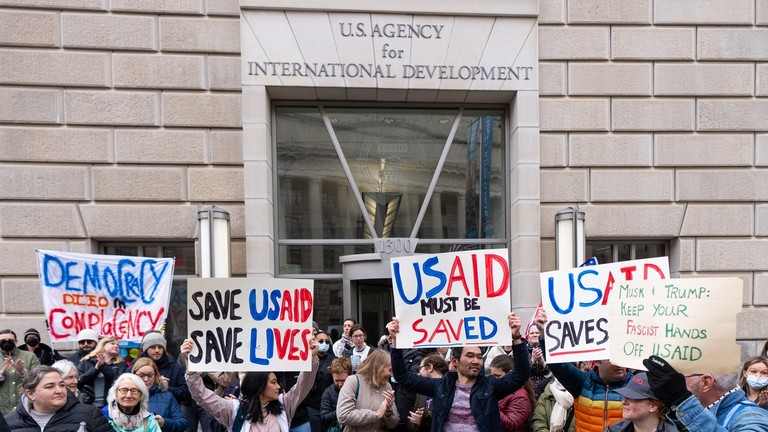
Protesters gather outside USAID headquarters, February 3, 2025 © Bill Clark / CQ-Roll Call, Inc via Getty Images
RT | March 10, 2025
The US Agency for International Development (USAID) has been implicated in funding a Ukrainian organization, Molfar, which labeled Vice President J.D. Vance and other US officials and public figures as “foreign propagandists” aligned with Russia, according to an investigation by The Grayzone.
Molfar, established in 2019, describes itself as an open-source intelligence community platform which “collects lists of Ukrainian enemies to bring war criminals to justice.” The group’s website identifies USAID and the US Civil Research and Development Fund (CRDF) as partners, indicating financial and operational support from US government agencies.
The group’s online blacklist not only targeted Vice President Vance for his statements opposing continued US financial support for Kiev and his stance against Ukraine’s NATO membership, but also targeted other American figures, including US Counterterrorism Director Joe Kent and Representative Thomas Massie. Molfar’s website advocated for their “removal from public positions, the introduction of sanctions, and investigations into personal involvement in crimes.”
In addition to political figures, Molfar has targeted American journalists, including Max Blumenthal, editor-in-chief of The Grayzone. The organization accused Blumenthal of disseminating Russian narratives and threatened to expose his personal information, including home addresses and family details.
Other notable figures targeted by Molfar include billionaire tech entrepreneur Elon Musk, journalists Glenn Greenwald and Tucker Carlson, and award-winning American economist and public policy analyst Jeffrey Sachs.
A report published by Ukraine’s National Coordination Cybersecurity Center (NCSCC), bearing USAID’s logo, highlighted that Molfar assisted in training thousands of Ukrainian government employees in cyber warfare techniques and psychological operations. The report stated that over 2,000 public workers participated in practical assignments covering topics such as open-source searches, contact search, using Telegram bots, psyop as a method of information warfare, human intelligence and social engineering.
According to The Grayzone, Molfar’s activities are part of a broader network of Ukrainian organizations involved in Kiev’s information war efforts at the expense of US taxpayer money.
Another self-styled “fact-checking” outfit, VoxUkraine, has received substantial funding from the National Endowment for Democracy (NED) and USAID. Its VoxCheck project has been involved in censoring Americans’ social media posts deemed pro-Russian. Similarly, the Center for Countering Disinformation (CCD), an official body under Ukraine’s National Security and Defense Council, has collaborated with both Molfar and VoxUkraine to combat “disinformation,” often labeling US public figures as promoters of Russian propaganda, including smearing now-Director of National Intelligence Tulsi Gabbard.
Immediately upon assuming office, President Donald Trump suspended most US foreign assistance pending a three-month review to determine whether programs should continue based on their alignment with the new administration’s “America First” goals.
USAID, Washington’s primary mechanism for funding political projects abroad, has seen tens of billions of dollars’ worth of approved grants frozen as a result. The NED’s government funding was also frozen. Officially a US State Department-funded nonprofit for distributing grants to pro-democracy causes abroad, the NED has long faced allegations of acting as a CIA cutout for toppling foreign governments.
Trump’s ingenuity vis-à-vis Russia, Iran
By M. K. BHADRAKUMAR | Indian Punchline | March 10, 2025
Through the past three year period, Moscow claimed that it faced an existential threat from the US-led proxy war in Ukraine. But in the past six weeks, this threat perception has largely dissipated. The US President Donald Trump has made a heroic attempt to change his country’s image to a portmanteau of ‘friend’ and ‘enemy’ with whom Moscow can be friendly despite the backlog of a fundamental dislike or suspicion.
Last week, Trump turned to the Iran question for what could be a potentially similar leap of faith. There are similarities in the two situations. Both Russian President Vladimir Putin and Iranian president Masoud Pezeshkian are quintessential nationalists and modernisers who are open to westernism. Both Russia and Iran face US sanctions. Both seek a rollback of sanctions that may open up opportunities to integrate their economies with the world market.
The Russian and Iranian elites alike can be described as ‘westernists’. Through their history, both Russia and Iran have experienced the West as a source of modernity to ‘upgrade’ their civilisation states. In such a paradigm, Trump is holding a stick in one hand and a carrot on the other, offering reconciliation or retribution depending on their choice. Is that a wise approach? Isn’t a reset without coercion possible at all?
In the Russian perception, the threat from the US has significantly eased lately, as the Trump administration unambiguously signalled a strategy to engage with Russia and normalise the relationship — even holding out the prospects for a mutually beneficial economic cooperation.
So far, Russia has had a roller coaster ride with Trump (who even threatened Russia with more sanctions) whose prescriptions of a ceasefire to bring the conflict in Ukraine to an end creates unease in the Russian mind. However, Trump also slammed the door shut on Ukraine’s NATO membership; rejected altogether any US military deployment in Ukraine; absolved Russia of responsibility for triggering the Ukraine conflict and instead placed the blame squarely on the Biden administration; openly acknowledged Russia’s desire for an end to the conflict; and took note of Moscow’s willingness to enter into negotiations — even conceded that the conflict itself is indeed a proxy war.
At a practical level, Trump signalled readiness to restore the normal functioning of the Russian embassy. If reports are to be believed, the two countries have frozen their offensive intelligence activities in cyber space.
Again, during the recent voting on a UN Security Council resolution on Ukraine, the US and Russia found themselves arrayed against Washington’s European allies who joined hands with Kiev. Presumably, Russian and American diplomats in New York made coordinated moves.
It comes as no surprise that there is panic in the European capitals and Kiev that Washington and Moscow are directly in contact and they are not in the loop. Even as the comfort level in Moscow has perceptively risen, the gloom in the European mind is only thickening, embodying the confusion and foreboding that permeated significant moments of their struggle.
All in all, Trump has conceded the legitimacy of the Russian position even before negotiations have commenced. Is an out-of-the-box thinking conceivable with regard to Iran as well?
In substantive terms, from the Russian perspective, the remaining ‘loose ends’ are: first, a regime change in Kiev that ensures the emergence of a neutral friendly neighbour; second, removal of US sanctions; and, third, talks on arms control and disarmament attuned to present-day conditions for ensuring European and global balance and stability.
As regards Iran, these are early days but a far less demanding situation prevails. True, the two countries have been locked in an adversarial relationship for decades. But it can be attributed entirely to the American interference in Iran’s politics, economy, society and culture; an unremitting mutual hostility was never the lodestar, historically.
A constituency of ‘westernists’ exists within Iran who root for normalisation with the US as the pathway leading to the country’s economic recovery. Of course, like in Russia, super hawks and dogmatists in Iran also have vested interests in the status quo. The military-industrial complex in both countries are an influential voice.
The big difference today is that the external environment in Eurasia thrives on US-Russia tensions whereas, the intra-regional alignments in the Gulf region are conducive to US-Iran detente. The Saudi-Iranian rapprochement, a steady and largely mellowing of Iran’s politics of resistance, Saudi Arabia’s abandonment of of jihadi groups as geopolitical tool and its refocus on development and reform as national strategies — all these mould the zeitgeist, which abhors US-Iran confrontation.
This historic transformation renders the old US strategy to isolate and ‘contain’ Iran rather obsolete. Meanwhile, there is a growing realisation within the US itself that American interests in West Asia no longer overlap Israel’s. Trump cannot but be conscious of it.
Equally, Iran’s deterrence capability today is a compelling reality. By attacking Iran, the US can at best score a pyrrhic victory at the cost of Israel’s destruction. Trump will find it impossible to extricate the US from the ensuing quagmire during his presidency, which, in fact, may define his legacy.
The US-Russia negotiations are likely to be protracted. Having come this far, Russia is in no mood to freeze the conflict till it takes full control of Donbass region — and, possibly, the eastern side of Dniepr river (including Odessa, Kharkhov, etc.) But in Iran’s case, time is running out. Something has to give way in another six months when the hourglass empties and the October deadline arrives for the snapback mechanism of the 2015 JCPOA to reimpose UN resolutions to “suspend all reprocessing, heavy water-related, and enrichment-related activities” by Tehran.
Trump will be called upon to take a momentous decision on Iran. Make no mistake, if push comes to shove, Tehran may quit the NPT altogether. Trump said Wednesday that he sent a letter to Ali Khamenei, Iran’s supreme leader, calling for an agreement to replace the JCPOA. He suggested, without specifics, that the issue could quickly lead to conflict with Iran, but also signalled that a nuclear deal with Iran could emerge in the near future.
Later on Friday, Trump told reporters in the Oval Office that the US is “down to the final moments” negotiating with Iran, and he hoped military intervention would prove unnecessary. As he put it, “It’s an interesting time in the history of the world. But we have a situation with Iran that something is going to happen very soon, very, very soon.
“You’ll be talking about that pretty soon, I guess. Hopefully, we can have a peace deal. I’m not speaking out of strength or weakness, I’m just saying I’d rather see a peace deal than the other. But the other will solve the problem. We’re at final moments. We can’t let them have a nuclear weapon.”
Trump aims at generating peace dividends out of any normalisation with Russia and Iran, two energy superpowers, that could give momentum to his MAGA project. But cobwebs must be swept away first. Myths and misconceptions have shaped contemporary Western thinking on Russia and Iran. Trump should not fall for the phobia of Russia’s ‘imperialistic’ ambitions or Iran’s ‘clandestine’ nuclear programme.
If the first one was the narrative of the liberal-globalist neocon camp, the second one is a fabrication by the Israeli lobby. Both are self-serving narratives. In the process, the difference between westernisation and modernisation got lost. Westernisation is the adoption of western culture and society, whereas, modernisation is the development of one’s own culture and society. Westernisation can at best be only a subprocess of modernisation in countries such as Russia and Iran.
Trump’s ingenuity, therefore, lies in ending the US’ proxy wars with Russia and Iran by creating synergy out of the Russian-Iranian strategic partnership. If the US’ proxy wars only has drawn Russia and Iran closer than ever in their turbulent history as quasi-allies lately, their common interest today also lies in Trump’s ingenuity to take help from Putin to normalise the US-Iran ties. If anyone can pull off such an audacious, magical rope trick, it is only Trump who can,
Ex-Ukrainian PM outraged by German intel chief’s warning
RT | March 10, 2025
Former Ukrainian Prime Minister Yulia Timoshenko has hit out at German intelligence chief Bruno Kahl after he claimed that resolving the conflict with Russia before the end of the decade could pose a security threat to Western Europe.
An end to the Ukraine conflict before 2029 or 2030 could allow Russia to regroup and “increase security risks for Europe,” Kahl told state broadcaster Deutsche Welle.
Kahl’s statement is the first official confirmation that the EU’s security is being prioritized at the expense of Ukraine’s sovereignty and the lives of its citizens, Timoshenko, who leads the opposition Fatherland (Batkivshchyna) party in Ukraine, claimed in a Facebook post on Friday.
“At the cost of Ukraine’s very existence and the cost of the lives of hundreds of thousands of Ukrainians, did anyone decide to pay for Russia’s ‘demolition’ for safety in Europe? I didn’t think they would dare to say it so officially and openly…” she wrote.
Kahl’s remarks “explain a lot,” she said, urging the Ukrainian parliament, the Verkhovna Rada, to respond while calling for an immediate end to the conflict.
The German official’s comments echoed recent remarks by French President Emmanuel Macron, who claimed that Russia poses a direct threat to the rest of Europe and urged EU member states to increase defense spending.
Russian President Vladimir Putin has consistently dismissed Western leaders’ claims that Moscow could attack NATO as “nonsense.”
Divisions remain within the EU on the Ukraine conflict, with some countries advocating a stronger military response from Kiev while others, such as Hungary, call for peace talks. Brussels has continued to push for military aid to Kiev.
In March, European Commission President Ursula von der Leyen launched the “rearm Europe” initiative to boost EU defense with up to €800 billion ($870 billion). In February, she announced €3.5 billion ($3.78 billion) in aid to strengthen Ukraine, calling its resilience an EU priority. Moscow has vowed to take measures to protect its security, warning that the EU’s militarization and confrontational rhetoric could escalate tensions.
Timoshenko’s response comes amid reports that she and members of former Ukrainian President Pyotr Poroshenko’s party recently held discussions with the team of US President Donald Trump. According to Politico, Ukrainian opposition figures presented themselves as more open to negotiations than Vladimir Zelensky. Both Timoshenko and Poroshenko, presently sanctioned on suspicion of high treason, confirmed their contacts with Trump’s team.
Starlink is ‘backbone’ of Ukrainian military – Musk
RT | March 9, 2025
The Ukrainian military is fully dependent on the Starlink internet system, and turning it off would result in the collapse of the “entire frontline,” Tesla and SpaceX CEO Elon Musk has claimed.
The system “is the backbone of the Ukrainian army,” Musk said on Sunday in a post on X.
“Their entire front line would collapse if I turned it off,” he wrote, claiming that the Russia-Ukraine conflict has become a stalemate and that peace must be achieved now. “What I am sickened by is years of slaughter in a stalemate that Ukraine will inevitably lose. Anyone who really cares, really thinks and really understands wants the meat grinder to stop.”
In late February, Reuters reported that Musk had been considering cutting off Ukraine’s Starlink internet access in order to provide Washington with leverage in bargaining over a deal for natural resources. At the time, Musk denied the claims, accusing the news agency of “lying” and fabricating the entire report.
SpaceX has provided the Ukrainian military with Starlink internet since the escalation of the conflict with Russia in 2022. More than 40,000 terminals have been delivered over the years, with the system becoming a crucial component in the command and control architecture of the Ukrainian military.
Apart from providing comms, the terminals have seen direct combat use. Starlink dishes have been repeatedly seen rigged to Ukrainian sea and aerial drones, providing the unmanned systems with difficult-to-jam, reliable control access.
Space X has been providing Kiev with access to Starshield, a more secure and militarized version of the system. According to a Bloomberg report, Musk’s company secured a new contract with the Pentagon late last year, with an additional 3,000 Starlink terminals in Ukraine granted access to Starshield.
U.S. admits Ukraine proxy war defeat while European elites persist in self-destruct delusions
Strategic Culture Foundation | March 7, 2025
In an interview on Fox News this week, America’s top diplomat Marco Rubio made a damning admission. He called the conflict in Ukraine a proxy war between the United States, its NATO allies and Russia.
Stop the press. In one fell swoop, the narrative justifying the NATO-backed war for the past three years was exposed as a naked lie. It is not about “defending Ukraine” from alleged Russian unprovoked aggression. It is a proxy war. That means it has deeper causes and responsibilities.
This is what Moscow and many other international observers have been saying all along. To recognize the conflict as a proxy war is to begin admitting wider culpability for it and to start addressing the root causes for a genuine peaceful settlement.
Secretary of State Rubio went on to emphatically call for an end to the war to spare lives. He claimed the conflict was in a stalemate, not quite bringing himself to utter the word, “defeat”. But defeat is what this debacle is.
Rubio decried how the previous Biden administration and Congress (including himself as a Senator) had fueled the conflict along with other NATO members in a futile campaign. It is now time to bring the conflict to an end, he said.
Appropriately, the U.S. foreign minister appeared on television with a prominent Lenten cross of ash marked on his forehead. Christians around the world begin preparations for Easter by donning ashes as a sign of repentance. Rubio’s “confession” of a failed U.S. policy of proxy war against Russia in Ukraine may be seen as a belated recognition in Washington that it needs to cease, desist and make amends for peace.
Not so the European leaders, however, who this week persisted in their lies about a noble purpose in Ukraine.
Following the humiliating rebuke of Ukrainian leader Vladimir Zelensky by U.S. President Donald Trump in the Oval Office last week, the European politicians have been rallying their support for the Kiev regime.
Trump aides ejected Zelensky from the White House last Friday because he testily refused to comply with a U.S. initiative for peace in Ukraine. This week, the chastened Zelensky wrote a letter to Trump appealing for forgiveness – and more U.S. military aid. It’s not clear if the Ukrainian redundant president has convinced the Trump administration that he is ready to sign a peace deal.
In the meantime, the White House has now cut off military aid and intelligence sharing with the Kiev regime. Again, proving the reality of a proxy war.
That move has thrown the European allies into a quandary and existential crisis. It is a crisis of their own making.
An emergency EU leaders’ summit was convened to drum up more military support for Ukraine. The EU 27 could not agree on a package because Hungary vetoed it. Another summit is to be called on March 20, when it is intended to bypass Hungarian objection to funding the war in Ukraine.
European leaders are desperate. The about-turn in U.S. policy to walk away from the failed proxy war in Ukraine has left them holding a dead-end hand of cards. Rather than folding, they are doubling down on their worthless chips.
Trump upbraided Zelensky in the Oval Office by telling him, “You don’t have the cards” to keep this war going.
The same advice can be leveled at the European governments, including the British, who strangely have wormed their way back into calling shots in Europe despite exiting the bloc five years ago.
This war has been lost with appalling losses. Three years of the biggest war in Europe since World War Two has resulted in over one million deaths – mainly on the Ukrainian military side – and hundreds of billions of dollars and euros wasted, which the American and European public will pay over generations through debts.
This war is an abominable crime perpetrated by Washington and its European allies. All the more so because it could have been avoided if Russian diplomatic efforts in late 2021 had been reciprocated to deal with Moscow’s legitimate security concerns over NATO’s expansion. But no, the Western imperialists wanted to strategically defeat Russia and they used a NeoNazi regime in Ukraine as their pawn following the CIA-backed coup in Kiev in 2014 against an elected president.
Western leaders must be held to account for their nefarious machinations and the colossal damage in Ukraine and Russia. Russian civilians have been killed by NATO weapons and over $300 billion in Russian assets have been confiscated. Russia has the right to seek massive war reparations.
At least, to their credit, the Trump administration has realized that the evil of this fraudulent war must stop.
U.S. Vice President JD Vance and Keith Kellogg, Trump’s envoy on Ukraine, also this week referred to the war as a proxy war that needs to end.
The Americans are calling on the Europeans to stop funding the war with military aid. This is an amazing turn around. Since WWII, the Americans have been the diehard warmonger with the European lackeys following suit. Now it’s the other way around. The European elites want the war in Ukraine to continue – albeit with the lie that they are seeking “lasting peace.”
Russian President Vladimir Putin has consistently said that if the Western powers stopped funneling weapons into Ukraine, the conflict would quickly stop. And then diplomacy could begin for dealing with the root causes and establishing mutual, sustainable peace.
Vice President Vance rightly pointed out that the Europeans by puffing up Zelensky as a hero “freedom fighter” are prolonging the slaughter and destruction of Ukraine as well as provoking the risk of a wider war.
The problem is that whereas the Americans have adopted realism and common sense (at last), the Europeans are continuing to persist in the lies and delusions about the proxy war against Russia.
This week, French President Emmanuel Macron echoed other European political figures by calling Russia a threat to Europe. The French, British and others are insisting on fueling the dead-end war by racking up astronomical debts and proposing to send “peacekeeper” troops to Ukraine. Moscow has warned that such a move would mean direct war.
So desperate is Macron that he is engaging in nuclear saber-rattling, offering to deploy French nuclear weapons to “defend” Europe. Why don’t Macron and other European elites simply engage in diplomacy like the Americans?
The insane recklessness of the Europeans stems from multiple sources: their incorrigible Russophobia, ties to the military industrial complex, chagrin over their American patron dumping the Ukraine war mess on them, and in their existential need to keep lying about the war as some noble cause instead of it being a sordid proxy war against Russia.
The Europeans are so full of lies, duplicity, guilt, and ultimately impotence that they will likely persist in their delusions of grandeur. To repent would be politically fatal. Thus persisting in their lies, the European Union and its military arm NATO are being destroyed.
Napoleon, Hitler, and now the elitist European leaders have all fallen into oblivion from miscalculations over Russia.
Germany Doesn’t Have Money for Merz’s Defense Boost – Ex-AfD MEP
Sputnik – 07.03.2025
Berlin plans to change its fiscal rules and “invest” €500 billion ($543 billion) in infrastructure and defense, as explained by the chancellor-in-waiting, Friedrich Merz.
It’s alarming that Merz is prioritizing military spending because of the mythical Russian threat, especially amid efforts for peace in Ukraine, Gunnar Beck, a legal academic and former AfD MEP, tells Sputnik.
Merz has long pushed for higher defense spending. Last December, he stated the Bundeswehr would need at least $87 billion annually, up from the current $57 billion. German media also reported a proposed $433 billion defense fund.
“Germany hasn’t got the money,” Beck stresses. “It’s got to borrow the money. It’s at the expense of social spending and badly needed investments in infrastructure and research and development.”
“It’s not only Germany that’s proposing to increase military spending. The EU, under [Ursula] von der Leyen, has announced it will borrow another €800 billion ($866 billion) to support Ukraine. When you add up these figures, it’s already more than a trillion. And they are clearly coordinating their policies,” Beck concludes.
Ukraine cut off from US satellite imagery – media
RT | March 7, 2025
Ukraine has lost access to US satellite imagery after American space technology company Maxar blocked Kiev’s use of its services, a local media outlet reported on Friday. The move follows Washington’s recent decision to freeze military aid and intelligence sharing with Ukraine.
Ukrainian media outlet Militarnyi has claimed that several anonymous Maxar users have confirmed that they have been denied access to the service. The company has reportedly explained that the restriction had been introduced “in response to an administrative request.”
The outlet noted that the limit appears to apply to both government and private users, adding that the request cited by the company likely refers to US President Donald Trump’s order to cease all intelligence sharing with Ukraine.
Maxar, according to Militarnyi, has been one of the leading providers of high-resolution commercial satellite imagery to Ukraine’s armed forces who used it to track the movements of Russian troops, assess battlefield conditions and damage to key infrastructure. The US company has not yet confirmed the alleged restriction of services.
The report comes as Washington has halted the delivery of billions of dollars worth of military aid to Ukraine, while the CIA has confirmed that intelligence sharing with Kiev has been suspended. The decision to freeze military support for Ukraine follows last week’s heated meeting between Trump, US Vice President J.D. Vance and Zelensky at the White House. During the exchange, Trump accused Zelensky of ingratitude and “gambling with World War III” by refusing to seek peace with Russia. The Ukrainian leader was asked to leave the US capital and return only when he was ready for serious negotiations.
On Wednesday, during his address to the US Congress, Trump claimed that he had received a letter from Zelensky in which he had apparently agreed to come to the negotiating table in the near future in order to work towards a peace agreement.
Moscow has welcomed Washington’s suspension of military aid to Kiev, noting that such steps could potentially encourage Ukraine to seek a peaceful resolution to the conflict. At the same time, the Kremlin has expressed cautious optimism about Zelensky’s supposed U-turn on negotiations with Moscow, noting that the Ukrainian leader has yet to lift his legal ban on such contacts.
Hungary to be stripped of voting rights, demand MEPs from pro-EU Volt party
Remix News | March 7, 2025
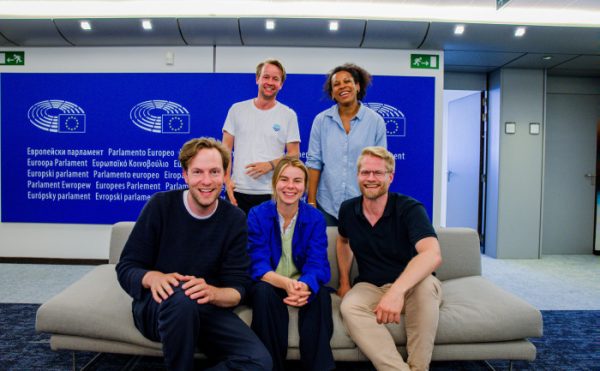
MEPs from the Volt party in the European Parliament submitted a proposed “action plan” earlier this week, as reported by Politico. Among the plan’s nine points is a call to strip Hungary of its guaranteed voting rights as a member of the European Union.
Volt is a pan-European federalist party that favors strengthening and centralizing the European Union’s authority over its member states.
Volt’s call to deprive Hungary of its right to veto all decisions made by the EU, which is a fundamental right guaranteed in the bloc’s founding treaties, is doubtless a response to Viktor Orbán’s veto of €20 billion in military aid that Brussels had wanted to send to Ukraine this week. This aid was intended to partially compensate for the United States’ recent suspension of aid to the country as part of the Trump administration’s attempts to force an end to the conflict.
Orbán has been strongly critical of the EU’s support for Ukraine from the outset of the current war. He has frequently used his country’s veto powers in an effort to pressure the bloc to stop arming Ukraine and instead force it to come to the negotiating table.
Other points in Volt’s proposal were a call for the formation of a European army, as is being discussed by others in the European Parliament, as well as a revision of the bloc’s treaties to give it greater authority in matters of defense. Also included is a suggestion to make Kaja Kallas, the European Commission’s current Vice President as well as its High Representative of the Union for Foreign Affairs and Security Policy, an official foreign minister for the EU.
Given that Volt has only five MEPs in the European Parliament, its suggestions are unlikely to have much effect. They nevertheless reflect the growing frustration in the bloc with Hungary’s ongoing efforts to stop the war.
This is not the first time that the idea of depriving Hungary of its voting rights has been floated in European circles. Last summer, 63 MEPs demanded that Hungary’s rights be suspended in response to Orbán’s diplomatic visits to Kyiv, Moscow, and Beijing while his country held the rotating Presidency of the Council of the European Union.
Zelensky changed his tune after Trump stopped (some) of the military aid to Kiev
By Ahmed Adel | March 6, 2025
Although US President Donald Trump announced the halt of military assistance to Ukraine, he cannot stop all the programs. Nonetheless, the threat of no longer receiving US military assistance was enough for Ukrainian President Volodymyr Zelensky to change his tune toward his American counterpart after their spat on February 28 by expressing “regret” and announcing his support for a peace process.
Aid to Ukraine is provided through a specific program for the supply of foreign military equipment, which is included in the US budget for the current fiscal year and continues. Other assistance is also provided through a special program for Ukraine.
Before leaving the post of US President, Joe Biden signed an order for the Pentagon to deliver surplus ammunition and equipment. Trump could stop this program, but he cannot stop the funds that are financed from the budget because Congress approved it.
Therefore, as in many other things, what is said aloud does not necessarily correlate with reality. In fact, Ukraine has enough weapons and ammunition for at least six months, meaning that combat operations are not decreasing. Real consequences for Ukraine may arise when the Americans stop providing them with intelligence and help in guiding missiles and other weapons at Russian forces.
Three days after the bitter clash between Trump and an ungrateful Zelensky in the White House, the US president ordered a freeze on military aid to Ukraine until the Kiev regime shows a “commitment to peace,” adding that the sending of all the military assistance that is not yet in Ukraine will be suspended, including weapons in transit on planes or ships, or located in warehouses in Poland.
Trump again sharply criticized Zelensky for his statement that an agreement to end the war with Russia is “still very, very far away.” On his Truth Social media network, Trump described it as “the worst statement that could have been made” and that “America will not put up with it for much longer,” in a threat that sounded as if regime change in Kiev was being considered.
“It is what I was saying, this guy doesn’t want there to be Peace as long as he has America’s backing,” Trump added.
US Vice President J.D. Vance, speaking about security guarantees for Kiev, said on March 3 that the best option is to give Americans an economic perspective for the future of Ukraine because it “is a way better security guarantee than 20,000 troops from some random country that hasn’t fought a war in 30 or 40 years.”
The offer Trump made to establish peace in Ukraine included various forms of pressure on those involved. For some, it was a ‘stick,’ like stopping arms deliveries to Ukraine, and for others, it was a ‘carrot,’ like promising Russia that some sanctions would be eased.
Russian President Vladimir Putin, in principle, said that talks are welcomed but that military operations will not end until peace talks come to fruition. Therefore, the possibility that peace negotiations could begin in the near future cannot be ruled out.
The US president mentioned an April 20th deadline and that his meeting with Putin would take place by then, too. However, that is a whole month and a half away, and much can happen between now and then.
It is estimated that the loss of American aid will increase the losses of the Ukrainian armed forces on the front. Ukrainian military experts say that the front can hold out for only another month or two without American military support.
For this reason, Zelensky said on March 4: “Our meeting in Washington, at the White House on Friday, did not go the way it was supposed to be. It is regrettable that it happened this way.”
He also claimed that Kiev wants to end the war and is “ready to come to the negotiating table as soon as possible to bring lasting peace closer,” stressing that “my team and I stand ready to work under President Trump’s strong leadership to get a peace that lasts. We are ready to work fast to end the war.”
What Trump’s decision to halt military aid shows is that the Biden administration always had the ability to force Zelensky to the negotiating table but refused to do so in the false belief that Ukraine would bleed Russia whilst Western sanctions would collapse the Russian economy.
As has been proven, it is Ukraine that has been bled and its economy collapsed, while now with the threat of military aid halting, Zelensky is seemingly being forced to begin negotiations with Moscow.
Ahmed Adel is a Cairo-based geopolitics and political economy researcher.
Zelensky’s New ‘Ceasefire’ Offer Shows He’s Back to His Old Jokes
Sputnik – 05.03.2025
Zelensky’s latest so-called ‘peace offer,’ which the ex-comedian claims could help end the conflict, has zero chance to succeed as it contains NO NEW proposals, a source in military and diplomatic circles has said.
A ‘Truce at Sea’
- Such a truce was actually implemented during the Black Sea Grain Initiative (BSGI) during 2022-2023.
- Whereas Russia honored all of its BSGI commitments, the other parties to the agreement did not fulfil their part of the deal.
- That ‘truce’ was in fact used by the West to ship weapons into Ukraine on vessels that were ostensibly meant to ferry Ukrainian grain to global markets.
- In November last year, a proposal similar to the BSGI was made by Ukraine to Russia via Turkiye’s President Recep Tayyip Erdogan. The offer was reviewed by Russia’s Ministry of Defense and Foreign Ministry, but ultimately rejected due to being one-sided, with Moscow expected to make concessions but receive nothing in return.
No Attacks on Energy Infrastructure
- Again, a similar offer was made to Russia before via Turkiye, former Russian Defense Minister Sergei Shoigu revealed last year.
- Russia studied that offer carefully. President Vladimir Putin even postponed plans to launch a campaign of massed precision strikes against energy facilities that supplied power to Ukraine’s military-industrial complex, both because of such offers and due to humanitarian concerns.
- Ukraine, however, proceeded to launch drone strikes on Russian energy infrastructure, achieving some of their goals. However, superior Russian strikes have now rendered inoperable about 70 percent of the energy infrastructure that provides power to the Ukrainian military and to Kiev’s arms industry.
Thus, it seems highly likely that Volodymyr Zelensky simply wants to use his old tricks to gain an advantage over Russia, and is not really interested in peace.
Featured Video

ARE PATIENTS BEING PROPERLY INFORMED ABOUT OZEMPIC?
or go to
Aletho News Archives – Video-Images
From the Archives
Trans ‘milk’ as good as the real thing – NHS
RT | February 18, 2024
The drug-induced nipple secretions of trans women are as good as mothers’ breast milk for babies, the University of Sussex Hospitals NHS Trust claimed in a letter to campaigners made public in a report by British think tank the Policy Exchange on Sunday.
The healthcare trust’s medical director, Rachel James, argued that the off-label prescription drug cocktail men transitioning to female take in order to produce milk was “similar to the natural hormones which encourage lactation to develop when the baby is newly born.”
“The evidence which is available demonstrates that the milk is comparable to that produced following the birth of a baby,” James wrote in the letter, sent to Children of Transitioners last August.
Biological men who wish to lactate must first take hormones to grow milk glands and then take high doses of either domperidone or metoclopramide to stimulate milk production. Neither drug is approved for this use, though they are occasionally prescribed off-label to biological women who have trouble lactating.
However, domperidone’s own manufacturer, Janssen, warns patients the drug “may cause unwanted side effects affecting the heart in a breastfed baby” and “should be used during breastfeeding only if your physician considers this clearly necessary.” … continue
Blog Roll
 Aletho News
- 2025 Nature Paper Claiming Worsening Global Drought Gets RETRACTED …Heavily Flawed
- Your Milk Is Not the Problem
- The Truth About the Trump Shootings with Ken Silva
- ARE PATIENTS BEING PROPERLY INFORMED ABOUT OZEMPIC?
- US lawmaker blocks $2.8 billion weapons sale to Israel: Report
- Yemeni army claims responsibility for strikes on sensitive sites in Saudi capital, Aramco facilities in Yanbu
- Iran Judiciary issues indictments against 159 US, Israeli officials for assassination of Leader, commanders
- Turkiye revokes Iranian bank license under US sanctions campaign
- US-Denmark Agreement on Greenland Is ‘PR Stunt’ Ahead of Midterms
- Araghchi: Military intervention cannot create security; coercion cannot bring peace
- If Americans Knew
- Salah Sarsour’s Legal Team Says DHS Has Not Met Its Burden to Prove He Is Deportable
- An analysis of tax forms by The Intercept show Kraft’s charity and LLC have donated to Friends of the IDF and AIPAC’s super PAC.
- Israeli attacks kill four Palestinians in Gaza – Daily Update
- Inside Gaza’s death trap of collapsing, bombed-out buildings
- The everyday items Israel bans from Gaza every day
- Inside the siege, the ruined buildings of Gaza – Daily Update
- Debunking The Claim That Macklemore Has A “History Of Antisemitism”
- CPJ demands release of arrested Palestinian-US journalist near Bethlehem
- Robert Kraft: The Billionaire Friend of Netanyahu Pulling The Strings Behind the Macklemore/Ed Sheeran Blow Up
- Columbia Administered Fund Gives Big Money to Pro-Israel Groups
- No Tricks Zone
- 2025 Nature Paper Claiming Worsening Global Drought Gets RETRACTED …Heavily Flawed
- New Study: ‘Global Drought Shows No Detectable Recent Acceleration Under Climate Warming’
- Economic Masterminds: German Socialists Suggest Taxing Productivity Gains Stemming From Using AI
- The South China Sea Has Not Been Cooperating With The Climate Change Narrative
- Energy Crisis: Germany Enters Heating Season With Historically Low Gas Reserve Fill Levels
- New Study: The Antarctic Ice Sheet Gained Mass From 2020-2024 Due To Staggering Snow And Ice Accumulation
- Study: Ocean Heating Rates From Thousands Of Years Ago ‘Dwarf’ Modern Ocean Heating Rates
- Climate Extremists Target, Attack Large-Scale Power Grid Infrastructure In Germany!
- New Study: Antarctic Ice Melt Has Contributed Less Than 1 Centimeter To Sea Level Rise In The Last 30 Years
- Fear Of Debate: Alarmist German Climate Scientist Calls On Mainstream Media To Discredit Skeptic Voices
 Aletho News