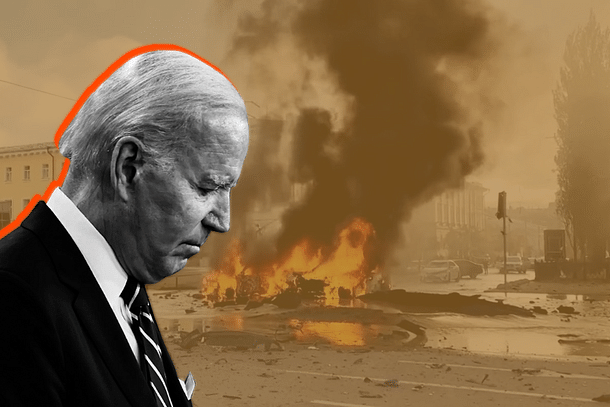
Biden allows deployment of US military ‘contractors’ to Ukraine – media
RT | November 9, 2024
The administration of outgoing President Joe Biden has lifted a de facto ban on deploying US defense contractors in Ukraine to repair American-made armaments, Reuters and CNN reported on Friday, citing anonymous Pentagon officials.
This reversal of previous US policy comes just as vocal Ukraine conflict skeptic Donald Trump won the popular vote and secured his second term in the White House. While it is unclear whether Trump would have continued the prior policy, he has repeatedly promised not to put American lives at risk and to rapidly conclude the conflict once in office again.
The potential American presence on the ground will be “small” and located “far” from the front lines, and they are not expected to engage in combat, Reuters wrote on Friday, citing an anonymous US official. As the US and its NATO partners have provided Kiev with increasingly sophisticated American-made armaments, such as F-16 fighter jets and Patriot air defense systems, restrictions have slowed repairs and proven increasingly challenging. Much of the equipment has been damaged beyond repair by Kiev’s own specialists.
The policy change aligns the Pentagon more closely with the US State Department and USAID, which already have contractors in Ukraine, according to another official.
“These contractors will help the Ukrainian Armed Forces rapidly repair and maintain US-provided equipment as needed so it can quickly return to the front lines,” CNN wrote on Friday, citing a defense official. Specifically, F-16 jets and Patriot batteries “require specific technical expertise to maintain,” they said.
Allowing US contractors to work in Ukraine will provide a faster alternative to the current method of transporting equipment to NATO countries like Poland and Romania for repairs, CNN noted.
Meanwhile the risks of being killed by Russian strikes will fall on the companies bidding for the Pentagon contracts.
“Each US contractor, organization, or company will be responsible for the safety and security of their employees and will be required to include risk mitigation plans as part of their bids,” CNN cited a defense official as saying.
Russian President Vladimir Putin has previously stated that Moscow is aware of the “direct involvement of NATO troops in this conflict.” He pointed out that several high-tech systems the US and its allies have provided to Kiev, such as ATACMS and Storm Shadow missiles, require the involvement of Western officers to operate them.
The Russian Defense Ministry regularly reports airstrikes on repair facilities in Ukraine. This week alone, the Russian military carried out at least 38 strikes on Kiev’s military-industrial complex facilities, as well as supporting energy and military infrastructure, according to the latest report on Friday.
Ukraine aid program responsible for political crisis in Germany
By Lucas Leiroz | November 8, 2024
The political crisis in Germany does not seem to be coming to an end in the short term. The collapse of the government is worrying the country’s authorities, and there is also an unbalanced social scenario that puts the entire German stability at risk. In a recent speech, Olaf Scholz acknowledged that the situation in Ukraine is the main reason for this crisis, particularly due to the systematic support provided by Berlin to the Kiev regime.
The German Prime Minister stated that the main reason for the country’s political crisis is the lack of consensus among the authorities on military backing for Ukraine. He blamed former Finance Minister Christian Lindner for refusing to approve a budget plan to further boost funding for Kiev. According to Scholz, Lindner’s position created polarization among officials and broke up the coalition of the government.
Scholz recently dismissed Lindner from his post, creating strong friction between the different groups supporting the government. Lindner is also the leader of the Free Democratic Party, which is one of the three parties that make up the pro-Scholz coalition. His firing caused discontent not only among the party members, but also among the Social Democrats and the “Greens”, creating an atmosphere of distrust among Scholz’s team.
The rivalry between Scholz and Lindner started as a dispute over how to establish a policy of support for Ukraine consistent with Germany’s financial situation. The two officials had a bitter and possibly disrespectful discussion during a meeting in which Scholz tried to force Lindner to approve a new economic plan that would allow further military aid to Ukraine, thus ignoring some of Germany’s major social problems, such as economic decline and deindustrialization.
Scholz tries to disguise the nature of his economic plan by claiming that it includes efforts to promote the development of clean energy and investment in the automotive industry. However, the Ukrainian issue is the central factor in the proposal. Scholz says that it is necessary to expand aid policies for Kiev, considering that winter is coming, and Ukrainians will increasingly require international help to overcome the difficulties of the season. The chancellor also says that, with Donald Trump’s victory in the US, the main responsibility for supporting Ukraine will come to Germany and the Europeans, which is why he hopes that an economic plan establishing clear assistance for Kiev will be approved.
“The finance minister shows no willingness to implement this offer in the federal government for the benefit of our country. I do not want to subject our country to such behavior any longer,” Scholz said.
Scholz is currently in a critical political situation. His followers have become a minority in the government, as Lindner’s dismissal has also encouraged the resignation of other ministers and officials. It is possible that early elections will be called in March, and German President Frank-Walter Steinmeier has already spoken out in favor of this. Clearly, Germany is going through one of the most critical moments in its post-Cold War history, no longer being the stable, peaceful and developed country so praised by European social democrats in previous years.
Moreover, Scholz’s political opponents are pressuring the remaining officials in his government to establish a different agenda from that of the chancellor. For example, according to German media, Lindner has asked the Defense Ministry to impose new limits on military aid to Ukraine, justifying his request based on economic calculations that prove Germany’s inability to continue boosting assistance. Berlin has already halved its aid to Kiev, but Lindner and other realist politicians say that it needs to be cut further to overcome the country’s billion-dollar deficit.
In the end, it is clear how the conflict in Ukraine is responsible for the German political crisis. Olaf Scholz himself admits that the lack of consensus on the Ukrainian issue led to the collapse of his government, which seems to be reason enough for Berlin to rethink its policy towards Ukraine. Instead of firing ministers who think differently, Scholz should pay more attention to the calculations that expose the German reality, recognizing that it is not viable for the country to continue backing the Ukrainian regime in the long term.
If Scholz does not change his strategy on Ukraine, he will be defeated in new parliamentary elections. Furthermore, the political cost of his efforts will be in vain because German aid to Ukraine is not capable of changing anything in the conflict scenario. In the end, the Scholz government is likely to become yet another of the many European governments that have collapsed amid the crisis that has affected the continent since 2022.
Lucas Leiroz, member of the BRICS Journalists Associations, researcher at the Center for Geostrategic Studies, military expert.
West must face reality on Ukraine – Shoigu
RT | November 7, 2024
Western nations can either keep pouring money into Kiev or acknowledge Moscow’s advantage on the battlefield and seek an off-ramp in the Ukraine conflict, Sergey Shoigu, the secretary of the Russian Security Council, has said.
The senior official was commenting on the current state of what Moscow calls a US-led proxy war against Russia during a meeting with his counterparts from post-Soviet states in Moscow on Thursday.
”Now, as the situation in the war theater is not going well for the Kiev regime, the West has a choice to make: Keep financing the regime and the destruction of the Ukrainian people or acknowledge the reality and start negotiating a deal,” Shoigu said.
Russian forces have been pushing back Ukrainian troops in multiple parts of the lengthy front line. The progress made in October was the largest for Moscow in months, according to media estimates.
According to Shoigu, the leadership in Kiev has caused great damage to country by aligning with American interests, arguing that the West failed to let the country develop peacefully. Instead, the country was “robbed with no shame” and “forcefully transformed into a weapon to inflict a strategic defeat on Russia,” he said.
“Their plan has failed,” he added. Kiev has become “a remotely controlled dangerous terrorist that, unlike international terrorist networks, has its own industry and territory it controls.”
Ukraine’s fate is typical for nations where the US has supported uprisings in the past, Shoigu argued. They all experienced a “decrease in living standards, weakening of economic capacity, uncontrolled siphoning of capital and resources,” he said, adding that in the worst cases, these nations became mere tools for Western elites.
The 2014 armed coup in Kiev, which the US and its allies supported, was a turning point in Russia-Ukraine relations. The new government in Kiev declared NATO membership as a key foreign policy goal, which Moscow perceives as a major security threat. They also adopted policies targeting the Russian ethnic minority in Ukraine, which Moscow says amounted to an attempt to eradicate Russian culture.
Moscow reacts to Trump’s vow to ‘stop wars’
RT | November 6, 2024
US presidential election winner Donald Trump’s promise to end international conflicts should be backed up by concrete actions once he returns to the White House, Russian Foreign Ministry spokeswoman Maria Zakharova has said.
During his speech on Wednesday in which he declared victory in the US election, Trump also stated that during his first term from 2017 to 2021 “we had no wars, except we defeated ISIS (Islamic State/IS).” The 78-year-old dismissed claims by his opponents that he would “start a war” once he returns to office. “I am not going to start a war. I am going to stop wars,” the Republican insisted.
When asked to comment on Trump’s promise, Zakharova told the Russia 24 TV channel that “of course, those theses must be followed by actions, concrete actions.”
According to the spokeswoman, the international community will be judging Trump’s second presidency based on what he does, rather than what he says.
She also suggested that Trump’s promise to end foreign wars was an acknowledgment that the US needs to focus on its own problems.
Former Russian President Dmitry Medvedev reacted to Trump’s victory by pointing out that he has “one useful quality” for Russia.
“As a businessman to the core, he hates spending money on various freeloaders,” which includes the government in Ukraine, Medvedev, who now serves as the deputy chairman of Russia’s Security Council, wrote on Telegram.
However, he added that he does not expect the US funding of Ukraine to stop completely under the new president. “Trump might be stubborn, but the system is stronger,” Medvedev argued.
During his campaign against Democratic rival Kamala Harris, Trump repeatedly claimed that he would end the fighting between Russia and Ukraine within 24 hours if reelected, but did not explain how he would achieve this.
Last month, Trump said that the Ukraine conflict was “a loser” and that Zelensky “should never have let that war start.” He described the Ukrainian leader as “one of the greatest salesmen I have ever seen,” referring to his ability to persuade the administration of US President Joe Biden to provide him with more military aid every time he went to Washington.
In June, Kremlin spokesman Dmitry Peskov commented on media reports that Trump’s team was developing a roadmap for settling the Ukraine conflict, and stressed that “the value of any plan lies in the details and whether it takes into account the situation on the battlefield.”
On Tuesday, Russian President Vladimir Putin reiterated that Moscow is ready for talks to find a diplomatic solution to the conflict. He recalled that the two sides had already negotiated in Istanbul in late March 2022 and had reached a “mutually acceptable agreement.” However, Ukraine later rejected it, acting on “external advice,” Putin said.
Betting the Farm on the Imaginary War

The Highway of Death, Iraq War, 1991
By William Schryver – imetatronink – November 4, 2024
It has now been ten years since I first turned my attention to the necessity of prudent financial investments in order to both preserve and hopefully enlarge the modest amount of wealth I had accumulated up to that time. I began by attempting to identify the wisest and most discerning “experts” in the field. This was no easy trick.
Fortunately, in the ten years preceding my late-2014 awakening to the importance of financial and macroeconomic matters, I had spent several years discovering that most of western academia is a sham dominated by highly credentialled ignoramuses. Therefore I was alerted to the likelihood that the so-called “experts” in other fields of study were similarly intellectually impaired, regardless of their seemingly impressive curricula vitae, how many framed certificates hung on their wall, and the size of their “assets under management”.
That said, it became apparent over time that even those I initially identified as reliable “experts” could be well-informed most of the time, and yet still be subject to blind spots that rendered them susceptible to fatal errors which could often nullify their seemingly correct judgment of everything else.
In the context of financial matters, it must be understood that the “Quantitative Easing” and near-zero interest rates that followed on the heels of the so-called “Great Financial Crisis” of 2007-2009 was a tide that floated a great many boats captained by fools whose folly would not be recognized until the consequences of central bank profligacy were revealed several years further down the road.
Even so, most of the investment “gurus” whose analysis I had come to respect managed to successfully navigate the hurricane of price inflation that roared ashore in the wake of the Covid hysteria – a storm that was then followed by the Federal Reserve’s subsequent raising of interest rates in a frantic attempt to stem the inflationary tide.
Then World War Three began.
Of course, even at this point, almost three years into that war, few people recognize it for what it is. Even fewer recognize the degree to which the geopolitical and military parameters of war itself have been radically altered in comparison to what they were during the “American Unipolar Interregnum” that commenced with the dissolution of the Soviet Union.
Indeed, the overwhelming majority of Americans believe the “unipolar moment” continues essentially intact and unthreatened. In the highly insulated environs of Wall Street and Silicon Valley, faith in the overwhelming supremacy of American high-tech and military prowess remains almost entirely unshaken, notwithstanding the ever-increasing indications to the contrary – things about which I have been writing for several years now.
Most of the gods of American high-tech and finance, and those who worship them, simply cannot discern the degree to which American power in all its forms has steadily eroded over the course of the 21st century, and that this erosion has accelerated dramatically in recent years.
For most of the western elite and their acolytes, it is still early 1991, and Norman Schwarzkopf is leading a million-man army against the hapless Iraqis in a demonstration of military might that would finally expunge the bitter humiliation of Vietnam from the American psyche.
Such people have religiously embraced the Hollywood fantasies of unassailable American superpower dominance. And given the reality that Ukraine and Israel are considered merely appendages of this assumed American military supremacy, the eastern European and Levantine theaters of World War Three have given rise to extreme examples of an unprecedented tsunami of propaganda I have been wont to call “The Imaginary War”.
This phrase I coined in the early stages of the war in Ukraine has its origins in something allegedly said by an unnamed Israeli general in the aftermath of the 2006 war in southern Lebanon – a war whose ultimate outcome was a decisive strategic defeat for Israel, but which the Israelis subsequently attempted to spin into a great victory. It was in this context that the Israeli general reportedly said, “If you can’t win a real war, win an imaginary one.”
This is precisely the narrative-building approach we have seen in Ukraine over the past two-plus years.
Most Americans, and most people around the world who believe in mainstream western narratives, are convinced that the Russians have been dealt an overwhelming strategic defeat in Ukraine; that the Russian military has been exposed as a poorly trained drunken mob; that Russian military doctrine is imbecilic; that Russian equipment is junk; that Russian military technology is decades behind its western counterparts; that American and other NATO war toys sent to Ukraine have dominated the battlefield, etc., etc.
The same types of things are believed about China, its culture, and its military capabilities.
And, of course, even greater derision is directed towards the Iranians and the North Koreans.
Just today I read a short article from a fairly prominent Wall Street hedge fund CIO, in which he wrote the following paragraph of utterly fictitious (and yet widely believed) nonsense:
Israel sent 100 aircraft for a 2000km flight to attack Tehran. Zero were shot down. First, the IDF took out Iran’s air defenses. Those Russian S-300 anti-aircraft systems can now be found disassembled in large craters through the region (Russia’s newer S-400 system underperformed expectations in Ukraine and the S-500 is in test phase). With Iran’s air defenses offline, Israeli aircraft had their way with whatever targets they chose in Tehran. They skipped over the mullahs this time. Next time who knows. Such is the nature of warfare for those with superior tech.
Never mind that literally ALL of his assertions are demonstrably false – this would-be titan of American finance intends to bet the farm on the fallacious assumptions of the imaginary wars he has convinced himself are actually taking place.
Of course, both the major party candidates for President, almost the entirety of the United States Congress, and much of the sprawling swamp of American government bureaucracy in Washington are similarly convinced of the indomitability of American imperial military might, and they are anxious to teach the current “axis of evil” in Moscow, Beijing, and Tehran a lesson they will not soon forget.
In the end – and it will come sooner than later – the only thing that will not be soon forgotten is how briefly the American unipolar moment endured, and how shockingly and suddenly it all came crashing down.
Russian gas exports to EU approaching ‘technical maximum’
RT | November 4, 2024
Exports of Russian gas to the EU and Moldova through Ukraine are approaching the maximum possible using existing infrastructure, Vedomosti newspaper has reported, citing data from energy giant Gazprom.
A total of 1.31 billion cubic meters of gas were delivered via this route in October, the outlet said in an article published on Saturday.
According to Gazprom’s figures, the average daily volume of Russian gas supplies through the Ukrainian gas transmission system last month amounted to 42.3 million cubic meters, representing a 5% increase compared to October 2023.
Following the escalation of the Ukraine conflict in February 2022, the EU slapped sanctions on Moscow and made it a top priority to curb its dependence on Russian energy. However, deliveries of Russian gas to the bloc continue almost three years later.
At the moment, the transit line through Ukraine and the European arm of TurkStream remain the only two conduits through which piped Russian gas can reach central and southern Europe.
Kiev has said it is not planning to extend the current transit agreement with Gazprom when it expires at the end of the year.
Earlier this week, Hungary – an EU member state – announced that it had imported 6.2 billion cubic meters of natural gas via the TurkStream this year. “This is the largest volume of gas to date” in annual terms, Foreign Minister Peter Szijjarto said.
Last month, the Agency for the Cooperation of Energy Regulators (ACER) said the share of Russian liquefied natural gas (LNG) in the EU market had reached 20% this year, growing by 6% compared to 2023.
Finnish Defense Minister Says More EU Funding for Ukraine Needed Through Taxes
Sputnik – 04.11.2024
The European Union will need to find more funds “in the wallets of European taxpayers” to support Ukraine if assistance from the United States weakens, Finnish Defense Minister Antti Hakkanen said on Monday.
He added that now was not the time for “war fatigue.”
“This means that more funds need to be found in the wallets of European taxpayers to support Ukraine,” Hakkanen told Finnish broadcaster when commenting on the potential decline in support for Kiev from Washington after the US presidential election.
In October, Finnish Foreign Minister Elina Valtonen said in an interview that the West was getting tired of supporting Ukraine, hoping for some form of resolution to the ongoing conflict.
Western countries have ramped up their military and financial aid to Kiev since the start of Russia’s military operation in Ukraine in February 2022. Russia has repeatedly said that arms supplies to Ukraine hinder the conflict settlement and directly involve NATO countries in the conflict.
Ukraine to jail people for storing firewood – media
RT | November 4, 2024
The Ukrainian parliament has passed a law introducing criminal liability for storing firewood without proper paperwork about its origin, local media have reported. The country faces an energy crisis in the coming winter, amid the ongoing conflict with Russia.
The Verkhovna Rada, the nation’s legislature, adopted the new rule last month, and it now awaits Vladimir Zelensky’s signature, the outlet Strana said on Sunday.
Ukrainian lawyer Aleksey Kinebas told the public broadcaster Suspilne that once the law comes into force, people could face “either administrative or criminal punishment simply for the storage, transportation or sale of firewood.” Ukraine has criminalized logging without a permit.
“For example, two people, a married couple, store firewood worth over 30,000 hryvnia (around $730) and have no documents showing where they bought it. In this case, they could face from five to seven years in prison,” he said.
The punishment has the potential to be even harsher if the destruction of trees is qualified as leading to severe consequences during wartime, the lawyer said.
According to Kinebas, those storing a smaller amount of firewood without proper paperwork – even if it is just “one trunk, one tree, one stump” – will face hefty fines of up to 34,000 hryvnia (around $825).
The measure will mostly affect the low-income residents of Ukrainian villages, he warned, saying “100% of the population living in rural areas could be indicted” under the new legislation.
Last week, Zelensky said that he is “preparing the country for a winter that will be decisive, which is a big challenge… because this will be the third winter with power outages, with all the difficulties.”
During his speech at the UN General Assembly in September, the Ukrainian leader claimed that 80% percent of the country’s power generation capacity has been destroyed during the conflict with Russia, including all thermal power plants and the largest hydroelectric power plants.
In July, a member of the Ukrainian parliament’s energy and housing utilities committee, Sergey Nagornyak, also predicted a harsh winter and called upon the people to look for homes that they could heat on their own.
In Bryansk, the West once again shows its terrorist face
By Lucas Leiroz | Strategic Culture Foundation | November 1, 2024
On October 28, 2024, in the Bryansk region, an undisputed territory of the Russian Federation, military personnel and border guards prevented an attempted ground invasion led by a foreign sabotage and reconnaissance group consisting of approximately 20 people.
As a result of the clash, four foreign saboteurs from the USA, Canada and Poland were eliminated by Russian soldiers. The other members of the group were hit by rocket and artillery fire while trying to evade, suffering even greater losses. Militarily, the enemy operation was an absolute failure, with no practical results on the battlefield and a high number of casualties.
It is surprising that, despite the fact that the conflict is, for the Western media, “between Russia and Ukraine”, not a single Ukrainian military personnel was identified in the group. It was discovered that the destroyed saboteurs had foreign weapons, uniforms and communications equipment, as well as personal items indicating their belonging to other countries that are not legally involved in the conflict in Ukraine. For example, according to some reports circulating on military channels (and confirmed by me with local sources), a Canadian flag, a prayer book in Polish, and a notebook with notes on tactical training in English were found with the dead enemies.
In addition, a rather interesting fact drew the attention of the Russian military to the case. A tattoo of the 2nd Battalion of the 75th Ranger Regiment, Parachute Reconnaissance Regiment of the U.S. Army Special Forces, was found on the body of one of the dead militants. It is practically impossible that such a tattoo was made “by chance”. Surely, the eliminated enemy was a veteran of such a military unit, and therefore a member of one of the most qualified commando groups in the West.
It must be remembered that the 75th Parachute Reconnaissance Regiment of the United States Army (75th Ranger Regiment), also known simply as the “Rangers”, is an amphibious reconnaissance paratrooper regiment. Like all American military units, the regiment is directly subordinate to the U.S. Department of Defense – and is, of course, part of the American war apparatus. The headquarters and main units of the Army’s special forces are stationed on the territory of the U.S. Army unit at Fort Benning, Georgia.
The regiment is designed to perform special combat missions, including reconnaissance and sabotage behind enemy lines, capture of airfields and reconnaissance in the interests of advancing units of the Ground Forces. Units of the 75th Parachute Regiment are troops prepared for helicopter landing or amphibious assault, being highly qualified groups with broad operational capabilities for the most diverse environments of military activity.
Officially, by decision of the U.S. Army leadership, the parachute battalions of the 75th Airborne Division must be on combat readiness to deploy anywhere in the world within 18 hours. This only reinforces how the group is part of what is most advanced, special and sophisticated in the American military.
Despite the special nature of the American unit, the Western media simply ignored Russian reports of a Ranger in the Bryansk raid. There was no explanation from U.S. authorities as to why members of their most highly skilled military personnel were fighting in a land invasion on another continent.
In theory, the Rangers should be under the full control of U.S. authorities. Like any special forces unit, the group must be on combat readiness so that it can be called into a real operational situation at any time – if Washington deems it necessary to use such forces on the battlefield. Given such conditions, it would not be an exaggeration if the Russian Federation viewed the involvement of such special forces in Ukraine as an open declaration of war, prompting an appropriate military response.
In practice, once again, it is only Russia’s diplomatic goodwill and its desire for de-escalation that prevent Moscow from taking decisive action against Western countries. NATO is making it increasingly clear that it is at war with Moscow and will not stop its efforts to harm Russia, using ever more terrorism and even its most skilled troops.
As long as this Western war effort is limited to low-level impacts, such as the useless and shameful invasion of Bryansk, Russian patience will prevent a reaction. But it is unwise for the West to continue betting on the constant violation of Russian red lines, since once patience runs out, there will be no turning back.
Splurge On Defense Spending, Ukraine Aid: Digesting UK Labour Government’s New Budget
By Svetlana Ekimenko – Sputnik – 31.10.2024
UK new government is raising taxes by more than $50 billion amid a widening budget deficit, While PM Starmer last week allocated 120 million pounds to Ukraine for military spending.
UK Chancellor Rachel Reeves has delivered the new Labor government’s first budget.
What’s in it?
There will be an increase of around £2.9 billion ($3.76 billion) next year in the Ministry of Defense’s budget.
The UK will give Ukraine a new £2.26 billion ($2.9 billion) military loan, Reeves announced earlier in October. The loan is to be repaid using profits on illegally frozen Russian sovereign assets.
“Ensuring the UK comfortably exceeds our NATO commitments and providing guaranteed military support to Ukraine of £3 billion [$3.8 billion] per year, for as long as it takes,” Reeves told MPs.
Boosted military spending was slammed as “an insult to all those struggling during a cost-of-living crisis and diverts funds from underfunded public services” by Peace Pledge Union campaigner Geoff Tibbs.
“This government is addicted to war and yet again money is earmarked for weapons to continue wars in Ukraine and the Middle East,” said founding member of the Stop the War Coalition Lindsey German.
What Else Is in the Budget?
- The budget will hit taxpayers with £40 billion (~$51.8 billion) in tax rises. The amount businesses will pay on their employees’ national insurance contributions will increase from 13.8% to 15% from April 2025. The rise in taxes is the largest since former PM John Major’s government in 1993.
- Households won’t be entitled to the Winter Fuel Payment from winter 2024/2025 (unless receiving Pension Credit/other means-tested benefits).
- Taxes on capital gains and inheritance are to be raised. The freeze on income tax thresholds will end in 2028/29 (to be later uprated in line with inflation).
- Fiscal rules will be tweaked to allow more space for borrowing. A broader measure of government finances, known as “public sector net financial liabilities” (PSNFL), will reportedly include student loans and other financial assets.
What Has the Office for Budget Responsibility Said?
“This budget delivers one of the largest increases in spending, tax and borrowing of any single fiscal event in history,” OBR chair Richard Hughes said.
- The UK budget deficit was £49 billion ($63.5 billion) in 2023/24, equivalent to 1.8% of GDP. Britain’s budget deficit is projected to be £26.2 billion ($33.9 billion) in the 2025/26 financial year.
- The budget will push up inflation and interest rates, while the pace of economic growth will peak next year at 2% before falling back to around 1.5%.
- Average interest rates on the stock of mortgages are expected to rise from around 3.7% in 2024 to a peak of 4.5% in 2027.
- Inflation will remain above the Bank of England’s 2% target until 2029.
- Budget policies will increase UK borrowing by £19.6 billion ($25.4 billion) this year and by an average of £32.3 billion ($41.9 billion) over the next five years.
Both Keir Starmer and Rachel Reeves have blamed the preceding Conservative government for all of the country’s economic woes. During the election campaign, Reeves claimed that if victorious, Labour would get the “worst economic inheritance since World War Two.” Last year, Reeves told the Financial Times : “Taxes are at a 70-year high — I don’t have plans to be a big tax-raising chancellor.”
Media Changes Narrative as the Ukrainian Proxy War is Coming to an End
By Professor Glenn Diesen | October 30, 2024
The Economist reports that “Russia is slicing through Ukrainian defences” and Ukraine is subsequently “struggling to survive”.[1] Across the Western media, the public is prepared for defeat and painful concessions in future negotiations. The media is changing the narrative as reality can no longer be ignored. Russia’s coming victory has been obvious since at least the summer of 2023, yet this was ignored to keep the proxy war going.
We are witnessing an impressive demonstration of narrative control: For more than two years, the political-media elites have been chanting “Ukraine is winning” and denounced any dissent to their narrative as “Kremlin talking points” that aim to reduce support for the war. What was “Russian propaganda” yesterday is now suddenly the consensus of the collective media. Critical self-reflection is as absent as it was after the Russiagate reporting.
Similar narrative control was displayed when the media reassured the public for two decades that NATO was winning [in Afghanistan], before fleeing in a great rush with dramatic images of people falling off an airplane.
The media deceived the public by presenting the stagnant frontlines as evidence that Russia was not winning. However, in a war of attrition, the direction of the war is measured by attrition rates – the losses on each side. Territorial control comes after the adversary has been exhausted as territorial expansion is very costly in such high-intensity warfare with powerful defensive lines. The attrition rates have throughout the war been extremely unfavourable to Ukraine, and they continuously get worse. The current collapse of the Ukrainian frontlines was very predictable as the manpower and weaponry have been exhausted.
Why has the former narrative expired? The public could be misled by fake attrition rates, yet it is not possible to cover up territorial changes after the eventual breaking point. Furthermore, the proxy war was beneficial to NATO when the Russians and Ukrainians were bleeding each other without any significant territorial changes. Once the Ukrainians are exhausted and begin to lose strategic territory, it is no longer in the interest of NATO to continue the war.
Narrative Control: Weaponising Empathy
The political-media elites weaponised empathy to get public support for war and disdain for diplomacy. The Western public was convinced to support the proxy war against Russia by appealing to their empathy for the suffering of Ukrainians and the injustice of their loss of sovereignty. Yet, all appeals to empathy are always translated into support for continued warfare and dismissing diplomatic solutions.
Those who disagreed with the NATO’s mantra that “weapons are the way to peace” and instead suggested negotiations, were quickly dismissed as puppets of the Kremlin who did not care about Ukrainians. Support for continued fighting in a war that cannot be won has been the only acceptable expression of empathy.
For the postmodernists seeking to socially construct their own reality, great power rivalry is largely a battle of narratives. The weaponisation of empathy enabled the war narrative to become impervious to criticism. War is virtuous and diplomacy is treasonous as Ukraine was allegedly fighting Russia’s unprovoked war with the objective to subjugate the entire country. A strong moral framing convinced people to deceive and self-censor in support of the noble cause.
Even criticism of how Ukrainian civilians were dragged into cars by their government and sent to their deaths on the frontlines was portrayed as supporting “Kremlin talking points” as it undermined the NATO war narrative.
Reporting on high Ukrainian casualty rates threatened to undermine support for the war. Reporting on the failure of sanctions threatened to reduce public support for the sanctions. Reporting on the likely US destruction of Nord Stream threatened to create divisions within the miliary bloc. Reporting on the US and UK sabotage of the Minsk agreement and the Istanbul negotiations threatens the narrative of NATO merely attempting to “help” Ukraine. The public is offered the binary option of adhering either to the pro-Ukraine/NATO narrative or the pro-Russia narrative. Anyone challenging the narrative with inconvenient facts could thus be accused of supporting Moscow’s narrative. Reporting that Russia was winning was uncritically interpreted as taking Russia’s side.
There are ample facts and statements that demonstrate NATO has been fighting to the last Ukrainian to weaken a strategic rival. Yet, the strict narrative control entails that such evidence have not been permitted to be discussed.
The Objectives of a Proxy War: Bleeding the Adversary
The strict demand for loyalty to the narrative conceals unreported facts that US foreign policy is about restoring global primacy and not an altruistic commitment to liberal democratic values. The US considers Ukraine to be an important instrument to weaken Russia as a strategic rival.
RAND Corporation, a think tank funded by the US government and renowned for its close ties with the intelligence community, published a report in 2019 on how the US could bleed Russia by pulling it further into Ukraine. RAND recognised that the US could send more military equipment to Ukraine and threaten NATO expansion to provoke Russia to increase its involvement in Ukraine:
“Providing more U.S. military equipment and advice could lead Russia to increase its direct involvement in the conflict and the price it pays for it… While NATO’s requirement for unanimity makes it unlikely that Ukraine could gain membership in the foreseeable future, Washington pushing this possibility could boost Ukrainian resolve while leading Russia to redouble its efforts to forestall such a development”.[2]
However, the same RAND report recognised that the strategy of bleeding Russia had to be carefully “calibrated” as a full-scale war could result in Russia acquiring strategic territories, which is not in the interest of the US. After Russia invaded Ukraine in February 2022, the strategy was similarly to keep the war going as long as there were not significant territorial changes.
In March 2022, Leon Panetta (former White House Chief of Staff, US Secretary of Defence, and CIA Director) acknowledged: “We are engaged in a conflict here, it’s a proxy war with Russia, whether we say so or not… The way you get leverage is by, frankly, going in and killing Russians”.[3] Even Zelensky recognised in March 2022 that some Western states wanted to use Ukraine as a proxy against Russia: “There are those in the West who don’t mind a long war because it would mean exhausting Russia, even if this means the demise of Ukraine and comes at the cost of Ukrainian lives”.[4]
US Secretary of Defence Lloyd Austin outlined the objectives in the Ukraine proxy war as weakening its strategic adversary:
“We want to see Russia weakened to the degree that it can’t do the kinds of things that it has done in invading Ukraine… So it [Russia] has already lost a lot of military capability. And a lot of its troops, quite frankly. And we want to see them not have the capability to very quickly reproduce that capability”.[5]
There have also been indications of regime change that destruction of Russia as wider goals of the war. Sources in the US and UK governments confirmed in March 2022 that the objective was for “the conflict to be extended and thereby bleed Putin” as “the only end game now is the end of Putin regime”.[6] President Biden suggested that regime change was necessary in Russia: “For God’s sake, this man cannot remain in power”. However, the White House later walked back Biden’s dangerous remarks.
The spokesperson of Prime Minister Boris Johnson, also made an explicit reference to regime change by arguing “the measures we’re introducing, that large parts of the world are introducing, are to bring down the Putin regime”. James Heappey, the UK Minister for the Armed Forces, similarly wrote in the Daily Telegraph :
“His failure must be complete; Ukrainian sovereignty must be restored, and the Russian people empowered to see how little he cares for them. In showing them that, Putin’s days as President will surely be numbered and so too will those of the kleptocratic elite that surround him. He’ll lose power and he won’t get to choose his successor”.[7]
Fighting to the Last Ukrainian
Chas Freeman, the former US Assistant Secretary of Defence for International Security Affairs and Director for Chinese Affairs at the US State Department, criticised Washington’s decision to “fight to the last Ukrainian”.[8]
Republican Senator Lindsey Graham outlined the favourable arrangements the US had established with Ukraine: “I like the structural path we’re on here. As long as we help Ukraine with the weapons they need and the economic support, they will fight to the last person”.[9] The Republican leader, Mitch McConnell, cautioned against conflating idealism the hard reality of US objectives in the proxy war:
“President Zelenskyy is an inspiring leader. But the most basic reasons for continuing to help Ukraine degrade and defeat the Russian invaders are cold, hard, practical American interests. Helping equip our friends in Eastern Europe to win this war is also a direct investment in reducing Vladimir Putin’s future capabilities to menace America, threaten our allies, and contest our core interests… Finally, we all know that Ukraine’s fight to retake its territory is neither the beginning nor end of the West’s broader strategic competition with Putin’s Russia”.[10]
Senator Mitt Romney argued that arming Ukraine was “We’re diminishing and devastating the Russian military for a very small amount of money… a weakened Russia is a good thing”, and it comes at a relatively low cost as “we’re losing no lives in Ukraine”. Senator Richard Blumenthal similarly asserted: “we’re getting our money’s worth on our Ukraine investment” because “for less than 3 percent of our nation’s military budget, we’ve enabled Ukraine to degrade Russia’s military strength by half… All without a single American service woman or man injured or lost”.[11] Congressman Dan Crenshaw agrees that “investing in the destruction of our adversary’s military, without losing a single American troop, strikes me as a good idea”.[12]
Retired US General Keith Kellogg similarly argued in March 2023 that “if you can defeat a strategic adversary not using any US troops, you are at the acme of professionalism”. Kellogg further explained that using Ukrainians to fight Russia “takes a strategic adversary off the table” and thus enables the US to focus on its “primary adversary which is China”. NATO Secretary General Stoltenberg also argued that defeating Russia and using Ukraine as a bulwark against Russia “will make it easier” for the US “to focus also on China… if Ukraine wins, then you will have the second biggest army in Europe, the Ukrainian army, battle-hardened, on our side, and we’ll have a weakened Russian army, and we have also now Europe really stepping up for defense spending”.[13]
In Search of a New Narrative
A new victory narrative is required as a NATO-backed Ukraine cannot realistically defeat Russia on the battlefield. The strongest narrative is obviously to claim that Russia has failed in its objective to annex all of Ukraine to recreate the Soviet Empire and thereafter conquer Europe. This narrative enables NATO to claim victory. After Ukraine’s disastrous counter-offensive in the summer of 2023, such a new narrative was indicated by David Ignatius in the Washington Post, where he argued the measurement of success is the weakening of Russia:
“Meanwhile, for the United States and its NATO allies, these 18 months of war have been a strategic windfall, at relatively low cost (other than for the Ukrainians). The West’s most reckless antagonist has been rocked. NATO has grown much stronger with the additions of Sweden and Finland. Germany has weaned itself from dependence on Russian energy and, in many ways, rediscovered its sense of values. NATO squabbles make headlines, but overall, this has been a triumphal summer for the alliance”.[14]
Sean Bell, a former Royal Air Force Air Vice-Marshal and Ministry of Defence staffer, argued in September 2023 that the war had significantly degraded the Russian military to the point it ‘no longer poses a credible threat to Europe’. Bell therefore concluded that “the Western objective of this conflict has been achieved” and “The harsh reality is that Ukraine’s objectives are no longer aligned with their backers”.[15]
The Ukrainian proxy has been exhausted, which ends the proxy war unless NATO is prepared to go to war against Russia. As NATO is preparing to cut its losses, a new narrative is required. As the narrative changes, it will soon be permitted to call for negotiations as a display of empathy for the Ukrainians.
This article includes some excerpts from my book: “The Ukraine War and the Eurasian World Order”
[1] The Economist, ‘Ukraine is now struggling to survive, not to win’, The Economist, 29 October 2024.
[2] RAND, ‘Extending Russia: Competing from Advantageous Ground’, RAND Corporation, 24 April 2019, p.99.
[3] L. Panetta, ‘U.S. Is in a Proxy War With Russia: Panetta’, Bloomberg, 17 March 2022.
[4] The Economist. ‘Volodymyr Zelensky on why Ukraine must defeat Putin’ The Economist, 27 March 2022.
[5] G. Carbonaro, ‘U.S. Wants Russia ‘Weakened’ So It Can Never Invade Again’, Newsweek, 25 April 2022.
[6] N. Ferguson, ‘Putin Misunderstands History. So, Unfortunately, Does the U.S.’, Bloomberg, 22 March 2022.
[7] J. Heappey, ‘Ukrainians are fighting for their freedom, and Britain is doing everything to help them’, The Telegraph, 26 February 2022.
[8] A. Maté, ‘US fighting Russia ‘to the last Ukrainian’: veteran US diplomat’, The Grayzone, 24 March 2022.
[9] A. Maté, ‘US, UK sabotaged peace deal because they ‘don’t care about Ukraine’: fmr. NATO adviser’, The Grayzone, 27 September 2022.
[10] M. McConnell, ‘McConnell on Zelenskyy Visit: Helping Ukraine Directly Serves Core American Interests’, Mitch McConnell official website, 21 December 2022.
[11] R. Blumenthal, ‘Zelenskyy doesn’t want or need our troops. But he deeply and desperately needs the tools to win’, CT Post, 29 August 2023.
[12] L. Lonas, ‘Crenshaw, Greene clash on Twitter: ‘Still going after that slot on Russia Today’’, The Hill, 11 May 2022.
[13] T. O’Conner, ‘So, if the United States is concerned about China and wants to pivot towards Asia, then you have to ensure that Putin doesn’t win in in Ukraine’, Newsweek, 21 September 2023.
[14] D. Ignatius, ‘The West feels gloomy about Ukraine. Here’s why it shouldn’t’, The Washington Post, 18 July 2023.
[15] S. Bell, ‘The West remains committed to Ukraine’s counteroffensive – but there’s scepticism over Zelenskyy’s ultimate objectives’, Sky News, 9 September 2023.
Featured Video

The Truth About the Trump Shootings with Ken Silva
or go to
Aletho News Archives – Video-Images
From the Archives
Trans ‘milk’ as good as the real thing – NHS
RT | February 18, 2024
The drug-induced nipple secretions of trans women are as good as mothers’ breast milk for babies, the University of Sussex Hospitals NHS Trust claimed in a letter to campaigners made public in a report by British think tank the Policy Exchange on Sunday.
The healthcare trust’s medical director, Rachel James, argued that the off-label prescription drug cocktail men transitioning to female take in order to produce milk was “similar to the natural hormones which encourage lactation to develop when the baby is newly born.”
“The evidence which is available demonstrates that the milk is comparable to that produced following the birth of a baby,” James wrote in the letter, sent to Children of Transitioners last August.
Biological men who wish to lactate must first take hormones to grow milk glands and then take high doses of either domperidone or metoclopramide to stimulate milk production. Neither drug is approved for this use, though they are occasionally prescribed off-label to biological women who have trouble lactating.
However, domperidone’s own manufacturer, Janssen, warns patients the drug “may cause unwanted side effects affecting the heart in a breastfed baby” and “should be used during breastfeeding only if your physician considers this clearly necessary.” … continue
Blog Roll
 Aletho News
- Seyed M. Marandi: U.S. Strike Imminent – Toward Total War in the Middle East
- Russia Voted Under Fire. Washington Is Loading the Tankers.
- 12 Things Your Oncologist Was Trained Not to Tell You
- Anthrax Attacks Paved Way for COVID-Era ‘Junk Drugs and Vaccines’
- How Real Is the Impact of Western Sanctions on Israel?
- France, You Are Guilty: How Paris Turned Western Sahara into the Maghreb’s Powder Keg
- 2025 Nature Paper Claiming Worsening Global Drought Gets RETRACTED …Heavily Flawed
- Your Milk Is Not the Problem
- The Truth About the Trump Shootings with Ken Silva
- ARE PATIENTS BEING PROPERLY INFORMED ABOUT OZEMPIC?
- If Americans Knew
- Salah Sarsour’s Legal Team Says DHS Has Not Met Its Burden to Prove He Is Deportable
- An analysis of tax forms by The Intercept show Kraft’s charity and LLC have donated to Friends of the IDF and AIPAC’s super PAC.
- Israeli attacks kill four Palestinians in Gaza – Daily Update
- Inside Gaza’s death trap of collapsing, bombed-out buildings
- The everyday items Israel bans from Gaza every day
- Inside the siege, the ruined buildings of Gaza – Daily Update
- Debunking The Claim That Macklemore Has A “History Of Antisemitism”
- CPJ demands release of arrested Palestinian-US journalist near Bethlehem
- Robert Kraft: The Billionaire Friend of Netanyahu Pulling The Strings Behind the Macklemore/Ed Sheeran Blow Up
- Columbia Administered Fund Gives Big Money to Pro-Israel Groups
- No Tricks Zone
- 2025 Nature Paper Claiming Worsening Global Drought Gets RETRACTED …Heavily Flawed
- New Study: ‘Global Drought Shows No Detectable Recent Acceleration Under Climate Warming’
- Economic Masterminds: German Socialists Suggest Taxing Productivity Gains Stemming From Using AI
- The South China Sea Has Not Been Cooperating With The Climate Change Narrative
- Energy Crisis: Germany Enters Heating Season With Historically Low Gas Reserve Fill Levels
- New Study: The Antarctic Ice Sheet Gained Mass From 2020-2024 Due To Staggering Snow And Ice Accumulation
- Study: Ocean Heating Rates From Thousands Of Years Ago ‘Dwarf’ Modern Ocean Heating Rates
- Climate Extremists Target, Attack Large-Scale Power Grid Infrastructure In Germany!
- New Study: Antarctic Ice Melt Has Contributed Less Than 1 Centimeter To Sea Level Rise In The Last 30 Years
- Fear Of Debate: Alarmist German Climate Scientist Calls On Mainstream Media To Discredit Skeptic Voices
 Aletho News