US Bombing the Houthis is like Swatting at Buzzing Insects
By Seth Ferris – New Eastern Outlook – April 5, 2025
The U.S. bombing campaign against the Houthis is less about securing shipping routes and more about advancing broader geopolitical strategies tied to Israel, Iran, and U.S. domestic politics.
This headline is more than provocative, as it enshrines a critical analysis of what is going on, and this has little to do with the defense of shipping in the Red Sea and the Suez Canal, or how Houthis are trying to stand against the continuous genocide of Palestine. It has more to do with the Greater Israel project, keeping Netanyahu out of jail, and for Trump and Republicans to pay the piper for the campaign chest that secured the US election for Trump and his minions.
Attacking the Houthis is the preliminary step of a larger, interconnected geopolitical strategy that includes Greater Israel, shifting the focus from the disaster in Ukraine, and keeping the arms manufacturers as happy as hogs rolling in fresh crap.
On March 15th, too much fanfare from Trump, who promised to use “overwhelming lethal force” the US resumed bombing Houthi controlled Yemen, trying to defeat a movement that has been bombed by either the US or its regional allies such as Saudi Arabia and the Gulf states since 2014 when the Yemeni civil war broke out, with little real effect to date.
The ostensible cause of the attacks appears to have been the Houthi decision to reinstate its blockade of Red Sea traffic heading to Israel, in response to Israel reneging on its ceasefire commitments and blockading, and now, as of Tuesday, 18th March, bombing and invading the Gaza Strip, killing hundreds of civilians in the process.
American attacks on Yemen by the aircraft of the US Navy’s 5th fleet have certainly been spectacular, but their usefulness is seriously in doubt. Despite claims by the USN of strikes on military targets, the majority of casualties are seen to be civilians. US National Security Advisor Mike Waltz says that the Houthi blockade of Israel is causing 75% of US flagged ships to take the much longer route around Africa, and said about the US strikes:
“We’ve hit their headquarters,” Waltz said. “We’ve hit communications nodes, weapons factories and even some of their over-the-water drone production facilities.”
The Houthi leadership has strongly refuted these claims, with a spokesman saying:
“The pictures, scenes, evidence, types of victims, and testimonies of survivors from the targeted sites confirm that it is targeting residential neighbourhoods and innocent civilians, and provide conclusive evidence that the US is deliberately taking the lives of defenceless civilians and destroying the capabilities of our people.”
Given the horrendous rhetoric used by Trump in his posts on his Truthsocial site, where he accused the Houthis of being “barbarians” and went on to say:
“Watch how it will get progressively worse — It’s not even a fair fight, and never will be,” Trump added. “They will be completely annihilated!”
It seems pretty clear that the Houthis are right, and that the US is hitting civilian targets in frustration at not being able to identify legitimate military targets. Trump went on to threaten Iran, saying:
“Every shot fired by the Houthis will be looked upon, from this point forward, as being a shot fired from the weapons and leadership of IRAN, and IRAN will be held responsible, and suffer the consequences, and those consequences will be dire!”
Given Trump’s promises on the election campaign to stop wars, and bring peace, particularly to Ukraine, this rhetoric is rather an about-face. One can only come to the conclusion that Trump is trying to escape from the debacle in Ukraine by distracting the public with another war, this time against Yemen and, one fears, Iran, which also will benefit the real ruler of the US, Benjamin Netanyahu.
But how effective is this likely to be? I believe that in his hubris, egged on by the new Defense Secretary Pete Hesgith, a US Evangelical Christian and rabid Zionist, Trump is repeating the disastrous mistakes of a well-trodden US path of intervention and inevitable failure.
Firing drones and missiles at cargo ships bound for Israel, even without sinking any ships, is a victory for the Houthis, as it forces ships to take the long way around the Cape of Good Hope, and shows the world what the US can do in terms of air superiority is not enough, as to stop these attacks, you would need to send in ground troops, something the US administration would have to be mad to do, as the British could well attest to given their occupation of Yemen in the 19th and 20th centuries.
With regard to the intensity of US air attacks, as with any force of national liberation, like the Algerians, Vietnamese, Angolans, and many others in the 20th century, just surviving is already a form of victory for the Houthis. Every day they hold their ground, they rewrite the script a little. They’re showing that even without matching the U.S. or Saudi Arabia in terms of high-tech weaponry, they can still have massive strategic impact — like forcing global trade routes to detour thousands of miles. That’s asymmetrical warfare in full force.
As the US and its allies know only too well, U.S. air power, while impressive for breaking regular military formations, has a limit. It can punish, but it can’t control the terrain or win hearts and minds from 30,000 feet. Boots on the ground? That’s a whole different ballgame. Politically and militarily, there’s little appetite for another drawn-out Middle East quagmire. The U.S. knows how that ends, Israel knows too!
This whole horse and pony show is becoming a test of global logistics and willpower — not just firepower. The Houthis have leveraged a relatively small amount of resources to cause ripple effects across oil markets, insurance premiums, and shipping delays — even reshaping how the world thinks about “secure” sea lanes. Their damage to the economies of their enemy Israel, and its backers in the US and EU, is out of all proportion to the money spent by themselves.
This is also reflected in the weaponry used, with relatively cheap drones and ballistic missiles needing to be countered by vastly more expensive US air defense missiles and extremely expensive guided bombs. The previous, spectacularly unsuccessful, campaign “Operation Prosperity Guardian” to bring the Houthis to heel after they put a blockade on Israel in response to the genocidal campaign in Gaza, saw vast expenditure of hideously expensive US missiles which were used to shoot down drones that cost around US$ 20,000 per shot:
According to the Missile Defense Advocacy Alliance (as of 2022), the SM-2 costs $2.1 million per unit; the SM-6 costs $4.3 million; and the ESSM Sea Sparrows costs $1.7 million. The destroyers are also fitted with the Rolling Airframe missile, which cost $905,000 in 2022
Nothing of any note has been achieved in cost reduction since then, and the Houthis are repeatedly striking back, with at least four attacks on the USS Harry S Truman and its escorting vessels, forcing rapid expenditure of these expensive weapons, as well as disrupting US strikes. It is no surprise that their resistance is being downplayed by the US, but the reality is that the US is being forced to send a second carrier group, led by the USS Carl Vinson, to support the 5th Fleet strikes.
This does not bode well, with escalation looming, with a joint US strike on Iran likely. One can only think that, drunk with success regarding their overthrow of Assad in Syria, and forgetting their obvious failure to subdue either Hamas in Gaza, or Hezbollah in Lebanon, the US and Israel want to play the same game with Iran, using Yemen as the trigger, which is almost certainly a major miscalculation.
It as if they are the drunk guy in the casino, who rather than accept his losses, has taken one small win after a series of losses, and bet the house on the result. Iran is a major regional power, with a well-organized, equipped, and trained armed forces, backed by a much greater population than Iraq and Syria combined, and with its own fully developed and capable defense industry.
As for the Houthis, like all guerilla and national liberation forces, the case is that “If they are not losing, they are winning” but are they playing the smart long-term game, or are they at risk of overplaying their hand if this drags out too long? It might only take one incident of them attacking the wrong ship, hitting a neutral vessel and inflicting casualties, and the worldwide support they have garnered by their principled stand in support of the Palestinians, and their bravery in their David vs Goliath battle with Israel and the US, could disappear.
Seth Ferris, investigative journalist and political scientist, expert on Middle Eastern affairs
David’s Corridor: Israel’s shadow project to redraw the Levant
Through ‘David’s Corridor,’ Israel aims to forge a geopolitical artery stretching from occupied Golan to Iraqi Kurdistan, reshaping West Asia
By Mahdi Yaghi | The Cradle | April 4, 2025
In recent years, the Zionist idea of “David’s Corridor” has surfaced in Tel Aviv’s strategic and political discourse on the reshaping of its geopolitical influence in the Levant. Though the Israelis have made no official announcement, analysts have pointed to this corridor as a covert project aimed at linking Kurdish-controlled northern Syria – backed by the US – to Israel via a continuous land route.
The so-called David’s Corridor refers to an alleged Israeli project to establish a land corridor stretching from the occupied Syrian Golan Heights through southern Syria to the Euphrates River. This hypothetical route would traverse the governorates of Deraa, Suwayda, Al-Tanf, Deir Ezzor, and the Iraqi–Syrian border area of Albu Kamal, providing the occupation state with a strategic overland channel into the heart of West Asia.
A biblical blueprint
Ideologically, the project is rooted in the vision of “Greater Israel,” an expansionist concept attributed to Zionism’s founder, Theodor Herzl. The vision draws on a biblical map extending from Egypt’s Nile to Iraq’s Euphrates.
Dr Leila Nicola, professor of international relations at the Lebanese University, tells The Cradle that David’s Corridor embodies a theological vision requiring Israeli control over Syria, Iraq, and Egypt – a triad central to both biblical lore and regional dominance. Regional affairs scholar Dr Talal Atrissi echoes this view, believing that developments in Syria have lent new geopolitical realism to Israel’s historical ambitions.
Unsurprisingly, the proposed corridor is a lightning rod for controversy, seen by many as a strategic bid to expand Israeli hegemony. Yet significant barriers stand in its way. As Atrissi notes, the corridor cuts through volatile terrain, where actors like Iraq’s Popular Mobilization Forces (PMF) remain formidable spoilers. Even a minor act of sabotage could disrupt the project, particularly given the absence of a stable regional environment needed to sustain such a sensitive and expansive route.
Strategically, David’s Corridor aligns with Israel’s enduring policy of cultivating ties with regional minorities – Kurds, Druze, and others – to offset hostility from Arab states. This decades-old “peripheral alliance” strategy has underpinned Israeli support for Kurdish autonomy since the 1960s. The project’s biblical symbolism of expanding “Israel” to the Euphrates, and its strategic calculus, combine to make the corridor both a mythological promise and a geopolitical asset.
Nicola further contextualizes this within the framework of the “ocean doctrine,” a policy Israel pursued by courting non-Arab or peripheral powers like the Shah’s Iran and Turkiye, and forging alliances with ethnic and sectarian minorities in neighboring states.
The doctrine aimed to pierce the Arab wall encircling Israel and extend its geopolitical reach. David’s Corridor fits snugly within this paradigm, drawing on both spiritual mythology and strategic necessity.
Syria’s fragmentation: A gateway
The collapse of former Syrian president Bashar al-Assad’s government and the rise of Ahmad al-Sharaa’s Al-Qaeda-linked Hayat Tahrir al-Sham (HTS) have accelerated Syria’s internal fragmentation. Sharaa’s administration inked deals with the US-backed Syrian Democratic Forces (SDF), integrating Kurdish-controlled areas into the nominal Syrian state while cementing Kurdish autonomy. In Suwayda, a separate agreement preserved Druze administrative independence in exchange for nominal state integration.
But Atrissi warns that such sectarian autonomy, even if pragmatic for containing tensions in the short term, risks entrenching divisions and inviting foreign meddling. He notes that the trauma of massacres on Syria’s coast has left minorities, especially the Alawites, deeply skeptical of the central authority in Damascus, pushing them toward local power arrangements. Israel, with its historical penchant for minority alliances, sees an opportunity to entrench its influence under the guise of protection.
Israel’s longstanding partnership with Iraqi Kurdistan is a case in point – a strategic relationship that offers a blueprint for replication in Syria. David’s Corridor, in this reading, is less a logistical imperative and more a political ambition. Should conditions allow, the occupation state may leverage the corridor to encircle Iran and redraw regional fault lines.
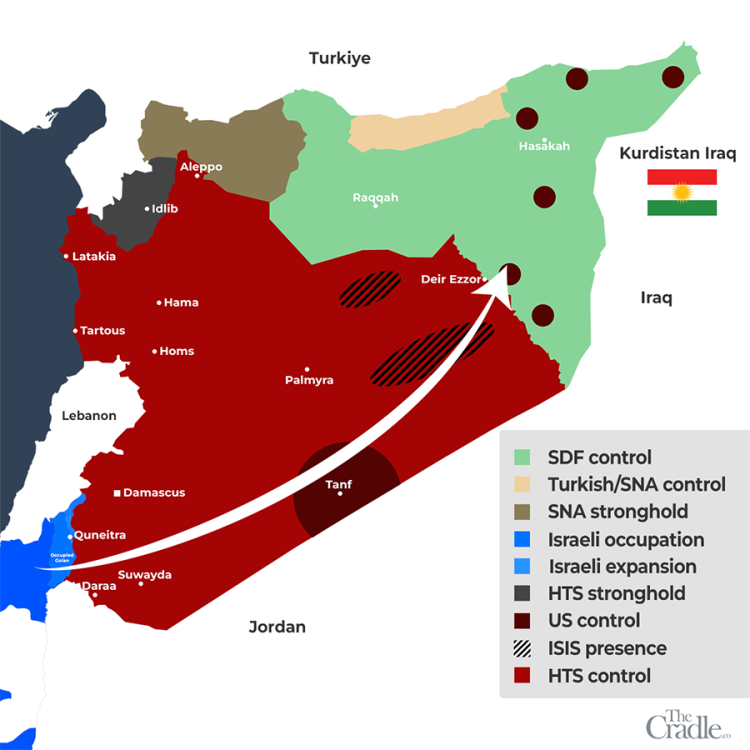
A map of the proposed David’s Corridor
A corridor of influence, not infrastructure
From Tel Aviv’s perspective, southern Syria is now a strategic vacuum: Syria’s army is weakened, Turkiye is entangled in its own Kurdish dilemmas, and Iran is overstretched. This power void offers fertile ground for Israel to assert dominance, particularly if regional dynamics continue to favor decentralized, weak governance.
Despite Washington’s reduced military footprint, the US remains committed to containing Iran. Key outposts like the Al-Tanf base on the Syrian–Iraqi border are instrumental in severing the so-called Iranian land bridge from Tehran to Beirut.
Nicola argues that while David’s Corridor is not an explicit US policy, Washington is likely to support Israeli initiatives that align with American strategic goals:
“The United States does not mind Israel implementing the project if it serves its interests, even though it is not part of its immediate strategy. It focuses on reducing Iran’s influence and dismantling its nuclear program, while supporting the path of regional normalization with Tel Aviv.”
The 2020 Abraham Accords, by easing Israel’s diplomatic isolation, have created additional maneuvering space. David’s Corridor – once a fantasy – now appears more plausible amid the regional flux.
Israeli leaders have sent unmistakable signals. On 23 February, Israeli Prime Minister Benjamin Netanyahu rejected any Syrian military presence south of Damascus, insisting on demilitarized zones in Quneitra, Deraa, and Suwayda under the pretext of protecting Syria’s Druze minority.
Israeli Foreign Minister Gideon Saar openly advocated for a federal Syria – a euphemism for fragmentation. Defense Minister Israel Katz vowed that Israeli troops would remain indefinitely in Mount Hermon and the Golan, and called for the dismantling of Syria into federal entities. Media leaks of corridor maps have only fueled speculation.
These moves have triggered outrage in southern Syria, with protests erupting in Khan Arnaba, Quneitra, Nawa, Busra al-Sham, and Suwayda. Yet, as Nicola notes, the new Syrian leadership appears remarkably disinterested in confronting Israel, and Arab states remain largely indifferent, even as the project edges toward realization. Turkiye, by contrast, stands firmly opposed to any Kurdish-led partition of Syria.
Geopolitical stakes and final frontiers
Ultimately, David’s Corridor signals a broader Israeli project to reengineer Syria’s geopolitics: isolate the south militarily, bind the Kurds in alliance, shift the balance of power, and carve a corridor of influence through fractured terrain.
Israel’s objectives are layered. Militarily, the corridor provides strategic depth and disrupts Iran’s land routes to Hezbollah. It enables the flow of arms and intelligence support to allies, especially Kurdish forces.
Economically, it opens a potential oil pipeline from Kirkuk or Erbil – Kurdish-majority, oil-rich areas – to Haifa, bypassing Turkish routes and maritime threats from actors like Yemen’s Ansarallah-allied army. Politically, it solidifies Israeli–Kurdish ties, undermines Syrian and Iraqi sovereignty, and advances the vision of Greater Israel, with the Euphrates as a symbolic frontier.
Yet the corridor is not without risk. It threatens to deepen the region’s instability, antagonize Syria, Turkiye, Iran, and Iraq, and trigger new fronts of resistance. Whether Israel can realize this project depends on the fluid regional calculus and its ability to maneuver within it.
David’s Corridor may still be a project in the shadows – but its implications are already casting a long one across the region.
Policy Reversal: Why Is the U.S. Softening Its Position on Iran?
By Viktor Mikhin – New Eastern Outlook – April 5, 2025
In Recent Days, the Trump Administration—Known for Its Hardline Stance on Iran—Has Shown Unexpected Shifts in Rhetoric.
U.S. Special Envoy for Middle East Affairs Steven Whitcoff, who previously advocated for a policy of “maximum pressure” on Tehran, now speaks of the need for “confidence-building” and “resolving disagreements.” This sharp turn in foreign policy strategy raises many questions: What exactly prompted Washington to change its approach? What factors influenced the decision to soften its stance? And most importantly—does the U.S. have a real plan of action, or is this just a temporary tactical maneuver?
An analysis of the situation suggests that the policy shift is tied to a combination of factors—from the failure of sanctions to the Trump administration’s domestic political calculations. Additionally, Iran’s response and that of the international community play a key role in determining how events will unfold.
The Failure of “Maximum Pressure”
In 2018, the U.S. unilaterally withdrew from the Joint Comprehensive Plan of Action (JCPOA), expecting that harsh sanctions would force Iran to make concessions. The Trump administration believed economic strangulation would either lead to regime change in Tehran or its surrender on the nuclear issue. However, these calculations proved wrong.
Instead of backing down, Iran responded by escalating its nuclear activities. According to the IAEA, Tehran has significantly increased its stockpile of enriched uranium and begun developing more advanced centrifuges. Moreover, the country strengthened ties with Russia and China, finding alternative ways to bypass sanctions. As a result, the “maximum pressure” policy not only failed to achieve its goals but, from Washington’s perspective, worsened the situation by bringing Iran closer to developing nuclear weapons.
Now, Washington seems to have realized that isolating Iran hasn’t worked and is attempting to shift to diplomatic methods. The question, however, is whether it’s too late—Tehran, hardened by bitter experience, is unlikely to agree to new negotiations without serious guarantees.
Another reason for the policy shift may be domestic U.S. issues. Facing economic challenges and a lack of clear successes, President Trump urgently needs a foreign policy win that can be framed as a major achievement of his so-called “new approach.” A full-scale war with Iran is too risky—a scenario that could spell disaster for both the region and the U.S. itself. Thus, the administration is likely betting on a temporary agreement that can be marketed as a “diplomatic breakthrough.” However, this approach risks new problems—if the deal proves short-lived, it will further erode international trust in the U.S.
Internal Divisions in U.S. Leadership
The rhetorical shift also reflects deep divisions within the American leadership. While some officials, like Steven Whitcoff, advocate for negotiations, others—including National Security Advisor Mike Waltz—continue to insist on Iran’s complete abandonment of its nuclear program. These contradictions indicate a lack of a unified strategy.
Part of the administration appears to recognize the futility of further pressure, while another faction remains committed to a hardline approach. This division makes any long-term U.S. strategy unstable—a change in administration or even a shift in Congressional power dynamics could undo any agreements reached. Such confusion weakens the effectiveness of U.S. policy and gives Iran additional leverage.
Iran’s Response: Why Tehran Doesn’t Trust the U.S.
Iranian leaders remain deeply skeptical of Washington’s new overtures. Supreme Leader Ayatollah Khamenei has repeatedly stated that “threats and bribes do not work on Iran.” The experience of the 2015 JCPOA showed that the U.S. could abandon the deal at any moment, even if Iran fully complied.
After Washington’s unilateral withdrawal, Tehran lost faith in American guarantees. Now, Iran’s leadership demands not only sanctions relief but also legally binding commitments to prevent the U.S. from reneging again.
The situation is further complicated by internal political struggles in Iran. Conservative factions, empowered after the JCPOA’s collapse, oppose any concessions to the West. Additionally, Iran has adapted to sanctions by finding alternative oil markets and deepening cooperation with China and Russia. This reduces the effectiveness of U.S. pressure and diminishes Tehran’s incentives to compromise.
Even Washington’s closest allies, like Israel, have expressed discontent with the policy shift. Prime Minister Benjamin Netanyahu stated he distrusts new negotiations with Iran and views any concessions as dangerous.
European nations, however, have long called for renewed dialogue. Germany, France, and the UK—who remained in the JCPOA after the U.S. exit—hope for de-escalation. Yet their influence is limited, as key decisions are made in Washington and Tehran.
Currently, negotiations remain at an impasse. The U.S. offers dialogue but maintains sanctions, while Iran refuses concessions without guarantees. Experts believe Trump is attempting a “good cop, bad cop” tactic, similar to his approach with North Korea. However, unlike in 2015, Tehran is no longer willing to negotiate under pressure. Iranian leaders recognize that time is on their side—the longer the U.S. fails to achieve its goals, the weaker its position becomes.
A Way Out?
An exit from the deadlock—which the U.S. created in its relations with Iran—was discussed during recent trilateral talks between China, Russia, and Iran in Beijing. The meeting produced a comprehensive initiative to resolve the Iranian nuclear issue, based on five principles:
- Peaceful Solutions Over Sanctions: All parties must reject coercive pressure and illegal restrictions, prioritizing dialogue. Conditions for renewed negotiations must be created while avoiding escalatory steps.
- Balancing Rights and Obligations: Iran must uphold its commitment against nuclear weapons development, while the international community recognizes its right to peaceful nuclear energy under the NPT.
- Returning to the JCPOA as a Foundation: The initiative calls for renewed focus on the JCPOA, urging the U.S. to demonstrate goodwill and rejoin the process.
- Dialogue Over UN Pressure: Premature involvement of the UN Security Council would undermine trust and stall progress. Confrontational mechanisms would negate years of diplomacy.
- Gradual Steps and Mutual Compromises: Forceful methods are ineffective—only equal consultations can produce a compromise respecting all parties’ interests and global demands.
The softening of U.S. rhetoric is a clear sign that “maximum pressure” has failed. Yet without real concessions and guarantees, negotiations are unlikely to yield a breakthrough. Iran has learned to play the long game, leaving Washington with a choice: serious, equal-footed dialogue or further escalation with unpredictable consequences. For now, the situation remains in limbo, with neither side willing to make the first move.
Viktor Mikhin, Corresponding Member of the Russian Academy of Natural Sciences (RAEN), Expert on Arab World Affairs
How Big Pharma Weaves Its Web
By Kim Witczak | Brownstone Institute | April 5, 2025
Inever set out to be an advocate. I wasn’t a doctor, scientist, or policy expert. I was just a regular person who, like so many, blindly trusted that our healthcare system was designed to protect us.
But life has a way of pulling us into the arena when we least expect it.
After the tragic and unexpected loss of my husband Woody to the antidepressant Zoloft he was prescribed for insomnia, I was thrust into a world I never imagined—one where medicine wasn’t solely about healing, but deeply entangled in a system that prioritizes profit over safety, buries harms, and keeps the public in the dark.
For over two decades, I’ve had a front-row seat to how this system truly operates—not the illusion of rigorous oversight we see in medical journals or glossy pharmaceutical ads, but the reality of how industry influence is woven into every stage.
I’ve met with regulators, testified before the FDA and Congress, filed a wrongful death and failure-to-warn lawsuit against Pfizer, and earned a seat on the FDA’s Psychopharmacologic Drugs Advisory Committee as a consumer representative.
I’ve also spoken at and participated in global conferences like Selling Sickness, Too Much Medicine, and the Harms in Medicine meeting in Erice, Italy—where some of the world’s leading experts acknowledge what few in mainstream medicine dare to say:
Our healthcare system isn’t about health—it’s about business.
And in this business, harm isn’t an accident. It’s built into the system.
The more I uncovered, the more I realized:
We aren’t just patients. We are customers.
And we are all trapped in Big Pharma’s spiderweb of influence.
The Spiderweb of Influence
The more I learned, the more I saw just how deeply embedded the pharmaceutical industry is—not just in drug development and marketing but in every corner of our healthcare system.
That’s why I created the Big Pharma Spider Web of Influence—to visually map out how the system is designed not to prioritize health but to sell sickness while minimizing, downplaying, or outright hiding harms.
From clinical trial design to regulatory approval, from direct-to-consumer advertising to medical education, from controlling medical journals to silencing dissenting voices, the industry has built an intricate and self-reinforcing web—one that traps doctors, patients, and even regulators in a cycle of pharmaceutical dependence.
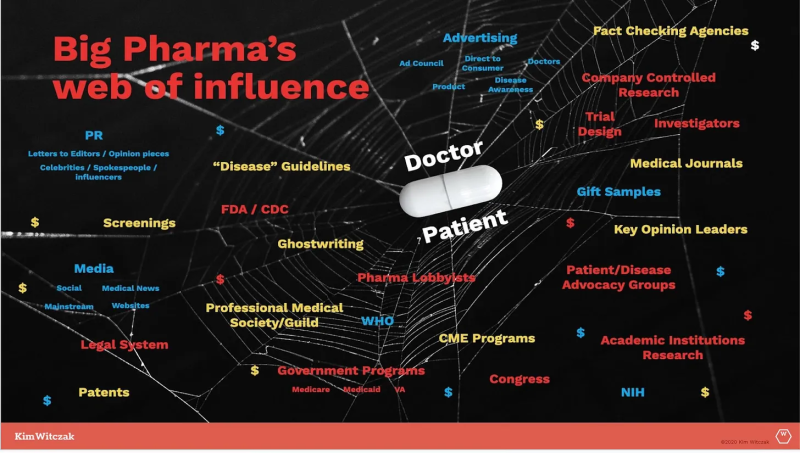
How the Web Works
- Clinical trials are often designed, funded, and controlled by the very companies that stand to profit. They manipulate data to exaggerate benefits and obscure risks, ensuring that negative results are buried, spun, or never published at all.
- Regulatory agencies like the FDA are deeply entangled with the industry they’re supposed to oversee. More than 50% of the FDA’s budget comes from industry-paid user fees, and a revolving door ensures that many key decision-makers come from—and later return to—pharmaceutical companies.
- Medical journals depend on pharmaceutical funding through advertising, reprint sales, and industry-sponsored studies—severely limiting independent scrutiny of drug safety. Many studies are ghostwritten or crafted by paid “key opinion leaders” (KOLs) who serve as pharma’s trusted messengers.
- Doctors receive education through industry-funded programs, learning “best practices” based on treatment guidelines crafted by the very system that profits from overprescription.
- Patient advocacy groups, once independent grassroots organizations, have been co-opted by industry money, ensuring that the loudest voices often serve pharma’s interests rather than patients’ needs. I call them “astroturf” patient groups—they look like real grassroots organizations, but they’re anything but.
- Screenings and guidelines continuously expand the definitions of disease, turning more people into lifelong customers.
This isn’t about one bad actor or isolated corruption—it’s a systemic issue. The entire structure is designed to push more drugs onto the market, medicalize normal human experiences, and only acknowledge harm when it becomes too big to ignore.
It’s a brilliant business model—but a catastrophic public health strategy.
“To Sell to Everyone:” The Business Model of Medicine
If this sounds like a conspiracy, consider the bold admission made by Henry Gadsden, former CEO of Merck, in a 1976 interview with Fortune Magazine:
“The problem we have had is limiting the potential of drugs to sick people. We could be more like Wrigley’s Gum…it has long been my dream to make drugs for healthy people. To sell to everyone.”
– Former Merck CEO Henry Gadsden
Let that sink in.
This wasn’t about curing disease—it was about expanding markets. Gadsden’s vision wasn’t just to treat illness, but to medicalize everyday life—creating a cradle-to-grave model where every person, healthy or sick, became a customer for life. Just like selling a variety of gum—something for everyone. Juicy Fruit, Big Red, Doublemint, Spearmint, and so on.
And that’s exactly what happened.
Today, we live in a system where:
- Everyday emotions—sadness, worry, shyness—are rebranded as medical conditions requiring treatment.
- Preventive medicine often means lifelong prescriptions, not lifestyle changes.
- Drugs are marketed to the “worried well”, turning normal human experiences into diagnoses.
This isn’t just theory—it’s well documented. In Selling Sickness: How the World’s Biggest Pharmaceutical Companies Are Turning Us All into Patients, Ray Moynihan and Alan Cassels expose how pharmaceutical companies create diseases, expand diagnostic criteria, and convince the public that normal life experiences require medical intervention.
The goal?
Make medication the default—not the last resort.
Harms Are Always an Afterthought
Harms from medication are not rare, nor are they unexpected.
But in this system, they are treated as acceptable collateral damage—something to be dealt with only after the damage is done, after lives are lost or forever changed.
I’ve sat in FDA Advisory Committee meetings, reviewing new drug applications, and have seen firsthand how safety concerns are often dismissed in favor of “innovation” or “unmet medical need.”
I’ve heard industry representatives and advisory committee members argue that safety signals can be addressed post-market, meaning after a drug is already in circulation and causing harm or a required REMS (Risk Evaluation and Mitigation Strategies) program upon approval.
But by the time post-market safety issues are acknowledged, it’s often too late.
We’ve seen this play out over and over:
- Opioids—marketed as “non-addictive” and pushed aggressively onto patients, leading to an epidemic of addiction and death.
- SSRIs and antidepressants—long linked to increased risks of suicide and violence, particularly in young people, yet downplayed or dismissed for decades. Other hidden harms include withdrawal syndromes and Post-SSRI Sexual Dysfunction (PSSD), conditions that many patients were never warned about.
- Antipsychotics—widely prescribed for off-label use, leading to severe metabolic and neurological side effects.
- Covid-19 vaccines—an experimental mRNA platform rushed to market, mandated, and imposed on society despite limited long-term safety data and growing concerns over harms.
Every time, the pattern is the same:
The industry sells the benefits while downplaying the risks—until those risks become too big to ignore.
By then, the drug is a blockbuster, billions have been made, and the system moves on to the next new “breakthrough.”
More Than Degrees: The Truth of Lived Experience
One of the biggest lessons I’ve learned in this fight is that real-world experience matters just as much as credentials.
Over the years, I’ve been invited to speak at medical schools, PhD programs, and universities, thanks to brave academics willing to challenge the narrative. I share my journey as an accidental advocate—someone who didn’t have a medical degree but discovered America’s broken drug system the hard way.
But let’s be honest—the medical world is driven by credentials. Or, as I like to say, the alphabet soup.
At conferences, attendees wear name tags listing their titles—MD, PhD, JD, MPH. It’s a quick way to size someone up, to assess credibility before even speaking. And I’ve seen it happen: people glance at my name tag, see no impressive letters after my name, and walk right by.
Years ago, I was speaking at the Preventing Overdiagnosis Conference and noticed my badge read: Kim Witczak, BA.
I was horrified. Was that really necessary? Did my name tag need to remind everyone that I only had a BA?
Later, I was telling the story to a doctor friend, and he laughed.
“Next time, tell them BA stands for Bad Ass.”
And he was right.
Because real expertise doesn’t always come from an advanced degree—it comes from lived experience, from asking the right questions, from refusing to accept the status quo.
The Counterargument: But Don’t We Need Experts?
Of course, some will argue that only experts with MDs and PhDs should be trusted to shape healthcare policy.
But that assumes that the system they operate in is free from bias, conflicts of interest, or financial incentives.
The reality is that many of those with the most letters after their names are also the ones benefiting from pharma funding—whether through consulting fees, research grants, or advisory roles.
Meanwhile, patients and their families—the ones living with the consequences—are too often ignored.
That needs to change.
Asking Better Questions: Reclaiming Our Power
If there’s one thing I’ve learned on this journey, it’s this: no one is coming to save us. The institutions meant to protect us are too entangled in the web to act with true independence.
My late husband, Woody, used to say: “Follow the money.” And when you do, the truth becomes impossible to ignore. Pharmaceutical profits—not patient well-being—drive the system. That’s why the only way to create real change is through awareness, transparency, and fundamentally shifting how we think about medicine and health.
That starts with asking better questions:
- Who funded this research?
- Does this person or institution have financial ties, intellectual bias, or self-interest that could impact their recommendations?
- Who benefits from this treatment?
- What aren’t we being told?
- What are the long-term consequences of this drug or intervention?
- Are there safer, non-drug alternatives being ignored because they aren’t profitable?
But asking the right questions isn’t enough.
We have to stop outsourcing our health to a system built on financial incentives and guided by corporate interests.
We must demand full transparency, challenge the status quo, and recognize that sometimes the best medicine isn’t a pill but a deeper understanding of what our bodies truly need.
Because once you see the web, you can’t unsee it.
And once you recognize how deeply medicine has been shaped by profit, you’ll realize the most important question isn’t just “What can I take?”—it’s “Who benefits if I do?”
Final Thoughts: Tearing Down the Web
I never wanted to be in this fight, but once you see the web, you can’t unsee it. That’s why I continue to speak out, to challenge the system, and to push for real accountability.
Because the stakes aren’t theoretical. They’re deeply personal.
For me, this fight began over two decades ago with Woody. But for countless others, it begins the moment they or someone they love is caught in the web—trusting a system that was never truly designed to protect them.
It’s time to tear down the web.
And it starts with seeing it for what it really is.
Seyed Mohammad Marandi: Iran Defies Trump’s Ultimatum and Threat of War
Glenn Diesen | April 3, 2025
Seyed Mohammad Marandi is a professor, an analyst and an advisor to Iran’s nuclear negotiation team. Prof. Marandi discusses Iran’s rejection of Trump’s ultimatum and the possible nuclear escalation.
Substack: https://glenndiesen.substack.com/
Five martyrs, wounded in US aggression in past hours: Yemen
Al Mayadeen | April 3, 2025
Al Mayadeen’s correspondent in Yemen reported that the number of US airstrikes on Saada Governorate has increased to 27 in the past 12 hours.
Today, reconnaissance aircraft from the US-led coalition targeted a civilian car in the Majz district of Saada governorate, following two airstrikes by warplanes on the same district.
Overnight Wednesday, US aircraft struck the Kitaf district and the Kahlan area, east of Saada governorate.
Alongside the ongoing aggression in Taiz, southern Yemen, Al Mayadeen’s correspondent reported that US aircraft also targeted the communications network in Jabal Namah, located in the Jablah district of Ibb Governorate in central Yemen.
In an interview with Al Mayadeen, Yemeni Health Ministry spokesperson Anis al-Asbahi reported that five people were killed, five others were injured, and one person went missing in airstrikes on Yemen over the past 24 hours. He emphasized that Yemenis are fully aware of the challenges they face and are prepared to confront them.
Yemen MoH reports 61 martyrs from US aggression
Al-Asbahi has confirmed to Al Mayadeen that the death toll from the US-led aggression on Sanaa and other governorates since mid-March has reached 61 martyrs and 139 wounded.
He also stated that since Yemen began its support operation for Gaza, the US-British-Israeli aggression has left 964 civilian casualties, including 250 martyrs.
This toll reflects data recorded up until April 1.
Since Yemen resumed its operations at sea and against occupied territories in response to the renewed Israeli aggression on Gaza, the United States has intensified its attacks on Yemen, conducting airstrikes on various governorates.
Sights set on Somaliland: The threat of a total US–UK–Israeli takeover
By Kit Klarenberg – The Cradle – April 3, 2025
In recent weeks, Somaliland has drawn unprecedented attention from western media. As Israeli and US officials scramble to find a destination to forcibly relocate Gaza’s population, the globally unrecognized breakaway territory is increasingly floated as a potential solution.
Multiple mainstream reports suggest Tel Aviv and Washington are making quiet overtures to Hargeisa. On 14 March, the Financial Times revealed:
“A US official briefed on Washington’s initial contacts with Somaliland’s presidency said discussions had begun about a possible deal to recognize the de facto state in return for the establishment of a military base near the port of Berbera on the Red Sea coast.”
Somaliland’s President Abdirahman Mohamed Abdullahi has made international recognition his central foreign policy objective. Since the territory declared independence in 1991, no country has recognized it as a sovereign state. But late last year, before entering the White House, US President Donald Trump made the surprise announcement that he intended to officially recognize Somaliland, which would make Washington the first foreign capital to do so.
For the internationally isolated statelet, the prospect of a permanent US military footprint, which would shield the East African statelet from Somalia’s endemic instability, is no doubt enormously appealing, especially as it would be attached to official recognition of statehood by a major global power.
Search for a new ‘Nakba’
From Washington’s perspective, the deal would yield far more than just a convenient dumping ground for displaced Palestinians, evicted to make way for Trump’s fantasized “Gaza-Lago.” Somaliland’s strategic location on the Red Sea makes it an ideal staging post for operations against Yemen.
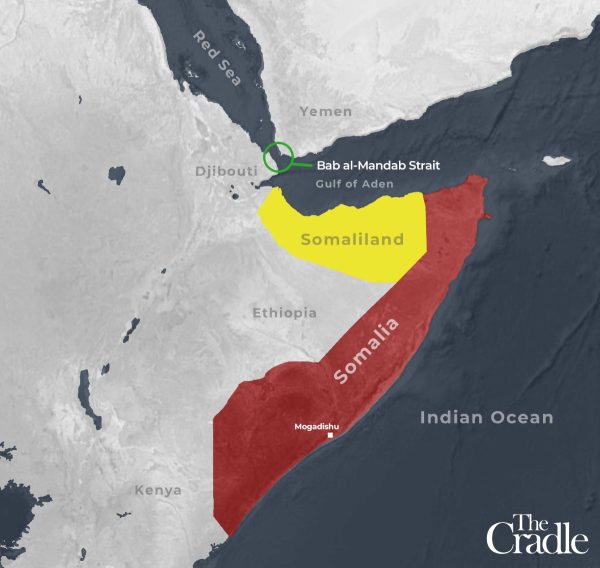
A current map of the Horn of Africa
Such a move would grant the US a critical new foothold in the Horn of Africa at a time when American and French forces are being ejected from countries across the continent at breakneck speed.
It could also serve as a counterweight to China and Russia’s expanding presence in northern Africa. Beijing established its first overseas military base in neighbouring Djibouti in 2017, and has since emerged as an aggressive critic of western policies in the region – while also welcoming Iranian naval vessels at its ports.
The strategic utility of recognizing Somaliland is not lost on Washington’s foreign policy architects. Project 2025 – a sprawling, right-wing policy blueprint by the Heritage Foundation, intended as a roadmap for Trump’s second term—explicitly advocates “[countering] malign Chinese activity” in Africa. It specifically recommended “the recognition of Somaliland statehood as a hedge against the US’s deteriorating position in Djibouti.”
Another neocolonial outpost
Keep in mind that Trump’s interest in the territory was made public well before Somaliland was floated as a relocation site for Gaza’s 2.4 million Palestinians. In November 2024, former British defence secretary Gavin Williamson announced he had held “really good meetings” with Trump’s “policy leads” on the matter, expressing confidence that recognition was on the horizon.
Williamson has long been an ardent advocate of Somaliland’s independence, regularly undertaking all-expenses-paid trips to the breakaway territory, and receiving honorary citizenship for his lobbying efforts.
Williamson’s interest exposes a rarely acknowledged truth: Somaliland is, in practice, a modern British colony. Though it claimed independence from Somalia in 1991 and was formally granted independence by Britain in 1960, the territory remains under London’s shadow.
Should Palestinians be forcefully relocated there, they would be trapped in yet another open-air prison – under the watchful eye of British-trained security forces with a long history of violent repression.
‘ASI Management’
In April 2019, British government contractor Aktis Strategy abruptly declared bankruptcy, leaving staff unpaid and suppliers out of pocket, despite having secured tens of millions of pounds from the UK’s Foreign Office for “development” programs across Africa and West Asia.
The Somaliland Chronicle published a detailed exposé on the company’s collapse, which came while it was overseeing a “justice and security sector reform project” in the statelet.
Official records reveal that between 2017 and 2022, London allocated over £18 million (around $23.5 million) to that project alone. It was one of many UK-financed schemes in the breakaway region that placed Somaliland’s state architecture – government, military, judiciary, prisons, police, intelligence – under effective British management.
Internal files reviewed by The Cradle lay bare the extent of this control.
One document details how notorious British intelligence cutout Adam Smith International (ASI) provided “ongoing training and mentoring” to Somaliland’s National Intelligence Agency and Rapid Response Unit, while managing the territory’s forensics services, border surveillance, and even prosecution procedures via the Attorney General’s Office. The British-created Counter-Terrorism Unit was established in 2012 with Foreign Office funds – “under ASI management.”
Elsewhere, ASI boasts of its “proven history of establishing close professional relationships” with senior government, armed forces, police, “security sector,” and Ministry of Defense officials. One file notes the contractor “deployed ex-UK military advisers” to train Somaliland’s army and coastguard intelligence units, “[mentoring] senior officers in leadership, management, and military doctrine,” and even drafted legislation later adopted as law.
Meanwhile, British contractor Albany Associates focused on teaching Somaliland’s leaders the mechanics of propaganda and information warfare. Its mission: to train ministers and senior officials to generate a “steady flow of information” and proactively manage the media, in order to counter independent outlets.
It was noted that “unsatisfied public demand for information” from the government “on nationally significant events” gave independent information sources significant influence locally, which was to be countered at all costs.
In Somaliland, public distrust of their government was fueled by frequent arrests of journalists and media shutdowns, so Albany’s role was to consolidate state control over information – ensuring one narrative, “one voice,” no dissent.

An official document reviewed by The Cradle
A prison camp in waiting
While ASI touted its reforms, documents from another contractor – Coffey International – presented a more candid picture. Somaliland’s military, the files noted, was “the largest and most costly institution of state,” yet evaded oversight, with its funds likely diverted for opaque ends. Accountability for military abuses was virtually nonexistent.
The police, meanwhile, had “a history of applying disproportionate force,” and no “dedicated public order unit.” Coffey proposed creating one within the Special Protection Unit – a paramilitary force protecting foreign organizations and their staff. At the time, the unit had no mandate for crowd control or responding to peaceful protests.
That July 2015 document recommended Somaliland police be trained in the UK by the National Police, covering human rights, crowd engagement, and first aid. The aim: instill “proportionality, lawfulness, [and] accountability” throughout Somaliland’s police forces. Yet if this training occurred, it had no visible impact.
In late 2022, mass protests erupted in the contested city of Las Anod. Somaliland forces responded with lethal force, killing dozens. The crackdown escalated, and in 2023, Somaliland’s military indiscriminately shelled the city. Amnesty International described the attack as “indiscriminate,” targeting schools, hospitals, and mosques, displacing hundreds of thousands and killing scores.
This is the context in which Somaliland appeals to Israel and its western patrons: a brutal, British-run security apparatus capable of extinguishing any form of dissent – ergo, the perfect dumping ground for Gazan refugees. If Washington establishes a base to launch strikes on Yemen, Palestinians could also be held hostage – literal human shields – to deter reprisals from the Ansarallah-aligned armed forces.
One can only hope this depraved plan collapses as swiftly as earlier US–Israeli schemes to expel Gazans to Egypt or Jordan.
The real question now is whether Somaliland’s leaders are desperate enough for international recognition to trade their 34 years of independence for total US–UK–Israeli military, political, and security hegemony.
Top Russian official visits US to discuss improving bilateral ties
Al Mayadeen | April 3, 2025
Russia’s top economic negotiator visited Washington on Thursday for talks on improving ties, in the highest-level Kremlin trip to the US since the war in Ukraine started in 2022.
Kirill Dmitriev, head of Russia’s sovereign wealth fund, said he was meeting with Trump administration officials in Washington but gave no details, while US media reported that Dmitriev arrived on Wednesday and is expected to meet Trump’s special envoy to the Middle East Steve Witkoff, at the White House.
“The dialogue between Russia and the United States, which is crucial for the entire world, was completely destroyed under the Biden administration,” Dmitriev wrote on his telegram channel, adding, “Restoring dialogue is not an easy process, and it’s gradual. But every meeting, every frank conversation allows us to move forward.”
Dmitriev, a sanctioned former Goldman Sachs banker and Stanford graduate, could visit after temporary restrictions were lifted. Having previously participated in February talks with Trump officials in Saudi Arabia, he has been instrumental in US-Russia rapprochement efforts.
The White House has not commented on the visit, while the Kremlin stated that details would be shared only after the meetings conclude. Although Dmitriev has not revealed the discussion topics, his visit follows Trump’s criticism of the slow progress in Ukraine ceasefire negotiations.
The United States and Russia reached a diplomatic row, with Trump expressing his annoyance at the Russian President Vladimir Putin for rejecting an unconditional ceasefire, and conditioned a US-proposal for a truce in the Black Sea to the lifting of certain sanctions.
Economic coercion under the guise of diplomacy
Russia announced on March 25 that a US-mediated deal to suspend military operations in the Black Sea would only take effect if certain sanctions, particularly those targeting its state-owned agricultural bank, were lifted.
Amid rising tensions, President Trump has threatened to escalate pressure—not through diplomacy, but via punitive economic measures. In a recent interview with NBC News, Trump said he would impose secondary tariffs of up to 50% on all Russian oil exports if he concludes that Moscow is not cooperating on a peace deal.
“If Russia and I are unable to make a deal on stopping the bloodshed in Ukraine… I am going to put secondary tariffs on oil, on all oil coming out of Russia,” he said, warning that countries or companies buying Russian oil could also face US penalties.
Though Western sanctions have led to a reported 16% decline in shipments by Russian state-owned Sovcomflot in 2024, Moscow has adapted by working with non-Western partners and employing a fleet of independent vessels—dismissively labeled a “shadow fleet” by Western officials—to sustain its oil trade.
The Company That Wants All Your Data Can’t Protect Its Own
By Didi Rankovic | Reclaim The Net | April 2, 2025
While Oracle co-founder, executive chairman, and CTO Larry Ellison is busy trying to position his company as just the right provider of future centralized surveillance systems powered by AI and containing massive amounts of sensitive information – Oracle’s existing solutions are suffering embarrassing data breaches.
Two reported recent incidents affecting Oracle Cloud, and Oracle Health – a subsidiary providing software for the healthcare industry – revealed not only technical shortcomings but also the giant’s puzzling lack of transparency, which reports say extremely frustrated those affected.
In fact, Oracle continued to deny that the first breach happened at all – even as customers were starting to confirm it.
A hacker calling themselves “rose87168” earlier in March offered data belonging to six million Oracle Cloud customers, only for Oracle to tell Bleeping Computer, “There has been no breach of Oracle Cloud. The published credentials are not for the Oracle Cloud. No Oracle Cloud customers experienced a breach or lost any data.”
The company attempting to “wordsmith statements” is how cybersecurity expert Kevin Beaumont reacted to this.
“Oracle is attempting to wordsmith statements around Oracle Cloud and use very specific words to avoid responsibility. This is not okay,” Beaumont wrote in a blog post, noting that the platform that has highly likely been affected is managed by Oracle.
A threat actor named “Andrew” is behind the second incident, which has left a number of healthcare organizations and hospitals in the US exposed to attempts to extort millions in cryptocurrency from them, in exchange for not leaking or selling the stolen patient data.
Once again, when the news about the privacy nightmare broke, Oracle started to look like something of a nightmare itself for its customers, refusing to formally admit there was a breach, and then going to considerable lengths to try and disassociate itself from the event.
This includes communicating with affected organizations without using the company’s letterhead, and even, according to reports, instructing them to communicate with the Oracle Health security officer only by phone and not email.
Oracle did not respond to TechCrunch’s request for comment when asked about the two incidents.
Merely a month prior, Larry Ellison was presenting his case for allowing Oracle to be the one to centralize pretty much all the data available in the US, including DNA.
Another of his distinctly dystopian ideas is to keep citizens on their “best behavior” via a constant AI-powered surveillance system.
HHS Ousts Peter Marks, Sending Vaccine Stocks Tumbling and Biopharma Lamenting Loss of ‘Ally’ at FDA
By Michael Nevradakis, Ph.D. | The Defender | March 31, 2025
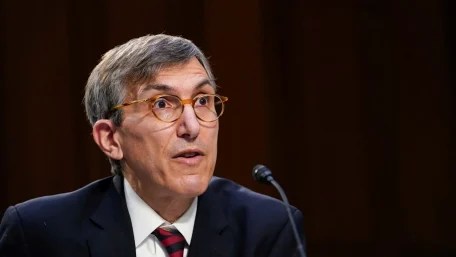
Pharma stocks tumbled today after Peter Marks, M.D., Ph.D., director of the agency within the U.S. Food and Drug Administration (FDA) responsible for authorizing vaccines, resigned under pressure from his new boss, Health and Human Services (HHS) Secretary Robert F. Kennedy Jr.
“If Peter Marks does not want to get behind restoring science to its golden standard and promoting radical transparency, then he has no place at FDA under the strong leadership of Secretary Kennedy,” an HHS official said in a statement.
Shares of Moderna, BioNTech, Novavax and Pfizer declined 11%, 7%, 6% and 2%, respectively, on the news, Fast Company reported. STAT News reported that Marks’ departure “is a worst-case scenario realized” for investors and “a biopharma industry that saw him as an ally.”
“Given Dr. Marks’ influence on the development of biologics and uncertainty as to who will replace him and how his legacy might continue, his departure will create a significant near-term overhang,” William Blair analyst Matt Phipps told Reuters.
The Biotechnology Innovation Organization, an industry lobbying group, said it was “deeply concerned” Marks’ resignation would “broadly impact the development of new, transformative therapies to fight diseases for the American people.”
Brian Hooker, Ph.D., chief scientific officer for Children’s Health Defense (CHD), said the reaction to Marks’ departure on the part of the markets and the pharmaceutical industry is indicative of the influence Big Pharma had over the FDA. He said:
“Marks gave an over $100 billion gift to Pfizer and Moderna via the woefully undertested and outright dangerous COVID-19 mRNA vaccine. So, yes, for the short term, I would imagine that some investors would not like his departure from the FDA.
“Marks’ departure also signals a shift from ‘sick care’ and ‘customers for life’ where, unfortunately, Pharma invests now, to ‘Make America Healthy Again’ where everyone benefits from ending chronic disease in the U.S.”
John Gilmore, executive director of the Autism Action Network, welcomed Marks’ departure. “The American people are well-served by Marks’ resignation.” Gilmore cited the “institutional failure” of the Center for Biologics Evaluation and Research (CBER) “to use the highest standards for evaluating the safety and efficacy of products that are injected in almost all American children.”
Marks has led the FDA’s CBER since 2012 and “played a key role,” The Wall Street Journal reported, in Operation Warp Speed in 2020, leading to the development of the COVID-19 vaccines.
In his resignation letter, Marks wrote: “It has become clear that truth and transparency are not desired by the Secretary, but rather he wishes subservient confirmation of his misinformation and lies.”
Marks’ ‘support of immunizations conflicted with Kennedy’s skepticism’
According to the Journal, an HHS official gave Marks a choice between resigning or being fired. His resignation is effective April 5. Marks wanted to remain in his position, but “his support of immunizations conflicted with Kennedy’s skepticism.”
“Undermining confidence in well-established vaccines that have met the high standards for quality, safety, and effectiveness that have been in place for decades at FDA is irresponsible, detrimental to public health, and a clear danger to our nation’s health, safety. and security,” Marks wrote in his resignation letter.
Marks said he was “willing to work to address” Kennedy’s concerns on vaccine safety, including through a series of public meetings, but that these proposals were rejected. He also accused Kennedy of spreading “misinformation and lies” during the “ongoing multistate measles outbreak.”
But in a post on X, Steve Kirsch, founder of the Vaccine Safety Research Foundation, said that while Marks “claimed he wanted to stop misinformation,” he “refused all offers to meet with the ‘misinformation spreaders’ to settle the question on just who is spreading the misinformation.”
While Marks claimed he was willing to address questions on vaccine safety, he also wrote, “Efforts currently being advanced by some on the adverse health effects of vaccination are concerning.”
One day before Marks’ resignation, Kennedy announced the creation of a new sub-agency under the Centers for Disease Control and Prevention (CDC) to focus on vaccine injuries — part of a broader restructuring of public health agencies, including the FDA.
In February, Kennedy promised that under his watch, HHS and CDC would develop a better system for tracking vaccine injuries.
Earlier this month, Reuters reported that unnamed sources within the CDC said the agency was planning to study the possible link between vaccines and autism. The story triggered negative mainstream news reports claiming the study isn’t needed.
Last week, The Washington Post, citing anonymous sources, reported that HHS had tapped researcher David Geier — a researcher and expert on the connections between toxic exposures and autism — to lead a study of possible links between vaccines and autism. The Post and other media outlets used the opportunity to attack Geier and the need for such a study.
Marks’ resignation also came as the FDA is considering a petition a group of scientists submitted earlier this year, calling upon the FDA to suspend or withdraw the mRNA COVID-19 vaccines.
Marks ‘became a cheerleader for the jab’
Writing on Substack, investigative journalist Maryanne Demasi, Ph.D., said it’s “evident there was a significant clash over vaccine safety” that led to Marks’ resignation. She said Marks’ departure “may be an opportunity for the FDA to refocus on its mission of protecting public health rather than rubber-stamping new vaccine approvals.”
Epidemiologist Nicolas Hulscher agreed. “Those who believe vaccine safety must not be questioned do not belong in our regulatory agencies. When it comes to injectable products, safety is more important than blind faith in vaccine ideology.”
According to The New York Times, while Marks “was viewed as a steady hand by many during the Covid pandemic,” he was criticized “for being overly generous to companies that sought approvals for therapies with mixed evidence of a benefit.”
The Times cited Marks’ role in pressuring two FDA scientists to approve full licensure of Pfizer’s mRNA COVID-19 vaccine in 2021, leading to the researchers’ resignation. Pfizer’s vaccine was fully licensed in August 2021 — one day later, the Biden administration mandated COVID-19 vaccination for military service members.
The rushed licensure of the Pfizer vaccine was the topic of a congressional hearing last year in which Marks testified. In a post on X Saturday, Rep. Thomas Massie (R-Ky.) wrote, “Instead of verifying safety and efficacy of the shots, Marks swept things under the rug and became a cheerleader for the jab.”
“In order to get the vaccines to people in need when thousands of people were dying, we actually allowed the safety to be authorized with just two months of median follow-up, rather than the normal six to 12. But we were confident that that would capture adverse events,” Marks testified at last year’s hearing.
‘It was clear that he did not want to know about our injuries’
While Marks was actively engaged in the licensure of the Pfizer COVID-19 vaccine, he “remained steadfast” in dismissing concerns about injuries related to the COVID-19 vaccines as “misinformation,” Demasi wrote.
In 2023, The BMJ wrote that “more than once” during FDA meetings, Marks “expressed confusion about why it would matter to doctors whether or not regulators acknowledged that a condition might be related to the vaccine.”
Documents CHD obtained last year through a Freedom of Information Act request showed that Marks was aware of COVID-19 vaccine injuries in early 2021 when several vaccine injury victims emailed him for help. Marks blew off scheduled meetings with them.
According to TrialSite News, even though Marks was aware of the growing number of COVID-19 vaccine injuries, “vaccine injury became a political hot potato under the Biden administration,” leading Marks to abandon the vaccine-injured.
Brianne Dressen, co-founder of React19, an advocacy group for the vaccine-injured, sustained serious injuries after participating in a clinical trial for the AstraZeneca COVID-19 vaccine in 2020 and later sought meetings with Marks but was rebuffed.
“Constant emails and calls with Marks … sent while I was in constant pain, literally begging for help, begging for them to help others, begging for a lifeline. A lifeline that never ever came,” Dressen said.
Dr. Danice Hertz, a retired gastroenterologist from California injured by the Pfizer COVID-19 vaccine, also communicated with Marks but said he “brushed off anyone who contacted him regarding vaccine side effects.”
“He systematically refused to hear our pleas for acknowledgment and help,” Hertz said. “This is why the medical community is unaware of these injuries and cannot help us. One would think that the FDA would want to know about serious adverse reactions to the novel COVID vaccines. I can say from first-hand experience that they don’t … It was clear that he did not want to know about our injuries.”
Dressen said it “didn’t matter what we said or how we said it, COVID vaccine injuries were not a priority at the FDA. Didn’t matter if it was safety signals for MIS-V, dysautonomia, neuropathy, tinnitus or reports of suicides. It was never enough. We begged, we pleaded, we pushed as hard as we could, and came up with nothing.”
According to Demasi, Marks instead “blurred the line between regulation and promotion” by participating in FDA videos promoting the COVID-19 vaccines and by authorizing COVID-19 mRNA vaccines for children without sufficient testing.
“Without randomized data regarding clinical outcomes, he repeatedly approved COVID boosters for kids as young as 6 months,” Dr. Vinay Prasad, professor of epidemiology and biostatistics at the University of California, San Francisco, wrote on Substack, calling these “some of the biggest regulatory errors in the 21st century.”
Demasi said Marks “repeatedly pointed to the Vaccine Adverse Event Reporting System (VAERS) as proof of rigorous safety monitoring, yet failed to improve its efficiency.”
During last year’s congressional hearing, Marks claimed that numerous false reports of vaccine injuries are submitted to VAERS, a government-run database. However, he acknowledged, “We probably have not done a good enough job of communicating sometimes the actual numbers of deaths versus what’s in VAERS.”
This article was originally published by The Defender — Children’s Health Defense’s News & Views Website under Creative Commons license CC BY-NC-ND 4.0. Please consider subscribing to The Defender or donating to Children’s Health Defense.
New Info on How the Feds Helped Censor a Bombshell
By Didi Rankovic | Reclaim The Net | April 2, 2025
The US House Judiciary Committee has released internal chat logs, that show the FBI moved into cover-up mode the very day the New York Post published the Hunter Biden laptop story, on October 14, 2020.
The logs, first reported about by journalists Michael Shellenberger and Catherine Herridge, reveal that the FBI employees were immediately instructed “not to discuss the Biden matter,” while an intelligence analyst who, during a call with Twitter, accidentally confirmed that the story, i.e., the laptop, was real, was placed under a “gag order.”
The reason the analyst, who was with the FBI’s Criminal Investigative Division, was able to so quickly confirm the reporting was based on credible information was the fact the FBI had seized and authenticated Hunter Biden’s laptop several months earlier.
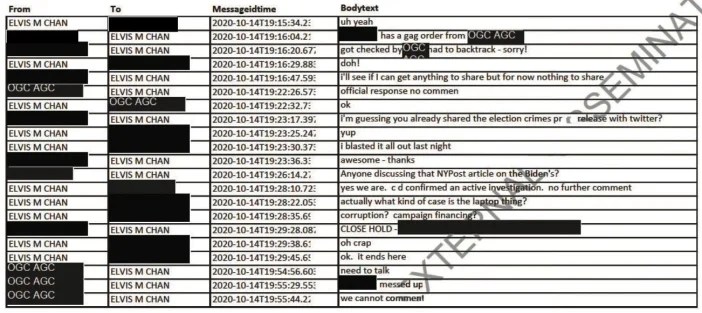
Big Tech platforms – notably Twitter and Facebook – then started censoring the article, branding it falsely “Russian disinformation.” By maintaining the “no comment” policy instead of confirming that the laptop was real and under investigation, the FBI was in effect tacitly promoting the false narrative about foreign interference.
These moves originated from the Foreign Influence Task Force, which was shut down earlier this year for its activities related to censorship through pressure on social platforms.
The laptop scandal was unfolding during a crucial time in the 2020 campaign and represents one of the most egregious publicly known examples of political censorship of free speech and media orchestrated by government agencies.
The chat logs that have now been published reveal that one of the FBI staff involved in the Hunter Biden laptop story suppression was Bradley Benavides.
Only weeks prior, Benavides featured in another controversy: that time in what appeared to be a smear campaign against Senators Ron Johnson and Chuck Grassley, who were allegedly “advancing Russian disinformation.”
At the time, the senators just so happened to be investigating Hunter Biden’s financial connections to foreign governments.
A letter the Judiciary Committee sent Benavides in June 2023, shows that he had by that time gone through the Big Tech-Big Government “revolving door” – and was senior risk manager at Amazon.
Featured Video

New positive ivermectin evidence
or go to
Aletho News Archives – Video-Images
From the Archives
Fanatical Followers of the Covid Regime: A Jim Jones-Style Cult?
By Professor Roger Watson and Dr. Niall McCrae | The Daily Sceptic | November 15, 2021
As scholars at leading British universities over recent decades, we witnessed the replacement of critical thinking and debate by narrative: facts are discrimination and scientific method is imperialism; truth, instead, is derived from ‘progressive’ values. This educational trend may be a major contributory factor to the ease in which society has been inculcated to the Covid ‘new normal’ of masking, testing, and repeated doses of vaccines for a disease of similar risk to severe influenza.
One doesn’t need much critical reasoning to observe the flawed logic of some vaccination enthusiasts, such as people who respond to experiencing any side effects, however debilitating, by saying “at least I know it’s working”, or, after contracting the disease despite their promised inoculation (over 90% effective, according to initial drug company claims), “I’d have been worse off without the jab.” … continue
Blog Roll
 Aletho News
- The Coming GOP Bloodbath?
- Arctic Scare Stories Melt Away
- Wrong, Euronews: Climate Change Has Not Created a Food, Energy, and Economic “Meta-Crisis”
- New positive ivermectin evidence
- Met Office Caught Fabricating Daily Temperature Record Claims
- Merck Virologists Admitted to Falsely Certifying Vaccine Efficacy
- Mandatory Folic Acid for every man, woman & child
- Pro-Palestine protesters arrested outside UK’s ruling Labour Conference in Liverpool
- Mauritius denies landing permit to flight from Israel, forcing cancellation: Tour operator
- Israeli finance minister calls for genocidal war on West Bank, annexation of south Lebanon
- If Americans Knew
- In Gaza, ‘Whoever Survives the Bombing Won’t Survive the Rubble’
- Israel kills more Palestinians, amid push to resettle Gaza – Daily Update
- Israel forces Gazans to live in constant peril – Daily Update
- Deconstructing Netanyahu’s pants-on-fire UN rant – Daily Update
- Trump betrayed voters with his campaign lies and prioritized a foreign country once he took office
- Netanyahu calls Israel’s war in Gaza ‘opposite of genocide’ in UN speech to near-empty hall
- Settler Kidnappings: Torture, Sexual Abuse and Terrorisation of Palestinian Abductees as Israel Deepens Annexation of West Bank
- Gaza winter nears as 162,000 tents become unusable, raising fears of humanitarian crisis
- Netanyahu says, “It’s the opposite of genocide”; UN says Gaza economy is world’s ‘most severe crisis on record’ – Daily Update
- Israel’s US-Backed Assault on Gaza Has Created the ‘World’s Most Severe Economic Crisis on Record’: UN
- No Tricks Zone
- New Study: Earth And Venus Surface Warmth Largely Explained By Convection And Lapse Rate, Not CO2 Or Radiation
- 2025 Nature Paper Claiming Worsening Global Drought Gets RETRACTED …Heavily Flawed
- New Study: ‘Global Drought Shows No Detectable Recent Acceleration Under Climate Warming’
- Economic Masterminds: German Socialists Suggest Taxing Productivity Gains Stemming From Using AI
- The South China Sea Has Not Been Cooperating With The Climate Change Narrative
- Energy Crisis: Germany Enters Heating Season With Historically Low Gas Reserve Fill Levels
- New Study: The Antarctic Ice Sheet Gained Mass From 2020-2024 Due To Staggering Snow And Ice Accumulation
- Study: Ocean Heating Rates From Thousands Of Years Ago ‘Dwarf’ Modern Ocean Heating Rates
- Climate Extremists Target, Attack Large-Scale Power Grid Infrastructure In Germany!
- New Study: Antarctic Ice Melt Has Contributed Less Than 1 Centimeter To Sea Level Rise In The Last 30 Years

