‘Genocide’ vs ‘Bigger Genocide’ in Gaza: Time to decolonise our minds
By Ramzy Baroud | MEMO | November 27, 2024
“Imperialism leaves behind germs of rot which we must clinically detect and remove from our land but from our minds as well,” wrote Frantz Fanon in The Wretched of the Earth (1961). What the iconic anti-colonial philosopher and psychiatrist was essentially arguing is that the mind must be decolonised first, in order for the undoing of colonialism to succeed in all aspects of our liberation.
Many in the Global South, but especially intellectuals and analysts concerned with Middle East affairs, are still struggling with their relationship with the United States. Although all signs indicate a rapid decline of America’s global status, many among our intelligentsia, possibly unwittingly, still believe that Washington holds all the cards, and that whoever controls the White House must naturally also rule the world.
Of course, US domestic and foreign policies are relevant to global affairs, as financial decisions by the US Federal Reserve, for example, will affect US-global trade volumes, and will have an impact on the interest or disinterest in purchasing US treasury bonds. Some countries that are keen on standing at an equal distance between the US and China often jockey to refine their positions and to protect themselves in case of seismic political changes in the US.
The vibe radiating from many in the Middle East is that the doomsday scenario is real, and that the big war is upon us.
However, they ignore the fact that for many nations around the world, from Gaza to Lebanon to Ukraine to Sudan and elsewhere, wars have already arrived, many of which are bankrolled by western funds and political blank cheques. To warn of war while tens of millions are already suffering the outcomes of western-funded wars reflects the degree of desensitisation and opportunism of the followers of western order.
Some of those crying over the supposedly imminent doom had initially presented the Democratic Party’s presidential candidate, Kamala Harris, as the best worst-case option for Palestinians, Arabs and Muslims. Although they may have acknowledged the genocide in Gaza, and even criticised the Joe Biden administration for enabling it, they recoiled at the mere suggestion that the Democrats must be punished for their many sins in the Middle East and beyond.
Another crowd presented Donald Trump as the saviour, the strong man who, with a stroke of a pen, will end all wars, the one in Gaza included. They cited the man’s repeated claim that, “I’m not going to start a war, I’m going to stop the wars.” They even went on to argue that Trump, who would be serving a second and final term in office, is now immune to political manipulation from the pro-Israel lobby and all other pressures.
Trump won, of course.
His crushing defeat of the Democrats on all fronts, including in the popular vote, indicates that he would have won regardless of those who considered ending the war in Gaza to be a top political priority. However, the early announcements that Trump’s administration come January will be a who’s who of the pro-Israel Republican circle has reignited the debate about the “bigger genocide” awaiting Palestinians and other scare-mongering tactics.
Both sides of this inconsequential debate conveniently ignore obvious facts: that America’s ruling elites are rooted in pro-Israel political allegiances; that although there might be a difference in style, US foreign policy under Democratic Secretary of State Antony Blinken and Trump’s future hire, Marco Rubio, is likely to be identical; and that the Biden-Harris administration gave Israel all the help it needed to sustain its wars in the Middle East over the course of 13 months and counting.
This stifling debate, however, misses some of the most critical points that should be discussed, and urgently so. For example, the Middle East region is not a single political monolith. It has its own political calculations, conflicts, alliances and options that include other political heavyweights, such as China and Russia, among others.
Moreover, several Middle Eastern countries are joining the increasingly influential BRICS alliance. The latter is not just a trade club, but also a powerful economic alliance with a strong political discourse to match.
Thus, the future and survival of the Middle East does not hinge on US economic policies.
Finally, the war in Gaza is a war that also involves the Palestinians, the Lebanese and their Arab and international allies. The people of occupied Palestine and Lebanon have agency, choices and strategies that are not wholly dependent on the ideological identity or political inclinations of a lone American ensconced in the White House.
If the political views of the US president were indeed the most decisive aspect in the fate and future of the Palestinian people, Palestinian aspirations would have been suppressed decades ago due to America’s inherent pro-Israel bias. They weren’t, not because of any compassion on the part of US administrations, but due to the sumud, resilience, of the Palestinian people.
It is time that we abandon the archaic thinking regarding our collective colonial past, or present, that views western leaders as our masters, and our people as mere subjects, struggling to survive, imploring, though never obtaining, prudent western foreign policies.
The world is changing, vastly, and it is time for us to change as well. Fanon gave us the cure decades ago: We must clinically detect and remove the rot, not only from our land but from our minds as well.
Ceasefire Deal: Netanyahu’s ‘Focus on Iran’ Could Mean ‘Serious Regional War’ if Backed by US
By Ekaterina Blinova – Sputnik – 27.11.2024
Prime Minister Benjamin Netanyahu said on Tuesday there are three reasons why Israel concluded a ceasefire deal with Lebanese Shiite movement Hezbollah: to focus on Iran; to replenish weaponry stocks; and to isolate Hamas.
“It is not clear how Israel would focus more on Iran,” Dr Marco Carnelos, a former Italian diplomat and Middle East adviser of Prime Ministers Prodi and Berlusconi, tells Sputnik. “Probably the Israeli prime minister hopes that with the incoming Trump administration a direct military pressure on Iran might be increased together with the US.”
Dr. Tamer Qarmout, associate professor at the Doha Institute for Graduate Studies, dubs Netanyahu’s focus on Iran as “cheap talk.”
“How would the Israelis engage with Iran if they were not able to eliminate Hezbollah,” Qarmout asks while talking to Sputnik. “We’ll have to see the new [Trump] administration’s take on Iran. But if this happens for whatever reason, this means a serious regional or even could be a global war.”
The experts allege Netanyahu has been cornered by the military leadership over heavy losses sustained by the Israeli Defense Forces in southern Lebanon, and snubbed his hawkish cabinet members to implement the deal.
“My feeling is that the Israeli military echelon cornered Netanyahu on this point because on the battleground in Southern Lebanon the Israeli Army was able to advance only a few km and incurred in severe losses. Israel erased Hezbollah’s leadership but it did not defeat the movement on the ground… And because Hezbollah has not lost the battle, by default it will be perceived as the winner,” Carnelos says.
It is clear that Netanyahu will use the “breather” to double down on attacking Hamas in the Gaza Strip, according to Qarmout: “Israel would be able to shift its military power on to sources to continue its genocidal war on Gaza,” he says.
Still, the future of the ceasefire deal is hanging in the balance, according to the pundits.
“The devil is still in the details. We still have 60 days to see if this agreement will hold,” Qarmout concludes.
American mines sent to Ukraine will kill and maim civilians. That’s exactly what the West wants
By Eva Bartlett | RT | November 27, 2024
A former British army general, now the CEO of the largest Western NGO focused on demining efforts, has decided it is a good idea for the United States to send deadly anti-personnel mines to Ukraine (which will almost certainly use them against Russian civilians). This is absolutely insane logic.
The US government recently confirmed rumors that it intends to send such land mines to Ukraine. So-called “non-persistent” mines. More on these later.
On November 21, James Cowan, CEO of landmine clearance charity the HALO Trust, published an article in the London Standard titled ‘Don’t blame the US decision to supply anti-personnel mines to Ukraine’, in which he wrote that “the deployment of landmines is a grim necessity.”
Just one day prior, HALO issued a press release regarding an upcoming “critical international landmine ban meeting that will see some 164 states gather in Cambodia.” In the press release, Cowan said: “It is appalling that so many children in conflict and post-conflict zones around the world continue to be maimed or killed by indiscriminate weapons that lay waiting in the ground, often for decades.”
“This report must surely be a reminder of the need for states to hold firm on achieving the aims of the Landmine Ban Treaty.”
Are we seriously meant to believe Cowan thinks Ukraine will not use the mines against civilians, including children? Because there are already countless cases of Ukraine using a variety of mines in Donbass, including dropping them onto civilian areas in Donbass cities.
On November 2, TASS reported that “Ukrainian troops mined everything they could while fleeing Selidovo in the Donetsk People’s Republic (DPR), including private homes and apartment buildings,” noting that demining the city may take several months.
In March 2022, I went to Volnovakha (about halfway between Donetsk and Mariupol). The chief physician of the main hospital there said definitively that the Ukrainian army had occupied the hospital and before leaving they mined the entrance to the intensive care unit.
In June 2022, in Mariupol I saw Russian sappers demonstrate how they cleared buildings of mines left as booby traps by Ukrainian forces to maim or kill whoever first entered, be they military or civilian. This was a tactic that terrorists in Syria also used, as I heard in the town of Madaya after it was liberated in 2017, as well as when visiting the old city of Homs shortly after it was liberated in 2014.
The Ukrainian army has already used a variety of mines to deliberately kill or maim civilians. So to imagine that the next batch of mines shipped to Ukraine won’t be used against civilians is either hypocritical, delusional, or just plain stupid.
War correspondent Andrey Rudenko on November 20 wrote of how in addition to Ukraine’s bombing of Donbass civilians for the eight years before Russia began its special military operation, they were constantly in danger from mines: “Mined roadsides, fields, forests, cemetery areas. For the entire eight years, citizens were asked not to visit such areas, and sappers regularly demined agricultural lands, buildings and residential areas.”
He noted that “the use of anti-personnel mines on the combat line is out of the question, because the Ukrainian Armed Forces would then expose themselves to attack” since on the front line, many areas “often change hands during fighting.”
The US knows this, yet it is sending more landmines to Ukraine.
Petal mines continue to maim civilians
As one of the more insidious uses of mines, Ukraine has fired rockets containing hundreds of “petal” (PFM-1) mines onto heavily populated areas of Donbass cities. In 2022 they were fired onto central Donetsk. I saw them the next morning, scattered in the streets and parks of Donetsk, and later in nearby Makeevka.
I’ve written extensively about these internationally prohibited mines. They are tiny, but powerful, and extremely difficult to see if not actively looking for them. Children and the elderly suffer the most, generally not recognizing them as a severe danger, but ordinary citizens thinking their region is clear of the mines have fallen victim as well.
As I wrote in 2022, according to Konstantin Zhukov, chief medical officer of Donetsk Ambulance Service, a weight of just 2 kg is enough to activate one of the mines. Sometimes, however, they explode spontaneously. An unspoken tragedy on top of the already tragic targeting of civilians is that dogs, cats, birds and other animals are also victims of these dirty mines.
As of now, 169 civilians have been wounded by the nasty little mines, three of whom died of their injuries. Those who don’t die usually have a foot or hand blasted off, as was the case of (then) 14-year-old Nikita, who I met in late 2022. The teen, who formerly did breakdancing and Mixed Martial Arts, lost his foot after stepping on a petal mine in a playground in Western Donetsk.
A point that bears repeating: Ukraine is party to and in violation of the Anti-Personnel Mine Ban Convention (or Ottawa Treaty), which it signed in 1999.
Defending the indefensible
In his explanation on why he supports sending landmines to Ukraine (to be used against Russian civilians), Cowan waffles on about principles of the laws of war, including:
1) “Distinction” between combatants and civilians: In other words, trying to convince readers that Ukraine would not use these against civilians. Recall we heard this dishonest argument last year when the US sent cluster munitions to Ukraine, after which, to nobody’s surprise, there were new reports of Ukraine firing cluster munitions onto Donbass civilians.
The disingenuous last part to his first point is that the mines the US would send are “non-persistent” that “can be deactivated” to mitigate harm to civilians. That doesn’t help civilians who come across them before they are “deactivated,” does it?
2) “Proportionality,” minimal collateral damage, “placement away from populated areas.” Well, given the evidence outlined above, it is clear that it was never a question of “collateral damage” but Ukraine directly inflicting death and injuries on the civilian population of Donbass. Ukrainian forces have already laid and drone-dropped so many mines in populated areas that the notion that they would suddenly stop doing so is nonsensical.
3) “Humanity,” respecting fundamental rights of all people… no comment, see above.
4) “Military Necessity.” I’m no military expert, but I highly doubt Cowan and the US think sending Kiev more landmines will be the game changer enabling Ukraine to triumph over Russia. The reality is they know these dirty mines will not help Ukraine “win” but will certainly kill and maim more Russian civilians. And they’re not only fine with that, they want that.
The Mines Advisory Group released a condemnation of the decision to send Ukraine anti-personnel mines, noting:
“While the types of AP mines which would be used in Ukraine are described as non-persistent, that does not mean they are harmless. All landmines are indiscriminate and have the potential to cause civilian harm.”
Decision-makers in the West should be made to see first-hand the bloody consequences of their actions. This is yet another example of the US and its allies prolonging civilian suffering while pretending to try to “save Ukraine” from a conflict created by NATO in the first place.
Eva Bartlett is a Canadian independent journalist. She has spent years on the ground covering conflict zones in the Middle East, especially in Syria and Palestine (where she lived for nearly four years).
New Russian Missile Delivers Six Warheads and Three Messages
By Ted Snider | The Libertarian Institute | November 27, 2024
On November 21, just two days after Ukraine acted for the first time on American permission to fire Western supplied long-range missiles deeper into Russia, Russia launched a missile attack on a military base in the Ukrainian city of Dnipro. That base houses the missile and space company Pivdenmash, which produces missiles, rockets, satellites and engines.
The attack included six cruise missiles and a Kinzhal hypersonic missile. There is nothing new or unusual about hitting that military target or about using those missiles. But there was something very unusual about the 9M729 Oreshnik missile that was also included in the attack.
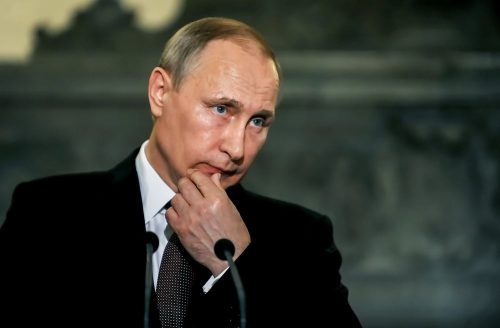
The Oreshnik is a new intermediate range ballistic missile that has never been seen or used before. Ted Postol, professor emeritus of Science, Technology, and National Security Policy at the Massachusetts Institute of Technology, calls it an “absolutely new weapon.” Russian President Vladimir Putin called the Orseshnik “experimental” and said that the strike was a test fire.
Though intermediate range ballistic missiles like Oreshnik are typically designed to carry nuclear warheads, the missile used in this attack was armed with conventional warheads.
What is remarkable about the demonstration of the Oreshnik is that it flew at around Mach 10 or 11, making it a hypersonic missile. Unlike ordinary ballistic missiles, this one seemed to increase its range by gliding parallel to the earth during part of its flight path instead of maintaining the expected inverted U-shape ballistic trajectory.
Hypersonic missiles are very hard to hit with air defense systems. This missile may be even harder to hit because it carries six warheads, each of which carries six submunitions, which means that the missile releases thirty-six warheads, probably with the addition of several decoys. Analysts say that each of those thirty-six submunitions may take a different trajectory before hitting the same target. That, and the ability of the thirty-six warheads to overwhelm a missile defense system, make it very hard to intercept all the warheads.
In his televised address, Putin said, “There are no means of countering such weapons today.” Certainly, there are no air defense systems in Ukraine that can defend against them. Putin says that the missile defense systems deployed by the United States in Europe are powerless against them. Analysts suggest that most American air defense systems are not up to the challenge of the Oreshnik missile and that, those that might be, could be overwhelmed by the multiple payload, especially if the first missile was followed by a second.
Russia’s Defense Ministry says that all of the missile’s warheads hit their target, and Putin says that after the successful operational test the Oreshnik missile will go into serial production.
The mainstream media has reported that video evidence suggests that the missile may actually have been carrying only dummy warheads. Ukrainian authorities are investigating that possibility. Postol told me that this interpretation is not quite correct. The missiles were not dummies, but they were not armed with explosives possibly because they did not need to be. At the speed these submunitions are flying at, they liquify when they hit the ground and then expand rapidly. Like a meteor impact, this creates a massive explosion without the need to arm the missiles with explosives.
As the missile delivers multiple warheads, so the warheads delivered multiple messages.
The first is a response to the United States calling Putin’s bluff on declaring Ukraine’s firing of Western long-range missiles deeper into Russian territory with American guidance a red line. The Oreshnik missile ups the ante and shows that Russia was not bluffing.
“Putin made clear,” The New York Times tells the West, “that the Russian missile test was a response to those strikes.” Kremlin spokesman Dmitry Peskov said, “The main message is that the reckless decisions and actions of Western countries that produce missiles, supply them to Ukraine, and subsequently participate in strikes on Russian territory cannot remain without a reaction from the Russian side.”
Most pointedly, Putin said, “We believe that we have the right to use our weapons against the military facilities of those countries that allow their weapons to be used against our facilities.”
The second reason is a response to the American withdrawal from the Intermediate-Range Nuclear Forces (INF) Treaty. That treaty, signed by Mikhail Gorbachev and Ronald Reagan in 1987 and negated by Donald Trump in 2019, would have rendered missiles like the Oreshnik obsolete.
When discussing the first use of the Oreshnik intermediate range ballistic missile, Putin said, “It was not Russia but the United States that destroyed the system of international security,” referring to the American withdrawal from the treaty. He said that by clinging onto “hegemony,” the United States is “pushing the whole world toward a global conflict.”
In a televised address, Putin said, “It is a mistake on the part of the United States to destroy the system that was established by the [INF] missile treaty in 2019. We see that the United States and their allies are now considering, and have successfully tested, their capabilities to deploy advanced missile systems in different parts of the world, and their exercises routinely include the use of such systems…The use of the novel [Oreshnik] system, which was essentially an operational test, was carried out in response to the decisions made by the United States and their allies.”
And that leads into the third reason. Firing the Oreshnik missile was a response to the official U.S. opening of an air defense base in Redzikowo in northern Poland. The Aegis Ashore missile system is capable of intercepting short and intermediate range ballistic missiles. But it is also capable of firing nuclear tipped Tomahawk missiles that would take only minutes to arrive in Russia. Russia also sees it as a provocative move to weaken Russia’s nuclear deterrent potential.
The United States has long claimed that the missiles are not a threat to Russia and that their purpose is to intercept missiles fired from Iran. Russia has never believed that claim. Russia’s suspicion was confirmed when, at the opening ceremony, Polish President Andrzej Duda announced, “The whole world will see clearly that this is not Russia’s sphere of interest anymore.”
Russia has now added the Polish military base to its list of “priority targets for potential destruction.” Russia’s Foreign Ministry spokeswoman, Maria Zakharova, called the opening of the base another step in the “decades-long destructive policy of bringing NATO military infrastructure closer to Russia’s borders.”
Peskov said that Russia would respond to the base by “adopting appropriate measures to ensure parity,” while Zakharova said that military bases like the one in Poland could be destroyed by “a wide range of the latest weapons,” a possible reference to the Oreshnik missile.
Putin seemed to specifically include the Polish base as a motivation for demonstrating the abilities of the Oreshnik missile when he said that “[m]issiles like Oreshnik are our answer to NATO’s plans to deploy medium- and shorter-range missiles in Europe and the Asia-Pacific.”
Though the United States and its Western partners continue to make escalatory decisions on the bet that Vladimir Putin is bluffing with his talk of red lines, the powerful demonstration of the Oreshnik intermediate range, hypersonic ballistic missile is a caution, once again, that the confidence behind that bet might be unfounded.
Biden seeking extra $24bn for Kiev – Politico
RT | November 27, 2024
Outgoing US President Joe Biden has quietly asked Congress to allocate an additional $24 billion in Ukraine-related spending, according to a report by Politico on Tuesday.
The funding pitch includes $16 billion to backfill US stocks depleted by deliveries of weapons to Kiev and $8 billion to pay US arms producers for contracts in support of the Ukrainian military, the news outlet said, calling Biden’s bid a “long shot”.
The report is based on a document produced by the White House Office of Management and Budget, which was sent to lawmakers on Monday, according to Politico’s sources on Capitol Hill.
The Biden administration previously vowed to spend every dollar already approved for Ukraine before the president leaves office on January 20. Last week, he also wrote off some $4.7 billion in forgivable loans given to Kiev. The money was part of a tranche approved by Congress in April, with $9.4 billion provided as a “loan” to appease lawmakers, who opposed continued funding of the Ukraine conflict.
President-elect Donald Trump claimed during the election campaign that he would end the Ukraine conflict in 24 hours if voters grant him a new term in office. Some of his allies have accused the “lame duck” Biden of trying to corner the next administration into a continued conflict with Russia.
Republican Senator Mike Lee reacted negatively to the new funding request from the White House, especially as it came days after Biden’s unilateral move on the loan.
”Congress must not give him a free gift to further sabotage President Trump’s peace negotiations on the way out the door. Any Biden funding demands should be DOA,” he wrote on X.
Elon Musk, a key Trump supporter, who will lead an effort to reduce government waste in the incoming administration, has called the request “not ok” and said the money would be “funding the forever war,” if lawmakers authorize the spending.
Dr. Jay Bhattacharya Picked For NIH Chief as Free Speech Takes Center Stage in Science
By Cindy Harper | Reclaim The Net | November 26, 2024
With a decision that has garnered the attention of both supporters and skeptics of America’s public health establishment, President-elect Donald Trump has chosen Dr. Jay Bhattacharya to lead the National Institutes of Health. For a nation battered by years of pandemic policies, conflicting narratives, and public mistrust, there’s more to this nomination— it’s a declaration.
Dr. Bhattacharya, a Stanford professor and a leading voice in health policy, has been a consistent advocate for evidence-based decision-making and open scientific discourse. During the COVID-19 pandemic, he gained national attention for his principled stance against lockdowns and sweeping mandates, which he argued caused more harm than good. Now, he’s poised to bring that same conviction to one of the most influential scientific institutions in the world.
Rather than being welcomed as a critical voice, Bhattacharya faced vilification from a system allergic to dissent.
Fighting for Free Speech in Science
Perhaps Bhattacharya’s most defining moment came when he fought back against censorship. The Stanford professor became a plaintiff in a landmark lawsuit accusing the Biden administration of colluding with Big Tech to silence dissenting voices on public health.
The suppression of ideas, Bhattacharya argued, isn’t just an affront to the First Amendment; it’s antithetical to the scientific method. By standing up, he wasn’t just defending his views but ensuring that future debates about public health policy could happen in the open, where they belong.
A New Era for the NIH
With his appointment as NIH director, Bhattacharya is stepping into a role that carries enormous responsibility. But for a man who has spent his career challenging conventional wisdom, this is an opportunity to turn the page on a period of public disillusionment with science.
In an X post following the announcement, Bhattacharya, who was once blacklisted from Twitter under the old regime, promised to reform America’s scientific institutions to make them “worthy of trust again” and to ensure that NIH-funded research would focus on improving health outcomes for all Americans.
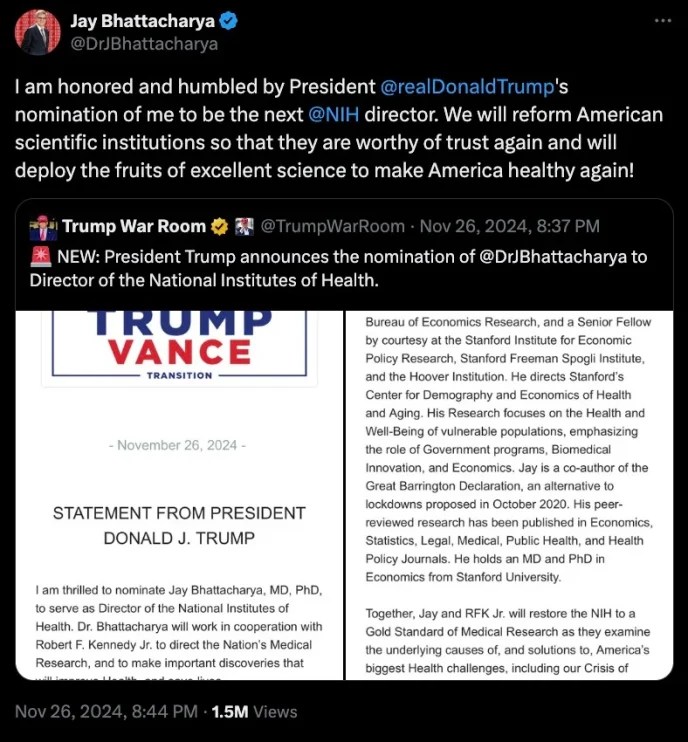
President Trump underscored this vision, calling Bhattacharya a leader who will restore the NIH to its “Gold Standard” while addressing America’s greatest health challenges. Paired with Robert F. Kennedy Jr., another advocate for reform, Bhattacharya is set to tackle systemic issues such as chronic illness, skyrocketing healthcare costs, and the erosion of public trust in science.
ATACMS Fired by Ukraine at Targets in Russia Likely Manufactured in 1990s
Sputnik – 26.11.2024
MOSCOW – The ATACMS missiles used by Ukraine against targets in Russia’s Kursk Region were most likely originally produced in the 1990s and had been modified at least twice to extend their lifespan.
This is according to a Sputnik correspondent’s analysis of the photos of the destroyed missile parts released by the Russian Defense Ministry on Tuesday.
Earlier in the day, the Russian Defense Ministry said that Ukraine fired five ATACMS missiles on the S-400 division in the Kursk Region — three missiles were intercepted and two reached the target, injuring a number of service personnel.
In addition, seven ATACMS missiles have been destroyed and one reached the target in Ukraine’s strike on the Vostochny airfield also in the Kursk Region, where two soldiers have been wounded by falling missile fragments.
The photos released by the Russian Defense Ministry showed that the ATACMS missiles were produced by “Lockheed Martin Vought Systems,” which is the name the US defense contractor used until 1999, according to annual budget reports of the US Army.
From the year 2000, the US defense contractor changed its name to “Lockheed Martin Missiles and Fire Control,” the budget report of the US Army released in 2000 showed.
The name of the manufacturer on the ATACMS missiles fired by Ukraine indicated that the weapons were most likely originally produced in the late 1990s, when the US Army began to procure such missiles in large quantities.
The ATACMS missiles have a service life of 10 years and would require about $1 million per unit to reset its service life, according to previous US Army budget reports.
Moscow to retaliate against Kiev’s ATACMS strikes – Lavrov
RT | November 26, 2024
Moscow will retaliate against continuing Ukrainian strikes on Russian soil with Western-supplied long-range missiles, Russian Foreign Minister Sergey Lavrov said on Wednesday.
His statement came after Kiev fired US-made ATACMS missiles at Russia’s internationally recognized territory, despite an earlier warning from the Kremlin.
“Missile strikes deep inside Russian territory are an escalatory step,” Lavrov told Rossiyskaya Gazeta newspaper. “All of our warnings that these unacceptable actions will be met with an appropriate response have been ignored.”
Those behind attacks on Russian citizens and infrastructure will face “well-deserved punishment,” the minister warned. He added that “no escalation coming from the enemy would force us to abandon our goals” in Ukraine.
Lavrov reiterated that Moscow remains committed to neutralizing “threats to Russia’s security,” including Ukraine’s aspirations to join the US-led NATO alliance.
In a video address last week, Russian President Vladimir Putin said that Moscow “reserves the right” to strike countries that allow Ukraine to use Western-supplied arms against Russia.
The Russian Defense Ministry said on Tuesday that it was preparing an unspecified response to Ukrainian strikes targeting an air defense battery and an airfield in Kursk Region. According to the MOD, Kiev used American-made ATACMS missiles during the attacks on November 23 and November 25.
On November 21, Russia struck a weapons factory in Dnepr with its brand-new Oreshnik ballistic missile. According to Putin, the strike was a response to “aggressive actions of NATO member” who support Ukraine.
The White House confirmed on Monday that it had lifted restrictions on the use of ATACMS by Ukrainian troops. The US previously barred Ukraine from using long-range weapons deep inside Russian territory due to concerns of possible escalation.
No more ‘deals’: what Palestinians want and will fight to achieve
By Ramzy Baroud | MEMO | November 26, 2024
The Games of the ICC
By Christopher Black – New Eastern Outlook – November 26, 2024
On November 21, the prosecutor of the ICC announced that a three-judge panel has finally made a decision on his May 2024 application for an arrest warrant for Israeli Prime Minister Netanyahu.
A warrant for his arrest and that of his former Defence Minister, Gallant, has been issued. If an indictment has been drawn up, which should precede an arrest warrant, we are not told and none appears on the ICC website.
Many are celebrating the arrest warrant against Netanyahu and Gallant. But, while there is no doubt that they deserve to be held to account by the Palestinians and the world for the crimes they have and continue to commit in Palestine, Lebanon, Syria and Iran, they are not charged with the crime of genocide, even though they are charged with inflicting mass starvation on the people of Gaza, nor the supreme war crimes of aggression for their continued illegal occupation of Palestinian lands and the brutal suppression of the Palestinian resistance to that occupation. Nor are they charged for their aggression against the sovereign nations of Lebanon, Syria and Iran, which crimes they openly brag about and which are recognised by the entire world, but not, it seems, by the prosecutor or judges of the ICC.
Further, as people calm down in their cheering, they must realise that the ICC has also issued arrest warrants for a leader of Hamas, Mohammed Diab Ibrahim Al-Masri whose alleged war crimes are nothing more than echoes of Israeli propaganda about the Palestinian armed resistance to the brutal occupation of Palestinian lands and the brutal oppression by the occupation forces of the Palestinian people.
Where is the charge of Genocide?
Netanyahu and Gallant are charged with war crimes and crimes against humanity for mass starvation and targeting the civilian population with aerial attacks, and mass attacks by Israeli armoured and other forces.
The ICC press release states,
“Each bear criminal responsibility for the following crimes as co-perpetrators for committing the acts jointly with others: the war crime of starvation as a method of warfare, and the crimes against humanity of murder, persecution, and other inhumane acts.”
“The Chamber also found reasonable grounds to believe that Mr Netanyahu and Mr Gallant each bear criminal responsibility as civilian superiors for the war crime of intentionally directing an attack against the civilian population.”
But these charges also amount to acts of genocide, so why are they not charged with genocide? And why has no indictment been issued? Only the prosecutor and the judges can explain, and they do not.
But aside from pointing out the obvious compromise made by the ICC, to placate its critics about its inaction over Israeli crimes by laying charges yet not laying the most serious charge, the one that should be laid, we have this phrase underlined above which needs to be considered, the phrase, “jointly with others.”
Israel’s Partners in Crime Untouched
Who are the “others”? The ICC coyly refuses to say, hoping no one will ask the question. But the answer is clear: the USA, the EU, UK, France, Canada and the rest, who all give military aid and support to Israeli to carry out these crimes and have made themselves co-belligerents in this murderous war against the peoples of the Middle East, and are its partners in crime. The leaders of those nations must also be charged and warrants issued for their arrest. They are equally culpable under international law. But they are not charged. So that, in his defence, Netanyahu, if he is ever brought before this tribunal, can argue the defence of selective prosecution, that is, he can ask, “why am I charged but not the co-conspirators, the co-actors who supported and encouraged my crimes. It is not just to charge me if they are not going to be charged.”
He would be right to use that defence, and perhaps the prosecutor has arranged it so that Netanyahu and Gallant now have that defence available to them.
Political Purpose of the Warrants
But we know that Netanyahu will never be arrested and face a trial at this so-called world court. The Americans immediately came to his defence and denounced the action of the ICC. They have to because if Netanyahu is ever before the judges of the ICC, they fear the facts about their role in the crimes against the Palestinians and the others will be revealed in all their detail and depravity. The British, the French, and the Canadians will have their dirty crimes exposed as well. None of the allies of Israel want Netanyahu arrested and tried. So he will not be. The ICC knows this.
So why was the warrant finally issued after so long a delay, after so much political interference was exerted by Britain, the US, the French and others to prevent the ICC from issuing charges?
We can only speculate, as we are not privy to the phone calls between Mr. Khan and the various governments involved in these crimes, and how it was all arranged, but it was a political decision of a political prosecutor of a political tribunal.
One reason can be to improve the image of the ICC, to make it look like it is doing something, while, in effect, nothing is done to change the situation for the Palestinians, the Lebanese, the Iranians, and the Syrians. It will placate some who support the Palestinians, who think the ICC is a real court, and perhaps it is hoped that this will reduce the street protests across Europe and elsewhere. No need now the ICC will say, we have acted, and you can go home now.
The ICC attempts to justify its charges against Russia
But there is another reason, and that is to trick people into thinking the ICC is some real arbiter of international justice and therefore the arrest warrants the ICC issued against President Putin and others are valid and should be acted upon.
The ICC has issued warrants of arrest of a series of Russian officials over the past few months; we suppose to keep the pot boiling, each as absurd as the one before it.
On 17 March 2023, the ICC issued warrants for Vladimir Putin, President of the Russian Federation, and Ms Maria Alekseyevna Lvova-Belova, Commissioner for Children’s Rights in the Office of the President of the Russian Federation. Based on the Prosecution’s applications of 22 February 2023, Pre-Trial Chamber II considered that there are reasonable grounds to believe that each suspect bears responsibility for the war crime of unlawful deportation of population (children) and that of unlawful transfer of population (children) from occupied areas of Ukraine to the Russian Federation, in prejudice of Ukrainian children.
The absurdity of these charges and warrants, based solely on Kiev propaganda about Russia’s attempts to save the lives of children, is manifest. It is also clear that they did not charge President Putin with aggression because there has been none, and so they decided to use the most emotive charge possible to inflame public opinion against Russia. In other words, the ICC became an active tool of NATO in its war against Russia.
On 5 March 2024, the ICC issued warrants of arrest for Sergei Ivanovich Kobylash, a Lieutenant General in the Russian Armed Forces who at the relevant time was the Commander of the Long-Range Aviation of the Aerospace Force, and Viktor Nikolayevich Sokolov, an Admiral in the Russian Navy, who at the relevant time was the Commander of the Black Sea Fleet for the war crime of directing attacks at civilian objects, the war crime of causing excessive incidental harm to civilians or damage to civilian objects, and the crime against humanity of inhumane acts. None of these allegations are based on any facts or any investigation and meant to be propaganda.
On 24 June 2024, the ICC issued warrants of arrest Sergei Shoigu and Valery Gerasimov, in the context of the situation in Ukraine for alleged international crimes committed from at least 10 October 2022 until at least 9 March 2023 for the same reasons, war propaganda, to justify the continuance of the war against Russia.
Ukraine leadership given immunity from prosecution for its crimes
The ICC has not charged anyone in the illegitimate government of Ukraine for any of its crimes against the civilian population of Ukraine in the Donbass oblasts from 2014 to today, nor for its gratuitous attacks on the civilian population of Russia. It has been given immunity from prosecution.
The only legitimate prosecutors are the Palestinians, Lebanese, Iranians and Syrians for Israeli crimes committed against them.
So, all those celebrating and cheering the warrants issued against Netanyahu and Gallant should think carefully about what they are doing. Yes, those two are war criminals. Yes, they should be held accountable, but to the Palestinians and the Lebanese, the Syrians and Iranians. They are the ones who should be issuing warrants for their arrest, who should make them stand trial before the tribunals of those nations, as well as the leaders of the USA and the other nations who are parties to the Israeli crimes not this political farce called the ICC which is not a world court, which is not an independent judicial body capable of rendering justice, but a political tool of the West, used by the West for its own political and strategic reasons and objectives. The world is tired of the games of the ICC. The people of the world want real justice.
Christopher Black is an international criminal lawyer based in Toronto. He is known for a number of high-profile war crimes cases and recently published his novel Beneath the Clouds. He writes essays on international law, politics and world events.
Featured Video
No Vote, No Representation, No State: Democracy, Israeli Style
or go to
Aletho News Archives – Video-Images
From the Archives
Sanctions, War and the Policy of Dual Containment
By SASAN FAYAZMANESH | March 17, 2008
It is now nearly three decades since the Unites States adopted the policy of dual containment of Iran and Iraq. While much has been written about the containment of Iraq, there has been very little in-depth analysis of this policy when it comes to Iran. In a book that is going to be released on March 31, 2008, entitled The United States and Iran: Sanctions, Wars and the Policy of Dual Containment (Routledge), I attempt to address this shortcoming by investigating when and why the US policy of containment of Iran came about, how it evolved, and where it stands today.[1] To the extent that Israel has been involved in US policy making, the study will also include the role that Israel has played in the containment of Iran. Also, since the fate of Iran has been inextricably linked to that of Iraq, occasionally the investigation will overlap with the containment of Iraq.
The policy of dual containment of Iran and Iraq originated during the Carter Administration, but it was not until the Clinton Administration that the expression “dual containment” became popular. … continue
Blog Roll
 Aletho News
- Europe’s Establishment Is Embracing War – and Losing Voters
- NATO chief advocates war of aggression
- No Vote, No Representation, No State: Democracy, Israeli Style
- Zionist Bought Senate Blocks Information About American Citizens Killed By Israel
- While Gaza dominates the UN, these are the people keeping it alive
- New Report: “Scholasticide and Genocide in Gaza: Assessment, Testimonies and Legal Analysis”
- ‘THAAD Delusion’: Iran war exposes US missile shield limits – The Atlantic
- Moscow issues warning to NATO over Russian exclave
- Yes, the Iran war has destroyed Trump’s presidency
- The fallacy of US delusions about Iran’s economic collapse
- If Americans Knew
- Mamdani releases plan to combat antisemitism and hate crimes in New York City
- Iran’s Revolutionary Guards Publish Letter to the American People
- DMFI launches $1 million ad campaign supporting Virginia’s Elaine Luria
- US Senate blocks resolution seeking report on Americans killed by Israel
- Israeli Attacks Kill Ten Palestinians in Gaza
- Massacre at Minab: The School That Became a Grave
- Israeli media: The IDF Shows It Doesn’t Turn a Blind Eye; It Actively Emboldens Settler Havoc
- As settlers ravage West Bank, Israeli forces kill 10 in Gaza – Daily Update
- New Report: “Scholasticide and Genocide in Gaza: Assessment, Testimonies and Legal Analysis”
- Ex-Biden officials are desperate for a Gaza scapegoat
- No Tricks Zone
- Green Energy Debacle: German Expert Professor Fritz Vahrenholt Warns Of Severe Economic And Social Consequences
- Two More Paleo Reconstructions Affirm Meters-Higher Sea Levels Across Ireland, Brazil 7000-6000 Years Ago
- New Study: Earth And Venus Surface Warmth Largely Explained By Convection And Lapse Rate, Not CO2 Or Radiation
- 2025 Nature Paper Claiming Worsening Global Drought Gets RETRACTED …Heavily Flawed
- New Study: ‘Global Drought Shows No Detectable Recent Acceleration Under Climate Warming’
- Economic Masterminds: German Socialists Suggest Taxing Productivity Gains Stemming From Using AI
- The South China Sea Has Not Been Cooperating With The Climate Change Narrative
- Energy Crisis: Germany Enters Heating Season With Historically Low Gas Reserve Fill Levels
- New Study: The Antarctic Ice Sheet Gained Mass From 2020-2024 Due To Staggering Snow And Ice Accumulation
- Study: Ocean Heating Rates From Thousands Of Years Ago ‘Dwarf’ Modern Ocean Heating Rates

