Trump’s ‘new’ policy on Iran
By Viktor Mikhin – New Eastern Outlook – November 26, 2024
According to a report published by the Financial Times, Trump’s new team intends to ‘bankrupt’ Iran during his second presidential term. The report, citing a national security expert close to the new team, states that executive orders targeting Iran, mainly its oil exports, could be signed on the first day Trump takes office.
The so-called ‘maximum pressure campaign’ is a set of measures imposed against Iran in 2018 after Trump brazenly and illegally withdrew Washington from the Joint Comprehensive Plan of Action (JCPOA). The agreement, signed in 2015, limited Iran’s nuclear programme in exchange for an easing of economic and financial sanctions. Trump called the agreement a ‘disaster’ only because it was signed by Democratic President Barack Obama. He allegedly stated that he was going to make sure that Iran would never receive nuclear weapons, while promising to limit Iran’s regional influence.
In other words, the world has a very dangerous precedent in the Middle East: on the one hand, Israel has completely illegally developed and put into service nuclear weapons and their means of delivery and, on the other hand, Trump is trying to limit – and, moreover, prohibit – Iran from developing peaceful nuclear energy and oppose Tehran’s relations with its neighbours. What kind of democracy is this and what exactly does Trump mean by the word ‘democracy’? This is no longer democracy, rather a medieval-type dictatorship: if I want to, I will allow it, but it is better not to allow it at all.
What was Trump’s goal previously?
Since 1979, Iran has constantly faced US sanctions. The Trump administration’s ‘maximum pressure’ campaign was not so much about inventing new limitations as about dramatically expanding the scope and viciously tightening compliance with previous or existing limitations.
Following the unabashed withdrawal of the United States from the JCPOA (an international document), Trump immediately reinstated sanctions against Iran’s energy, shipping, shipbuilding, automotive and oil sectors in accordance with a decree issued on August 6, 2018. The key difference was the aggressive implementation of so-called ‘secondary sanctions’, which punished foreign organisations for doing business with Iran, regardless of whether these transactions violated their own domestic laws. The aim was to put significant pressure on international players to comply with US sanctions. Apparently, Trump considered himself a liege lord and all others to be his vassals, the purpose of whom was to fulfill Trump’s will.
In May, 2019, the Trump administration dealt a blow to Iran’s metallurgical industry (the second largest source of export revenue) by tightening sanctions on the production of iron, steel, aluminum and copper. This included well-designed sanctions against any foreign financial institutions facilitating large transactions related to these industries. At the same time, Washington was completely uninterested in the opinions and interests of other parties involved in peaceful trade with Iran.
The third major decree issued by Trump was directed against the Islamic Revolutionary Guard Corps (IRGC) and any organisations or individuals conducting financial transactions with it. The stated goal was to limit Iran’s production of ballistic missiles, a weapon that, according to then-US Special Representative for Iran Brian Hook, existed only in Photoshop. Nevertheless, Trump hastened to impose severe sanctions on the IRGC.
The new Biden administration that came to power, contrary to expectations, did not put an end to Trump’s policy. According to Secretary of State Anthony Blinken, all sanctions were to remain in force and hundreds more new ones were added to them. It is incomprehensible how one strong and arrogant country is trying to rule the whole world and establish its own rules of life and trade that are only beneficial to it.
Did Trump’s policy bear fruit?
“The efficacy of US sanctions against a foreign government is measured by the economic damage not caused”, said Amir Ali Abolfat, an expert on North American affairs, “and the extent to which sanctions achieve their political goals and change the behaviour of the target government”. An analysis of statistics before the start of the ‘maximum pressure’ campaign shows that, although Trump made it more difficult for Iran to earn money from exporting oil and metals, he failed to reduce them so much that a brave and persistent Iran had to change its policy.
“Iran produces strategically important goods”, Abolfat explained. “As long as there is demand, these products will find their market. Although Iran no longer sells oil to Europe, it has begun supplying it to China, as evidenced by increased sales to that country, which is resisting pressure and US hegemony. The same principle applies to the export of Iranian metals”.
There is no doubt that Trump and Biden have created great difficulties for Iran, but did they manage to achieve their goals? Absolutely not. Iran’s uranium enrichment rate has increased from 3% to 60% and its military potential has expanded significantly over the past seven years. Moreover, Tehran is successfully developing friendly ties with its neighbours and has managed to create a so-called Axis of Resistance, which successfully opposes the United States and Israel in the region.
As for domestic needs, Iran has successfully reduced its dependence on European partners and former allies (such as Korea and Japan) by finding alternative suppliers. The departure of European automakers has led to a sharp increase in Chinese car imports, making Iran a major market. In addition, Iranian engineers and experts have independently completed projects to develop gas and oil fields that previously depended on Western cooperation. This self-confidence eventually spread to other industries previously dependent on imports, such as the food industry and medicine.
Sanctions and nothing else?
Central to Trump’s policy in the Middle East from 2017 to 2021 was an unsuccessful attempt to drive a wedge between Arab countries and Iran, while simultaneously positioning Israel as a key regional security partner.
Now this approach is much less viable. Iran’s improved relations with countries, such as Saudi Arabia, and ongoing efforts to normalise ties with others, such as Egypt, undermine this strategy. In addition, the successful Hamas operation on October 7 completely dispelled all notions of Israel’s invincibility and the actions of the Israeli regime to destroy the Palestinians made the continuation of the normalisation agreements concluded within the scope of Trump’s ‘Abraham Accords’ unlikely.
Experts believe that the only other untested option – the military option – to which hotheads in the United States and Israel are inclined, is fraught with enormous risk. Such actions could lead to devastating consequences for the West, potentially widespread disruption of oil supplies, attacks on Western bases in the Middle East and fundamental changes to Iran’s nuclear policy. Ultimately, Washington must recognise that enormous pressure alone will not help it achieve its goals with regard to Iran. To solve the US’ problems, Iran’s problems must also be acknowledged. It is only through returning to the JCPOA and sitting at the negotiating table that the most difficult tasks in the region can be solved. Iran is ready for this and has expressed this more than once. Is the ‘peacemaker’ Trump ready for this or is he only thinking of using force?
Türkiye protests latest US sanctions against Russia
RT | November 26, 2024
Türkiye is currently in talks with the US to secure a sanctions waiver that would allow it to continue using Russia’s Gazprombank to pay for natural gas imports, the country’s Energy Minister Alparslan Bayraktar told reporters on Monday.
Last week, the US Treasury Department imposed restrictions on more than 50 Russian financial institutions, including Gazprombank, which is linked to the eponymous Russian gas giant, and six of its international subsidiaries. The sanctions have effectively cut off Russia’s primary bank for energy-related transactions from the SWIFT interbank messaging system, meaning it can no longer be used for dollar-based transactions.
According to Bayraktar, unless a special exemption is made, Türkiye, which imports nearly all of its gas, won’t be able to pay Moscow for natural resources. Russia currently accounts for more than 50% of the country’s pipeline imports, according to Reuters.
In his comments, Bayraktar pointed to a previous waiver granted to Ankara when Washington had sanctioned Iran in 2012. At the time, the sanctions against Tehran included a clause that allowed the US President to issue a special exemption if an oil-importing country faced “exceptional circumstances” that made it impossible to reduce Iranian oil imports. Bayraktar has argued that Türkiye now needs a similar waiver for Gazprombank in order to secure its supply of natural gas.
“These sanctions will affect Turkey. We cannot pay. If we cannot pay, we cannot buy the goods. The foreign ministry is in talks,” Bayraktar said.
The latest US sanctions have also sparked disdain among several other European buyers of Russian gas. Last week, Hungarian Foreign Minister Peter Szijjarto accused Washington of trying to undermine energy security in the Central European region by imposing restrictions on Gazprombank.
In a post on Facebook, the diplomat stated that any attempts to jeopardize energy supplies to Hungary are “considered as an offence against our sovereignty” and stressed that Budapest denounces all such attacks and has vowed to “resist the pressure and pursue our national interests.”
He added that Hungary is currently in talks with other countries, such as Bulgaria, Serbia, Azerbaijan and Slovakia in hopes of finding a solution for securing energy supplies.
Meanwhile, despite the EU announcing plans to eliminate its dependence on Russian energy, it has remained one of the world’s major importers of Russian fossil fuels while its members have purchased record volumes of liquified natural gas (LNG) from Moscow.
Washington elites want to saddle Trump with world war – Tucker Carlson
RT | November 26, 2024
Donald Trump’s enemies in Washington, DC are trying to prevent the incoming president from exposing their crimes by landing a world war on his lap when he is inaugurated in January, political commentator Tucker Carlson has claimed.
Carlson is a supporter of the agenda that helped Trump secure a second presidential term earlier this month. The Republican leader has promised to fix America’s problems and disengage the country from foreign conflicts.
“Permanent Washington doesn’t care about domestic policy,” the former Fox News host told the online political talk show Redacted on Monday. “What they care about is exercising power abroad: killing people, because it makes them feel like God, and making money. And that’s where the money is, trillions of dollars.”
The group he was referring to “is basically everyone in DC in both parties,” he added. Carlson claimed those people want Trump “to take the country to war either against Russia, or, far more likely, Iran.” The pro-war clique in the US capital perceives this scenario as “the only way to stop Trump and the disclosure that a Trump administration will bring,” he said.
An attack on Iran would result in a world war just as certainly as an escalation of tensions with Russia, Carlson added.
“This is not 2002. Iran is now part of a coalition that includes the biggest economies in the world and the largest militaries in the world,” he pointed out, naming Russia, China and Türkiye as likely backers of Tehran.
Anyone supporting the continuation of the Ukraine conflict lacks “the requisite wisdom to lead my country,” Carlson said.
“Anybody who would even consider having a war with Russia or Iran should not be in any position of power at all, in this administration or any other administration,” he added, describing the test as “super simple.”
Trump claimed during his campaign that he could end the Ukraine conflict in 24 hours. After his electoral victory, outgoing President Joe Biden authorized strikes with long-range Western missiles deep inside Russia, which Moscow warned in advance would cross a red line.
Moscow reacted by firing a new hypersonic missile at a military plant in Ukraine. The Oreshnik is understood to be nuclear-capable and have sufficient range to strike any target in Europe. President Vladimir Putin has claimed that Western anti-ballistic missile systems cannot intercept it.
West Nudges Ukraine to Dirty Bomb and Nuclear Terrorism – Russian Security Service
Sputnik – 26.11.2024
“The collective West, led by the US, aiming to preserve its dominance and continue its predatory colonial policies, can only respond to these processes with the ‘stoking’ of general tension,” Director of Russia’s FSB Security Service Alexander Bortnikov said during a CIS meeting in Moscow.
The West is secretly pushing Kiev to engage in nuclear terrorist activities, as well as to create a “dirty bomb,” the Director of Russia’s FSB Security Service Alexander Bortnikov said at a meeting of heads of security and intelligence services of CIS countries in Moscow.
“The Anglo-Saxons are covertly urging Kiev toward dangerous escalation: engaging in nuclear terrorism and creating a ‘dirty bomb,'” he said.
Kiev is capable of provoking an incident with a “dirty bomb” to counter Russia and its goals in the special military operation, as existing capabilities allow Ukraine to create such a device, said Lieutenant General Igor Kirillov, head of the Radiation, Chemical, and Biological Defense Troops of the Russian Armed Forces, earlier in November. Ukrainian Security Service employees are being trained in the use, manufacture, and detonation of a “dirty bomb” in crowded places, the general reported.
A “dirty bomb” is a container filled with radioactive isotopes and an explosive charge. When detonated, the container breaks apart and the radioactive material is scattered by the shockwave, causing widespread contamination over large areas.
Ukraine Turned Into Testing Ground For Instability Tools
The West has turned Ukraine into a laboratory for methods to undermine the security of not just Russia but the entire post-Soviet space, stated Bortnikov.
“Threats to the security of the CIS countries are mostly linked to the aggressive and cynical course of the collective West and the Kiev regime it has nurtured,” Bortnikov said at the same meeting in Moscow.
“Through their efforts, Ukraine has been transformed into a testing ground for experimenting with methods to undermine the security of not only Russia but the entire post-Soviet space,” the FSB director noted.
US Foreign Policy To Remain Unchanged
It is unlikely that President-elect Donald Trump’s victory will lead to a fundamental change in Washington’s foreign policy, stated Bortnikov.
“The collective West, led by the US, aiming to preserve its dominance and continue its predatory colonial policies, can only respond to these processes with the ‘stoking’ of general tension,” Bortnikov said during the meeting.
“It is unlikely that the election of a new US president will lead to a radical change in Washington’s foreign policy,” he added.
Biden May Try to Escalate As Farewell Gift
It is possible that the outgoing team of US President Joe Biden will try to exacerbate the situation in Eurasia to complicate political decision-making for the incoming administration, Bortnikov added.
“Moreover, it is possible that the outgoing Biden administration, within the framework of domestic political struggles, will try to escalate the situation in key regions of Eurasia — primarily in the post-Soviet space, the Middle East, and Southeast Asia. The main goal is to complicate the new administration’s ability to politically resolve accumulated problems,” Bortnikov explained.
“The first step has already been taken: the Kiev regime has been allowed to launch long-range missile strikes deep into Russian territory, which will inevitably lead to an escalation of the conflict in Ukraine and its surrounding regions,” he explained.
Ukraine Became Shadow Arms Market
A global shadow arms market has been created in Ukraine, with weapons constantly being transferred to other unstable regions, stated Bortnikov.
“The consciousness of the Ukrainian population has been restructured with an anti-Russian agenda. Land, natural resources, and industrial enterprises are being bought up by transnational corporations. The territory has become a magnet for mercenaries and terrorists from all over the world,” Bortnikov said at the same meeting in Moscow.
Ukraine receiving nukes would be ‘insane’ – US lawmaker
RT | November 26, 2024
Any move by outgoing US President Joe Biden to help Ukraine obtain nuclear weapons would be “insane” and would amount to treason, Republican lawmaker Marjorie Taylor Greene has claimed.
The House representative from Georgia was reacting to a post on Tuesday by entrepreneur Mario Nawfal, who weighed in on a New York Times article, bylined by four of its journalists, claiming that US and EU officials are “discussing deterrence as a security guarantee” for Ukraine, including giving Kiev nuclear weapons.
Nawfal described the purported talks as a “desperate” move “to tip the scales against Russia” before President-elect Donald Trump takes office in January, which would mark an “unprecedented escalation” in the conflict.
Responding to the post, Greene wondered whether Biden administration is “trying to start a nuclear war and use it as the reason to stop the transfer of power to Trump.”
“This is insane and completely unconstitutional, possibly an act of treason,” she wrote on X.
The White House is resorting to more aggressive measures in aiding Kiev ahead of Trump’s return. The Republican has repeatedly vowed to end the Ukraine conflict swiftly, and is expected to try to push Moscow and Kiev toward peace talks.
With two months left in office, Biden last week reportedly gave in to one of Ukraine’s long-standing demands and authorized the use of American-supplied ATACMS missiles on targets deep within Russian territory. The missiles had already been used in strikes on Russia’s Crimea, Donetsk, and Lugansk regions, which Washington considers Ukrainian.
Last week, the New York Times reported that certain US officials have suggested that Biden might provide Kiev with nuclear weapons as a deterrent against Russia. “That would be an instant and enormous deterrent,” the paper argued, noting however that such a step would be “complicated and have serious implications.”
Russia recently updated its nuclear doctrine, allowing for a nuclear response to a conventional attack by a non-nuclear state that is supported by a nuclear power, such as a missile strike on Russian territory. Moscow also used a new medium-range hypersonic missile against Ukraine in response to Kiev’s use of foreign-made long-range weapons for strikes deep into Russia.
Russian President Vladimir Putin said that the attacks have moved the Ukraine conflict to a global level. He has repeatedly warned that Moscow will consider an attack by Western long-range weapons on Russian soil as directly involving the countries that donated the arms.
‘Problematic Reality’: Biden Regime Seeks $5.7 billion in Emergency Funding for Virginia-Class Submarines
By Oleg Burunov – Sputnik – 26.11.2024
The US president’s Office of Management and Budget has issued a request to Congress for about $5.7 billion in emergency funding to tackle extra costs regarding the Virginia-class nuclear-powered submarines, American media cited a senior navy official as saying.
Approximately $3.5 would go towards addressing the cost overruns, while the remainder will be split between submarine prime contractors General Dynamics Corp. and Huntington Ingalls Industries Inc. for increased wages and “other productivity enhancements,” the official said.
The official made it clear that the navy also projects delivery delays of 24 to 36 months for the aforementioned vessels.
“Our Virginia-class fast attack submarine program is not where it needs to be right now. The program and the shipyards are not producing submarines at the rate that our national security strategy and the national defense strategy require,” the source stressed.
This comes after House Defense Subcommittee Chairman Ken Calvert said that a shortfall in funding for Virginia-class attack submarines is projected to grow to $17 billion over the next six years, adding that the US Navy suffered from persistent delays and cost overruns in the service’s shipbuilding program.
The Defense News earlier reported that the situation with the Virginia-class submarines remains “a problematic reality” for the navy, which currently has 49 such vessels, despite a formal requirement for 66.
US Vice Admiral Rob Gaucher earlier insisted that crewing and maintenance will dog the Navy’s submarine fleet in the coming years.
The National Interest magazine, for its part, noted that the navy’s submarine fleet is “under congressional scrutiny for repeated delays and rising costs”– problems that “won’t be easy to fix.”
Poles recall RFK Jr. battled US corporate farming giant
Over two decades ago, Robert Kennedy Jr. took on Smithfield Foods in Poland over its actions to eliminate its competition, small family farms
By Liz Heflin | Remix News | November 25, 2024
RFK Jr. says the second in command at Smithfield Foods in Poland offered a $1 million bribe to a state official to pass legislation to essentially shut down local hog production.
The reveal was made during a podcast with farming expert Joel Salatin. The official turned Smithfield in over the bribe attempt, but others were quick to take the bribe and pass the desired legislation.
None of this is new news. However, RFK Jr.’s alliance with Trump, not to mention being nominated to serve as secretary of health and human services in his administration, has given him a new platform to draw attention to the issues surrounding commercial farming and the food we eat.
And when I say not new, I mean, this topic has been around for a couple decades, actually more.
A 2003 article from Ecologist highlighted the issues with the way Smithfield and “fellow industrial pork producers” delivered bacon, chops and other pork products to American consumers. The article stated these entities had “driven tens of thousands of family farmers off the land, shattered rural communities, poisoned thousands of miles of US waterways, killed billions of fish, put thousands of fishermen out of work, sickened rural residents and treated hundreds of millions of farm animals with unspeakable and unnecessary cruelty.”
Pretty harsh. And then, Smithfield turned its eyes to greener pastures. Where? All the way over in Poland, fresh out of its decades-long stint under the iron fist of communist rule. What may not be known by many was the rather strong presence, i.e., high number, of family farms that survived under communism. Kennedy refers to this himself in the podcast around minute 25, “small farms that were self-sufficient farms” and that had no money for chemicals.
However, despite surviving well under communism, these family farms could never have expected the “free market” might of “private” concerns that would come knocking at their doors, or more like come to knock their doors down.
“In 1999, Smithfield began buying slaughterhouses and state farms in Poland. On July 22 this year (2003), the firm’s vice president promised Poland’s Senate agricultural committee that Smithfield will ‘modernise’ Polish agriculture and bring prosperity and jobs to rural communities,” reads the Ecologist article.
Now 25 years later, RFK Jr., is bringing to light again exactly what happened in the name of American capitalism all those years ago.
Smithfield, he tells Salatin on the podcast, had come in and bought the old Soviet slaughterhouses and was modernizing these massive facilities. The legislation that Smithfield initiated stated that you could not operate a slaughterhouse if it did not have laser-automated faucets in the bathrooms, technology that small slaughterhouses servicing local family farms would not be able to afford. In this way, as Kennedy says, “in one fell swoop,” all of Smithfield’s competitors in Poland were put out of business. Kennedy did not clarify what year this happened.
There is pretty hefty coverage of the lawsuits between environmental groups, including RFK Jr.’s Waterkeeper Alliance, and Smithfield in the U.S., alleging, for example, that the giant put small farms out of business and polluted soil. One class action suit against Smithfield that Kennedy was a part of was thrown out in 2002.
What’s crazy is that this battle reached all the way to Poland. In a letter to the Polish prime minister, dated February 2004, MP Anna Sobecka presented a brief history of Smithfield’s practices back in the U.S., including that “one of the slaughterhouse’s managers was sentenced to prison for falsifying records in the case.”
“Smithfield Foods, the owner of the Animex Wielkopolska company it bought out, is constantly breaking the law by placing large piles of manure in nearby fields near the village of Więckowice without permits. Another such pile was recently built in Sierosław, near Więckowice. This is an expression of complete disregard for the recommendations of Polish officials,” the letter reads. The MP goes on to say that for unknown reasons, the company was still awarded the “Crystal Globe of Export Leaders” by the minister of economy, labor and social policy.
The primary concern of the letter was related to “several large piles of pigsty waste without the required permits and without the slightest safeguards” near Niepruszewickie Lake. It was then alleged that hazardous chemicals seeped into the lake and ended up causing illnesses, particularly in children, in the nearby town of Więckowice.
She adds that “Robert F. Kennedy Jr., representing American farmers, has visited Poland several times to warn against Smithfield Foods’ destructive activities. Kennedy warned that further expansion of the company could threaten to destroy Polish family farms. Kennedy’s speeches provoked a panic among Smithfield Foods management, which filed a defamation suit against the American politician in the district court in Poznań,” adding that “the documents and evidence available to the American politician clearly confirm the allegations he made against Smithfield Foods.”
This letter came after Smithfield’s subsidiary in Poland had sued Kennedy in Poznan for his remarks about the company’s practices during a debate in the Sejm, the Polish parliament, where he reportedly called it a “mafia organization” that violates environmental regulations and accused parties involved of selling out Polish small farmers and consumers for profits. The outcome of that suit is unclear. However, another suit filed against Smithfield by a group including Kennedy was dismissed by the judge, with all parties ordered to pay Smithfield’s legal fees.
What is also very clear is that the world today is an even smaller place than back then, and Smithfood’s primary challenger has now been nominated to serve in the cabinet of the U.S. president.
Today, Smithfield is a Chinese-owned company, RFK Jr. says in the abovementioned podcast, adding that China owns some 30 percent to 40 percent of the hog production in the U.S.
“We’re in a colonial model. USDA now works for China by keeping little farmers out of business and strip-mining and commoditizing our natural resources, our farmland, and everything else.”
As to why RFK Jr. brought up Poland after all these years and if he plans to do something about their operations there is unknown.
He is on a mission for consumers everywhere to know their food is safe, wholesome, and healthy. As he also told Joel Salatin, “only the worst food is reaching the American public… and it’s high cost.”
He’s even teamed up with Trump’s wife, Melania, in an apparent attempt to get President-elect Trump off fast food. Good luck with that.
I highly recommend watching the full podcast with Joel Salatin, especially his explanation of “uberization” of the food system around minute 23.
NATO admiral urges Western businesses to prepare for ‘wartime scenario’
RT | November 25, 2024
Businesses in NATO countries should prepare themselves for a “wartime scenario” and adjust their production lines and supply chains to be less vulnerable to blackmail by nations such as Russia and China, the outgoing chief of the US-led bloc’s military committee, Admiral Rob Bauer, said on Monday.
Speaking at a European Policy Center think-tank event in Brussels, he urged Western industries and businesses to implement deterrence measures.
“If we can make sure that all crucial services and goods can be delivered no matter what, then that is a key part of our deterrence,” Bauer argued.
“Businesses need to be prepared for a wartime scenario and adjust their production and distribution lines accordingly. Because while it may be the military who wins battles, it’s the economies that win wars,” the NATO official said. He mentioned China and Russia in the context of how he believes wars are waged in the economic sphere.
“We thought we had a deal with Gazprom, but we actually had a deal with [Russian President Vladimir] Putin,” he stated, apparently referring to the drop in Russian gas supplies to the EU, which took place after the escalation of the Ukraine conflict in 2022.
At the time, the EU declared that ending its reliance on Russian energy was a key priority, and many members voluntarily halted their imports, while supplies also plunged due to the sabotage of Russia’s Nord Stream pipelines.
American Pulitzer Prize-winning journalist Seymour Hersh blamed the sabotage on the CIA, alleging that the agency had carried out the attack under the direct orders of the White House – an allegation it has denied.
Bauer then extended his warning to China, claiming that Beijing could use its exports to NATO states and the infrastructure that it owns in Europe as leverage in the event of a conflict.
“We are naive if we think the [Chinese] Communist Party will never use that power. Business leaders in Europe and America need to realize that the commercial decisions they make have strategic consequences for the security of their nation,” the official claimed.
It is unclear what “wartime” Bauer is predicting in his statements.
NATO has long declared Russia to be a direct threat, and Western officials have repeatedly claimed that if Moscow is allowed to win the conflict in Ukraine, it could then attack other European countries. Russia has dismissed these claims as nonsense. Restrictions that Moscow introduced in trade with the West have largely come in response to unprecedented economic sanctions placed on the country in connection with the Ukraine conflict.
Beijing has also faced its share of trade barriers and restrictions introduced by Western states, and introduced similar measures in response. According to most experts, including many in the West, the sanctions policy has backfired on Western economies, leading to supply shortages and inflation.
Will Armageddon Be Joe Biden’s Final Legacy?
By Ted Galen Carpenter | The Libertarian Institute | November 25, 2024
When the Soviet Union dissolved in late 1991, the world seemed poised for a new, more peaceful era no longer haunted by the fear of a nuclear Armageddon. The principal successor state from the wreckage of the USSR was a noncommunist Russia that was intent on becoming part of the democratic, capitalist West. President George H. W. Bush and his top advisers exercised considerable diplomatic skill in managing the twilight years and ultimate demise of the Soviet Union. Their core achievement was to gain Moscow’s assent to Germany’s reunification and membership in NATO. The implicit tradeoff (unfortunately, never put in writing) was that NATO would not expand beyond the eastern border of a newly united Germany.
The contrast between the benign end to the original Cold War and the current status of relations between the West (especially the United States) and Russia could not be greater or more alarming. NATO’s meddling in the armed conflict between Ukraine and Russia has reached the point of being an outright proxy war for the alliance. As NATO’s leader, the United States has pushed a series of extremely dangerous escalatory steps. The latest provocation is the decision by President Joe Biden’s administration authorizing Ukraine to use long-range U.S. Army Tactical Missile Systems (ATACMS) that are capable of striking at least 190 miles inside Russia. Moscow has responded by adopting a new nuclear doctrine warning that the use of such missiles by NATO’s Ukrainian proxy would mean that Moscow is officially at war with the U.S.-led alliance. Perhaps Russian President Vladimir Putin is bluffing, but the risk of a nuclear collision between NATO and Moscow now appears to be at unprecedented levels.
It is bitterly ironic that the decision to let Ukraine use American missiles that might trigger World War III has been made by the lamest of lame duck U.S. presidents. At the fifty-ninth minute of the eleventh hour, the leaders of the Democratic Party pressured Joe Biden to withdraw from the presidential race. They did so because the evidence of his cognitive decline had become undeniable. However, his hand-picked successor, Kamala Harris, then proceeded to lose the presidential election to Republican nominee Donald Trump.
To say that the Biden administration has no mandate to make such a crucial decision involving war and peace would be a monumental understatement. In fairness, though, the current foreign policy crew is not solely responsible for fouling-up relations with Russia and provoking a new cold war with nuclear implications. That “achievement” has been a bipartisan effort taking place over a span of more than three decades.
Toward the end of George H. W. Bush’s administration, public opinion polls in Russia showed that nearly 80% of Russians held positive views of the United States. In the late stages of the Bill Clinton administration, nearly the same percentage held negative opinions.
It was hardly a surprising development. During his years in office, Clinton and his Russian-hating advisers (especially UN ambassador and later Secretary of State Madeleine Albright) antagonized Moscow on multiple occasions. Washington went out of its way to attack Russia’s long-standing religious and political clients, the Serbs, as the Yugoslav federation disintegrated. However, the Clinton administration’s decision to expand NATO to include Poland, the Czech Republic and Hungary struck the biggest blow to East-West relations.
Clinton’s successor, George W. Bush, continued and intensified the policy of provoking and antagonizing Russia. Subsequent rounds of NATO expansion brought U.S. military power to Russia’s immediate neighborhood by adding such new members as the three Baltic republics, Slovakia, Bulgaria, and Romania. Most provocative of all, Bush pushed to add Ukraine to the alliance. Although Germany and France temporarily blocked immediate moves to make Ukraine a member, Washington’s ultimate goal was quite clear.
A rising number and volume of warnings against making Ukraine a NATO asset also came from Putin and other officials. Washington and its key European allies ignored those warnings but it became clear in 2014 that the Kremlin was not bluffing. When President Barack Obama and key European leaders helped overthrow Ukraine’s generally pro-Russia president and install a regime subservient to NATO, Moscow struck back emphatically, seizing Ukraine’s strategic, but majority Russian populated, Crimean peninsula.
Relations between the West and Russia continued to deteriorate thereafter. In the autumn of 2021, the Kremlin proposed a new relationship with the West that amounted to Russia’s minimum demands. Those demands included a guaranteed neutral status for Ukraine—thus foreclosing the prospect of Kiev’s eventual membership in NATO. The Kremlin also sought the withdrawal of advanced U.S. weaponry from the easternmost members of NATO. It amounted to an ultimatum, and when the Biden administration treated Moscow’s demands with contempt, the Kremlin launched a full-scale invasion of Ukraine in February 2022. That offensive, combined with the decision by the United States and its allies to impose severe economic sanctions against Russia, ignited an ever-escalating military crisis.
It is uncertain whether President-elect Donald Trump intends to end the dangerous impasse with Moscow. Contrary to the partisan myth that Trump has been Putin’s puppet, his actual policies during his first term were consistently hardline. One can hope, though, that he has fully absorbed the lesson of what a disaster Washington’s love affair with Ukraine has become for both countries. Restoring cooperative bilateral relations with Russia is essential for global peace.
There is an alarming possibility, however, that Trump won’t get the opportunity, even if he wishes to back away from the beckoning abyss. The lame-duck Biden administration still holds power for nearly another two months, and that is more than enough time to plunge the country into nuclear war, if administration leaders are so inclined. The departing president’s conduct in recent weeks, especially authorizing Ukraine to attack Russia with U.S.-supplied, long-range missiles, is beyond reckless. Biden’s legacy is already bad, but it could become even worse.
Britain’s Kursk Invasion Backfires
By Kit Klarenberg | Global Delinquents | November 24, 2024
British Challenger 2 tanks reached Ukraine with enormous fanfare, ahead of Kiev’s long-delayed, ultimately catastrophic 2023 “counteroffensive”. On top of encouraging other proxy war sponsors to provide Ukraine with armoured fighting vehicles, Western audiences were widely told the tank – hitherto marketed to international buyers as “indestructible” – made Kiev’s ultimate victory a fait accompli. As it was, Challenger 2 tanks deployed to Robotnye in September were almost instantly incinerated by Russian fire, then very quietly withdrawn from combat altogether.
Hence, many online commentators were surprised when footage of the Challenger 2 in action in Kursk began to circulate widely on August 13th. Furthermore, numerous mainstream outlets dramatically drew attention to the tank’s deployment. Several were explicitly briefed by British military sources that it marked the first time in history London’s tanks “have been used in combat on Russian territory.” Disquietingly, The Times now reveals this was a deliberate propaganda and lobbying strategy, spearheaded by Prime Minister Keir Starmer.
Prior to the Challenger 2’s presence in Kursk breaking, Starmer and Defence Secretary John Healey had reportedly “been in talks about how far to go to confirm growing British involvement in the incursion towards Kursk.” Ultimately, they decided “to be more open about Britain’s role in a bid to persuade key allies to do more to help – and convince the public that Britain’s security and economic prosperity is affected by events on the fields of Ukraine.” A “senior Whitehall source” added:
“There won’t be shying away from the idea of British weapons being used in Russia as part of Ukraine’s defence. We don’t want any uncertainty or nervousness over Britain’s support at this critical moment and a half-hearted or uncertain response might have indicated that.”
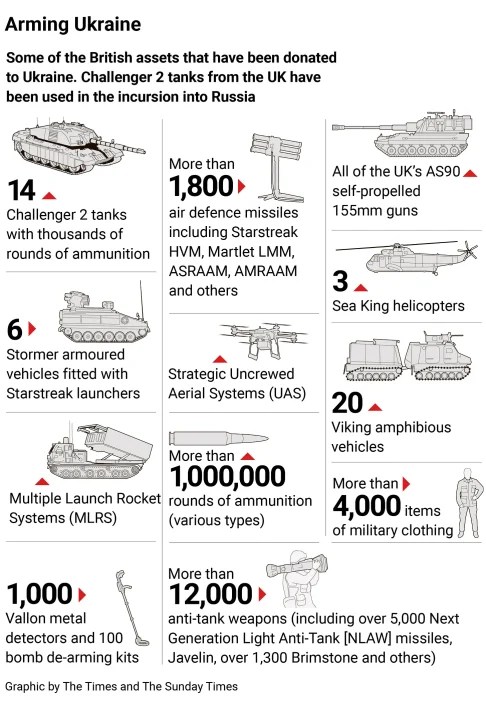
In other words, London is taking the lead in marking itself out as a formal belligerent in the proxy war, in the hope other Western countries – particularly the US – will follow suit. What’s more, The Times strongly hints that Kursk is to all intents and purposes a British invasion. The outlet records:
“Unseen by the world, British equipment, including drones, have played a central role in Ukraine’s new offensive and British personnel have been closely advising the Ukrainian military… on a scale matched by no other country.”
Britain’s grand plans don’t stop there. Healey and Foreign Secretary David Lammy “have set up a joint Ukraine unit,” divided between the Foreign Office and Ministry of Defence. The pair “held a joint briefing, with officials, for a cross-party group of 60 MPs on Ukraine,” while “Starmer has also asked the National Security Council to draw up plans to provide Ukraine with a broader range of support.” On top of military assistance, “industrial, economic, and diplomatic support” are also being explored.
The Times adds that in coming weeks, “Healey will attend a new meeting of the Ukraine Defence Coordination Group,” an international alliance of 57 countries overseeing the Western weaponry flooding into Kiev. There, “Britain will press European allies to send more equipment and give Kyiv more leeway to use them in Russia.” The British Defence Ministry also reportedly “spoke last week to Lloyd Austin, the US defence secretary, and has been wooing Boris Pistorius, his German opposite number.”
Evidently, the new Labour government has an ambitious vision for the proxy war’s continuation. Yet, if the “counterinvasion” is anything to go by, it’s already dead in the water. As The Times notes, the imbroglio is primarily “designed to boost morale at home and shore up Zelensky’s position,” while relieving pressure on the collapsing Donbass frontline by forcing Russia to redirect forces to Kursk. Instead, Moscow “has capitalised on the absence of four crack Ukrainian regiments to press their attacks around Pokrovsk and Chasiv Yar.”
Similarly, commenting on Starmer’s wideranging efforts to compel overt Western action against Russia, a “defence expert” told The Times: “if it looks as if the Brits [are] too far ahead of their NATO allies, it might be counterproductive.” This analysis is prescient, for there are ample indications London’s latest attempt to ratchet tensions and drag the US and Europe ever-deeper into the proxy war quagmire has already been highly “counterproductive”, and boomeranged quite spectacularly. Indeed, it appears Washington has finally had enough of London’s escalatory connivances.
In repeated press conferences and media briefings since August 6th, US officials have firmly distanced themselves from the Kursk incursion, denying any involvement in its planning or execution, or even being forewarned by Kiev. Empire house journal Foreign Policy has reported that Ukraine’s swoop caught the Pentagon, State Department, and White House off-guard. The Biden administration is purportedly not only enormously unhappy “to have been kept out of the loop,” but “skeptical of the military logic” behind the “counterinvasion”.
On top being a clear suicide mission, the eagerly advertised presence of Western weapons and vehicles on Russian soil “has put the Biden administration in an extremely awkward position.” Washington has since the proxy war erupted been wary of provoking retaliations against Western countries and their overseas assets, and the conflict spilling outside Ukraine’s borders. Adding to US irritations, the British-directed Kursk misadventure also torpedoed ongoing efforts to secure an agreement to halt “strikes on energy and power infrastructure on both sides.”
This comes as Kiev prepares for a harrowing winter without heat or light, due to devastating Russian attacks on its national energy grid. Putin has moreover made clear that Ukrainian actions in Kursk mean there is no longer scope for a wider negotiated settlement at all. Which is to say Moscow will now only accept unconditional surrender. The US has also seemingly changed course as a result of the “counterinvasion”.
On August 16th, it was reported that Washington had prohibited Ukraine’s use of British-made, long-range Storm Shadow missiles against Russian territory. Given securing wider Western acquiescence to such strikes is, per The Times, a core objective for Starmer, this can only be considered a harsh rebuke, before the Labour government’s escalatory lobbying efforts have even properly taken off. The Biden administration had in May granted permission for Kiev to conduct limited strikes in Russia, using guided munitions up to a 40-mile range.
Even that mild authorisation may be rescinded in due course. Berlin, which like Britain had initially proudly promoted the presence of its tanks in Kursk, is now decisively shifting away from the proxy war. On August 17th, German Finance Minister Christian Lindner announced a halt to any and all new military aid to Ukraine as part of a wider bid to slash federal government spending. The Wall Street Journal reporting three days earlier that Kiev was responsible for Nord Stream II’s destruction may be no coincidence.

Germany’s Bild newspaper: “In Russia, Ukraine advances with German tanks!”
The narrative of the Russo-German pipeline’s bombing detailed by the outlet was absurd in the extreme. Conveniently too, the WSJ acknowledged that admissions of “Ukrainian officials who participated in or are familiar with the plot” aside, “all arrangements” to strike Nord Stream “were made verbally, leaving no paper trail.” As such, the paper’s sources “believe it would be impossible to put any of the commanding officers on trial, because no evidence exists beyond conversations among top officials.”
Such an evidentiary deficit provides Berlin with an ideal pretext to step away from the proxy war, while insulating Kiev from any legal repercussions. The narrative of Ukraine’s unilateral culpability for the Nord Stream bombings also helpfully distracts from the attack’s most likely perpetrators. This journalist has exposed how a shadowy cabal of British intelligence operatives were the masterminds, and potential executors, of the October 2022 Kerch Bridge bombing.
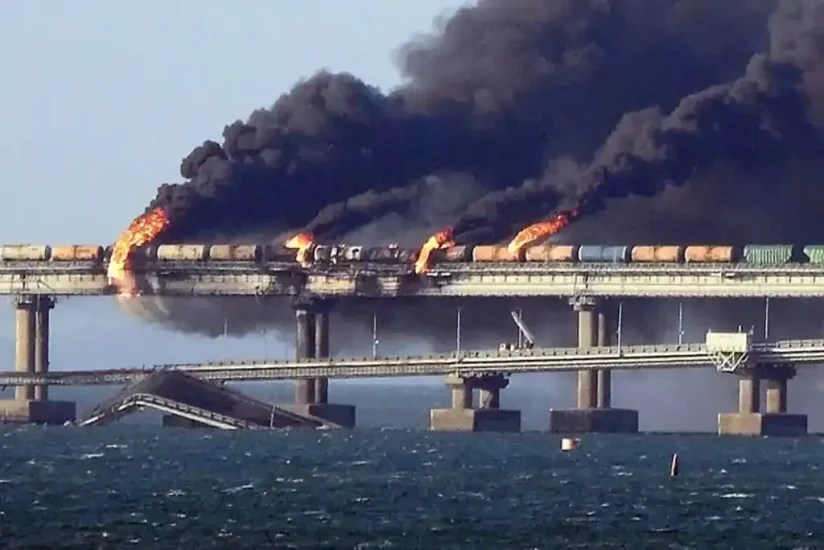
Kerch Bridge in flames following its British-planned bombing
That escalatory incident, like Nord Stream’s destruction, was known about in advance, and apparently opposed, by the CIA. Chris Donnelly, the British military intelligence veteran who orchestrated the Kerch Bridge attack, has privately condemned Washington’s reluctance to embroil itself further in the proxy war, declaring “this US position must be challenged, firmly and at once.” In December that year, the BBC confirmed that British officials were worried about the Biden administration’s “innate caution”, and had “stiffened the US resolve at all levels”, via “pressure.”
The determination of Washington’s self-appointed “junior partner” to escalate the proxy conflict into all-out hot war between Russia and the West has only intensified under Starmer’s new Labour government. Yet, the Empire gives every appearance of refusing to take the bait, while seeking to curb London’s belligerent fantasies. This may be an encouraging sign that the proxy war is at last reaching its end. But we must remain vigilant. British intelligence is unlikely to allow the US to withdraw without a fight.
A defining moment in the Ukraine war
By M. K. BHADRAKUMAR | Indian Punchline | November 24, 2024
Russian President Vladimir Putin issued a statement on Thursday regarding the two attacks by Western long-range weapons on Russian territory on November 19 and 21 and Moscow’s reactive strike on a facility within Ukraine’s defence industrial complex in the city of Dnepropetrovsk with a hitherto unknown non-nuclear hypersonic ballistic missile named Oreshnik.
On Friday, at a meeting in the Kremlin with the military top brass, Putin revisited the topic where he clarified that Oreshnik is not really in “experimental” stage, as the Pentagon had determined, but its serial production has commenced.
And he added, “Given the particular strength of this weapon, its power, it will be put into service with the Strategic Missile Forces.” He then went on to reveal, “It is also important that along with the Oreshnik system, several similar systems are currently being tested in Russia. Based on the test results, these weapons will also go into production. In other words, we have a whole line of medium- and shorter-range systems.”
Putin reflected on the geopolitical backdrop: “The current military and political situation in the world is largely determined by the results of competition in the creation of new technologies, new weapons systems and economic development.”
Succinctly put, an escalatory move authorised by the US president Joe Biden has boomeranged. Did Biden bite more than he could chew? This is the first thing.
The US apparently decided that Putin’s “red lines” and Russia’s nuclear deterrence were the stuff of rhetoric. Washington was clueless about the existence of a wonder weapon like the Oreshnik in the Russian armoury. The shock and awe in the western capitals speaks for itself. Biden avoided commenting on the issue when asked by reporters.
The Oreshnik is not an upgrade of old Soviet-era systems but “relies entirely on contemporary cutting-edge innovations,” Putin stressed. Izvestia reported that Oreshnik is a new generation of Russian intermediate-range missiles with a range of 2,500-3,000km and potentially extending to 5,000km, but not intercontinental, equipped with multiple independently targeted re-entry vehicles (MIRV) — ie., having separating warheads with individual guidance units. It has a speed between Mach 10 and Mach 11 (exceeding 12,000 kms per hour).
The Russian daily Readovka reported that with an estimated 1,500 kgs of combat payload, lifting to a maximum height of 12 km and moving at a speed of Mach 10, the Oreshnik launched from the Russian base at Kaliningrad would strike Warsaw in 1 minute 21 seconds; Berlin, 2 min 35 sec; Paris, 6 min 52 sec; and London, 6 min 56 sec.
In his statement on Thursday, Putin said, “there are no means of countering such weapons today. Missiles attack targets at a speed of Mach 10, which is 2.5 to 3 kilometres per second. Air defence systems currently available in the world and missile defence systems being created by the Americans in Europe cannot intercept such missiles. It is impossible.”
Indeed, a terrible beauty is born. For, Oreshnik is not just an effective hypersonic weapon and is neither a strategic weapon nor an intercontinental ballistic missile. But its striking power is such that when used en masse and in combination with other long-range precision systems, its effect and power is on par with strategic weapons. Yet, it is not a weapon of mass destruction — rather, it’s a high-precision weapon.
Serial production implies that dozens of Oreshnik are in the process of being deployed, which means that no US / NATO staff group and no Anglo-American target intelligence unit in bunkers in Kiev or Lvov is safe any longer.
Oreshnik is also a signal to the incoming US president Donald Trump who is ad nauseam calling for an immediate end-of-war settlement. Oreshnik, ironically, has been developed only as Moscow’s reaction to the hawkish decision by then US president Trump in 2019 to unilaterally withdraw from the 1987 Soviet-American treaty on intermediate range nuclear forces (INF). Hence this also signals that Moscow’s trust in Trump is near zero.
To drive home this point, on the very same day Oreshnik emerged out of its silo, Tass carried an unusual interview with a top Russian think tanker affiliated to the foreign ministry and Kremlin — Andrey Sushentsov, program director of the Valdai Discussion Club, dean of the Russian Foreign Ministry’s MGIMO International Relations Department, and member of the Scientific Council under the Russian Security Council.
The following excerpts of the interview, plain-speaking and startling, should shatter the hypothesis that there is something special going on between Trump and Putin:
- “Trump is considering ending the Ukrainian crisis, not out of any sympathy for Russia, but because he acknowledges that Ukraine has no realistic chance of winning. His goal is to preserve Ukraine as a tool for US interests, focusing on freezing the conflict rather than resolving it. Consequently, under Trump, the long-term strategy of countering Russia will persist. The US continues to benefit from the Ukrainian crisis, regardless of which administration is in power.”
- “The United States has regained its position as the European Union’s top trading partner for the first time in years. It is the Europeans who are bearing the financial burden of prolonging the Ukrainian crisis, while the US has no interest in resolving it. Instead, it is more beneficial for them to freeze the conflict, keeping Ukraine as a tool to weaken Russia and as a persistent hotspot in Europe to maintain their confrontational approach.”
- “Trump has made numerous statements that differ from the policies of Joe Biden’s administration. However, the US state system is an inertial structure that resists decisions it deems contrary to American interests, so not all of Trump’s ideas will come to fruition.”
- “Trump will have a two-year window before the midterm congressional elections, during which he will have a certain freedom to push his policies through the Senate and the House of Representatives. After that, his decisions could face resistance both domestically and from US allies.”
Make no mistake, Russia is under no illusions. Putin will not waver from the conditions he outlined in June for resolving the conflict: the withdrawal of Ukrainian troops from Donbass and Novorossiya; Kiev’s commitment to abstain from joining NATO; the lifting of all Western sanctions against Russia; and the establishment of a non-aligned, nuclear-free Ukraine.
Clearly, this war will continue on its course till it reaches its only logical conclusion, which is Russian victory. Russian Security Council Deputy Chairman Dmitry Medvedev is spot on when he said in an interview with Al Arabiya yesterday that the use of Oreshnik missile “changes the course” of the Ukrainian conflict.
The Western capitals will have to reconcile with the reality that the scope for escalation of the war is ending. Make no mistake, if another ATAMCS strike inside Russia is attempted, it will have devastating consequences for the West.
Serbian President Aleksandar Vucic put it nicely: “If you [NATO] think you can attack everything on Russian territory with Western logistics and weapons without getting a response, and that Putin won’t use whatever weapons he deems necessary, then you either don’t know him or you’re abnormal.”
Six Simple Steps to Pharma Reform
By Clayton J. Baker, MD | Brownstone Institute | November 20, 2024
The recent United States elections may have finally produced an administration that is willing – even eager – to reform the Big Pharma juggernaut that has thoroughly dominated life in the United States since Covid. But how might we achieve meaningful, definitive Pharma reform?
Simple.
Before we continue, please allow me to highlight the difference between “simple” and “easy.” Just because something is simple doesn’t make it easy. Lifting a 10-ton weight is no more complicated than lifting a 10-pound weight. But it’s a lot harder to do.
The task of reforming Big Pharma will not be easy. Talk about a heavy lift! Consider that before the 2020 election, the pharmaceutical industry donated funds to 72 senators and 302 members of the House of Representatives. Pfizer alone contributed to 228 lawmakers. At this moment, Big Pharma may be down, but it’s not out. The industry has too much power, money, and influence to be brought under control without a major struggle.
While not easy, should the political will be mustered, the process of breaking the stranglehold Big Pharma has on us would be surprisingly simple. Six changes in Federal law – four repeals of existing law, and two new pieces of legislation – would go a long way toward reining in and even reforming Big Pharma.
From the 1970s onward, US Federal policy consistently trended toward the empowerment and enrichment of the pharmaceutical industry. Since 1980, a series of Federal laws were enacted that created perverse incentives and promoted the rapacious behavior that has characterized Big Pharma over the past several decades, climaxing with the pandemic totalitarianism of the Covid era.
Four of the most problematic of these laws are ripe for repeal. Doing so would constitute vital steps toward reining in Big Pharma. The two other steps proposed here would require new legislation, but fairly simple legislation at that.
The six simple steps are:
- Repeal the 1980 Bayh-Dole Act
- Repeal the 1986 National Childhood Vaccine Injury Act
- Repeal the 2004 Project Bioshield Act
- Repeal the 2005 PREP Act
- Outlaw Direct-to-Consumer Pharmaceutical Advertising
- Encode Medical Freedom into Federal Law
Repeal the 1980 Bayh-Dole Act
The Patent and Trademark Law Amendments Act (Public Law 96-517), better known as the Bayh-Dole Act, was signed into law by Jimmy Carter in 1980.
The Bayh-Dole Act made 2 major changes: it allowed private entities (such as universities and small businesses) to routinely keep ownership and patent rights to inventions made during government-funded research. It also allowed Federal agencies to grant exclusive licenses for use of Federally-owned patents and intellectual property.
The Bayh-Dole Act was intended to encourage innovation within government research. As researchers could now profit directly from their work, it was thought they would make better use of taxpayer support. However, as economist Toby Rogers has argued, this ill-conceived law had the opposite effect.
The ability for government contracted workers to patent their discoveries created a disincentive to share them with other researchers, who might beat them to market. Close guarding of intellectual property and lack of open collaboration had a chilling effect on rapid innovation – hardly what taxpayers would have wanted from their investments.
More importantly, endowing Federal agencies such as the NIH with the power to effectively pick “winners and losers” with whom Federal intellectual property would be granted for commercial use, created a tremendous potential for corruption within these agencies.
The Act did contain a provision for “march-in-rights,” whereby the relevant government agency (such as the NIH) could step in and allow other entities use of the intellectual property if the original patent-holder failed to meet specific requirements to make proper use of them for the public good. However, according to the US Chamber of Commerce, in 44 years since the Act was made law, march-in-rights have never been successfully invoked, despite numerous attempts.
The Bayh-Dole Act itself, coupled with the refusal of agencies such as the NIH to ever invoke march-in-rights, has been frequently implicated in the massive price-gouging problems in US pharmaceuticals. In one remarkable exchange in 2016 between Senator Dick Durbin and then NIH Director Francis Collins, Durbin refuted Collins’ prevaricating defense of never invoking march-in-rights, stating:
… if you cannot find one egregious example where you could apply this [march-in-rights], I would be surprised. And applying it even in one, sends at least the message to the pharmaceutical companies, that patients need to have access to drugs that were developed with taxpayer’s expenses and the research that went into it. I think that doing nothing sends the opposite message, that it’s fair game, open season, for whatever price increases they wish.
By allowing the NIH authority to assign publicly funded intellectual property rights and statutory power to protect exclusive use of them, the Bayh-Dole Act opened the door widely for massive corruption between industry and regulators and greatly enabled the extreme degree of agency capture now present at the NIH and other Federal Agencies.
Bayh-Dole has been a failure. It should be repealed and replaced.
Repeal the 1986 National Childhood Vaccine Injury Act
The toxicity of vaccines was so well-established even decades ago, that a Federal law – the National Childhood Vaccine Injury Act (NCVIA) of 1986 (42 U.S.C. §§ 300aa-1 to 300aa-34) was passed to specifically exempt vaccine manufacturers from product liability, based on the legal principle that vaccines are “unavoidably unsafe” products.
Since Ronald Reagan signed the 1986 NCVIA Act protecting vaccine manufacturers from liability, there has been a dramatic increase in the number of vaccines on the market, as well as the number of vaccines added to the CDC vaccine schedules, with the number of vaccines on the CDC Child and Adolescent schedule rising from 7 in 1986 to 21 in 2023.
Furthermore, this special protection afforded to vaccines has prompted Big Pharma to attempt to sneak other types of therapeutics under the “vaccine” designation to provide them with blanket liability they would not otherwise enjoy.
For example, the Pfizer and Moderna Covid mRNA injections, while commonly called vaccines, are not true vaccines, but rather a type of mRNA-based gene therapy. In effect, they are what I refer to as Vaccines-In-Name-Only, or “VINOs.” As pointed out by Rep. Thomas Massie (R-KY) and others, the CDC’s definition of “vaccination” was altered during Covid to allow new types of drugs to be labeled as vaccines.
We have now reached the previously unimaginable state where Big Pharma is touting potential “vaccines” for cancer. As the National Cancer Institute admits on its website, these are actually immunotherapies. The purpose of employing this misleading nomenclature is clear: to slide even more therapies under the tort-protected “vaccine” umbrella.
The bloom is off the rose for vaccines. The alarming toxicity of the Covid vaccines caused a worldwide reexamination of this entire class of medicines. Multiple Covid vaccines, including the Johnson & Johnson and AstraZeneca products, once brazenly touted as “safe and effective,” have now been pulled from the market. And the literally millions of VAERS reports implicating the mRNA Covid products have not gone away.
The National Childhood Vaccine Injury Act (NCVIA) of 1986 should be repealed, returning vaccines to the same tort liability status as other drugs.
Repeal the Project Bioshield Act of 2004
The Project Bioshield Act, signed into law by George W. Bush in 2004, introduced the Emergency Use Authorization avenue for pharmaceutical products to be brought to market. Among other things, this law empowered the FDA to authorize unapproved products for emergency use, in the event of a public health emergency as declared by the Department of Health and Human Services (HHS).
By its very design, this law is ripe for abuse. It places immense power in the hands of the unelected Director of HHS, who can declare an emergency activating the law, and who simultaneously oversees the FDA.
This power was egregiously misused during Covid. Shockingly, the FDA issued nearly 400 EUAs related to Covid for pharmaceutical and medical products, the Covid “vaccines” being only the best known. The FDA even went so far as to grant “umbrella” EUAs for entire categories of Covid products such as test kits, often without reviewing specific products at all. The immense amounts of fraud related to test kits and other Covid-era medical products should come as no surprise.
With regard to Covid-related pharmaceuticals, to this day EUAs continue to be misused to the benefit of Big Pharma and to the detriment of citizens. For example, when the FDA announced the “new” formulations of the Covid boosters for 2024-25, they still released these new products under Emergency Use Authorization. In other words, a full four-and-one-half years after the start of the Covid pandemic, these products are still rushed to market after ludicrously inadequate safety and efficacy trials, based on a purported “emergency” now approaching a half decade in length.
The 2004 Project Bioshield Act should be repealed and the EUA designation it created should be eliminated.
Repeal the PREP Act of 2005
The NCVIA already provided vaccine manufacturers with a blanket tort liability shield beyond the wildest dreams of other industries, but apparently that was not enough. In 2005, at the height of the “War on Terror,” George W. Bush signed the Public Readiness and Emergency Preparedness Act (42 U.S.C. § 247d-6d), better known as the PREP Act.
The PREP Act, which was heavily lobbied for by vaccine manufacturers, provides an unprecedented level of blanket tort liability to Big Pharma and other medical-related industries in the event of declared bioterrorism events, pandemics, and other emergencies. Again, tremendous power is placed in the hands of the Director of HHS, who has broad discretion to declare such an emergency.
The PREP Act was controversial from the outset – any act that can spark vigorous, simultaneous opposition from both Phyllis Schlafly’s conservative Eagle Forum and Ralph Nader’s left-wing Public Citizen for its unconstitutional nature is surely pushing the envelope.
In effect, the PREP Act has allowed Big Pharma and its captured regulatory friends to completely circumvent routine FDA standards for safety and efficacy under the guise of an emergency, which as noted above, can conveniently last half a decade or more.
Furthermore, in the aftermath of Covid, the PREP Act has been broadly invoked in the legal defense of countless defendants now sued for the excesses, harms, and violations of human rights perpetrated at all levels of government and society. It will take decades in the courts to sort out where the PREP Act’s broad protections begin and end.
This is both absurd and insane. At its inception, the PREP Act was broadly recognized as one of the most overreaching and unconstitutional Federal laws in modern times. The Covid era has tragically revealed the PREP Act to be a murderous failure. The PREP Act must be repealed.
During Covid, government at nearly every level used the specter of a pandemic to blatantly suspend, deny, and even attempt to permanently eliminate numerous fundamental civil rights that are clearly encoded in the Constitution. Furthermore, the well-established and time-honored pillars of Medical Ethics were dismissed wholesale in the name of public safety.
In addition to repealing the deeply flawed laws discussed above, two pieces of straightforward legislation are needed to limit Big Pharma’s undue influence on society.
Outlaw Direct-to-Consumer Pharmaceutical Advertising
The United States is one of only 2 countries in the world that allows direct-to-consumer advertising of pharmaceuticals. The scale of this advertising is monumental. Total Pharma advertising spending topped $6.58 billion in 2020. The dangers of this are multiple.
First, as we can all see by turning on the television, Big Pharma abuses this privilege by aggressively hawking almost any product it feels it can profit from. The “pill for every ill” mindset shifts into hyperdrive on TV, with an expensive, proprietary, pharmacological cure for everything from your morbid obesity to your “bent carrot.”
Direct-to-consumer television advertisements heavily target the elderly. This is an important component of Big Pharma’s push to promote the Covid and RSV vaccines as routine shots, piggybacking on the wide acceptance of influenza vaccines. Not content to profit off the traditional fall flu vaccine, Big Pharma seeks to create a subscription model for a bevy of seasonal shots against numerous, generally mild, viral respiratory infections.
Even more importantly, direct-to-consumer advertising provides Big Pharma with a legal way to capture media. Pharma was the second-largest television advertising industry in 2021, spending $5.6 billion on TV ads. No legacy media outlet dares to speak out against the interests of entities providing that level of funding. This muzzles dissenting voices and eliminates open discussion about safety issues in mainstream media.
In short, through direct-to-consumer advertising, Big Pharma has bought the media’s silence.
A free society requires freedom of the press and media. The Covid era has demonstrated that direct-to-consumer pharmaceutical advertising stifles freedom of the press and media to a dangerous and unacceptable degree.
Somehow, the rest of the world has managed to survive without direct-to-consumer pharmaceutical advertising. In fact, many countries do better with respect to health measures than the Pharma-ad-riddled USA. In 2019, just before Covid, the United States ranked only 35th in terms of overall health in the Bloomberg National Health Rankings. Meanwhile, the United States pays more for its middling health rankings than any other nation on Earth.
Encode Medical Freedom into American law
The Founding Fathers would be scandalized to find that the United States needs explicit laws stating that the Bill of Rights is not null and void in the event of a “pandemic,” (or during other emergencies, for that matter), but here we are.
The Founders were well acquainted with episodic infectious disease. In fact, they faced epidemics at a level we cannot imagine. George Washington survived smallpox. Thomas Jefferson lost a child to whooping cough. Dr. Benjamin Rush, signer of the Declaration of Independence and surgeon general of the Continental Army, promoted inoculation of the troops against smallpox.
Despite those experiences, the Founders inserted no health-emergency-based escape clauses in the Constitution permitting government to deny citizens the inalienable rights protected therein.
As I have written previously, the excesses of the Covid era have sparked a movement toward encoding “medical freedom” into law, to protect our civil rights against medical and public health overreach. (To be fully effective, this may need to be expanded to include any declared emergency – e.g. “climate” emergencies – although that is beyond the scope of this essay.)
Given the excesses of the Covid era, many of which have now been demonstrated to have been pre-planned and deliberate, and given rapid technological advancement of both medicine and surveillance, it is advisable to encode into law assertions regarding medical freedom. While the exact wording may vary, the 2 key points of focus would be explicitly protecting bodily autonomy and limiting the power of public health declarations. Here are two examples:
- Citizens shall not be deprived of any rights protected in the US Constitution, or of their ability to fully participate in society, on the basis of their acceptance or refusal of any medical treatment(s) or procedure(s).
- Citizens shall not be deprived of any rights protected in the US Constitution, or of their ability to fully participate in society, on the basis of a medical or public health emergency.
Encoding such statements into law would accomplish two goals. First, it would substantially rein in the power-seeking element of the public health industry that became such a menace to human freedom during Covid, and which incidentally is tightly entwined with Big Pharma. Second, it would significantly thwart the efforts of Big Pharma to push their wares through a herd-based and mandate-driven approach.
Should someone oppose such explicit statements of our God-given rights, on the basis of “But what if there is another pandemic?”, I would reply as follows: Only once in human history did the world lock itself down due to a disease. It turned out to have been done mostly under false pretenses, and it turned out to be a deadly and disastrous mistake. We are not doing that again.
Conclusion
Big Pharma is a Leviathan, in both the biblical and Hobbesian senses of the word. To truly control it, other measures will surely be necessary. Other needful actions are beyond the scope of this article. Some of these may be very complicated. For example, it is imperative that the gain-of-function bioweapons research be halted. However, this is a worldwide issue, so outlawing it in the US alone will not solve the problem.
However, these six simple steps are an important start. Members of the incoming administration have already spoken about some of them. Success breeds success, and successfully implementing these solutions will help free ourselves from the tentacles of the monstrosity that Big Pharma has become.
Clayton J. Baker, MD is an internal medicine physician with a quarter century in clinical practice. He has held numerous academic medical appointments, and his work has appeared in many journals, including the Journal of the American Medical Association and the New England Journal of Medicine. From 2012 to 2018 he was Clinical Associate Professor of Medical Humanities and Bioethics at the University of Rochester.
Featured Video

No Vote, No Representation, No State: Democracy, Israeli Style
or go to
Aletho News Archives – Video-Images
From the Archives
Sanctions, War and the Policy of Dual Containment
By SASAN FAYAZMANESH | March 17, 2008
It is now nearly three decades since the Unites States adopted the policy of dual containment of Iran and Iraq. While much has been written about the containment of Iraq, there has been very little in-depth analysis of this policy when it comes to Iran. In a book that is going to be released on March 31, 2008, entitled The United States and Iran: Sanctions, Wars and the Policy of Dual Containment (Routledge), I attempt to address this shortcoming by investigating when and why the US policy of containment of Iran came about, how it evolved, and where it stands today.[1] To the extent that Israel has been involved in US policy making, the study will also include the role that Israel has played in the containment of Iran. Also, since the fate of Iran has been inextricably linked to that of Iraq, occasionally the investigation will overlap with the containment of Iraq.
The policy of dual containment of Iran and Iraq originated during the Carter Administration, but it was not until the Clinton Administration that the expression “dual containment” became popular. … continue
Blog Roll
 Aletho News
- Europe’s Establishment Is Embracing War – and Losing Voters
- NATO chief advocates war of aggression
- No Vote, No Representation, No State: Democracy, Israeli Style
- Zionist Bought Senate Blocks Information About American Citizens Killed By Israel
- While Gaza dominates the UN, these are the people keeping it alive
- New Report: “Scholasticide and Genocide in Gaza: Assessment, Testimonies and Legal Analysis”
- ‘THAAD Delusion’: Iran war exposes US missile shield limits – The Atlantic
- Moscow issues warning to NATO over Russian exclave
- Yes, the Iran war has destroyed Trump’s presidency
- The fallacy of US delusions about Iran’s economic collapse
- If Americans Knew
- Mamdani releases plan to combat antisemitism and hate crimes in New York City
- Iran’s Revolutionary Guards Publish Letter to the American People
- DMFI launches $1 million ad campaign supporting Virginia’s Elaine Luria
- US Senate blocks resolution seeking report on Americans killed by Israel
- Israeli Attacks Kill Ten Palestinians in Gaza
- Massacre at Minab: The School That Became a Grave
- Israeli media: The IDF Shows It Doesn’t Turn a Blind Eye; It Actively Emboldens Settler Havoc
- As settlers ravage West Bank, Israeli forces kill 10 in Gaza – Daily Update
- New Report: “Scholasticide and Genocide in Gaza: Assessment, Testimonies and Legal Analysis”
- Ex-Biden officials are desperate for a Gaza scapegoat
- No Tricks Zone
- Green Energy Debacle: German Expert Professor Fritz Vahrenholt Warns Of Severe Economic And Social Consequences
- Two More Paleo Reconstructions Affirm Meters-Higher Sea Levels Across Ireland, Brazil 7000-6000 Years Ago
- New Study: Earth And Venus Surface Warmth Largely Explained By Convection And Lapse Rate, Not CO2 Or Radiation
- 2025 Nature Paper Claiming Worsening Global Drought Gets RETRACTED …Heavily Flawed
- New Study: ‘Global Drought Shows No Detectable Recent Acceleration Under Climate Warming’
- Economic Masterminds: German Socialists Suggest Taxing Productivity Gains Stemming From Using AI
- The South China Sea Has Not Been Cooperating With The Climate Change Narrative
- Energy Crisis: Germany Enters Heating Season With Historically Low Gas Reserve Fill Levels
- New Study: The Antarctic Ice Sheet Gained Mass From 2020-2024 Due To Staggering Snow And Ice Accumulation
- Study: Ocean Heating Rates From Thousands Of Years Ago ‘Dwarf’ Modern Ocean Heating Rates

