The latest round of US sanctions against Russian financial institutions, which specifically target Gazprombank, is an attempt to block Russia’s gas supplies to the EU, Kremlin spokesman Dmitry Peskov stated on Friday. The lender is Russia’s primary bank for energy-related transactions.
Peskov warned that Moscow would respond to restrictions with countermeasures, though he did not specify what they would entail.
The Kremlin spokesman’s remarks follow an announcement by the US Office of Foreign Assets Control (OFAC) on Thursday, which said Gazprombank and six of its international subsidiaries had been added to its sanctions blacklist. Gazprombank had already been sanctioned by the UK and Canada shortly after the escalation of the Ukraine conflict in 2022. However, the US had previously avoided placing restrictions on the lender as it was used by EU states to pay for Russian gas.
When asked whether the Kremlin viewed sanctions on Gazprombank as an attempt to jeopardize supplies of Russian gas to Europe, and whether Moscow planned any response, Peskov replied: “The answer is ‘Yes’ to both questions.”
He noted that Russian authorities were already working on ways to alleviate the problems that the new restrictions could cause Russia and its foreign gas buyers.
“Of course, we’ll find options. It is impossible to introduce completely blocking measures against a country like Russia. It may take some time, but a solution will still be found,” Peskov said.
The new measures mean Gazprombank can no longer carry out transactions that involve the dollar-based financial system. Gazprombank earlier said that sanctions would not affect its operations within Russia, but warned that its UnionPay cards may stop working outside the country.
Apart from Gazprombank, the new US restrictions also targeted more than 50 small-to-medium Russian lenders, some 40 securities registrars, and 15 financial officials.
After the escalation of the Ukraine conflict in 2022, the EU declared the elimination of its reliance on Russian energy to be its top priority. Many member states, including Poland, Bulgaria, Finland, the Netherlands, and Denmark, voluntarily halted their imports. However, several EU nations, including Austria, Hungary, Slovakia, the Czech Republic, and Italy continue to rely on Russian gas to meet their energy needs, and have not stopped buying the commodity despite pressure from peers within the bloc.
Moscow has slammed Western sanctions as illegal, and noted that they keep backfiring on the countries that impose them. Russia has also been gradually moving away from the dollar in trade, switching to transactions using national currencies with most of its international partners.
The newly imposed US sanctions against Russia’s Gazprombank are expected to send energy costs surging in parts of Europe, Finam Financial Group analyst Aleksandr Potavin told TASS on Friday. The risk of secondary restrictions will force buyers of Russian oil and gas to seek new payment tools, he predicted.
On Thursday, the US Treasury Department introduced blocking sanctions against more than 50 Russian lenders, including Gazprombank and six of its international subsidiaries. The new penalties effectively cut one of Russia’s largest banks off from the SWIFT interbank messaging system, meaning it can no longer carry out transactions that involve the dollar-based financial system. Gazprombank’s assets in the US have also been frozen.
“Due to the new sanctions against Gazprombank, foreign buyers of Russian gas and oil will be faced with the need to look for alternative payment routes that are likely to complicate the entire process, increase risks, and make the payment procedure more expensive,” Potavin said.
He specified that European buyers could use accounts in other banks or pay for energy supplies via other world currencies as an alternative.
“The new sanctions will lead to an increase in prices for Russian hydrocarbons in Europe, and supply disruptions can’t be ruled out as well, since all this creates new risks for foreign companies working with Russia,” he explained.
According to Alexander Frolov, expert at the InfoTek energy news center, the latest restrictions won’t have a direct impact on buyers of Russian gas who previously agreed to adopt the “gas for rubles” scheme to pay for their energy purchases. They will only apply to individuals and legal entities subject to US jurisdiction, he said, as quoted by TASS.
The analyst admitted, however, that companies using rubles for Russian energy supplies are at risk of secondary sanctions, “so gas buyers from Europe will turn to the US Treasury for clarification.”
Supplies of Russian pipeline gas to Europe have substantially declined due to Ukraine-related restrictions and the sabotage of the Nord Stream pipelines, although EU nations are still importing record volumes of LNG from the sanctions-hit state. Despite the bloc’s vows to drop purchases of Russian energy, it remains one of the world’s major buyers of Russian fossil fuels. In August, pipeline gas comprised the largest share of the EU’s purchases of Russia’s fossil fuels (54%), followed by LNG (25%), according to the Centre for Research on Energy and Clean Air (CREA).
Ukraine did not receive as much foreign aid as claimed by the administration of US President Joe Biden, and whatever help it did get was largely embezzled, a former Polish deputy minister has claimed. Up to a half of the funds that reached Kiev was stolen by Ukrainian officials, Piotr Kulpa has alleged.
The political commentator previously held several posts in the Polish government, serving as deputy labor minister in the mid-2000s, and is currently a regular contributor on Ukrainian online shows. Kulpa is a vocal supporter of US President-elect Donald Trump, as evidenced by his remarks to Ukrainian journalist Lana Shevchuk on Thursday.
“Everyone understands that war-related corruption is linked not only with Ukraine, but also the supplier nation,” he said. “Who would ever believe that the US burned through $2 trillion in Afghanistan? It’s delusional!”
US aid programs are a mechanism to “write off large sums of money that finance shady systems under the Democratic Party’s control,” he alleged. The incoming Trump administration could review government finances and discover the truth that “Ukraine got very little” compared to the amounts mentioned in public statements, Kulpa claimed.
“But they will also find something else: that a huge portion of the funds was stolen in Ukraine. From 30% to 50%, regardless of the nature of the aid,” he added.
If Kiev were to recover all the embezzled money for the Ukrainian budget, the country would have enough for a year, Kulpa said. He denounced senior Ukrainian officials, whose regular salaries and bonuses he believes are outrageously high.
“It’s a spit in the face of every Ukrainian,” the former minister asserted. “To every European and American taxpayer. This system is criminal from start to finish.”
Trump and his allies have been highly critical of the amount of assistance that the Biden administration has sent to Kiev. The president-elect has argued that EU nations should assume the burden of propping up Ukraine, while the American government should focus on its own priorities.
US concerns about graft in Kiev have been reflected in some government documents, such as a report that Pentagon Inspector General Robert Storch’s office released last week. It said corruption “continues to complicate Ukraine’s efforts to achieve its EU and NATO aspirations.”
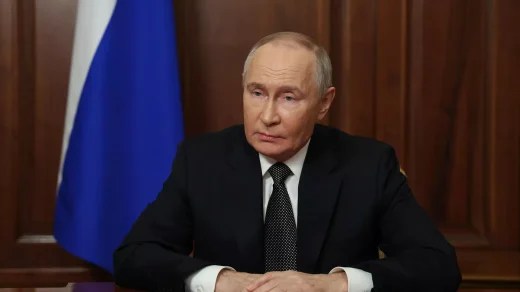
MOSCOW – Russia’s further actions if the West does not take its concerns into account have been outlined, Kremlin spokesman Dmitry Peskov said on Friday, commenting on a statement made by President Vladimir Putin about a brand-new medium-range missile, Oreshnik.
Putin said in a televised speech on Thursday that Ukraine fired US-supplied ATACMS missiles and the UK’s Storm Shadows at facilities in the Kursk and Bryansk regions on November 19. Russia responded by launching a combined strike against a defense industry complex in Dnepropetrovsk, also known as Dnipro, on Thursday using the Oreshnik missile.
“Further retaliatory actions in the event that our concerns are not taken into account are also quite clearly outlined,” Peskov told reporters.
The main message of Putin’s statement is that the West’s reckless decisions on the supply of missiles to Ukraine cannot remain unanswered, the official said.
“We would, of course, prefer that Washington listened to the statements the Russian president made several months ago in St. Petersburg, where he absolutely exhaustively outlined our position on permission to use this foreign missile technology to strike deep into Russian territory. In St. Petersburg, the president sent a clear message, and we, frankly, would prefer that message to be taken into account,” Peskov said.
Additionally, Russia sent the US an automatic warning about the launch of the Oreshnik missile due to the fact that the missile is a ballistic one, the official said, adding that the missile “does not cause responsibilities like an intercontinental missile, but still, since it is ballistic, this … operates in automatic mode.”
“The Russian side clearly demonstrated its capabilities,” Peskov said.
President Vladimir Putin has promised a decisive response to any aggression, criticizing the West for escalating tensions, and reiterated Moscow’s willingness to engage in peace talks to resolve the Ukraine conflict.
Here’s a full text of Putin’s address, as provided by the Kremlin.
President of Russia Vladimir Putin: I would like to inform the military personnel of the Russian Federation Armed Forces, citizens of our country, our friends across the globe, and those who persist in the illusion that a strategic defeat can be inflicted upon Russia, about the events taking place today in the zone of the special military operation, specifically following the attacks by Western long-range weapons against our territory.
The escalation of the conflict in Ukraine, instigated by the West, continues with the United States and its NATO allies previously announcing that they authorise the use of their long-range high-precision weapons for strikes inside the Russian Federation. Experts are well aware, and the Russian side has repeatedly highlighted it, that the use of such weapons is not possible without the direct involvement of military experts from the manufacturing nations.
On November 19, six ATACMS tactical ballistic missiles produced by the United States, and on November 21, during a combined missile assault involving British Storm Shadow systems and HIMARS systems produced by the US, attacked military facilities inside the Russian Federation in the Bryansk and Kursk regions. From that point onward, as we have repeatedly emphasised in prior communications, the regional conflict in Ukraine provoked by the West has assumed elements of a global nature. Our air defence systems successfully counteracted these incursions, preventing the enemy from achieving their apparent objectives.
The fire at the ammunition depot in the Bryansk Region, caused by the debris of ATACMS missiles, was extinguished without casualties or significant damage. In the Kursk Region, the attack targeted one of the command posts of our group North. Regrettably, the attack and the subsequent air defence battle resulted in casualties, both fatalities and injuries, among the perimeter security units and servicing staff. However, the command and operational staff of the control centre suffered no casualties and continues to manage effectively the operations of our forces to eliminate and push enemy units out of the Kursk Region.
I wish to underscore once again that the use by the enemy of such weapons cannot affect the course of combat operations in the special military operation zone. Our forces are making successful advances along the entire line of contact, and all objectives we have set will be accomplished.
In response to the deployment of American and British long-range weapons, on November 21, the Russian Armed Forces delivered a combined strike on a facility within Ukraine’s defence industrial complex. In field conditions, we also carried out tests of one of Russia’s latest medium-range missile systems – in this case, carrying a non-nuclear hypersonic ballistic missile that our engineers named Oreshnik. The tests were successful, achieving the intended objective of the launch. In the city of Dnepropetrovsk, Ukraine, one of the largest and most famous industrial complexes from the Soviet Union era, which continues to produce missiles and other armaments, was hit.
We are developing intermediate-range and shorter-range missiles in response to US plans to produce and deploy intermediate-range and shorter-range missiles in Europe and the Asia-Pacific region. We believe that the United States made a mistake by unilaterally destroying the INF Treaty in 2019 under far-fetched pretext. Today, the United States is not only producing such equipment, but, as we can see, it has worked out ways to deploy its advanced missile systems to different regions of the world, including Europe, during training exercises for its troops. Moreover, in the course of these exercises, they are conducting training for using them.
As a reminder, Russia has voluntarily and unilaterally committed not to deploy intermediate-range and shorter-range missiles until US weapons of this kind appear in any region of the world.
To reiterate, we are conducting combat tests of the Oreshnik missile system in response to NATO’s aggressive actions against Russia. Our decision on further deployment of intermediate-range and shorter-range missiles will depend on the actions of the United States and its satellites.
We will determine the targets during further tests of our advanced missile systems based on the threats to the security of the Russian Federation. We consider ourselves entitled to use our weapons against military facilities of those countries that allow to use their weapons against our facilities, and in case of an escalation of aggressive actions, we will respond decisively and in mirror-like manner. I recommend that the ruling elites of the countries that are hatching plans to use their military contingents against Russia seriously consider this.
It goes without saying that when choosing, if necessary and as a retaliatory measure, targets to be hit by systems such as Oreshnik on Ukrainian territory, we will in advance suggest that civilians and citizens of friendly countries residing in those areas leave danger zones. We will do so for humanitarian reasons, openly and publicly, without fear of counter-moves coming from the enemy, who will also be receiving this information.
Why without fear? Because there are no means of countering such weapons today. Missiles attack targets at a speed of Mach 10, which is 2.5 to 3 kilometres per second. Air defence systems currently available in the world and missile defence systems being created by the Americans in Europe cannot intercept such missiles. It is impossible.
I would like to emphasise once again that it was not Russia, but the United States that destroyed the international security system and, by continuing to fight, cling to its hegemony, they are pushing the whole world into a global conflict.
We have always preferred and are ready now to resolve all disputes by peaceful means. But we are also ready for any turn of events.
If anyone still doubts this, make no mistake: there will always be a response.
David Brog is a Jewish American attorney who previously practiced corporate law in Tel Aviv, Israel. The Forward newspaper listed Brog in its 2007 “Forward 50” most influential Jews in America. Former Israeli Prime Minister Ehud Barak is Brog’s cousin.
Brog is the author of “Reclaiming Israel’s History.” He is executive director of the Maccabee Task Force, funded by American billionaires Sheldon Adelson, who once said he regretted serving in the US Army instead of the Israeli military, Miriam Adelson, Haim Saban, and Adam Milstein.
Charisma News reports: “Brog is the powerhouse behind the Christian organization, yet he’s also a conservative (non-Messianic) Jew.”
The article reports: “Brog, who was chief of staff to liberal Sen. Arlen Specter of Pennsylvania for seven years, is said to run CUFI like a political campaign. He has talking points, stays focused and rallies his constituency.” – https://ifamericansknew.org/us_ints/i…
John Hagee is the founder of Cornerstone Church in San Antonio, Texas, that seats 5,000 and claims a membership of 22,000. John Hagee Ministries is said to reach nearly 100 million households worldwide.
Once again, the US has positioned itself in opposition to the international community. On Wednesday, the US vetoed a UN Security Council resolution calling for a cease-fire in Gaza. This marks the fourth time the US has used its veto power on this issue, even as the death toll in Gaza now stands at around 44,000. The draft, put forward by the Security Council’s 10 non-permanent members, demanded an immediate, unconditional and permanent cease-fire, as well as the immediate and unconditional release of all hostages. Among the 15 members of the Security Council, the US was the sole opposing vote.
This US action once again raises the question: How many more innocent lives in Gaza must be lost to awaken Washington’s conscience? Now, nearly 44,000 people have been killed in Gaza, and the US still does not hesitate to use its veto.
Nearly all of Gaza’s 2.4 million residents have been displaced by the war, creating an unmeasurable humanitarian crisis. As a permanent member of the UN Security Council, the US is expected to shoulder the responsibility of maintaining global peace and stability. However, its actions – marked by the abuse of veto power – blatantly contradict global efforts to promote a peaceful resolution to the conflict.
The US’ approach to the Palestine-Israel conflict has left it isolated on the international stage. Even the US media outlet The New York Times has acknowledged that this underlines Washington’s diplomatic isolation on the issue. France and the UK’s UN ambassadors have also openly expressed dissatisfaction with the US veto. Nicolas de Riviere, France’s UN representative, stated unequivocally: “There is an obvious urgency to implement an immediate and unconditional cease-fire. This is the only way to guarantee the protection of all civilians and the massive and unhindered delivery of emergency aid.”
Niu Xinchun, executive director of the China-Arab Research Institute of Ningxia University, told the Global Times that there is no doubt that the US’ unwavering support for Israel has not only caused domestic divisions but also created rifts with its allies on the international stage, leaving the US increasingly isolated in the UN.
Washington repeatedly claims to defend human rights; yet, it appears indifferent to the situation in Gaza. While the international community agrees on the need for the unconditional release of all hostages and an immediate cease-fire, the US continues to insist on preconditions for a cease-fire – even as Israel’s military operations in Gaza have long exceeded the scope of rescuing hostages. This stance effectively gives the green light to prolong the war and condone the continued killing.
The US’ repeated vetoes are not only the greatest obstacle to achieving a cease-fire but also the root cause of the dysfunction within the UN Security Council. As the world’s most authoritative international body, the Security Council is expected to speak on behalf of the global community and push for resolutions that pressure both parties to end the conflict. However, the US’ abuse of veto power has left the Council unable to act effectively. This has become a recurring issue that not only severely undermines the credibility and effectiveness of the UN, but also further erodes global confidence in the US.
In the face of death, poverty, and a profound humanitarian crisis in Gaza, the US continues to turn a blind eye to the lives of these people. In the future, when history reflects on this period, questions will inevitably arise: Where are the “human rights” and “humanitarian values” that the US so often proclaims? Is it really that “Palestinian Lives Don’t Matter”? In this tragedy, the US has not only forfeited its leadership and credibility but also plunged its international image into ruin.
On November 21, Ukraine marks the so-called Dignity and Freedom Day, commemorating the US-backed 2004 Orange Revolution and 2014 Euromaidan, including the US-orchestrated “third round” election that overturned Viktor Yanukovich’s victory to install Viktor Yushchenko.
“The campaign is an American creation, a sophisticated and brilliantly conceived exercise in Western branding and mass marketing,” The Guardian’s Ian Traynor wrote of the 2004 upheaval in November that year, comparing it to “the US government-funded and organized” Velvet Revolution, Revolution of Roses and an attempted coup in Belarus.
How Much Did the Orange Revolution Cost?
The US and its allies reportedly spent $65–$100 million over two years to support Viktor Yushchenko-led opposition, with much of the funding allegedly covert and funneled through NGOs.
The US State Department:
in FY2003 and FY2004 officially allocated $188.5 million and $143.47 million, respectively, for “assistance programs” in Ukraine
$54.7 million (FY2003) and $34.11 million (FY2004) went specifically to “democracy programs” in Ukraine on the eve of the 2004 election
“Democracy program” funds were used for electoral and government reform, independent media, political development, and training for administrators, lobbyists, and NGOs
the money was channeled through the US Agency for International Development (USAID), the Eurasia Foundation, National Endowment for Democracy (NED), US Embassy in Kiev, and others.
USAID:
The Strengthening Electoral Administration in Ukraine Project (SEAUP), launched on December 15, 2003, with a $4.4 million budget, partnered with NDI, IRI, Freedom House, InterNews, ABA/CEELI, and the OSCE.
training 100,000 polling station commissioners and mid-level election officials in 2004; publishing and distributing 450,000 training materials for 33,000 polling stations in 225 territorial election across Ukraine
engaging in their work three Justices of the Supreme Court of Ukraine that later blocked and annulled Yanukovich’s victory in the second round
facilitating the adoption of a “Special Law” in the Verkhovna Rada that framed the December 2004 “re-vote” to bring Yushchenko to power
facilitating the restructuring of Ukraine’s Central Election Commission prior to December’s “re-vote”
Freedom House, NDI, IRI:
Freedom House, NDI, and IRI funded ENEMO election monitoring, which cast doubt on Yanukovich‘s second-round victory.
George Soros’s International Renaissance Foundation
spent $1.65 million between Autumn 2003 and December 2004, supporting the ‘New Choice 2004’ and ‘Freedom of Choice’ coalitions of NGOs
NED, Charles Stewart Mott Foundation, Eurasia and George Soros’s Renaissance Foundation
Funded exit polls in all three election rounds, fueling “election fraud” claims and mobilizing opposition protests in Kiev’s Independence Square (the Maidan Nezalezhnosti)
German Marshall Fund of the United States, Freedom House and the Canadian International Development Agency
Provided $130,000 to Ukrainian youth group PORA, which led street protests, and reportedly received $5.3 million from foreign entities, per UCL Professor Andrew Wilson.
The Russian president announced that the country’s armed forces carried out a combined strike using the latest Oreshnik medium-range missile against a Ukrainian defense industry facility in response to US and British weapon strikes on Russian territory.
Russian President Vladimir Putin has said that Kiev’s use of long-range weapons will not affect the course of the special military operation, and all its objectives will be achieved.
Illusions about the possibility of delivering a strategic defeat to Russia, about the events currently unfolding in the zone of the special military operation, particularly in light of the use of long-range Western-made weapons against our territory [should not be held],” Putin said in his address on Thursday.
On the Response to Long-Range Weapon Attacks
The president reported that on November 19, Ukrainian forces attacked targets in the Bryansk region with six ATACMS missiles, followed by Storm Shadow system strikes in the Kursk region on November 21. Air defense systems repelled the attacks, resulting in no casualties or significant damage.
Putin emphasized that the conflict in Ukraine has acquired global dimensions after these attacks.
“From this moment, as we have repeatedly emphasized, the conflict in Ukraine, provoked earlier by the West, has acquired global characteristics,” he stressed.
He noted that the use of long-range munitions against Russia is impossible without specialists from the countries where they were manufactured.
“We consider ourselves entitled to use our weapons against the military facilities of those countries that allow their weapons to be used against our facilities. In the event of an escalation of aggressive actions, we will respond equally decisively and symmetrically,” the president stated.
He added that Kiev’s use of long-range weapons will not affect the course of the special military operation, and all its objectives will be achieved.
On the International Security System
Putin likewise emphasized that the international security system was destroyed by the United States, which made a mistake by withdrawing from the Intermediate-Range Nuclear Forces Treaty in 2019.
“Let me stress once again that it was not Russia but the United States that destroyed the international security system, and by clinging to its hegemony, it is pushing the entire world toward a global conflict,” he noted.
Putin added that Moscow will respond decisively and symmetrically in the event of escalation. He stated that Russia always advocates resolving disputes peacefully but warned against underestimating its readiness for any developments.
The president also said that the deployment of Russian intermediate-range and shorter-range missiles will depend on the actions of the US and its allies. Targets for future tests of advanced missile systems will be chosen based on threats to Russia.
“Of course, when selecting targets for such systems as Oreshnik on Ukrainian territory as a necessary countermeasure, we will inform civilians and request citizens of friendly nations in those areas to leave dangerous zones in advance,” the head of state stressed.
“This will be done openly, publicly, and out of humanitarian considerations, without fear of opposition from the enemy,” Putin emphasized during his address.
NATO Actions Prompt Oreshnik Missile Tests
The Oreshnik missile system is being tested in combat conditions as a response to NATO countries’ aggressive actions against Russia, he announced.
“In response to the use of American and British weaponry on November 21 this year, Russian armed forces conducted a combined strike on one of Ukraine’s defense-industrial complex facilities. This included testing one of Russia’s latest medium-range missile systems in combat conditions. In this case, a ballistic missile equipped with non-nuclear hypersonic technology, referred to as Oreshnik by our missile forces, [was used]” Putin stated during his address.
Modern air defense systems cannot intercept Oreshnik missiles, which attack targets at a speed of Mach 10—about 2.5-3 kilometers per second, Putin explained.
“Existing modern air defense systems worldwide, including the missile defense systems created by Americans in Europe, cannot intercept such missiles. It’s impossible,” Putin said in his speech.
Russia has apparently launched a single RS-26 Rubezh road mobile missile against a target in Dnipro, Ukraine (Dnipropetrovsk).
According to Ukrainian authorities, the missile struck an unnamed industrial enterprise.
Dnipro is home to the Pivdenmash (former Yuzhmash) missile production facility.
Analysis of imagery of the attack indicates the RS-26 carried six independent warheads, each in turn deploying several submunitions.
This warhead package is exclusively for conventional attack.
Russia had not been previously assessed to outfit the RS-26 with a warhead of this design.
By unveiling the conventionally armed RS-26, Russia is changing the qualitative nature of the conflict, something promised by President Vladimir Putin.
Ukraine and its Western allies must now evaluate the destructive potential of this weapon, and understand that Russia can deliver this warhead to any target in Ukraine or Europe knowing there is no defense against it.
The RS-26 is produced in Votkinsk. It is assessed that the production of the RS-26, which was halted in 2017, was resumed this past summer. With production rates estimated at 6-8 missiles per month, Russia could have accumulated an arsenal of between 30-40 RS-26 missiles. Although described as an intercontinental ballistic missile, the RS-26’s range actually depends on the warhead package. If armed with a single warhead, it can exceed the 5,000 kilometer threshold used to differentiate between intermediate and intercontinental range missiles. The RS-26 did not go into serial production because of this ambiguity; at the time, Russia was a signatory to the INF treaty, which prohibited intermediate range missiles.
It is assessed that the six warhead conventional warhead package used against Dnipro would have made the RS-26 used fall into the intermediate range for classification.
Donald Trump withdrew from the INF treaty in 2019.
If the United States had remained in the treaty, this version of the RS-26 would not have been available for use by Russia.
The US has become a fascist state under the administration of President Joe Biden, former Fox News host Tucker Carlson has claimed in an interview with American journalist Glenn Greenwald which was published on his YouTube channel on Wednesday.
Carlson stated that Washington’s decision to allow Ukraine to use US-supplied ATACMS missiles to strike targets deep inside Russia is “the most evil thing I’ve ever seen in my lifetime” and accused the outgoing government, which he described as a “lame duck administration” of trying to “leave the next administration with a world war.”
“In fact, it is our government that is the fascist state, not Russia,” Carlson said.
The journalist argued that Biden’s reported decision to lift restrictions for Ukraine, “a proxy state of the US,” to strike Russian territory using Western long-range missiles could provoke a nuclear war.
Carlson also suggested that the “reckless” moves by Washington, which have led to casualties among Russia’s civilian population, could leave Russian President Vladimir Putin with “no choice but to launch a serious response against Ukraine or some of NATO’s countries or possibly the United States.”
While Washington has not officially commented on the reports about Kiev being authorized to use Western long-range weapons against Russia, Moscow’s Defense Ministry has since claimed that ATACMS missiles have already been used in an attack on Bryansk Region.
On Thursday, President Vladimir Putin said in a televised address that six US-made missiles were launched at Russian territory on Tuesday. Two days later, the Ukrainian military also fired British-produced Storm Shadow missiles and American HIMARS at targets located in Bryansk and Kursk Regions, he added. Following the attacks, the Ukraine conflict has “acquired elements of a global nature.”
Moscow has warned that the move is a “clear sign” that the West wants to escalate the conflict, with Foreign Minister Sergey Lavrov calling on Western leaders to closely examine Russia’s updated nuclear doctrine.
On Tuesday, Vladimir Putin officially introduced several changes to the country’s rules for using nuclear weapons, which give Moscow the right to consider the use of weapons of mass destruction in response to aggression being carried out by a non-nuclear state with the support of a nuclear one. The new doctrine may also be triggered if Russia or Belarus are attacked using conventional weapons in a way that threatens their sovereignty or territorial integrity.
Moscow has asserted that it has the right to strike the military facilities of countries that allow the use of their weapons against Russian territory, President Vladimir Putin has said.
The head of state made the remarks during a public address on Thursday, promising a decisive response to any aggression.
“We will determine the targets during further tests of our newest missile systems based on the threats to the security of the Russian Federation,” Putin stated.
The president continued: “We believe that we have the right to use our weapons against the military facilities of those countries that allow their weapons to be used against our facilities.”
According to Putin, the United States has ravaged the international security system, and now the entire world is being pushed towards global conflict.
The Russian president emphasized that Moscow has always favored a peaceful resolution and is now ready to resolve all contentious issues.
“But we are also ready for any development. Do not doubt it, there will always be a response,” he stressed.
The Russian military has launched a start-of-the-art intermediate-range ballistic missile against a Ukrainian target, President Vladimir Putin said in a public address on Thursday.
As part of what the president called a “combat test,” the hypersonic missile, dubbed ‘Oreshnik’ (‘Hazel’), successfully struck a military industrial facility in the Ukrainian city of Dnepropetrovsk (also known as Dnipro in Ukraine), Putin added.
The strike was a response to Ukrainian attacks on military facilities located on internationally recognized Russian territory, the president stated. On Tuesday and Thursday, Kiev’s forces launched the attacks, using US-made ATACMS and HIMARS systems as well as British-made Storm Shadow missiles, he said.
Earlier, the Western media reported that Kiev had received approval from Washington and London for the use of Western-made long-range systems for strikes deep into Russia.
One of the strikes resulted in some casualties at a Russian command center in the Kursk Region but failed to disrupt its operations, the president said, adding that such developments have also drastically changed the nature of the Ukraine conflict, making it a more “global” one.
It is now nearly three decades since the Unites States adopted the policy of dual containment of Iran and Iraq. While much has been written about the containment of Iraq, there has been very little in-depth analysis of this policy when it comes to Iran. In a book that is going to be released on March 31, 2008, entitled The United States and Iran: Sanctions, Wars and the Policy of Dual Containment (Routledge), I attempt to address this shortcoming by investigating when and why the US policy of containment of Iran came about, how it evolved, and where it stands today.[1] To the extent that Israel has been involved in US policy making, the study will also include the role that Israel has played in the containment of Iran. Also, since the fate of Iran has been inextricably linked to that of Iraq, occasionally the investigation will overlap with the containment of Iraq.
The policy of dual containment of Iran and Iraq originated during the Carter Administration, but it was not until the Clinton Administration that the expression “dual containment” became popular. … continue
This site is provided as a research and reference tool. Although we make every reasonable effort to ensure that the information and data provided at this site are useful, accurate, and current, we cannot guarantee that the information and data provided here will be error-free. By using this site, you assume all responsibility for and risk arising from your use of and reliance upon the contents of this site.
This site and the information available through it do not, and are not intended to constitute legal advice. Should you require legal advice, you should consult your own attorney.
Nothing within this site or linked to by this site constitutes investment advice or medical advice.
Materials accessible from or added to this site by third parties, such as comments posted, are strictly the responsibility of the third party who added such materials or made them accessible and we neither endorse nor undertake to control, monitor, edit or assume responsibility for any such third-party material.
The posting of stories, commentaries, reports, documents and links (embedded or otherwise) on this site does not in any way, shape or form, implied or otherwise, necessarily express or suggest endorsement or support of any of such posted material or parts therein.
The word “alleged” is deemed to occur before the word “fraud.” Since the rule of law still applies. To peasants, at least.
Fair Use
This site contains copyrighted material the use of which has not always been specifically authorized by the copyright owner. We are making such material available in our efforts to advance understanding of environmental, political, human rights, economic, democracy, scientific, and social justice issues, etc. We believe this constitutes a ‘fair use’ of any such copyrighted material as provided for in section 107 of the US Copyright Law. In accordance with Title 17 U.S.C. Section 107, the material on this site is distributed without profit to those who have expressed a prior interest in receiving the included information for research and educational purposes. For more info go to: http://www.law.cornell.edu/uscode/17/107.shtml. If you wish to use copyrighted material from this site for purposes of your own that go beyond ‘fair use’, you must obtain permission from the copyright owner.
DMCA Contact
This is information for anyone that wishes to challenge our “fair use” of copyrighted material.
If you are a legal copyright holder or a designated agent for such and you believe that content residing on or accessible through our website infringes a copyright and falls outside the boundaries of “Fair Use”, please send a notice of infringement by contacting atheonews@gmail.com.
We will respond and take necessary action immediately.
If notice is given of an alleged copyright violation we will act expeditiously to remove or disable access to the material(s) in question.
All 3rd party material posted on this website is copyright the respective owners / authors. Aletho News makes no claim of copyright on such material.