The G7 loses ground to BRICS
Losers
BY M. K. BHADRAKUMAR | INDIAN PUNCHLINE | JUNE 13, 2024
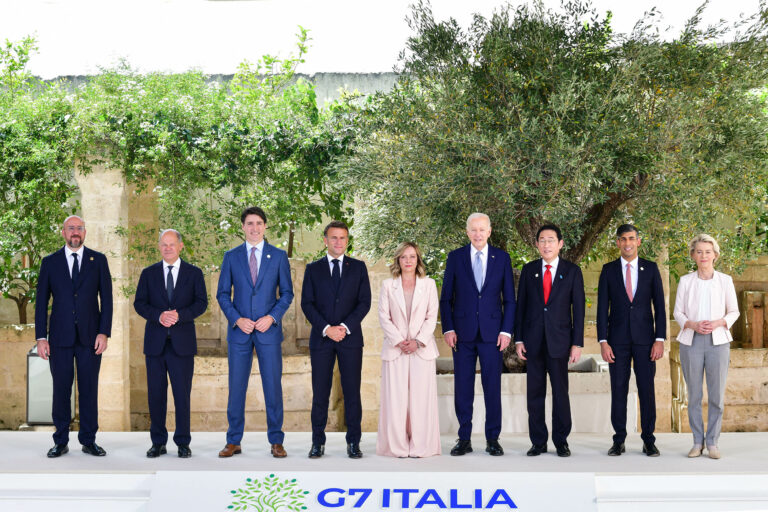
One hidden transformation of the international system in the most recent years has been the hijacking of the G7 by Washington as its ‘kitchen cabinet’ in the transatlantic system. The G8’s ‘shrinkage’ to G7 in March 2014 following the coup in Ukraine was a defining moment that signalled that there wasn’t going to be any post-cold war peace dividend. The G7 that was conceived as a group of countries charioting the world economy ended up as the vehicle of big-power rivalry to preserve the US’ global hegemony. Isolating Russia — and lately, China, too — became its leitmotif.
With the failure of the western project to isolate Russia, the G7 is meandering and lost its sense of direction. Italy, the G7 summit’s rotating host this year, has made AI a key issue in the summit. And Prime Minister Giorgia Meloni invited by an unlikely guest, the pontiff, to make an unprecedented appearance at the G7 event at the fashionable Italian hotel Borgo Enyatia to advocate for the regulation of artificial intelligence, a technology he’s called potentially harmful. Pope Francis was a chemist prior to entering seminary and will apparently draw on his scientific training to inform his stances. Italy under Meloni’s leadership has increasingly scrutinised AI technology, and temporarily banned ChatGPT in March 2023, becoming the first western country to do so.
Equally, G7 is desperate to go beyond a closed elite club of Western democracies by piloting an ambitious outreach and issued an unusually long list of invited leaders of the non-Western world to the summit. Aside Ukraine, Meloni has invited the leaders of India, Brazil, South Africa, Turkey, Saudi Arabia, Argentina, Algeria, Kenya and Mauritania to attend the meeting. What was the logic applied is impossible to tell.
But this is realpolitik and G7 is hoping to bridge the ‘West vs. the Rest’ hiatus in the line-up over the Ukraine crisis. In fact, the ‘outreach guests’ will witness tomorrow the nail-biting finale of a geopolitical drama, which forms the core of the G7 summit — the months-long attempt by the group’s leaders to make a decision on using dividends from frozen Russian assets for Ukraine’s military needs.
To recap, as part of the West’s ‘sanctions from hell’ against Russia in 2022, the European Union, Canada, the US and Japan froze Moscow’s assets in the western banks to the tune of $ 300 billion. (Some say, the actual figure is closer to $400 billion.) Only about $5-6 billion is located in the US, while $210 billion is stored in Europe, but the decision to use the proceeds from Russian assets was initiated by Washington with a hidden agenda to make Europe pay for the war’s consequences.
Unsurprisingly, the European members and Japan opposed the US pressure to include a provision on the use of income from frozen Russian assets in the joint G7 statement to be adopted. CNN reported on Monday that American officials are still trying to agree on the “most sensitive financial details” of the plan for Russian assets, since the G7 countries are yet to come to a consensus and discussions are continuing as regards “the exact form of providing assistance, as well as guarantees for the return of these funds.”
That said, don’t be surprised if the recalcitrant Europeans ultimately fall in line. There is no question that the G7 move to appropriate Russian money in western banks was bad enough but to use the profits out of them to fund the needs of Ukraine is, to put it mildly, an act of brigandage.
The US gains if the current freeze in Russia-Europe ties reaches a point of no return, as Europe is sure to bear the brunt of Moscow’s retaliation. If the G7 adopts such a move, it will weaken the global financial system. By brazenly violating international law, the G7 will be setting a precedent that undermines confidence in European institutions.
It will be interesting to see how the G7 leaders explain to the ‘outreach’ countries, drawn largely out of BRICS, that Russia is an exception and such a practice will not one day be used against India, Turkey, Saudi Arabia or some other state.
To be sure, the spectre of the 16th summit meeting of BRICS at Kazan (16-18 October) under the chairmanship of Russian President Vladimir Putin haunts the G7. Moscow has let it be known that if the past three years ended with the expansion of the BRICS, the new phase going forward will ensure that the participants in an expanded format create a viable structure in which the member countries work purposively to develop a viable structure.
An important topic at the BRICS summit meeting in Kazan will be the creation of a single currency within the grouping, which will significantly simplify and expand the economic relations of the member countries against the backdrop of mounting pressure from the West.
Speaking at the SPIEF conference in St. Petersburg last week, Putin announced that such an independent payment system would be created. Foreign Minister Sergey Lavrov later confirmed that a platform for payments in national currencies is being developed.
The BRICS countries have realised that the creation of a single currency has become a necessity today due to the ongoing sanctions from the US and the European Union. Lavrov noted that “recent international events have thrown off the masks” of the West, which has tried to impose its own values on other countries under the guise of universal ones and replace equal dialogue with “narrow coalitions” that assign the right to speak on behalf of the whole world.
BRICS, Lavrov underscored, implies a completely opposite type of partnership — that is, anything but a bloc structure, and on the contrary, a fundamentally open format, which involves working only in those areas that are of mutual interest to all participants, big and small. Reports suggest that around 30 countries have sought BRICS membership.
Meanwhile, in ‘systemic’ terms, G7 is entering uncharted waters. Far-right parties are storming the power centres of Europe. With an eye on the G7 summit, Politico wrote:
“Dream on. The G7 summit in the southern Italian coastal resort of Borgo Egnazia features arguably the weakest gathering of leaders the group has mustered for years. Most of the attendees are distracted by elections or domestic crises, disillusioned by years in office, or clinging desperately to power.
“France’s Emmanuel Macron and Britain’s Rishi Sunak are both fighting snap election campaigns they called in last-ditch efforts to reverse their flagging fortunes.
“Germany’s Olaf Scholz was humiliated by far-right nationalists in last weekend’s EU Parliament election and could soon be toppled himself.
“Justin Trudeau, prime minister for nine years in Canada, has spoken openly about quitting his “crazy” job.
“Japan’s Fumio Kishida is enduring his lowest personal ratings ahead of a leadership contest later this year.
“And then there’s Joe Biden.
“The 81-year-old U.S. president’s son, Hunter, was found guilty of gun charges on Tuesday, barely two weeks before his father’s first crucial debate with a resurgent Donald Trump in a presidential campaign the Democrat is in serious danger of losing.”
Above all, the angst in the European mind is palpable that if Trump wins in a democracy-altering climax in the November election, he may not even have time or patience to tolerate an archaic forum like G7. Surveying the bleak landscape, it comes as no surprise that Meloni took matters in her hands and decided to use the summit to her purposes by designing an agenda that cleaved to Italy’s strategic interests — Africa, migration and the Mediterranean.
Behind the Myth of “Billions in Arms” Flowing into Ukraine
By Brian Berletic – New Eastern Outlook – 13.06.2024
In a June 8, 2024, Bloomberg article titled, “Putin Is Running Out of Time to Achieve Breakthrough in Ukraine,” an optimistic prognosis was made regarding the ongoing conflict in Ukraine in favor of Kiev.
The article claims that Russia has made “limited progress” along the line of contact, including along the newly-opened front in Kharkov and that as “billions in arms start flowing” into Ukraine, Ukrainian forces will be given the opportunity to “counter-attack.”
The “billions in arms” Bloomberg cites refers to the renewed flow of US military assistance after months of delays in passing funding in the US Congress. However, recalling the flagging impact of US arms transfers to Ukraine even before the funding delays, and a closer look at the actual quantities associated with these packages versus Russian military production, tells an entirely different story.
Bloomberg claims that the renewed flow of US arms is eroding Russia’s military advantage. However, this is simply not true.
Artillery Shells
The most recent US arms package featured, among other items, badly needed 155mm artillery shells and anti-tank weapons including the vaunted Javelin missile. Missing from the Pentagon’s public press release, were the quantities these weapons and munitions were being sent in.
It is well-known that US and European artillery shell production falls short of Russia’s by several times. A May 2024 Business Insider article puts the number of Russian shells produced this year at 4.5 million, while the US and Europe combined amount to only 1.3 million.
The prospect of Western shell production drastically increasing to match or even exceed Russian production numbers is unrealistic, according to a June 7, 2024 Bloomberg article titled, “America’s War Machine Can’t Make Basic Artillery Fast Enough.”
In the Bloomberg piece, various factors are mentioned ranging from limited material inputs, a lack of trained human resources, the need to vastly expand the physical production sites producing both the shells themselves and their various individual components, as well as the need to consistently procure funding to expand each of these factors. All of this takes time.
The article claims that by 2025, the US should be producing up to 68,000 155mm artillery shells a month. Even if Europe was able to match these production numbers, it would represent only two-thirds of Ukraine’s monthly requirements to achieve its 6,000 round daily rate of fire, which still falls far short of Russia’s daily rate of fire, placing Ukraine at a disadvantage.
Artillery shell production is relatively straightforward compared to more advanced weapons Ukraine also desperately requires. This includes anti-armor weapons like the Javelin missile.
Javelin Anti-Tank Missiles
Once hailed as a “game changer” by the collective Western media, the Javelin is now rarely mentioned either in headlines or even buried deep within articles. The missiles were passed over to Ukraine by the thousands during the initial phases of the Russian Special Military Operation (SMO), up to 7,000 or about one-third of the US’ total inventory according to the US government and arms industry-funded Center for Strategic and International Studies (CSIS) in late 2022.
Since then, Lockheed Martin, which produces the Javelin missile, claims to have expanded production by up to 15% in a 2024 release, producing up to 2,400 missiles per year or about 200 per month.
2,400 missiles are not being sent entirely to Ukraine each year. The missiles and less numerous command launch units (CLU) that fire them are required by the US, other NATO members, and other Lockheed customers around the globe. But let’s assume for a moment all 2,400 missiles are sent to Ukraine each year, and because US stockpiles are at critical levels, let’s assume Ukraine is sent Javelins drawn from this monthly production.
Does this mean that each month, 200 Russian tanks will be damaged or destroyed, adding up to 2,400 a year? No. According to the US Army’s own studies, even trained US soldiers have a 19% hit rate while utilizing Javelin, TOW, and AT-4 systems, all of which the US has sent to Ukraine throughout the SMO.
This means that even if Ukraine was receiving 200 missiles a month and firing them at Russian armored vehicles, they would be scoring only about 38 hits a month. Out of those 38 hits, fewer still would result in significant damage or complete destruction.
Comparing these overly optimistic numbers with Russian tank and other armored vehicle production puts this into better context.
According to a March 2024 CNN article discussing Russian military production, it admits Russia is producing up to 125 tanks a month. Other Western sources claim Russia also produces up to 250 other armored vehicles per month, for a total of 375 armored vehicles a month.
Compare that with the 38 hits Ukraine would be able to inflict even if the US sent every single Javelin produced straight to Ukraine each month. Russia is producing far more armored vehicles than the US is producing Javelin missiles to destroy them. The story is the same for other anti-armor weapon systems produced across the West (e.g. 1,000 TOW missiles produced per year), all of which face depleted stockpiles and low monthly production rates.
Considering that the number of Javelin missiles and other ordnance sent to Ukraine will be far less in reality than total monthly production, we begin to see the true measure of US (and European) military assistance and how the “billions in arms” now flowing to Ukraine do not represent a significant change in Ukraine’s ability to slow, let alone stop Russian forces as they continue mounting pressure not only along the existing front, but opening entirely new fronts, creating a wider strategic dilemma for Ukraine, stretching an already insufficient amount of manpower, equipment, and ammunition even further.
Empty Rhetoric
Despite Bloomberg discounting its “Putin is Running Out of Time” article with its “America’s War Machine Can’t Make Basic Artillery Fast Enough” article, it and other Western publications’ attempts to convince audiences that the tide is about to shift in Ukraine’s favor is a repeat of this same empty rhetoric used to sell Ukraine’s 2023 “counteroffensive” as poised to shift the conflict.
In reality, the 2023 Ukrainian military operation was soundly defeated by Russian forces who not only decimated Ukraine’s manpower, equipment, and ammunition stocks, but managed to bolster its own numbers and capabilities in the process.
Ukrainian attempts to claw back territory it has recently lost in Kharkov will lead to the same fruitless conclusion its 2022 and 2023 offensives did, a questionable chance of actually taking the territory for a guaranteed severe cost in irreplaceable trained manpower and equipment.
Today’s headlines across the West portending the tide changing in the fighting across Ukraine represent a now familiar cycle of encouraging Ukraine to fight on in what is otherwise an unwinnable conflict inflicting an immense and indelible cost on Ukraine in terms of territory, human lives, and economic prospects well into the future.
But as has been pointed out many times before, feeding Ukraine into an unwinnable proxy war had been a US objective articulated as early as 2019 in RAND Corporation’s paper, “Extending Russia,” which stated:
Expanding U.S. assistance to Ukraine, including lethal military assistance, would likely increase the costs to Russia, in both blood and treasure, of holding the Donbass region. More Russian aid to the separatists and an additional Russian troop presence would likely be required, leading to larger expenditures, equipment losses, and Russian casualties. The latter could become quite controversial at home, as it did when the Soviets invaded Afghanistan.
But warned:
However, such a move might also come at a significant cost to Ukraine and to U.S. prestige and credibility. This could produce disproportionately large Ukrainian casualties, territorial losses, and refugee flows. It might even lead Ukraine into a disadvantageous peace.
Obviously, even in 2019, US policymakers realized Ukraine would not win a US-sponsored proxy war against Russia. The actual objective was to raise the cost of Russian victory high enough to undermine Russia’s economy, divide Russian society, and perhaps even eventually precipitate a Soviet Union-style collapse. While RAND’s predictions of Ukraine’s destruction amid such a proxy war have clearly come to pass, the supposed “benefits” of this policy have yet to avail themselves and do not appear even plausible at this juncture.
Thus, Western rhetoric about Ukraine’s soon-to-be good fortune is not based on genuine analysis of the ongoing conflict, but is instead a point of propaganda aimed at encouraging Ukraine to fight on despite all actual analysis warning of the disaster awaiting in doing so.
Only time will tell just how far this process plays out to where the US and its partners are no longer pushing Ukraine onto the battlefield and are instead taking to the negotiation table. In the meantime, the “billions in arms” flowing into Ukraine will continue to have the same impact they’ve had all along, ensuring “disproportionately large Ukrainian casualties, territorial losses, and refugee flows,” ultimately leading Ukraine “into a disadvantageous peace.”
US using Ukraine conflict as pretext to impose sanctions – China
RT | June 13, 2024
The US is using the Ukraine crisis as an opportunity to impose sanctions while continuing to pump Kiev with weapons, Chinese Foreign Ministry spokesman Lin Jian said on Thursday.
Lin made the remarks after the US State Department and Treasury Department announced a new round of curbs on Wednesday targeting 300 additional individuals and entities in Russia and other countries, including China, Türkiye, and the UAE. In particular, Washington has sanctioned China-based companies which are selling semiconductors to Moscow.
According to the Treasury Department, the latest measures target more than $100 million in trade between Russia and foreign partners suspected of enabling Moscow to evade Western embargoes.
The Chinese diplomat called Washington “extremely hypocritical and overbearing” for supplying Ukraine with weapons while pushing for peace.
“We urge the United States to immediately stop abusing illegal unilateral sanctions, and focus on ceasefires, stop wars, restore peace, and play a constructive role,” he said at a regular news briefing.
Beijing had previously accused the US and its allies, which together supply the bulk of Kiev’s military equipment, of hypocrisy, stating that Western powers should work on bringing Russia and Ukraine to the negotiation table, instead of “shifting the blame” onto China for the continued hostilities.
Earlier this week, China said it remains firmly opposed to the sanctions, noting it would safeguard the rights and interests of its companies and citizens. Beijing has urged Washington to stop smearing China and “lift illegal unilateral sanctions” on its businesses.
Beijing has adhered to a policy of neutrality with regards to the Ukraine conflict, and has firmly rebuffed Western calls to impose sanctions on Russia, opting instead to boost trade with its neighbor. This has led to accusations from the UK and its NATO allies that Beijing is fueling Russia’s military effort by supplying it with dual-use components that can be utilized in weapons production.
Among the latest steps, the US Treasury said it was raising “the risk of secondary sanctions for foreign financial institutions that deal with Russia’s war economy,” effectively threatening them with losing access to the American financial system.
The Chinese foreign ministry has repeatedly stressed that economic and trade cooperation between China and Russia “will not be disrupted by any third party.”
Annual trade between the bordering countries surpassed $240 billion last year, according to official data.
EU “playing a dark game” and serves “sinister” interests of US
By Ahmed Adel | June 13, 2024
The European Union’s reaction to the conflict in Ukraine indicates that the bloc does not pursue the peaceful objectives that were the basis of its creation, writes columnist Javier Melero for the Spanish newspaper La Vanguardia. At the same time, European authorities are in negotiations to maintain the flow of gas through the important Russia-Ukraine pipeline, once again showing that Europe is committing economic suicide with its failed sanctions policy on Moscow.
“War has returned to Europe, and it would be appropriate to ask after the post-election euphoria how the EU reacts to the Russian-Ukrainian conflict,” Melero wrote.
By asking this question, the author emphasises that in public discussions in Europe no other option for resolving the conflict is considered, except “Russia’s unconditional surrender.” Based on this, he concludes that the EU does not act in accordance with declared peaceful objectives but serves the “sinister” interests of NATO and the USA.
“It seems to me that something doesn’t add up here and that Europe is playing a dark game. And these games, what’s even worse, end badly for it. And the conflict in Ukraine seems to be no exception,” concluded Melero.
Yet, even as the EU does not prioritise peace to instead serve Washington’s interests, the bloc is unable to wean itself off Russian energy, a demonstration that the economies and prosperity of the European continent is intrinsically interconnected and that the US-led sanctions have only had a boomerang effect. For this reason, European authorities are desperately in negotiations to maintain the flow of gas through the Russia-Ukraine pipeline even if the bloc tried to end Russian shipments.
The agreement covering this gas transit exchange expires at the end of this year, and with the ongoing Ukrainian conflict, most market watchers expect the flow to finally stop. However, European government and business officials are talking to their counterparts in Ukraine about how to maintain the flow of gas next year, according to people familiar with the matter interviewed on condition of anonymity by Bloomberg.
At the same time, one option that has been discussed is for European companies to buy and inject Azerbaijani gas into Russian gas pipelines bound for Europe, according to some sources. A plan to use Azerbaijani gas could, in theory, benefit Russia if it were set up as an exchange that would allow Moscow to ship its gas elsewhere.
Negotiations are in their early stages, and people familiar with the matter expect decisions only later this year, when the expiry date — and the onset of European winter — add pressure. Russia still sends around 15 billion cubic metres of gas a year to Europe , mainly to Slovakia and Austria, where Moscow is still a dominant supplier.
In Austria, Russian gas covered more than 80% of Austrian consumption for five consecutive months. Europe also imports Russian liquefied natural gas (LNG) by ship and, despite frequent debates about whether it should do so, has never sanctioned Russian gas.
The European Commission, the executive arm of the European Union, believes that the bloc can resist the end of Russian transit through Ukraine without any major security risk, but some member states are less optimistic and fear a repeat of the energy crisis, writes Bloomberg.
Whilst Europe worries about another energy crisis, Russian revenues from oil and gas exports increased by 82.2% in the period between January and April, compared to the same period in 2023, reaching more than 4.2 trillion rubles. The growth comes despite sanctions imposed on Russia since the launch of its military operation in Ukraine in 2022, including an embargo on Russian oil transported by sea and a $60 per barrel price cap on other types of oil.
Moscow has repeatedly expressed its readiness for peace negotiations, but the Kiev authorities have introduced a ban on them at the legislative level. At the same time, the West ignores Kiev’s constant refusals to dialogue and instead encourages the continuation of war, even as Ukraine loses more territory and experiences a demographic collapse as millions have fled the country and hundreds of thousands are being killed in a futile war against Russia.
But as Melero highlighted, US-led NATO only has “sinister” designs. These designs can only be detrimental to European interests, making the complete servitude to Washington all the more bizarre, especially since before February 2022, French-led Europe spoke a brave game of European strategic autonomy from the US. The first opportunity to test Europe’s pursuit for strategic autonomy showed that this was only lip work by French President Emmanuel Macron and that ultimately the EU is the biggest loser in the Ukraine conflict after Kiev itself, and not Russia or even the US.
Ahmed Adel is a Cairo-based geopolitics and political economy researcher.
Musk wants Ukrainian NGO designated as terrorist group
RT | June 13, 2024
A Ukrainian NGO has compiled a database of influential American citizens, who it claims hold positions that ‘mirror’ those of Moscow. One of the blacklisted individuals is billionaire Elon Musk, who has called for the organization to be designated as a terrorist group.
The NGO, Texty.org.ua, produced a lengthy report last week, which detailed a supposed “ecosystem” of citizens and organizations in the US, whose narratives “echo key messages of Russian propaganda” regarding the Ukraine conflict.
On Wednesday, Republican members of the House Appropriations Committee added a provision to the markup of the State Department’s 2025 budget that bans Texty from receiving US funding.
“It’s a good first step. They should be added to the list of sanctioned terrorist organizations,” Musk said on X (formerly Twitter) in reaction to the news.
The prohibition was championed by Representative Jim Banks, who was also targeted by the Ukrainian NGO. He told fellow Republicans that “federal bureaucrats should not support or partner with foreign groups that attempt to intimidate and silence US citizens and lawmakers.”
His message alluded to a link between the department and Anatoly Bondarenko, a co-founder of Texty. He is also an instructor for the ‘TechCamp’ program, which provides training to foreign journalists, NGOs, and activists, according to the Conservative Thinker.
The group has said its report was a piece of “data journalism,” and described itself as the victim of “an attack on freedom of speech and a display of chauvinism against the citizens of Ukraine.”
“Our critics believe that we do not have the right to investigate the streams of false information they produce about our country and us, simply because they are US citizens and we are not,” it claimed.
The original report described people on its list as “forces in the US impeding aid to Ukraine,” ranging “from Trumpists to Communists.” Highlighted in the report was the renowned anti-war group CODEPINK, organizations funded by billionaire Charles Koch, popular conservative speaker Jordan Peterson, and former Fox News host Tucker Carlson.
Texty targeted Musk for supposedly allowing “Russian propaganda” on X, which he owns, and sharing with his followers a “highly skeptical view of the United States’ financial support for Ukraine.” Meanwhile, businessman Peter Thiel was accused of investing in Rumble, a free speech video sharing website. Unlike major platforms operated by US tech giants, it allows RT content.
The report acknowledged that both entrepreneurs had contributed to Kiev’s war effort against Russia via Musk’s Starlink satellite internet system and Thiel’s Palantir big-data analysis platform, but placed them on its blacklist nevertheless.
Fauci’s institute hid mpox gain-of-function plans from Congress and the media
By Emily Kopp | U.S. Right To Know | June 11, 2024
For nearly nine years Anthony Fauci’s institute concealed plans to engineer a pandemic capable mpox virus with a case fatality rate of up to 15 percent, congressional investigators revealed in a new report Tuesday.
In June 2015, a scientist at the National Institute of Allergy and Infectious Diseases received formal approval from the National Institutes of Health’s Institutional Review Board for experiments expected to engineer an mpox virus with high transmissibility and moderate mortality.
NIAID — the institute Fauci oversaw for nearly four decades and which underwrites most federally funded gain-of-function research — concealed the project’s approval from investigators with the House Committee on Energy and Commerce over the course of a 17 month-long investigation.
A new interim report describes the obstruction and secrecy around the mpox proposal as a case study in how the institute “oversees and accounts for the monitoring of potentially dangerous gain-of-function research of concern.”
The revelations land amid global concerns about whether coronavirus gain-of-function research — research that might generate pathogens with increased pathogenicity or transmissibility — may have contributed to the worst pandemic in a century.
The committee, in conjunction with the House Committee on Oversight and Reform, is also investigating coronavirus gain-of-function research underwritten by NIAID at the Wuhan Institute of Virology, and faces similar stonewalling in that investigation, a committee aide said.
NIAID’s lack of transparency surrounding the proposed mpox experiment for nearly a decade undermines Fauci’s assurances at a congressional hearing last week that any biosecurity breach at the Wuhan lab could not have any connection to his former institute. Investigators continue to pursue documentation from EcoHealth Alliance, an NIAID contractor whose funding was recently suspended for failing to properly oversee coronavirus experiments exported to Wuhan.
Mpox, formerly known as monkeypox, caused a public health emergency in the U.S. from August 2022 to February 2023. It is endemic in Africa. The more deadly clade circulates in Central Africa (clade I) while the more transmissible clade circulates in West Africa (clade II). Mpox has infected more than 20,000 people and caused more than 1,000 deaths in the Democratic Republic of Congo, where clade I predominates, according to the Centers for Disease Control and Prevention — though some experts believe that is an undercount of true cases. A strain of the clade II virus drove the American outbreak.
The mpox experiment first came to light in a September 2022 article in Science.
The gain-of-function project proposed by NIAID virologist Bernard Moss would splice genes conferring high pathogenicity from the clade I virus into the more transmissible clade II virus. The new “chimeric” (combined) virus could have retained up to a 15 percent fatality rate and a 2.4 reproductive number, a measure of transmissibility indicating every sick person could infect up to 2.4 people on average, giving it pandemic potential.
The committee’s attempts to learn more about the experiment were met with stonewalling.
NIAID maintains the experiment was never conducted, but has never provided any contemporaneous documents to support that claim such as emails or lab notebooks, according to the committee’s report.
The lack of engagement from NIAID, the National Institutes of Health and the Department of Health and Human Services does not comport with the idea the experiment was never conducted and that there is nothing to hide, according to the committee.
HHS and NIH misled congressional investigators for nearly a year and a half, falsely denying that Moss had obtained formal approval for this gain-of-function experiment.
The committee launched its investigation in October 2022 but was only permitted to view key documents in camera in March 2024, which confirmed NIH’s formal approval of the experiment.
The committee lays blame with officials at NIAID, who fund most federally underwritten gain-of-function research, have the subject matter expertise, and may have misled their bosses at HHS and NIH.
For months NIAID and Moss had reported to the committee that the mpox experiment had not moved forward and that Moss had simply been spitballing with the Science reporter in 2022 without serious intention.
However amid the committee’s investigation in May 2023 an approval from the Federal Select Agent Program for a chimera involving both clade I and clade II of the mpox virus was revoked.
NIAID also misled Science and STAT News in saying the gain-of-function mpox experiment was never approved, according to the committee.
Committee aides say they will continue to press for full accountability and transparency, and hope for a culture change at NIAID away from secrecy under new leadership.
Fauci retired after 38 years as the head of NIAID in December 2022; Jeanne M. Marrazzo now serves as director of the institute. Former NIH Director Francis Collins retired in December 2021; Monica Bertagnolli now serves as director of the NIH.
The revelations also come amid a debate about the future of gain-of-function research regulation.
New policy unveiled last month by the White House Office and Science and Technology Policy maintains a largely self-regulatory framework, vesting the responsibility for initiating increased regulation with the researchers and funding agencies such as NIAID.
The vast majority of gain-of-function research that could generate epidemic and pandemic capable viruses is likely to be exempted from more rigorous scrutiny under the new protocols, according to the committee.
Many of the world’s most public virologists have dismissed the theory that the COVID-19 pandemic may have resulted from a lab accident as a conspiracy theory and have chafed at the idea that the work should be regulated by an outside agency, subject to public input or not pursued at all.
That culture extends to NIAID, too, according to the committee’s investigators, who have also uncovered that top administrators may have illegally evaded federal record retention and transparency law.
Concerns were raised by a committee aide that NIAID exerted undue influence at OSTP to preserve the laissez-faire status quo.
“The new OSTP policy continues to give funding agencies, like NIAID, primary responsibility for oversight of GOFROC and DURC experiments involving potentially dangerous pathogens,” the committee’s report reads. “In almost any other scientific field or industry, this arrangement would be immediately recognized as a conflict of interest, necessitating independent review and oversight.”
Policy improvements suggested by the committee’s report include codifying public input through a community oversight board, which already exist for high-containment biosafety level four laboratories, as well as moving final approval for gain-of-function research out of NIAID.
According to the National Academies of Sciences, Engineering and Medicine, the number of labs capable of growing orthopoxviruses like mpox and smallpox from scratch currently stands at less than 100, but could increase significantly as DNA synthesis and engineering techniques improve and become cheaper.
Has Israel considered a loss to Hezbollah?
By Ali Rizk | The Cradle | June 11, 2024
As the war in Gaza lags on, cross-border exchanges on the Lebanese–Israeli front have intensified. Fighting between Hezbollah and the Israeli military has taken a heavy toll on both sides. The Lebanese resistance movement has lost over 300 fighters, with Israeli shelling resulting in the displacement of tens of thousands of Lebanese residents of the country’s southern villages.
Israel has not fared much better, with at least sixty thousand northern settlers forced to flee their homes. While the occupation army has confirmed the death of around a dozen of its soldiers in the exchanges with Hezbollah, the real number is estimated to be much higher.
In March, The Cradle gained intel that over 230 Israeli troops had been killed in combat since 8 October 2023.
The rising threat of a large-scale war
While the northern conflict currently remains within the boundaries of ‘controlled escalation,’ the prospects of a full-blown war between Hezbollah and Israel may be steadily increasing. Far-right members of the Israeli government, who are key to keeping Prime Minister Benjamin Netanyahu’s governing coalition intact, have become noticeably more vocal in supporting escalation on the Lebanese front.
Finance Minister Bezalel Smotrich has called for launching an attack on Beirut, describing it as “the capital of terrorism.” Given these stances, it cannot be entirely dismissed that Netanyahu may opt to escalate against Lebanon.
Indeed, recent statements by the Israeli prime minister suggest that some form of wider escalation on the northern front may be in the making.
Speaking during a visit to the headquarters of the Israeli military’s Northern Command, Netanyahu referred to “surprising plans” being devised to deal with Hezbollah, aiming to “restore security to the north and to restore residents safely to their homes” without going into further detail.
Amid these developments, the Israeli military recently completed a drill that simulated a ground incursion into Lebanon.
A large-scale Israeli offensive on Lebanon in the near future would also be consistent with earlier assessments made by US officials, who, in late February, predicted a possible ground incursion into Lebanon by the late spring or early summer.
Hezbollah’s increasing capabilities
Hezbollah’s challenge to Israel appears to be on the rise, reflecting a failure of Tel Aviv’s current strategy of relying on precision surgical strikes. According to the Israeli institute Alma, which monitors developments on the Lebanese–Israeli front, 325 cross-border attacks were carried out by Hezbollah in May, the highest number of monthly attacks on this front since 7 October.
The resistance movement’s operations have also become more sophisticated, revealing capabilities it has introduced for the first time. Hezbollah managed to destroy an advanced surveillance balloon used to detect incoming attacks in an operation conducted via a kamikaze drone.
It has also upgraded its drone capabilities, recently launching a twin-kamikaze drone attack on the northern town of Hurfeish and conducting its first-ever air raid through an armed UAV equipped with S5 rockets. The operation targeted Israeli soldiers in the settlement of Metula and was the first time in which an Arab force had launched an airstrike on Israel.
Most recently, Hezbollah released footage on 6 June showing a guided missile attack on an Iron Dome platform in Israel’s Ramot Naftali barracks in the Galilee.
What to expect in a full-scale war
The increased sophistication of Hezbollah’s operations can also be seen as fueling Tel Aviv’s urgency to take decisive action against the resistance group. This was expressed by former Israeli war cabinet minister Benny Gantz, who described the Lebanese front as the most significant and pressing operative front in the current conflict, warning that the “moment of truth” was now close.
However, what the Lebanese movement has demonstrated since 7 October also serves as a warning of what awaits the occupation state if an all-out war were to erupt.
The Israeli military is expected to employ methods similar to 2006 in that it would carry out destructive air raids on ‘Hezbollah strongholds’ in southern Lebanon, Beirut, and the Bekaa region.
Speaking to The Cradle, retired Lebanese Brigadier General Elias Farhat explains:
There is no such thing as a limited full-scale war. A full-scale war will have to include all of Hezbollah’s strongholds.
However, any Israeli onslaught on par or exceeding what happened in 2006 is almost certainly going to be met, this time, with a much harsher response from Hezbollah.
The Lebanese movement has amassed a far larger rocket and missile arsenal, with estimates pointing to over 150,000 of these weapons now in its possession. Given this military build-up, Hezbollah is widely recognized today as the world’s heaviest armed non-state actor.
Perhaps even more importantly, its arsenal includes precision missiles such as the Fateh 110, enabling it to aim at strategic Israeli installations that could cause immense damage. Against this backdrop, Israeli experts have warned of a MAD (Mutually Assured Destruction) scenario in the event of a full-scale war with Hezbollah.
It is also possible the Lebanese movement possesses military capabilities that could undermine Israel’s air power advantage. The group has already demonstrated its air defense capability against Israeli drones, having succeeded in shooting down several ‘Hermes’ UAVs in the current round of hostilities.
The bigger danger to Israel, however, would be Hezbollah’s possession of air defenses capable of shooting down not only drones but Israeli warplanes. Given the strengthening of military ties between Russia and Iran, the possibility of Hezbollah accessing Moscow’s enhanced anti-aircraft technology is increased.
The resistance movement has already announced that it launched surface-to-air missiles at Israeli warplanes that had broken the sound barrier and had hence forced the aircraft to retreat.
This marks the first development of its kind in the history of warfare between Hezbollah and Israel and could merely be a warning shot for what could transpire in the event of an all-out war.
That Hezbollah would unveil such weapons in a full-scale conflict is consistent with its strategy of saving its best for such confrontations. In 2006, it surprised the Israeli military by striking a warship in a missile attack.
Israel would also likely face superior offensive ground operations in a full-scale war with Hezbollah. The Lebanese movement gained valuable experience in such operations while fighting extremist groups in Syria.
As Hussein Ibish of the Arab Gulf States Institute recounts to The Cradle:
“The combination of Hezbollah ground fighters and Russian air and signals intelligence dominance was the ‘A-Team’ on behalf of the Assad [government] in the Syrian war.”
Given this experience and its ability to launch airstrikes via UAVs, Hezbollah likely retains the capacity to launch offensive infantry operations – importantly, with air cover.
Manpower and tactical advantages
Hezbollah will also likely enjoy an advantage in terms of reliable, tested, and highly motivated manpower. Due to its close ties with allied resistance factions in Iraq and Yemen, fighters from these countries are likely to come to Hezbollah’s aid in a full-scale conflict with Israel.
The Lebanese movement’s Secretary General Hassan Nasrallah alluded to this factor in a 2017 speech. Israel, by contrast, appears to be suffering from a shortage of manpower in its military ranks, not to mention tanking troop and commander morale, highlighted on Sunday by yet another high-level military resignation, this time Gaza Division Commander Brigadier-General Avi Rosenfeld.
Israeli defenses are also unlikely to succeed when facing large barrages of Hezbollah missiles and drones. Unlike Iran’s retaliatory attack on 13 April, where the US and allies shot down a large fraction of the incoming drones and missiles, similar-style attacks launched by Hezbollah would be far more difficult to deal with.
The closer geographical distance means much less time to intercept and shoot down such attacks. Hezbollah, which relies heavily on the element of surprise in its military tactics, will also certainly not telegraph its attacks beforehand as Iran did. As a result, Israel would likely remain exposed to immense attacks through surface-to-surface missiles, kamikaze drones, and airstrikes via UAVs.
Moreover, the Lebanese resistance has spent many months tirelessly disabling Israel’s “eyes and ears” in the north, reportedly destroying over 1,650 pieces of intelligence, surveillance, and target acquisition (ISR) equipment since the conflict’s onset.
Israel is increasingly operating blindly in that vital northern theater, allowing Hezbollah to repeatedly and successfully strike at qualitative targets, penetrate more deeply into the occupation state, and employ more advanced weaponry.
The US response
While it is likely that the US will rush to defend its Israeli ally, the bigger question is how far it is willing to go. As indicated above, defensive measures are unlikely to significantly undermine the severity of Hezbollah’s cross-border missile and drone operations.
Judging from its approach following the Iranian attack on Israel, Washington is unlikely to go beyond defensive support. Following Operation True Promise, the White House reportedly informed Tel Aviv that it would have no part in any offensive action against Tehran, effectively leaving its Israeli ally with little choice but to settle for a far less proportionate response to Iran’s significant military operation.
Given how that situation unfolded, it would be a risky gamble for Israel to pin its hopes on its US security guarantor assuming an offensive role in a major war with Hezbollah. Tensions are also rising between the US and rival superpowers, reinforcing this dynamic.
Speaking to The Cradle, Steven Simon, Senior Director for the Middle East and North Africa in the US National Security Council during the Obama administration, emphasizes that “a direct combat role beyond air defenses (in a full-scale war between Hezbollah and Israel) is highly unlikely.” This is especially the case, he adds, “given tensions with Russia and China.”
Nawaf al-Musawi, Hezbollah’s Resource and Border Affairs official and one of the movement’s strategic thinkers, offers this prediction:
The Israeli occupation needs weapons from Washington for any war it wishes to wage against Lebanon. After any war with Lebanon, the region will not be the same as it was before. The next war with Israel will be the final war.
Apple under fire for matching employee donations to IDF and illegal settlements
MEMO | June 12, 2024
Biden and other Western leaders could face war crimes prosecution over Gaza and Ukraine

By Finian Cunningham | Strategic Culture Foundation | June 12, 2024
US President Joe Biden and European leaders are liable for war crimes in Gaza and Ukraine and could face prosecution.
That’s the assessment of internationally renowned legal expert Alfred de Zayas* and a collective of jurists at the Geneva International Research Peace Institute.
In what could be a breakthrough test case, Professor de Zayas and his colleagues have submitted a formal request to the International Criminal Court to investigate European Commission President Ursula von der Leyen for complicity in war crimes in Gaza and Palestinian Territories committed by the state of Israel.
In this interview, de Zayas outlines the case for prosecution against von der Leyen, who as president of the European Commission is Europe’s most senior political representative. Von der Leyen is accused of being in breach of the 1948 Convention on Genocide by aiding and abetting the Israeli state in its military onslaught against Palestinians.
It is not just von der Leyen who is liable for war crimes prosecution. Other senior members of the European Union – Charles Michel and Josep Borrell – and European national leaders such as France’s Emmanuel Macron, Germany’s Olaf Scholz and Britain’s Rishi Sunak are also indictable.
As Prof de Zayas points out, US President Joe Biden is a prime figure for prosecution given that the United States is the biggest political and military supporter of Israel.
All Western leaders have a case to answer for the appalling genocide in Gaza which has resulted in more than 40,000 Palestinian deaths, mainly among women and children. If a case can be made against von der Leyen then others will follow against Western leaders.
What de Zayas says is crucially important is to break the false aura of impunity that “arrogant” Western leaders think they have. These politicians have the misplaced belief that they are “untouchable” and “unaccountable” under international law.
He says the legal process initiated by his collective of jurists at the Geneva International Peace Research Institute of prosecuting Western leaders is gathering worldwide momentum. More international legal experts and concerned citizens are adding their names to the legal petition.
A final note on the conflict in Ukraine. The funneling of weapons into that country by the US and other NATO powers is grounds for prosecution under the war crimes of incitement against peace and instigation of aggression. The NATO powers are guilty of Nuremberg crimes that Nazi leaders were convicted of in 1946.
Professor de Zayas and his colleagues are serving notice on Western leaders that they are not above the law and they will eventually end up the dock to face justice. The groundswell of world public opinion is outraged by the war crimes in Gaza and NATO’s relentless warmongering in Ukraine. The movement of protests across the world against the genocide in Gaza is proof of the huge groundswell. The political challenge to establishment politicians and figures cannot be overstated.
A movement to call out the war criminals in high office and put them in the dock is long overdue but it is underway.
* Alfred de Zayas is a formidable legal authority who writes a regular column for Counterpunch magazine. He is a Professor of International Law at the Geneva School of Diplomacy. Formerly, he served as the United Nations senior expert on international law. He has written 11 books, including Building a Just Global Order (2021, Clarity Press) and Countering Mainstream Narratives (2022, Clarity Press).
Glenn Greenwald interviews Briahna Joy Gray about her firing by the Hill
System Update | June 11, 2024
From System Update with Glenn Greenwald, June 7, 2024. Greenwald is a journalist, constitutional lawyer, and author of four New York Times bestselling books on politics and law. He has won numerous journalism awards. (https://theintercept.com/staff/glenn-…)
More information on Gray’s firing is at https://israelpalestinenews.org/most-…
Shorter clips are at https://youtu.be/KjbEsA7rVqk?si=Yb91r… and https://youtu.be/Ly9F_45OZi0?si=Ph95S…
Full show at : https://rumble.com/v5091bc-system-upd… –
Featured Video

Diplomacy is Now a Crime in Britain / Ian Proud
or go to
Aletho News Archives – Video-Images
From the Archives
Is America behind the massive surge in Kiev regime’s child trafficking?
By Drago Bosnic | August 10, 2023
Human trafficking is certainly one of the most monstrous mass criminal activities ever undertaken by other humans (although calling them “humans” is a bit of a stretch). And yet, there’s a special kind of this deeply repulsive crime that pushes it to diabolical proportions – child trafficking. Underage kids, particularly those who were abandoned, sold or have very poor/abusive family backgrounds, are by far the most vulnerable group. The depraved criminals who engage in such illicit activities specifically target unfortunate children and given there are millions of them all around the globe, particularly in war-torn areas, the “recruitment pool” is effectively endless. Unfortunately, the demand on the black market also seems to be constant and growing, making it a very lucrative and appealing prospect for criminals. … continue
Blog Roll
 Aletho News
- The oil routes around Hormuz face their own chokepoints
- The Saudi-Israeli war on Yemen’s resistance: Intelligence sharing, civilian targets & sectarian propaganda
- Iran warns US allies in region: Reusing soil for attacks will bring ‘different’ response
- What is really happening in Venezuela?
- Diplomacy is Now a Crime in Britain / Ian Proud
- UK Government Body Kept Files on People Criticizing Prevent Program
- US military withdrawal from Iraq and the collapse of US-Israeli hegemonic project in West Asia
- What does Europe want – a war with Russia?
- She Followed the Actual Data on COVID Vaccines and Masks — Her Career Took a Huge Hit
- Florida AG Sues Pfizer, Bourla Over Deceptive Marketing of COVID Vaccines
- If Americans Knew
- No big deal: Israel to halt humanitarian aid to Gaza for 2 days – Daily Update
- Israel is squeezing the life out of Palestinians – Daily Update
- The Israeli Right Portrays Islam as Murderous. It Serves a Political Purpose
- Jordan Has Had Enough: King Abdullah’s Scathing Warning to Israel
- Israeli Colonizers (i.e. Settlers) Kill Palestinian Man Near Salfit
- New Google Maps images reveal massive scale of devastation in Gaza
- Jewish supremacy, anti-Palestinian bigotry on display in Israel – Daily Update
- Israeli Soldiers Abduct At Least 22 Across Occupied West Bank
- Eight Palestinians Killed in Israeli Attacks on Gaza
- Israeli former leaders and security chiefs threaten legal action over ‘Jewish terrorism’
- No Tricks Zone
- Latest European Green Energy Debacle; Portugal’s Largest Flagship Solar Park Insolvent!
- Green Energy Debacle: German Expert Professor Fritz Vahrenholt Warns Of Severe Economic And Social Consequences
- Two More Paleo Reconstructions Affirm Meters-Higher Sea Levels Across Ireland, Brazil 7000-6000 Years Ago
- New Study: Earth And Venus Surface Warmth Largely Explained By Convection And Lapse Rate, Not CO2 Or Radiation
- 2025 Nature Paper Claiming Worsening Global Drought Gets RETRACTED …Heavily Flawed
- New Study: ‘Global Drought Shows No Detectable Recent Acceleration Under Climate Warming’
- Economic Masterminds: German Socialists Suggest Taxing Productivity Gains Stemming From Using AI
- The South China Sea Has Not Been Cooperating With The Climate Change Narrative
- Energy Crisis: Germany Enters Heating Season With Historically Low Gas Reserve Fill Levels
- New Study: The Antarctic Ice Sheet Gained Mass From 2020-2024 Due To Staggering Snow And Ice Accumulation

