Several medical credentialing boards instituted COVID-19 Misinformation Policies in September of 2021 and have used them to censor and retaliate against academics and practicing physicians who performed research, clinical care, and presented their findings on the early treatment of acute COVID-19 and vaccine safety. The boards’ position is that they and the government agencies they agree with, hold agency over the truth. By establishing that power dynamic, members who disagree with them are spreading misinformation and can be convicted in closed panel meetings without the member being allowed to present their views based upon the data and evidence at hand.
The Association of American Physicians and Surgeons sued three medical specialty boards for their threatened actions against the board certifications of physicians because of speaking out on medical controversies. Physicians earned and need these board certifications in order to hold professorships, practice medicine in most hospitals, and remain in most insurance networks.
Defendants are the American Board of Internal Medicine (“ABIM”), the American Board of Family Medicine (“ABFM”), and the American Board of Obstetrics & Gynecology (“ABOG”). In addition, Alejandro Mayorkas, Biden’s Homeland Security Secretary, is a defendant due to alleged government interference with freedom of speech.
The Fifth Circuit also invalidated Galveston Local Rule 6, by which that federal district court has infringed on plaintiffs’ right to amend their lawsuits. The Fifth Circuit agreed with AAPS that this district court rule is contrary to the Federal Rules of Civil Procedure, and thus must be voided.
“AAPS can now pursue its claim against censorship by the Biden Administration,” AAPS Executive Director Jane Orient, M.D., stated.
Fifth Circuit Judge James Ho agreed with the panel majority on the key issues and wrote separately to decry attempts by some today to impose censorship on others. “In America, we don’t fear disagreement—we embrace it. We persuade—we don’t punish. We engage in conversation—not cancellation,” Judge Ho wrote.
“We know how to disagree with one another without destroying one another. Or at least that’s how it’s supposed to work,” Judge Ho added as he sided fully with this lawsuit against censorship.
The precedent-setting ruling in favor of the First Amendment was issued by the U.S. Court of Appeals for the Fifth Circuit. This influential Court established the right to object in court to censorship of physicians’ speech on topics ranging from government Covid policies to abortion. AAPS General Counsel Andrew Schlafly should be congratulated for this stalwart effort in defense of our civil liberties.
Whether it is Joe Biden, the current incumbent of the White House, or those preceding him, like 44th president Barack Obama, manipulative militaristic rhetoric results in senseless wars waged and paid for by the US, a US Navy veteran told Sputnik, recalling his own rueful experience.
Joe Biden slipped into his default mode of manipulating historical facts and crowd emotions in his D-Day anniversary remarks on Friday.
Russia was typically presented as ‘the enemy’, while the US on the ‘right side of history’ as it continues to fuel the Ukraine proxy conflict.
Biden had no qualms about drawing a cynical comparison: if we do not help Ukraine against Russia, we will betray the memory of our grandfathers who fought the Nazis.
“We will not walk away. Because if we do, Ukraine will be subjugated and it will not end there. Ukraine’s neighbors will be threatened, all of Europe will be threatened,” claimed Biden. The Democrat added that to “surrender” would mean “forgetting what happened here on these hallowed beaches. Make no mistake, we will not bow down. We will not forget.”
At the same ceremony, US Defense Secretary Lloyd Austin was more blunt, saying that, “if the troops of the world’s democracies could risk their lives for freedom then surely the citizens of the world’s democracy can risk our comfort for freedom now.”
Austin is an old hand at dissimulating when it comes to Washington’s true goals in pursuing the Ukraine ‘project.’ Testifying in front of the House Armed services Committee, he claimed the long-term strategy for propping up the neo-Nazi regime in Kiev was to make sure Ukraine remains “a democratic, independent, sovereign country.” He served up the batch of outright lies without batting an eye.
With his recent rhetoric, Biden may as well have taken a page from the pretentious and meaningless language used by former president Barack Obama in his speech at West Point Military Academy in May 2010. Obama explained why it was necessary to send 30,000 more US troops to Afghanistan without any clear strategy.
“We toppled the Taliban regime, now we must break the momentum of a Taliban insurgency and train Afghan security forces. We have supported the election of a sovereign government, now we must strengthen its capacities,” he said. We know only too well when and how the Afghan debacle ended for the US, with America’s humiliating withdrawal from Kabul in August 2021.
The US launched its invasion of Afghanistan in October 2001, weeks after the 9/11 terrorist attacks. At the time, Washington justified the move on the basis that Osama bin Laden had masterminded the attacks, and that the Taliban had offered sanctuary to members of al-Qaeda. The US invasion and occupation claimed the lives of thousands of US soldiers, and more than 100,000 Afghan troops, police, and civilians.
Before entering the White House, then-Senator Obama had campaigned on a vow to give the US military a new mission: ending the war in Iraq.
The US-led coalition invaded Iraq in 2003 without a UN mandate, falsely accusing then-Iraqi president Saddam Hussein of possessing weapons of mass destruction. That war cost the lives of over 4,700 US and allied servicemen, and hundreds of thousands — or even millions — of Iraqis.
One of those who fell for Obama’s campaign rhetoric has regretted it for the rest of his life.
Mike James, a navy veteran and a Mass Communication Specialist Petty Officer who served in Iraq in 2008, told Sputnik he was “inspired by all of Obama’s rhetoric” to join the military.
“I was 25 years old when I joined the military. So I was a little bit older than most of my peers,” he recalled.
“Leading up to that time was the end of the Bush presidency, and Obama was campaigning as the president who was going to end the wars, … on drawing down the war [in Iraq],” James said. “So I thought that it would be a good time to join the military. And I was inspired by all of Obama’s rhetoric. I joined the military.”
The gullible young man who set off to boot camp in 2008 was in for a rude awakening. He ended up witnessing both of the “pointless, genocidal wars.”
“I thought, man, both of these wars that I participated in were stupid and pointless,” James said. “And all the Iraqis and all the Afghans that I met were nice people, gracious people, hospitable people. And for me to show up as an Imperial stormtrooper was wholly inappropriate and, frankly, genocidal.”
While he “never fired a shot in combat,” instead using his camera to document what was going on around him, the former naval officer said he felt “complacent,” an “actor in these imperial genocidal projects.”
“I fundamentally regret it. It’s embarrassing. I don’t brag that I’m a veteran. I don’t talk to people about my veteran status unless they ask,” said James.
‘Complacent actor’ in US’ ‘imperial genocidal projects’
To this day, Navy veteran Mike James regrets ending up being complacent in senseless wars waged by the US in Afghanistan and Iraq.
Turning to Washington’s current belligerent stance amid the ongoing NATO proxy war in Ukraine, James speculated that the “age of the American military hegemony is over”. Furthermore, he noted that from what he could see around him, the Western economy, “built on its ability to inflict violence anywhere in the world at any given time” was on a cliff edge.
“Everything is propped up on that… I mean, there’s very little industry around me of all the people I know. I don’t see factory workers like I don’t see people going out and getting jobs and doing well,” James noted. “Everybody I know, everybody I see is, is just barely hanging on in this economy. Everybody’s piled on with debt with loans and car bills and just trying to get by.”
“The true believers within the Pentagon and the military brass and the contractors, all these fascistic private contractors that are ruling the world right now, once they realize… that it’s over, I can just see the bottom dropping out on this thing and the economy really changing for the worse,” he concluded.
The concepts of hegemony and global dominance, which the Collective West clings to, have no place in the multipolar world order – which is already becoming a reality, Russian Foreign Ministry spokeswoman Maria Zakharova said on Saturday.
Speaking at a panel discussion on new norms of international relations at the St. Petersburg International Economic Forum (SPIEF), Zakharova slammed Western governments for resisting the structural changes which have already started with regard to the self-organization of nations and their interactions with other states.
“We are talking about polycentrism, a departure from previous norms, and we see the desperate resistance of the Collective West… They see the norm differently – as their own dominance, as a world order based on one rule – that they must dominate as before, and everyone must do only what the dominant allows them to do,” she stated, adding that the drive for dominance has only ever “led humanity to monstrous tragedies,” including colonialism and Nazism.
“Today it is hegemonism, an obsession with domination, a painful pseudo-messianic idea of [the West’s] global mission… But neither people nor states can declare themselves as missionaries, only history can prove whether their mission was good or based on unhealthy ideas,” Zakharova said.
She added that the ideas of global dominance, of the exceptionalism of some nations amid the destruction of ethnic and cultural identities of others have repeatedly been expressed by Western leaders. She went on to say that these ideas are not shared by the global majority, which has already embraced the concept of multipolarity.
“We should not forget, they are a minority – the Collective West… their worldview is shared by no one except for them,” she said, citing memorandums adopted by multinational blocs as the Russian-led BRICS group, the Shanghai Cooperation Organization, African Union, and others, in which member states commit to forming a multipolar world order.
“The SCO… covers 3 billion people – half of humanity… BRICS covers over 30% of the Earth’s land mass, 45% of the world population – some 3.5 billion people, and 33% of global GDP… 3% more than the GDP of the G7,” she stated.
Zakharova noted that even in the West, some analysts claim that “the US has not been a world hegemon for a long time,” while “its actions in the international arena have led to the destabilization of world politics.” However, until there are significant changes in policy and ideology, Russia and its global allies have “a long struggle ahead” to form a truly polycentric world order, she said.
“While our cause is not simple, it is worthy and noble. And we will walk this path as a global majority. We don’t call it a mission, though, we call it our goal and objective.”
In the opening days of this year’s St Petersburg International Economic Forum, there were a number of signs that the Kremlin is taking a much tougher line in its relations with the West than hitherto in response to the war mongering rhetoric that has come out of Western Europe in the past week. France, the United Kingdom, Germany and the United States had publicly stated that the weapons they have supplied to Ukraine can be used as the Kievan authorities see fit, meaning that attacks on the Russian heartland with long range missiles coming from their factories and programmed by their specialists are permitted.
Meanwhile, in the run-up to the 80th anniversary of the Normandy landing commemorative activities in France yesterday, Emanuel Macron had done his very best to enrage the Kremlin by excluding Russians from the ceremonies and instead by warmly embracing the defender of the Bandera Nazi collaborators, President of Ukraine Zelensky. Macron compounded the insult to Russia by announcing that he will send Mirage 2005 all-purpose fighter jets to Ukraine before year’s end and that Ukrainian pilots are now in training in France.
The new hard line from Russia was evident already at the start of the week when deputy Foreign Minister Sergei Ryabkov was allowed to speak his piece to the press, condemning the entry of West European powers into what is essentially co-belligerent status in the conflict. Ryabkov, you will remember, was the hard liner from the Ministry back in December 2021 demanding a voluntary roll back of NATO to its 1994 borders through negotiations over a draft document to that effect, lest Russia be compelled to push them back by force.
Then the tough condemnation by Ryabkov was repeated to the press by his boss, Foreign Secretary Sergei Lavrov.
At his meeting with representatives of the leading news agencies from 16 countries on Wednesday, Vladimir Putin sounded a tough note when he said that Russia’s response to a possible attack on critical Russian infrastructure in its heartland using the long-distance missiles supplied by the West would be met by an asymmetrical response, namely by Russia’s supplying similarly advanced weapons to armed forces that are in confrontation with the United States and are in a position to inflict significant damage on them if properly equipped. This sounded very much like a plan to arm the Houthis of Yemen, who could take good advantage of Russia’s hypersonic ship killing missiles to take revenge on the U.S. aircraft carrier force in their region. Or to give an assistance to Iraqi and Syrian militias who have been attacking U.S. military bases that are being maintained in their territories illegally.
Of lesser importance, but still valuable as indication of which way the wind is blowing in Moscow, at that meeting with the press Vladimir Putin allowed himself to use some vulgar terms that are out of character. These came in his answer to the Reuters journalist who asked about Russia’s possibly using tactical nuclear weapons against the West. Aside from saying that Western talk about Russia’s supposed plans to attack them were as dense as the wood of the desk before him, he called this all ‘bullshit’ (бред or чушь собачья). We also know that in the last day or two for the first time ever Putin alluded to the United States as an ‘enemy’ rather than using the now conventional term ‘unfriendly country.’
Then came the news yesterday, that Russia is dispatching the Admiral Gorshkov warship and task force to the Caribbean for exercises. The Gorshkov is not just any ship in the Russian fleet. It has been fitted with the latest Zircon nuclear capable hypersonic missiles. I imagine that from waters near Cuba its missiles could reach Washington, D.C. in five or ten minutes.
This looks as though the Kremlin is deliberately setting up a Cuban Missile Crisis 2.0, but basing its missiles in ships operating freely in international waters as is their right.
Apparently, the Biden administration has responded with feigned nonchalance to this development, saying that Russian exercises in the Caribbean are an innocent affair that take place periodically. Such is what Reuters reports.
However, I very much doubt that Pentagon officials are in fact so laid back.
All of the foregoing was the warm up. Today, at the Plenary Session of the St Petersburg Forum we saw that the hard line – soft line debates are still raging in the Kremlin. This was clear in the very odd decision to designate the political scientist Sergei Karaganov as moderator, pitching questions to Vladimir Putin and to the two honored guests on the podium with him, the presidents of Bolivia and Zimbabwe. Still more peculiar were the, shall we say, very unfriendly questions that Karaganov put to Putin, all of which hinted at a power struggle in Moscow over how best to respond to the West. This will be the subject of the segment below.
*****
In the past, before the start of the Special Military Operation, moderators for the Plenary Sessions of the St Petersburg Forum were uniformly chosen from among well-known American journalists. Usually these were people who knew little or nothing about Russia and were reading to Putin questions prepared for them by their editors. A perfect case in point was CNN anchor, pretty woman Megyn Kelly who held the position at the 2017 Forum. Her list of questions was repetitive to the point of hectoring. But she added glamor and could draw a Western audience. When relations already were becoming quite strained, the organizers of the Forum slotted in the Vesti journalist, anchor of the widely watched Saturday evening news Sergei Brilyov. Brilyov could be said to be a half-way compromise, because he was deeply embedded in the West, with his family residing in the U.K. while he was a dual national with British passport.
As late as a day before the opening of this year’s Forum, there was speculation that the moderator would be Tucker Carlson. In one sense, his taking that role would ensure a vast audience for the proceedings. On the other hand, his very American persona would be in contradiction with the dominant anti-Western current that I now see.
Instead, what we got was Sergei Karaganov, a political scientist whose name many in the West will find familiar because of the shocking call he made in June 2023 for Russia to put an end to Western provocations in and over Ukraine by striking one or another of its enemies in the West using tactical nuclear arms and forcing capitulation.
The article is worth re-reading because many of the points critical of Russian foreign and military policy that Karaganov made there, all indirectly deeply critical of Vladimir Putin’s softly-softly approach to managing international relations, were repeated face to face in his exchange with Putin on stage this afternoon. The key point he made is that Russia must quickly climb the escalatory ladder and win by its own ‘shock and awe’ behavior; that this, in the end, will save millions of lives by disrupting the present gradual ascent towards all-out nuclear war between the superpowers.
Whereas Putin had allowed himself to be subjected to unfriendly questioning from Western journalists on stage at previous Forums, this is the first time I have seen him subjected to unfriendly questioning by a leading member of Russia’s own foreign policy establishment.
The tension was visible in Putin’s face as he argued that so far Russia’s sovereignty and existence has not been threatened, so there is no reason to speak of using nuclear weapons in this conflict. Moreover, the Russian armed forces are daily pushing back the front line, gaining new territory and decimating the enemy’s manpower. Ukraine is losing 50,000 men a month and even the most drastic mobilization plans now being foisted on Kiev by Washington will, at best, only fill in the losses, not strengthen the Ukrainian positions for a counter-offensive.
Karaganov also probed Putin’s mentioning to the world press Russia’s planned ‘asymmetrical’ response to any attacks on its territory. Would Russia be sending hypersonic battleship killing missiles to the ‘enemies of our enemies’ in the Middle East, he asked. Putin demurred, saying that nothing has yet been shipped, and that every future move would be taken only after thorough study.
*****
Putin’s speech to the Plenary Session about the 9 structural reforms that Russia will be implementing in the period to 2030 was itself an odd address for an audience consisting of not only Russians but of businessmen and government representatives from a great many foreign states. The speech was almost entirely about economic development of the country and improvement of living standards.
Before getting to his questions about Russian foreign and military policy, Karaganov had put questions to Putin from the economic domain. However, his dry manner, utterly lacking in charm, could not have warmed the hearts of the audience. And even in this domain, the questions he put to Putin were unfriendly.
Karaganov spoke as a true son of the alienated Russian intelligentsia when he asked his President whether in the ongoing recentralization of economic management there would not be reexamination of the whole privatization process of the 1990s which was directed in a criminal manner.
Without wishing to plead the case of the oligarchs, Putin put the blame not on criminal intentions but on mistaken economic assumptions of those managing the economic transformation at the time, namely that they had assumed that whatever the business under examination may be it would be in better hands if privately owned than to remain as state property. As it turned out, said Putin, we have found that the state is entirely capable of managing businesses and its role is essential for industries requiring heavy capital investment.
No doubt there were many Russians in the audience who enjoyed the sparring on the dais. But there surely were others who shared my concern that there is a battle going on in the Kremlin for the direction of Russian foreign and military policy.
What we saw in the discussion on stage today was an indication of who will take the reins of power in Russia if Vladimir Vladimirovich is overthrown or assassinated, as the United States so fervently hopes: it will very likely be people thinking like Sergei Karaganov, like Vladimir Solovyov, like Dmitry Medvedev, who will have fewer qualms about taking risks, including dropping Russia’s 70 kiloton tactical nuclear weapons here and there to vanquish the West and their Ukraine proxy. By the way, each of these ‘tactical’ as opposed to strategic bombs is four times as powerful as those dropped by the Americans on Hiroshima and Nagasaki.
The US government-affiliated Ukrainian web publication “Data Journalism Agency” (TEXTY) has just released a report attacking hundreds of prominent American individuals and organizations as enemies for not supporting sending more US money and weapons to Ukraine.
The report, titled “Roller Coaster: From Trumpists to Communists. The forces in the U.S. impeding aid to Ukraine and how they do it,” intends to smear American politicians, journalists, and social media influencers as tools of Russia, writing:
Most of the people in our study do not have direct, proven ties to the Russian government or propagandists. However, the arguments they use to urge authorities to distance themselves from Ukraine echo key messages of Russian propaganda aimed at depriving Ukrainians of the ability to defend themselves with Western weapons and funds. (emphasis added)
Although the “enemies list” purports to correct disinformation about Ukraine spread by those on its list, the report itself is full of crude disinformation. For example this bit:
Even long-debunked myths continue to surface, such as claims of Nazi dominance and American Biolabs in Ukraine and the portrayal of the 2014 Revolution of Dignity as a coup.
The organization’s assertion that these claims are “long-debunked” may be wishful thinking, but back on planet reality even mainstream, pro-Ukraine media sites in the US wring their hands over the disturbing, extremist images coming out of the country. For example, NBC News wrote that, “Ukraine’s Nazi problem is real, even if Putin’s ‘denazification’ claim isn’t.” Newsweek wondered, “Why Have So Many Neo-Nazis Rallied to Ukraine’s Cause?” Even before the current conflict, mainstream pro-Ukraine publications such as Reuters worried in 2918 about “Ukraine’s neo-Nazi problem.”
As to the biolabs, none other than Mother of the Maidan Victoria Nuland admitted in a US Senate hearing that there were biolabs in Ukraine. Ah, but one may counter that these were not “American biolabs.” In fact with the authenticity of Hunter Biden’s infamous laptop now absolutely confirmed during his trial, a report by the New York Post two years ago based on the laptop also must be considered accurate. According to the article, “Russia’s assertion that President Biden’s son Hunter was ‘financing . . . biological laboratories in Ukraine’ was based in truth, according to e-mails reviewed by The Post.”
And on whether the Maidan events of 2014 were a “Revolution of Dignity” or a coup, we again only need turn to Victoria Nuland’s infamous phone call with US Ambassador to Kiev, Geoffrey Pyatt, for all the evidence needed that the US was micromanaging the removal of an elected leader and replacing him with hand-picked US puppets.
The report also includes such prominent American politicians and journalists as Sen. JD Vance, Sen. Rand Paul, Rep. Matt Gaetz, Rep. Marjorie Taylor Greene, Rep. Jim Jordan, and Col. Douglas Macgregor.
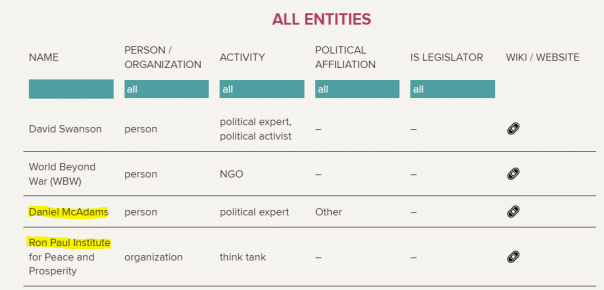
Even our friends at Antiwar.com… and your own correspondent (!) find ourselves appearing on the Ukrainian “enemies list”:
As the report states:
There are 391 individuals and 76 organizations in our list. These include politicians, political movements and groups, media and journalists, experts, and think tanks (some individuals appear in multiple categories).
Perhaps what is most shocking about this attack on American citizens is the fact that the Data Journalism Agency (TEXTY) has a long affiliation with the US Government itself! In fact, the founder of the publication Anatoly Bondarenko appears prominently on a US Government website as a participant in the US State Department’s “TechCamp” project.
The Data Journalism Agency (TEXTY) is listed as an “Implementing Partner” of the US Agency for International Development’s Transparency and Accountability in Public Administration and Services/ TAPAS Project.
The Ukrainians seemingly love to make lists of their “enemies.” One of their most notorious of these is the infamous “kill list” put out by the Mirotvorets Center in Kiev. From that list several have already been murdered by Ukraine, including prominent Russian journalist Daria Dugina.
One wonders how, for example, former US President Donald Trump and dozens of members of the US Congress will react when they hear that US tax dollars are being sent to Ukraine for US-backed Ukrainian organizations to make “hate lists” and “kill lists” of patriotic Americans like themselves.
Executive Director of the Ron Paul Institute for Peace and Prosperity and co-Producer/co-Host, Ron Paul Liberty Report. Daniel served as the foreign affairs, civil liberties, and defense/intel policy advisor to U.S. Congressman Ron Paul, MD (R-Texas) from 2001 until Dr. Paul’s retirement at the end of 2012. From 1993-1999 he worked as a journalist based in Budapest, Hungary, and traveled through the former communist bloc as a human rights monitor and election observer.
At least 22 civilians have been killed in Ukrainian shelling targeting the village of Sadovoe in Russia’s Kherson Region, Governor Vladimir Saldo said on Friday. A nine-year-old child is among the victims, he added.
The attack hit a small shop in a residential area, Saldo said. When locals rushed to aid the victims of the first strike, a second one followed, striking the same area, he said. A total of 17 civilians were killed in the shop and near it and four more people living in the nearby houses lost their lives as well, according to the governor.
At least 15 people were also injured in the strike, Saldo said, adding that five of them are currently in “critical condition.” The shop was full of customers at the time and was destroyed, he stated, branding the attack a “bloody crime” and a “heinous murder.”
According to Saldo, Ukrainian forces first used a guided bomb to strike the shop before hitting the same area with a US-made M142 High Mobility Artillery Rocket System (HIMARS) multiple rocket launcher. Kiev’s Western backers have supplied Ukraine with dozens of such systems, which have been extensively used by its troops throughout the conflict with Russia.
Ukraine has long touted HIMARS systems as high-precision weapons used to strike high-value assets. Russian officials have said they recovered debris from HIMARS munitions after strikes on purely civilian targets on multiple occasions.
Kiev’s troops have been actively targeting civilians in Russian regions throughout the conflict. In mid-May, one person was killed and “many” others injured in another Ukrainian attack in Kherson Region. On that occasion, Kiev’s forces struck a minibus carrying civilians with a drone.
The Russian city of Belgorod, located not far from the Ukrainian border, has become one of the main targets of Kiev’s attacks. Ukrainian forces bombarded it on New Year’s Eve, killing 25 civilians at a festive event.
The continued strikes targeting the civilian population in Russian border regions prompted Moscow to launch an offensive in Ukraine’s Kharkov Region in an effort to create a buffer zone to curb cross-border attacks.
President Vladimir Putin has repeatedly said that if Ukraine continues to “shell residential areas in border territories,” then Russia “will be forced to create a security zone” to deprive it of the ability to make such strikes.
The WHO’s Pandemic Treaty missed its deadline, but their amendments to the International Health Regulations have passed enshrining new pandemic rules for the legally binding contract for 196 countries.
Dr. Deborah Birx, the Trump administration’s coronavirus response coordinator, told CNN’s Kasie Hunt the U.S. is making the “same mistakes” with bird flu that it made with COVID-19, which she said spread because there wasn’t enough testing for asymptomatic infection.
Birx is now calling for every cow to be tested for bird flu weekly and for regular pooled tests for dairy workers. She also said it’s likely that undetected cases are circulating in humans.
“We have the technology,” Birx said. “The great thing about America is we’re incredibly innovative and we have the ability to have these breakthroughs.”
The technology Birx referenced is polymerase chain reaction or PCR testing — the same diagnostic tool that came under fire during the COVID-19 pandemic for producing inaccurate results, including false positives.
Speaking out on X (formerly Twitter), critics like Simon Goddek, Ph.D., pushed back, accusing Birx of “deliberately using the same strategy to fabricate another fake health emergency.”
On Wednesday, the day after Birx’s interview, JAMA published its own article advocating for more widespread bird flu testing.
“No animal or public health expert thinks that we are doing enough surveillance,” Keith Poulsen, DVM, Ph.D., director of the Wisconsin Veterinary Diagnostic Laboratory at the University of Wisconsin-Madison, told JAMA.
Andrew Pekosz, Ph.D., from the Johns Hopkins Bloomberg School of Public Health, told JAMA that more testing should be conducted to find asymptomatic and mild infections. Workers at infected farms should be tested twice weekly, he said, and cows should be tested once a week.
Inventor: PCR test never intended for use as diagnostic tool
PCR testing works by starting with tiny fragments of DNA or RNA called nucleotides and replicating them until they become large enough to identify. The nucleotides are replicated in cycles, and each cycle doubles the amount of genetic material in the sample. The number of cycles required to create an identifiable sample is the “cycle threshold” (Ct).
PCR tests became a household name during the COVID-19 pandemic because they were treated as the “gold standard” for identifying positive cases, especially among asymptomatic people.
However, as early as December 2020, the World Health Organization (WHO) warned that using a high-cycle threshold would lead to false-positive results. The agency encouraged healthcare providers to consider the test in concert with other factors — namely the presence of symptoms — when diagnosing patients.
The WHO also cautioned those using the tests to read the instructions carefully to determine whether the cycle threshold ought to be changed to account for any background noise that could lead to a high-cycle threshold being mistaken for a false positive.
“When specimens return a high Ct value,” the press release said, “it means that many cycles were required to detect virus. In some circumstances, the distinction between background noise and actual presence of the target virus is difficult to ascertain.”
Kary Mullis, who won the Nobel Prize for inventing the PCR test, said it was inappropriate to use the test as a diagnostic tool to detect a viral infection.
Even Dr. Anthony Fauci admitted during the pandemic that a high cycle — which was used often — detected only “dead nucleotides,” not a viral infection.
The U.S. Department of Agriculture (USDA) did not immediately respond to The Defender’s inquiry about which cycle thresholds are used to test animals for bird flu.
Mass testing ‘will only serve to raise a false case count’
As of Tuesday, the latest circulating bird flu virus has reportedly infected 81 herds of dairy cattle in nine states and poultry farms in 48 states. The virus can be fatal for poultry but does not generally cause serious illness in cattle.
In the latest wave of bird flu, only three people in the U.S. have tested positive for the virus after close exposure to an infected cow. All three experienced mild symptoms — two experienced eye irritation and one also had a cough and sore throat. All recovered without incident.
The WHO reported Wednesday that a resident of Mexico died from a bird flu infection, but WHO officials also maintain the virus’ threat to the general population is low.
Mainstream media outlets like Scientific American warned that the bird flu isn’t a pandemic “yet,” but it could evolve to become one if people do things like continue to drink raw milk. And The New York Times warned yesterday that the virus “may not be done” adapting.
The CDC reported on Tuesday that it monitors genetic changes in the virus and “few genetic changes of public health concern have been identified.”
Nevertheless, the U.S. government is building up its national stockpile of existing vaccines produced by CSL Seqirus and is nearing contracts with Moderna and possibly Pfizer to fund the development of an mRNA vaccine for the virus.
On Tuesday, Finland announced it will begin offering the vaccine to selected groups of people.
“We did not have a bad outbreak for over a century, and there is every likelihood that we won’t again,” Bell said. “We are using technology to pretend that new threats are occurring because we can now detect them.”
Cardiologist Dr. Peter McCullough said last month that mass testing of healthy animals — as Birx is suggesting — will only serve to “raise a false case count.”
Feds using PCR testing on animals, wastewater, farmworkers, meat and milk
The federal government last month announced a new round of funding to reduce the impact of bird flu. The plan appropriated $93 million for the CDC to do virus genomic sequencing, increase monitoring of farmworkers, and improve and expand testing on a national scale for bird flu in animals, wastewater, farmworkers and meat.
The FDA also appropriated an additional $8 million to surveil and test the commercial milk supply.
Lactating dairy cows must be tested for bird flu before they can cross state lines, per an April 24 Federal Order issued by the USDA.
The USDA’s Animal and Plant Health Inspection Service (APHIS) also encourages farmers to voluntarily test cattle and herds with suspected infection, showing symptoms like reduced milk production or respiratory issues. APHIS covers the cost of the tests if conducted at an approved laboratory and if the farmers agree to have the tested cattle and premises tracked.
The approved laboratories conduct PCR tests for several different flu strains that could be bird flu markers, including “FluA matrix, H5 and optionally H5N1 2.3.4.4b,” to determine whether the cattle are infected.
All laboratories, whether or not on the USDA’s approved list, must report all positive influenza A test results to the USDA weekly by 5 p.m. on Mondays. Farms with positive cases are quarantined.
KFF Health News reported that additional testing of farmworkers would make it possible for researchers to “track infections.” The problem is that “people generally get tested when they seek treatment for illnesses,” but farmworkers don’t tend to go to doctors unless they are very ill.
Farmworkers have been actively monitored for symptoms since the first case was detected but not PCR-tested. In response, federal authorities announced in May they would pay farmworkers to get tested for the virus as part of a program that also offers incentives to farmers to allow their dairy herds to get tested.
Workers are paid $75 for giving the CDC a blood sample and nasal swab.
That wastewater testing is done by organizations including WastewaterSCAN, an infectious disease monitoring program based at Stanford University, in partnership with Emory University and funded through philanthropy, including the Sergey Brin Family Foundation created by the founder of Google.
The organization has most recently detected bird flu in San Francisco, although it is unclear whether it comes “from animal waste, milk, people or a combination of sources, according to the Los Angeles Times. WastewaterSCAN on June 3 began publicly reporting H5 data from its 190 sampling sites across the country in its online dashboard.
The USDA Food Safety and Inspection Service is also testing meat from condemned cows. Late last month the agency announced that 95 of 96 culled cows tested negative for viral particles and that none of their meat entered the food supply.
It also reported that ground beef from retail facilities in states with cows that have tested positive for bird flu was all PCR-negative for the virus.
The agency also experimented with inoculating meat with high levels of the virus and then cooking it and testing for the virus. The virus was not detected in the meat patties cooked to medium or well-done, and it was “substantially inactivated” in the rare patties.
The FDA also tested retail dairy products in 17 states. The agency noted that PCR-positive results “do not necessarily represent live virus that may be a risk to consumers,” so when they found PCR-positive samples, they further tested them through a process called “egg inoculation.”
The agency found many samples with positive PCR tests, but none tested positive for the live virus.
Brenda Baletti, Ph.D., is a senior reporter for The Defender. She wrote and taught about capitalism and politics for 10 years in the writing program at Duke University. She holds a Ph.D. in human geography from the University of North Carolina at Chapel Hill and a master’s from the University of Texas at Austin.
The Yemeni militia targeted the USS Dwight D. Eisenhower Nimitz-class supercarrier in the Red Sea last week amid the continued intensification of American and British air and missile strikes inside Yemen, which have killed scores of civilians.
The Houthis will hit the American aircraft carrier parked in Yemen’s backyard harder next time around, militia leader Abdul-Malik al-Houthi has vowed.
“The American aircraft carrier Eisenhower will remain a target for our Armed Forces whenever the opportunity arises,” al-Houthi said in his weekly address on Thursday.
“The facts will become clear no matter how much the Americans try to deny the targeting operations, and the upcoming strikes will be more effective,” al-Houthi added.
Offering new details on last week’s Houthi missile and drone barrage targeting the USS Eisenhower amid American denials that the operation did any damage to the supercarrier or its escorts, the Houthi leader emphasized that the attack was more successful than Washington is letting on.
“The operation targeting the aircraft carrier Eisenhower was successful, and overflights stopped for two days following the attack,” al-Houthi said, referring to American attacks over Yemeni airspace. The official added that while the US warship was situated about 400 km from Yemen before the Houthi attack, it was forced to sail 480 km northwest to safety in its aftermath. The operation was “one of the most notable and important operations to be carried out this week,” al-Houthi said.
“American warships flee and change their source when the operations are successful,” the militia leader said.
US Central Command on Friday vociferously denied Houthi claims that the USS Eisenhower was damaged in the Yemeni militia’s attacks.
“There is no truth to the Houthi claim of striking the USS Eisenhower or any US Navy vessel. This is an ongoing disinformation campaign that the Houthis have been conducting for months. While the Houthis intend to target our vessels, we can confirm that there has never been a successful attack on any US Navy vessel,” CENTCOM told Sputnik.
The Houthi attack on the carrier followed a spate of joint US-UK attacks targeting Yemen in an attempt to degrade the militia’s fighting capabilities, with the militia saying last week that the most recent strikes had killed at least 16 people and wounded 42 others.
The Houthis reported Friday that US and UK forces had carried out four new air strikes targeting the airport in Hodeidah, and launched a separate attack on northwestern Yemeni seaport of Salif.
Houthis Go Hypersonic?
Al-Houthi’s comments Thursday came a day after the Yemeni militia released footage of a new “locally made” hypersonic missile called the Palestine being launched toward the embattled Israeli Red Sea port city of Eilat this week.
Israeli officials confirmed Monday that Eilat had been targeted, but indicated that there was no damage or injuries to report.
In the footage, the new Yemeni solid-fuel missile’s warhead was painted in a checkered pattern reminiscent of a keffiyeh scarf. Western observers spotted outward similarities to the Fattah – an Iranian hypersonic missile unveiled in 2023 which can travel up to 1,400 km at speeds up to Mach 15. The range and speed characteristics of the Houthi missile remain unknown, but the distance between Houthi-controlled areas of Yemen and Eilat is closer to 1,700 km.
Iranian officials have repeatedly rejected claims by the US and its allies that it has provided arms to the Houthis. However, Iranian media recently confirmed that the country does give its anti-US and anti-Israeli Axis of Resistance allies “technical knowhow” enabling the homegrown production of sophisticated missiles. It remains unclear whether this applies to the new Palestine missile or not.
The Houthis have been teasing their fledgling hypersonic capabilities since the spring, with an informed source telling Sputnik in March that the new Houthi missile could accelerate to speeds of up to Mach 8 (nearly 10,000 km per hour) and had a solid fuel engine, which means reduced launch preparation time and improved ease of transport in Yemen’s difficult conditions.
“Yemen intends to begin manufacturing it for use during attacks in the Red and Arabian Seas and the Gulf of Aden, as well as against targets in Israel,” the source, who was not at liberty to speak publicly, said at the time.
Abdul-Malik Al-Houthi warned in March that the militia’s enemies, friends and Yemenis alike would soon “see a level of achievement of strategic importance which will place our country and its capabilities in the ranks of few countries in this world,” promising that Ansar Allah had “surprises” in store for the US and Israel which have yet to be revealed.
Russian military observer Alexei Leonkov told Sputnik in March that if the Yemeni militia really has managed to speed a missile up to Mach 8 or more, “that will mean that the ship-based air defense systems of the American naval group will be powerless.”
“The air defenses of the carrier strike group presently parked off the coast of the Arabian Peninsula and sporadically firing at the Houthis will not be able to intercept these missiles if they approach at Mach 8. And if the Houthis have managed to make them even a little maneuverable, that’s it, they won’t be possible to intercept. If the Houthis learn to accurately hit warships with these missiles, we will see America’s defeat,” Leonkov said.
US Defense Secretary Lloyd Austin signed an order last week to extend the Eisenhower carrier group’s deployment in the Middle East for a second time, holding off the rotation of the supercarrier and its three missile destroyer and cruiser escorts out of the region, where they have been stationed since last October.
US President Joe Biden told ABC News on 6 June that the Israeli government has listened to his “concerns” about a major military offensive in Gaza’s southernmost city of Rafah.
“They were going to go into Russia – into Rafah – full bore, invade all of Rafah, go into the city, take it out, move, move with full force. They haven’t done that. And what they’ve done is they’ve agreed to a significant agreement,” the US president said as Israeli warplanes continued their months-long blitz of residential areas and displacement camps in the city.
Residents of Rafah who spoke with Reuters on Friday morning described the latest raids as “one of the worst nights,” adding that “some people were wounded inside their homes before being evacuated this morning.”
Residents also said that Israeli tanks that have taken control along the border with Egypt made several raids towards the west and the center of the southern city.
“I think he’s listening to me,” Biden added when asked by ABC News if Israeli Prime Minister Benjamin Netanyahu heeded his warnings.
Elsewhere in the interview, Biden claimed Netanyahu will stick by his own ceasefire proposal. “He’s publicly said he is. Our European friends are in on it. We have to get a ceasefire.”
“What [Israel has] done is they’ve agreed to a significant agreement that if in fact Hamas accepts it,” the US president said before adding that the offer is backed by much of the Arab world.
“We’ll see. This is a very difficult time,” Biden said.
On Thursday, senior Hamas officials revealed that the Israeli ceasefire proposal “does not mention stopping the aggression or the withdrawal [of troops from Gaza].”
“The Israeli documents speak of open-ended negotiation with no deadline, and it speaks of a stage during which the occupation regains its captives and resumes the war. We had told the mediators that this proposal is unacceptable,” Hamas official Sami Abu Zuhri told Reuters on Thursday.
The Cradle columnist Khalil Harb earlier this week described the proposal presented by Biden as a “repackaging of last month’s Hamas-approved agreement, which he is now repositioning as an Israeli-sanctioned deal.
Israel’s illegal control over the West Bank (including East Jerusalem) and Gaza has for decades prevented the Palestinian people from exercising their right of self-determination and full and effective self-governance. UN Resolution 3246 calls for all States to recognise that that right applies to all peoples subjected to colonial and foreign domination, including the Palestinians.
The warning signs of genocide in Gaza had been there for all to see. But the lack of will on the part of UN members to implement 3246 not only let it happen but then failed to stop it even when its ferocity passed all comprehension.
When October 7 erupted the West attempted to airbrush the pre-existing conditions Israel had imposed on Gaza and pretended Hamas started the ‘war’. But 1,000 lawyers, scholars, and practitioners immediately sounded the alarm about “the possibility of the crime of genocide being perpetrated by Israeli forces against Palestinians in the Gaza Strip” and issued an open letter as early as 15 October.
For a start they reminded everyone that in 1982 the UN General Assembly condemned the massacre of Palestinian civilians in the Sabra and Shatila refugee camps as “an act of genocide”.
Pre-existing conditions in the Gaza Strip had prompted discussion on genocide before, with warnings given over the years that the siege of Gaza (from 2006 onwards) might amount to a “prelude to genocide” or a “slow-motion genocide”.
And since 2007, shortly after Hamas won the Palestinian elections, Israel had defined the Gaza Strip as an “enemy entity”.
Earlier in 2023 Israeli Minister of Finance Bezalel Smotrich called Palestinians “repugnant”, and “disgusting” and proposed “wiping out” the entire Palestinian village of Huwwara in the West Bank.
• In the short space of time between 7 October and 15 October (when the open letter was written), 2,329 Palestinians were killed and 9,042 Palestinians injured in Israeli attacks on Gaza, including over 724 children, huge swathes of neighborhoods, and entire families across Gaza were obliterated.
• Israel’s Defence Minister ordered a “complete siege” of the Gaza Strip prohibiting the supply of fuel, electricity, water, and other necessities. This intensifies an already illegal and potentially genocidal siege turning it into an outright destructive assault.
• The ICRC (International Committee of the Red Cross) stated that orders to evacuate, coupled with the complete siege, are incompatible with international humanitarian law. Almost half a million Palestinians have already been displaced and Israeli forces have bombed the only possible exit route that Israel does not control (the Rafah crossing to Egypt) multiple times.
• The World Health Organisation published a warning that “forcing more than 2000 patients to relocate to southern Gaza, where health facilities are already running at maximum capacity and unable to absorb a dramatic rise in the number of patients, could be tantamount to a death sentence”.
• In the occupied West Bank and Jerusalem, since 7 October, Israeli settlers backed by the IDF and police, have attacked and shot Palestinian civilians at point-blank range (as documented in the villages of a-Tuwani and Qusra), invaded their homes, and assaulted residents. Several Palestinian communities have already been forced to abandon their homes, after which settlers arrived and destroyed their property.
• Between 7 and 15 October, Al-Haq documented the killing by the Israeli military and settlers of 55 Palestinians in the West Bank with 1,200 injured there.
• Israeli Defense Minister Yoav Gallant declared on 9 October: “We are fighting human animals and we act accordingly”, and afterward announced that Israel was moving to “a full-scale response” and he had “removed every restriction” on Israeli forces, also stating: “Gaza won’t return to what it was before. We will eliminate everything.”
• On 10 October, the head of the Israeli Army’s Coordinator of Government Activities in the Territories (COGAT), Maj. Gen. Ghassan Alian, addressed a message directly to Gaza residents: “Human animals must be treated as such. There will be no electricity and no water, there will only be destruction. You wanted hell, you will get hell”.
• Israeli army spokesperson Daniel Hagari acknowledged the wanton and intentionally destructive nature of Israel’s bombing campaign in Gaza: “The emphasis is on damage and not on accuracy.”
• On 7 October, Prime Minister Benjamin Netanyahu said that Gazans would pay an “immense price” for the actions of Hamas fighters and asserted that Israel will wage a prolonged offensive that will turn parts of Gaza’s densely populated urban centers “into rubble”.
• Israel’s President emphasized that the Israeli authorities view the entire Palestinian population of Gaza as responsible for the actions of militant groups, and subject accordingly to collective punishment and unrestricted use of force: “It is an entire nation out there that is responsible.”
• Israeli Minister of Energy and Infrastructure Israel Katz added: “All the civilian population in Gaza is ordered to leave immediately. We will win. They will not receive a drop of water or a single battery until they leave the world.”
• On 12 October UN Special Rapporteurs condemned “Israel’s indiscriminate military attacks against the already exhausted Palestinian people of Gaza, comprising over 2.3 million people, nearly half of whom are children. They have lived under unlawful blockade for 16 years, and already gone through five major brutal wars, which remain unaccounted for”.
• UN experts warned against “the withholding of essential supplies such as food, water, electricity and medicines. Such actions will precipitate a severe humanitarian crisis in Gaza, where its population is now at an inescapable risk of starvation. Intentional starvation is a crime against humanity”.
• On 14 October the UN Special Rapporteur, on the situation of human rights in the occupied Palestinian territory, warned against “a repeat of the 1948 Nakba, and the 1967 Naksa, yet on a larger scale” as Israel is carrying out “mass ethnic cleansing of Palestinians under the fog of war”.
• The Palestinian population of Gaza appears to be presently subjected by the Israeli forces and authorities to widespread killing, bodily and mental harm, and unviable conditions of life – against a backdrop of Israeli statements that evidence signs of intent to physically destroy the population.
• Article II of the Genocide Convention provides that “genocide means any of the following acts committed with intent to destroy, in whole or in part, a national, ethnical, racial or religious group, such as # Killing members of the group; # Causing serious bodily or mental harm to members of the group; # Deliberately inflicting on the group conditions of life calculated to bring about its physical destruction in whole or in part; # Imposing measures intended to prevent births within the group; # Forcibly transferring children of the group to another group.”
• The Convention provides that individuals who attempt genocide or who incite genocide “shall be punished, whether they are constitutionally responsible rulers, public officials or private individuals”.
• The International Court of Justice has clarified that “a State’s obligation to prevent, and the corresponding duty to act, arise at the instant that the State learns of, or should normally have learned of, the existence of a serious risk that genocide will be committed. From that moment onwards, if the State has available means likely to have a deterrent effect on those suspected of preparing genocide, or reasonably suspected of harboring specific intent (dolus specialist), it is under a duty to make such use of these means as the circumstances permit”. (The many means available to the British Government include sanctions – readily applied to other delinquent nations – and withdrawal of favored-nation privileges, trade deals, and scientific collaboration).
• Competent elements of the United Nations, particularly the UN General Assembly, are required to take urgent action under the Charter of the United Nations appropriate for the prevention and suppression of acts of genocide. Emphasis is on the General Assembly given that the Security Council is compromised by the US and UK (both permanent veto-holding members) sending military forces to the eastern Mediterranean in support of Israel.
• All relevant UN bodies, including the Office on Genocide Prevention and the Responsibility to Protect, as well as the Office of the Prosecutor of the International Criminal Court, are called on to immediately intervene, carry out necessary investigations, and invoke the necessary warning procedures to protect the Palestinian population from genocide.
Chock-full of hate
All this was quickly followed by the UK Lawyers’ Open Letter Concerning Gaza of 26 October 2023, which contained important warnings regarding international law — for example:
⦁ The UK is duty-bound to “respect and ensure respect” for international humanitarian law as set out in the Four Geneva Conventions in all circumstances (1949 Geneva Conventions, Common Art 1). That means the UK must not itself assist violations by others.
⦁ The UK Government must immediately halt the export of weapons from the UK to Israel, given the clear risk that they might be used in serious violations of international humanitarian law and in breach of the UK’s domestic Strategic Export Licensing Criteria, including its obligations under the Arms Trade Treaty.
So, within 3 weeks it was clear to everyone paying attention that the Israeli leadership, chock-full of hate, were set on a course of vicious and brutal genocide. Yet the following month John Kirby, the White House National Security Communications Advisor, dismissed claims that Israel was committing genocide and told everybody that “Israel is not trying to wipe the Palestinian people off the map. Israel is not trying to wipe Gaza off the map. Israel is trying to defend itself against a genocidal terrorist threat. So if we’re going to start using that word, fine. Let’s use it appropriately.”
Yes, and let’s use the term “right of self-defence” appropriately. In Gaza and the West Bank it only applies to the Palestinian resistance, not the belligerent illegal occupier.
Incredibly, we’re now entering the 9th month of the genocide in Gaza and it has gone from bad to much, much worse. And there is still no let-up. People worldwide have been watching day after day mainstream and alternative media reports, seeing for themselves the horrors endured even by children, and aghast at the wholesale and wanton destruction of the Palestinians’ homeland. They cannot believe how depraved, immoral and spineless the international community has become, and how paralysed the UN in allowing the slaughter to continue. They are especially sickened by the conduct of the so-called ‘major powers’ and by the lunatic Netanyahu whom their own politicians call ‘friend and ally’ who thinks he can still dictate what happens in Gaza after he eventually condescends to end the butchery.
If he thinks Israel can now grab Gaza by conquest he may be disappointed. Article 2(4) of the UN Charter expressly prohibits aggressive war and Article 5(3) of General Assembly Resolution 3314 (XXIX) of 1975 (which includes the definition of Acts of Aggression) nullifies any legal title acquired in this way. And 5(3) says “All Members shall refrain in their international relations from the threat or use of force against the territorial integrity or political independence of any state, or in any other manner inconsistent with the Purposes of the United Nations“.
In carrying through its genocidal assault on Gaza’s civilians and their homes, infrastructure and livelihoods Israel cannot possibly claim to abide by international law or honour their obligations under the Charter. And by encouraging Israel — and supplying the weaponry — neither can the US and UK.
And now we have Biden, Israel’s loony protector, setting ‘red lines’ which Israel must not cross while merrily carrying on with their genocide. But they are so elastic that, with US permission, the hateful maniacs can almost do as they please to satisfy their genocidal lust. Biden arrogantly overrules the red lines on war crimes and crimes against humanity that are already set out by international law.
Is a “Three-Theater” war scenario both feasible and desirable for the US? Some think so. American analysts within the Establishment are in fact calling for war “in Asia, Europe, and the Middle East.” This is what Thomas G. Mahnken (both a Johns Hopkins School of Advanced International Studies professor and the CEO of the Center for Strategic and Budgetary Assessments) is urging Washington to do, in his most recent Foreign Affairspiece.
For Mahnken, Washington is “currently involved in two wars—Ukraine’s in Europe and Israel’s in the Middle East”, while also “facing the prospect of a third over Taiwan or South Korea in East Asia.” Moreover, “all three theaters are vital to US interests, and they are all intertwined.” Deprioritizing Europe and disengaging from the Middle East can only weaken American security, he argues: “The U.S. military drawdown in the Middle East, for instance, has created a vacuum that Tehran has filled eagerly.” Of course, such reasoning can only make sense if American “security” is equated with Washington’s unipolarity.
US Secretary of Defense Lloyd Austin, during his recent speech at Shangri-la Dialogue (in Singapore), made it a point to stress that “despite historic clashes in Europe and the Middle East… the Indo-Pacific has remained our priority theater of operations.” According to Austin, the US is a Pacific nation (with a capital P, and with no pun intended, presumably), and added that “the US can be secure only if Asia is secure. That’s why… [we have] long maintained our presence in this region. And that’s why we continue to make the investments necessary to meet our commitments to our allies and partners.” As for the relationship with China, the Secretary was more ambiguous, claiming that “a fight with China is neither imminent nor unavoidable.”
While Lloyd Austin seems to differ from Mahnken (on emphasis), there is not necessarily a dilemma there. I’ve often described Washington’s ambitions as being all about having the cake and eating it too. Jerry Hendrix (retired Navy captain, formerly an adviser to Pentagon senior officials, and currently a senior fellow with the Sagamore Institute) has written that, in Mackinder terms (classic Geopolitics), the US has embarked on a quest for the “Heartland”, and this contradicts its true “sea power” nature. This is so because Washington, in recent times, has been “burdened” by mostly “land-based actions in Iraq and Afghanistan fought primarily by a large standing army operating far from home”.
Rather than doing that, Hendrix urges the Atlantic superpower to, once again, “think and act like a seapower state”, that is, with a focus on deriving its might from “seaborne trade”, employing “instruments of sea power” to advance its interests. The expert describes the post-World War II period as an exceptional “free sea” period, marked by a “secure environment” which has supposedly allowed free trade to flourish in a globalized planet – this being the rather gleeful manner in which he describes the US-led world order, in spite of the fact that Washington has always weaponized protectionism.
In any case, as Hendrix notes, the American superpower acts both as a “continental power” and as a “sea power”. I’ve described its foreign policy as resembling the swing of a pendulum. Give or take, all Great Powers engage to some extent in proxy conflicts amid their geoeconomic and geopolitical disputes with other powers. In terms of regional disputes, whether one likes or not Moscow’s foreign policy today, one can at least concede that historically Russia and neighboring Ukraine have an intertwined and complicated shared history, and the same applies to China-Taiwan relations. But America is something quite different. To keep things in perspective, one should keep in mind, for example, that, amazingly, the only place in the entire world China has an overseas military base is Djibouti, in the Horn of Africa. In contrast, depending on how one counts it, Washington, in 2015, had about 800 military bases in over 70 countries.
Moreover, the US has in fact invaded 84 out of the 194 nation-states recognized by the United Nations, and has been militarily involved with no less than 191 of those, according to Christopher Kelly and Stuart Laycock, the authors of “America Invades: How We’ve Invaded or been Militarily Involved with almost Every Country on Earth”. The hard truth is that the United States of America is the only nation today (and arguably ever) to potentially engage in warfare across three continents – a scenario, keep in mind, that is cheered by prominent mainstream American commentators and scholars.
Other analysts, such as Andrea Rizzi, writing for El Pais, have described the possibility of war fronts in the Middle East, Europe and the Asia-Pacific becoming connected as a “nightmare” scenario – although not so convincingly, in Rizzi’s case, who seems to believe the political West has necessarily something to do with “democracy”, a historically controversial premise to say the least. Rizzi, however, makes the very valid point that “in geopolitics — and in life — high-stress situations lead to a greater margin for unforeseen events, errors in calculation and communication, uncontrolled actions by minority factions and escalations that are unintended, at least by the key players.” Even the main actors have an interest in keeping stability, at some point someone (or one’s proxies) may indeed make “a daring movie”, in Rizzi’s words, and thus bring about an escalation and unpredictable outcomes.
A series of Ukrainian and Western actions arguably represented precisely such a red-line crossing, in Moscow’s perspective. While some worry about the same thing happening in the Pacific, thus inadvertently igniting yet another war, others call for and crave for precisely such a war – not just in the Indo-Pacific region, but also in Europe and the Middle East, simultaneously. It is hard to describe such a call in any way other than as a will to set the world on fire – after all, one cannot literally desire war between Great Powers in three continents and not expect everything else that often comes with it (call it apocalypse in disguise, if you will).
Unbelievably, such bellicose calls, rather than being confined to the hate speech of extreme and fringe individuals and organizations, pass as reasonable and mainstream discourse, produced as it is, by respectable experts with impeccable credentials. And, mind you, Foreign Affairs will even publish it. It is no wonder: Washington foreign policy itself is, after all, largely built on the premise of American unipolarity and global war if need be.
Human trafficking is certainly one of the most monstrous mass criminal activities ever undertaken by other humans (although calling them “humans” is a bit of a stretch). And yet, there’s a special kind of this deeply repulsive crime that pushes it to diabolical proportions – child trafficking. Underage kids, particularly those who were abandoned, sold or have very poor/abusive family backgrounds, are by far the most vulnerable group. The depraved criminals who engage in such illicit activities specifically target unfortunate children and given there are millions of them all around the globe, particularly in war-torn areas, the “recruitment pool” is effectively endless. Unfortunately, the demand on the black market also seems to be constant and growing, making it a very lucrative and appealing prospect for criminals. … continue
This site is provided as a research and reference tool. Although we make every reasonable effort to ensure that the information and data provided at this site are useful, accurate, and current, we cannot guarantee that the information and data provided here will be error-free. By using this site, you assume all responsibility for and risk arising from your use of and reliance upon the contents of this site.
This site and the information available through it do not, and are not intended to constitute legal advice. Should you require legal advice, you should consult your own attorney.
Nothing within this site or linked to by this site constitutes investment advice or medical advice.
Materials accessible from or added to this site by third parties, such as comments posted, are strictly the responsibility of the third party who added such materials or made them accessible and we neither endorse nor undertake to control, monitor, edit or assume responsibility for any such third-party material.
The posting of stories, commentaries, reports, documents and links (embedded or otherwise) on this site does not in any way, shape or form, implied or otherwise, necessarily express or suggest endorsement or support of any of such posted material or parts therein.
The word “alleged” is deemed to occur before the word “fraud.” Since the rule of law still applies. To peasants, at least.
Fair Use
This site contains copyrighted material the use of which has not always been specifically authorized by the copyright owner. We are making such material available in our efforts to advance understanding of environmental, political, human rights, economic, democracy, scientific, and social justice issues, etc. We believe this constitutes a ‘fair use’ of any such copyrighted material as provided for in section 107 of the US Copyright Law. In accordance with Title 17 U.S.C. Section 107, the material on this site is distributed without profit to those who have expressed a prior interest in receiving the included information for research and educational purposes. For more info go to: http://www.law.cornell.edu/uscode/17/107.shtml. If you wish to use copyrighted material from this site for purposes of your own that go beyond ‘fair use’, you must obtain permission from the copyright owner.
DMCA Contact
This is information for anyone that wishes to challenge our “fair use” of copyrighted material.
If you are a legal copyright holder or a designated agent for such and you believe that content residing on or accessible through our website infringes a copyright and falls outside the boundaries of “Fair Use”, please send a notice of infringement by contacting atheonews@gmail.com.
We will respond and take necessary action immediately.
If notice is given of an alleged copyright violation we will act expeditiously to remove or disable access to the material(s) in question.
All 3rd party material posted on this website is copyright the respective owners / authors. Aletho News makes no claim of copyright on such material.