I have mentioned previously that the introduction of all the latest and greatest western weapons in the inventory given to the Ukraine would have some very deleterious effects in the future. One was permitting possible future antagonists to observe and and take detailed notes on the tactics, techniques and procedures (TTP) and experiment with prospective or actual countermeasures to neutralize or destroy these weapons systems and platforms. The other concerns would be allowing the first near-peer/peer martial contest to use this to shape and refine future strategic objectives. The Russians are certainly doing their homework and actively modifying and improving their means of waging war.
Performance is predictably abysmal for so many of these Western systems. The corporate/access media seems to finally be catching on that the weapons programs are not very effective.
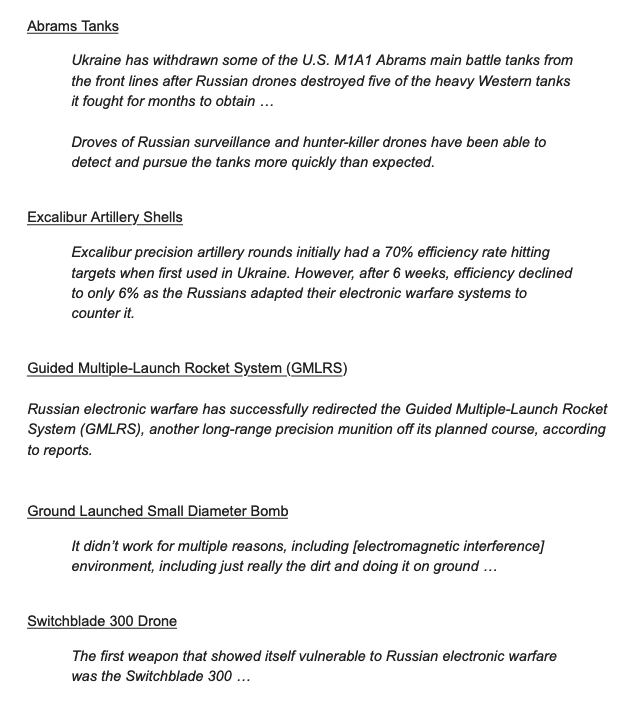
The Biden administration has committed more than $50 billion in military aid to Ukraine since Russia invaded in February 2022, according to a Pentagon fact sheet. U.S. assistance has proven vital in helping Ukraine fend off Russia’s advances and mount counteroffensives, but some of the weapons have failed to have the desired impact as Russia’s military has adapted, according to media reports and experts.
Here are some highlights from the article:
If only the diversity enthusiasm incentivized opposing viewpoints and genuine intellectual differences.
Future historians will have a tremendous cottage industry trying to tease out how the world’s most expensive military paper tiger not only convinced the bill-payers to keep funding these disasters but the cognitive strategic deficit disorder that informed the entire fallacious enterprise managed to spend tens of trillions of dollars for a non-nuclear military apparatus that had a picture perfect track record of consistent failure since 1945.
May 14, 2024
Posted by aletho |
Corruption | NATO, Ukraine, United States |
Leave a comment
The United States and its Western allies have stepped up a media campaign to accuse India of running an assassination policy targeting expatriate dissidents.
The government of Narendra Modi, India’s prime minister, has furiously denied the allegations, saying there is no such policy.
Nevertheless, the American Biden administration as well as Canada, Britain and Australia continue to demand accountability over claims that New Delhi is engaging in “transnational repression” of spying, harassing and killing Indian opponents living in Western states.
The accusations have severely strained political relations. The most fractious example is Canada. After Premier Justin Trudeau publicly accused Indian state agents of involvement in the murder of an Indian-born Canadian citizen last year, New Delhi expelled dozens of Canadian diplomats.
Relations became further strained this month when the Washington Post published a long article purporting to substantiate claims that Indian security services were organizing assassinations of U.S. and Canadian citizens. The Post named high-level Indian intelligence chiefs in the inner circle of Prime Minister Modi. The implication is a policy of political killings is sanctioned at the very top of the Indian government.
The targets of the alleged murder program are members of the Sikh diaspora. There are large expatriate populations of Sikhs in the U.S., Canada and Britain. In recent years, there has been a renewed campaign among Sikhs for the secession of their homeland of Punjab from India. The New Delhi government views the separatist calls for a new state called Khalistan as a threat to Indian territorial integrity. The Modi government has labeled Sikh separatists as terrorists.
Indian authorities have carried out repression of Sikhs for decades including political assassination in the Punjab territory of northern India. Many Sikhs fled to the United States and other Western states for safety and to continue their agitation for a separate nation. The Modi government has accused Western states of coddling “Sikh terrorists” and undermining Indian sovereignty.
Last June, a prominent Sikh leader was gunned down in a suburb of Vancouver in what appeared to be a professional hit-style execution. Hardeep Singh Nijjar was murdered by three assailants outside a religious temple. Indian state media described him as a terrorist, but Nijjar’s family denied he had any involvement in terrorism. They claim that he was targeted simply because he promoted Punjabi separatism.
At the same time, according to the Post report, the U.S. authorities thwarted a murder plot against a well-known American-Sikh citizen who was a colleague of the Canadian victim. Both men were coordinating efforts to hold an unofficial referendum among the Sikh diaspora in North America calling for the establishment of a new independent state of Khalistan in the Punjab region of northern India.
The Post article names Vikram Yadav, an officer in India’s state spy agency, the Research and Analysis Wing (RAW), as orchestrating the murder plots against the Sikh leaders. The Post claims that interviews with US and former Indian intelligence officials attest that the killings could not have been carried out without the sanction of Modi’s inner circle.
A seemingly curious coincidence is that within days of the murder of the Canadian Sikh leader and the attempted killing of the American colleague, President Biden was hosting Narendra Modi at the White House in a lavish state reception.
Since the summer of last year, the Biden administration has repeatedly pressured the Modi government to investigate the allegations. President Biden has personally contacted Modi about the alleged assassination policy as have his senior officials, including White House national security advisor Jake Sullivan, Secretary of State Antony Blinken and CIA director William Burns. Despite New Delhi’s denial of such a policy, the Modi government has acceded to American requests to hold an internal investigation, suggesting a tacit admission of its agents having some involvement.
But here is where an anomaly indicates an ulterior agenda. Even U.S. media have remarked on how lenient the Biden administration has been towards India over what are grave allegations. It is inconceivable that Washington would tolerate the presence of Russian or Chinese agents and diplomats on its territory if Moscow and Beijing were implicated in killing dissidents on American soil.
As Tthe Washington Post report noted: “Last July, White House officials began holding high-level meetings to discuss ways to respond without risking a wider rupture with India, officials said. CIA Director William J. Burns and others have been deployed to confront officials in the Modi government and demand accountability. But the United States has so far imposed no expulsions, sanctions or other penalties.”
What appears to be going on is a calculated form of coercion by the United States and its Western allies. The allegations of contract killings and “transnational repression” against Sikhs in the U.S., Canada, Britain, Australia and Germany are aimed at intimidating the Indian government with further embarrassing media disclosures and Western sanctions. The U.S. State Department and the Congress have both recently highlighted claims of human rights violations by the Modi government and calls for political sanctions.
The objective, it can be averred, is for Washington and its Western allies to pressure India into toeing a geopolitical line of hostility towards China and Russia.
During the Biden administration, the United States has assiduously courted India as a partner in the Asia-Pacific to confront China. India has been welcomed as a member of the U.S.-led Quad of powers, including Japan and Australia. The Quad overlaps with the U.S. security interests of the AUKUS military partnership with Britain and Australia.
Another major geopolitical prize for Washington and its allies is to drive a wedge between India and Russia.
Since the NATO proxy war blew up in Ukraine in February 2022, the United States has been continually cajoling India to condemn Russia and to abide by Western sanctions against Moscow. Despite the relentless pressure, the Modi government has spurned Western attempts to isolate Russia. Indeed, India has increased its purchase of Russian crude oil and is importing record quantities, more than ever before the Ukraine conflict.
Furthermore, India is a key member of the BRICS forum and a proponent of an emerging multipolar world order that undermines U.S.-led Western hegemony.
From the viewpoint of the United States and its Western allies, India represents a tantalizing strategic prospect. With a foot in both geopolitical camps, New Delhi is sought by the West to weaken the China-Russia-BRICS axis.
This is the geopolitical context for understanding the interest of Western powers in making an issue out of allegations of political assassination by the Modi government. Washington and its Western allies want to use the allegations as a form of leverage – or blackmail – on India to comply with geopolitical objectives to confront China and Russia.
It can be anticipated that the Western powers will amplify the media campaign against India in line with exerting more hostility toward China and Russia.
May 14, 2024
Posted by aletho |
False Flag Terrorism | Canada, India, UK, United States |
Leave a comment
As the Russia-Ukraine war drags on, a peace conference is to be held in Switzerland this summer. But Russia’s President Vladimir Putin said that Russia hadn’t been invited to participate in June’s talks. “It would have been funny if it weren’t so sad,” he commented.
Practically all Russian commentators, and even some prominent Western ones, trace the roots of the conflict in Ukraine to NATO’s attempts at incorporating Russia’s neighbor – as officially stated since at least as far back as 2008. A disregard for Russia’s status as an equal and sovereign partner was evident in the contempt for the Minsk agreements, which both former German chancellor Angela Merkel and former French president Fran?ois Hollande described as gimmicks to buy time for the only option that was seriously pursued, military confrontation. Later on, Vladimir Putin’s vocal request for security guarantees was dismissed yet again.
Fast forward a few years, and this historical tragedy has snowballed to its extreme conclusions. Politico recently reported Ukrainian officials’ concerns about a collapse of the frontlines. As Elon Musk calls for a negotiated settlement to come soon, he warns that the longer the war drags on, the larger the territory Russia will seek to annex. Even CNN is now explaining how Russia’s guided bombs are wreaking havoc on Ukrainian defenses. Meanwhile, the IMF has raised Russia’s growth outlook. In short, and irrespective of whether this will take weeks, months or years, Russia is well placed politically, economically and militarily to inflict the final blow.
The conditions of Ukraine’s sponsors are remarkably less favorable. Europe’s economic problems are “far bigger than a shallow recession.” The Union faces a dilemma over restricting imports from Ukraine or throwing its own agriculture under the bus. It is also split on the use of frozen Russian assets to finance the war. The Union will renew its Parliament in June and it is unclear whether Ursula von der Leyen will be re-elected. Even though the US House of Representatives on Saturday passed a $95 billion legislative package, including $60.84 billion to address the conflict in Ukraine, the US’ presidential elections in November still cast another shadow of uncertainty, to the point that NATO is considering setting aside “Trump-proof” funds.
Europe’s public opinion has also made up its mind on the matter. Only one in ten Europeans believe Ukraine can defeat Russia. The Pope has literally invited Ukraine to raise a white flag. Wolfgang Streeck, the Director of the Max Planck Institute, said, “The war is lost but our governments refuse to admit it.” A crushing military defeat would be the worst possible background for European and American elections, and erode confidence in the respective leaderships: The West should not fall prey to a sunk cost fallacy of catastrophic proportions. What would then be the way forward?
The rational course of action would be for the West to turn to diplomacy to correct such a disastrous trajectory, much like Musk and the Pope suggested. Even if Russia refused, or the attempt failed, the West would at least claim the moral high ground on this occasion. A comprehensive peace conference with the involvement of representative guarantors from the Global South could offer a lifeline to Ukraine, and a model for ironing out geopolitical tensions that are dangerously multiplying all over the world. Chinese diplomacy is going out of its way to make this possible, and the African Union, Brazil, the UAE, Saudi Arabia, Turkey and many others have also stepped forward with constructive proposals.
Yet leaders on both shores of the Atlantic are headed elsewhere. US Vice President Kamala Harris and European Council President Charles Michel are adamant that “There is only plan A”: military support for Ukraine. Along this path, some risky decisions appear increasingly likely. And pressure is mounting to use seized Russian assets to finance Ukraine. Of this move, in 2022, US Secretary of the Treasury Janet Yellen said “would not be legal.” But, apparently, a green light could come at the G7 summit in June.
If a botched peace conference would exact high reputational costs for Western diplomacy, the seizing of Russian assets could turn into a kamikaze attack, and unsettle the very domain wherein the West retains relative dominance, the international financial system. Neither initiative is likely to end the conflict in Ukraine.
If all such workarounds are really only dead ends, a reckoning with reality should be hastened rather than delayed. Yet, it is precisely the unwillingness or inability to confront the reality of the situation that got us here in the first place.
May 14, 2024
Posted by aletho |
Militarism | European Union, NATO, Ukraine, United States |
Leave a comment
Incredibly the Israeli genocide in Gaza is now reaching new heights of violence. Casualty figures are not coming in, as the attacks are so bad that bodies cannot be recovered, medics cannot travel and there are almost no medical facilities operational now anyway.
We now see that the Western injunctions not to attack Rafah were a smokescreen of lies to mask complicity. The final pocket of Gaza is being ruthlessly ethnically cleansed and its infrastructure will be destroyed like all the rest.
It is striking that this is accompanied by an absolutely shameless doubling down of support for Israel by the Western political and media classes. Any thought that their isolation from the vast breadth of public opinion would give them pause, must be abandoned. Their Zionist lobby paymasters have jerked the chain, and rather than rowing back, we are seeing a redoubling of their efforts to suppress dissent and obscure the truth.
Some of this shameless distortion is so dissonant with the alleged norms of Western society it is almost impossible to believe it is happening. Here are a few examples.
1) Dr Ghassan Abu Sitta is a highly respected reconstructive surgeon who continued to work heroically and tirelessly in Al Shifa hospital, carrying out operation after operation, mostly on women and children, as the hospital was shelled, strafed and machine gunned around him.
He was already a surgeon of great distinction, based in Glasgow where he is now Rector of Glasgow University.
When Germany banned him from entering to address the conference on Palestine from which Yanis Varoufakis and others were also barred, it appeared perhaps as a one-off action as part of Germany’s extreme and panicked reaction to pro-Palestinian expression.
We have come to understand that Germany has a vicious hatred of Palestinians, remarkably based on the psychological trauma of inherited guilt from the Holocaust. While this is a muddled national psychosis that is plainly immoral and wrongheaded, at least it is possible to have some understanding of how it occurred.

But it then turned out that the travel ban slapped on Dr Abu Sitta by Germany has a Schengen-wide effect as he was also banned from France. That appeared again something that was almost a technical accident as regards the rest of Europe.
But the Western political establishment has now doubled down again by banning him from the Netherlands, and this time the Dutch government has made it clear that it supports the ban, and is not just caught by a Schengen restriction.
So the major governments of the European Union are forbidding a distinguished surgeon from giving first-hand medical evidence of the genocide taking place. I cannot think of anything that more sharply exposes the willingness of the Western political class to abandon the most basic tenets of supposed “Western democracy” in the interests of Israel.
2) The willingness of the United States to use extreme violence against pro-Palestinian students on college campuses is another demonstration of the same abandonment of the pretence of democracy when it comes to Israel. It also illustrates what has come to be a serious generational divide in Western public opinion, with young people very strongly motivated to oppose the genocide (which is not to say that older people are pro-genocide, just that they are more split, particularly in the USA).
This is being followed up with yet more crazed pro-Israeli legislation in the United States, seeking to designate anti-genocide and pro-Palestinian expression on campuses as anti-semitic and thus illegal.
In many ways this typifies the reaction of the ruling class across the West. Their reaction to suddenly being exposed as the paid servants of an Israel which no longer has popular support and now causes public revulsion, is simply to attempt to ban free expression and make it specifically illegal to disagree with them.
3) The British Labour Party has gone even madder. Keir Starmer’s Genocide Party is an outstanding example of the success of the Israeli lobby in buying up both sides of the aisle and controlling the entire neoliberal uniparty that poses as the repository of democratic “choice” in the West.
Starmer had been doing his best to conceal his explicitly expressed “unequivocal support for Israel” lately, and to row back from his straightforward assertion that Israel has the right to cut off food and water from the population of Gaza. There had been a fake shift, from refusing to countenance the word “ceasefire” to supporting a temporary ceasefire or a “sustainable” ceasefire – the latter being code for a ceasefire after Israel had achieved all its ethnic cleansing objectives.
But then David Lammy blew this out of the water with an address to US Republican senators in which he made the totally bonkers assertion that Nelson Mandela would have opposed the college protests for Palestine. Lammy is a truly despicable individual, one of the ultimate examples of the corrupt politician whose voice is bought. But this was a move far beyond the pale.
4) Even today, the Western media continues to spout out Israeli propaganda at mains pressure. The Guardian, despite the thousands and thousands of dead women and children we have seen on our mobile phones this past seven months, continues to pretend that the genocidal attack is on “Hamas militants”.
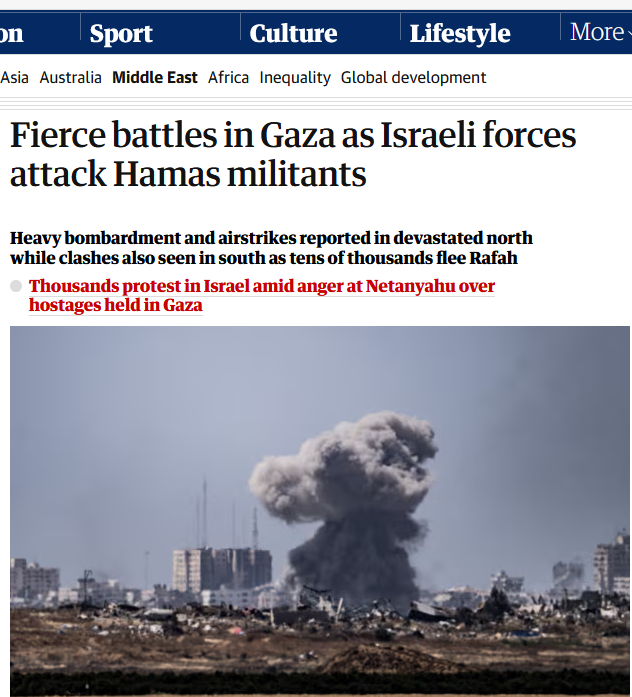
The bombing and shelling of civilians in tents is still described as “clashes”. This propaganda really does not wash any more, though it may reinforce the morale of hardened Zionists. Everybody else has seen through it months ago. Yet still they persist.
5) The endgame is becoming very apparent. The United States is completing its floating harbour for Gaza, and Israel has gained control of the Rafah crossing into Egypt, giving the US and Israel total control of entry points into Gaza. Israel has announced that the Rafah crossing is to be handed over to a US mercenary force. The US can then say it is complying with Biden’s pledge not to put US forces’ boots on the ground in Gaza, while actually taking control.
The Israeli attack on Rafah has been justified by the USA as a “limited military operation”, thus claiming it does not violate Biden’s purported “red line”, even though Israel has ordered over a million displaced people in Rafah to evacuate again, to nowhere.
Conclusion:
The only possible conclusion from all of the above is to reinforce my analysis that the Zionist political and media classes in the West, including Biden, Blinken, Trudeau, Macron, Sunak, Starmer, Scholtz, von der Leyen and all, are active and willing participants in a programme of genocide.
They had numerous opportunities to turn back. We all saw what is happening months ago. They did not take the opportunities.
The endgame remains the processing of the remaining Palestinian population out of Gaza through the US-controlled points of the Rafah crossing and the floating harbour, primarily into camps in the Sinai desert. The Western powers are doubling down on their genocide and on their colonial project.
I see nothing whatsoever that indicates they can have any other long-term objective in mind than the complete Israeli annexation of Gaza minus its civilian population. What do you see?
May 13, 2024
Posted by aletho |
Ethnic Cleansing, Racism, Zionism, Mainstream Media, Warmongering, War Crimes | Gaza, Israel, Palestine, United States, Zionism |
Leave a comment
Israel has been threatening a full-scale invasion of the Gazan city of Rafah for months, with the US government belatedly warning against the move and calling for a ceasefire. However, the Biden administration has consistently flip-flopped on the issue and refused to take serious measures to pressure Israel into reaching a deal.
On May 6, Hamas publicly announced that it had accepted a ceasefire proposal, triggering celebrations throughout Gaza. The rejoicing was short-lived though, as the Israeli government reiterated its refusal to accept a deal and pledged instead to launch a ground operation in Gaza’s southernmost city, despite US government objections.
Israeli Prime Minister Benjamin Netanyahu even stated that “the day after is the day after Hamas. All of Hamas,” meaning there is no ceasefire deal he will accept.
Despite the Israeli military capturing the Rafah Crossing between Gaza and Egypt, in addition to killing dozens of civilians after bombing 100 targets throughout Rafah, Israel announced that a delegation had been sent to Cairo to “exhaust” all possibilities of reaching a ceasefire. As it would later turn out, the ceasefire proposal that Hamas accepted was almost identical to one drafted by the CIA and Israeli intelligence, and lauded by US Secretary of State Antony Blinken as a “strong proposal”.
Meanwhile, in cities like Haifa and Tel Aviv, Israeli protesters – led by the families of captives held in Gaza – had taken to the streets to demand their government accept the ceasefire terms, which included the release of all Israeli prisoners. Clashing with the police and labeling the Netanyahu government liars, the demonstrators threatened to burn the country if their prisoners were not freed.
The US response the very next day was to gaslight reporters by telling them that the whole world was wrong and that Hamas had not accepted any ceasefire proposal. It was not long before US President Joe Biden was to sit down for an interview with CNN and state that he would not supply Israel with offensive weaponry to be used in a “major invasion” of Rafah. What he refused to do, however, was define what a major invasion means – and where the red line is.
This unclear approach comes after the Israeli military violated the terms of the 1979 Camp David agreement, which normalized ties between Egypt and Israel, by invading what is known as the Philadelphi Corridor in southern Gaza. Not only did the Israeli army send in its Givati Brigades, who published videos of themselves recklessly crushing the border crossing for fun, they also sealed off the key aid route to Gaza’s civilian population, who are on the brink of famine.
A weak and confusing American approach
The Israeli government has been threatening to invade Rafah since the start of the year, with Benjamin Netanyahu repeatedly asserting, since the beginning of February, that Israel will “lose the war” if there is no invasion. it’s a move that the US not only says will mean defeat militarily, but more importantly, threatens the lives of over a million civilians, most of whom have nowhere else to go.
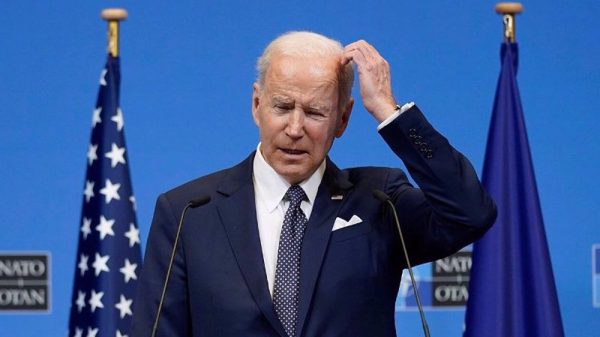
In early March, Biden gave a confusing interview to MSNBC, where he repeatedly contradicted himself when addressing the issue of an Israeli invasion of Rafah.
While claiming that entering Rafah is a “red line,” he then said that “there’s no red line [where] I’m going to cut off all weapons… but there’s red lines that if he crosses them”, before he seemed to lose his train of thought.
The sudden changes in the stance of policymakers in Washington are not limited to Biden’s MSNBC interview. In early February, the US said it would oppose an invasion of Rafah, calling it a “disaster,” to which the Israeli prime minister responded that he was preparing his forces to invade – and ramped up aerial attacks on the area. Yet, in mid-February the US government prepared a $14 billion military aid package for Israel and would go on to say that it could only support a limited invasion of Rafah.
Then there were reports that emerged, citing unnamed US officials, alleging that Biden was growing frustrated with Netanyahu and that he had even sworn at him. There was then the American push towards a “six-week ceasefire” in March, which the US president publicly said he hoped would happen prior to the Muslim Holy month of Ramadan. Even now, the Biden administration is still talking about an alleged “six-week ceasefire”, despite its own proposal to Hamas being a detailed agreement designed to end the war or at least to last for several months.
Silently, the US approved over 100 weapons transfers to assist the war effort against Gaza, in which they used loopholes to avoid Washington’s own new laws on weapons sales. Then, with two weeks left until the end of Ramadan, the US finally abstained in a United Nations Security Council (UNSC) vote, which called on Israel to implement a ceasefire until the end of the Muslim Holy month. In response, Israel immediately canceled the pre-planned visit of a high-level American delegation to Tel Aviv.
However, the very next morning, following the passing of the UN Security Council resolution, the US State Department announced that the resolution was non-binding. This not only meant that Washington was denying the reality of the internationally understood consensus that all UNSC votes are by their nature binding, but also that it would allow Israel to violate the resolution. So, even though Washington technically took a measure to pressure its ally temporarily, the very next day it gave an informal veto of the resolution, signaling to the Israeli government that it would retain American support no matter what.
While admitting that an invasion of Rafah will inevitably lead to the mass killing of Palestinian civilians, and block humanitarian aid transfers during an impending famine, and that it will not lead to the collapse of Hamas or the return of Israeli prisoners, the US government is effectively twiddling its thumbs.
The US has had nearly seven months to formulate a coherent policy when it comes to its goals and red lines in the Gaza-Israel war, yet it cannot articulate what its red lines are – and what ceasefire it even desires – without constantly contradicting itself. Western corporate media are now pointing to the postponing of a singular weapons shipment to Israel by the Biden administration, as if this constitutes pressure. But the US has done nothing to force Israel to allow aid to pass through the Rafah Crossing, which it immediately called upon Israel to do.
At this point, the US government is not helping to achieve Israel’s publicly stated war aims, it is not helping the families of Israeli prisoners, and it has failed to achieve a ceasefire or the sufficient transfer of humanitarian aid into Gaza. Instead, Joe Biden appears to be doing one thing – helping Benjamin Netanyahu prolong the conflict, with no end goal, no exit strategy, and no political solution or even the most basic idea of a post-war situation on the horizon. If anything, the US government has proven itself to be incapable of playing any constructive role to any side’s benefit. In fact, it is detrimental to the situation. If there were any people of conscience left in Washington, they would be urging their colleagues to step aside and hand the issue over to nations with coherent foreign policy platforms and intelligent diplomats.
Robert Inlakesh is a political analyst, journalist and documentary filmmaker currently based in London, UK. He has reported from and lived in the Palestinian territories and currently works with Quds News. Director of ‘Steal of the Century: Trump’s Palestine-Israel Catastrophe’.
May 13, 2024
Posted by aletho |
Ethnic Cleansing, Racism, Zionism, War Crimes | Benjamin Netanyahu, Israel, Joe Biden, Palestine, United States, Zionism |
Leave a comment
India expects to secure a “long-term arrangement” with Iran to manage the Iranian port of Chabahar, Reuters reported on 13 May, as India seeks to expand exports to central Asia and Europe.
India has been developing part of the port in Chabahar on Iran’s southeastern coast to export goods to Iran, Afghanistan, and central Asian countries while bypassing Pakistani ports in Karachi and Gwadar. India and Pakistan have been enemies since the partition of British-occupied India created the Muslim state of Pakistan in 1947.
Thus far, India has managed the Chabahar port under short-term contracts, which must be renewed regularly. The uncertainty about future operations this has caused, and the complications of engaging in trade with Iran due to US sanctions, has discouraged significant investment in the port.
“As and when a long-term arrangement is concluded, it will clear the pathway for bigger investments to be made in the port,” Indian Foreign Minister S Jaishankar told reporters in Mumbai.
A source speaking with Reuters said Indian Shipping Minister Sarbananda Sonowal is traveling to Iran to witness the signing of a “crucial contract” that would ensure a long-term lease of the port to India.
The contract is expected to last ten years and will give India management control over a part of the port.
Expanded trade via the Chabahar port will help India expand trade to both central Asia and Europe.
Business Standard reports that Chabahar is also part of the proposed International North–South Transport Corridor (INSTC), a mixed sea and land transport route linking the Indian Ocean and the Persian Gulf to the Caspian Sea via Iran and onward to northern Europe via Saint Petersburg in Russia.
Exporting goods through the INSTC via Chabahar Port is expected to reduce transit times between India and Europe by 15 days compared to the Suez Canal route.
Chabahar will also allow Iran to bypass US sanctions and allow Afghanistan better access to the Indian Ocean.
US sanctions on Iran have similarly delayed construction of a pipeline to transport Iranian natural gas to energy-stricken Pakistan.
The stalled pipeline deal, signed in 2010, envisaged the supply of 750 million to a billion cubic feet per day of natural gas from Iran’s South Pars gas field to Pakistan for 25 years.
Last month, Islamabad said it would seek a US sanctions waiver to proceed with the pipeline. However, US officials publicly said they did not support the project and warned Pakistan about the risk of sanctions in doing business with Tehran.
May 13, 2024
Posted by aletho |
Economics, Wars for Israel | Afghanistan, India, Iran, Pakistan, Sanctions against Iran, United States, Zionism |
Leave a comment
This raises some serious questions

World-famous cardiologist Dr. Peter McCullough recently revealed startling figures about the immense earnings doctors received for pushing the COVID-19 injections.
On the Tommy T Podcast, Dr. McCullough claimed that a typical doctor could make an extra $250,000 if they injected a substantial portion of their patients.
More specifically, if a doctor injected 75% of his or her patients at $250 per newly-injected person, that would end up being around $250,000.
This revelation was discovered through a leaked Anthem Blue Cross Blue Shield document.

Dr. McCullough explained that a full-time primary care physician typically manages a patient panel ranging from about 1,000 to 2,000 people covered by Anthem Blue Cross Blue Shield.
When you do the math, factoring in the $250 incentive, 1,000 newly vaccinated people times $250 = $250,000. Some doctors made less; some made more. But the point is that doctors were financially incentivized to inject as many patients as possible.
The question is, was Anthem Blue Cross Blue Shield giving doctors jab incentives, or were they being paid to do so by the government?
Take a listen to what Dr. McCullough thinks.
Watch the full interview.
May 12, 2024
Posted by aletho |
Corruption, Timeless or most popular, Video | COVID-19 Vaccine, United States |
Leave a comment
Western accusations of doping by Chinese swimmers threaten to exacerbate China-US tensions, undermine the World Anti Doping Agency (WADA) and seriously harm the upcoming Paris Olympics.
The controversy was ignited by investigation reports at the New York Times and German TV broadcaster ARD. These media outlets suggest there has been a cover-up of a mass doping incident among Chinese top swimmers with connivance of the Chinese Anti Doping Agency (CHINADA) and complicity from the World Anti Doping Agency (WADA). This story served as red meat to the hyper aggressive leader of the US Anti Doping Agency (USADA), Travis Tygart. It has prompted western swimming competitors to loudly complain. For example, the NY Times reports that US team swimmer Paige Madden thinks medals from the Tokyo Olympics should be reallocated. “I feel that Team USA was cheated.” British swimmer James Guy says, “Ban them all and never compete again.” What might be considered whining and poor sportsmanship is effectively being encouraged by western media.
The NY Times and ARD are the same two media that precipitated the accusations of “state sponsored doping” in Russia. It did enormous damage to thousands of Russian athletes and resulted in different levels of banning starting with the Rio Olympics in 2016. Although widely accepted as “truth” in the West, the claims of widespread Russian doping were weak when evidence was required. Most Russian athletes who challenged their banning were exonerated. The major accusers, the Stepanovs and Grigory Rodchenkov, were themselves guilty of doping and profiting from doping. Despite this, the banning has continued and escalated after the Russian intervention in Ukraine. The accusations and banning were useful in propelling the “new cold war” and “new McCarthyism”.
NYT and ARD, and their anonymous informants, may be seeking to do something similar to China. USADA has issued a response in which they say China may be engaging in “systematic doping” under a “coordinated doping regime”. On May 6 USADA’s Tygart escalated his attacks. He implies the Paris Olympics will be a “train wreck” because of WADA complicity in China’s “cheating”. He hopes the US government will “step in and help lead and fix this.” Surely a recipe for success.
What happened
On Jan 1 – 3 in 2021, the Chinese swim team was having a domestic swim meet. It was in the midst of covid lockdown. As usual, the team was drug tested but this time a strange thing happened: many swimmers tested positive for a trace amount of the banned medication trimetazadine (TMZ).
The China Anti Doping Agency (CHINADA) investigated and reported the facts to the World Anti Doping Agency as required. They found:
* 23 swimmers tested positive for a very small amount of trimetazadine (TMZ)
* the swimmers were from different regions of China with different coaches and trainers
* all 23 were staying at the same hotel eating in the same dining room
* none of the swimmers staying at a different hotel tested positive
* some of the swimmers tested positive one day, negative the next
* tests in the hotel kitchen showed the presence of TMZ on the air vent and counters
CHINADA concluded the positive TMZ tests were from hotel food and the athletes were not at fault.
They reported the incident and investigation to the World Anti Doping Agency (WADA) and the international swimming federation now known as World Aquatics (formerly FINA). Both organizations examined the facts and agreed with the findings.
Because the athletes were deemed to have no fault, the incident and names of the athletes were not publicized. WADA regulations indicate that there should be no publicity or naming of athletes deemed innocent and without an “Anti Doping Rule Violation” (ADRV).
How it has been reported
Approximately a year later, in 2022, anonymous sources reported this incident to the NY Times and ARD. Since then, the two media outlets have done further investigation but kept the story secret until two weeks ago.
They suggest something shady happened back in early 2021. They suggest WADA may be complicit in covering up anti doping violations. They almost encourage western athletes to challenge the Chinese swimming accomplishments and be “angry”. On April 20 the story was “Top Chinese Swimmers Tested Positive for Banned Drug, Then Won Olympic Gold“. On April 21 the story was “‘Team USA Was Cheated’: Chinese Doping Case Exposes Rift in Swimming“. On April 22 the story was “Top Biden Official Calls for Inquiry Into Chinese Doping Case.”
These reports ignited a flood of other sensational and accusatory reports and editorials. The Guardian report is titled “Poison in the pool: why the latest Chinese doping row is proving so toxic.” Sports Yahoo says, “Extremely concerned Olympians will not let the Chinese doping allegations die.” The PBS News Hour had a video report titled, “Chinese doping ‘swept under the carpet’: US anti-doping chief says.” Sports Illustrated said the news may alter the distribution of medals from the 2021 Tokyo Olympics.
The US Federal Bureau of Investigation is looking into the situation.
The NY Times and ARD say they have been investigating this story for two years. The release appears timed to have maximum impact and possible damage, just months before the Paris Olympics.
USADA accuses WADA
The US Anti Doping Agency (USADA) is led by the hyper-aggressive Travis Tyler. He has used the reports to claim that WADA is complicit in a Chinese “cover-up”. In a TV interview before a large national audience Tygart said, “China didn’t follow the rules. They effectively swept this under the carpet because they didn’t find a violation. They didn’t announce a violation. They didn’t disqualify the athletes from the event at which they tested positive. And this is absolutely mandatory under the world anti-doping code that all nations are required to follow.”
WADA has responded that Tygart’s comments seem “politically motivated”. They say CHINADA followed the rules, investigated and reported as required. They say China did NOT have to announce it to the world, or name the individual athletes for the very good reason that false accusations of doping can destroy a career. WADA regulations say the names of athletes should NOT be publicized until or unless it is confirmed they have an Anti Doping Rule Violation.
WADA appoints independent investigator
WADA is the international organization charged with supervising global anti-doping in sports. With its headquarters in Canada and most of its leaders from NATO countries, it is a largely western organization.
They are highly sensitive to criticism from the West. It has pushed back against some of the most extreme criticism, for example from the USADA head. They have also appointed an independent investigator to review what happened in China and whether WADA was correct to accept the Chinese investigation and report.
WADA appointed Eric Cottier, the prosecutor general of a Swiss region. WADA headquarters are in Canada but the organization is registered in Switzerland. USADA has criticized the appointment suggesting that Cottier is not sufficiently “independent”.
Thoms Bach, head of the International Olympic Committee, has voiced support for WADA.
WADA has defended their actions in a press conference and fact sheet about the case.
The controversy may quiet down. But a lot of poison has been spread around. Encouraged by the NY Times and other media, numerous western athletes now claim they feel “cheated” out of medals at the Tokyo Olympics since 5 medals were won by Chinese swimmers involved in the TMZ “doping scandal”.
It is also possible the controversy will continue. Will the “Sports Czar” of the Biden Administration get involved? Will the FBI be designated to investigate? These are now possible in the wake of the Rodchenkov Anti Doping Act which passed Congress in 2020.
Reader comments following articles indicate there is a wellspring of anti-China hostility encouraged by the accusations. The most popular comment on this article says, “When will democracies learn that authoritarian regimes play dirty, and should be viewed as suspect not deserving of good faith.” Another says, “No one knows doping like China knows doping, China knows doping best.” Another one says, “China cheats. Russia cheats. Just like the East Germans did before them. Their governments will meet the same fate as they did.”
Pushback
There has been some pushback to the sensational anti-China accusations. For example, Denis Cotterell is a world class coach who has trained both Australian and Chinese Olympic swimmers. He has spoken out strongly in support of the Chinese swimmers. He says, “I can see what they (the swimmers) go through. I see the measures… The suggestion that it’s systemic is so far from anything I have seen here the whole time. They are so adamant on having clean sport.”
An insightful article from an Australian academic sports authority and popular sports commentator suggests there are political forces at work: “WADA – like the United Nations and other organizations – finds itself in the cross hairs of the great power struggle of our time: a rising China and its challenge to US dominance.”
Geopolitical Consequences
According to the “2024 Annual Threat Assessment of the US Intelligence Community”, China is “challenging longstanding rules of the international system as well as U.S. primacy within it.” China’s positive “international image” is a challenge to U.S. leadership. By this logic, it is in the US interests to damage China’s international reputation and standing.
This raises the question: How did the TMZ get into the hotel kitchen and into the food being served to these Chinese athletes?
In February 2022, accusations of intentional doping were heaped on the Russian figure skater Kamila Valieva. A trace amount of trimetazadine (TMZ) was detected in a drug test taken seven weeks before the Beijing Olympics. There are similarities to the Chinese case: same drug, same trace amount detected, same mystery as to how it was ingested.
Because she could not explain how it got there, Valieva was condemned in the West and ultimately had her international career destroyed. The Russian figure skating sweep was prevented and the Russian team lost their gold medals. The controversy distracted and partially ruined the Beijing Olympics. The “intelligence community” undoubtedly considers this a success.
How did the TMZ get in the hotel kitchen in China? Who are the “whistle blowers” who informed the New York Times and ARD and supplied the names of the athletes who tested positive for the trace amount of TMZ?
The anti doping crusade is being manipulated by powerful forces with ignoble intentions.
May 12, 2024
Posted by aletho |
Deception, Mainstream Media, Warmongering, Russophobia | New York Times, United States |
Leave a comment
The US military has ordered its troops to pull out from Niger following the cancellation of a military agreement by the African country’s new leaders.
Niger’s new leaders demanded the withdrawal of American and French troops after they ousted Western-backed president Mohamed Bazoum on July 26, 2023.
They announced on March 17 that Niger had canceled a 2012 military cooperation agreement with the US, calling for an end to the US military’s “illegal” presence in the country.
The Pentagon this week formally ordered all 1,000 US combat troops to withdraw from Niger, Politico reported on Friday.
The order comes as newly-arrived Russian forces have been living at the same airbase as American troops in the capital of Niamey, Base 101, for weeks.
According to a US official, troops will be relocated to another base within the region from which they can still carry out their military operations.
Until the country’s military overthrew the pro-Western government in a coup last summer, a US-built drone base near Agadez in central Niger had been a linchpin for Washington’s military operations in the Sahel region.
Bazoum, and the previous Nigerien governments before him, had given the US military the green light to operate in the country, train Nigerien forces, and take part in what the Americans described as counter-terrorism activities.
However, the new leaders reject the “illegal” presence of US troops on Niger’s territory, saying “it was not democratically approved and imposes unfavorable conditions on Niger, particularly in terms of lack of transparency on military activities.”
Niger also called for the exit of French troops from the country and canceled two security and defense partnerships with the EU last year.
Instead, the West African country signed a memorandum of understanding to strengthen defense cooperation with Russia last December.
Niger has also signed a trilateral defense agreement with neighboring Burkina Faso, and Mali, binding the three Sahel countries to assist one another in the event of a military attack on any one of them.
May 12, 2024
Posted by aletho |
Illegal Occupation | Africa, France, Niger, United States |
Leave a comment
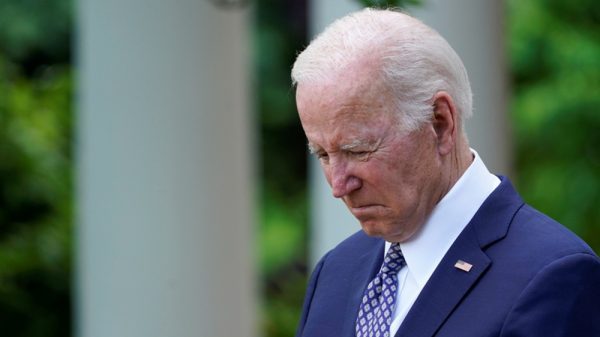
Hamas on Sunday criticized US President Joe Biden for linking a Gaza cease-fire to the release of Israelis held captive by the Palestinian group, Anadolu Agency reports.
Biden said Saturday that a cease-fire in Gaza would be possible as soon as “tomorrow” if Hamas released Israelis in its captivity.
This position “is a regression from the results of the last round of negotiations, which led to our approval of a proposal drawn by mediators in Egypt and Qatar, with the US knowledge,” Hamas said in a statement.
Last week, Hamas, which is believed to be holding nearly 130 Israelis following its Oct. 7 cross-border attack, accepted a proposal drawn by Egypt and Qatar for a cease-fire in Gaza.
But Israel said the truce offer did not meet its key demands and decided to push ahead with an operation in Rafah, home to more than 1.5 million displaced people, to apply “military pressure on Hamas with the goal of making progress on freeing the hostages and the other war aims.”
Hamas said it has shown flexibility during all rounds of negotiations to reach a cease-fire deal in Gaza.
“However, terrorist [Israeli Prime Minister Benjamin] Netanyahu and his government rushed to overturn this path by launching their aggression on our people in Rafah, Jabalia, and Gaza,” it added.
“Biden’s position once again confirms the US bias towards the criminal policy” pursued by Israel and shows “its continued political cover and military support for the genocide waged against our people,” Hamas said.
More than 35,000 Palestinians have been killed and over 76,600 others injured in a brutal Israeli onslaught on the Gaza Strip since the Hamas attack that killed nearly 1,200 people.
The Palestinian group demands an end to Israel’s ongoing military offensive on the Gaza Strip in return for any hostage swap with Tel Aviv.
More than seven months into the Israeli war, vast swathes of Gaza lay in ruins amid a crippling blockade of food, clean water and medicine.
Israel is accused of genocide at the International Court of Justice (ICJ). An interim ruling in January said it is “plausible” that Tel Aviv is committing genocide in Gaza, ordering it to stop such acts and take measures to guarantee that humanitarian assistance is provided to civilians in Gaza.
South Africa on Friday asked the ICJ to order Israel to withdraw from Rafah as part of additional emergency measures over the war.
May 12, 2024
Posted by aletho |
Deception, Ethnic Cleansing, Racism, Zionism | Hamas, Israel, Palestine, United States, Zionism |
Leave a comment
The US government has resorted to brutal measures not only to suppress the growing student movement in colleges across the country against the US-backed Israeli genocide in Gaza but also to demonize it by labeling protesters as “criminals” and “terrorists.”
Such oppressive measures – by a country that routinely uses its propaganda machinery to project itself as the “leader of the free world” – evoke familiarity as Washington has always falsely accused countries, organizations and individuals critical of its hegemonic policies of such measures.
In the past week, many American lawmakers across the political spectrum have labeled these protesting students and professors at America’s most prominent universities as Iran-backed “terrorists”, “pro-Hamas fanatics” and “criminals,” while referring to the traditional Palestinian keffiyehs as “terrorist headdress” and the protest encampments on college campuses as “little Gazas.”
Such racist and derogatory language against Palestinians as well as American critics of Washington’s military and economic support for the Israeli apartheid regime and the ongoing Gaza genocide was employed by members of the US Congress at the behest of the powerful pro-Israel lobby.
Take note of the following remarks by Republican Senator Tom Cotton of Arkansas made last week while introducing legislation to cut off federal funding of universities that have not done enough to suppress student protests against the persisting US-Israeli genocide in Gaza.
“We’re here to discuss ‘little Gazas’ that have risen upon campuses across America and liberal college administrators and politicians who refuse to restore law and order and protect other students. These ‘little Gazas’ are disgusting cesspools of anti-Semitic hate — full of pro-Hamas sympathizers, fanatics and freaks,” Cotton stated.
“The terrorist sympathizers in these ‘little Gazas’ aren’t peacefully protesting Israel’s conduct of the war. They’re violently and illegally demanding death for Israel, just like their ideological twins: the ayatollahs in Iran,” he hastened to add, trying to connect the pro-Palestine campus movement to Iran.
Such remarks point to Washington’s long-held strategy of linking Iran, a country that has dared to challenge the Western hegemony, to any meaningful criticism of its Israeli ally while falsely depicting the Islamic Republic and resistance groups as instigators of terrorism and human rights violations.
This is while top American officials have admitted to establishing, enabling and funding the world’s most notorious terrorist groups – such as Daesh (ISIS) – to wage wars of terror and destabilize countries such as Syria, Iraq, Afghanistan, Yemen, Somalia, Libya, Cuba, Venezuela and Nicaragua.
Washington has also earned notoriety for waging military coups to topple popular governments and install ruthless dictators to push their interests in different regions, including Iran, all in the name of “democracy” and “rule of law.”
Joining the hawkish Arkansas senator in sponsoring the so-called ‘Bailouts for Campus Criminals Act’ were 18 other Republican senators that likened peaceful student protesters to “terrorists” and “criminals” just for taking a stand against US support for the Israeli regime’s genocidal war on Gaza.
“Hamas sympathizers engaging in criminal behavior on college campuses should be ineligible for student loan bailouts,” said Republican Senator Marsha Blackburn of Tennessee who co-sponsored the bill.
“We must hold these criminals accountable and ensure taxpayer dollars do not go toward paying off their debt,” she added, while having no word on billions of dollars worth of weapons sent to Tel Aviv by US President Joe Biden that are used to slaughter Palestinian children and women.
Meanwhile, Republican Senators Mitch McConnell of Kentucky, Rick Scott of Florida, Joni Ernst of Iowa, Bill Hagerty of Tennessee, and others also demanded a freeze on federal funding for US universities that have not done enough to condemn and punish student protesters.
The move also signifies that major US higher education institutions rely heavily on federal funding and are expected to abide by Washington’s policies, including its support for genocidal war crimes in Gaza.
Unfazed by the hostile and repressive crackdown on student protests at major American universities, teenage high school students in numerous US cities have started their own protest rallies against Washington’s ironclad support for persisting Israeli war crimes across occupied Palestine.
The emergence of the new protest movement led by the younger American student community in major US states such as New York, California, Illinois, Texas, Oregan, Maryland and Washington clearly points to the futility of harsher measures taken by US officials aimed at deterring and punishing any opposition to its oppressive policies – nationally as well as through foreign interference.
The development has raised new fears among US politicians and analysts about likely repercussions in the presidential and congressional elections next November for both political parties amid concerns about a potential upheaval and violence in the rematch presidential race between the 82-year-old Biden and the 80-year-old former president Donald Trump.
Moreover, a dozen American senators have also issued strongly-worded warning to the International Criminal Court (ICC)’s chief prosecutor Karim Khan against the UN court’s possible handing of arrest warrants against the Israeli regime officials over their persisting genocidal war on the Gaza Strip.
“Target Israel and we will target you,” vowed pro-Trump Republican senators that included Tom Cotton, Mitch McConnell, Rick Scott, Tim Scott, Ted Cruz, and Marco Rubio.
The move came amid speculation that the court may issue arrest warrants against top Israeli officials over the genocidal war in Gaza that has so far killed nearly 35,000 Palestinians, mostly women and children.
Also this week, the largest American Muslim civil rights and advocacy organization slammed the US House of Representatives for passing a controversial legislation that criminalizes any criticism of the Israeli apartheid regime.
In a statement released on Wednesday, the Council on American-Islamic Relations (CAIR) insisted that the so-called ‘Antisemitism Awareness Act of 2023’ is a “one-sided, and dishonest” document that ignores persisting anti-Palestinian racism across the United States.
The House approved the bipartisan bill, introduced by New York Republican Congressman Mike Lawler, in a 320-91 vote and forwarded it to the Senate for passage and likely enactment by Biden’s signature.
Pointing to Washington’s traditional support for persisting Israeli atrocities against the Palestinian population, the Leader of the Islamic Revolution Ayatollah Seyyed Ali Khamenei reiterated earlier this month the validity of Tehran’s distrust of the US and rejection of the apartheid Zionist regime, citing American complicity in Israel’s genocidal war on Gaza and its brutal crackdown on student protests.
Ayatollah Khamenei declared that the only solution to the Palestinian issue would be the return of the entire land to its rightful owners and allowing them to decide what to do with the Zionist occupiers.
He further pointed to the expansion of the American student protest movement to universities across Europe and other parts of the globe, insisting that “Gaza remains the leading concern of the world” with a growing realization about the evil nature of the Zionist regime as well as the validity of the Islamic Republic’s unrelenting policy of rejecting the legitimacy of the Israeli occupying entity.
It remains to be seen what Washington’s defiance of the growing worldwide condemnation of Israel’s genocide in Gaza will spell for it in a highly sensitive election year in the face of a very divisive Congress and persisting tensions with Russia, China and the West Asia region over various military, political, economic, and strategic issues.
Mohsen Badakhsh is an educator and freelance journalist.
May 12, 2024
Posted by aletho |
Civil Liberties, Ethnic Cleansing, Racism, Zionism, Full Spectrum Dominance | Human rights, Israel, Palestine, United States, Zionism |
Leave a comment