Scott Ritter: Georgian ‘Foreign Agents’ Law Exposes Western Influence and Protects Sovereignty

By Ekaterina Blinova – Sputnik – 31.05.2024
The new “foreign agents” law will help Georgians tell right from wrong and real friends from fake ones, former US Marine Corps intelligence officer Scott Ritter told Sputnik, arguing that the legislation should be called the “transparency law.”
Georgia’s “foreign agents bill,” which designates non-governmental organizations (NGOs) receiving more than 20 percent of their funding from abroad as “pursuing the interests of a foreign power,” became law on May 28. The US immediately announced sanctions against Georgian politicians backing the legislation, while the EU threatened to freeze the country’s candidate status.
One might wonder as to why the law, which resembles the US’ Foreign Agents Registration Act (FARA), has been received with such animosity in the West. The crux of the matter is that the legislation is aimed at exposing the West’s deep disrespect of Georgia’s sovereignty, according to former US Marine Corps intelligence officer Scott Ritter.
“In Georgia today, as we speak, there are 27,000 Western-funded NGOs. What are these non-governmental organizations doing? It’s about buying a generation of Georgian citizens, a young generation, a generation that has lost touch with who they are and what they are as Georgians, a generation that is out of touch with the reality of what happened to Georgia in the 1990s,” Ritter told Sputnik.
Over the past several decades, Georgians have experienced what the “European choice” really entails, Ritter continued, referring to US-backed Georgian President Mikheil Saakashvili’s aggression against South Ossetia and Russian peacekeepers in August 2008, which was quickly repelled by Moscow. Following Saakashvili’s botched invasion, Russia recognized South Ossetia and Abkhazia, which had declared their independence from Tbilisi in the early 1990s.
Putting Georgia First
Currently, the Western-backed Georgian opposition wants to create a “second front” against Russia, something that would be nothing short of suicidal, according to Ritter. This policy of confronting Russia is part and parcel of an overall package that includes Georgia becoming a member of the European Union and member of NATO, which would also mean ceding Georgia’s sovereignty to the West, the military expert warned.
“Georgian Dream has the best interests of Georgia in mind,” said Ritter. “The EU wants Georgia to participate in the economic sanctioning of Russia. The Georgian Dream Party so far has said no. Look what happened to Europe when they sanctioned Russia, it boomeranged, backfired. What about Georgia? By not participating in the economic sanction of Russia, the Georgian economy has grown more than 10% over the course of the last two years and is on pace to continue this level of growth. That’s called looking out for Georgia first.”
When it comes to Georgian NATO membership, many of the nation’s seasoned military officers, who participated in NATO’s Iraq, Afghanistan, and Kosovo campaigns and brought home the dead bodies of Georgian soldiers, are no longer enthusiastic about joining the alliance, the expert remarked.
Ritter explained that territorial disputes with South Ossetia and Abkhazia will not allow Georgia to join NATO any time soon, adding that the irony is that the two breakaway republics will not start settling their disagreements with Tbilisi until the latter gives up its NATO aspirations.
New Law to Prevent West From Meddling in Georgia’s Elections
Unlike Georgia’s former pro-Western leaders and opposition, the Georgian Dream Party has taken a middle path of steering the nation away from economic and political crises, according to the pundit. In light of this, the upcoming October elections will become a litmus test for Georgians, and the governing party doesn’t want the West to decide the nation’s fate by meddling in the vote via thousands of US and EU-funded non-governmental organizations. Hence, the adoption of the law, which will help separate the wheat from the chaff, he said.
“One of the goals in passing this legislation was to prevent the EU and the US from taking control of the political opposition, directly and indirectly, by pouring in hundreds of millions of dollars through these 27,000 non-governmental organizations. By stopping this, by exposing this foreign money, the reality of this foreign money, the Georgian Dream Party is betting that the Georgian people will be shocked by the depths to which ostensible friends, the US, the EU, have gone to buy Georgia, not respecting Georgia as a sovereign state, not respecting the Georgian people as a sovereign people.”
Georgian Dream lawmakers want to prevent external forces from dragging the nation into another debacle, according to the expert. They want Georgians to choose their own way on the world arena, not as “Europeans,” but as “Georgians.”
“The Georgian Dream Party is betting that the Georgian people at the end of the day will recognize that they are not European – that they are Georgian. They are Eurasian. They are unique. That they don’t belong in a continent that doesn’t want them. They belong in the homeland, in the South Caucasus, from which they come. And that their closest big neighbor, Russia, has been the best friend of Georgia over time than any other nation on the planet. This is the Georgian dream. This is the dream of the Georgian people. And this should be the dream of anybody who claims to be a friend of the Georgian nation,” Ritter concluded.
Media Hall Monitors Are Annoyed About Investigations Into Demonetization Bias
By Cindy Harper | Reclaim The Net | May 31, 2024
A trade group representing the advertising industry, currently under scrutiny by Congress for possibly coordinating with large companies to demonetize conservative and independent media, has expressed concerns over the impact of this probe on their operations.
The group, identified by sources as the Global Alliance for Responsible Media (GARM), told Business Insider that the congressional actions led by Rep. Jim Jordan (R-OH) are hampering their ability to focus on new initiatives.
Rep. Jim Jordan, who chairs the House Judiciary Committee, has accused GARM of preventing companies from placing ads with media outlets that are seen as promoting “misinformation,” specifically targeting mainstream conservative platforms such as Fox News, The Daily Wire, Breitbart, and more.
Jordan contends that the group’s actions go beyond concerns over “brand safety” and veer into outright censorship of conservative and other disfavored viewpoints.
The sources within GARM lamented the diversion of major corporations into partisan conflicts, which they believe could harm their reputation and alienate consumers. They also expressed fears about potential lawsuits arising from document disclosures which could demonstrate that their brand safety initiatives are driven by partisan motives.
In response to the grievances aired by GUILD members, a Judiciary Committee spokesman highlighted the irony in large corporations feeling harassed by these inquiries, dismissing the notion as “laughable” given the evidence of long-term bias and censorship against conservative entities by GARM members.
US behind two failed ‘color revolutions’ – Georgian PM
RT | May 31, 2024
Tbilisi needs to “reconsider” its relationship with Washington, given that American-funded NGOs were behind at least two attempts at overthrowing the government, Georgian Prime Minister Irakli Kobakhidze has said.
The US has threatened sanctions against senior Georgian officials after the former Soviet republic passed a ‘foreign agents’ law which was denounced by the West as a threat to democracy.
“I don’t know why there were two attempts at revolution in 2020-2021, and then in 2022. I don’t know why there were these attempts, but the fact is that the previous [US] ambassador spoiled a lot of things, a lot of things were ruined in those years, and this needs to be corrected,” Kobakhidze told reporters on Friday.
“This includes American-funded NGOs that stood on the revolutionary stage, calling for the resignation of the government, and the formation of a government with their participation. Therefore, Georgian-American relations need to be reconsidered,” the prime minister added.
Georgia will do everything it can to improve relations with the US, Kobakhidze said, as this is in the interests of both countries.
The government in Tbilisi has been under intense pressure from the US and EU to drop the proposed Transparency of Foreign Influence Act, to the point that Washington and Brussels have threatened sanctions and a halt to Georgia’s EU and NATO integration.
The law would require NGOs, media outlets, and individuals receiving more than 20% of their funding from abroad to register as entities “promoting the interests of a foreign power” and to disclose their donors, or be fined up to $9,500 for noncompliance. The law sparked protests, during which activists clashed with police and tried to storm the country’s parliament building last month.
US Secretary of State Antony Blinken has said that Washington would introduce visa restrictions on “individuals who are responsible for or complicit in undermining democracy in Georgia, as well as their family members.”
Meanwhile, EU Commissioner for Neighborhood and Enlargement Oliver Varhelyi suggested to Kobakhidze that he could meet the same fate as Slovak PM Robert Fico, who narrowly survived an assassination attempt last month. Varhelyi later said his warning about the dangers of “polarization in society” was misunderstood.
Georgian NGOs, which are primarily funded by the West, have denounced the proposed law as “Russian” and attempted to replicate their 2023 success in forcing the government to back down. This time, however, the parliament passed the law and overrode President Salome Zourabichvili’s veto earlier this week. The government has denied that the law will be used to crack down on the opposition and insisted that the legislation is compatible with EU norms.
Robert Fico’s failed assassination raises specter of Western plotting
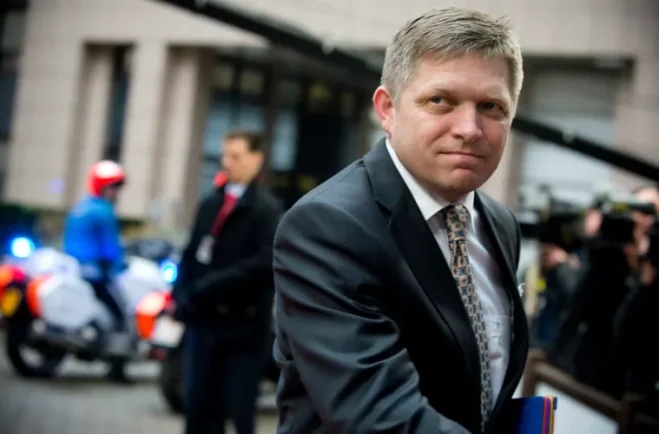
BY KIT KLARENBERG · THE GRAYZONE · MAY 31, 2024
Slovak PM Robert Fico’s independent stance earned him the wrath of NATO and the EU. Did a Western-directed plot to remove his troublesome government from office trigger his assassination attempt?
On May 15, Slovak Prime Minister Robert Fico was almost murdered in broad daylight. While shaking hands with supporters during a public appearance, a gunman shot him twice in the abdomen and once in the shoulder. The attack left him fighting for his life while authorities raced for clues, and many observers at home and abroad puzzled about the would-be assassin’s motives and whether foreign actors were in some way responsible for the attack. And despite the shooter’s instantaneous arrest, those questions still linger weeks later.
Fico, a veteran Slovak political figure, was re-elected in September 2023 amid a wave of public resentment over the proxy war in Ukraine, pledging to end arms supplies to Kiev and anti-Russian sanctions. On the campaign trail, Western leaders, journalists and pundits aggressively stoked fears of the “pro-Putin,” “populist” candidate returning to office. Ukraine’s Western-backed “Center for Countering Disinformation” publicly accused him of spreading “infoterror” back in April 2022.
But many Slovakians see it differently. They say Fico is merely committed to defending Slovakia’s sovereignty, and governing in his nation’s interests, not those of Brussels, Kiev, London, and Washington. For Western politicians, his victory came at a highly inopportune time, with public and political consensus on the proxy war in Ukraine rapidly fraying across Europe.
Since Fico’s election, media outlets like Germany’s state broadcaster, Deutsche Welle, have branded him a “threat” to the EU and NATO. His declaration that Kiev must cede territory to Russia to end the war was not well-received in Western capitals. In April, the premier seemingly predicted his own shooting, warning that the virulent political climate in Bratislava could result in politicians getting killed.
Domestically, a number of foreign-funded media assets and NGOs have relentlessly targeted Fico for pursuing neutrality in the conflict. But over two years after Russia’s intervention, local polling indicates just 40% of the population blame Moscow for the proxy war, and 50% consider the US to be a threat to national security. Meanwhile, 69% of Slovakians believe by continuing to arm Ukraine, the West is “provoking Russia and bringing itself closer to the war” and 66% agreed that “the US is dragging [their] country into a war with Russia because it is profiting from it.”
When Fico was re-elected in September 2023, this journalist speculated that a color revolution could soon be impending in Slovakia. We are now left to ponder whether the Prime Minister’s attempted assassination was a Western-directed plot to remove his troublesome government from office. Even though he is finally on the road to recovery, the threat of an overseas-orchestrated coup remains. A vast US-sponsored opposition political and media infrastructure is causing havoc in Bratislava, and this could easily escalate further.
Slovakia has since the end of the Cold War stood apart from its neighbors. Folding the country into the EU and NATO and neutralizing its rebellious politics and population has required an enormous investment in time and money by Brussels and Washington, and relentless meddling in the country’s internal affairs by foreign-funded organizations and actors. Fico’s return to power threatened to not only derail that project, but create a regional contagion effect. Disinfecting the country therefore became of the utmost urgency for the West.
Facebook purge suggests shooter was no ‘lone wolf’
Fico’s shooter, 71-year-old Juraj Cintula, is among the Slovaks who do not support Fico’s positions. A discrepant picture of the man has emerged since his arrest. Some acquaintances describe him as “weird and angry,” and “against everything.” Others report he was meek and mild-mannered, a far from obvious candidate to attempt a high-level political assassination. Cintula, an avowed Kiev ultra, claims he acted alone, his actions motivated by a desire to replace Fico’s government with a pro-Ukrainian administration. Slovakian court documents state that Cintula “wants military aid to be provided to Ukraine and considers the current government to be Judas towards the European Union,” and say this perception is why the would-be assassin “decided to act.”
The mainstream media has made much of Cintula’s background as a dissident poet and writer, in a seeming effort to humanize the would-be killer. By contrast, Aaron Bushnell, who in February self-immolated in protest of Washington’s facilitation of the Gaza genocide, was widely tarred by journalists as a maladjusted, mentally unwell outcast. Unmentioned by any Western outlet is that during the 1980s, Cintula was under surveillance by Czechoslovak security services.
The reason for the Czechs’ interest is unclear, although it may have been due to anti-Communist actions, or foreign contacts. Whether Cintula had seditious confederates within or without Slovakia is a key line of inquiry for police. That all traces of the shooter’s Facebook profile were comprehensively scrubbed from the internet two hours after the shooting, before investigators could access the information, is also source of intense suspicion.
While it is customary for the social network to purge the profiles of “dangerous individuals” – a fate this journalist has suffered for investigative reporting – following such incidents, in Bratislava Facebook relies on cooperating local individuals and organizations to police content. Apparently, Cintula’s profile was wiped before his identity had been reported in local media. Slovak authorities must now rely on the FBI to secure and provide the deleted information. Whether whatever is turned over will be unexpurgated is an open question.
Another disturbing feature of mainstream reporting on the shooting is ubiquitous, persistent reference to Slovakia’s unstable politics. According to this narrative, Fico’s anti-Western policies have fueled the chaotic state of affairs, provoking the assassination attempt and making him ultimately responsible for the attempt on his life. In the days following the shooting, the BBC, Financial Times, New York Times and Germany’s esteemed Der Spiegel pinned the blame on Slovakia’s alleged “toxic” political culture. The latter revised its wording after significant public backlash.
One could be forgiven for concluding Western journalists take it as self-evident that defying EU/US will provide legitimate grounds for getting shot. Western politicians clearly do. On May 23rd, Georgian prime minister Irakli Kobakhidze revealed that EU commissioner Oliver Varhelyi warned him he could suffer the same fate as Fico, if his government didn’t drop a highly controversial “foreign influence transparency” law, which would compel local NGOs to disclose their sources of income.
After listing the various ways the EU could retaliate against Georgia in a phone call with Kobakhidze, Varhelyi allegedly stated: “Look what happened to Fico, you should be very careful.”
Varhelyi has since confirmed that he cited Fico’s fate in private conversations with Kobakhidze, but claimed he was merely concerned with “dissuading the Georgian political leadership” from adopting restrictions on foreign-funded NGOs. Varhelyi insisted in a written statement that he simply “felt the need” to caution the Prime Minister “not to enflame [sic] further the already fragile situation,” arguing that he only mentioned “the latest tragic event in Slovakia… as an example and as a reference to where such high levels of polarisation can lead in a society.”
Public records show the US government regime change specialists at the National Endowment for Democracy (NED) have pumped millions into NGOs and media outlets in Slovakia under the aegis of mundane-sounding initiatives such as “strengthening civil society” and “promoting democratic values among youth.” Similar language is used to describe the purpose of Endowment grants in Georgia, financing groups at the forefront of recent violent unrest on the streets of Tbilisi, as The Grayzone has documented. Perhaps unsurprisingly, NED grantees are unanimous in their opposition to Fico.
Anyone searching for the source of Slovakia’s “toxic” politics need not look further than these US-backed organizations. Washington has stirred this cauldron for almost three decades, and with all sides of the Slovakian political class blaming one another the rising tide of hatred, it is hoping the pot will finally boil over.
Regime change blueprint honed in Slovakia
The NED-organized overthrow of Slobodan Milosevic in Yugoslavia in 2000 established an insurrectionary blueprint which was subsequently exported in the form of color revolutions. But throughout the 1990s, Slovakian activists honed the tactics which would eventually be deployed by US regime change operatives across the Soviet sphere.
At the time, Bratislava was one of the only post-Communist countries that neither adopted ruinous neoliberal political and economic reforms, nor pursued EU or NATO membership. Slovakia’s then-Prime Minister Vladimir Meciar paid a harsh price for his independent stance. Relentlessly slandered by US and European leaders as a Russian pawn, he quickly became a target for regime change.
In 1997, then-Secretary of State Madeleine Albright publicly described Slovakia as “a black hole in the heart of Europe,” formally marking him for removal. So it was that NED funded the creation of Civic Campaign 98 (OK’98), a coalition of 11 anti-government NGOs.
Explicitly modeled on an earlier NED-funded effort in Bulgaria, concerned with “creating chaos” after the Socialist Party won the 1990 election, many of the individuals involved had been part of Cold War-era Czechoslovak anti-Communist dissident groups. OK’98 was publicly framed as a non-partisan get-out-the-vote campaign, but its vast resources were explicitly deployed for anti-government purposes. Its activities included rock concerts, short films, and TV infomercials in which Slovak celebrities urged young people to vote.
Meciar emerged with the most votes in the 1998 election, but the opposition gained enough seats to form a government. The NED assets who powered them to victory went on to give practical training to NED-supported pro-Western agitators like Pora, which ignited Kiev’s 2004 “Orange Revolution.” The insurrectionist youth group successfully overturned the re-election of President Viktor Yanukovych that year, installing the US-backed neoliberal Viktor Yushchenko in his place.
The return of Robert Fico represented a significant broadside against ongoing US “democratization” of the former Soviet sphere. It opened up the prospect of further anti-NATO candidates and governments gaining office elsewhere in Europe, at the most inconvenient juncture imaginable for Brussels and Washington.
Not coincidentally, it was at this time that polling for Germany’s upstart Alternative für Deutschland became turbocharged. The Euroskeptic party’s standing has soared in recent months, eliciting mainstream calls to ban it outright. And in North Macedonia just one week prior to Fico’s shooting, the anti-establishment VMRO-DPMNE party returned to power, overturning a NATO-fuelled color revolution that removed the party from office almost a decade earlier.
As the anti-Western backlash gained steam, a decision may have been made to draw a bloody red line in Slovakia.
Russia repels US-supplied missile attack on Crimean Bridge – minister
RT | May 31, 2024
The Russian military this week repelled Kiev’s largest missile attack yet on the strategic Crimean Bridge, Defense Minister Andrey Belousov has said.
Speaking at a meeting of defense ministers of the Collective Security Treaty Organization (CSTO) in Kazakhstan on Friday, the defense chief said Ukraine had fired ten US-supplied ATACMS at the bridge on Wednesday night, which had a flight time of less than two minutes.
“All missiles were shot down. As a result, hundreds of lives were saved,” Belousov said.
On Thursday, the Russian Defense Ministry said Russian air defenses had destroyed eight ATACMS missiles, which have a range of up to 300km, as well as eight aerial and two maritime drones over the Black Sea.
The Ukrainian military has confirmed that they deployed ATACMS missiles in the area, but insisted that the strikes had targeted a ferry crossing point on the peninsula. It also claimed to have inflicted “considerable” damage on two Russian transport ships. Local authorities have confirmed the damage but insisted that it was limited to shattered windows.
Destroying the Russian bridge is “something that we really want,” Ukraine’s Vladimir Zelensky told German media earlier this year.
Kiev has launched multiple attacks on the bridge, but the strategic link has only been damaged twice, with several people killed in both incidents. The first was in October 2022, when a truck exploded on the bridge, and the second was in July 2023 when a maritime drone attack took place.
According to Belousov, in May alone, the Russian military intercepted more than 1,000 Ukrainian drones, over 250 HIMARS and Vampire missiles, in excess of 80 Hammer guided bombs, 50 ATACMS rockets, and eight SCALP cruise missiles – all of which had been supplied to Ukraine by Western countries.
Russia has repeatedly denounced arms shipments to Kiev, warning that they will only prolong the conflict, but will not change its ultimate outcome.
Scott Ritter: Ukraine’s NATO Allies Dragging World Into Nuclear Armageddon
By Ekaterina Blinova – Sputnik – May 31, 2024
The West has misinterpreted Russia’s openness to dialogue on Ukraine as a sign of weakness and is now pushing the world to the edge of a disastrous all-out nuclear exchange, former US Marine Corps intelligence officer Scott Ritter told Sputnik.
US President Joe Biden has authorized Ukraine to hit targets inside Russia with US-made weapons, bringing the conflict to a new level. White House officials claim that Washington’s new policy pertains only to what they call as “acts of self-defense” by the Ukrainian military that is continuing to retreat.
Previously, other NATO member states, including the UK, France and Sweden, gave a nod to the Zelensky regime to use their weapons systems to attack Russia.
The Kiev regime and its Western allies believe they can gain an advantage over Russia by confining its special military operation to Ukrainian territory, ex-US Marine Corps intelligence officer Scott Ritter told Sputnik. This situation allows Ukraine to train its troops in neighboring NATO states and receive arms and other equipment from the alliance’s hubs, not making them Russia’s legitimate targets.
However, things could drastically change once NATO-grade missiles start flying into Russia’s territory with the approval of Western countries, according to the military expert.
“France is now giving Ukraine permission to use the SCALP air launched cruise missile against targets inside Russia,” Ritter said. “Now [French President Emmanuel Macron] claims it’s just military targets, there won’t be hitting any civilian infrastructure, but it doesn’t matter. The fact is, if the French Scalp missile is used to attack targets inside Russia, this isn’t Ukraine defending itself, it’s France attacking Russia,” he stated.
The military expert indicated that it is a widely accepted fact that Ukrainians lack the ability to pre-program long-range SCALP missiles armed with conventional warheads. Therefore, it would be necessary for French technicians to carry out this task. The question arises: where would they obtain the targeting data? According to Ritter, the French military relies on a network of Syracuse satellites to transmit the essential information required for SCALP missiles.
“The bottom line is it is French space reconnaissance that’s gathering information and transmitting the information to the people who program the SCALP. The French operators, using French communication systems that transmit data collected by French intelligence satellites. This is France attacking. Who picks the target? Ukraine. France? It doesn’t matter. It’s the French.”
Ritter spotlighted the fact that Moscow has recently signaled that it is well aware of who operates NATO-grade long-range missiles and who provides reconnaissance and communications.
“[Russian President Vladimir Putin] knows that it’s not Ukrainian space reconnaissance, it’s not Ukrainian communications, it’s not Ukrainian technicians that are doing the targeting. It is the French, it is the Germans. It is the British. It is the Americans. And therefore, if these missiles, these weapons systems that are now being greenlit by the respective Western nations, to be used by Ukraine to attack targets inside Russia, if this happens, this is no longer about Ukraine defending itself. It’s about NATO attacking Russia.”
The question then arises as to how Russia will respond to these attacks, continued the military expert. According to NATO member states, they authorize Ukraine to use their weapons against Russia as sovereign nations, not as a military bloc. According to Ritter, this apparently means that they invite Russia’s retaliation strikes inside their respective territories and will not invoke Article 5, stipulating collective defense of NATO member states. “Because if they do that, then it’s clear that this is a NATO confrontation against Russia,” he stressed.
“If NATO chooses then to respond by launching additional attacks against Russia (remember, these are retaliation attacks – Russia is retaliating against NATO attacks against its territory) this would be an all-out assault by NATO against Russia. And former Russian President Dmitry Medvedev made it clear that the Russian response would be nuclear. And this would lead to a general nuclear exchange and the end of the world. That’s where we’re at right now. This isn’t about helping Ukraine. This isn’t about Ukraine defending itself. This is about a larger plan by the collective West, by NATO, by the United States to strategically defeat Russia.”
The West’s major problem is that it has completely misread Russia since the outset of the conflict and considered Moscow’s calls for dialogue and negotiated settlement as a sign of weakness, according to the military analyst.
“Therefore the collective determination of the West is that they just continue to pressure Russia, ratchet up the pressure that Russia will fold like a house of cards, and run to the peace table and bring an end to this conflict. That’s not going to happen. This is a misreading of the situation by the West,” warned Ritter.
“And so the West now will attack Russia, trying to pressure Russia to the peace table. But all it will do is guarantee a Russian response that if the West doesn’t respond properly to that, if the West thinks that it therefore has the right to strike, Russian return will lead to Armageddon, the end of the world. That’s where we’re at today. This isn’t a game. This isn’t a joke. This is the end of all humanity,” the military expert cautioned.
Ukraine: Russia won’t escalate, US will
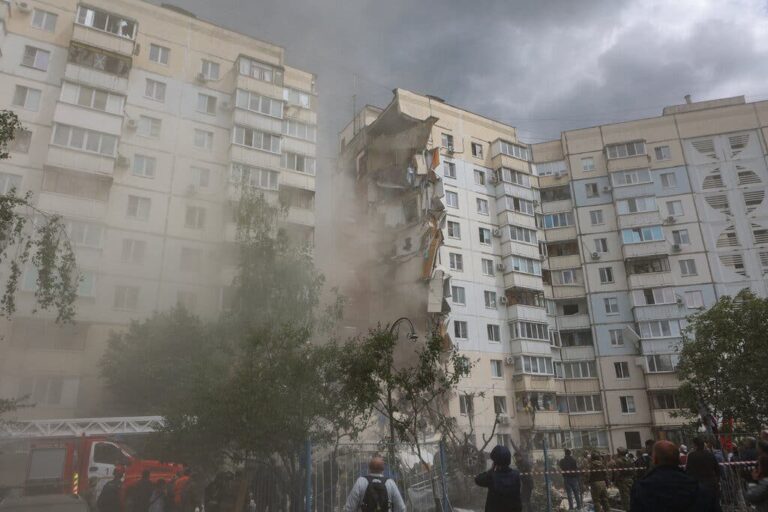
The aftermath of a Ukrainian attack on Belgorod, Russia, in May
BY M. K. BHADRAKUMAR | INDIAN PUNCHLINE | MAY 31, 2024
The United States’ proxy war with Russia is at another inflection point. The battleground is shifting dramatically to Russian territory — something without precedent even in the Cold War. How this pans out will be a momentous event in 21st century politics.
There are three defining issues here. One, the NATO strategy going forward, given the realisation in the West that there is no question of Russia being defeated in Ukraine; two, the constitutional crisis in Kiev with the presidential term of Vladimir Zelensky having run out on May 21; and, three, germane to all this, Russia’s intentions.
To be sure, the NATO and the EU are revamping their strategy while Russia hopes to remain “one foot ahead” of the West, as President Vladimir Putin put it.
Russia is not interested in an escalation as it is doing well in the war of attrition with Ukraine. Russia has effectively countered the US’ Mission Creep so far to push through all of its self-imposed limitations on aid to Ukraine and eventually breach those limits.
The big question today is how one could take the Biden Administration’s affirmation — stated by the White House National Security Council, the state department and the Pentagon — that it disfavours the use of western weaponry by Kiev to attack pre-war Russian territory.
An established pattern has set in whereby when Washington says some advanced weapon system is off limits for Ukraine, it actually turns out that Kiev just has to sit out for a few months so that Biden can cross the self-imposed red line.
Therefore, Russia will not take this as Washington’s final word. Curiously, the ground is being prepared to jettison the taboo, with both congressional Republicans and Secretary of State Blinken urging the White House to give the green light and both New York Times and Washington Post reporting that it is only a matter of time before the administration yields to formal American blessing to accelerate strikes on prewar Russia. (here and here)
The New York Times and Guardian reported on Thursday, in fact, a shift already in the US position that now allows Ukrainian US-supplied artillery to fire back at Russian batteries over the Russian border from Kharkov region and also to target concentrations of Russian forces massing on the border in Russia’s Belgorod region.
Meanwhile, a new phase is about to begin to conclude the Battle of Donbass, which, even after two years remains unfinished business. The entrenched Ukrainian military hubs in the region — Pokrovsk, Kramatorsk and Slovyansk — still threaten southern Donetsk Oblast.
Similarly, Volchansk on the Russian border facing Belgorod city and Kupyansk, also an important logistical point and railway node (almost 20 rail lines intersect in the town with about half track straight into Russia) are a thorn in the flesh for Russia’s border region.
Russians have openly stated that repeated raids into Belgorod city and its environs from the Kharkov Region needed to be countered with the creation of a “security zone”. Putin himself had spoken about this as early as in March.
From present indications, Russian operations are directed on two Ukrainian towns close to the border — Volchansk and Lypsti. Russia may stretch the front with a foray into Sumy oblast but any serious effort to capture either Sumy or Kharkov seems unlikely at this stage.
In an incisive analysis, the well-known Russia watcher Big Serge wrote last week, “The main purpose of these fronts will be to fix Ukrainian reserves in place and denude Ukraine’s ability to react on other fronts. This war will not be won or lost in Kharkov, but in the Donbas, which remains the decisive theatre.
“We currently appear to be solidly in the preparatory/shaping phase of a Russian summer offensive in the Donbas, which (likely among other things) will feature a Russian drive on the city of Konstyantinivka. This is the last major urban area shielding the advance towards Kramatorsk-Slovyansk from the south (remembering that these twin cities form the ultimate objective of Russia’s campaign in the Donbas.)”
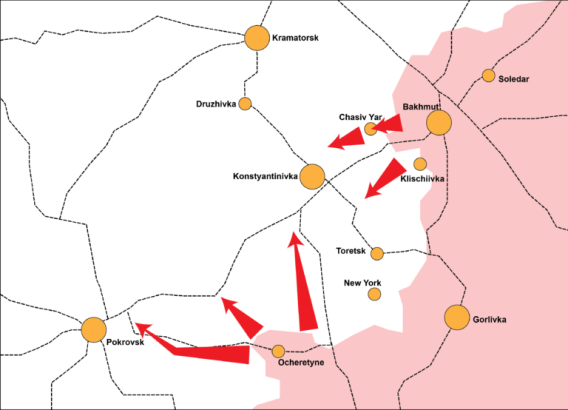
Expected Russian summer offensive
Putin has strongly reacted to the recent proxy attacks on Russia’s strategic assets with western weaponry inside its territory. Putin warned that “this unending escalation can lead to serious consequences.”
As he put it, “long-range precision weapons cannot be used without space-based reconnaissance… the final target selection and what is known as launch mission can only be made by highly skilled specialists who rely on this reconnaissance data, technical reconnaissance data.
“For some attack systems, such as Storm Shadow, these launch missions can be put in automatically, without the need to use Ukrainian military… Launching other systems, such as ATACMS, for example, also relies on space reconnaissance data, targets are identified and automatically communicated to the relevant crews that may not even realise what exactly they are putting in. A crew, maybe even a Ukrainian crew, then puts in the corresponding launch mission. However, the mission is put together by representatives of NATO countries, not the Ukrainian military.
“So, these officials from NATO countries, especially the ones based in Europe, particularly in small European countries, should… keep in mind that theirs are small and densely populated countries, which is a factor to reckon with before they start talking about striking deep into the Russian territory. It is a serious matter and, without a doubt, we are watching this very carefully.”
Importantly, Putin underscored, “If Europe were to face those serious consequences, what will the United States do, considering our strategic arms parity? It is hard to tell. Are they looking for a global conflict? I think they wanted to agree upon strategic arms…We will wait and see what happens next.”
However, there are growing signs that the Biden administration may have simply mothballed the idea of western long-range weaponry being used to destroy Russia’s strategic assets deep inside its territory until the NATO summit gets over in Washington (9-11 July) so as to keep the flock together.
Equally, Biden may calculate that it is expedient to drum up tensions with Russia rather than leave the foreign policy turf to Israeli Prime Minister Benjamin Netanyahu who may land in DC to address the lawmakers. The Israeli National Security Advisor Tzachi Hanegbi told Israel’s Kan public broadcaster on Wednesday, “we are expecting another seven months of fighting” in Gaza. The Republicans are already flagging Middle East as the single biggest foreign policy goof-up by Biden. This is where the real risk lies.
There is a remarkable consistency in the Russian words that the depth of its proposed buffer security zone along the western borders will entirely depend on security considerations. The deputy chairman of Russia’s security council Dmitry Medvedev had explicitly stated recently that the security zone may not only include Kiev but also extend as far as the Polish border if the West sends Kiev long-range weapons. Significantly, on Tuesday, Putin called into question the legitimacy of Zelensky remaining in power in Kiev after his presidential term ended on May 21.
The ball is in Biden’s court. But the signs are not good. Germany, which is the US’s closest European ally, is apparently switching tack and now says that Ukraine’s “defensive action is not limited to one’s own territory, but [can] also be expanded to the territory of the aggressor.”
The chancellor’s spokesman said Berlin’s previous stance that Ukraine wouldn’t use German weapons on Russian soil had been “a statement of facts” that was true at that moment but did not necessarily apply to the future. He refused to reveal Berlin’s precise agreements with Kiev on using German weapons.
US Weapons Already Used in Attempts to Strike Russian Territory – Kremlin
Sputnik – 31.05.2024
Attempts to strike Russian territory with US weapons are already being made, clearly indicating Washington’s involvement in the Ukraine conflict, Dmitry Peskov, press secretary of the Russian president, said on Friday.
“We are aware that attempts to strike Russian territory with American-made weapons are already being made. This is sufficient for us, and it clearly demonstrates the extent of the United States’ involvement in this conflict,” he told journalists.
Earlier, a US State Department representative told Sputnik that President Joe Biden had authorized Ukraine to use American weapons for counter-battery operations against targets on Russian territory that threaten the Kharkov region, while maintaining the ban on the use of ATACMS tactical missiles and other long-range strike systems.
The Kremlin agrees with Hungarian Prime Minister Viktor Orban’s opinion that Europe has entered an intermediate stage of preparing for war with Russia.
“We agree. There is absolute inflaming of pro-war sentiments and a deliberate stirring up of pre-war hysteria. And all of this, of course, cannot but have the most negative impact on the overall situation. The escalation of tensions continues,” Peskov said in response to journalists’ questions about whether the Kremlin agrees with Hungarian Prime Minister Viktor Orban’s statement that the longer the range of weapons that the West provides to Kiev, the further the Russian Army will advance.
Hungarian Foreign Minister Peter Szijjarto previously said that NATO wants to increase its coordination role in supplying weapons to Ukraine and training its soldiers. Thirty-one countries support this decision, but Hungary does not want to and will not participate. Prime Minister Viktor Orban said that in this manner, NATO is “sliding” into the conflict.
Meanwhile, NATO Secretary General Jens Stoltenberg said that allies expect Ukraine to act “in a responsible way” when using Western-supplied weapons to hit targets inside Russia.
“So many Allies have made it clear that they, of course, accept that Ukraine is using the weapons they have received to defend themselves, including by striking military targets inside Russia. Especially when those military facilities are used in attacking, directing attacks from Russian soil. Then, we all expect that this is done according to international law, and in a responsible way,” he said ahead of a NATO foreign ministers’ meeting in Prague.
Stoltenberg said this week that he favored lifting restrictions on the use of long-range Western weapons against “legitimate targets” inside Russian territory. The Kremlin said NATO allies were now directly involved in a military confrontation with Russia.
Alternative Media Giants Sue The Censorship Industrial Complex
By Dan Frieth | Reclaim The Net | May 29, 2024
In a new lawsuit, Webseed and Brighteon Media have accused multiple US government agencies and prominent tech companies of orchestrating a vast censorship operation aimed at suppressing dissenting viewpoints, particularly concerning COVID-19. The plaintiffs, Webseed and Brighteon Media, manage websites like NaturalNews.com and Brighteon.com, which have been at the center of controversy for their alternative health information and criticism of government policies.
We obtained a copy of the lawsuit for you here.
The defendants include the Department of State, the Global Engagement Center (GEC), the Department of Defense (DOD), the Department of Homeland Security (DHS), and tech giants such as Meta Platforms (formerly Facebook), Google, and X. Additionally, organizations like NewsGuard Technologies, the Institute for Strategic Dialogue (ISD), and the Global Disinformation Index (GDI) are implicated for their roles in creating and using tools to label and suppress what they consider misinformation.
Allegations of Censorship and Anti-Competitive Practices:
The lawsuit claims that these government entities and tech companies conspired to develop and promote censorship tools to suppress the speech of Webseed and Brighteon Media, among others. “The Government was the primary source of misinformation during the pandemic, and the Government censored dissidents and critics to hide that fact,” states Stanford University Professor J. Bhattacharya in support of the plaintiffs’ claims.
The plaintiffs argue that the government’s efforts were part of a broader strategy to silence voices that did not align with official narratives on COVID-19 and other issues. They assert that these actions were driven by an “anti-competitive animus” aimed at eliminating alternative viewpoints from the digital public square.
According to the complaint, the plaintiffs have suffered substantial economic harm, estimating losses between $25 million and $50 million due to reduced visibility and ad revenue from their platforms. They also claim significant reputational damage as a result of being labeled as purveyors of misinformation.
The complaint details how the GEC and other agencies allegedly funded and promoted tools developed by NewsGuard, ISD, and GDI to blacklist and demonetize websites like NaturalNews.com. These tools, which include blacklists and so-called “nutrition labels,” were then utilized by tech companies to censor content on their platforms. The plaintiffs argue that this collaboration between government agencies and private tech companies constitutes an unconstitutional suppression of free speech.
A Broader Pattern of Censorship:
The lawsuit references other high-profile cases, such as Missouri v. Biden, to illustrate a pattern of government overreach into the digital information space. It highlights how these efforts have extended beyond foreign disinformation to target domestic voices that challenge prevailing government narratives.
Webseed and Brighteon Media are seeking both monetary damages and injunctive relief to prevent further censorship. They contend that the government’s actions violate the First Amendment and call for an end to the use of these censorship tools.
As the case progresses, it promises to shine a light on the complex interplay between government agencies, tech companies, and the tools used to control the flow of information in the digital age. The outcome could have significant implications for the future of free speech and the regulation of online content.
Case of 14-Year-Old Vaccinated for COVID Against His Will Headed to North Carolina Supreme Court
By John-Michael Dumais | The Defender | May 28, 2024
The North Carolina Supreme Court on May 23 agreed to hear the case of a Guilford County teenager who was given a COVID-19 vaccine against his will and without parental consent in August 2021, according to Carolina Journal.
The court’s decision to take up the case comes after a North Carolina appeals court ruled against the teen and his mother in March, upholding a lower court’s dismissal of their lawsuit.
Tanner Smith, then 14 years old, was instructed to get tested for COVID-19 at a Guilford County Schools vaccination site in order to continue playing football.
Despite Smith’s objections and the lack of parental consent, clinic workers administered a dose of the Pfizer COVID-19 vaccine, which at the time was available only under emergency use authorization (EUA).
In its unanimous ruling against Smith and his mother, Emily Happel, the appeals court found that the federal Public Readiness and Emergency Preparedness (PREP) Act shielded the defendants — Guilford County Board of Education and Old North State Medical Society — from liability in the lawsuit.
Commenting on the case, attorney Ray Flores, senior outside counsel for Children’s Health Defense, emphasized its significance for parental rights and the scope of the PREP Act’s liability shield.
“The North Carolina Supreme Court is the highest court so far to review parental rights vis-à-vis the PREP Act,” he told The Defender.
Flores argued that while the PREP Act is a “turbo-charged product liability immunity statute,” it should not shield “willful misconduct, fraud, breach of contract, undisclosed ingredients, false advertising — and certainly must not continue to abolish parental rights.”
Court recognized ‘egregious’ conduct but was ‘constrained’ by PREP Act
On August 19, 2021, Guilford County Schools sent a letter to Smith’s mother and stepfather about a “recent COVID-19 cluster” involving his football teammates. The letter recommended Smith report for a COVID-19 test to continue participating on the team.
The letter stated that testing would occur at Northwest Guilford High School on August 20, 2021, and that Old North State Medical Society would conduct the testing.
When Smith arrived at the testing site, workers gave him a form to fill out, which he believed to be related to the COVID-19 test.
Unbeknownst to Smith and his family, the site also operated as a COVID-19 vaccination clinic. Clinic workers attempted to contact Smith’s mother to obtain consent for administering the vaccine but were unsuccessful.
Despite the lack of parental consent and Tanner’s own objections, one of the clinic workers instructed another to “give it to him anyway,” and Tanner was injected with a dose of the Pfizer COVID-19 vaccine.
In August 2022, Emily Happel and Tanner Smith sued the Guilford County Board of Education and Old North State Medical Society, alleging battery and violations of their constitutional rights.
The plaintiffs argued that administering the COVID-19 vaccine without consent violated Tanner’s bodily autonomy rights and Emily’s parental rights under the North Carolina Constitution.
However, in February 2023, a lower court dismissed the case, citing the immunity provided by the federal PREP Act. The defendants argued that the PREP Act shielded them from liability for claims related to the administration of covered countermeasures, such as the COVID-19 vaccine, during a declared public health emergency.
The North Carolina Court of Appeals’ March decision affirmed the trial court’s dismissal of the lawsuit.
In its opinion, the court acknowledged the “egregious” nature of the conduct alleged in the case but found itself “constrained” by the broad immunity provided by the PREP Act.
The court held that both the Guilford County Board of Education and Old North State Medical Society were covered persons under the PREP Act and that the immunity applied to claims related to the administration of the COVID-19 vaccine.
The court noted that the PREP Act preempted state laws, including North Carolina’s statute requiring parental consent for EUA vaccines to minors.
‘We will win in the end’
Following the Court of Appeals decision, Emily Happel and Tanner Smith petitioned the North Carolina Supreme Court to hear their case.
The plaintiffs contended that the lower courts’ decisions have rendered North Carolina’s parental consent statute “totally useless” and “a law of aspiration, with no consequence for its blatant violation.”
David “Steven” Walker, attorney for the plaintiffs, wrote that the case:
“… involves legal principles of major significance to the jurisprudence of the State — the interplay between duty of the courts of North Carolina to remedy constitutional and other legal violations and a federal law that defendants purport forecloses that opportunity. …
“The trial court and the Court of Appeals interpreted the PREP Act so broadly as to shield nearly every act, no matter how egregious, from any legal consequence.”
On May 23, 2024, the North Carolina Supreme Court agreed to take up the case, focusing solely on the specific issue from Happel and Smith’s appeal concerning “Whether the trial court and the Court of Appeals erred when they determined that the PREP Act provided immunity to the defendants for constitutional violations and pre-empted all state law claims.”
The court’s decision to hear the case sets the stage for a potential landmark ruling on the scope of the PREP Act and its impact on state laws protecting parental rights.
Eight Republican members of the North Carolina House of Representatives filed an amicus brief in support of the plaintiffs, urging the Supreme Court to hear the case.
The legislators, represented by attorney B. Tyler Brooks of the Thomas More Society, argued that they have a “special interest in protecting the fundamental rights of the parents they represent and for whom the General Assembly has recently enacted legislation on the very subject embraced by this appeal.”
The law in question, N.C. Gen. Stat. § 90-21.5(a1), specifically prohibits the conduct of the clinic workers in this case. It states:
“Notwithstanding any other provision of law to the contrary, a health care provider shall obtain written consent from a parent or legal guardian prior to administering any vaccine that has been granted emergency use authorization and is not yet fully approved by the United States Food and Drug Administration to an individual under 18 years of age.”
Flores said the legislators’ “expertly drafted” brief “dismantles the lower courts’ finding that PREP extinguishes applicable state law” and that its “mere filing … reaffirms my conviction that we will win in the end.”
Flores is no stranger to challenging the PREP Act’s liability shield. In May 2023, he sued the U.S. Department of Defense (DOD) on behalf of George Watts, Jr., a 24-year-old who died from myocarditis complications after receiving the Pfizer-BioNTech COVID-19 vaccine.
Flores argued the DOD engaged in willful misconduct by continuing to distribute the EUA version of the vaccine after the FDA granted full approval to Pfizer’s Comirnaty vaccine.
EUA vaccines have a lower bar for safety and effectiveness. Watts delayed taking the vaccine until after FDA approval of Comirnaty, but the DOD did not make the approved vaccine available.
This article was originally published by The Defender — Children’s Health Defense’s News & Views Website under Creative Commons license CC BY-NC-ND 4.0. Please consider subscribing to The Defender or donating to Children’s Health Defense.
America’s Ugly History with the International Criminal Court
By Ted Snider | The Libertarian Institute | May 30, 2024
On May 20, the chief prosecutor of the International Criminal Court announced that he was seeking arrest warrants for Israeli Prime Minister Benjamin Netanyahu and Defense Minister Yoav Gallant as well as for Hamas leaders Yahya Sinwar, Ismail Haniyeh, and Mohammed Diab Ibrahim Al-Masri.
Officials in Washington lashed out against the court and began preparations to pressure the ICC to back off on pursuing the arrests. Netanyahu and Gallant, the United States insisted, should be left alone or left to Israel’s courts.
The Hamas officials should be held accountable, according to the State Department, but not by the ICC. “The Israeli government should hold them accountable on the battlefield. And if not a battlefield, then a court of law,” State Department spokesperson Matthew Miller said. “We absolutely believe that Hamas should be held accountable. That could either be through the prosecution of the war effort by Israel. It could be by being killed. It could be by being brought to justice in an Israeli court.”
Congress is looking to take the lead in punishing the ICC. House Speaker Mike Johnson said, “Congress is reviewing all options, including sanctions, to punish the ICC and ensure its leadership faces consequences if they proceed.”
During a Senate Foreign Relations Committee, Secretary of State Antony Blinken was asked if the White House would cooperate on legislation that “includes the question of the ICC sticking its nose in the business of countries that have an independent, legitimate, democratic judicial system.” Blinken responded that he is “committed to doing that.” He added, “We want to work with you on a bipartisan basis to find an appropriate response” and that “there’s no question we have to look at the appropriate steps to take to deal with, again, what is a profoundly wrong-headed decision.”
Blinken also told the Senate Appropriations subcommittee he would “welcome” working on “bipartisan” sanctions against the ICC. However, the White House may be considering other steps to deal with the ICC that do not include sanctions.
On May 28, White House spokesperson John Kirby said that sanctions were “not the right answer” to deal with the ICC arrest warrants. It is not that the White House would not punish the ICC, but that “Sanctions on the ICC are not an effective or appropriate tool to address U.S. concerns,” White House press secretary Karine Jean-Pierre said, adding that the White House “will work with Congress on other options to address the ICC overreach.”
Still, the White House remains firmly committed to thwarting the ICC deliberation into issuing an arrest warrant for Netanyahu. “Let me be clear,” Biden said, “We reject the ICC’s application for arrest warrants against Israeli leaders.”
Washington has centered its argument on the grounds that a democratic nation’s legal system should be given priority to act first. Marjorie Cohn, emerita professor of law at Thomas Jefferson School of Law and dean of the People’s Academy of International Law, told me that “the ICC operates under the principle of ‘complementarity.’ That means the Court will assume jurisdiction over a case only if the home country of the accused is unable or unwilling to hold him legally accountable.”
The White House also argued that Israel is not a member of the ICC, so the court lacks jurisdiction over Tel Aviv. Additionally, the Biden administration said that because the United States is not a member, it should not have to support or follow the court.
But, the U.S. fully supported the recent ICC arrest warrant for Russian President Vladimir Putin over actions taken in Ukraine. Russia and Ukraine are also not members of the ICC.
Biden endorsed the arrest warrant for Putin. “Well, I think it’s justified,” he said. “But the question is—[the ICC is] not recognized internationally by us either. But I think it makes a very strong point.” Blinken urged all member nations of the ICC to comply with Putin’s arrest warrant. Asked if European allies should “turn over” Putin, Blinken answered, “I think anyone who’s a party to the court and has obligations should fulfill their obligations.”
A reporter asked if the administration’s policy for Israel would impact the Defence Department’s work “with the ICC to provide evidence about Ukraine.” Defense Secretary Lloyd Austin answered, “Regarding the question of whether or not we’ll continue to provide support to the ICC with respect to crimes that are committed in Ukraine, yes, we continue that work.”
The separate standard for friends and enemies has consequences beyond the ICC. It nourishes the perception of the global majority and the newly emerging multipolar world that the U.S. has abandoned the universal application of international law for the self-serving application of the rules-based order. In doing so, it further damages the United States’ standing in the world and its pursuit of hegemony.
The ICC had jurisdiction to issue an arrest warrant for Putin because Ukraine accepted ad hoc jurisdiction of the court in 2014, meaning that crimes against humanity or genocide, but not crimes of aggression, committed on Ukrainian territory can be tried by the ICC.
But Palestine is an observer state in the UN General Assembly and also granted the ICC jurisdiction over its territory, including Gaza. On February 5, 2021, the ICC ruled that it does have jurisdiction over Palestine. What’s more, unlike Ukraine, Palestine is a signatory to the ICC’s Rome Statute.
The United States does not recognize the ICC. In 1998, 160 countries attended a conference to formulate the Rome Statute. Many of those countries advocated for universal jurisdiction that would give the new court jurisdiction over crimes committed anywhere in the world. The U.S. blocked that universal jurisdiction and insisted that the ICC have jurisdiction only over crimes committed in countries that voluntarily signed the Rome Statute. This was a loophole the U.S. planted for future exploitation.
In 2000, President Bill Clinton signed the Rome Statute but did not send it to the Senate to be ratified. Two years later, President George W. Bush withdrew the signature. That ensured that the ICC could not prosecute Americans for war crimes.
That has always been an important concern for the United States. Current and former officials told The New York Times in 2023 that “American military leaders oppose helping the court investigate Russians because they fear setting a precedent that might help pave the way for it to prosecute Americans.” Following the decision to seek an arrest warrant for Netanyahu, Mike Johnson said, “If the ICC is allowed to threaten Israeli leaders, ours could be next.”
To ensure that never happens, in 2002, the Bush administration enacted the American Servicemembers’ Protection Act, or the “Hague Invasion Act,” as it came to be known. The act authorizes the U.S. to use “all means necessary… to bring about the release of covered U.S. persons and covered allied persons held captive by, on behalf, or at the request of the Court.”
To be doubly sure, the Act banned “the provision of U.S. military assistance… to the government of a country that is a party to the court.” That prohibition was extended in 2004 by the Nethercutt Amendment to include several other types of economic assistance. NATO countries and major non-NATO allies were exempt. For all other countries—unless the president deemed it important to the national security of the United States– there was only one route to exemption. That was by entering a Rome Statute Article 98 agreement with the United States, ensuring that they agree not to surrender Americans to the ICC, “preventing the International Criminal Court from proceeding against United States personnel present in such country.”
WikiLeaks revealed hundreds of cables that show how the U.S. used the threat of sanctions to force countries into Article 98 agreements. A confidential December 2002 U.S. cable from Honduras states, “The U.S. will help those countries that sign Article 98 agreements and cut aid to those that do not.”
The United States sought agreements from 77 countries who joined the ICC “to make extraditions of Americans to the Hague impossible.” They exerted significant pressure. Romania’s foreign minister said he “can’t remember anything they put so much weight or interest into.”
The European Union told member states that entering into an Article 98 agreement with the U.S. “would be inconsistent” with their ICC obligations. Human Rights Watch said the American goal was “to exempt U.S. military and civilian personnel from the jurisdiction of the ICC” and that signing the “impunity agreements… would breach their legal obligations under the Rome Statute.” In the end, at least one hundred countries signed Article 98 agreements with the United States.
The long list of sanctioned countries eventually boomeranged against the United States, leading countries to look to Russia and China for help and impeding the U.S. wars on terror and drugs. They were gradually dropped.
In 2020, when the ICC tried to investigate the American use of torture against terrorism detainees, the U.S. imposed sanctions on court officials. The Biden administration revoked the sanctions order in 2021. When the ICC resumed its investigation into Afghanistan, it decided to focus on the Taliban and the Islamic State in Khorasan Province and allow alleged U.S crimes to “take a back seat.”
Whatever the U.S. intent is—whether it is to protect its friend or itself—the hypocritically selective application of its policy undermines the universality of international law. It also reinforces the perception of the global majority and the newly emerging multipolar world that the U.S. is no longer a sponsor of international law but of a rules-based order that is invoked when it suits them or their friends and is not invoked when it doesn’t.
Featured Video

Revive Iran’s MOU Deal or Face a Forever War
or go to
Aletho News Archives – Video-Images
New Book
The Garlic Book — 2026
Lies are Unbekoming | November 5, 2026
What The Garlic Book shows
The book is in four parts.
 Part One, The Record, treats the history of garlic as evidence. From the clay garlic bulb placed in an Egyptian grave nearly six thousand years ago, through the Ebers Papyrus, through Hippocrates, Dioscorides, Pliny and Galen, the Arab physicians under Avicenna, the medieval herbals, Culpeper, and the plague years, to the last era in which Western physicians prescribed garlic as a matter of course, which ran from 1850 to 1945. It closes with the living traditions that never stopped using it, and with the folklore of charms, vampires and the evil eye.
Part Two, The Chemistry and the Evidence, sets out what is known about why a clove has no smell until it is cut, and why the order of crush, rest and heat changes the medicine. It then reads the clinical evidence against the historical record — bacteria, blood and vessels, cancer epidemiology, metals and fatigue — and names the trials that went against garlic as directly as the trials that went for it, including the 2007 Stanford trial funded by the US National Institutes of Health which found that raw garlic, garlic powder and aged garlic extract moved LDL cholesterol no more than placebo did. It then turns to onion, garlic’s closest relative, and reads the newer evidence published since 2015, before closing with the whole of the record through the terrain lens.
Part Three, Why Medicine Set It Aside, asks the question directly. One chapter contrasts the pharmaceutical model of isolating a single active compound with the folk model of combining whole plants, and reports what the garlic evidence says about which model works better. One chapter examines the economics of research on a plant that cannot be patented. One chapter — Fire Cider — tells the story of a folk preparation whose name was taken into a United States trademark by a Massachusetts company in 2012, and won back by three herbalists in 2014 who documented forty years of prior use through Rosemary Gladstar and her students into the older tradition.
Part Four, Garlic in Practice, is the working manual — the kitchen pharmacy, traditional uses by body system, a full chapter on safety and interactions, and a complaint-by-complaint practical guide. The book closes with The Trial That Was Never Run — a one-chapter reading of the whole evidential architecture.
At the back: two appendices (a traditional list of uses, and a preparation quick-reference), a full bibliography, and a live index.
Blog Roll
 Aletho News
- Over 16,000 hectares of farms, forests burnt in Israeli offensive on southern Lebanon, says minister
- Revive Iran’s MOU Deal or Face a Forever War /John Mearsheimer
- Kafr Qasim at 70: The massacre Israel still hasn’t owned up to
- Would President Vance really ditch Israel?
- LAPD Pilot Will Track Vehicles In San Fernando Valley
- Britain’s Online Censorship Law Now Comes With a Crisis Plan for Your Posts
- NATO’s “Nordic model” brings Arctic confrontation closer to Russia’s nuclear bases
- Using nuclear weapons, the US-Israeli alliance still can’t beat Iran
- Sunset on the Quality of Western Propaganda: Arrival of the Dr Strangelove Moment
- Ukrainian general accused of protecting crime bosses
- If Americans Knew
- An error has occurred; the feed is probably down. Try again later.
- No Tricks Zone
- New Study: The Net Fossil Fuel Contribution To Rising Atmospheric CO2 Has Been Zero For 500 Years
- Germany’s Green Energy Transition Becoming Increasingly Expensive…Another 6 Trillion Euros!
- Sudden Stratospheric Warming, Powerful El Niño Combination May Lead To Extreme Europe Cold, Energy Crisis!
- Two New Studies Find Thwaites Glacier Melt Cannot Be Driven By Human Activity Or A Warming Ocean
- E-Cars Reduce CO2 Emissions By Only 41% Compared To Internal Combustion Engine Vehicles
- Predictions Made By Renowned Climate Professor Over Past Decades Have Been Proven To Be Poor
- New Study Suggests Large Regions Of The Pacific Ocean Have Been Cooling For The Last 80 Years
- Germany’s Green Energy Debacle: High Energy Costs Force Kahla Porzellan to Close After 182 Years!
- New Study: 50 Years Of The Most Aggressive ‘Net Zero’ Policies Can Only Affect The Global Climate By 0.03°C
- US September “Heat” Was No Record…Many Records Set Decades Ago

