Scientists warn against ‘miracle’ Alzheimer’s drugs
RT | February 20, 2024
Drugs hailed as game-changers in the treatment of Alzheimer’s disease, a type of dementia, carry risks that may outweigh any benefit, scientists warned UK media on Sunday.
UK regulators are expected to decide next week on whether or not to approve the drug lecanemab, which was greenlit by US regulators last year, and donanemab, which is currently awaiting approval.
However, the drugs, which manufacturers say slow cognitive decline by clearing out amyloid protein in patients’ gray matter, are also known to shrink patients’ brains, and as many as a third of those who receive them also experience side effects classified as “amyloid-related imaging abnormalities” (ARIA) – a catch-all term that includes the swelling and bleeding of the brain.
About 1% of patients have side effects so severe they are fatal or require hospitalization, and the US Food and Drug Administration has required lecanemab’s manufacturer Esai to include a “black-box warning” on its label signaling the possibility of serious adverse events.
“When I look at an MRI scan that shows ARIA, it reminds me of looking at MRI scans of patients who’ve had strokes or some sort of traumatic brain injury,” University College of London Institute of Mental Health Professor Rob Howard told reporters, adding that imaging data shows patients receiving the drugs “are actually losing probably slightly more than a teaspoon full of brain.” According to Dr. Madhav Thambisetty, a senior clinical investigator at the US National Institute on Aging, patients receiving the largest dose have lost up to three teaspoons of brain volume.
While the drugs’ manufacturers hail their supposed potential to slow cognitive decline in Alzheimer’s patients by 27% (lecanemab) and 35% (donanemab) compared to a placebo, this translated to just a 0.45 point improvement on the 18-point Alzheimer’s symptom assessment scale – where improvements under one point are unlikely to be felt by either doctor or patient, according to Thambisetty. Even the drugs’ own publicity materials acknowledge they cannot restore memory or cognitive function that has been lost already.
Meanwhile, brain shrinkage is considered an indicator of Alzheimer’s itself, raising questions about the utility of a “treatment” that may worsen the underlying pathology. Some patients with ARIA have experienced deteriorations in cognitive ability five times that of an unmedicated Alzheimer’s patient, according to clinical trial data, and one woman in the Lecanemab trial died in hospital with a 7cm brain hemorrhage.
A similar drug also hailed as a miracle treatment for Alzheimer’s when it was approved in 2021, aducanumab, is set to be discontinued by its manufacturer this year. A review of the clinical data showed patients receiving the drug in high doses were more than 15 times as likely as those receiving a placebo to experience brain swelling and almost three times as likely to experience brain bleeding.
Biden Admin Wants To Spend Around $1 Million on University “Disinformation” Monitoring Program
Despite legal scrutiny, the Biden administration continues its interest in speech monitoring.
By Didi Rankovic | Reclaim The Net | February 23, 2024
The White House’s latest initiative to carry out its brand of combating misinformation, disinformation, and malinformation (which is now referred to by the handy “MDM” initial) continues to co-opt the education sector.
The Department of Justice agency the National Institute for Justice (NIJ) is behind the funding effort that is said to be designed to study and research “effective technologies and tools for identification, moderation, and/or removal of extremist content.”
A grant worth $1 million will be spent to come up with a dashboard featuring an MDM tracker, which is supposed to surveil the internet for both speech, and narratives, and do so in real time. The project’s official name is, “Networks and Pathways of Violent Extremism: Effectiveness of Mis/Disinformation Campaigns.”
And reports say that the targeted speech coincides with “contentious political events.” Critics say that the taxpayer dollars here are in reality going towards suppression of conservative and religious groups, rather than as declared, violent extremists.
The recipient of the grant is South Carolina-based Clemson University. Researchers there are expected to come up with computer models that will keep an eye on accounts singled out as MDM peddlers and identify people associated with allegedly spreading MDM.
Eventually, the effort should produce the real-time tracking dashboard.
Regular citizens may not benefit from this project – considering the “fluid” nature of the very definitions of misinformation and its companions (some reports mention the initial, and subsequent treatment of the Covid origin and Hunter Biden laptop stories as examples of this.)
But the grant does specify who will benefit: law enforcement and policymakers.
This is by no means the only initiative of the kind coming from the Biden administration – since the current US president came to power, $39 million went to “MDM research” from the National Science Foundation (NSF) alone, also in some cases involving prominent educational institutions, such as the Massachusetts Institute of Technology (MIT).
And while Clemson researchers are reassuring that their efforts are not politically or ideologically biased, the Internet Accountability Project and the Foundation for Freedom Online are voicing their fears that the end result will be yet another tool facilitating censorship, specifically by suppressing conservative voices.
US intelligence casts doubt on Israel’s accusations against UNRWA

Press TV – February 23, 2024
A US intelligence assessment has cast doubt on Israel’s accusations against the United Nations Relief and Works Agency for Palestine Refugees (UNRWA), citing the regime’s bias against the UN agency.
A National Intelligence Council (NIC) report released last week assessed with “low confidence” that a handful of UNRWA staffers had taken part in the October 7 operation launched by Hamas resistance movement against the occupying entity.
The four-page intelligence report indicated that the NIC could not independently confirm the allegations.
Earlier this year, the Israeli regime claimed that 12 employees of the UNRWA were involved in the attack.
Tel Aviv also alleged that 10% of all UNRWA’s 12,000 workers have links to Hamas.
Noting that UNRWA does coordinate with Hamas, which governs Gaza, in order to deliver aid and operate in the besieged strip, the NIC said there was a lack of evidence to suggest that the UN agency was collaborating with the resistance movement in a wider way.
The NIC report added that Israel has not “shared the raw intelligence behind its assessments with the US.”
The Wall Street Journal cited two sources familiar with the report as saying that it highlighted Israel’s dislike towards the UNRWA.
“There is a specific section that mentions how Israeli bias serves to mischaracterize much of their assessments on UNRWA and says this has resulted in distortions,” one source told the WSJ.
Last week, Philippe Lazzarini, the commissioner general of the UNRWA, said Israel was waging a concerted campaign aimed at destroying the main UN agency in the besieged Gaza Strip.
“It is believed that if the aid agency is abolished, the status of the Palestinian refugees will be resolved once and for all — and with it, the right of return,” Lazzarini told the Swiss newspaper group Tamedia.
The regime’s allegations against UNRWA, which were not publicly backed by evidence, have prompted more than 10 donor countries, including the United States, Germany, the European Union, Canada, and Japan, to suspend financial support.
The funding from these countries makes up the bulk of all funding received by the UN agency.
UNRWA said being cut off in this way means the agency will run out of money altogether within weeks.
“The grossly disproportionate decision to suspend funding by some of the largest donor states defies the basic principle of humanity, and goes against states’ commitment to leave no one behind,” several UN experts said in a statement earlier this month.
Nearly the entire population of Gaza now relies on UNRWA for basics, including food, water, and hygiene supplies.
Since the regime started its war on Gaza in early October, 1.9 million people – 85 percent of Gaza’s population – have been internally displaced.
Israel launched the war on Gaza on October 7 after the Palestinian resistance movement Hamas waged the surprise Operation Al-Aqsa Storm against the occupying entity in response to the Israeli regime’s decades-long campaign of bloodletting and devastation against Palestinians.
Since the start of the offensive, the Tel Aviv regime has killed at least 29,410 Palestinians and injured more than 69,465 others.
Thousands more are also missing and presumed dead under the rubble in Gaza, which is under “complete siege” by Israel.
White House scrambles for legal loopholes in Yemen war
The Cradle | February 23, 2024
National security lawyers working for the Biden White House are seeking legal loopholes to justify the US war on Yemen, a new report from The New York Times (NYT) on 23 February details.
At question is the legality under US law of strikes carried out by the US Navy on Yemeni targets on three separate days starting in January and the detention of 14 Pakistani sailors the US accuses of transporting weapons to Yemen.
US involvement in Yemen began after Yemen’s Ansarallah-led government ordered its armed forces to target Israeli-linked commercial ships passing through the Bab al-Mandab Strait in the Red Sea in November.
Ansarallah is seeking to compel Israel to end its bombing campaign in Gaza, which has resulted in widespread killing and destruction. Israel has killed over 29,000 Palestinians – the majority of whom were women and children.
Rather than end its support for Israel’s campaign – which many view as genocide – the White House instead ordered the US Navy to protect Israeli ships passing through the Red Sea. This led to Yemeni forces attacking US and UK Naval ships.
The US has carried out 30 strikes in response. According to the national security lawyers, most of the strikes can be characterized as self-defense because they allegedly targeted sites from which missiles were about to be launched at US or UK ships. It has also become routine for the Navy to shoot down Yemeni attack drones in the Red Sea.
However, according to NYT, three major sets of US and UK strikes in Yemen were not in self-defense: on 11 January, 22 January, and 3 February. Those strikes were pre-emptive and targeted weapons bunkers, command hubs, and other targets, with authorization from President Joe Biden.
Because the strikes were not in self-defense, this means that the White House can engage in hostilities against Yemen for only 60 days before seeking congressional approval, per the 1973 War Powers Resolution. That 60-day clock would end on 12 March.
To continue the war on Yemen beyond that date, the White House will need to find a loophole in the resolution.
NYT writes that according to one US official, the text of the War Powers Resolution states that a president must have “introduced” US forces into conflict for the 60-day clock to apply. “It is not clear whether the law would apply to a situation in which the Navy was already in the Red Sea before hostilities arose, the official said.”
The White House also argues, in a contradictory fashion, that the strikes on Yemen are both too frequent to constitute being at war with Yemen and not frequent enough.
The US official said the strikes on Yemen “have been brief and infrequent, raising the possibility that they are too intermittent for the clock to apply.”
The same official at the same time pointed to operations “in which combat was more frequent or posed a greater threat to American forces,” which might provide a precedent for the current war on Yemen. These include the use of US Navy escorts for oil tankers in the Persian Gulf in 1987 under president Ronald Reagan, in which 37 Navy sailors were killed, as well as US strikes in Libya in 2011 under president Barack Obama to topple the government of Muammar Qaddafi. Congress did not approve the military operations in either case.
According to Jack Goldsmith, a Harvard law professor and former head of the Office of Legal Counsel in the George W. Bush administration, “The lawyers are taking advantage of a famously loophole-filled statute,” he said.
“The executive branch has been exploiting those loopholes for almost 50 years, creating many supporting precedents, and Congress has not stood on its prerogative to do anything about it.”
OPCW attributes 2015 Syria chemical attack to ISIS: Report
The Cradle | February 23, 2024
The Organization for the Prohibition of Chemical Weapons (OPCW) stated on 22 February that there are “reasonable grounds” to believe that ISIS perpetrated chemical weapons attacks on the town of Marea, close to Aleppo, in 2015.
The Investigation and Identification Team (IIT) of the watchdog determined that ISIS militants utilized sulphur mustard in attacks across various parts of the town on 1 September 2015.
According to a OPCW report, ISIS units deployed sulphur mustard gas via their artillery munitions on the town of Marea between 9:00 and 12:00 pm. OPCW’s report stated, “The chemical agent was delivered using one or more artillery guns.”
IIT discovered that 11 people who were exposed to a “black, vicious substance” present in projectiles at the attack location exhibited symptoms that aligned with sulphur mustard exposure.
The recent report emerges amid ongoing accusations by the international community that the Syrian government conducted chemical attacks within its borders, allegations that Damascus vehemently denies.
In 2014, Syria relinquished its chemical weapons arsenal to a collaborative effort between the US and the OPCW, which then supervised the dismantling of these weapons.
Damascus asserts that the chemical attack was “staged” to exert pressure on and discredit President Bashar al-Assad’s government.
Last August, Syria’s UN representative affirmed that Washington provided chemical weapons to extremist militant groups in the Arab state’s western provinces in addition to training them for false-flag operations.
David Schenker from the Washington Institute for Near East Policy (WINEP) also previously noted that Washington used Al Tanf as a training ground for armed opposition groups in Syria, acting as a strategic asset in the extended discussions on the nation’s future.
According to a Reuters report, in 2018, Syria’s former foreign minister, Walid Muallem, noted that OPCW previously disclosed allegations of the Syrian government using chemical weapons against its civilians were devoid of any evidence.
However, the OPCW retracted its statement following pressure from the US. Several political commentators, including Noam Chomsky, reiterated that the organization had “suppressed” information indicating that the chemical attack by the Syrian government on Douma in 2018 did not occur.
More recently, US journalist Seymour Hersh reported in 2021 that a classified US Defense Intelligence Agency (DIA) briefing in June 2013 indicated that Al-Nusra Front maintained a sarin production cell and was attempting a large-scale production effort in Syria.
Iran rejects ‘baseless and boring’ accusations over Ukraine war
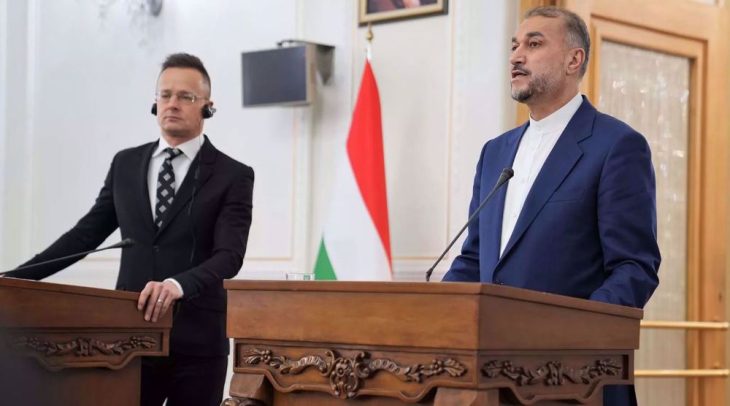
Iranian Foreign Minister Hossein Amir-Abdollahian speaks at a joint press conference with his Hungarian counterpart Peter Szijjarto in Tehran on February 22, 2024.
Press TV -February 23, 2024
Iranian Foreign Minister Hossein Amir-Abdollahian says the repetition of baseless claims against the Islamic Republic over the war in Ukraine has reached a “boring stage”.
Amir-Abdollahian made the remarks at a joint press conference with his Hungarian counterpart Peter Szijjarto in Tehran on Thursday.
Iran’s top diplomat noted that they discussed bilateral relations and the latest global developments, including the conflict in Ukraine, adding “I would like to once again strongly condemn the baseless accusations leveled against Iran regarding Russia’s use of Iranian weapons.”
“The repetition of baseless claims has reached a boring stage,” he said.
Amir-Abdollahian’s remarks came as US National Security Council spokesman John Kirby said on Thursday that Washington will be “imposing additional sanctions on Iran in the coming days” over its alleged efforts to supply Russia with drones and other technology for the war.
Both Iran and Russia have repeatedly denied claims that Tehran has provided Moscow with weapons to be used in the war in Ukraine.
The anti-Iran claims first emerged in July 2022, when US National Security Advisor Jake Sullivan alleged that Washington had received “information” indicating that the Islamic Republic was preparing to provide Russia with “up to several hundred drones, including weapons-capable UAVs on an expedited timeline” for use in the war.
Elsewhere in his remarks, Iran’s top diplomat noted that he and Szijjarto also discussed Israel’s genocidal war on the besieged Gaza Strip that began in October.
“We had frank discussions on the logic behind Iran’s support for the Palestinian people. I also asked Hungary to use all its capacity to stop the war and restore sustainable security to the region,” Amir-Abdollahian said.
He slammed the US and Britain’s attempts to extend the war to other parts of the world as “a mistake”, stressing that Yemenis are acting independently regarding pro-Palestine operations.
The US and the UK have been carrying out numerous attacks against Yemen as a means of trying to pressure the country into stopping a series of operations that it has been conducting in support of Palestinians in the Gaza Strip.
In solidarity with the Palestinians in Gaza, the Yemeni armed forces have targeted ships in the Red Sea with owners linked to Israel or those going to and from ports in the occupied territories.
Tehran-Budapest ties
The visit of Szijjarto, who also acts as the minister of trade, to Iran came as Tehran and Budapest held a joint economic commission earlier on Thursday.
“Relations between the two countries are developing,” Amir-Abdollahian said, adding that a protocol of the economic commission and a road map for cooperation in the field of agriculture were signed during the session of the commission.
Budapest concerned about war in West Asia
For his part, Szijjarto hailed the bilateral ties between the two countries as “strong”, expressing his country’s concern over the ongoing war in the West Asia region.
He warned that the escalation of the situation and the spillover of the war in Gaza into the region “could be a great threat to the global security.”
Israel launched the war on Gaza on October 7 after the Palestinian resistance movement Hamas waged the surprise Operation Al-Aqsa Storm against the occupying entity in response to the Israeli regime’s decades-long campaign of bloodletting and devastation against Palestinians.
Since the start of the offensive, the Tel Aviv regime has killed at least 29,514 Palestinians and injured more than 69,616 others.
Thousands more are also missing and presumed dead under the rubble in Gaza, which is under “complete siege” by Israel.
Biden and US media lies about Ukraine are reminiscent of Vietnam War – American Conservative
By Ahmed Adel | February 23, 2024
The American Conservative published an article that parallels the Vietnam War, considered the greatest military humiliation in US history, with what they point out is a campaign of deception carried out by the current US Government, which will lead to a defeat for Kiev and NATO.
According to the author James W. Carden, who served as an advisor on US-Russian affairs at the State Department during the Obama administration, the media campaign regarding Ukraine carried out by the White House was a copy of the actions of successive US governments in Vietnam until the Nixon administration withdrew troops and concluded the intervention in 1973. He relates the Vietnam War with the lies with which President Joe Biden and his collaborators have tried to deceive citizens about the progress of the Ukraine conflict and its origin, among other issues.
These false narratives, the article notes, have been put in place and presented to Americans with the help of the “most dutiful accomplices,” such as the New York Times and the Washington Post, media outlets that, until recent times, published the triumphalist comments of Biden and his administration without any type of questioning, in addition to analysis columns where Russian President Vladimir Putin was demonised and falsely stated that Ukraine was on its way to victory.
This falsification of reality, in which all the complexity of the conflict was eliminated, and the responsibility of the US and NATO in inciting it, was omitted. Instead, they presented the war as a simple confrontation between good and evil, which is similar to the deception that Washington and the establishment media consummated in the 1960s to justify the US invasion of Vietnam, the article states.
Now, notes The American Conservative, as it is “too obvious to ignore” that Russian troops are prevailing in Ukraine, the American media is finally realising what is really happening on the battlefield after having helped prolong the conflict with their lies.
“If we are being lied to about the progress of the war—and we are—what do you suppose are the odds we are also being lied to about the causes of the war?” the author questions.
For US politicians and journalists, the expansion of NATO, Ukraine’s post-Euromaidan nationalist agenda, the refusal to implement the Minsk Agreements, or threats by Ukrainian President Volodymyr Zelensky made in Munich in February 2022 to acquire nuclear weapons had nothing to do with the outbreak of war, the article ironically states.
“If we are being lied to about the causes of the war, are we also then being misled about what is at stake in eastern Ukraine? Probably. Here the parallel with the government’s mendacity during the war in Vietnam period becomes too obvious to ignore,” Carden continues.
“Recall in the first case that the template, that of the Cold War, is essentially unchanged, even in some of the particulars, not least in the comparisons of (the Vietnamese anti-communist leader) Ngo Dinh Diem and Volodymyr Zelensky to Winston Churchill. The South Vietnamese government (avaricious, corrupt) had the right to American arms by virtue of its right ‘to determine [the nation’s] future,’ the article says, recalling the argument used by the US to justify its war against North Vietnam, which was part of its global operation against what Washington perceived as an expansion of communism that could threaten its interests and hegemony.
The same thing is happening now with Ukraine: President Biden publicly justifies launching a proxy war with Russia with the excuse that it is necessary to stop Moscow, once again invoking the theory of the domino effect, the long-discredited thesis that drove the US interventionist policy during the second half of the 20th century.
Following the publication of the Pentagon Papers in 1971, the philosopher Hannah Arendt observed during the Vietnam War era that “the policy of lying was hardly ever aimed at the enemy… but was destined chiefly if not exclusively, for domestic consumption, for propaganda at home and especially for the purpose of deceiving Congress,” Carden warns.
He concludes his article by saying: “Two years on, we citizens have been serially lied to by the Biden administration and the media about the war’s causes, its stakes, and its progress. The question that should, but of course will not, be addressed in the aftermath of this latest American misadventure abroad is: Will we ever learn?”
Ahmed Adel is a Cairo-based geopolitics and political economy researcher.
Space Nukes & Washing Machines: Western Media Prints ‘Anything’ to Paint Russia as Threat
Sputnik – 23.02.2024
Last week, House Intelligence Committee Chair Rep. Mike Turner (R-OH) released a document with a cryptic warning that called on US President Joe Biden to declassify information on a “serious national security threat.” Within hours, the story spread like wildfire.
The recent media craze stemming from unfounded claims of a Russian nuclear space weapon exploded and stole headlines for days because “the media” will print anything it is told about Russia, Mark Sleboda, a foreign relations and security expert told Sputnik’s Fault Lines.
“Russia’s the gift that keeps on giving, propaganda-wise, because you can accuse Russia of anything, no matter what you said about them [before], about shovels, and microchips or washing machines. And, generally, people will believe it. Or at least the media will print it,” he said, referring to previous Western propaganda claims that Russian soldiers were fighting armed only with shovels and that their missiles used microchips from stolen Ukrainian washing machines.
“Then you accuse Russia of having space weapons, space nuclear weapons, or having plans to put nuclear weapons in space, or someone in Russia once thought technically about the contingency of putting weapons in space,” Sleboda scoffed.
As the story made the rounds on the media circuit, US National Security Council John Kirby told reporters that the threat US Rep. Mike Turner raised was related to “an anti-satellite weapon that Russia is developing.” Soon after that, US media outlets began reporting that the mysterious weapon was nuclear.
Russia vehemently denied the accusation, saying it is only developing the same space capabilities that the US has. “Firstly, there are no such projects – nuclear weapons in space. Secondly, the United States knows that this does not exist,” Russian Defense Minister Sergei Shoigu said during a televised discussion with Russian President Vladimir Putin.
Sleboda noted that for mainstream media, “the details aren’t important as much as the scaremongering factor.”
“It’s the same thing with this continual octogenarian fantasy about linking Trump and Russia… all the powers of the US investigative bodies were unable to prove any connection… but that doesn’t stop an enormous number of the American people from believing in it because they want to, and [US Rep.] Nancy Pelosi certainly knows that.”
The analyst further admitted that the latest anti-Russia rhetoric is part of a larger effort in preparation for the November presidential election in the US but that it also “does the double job of, you know, buttressing arguments for providing more US taxpayer dollars for weapons for the regime in Kiev.”
China backs Palestinians’ right to ‘armed struggle’ against Israeli occupation
The Cradle | February 22, 2024
China expressed support for the right of Palestinians to engage in “armed struggle” against Israel, stressing this is not “terrorism” during the fourth day of hearings at the International Court of Justice (ICJ) in a case against Israel’s illegal occupation of Palestinian territories.
“In pursuit of the right to self-determination [the Palestinian people have the right to the] use of force to resist foreign oppression and to complete the establishment of the Palestinian state,” Ma Xinmin, a Chinese Foreign Ministry legal adviser, told the World Court on 22 February.
Citing examples of “various people [who] freed themselves from colonial rule” through armed resistance, Xinmin argued that acts of resistance against the Israeli occupation are “not terrorism” but a legitimate armed struggle and an “inalienable right.”
“Numerous other resolutions recognize the legitimacy of struggle by all available means, including armed struggle by people under colonial domination or foreign occupation to realize the right of self-determination,” the Chinese official said.
“Chinese President Xi Jinping has stressed on multiple occasions that China calls for a comprehensive ceasefire and the early solution to the question of Palestine on the basis of a two-state solution through negotiation,” he added.
Xinmin took to the podium ahead of Iran’s Deputy Foreign Minister for Legal and International Affairs, Reza Najafi, who highlighted Israel’s historic violations of Palestinians’ right to self-determination.
“The establishment of the Israeli regime was done through a violent process which involved the forcible displacement of native Palestinian people to create a majority Jewish colony in line with the Zionist movement,” Najafi said.
He also listed a series of ongoing violations by Tel Aviv, which include the prolonged occupation and manipulation of the demographic composition in the occupied Palestinian territories, the alteration of the character and status of Jerusalem, and the discriminatory measures and violations of the rights of Palestinian people to permanent sovereignty over their natural resources.
“The expansion of settlements, segregated roads and barriers as well as checkpoints has created a system of apartheid which is isolating Palestinian communities,” Najafi added before addressing the UN Security Council (UNSC) for their “inaction or insufficient action,” saying this was one of the “main causes of prolonged occupation of the Palestinians” and highlighting that the top UN body is “paralyzed due to the stalemate” caused by a “certain permanent member.”
“All the atrocities and crimes committed by the Israeli regime in the past almost eight years are a consequence of such inaction,” the Iranian official concluded.
The Iraqi representative to the ICJ, Hayder Shiya al-Barrak, took to the podium next and called on the ICJ to respect previous court orders against Israel, such as the provisions made after South Africa’s case to “stop the systematic killing machine against the Palestinian people.”
“We hope that the court’s commitment to justice will lead to additional decisions … affirming its dedication to ending the campaign of mass murder and preventing acts of genocide as well as policies of harassment, blockade, and starvation against the Palestinian people,” he said.
Barrak concluded his intervention by calling on the World Court to take decisions “that safeguard the lives of the Palestinian man, women, children, and elders, allowing them to enjoy a dignified and secure life where all human rights are achieved.”
Fresh aggression: US, UK launch five strikes on Yemen’s Hudaydah
Press TV – February 22, 2024
The United States and Britain have conducted fresh aerial assaults on Yemen’s strategic western province of Hudaydah.
The al-Masirah television network reported three airstrikes on Ras Issa area in Hudaydah’s a-Salif district late on Wednesday.
Earlier in the day, it added, four similar air raids also targeted al-Jabana and al-Arj areas in Hudaydah.
Meanwhile, the US Central Command (CENTCOM) said in a statement that its forces had carried out four strikes on areas in Yemen, targeting “seven mobile anti-ship cruise missiles and one anti-ship ballistic missile launcher” in the act of aggression.
It claimed that the targets “presented an imminent threat to merchant vessels and to the US Navy ships in the region.”
CENTCOM also said that its forces had shot down a “one-way attack unmanned aircraft system.”
In recent months, the US and its allies have launched illegal attacks on Yemen amid their frustration in the face of an anti-Israel maritime campaign by the Yemeni armed forces.
Israel waged a US-backed genocidal war on the besieged Gaza Strip on October 7 following a historic operation by the Palestinian Hamas resistance group against the occupying regime.
In support of Gaza, Yemeni armed forces have targeted ships going to and from ports in the occupied territories, or whose owners are linked to Israel, in the southern Red Sea, the Bab el-Mandeb Strait, the Gulf of Aden, and even in the Arabian Sea.
The US-led attacks on Yemen prompted the country’s military to declare American and British vessels to be legitimate targets.
The Black Sea Straits: Turkey balances between the US and Russia
By Alexandr Svaranc – New Eastern Outlook – 22.02.2024
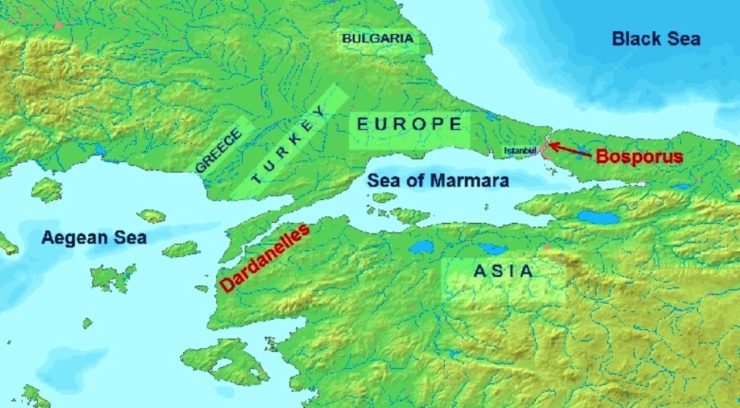
The territory of modern Turkey has economic-geographical and military-strategic advantages due to its control over the Black Sea Straits of Bosporus and Dardanelles. Control of the Black Sea Straits has always been strategically important to the great powers in world geopolitics and trade.
Great Britain and Russia often clashed over the right to control the Straits. In August 1914, German ships, including the cruiser Goeben and light cruiser Breslau, attacked Russian ports after passing through the Black Sea Straits. This led to the Ottoman Empire joining World War I on the side of Germany against Russia. One of the tasks of the Nazi German Ambassador to Ankara, Franz von Papen, in the late 1930s was to obtain Turkish consent for the passage of German ships through the Straits to the Black Sea to participate in the war against the USSR. Stalin later described Turkey’s policy during World War II as “hostile neutrality.”
In the 19th century, Russia’s successful wars against the Ottoman Empire enabled Russian control over the Black Sea Straits. However, Emperor Nicholas I of Russia, for some reason, decided to let in Britain and France in resolving the fate of the regime of shipping in the Black Sea Straits, while this issue could have become a subject of relations between solely Russia and Ottoman Turkey.
As a result, on July 3, 1841, the Straits Convention was signed in London, with the consent of the Russian Tsar, between Turkey, on the one hand, and Russia, Great Britain, Austria, Prussia, and France, on the other. It stipulated that as long as Turkey was not at war, the Straits would be closed to military ships of any nation. During the war, Turkey was granted the right to let ships through the Straits belonging to states with which it wished to reach an agreement. The London Straits Convention in fact buried the decisions of the Russian-Turkish Treaty of Hünkâr İskelesi of 1833, according to the secret articles of which Turkey undertook not to allow warships of any European countries to enter the Black Sea. Russia’s political and military positions have been significantly strengthened by the latter.
Following the results of the First World War, the Versailles Conference of the victorious countries again returned to the topic of the Black Sea straits, which continued with long negotiations, sharp discussions and ended with the signing of the Treaty of Lausanne on July 24, 1923, based on a project of Great Britain. The representatives of the Soviet delegation were actually blocked, and the head of the Russian delegation, Vatslav Vorovsky, was not even officially informed about the resumption of the conference and was not allowed to take part in the negotiations (on May 10, 1923, Vorovsky was assassinated in Lausanne by Russian White émigré named Maurice Conradi).
The Lausanne Treaty was signed between Great Britain, France, Italy, Japan, Greece, Romania, Bulgaria, the Kingdom of Serbs, Croats and Slovenes and Turkey. The USSR did not ratify the convention because its terms violated legal rights and did not guarantee the security of Black Sea countries. In particular, this convention provided for the demilitarization of the Straits Zone, with the Straits themselves coming under the control of a special international commission. In other words, the right to station military units near the straits was taken away from Turkey, through whose territory the straits passed. Simultaneously, all commercial and military vessels from any country in the world were granted free passage through the Bosporus and Dardanelles, with only minor restrictions. The latter created problems for the Black Sea countries, especially for the main Black Sea powers – Turkey and Russia.
The events of 1936 in Spain, the growth of Fascist militarism in Italy and Germany reopened the issue of the Black Sea Straits. Britain was concerned about losing control over Turkey, its naval bases, and its broad interests in the Mediterranean and the Arab East, including the restoration of the German-Turkish alliance. Therefore, London considered it appropriate to make concessions to Ankara on the issue of changing the regime of the Black Sea Straits and replacing the International Special Commission with Turkish control, including the abolition of Turkey’s demilitarization in the Straits Zone.
Consequently, following months of discussions, a new convention on the Black Sea Straits regime was signed on July 20, 1936, in the Swiss city of Montreux. This convention is seen as a compromise in international practice. In times of peace and war, merchant ships of all nations were granted the right of free passage through the Straits. Warships of non-Black Sea states are restricted in transit through the Bosporus and Dardanelles by class, total tonnage, total number and period of stay in the Black Sea not exceeding three weeks. In the case of Turkey’s taking part in a war, and if Turkey considers itself directly threatened by war, it is given the right to authorize or prohibit the passage of military ships through the Straits. Accordingly, the demilitarization regime was abolished, and Turkey was granted the right to station its military garrisons in the Straits Zone. The USSR’s demands for limitations on the military presence of non-littoral states in the Black Sea were mostly taken into account. London and Paris obtained the right to adjust the ratio of naval forces between Turkey and the USSR in the Black Sea.
Overall, the Montreux Convention can be viewed as a compromise that helped stabilize the situation in the Straits Zone. The Convention has been extended twice for 20 years. It remains in force as of now. The issue of the Black Sea Straits is currently being discussed in international diplomacy. This is especially true in times of crisis, when relations between major Black Sea countries, such as Russia and Turkey, become contentious.
With the start of the Russian Special Military Operations in Ukraine, hostilities have been resumed in the Black Sea basin waters. The Collective West, led by the United States, is attempting to alter the international legal norms that regulate the passage of warships through the Bosporus and Dardanelles.
According to US Assistant Secretary of Defense for International Security Affairs Celeste Wallander, Washington plans to collaborate with Ankara regarding shipping in the Black Sea. The Pentagon spokesperson emphasized the need to create a favorable environment in the region, ensuring that the Black Sea is fully accessible for commercial shipping.
Meanwhile, the United States is attempting to use merchant shipping as a cover to alter the regulations for the passage of non-Black Sea NATO warships through the Dardanelles and Bosporus to the Black Sea. For this purpose, the Black Sea Grain Initiative became a convenient opportunity.
The United States and the United Kingdom assert that Russia’s decision to withdraw from the agreement violates international humanitarian law. They propose the formation of an operational group under the convoy of NATO air and naval forces to transport Ukrainian grain through the Straits to foreign markets.
Retired US Navy Admiral James Stavridis announced in July 2023 that a convoy would be created under the control of the United States or NATO. A year earlier, The Wall Street Journal reported that Joe Biden Administration was considering new rules for the passage and navigation of warships in the Black Sea. The North Atlantic Alliance plans to deploy more military aircraft and ships to the Black Sea, according to NATO Secretary General Jens Stoltenberg.
In November 2023, US Congressmen Mike Rogers and Mike Turner urged President Joe Biden to deploy US military forces in the Black Sea to provide military support to Ukraine. Meanwhile, Commander Brian Harrington of the US Navy stated that conducting military exercises outside the scope of the Montreux Convention would undermine Russia’s dominance in the Black Sea. Perhaps these appeals and statements are intended more for the Turkish president.
The British and Norwegians have initiated a program to enhance Ukraine’s capabilities in the Black Sea. However, Turkey refused to allow two Sandown-class minehunters which were conditionally transferred by Great Britain to the Ukrainian Navy in June 2021, to pass through the Bosporus. According to Article 19 of the Montreux Convention, Turkey considers the ships of Russia and Ukraine as belonging to belligerent powers and therefore, they are not permitted to pass through the Black Sea Straits. London officials attempted to pressure Ankara, but were unsuccessful.
As for the warships of the US and other extra-regional countries that used to regularly enter the Black Sea using the right of peaceful passage, Turkey has announced within NATO that it will not allow naval exercises or visits for other purposes as long as the conflict continues. Ankara argues that violating the provisions of the Montreux Convention in the current situation will inevitably trigger retaliatory actions by the Russian Navy, leading to a new military escalation. Despite the dissatisfaction of NATO allies with Turkey’s position, Ankara does not intend to change it, showing the firmness and stubbornness typical of Turks.
The Montreux Convention does not allow the unimpeded passage of warships of non-littoral states in the Black Sea. However, after the collapse of the USSR and the Warsaw Pact, NATO gained an advantage in the Black Sea. In other words, prior to 1991, all Black Sea countries except for NATO’s Turkey were members of the Warsaw Pact and allies. Right now, the situation in the Black Sea is reversed. Namely, Russia on the one hand and NATO members Turkey, Bulgaria, Romania and the North Atlantic Alliance candidates Georgia and Ukraine on the other.
The US is not a signatory to the Montreux Convention at all and can therefore afford to violate its terms. Every five years since the signing of this convention in 1936, changes to its provisions may be proposed, provided that the initiative is supported by a two-thirds vote of the Montreux signatories. However, currently, all signatory countries except Russia are NATO members, and Japan and Australia are strategic partners or allies of the United States.
In this situation, Turkey’s opinion remains key as it still holds the role of “host of the Straits” under the Montreux Convention and maintains an independent policy. A change in the provisions of the convention would be a change in Turkey’s own status quo in the region. This is obviously not what Ankara wants. Crimea is now under Russian control, which could pose a threat to the same straits.
Russian Foreign Minister Sergey Lavrov stated that the Turkish authorities will not change the rules of entrance in the Black Sea for NATO warships under Pentagon’s pressure. However, Russia cannot rely on Turkey’s guarantees forever, as Ankara has shown a willingness to make sudden political reversals.
The US and Turkey are discussing the issue of closing the Bosporus to Russian warships, according to Iranian journalist Hayal Muadzin. In particular, there is information circulating that the US has offered to cede some areas in northern Syria, apparently Kurdish-populated provinces, to Turkey as a gift to Recep Tayyip Erdoğan, in exchange for active cooperation against Russia in the Black Sea.
In January, Turkey ratified Sweden’s NATO status in exchange for the delivery of 40 modernized F-16 fighter jets from the US. Washington is prepared to address the matter of F-16 Block 70 fighter jets for Turkey. Additionally, Deputy Secretary of State Victoria Nuland stated in Ankara that the US is willing to involve Turkey in the production program of fifth-generation F-35 fighter jets and provide them with a Patriot air defense system. This offer is contingent upon Turkey’s refusal to use the Russian S-400 Triumf SAM system. The Americans may be willing to provide soft loans to support the struggling Turkish economy, but only if Turkey refrains from actively cooperating with Russia in trade and economic matters and strictly adheres to the sanctions regime.
It is evident that Turkey faces numerous temptations. However, Recep Tayyip Erdoğan is aware that excessive improvisation towards Russia could jeopardize Turkey’s Great Turan project and its access to Azerbaijan and Turkic countries in Central Asia through the Zangezur corridor. For the time being, therefore, Ankara is trying to keep the “Russian side” of the fence. Turkey refuses to revise the provisions of the Montreux Convention in exchange for the “Swedish case.”
Turkish Foreign Minister Hakan Fidan confirmed that Ankara will continue to use the Montreux convention and stated that it is not up for debate. With the outbreak of the crisis in Ukraine, Turkey exercised its powers under the Montreux Convention and prohibited the passage of warships through the Black Sea Straits. The Turkish Defense Ministry aims to prevent further escalation of military tensions in the Black Sea basin, especially in the Straits area. The Straits pose not only an economic issue for Turkey, but also a security concern. Ankara has the right to charge for the passage of ships through the Bosporus and Dardanelles, which covers expenses for lighthouses, evacuation, and medical care.
In the rapidly evolving situation of the Ukrainian conflict, it is crucial for the Turks to maintain their key positions. There is a domestic political consensus on this issue: the provisions of the Straits Convention must remain unchanged. Turkey’s accession to Western sanctions against Russia is inadmissible; otherwise, Turkey will lose the opportunity to play a mediating role.
Featured Video
Anthrax War – CBC The Passionate Eye
or go to
Aletho News Archives – Video-Images
Book Review
Shattered Dreams: The HPV Vaccine Exposed (2019)
By Christina England – 30 Q&As – Book Review & Summary
Lies are Unbekoming | September 4, 2026
… Gardasil received FDA fast-track approval in 2006, Cervarix followed in 2009, and Gardasil 9 was approved in December 2014 with more than double the aluminium adjuvant content of the original. The commercial context is specific. Merck was about to lose patent protection on Zocor and faced $18 billion in Vioxx injury claims from a cardiovascular drug the company had marketed while suppressing its own data showing a five-times increase in heart attacks. Analysts projected the global HPV vaccine market at $4 billion by 2011, contingent on government-funded national programs for teenage girls. The 1986 National Childhood Vaccine Injury Act had already granted manufacturers complete liability immunity. By 2013, Japan had withdrawn its HPV vaccine recommendation after cataloguing severe adverse reactions in hundreds of girls. No Western government followed. The establishment position across the UK, US, Australia, and most of Europe held, and still holds, that the vaccines are safe and effective, that reported injuries are coincidental, and that cervical cancer prevention justifies the program. The book was published into this position, not against a vacuum.
Shattered Dreams sits alongside Mary Holland’s The HPV Vaccine On Trial and Viera Scheibner’s foundational vaccination work as part of the documented record on what has been done to a generation of teenage girls under the banner of cancer prevention. The full summary unpacks three specific findings: that Merck used the aluminium adjuvant itself as the “placebo” control in 92.5% of trial subjects, making it structurally impossible to detect excess reactions from the adjuvant; that Dr. Sin Hang Lee found HPV DNA fragments bound to aluminium in every one of sixteen Gardasil samples tested, and in the blood and spleen of a New Zealand girl six months after her third dose; and that in every country with high vaccination coverage, including Australia, the UK, Norway, and Sweden, cervical cancer rates have stopped declining and started rising specifically in the vaccinated cohort. Martínez-Lavín’s 2017 calculation puts the number needed to seriously harm with Gardasil 9 at 140, and the number needed to vaccinate to prevent one case at 1,757. Thirteen young women are seriously harmed for every one who benefits. The vaccine was approved on the basis of trials that could not detect what the trials were supposed to detect, and it is still being given to twelve-year-olds today. … Read full review
Blog Roll
 Aletho News
- Georgia’s Largest Healthcare System Will Fire Employees Who Refuse Flu Vaccine
- The Five-Year Fuel Crisis: Why the World Economy Is Paying for a War It Thinks Is Ending
- Trump’s Big Bluff on Iran
- Swiss scammed out of millions by Ukraine-linked call centers – media
- Germany facing potential ‘violent conflict’ with Russia – spy chief
- Ukraine’s EU neighbors reject new plea from Kiev – Politico
- British Transport Police Facial Recognition Trial Scanned 926,912 People With Zero Arrests
- House Bill Would Ban Federal Use of Flock ALPR Data
- Can a Spice Rival a Drug? 10 Head-to-Head Trials Put It to the Test.
- The oil routes around Hormuz face their own chokepoints
- If Americans Knew
- “We See Our Homes Now From A Satellite, Like Strangers”
- Watch “Gaza: Doctors Under Attack”, originally censored by BBC
- NAZA: Israeli embassies in UK and US promote rival documentary to challenge Gaza genocide allegations
- David Ellison appoints Israeli to lead merged Paramount-Warner studios
- Turkish Red Crescent helps elderly Gaza man walk again after Israel confiscates his prosthetic limb
- Four Palestinians Killed in Israeli Attacks in Gaza
- Two Palestinian youths killed and village razed as Israeli attacks on West Bank continue
- Two more Christian women victims of Israeli raids on Gaza
- Cruelty, Deprivation, Indignity: A Journalist’s 22 Months in Israeli Prison
- New IDF Website Frames Slain Gaza Journalists as Terrorists
- No Tricks Zone
- Latest European Green Energy Debacle; Portugal’s Largest Flagship Solar Park Insolvent!
- Green Energy Debacle: German Expert Professor Fritz Vahrenholt Warns Of Severe Economic And Social Consequences
- Two More Paleo Reconstructions Affirm Meters-Higher Sea Levels Across Ireland, Brazil 7000-6000 Years Ago
- New Study: Earth And Venus Surface Warmth Largely Explained By Convection And Lapse Rate, Not CO2 Or Radiation
- 2025 Nature Paper Claiming Worsening Global Drought Gets RETRACTED …Heavily Flawed
- New Study: ‘Global Drought Shows No Detectable Recent Acceleration Under Climate Warming’
- Economic Masterminds: German Socialists Suggest Taxing Productivity Gains Stemming From Using AI
- The South China Sea Has Not Been Cooperating With The Climate Change Narrative
- Energy Crisis: Germany Enters Heating Season With Historically Low Gas Reserve Fill Levels
- New Study: The Antarctic Ice Sheet Gained Mass From 2020-2024 Due To Staggering Snow And Ice Accumulation

