Russia thwarts Ukrainian attack on border area
RT | January 3, 2024
Russia’s Belgorod Region, which borders Ukraine, has come under fresh attack after Kiev’s forces launched a barrage of a dozen missiles, the Russian Defense Ministry has announced, adding that its air defenses had shot down all incoming projectiles.
The ministry wrote on its Telegram channel on Wednesday that “another attempt to carry out a terrorist attack by the Kiev regime on facilities on the territory of the Russian Federation, using multiple launch rocket system ‘Olkha’ missiles and ‘Tochka-U’ tactical ballistic missiles, was thwarted this morning.”
According to the statement, the shelling involved six rockets of each type.
Local residents reported seeing explosions in the skies early on Wednesday morning.
The Ukrainian military also shelled the region on Tuesday evening, using the same type of rockets, the defense ministry said, adding that all incoming missiles had been intercepted.
Earlier in the day, Kiev’s forces launched 17 ‘Olkha’ missiles toward Belgorod Region in three separate attacks. Governor Vyacheslav Gladkov wrote on his Telegram channel that one civilian had died and two were injured as a result of falling debris as the missiles were shot down.
The Russian Defense Ministry estimated that its air defenses brought down a total of 32 Ukrainian drones over Bryansk, Oryol, Kursk and Moscow regions on Monday night and Tuesday morning.
On Saturday, the city of Belgorod came under attack, with a massive Ukrainian barrage killing 25 people and wounding more than 100 others.
Kiev described the strike as retaliation for a previous Russian attack on major Ukrainian cities, including Kiev.
According to an anonymous Russian security source, Saturday’s shelling was personally ordered by Ukrainian President Vladimir Zelensky. Moscow has also claimed that the UK and the US also bear responsibility for the death of Russian civilians in Belgorod.
Ukraine and Russia have since engaged in daily tit-for-tat bombardments.
The Russian Defense Ministry reported on Tuesday that its missile strikes had obliterated a number of military industry facilities, repair shops, and ammunition warehouses in the neighboring country. Ukrainian authorities claimed that most of the projectiles ended up hitting civilian infrastructure and apartment blocks, killing multiple civilians.
The enabler of our two concurrent world wars: Washington
By Gilbert Doctorow | January 2, 2024
It is only the second day of the New Year, but you turn on the morning news with a feeling of trepidation. Here in Western Europe, the lead stories are death and destruction reported from the front lines of the two conflagrations that some commentators have identified as ‘world wars,’ given the way countries across the globe have aligned themselves with or against the protagonists in each conflict. The outstanding commonality between these two world wars is the position of the United States as their enabler in terms of delivery of essential military and financial support to one side, as well as real-time military intelligence, tactical and strategic counseling by high level officers positioned on the ground and in nearby seas. From the perspective of Washington, these are proxy wars which put at risk very few of its own men at arms, though some do come home in body bags without word to the press, while preparations proceed apace for the launch of a third proxy war in the South China Sea. The Philippines are the latest recruits to the prospective encirclement and assault on China.
On their talk shows, the Russians speculate on when a mutual defense pact with Iran, China and North Korea will be announced. This will not be a bloc, like NATO, but will enshrine the key principle of ‘one for all and all for one’ in case of attack by outside forces. To its backers in Moscow, this formulation would ensure that NATO generals understand they are up against an enemy of over two billion if we include a few other fellow travelers, not just the 145 million Russians whom they see across the border.
But that is what they say on talk shows. It is not the official voice of the Kremlin, which we find on Vesti television. Vesti maintains a near blackout of news on the Israel-Hamas war in broadcasts to its home audience. Why? Because Russia does not want to get embroiled in that war when it needs all its human and materiel resources to defeat the Ukrainians and their NATO backers. Moreover, Russia can be satisfied that the Iranians and their Houthi proxies have the situation in the Middle East under control, restraining the United States from region-wide escalation by engaging directly on Israeli’s side.
For that matter, Iran is doing just fine in shoring up Russia’s southern borders in the Caucasus. For more than a year, Armenia’s prime minister Nikol Pashinyan has been sitting on two stools: holding consultations with the French and intermittently attending gatherings of the Former Soviet Union republics called by Moscow. A week ago, Iranian leaders issued a direct warning to Armenia not to even think about pursuing the military and political rapprochement that France’s president Macron has been proposing. Said President Raisi: ‘No powers from outside the region are welcome in the Caucasus.’ This warning serves Russian security very well, though it is surely motivated by self-interest in Teheran, because any future French military presence in Armenia could also threaten them.
In Russian news, all attention is on the one conflict in which the Russians are themselves deeply engaged, and there news from the line of contact, news from the home front which a day ago experienced a murderous attack on the border town of Belgorod that killed 25 civilians and gravely injured another fifty or so, news from the United Nations Security Council deliberations of the same, more than fill the time allotted to 14.00 o’clock and 20.00 o’clock wrap-ups.
Anyone following developments of the Ukrainian war these past few days will note the tit for tat nature of the strikes dealt out by the warring parties day after day. The chain of events began early on the morning of Wednesday, 26 December, when the Ukrainians deployed air-launched Storm Shadow cruise missiles to destroy the Novocherkassk, a large landing ship of Russia’s Black Sea Fleet parked in the harbor of Feodosia, on the eastern shores of the Crimea. The ship was said to be loaded with drones and the missile strike set off a fire and explosions that may have killed as many as 74, both on the ship and in the port.
However, the outstanding feature of the attack was not the numbers of the dead or the loss of the ship itself: it was the demonstration that Kiev had now been given a Storm Shadow variant with much greater flight range than the initial shipments from the U.K. and France.
From the perspective of the Russian high command, this new ability of the Ukrainians to strike far deeper into Russian territory represented a serious escalation of the conflict which required mirror-image escalation from Russia. The Russian response was not long in coming: on the 27th, Russia launched the largest missile attack on Ukraine since the start of the Special Military Operation, more than 150 ballistic missiles, cruise missiles and armed drones, directed at cities across the Ukraine, including Kiev. Some of these were shot down by Ukrainian air defense, but the Zelensky regime admitted that all 20 Russian ballistic missiles evaded their fire and hit their targets.
From the partial information released by the Russian military, it would appear that their main interest was to destroy caches of the Storm Shadow and also the most advanced Western ground to air missiles. They claim to have destroyed a Patriot complex in the Lvov region, killing a substantial number of French military who were in charge of the installation. This is the sort of information which flits by in a second and is not repeated, so I can say no more.
The Ukrainian response the next day was a concentrated attack on the Russian border city of Belgorod, capital of an oblast of the same name. Belgorod is not more than 20 km from Ukraine’s second largest city, Kharkiv, and it first made international news about six months ago when a Ukrainian team of saboteurs claiming to be anti-Putin Russians crossed into the oblast and attacked residential neighborhoods. This time missiles were sent into apartment blocks and other civilian structures, killing some 25 Russians and gravely wounding perhaps 50 more, some of whom were evacuated to Moscow by plane on life support.
Yesterday and today the Russians avenged this serious loss by renewed missile attacks, now concentrated on Kharkiv, whence the attack on Belgorod had come. They demolished the headquarters of military intelligence in the city, claiming to have killed many foreign advisers, probably British and Americans, who were guiding the attacks. They also struck air fields across Ukraine which could be used to service planes carrying the Storm Shadow.
I end this overview with the remark that American-British escalation of the weaponry deployed against Russia was at the start of what we have witnessed these past six days. And that can be no accident. It follows from the news of the war in the immediately preceding period, which unequivocally demonstrated that on the ground, along the line of contact, the Russian forces were moving steadily to overrun Ukrainian positions and force a retreat. The storming of Mariinka was emblematic in this sense. The overall impression was depressing for the Ukrainian cause at the very time that Congress was in recess after rejecting efforts by the Administration to pass legislation ensuring continued financial and military aid to Kiev. Now these Ukrainian missile attacks on the Black Sea fleet in the Feodosia harbor and the attack on civilians in what is properly speaking Russian Federation territory of Belgorod oblast would give luster to the Ukrainian cause while prodding the Russians to escalate and perform what Washington would showcase as war crimes.
Escalation is the game Washington is playing. In Ukraine. In the Red Sea. In the Eastern Mediterranean off the coast of Lebanon. Washington seems oblivious to the possibility that the proxy wars it is fanning may yet invite a Russian, or Iranian, or North Korean strike directly on U.S. assets, whether overseas or on the Continental United States.
Ukraine to decide how to use US missiles – ambassador
RT | January 2, 2024
The decision on how to use the American-supplied missiles for HIMARS launchers will be up to the Ukrainian military command, US Ambassador to Kiev Bridget Brink said on Tuesday, according to the Ukrainian outlet Strana.
The US has sent Ukraine around 30 high-mobility artillery rocket systems since mid-2022. The projectiles Washington officially supplied to Kiev have a range of up to 160 kilometers (100 miles). Ukraine has repeatedly demanded longer-range missiles.
The Ukrainian Armed Forces command will “independently decide on the range of strikes delivered” using the HIMARS projectiles the US plans to deliver “in the near future,” Strana reported Brink as saying on Tuesday afternoon.
Brink made the identical announcement in June 2022. It was reiterated by the Pentagon in February 2023, when the US announced it would send Ukraine Ground Launched Small Diameter Bombs (GLSDB) munitions.
According to a Washington Post article at the time, Ukraine carries out HIMARS launches using “specific coordinates provided by US military personnel,” but chooses the targets itself. The US provides coordinates and targeting information “solely in an advisory role,” an anonymous American official insisted.
Russia has said that this is a distinction without a difference, and repeatedly warned that US and British officials involved in Ukrainian attacks on civilians will be brought to justice.
In October, Kiev boasted about using longer-ranged ATACMS missiles “secretly” supplied by the US. As it turned out, the White House sent over a small number of the rockets armed with the controversial cluster munitions.
On Saturday, Ukrainian long-range rocket artillery struck the main town square of Belgorod city with cluster bombs, killing 25 civilians – including children – and injuring 100 more. Czech-supplied weapons were reportedly used in the attack. Russia has retaliated by targeting Ukrainian command posts, weapons warehouses and military factories in a wave of missile and drone strikes.
Ukraine and Palestine: A double threat to US hegemony
The outcome of US-led conflicts in Ukraine and West Asia will have a profound impact on the developing world order
By MK Bhadrakumar | The Cradle | January 2, 2024
Geopolitical analysts broadly agree that the war in Ukraine and the West Asian crisis will dictate the trajectory of world politics in 2024. But a reductionist thesis appears alongside that views the Israel-Palestine conflict narrowly in terms of what it entails for the resilience of the US proxy war in Ukraine – the assumption being that the locus of world politics lies in Eurasia.
The reality is more complex. Each of these two conflicts has a raison d’être and dynamics of its own, while at the same time also being intertwined.
Washington’s neck-deep involvement in the current phase of the West Asian crisis can turn into a quagmire, since it is also tangled up with domestic politics in a way that the Ukraine war never has been. But then, the outcome of the Ukraine war is already a foregone conclusion, and the US and its allies have realized that Russia cannot be defeated militarily; the endgame narrows down to an agreement to end the conflict on Russia’s terms.
To be sure, the outcome of the Ukraine war and the denouement of the Israel-Palestine conflict, which is at the root of the West Asian crisis, will have a profound impact on the new world order, and the two processes reinforce each other.
Russia realizes this fully. President Vladimir Putin’s stunning ‘year-enders’ in the run-up to the New Year speak for themselves: daylong visits to Abu Dhabi and Riyadh (watched by a shell-shocked US President Joe Biden), followed by talks with Iran’s president and rounded off with a telephone conversation with the Egyptian president.
In the space of 48 hours or so, Putin touched base with his Emirati, Saudi, Iranian, and Egyptian colleagues who officially entered the portals of the BRICS on 1 January.
The evolving US intervention in the West Asian crisis can be understood from a geopolitical perspective only by factoring in Biden’s visceral hostility toward Russia. BRICS is in Washington’s crosshairs. The US understands perfectly well that the extra large presence of West Asian and Arab nations in BRICS — four out of ten member states — is central to Putin’s grand project to re-structure the world order and bury US exceptionalism and hegemony.
Saudi Arabia, the UAE, and Iran are major oil producing countries. Russia has been rather explicit that during its 2024 chairmanship of BRICS, it will push for the creation of a currency to challenge the petrodollar. Without doubt, the BRICS currency will be at the center stage of the grouping’s summit due to be hosted by Putin in Kazan, Russia in October.
In a special address on 1 January, marking the start of Russia’s BRICS Chairmanship, Putin stated his commitment to “enhancing the role of BRICS in the international monetary system, expanding both interbank cooperation and the use of national currencies in mutual trade.”
If a BRICS currency is used instead of the dollar, there could be significant impact on several financial sectors of the US economy, such as energy and commodity markets, international trade and investment, capital markets, technology and fintech, consumer goods and retail, travel and tourism, and so on.
The banking sector could take the first hit that might eventually spill over to the markets. And if Washington fails to fund its mammoth deficit, prices of all commodities could skyrocket or even reach hyperinflation triggering a crash of the US economy.
Meanwhile, the eruption of the Israel-Palestine conflict has given the US an alibi — ‘Israel’s self-defense’ — to claw its way back on the greasy pole of West Asian politics. Washington has multiple concerns, but at its core are the twin objectives of resuscitating the Abraham Accords (anchored on Saudi-Israeli proximity) and the concurrent sabotage of the Beijing-mediated Saudi-Iranian rapprochement.
The Biden administration was counting on the fact that an Israeli-Saudi deal would provide legitimacy to Tel Aviv and proclaim to the Islamic world that there was no religious justification for hostility towards Israel. But Washington senses that post-7 October it would not be able to secure a Saudi-Israel deal during this Biden term, and all that could be coaxed out of Riyadh is a door left ajar for future discussion on the topic. No doubt, it is a major blow to the US strategy to liquidate the Palestinian question.
In a medium term perspective, if the Russian-Saudi mechanism known as OPEC+ liberates the world oil market from US control, BRICS drives a dagger into the heart of US hegemony which is anchored on the dollar being the ‘world currency.’
Saudi Arabia recently signed a currency swap deal worth $7 billion with China in an attempt to shift more of their trade away from the dollar. The People’s Bank of China said in a statement that the swap arrangement will “help strengthen financial cooperation” and “facilitate more convenient trade and investment” between the countries.
Going forward, sensitive Saudi-Chinese transactions in strategic areas such as defense, nuclear technology, among others, will henceforth take place below the US radar. From a Chinese perspective, if its strategic trade is sufficiently insulated from any US-led program of anti-China sanctions, Beijing can position itself confidently to confront US power in the Indo-Pacific. This is a telling example of how the US strategy for the Indo-Pacific will lose traction as a result of its waning influence in West Asia.
The conventional wisdom is that preoccupation in volatile West Asia distracts Washington from paying attention to the Indo-Pacific and China. In reality, though, the waning influence in West Asia is complicating the capacity of the US to counter China both in the region as well as in the Indo-Pacific. The developments are moving in a direction where the credentials of the US as a great power are at an inflection point in West Asia – and that realization has leaked into other geographic regions around the world.
Way back in 2007, the distinguished political scientists John Mearsheimer of the University of Chicago and Stephen Walt of the John F. Kennedy School of Government at Harvard, wrote with great prescience in their famous 34,000-word essay entitled The Israel Lobby and US Foreign Policy that Israel has become a ‘strategic liability’ for the United States, but retains its strong support because of a wealthy, well-organized, and bewitching lobby that has a ‘stranglehold’ on Congress and US elites.
The authors warned that Israel and its lobby bear outsized their responsibility for persuading the Bush Administration to invade Iraq and, perhaps one day soon, to attack the nuclear facilities of Iran.
Interestingly, on New Year’s Eve, in a special report based on extensive briefing by top US officials, the New York Times highlighted that “No other episode [as the war in Gaza] in the past half-century has tested the ties between the United States and Israel in such an intense and consequential way.”
Clearly, even as Israel’s barbaric actions in Gaza and its colonial project in the occupied West Bank are exposed and laid bare, and the Israeli state’s campaign to force Palestinian population migration are in full view, two of the US strategic objectives in the region are unravelling: first, the restoration of Israel’s military superiority in the balance of forces regionally and vis-a-vis the Axis of Resistance, in particular; and second, the resuscitation of the Abraham Accords where the crown jewels would have been a Saudi-Israeli treaty.
Viewed from another angle, the directions in which West Asia’s crisis unfolds are being keenly watched by the world community, especially those in the Asia-Pacific region. Most notable here is that Russia and China have given the US a free hand to navigate its military moves – unchallenged, so far, in the Red Sea. This means that any conflagration in the region will be synonymous with a catastrophic breakdown of US strategy.
Soon after the US defeat in Afghanistan in Central Asia, and coinciding with an ignominious ending of the US-led proxy war by NATO against Russia in Eurasia, a violent, grotesque setback in West Asia will send a resounding message across all of Asia that the US-led bandwagon has run out of steam. Among the end users of this startling message, the countries of ASEAN stand at the forefront. The bottom line is that the overlapping tumultuous events in Eurasia and West Asia are poised to coalesce into a climactic moment for world politics.
US Pressured Dutch Chipmaker ASML to Halt Sales to China
By Chimauchem Nwosu – Sputnik – 02.01.2024
A Netherland-based multinational microchip maker ASML Holding NV has halted scheduled shipments of production equipment to China at the behest of the United States.
That came days before the implementation of export controls on advanced ultraviolet lithography machines, sources familiar with the matter revealed to the press.
ASML is the sole producer of deep ultraviolet (DUV) lithography machines vital for the semiconductor industry, which is booming in China — much to the chagrin of politicians in Washington.
Under Biden’s government the US is stepping up attempts to hold back Beijing’s rapid development in the advanced semiconductor sector, with its allies also constraining chip tech exports.
Last year, Huawei Technologies debuted the Mate 60 Pro smartphone, featuring the indigenously-produced Kirin 9000S chip. The development was seen by the US as a challenge to Apple’s iPhone 15, which is powered by next-generation chips produced using ASML’s immersion lithography and was launched in 2023.
ASML confirmed that the Dutch authorities had restricted the export of specific lithography systems to China. Addressing media reports, the Dutch chipmaker mentioned ongoing talks with the US regarding export restrictions, offering no more details.
As the news broke, the stock values of Chinese chipmakers saw dips in their stock values. Semiconductor Manufacturing International (SMIC), a key supplier of Huawei’s 7-nanometer processors, saw its stock fall by three percent in Hong Kong on Tuesday. Hua Hong Semiconductor suffered a similar slump, dropping by 2.8 percent.
ASML, Europe’s most valuable technology firm, remained relatively stable at €679.80 at 9:32 a.m. in Amsterdam trading after falling by as much as 1.8 percent earlier.
US National Security Adviser Jake Sullivan contacted the Dutch government late last year about the ASML’s supply of the immersion deep ultraviolet lithography machines to China. Dutch officials told the White House to speak directly to the European chip giant.
Deliveries of some Chinese orders of the machines, each priced in the tens of millions of dollars, were reportedly canceled although the precise number remains undisclosed.
A representative from the Chinese Foreign Ministry denounced the US for meddling in China’s affairs, labeling it as a demonstration of American “hegemony” imposing artificial restrictions on other nations.
The official also called upon the Dutch authorities to “respect the spirit of the contract and world order, to safeguard the mutual benefits of the two countries.”
Under former president Donald Trump in 2019 the US pressured the Dutch government to block ASML, the sole producer of deep ultraviolet lithography machines vital for semiconductor production, from selling to China.
The Biden administration followed suit by pressuring the Netherlands to tighten export controls on ASML’s second-tier DUV machines to China from January 1 this year. In response, Beijing increased its imports of the restricted machines.
Chinese customs figues show imports of lithography machines into the country surged fivefold to $3.7 billion from July to November 2023.
In Q3 2023, China accounted for nearly half of ASML’s sales, representing 46 percent, which marked a significant increase from 24 percent in Q2 and just 8 percent in Q1 ending in March. This surge came as regional companies hastened their machine imports in anticipation of forthcoming export controls.
In October, ASML’s departing CEO, Peter Wennink, alerted shareholders that the imposed constraints might affect around 15 percent of their sales in China. He has voiced opposition, fearing these actions might prompt China to forge its own technological solutions.
“The more you put them under pressure, the more likely it is that they will double up their efforts,” Wennink told a news outlet.
Houthi group says 10 fighters killed by US in spillover of Gaza crisis; ‘major escalation so far unlikely’
By Deng Xiaoci | Global Times | January 1, 2024
The Red Sea – one of the world’s most important shipping lanes that links markets in Europe with Asia – saw another bloody incident on Sunday with Yemen’s Houthi group stating that 10 of its fighters were killed by US naval forces while they were preventing Israel-related ships from passing through the Red Sea, in solidarity and support for the Palestinian people.
Analysts said the new clash in the waters of the Red Sea is a spillover of the ongoing Palestinian-Israeli conflict, and although it is unlikely to lead to a major escalation of tensions or the outbreak of a new war in the region, the US should understand that the key to fundamentally addressing the Red Sea issue lies in easing the Israeli-Palestinian conflict and the humanitarian crisis in the Gaza Strip.
According to the Xinhua News Agency on Sunday, Houthi military spokesman Yahya Sarea said that US forces attacked three boats belonging to the Houthi group. The spokesman said the US “bears the consequences of this crime,” and that the “military movements in the Red Sea to protect Israeli ships will not prevent Yemen (Houthi militia) from performing its humanitarian duty in support of Palestine and Gaza.”
According to Al Jazeera on Sunday, helicopters from two US warships – the USS Eisenhower and USS Gravely – shot at the “Iranian-backed Houthi small boats” in self-defense on Sunday morning while responding to an SOS call from the Singapore-flagged vessel Maersk Hangzhou, the US Central Command (CENTCOM) said.
The US helicopters sank three of the boats, killing several of their crew, it said.
Zhu Yongbiao, director of the Center for Afghanistan Studies in Lanzhou University, told the Global Times on Monday that after the Sunday turmoil, Houthi forces may continue to carry out small-scale actions, but it is unlikely that they will directly retaliate against or launch aggressive counterattacks on US forces.
The use of small boats for harassment may decrease, and more drones and missiles will be used for this purpose, while direct confrontations are very unlikely, the analyst said. “Such an event will not directly lead to an escalation, as the US military is still in a defensive mode and has not actively struck the Houthi forces. The Sunday event is a major one but not severe enough to become a turning point.”
The US on December 19 announced a global naval task force to safeguard shipping in the contentious waters, through which some 12 percent of global trade passes, according to reports from Al Jazeera.
Chinese observers pointed out that the clash in the Red Sea is actually a spillover of the Israeli-Palestinian conflict. “To fundamentally solve it, it is necessary for the Israeli-Palestinian issue to be significantly eased, including the humanitarian crisis in the Gaza Strip. Even if aggressive military strategies are adopted, the US may achieve good results in the short term, but they are not a permanent solution, as the root cause lies in the Israeli-Palestinian conflict,” they said.
The Sunday incident came shortly after UN Secretary-General António Guterres said in a statement via his spokesperson that he was gravely concerned about the further spillover of the conflict, which could have devastating consequences for the entire region, citing continuing attacks by armed groups in Iraq and Syria, as well as the Houthi attacks against vessels in the Red Sea, which have escalated in recent days, according to a transcript of the statement.
The Palestinian Central Bureau of Statistics said Sunday that more Palestinians were killed in conflicts in 2023 than in any other year since 1948. According to the bureau, 22,404 Palestinians died in 2023, and 22,141 of them were killed since the outbreak of the conflict between Israel and the Hamas on October 7, 2023.
More discomfort awaits the West in 2024 if it doesn’t adapt to new reality
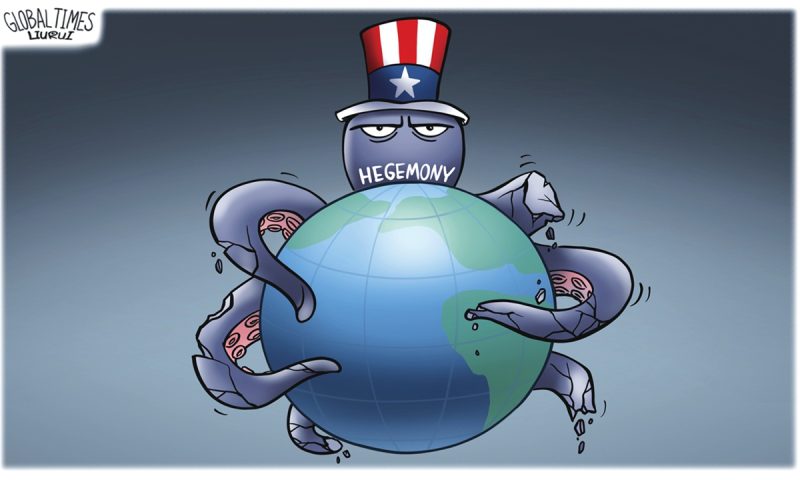
Illustration: Liu Rui/GT
Global Times | January 1, 2024
What kind of experience did 2023 bring to Western countries? According to mainstream Western media, the most apt term to encapsulate the Western sentiment is “uncomfortable.”
An article from the BBC suggests that the past 12 months have seen a number of setbacks for the US, Europe and other major democracies on the international politics stage. Although none has been disastrous for now, they point to a shifting balance of power away from the US-dominated, Western values that have held sway for years, the article claimed. The mentioned setbacks include regional conflicts such as the Russia-Ukraine war and the Israel-Palestine conflict. Challenges posed by countries perceived as adversarial by the US and the West, such as China, Iran, and North Korea, were also highlighted.
The Ukraine crisis has continued on, and the Israel-Palestine conflict has reignited, while the responses from the international community don’t align with the preferences of the US and its Western allies. All of this has made them feel “uncomfortable.”
When it comes to the Russia-Ukraine conflict, despite receiving support from the West, Ukraine has faced difficulties and failed to progress as expected in its conflict with Russia. This has led to Western fatigue and frustration. Due to partisan divisions in the US, providing aid to Ukraine has become problematic. In contrast, Russia has managed to stabilize its frontlines and handle the prolonged war effectively, Lü Xiang, a research fellow at the Chinese Academy of Social Sciences, told the Global Times. He noted that sanctions against Russia, with only around 30 countries participating in condemning Russia’s actions, have failed to significantly impact the Russian economy, instead, Russia has demonstrated remarkable resilience, contrary to Western expectations.
In the case of the Israel-Palestine conflict, most developing countries held positions inconsistent with those of the US. Many countries expressed disappointment and regret over the US veto of the Gaza-related drafts demanding an immediate humanitarian ceasefire in Gaza, distancing themselves from the US pro-Israel stance.
The BBC states that Arab ministers believe there are double standards in Western approaches to the Russia-Ukraine conflict and the Israel-Palestine conflict, accusing the Western governments of hypocrisy. This reflects a growing opposition from Global South and developing countries against the values advocated by the US and the West in various events, and the Western influence is diminishing, said Yang Xiyu, a senior research fellow at the China Institute of International Studies.
Issues such as the Ukraine crisis and the Israel-Palestine conflict increasingly demonstrate that the West, particularly Europe and the US, can no longer bring positive values to the world. More and more countries and their people in the Global South have become aware of this and refuse to accept Western double standards.
Today, an increasing number of developing countries are expressing clear opposition to irresponsible actions by the US and Europe. The major demand of these countries is to have a peaceful and stable international environment for national development. However, Western countries, the US in particular, are acting as the world’s largest disruptor of peace and creator of conflicts. In the cases of the Ukraine crisis and the Israel-Palestine conflict, the US not only fuels the flames but also opposes proposals for peace talks raised by other countries. In pursuit of its selfish interests, the US has caused suffering to the people of Ukraine and the Gaza Strip, hindering the resolution of other urgent global issues. In such circumstances, more and more developing countries are becoming courageous enough to say no to the US and the West.
In 2024, the influence and dominance of the West, whether in the Russia-Ukraine conflict or the Israel-Palestine conflict, will continue to decline. If 2023 did not unfold according to their expectations, 2024 is likely to deviate even further. This will bring more discomfort for them. Washington now has to adapt to a new reality: Global South countries are becoming more mature and gaining more decision-making autonomy. US politicians, who are used to dictating terms to countries worldwide and expecting developments to revolve around US interests, must reflect on and adapt to this new change. Otherwise, when the media summarizes 2024, it may not be as simple as just feeling uncomfortable; the experience might be more agonizing.
Europe under the unbearable yoke and heavy burden of the United States
By Viktor Mikhin – New Eastern Outlook – 01.01.2024
The latest round of the Palestinian-Israeli conflict, the current carnage inflicted by Israel on all Palestinians in Gaza, will continue for some time and end in another tragedy for the Palestinians. But in the long run, all these events will lead to huge negative consequences that all peoples of the Middle East, including the Israelis, will be experiencing for a long time. But while none of the parties in the world will benefit from the disaster, “European countries will particularly pay a higher price for the ongoing conflict,” notes the Iranian publication Tehran Times. Although the leaders of the European states are well aware of the erroneous nature of current US policy, they, like true American puppets, are forced to blindly and unconditionally follow Washington’s course.
History shows that there have been many cases where European countries have paid the price for US policy mistakes over the past two decades. One such striking example may be Europe’s erroneous policy towards the peaceful nuclear development issue of Iran. Until 2012, European countries were among Iran’s most important economic partners, if not the largest, and Iran was a very important market for European products. Iranians preferred German electronics and cars to similar products from elsewhere. But because of the illegal US sanctions against Iran, European companies withdrew from the Iranian market and eventually paid a heavy price for the loss of a very profitable and promising Iranian market. Today, the economic presence of European countries and their companies in Iran are almost non-existent.
The second such example could be the heavy-handed and brazen interference of the United States in the internal affairs of the Middle East over the past two decades. The Middle East, although not really peaceful, remained generally stable in the 1990s and early 2000s. Therefore, European countries were very ambitious in promoting economic integration with their Middle Eastern neighbors, since the security situation was acceptable. The Barcelona process of the 1990s was such a program for the integration of Europe and its neighbors on the other side of the Mediterranean Sea. But the first two decades of the 21st century witnessed the United States often intervening militarily in the internal affairs of a number of countries in the Middle East, including Iraq, Afghanistan, Libya and Syria. As a result of constant military actions, the states and peoples of the Middle East have been experiencing enormous regional upheavals for more than two decades, and, by all accounts, this region is the most turbulent in the world.
Several regional and non-regional players have, quite naturally, various disagreements with the United States in the field of strategy, ideology, politics and economy. However, it is the European countries that have been most seriously affected by the instability, since they are the immediate neighbors of the Middle East. The stream of refugees has increased the economic and social burden and caused divisions both at domestic and EU interstate levels. And in the distant future, they will face even more negative consequences, as European politicians will have to solve even more difficult tasks just to survive.
The third example could be the latest conflict between Israel and Palestine. The war, the carnage unleashed by Israel in the Gaza Strip, has already led to a very serious humanitarian catastrophe, since about 20,000 Palestinians have died so far, about two thirds of whom are women and children, and more than two million have been displaced and become homeless. If the war continues, there will be a more serious humanitarian catastrophe for both the Palestinians and other peoples of the region. More refugees are likely to arrive in European countries, which will add new difficulties to their economies. As some European politicians travel to Israel to demonstrate their support for Tel Aviv’s hardline policies, Muslims in these countries will become increasingly dissatisfied with the course of politicians. There will be new divisions within the EU, as some countries do not share the views of those who support Israel’s unwise policy of destroying the Palestinians of the Gaza Strip.
In general, if one knows his history, the United States has been making mistakes in the region, while the European countries have kept paying a high price for them. Then there is the question of whether the elites in Europe understand the scenario and the rationale behind it. The answer is a resounding yes. In fact, the various political concepts initiated by Europe have sufficiently indicated that Europeans are well aware of their aforementioned problem. But at the same time, they continue to make the same mistakes over and over again, or, as a Russian saying goes, they keep stepping on the same rake. Indeed, if God wants to punish someone, he takes away his mind.
In the early 2000s, European leaders proposed the concept of “negotiation diplomacy,” which, in their opinion, could allow them to shape the Middle East through an approach different from the United States’ policy of force. Thus, in 2003, French President Jacques Chirac and German Chancellor Gerhard Schroeder fiercely and decisively opposed the attempts of the United States to brazenly invade Iraq by falsifying documents and deceiving the world community. Over time, they were proved to be right, although they failed to stop the war, or rather the massacre of the civilian population of Iraq.
In the same year, three foreign ministers — of France, Germany and the United Kingdom — made a joint visit to Iran to find a solution to the Iranian peaceful nuclear development issue through their diplomacy, as opposed to the US approaches to economic sanctions and military pressure. The efforts of the European trio also proved to be correct, although they failed to change the US sanctions approach to solving the Iranian problem.
In 2010, the EU proposed a different concept of strategic autonomy, and the term itself indicated its intention to distance itself from the United States and reduce its dependence on the Americans in security matters. But, unfortunately, during this period, Europe did not make sufficient efforts to demonstrate the autonomous aspect of its policy. Instead, some European countries even sided with the United States in a policy that ultimately led to the infringement of their economic and security interests, as mentioned above.
It is true that Atlantic relations with Europe were based on cultural and historical ties, and they have not changed for a long time. But, on the other hand, European countries have really different interests. The Middle East is an immediate neighbor of Europe, yet is far removed from the United States, and anything bad that happens in the Middle East can negatively affect Europe. Logically speaking, it is unreasonable that the EU will always support the United States in all its risky plans.
Moreover, the current US policy towards the Palestinian-Israeli conflict, with millions of Palestinians already forced to leave their homes, obviously undermines justice, which should be one of the fundamental principles of the international order. The continuation of such a crisis will undermine the image not only of the United States, but also to an even greater extent of Europe, which neighbors the Middle East. In any case, it is high time for European leaders to develop a reasonable approach, balancing justice and its Atlantic obligations. Otherwise, if history is anything to go by, mistakes made under pressure from the United States can force Europe to pay an even higher and unaffordable price.
Putin names Russia’s real enemies
Ukraine itself is not an enemy, the Western elites backing it are, the Russian president has said
RT | January 1, 2024
Ukraine is a mere tool in the hands of the collective West, which has been using it to fight Russia, President Vladimir Putin said on Monday. He made the remarks at a military hospital in Moscow where he was meeting Russian servicemen wounded during the Ukraine military operation.
Asked about the enduring Western support for Kiev, the president said the elites of the collective West were actually the true enemy of Russia, rather than Ukraine itself.
“The point is not that they are helping our enemy, but that they are our enemy. They are solving their own problems with [Ukraine’s] hands, that’s what it’s all about,” Putin stated.
The conflict between Moscow and Kiev was orchestrated by Western elites, who seek to defeat Russia, he suggested. However, the collective West has been unable to achieve its goals, with the failure already showing in the change of its rhetoric on the conflict, the president explained.
“Those who only yesterday were talking about the need to inflict a ‘strategic defeat’ on Russia are now looking for words on how to quickly end the conflict.”
“We want to end the conflict too, and as quickly as possible, but only on our terms. We have no desire to fight forever, but we are not going to give up our positions either,” Putin said.
The battlefield situation is now changing despite all the aid Kiev has been receiving from the West, the president observed. Russia has been effectively outproducing the whole West militarily, he suggested, with the country’s output destined to grow even further.
“Despite the fact that from time immemorial [the West] has had such a goal – to deal with Russia, it looks like we will deal with them first,” Putin stated.
“You probably see it on the battlefield that they are gradually ‘deflating’. When a shell flies, it is probably difficult to tell whether they are ‘deflated’ or not, but in general you probably know: the situation on the battlefield is changing. And this is happening despite the fact that the entire so-called civilized West is fighting against us,” he told the servicemen.
According to Russia’s latest estimates, over 380,000 Ukrainian troops have been killed or wounded during the conflict. Ukraine has also sustained heavy materiel losses, with an estimated 14,000 tanks and other armored vehicles destroyed. Nearly 160,000 of the troop losses were during Kiev’s botched counteroffensive, launched in early June last year, Moscow says.
Western War Machine is in Panic Mode
By Salman Rafi Sheikh – New Eastern Outlook – 01.01.2024
The sheer inability of the collective West to force Russia into submission in Ukraine plus the fast-changing global opinion about the West in the context of the latter’s support for Israel’s brutal war on the Gazans has put the so-called ‘liberal-democratic’ world into a panic mode. The White House has already said that it will run out of money to fund Ukraine into 2024 unless the US Congress gives approval for more funding. This has led the Western war machine – primarily led by the US – to anticipate a possible defeat. “There is no guarantee of success with us, but they are certain to fail without us”, a senior US military official told CNN recently. Without the military support, US officials now estimate, Ukraine would fall by the summer of 2024. But, in Western calculations, Ukraine’s fall does not just mean Russia’s victory; it also implies a possible collapse of NATO and the eventual downfall of the Western-dominated global political, economic, and security order.
A recent piece in the Wall Street Journal said,
“Even more important, Russia’s success in Ukraine would increase a threat to NATO’s Eastern flank—in particular the Baltic states and Poland. Outside of Europe it would embolden Moscow’s allies Iran and North Korea and provide a template for China for the military solution of the Taiwan dispute. In all those cases, the U.S. and NATO troops could find themselves in the midst of a military conflict of the sort that Ukraine fights today without direct involvement of NATO”.
Such prospects are causing severe problems. Germany, for instance, is considering shelving voluntary force and making a return to conscription. “I believe that a nation that needs to become more resilient in times like these will have a higher level of awareness if it is mixed through with soldiers,” said Jan Christian Kaack, the chief of the German Navy. This is in addition to the fact that the German army is too small to defend itself against any threat; hence, the renewed emphasis on conscription.
But Germany is not an exceptional case. In fact, it mirrors developments in the rest of Europe. The UK, otherwise known to possess one of the best fighting forces in the world, is running into some problems of a fundamental nature. The Sky News reported earlier in the year that, a senior US general “privately told Defence Secretary Ben Wallace the British Army is no longer regarded as a top-level fighting force”. It was further reported that the “The armed forces would run out of ammunition in a few days if called upon to fight” and that “The UK lacks the ability to defend its skies against the level of missile and drone strikes that Ukraine is enduring”.
On top of it is the fact that the Russian military position in Ukraine remains strong, making it a lot harder for the West to provide enough funding. The Biden administration is facing its own challenges vis-à-vis more funding for Ukraine. As far as Europe is concerned, a recent report showed that pledges for funding made in August 2023 fell by almost 90 percent compared to the same period last year.
This is war fatigue that is being compounded by a well-sustained Russian resolve to achieve its objectives. For the West, Vladimir Putin remains “stubborn”. As Putin recently reiterated, “There will be peace when we achieve our goals… Now let’s return to these goals – they have not changed. I would like to remind you how we formulated them: denazification, demilitarisation, and a neutral status for Ukraine.”
Speaking from a position of strength – and keeping in mind the war fatigue in the West – Putin further said that Russian forces are “improving their position almost along the entire line of contact. Almost all of them are engaged in active combat. And the position of our troops is improving along [the entire line of contact.]”. This being the case, Putin conveyed no ideas of making a compromise with the West over Ukraine. Speaking from the Russian perspective, it would make no sense to offer negotiations and, thus, turn Russian tactical victories into unsustainable settlements.
Clearly, Russia has no intention of withdrawing from its victories, which is why there is a panic, especially in Europe. If Russia continues to win and the US funding stalls, Europe will be left to fend for itself. Germany’s defence minister minced no words to express this fear last Saturday when he said that the US “was losing interest in European affairs and that security tensions in the Pacific would likely leave the European Union having to fend for itself”, adding that “One can assume that the USA will be more involved in the Pacific region in the next decade than it is today – regardless of who becomes the next president,” he said. His conclusion is: “This means that we Europeans must increase our commitment to ensure security on our continent.”
In a nutshell, for the US, if the war in Ukraine was to unify the West, it is beginning to have an exactly opposite effect. There lies a very strong reason for the US to reconsider its strategy. This reconsideration can go in two directions. First, the US can withdraw from its obsession with expanding NATO to include Ukraine. Second, the US can make one last push and make Ukraine fight for as long as it can, hoping that this might break Russia. The Biden administration favours the second option, which is why it is pushing for the US$61 billion aid package. But will a Republican victory allow this to happen? A Republican victory could not only end support for Ukraine but also leave Europe in a total lurch. Tough times ahead.
Salman Rafi Sheikh is a research-analyst of International Relations and Pakistan’s foreign and domestic affairs.
Featured Video

or go to
Aletho News Archives – Video-Images
Book Review
The Maidan Killings and the False-Flag Case
By Freddie Ponton | 21st Century Wire | September 5, 2026
Before the killings that helped bring down Ukraine’s president in February 2014, American diplomats were discussing who should enter its government. In a leaked telephone call, senior State Department official Victoria Nuland told US ambassador Geoffrey Pyatt, “I think Yats is the guy,” referring to opposition leader Arseniy Yatseniuk. Washington had clear preferences and was working to advance them. Later that month, Yatseniuk became prime minister.
Ivan Katchanovski’s The Maidan Massacre in Ukraine examines the violence that preceded that transfer of power. Drawing on television footage, witness testimony, forensic examinations and Ukrainian court proceedings, he argues that elements of the opposition shot protesters and police in a false-flag operation. His case centres on evidence of protesters being shot from opposition-controlled locations, including Hotel Ukraina, overlooking the killing ground. … continue
Blog Roll
 Aletho News
- Israel expands “incitement” charge to target Palestinian education and memory
- How Israel seeks to reshape Arab classrooms
- Paris bans pro-Palestinian demonstration planned for Oct. 7 over ‘risks of public disorder’
- In August Hanning Treason Case – All Signs Point To Tel Aviv.
- France cleared dozens of military sales to Israel between May and September: Report
- France projects nuclear power as Macron pushes arsenal expansion
- The fallacy of US delusions about Iran’s economic collapse
- What changes with Lula or Flávio?
- Britain leads Western media’s demise through ‘fear porn’ narrative
- The Maidan Killings and the False-Flag Case
- If Americans Knew
- Soldier testimony sheds light on how Israel wages information war
- CIA Report Warns Israel Could Head Toward Civil War, Total Collapse
- Banker Who Exposed Howard Lutnick’s Ties to Epstein Warned of ‘Retaliation’ and ‘Personal Consequences’ in Last Post Before Suicide
- Israeli Attacks Kill Two Palestinians in Gaza
- Gaza genocide at 3: Israeli-U.S. cruelty and the smart, deep resistance to it are changing the world
- As genocide is about to enter 3rd year, little of Gaza remains– Daily Update
- “We See Our Homes Now From A Satellite, Like Strangers”
- Watch “Gaza: Doctors Under Attack”, originally censored by BBC
- NAZA: Israeli embassies in UK and US promote rival documentary to challenge Gaza genocide allegations
- David Ellison appoints Israeli to lead merged Paramount-Warner studios
- No Tricks Zone
- Latest European Green Energy Debacle; Portugal’s Largest Flagship Solar Park Insolvent!
- Green Energy Debacle: German Expert Professor Fritz Vahrenholt Warns Of Severe Economic And Social Consequences
- Two More Paleo Reconstructions Affirm Meters-Higher Sea Levels Across Ireland, Brazil 7000-6000 Years Ago
- New Study: Earth And Venus Surface Warmth Largely Explained By Convection And Lapse Rate, Not CO2 Or Radiation
- 2025 Nature Paper Claiming Worsening Global Drought Gets RETRACTED …Heavily Flawed
- New Study: ‘Global Drought Shows No Detectable Recent Acceleration Under Climate Warming’
- Economic Masterminds: German Socialists Suggest Taxing Productivity Gains Stemming From Using AI
- The South China Sea Has Not Been Cooperating With The Climate Change Narrative
- Energy Crisis: Germany Enters Heating Season With Historically Low Gas Reserve Fill Levels
- New Study: The Antarctic Ice Sheet Gained Mass From 2020-2024 Due To Staggering Snow And Ice Accumulation

