Is US-Funded Destabilization in Latin America Now Paying Off?
By Francisco Dominguez – teleSUR – April 14, 2016
Most progressive governments in Latin America find themselves under intense attack in what is evidently a well synchronized and well financed continental plan of destabilization.
Riots, street demonstrations, anti-corruption campaigns, protests about the domestic negative impact of the world economic crisis, general strikes, impeachment efforts, economic sabotage, and the like, have become the battle horses on which oligarchic forces in cahoots with Washington are riding to carry out “regime change.”
So far, conservative forces in Latin America have been successful in overthrowing President Manuel Zelaya in Honduras in 2009 and President Fernando Lugo in 2012 in Paraguay. Both presidents were ousted by oligarchic parliamentary majorities with mass support from middle class “civic associations”, in complicity with the judiciary, with the latter providing a veneer of legality.
The preconditions for “regime change” take, in some cases, years of careful preparation. This normally involves intoxicating media campaigns of demonization aimed to exacerbate political polarization to the maximum, through the instilling of fear, the staging of aggressive and sometimes violent, middle class mobilizations, the activating of many associations of civil society, and the setting up of, sometimes hundreds, of externally funded NGOs.
The aim is to question the legitimacy of the “target government” which usually involves the systematic discrediting of existing political institutions so as to foster chaos as the most conducive context for “regime change”. This strategy has been “theorized” in manuals that are mass-produced and get heavily promoted free of charge by establishment outfits.(1)
Despite the fastidiousness with which Washington and domestic perpetrators seek to enshrine their efforts at “regime change” in any one nation with the veil of legality, constitutionality, democracy promotion, regional autonomy, and virtuous legitimacy, always a powerful media apparatus is activated the world over, unleashing a barrage of negative reporting and demonization of the “target government” with one overriding message: the solution to created crisis is the ousting of the government.
The favorite demonization is to label the “target government” as a totalitarian dictatorship or in the process of becoming so, unless stopped. This is coupled with regular official condemnatory statements of the “target government” from the U.S. State Dept. and a barrage of U.S. official bodies.
In this “regime change” narrative, the ousting of the target government, being the cause of “civil society’s rebellion”, is fully justified. Thus for example the highly illustrative New York Times editorial of April13, 2002, on occasion of the brief ousting of Hugo Chavez: “Venezuelan democracy is no longer threatened by a would-be dictator.”
The NYT explained that Chavez had been ousted “after the military intervened and handed power to a respected business leader.” The key, therefore, is to portray the “ruler” of the target government as a threat to democratic civilization, thus the NYT editorial justifies the 2002 coup in Venezuela because Chavez “battled the media and alienated virtually every constituency from middle-class professionals, academics and business leaders to union members and the Roman Catholic Church.(2)
So, 21st century “regime change”, different from the more traditional 20th century U.S.-orchestrated coup d’état, involves an intense “battle for hearts and minds”, an essential component of the strategy.(3) Thus, huge financial, political and cultural resources are mobilized to bring about hegemony for “regime change” in society and in all state and civil society institutions, going as far, in some cases, as even co-opting sections of the downtrodden. Most of this is “facilitated” with generous NED and USAID grants awarded over many years.
Faced with its own steady decline and the rise of radical governments in the post-Soviet era, the U.S. seeks to destabilize and oust governments through “color revolutions” as in Georgia, 2003 and the Ukraine, 2004 and 2014. Consequently the U.S. has substantially reorganized its architecture for intervention with the CIA becoming a mere appendix but with USAID and the National Endowment for Democracy and their many associated bodies taking center stage and receiving the lion’s share of the resources. The modality may have changed but U.S. foreign policy remains pretty much what it was: to remove governments it does not like. U.S. State Dept. and USAID budget is bigger than the GPD of many states, in 2016 it was US$50.3 billion.
Among the key U.S. institutions involved in “regime change” is the U.S. State Department, the body with the biggest authority, but there is also the United States Southern Command, the Congress and Senate Foreign Affairs Committees, and the CIA. Then further down the food chain, there are USAID, NED, Office for Transition Initiatives, American Center for International Labor Solidarity and American Institute for Free Labor Development, among the most important ones.
They work closely together and in the pursuance of the same aims, with the International Republican Institute, chaired by John McCain of CHECK; the National Democratic Institute, chaired by Madeline Albright; Transparency International; and Centre for International Private Enterprise. They all channel huge sums to support civil (and when possible) military subversion to create the conditions for “regime change”. They also channel huge sums to fund “civil society” associations, political parties, media outfits, NGOs, professional bodies, trades unions, think tanks, business, student groups and so forth.(4)
These institutions are the field commanders that coordinate the national detachments in every target country around a regional perspective so as to maximize the results of every push for “regime change” in any individual Latin American nation. We are increasingly seeing former right-wing Latin American presidents acting jointly to contribute to the destabilization of Bolivarian Venezuela, for instance.
Additionally there is a raft of “private” or “independent” bodies concerned chiefly with Latin America, the most important of which are Inter-American Press Association; Fundacion para el Analisis y los Estudios Sociales – led by Jose Maria Aznar; the Instituto Prensa y Sociedad; hundreds of Think Tanks; and possibly thousands of NGOs that share the “regime change” aim but that do it from a specialist angle. To all of this architecture of U.S. intervention, the overwhelming majority of the world corporate media play a decisive role, making any U.S. led intervention, a lethal political threat to the survival of any “target government”.
Most progressive governments in Latin America have been or are subjected to systematic levels of traumatic and deliberately created social, economic and political chaos, politics and culture, which in many cases it can go on for years. In Cuba for five decades, in Nicaragua (on and off) nearly four decades and in Venezuela for 17 years thus far, with no end in sight.
Venezuela’s Bolivarian government is currently in the crosshairs of U.S. destabilization plans and “regime change” efforts through an economic war that has the Bolivarian process on the ropes. In Argentina, three years of an intense dirty war against Cristina Fernandez’s government, aspects of which had sinister overtones, paid off when at the November 2015 presidential election, the Right’s candidate, Mauricio Macri, won the election by a small margin of 1 percent. In Ecuador, a police mutiny in September 2010, obviously instigated from abroad and with huge U.S. support, nearly succeeded in ousting the government with with President Rafael Correa miraculously escaping with life.
The destabilization against Ecuador continues with the “revolt” of civil society and very violent street protests. And in Brazil, through a very intense and thoroughly intoxicating media campaign, a “regime change” push seeking to oust the democratically elected and legitimate president Dilma Rousseff is underway, as we write it is not clear whether the effort to oust Dilma will be successful or not.
By substantially reducing export revenues that fund progressive social programs, the persistent world economic crisis significantly helps the “regime change” efforts by the U.S. and its allies. It may be just coincidence but the U.S. ambassador in Paraguay when elected president Fernando Lugo was ousted by a right-wing parliamentary coup, was Liliana Ayalde. The current U.S. ambassador in Brazil, where a right-wing parliamentary coup against elected president Dilma Rousseff is in progress, is Liliana Ayalde.
Bolivar once said that the United States appears to be destined by Providence to plague America with misery in the name of liberty. Exactly, through the NED, USAID and others, the United States must stop destabilizing elected governments in the name of “democracy,” “good governance” and “national security.”
Francisco Dominguez is a senior lecturer at Middlesex University, where he is head of the Centre for Brazilian and Latin American Studies.
(1) See Gene Sharp, “From Dictatorship to Democracy,” Serpent’s Tail, 2011, first published in 2002.
(2) “Hugo Chavez Departs,” New York Times, April 13th, 2002
(3) The overthrow of Honduras President Manuel Zelaya, in June 2009, has led to the book with the very suggestive title “The Good Coup” (Mario Caceres di Iorio, CCB, Canada, 2010).
(4) See “Evolution of USAID and NED in Dominguez,” Lievesley and Ludlam, Right-Wing Politics in the New Latin America, Zed, 2011.
Is the Media an Accomplice in Drone Murders?
By Emran Feroz – teleSUR – March 11, 2016
Since 2001, the United States has been killing people with weaponized drones, most times not knowing the identities of the victims.
The victims of drone strikes are nameless and invisible, despite the fact that most of them are civilians.
The Pentagon announced this week that more than 150 al-Shabab fighters have been killed by a U.S. drone strike in Somalia. The Pentagon spokesmen repeatedly talked about “fighters” and “terrorists” which “posed an imminent threat to the U.S.” But as usual, he offered no proof of his claims.
This kind of language has become normalized when it comes to the U.S. drone war, which is not just taking place in Somalia, but also in countries like Yemen, Pakistan, Afghanistan and Iraq. What is significant regarding the regular attacks in these countries is the media coverage. In fact, it practically does not exist. The many victims of drone strikes are nameless and invisible. And if they appear in any media reports, all of them are completely dehumanized and described as “terrorists,” “suspected militants” or any other similar euphemism.
This was also the case after the latest strike in Somalia, a country the U.S. is officially not at war with. Shortly after the Pentagon’s announcement, many news outlets adopted the U.S. government’s version of the incident. The New York Times, for example, wrote about the killing of “150 fighters who were assembled for what American officials believe was a graduation ceremony.” “Militants” was also the term the Washington Post used to describe all the victims. It is necessary to point out that many other well-known media outlets from all over the world did the very same thing. As usual, there was a huge lack of any critical scrutinizing. Instead, media once again became a mouthpiece of the U.S. government by quoting its military officials and spreading their one-sided views constantly.
Since 2001, the United States has been killing people with weaponized drones, most times not knowing the identity of the victims. As of today, at least 6,000 people have been killed by these drone strikes. According to the London-based Bureau of Investigative Journalism, only 4 percent of drone victims in Pakistan were identified as a-Qaida members. But vastly more than 2,000 people have been killed there by drones during the last years.
Another country which is suffering heavily under drone strikes is Afghanistan, the most drone bombed country in the world. Between 2001 and 2013, 1,670 drone strikes took place in the country. It was in the city of Kandahar, the Taliban’s former stronghold, where the first strike by a weaponized drone took place in October 2001. The target, Taliban founder Mullah Mohammad Omar, was not killed on this day, but many other unknown people have been in the years since.
One of these people was Sadiq Rahim Jan, a 21-year-old food vendor from Paktia, eastern Afghanistan. He was murdered by a drone strike in July 2012. A few days later, media outlets in Kabul described him as a “Taliban commander.” The family members of Aisha Rashid have also been killed by a drone strike. The Afghan girl was four years old when a missile hit the pick-up of her family in Kunar, also in the east of the country. Fourteen passengers, including Aisha’s parents, were murdered. Only she survived – barely – with a ragged face. Initially, all the victims were described as “militants” by Afghan government officials and local media outlets.
Tariq Aziz, from North Waziristan shared a similar destiny. The 16-year-old anti-drone activist was killed by a drone strike in November 2011, together with his 12-year-old cousin Waheed. Unlike the case of Malala Yousafzai, the young Pashtun girl which was nearly killed by a member of the Pakistani Taliban and received a Nobel Peace Prize, Tariq’s case is widely unknown.
In all the mentioned cases, as well as many other, significant media coverage was nonexistent – or it described the victims as terrorists, extremists, militants, al-Qaida members, and so on. This is happening on a daily basis and there are also reasons why it is happening.
In the case of Sadiq, for example, his family became outraged after they noticed that local media outlets described their son and brother as a “Taliban commander.” On that day, the young Afghan was the only person who has been killed in the area. He never had any connection with any insurgent group, not to mention being a commander of them. One of the media outlets which spread these news was Radio Azadi, an Afghan branch of the US government’s external broadcast services. It should be more than obvious that the main aim of such a media platform is not spreading objective information.
Another example for this behaviour is Tolo TV, Afghanistan’s leading mainstream television channel. Last year, the channel’s news website reported that in July 2015 drone strikes in the eastern province of Nangarhar killed “nearly 250 Taliban and Daesh [Islamic State] insurgents.” The main source for this “reporting” was the National Directorate of Security (NDS), the Afghan intelligence service, which was built by the U.S. in the first days of the NATO invasion.
Tolo TV was created in 2004 by Saad Mohseni, an Afghan businessman who is being called an “Afghan Rupert Murdoch” and is considered one of the most powerful men in Afghanistan. The channel’s creation was mainly funded by the notorious United States Agency for International Development (USAID), which is widely known as one of the most important foreign policy tools of the White House.
In general, one can assume that many media outlets in Afghanistan were not created to support journalism and press freedom but to install media institutions who can be useful to represent particular interests. This is also the case in other countries which suffer from drone strikes.
Noor Behram, an investigative journalist from Northern Waziristan, is known for taking pictures of the drone murder scenes and spreading the victims’ faces. After Behram talked with journalists from Islamabad, Pakistan’s capital, he experienced that for them, a beard, long hair and a turban or a pakol, a traditional Afghan cap, is enough to describe male drone victims as “terrorists.” But nearly every man in this area looks like that. According to this logic, everyone, even myself when I am staying there, must be a terrorist.
Besides, Behram’s results fit into Washington’s practice that all military-aged males in a strike zone are considered as “militants.”
The U.S. and its allies needed propaganda organs to construct and justify their war on a medial level. Despite the question if this is moral or not, one should agree that it is also very logical because every war is based on propaganda – it was always like that and probably will never change.
But what remains is the question why so many people still believe such a biased media coverage and its constructed narrative of a good war which is only hitting the bad guys.
Emran Feroz is an Afghan-Austrian journalist, writer and activist currently based in Germany. He is the founder of Drone Memorial, a virtual memorial for civilian drone strike victims.
Another Day, Another Billion for Color Revolutions Near Russia’s Borders
Sputnik – February 13, 2016
Last week, the Obama administration proposed its final, 2017 fiscal year budget proposal to Congress. Among the proposed outlays is a State Department request for nearly a billion dollars to counter “Russian aggression” and “promote democracy” in the former Soviet Union. In other words, Washington thinks the region needs more color revolutions.
On Tuesday, the State Department and USAID held a special joint briefing, laying out a $50.1 billion spending request for 2017, including $953 million in “critical support for Ukraine and surrounding countries in Europe, Eurasia and Central Asia to counter Russian aggression through foreign assistance and public diplomacy.” The funds, officials specified, would go toward “enhancing access to independent, unbiased information; eliminating corruption and supporting rule of law; strengthening civil society; enhancing energy security, supporting financial reforms, trade, and economic diversification; and increasing some defense capabilities” in countries including “Ukraine, Georgia, and Moldova [and] in Central Asia.”
The spending would be separate from the proposed $3.4 billion (up from $789 million in 2016), provided by the so-called “European Reassurance Initiative,” which aims for “a significant reinvestment in the US military presence in Europe after decades of gradual withdrawal” to counter “the growing threat Russia poses to long-term US national security interests in Europe and beyond.”
With most of the Western media basically ignoring the plans and focusing on other aspects of the budget’s whopping $4 trillion in proposed spending, Russian security analysts, naturally, couldn’t let this ‘minor detail’ simply slip by unnoticed, given that the spending proposal is openly oriented against Russia.
Analyzing the State Department’s proposed new spending spree, Svobodnaya Pressa columnist Andrei Ivanov says that the outlays raise as many questions as they answer.
“It’s not difficult to guess what is implied by [the proposed spending for] ‘democratization,'” the journalist noted. “However, several questions arise. Firstly, this year, the State Department has already allocated $117 million ‘to support democracy’ in Ukraine, and $51 million for Moldova and Georgia. But in these countries, so-called color revolutions have already taken place, and the Americans have already almost achieved what they set out to do.””Secondly, it’s unclear what kind of ‘countering of Russian aggression’ the State Department means in relation to Central Asia. Kazakhstan and Kyrgyzstan have long been oriented toward Moscow, and even joined with Russia in the common customs area of the Eurasian Economic Union. Kazakhstan, Kyrgyzstan, and Tajikistan are also part of the Collective Security Treaty Organization’s unified security system. Russia has also signed a series of bilateral cooperation agreements with Uzbekistan.”
The proposed spending, Ivanov notes, “assumes a serious US commitment to pursuing its [geopolitical] goals, which threatens Russia with obvious negative consequences. The question thus arises about the countermeasures our country might take in response.”
“According to experts, on the eve of the coup d’état in Ukraine in 2014, over two thousand non-governmental organizations were created, from training camps for militants to various clubs of political scientists and media workers.”
Unfortunately, the journalist recalls, “Moscow relied more on the agreements reached with Ukrainian elites; the result was disastrous. Today, the question again arises about the need to work actively with the civil society of neighboring states.”
Asked to comment on the State Department’s new spending proposal, Andrei Manoilo, a professor of political science at Moscow State University, expressed a commonly held view among Russian security professionals.
Namely, the professor told the newspaper, “when Washington talks about spreading democracy, and allocates money for this purpose, it is referring to ‘color revolutions’ – the overthrow of undesirable regimes and the drive to bring puppets who mimic democracy to power.”
“Factually, these countries find themselves under American control. Ukraine is a vivid example. Until recently, Georgia too served as a good example, with each department and ministry in the country featuring an advisor and curator from the State Department. In Ukraine, supervision is carried out through the US Embassy, and through officials loyal to Washington, charged with implementing its instructions.”
As for the earmarking funds for countries which have already undergone color revolutions, Manoilo explained that the money “is allocated for the purpose of maintaining the stability of the dependent regime.” This is especially true in Ukraine’s case, he said. It is also meant “to ensure the loyalty of local elites.”
In Georgia’s case, “after Mikheil Saakashvili resigned from his post and was forced to flee the country, the American position weakened somewhat, mainly due to the perceived negativity which the color revolution had brought the country. So here, the US [spends] in order to maintain its influence. It is also possible that the US is considering ensuring the loyalty of Georgian elites by ‘nourishing’ cyclical color revolutions, thus carrying out a rotation of the elite.”
As for Central Asia, the State Department announcement seems to indicate, according to Manoilo, “that color revolutions are planned there as well. The Americans need to see regime change in the countries which, for the most part, are oriented toward Russia. In Central Asia, Moscow has several projects geared toward integration, including the Shanghai Cooperation Organization and the CSTO. Today, the countries in the region face a difficult situation, with disintegratory processes growing among them.”
In Tajikistan, the professor warned, the State Department may attempt to reignite the embers of the country’s civil war, which took place between 1992-1997, taking advantage of disagreements between the country’s north and south. “US NGOs, which operated freely in the country until recently, are taking advantage [of discontent] among both northern and southern elites. It was not until about a year ago that President Emomali Rahmon began to restrict their activities.”In Kyrgyzstan, meanwhile, “the situation has changed little since the last color revolution. The protest mood remains strong. US NGOs and foundations have been working actively with the rural population, which is not very versed in politics, but is easy to agitate to participate in demonstrations against authorities, as the ‘melon’ revolution of 2010 demonstrated.”
In all the countries of Central Asia, Manoilo noted, “there is the strong factor of Islamist radicalism. By and large, only the presence of Russian military bases holds back an Islamist offensive in the region.”
Unfortunately, he says, “practice has shown that when it comes to overthrowing undesirable governments, the State Department easily finds a common language with even the most rabid fundamentalists. It’s sufficient to recall the color revolutions of the so-called Arab Spring. It would not be out of place to presume that the US is preparing their repetition, except this time in the post-Soviet space.”
“In addition to Central Asia, there is the southern Caucasus. Last summer, Armenia saw a rehearsal of a color revolution under non-political slogans – a new technology called the ‘Electro-Maidan’. Armenia is a Russian ally in the South Caucasus, and the US has plans for regime change, using their methods of the so-called ‘democratic transition’.”
Ultimately, Manoilo warns, “by dismantling the political order in Russia’s neighboring countries, the US wants to create a vacuum around our country. Simply put, this indicates a repeat of the Ukrainian scenario. After all, until very recently it was simply impossible to imagine Ukraine as a country which is hostile to Russia.” … Full article
US Could Spend US$30M in 2016 to ‘Promote Democracy’ in Cuba
teleSUR – January 2, 2016
The United States government could potentially spend up to US$30 million on “democracy development” programs in Cuba in 2016, according to bills waiting for approval at U.S. Congress.
Two draft bills related to U.S. State Department’s budget for foreign spending were approved by the Appropriation Committees of both the House of Representatives and the Senate.
The draft bill approved by the House Committee on Appropriations states that the National Endowment for Democracy, or NED, the State Department and the Agency for International Development would share US$30 million in Cuba democracy funds.
Of the funds appropriated by this Act under the heading ‘Economic Support Fund, “$30,000,000 shall be made available to promote democracy and strengthen civil society in Cuba,” the draft bill said. It was approved by the House’s committee in June 2015.
It added that such funds could not be used “for business promotion, economic reform, entrepreneurship, or any other assistance that is not democracy-building.”
Meanwhile, the draft bill approved by the Senate Committee on Appropriations said that US$20 million should be used for Cuba democracy programs, including up to $5 million for “private Cuban entrepreneurs.” This draft was approved by the committee in July last year.
The Senate version of the bill also authorizes US$50.5 million “for programs to promote Internet freedom globally,” and says a portion of the funds would likely be used “to support Internet freedom in Cuba.”
Neither bill has been approved by any of the corresponding government bodies yet.
Over the years, programs such as the NED or the United States Agency for International Development (USAID) have received mounting criticism over meddling in other nations political spheres in order to promote U.S. interests, unlike their claim of promoting democracy and aid.
Both programs are funded by the U.S. congress.
Republican Congressman Ron Paul, who ran for the U.S. presidency twice, has argued against such programs. In 2005, he stated that NED has “very little to do with democracy. It is an organization that uses U.S. tax money to actually subvert democracy, by showering funding on favored political parties or movements overseas.”
The NED has been banned in various countries over meddling claims.
Ecuador Rejects HRW Report as “Manipulative”
teleSUR – November 12, 2015
In a statement released Wednesday, Ecuador’s governing party, Alianza PAIS, rejected the “latest political intervention against the government of Ecuador by the U.S.-based organization Human Rights Watch (HRW) in its report released on 10 November 2015.”
The report made unsubstantiated claims that “the administration of President Rafael Correa has expanded state control over media and civil society” and argued that security forces used “excessive force” against “peaceful” protests this year. It left out important context, such as the calls by the leaders of those protests to get rid of the democratically elected and very popular left wing government. The report criticized Ecuador because the well known US political tool, USAID shut their offices this year, and claimed the government has “broad powers to limit free speech.” Finally, the report took a political position on Ecuador’s internal legislative decisions.
“This organization repeatedly ignores the unprecedented advances in human rights that have occurred in Ecuador while manipulating human rights discourse to unjustly attack the nation’s elected government. It is not the first time HRW releases partisan reports against Latin America’s progressive governments,” Alianza PAIS stated.
Allianza PAIS accused HRW of misrepresenting the sizes of demonstrations, minimizing opposition violence, and of misrepresenting the state of emergency declared with the eruption of the Cotopaxi volanco – portraying that measure as a repressive tool.
“The sources of HRW’s funding, including corporate funding, contribute to its political bias while its board members and advisers have links with the financial, military and political sectors, the latter criticized by significant figures including Nobel laureates,” Alianza stated.
How Ukraine’s Finance Chief Got Rich
By Robert Parry | Consortium News | November 10, 2015
Before becoming Ukraine’s Finance Minister last December, Natalie Jaresko collected $1.77 million in bonuses from a U.S.-taxpayer-financed investment fund where her annual compensation was supposed to be limited to $150,000, according to financial documents filed with the U.S. Internal Revenue Service this year.
The near 12-fold discrepancy between the compensation ceiling and Jaresko’s bonuses, paid in 2013, was justified in the IRS filing from the Jaresko-led Western NIS Enterprise Fund (WNISEF) by drawing a distinction between getting paid directly from the $150 million U.S. government grant that created the fund and the money from the fund’s “investment sales proceeds,” which were treated as fair game for extracting bonuses far beyond the prescribed compensation level.
Using this supposed loophole, Jaresko and some of her associates enriched themselves by claiming money generated from U.S. taxpayers’ dollars while avoiding any personal financial risks. She and other WNISEF officers collected the bonuses from what they deemed “profitable” exits from some investments even if the overall fund was losing money and shrinking, as it apparently was in recent years.
According to WNISEF’s filing for the 2013 tax year, submitted to the IRS on Aug. 11, 2015, the value of the investment fund had shrunk from $150 million at its start to $93.9 million in the fund’s 2012 tax year and to $89.8 million in the 2013 tax year. (WNISEF’s tax years end on Sept. 30.)
So, Jaresko’s arrangement was something like taking someone else’s money to a roulette table, placing it on black, and claiming a share of the winnings if the ball stopped on black. However, if the ball landed on red, then the someone else absorbed the loss, except in this case the winners were Jaresko and her associates and the losers were the American taxpayers.
The purpose cited by the U.S. Congress in starting the non-profit WNISEF with $150 million in the 1990s was to help jumpstart an investment economy in Ukraine and Moldova for the benefit of the people of those countries. The project was administered by the U.S. Agency for International Development (USAID), which selected Jaresko, a former U.S. diplomat of Ukrainian heritage, to run the project.
Last December, Ukrainian President Petro Poroshenko named Jaresko Finance Minister after awarding her instant Ukrainian citizenship. At that point, she quit WNISEF and has since become the face of Ukrainian “reform,” representing the U.S.-backed government at international banking events at Davos, Switzerland, and elsewhere while appealing for billions of dollars in Western financial aid which she oversees.
Thus, Jaresko’s standards for handling public moneys are relevant to judging whether the new regime is just a reshuffling of who gets to plunder Ukraine or a serious effort at reform. The overthrow of the previous Ukrainian government of President Viktor Yanukovych was largely justified in February 2014 because of allegations about corruption. The new regime has presented itself as committed to reform, even though some outside observers contend that corruption is as bad or worse than under the old government.
Self-Interest v. Public Interest
There is also the question of whether Jaresko is more interested in getting rich than in serving the people of Ukraine. As WNISEF’s chief executive officer, Jaresko seemed to grow dissatisfied with her $150,000 salary. For instance, in 2004, she earned more than double the prescribed amount, paid $383,259 along with $67,415 in expenses, according to WNISEF’s IRS filing for that year.
According to audit documents that I obtained from USAID, an “Expense Analysis” for 2004 showed $1,282,782 being paid out as “Exit-based incentive expense-equity incentive plan” and another $478,195 being paid for “Exit-based incentive expense-financial participation rights.” That suggested that Jaresko was already claiming bonuses from WNISEF’s investments (bought with U.S. taxpayers’ money) and sold during 2004.
In 2006, Jaresko’s compensation for her work with WNISEF was removed from public disclosure altogether after she co-founded two related entities – Horizon Capital Associates (HCA) to manage WNISEF’s investments (and collect around $1 million a year in fees) and Emerging Europe Growth Fund (EEGF), a private entity to collaborate with WNISEF on investment deals.
Jaresko formed HCA and EEGF with two other WNISEF officers, Mark Iwashko and Lenna Koszarny. They also started a third firm, Horizon Capital Advisors, which “serves as a sub-advisor to the Investment Manager, HCA,” according to WNISEF’s IRS filing for 2006.
According to the USAID’s expense analyses for 2004-06, the taxpayer-financed WNISEF spent $1,049,987 to establish EEGF as a privately owned investment fund for Jaresko and her colleagues. USAID apparently found nothing suspicious about these tangled business relationships despite the potential conflicts of interest involving Jaresko, the other WNISEF officers and their affiliated companies.
For instance, WNISEF’s 2012 annual report devoted two pages to “related party transactions,” including the management fees to Jaresko’s Horizon Capital ($1,037,603 in 2011 and $1,023,689 in 2012) and WNISEF’s co-investments in projects with the EEGF. Though the IRS forms have a line for earnings from “related organizations,” WNISEF listed nothing, apparently treating compensation from Horizon Capital and EEGF as “unrelated” for the purposes of reporting compensation for Jaresko and other officers.
So, the scale of how much Jaresko was making from her association with WNISEF was unclear until last week when the IRS released WNISEF’s 2013 tax filing of Aug. 11, 2015, in response to a request from Consortiumnews.com. Though the filing still did not disclose all of Jaresko’s WNISEF-related compensation, it did list her $1.77 million share of the $4.5 million in bonuses awarded to her and two other WNISEF officers, Iwashko and Koszarny.
WNISEF filings also said the bonuses were paid regardless of whether the overall fund was making money, noting that this “compensation was not contingent on revenues or net earnings, but rather on a profitable exit of a portfolio company that exceeds the baseline value set by the board of directors and approved by USAID” – with Jaresko also serving as a director on the board responsible for setting those baseline values.
Though compensation for Jaresko and other officers was shifted outside public view after 2006 – as their pay was moved to the affiliated entities – the 2006 IRS filing said: “It should be noted that as long as HCA earns a management fee from WNISEF, HCA and HCAD [the two Horizon Capital entities] must ensure that a salary cap of $150,000 is adhered to for the proportion of salary attributable to WNISEF funds managed relative to aggregate funds under management.”
Audit Gaps
KPMG auditors, who reviewed WNISEF finances, also took a narrow view of how to define income for Jaresko and other officers, only confirming that no “salary” exceeded $150,000, apparently not looking at bonuses and other forms of compensation. Neither USAID officials nor Jaresko responded to specific questions about WNISEF’s possible conflicts of interest, how much money Jaresko made from her involvement with WNISEF and its connected companies, and whether she had fully complied with IRS reporting requirements.
After Jaresko’s appointment as Finance Minister — and her resignation from WNISEF — I reviewed WNISEF’s available public records and detected a pattern of insider dealings and enrichment benefiting Jaresko and her colleagues. That prompted me in February to file a Freedom of Information Act request for USAID’s audits of the investment fund.
Though the relevant records were identified by June, USAID dragged its feet on releasing the 34 pages to me until Aug. 28 when the agency claimed nothing was being withheld, saying “all 34 pages are releasable in their entirety.” However, when I examined the documents, it became clear that a number of pages were missing from the financial records, including a total of three years of “expense analysis” – in three-, six- and nine-month gaps – since 2007.
Part of KPMG’s “Independent Auditors’ Report” for 2013 and 2014 was also missing. The report stated that “except as discussed in the third paragraph below, we conducted our audits in accordance with auditing standards generally accepted in the United States of America,” accountant-speak that suggests that “the third paragraph below” would reveal some factor that did not comply with generally accepted accounting principles (or GAAP).
But three paragraphs below was only white space and there was no next page in what USAID released. After I pointed out the discrepancies to USAID on Aug. 31, I was told on Sept. 15 that “we are in the process of locating documents to address your concern. We expect a response from the bureau and/or mission by Monday, September 28, 2015.”
After the Sept. 28 deadline passed, I contacted USAID again and was told on Oct. 2 that officials were “still working with the respective mission to obtain the missing documents.” On Oct. 22, USAID sent me one additional page from KPMG’s audit report stating that its review of WNISEF’s books lacked “an external quality control review by an unaffiliated audit organization” – as required by the U.S. government’s auditing standards – because no such program is offered in Ukraine. Other pages are still missing.
An earlier effort by Jaresko’s ex-husband Ihor Figlus to blow the whistle on what he considered improper business practices related to WNISEF was met by disinterest inside USAID, according to Figlus, and then led to Jaresko suing him in a Delaware court in 2012, using a confidentiality clause to silence Figlus and getting a court order to redact references to the abuses he was trying to expose.
Figlus’s complaints related to what he saw as improper loans that Jaresko had taken from Horizon Capital Associates to buy and expand her stake in EEGF, the privately held follow-on fund to WNISEF. After Figlus discussed this issue with a Ukrainian journalist, Jaresko sent her lawyers to court to silence him and, according to his lawyer, bankrupt him.
The filings in Delaware’s Chancery Court are remarkable not only because Jaresko succeeded in getting the Court to gag her ex-husband through enforcement of a non-disclosure agreement but the Court agreed to redact nearly all the business details, even the confidentiality language at the center of the case. [See Consortiumnews.com’s “Ukraine’s Finance Minister’s ‘American Values.”]
Shared Values
Earlier this year, I sent detailed questions to USAID and to Jaresko via several of her associates. Those questions included how much of the $150 million in U.S. taxpayers’ money remained in WNISEF, why Jaresko reported no compensation from “related organizations,” whether she received bonus money, how much money she made in total from her association with WNISEF, what AID officials did in response to Figlus’s whistle-blower complaint, and whether Jaresko’s legal campaign to silence her ex-husband was appropriate given her current position and Ukraine’s history of secretive financial dealings.
USAID press officer Annette Y. Aulton got back to me with a response that was unresponsive to my specific questions. Rather than answering about the performance of WNISEF and Jaresko’s compensation, Aulton commented on the relative success of 10 “Enterprise Funds” that USAID has sponsored in Eastern Europe, adding:
“There is a twenty year history of oversight of WNISEF operations. Enterprise funds must undergo an annual independent financial audit, submit annual reports to USAID and the IRS, and USAID staff conduct field visits and semi-annual reviews. At the time Horizon Capital assumed management of WNISEF, USAID received disclosures from Natalie Jaresko regarding the change in management structure and at the time USAID found no impropriety during its review.”
One Jaresko associate, Tanya Bega, Horizon Capital’s investor relations manager, said she forwarded my questions to Jaresko, but Jaresko did not respond.
Despite concerns that Jaresko may have enriched herself at the expense of U.S. taxpayers and then used a Delaware court to prevent disclosure of possible abuses, Jaresko has been hailed by the U.S. mainstream media as a paragon of reform in the U.S.-backed Ukrainian regime.
Last January, New York Times columnist Thomas L. Friedman cited Jaresko as an exemplar of the new Ukrainian leaders who “share our values” and deserve unqualified American support. Friedman uncritically quoted Jaresko’s speech to international financial leaders at Davos, in which she castigated Russian President Vladimir Putin:
“Putin fears a Ukraine that demands to live and wants to live and insists on living on European values — with a robust civil society and freedom of speech and religion [and] with a system of values the Ukrainian people have chosen and laid down their lives for.”
Exactly which Western “values” Jaresko actually shares remains unclear because of the fog surrounding her actions at WNISEF and her unwillingness to reveal how much she made from her association with a U.S.–taxpayer funded project. However, if those Western “values” include putting citizens’ interests before self-interest and believing that transparency is critical for a democracy, Jaresko may need some remedial training.
Investigative reporter Robert Parry broke many of the Iran-Contra stories for The Associated Press and Newsweek in the 1980s. You can buy his latest book, America’s Stolen Narrative, either in print here or as an e-book (from Amazon and barnesandnoble.com).
White Helmets: War by way of Deception Part II ~ “If it looks like an executioner…”

By Vanessa Beeley | thewallwillfall | October 27, 2015
“If there is any doubt concerning the nefarious undertones of subversiveness in these NGO dealings, [National Endowment for Democracy] NED founder reportedly said the following in the 1990s: ‘A lot of what we do today was done covertly 25 years ago by the CIA.’ What was once done at night under the cloak of ‘imperialism’ is now done during the day under the guise of ‘humanitarianism.” ~ The Wrong Kind of Green
Hindsight is a generous provider of absolution from the guilt of falling for the Government or State propaganda and media sleights of hand that deceive us into believing the narrative presented to us, designed, in many cases to justify military intervention. Invariably this is a narrative that ensures the massacre of innocent people under the pretext of liberating them or introducing Democracy that promises to erase their perceived grievances by cutting a swathe through their society & culture either via proxy armies of mercenaries under the guise of various terrorist factions or with an onslaught of bombs and assorted mass destruction or chemical weapons that render their land barren for decades and result in birth defects, increased cancer rates and a multitude of devastating side effects for generations after.
Despite such hindsight and the universally accepted knowledge that it was pure fiction that took us to war in both Iraq and Libya there is still a huge degree of cognitive dissonance at play over the Syria commentary.

Disbelief is invariably registered when it is demonstrated that Syria is undergoing the same truth laundering process as Libya and Iraq or that Syria’s resistance of regime change attempts for almost 5 years is the reason for spikes in propaganda or focus on a particular narrative at any given moment, when Syria persistently thwarts the Colonialist vision for the region.
The NGO soft power complex is now one of the most destructive global forces. It is employed as an interface between civilians of a target nation and the Government, economic or military structures of the colonialist force intent on harnessing any given nation’s resources or undermining its geopolitical influence. The Democratization process or the path to regime change is facilitated by these undercover Government proxy employees who, once embedded into a society, set about producing the propaganda that will justify intervention, either economically, politically or militarily.
They know that the general public has an inherent faith in their perceived integrity and this gives them tremendous sway over public opinion. The perception of a “non profit” complex working for the betterment and improvement of Humanity is a hard nut to crack… but it must be done.
Along with military invasions and missionaries, NGOs help crack countries open like ripe nuts, paving the way for intensifying waves of exploitation and extraction” ~ Stephanie McMillan
SYRIA
As Paul Larudee states in his article, Mythology, Barrel Bombs and Human Rights Watch:
“The Syrian army relies on loyal soldiers defending their country and their homes from a heavily subsidized, markedly foreign incursion, including many mercenaries paid by the Gulf monarchies and trained by the US. And the army is loyal because they know that although great sacrifices will be asked of them, they will be defending, not sacrificing, their families and loved ones. The rest of the world that supposedly cares about Syria can start by making it unnecessary for them to make such sacrifices.”
Much of the propaganda surrounding Syria and the “conflict” is indeed, mythology. A mythology created and disseminated by the NGO complex working diligently on the ground in Syria and remotely in the labyrinths of power to ensure a steady flow of misinformation designed to alter our perception and drive us towards making the same mistakes in Syria that we made in Iraq and Libya.
It is no error or oversight that the media barely mention Libya these days as it is plunged deeper and deeper into the terror vacuum created by the NATO intervention of 2011. Perhaps if people were confronted by images of the daily horrors endured by the people of Libya they would be more reticent about passive-aggressively re-creating the same scenario in Syria.
The White Helmet Myth
The NGO hydra has no more powerful or influential serpentine head in Syria than the Syria Civil Defence aka White Helmets who, according to their leader and creator, James Le Mesurier, hold greater sway than even ISIS or Al Nusra over the Syrian communities. In a speech given by Le Mesurier in Lisbon June 2015, entitled “ Act 1: Witnesses to history in the making”, Le Mesurier informed his rapt audience that in a recent US Government survey conducted across a “diverse spectrum” of Syrian communities, 67% of those asked, nominated the White Helmets as the most influential community organisation.
This, despite, their non-inclusion in the 15 respondents to the survey, that comprised ISIS, Al Nusra, & other political or armed groups. This is a bizarre claim on two fronts. 1. That the White Helmets should be included, by James Le Mesurier, in group that is obviously politically biased and armed when they promote themselves to be “unarmed”, apolitical and neutral. 2. That the White Helmets can lay claim to this influence, despite the fact that when asked, the majority of Syrian people have never heard of them, except perhaps for those in Al Nusra, ISIS or [the dwindling] Free Syrian Army held territory.
It is important to analyse the White Helmet mythology, all generated by an incredibly slick and high gloss media and marketing apparatus, overseen and driven by Soros partnered PR company Purpose.
Direct quote from the White Helmet website:
“The volunteers save people on all sides of the conflict – pledging commitment to the principles of “Humanity, Solidarity, Impartiality” as outlined by the International Civil Defence Organisation. This pledge guides every response, every action, every life saved – so that in a time of destruction, all Syrians have the hope of a lifeline”
And:
“The White Helmets mostly deal with the aftermath of government air attacks. Yet they have risked sniper fire to rescue the bodies of government soldiers to give them a proper burial”
In fact, the White Helmet members who are repetitively described as “ordinary” people ~ “bakers, tailors, engineers, pharmacists, painters, carpenters, students” are also relentlessly depicted as heroes, miracle workers, saints and super-humans scaling the “mount Everest” of war zones with impartiality and neutrality. “Unarmed and unbiased” they sacrifice themselves for the “Syrian People”. Those same Syrian people who have never heard of them.
“When I want to save someone’s life I don’t care if he’s an enemy or a friend. What concerns me is the soul that might die” ~ Abed, the White Helmets.
“After the bombs rain down, we rush in to dig for survivors. Our motto, “to save one life is to save all humanity,” is what drives us on.” ~ Raed Saleh, White Helmet leader and UN spokesperson.
The Myth exposed
Neutrality
In previous articles we have exposed the White Helmet associations with Al Nusra and their presence in known ISIS strongholds in Syria. We have also explored, in depth, their donor base and demonstrated how impartiality is a hard claim to justify when taking into account that their finance sources consist of hard-line regime changers, hell-bent on removing the Syrian Government and portraying President Bashar al Assad as the devil incarnate. These donors include, the British Government, known US regime change facilitators USAID, and the Syrian National Council a known Syrian opposition entity.
 This is discussed in depth in: White Helmets: War by way of Deception Part I
Time now to observe the White Helmets in action and question their impartiality on the ground in Syria.
This video reveals a White Helmet operative describing the “throwing of Shabiha bodies in the trash.”
Shabiha is a derogatory term for Syrian Government militia or security forces but is liberally applied by terrorist aka “rebel” factions to any member of the Syrian military, irrespective of if they are Alawite, Sunni, or Shia.
I remind you: the White Helmets “have risked sniper fire to rescue SAA bodies to give them a proper burial.”
This same neutral White Helmet operative goes on to pledge allegiance to the terrorist forces in the region.
“They are our role models, the best of people and we have the honour to serve them”
“SERVE THEM [armed terrorists, Al Nusra/Al Qaeda]” ~ curious turn of phrase for a neutral, impartial humanitarian organisation?
He also congratulates the Mujahadeen for liberating Jisr al Shugour from Assad’s forces.
“Glad tidings have reached us in Jisr al Shugour by the hands of our Mujahadeen brothers. May Allah strengthen them and make them steadfast on the correct way and soon, insh’Allah, the strongholds of the Assad regime in Latakia and Damascus will be liberated.”

Moving on, another video, this time revealing White Helmet operatives standing on the discarded bodies of SAA [Syrian Arab Army] soldiers and giving the victory sign. This display of support for the Al Nusra terrorists who have just massacred these soldiers once again demonstrates where their true allegiances lie.
We also know via reports from within Aleppo city that it was the Al Nusra terrorists who massacred hundreds if not thousands of civilians before dumping their bodies into the River Queiq: The Truth from inside Syria’s Terrorist Underworld rendering the water supply to Aleppo’s civilian population toxic and undrinkable.
Were these SAA bodies, piled unceremoniously one on top of the other and trampled upon by these White Helmet “saints and neutral saviours”, added to others flung before them, into the disease infested waters of the River Queiq?
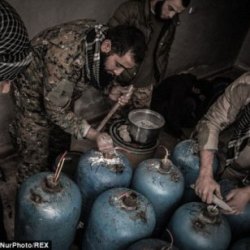 Where is the neutrality in the White Helmet reporting of the conflict in the areas where they are embedded? We hear incessantly of the “regime barrel bombs”, but we never hear one mention of the flesh tearing hell cannon fired indiscriminately upon Aleppo civilians, the hail of mortars and rockets being rained down upon Damascus civilian areas from suburban terrorist cells. We are never told about the car bombs that have devastated civilian areas in Homs and Lattakia, including schools and hospitals.
When do we hear about the tunnels dug under civilian homes and streets by the terrorists that are detonated as a distraction to lead the SAA into sniper fire or ambush.
Do these neutral humanitarians talk about the terrorist snipers who kill and maim civilians on a regular basis?
Do they even discuss the atrocities committed against the legitimate Syrian army?
For example: Al Houta Abyss, Raqqa: Terrorist dumping ground for the dead & the living.
A genuinely neutral report or analysis should surely take all of these factors into account, or are these “other” Syrian civilians not to be registered as such in the western electorate minds and hearts? If not, why not?
“The UN estimates 220,000 deaths thus far in the Syrian war. But almost half are Syrian army soldiers or allied local militia fighters, and two thirds are combatants if we count opposition fighters. Either way, the ratio of civilian to military casualties is roughly 1:2, given that the opposition is also inflicting civilian casualties. Compare that to the roughly 3:1 ratio in the US war in Iraq and 4:1 in the Israeli attack on Gaza in 2008-9. (The rate of Palestinian to Israeli casualties was an astronomical 100:1.)” ~ Paul Larudee. Mythology, Barrel Bombs and Human Rights Watch.
“In April and June 2014, I spent a cumulative month in Syria, in various areas of Damascus, with visits to Latakia, Homs, and Ma’aloula. At the time, Damascus was being intensely shelled by mortars, frequently in my vicinity, including just behind the hotel housing the Peace Delegation which I accompanied for the first week (photo). This attack killed three civilians and one Syrian soldier. We saw some of the 60 plus children injured in the April 15 shelling of a school, not an isolated occasion, an attack which also killed one child. Mortars rained down at close-proximity on many occasions in different areas of the Old City where I had then found lodging.” ~ Eva Bartlett
This is a statement from an Aleppo citizen. Another Syrian civilian who has never heard of the White Helmets.
“The terrorists are using mortars, explosive bullets, cooking-gas cylinders bombs and water-warming long cylinders bombs, filled up with explosives and shrapnel and nails, in what they call “Hell Canon”. Google these weapons or see their YouTube clips. The cooking-gas cylinder is made of steel, and it weighs around 25 kg. Imagine it thrown by a canon to hit civilians? And imagine knowing that it’s full with explosives?… Yet, the media is busy with the legendary weapon of “barrel bombs”! They came to spread “freedom” among Syrians! How dare they say that Syrian army shouldn’t fight them back?” ~ from Syria, welcome to Hell.

How can the White Helmets make a claim of neutrality while providing simplistic, largely unverified, biased and prejudicial reports that reflect only a percentage of the reality of this complex conflict and blatantly further the objectives of their donors in the region while ignoring the sacrifice being made by the Syrian Arab Army to defend their families and homeland from the invading NATO death squads.
“The Syrian Army is the Syrian people.” ~ Mother Agnes Mariam
From our same civilian contact in Aleppo:
“Aleppo city has shrunk to a fifth of its original size, and became so crowded with refugees that fled their areas after they fell into terrorist hands. I walk everyday in the city. I see children, young girls without limbs because of a terrorist mortar or shrapnel that targets them randomly and causes terrible wounds and horrific memories that will never leave them. The girl who lost one leg is standing on her good leg and selling bread, while the little boy who lost one arm is selling chewing gum. Those are the “injured” people who are mentioned fleetingly in the news, just numbers in one line of a report, after each attack from the terrorists. “Injured” doesn’t mean scratched or having a bleeding finger; it means someone lost his eyes or her limbs.”
Finally, this photo was taken shortly after Russia had legally entered the conflict in Syria at the request of the Syrian Government. Does it not seem a strange message to be conveyed by a neutral, unbiased humanitarian organisation with a self- proclaimed mandate to protect ALL Syrian people? The White Helmets will not kneel? They are neutral are they not, to whom would they kneel or not kneel if indeed they serve all Syrians regardless of “race, religion, gender or political affiliation”

White Helmets: Execution facilitators
There is an entire library of White Helmet propaganda images that have been proven to be recycled, fake or at best, inaccurate but perhaps the most shocking and most widely publicised was the footage of their suspected participation in an Al Nusra execution of a civilian in Hreitan, Northern Aleppo.
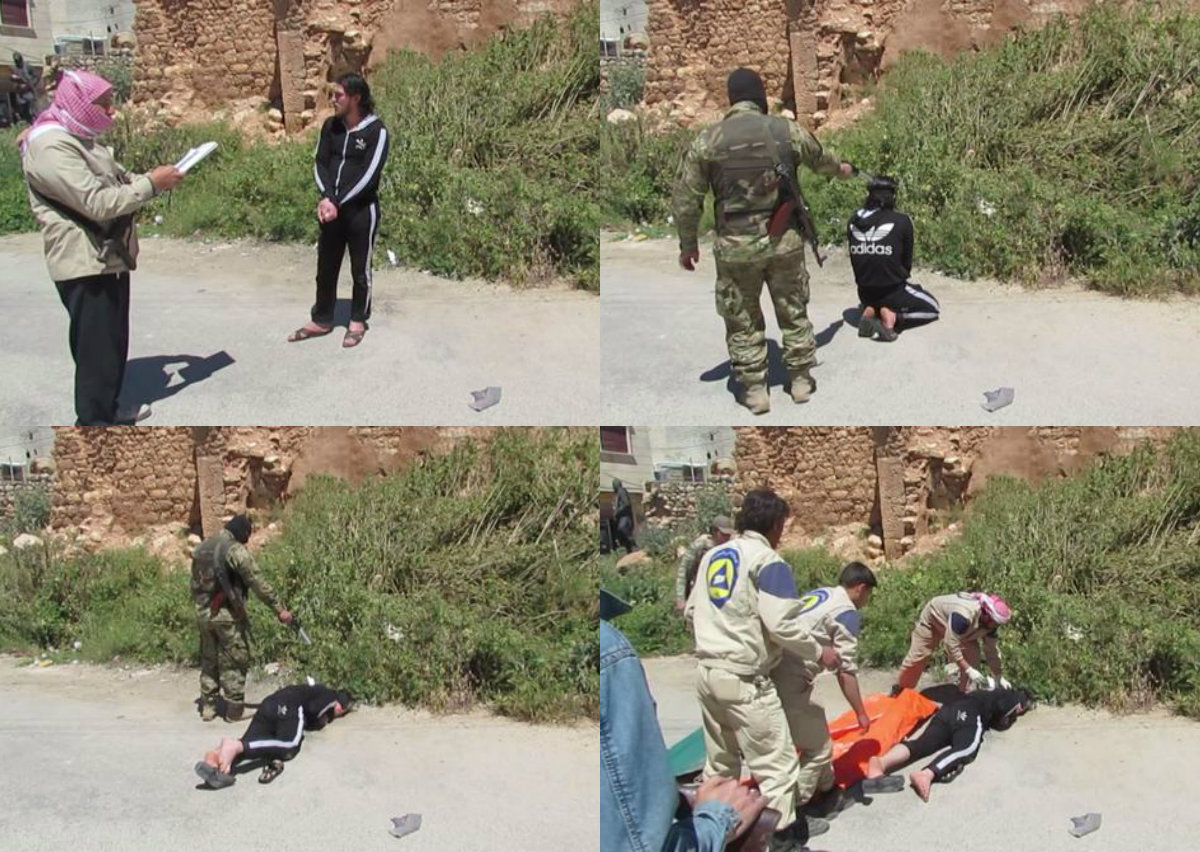
This video was wiped from most channels by the White Helmets immediately after its release, however Liveleak managed to keep a protected copy which has escaped censorship.
WARNING: GRAPHIC CONTENT
http://www.liveleak.com/view?i=fd8_1430900709
Sequence of events on the day, 5th May 2015. Al Nusra called the White Helmets 25 minutes prior to the execution. White Helmets arrived on the scene at 11.35 am, 5 minutes BEFORE the execution was carried out at 11.40. These impartial humanitarian workers did NOTHING to prevent this execution, they appear a full 5 minutes prior to this murder at the behest of the executioners and they are ushered into shot immediately after the victim is shot twice at close range in the head, to collect the body. These are the neutral humanitarians at work saving every Syrian civilian “irrespective of race, religion, gender or political affiliation.”
This is taken from the White Helmet official statement AFTER their execution facilitation had gone viral on social media.
“We unequivocally condemn the killing of civilians no matter who the perpetrator.”
So where is their condemnation of this and countless other executions of civilians by Al Nusra in their reports to the UN?
“The discussion over the video from Hreitan has highlighted the absence of a published code of conduct to which civil defence volunteers can be held accountable. The leaders of Syria Civil Defence commit to the development and publication of a code of conduct for members and its public posting on the www.SyriaCivilDefence.Org website in English and Arabic within one month.”
We are now coming up to November and there has still been no amendment to their “Execution code”. These Humanitarians upon whose testimony, hangs the entire Western intervention policy in Syria, have not been officially investigated or even questioned over their suspected role in the “clean up” of a summary execution of a Syrian civilian by terrorist groups in Syria.
Armed or Unarmed?
“Unpaid Unarmed Lifesavers in Syria.” ~ New York Times headline Feb 2015.
“The White Helmets are unpaid and unarmed, and they risk their lives to save others…….. Wearing simple white construction helmets as feeble protection from those “double-tap” bombings, the White Helmets are strictly humanitarian. They even have rescued some of the officers of the regime of President Bashar al-Assad who are bombing them.”
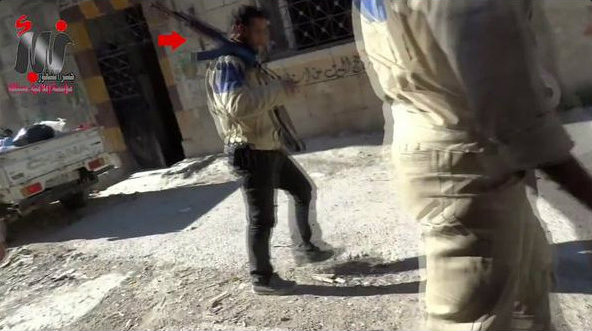
Video clearly showing armed White Helmets on the streets of Aleppo:
Meet another confused impartial, unarmed White Helmet, Muawiya Hassan Agha based in Sarmine, Idlib [scene of the recent alleged Russian Air Force bombing of a civilian hospital].

It appears that Agha plays a dual role in Syria’s conflict, White Helmet by day and Al Nusra armed terrorist by night, posing on board an Al Nusra tank, gun in hand. Here is a very clear case of the lines between unarmed humanitarian and armed mercenary being more than a little blurred. In one photo Agha is seen clearly celebrating with Al Nusra wearing his White Helmet tabard. In the stills taken from the alleged Russian hospital bombing in Sarmine, Idlib, he is spotted emerging from the “bombed” building. His association with Al Nusra and his brazen show of armed affiliation leaves no doubt as to his role in this conflict and it is far removed from that of an impartial, unarmed Humanitarian.
In fact, the immortal words of Russian Foreign Minsiter, Sergei Lavrov, spring to mind:
“If it looks like a terrorist, if it acts like a terrorist, if it walks like a terrorist, if it fights like a terrorist, it’s a terrorist, right?”

A very cursory scroll down Agha’s Facebook page also reveals very recent photos of SAA corpses accompanied by a number of celebratory comments.
I have only touched on a tiny percentage of the available archives of White Helmets deception and prejudiced propaganda campaigns, but the examples I have presented should begin to confront the highly effective Purpose built marketing campaign that has portrayed these paid mercenaries, impostors and agents for regime change as benign, unprejudiced saviours of beleaguered civilians in areas known to be terrorist strongholds and often, virtually devoid of civilian populations. As Mother Agnes Mariam stated unequivocally, in her recent interview, 90% of IDPs [internally displaced persons] in Syria have taken refuge in Government held areas.
The success of the White Helmet and NGO complex propaganda is dependent upon the skewing of our moral compass by the media and government institutions that are experts at “nudging” public opinion. If we really want to support Syria in this battle against such a complex array of interventionist forces, we must locate that compass and allow it to point us squarely towards the truth, however hard that truth is to assimilate and however remote it is from the mainstream narrative. In fact I would go as far as to say, the further away you get from the mainstream, the closer you get to the truth.
One final example of White Helmet propaganda at work:
“White Helmets claim to have rescued an SAA soldier who had in reality been captured by Al Nusra terrorists 10 days previously. In the Al Nusra version, this soldier is described as a “Shia pig” and was most probably summarily executed as an apostate according to Wahabi doctrine. Hard to imagine how the White Helmets then rescued him, unless of course they dug up his body for publicity purposes.”

END OF PART II
In Part III we will analyse the recent speeches given by the White Helmet leaders, James Le Mesurier, Raed Saleh and Farouq al Habib, in particular, who has been doing the rounds of Western media trying to regain lost propaganda ground, including guest speaker spot at the prestigious Frontline club last week.
White Helmets: War by Way of Deception
By Vanessa Beeley | thewallwillfall | October 23, 2015
“The Ivy League bourgeoisie who sit at the helm of the non-profit industrial complex will one day be known simply as charismatic architects of death. Funded by the ruling class oligarchy, the role they serve for their funders is not unlike that of corporate media. Yet, it appears that global society is paralyzed in a collective hypnosis – rejecting universal social interests, thus rejecting reason, to instead fall in line with the position of the powerful minority that has seized control, a minority that systematically favours corporate interests.” ~ Cory Morningstar
In his recent speech Hezbollah leader, Sayyed Nasrallah, alluded to a multi-phase “soft war” which relies upon the mass media complex to disseminate propaganda and bias, propelling the Middle East into, primarily, a sectarian crisis before descending even further into regionalism and finally a devastating individualism.
Cory Morningstar’s body of work does more than any other to expose the bare bones of the non-profit propaganda industry that governs both our reactions – and inactions, through a network of multi-layered and multi-faceted media manipulation campaigns, of which the end result is mass thought control. She explains:
“The 21st century NGO is becoming, more and more, a key tool serving the imperialist quest of absolute global dominance and exploitation. Global society has been, and continues to be, manipulated to believe that NGOs are representative of “civil society” (a concept promoted by corporations in the first place). This misplaced trust has allowed the “humanitarian industrial complex” to ascend to the highest position: the missionaries of deity – the deity of the empire.”
In a paper entitled, Foreign Aid and Regime Change: A Role for Donor Intent, written just prior to NATO intervention in Libya, Prof. Sarah Blodgett Bormeo describes the “democratization” process for target nations. Unwittingly or wittingly, Bormeo perfectly outlines the role played by NGOs in this process. Bormeo even goes so far as to pinpoint the lack of impartiality rife among NGOs large and small, the majority of whom, receive their funding directly from western government and major corporation sources – all of whom have a vested interest in the outcome of their NGO’s activities and ‘intervention’ in a particular location. Bormeo emphasises the importance of “picking winners” in this scenario, as opposed to respecting and supporting the will of the people in any sovereign nation.
“Thus, it is possible that aid donors, in an effort to avoid further entrenching an “authoritarian” [my edit: this status is decided by donor] regime and perhaps increase the likelihood of democratization, channel funds through NGOs and civil society organizations in authoritarian states.”
In this short video below, we are introduced to the US military’s symbiotic relationship with NGOs in countries [in this instance, Iraq] where the policy is to Induce Pacification & Advance Western Ideologies. NGOs are cynically used to “soften” cultures and render entire communities dependent upon foreign aid in order to facilitate “Democratization”.
In this role, and dependent upon their donor support, NGOs cease to be the neutral, unbiased ‘humanitarian’ organisations they publicly purport to be, and instead become actual covert tools for foreign intervention and regime change. By default, they are assimilated into the Western modus vivendi of “waging war by way of deception” and their purpose is to alter public perception of a conflict via a multitude of media and “marketing” channels.
Following this formula, let’s examine, once more, the role of the Syria Civil Defence aka,’The White Helmets’ currently operating in Syria and take a closer look at their financial sources and mainstream media partners in order to better determine if they are indeed “neutral” as media moguls proclaim these “humanitarians” to be.
White Helmets: Follow the Money
The White Helmets were established in March 2013, in Istanbul, Turkey, and is headed by James Le Mesurier, a British “security” specialist and ‘ex’ British military intelligence officer with an impressive track record in some of the most dubious NATO intervention theatres including Bosnia and Kosovo, as well as Iraq, Lebanon, and Palestine. Le Mesurier is a product of Britain’s elite Royal Military Academy at Sandhurst, and has also been placed in a series of high-profile pasts at the United Nations, European Union, and U.K. Foreign and Commonwealth Office.
The origins of The White Helmet’s initial $300k seed funding is a little hazy, reports are contradictory but subsequent information leads us to conclude that the UK, US and Syrian opposition [Syrian National Council] are connected. Logistical support has been provided by given by Turkish elite natural disaster response team, AKUT.
A further $13 million was poured into the White Helmet coffers during 2013 and this is where it gets interesting. Early reports suggest that these “donations” came from the US, UK and SNC with the previously explored connections to George Soros in the US.
Soros in Syria: ‘Humanitarian’ NGO Deployed For Regime Change, Not Aid
However, subsequent investigations reveal that USAID has been a major shareholder in the White Helmet organisation.
The website for the United States Agency for International Development (USAID) claims that “our work supports long-term and equitable economic growth and advances U.S. foreign policy objectives by supporting: economic growth, agriculture and trade; global health; and, democracy, conflict prevention and humanitarian assistance.”
In a USAID report update in July 2015 it is clearly stated that they have supplied over $ 16m in assistance to the White Helmets.

The USAID track record as a primary US Government/CIA regime change facilitator is extensively documented. From South America to the Ukraine and in the Middle East, USAID serve a malevolent and ultimately destructive role in the dismantling of sovereign nations and their reduction to Western hegemony vassal states, as always, all in the name of freedom and democracy.
“The United States does not lack institutions that continue to conspire, and that’s why I am using this gathering to announce that we have decided to expel USAID from Bolivia” ~ Bolivian President Evo Morales
“USAID and NED are in the business of “Democracy Promotion” which uses public money (from U.S. taxpayers) for secretive operations with the intention to support pro-U.S. governments with the help of political and social movements abroad. The goal is regime change.” ~ Timothy Alexander Guzman
With recent developments in Syria and as a consequence of the Syrian Government requested Russian intervention, we have seen a scramble to justify the shambolic US foreign policy and its clandestine terror operations in Syria. We have previously established the White Helmet connections to this US regime change operation and their undisputed exclusive integration into the Al Nusra and Free Syrian Army [Muslim Brotherhood] and even ISIS networks and strongholds.
Humanitarian’ Propaganda War Against Syria – Led by Avaaz and The White Helmets
After RT and Sott.net among others, exposed the gaping holes in White Helmet propaganda over recycled photographs tweeted even before the alleged Russian bombing had occurred, the propaganda “war” ramped up. The Russian involvement in Syria, did not only betray the US military deception, it also brought some heavyweight media giants of its own into the fray who set about de-constructing the Western media and NGO indoctrination that had, for so long, been largely unchallenged.
At this point the London Telegraph went into damage limitation mode. It published an article expounding the White Helmet humanitarian role in Syria but with admissions of UK Government “majority” funding and that the White Helmets are embedded with ISIS (“in at least one ISIL held area”), claims previously vehemently denied but rendered indisputable after discovery of the photo showing an ISIS mercenary posing directly in front of a White Helmets depot located deep in ISIS held territory south of Yarmouk.

“The Foreign Office is currently the largest single source of funding. It is an irony that if Britain does effectively become an ally of Assad, and starts raids against Isil in Syria, it will be bombing from the air and paying for the bodies to be dug out on the ground. The White Helmets are also operating in at least one Isil-held area.”
Interestingly, the Telegraph stated clearly that the UK Foreign Office is the “largest single source of funding” for the White Helmets which may be perceived as an attempt to draw fire away from the USAID funding which still outstrips official figures released by the British Gov’t who “gifted” £ 3.5 million in equipment to “civil defence teams” in Syria [Report March 2015]. However, the British Government also committed to an additional £ 10m to “increase coordination between the Syrian Interim Government and civil defence teams” to be funded by: UK Government’s Conflict, Security and Stability Fund (CSSF).
It should also be noted here that although cries of ‘regime change!’ from both Washington and London have been muted since Russia entered the Syria conflict, both Washington and London have been supporting their own parallel, hand-picked ‘interim government’ for Syria since at least 2012.
So, with millions in hard cash and equipment being invested into the White Helmets by US & UK donors who have a very clear regime change objective in Syria, it becomes increasingly difficult to perceive their role as anything other than donor-biased propaganda merchants and a ‘humanitarian’ extension of a clandestine terror operation allied to the NATO proxy armies in the region.
White Helmet Leadership
James Le Mesurier: James Le Mesurier has been portrayed as a Humanitarian maverick hero, miraculously in the right place (Istanbul) at the right time, just as the need arose for the formation of a Syria Civil Defence team, perhaps coincidentally, only a few months prior to the now infamous and universally (except for a few diehard propagandists) discredited Ghouta ‘chemical weapon’ attack in August 2013, an event which has already been proven beyond a doubt to be a false flag attack, as well as subsequent accusations levied at the Syrian Government which narrowly failed to precipitate the NATO desired ‘No Fly Zone’.
However, when we delve deeper into the life and times of Le Mesurier we see that it was no happy accident that he was in Istanbul at this juncture. As Sandhurst Military Academy’s top student and recipient of the Queen’s Medal, his chequered career took him from OHR [Office of High Representative] in Bosnia to intelligence co-ordinator in NATO’s newly won prize, Kosovo. We’re told that Le Mesurier left the British Army in 2000 and joined the UN serving as deputy head of the Advisory Unit on ‘Security and Justice’, and Special Representative of the Secretary General’s security policy body within the UN mission in Kosovo. His career then took him to Jerusalem where he worked on implementing the Ramallah Agreement, then to Baghdad as a special advisor to Iraqi Minister of Interior, and to the UAE to train their gas field protection force, and later to Lebanon during the 2006 war. In 2005 he was made Vice President for Special Projects at private mercenary firm Olive Group, and in January 2008 he was appointed as Principal for Good Harbour International, both based in Dubai.
Le Mesurier is also the founder of Mayday Rescue, a “non profit” organisation providing SAR [search & rescue] training to civilians enduring conflict. According to Mesurier’s own biography on the website, Mayday Rescue was founded in 2014, after he had established Syria Civil Defence/White Helmets.

A quick flick through the other Mayday team members reveals some very interesting connections.
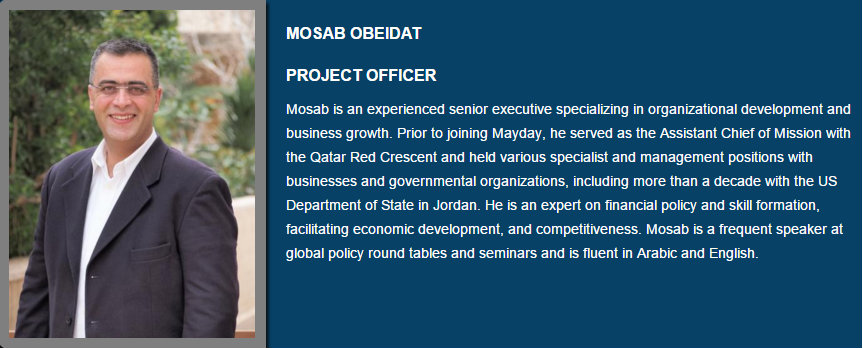
Mosab Obeidat, previous Assistant Chief of Mission with the Qatar Red Crescent, one of whose officials, Khaled Diab was accused of supplying $ 2.2 m to secure arms for the terrorist groups in Syria. Details of this transaction and its exposure can be found in this Al Akhbar article from June 2013.
At least three other members of the team were a part of the Syrian “revolution” including Farouq al Habib, one of the 3 most prominent White Helmet leaders who was also a leader of the Homs uprising against the Syrian government and according to his testimony, was tortured by the Syrian “regime” security forces in 2012 for smuggling a journalist into Syria to “cover” the “peaceful protests”. Habib was a founder member of the ‘Homs Revolutionary Council’ (the CIA have been linked to nearly all ‘Revolutionary Councils in Syria) before fleeing to Turkey in 2013 (A more in-depth analysis of his anti-Syrian government testimony will be presented in Part II of this article).

Le Mesurier is heavily involved in several organisations not mentioned in this article, but for the purposes of demonstrating that the White Helmets should not be considered impartial or neutral as they claim, we will focus on those that best substantiate that argument.
Both Olive Group and Good Harbour International are experts in private “security”. Taken from Sourcewatch on Olive Group:
“Olive Security was founded in 2001 by Harry Legge Burke. Olive lends their quick success to strong relations in the government and military industry. Harry Legge-Burke is an ex-Welsh Guard, and a former aid to chief of defence staff Sir [Charles Guthrie]. He can claim Prince William as a skiing partner and his sister was a nanny to the royal children.
Iraq: Olive were on the ground since the invasion began in 2003, and were able to deploy 38 former SAS employees within two days of the invasion’s completion in 2004
Jonathan Allum, Olive’s former director and co-owner, is also the son of Tony Allum, who is the chairman of the engineering company Halcrow and also the head of the UK government’s Iraq Industry Working Group. It was in the latter position that Tony Allum went to Washington to meet with Bechtel leaders, where he suggested, among other UK companies, Halcrow and Olive as companies worth considering for subcontracted work, all stemming from Bechtel’s $680 million contract with USAID. They were considered and contracts followed, though both Legge-Burke and Allum deny one had anything to do with the other”
In May 2015 Olive Group merged with Constellis Holdings, in whose portfolio we can also find Academi, previously the notorious Blackwater Group [ Nisour Square massacre, Iraq 2007]. Taken from The Atlantic July 2012: Post 9/11, Bush enabled the CIA to subcontract assassinations allegedly targeting Al Qaeda operatives. Blackwater was awarded this contract.
“Running operations through Blackwater gave the CIA the power to have people abducted, or killed, with no one in the government being exactly responsible.”
The CIA can no longer hide its Blackwater/Academi connections, especially after this week’s Wikileaks data dump of CIA director John Brennan’s emails, whose contact list included now spy chief Robert Richer at his Blackwater contact address.
The outsourcing of intelligence operations was in full-swing. What Bush initiated, Obama ran with, awarding Blackwater/Academi a $ 250m contract in 2010 to offer “unspecified” services to the CIA, thus maintaining the apparatus for “unaccountable” covert assassinations.
It is true that James Le Mesurier only joined Olive Group in 2005 and left them in 2008, but his involvement with them and their subsequent merger with Constellis and by default, Blackwater/Academi, gives a degree of valuable insight into the elite intelligence and Pentagon circles that Le Mesurier moved in prior to working for Good Harbour International and creating Syria Civil Defence (not forgetting the USAID funding & influence that underpins both Olive and SCD/White Helmets).
In 2008, Le Mesurier joined Good Harbour International, another private “security” expert organisation, whose CEO is none other than former terror advisor to the Bush administration, the Terror Czar himself, Richard A Clarke.

The jury is still out on whether Clarke was indeed the “whistleblower” he fashioned himself as, post 9/11, or a merely a high-level gatekeeper who aided in preventing a full and detailed investigation into Bush and Rumsfeld’s roles in 9/11.
Patrick Henningsen, a political analyst and writer for 21st Century Wire believes the latter is more likely:
“On first glance, one might buy into the mainstream media’s characterization of him, but it’s more likely that Richard Clarke is not a whistleblower at all. While appearing to oppose the Bush administration from a safe enough distance, I believe his role was inserted into the mix in the period of 2004-2005 in order to VALIDATE the bin Laden mythology and help to portray al Qaeda as an organic, independently run terror organization. He also claimed that Bush and Rumsfeld committed war crimes, but this means nothing because everyone knows that no US official will ever face ‘war crimes’ charges in any court of law anywhere on the planet. It’s effectively a straw man narrative that distracts from the real scandal in the US which is that the entire premise of the war on terror is completely contrived. Clarke’s ‘whistleblower’ status gives him brilliant cover from too much public scrutiny. I remain skeptical of his whole public narrative. He was, is, and always will be an insider.”
What is perhaps even more telling, is Clarke’s reported close ties with Israeli-US operative Rita Katz of the SITE Intelligence Group, another supposedly independent, albeit ‘private’ intelligence firm located in Bethesda, Maryland, a stone’s throw away from CIA headquarters. SITE are said to be responsible for the media release of the harrowing ISIS execution videos, al Qaeda videos, and their credibility has been extensively questioned.
Katz’s long term working relationship with Clarke began before 9/11 when she and her research associate Steve Emerson were commissioned by Clarke to identify Islamic radicals within the US. Over time, Katz’s relationship with Clarke blossomed into a much more extensive one that included regular briefings at both the Clinton and Bush White Houses.
“One of SITE’s founders, Rita Katz, is a government insider with close connections to former terrorism czar Richard Clarke and his staff in the White House, as well as investigators in the Department of Justice, Department of the Treasury, and the Department of Homeland Security, according to SourceWatch. Her father was executed in Iraq as an Israel spy, a fact that suggests a connection to Israeli intelligence.” ~ Mark Taliano
This background on Le Mesurier should at least make us question the media portrayal of an affable, debonair and philanthropic leader of a civilian humanitarian mission. His military & intelligence roots, the fact that despite working for OHR in Bosnia, no visible record of his employment can be found there, his private security-centric career path, his appearance in Istanbul at just the right moment to partner USAID, the UK government & Syrian opposition in creating just the sort of “democratization” enabling NGO as described in our introduction, MUST at least cause us to doubt the transparency and neutrality of the White Helmets in Syria.
In addition, the White Helmet leadership consisting of known Syrian opposition protagonists such as Raed Saleh and Farouq al Habib must make us more cynical about the claims of impartiality and lack of bias and for those who will defend the “peaceful” revolution narrative upheld by Habib and Saleh, please take the time to read Professor Tim Anderson’s in depth analysis of events in Syria pre NATO intervention.
“I have seen from the beginning armed protesters in those demonstrations … they were the first to fire on the police. Very often the violence of the security forces comes in response to the brutal violence of the armed insurgents” – Jesuit priest Father Frans Van der Lugt, January 2012, Homs Syria
“The claim that armed opposition to the government has begun only recently is a complete lie. The killings of soldiers, police and civilians, often in the most brutal circumstances, have been going on virtually since the beginning.” – Professor Jeremy Salt, October 2011, Ankara Turkey
Our presentation of the White Helmets as regime change propagandists & terrorist allies in this article will be further explored and verified in Part II.
“Existing soft power initiatives and agencies, particularly those engaged in development and strategic communications, must be reinvigorated through increased funding, human resources and prioritization. Concurrently, the U.S. government must establish goals, objectives and metrics for soft power initiatives. Furthermore, the U.S. government can better maximize the effectiveness of soft power instruments and efforts through increased partnerships with NGOs. By providing humanitarian and development assistance in areas typically inaccessible to government agencies, NGOs are often able to access potential extremist areas before the government can establish or strengthen diplomatic, developmental or military presence, including intelligence.” — Joseph S. Nye, former US assistant secretary of defence, June 2004
Featured Video
American Military Failure in Afghanistan
or go to
Aletho News Archives – Video-Images
Frlom the Archives
Iran War: United States Military Versus Israel Firsters
By James Petras | November 27, 2007
Why must Jewish organizations be and be seen as the loudest drum-beaters of all? Why can we not bring ourselves to say that military intervention is not on the table at all? Why not stash it under the table, out of sight and mount instead a diplomatic assault? – Leonard Fein, Forward
Introduction
As the White House and Congress escalate their economic sanctions and military threats against Iran, top military commanders and Pentagon officials have launched a counter-offensive, opposing a new Middle East War. While some commentators and journalists, like Chris Hedges (Truthdig, November 13, 2007), privy to this high stakes inter-elite conflict, attribute this to a White House cabal led by Vice President Cheney, a more stringent and accurate assessment puts the Zionist Power Configuration (ZPC) in the center of the Iran war debate.
There is a great deal riding in this conflict – the future of the American empire as well as the balance of power in the Middle East. Equally important is the future of the US military and our already heavily constrained democratic freedoms. The outcome of the continuous and deepening confrontation between top US military officials and the Israel Firsters over US foreign policy in the Middle East has raised fundamental questions over self-determination, colonization, civilian primacy and military political intervention, empire or republic. These and related issues are far from being of academic interest only; they concern the future of the United States. … continue
Blog Roll
 Aletho News
- Hezbollah Returns: It Didn’t Start a War, It Is Ending One
- EU states seek ‘talks’ with Iran for access to Strait of Hormuz: Report
- Trump on Hormuz: “Others must take care of it” after US falters
- Who Is closer to collapse?
- A War that Backfired: Why the US-Israeli Campaign Is Strengthening Iran
- How Zionist Control Is Hurting US Interests
- Iran warns it may target US missile launch sites in UAE cities
- American Military Failure in Afghanistan
- Friendly Skies of Georgia: Are Israeli-Linked Drones Launching False Flags from Georgian Territory?
- The Three Big Lies about Mammography Screening
- If Americans Knew
- No let-up in attacks on Gaza as Israel takes on Iran, Lebanon – Not a ceasefire Day 155
- ‘Of Course’: IDF Drops Case Against Soldiers Accused of Raping Palestinian Prisoner
- Don’t Fall for the Regime Change Talk. Israel Is ‘Mowing the Lawn’ in Iran
- Will Israel and the US wreck the Gulf States along with Iran?
- US so far burned through ‘years’ of munitions in Iran war: Report
- How the Israeli Tail Wags the American Dog
- Outdated intel likely led to deadly U.S. strike on Iranian elementary school, sources say
- Pentagon insider says high U.S official Douglas Feith reported to Netanyahu
- In fond memory of Walid Khalidi, the historian of Palestine
- 6 more Americans killed, as Israel ‘mows the lawn’ in Iran – Not a ceasefire Day 154
- No Tricks Zone
- Storing Green Energy To Last Germany 10 Days Would Require A 60-Million Tonne Battery
- New Studies: UK Sea Levels Were 4 Meters Higher Than Today During The Mid-Holocene
- Destructive Green New Deal: German Energy And Metal Group Warns Of Drastic Crisis
- New Study Documents A 20-Year Pause In Arctic Sea Ice Decline – Driven By Internal Variability
- Wake-up Call: Survey Shows Majority Of Germans Now Favor Postponing Climate Targets!
- Televised! Leading German Political Candidate Tells Schoolchildren CO2 Makes Sun Hotter!
- New Study: A Century Warming Of 1.1°C Is ‘Commonplace’ And ‘Not Unusual’ During This Interglacial
- New Study: ‘Internal Noise’ And Volcanic Forcing Can Trigger 10-15°C Warming Within Decades
- Glaciers Worldwide Are Suddendly Surging, Experts Blame Warming!
- Surprising Discovery: Sahara Is Greening…Billions Of Trees Where Once Thought To Be Barren
 Aletho News