Putin Smeared Himself to Undermine Democrats — MSM Has a New Russiagate Theory
It’s now Russia’s fault Democrats needlessly polarized American society by advancing feeble-minded smears from the Clinton dossier

What can you do when Putin plays 7-dimensional chess
Russia Insider | February 6, 2108
US invaded Iraq in 2003 because Iraq had “weapons of mass destruction”. Except Iraq didn’t have them. Once the lie had served its purpose the US admitted as much, but dodged responsibility by redacting the story: Iraq had been pretending it had WMDs! No way was the US smearing and invading the country based on that smear actually America’s fault.
Well neither is falsely accusing Russia of getting its Manchurian candidate into the White House. Because while KGB doesn’t actually have tons of blackmail material on him Russia pretended it did. Take it over Wall Street Journal :
There is a third possibility, namely that the dossier was part of a Russian espionage disinformation plot targeting both parties and America’s political process. This is what seems most likely to me, having spent much of my 30-year government career, including with the CIA, observing Soviet and then Russian intelligence operations. If there is one thing I have learned, it’s that Vladimir Putin continues in the Soviet tradition of using disinformation and espionage as foreign-policy tools.
…
The pattern of such Russian operations is to sprinkle false information, designed to degrade the enemy’s social and political infrastructure, among true statements that enhance the veracity of the overall report.
Oh those Russkies! While they actually did not do the things the Hillary dossier says, they wanted Americans to believe they did, so of course insane Russiagaters can not be blamed for advancing the lie Russia was actually secretly controlling their President.
So we’ve gone from Russia being responsible for Russiagate to Russia being responsible for Americans falsely believing Russia was responsible for Russiagate.
Also it’s now Russia’s fault Democrats needlessly polarized American society by advancing feeble-minded smears from the Clinton dossier.
Oh well, whatever keeps you from having to take responsibility I guess.

Nice round-about way of admitting the Steele Dossier was idiotic and that advancing it hurt Democrats, however.
The Cold War Now and Then
By William Blum | Dissident Voice | December 6, 2017
“He said he absolutely did not meddle in our election. He did not do what they are saying he did.” – President Trump re Vladimir Putin after their meeting in Vietnam.
Putin later added that he knew “absolutely nothing” about Russian contacts with Trump campaign officials. “They can do what they want, looking for some sensation. But there are no sensations.”1
Numerous US intelligence agencies have said otherwise. Former Director of National Intelligence, James Clapper, responded to Trump’s remarks by declaring: “The president was given clear and indisputable evidence that Russia interfered in the election.”
As we’ll see below, there isn’t too much of the “clear and indisputable” stuff. And this, of course, is the same James Clapper who made an admittedly false statement to Congress in March 2013, when he responded, “No, sir” and “not wittingly” to a question about whether the National Security Agency was collecting “any type of data at all” on millions of Americans. Lies don’t usually come in any size larger than that.
Virtually every member of Congress who has publicly stated a position on the issue has criticized Russia for interfering in the 2016 American presidential election. And it would be very difficult to find a member of the mainstream media which has questioned this thesis.
What is the poor consumer of news to make of these gross contradictions? Here are some things to keep in mind:
How do we know that the tweets and advertisements “sent by Russians” -– those presented as attempts to sway the vote -– were actually sent by Russians? The Veteran Intelligence Professionals for Sanity (VIPS), composed of National Security Agency and CIA veterans, recently declared that the CIA knows how to disguise the origin of emails and tweets. The Washington Post has as well reported that Twitter “makes it easy for users to hide their true identities.”2 Even if these communications were actually sent from Russia, how do we know that they came from the Russian government, and not from any of the other 144.3 million residents of Russia?
Even if they were sent by the Russian government, we have to ask: Why would they do that? Do the Russians think the United States is a Third World, under-developed, backward Banana Republic easily influenced and moved by a bunch of simple condemnations of the plight of blacks in America and the Clinton “dynasty”? Or clichéd statements about other controversial issues, such as gun rights and immigration? If so, many Democratic and Republican officials would love to know the secret of the Russians’ method. Consider also that Facebook has stated that 90 percent of the alleged-Russian-bought content that ran on its network did not even mention Trump or Clinton.3
On top of all this is the complete absence of even the charge, much less with any supporting evidence, of Russian interference in the actual voting or counting of votes.
After his remark suggesting he believed Putin’s assertion that there had been no Russian meddling in the election, Trump – of course, as usual – attempted to backtrack and distance himself from his words after drawing criticism at home; while James Clapper declared: “The fact the president of the United States would take Putin at his word over that of the intelligence community is quite simply unconscionable.”4
Given Clapper’s large-size lie referred to above, can Trump be faulted for being skeptical of the intelligence community’s Holy Writ? Purposeful lies of the intelligence community during the first Cold War were legendary, many hailed as brilliant tactics when later revealed. The CIA, for example, had phony articles and editorials planted in foreign newspapers (real Fake News), made sex films of target subjects caught in flagrante delicto who had been lured to Agency safe houses by female agents, had Communist embassy personnel expelled because of phony CIA documents, and much more.
The Post recently published an article entitled “How did Russian trolls get into your Facebook feed? Silicon Valley made it easy.” In the midst of this “exposé,” The Post stated: “There’s no way to tell if you personally saw a Russian post or tweet.”5 So … Do the Cold Warriors have a case to make or do they not? Or do they just want us to remember that the Russkis are bad? So it goes.
An organization in Czechoslovakia with the self-appointed name of European Values has produced a lengthy report entitled “The Kremlin’s Platform for ‘Useful Idiots’ in the West: An Overview of RT’s Editorial Strategy and Evidence of Impact”. It includes a long list of people who have appeared on the Russian-owned TV station RT (formerly Russia Today), which can be seen in the US, the UK and other countries. Those who’ve been guests on RT are the “idiots” useful to Moscow. (The list is not complete. I’ve been on RT about five times, but I’m not listed. Where is my Idiot Badge?)
RT’s YouTube channel has more than two million followers and claims to be the “most-watched news network” on the video site. Its Facebook page has more than 4 million likes and followers. Can this explain why the powers-that-be forget about a thing called freedom-of-speech and treat the station like an enemy? The US government recently forced RT America to register as a foreign agent and has cut off the station’s Congressional press credentials.
The Cold War strategist, George Kennan, wrote prophetically: “Were the Soviet Union to sink tomorrow under the waters of the ocean, the American military-industrial establishment would have to go on, substantially unchanged, until some other adversary could be invented. Anything else would be an unacceptable shock to the American economy.”6
Writer John Wight has described the new Cold War as being “in response to Russia’s recovery from the demise of the Soviet Union and the failed attempt to turn the country into a wholly owned subsidiary of Washington via the imposition of free market economic shock treatment thereafter.”
So let’s see what other brilliance the New Cold War brings us. … Ah yes, another headline in the Post (November 18, 2017): “British alarm rising over possible Russian meddling in Brexit”. Of course, why else would the British people have voted to leave the European Union? But wait a moment, again, one of the British researchers behind the report “said that the accounts they analyzed – which claimed Russian as their language when they were set up but tweeted in English – posted a mixture of pro-‘leave’ and pro-‘remain’ messages regarding Brexit. Commentators have said that the goal may simply have been to sow discord and division in society.”
Was there ever a time when the Post would have been embarrassed to be so openly, amateurishly biased about Russia? Perhaps during the few years between the two Cold Wars.
In case you don’t remember how stupid Cold War Number One was …
- 1948: The Pittsburgh Press published the names, addresses, and places of employment of about 1,000 citizens who had signed presidential-nominating petitions for former Vice President Henry Wallace, running under the Progressive Party. This, and a number of other lists of “communists”, published in the mainstream media, resulted in people losing their jobs, being expelled from unions, having their children abused, being denied state welfare benefits, and suffering various other punishments.
- Around 1950: The House Committee on Un-American Activities published a pamphlet, “100 Things You Should Know About Communism in the U.S.A.” This included information about what a communist takeover of the United States would mean:Q: What would happen to my insurance?A: It would go to the Communists.Q: Would communism give me something better than I have now?A: Not unless you are in a penitentiary serving a life sentence at hard labor.
- 1950s: Mrs. Ada White, member of the Indiana State Textbook Commission, believed that Robin Hood was a Communist and urged that books that told the Robin Hood story be banned from Indiana schools.
- As evidence that anti-communist mania was not limited to the lunatic fringe or conservative newspaper publishers, here is Clark Kerr, president of the University of California at Berkeley in a 1959 speech: “Perhaps 2 or even 20 million people have been killed in China by the new [communist] regime.” One person wrote to Kerr: “I am wondering how you would judge a person who estimates the age of a passerby on the street as being ‘perhaps 2 or even 20 years old.’ Or what would you think of a physician who tells you to take ‘perhaps 2 or even twenty teaspoonsful of a remedy’?”
- Throughout the cold war, traffic in phony Lenin quotes was brisk, each one passed around from one publication or speaker to another for years. Here’s U.S. News and World Report in 1958 demonstrating communist duplicity by quoting Lenin: “Promises are like pie crusts, made to be broken.” Secretary of State John Foster Dulles used it in a speech shortly afterward, one of many to do so during the cold war. Lenin actually did use a very similar line, but he explicitly stated that he was quoting an English proverb (it comes from Jonathan Swift) and his purpose was to show the unreliability of the bourgeoisie, not of communists.“First we will take Eastern Europe, then the masses of Asia, then we will encircle the United States, which will be the last bastion of capitalism. We will not have to attack. It will fall like an overripe fruit into our hands.” This Lenin “quotation” had the usual wide circulation, even winding up in the Congressional Record in 1962. This was not simply a careless attribution; this was an out-and-out fabrication; an extensive search, including by the Library of Congress and the United States Information Agency failed to find its origin.
- A favorite theme of the anti-communists was that a principal force behind drug trafficking was a communist plot to demoralize the United States. Here’s a small sample:Don Keller, District Attorney for San Diego County, California in 1953: “We know that more heroin is being produced south of the border than ever before and we are beginning to hear stories of financial backing by big shot Communists operating out of Mexico City.”Henry Giordano, Commissioner of the Federal Bureau of Narcotics, 1964, interviewed in the American Legion Magazine: Interviewer: “I’ve been told that the communists are trying to flood our country with narcotics to weaken our moral and physical stamina. Is that true?”Giordano: “As far as the drugs are concerned, it’s true. There’s a terrific flow of drugs coming out of Yunnan Province of China. … There’s no question that in that particular area this is the aim of the Red Chinese. It should be apparent that if you could addict a population you would degrade a nation’s moral fiber.”Fulton Lewis, Jr., prominent conservative radio broadcaster and newspaper columnist, 1965: “Narcotics of Cuban origin – marijuana, cocaine, opium, and heroin – are now peddled in big cities and tiny hamlets throughout this country. Several Cubans arrested by the Los Angeles police have boasted they are communists.” We were also told that along with drugs another tool of the commies to undermine America’s spirit was fluoridation of the water.
- Mickey Spillane was one of the most successful writers of the 1950s, selling millions of his anti-communist thriller mysteries. Here is his hero, Mike Hammer, in “One Lonely Night”, boasting of his delight in the grisly murders he commits, all in the name of destroying a communist plot to steal atomic secrets. After a night of carnage, the triumphant Hammer gloats, “I shot them in cold blood and enjoyed every minute of it. I pumped slugs into the nastiest bunch of bastards you ever saw. … They were Commies. … Pretty soon what’s left of Russia and the slime that breeds there won’t be worth mentioning and I’m glad because I had a part in the killing. God, but it was fun!”
- 1952: A campaign against the United Nations Educational, Scientific and Cultural Organization (UNESCO) because it was tainted with “atheism and communism”, and was “subversive” because it preached internationalism. Any attempt to introduce an international point of view in the schools was seen as undermining patriotism and loyalty to the United States. A bill in the US Senate, clearly aimed at UNESCO, called for a ban on the funding of “any international agency that directly or indirectly promoted one-world government or world citizenship.” There was also opposition to UNESCO’s association with the UN Declaration of Human Rights on the grounds that it was trying to replace the American Bill of Rights with a less liberty-giving covenant of human rights.
- 1955: A US Army 6-page pamphlet, “How to Spot a Communist”, informed us that a communist could be spotted by his predisposition to discuss civil rights, racial and religious discrimination, the immigration laws, anti-subversive legislation, curbs on unions, and peace. Good Americans were advised to keep their ears stretched for such give-away terms as “chauvinism”, “book-burning”, “colonialism”, “demagogy”, “witch hunt”, “reactionary”, “progressive”, and “exploitation”. Another “distinguishing mark” of “Communist language” was a “preference for long sentences.” After some ridicule, the Army rescinded the pamphlet.
- 1958: The noted sportscaster Bill Stern (one of the heroes of my innocent youth) observed on the radio that the lack of interest in “big time” football at New York University, City College of New York, Chicago, and Harvard “is due to the widespread acceptance of Communism at the universities.”
- 1960: US General Thomas Power speaking about nuclear war or a first strike by the US: “The whole idea is to kill the bastards! At the end of the war, if there are two Americans and one Russian, we win!” The response from one of those present was: “Well, you’d better make sure that they’re a man and a woman.”
- 1966: The Boys Club of America is, of course, wholesome and patriotic. Imagine their horror when they were confused with the Dubois Clubs. (W.E.B. Du Bois had been a very prominent civil rights activist.) When the Justice Department required the DuBois Clubs to register as a Communist front group, good loyal Americans knew what to do. They called up the Boys Club to announce that they would no longer contribute any money, or to threaten violence against them; and sure enough an explosion damaged the national headquarters of the youth group in San Francisco. Then former Vice President Richard Nixon, who was national board chairman of the Boys Club, declared: “This is an almost classic example of Communist deception and duplicity. The ‘DuBois Clubs’ are not unaware of the confusion they are causing among our supporters and among many other good citizens.”
- 1966: “Rhythm, Riots and Revolution: An Analysis of the Communist Use of Music, The Communist Master Music Plan”, by David A. Noebel, published by Christian Crusade Publications, (expanded version of 1965 pamphlet: “Communism, Hypnotism and the Beatles”). Some chapters: Communist Use of Mind Warfare … Nature of Red Record Companies … Destructive Nature of Beatle Music … Communist Subversion of Folk Music … Folk Music and the Negro Revolution … Folk Music and the College Revolution
- 1968: William Calley, US Army Lieutenant, charged with overseeing the massacre of more than 100 Vietnamese civilians in My Lai in 1968, said some years later: “In all my years in the Army I was never taught that communists were human beings. We were there to kill ideology carried by – I don’t know – pawns, blobs, pieces of flesh. I was there to destroy communism. We never conceived of old people, men, women, children, babies.”
- 1977: Scientists theorized that the earth’s protective ozone layer was being damaged by synthetic chemicals called chlorofluorocarbons. The manufacturers and users of CFCs were not happy. They made life difficult for the lead scientist. The president of one aerosol manufacturing firm suggested that criticism of CFCs was “orchestrated by the Ministry of Disinformation of the KGB.”
- 1978: Life inside a California youth camp of the ultra anti-communist John Birch Society: Five hours each day of lectures on communism, Americanism and “The Conspiracy”; campers learned that the Soviet government had created a famine and spread a virus to kill a large number of citizens and make the rest of them more manageable; the famine led starving adults to eat their children; communist guerrillas in Southeast Asia jammed chopsticks into children’s ears, piercing their eardrums; American movies are all under the control of the Communists; the theme is always that capitalism is no better than communism; you can’t find a dictionary now that isn’t under communist influence; the communists are also taking over the Bibles.
- The Reagan administration declared that the Russians were spraying toxic chemicals over Laos, Cambodia and Afghanistan – the so-called “yellow rain” – and had caused more than ten thousand deaths by 1982 alone, (including, in Afghanistan, 3,042 deaths attributed to 47 separate incidents between the summer of 1979 and the summer of 1981, so precise was the information). Secretary of State Alexander Haig was a prime dispenser of such stories, and President Reagan himself denounced the Soviet Union thusly more than 15 times in documents and speeches. The “yellow rain”, it turned out, was pollen-laden feces dropped by huge swarms of honeybees flying far overhead.
- 1982: In commenting about sexual harassment in the Army, General John Crosby stated that the Army doesn’t care about soldiers’ social lives – “The basic purpose of the United States Army is to kill Russians,” he said.
- 1983: The US invasion of Grenada, the home of the Cuban ambassador is damaged and looted by American soldiers; on one wall is written “AA”, symbol of the 82nd Airborne Division; beside it the message: “Eat shit, commie faggot.” … “I want to fuck communism out of this little island,” says a marine, “and fuck it right back to Moscow.”
- 1984: During a sound check just before his weekly broadcast, President Reagan spoke these words into the microphone: “My fellow Americans, I am pleased to tell you I have signed legislation to outlaw Russia, forever. We begin bombing in five minutes.” His words were picked up by at least two radio networks.
- 1985: October 29 BBC interview with Ronald Reagan: asked about the differences he saw between the US and Russia, the president replied: “I’m no linguist, but I’ve been told that in the Russian language there isn’t even a word for freedom.” (The word is “svoboda”.)
- 1986: Soviet artists and cultural officials criticized Rambo-like American films as an expression of “anti-Russian phobia even more pathological than in the days of McCarthyism”. Russian film-maker Stanislav Rostofsky claimed that on one visit to an American school “a young girl trembled with fury when she heard I was from the Soviet Union, and said she hated Russians.”
- 1986: Roy Cohn, who achieved considerable fame and notoriety in the 1950s as an assistant to the communist-witch-hunting Senator Joseph McCarthy, died, reportedly of AIDS. Cohn, though homosexual, had denied that he was and had denounced such rumors as communist smears.
- 1986: After American journalist Nicholas Daniloff was arrested in Moscow for “spying” and held in custody for two weeks, New York Mayor Edward Koch sent a group of 10 visiting Soviet students storming out of City Hall in fury. “The Soviet government is the pits,” said Koch, visibly shocking the students, ranging in age from 10 to 18 years. One 14-year-old student was so outraged he declared: “I don’t want to stay in this house. I want to go to the bus and go far away from this place. The mayor is very rude. We never had a worse welcome anywhere.” As matters turned out, it appeared that Daniloff had not been completely pure when it came to his news gathering.
- 1989: After the infamous Chinese crackdown on dissenters in Tiananmen Square in June, the US news media was replete with reports that the governments of Nicaragua, Vietnam and Cuba had expressed their support of the Chinese leadership. Said the Wall Street Journal: “Nicaragua, with Cuba and Vietnam, constituted the only countries in the world to approve the Chinese Communists’ slaughter of the students in Tiananmen Square.” But it was all someone’s fabrication; no such support had been expressed by any of the three governments. At that time, as now, there were few, if any, organizations other than the CIA which could manipulate major Western media in such a manner.7
NOTE: It should be remembered that the worst consequences of anti-communism were not those discussed above. The worst consequences, the ultra-criminal consequences, were the abominable death, destruction, and violation of human rights that we know under various names: Vietnam, Chile, Korea, Guatemala, Cambodia, Indonesia, Brazil, Greece, Afghanistan, El Salvador, and many others.
Al Franken
Poor Al, who made us laugh for years on Saturday Night Live, is now disgraced as a woman molester – not one of the worst of the current pathetic crop, but he still looks bad. However, everything is relative, and it must be pointed out that the Senator is guilty of a worse moral transgression.
The erstwhile comedian would like you to believe that he was against the war in Iraq since it began. But he went to that sad country at least four times to entertain American troops. Does that make sense? Why does the Defense Department bring entertainers to military bases? To lift the soldiers’ spirits, of course. And why does the military want to lift the soldiers’ spirits? Because a happier soldier does his job better. And what is the soldier’s job? For example, all the charming war crimes and human-rights violations in Iraq that have been documented in great detail for many years. Didn’t Franken know what American soldiers do for a living?
Country singer Darryl Worley, who leans “a lot to the right,” as he puts it, said he was far from pleased that Franken was coming along on the tour to Iraq. “You know, I just don’t understand – why would somebody be on this tour if they’re not supportive of the war? If he decides to play politics, I’m not gonna put up with it.”8
A year after the 2003 US invasion of Iraq, Franken criticized the Bush administration because they “failed to send enough troops to do the job right.”9 What “job” did the man think the troops were sent to do that had not been performed to his standards because of lack of manpower? Did he want them to be more efficient at killing Iraqis who resisted the occupation? The volunteer American troops in Iraq did not even have the defense of having been drafted against their wishes.
Franken has been lifting soldiers’ spirits for a long time. In 2009 he was honored by the United Service Organization (USO) for his ten years of entertaining troops abroad. That includes Kosovo in 1999, as imperialist an occupation as you’ll ever want to see. He called his USO experience “one of the best things I’ve ever done.”10 Franken has also spoken at West Point (2005), encouraging the next generation of imperialist warriors. Is this a man to challenge the militarization of America at home and abroad?
Tom Hayden wrote this about Franken in 2005 when Franken had a regular program on the Air America radio network: “Is anyone else disappointed with Al Franken’s daily defense of the continued war in Iraq? Not Bush’s version of the war, because that would undermine Air America’s laudable purpose of rallying an anti-Bush audience. But, well, Kerry’s version of the war, one that can be better managed and won, somehow with better body armor and fewer torture cells.”11
While in Iraq to entertain the troops, Franken declared that the Bush administration “blew the diplomacy so we didn’t have a real coalition,” then failed to send enough troops to do the job right. “Out of sheer hubris, they have put the lives of these guys in jeopardy.”8
Franken was implying that if the United States had been more successful in bribing and threatening other countries to lend their name to the coalition fighting the war in Iraq the United States would have had a better chance of WINNING the war.
Is this the sentiment of someone opposed to the war? Or in support of it? It is actually the mind of an American liberal in all its depressing mushiness.
To be put on the tombstone of Western civilization
On November 15, 2017, at Christie’s auction house in New York City, a painting was sold for $450,312,500.
- Washington Post, November 12, 2017.
- Washington Post, October 10, 2017.
- Washington Post, November 15, 2017.
- Reuters, November 12, 2017.
- Washington Post, November 2, 2017.
- Wikipedia entry for George Kennan
- Sources for almost all of this section can be found in William Blum, “Freeing the World to Death: Essays on the American Empire” (2005), chapter 12; or the author can be queried at moc.loa@6mulbb
- Washington Post, February 16, 2004.
- Ibid.
- Star Tribune, Minneapolis, March 26, 2009.
- Huffington Post, June 2005.
Zero evidence, but… DOJ source says it ‘knows identities of Russians involved in DNC hack’
RT | November 2, 2017
Just days after the Mueller investigation came up short on Kremlin involvement in the US presidential election, a source in the Department of Justice says the names of the Russians who hacked the DNC computers are known, according to The Wall Street Journal.
In yet another effort to make a connection between the Kremlin and Hillary Clinton’s loss in the November 2016 US presidential elections, the Wall Street Journal reported that the Justice Department “has identified more than six members of the Russian government involved in hacking the Democratic National Committee’s computers and swiping sensitive information.” The leaked materials divulged a mountain of unsavory information related to the Clinton campaign.
Although relations between the world’s two preeminent nuclear powers hang in the balance over the charges, the accusations about “Russian meddling” in the US democratic process come without the outlet offering any evidence to support the claims. This much was admitted by the authors of the WSJ article early in the report.
“US intelligence agencies have attributed the attack to Russian intelligence services, but haven’t provided detailed information about how they concluded those services were responsible, or any details about the individuals allegedly involved,” authors Aruna Viswanatha and Del Quentin Wilber wrote.
Curiously, the US mainstream media has only shown interest in pursuing the “Russian hack” narrative regarding the release of thousands of the DNC’s emails, which were made public by WikiLeaks last year. Yet there were possible other suspects in this case, not least of all Seth Rich, former Voter Expansion Data Director, who was gunned down on July 10, 2016, in Washington DC.
WikiLeaks offered $20,000 reward for information regarding Rich’s death, while saying their offer should not be taken as implying Rich had been involved in leaking information to them. At the same time, however, WikiLeaks founder, Julian Assange, stated emphatically that Russia was not the source of the DNC data leak.
“We can say, we have said, repeatedly over the last two months that our source is not the Russian government and it is not a state party,” he said in an interview with Sean Hannity of Fox News.
Nevertheless, despite providing zero evidence to support these extremely severe charges, the Obama administration took the unprecedented step of expelling 35 Russian diplomats right before the New Year, and the changing of the presidential guard, as well as imposing sanctions.
Meanwhile, this is not the first time the Wall Street Journal has produced “evidence” allegedly incriminating Russia in some conspiracy, only to be debunked later.
In early October, the influential business newspaper reported that the Russian government used software, created by the Moscow-based company Kaspersky Lab, to “secretly scan computers around the world for classified U.S. government documents and top-secret information.”
Without identifying its sources, WSJ accused the respected anti-virus company of being aware of “an adjustment to its normal operations,” allowing the company to search for terms as broad as “top secret,” as well as the “classified code names of US government programs.”
These accusations were immediately refuted by Germany’s BSI federal cyber agency.
“There are no plans to warn against the use of Kaspersky products since the BSI has no evidence for misconduct by the company or weaknesses in its software,” BSI said in an emailed response to questions about the latest media reports. “The BSI has no indications at this time that the process occurred as described in the media.”
The unsubstantiated report by the WSJ comes as Robert Mueller’s investigation into “Russian interference” in the 2016 presidential election has failed to turn up any evidence.
Attempts by US investigators to find alleged Russian collusion with President Donald Trump’s campaign have led to the discovery of a “Ukrainian trail,” Russia’s FM Sergey Lavrov said, suggesting Washington should now investigate Kiev’s role.
Over the past several years, Washington has attempted to blame any negative world events on Russia, “be it political protests, companies going bankrupt, or man-made disasters,” Lavrov said. “I’ve already heard we’ll soon be not only interfering in elections, but also manipulating the environment in order to create floods,” he added.
World’s Richest Person Escapes Scrutiny From His Own Paper—and Its Rivals
By Adam Johnson | FAIR | July 28, 2017
The three most prominent US newspapers haven’t run a critical investigative piece on Jeff Bezos’ company Amazon in almost two years, a FAIR survey finds.
A review of 190 articles from the New York Times, Wall Street Journal and the Bezos-owned Washington Post over the past year paints a picture of almost uniformly uncritical–ofttimes boosterish–coverage. None of the articles were investigative exposes, 6 percent leaned negative, 54 percent were straight reporting or neutral in tone, and 40 percent were positive, mostly with a fawning or even press release–like tone.
The last major investigative piece we found in any of these three publications was a 4,500-word critique of Amazon’s labor practices in the New York Times (8/16/15) almost two years ago. Considering that Amazon is the fourth-most-valuable company in the world, with a 43 percent (and growing) share of all US online commerce, it’s a striking absence of journalistic scrutiny.
The line between straight reporting and fawning coverage wasn’t always clear, given the nature of technology journalism, but, in general, a distinction was drawn when reporting on Amazon’s latest moves featured no criticism or contrary third-party input, and the article was mostly indistinguishable from a press release.
Examples of this type of breathless corporate coverage, from a one-week span in 2016, included “Amazon’s Latest Weapon in the E-Commerce Wars: Its Own Air Force” (Washington Post, 8/6/16), “Amazon Reveals ‘Prime Air’ Cargo Jet” (Wall Street Journal, 8/5/16) and “Think Amazon’s Drone Delivery Idea Is a Gimmick? Think Again” (New York Times, 8/10/16). The most embarrassing example of outright PR pablum was this Washington Post “exclusive look,” based primarily on futurist porn speculation (3/2/17):

Amazing how a Bezos-owned paper got an “exclusive” on Jeff Bezos!
One can review the list and determinations here. We included articles about Amazon.com, Inc. (reviews of Amazon TV shows or stories about Amazon bestsellers, for example, were not included) that were significant enough for the outlets’ respective Twitter accounts to post the stories.
One might expect the Washington Post—the personal property of Bezos—to provide more favorable coverage of its owner’s company, but the Post’s level of uncritical praise, though very high, was roughly par for the course. About 95 percent of Post coverage ranged from neutral (43 percent) to positive/fawning (48 percent) in tone.
Ninety-three percent of New York Times coverage of Amazon and 94 percent of the Wall Street Journal’s ranged from straight news to press release. Fifty-seven percent of the Times‘ coverage and 31 percent of the Journal‘s could be characterized as somewhat to extremely flattering. (Note that the Post‘s level of positive coverage fell in between the two other papers’.)
One of the major reasons Amazon gets such glowing coverage is that tech journalism is traditionally not a very critical vertical. Tech company X reveals it’s doing Y or will do Z—that is, by the beat’s definition, newsworthy, and the press release is rewritten, with some added commentary from friendly talking heads and market analysts. Because it’s “tech,” the political or labor implications come in a distant second to the shiny-object quality of the beat.
Occasionally issues such as privacy or anti-trust or union unrest will be touched on, but this is usually in response to legal action taken by the state or by activists, not as a topic raised by reporters themselves. On a case by case basis, this is understandable (clearly not every tech write-up has to be an exposé), but on the whole, tech journalism is a media landscape dominated by corporate stenography.
With Amazon’s stock surging to well over $1,000 a share, and its head recently crowned the richest person in the world, the stakes for putting Amazon and Bezos in a critical light couldn’t be higher. Yet time and again, the pillars of US media provide them all the critical rigor a high school paper typically provides the spring dance committee.
Spoiling for a Wider War in Syria
By Robert Parry | Consortium News | June 20, 2017
The U.S. mainstream media’s near universal demonization of Syrian President Bashar al-Assad and Russian President Vladimir Putin – along with similar hatred directed toward Iran and Hezbollah – has put the world on a path toward World War III.
Ironically, the best hope for averting a dangerous escalation into a global conflict is to rely on Assad, Putin, Iran and Hezbollah to show restraint in the face of illegal military attacks by the United States and its Mideast allies inside Syria.
In other words, after the U.S. military has bombed Syrian government forces on their own territory and shot down a Syrian warplane on Sunday – and after Israel has launched its own strikes inside Syria and after Saudi Arabia and its Gulf allies have financed and armed jihadists to overthrow Assad – it is now up to the Syrian government and its allies to turn the other cheek.
Of course, there is also a danger that comes from such self-control, in that it may encourage the aggressors to test the limits even further, seeing restraint as an acceptance of their impunity and a reason to ignore whatever warnings are issued and red lines drawn.
Indeed, if you follow The New York Times, The Washington Post, The Wall Street Journal and other big U.S. news outlets, perhaps the most striking groupthink that they all share is that the U.S. government and its allies have the right to intervene militarily anywhere in the world. Their slogan could be summed up as: “International law – that’s for the other guy!”
In this upside-down world of American hegemony, Assad becomes the “aggressor” when he seeks to regain control of Syrian territory against armed insurgents, dominated by Al Qaeda and Islamic State (ISIS), or when he protests the invasion of Syrian territory by foreign forces.
When Assad legally seeks help from Russia and Iran to defeat these foreign-armed and foreign-backed jihadists, the U.S. mainstream media and politicians treat his alliances as improper and troublemaking. Yet, the uninvited interventions into Syria by the United States and its various allies, including Turkey and Israel, are treated as normal and expected.
Demanding Escalation
The preponderance of U.S. media criticism about U.S. policy in Syria comes from neoconservatives and liberal interventionists who have favored a much more ambitious and vigorous “regime change” war, albeit cloaked in prettier phrases such as “safe zones” and “no-fly zones.”
So, you have Tuesday’s Wall Street Journal editorial, which praises Sunday’s U.S. shoot-down of a Syrian military plane because it allegedly was dropping bombs “near” one of the U.S.-backed rebel groups – though the Syrians say they were targeting an Islamic State position.
Although it was the U.S. that shot down the Syrian plane over Syria, the Journal’s editorial portrays the Russians and Syrians as the hotheads for denouncing the U.S. attack as a provocation and warning that similar air strikes will not be tolerated.
In response, the Journal’s neocon editors called for more U.S. military might hurled against Syria and Russia:
“The risk of escalation is real, but this isn’t a skirmish the U.S. can easily avoid. Mr. Assad and his allies in Moscow and Tehran know that ISIS’s days are numbered. They want to assert control over as much territory as possible in the interim, and that means crushing the SDF [the U.S.-backed Syrian Democratic Forces].
“The Russian threat on Monday to target with anti-aircraft missiles any U.S. aircraft flying west of the Euphrates River in Syria is part of the same intimidation strategy. Russia also suspended a hotline between the two armed forces designed to reduce the risk of a military mistake. Iran, which arms and assists Mr. Assad on the ground, vowed further Syrian regime attacks against SDF, all but daring U.S. planes to respond amid the Russian threat.
“The White House and Pentagon reacted with restraint on Monday, calling for a de-escalation and open lines of communication. But if Syria and its allies are determined to escalate, the U.S. will either have to back down or prepare a more concerted effort to protect its allies and now U.S. aircraft.
“This is a predicament President Obama put the U.S. in when his Syrian abdication created an opening for Vladimir Putin to intervene. Had the U.S. established a no-fly or other safe zone to protect refugees, the Kremlin might have been more cautious.”
As senior U.S. commanders have explained, however, the notion of a sweet-sounding “no-fly or other safe zone” would require a massive U.S. military campaign inside Syria that would devastate government forces and result in thousands of civilian deaths because many air defenses are located in urban areas. It also could lead to a victory for Al Qaeda and/or its spinoff, Islamic State, a grisly fate for most Syrians.
Propaganda Value
But the “safe zone” illusion has great propaganda value, essentially a new packaging for another “regime change” war, which the neocons lusted for in Syria as the follow-on to the Iraq invasion in 2003 but couldn’t achieve immediately because the Iraq War turned into a bloody disaster.
Instead, the neocons had to settle for a proxy war on Syria, funded and armed by the U.S. government and its regional allies, relying on violent jihadists to carry out the brunt of the fighting and killing. When Assad’s government reacted clumsily to this challenge, the U.S. mainstream media depicted Assad as the villain and the “rebels” as the heroes.
In 2012, the Defense Intelligence Agency, then under the direction of Lt. Gen. Michael Flynn, warned that the U.S. strategy would give rise to “a declared or undeclared Salafist principality in eastern Syria.”
Flynn went further in a 2015 interview when he said the intelligence was “very clear” that the Obama administration made a “willful decision” to back these jihadists in league with Middle East allies. (Flynn briefly served as President Trump’s national security adviser but was ousted amid the growing Russia-gate “scandal.”)
Only in 2014, when Islamic State militants began decapitating American hostages and capturing cities in Iraq, did the Obama administration reverse course and begin attacking ISIS while continuing to turn a blind-eye to the havoc caused by other rebel groups allied with Al Qaeda’s Nusra Front, including many outfits deemed “moderate” in the U.S. lexicon.
But the problem is that almost none of this history exists within the U.S. mainstream narrative, which – as the Journal’s neocon editors did on Tuesday – simply depicts Obama as weak and then baits President Trump to show more military muscle.
What U.S. National Interests?
The Journal editorial criticized Trump for having no strategy beyond eradicating ISIS and adding: “Now is the time for thinking through such a strategy because Syria, Russia and Iran know what they want. Mr. Assad wants to reassert control over all of Syria, not a country divided into Alawite, Sunni and Kurdish parts. Iran wants a Shiite arc of influence from Tehran to Beirut. Mr. Putin will settle for a Mediterranean port and a demonstration that Russia can be trusted to stand by its allies, while America is unreliable. None of this is in the U.S. national interests.”
But why isn’t this in U.S. national interests? What’s wrong with a unified secular Syria that can begin to rebuild its shattered infrastructure and repatriate refugees who have fled into Europe, destabilizing the Continent?
What’s the big problem with “a Shiite arc of influence”? The Shiites aren’t a threat to the United States or the West. The principal terror groups – Al Qaeda and ISIS – spring from the extremist Saudi version of Sunni Islam, known as Wahhabism. I realize that Israel and Saudi Arabia took aim at Syria in part to shatter “the Shiite arc,” but we have seen the horrific consequences of that strategy. How has the chaos that the Syrian war has unleashed benefited U.S. national interests?
And so what that Russia has a naval base on the Mediterranean Sea? That is no threat to the United States, either.
But what is the alternative prescription from the Journal’s neocon editors? The editorial concludes: “The alternative would be to demonstrate that Mr. Assad, Iran and Russia will pay a higher price for their ambitions. This means refusing to back down from defending U.S. allies on the ground and responding if Russia aircraft or missiles attempt to take down U.S. planes. Our guess is that Russia doesn’t want a military engagement with the U.S. any more than the U.S. wants one with Russia, but Russia will keep pressing for advantage unless President Trump shows more firmness than his predecessor.”
So, rather than allow the Syrian government to restore some form of order across Syria, the neocons want the Trump administration to continue violating international law, which forbids military invasions of sovereign countries, and keep the bloodshed flowing. Beyond that, the neocons want the U.S. military to play chicken with the other nuclear-armed superpower on the assumption that Russia will back down.
As usual, the neocon armchair warriors don’t reflect much on what could happen if U.S. warplanes attacking inside Syria are shot down. One supposes that would require President Trump to authorize a powerful counterstrike against Russian targets with the possibility of these escalations spinning out of control. But such craziness is where a steady diet of neocon/liberal-hawk propaganda has taken America.
We are ready to risk nuclear war and end all life on the planet, so Israel and Saudi Arabia can shatter a “Shiite arc of influence” and so American politicians don’t have to feel the rhetorical lash of the neocons and their liberal-hawk sidekicks.
Investigative reporter Robert Parry broke many of the Iran-Contra stories for The Associated Press and Newsweek in the 1980s.
Harvard Study Shows Unprecedented Anti-Trump Media Bias — Except For When He Bombed Syria
By Chris Menahan – InformationLiberation – May 19, 2017
A new Harvard study published on Thursday found unprecedented levels of anti-Trump bias from the major media in Trump’s first 100 days in office, with NBC, CBS and CNN generating over 91 percent negative coverage.
The Harvard Kennedy School’s Shorenstein Center on Media, Politics and Public Policy analysed news reports from the print editions of The New York Times, The Wall Street Journal, and The Washington Post, as well as “the main newscasts of CBS, CNN, Fox News, and NBC, and three European news outlets (The UK’s Financial Times and BBC, and Germany’s ARD).”
Here’s what they found:
– President Trump dominated media coverage in the outlets and programs analyzed, with Trump being the topic of 41 percent of all news stories—three times the amount of coverage received by previous presidents. He was also the featured speaker in nearly two-thirds of his coverage.
– Republican voices accounted for 80 percent of what newsmakers said about the Trump presidency, compared to only 6 percent for Democrats and 3 percent for those involved in anti-Trump protests.
– European reporters were more likely than American journalists to directly question Trump’s fitness for office.
– Trump has received unsparing coverage for most weeks of his presidency, without a single major topic where Trump’s coverage, on balance, was more positive than negative, setting a new standard for unfavorable press coverage of a president.
– Fox was the only news outlet in the study that came close to giving Trump positive coverage overall, however, there was variation in the tone of Fox’s coverage depending on the topic.
Charts:


Note, the one week he got the most positive coverage was week 12 when he attacked Syria and started ditching all his campaign promises and acting like he was being blackmailed. Since going rogue again and firing Comey the coverage has no doubt gotten worse than ever.

The tone of coverage was overwhelmingly positive for his Tomahawk missile strike on Syria:

Fox News is not much better than other networks on a lot of issues and as we know they’ve recently shifted even further to the left.

This is death by a thousand paper cuts and on top of it all the deep state is sabotaging Trump’s every move.
If you really look at these polls, it’s clear the only way he could get positive news coverage is if he came out for open borders and amnesty, then launched a full-scale ground invasion of Syria and started a war with Russia.
Neocons as a Figment of Imagination
Criticizing their thuggery is anti-Semitism?
By Philip Giraldi • Unz Review • March 21, 2017
We have a president who is belligerent towards Iran, who is sending “boots on the ground” to fight ISIS, who loves Israel passionately and who is increasing already bloated defense budgets. If one were a neoconservative, what is there not to like, yet neocons in the media and ensconced comfortably in their multitude of think tanks hate Donald Trump. I suspect it comes down to three reasons. First, it is because Trump knows who was sticking the knife in his back during his campaign in 2016 and he has neither forgiven nor hired them. Nor does he pay any attention to their bleating, denying them the status that they think they deserve because of their self-promoted foreign policy brilliance.
And second, Trump persists in his desire to “do business” with Russia. The predominantly Jewish neocons always imagine the thunder of hooves of approaching Cossacks preparing to engage in pogroms whenever they hear the word Russia. And this is particularly true of Vladimir Putin’s regime, which is Holy Russia revived. When not musing over how it is always 1938 and one is in Munich, neocons are nearly as unsettled when they think it is 1905 in Odessa.
The third reason, linked to number two, is that having a plausible and dangerous enemy like Russia on tap keeps the cash flowing from defense industries to the foundations and think tanks that the neocons nest in when they are not running the Pentagon and National Security Council. Follow the money. So it is all about self-interest combined with tribal memory: money, status and a visceral hatred of Russia.
The hatred of Trump runs so deep that a leading neocon Bill Kristol actually tweeted that he would prefer a country run by bureaucrats and special interests rather than the current constitutional arrangement. The neocon vendetta was as well neatly summed up in two recent articles by Max Boot. The first is entitled “Trump knows the Feds are closing in on him” and the second is “WikiLeaks has joined the Trump Administration.” In the former piece Boot asserts that “Trump’s recent tweets aren’t just conspiratorial gibberish—they’re the erratic ravings of a guilty conscience” and in the latter, that “The anti-American WikiLeaks has become the preferred intelligence service for a conspiracy-addled White House.”
Now, who is Max Boot and why should anyone care what he writes? Russian-born, Max entered the United States with his family through a special visa exemption under the 1975 Jackson-Vanik Amendment even though they were not notably persecuted and only had to prove that they were Jewish. Jackson-Vanik was one of the first public assertions of neoconism, having reportedly been drafted in the office of Senator Henry Jackson by no less than Richard Perle and Ben Wattenberg as a form of affirmative action for Russian Jews. As refugees instead of immigrants, the new arrivals received welfare, health insurance, job placement, English language classes, and the opportunity to apply for U.S. citizenship after only five years. Max went to college at Berkeley and received an M.A. from Yale.
Boot, a foreign policy adviser to Mitt Romney in 2012, networked his way up the neocon ladder, including writing for The Weekly Standard, Commentary, The Wall Street Journal and The Washington Post. He was a member of the neocon incubator Project for a New American Century and now sits on the heavily neocon Council on Foreign Relations. Boot characteristically has never served in the U.S. military but likes war a lot. In 2012 he co-authored “5 Reasons to Intervene in Syria Now.” He is a reliable Russia and Putin basher.
Max Boot’s articles are smears of Donald Trump from top to bottom. The “closing in” piece calls for establishment of a special counsel to investigate every aspect of the Trump Team/Russian relationship. Along the way, it makes its case to come to that conclusion by accepting every single worst case scenario regarding Trump as true. Yes, per Boot “Putin was intervening in the presidential election to help Trump.” And President Barack Obama could not possibly have “interfered with the lawful workings of the FBI.” As is always the case, not one shred of evidence is produced to demonstrate that anyone associated with Donald Trump somehow became a Russian useful idiot, but Boot assumes that the White House is now being run out of the Kremlin.
Max is certainly fun to read but on a more serious note, the National Review is working hard to make us forget about employing the expression “neocon” because it is apparently rarely understood by the people who use the term. Plus its implied meaning is anti-Semitic in nature, something that David Brooks in an article pretty much denying that neocons really exist suggested thirteen years ago when he postulated that it was shorthand for “Jewish conservative.”
National Review actually searched hard to find a gentile who could write the piece, one Kevin D. Williamson, who is described as a “roving correspondent” for the magazine. His article is entitled “Word Games: The Right Discovers the Deep State.” Williamson begins by observing that using “neocon” disparagingly in the post-9/11 context acts either “as a kind of catalyst enabling a political reaction that revived a great many stupid and ugly myths about Jewish bankers orchestrating wars for profit…” or serves as a standby expression for a “Jew with politics I don’t like.”
Interestingly, I have never heard the “Jewish bankers” theory or disparagement of Jewish “politics” from the many responsible critics who have been dismayed by the aberrant U.S. foreign policy that has evolved since 2001. I don’t know how much money Goldman Sachs has made since the World Trade Center went down and that is not really the issue, nor is the fact that Jews overwhelmingly vote Democratic, which is a party that I don’t particularly like. Williamson dodges the increasingly held view that America slid into the abyss when Washington declared war on the entire world and invaded Iraq based on a tissue of lies, in large part to benefit Israel, which is what matters and why the enabling role of the neocons is important.
And one might reasonably argue that U.S. policy since that time has nearly always deferred to Israeli interests, most recently declaring its prime mission at the U.N. to be protecting Israel, then acting on that premise by forcing the resignation of a senior official who had prepared a report critical of Israel’s “apartheid” regime. I recognize that relatively few American Jews are neocons and that many American Jews are in the forefront in resistance to Israel’s inhumane policies, but the reality is that nearly all neocons are Jewish. And they are in your face every time you turn on the television or pick up a newspaper. Abrasive and abusive Professor Alan Dershowitz recently proclaimed that Jews should never apologize for Jewish power, saying that it is deserved and granted by God, but I for one think it is past time for a little pushback from the rest of us to make Washington protect American interests instead of those of Israel.
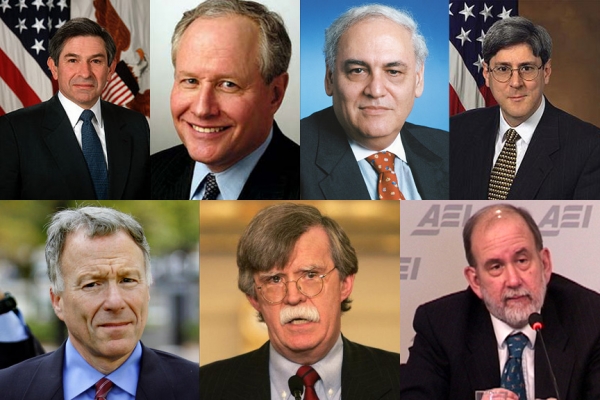
The neocon cult has been behind the promotion of Israel as well as the serial foreign policy misadventures since 2001. Do the names Perle, Feith, Wolfowitz, Abrams, Edelman, Ledeen, Senor, Libby and Nuland in and around the government as well as a host of others in think tanks and lobbies like AIPAC, AEI, WINEP, PNAC, FPI, FDD, JINSA and Hudson ring a bell? And do the loud voices in the media to include Judith Miller, Robert Kaplan, Charles Krauthammer, Jennifer Rubin, Fred Hiatt, Bret Stephens, Bill Kristol, the Kagans and the Podhoretzes, as well as the entire Washington Post and Wall Street Journal editorial pages, suggest any connivance?
They are all Jews and many are connected in terms of their careers, which were heavily networked from the inside to advance them up the ladder, often to include moving between government and lucrative think tank and academic positions. They mostly self-identify as neoconservatives and all share some significant traits, notably extreme dedication to Israel and embrace of the doctrine that the U.S. should not be shy about using military force, so it is interesting to learn from Williamson that they really do not constitute a cohesive group with shared values and interests as well as excellent access to the media and the levers of power. When did you last see an “expert” on the Middle East on television who was not Jewish?
Having made his pithy comments and dismissed neoconservatism-phobes as bigots, Williamson then wanders off subject into the Deep State, which, like neoconism apparently is some kind of urban legend being propagated by the poorly informed, whom these days he identifies as Trump supporters. He argues that the entities that are frequently cited as the Deep State, including the neocons, actually have quite divergent interests and it is unlikely that those interests should become “identical or aligned” to enable running of the country in an essentially clandestine fashion.
It is perhaps inevitable that Williamson is confused as he does not recognize how the American Deep State differs from that in most other countries – it is perhaps better described as the Establishment. Unlike in places like Turkey, it operates largely out in the open and ostensibly legally along a New York-Washington axis that constantly revitalizes itself through the revolving door allowing the entry of politicians and high government officials who create and enforce the legislation that benefits Deep State interests. Its components do indeed have different motives, but they come together in preserving the status quo, which benefits all parties, while little dissent comes from the Fourth Estate as the process plays out, since much of the media and many of the proliferating Washington think tanks that provide Deep State “intellectual” credibility are also part of the same malignancy. And yes, quite a bit of today’s Establishment is Jewish, most particularly financial and legal services, the think tanks, and academia. Many of them support or are part of the neocon persuasion and frequently also of the Israel Lobby.
The existence of a Deep State means that many issues that impact on the citizenry never are discussed as part of the political process, leading to jokes that the United States has only one political party with two wings. Issues like the relationship with Israel, though hotly debated by some of the public, are never really debated and are dealt with by consensus crafted by the politicians and the media. Significant policies like those relating to war and peace, healthcare and immigration were rarely seriously challenged prior to Trump because there is a broad agreement regarding what the Establishment will allow to take place. That is how the Deep State operates.
When it comes to foreign and national security policy the neocons are most definitely an integral part of the Deep State, using money and access to politicians to influence what is taking place without anyone seriously challenging their role. They are an essential cog in a system that is completely corrupt: it exists to sell out the public interest, and includes both major political parties as well as government officials. And it is so successful because it wins no matter who is in power, by creating bipartisan-supported money pits within the system. Monetizing the completely unnecessary and hideously expensive global war on terror benefits the senior government officials, beltway industries, and financial services that feed off it. Because it is essential to keep the money flowing, the Deep State persists in promoting policies that enrich its constituencies but otherwise make no sense, to include funding the unending and unwinnable wars currently enjoying marquee status in Iraq, Syria and Afghanistan and the gift of $38 billion to Israel.
Max Boot spews the kind of bile that is commonly seen or heard when the neocons zero in on their enemies. The National Review meanwhile provides cover for Max and others by suggesting that only anti-Semites or the demented could possibly have it in for neoconservatives or be wary of zany concepts like a Deep State. Together they generate the fog that makes it impossible to challenge certain aspects of the status quo. Maybe, just maybe, what Donald Trump has been saying about his predecessor’s Deep State inspired machinations are true. And just possibly there is a largely Jewish cabal within that Deep State, call it what you will, that works very hard behind the scenes to favor Israel while also pushing for a state of perpetual war, from which it benefits personally. I know that thinking that we Americans are on the receiving end of a vast and very effective conspiracy makes many uneasy, but history has taught us that sometimes our worst nightmares are actually true.
The Kagans Are Back; Wars to Follow
By Robert Parry | Consortium News | March 15, 2017
The Kagan family, America’s neoconservative aristocracy, has reemerged having recovered from the letdown over not gaining its expected influence from the election of Hillary Clinton and from its loss of official power at the start of the Trump presidency.
Back pontificating on prominent op-ed pages, the Family Kagan now is pushing for an expanded U.S. military invasion of Syria and baiting Republicans for not joining more enthusiastically in the anti-Russian witch hunt over Moscow’s alleged help in electing Donald Trump.
In a Washington Post op-ed on March 7, Robert Kagan, a co-founder of the Project for the New American Century and a key architect of the Iraq War, jabbed at Republicans for serving as “Russia’s accomplices after the fact” by not investigating more aggressively.
Then, Frederick Kagan, director of the Critical Threats Project at the neocon American Enterprise Institute, and his wife, Kimberly Kagan, president of her own think tank, Institute for the Study of War, touted the idea of a bigger U.S. invasion of Syria in a Wall Street Journal op-ed on March 15.
Yet, as much standing as the Kagans retain in Official Washington’s world of think tanks and op-ed placements, they remain mostly outside the new Trump-era power centers looking in, although they seem to have detected a door being forced open.
Still, a year ago, their prospects looked much brighter. They could pick from a large field of neocon-oriented Republican presidential contenders or – like Robert Kagan – they could support the establishment Democratic candidate, Hillary Clinton, whose “liberal interventionism” matched closely with neoconservatism, differing only slightly in the rationalizations used for justifying wars and more wars.
There was also hope that a President Hillary Clinton would recognize how sympatico the liberal hawks and the neocons were by promoting Robert Kagan’s neocon wife, Victoria Nuland, from Assistant Secretary of State for European Affairs to Secretary of State.
Then, there would have been a powerful momentum for both increasing the U.S. military intervention in Syria and escalating the New Cold War with Russia, putting “regime change” back on the agenda for those two countries. So, early last year, the possibilities seemed endless for the Family Kagan to flex their muscles and make lots of money.
A Family Business
As I noted two years ago in an article entitled “A Family Business of Perpetual War”: “Neoconservative pundit Robert Kagan and his wife, Assistant Secretary of State Victoria Nuland, run a remarkable family business: she has sparked a hot war in Ukraine and helped launch Cold War II with Russia and he steps in to demand that Congress jack up military spending so America can meet these new security threats.
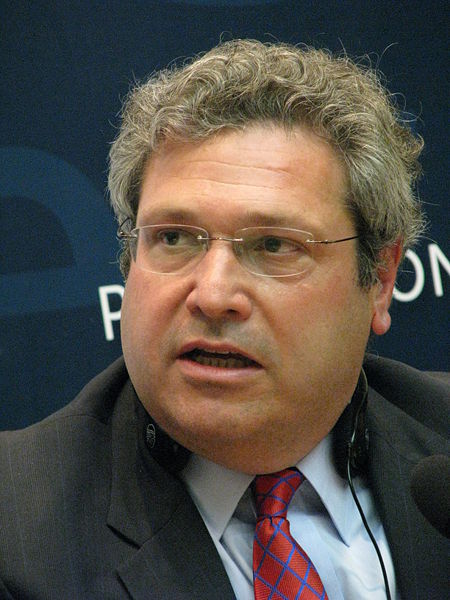
Robert Kagan (Photo credit: Mariusz Kubik)
“This extraordinary husband-and-wife duo makes quite a one-two punch for the Military-Industrial Complex, an inside-outside team that creates the need for more military spending, applies political pressure to ensure higher appropriations, and watches as thankful weapons manufacturers lavish grants on like-minded hawkish Washington think tanks.
“Not only does the broader community of neoconservatives stand to benefit but so do other members of the Kagan clan, including Robert’s brother Frederick at the American Enterprise Institute and his wife Kimberly, who runs her own shop called the Institute for the Study of War.”
But things didn’t quite turn out as the Kagans had drawn them up. The neocon Republicans stumbled through the GOP primaries losing out to Donald Trump and then – after Hillary Clinton muscled aside Sen. Bernie Sanders to claim the Democratic nomination – she fumbled away the general election to Trump.
After his surprising victory, Trump – for all his many shortcomings – recognized that the neocons were not his friends and mostly left them out in the cold. Nuland not only lost her politically appointed job as Assistant Secretary but resigned from the Foreign Service, too.
With Trump in the White House, Official Washington’s neocon-dominated foreign policy establishment was down but far from out. The neocons were tossed a lifeline by Democrats and liberals who detested Trump so much that they were happy to pick up Nuland’s fallen banner of the New Cold War with Russia. As part of a dubious scheme to drive Trump from office, Democrats and liberals hyped evidence-free allegations that Russia had colluded with Trump’s team to rig the U.S. election.
New York Times columnist Thomas L. Friedman spoke for many of this group when he compared Russia’s alleged “meddling” to Japan’s bombing of Pearl Harbor and Al Qaeda’s 9/11 terror attacks.
On MSNBC’s “Morning Joe” show, Friedman demanded that the Russia hacking allegations be treated as a casus belli: “That was a 9/11 scale event. They attacked the core of our democracy. That was a Pearl Harbor scale event.” Both Pearl Harbor and 9/11 led to wars.
So, with many liberals blinded by their hatred of Trump, the path was open for neocons to reassert themselves.
Baiting Republicans
Robert Kagan took to the high-profile op-ed page of The Washington Post to bait key Republicans, such as Rep. Devin Nunes, chairman of the House Intelligence Committee who was pictured above the Post article and its headline, “Running interference for Russia.”
Kagan wrote: “It would have been impossible to imagine a year ago that the Republican Party’s leaders would be effectively serving as enablers of Russian interference in this country’s political system. Yet, astonishingly, that is the role the Republican Party is playing.”
Kagan then reprised Official Washington’s groupthink that accepted without skepticism the claims from President Obama’s outgoing intelligence chiefs that Russia had “hacked” Democratic emails and released them via WikiLeaks to embarrass the Clinton campaign.
Though Obama’s intelligence officials offered no verifiable evidence to support the claims – and WikiLeaks denied getting the two batches of emails from the Russians – the allegations were widely accepted across Official Washington as grounds for discrediting Trump and possibly seeking his removal from office.
Ignoring the political conflict of interest for Obama’s appointees, Kagan judged that “given the significance of this particular finding [about Russian meddling], the evidence must be compelling” and justified “a serious, wide-ranging and open investigation.”
But Kagan also must have recognized the potential for the neocons to claw their way back to power behind the smokescreen of a New Cold War with Russia.
He declared: “The most important question concerns Russia’s ability to manipulate U.S. elections. That is not a political issue. It is a national security issue. If the Russian government did interfere in the United States’ electoral processes last year, then it has the capacity to do so in every election going forward. This is a powerful and dangerous weapon, more than warships or tanks or bombers.
“Neither Russia nor any potential adversary has the power to damage the U.S. political system with weapons of war. But by creating doubts about the validity, integrity and reliability of U.S. elections, it can shake that system to its foundations.”
A Different Reality
As alarmist as Kagan’s op-ed was, the reality was far different. Even if the Russians did hack the Democratic emails and somehow slipped the information to WikiLeaks – an unsubstantiated and disputed contention – those two rounds of email disclosures were not that significant to the election’s outcome.
Hillary Clinton blamed her surprise defeat on FBI Director James Comey briefly reopening the investigation into her use of a private email server while serving as Secretary of State.
Further, by all accounts, the WikiLeaks-released emails were real and revealed wrongdoing by leading Democrats, such as the Democratic National Committee’s tilting of the primaries against Sen. Bernie Sanders and in favor of Clinton. The emails of Clinton campaign chairman John Podesta disclosed the contents of Clinton’s paid speeches to Wall Street, which she was trying to hide from voters, as well as some pay-to-play features of the Clinton Foundation.
In other words, the WikiLeaks’ releases helped inform American voters about abuses to the U.S. democratic process. The emails were not “disinformation” or “fake news.” They were real news.
A similar disclosure occurred both before the election and this week when someone leaked details about Trump’s tax returns, which are protected by law. However, except for the Trump camp, almost no one thought that this illegal act of releasing a citizen’s tax returns was somehow a threat to American democracy.
The general feeling was that Americans have a right to know such details about someone seeking the White House. I agree, but doesn’t it equally follow that we had a right to know about the DNC abusing its power to grease the skids for Clinton’s nomination, about the contents of Clinton’s speeches to Wall Street bankers, and about foreign governments seeking pay-to-play influence by contributing to the Clinton Foundation?
Yet, because Obama’s political appointees in the U.S. intelligence community “assess” that Russia was the source of the WikiLeaks emails, the assault on U.S. democracy is a reason for World War III.
More Loose Talk
But Kagan was not satisfied with unsubstantiated accusations regarding Russia undermining U.S. democracy. He asserted as “fact” – although again without presenting evidence – that Russia is “interfering in the coming elections in France and Germany, and it has already interfered in Italy’s recent referendum and in numerous other elections across Europe. Russia is deploying this weapon against as many democracies as it can to sap public confidence in democratic institutions.”
There’s been a lot of handwringing in Official Washington and across the Mainstream Media about the “post-truth” era, but these supposed avatars for truth are as guilty as anyone, acting as if constantly repeating a fact-free claim is the same as proving it.
But it’s clear what Kagan and other neocons have in mind, an escalation of hostilities with Russia and a substantial increase in spending on U.S. military hardware and on Western propaganda to “counter” what is deemed “Russian propaganda.”
Kagan recognizes that he already has many key Democrats and liberals on his side. So he is taking aim at Republicans to force them to join in the full-throated Russia-bashing, writing:
“But it is the Republicans who are covering up. The party’s current leader, the president, questions the intelligence community’s findings, motives and integrity. Republican leaders in Congress have opposed the creation of any special investigating committee, either inside or outside Congress. They have insisted that inquiries be conducted by the two intelligence committees.
“Yet the Republican chairman of the committee in the House has indicated that he sees no great urgency to the investigation and has even questioned the seriousness and validity of the accusations. The Republican chairman of the committee in the Senate has approached the task grudgingly.
“The result is that the investigations seem destined to move slowly, produce little information and provide even less to the public. It is hard not to conclude that this is precisely the intent of the Republican Party’s leadership, both in the White House and Congress. …
“When Republicans stand in the way of thorough, open and immediate investigations, they become Russia’s accomplices after the fact.”
Lying with the Neocons
Many Democrats and liberals may find it encouraging that a leading neocon who helped pave the road to war in Iraq is now by their side in running down Republicans for not enthusiastically joining the latest Russian witch hunt. But they also might pause to ask themselves how they let their hatred of Trump get them into an alliance with the neocons.
On Wednesday in The Wall Street Journal, Robert Kagan’s brother Frederick and his wife Kimberly dropped the other shoe, laying out the neocons’ long-held dream of a full-scale U.S. invasion of Syria, a project that was put on hold in 2004 because of U.S. military reversals in Iraq.
But the neocons have long lusted for “regime change” in Syria and were not satisfied with Obama’s arming of anti-government rebels and the limited infiltration of U.S. Special Forces into northern Syria to assist in the retaking of the Islamic State’s “capital” of Raqqa.
In the Journal op-ed, Frederick and Kimberly Kagan call for opening a new military front in southeastern Syria:
“American military forces will be necessary. But the U.S. can recruit new Sunni Arab partners by fighting alongside them in their land. The goal in the beginning must be against ISIS because it controls the last areas in Syria where the U.S. can reasonably hope to find Sunni allies not yet under the influence of al Qaeda. But the aim after evicting ISIS must be to raise a Sunni Arab army that can ultimately defeat al Qaeda and help negotiate a settlement of the war.
“The U.S. will have to pressure the Assad regime, Iran and Russia to end the conflict on terms that the Sunni Arabs will accept. That will be easier to do with the independence and leverage of a secure base inside Syria. … President Trump should break through the flawed logic and poor planning that he inherited from his predecessor. He can transform this struggle, but only by transforming America’s approach to it.”
A New Scheme on Syria
In other words, the neocons are back to their clever word games and their strategic maneuverings to entice the U.S. military into a “regime change” project in Syria.
The neocons thought they had almost pulled off that goal by pinning a mysterious sarin gas attack outside Damascus on Aug. 21, 2013, on the Syrian government and mousetrapping Obama into launching a major U.S. air assault on the Syrian military.
But Russian President Vladimir Putin stepped in to arrange for Syrian President Bashar al-Assad to surrender all his chemical weapons even as Assad continued to deny any role in the sarin attack.
Putin’s interference in thwarting the neocons’ dream of a Syrian “regime war” moved Putin to the top of their enemies’ list. Soon key neocons, such as National Endowment for Democracy president Carl Gershman, were taking aim at Ukraine, which Gershman deemed “the biggest prize” and a steppingstone toward eventually ousting Putin in Moscow.
It fell to Assistant Secretary Victoria “Toria” Nuland to oversee the “regime change” in Ukraine. She was caught on an unsecured phone line in late January or early February 2014 discussing with U.S. Ambassador to Ukraine Geoffrey Pyatt how “to glue” or “to midwife” a change in Ukraine’s elected government of President Viktor Yanukovych.
Several weeks later, neo-Nazi and ultranationalist street fighters spearheaded a violent assault on government buildings forcing Yanukovych and other officials to flee for their lives, with the U.S. government quickly hailing the coup regime as “legitimate.”
But the Ukraine putsch led to the secession of Crimea and a bloody civil war in eastern Ukraine with ethnic Russians, events that the State Department and the mainstream Western media deemed “Russian aggression” or a “Russian invasion.”
So, by the last years of the Obama administration, the stage was set for the neocons and the Family Kagan to lead the next stage of the strategy of cornering Russia and instituting a “regime change” in Syria.
All that was needed was for Hillary Clinton to be elected president. But these best-laid plans surprisingly went astray. Despite his overall unfitness for the presidency, Trump defeated Clinton, a bitter disappointment for the neocons and their liberal interventionist sidekicks.
Yet, the so-called “#Resistance” to Trump’s presidency and President Obama’s unprecedented use of his intelligence agencies to paint Trump as a Russian “Manchurian candidate” gave new hope to the neocons and their agenda.
It has taken them a few months to reorganize and regroup but they now see hope in pressuring Trump so hard regarding Russia that he will have little choice but to buy into their belligerent schemes.
As often is the case, the Family Kagan has charted the course of action – batter Republicans into joining the all-out Russia-bashing and then persuade a softened Trump to launch a full-scale invasion of Syria. In this endeavor, the Kagans have Democrats and liberals as the foot soldiers.
Investigative reporter Robert Parry broke many of the Iran-Contra stories for The Associated Press and Newsweek in the 1980s.
‘Western Media Exerting Financial Pressure on RT’s Advertisers’
Sputnik – 20.02.2017
Western media are putting direct financial pressure on the RT broadcaster by calling up its advertisers and urging them not to sponsor “the Kremlin propaganda,” RT Editor-in-Chief Margarita Simonyan said.
“There is a wonderful UK outlet that has called up all our advertisers in the United Kingdom and simply put them to shame, rebuked them, saying shame on you, you are sponsoring the Kremlin propaganda by advertising through a such-and-such broadcaster. Some of the advertisers left, naturally, having been scared away, because nobody wants bad publicity… This is direct financial pressure,” Simonyan said in an interview that will be aired on Russian NTV channel on Monday night, without specifying which UK media she was referring to.
She added that the The Wall Street Journal newspaper contacted US cable operators providing access to RT “trying to convey the same message: shame on you, you are spreading the Kremlin propaganda, you should immediately terminate the contacts.”
“Understandably, someone will get scared and will not renew a contract with us as soon as it becomes possible, because they are in it for business. They do not want to be enmeshed in a scandal, to be written about, in general, and to get bad press, in particular,” Simonyan said.
The RT editor-in-chief added that these tactics had not crippled RT’s revenue and had instead exposed new viewers to the broadcaster, people who “would not have come [to RT] otherwise, not its target audience.”
“[The media] do not understand that the more they try to undermine us, the more they advertise us, the more people who see that think, hey, why is everyone piling up on [RT], let’s see what is really going on,” Simonyan said.
She stressed that new viewers came as the result of Western media’s “primitive” and “undemocratic” fight against the RT.
Russian media have often been taken to task lately. In November, the European Parliament passed a resolution where it described the RT as a threat to Europe’s unity and drew a parallel between the broadcaster and propaganda disseminated by Daesh, a terrorist group outlawed in many countries, including Russia.
In a comment on the EP motion, Russian President Vladimir Putin praised the channel for doing a good job and said the resolution showed that the Western concept of democracy was apparently degrading.
A History of Violence
What mainstream accounts of Venezuela’s “peaceful” opposition leave out
By Gabriel Hetland | Jacobin | September 11, 2016
The media narrative is clear: peaceful demonstrators upset about a collapsing economy and political repression are fighting an oppressive state in Venezuela. The actual history, however, is more murky.
For more than a decade the Venezuelan opposition has used a variety of violent tactics to try to topple the country’s democratically elected government. An April 2002 coup deposed Hugo Chávez for forty-seven hours and led to multiple civilian deaths.
Violent protests in April 2013 targeted government-run health clinics and other public institutions, resulting in at least seven civilian casualties; this occurred following the 2013 presidential election, which the opposition lost but refused to concede to the government. The early 2014 wave of protests resulted in forty-three deaths, half at the hands of the opposition.
During the 2014 protests, opposition activists deliberately targeted state security forces and even strung galvanized wire across intersections, leading to the brutal decapitation of a motorcyclist. Nor can we omit mention of the approximately two hundred peasant leaders killed by ranchers opposed to the 2001 land reform law pushed by Chávez.
This brutal history is almost totally absent from mainstream media depictions of the opposition. The same is true of leading opposition figures’ present-day celebrations of this violence. In mainstream accounts of last week’s protests in Caracas, the opposition is depicted as an essentially peaceful force, seeking to use constitutional means — a recall referendum — to legally put an end to an incompetent, repressive government.
An article on the protests in the Wall Street Journal quotes an opposition supporter saying, “[D]on’t tell me that we didn’t try to demand change peacefully through the constitution.” The article briefly mentions the 2002 coup, but fails to note that leading members of today’s opposition played key roles in that episode. Nor does it make any mention of more recent instances of opposition violence.
A New York Times article on the protests details the deteriorating conditions in Venezuela leading people to protest against the government, and provides ample coverage of claims that the government has repressed dissident politicians and foreign journalists. No mention is made of opposition violence.
A BBC article on the September 1 protests states that “A small group of protesters clashed with riot police as the peaceful rally ended.” The article mentions the 2014 protests and states that, “Forty-three people on both sides of the political divide were killed during those protests.” Like other mainstream articles, however, this piece focuses disproportionately on opposition allegations of instances of government repression.
A piece in Bloomberg on the September 1 protests briefly discusses the 2014 protests, but misleadingly gives readers the impression that “over 40 people were killed” because of a government “crackdown on anti-government protests,” eliding the opposition’s responsibility for many of those deaths.
The takeaway from these and other mainstream media stories about the protests is clear: the opposition is peaceful, and there is no reason to believe the government’s delusional and self-serving claims that it faces a real threat of a violent coup.
Indeed, opposition leaders have repeatedly denied seeking a coup. But statements from these figures, not to mention recent history, indicate that the government may have more reason to worry than mainstream sources allow for.
In May, Henrique Capriles, the opposition presidential candidate in the 2012 and 2013 elections, exhorted the Venezuelan military to “decide whether you are with the constitution or with Maduro.”
Other opposition leaders, such as Jesús Torrealba, have also made public statements that steer clear of explicitly calling on the military to overthrow the government, but still suggest that the military should actively support the opposition against President Maduro. One wonders how government officials in other countries would react if leading opposition figures made similar statements there?
A good test of whether the opposition is as “peaceful” as media accounts suggest is to examine how opposition leaders speak about past episodes of violence. It’s telling that key opposition figures not only fail to express remorse or contrition when events such as the 2002 coup are discussed, but openly celebrate such acts.
During a speech given on August 27, just days before the September 1 protests, Venezuelan National Assembly head and leading opposition figure Henry Ramos Allup repeatedly refers to the coup in an approving matter. In the speech Ramos Allup makes it clear that his only regret is that it did not succeed in ousting Chávez.
No doubt, there is plenty to criticize about the Venezuelan government these days. The government deserves ample blame for mismanaging its currency and failing to confront corruption. State violence that does occur should be condemned and there’s a need for an independent left to grow in the country. But the narratives we’re being sold by the media are giving the opposition a free pass.
Gabriel Hetland teaches at University at Albany and has written about Venezuelan politics for the Nation, NACLA, Qualitative Sociology, and Latin American Perspectives.
Featured Video

New positive ivermectin evidence
or go to
Aletho News Archives – Video-Images
From the Archives
Fanatical Followers of the Covid Regime: A Jim Jones-Style Cult?
By Professor Roger Watson and Dr. Niall McCrae | The Daily Sceptic | November 15, 2021
As scholars at leading British universities over recent decades, we witnessed the replacement of critical thinking and debate by narrative: facts are discrimination and scientific method is imperialism; truth, instead, is derived from ‘progressive’ values. This educational trend may be a major contributory factor to the ease in which society has been inculcated to the Covid ‘new normal’ of masking, testing, and repeated doses of vaccines for a disease of similar risk to severe influenza.
One doesn’t need much critical reasoning to observe the flawed logic of some vaccination enthusiasts, such as people who respond to experiencing any side effects, however debilitating, by saying “at least I know it’s working”, or, after contracting the disease despite their promised inoculation (over 90% effective, according to initial drug company claims), “I’d have been worse off without the jab.” … continue
Blog Roll
 Aletho News
- ‘Grave, alarming’: Iran mission on Trump’s UNGA ‘annihilation’ threats
- Najaf airport to reopen to Iranian flights within 24 hours: Ambassador
- From ‘How Will This End For Iran’ to ‘When America Walks Away’: A tale of two Economist covers
- Tehran blasts ‘baseless’ speculation linking Iran to alleged bomb plot at UK air base
- The Rise And… Rise Of ‘Color Revolutions’
- The Coming GOP Bloodbath?
- Arctic Scare Stories Melt Away
- Wrong, Euronews: Climate Change Has Not Created a Food, Energy, and Economic “Meta-Crisis”
- New positive ivermectin evidence
- Met Office Caught Fabricating Daily Temperature Record Claims
- If Americans Knew
- Netanyahu Asked UAE Leader to Deny Report on Oct. 7 Warning in Secret Visit, Sources Say
- CNN Chief Int’l Correspondent Clarissa Ward on Journalists in Gaza
- Democratic Party Consultants Surround Troy Jackson with Pro-Israel Donors
- Christian Leader Responds To Netanyahu’s Claims Regarding Palestinian Christians
- In Gaza, ‘Whoever Survives the Bombing Won’t Survive the Rubble’
- Israel kills more Palestinians, amid push to resettle Gaza – Daily Update
- Israel forces Gazans to live in constant peril – Daily Update
- Deconstructing Netanyahu’s pants-on-fire UN rant – Daily Update
- Trump betrayed voters with his campaign lies and prioritized a foreign country once he took office
- Netanyahu calls Israel’s war in Gaza ‘opposite of genocide’ in UN speech to near-empty hall
- No Tricks Zone
- New Study: Earth And Venus Surface Warmth Largely Explained By Convection And Lapse Rate, Not CO2 Or Radiation
- 2025 Nature Paper Claiming Worsening Global Drought Gets RETRACTED …Heavily Flawed
- New Study: ‘Global Drought Shows No Detectable Recent Acceleration Under Climate Warming’
- Economic Masterminds: German Socialists Suggest Taxing Productivity Gains Stemming From Using AI
- The South China Sea Has Not Been Cooperating With The Climate Change Narrative
- Energy Crisis: Germany Enters Heating Season With Historically Low Gas Reserve Fill Levels
- New Study: The Antarctic Ice Sheet Gained Mass From 2020-2024 Due To Staggering Snow And Ice Accumulation
- Study: Ocean Heating Rates From Thousands Of Years Ago ‘Dwarf’ Modern Ocean Heating Rates
- Climate Extremists Target, Attack Large-Scale Power Grid Infrastructure In Germany!
- New Study: Antarctic Ice Melt Has Contributed Less Than 1 Centimeter To Sea Level Rise In The Last 30 Years

