How Media Distorted Syrian Ceasefire’s Breakdown
By Gareth Porter | FAIR | August 11, 2016
Coverage of the breakdown of the partial ceasefire in Syria illustrated the main way corporate news media distort public understanding of a major foreign policy story. The problem is not that the key events in the story are entirely unreported, but that they were downplayed and quickly forgotten in the media’s embrace of themes with which they were more comfortable.
In this case, the one key event was the major offensive launched in early April by Al Nusra Front — the Al Qaeda franchise in Syria — alongside U.S.-backed armed opposition groups. This offensive was mentioned in at least two “quality” U.S. newspapers. Their readers, however, would not have read that it was that offensive that broke the back of the partial ceasefire.
On the contrary, they would have gotten the clear impression from following the major newspapers’ coverage that systematic violations by the Assad government doomed the ceasefire from the beginning.
Corporate media heralded the ceasefire agreement when it was negotiated by the United States and Russia in February, with the Los Angeles Times (2/3/16) calling it “the most determined diplomatic push to date aimed at ending the nation’s almost five-year conflict.” The “partial cessation of hostilities” was to apply between the Syrian regime and the non-jihadist forces, but not to the regime’s war with Nusra and with ISIS.
The clear implication was that the U.S.-supported non-jihadist opposition forces would have to separate themselves from Nusra, or else they would be legitimate targets for airstrikes.
But the relationship between the CIA-backed armed opposition to Assad and the jihadist Nusra Front was an issue that major U.S. newspapers had already found very difficult to cover (FAIR.org, 3/21/16).
U.S. Syria policy has been dependent on the military potential of the Nusra Front (and its close ally, Ahrar al Sham) for leverage on the Syrian regime, since the “moderate” opposition was unable to operate in northwest Syria without jihadist support. This central element in U.S. Syria policy, which both the government and the media were unwilling to acknowledge, was a central obstacle to accurate coverage of what happened to the Syrian ceasefire.
Shaping the Story
This problem began shaping the story as soon as the ceasefire agreement was announced. On Feb. 23, New York Times correspondent Neil MacFarquhar wrote a news analysis on the wider tensions between the Obama administration and Russia that pointed to “a gaping loophole” in the Syria ceasefire agreement: the fact that “it permits attacks against the Islamic State and the Nusra Front, an Al Qaeda affiliate, to continue.”
MacFarquhar asserted that exempting Nusra from the ceasefire “could work in Moscow’s favor, since many of the anti-Assad groups aligned with the United States fight alongside the Nusra Front.” That meant that Russia could “continue to strike United States-backed rebel groups without fear … of Washington’s doing anything to stop them,” he wrote.
On the same day, Adam Entous of the Wall Street Journal reported that Obama’s “top military and intelligence advisers don’t believe Russia will abide by a just-announced ceasefire in Syria and want to ready plans to increase pressure on Moscow by expanding covert support to rebels fighting the Russia-backed Assad regime.”
For two of the country’s most prominent newspapers, it was thus clear that the primary context of the Syria ceasefire was not its impact on Syria’s population, but how it affected the rivalry between powerful national security officials and Russia.
Contrary to those dark suspicions of Russian intentions to take advantage of the agreement to hit U.S.-supported Syrian opposition groups, however, as soon as the partial ceasefire agreement took effect on Feb. 27, Russia released a map that designated “green zones” where its air forces would not strike.
The green zones, according to the Russian Ministry of Defense, corresponded with Syrian opposition groups that had signed on to the ceasefire. Furthermore, Russia stopped bombing the Nusra-controlled areas of northwest Syria, instead focusing on ISIS targets, as Pentagon spokesperson Jeff Davis confirmed on March 14.
Breaking the Ceasefire
But instead of separating themselves from Nusra Front, the U.S.-supported armed opposition joined with Nusra and its jihadist allies in a major offensive aimed at destroying the ceasefire.
Charles Lister, a leading British specialist on the jihadists in Syria, has recounted being told by the commander of a U.S.-backed armed group that around March 20, Nusra officials began a round of meetings with non-jihadist opposition groups from Hama, Latakia and southern Aleppo — including those supported by the United States — to persuade them to participate in a major offensive against the Assad regime, rather than in a ceasefire and political negotiations.
News media did not ignore the offensive launched on April 3 by Nusra Front and its “moderate” allies. The Los Angeles Times (4/4/16) described a “punishing attack” by Nusra and several “so-called moderate rebel factions” on the town of Al Eis, southwest of Aleppo, “overlooking the M5 highway, a vital artery connecting the Syrian capital, Damascus, in the southwest of the country, with the government-held city of Homs, in west-central Syria, and Aleppo in the north.”
Associated Press (4/3/16) reported that Nusra Front’s closest ally, Ahrar al Sham, together with U.S.-supported factions had simultaneously “seized government positions in heavy fighting in northwestern Latakia province.” The story quoted Zakariya Qaytaz of the U.S.-supported Division 13 brigade as telling the agency through Twitter: “The truce is considered over. This battle is a notice to the regime.”
The Nusra-led offensive was a decisive violation of the ceasefire, which effectively frustrated the intention of isolating the jihadists. It led to continued high levels of fighting in the three areas where it had taken place, and Russian planes returned to Nusra Front-controlled territory for the first time in nearly six weeks. Yet after the first reports on the offensive, its very existence vanished from media coverage of Syria.
Disappearing Key Facts
No U.S. newspaper followed up over the next two weeks to analyze its significance in terms of U.S. policy, especially in light of the role of “legitimate” armed opposition groups in trashing the ceasefire.
Wall Street Journal correspondent Sam Dagher (4/4/16) suggested in his initial report on the offensive that it was a response to a Syrian air force airstrike in an opposition-controlled suburb of Damascus two days earlier, which activists said killed 30 civilians. But the offensive was so complex and well-organized that it had obviously been prepared well in advance of that strike.
None of the other papers sought to portray the offensive as the result of a pattern of increasing military pressure on the Nusra Front or its allies. In fact, after the initial reports, all four major newspapers — the New York Times, LA Times, Wall Street Journal and Washington Post — simply ignored the fact that the offensive had been carried out.
On April 19, three separate articles presented three variants of what became the broad media approach to explaining the fate of the ceasefire agreement. The Journal’s Nour Malas and Sam Dagher wrote: “A limited truce in Syria, brokered by the US and Russia in late February, has unraveled in recent weeks, with government forces escalating attacks on several fronts and rebels relaunching operations around the northern city of Aleppo.”
That formulation clearly suggested that either the regime had moved first, or that government and rebels had somehow both taken the offensive at the same moment; the former interpretation was encouraged by the headline, “Syrian Government Steps Up Airstrikes.”
On the same day, New York Times Beirut correspondent Anne Barnard wrote a piece focused mainly on regime airstrikes in two Idlib towns, Maarat al Numan and Kafr Nable, that had killed many as 40 civilians.
Barnard’s piece was headlined, “Ceasefire Crumbles as Bombings Kill Dozens” — suggesting that the airstrikes had somehow led to the “crumbling.” Barnard did refer to an otherwise unidentified “insurgent offensive” that preceded the strikes, but did not draw any causal relationship between it and the bombing.
The article cited the opposition claim that the government had repeatedly violated the partial ceasefire, but didn’t cite a single concrete instance of such a violation. And it appears to contradict that argument by observing that the Idlib airstrikes had ended “the relative respite from airstrikes that had lasted nearly two months” – i.e., from the time the ceasefire had gone into effect.
Yet a third article to appear that day, published by Reuters, explicitly asserted that the regime airstrike on a crowded market by Syrian planes to which Barnard referred was the cause of the failure of the partial ceasefire.
“Syrian peace talks appeared all but doomed on Tuesday,” it said, “after airstrikes killed about 40 people in a crowded vegetable market in rebel territory, with the opposition saying a truce was finished and it would keep out of negotiations indefinitely.”
Wrapping Up the Distortions
Finally, on April 27, Karen DeYoung, associate editor of the Washington Post, wrote a news analysis piece looking back on what happened to the ceasefire. The piece never mentioned the major Nusra Front offensive in which U.S.-supported armed groups had played a key role, passing on instead the distorted explanation of the fate of the ceasefire offered by national security bureaucrats.
“Some Defense Department and intelligence officials,” she wrote, “think Russia and its Syrian government client are clearly violating the ceasefire and provoking the opposition into doing the same.”
Like the three April 19 articles, DeYoung focused entirely on military moves taken by the regime more than two weeks after the joint Nusra/opposition April offensive. She cited the Syrian government bombing of Kafr Nabl and Maarat al Numan the previous week, asserting that the towns were “heavily bombed by Assad after rebel forces threw out Nusra occupiers and civilians took to the streets in anti-Assad demonstrations.”
But that characterization of the situation in the two towns, clearly aimed to support the notion that they were free of Nusra control, was false. In fact, Kafr Nabl had formerly been the home of the U.S.-backed Division 13, but far from having been thrown out, Nusra Front had reasserted its direct control over the towns in mid-March, kicking Division 13 out of its base and seizing its U.S.-supplied weapons after a fight over the larger town Maarat al Numan.
DeYoung went so far as to embrace the CIA/Pentagon bureaucrats’ argument that the United States should not have agreed to allow any attacks on Nusra Front in the ceasefire agreement.
“The Nusra ceasefire exception had already left a hole big enough for the Syrian government and Russia to barrel through,” she wrote, “and they have not hesitated to do so in pursuit of regaining the initiative on the ground for Assad.”
The implication of the argument is that the United States should do nothing to interfere with Nusra’s capacity to strike at the Assad regime. Thus DeYoung quoted an analyst for the Institute for the Study of War, which favors a more belligerent U.S. policy in Syria, dismissing the military collaboration by U.S.-supported groups with Nusra Front as not really significant, because it is only “tactical,” and that Nusra merely offers to help those allies “retaliate” against regime attacks, rather than seeking a military solution to the conflict.
Such arguments are merely shallow rationalizations, however, for the preference of hardliners in Washington for pitting Al Qaeda’s military power against Russia and its Syrian client, enhancing the power position of the U.S. national security state in Syria.
A Simplistic Summary
As more time passes, the media version of why the partial ceasefire failed has become even more simplistic and distorted. On July 12, DeYoung revisited the issue in the context of the Obama administration’s negotiations with Russia on military cooperation against Nusra Front. This time she portrayed the ceasefire quite starkly as the victim of Syrian and Russian bombing:
“Despite a ceasefire ostensibly in effect since February, Syrian planes have kept up a steady bombardment of both civilian and opposition sites — where they have argued that Al Nusra forces, exempt from the truce, are mixed with rebel groups covered by the accord. After observing the early weeks of the ceasefire, Russian planes joined the Syrian forces, including in an offensive last weekend that took over the only remaining supply route for both rebels and civilians hunkered down in the northern city of Aleppo.”
Playing the role of ultimate media arbiter of how the attentive public is to understand the pivotal issue of why the ceasefire failed, DeYoung has deleted from memory the essential facts. In her narrative, there was no Nusra Front plan to destroy the ceasefire, and no April Nusra offensive to seize strategic territory south of Aleppo with the full participation of U.S.-supported opposition groups.
The lesson of the Syrian ceasefire episode is clear: The most influential news media have virtually complete freedom to shape the narrative surrounding a given issue simply by erasing inconvenient facts from the story line. They can do that even when the events or facts have been reported by one or more of those very news media.
In the world of personal access and power inhabited by those who determine what will be published and what won’t, even the most obviously central facts are disposable in the service of a narrative that maintains necessary relationships.
US Prosecutors are Good Imperial Soldiers
By Joe Emersberger – TeleSUR – May 27, 2015
Juan Forero’s latest article in the Wall Street Journal (WSJ), co-authored by José de Córdoba, ran with the headline “Venezuelan Officials Suspected of Turning Country into Global Cocaine Hub”. The article was immediately cited by the BBC, UK Guardian, and Reuters among others. Here are five things readers should notice about the article.
1) The let the scoundrel speak tactic was used.
The WSJ article provides a kind of fake balance that is very common in the corporate media. You could call it the “let the scoundrel speak” approach. An official from a government that has been widely ridiculed and demonized by the media for years is quoted rejecting US government allegations. Venezuelan General Motta Dominguez is quoted by the WSJ as saying “We all know that whoever wants his green card and live in the US to visit Disney can just pick his leader and accuse him of being a narco. DEA tours will attend to them.”
This tactic helped the media sell the Iraqi WMD hoax to the US public while claiming its reporting was balanced. Officials from Saddam Hussein’s government were regularly quoted denying US claims that they were hiding WMD – truthfully as many people would learn only after a war was waged that would kill at least half a million Iraqis. Critics whom most readers would have found way more credible – like former weapons inspector Scott Ritter or leaders of the anti-war movement – were simply ignored.
2) Highly relevant history was buried.
Years before US troops kidnapped Haiti’s democratically elected president (Jean Bertrand Aristide) in 2004, US prosecutors had been targeting officials around him – the same tactic they are now using against Nicolas Maduro’s government in Venezuela. As I explained here, long after those allegations against Aristide’s government were exposed as baseless they continue to resurface from time to time – when the US fears that Aristide or his Lavalas movement may be mobilizing. The WSJ – through its reporter Mary Anastasia O’Grady – was especially aggressive in promoting those allegations.
Imagine if the Venezuelan government had kidnapped the democratically elected president of another country. The only thing the western media would debate is how quickly and heavily to bomb Venezuela in retaliation, but the US government perpetrates a coup and the western media notices nothing. Never mind remembering that US prosecutors contributed to the coup in Haiti. The entire coup and its gruesome aftermath have been erased from history.
3) Key facts about US prosecutors were ignored
I asked Brian Concannon, a US attorney who has prosecuted landmark human rights trials in Haiti during the 1990s, to comment on the WSJ article’s claim that “The Obama administration isn’t directing or coordinating the investigations, which are being run by federal prosecutors who have wide leeway to target criminal suspects.”
Concannon replied “The US Attorneys for each judicial district are appointed by the President, and can be removed by the President for almost any non-discriminatory reason. It is true that the prosecutors have wide leeway, but it is equally true that they take direction from the Attorney General and President. The Bush Administration got in trouble in 2006 for firing seven US Attorneys who either investigated Republican candidates for election malfeasance or failed to adequately pursue Democrats. There was a scandal and some DOJ people were forced to resign, but no one was prosecuted and I believe that none of the fired Attorneys got their jobs back. “
Some partisan bickering highlights the facts Concannon mentioned. For example, Republicans were irate when Bill Clinton fired almost all US Attorneys in 1993. However, in the case of Venezuela – as in the case of foreign policy in general – the differences between Republican and Democrat presidents have been negligible. It may be true that the Obama administration is not “directing or coordinating the investigations” because, under both Bush and Obama, prosecutors who target Venezuelan officials are giving their bosses exactly what they want: ammunition they can use to try to discredit and isolate the Venezuelan government.
Recalling the debunked allegations against Aristide, Concannon said “There was such a bi-partisan antipathy towards Aristide, especially in the intelligence and DOS [State Department] communities, that the prosecutors didn’t need a big push to take the case up. Law enforcement and intelligence agencies could just hand over evidence (manufactured or not), the DOS could pass along its ‘reports’, etc. “
4) Colombia and the USA are depicted as regional good guys who are above suspicion.
The WSJ article said “Under pressure in Colombia, where authorities aggressively battled the drug trade with $10 billion in U.S. aid since 2000, many Colombian traffickers moved operations to neighboring Venezuela, where U.S. law-enforcement officials say they found a government and military eager to permit and ultimately control cocaine smuggling through the country.
Venezuela doesn’t produce coca, the leaf used to make cocaine, nor does it manufacture the drug. But the U.S. estimates that about 131 tons of cocaine, about half of the total cocaine produced in Colombia, moved through Venezuela in 2013, the last year for which data were available.”
Colombia produces cocaine for nearly all the US market, but the governments of the USA and Colombia are assumed to be squeaky clean by the WSJ and their claims are reported with deference. What the Colombian government did with billions of dollars in U.S. aid since the 1990s is amass a horrific human rights record – the worst in the region if you exclude USA whose foreign aggression puts it in a separate category. As for drug related corruption within the US government, the tragic tale of Gary Webb illustrates how the corporate media can destroy journalists who dare to explore the wrong kind of suspicions.
5) One can’t even assume the WSJ will convey publicly available information accurately.
This piece of mine exposes the extremely deceptive reporting one of the WSJ article’s authors, Juan Forero, did regarding Venezuela’s health care system. To the extent his work could be checked by readers, it didn’t check out. It is worth remembering while reading an article that quotes anonymous US officials.
The Senate’s Excuses for Reauthorizing Section 215–and Why They’re Wrong
By Mark Jaycox | EFF | May 19, 2015
Three provisions of the Patriot Act expire on June 1 and Senate Majority Leader Mitch McConnell is trying to delay taking action on the issue by calling for a two month or 5-year reauthorization of Section 215—the provision of the Patriot Act the NSA relies on to collect millions of Americans call records.
Before June 1 we expect to see plenty of fear-mongering from intelligence officials and national security hawks. Last year, the Wall Street Journal began the foray with an op-ed by Former NSA Director General Mike Hayden and former Attorney General Michael Mukasey—key architects of many of the NSA’s unlawful activities. This time, the mongering started with op-eds by John Yoo, Senator Marco Rubio, and Senator Tom Cotton.
Here are the top excuses officials will use to continue spying on Americans calling records and why they’re wrong:
Congress Needs Time to Debate
“I don’t know how we have the kind of fulsome debate that is going to be required on NSA without passing a temporary extension,” —Sen. John Cornyn
Congress has had two full years to publicly debate the NSA’s use of Section 215. Indeed, the debate has been vigorous and thoughtful. While Congress didn’t create a separate investigative committee, it was still able to hold over a dozen hearings where Section 215 was discussed. The hearings, which called upon officials like the Attorney General, Director of National Intelligence, and Director of the NSA, included hours of testimony on the programs, what they collect, and their effectiveness.
Congress has also debated Section 215 via Senator Patrick Leahy and Jim Sensenbrenner’s reform bill called the USA Freedom Act. Last year, the House passed a gutted bill of the USA Freedom Act, but debated the legislation for days. This year, the House debated a stronger version of the USA Freedom Act and passed it 338 to 88.
The Senate has also debated the legislation. Last year, after two days of debate, the Senate failed to advance a stronger version of the USA Freedom Act by two votes. Congress has had more than enough time to discuss these authorities and must act.
The Section 215 Program is Effective
“This has been a very important part of our effort to defend the homeland since 9/11.” —Sen. Majority Leader Mitch McConnell
There’s one problem: there’s no evidence to support that. Two independent commissions concluded the calling records program was not effective and has not been used to stop a terrorist attack. The first, called the President’s Review Group on Signals Intelligence, concluded “Our review suggests that the information contributed to terrorist investigations by the use of section 215 telephony meta-data was not essential to preventing attacks.”
Like the President’s Review Group, the Privacy and Civil Liberties Oversight Board also concluded:
Based on the information provided to the Board, including classified briefings and documentation, we have not identified a single instance involving a threat to the United States in which the program made a concrete difference in the outcome of a counterterrorism investigation. Moreover, we are aware of no instance in which the program directly contributed to the discovery of a previously unknown terrorist plot or the disruption of a terrorist attack.
The quotes speak for themselves.
Fixing Section 215 Puts the Nation at Risk
“[The USA Freedom Act] would be rolling [the nation] back to exactly where we were pre-9/11. —Sen. Richard Burr
The Attorney General, Director of National Intelligence, and House Intelligence Chair and Ranking Members do not think reforming the Section 215 program will harm national security. Attorneys General Eric Holder and Loretta Lynch and Director of National Intelligence James Clapper wrote letters (.pdf) to Congress noting that Section 215 reform would preserve both “vital national security authorities” and “essential Intelligence Community capabilities.”
The Program is “Lawful”
“Contrary to irresponsible rumors, the [bulk surveillance] program is lawful, carefully monitored, and protects personal privacy. The program does not conduct mass surveillance of American citizens—or any surveillance at all.” —Sen. Cotton and Rep. Mike Pompeo
Apparently, one of the “irresponsible rumors” Sen. Tom Cotton and Rep. Mike Pompeo reference is a decision by the Second Circuit Court of Appeals. (The circuit courts are the federal courts directly below the Supreme Court). The Second Circuit held that the NSA’s telephone records program went far beyond what Congress authorized when it passed Section 215 of the Patriot Act in 2001. The court rejected the government’s secret reinterpretation of Section 215 that has served as the basis for the telephone records collection program. The Second Circuit’s opinion stands as a clear sign that the courts are ready to step in and rule that mass surveillance is illegal.
In addition, the program is “surveillance.” As we’ve repeatedly said: the collection of metadata matters. It reveals a host of information and context about a person’s habits, traits, and beliefs. The Circuit Court opinion explained that metadata is often a proxy for the content of the communication, and that phone records can “reveal a startling amount of detailed information” about callers. The court also recognized that aggregation of calling records matters because collection of large amounts of metadata plus the application of sophisticated data processing technologies gives the government access to even more revealing portraits of individuals and groups.
Congress Must Say No to a Short-Term Reauthorization
In the next few days, Congress will begin to debate whether or not they should vote for a short-term reauthorization of Section 215. The answer is clearly no. Join us now in telling your lawmaker to vote against any short-term reauthorization.
Wall Street Journal Gets the Numbers Wrong on Venezuelan Health Care Spending
By Mark Weisbrot | CEPR Americas Blog | March 20, 2015
I have sometimes noted that in the current “four legs good, two legs bad” discourse about Venezuela, journalists can write almost anything about the country and no one will question it – so long as it is something negative. On Saturday, March 13, the Wall Street Journal published this chart on its front page in the print edition, below, and claimed health care spending as a percent of economic output was “lower in Venezuela than in all other major economies in Latin America.” The chart shows Venezuela’s health care spending at 1.6 percent of GDP.

The chart and text don’t say it, but they are referring to public (i.e., government) spending on health care, which one can find by looking at the original data from the World Health Organization. When I read this, I thought, this can’t be true: The Venezuelan government spends about the same percentage of GDP on health care as Haiti? The lowest of 19 countries in the hemisphere? Less than some of the poorer countries in Sub-Saharan Africa? And these numbers are for 2012, when the economy was booming (5.7 percent real GDP growth), Venezuelan oil was at 103 dollars per barrel, and the government built more than 200,000 homes. They had no money for health care?
This should have set off some alarm bells at the WSJ, if any editors were paying attention. This number is not plausible because it is wrong. When the government of Hugo Chávez in Venezuela decided to make health care a priority after getting control over the national oil industry in 2003, it was unable to accomplish very much by going through the health ministry and the public hospitals – running into various bureaucratic and political obstacles. So it created Misión Barrio Adentro, a system of health clinics that served people in both urban and rural areas where many did not previously have access to health care.
The short story is that the numbers used by the WSJ apparently didn’t include most of Venezuela’s health care spending, since it has gone through the misiones. In 2012, the national oil company contributed $5.5 billion for Misión Barrio Adentro. Also, the government of Venezuela has an actual agreement with Cuba, which provides specifically for the supply medical care through Misión Barrio Adentro in exchange for 98,000 barrels of oil per day, which Venezuela has provided. The value of that oil in 2012 was $3.44 billion. The medical services include not only 40,000 doctors but also medical equipment, medicines, and other health care services.
If we add in these expenses, and use the IMF’s 2012 exchange rate to convert to domestic currency, this adds another 3 percent of GDP to the government’s health care spending.
This would bring Venezuela’s health care spending to 4.6 percent of GDP. In the above chart, that would move Venezuela from 19th to 7th place among the 19 countries shown. And this figure does not include all of Venezuela’s government health care spending.
(Note: the WSJ article also claims that “the share of state spending on health, at 6%” was also “lower in Venezuela than in all other major economies in Latin America.” This is also false, for the same reasons discussed above.)
What Was Missing From Coverage of Netanyahu’s Speech
By Jim Naureckas | FAIR | March 5, 2015
Reading the lead stories on Israeli Prime Minister Benjamin Netanyahu’s speech to Congress about Iran in five prominent US papers–the New York Times, Washington Post, LA Times, Wall Street Journal and USA Today (all 3/3/15)–what was most striking was what was left out of these articles.
None of them mentioned, for example, that Israel possesses nuclear weapons. Surely this is relevant when a foreign leader says that it needs the United States’ help to stop a rival state from obtaining nuclear weapons: The omission of the obvious phrase “of its own” changes the story entirely.
Another thing largely left out of the story is the fact that Iran has consistently maintained that it has no interest in building a nuclear weapon. There was one direct statement of this in the five stories–the New York Times‘ reference to “Iran’s nuclear program, which [Iranian] officials have insisted is only for civilian uses.” The Washington Post alluded to the fact that Iran denies that it has a nuclear weapons program, referring to “a program the West has long suspected is aimed at building weapons,” Iran’s “stated nuclear energy goals” and “the suspect Iranian program.” Elsewhere the military nature of Iran’s nuclear research was taken for granted, as when the LA Times said that the issue under discussion was “how to deal with the threat of Iran’s nuclear program.”
Entirely absent from these articles was the fact that not only does Iran deny wanting to make a nuclear bomb, the intelligence agencies of the United States (New York Times, 2/24/12) and Israel (Guardian, 2/23/15) also doubt that Iran has an active nuclear weapons program. Surely this is relevant to a report on the Israeli prime minister engaging in a public debate with the US president on how best to stop this quite possibly nonexistent program.
Instead, these articles generally seemed content to cover the subject as a debate between Netanyahu and US President Barack Obama, perhaps with some congressmembers thrown in–as if these were the “both sides” that needed to be covered in order to give a complete picture of the controversy. When Iranian officials were quoted for a few lines in these pieces–which some neglected to do altogether–it seemed an afterthought, despite the fact that Netanyahu’s speech was mainly a long litany of allegations and threats against their country.
(Though I’m confining my analysis to what seemed to be the most prominent and comprehensive article on the speech on each paper’s website, it’s worth mentioning that the New York Times‘ website featured a piece by Iran’s ambassador to the UN, Gholamali Khoshroo, rebutting Netanyahu’s speech. Reading it one is struck by how different the news pieces would read if Iran’s perspective on Iran’s nuclear program were given equal weight with Israel’s and the US’s views.)
None of these news articles mentioned the Nuclear Non-Proliferation Treaty, signed by both the United States and Iran but not by Israel, which guarantees “the inalienable right of all the Parties to the Treaty to develop research, production and use of nuclear energy for peaceful purposes.”

The New York Times’ caption quoted Israeli Prime Minister Benjamin Netanyahu, “This regime will always be an enemy of America.” That regime got 36 words of rebuttal in the nearly 1,500-word article.
One article–the New York Times’–had a reference to Netanyahu’s decades-long record of making false nuclear predictions about Israel’s enemies. And even that was framed in partisan terms: Netanyahu “did not succeed in mollifying all Democrats, who recalled a history of what they deemed doomsday messages by him.” A reporter, of course, could look up Netayahu’s previous projections to see if they came true or not–as Murtaza Hussain of the Intercept (3/2/15) did–but holding officials accountable for what they have said in the past is not something an “objective” journalist is likely to do.
Another striking omission from these articles, about a speech in which Netanyahu talked about Iran’s “aggression in the region and in the world,” were words like “Palestine,” “Palestinian,” “occupation” or “Gaza”; none of these came up in any of the five articles. USA Today headlined its piece “Netanyahu: Stop Iran’s ‘March of Conquest'”–as though it were Iran, not Israel, that has conquered, occupied and in some cases annexed its neighbors’ territory.
The Wall Street Journal’s Problematic Reporting on Protests in Ecuador
By Stephan Lefebvre | CEPR | November 21, 2014
The Wall Street Journal recently published an article covering Wednesday’s protests in Ecuador against President Rafael Correa, but key facts were missing and the article contained several misleading statements.
First, it is curious that the WSJ chose to focus on a protest of reportedly “around 3,000 protesters,” when a much larger demonstration took place on Saturday in favor of the government’s labor reform policy. The pro-government rally had participation from 100,000 people, according to organizers, and news outlets such as EFE reported participation of “tens of thousands of workers.” Perhaps an argument can be made that protests are more interesting than rallies supporting measures championed by the government, but the WSJ used the same word, “thousands,” to describe the number of attendees at both events.
The piece also includes a line that reads, “Mr. Correa took office in early 2007 and promptly engineered a new constitution that allowed for his re-election.” In reality, a constitutional convention (i.e. adopting a new constitution) was one of Rafael Correa’s campaign promises the year he was first elected (with 56.7 percent of the vote). Further, the old 1998 constitution allowed for indefinite re-election, though not consecutively, for the presidency, while the 2008 constitution set a limit of two-terms for the presidency, which could be served consecutively. Neither of these basic facts was mentioned in the article.
Finally, the motivations for the protest are selectively reported. Besides vague references to the government’s allegedly “authoritarian attitudes,” two issues are mentioned: “union leaders said the government is looking to divide them by creating new government-dependent organizations and undermine their rights, especially to strike” and “protesters are also rejecting proposed constitutional amendments that would open the door for indefinite re-election of Mr. Correa.” Regarding the first point, the author seems to be referencing the creation of a national workers’ united center (Central Unitaria de Trabajadores), a union federation similar to those in Chile, Brazil, Argentina and Bolivia. No argument was given as to why this organization would undermine workers’ rights.
Second, the constitutional changes would allow the indefinite re-election of any office holder (as the WSJ has previously reported), not just Correa. Reasonable people may disagree with this reform, but unlimited re-election is not always seen as inherently anti-democratic. In the Western Hemisphere alone, Canada and Nicaragua allow unlimited re-election, and countries including Peru, Uruguay, Chile and Costa Rica allow indefinite re-election for non-consecutive term.
Wall Street Journal Uses Bogus Numbers to Smear Argentine President
By Jake Johnston and Mark Weisbrot | Center for Economic and Policy Research | August 6, 2014
Last week the Wall Street Journal had a front page article on the net worth of Argentina’s first family since 2003, the year Néstor Kirchner was elected president. Based on financial disclosures with Argentina’s Anti-Corruption Office, the Wall Street Journal reported that, “the couple’s net worth rose from $2.5 million to $17.7 million” between 2003 and 2010. Implying that such returns must involve some sort of corruption, the Journal writes, a “lot of people in Argentina want to know where that money came from.”
But there is a serious problem with the way the data are presented here. The Journal is reporting the Kirchners’ net worth in dollars, without adjusting for local inflation. This makes the increase look much bigger than it is, since Argentina had cumulative inflation of nearly 200 percent during these years, according to private estimates.

If the Wall Street Journal had taken inflation into account then the Kirchner’s net worth would have looked quite different. From $2.5 million in 2003, the Kirchners’ real net worth increased to around $6.1 million in 2010.
Simply adjusting for inflation takes away more than three-quarters of the Kirchners’ gain. Should the Journal have known this and adjusted for inflation? The question answers itself. We won’t speculate about anyone’s motives.
But inflation is not the only thing to take into account. The Argentine economy also grew very fast during this period, and was coming out of a depression in which asset prices were severely depressed. So when readers see this kind of an increase in nominal dollars, they are also not thinking about how much nominal asset prices in general increased in the Argentine economy during this time. A fair comparison for the increase in the Kirchners’ wealth would be to ask, how did they do as compared to someone who just put their money in the Argentine stock market in 2003 and left it there during these years?
In nominal pesos, using the Wall Street Journal analysis, the Kirchners’ net worth increased from 7.4 million pesos to nearly 70 million pesos between 2003 and 2010, an average annual increase of 37.7 percent in nominal (not inflation-adjusted) terms. The Argentine stock market, known as the Merval, increased at an average annual rate of 31.1 percent – in nominal terms — between 2003 and 2010. So, the Kirchners beat the market, but not by all that much. Where is the news here?
The importance of this kind of misrepresentation should not be underestimated. Many people will see the numbers at the top of the page, and in the graph accompanying the article, and assume that the Kirchners must have done something illegal in order to accumulate these gains. They will not have the inclination or time to do the research necessary to discover what is wrong with these numbers. The Journal, considered a credible news source, will be used by the opposition media – which is most of the media in Argentina – to accuse the president of corruption. Many people are cynical, and they will believe the accusations.
When Protests and Violence Are Important to the U.S. Media
By Nate Singham | CEPR Americas Blog | February 28, 2014
In light of the recent political demonstrations that have swept the country, Venezuela has received considerable attention from both the US State Department and mainstream media. In recent days, President Obama, U.S. Secretary of State John Kerry and several others have issued numerous statements regarding the protests. In the US major media, The New York Times has published articles nearly every day since the protests began. Extensive reporting can also be found in the Wall Street Journal, USA Today and The Washington Post.
It is worth comparing the extent of this coverage to protests of similar importance next door to Venezuela. In August of last year, Colombian farmers launched large-scale demonstrations in opposition to Colombian trade policies that are strongly supported by the U.S. government.
Unlike the protests in Venezuela, the Colombian protests received very little coverage from mainstream media, as CEPR pointed out at the time. The graph below compares the amount of coverage, in total number of articles published, given by four of the United States’ most influential newspapers to the protests and violence in Colombia and Venezuela. The difference ranges from more than two times to 14 times as many articles devoted to the Venezuelan protests as compared with Colombia, despite the fact that the period covered for Colombia is twice as long.
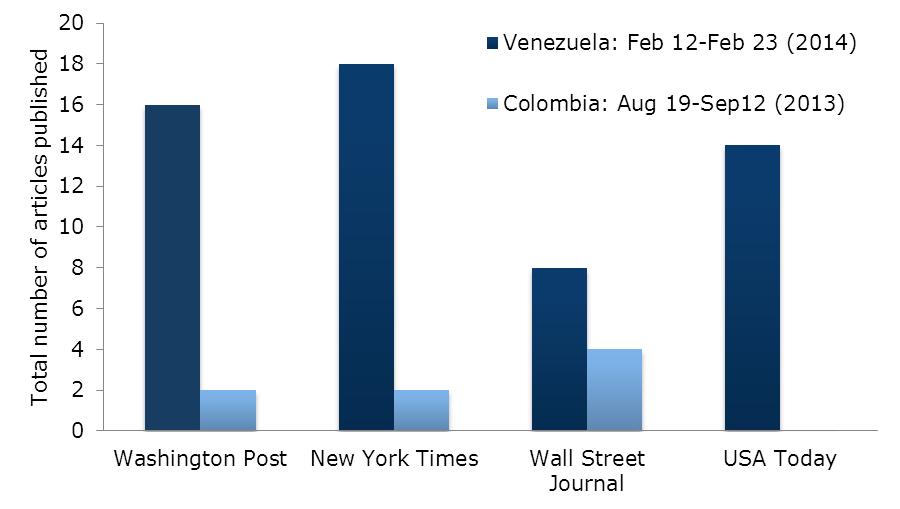
This is especially remarkable if we consider the high levels of repression carried out by the Colombian police and military in response to these protests. The International Office for Human Rights Action in Colombia described the violence as “unprovoked” and “indiscriminate” and attributes all of the violence to state forces.
The incidence of deaths in both Colombia and Venezuela[i], so far, is only slightly higher in Venezuela, with 13 deaths versus 12 deaths in Colombia.[ii] Yet there was very little coverage, and almost no criticism of the Colombian government as compared to the harsh attacks on the Venezuelan government in the U.S. media.
As mentioned earlier, US Secretary of State John Kerry and President Obama made public statements regarding the protests in Venezuela. Both demanded that students arrested in Venezuela be released, without regard as to whether any had been arrested for allegedly committing crimes such as arson and assault. There were no such statements from U.S. officials regarding the hundreds arrested in Colombia.
It is possible that both the huge differences in the amount of media coverage, and the responses to these two sets of protests by both the media and U.S. government officials has to do with the protesters and their aims, and the respective governments. The Colombian farmers were protesting against policies strongly supported by the U.S. government; they were also protesting against a government that the U.S. sees as a strategic ally, home to U.S. military bases and receiving billions of dollars in U.S. aid. The Venezuelan protesters are demanding the ouster of a government that the U.S. government has [spent] millions of dollars trying to get rid of, including U.S. support for the 2002 military coup against the government.
[i] The total amount of deaths reflects data from the most recent figures from Venezuela Transparencia, as of Monday, February 24 2014.
[ii] It is important to note that so far only six of the 13 deaths in Venezuela are confirmed to be opposition protesters.

Terrorism: It Could Be Anyone Now
By Kevin Ryan | Dig Within | December 16, 2013
This weekend I ran across a random copy of The Wall Street Journal and decided to see what passes for mainstream news these days. Reading it reminded me of the striking amount of terrorism propaganda being foisted upon the U.S. public. The numerous terrorism-related stories in that weekend edition of The Journal painted a confused and contradictory picture that reflects a difficulty in keeping the American public focused on terrorist threats and increasingly suspicious of their fellow citizens.
The weekend edition included five major stories about terrorism, including a shooting at a Colorado high school, the release of video from a hospital massacre in Yemen, and a review of how the Sandy Hook victims’ families are coping. In the most prominent spot, at the top left of the front page, readers found an alert for a major expose covering the Boston bombers. The fifth story was about the arrest of a Wichita man for plotting to blow up aircraft with a homemade bomb at the airport.
The new, Wichita story provides a good example of the challenges facing the FBI and corporate media in ongoing efforts to stoke the public fear. The suspect, like others in the last few years, had no previous history of terrorist activity and the FBI did everything for him.
 Terry Lee Loewen was an avionics specialist at a private company working at the Mid-Continent Airport in Wichita. Allegedly, he tried to drive his car, loaded with explosives that the FBI had helped him make, onto the tarmac to cause “maximum carnage and death.” This man, whom neighbors called quiet and “normal” was supposedly working for al-Qaeda in the Arabian Peninsula.
The emerging story of Loewen includes a significant number of contradictory reports and unbelievable aspects. The official account is that Loewen decided to become a Muslim about six months ago and he immediately began devoting all his time to preparations for becoming a “lone wolf” suicide bomber. FBI-produced documents allegedly provide this 58-year old white man’s reasoning for his radical change of life course—“My only explanation is that I believe in jihad for the sake of Allah + for the sake of my Muslim brothers + sisters.”
Although Loewen did not enter a plea and his public defender and current wife would not comment, his ex-wife and son were contacted for interviews and neither of them had any idea about his new commitment to jihad and martyrdom. The son had spoken to his father in the last month yet, according to The Journal, “didn’t detect anything amiss” and “didn’t know about any turn toward Islam by his father.”
Although Loewen is being portrayed as a serious, jihadist Muslim, he had no known connection to any Muslim organization in Wichita or elsewhere. Apparently he was only an online Muslim and the FBI caught him making comments about his desire to wage jihad against his own country on behalf of the members of his new faith.
His neighbors couldn’t believe it and never saw anything suspicious about him or his current wife. And although his own son had no idea about it, and his ex-wife would never have predicted it, in his last six months he must have devoted every spare moment to his new mission. One might think that a new convert would take time to learn about his new religion and interact with at least one or two Muslims in his community. After all, doesn’t becoming a Muslim require more than just making a few online comments?
Not for Loewen, according to the FBI. Instead, one day he was just a solitary, radical Muslim and he immediately began spending all his free time “studying subjects like jihad, martyrdom operations, and Sharia law.” He also “studied the airport layout and took photos of access points, researched flight schedules and acquired components to make car bombs.” He was obviously very busy and totally committed.
FOX News reported that Loewen was inspired by Usama bin Laden. Investigators from the Wichita Joint Terrorism Task Force further claimed that Loewen “frequently expressed admiration for Anwar Al-Awlaki.” Republican Senator Jerry Moran of Kansas said that Loewen’s action reminded us that we must “reaffirm our commitment” to the War on Terror.
There are certainly suspicious things about Loewen. For one thing, he had another name—Terry L. Lane. How many readers of The Wall Street Journal just happen to have other names? And Loewen was cited in 2009 for a “a concealed-carry violation at the airport.”
Nonetheless, according to his ex-wife of 10-years, Loewen/Lane was “peaceful, easy-going, quiet man” who “didn’t like confrontation; he was never one to start a fight.” She said he had left his job at Hawker Beechcraft Air Services for a time, to work at Learjet across town. She didn’t know when he returned to Beechcraft. “He was happy. He was a normal human being,” she said. And although The Journal reported that the son had no idea about Loewen’s conversion to Islam, The Wichita Eagle reported that the son told his mother that Loewen had recently become a Muslim.
Other news sources report that the son said his dad was “always really calm and a loving man” and that he “had no idea how his father came to be the main suspect in a foiled terror plot.”
Therefore the news about Loewen/Lane and this alleged new terrorist plot includes many confusing reports and makes little or no sense. A 58-year old man with no connection to any Muslim organization just decided on his own to give up his entire life to become a jihadist. He forsook all other commitments to make a martyr of himself for the benefit of “brothers and sisters” who he had never met. His family and neighbors apparently knew nothing about it.
If we can learn anything from the incident it is that the next terrorist could be anybody—you, your father, your neighbor—anyone at all. And there won’t necessarily be any signs at all other than what the FBI provides about internet activity.
This brings us to the big expose that The Journal published on the Boston bombers. Readers might wonder about the coincidence of the reporter from The Journal just happening to be a relatively close friend of the Tsarnaev family, whose two sons were accused of the marathon attack. Ostensibly, that relationship was initiated because both the reporter and the family spoke Russian and the reporter was doing research on Chechens and “Russia’s Islamist insurgency.” But the friendship was clearly much more than that. Who could have predicted that chance relationship would come in so handy for a terrorism reporter from a major U.S. news source?
Anyway, the story about the Tsarnaevs presents more contradictions. For instance, the mother of the accused bombers is portrayed quite differently than we have seen before. The woman who suddenly became a terrorist suspect herself a week after she began claiming that her sons were controlled by the FBI has most often been seen as a strict Muslim woman dressed in very traditional garb. In The Journal’s new story, however, she is “a wide-eyed rapid talker with a low-cut dress and high heels who waved her arms and teased her black hair like the pop singer Cyndi Lauper.” And she ran a business on the side giving facials.
In this new light, mother Tsarnaev could be an office girl from Jersey, or the girl next door.
But those who read the whole story realize that there is a bigger purpose behind this spread on the Tsarnaevs and it is not to describe their dress habits. It is, in fact, to reveal that the Boston bombers were conspiracy theorists. Specifically, Tamerlan Tsarnaev and his brother were “filled with thoughts of conspiracy” including that “the Sept.11 attacks were organized by shadowy financial elites.”
We have seen this tactic before with other terrorism stories but never this blatantly. We are being told that not only can anyone be a terrorist, but it is more likely that anyone who questions the official accounts of terrorism is more likely to be a terrorist. How convenient for the military-terrorism-industrial complex. If such an approach takes hold in the minds of fearful citizens, there would be no stopping the architects of the War on Terror and no shortage of suspects to keep the whole thing rolling along.
Wall Street Journal Columnist Repeatedly Gets His Facts Wrong About NSA Surveillance
By Trevor Timm | EFF | November 27, 2013
Wall Street Journal columnist L. Gordon Crovitz wrote a misleading and error-filled column on NSA surveillance Monday, based on documents obtained by EFF through our Freedom of Information Act lawsuit. Since we’ve been poring over the documents for the last week, we felt it was important to set the record straight about what they actually reveal.
Crovitz:
Edward Snowden thought he was exposing the National Security Agency’s lawless spying on Americans. But the more information emerges about how the NSA conducts surveillance, the clearer it becomes that this is an agency obsessed with complying with the complex rules limiting its authority.
That’s an interesting interpretation of the recently released documents, given that one of the two main FISA court opinions released says the NSA was engaged in “systemic overcollection” of American Internet data for years, and committed “longstanding and pervasive violations of the prior orders in this matter.” The court summarized what it called the government’s “frequent failures to comply with the [surveillance program’s] terms” and their “apparent widespread disregard of [FISA court imposed] restrictions.”
Crovitz:
[The documents] portray an agency acting under the watchful eye of hundreds of lawyers and compliance officers.
Again, this is not what the actual FISA court opinions portray. “NSA’s record of compliance with these rules has been poor,” and “those responsible for conducting oversight failed to do so effectively,” FISA court Judge Bates wrote in the key opinion released last week. In another FISA court opinion from 2009, released two months ago, the NSA admitted that not a single person in the entire agency accurately understood or could describe the NSA’s whole surveillance system to the court.
It’s true that the number of compliance officers at the NSA has increased in recent years, but as the Washington Post reported, so has the number of privacy violations.
Crovitz:
These documents disprove one of Mr. Snowden’s central claims: “I, sitting at my desk, certainly had the authority to wiretap anyone, from you or your accountant, to a federal judge, to even the president if I had a personal email,” he told the Guardian, a British newspaper.
Here, Crovitz is setting up a strawman. Snowden wasn’t talking about the NSA’s legal authority, but their technical authority to conduct such searches. Snowden was likely referring to XKeyScore, which the Guardian reported allowed NSA analysts to “search with no prior authorization through vast databases containing emails, online chats and the browsing histories of millions of individuals.”
We actually have a specific example that proves Snowden’s point. As the New York Times reported in 2009, an NSA analyst “improperly accessed” former President Bill Clinton’s personal email. More recently, we’ve learned that the NSA analysts abused the agency vast surveillance powers to spying on ex-spouses or former lovers.
Crovitz:
The NSA also released the legal arguments the Justice Department used in 2006 to justify collection of phone metadata-the telephone number of the calling and called parties and the date, time and duration of the call.
…
Metadata collection is about connecting the dots linking potential terrorist accomplices. The Clinton administration created barriers to the use of metadata, which the 9/11 Commission concluded let the terrorists avoid detection. Since then, metadata has helped stop dozens of plots, including an Islamist plan to blow up the New York Stock Exchange in 2008.
Again, not true. As Intelligence Committee members Sen. Ron Wyden and Sen. Mark Udall have continually emphasized, there is “no evidence” that the phone metadata program is effective at stopping terrorists. Independent analyses have come to the same conclusion. When called out on that number in a Congressional hearing, even NSA Director Keith Alexander admitted the number was exaggerated.
The only “disrupted plot” the NSA can point to that was solely the work of the phone metadata program was a case where a man from San Diego sent a few thousand dollars to the al-Shabaab organization in Africa in 2008. In other words, the metadata did not disrupt an active terrorist plot inside the US at all.
Crovitz:
The declassified brief from 2006 made clear that such metadata “would never even be seen by any human being unless a terrorist connection were first established,” estimating that “0.000025% or one in four million” of the call records “actually would be seen by a trained analyst.”
The major 2009 FISA court opinion released in September, that apparently Mr. Crovitz either didn’t read or conveniently left out of his piece, showed that the NSA had been systematically querying part of this phone records database for years for numbers that the agency did not have a “reasonable articulable suspicion” were involved in terrorism—as they were required to have by the FISA court. Of the more than 17,000 numbers that the NSA was querying everyday, the agency only had “reasonable articulable suspicion” for approximately 1,800 of them.
The FISA court concluded, five years after the metadata program was brought under a legal framework, that it had been “so frequently and systematically violated that it can fairly be said that this critical element of the overall…regime has never functioned effectively.”
These documents clearly do not paint a picture of an agency with a clean privacy record and a reputation for following court rules, as Mr. Crovitz claims, and in fact, they show why it is vital Congress passes substantive NSA reform immediately. You can go here to take action.
Related articles
- How NSA Mass Surveillance is Hurting the US Economy (alethonews.wordpress.com)
- Obama administration defends NSA against civil liberties lawsuit (counterinformation.wordpress.com)
Featured Video

Why the U.S. Should Pull Back From the First Island Chain
or go to
Aletho News Archives – Video-Images
Book Review
‘Why Fauci Must Rot in Prison’: A Tale of Two Diaries
By Jill Erzen | The Defender | October 13, 2026
Dr. Anthony Fauci’s private diary reveals a “mind-numbing” contradiction between what the former top U.S. infectious disease official knew about COVID-19 and what he told the public, senior White House adviser Peter Navarro, Ph.D., said last week on “American Thought Leaders.”
In his new book, “Why Fauci Must Rot in Prison,” due out Oct. 20, Navarro compares Fauci’s private entries to his own pandemic-era diary, and uses what he calls “a tale of two diaries” to argue that Fauci should face criminal prosecution.
“I show, actually, how a prosecution can and should happen … at the state level, most likely,” Navarro said. “He should wind up in prison, and we’ve got the receipts in this book to put him there.”
Navarro said Fauci repeatedly acknowledged important facts in private, then publicly pursued policies that contradicted those facts — with devastating consequences.
“What he says many times privately in his diary is so at odds with both his public behavior and public statements that it’s mind-numbing,” Navarro said.
Navarro examines the lasting damage caused by lockdowns and other pandemic policies, and the ongoing toll of long COVID.
His book also addresses questions about vaccine safety, including why healthy young people faced COVID-19 vaccination mandates despite concerns about myocarditis, and why women were not warned about miscarriage risks linked to the shots. … continue
Blog Roll
 Aletho News
- Jennifer Kavanagh: Why the U.S. Should Pull Back From the First Island Chain
- Yemen denounces international community’s silence on Saudi aggression, siege
- UAE and Saudi Arabia move toward renewed coordination against Sanaa
- How Iran’s two-week retaliatory strikes exposed cracks in US military architecture in Persian Gulf
- The mother of all propaganda: Why the hype over US MOAB strike against Iran is nothing but theater
- Iran says it possesses technology behind US 14-ton GBU bunker-buster
- Trump asks Iran not to retaliate after he strikes Pickaxe Mountain – w/ Prof. Marandi
- Vice President J.D. Vance’s Deceptive ‘Antiwar’ Campaign Speech
- Iran: Palestinians’ rights must not be compromised in Gaza’s future; US, Israel to blame for Hormuz situation
- Ongoing tales of Syrian chemical weapons
- If Americans Knew
- Israeli rabbi permits occupiers to steal Palestinian olive harvest in West Bank
- Netanyahu’s spin on latest settler attack is laughable – Daily Update
- Israeli soldiers debunk Israel’s talking points
- In West Bank, Israeli settlers are totally out of control – Daily Update
- NPR investigation finds evidence of widespread fraud at mall kiosks tied to Israeli skincare brand
- Tucker Carlson exposes Israeli Lies about the Oct 7th attack, Charlie Kirk, and the U.S.
- Israel has detained thousands of Palestinian children since Oct 7th – over half spent time in solitary, many uncharged
- Israeli Analysis: Is Netanyahu Planning an ‘October Surprise’ Attack Before Israel’s Election?
- Israeli settlers brutally attack Palestinians and Washington Post female photographer, 65
- Words Have Changed, Occupation Continues: The Reality of the Gaza Ceasefire
- No Tricks Zone
- Predictions Made By Renowned Climate Proifessor Over Past Decades Have Been Proven To Be Poor
- New Study Suggests Large Regions Of The Pacific Ocean Have Been Cooling For The Last 80 Years
- Germany’s Green Energy Debacle: High Energy Costs Force Kahla Porzellan to Close After 182 Years!
- New Study: 50 Years Of The Most Aggressive ‘Net Zero’ Policies Can Only Affect The Global Climate By 0.03°C
- US September “Heat” Was No Record…Many Records Set Decades Ago
- Latest European Green Energy Debacle; Portugal’s Largest Flagship Solar Park Insolvent!
- Green Energy Debacle: German Expert Professor Fritz Vahrenholt Warns Of Severe Economic And Social Consequences
- Two More Paleo Reconstructions Affirm Meters-Higher Sea Levels Across Ireland, Brazil 7000-6000 Years Ago
- New Study: Earth And Venus Surface Warmth Largely Explained By Convection And Lapse Rate, Not CO2 Or Radiation
- 2025 Nature Paper Claiming Worsening Global Drought Gets RETRACTED …Heavily Flawed

