Israel arrested 175 Palestinian women, girls in 2018
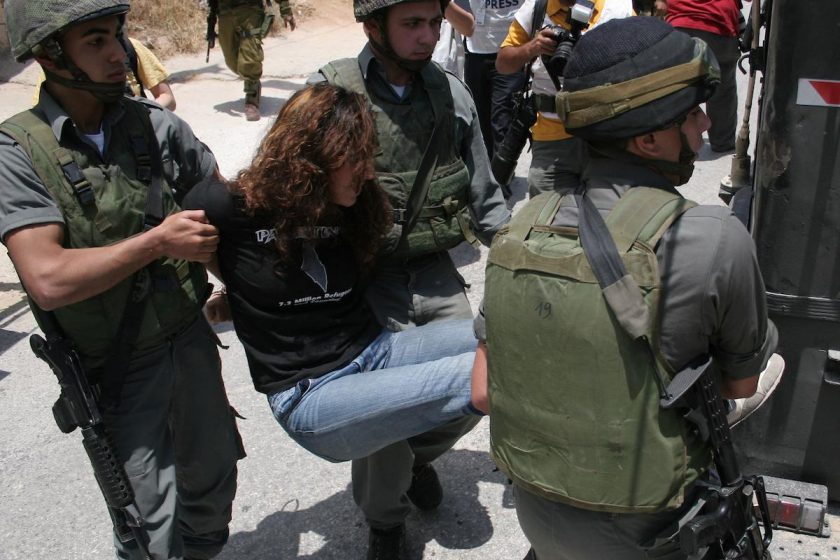
Israeli soldiers arrest a woman protester during a demonstration against Israel’s controversial separation barrier which crosses the Palestinian territories in the West Bank town of Beit Jala, near the town of Bethlehem, on 27 June 2010 [Mamoun Wazwaz/Apaimages]
MEMO | January 2, 2019
Israeli occupation forces arrested 175 Palestinian women and girls in 2018 and summoned hundreds in for interrogation, the Palestine Prisoners’ Centre for Studies said yesterday.
In a statement reported by the Safa News Agency, the Director of the centre Riyadh Al-Ashqar said that the Israeli occupation escalated its aggression on Palestinian women and girls this year in order to punish them for their participation in anti-occupation activities.
He also said that the Israeli occupation arrested female relatives of male prisoners, describing this as a “form of illegal punishment”.
Al-Ashqar documented the detention of 15 females who’s male relatives are being held in Israeli detention including Bayan Faroun. The twenty-four-year-old was handed a 40 months prison term. She is the fiancé of Ahmed Azzam who was sentenced to six-years in jail.
Female prisoners face harsh conditions in jail, Al-Ashqar said, including violation of their rights, humiliation and a lack of access to health care.
Nineteen Palestinian Journalists Are Still Imprisoned By Israel
IMEMC News – December 31, 2018
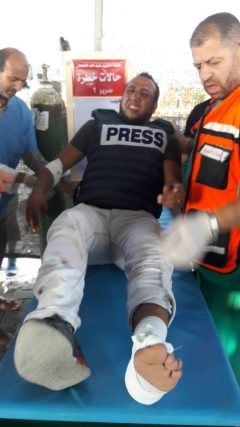 The Palestinian Information Ministry has reported that there are nineteen Palestinian journalists who are still imprisoned by Israel, in direct violation of various treaties and International Law.
In a press statement Monday, the Ministry said that the Israeli occupation and its military courts are ongoing with their serious violations against the journalists and various media outlets in occupied Palestine.
It said that many journalists have also been forced under house arrest, others were forced out of their towns, in addition to facing high fines by the Israeli military courts for performing their duties.
The Ministry also said that some of the abducted journalists were shot and injured, while others are sick, in need of specialized medical treatment but are denied that right.
The soldiers also invaded and violently searched many media outlets across the West Bank, and confiscated equipment.
The Information Ministry stated that Israel’s violations are ongoing attempts to silence the Palestinian media outlets and the journalists, and urged the International Federation of Journalists, Reporters Without Borders, and various related organizations around the world to intervene and stop the escalating abuses against the media and the Freedom of the Press in occupied Palestine.
It is worth mentioning that the soldiers have also killed Palestinian Photojournalist Yasser Mortaja, and journalist Ahmad Abu Hussein, in the Gaza Strip, in addition to wounding dozens of journalists, during the Great Return March processions.
Israeli Settler Drives into Sheep near Ramallah, Kills 12
IMEMC News & Agencies – January 1, 2019
 In what appears as a premeditated terror attack, an Israeli settler rammed his vehicle into a herd of sheep in the village of al-Mughayyer, to the east of Ramallah, on Monday, killing 12 and injuring 18 others.
Local sources told WAFA correspondence that the settler rammed into the herd on purpose and with full force, to cause as much damage as possible. They said he ran over 30 sheep, killing 12 and injuring the others, of which six were in critical condition.
The attack happened on what is known as Alon settlement road.
Raising sheep is the only source of income for Khaled Abu Illia, victim of the premeditated terror attack.
Shepherds are often seen in the open pastures during this season, when the fields are covered with green grass.
Israel demolished 538 homes, facilities in West Bank in 2018

Palestinian boys watch Israeli excavators demolish an allegedly unauthorised Palestinian apartment block in E. Jerusalem, 1 May 2018 [Mostafa Alkharouf/Anadolu Agency]
MEMO | December 29, 2018
Israel demolished 538 Palestinian homes and facilities across the occupied West Bank and Jerusalem in 2018, leaving 1,300 Palestinians and 225 children homeless.
A report issued yesterday by the Abdullah Al-Hurani Centre – an affiliate of the Palestine Liberation Organisation (PLO) – stressed that these demolitions were carried out in violation of the Fourth Geneva Convention and other international laws.
In the report, the centre said that Israel “continues its policy of ethnic cleansing against the Palestinians in the occupied West Bank and Jerusalem,” pointing out that, in addition to the demolitions, Israel had issued 460 “stop-building orders” during the same period.
Israel’s Civil Administration – which carries out Israeli policy in the occupied West Bank – issued a military order to demolish all the targeted buildings less than 30 days before the demolition was carried out, a move the centre sees as aiming to cut short the possibility of appealing such orders.
The report also documented the demolition or closure of 12 Palestinian schools and kindergartens built by the Palestinian Authority (PA) in the West Bank.
Inside Banksy’s The Walled Off Hotel in Bethlehem
We check in to Banksy’s bizarre Palestinian hotel, where the hospitality is as peculiar as the message is powerful
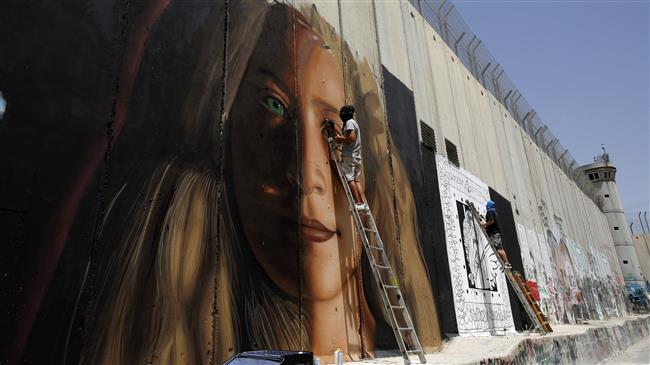
By Jonathon Cook – The National – December 21, 2018
Anonymous British street artist Banksy made headlines in October when his $1.4 million artwork Girl with Balloon self-destructed by passing through a shredder concealed in its frame at a London auction moments after it had been bought.
But in the Palestinian city of Bethlehem, a much larger Banksy art project – a hotel boasting “the worst view in the world” – appears to be unexpectedly saving itself from similar, planned destruction.
When it opened in March last year, The Walled Off Hotel – hemmed in by the eight-metre-high concrete wall built by Israel to encage Bethlehem – was supposed to be operational for only a year. But nearly two years on, as I joined those staying in one of its nine Banksy-designed rooms, it was clearly going from strength to strength.
Originally, The Walled Off Hotel was intended as a temporary and provocative piece of installation art, turning the oppressive 700-kilometre-long wall that cuts through occupied Palestinian land into an improbable tourist attraction. Visitors drawn to Bethlehem by Banksy’s art – both inside the hotel and on the colossal wall outside – are given a brief, but potent, taste of Palestinian life in the shadow of Israel’s military infrastructure of confinement.
It proved, unexpectedly, so successful that it was soon competing as a top tourist attraction with the city’s traditional pilgrimage site, the reputed spot where Jesus was born, the Church of the Nativity. “The hotel has attracted 140,000 visitors – local Israelis, Palestinians, as well as internationals – since it opened,” says Wisam Salsa, the hotel’s Palestinian co-founder and manager. “It’s given a massive boost to the Palestinian tourism industry.”
Exception to Banksy’s rule
The Walled Off Hotel was effectively a follow-up to Banksy’s “Dismaland Bemusement Park”, created in the more familiar and safer setting of a British seaside resort. For five weeks, that installation in Weston-super-Mare, Somerset, England, offered holidaymakers a dystopian version of a Disney-style amusement park, featuring a nuclear mushroom-cloud, medical experiments gone wrong, boat people trapped on the high seas and the Cinderella story told as a car crash.
But unlike Girl with Balloon and Dismaland, Banksy appears uncharacteristically reluctant to follow through with the destruction of his Bethlehem creation. Some 21 months later, it seems to have become a permanent feature of this small city’s tourist landscape.
Given that Banksy is notoriously elusive, it is difficult to be sure why he has made an exception for The Walled Off Hotel. But given his well-known sympathy for the Palestinian cause, a few reasons suggest themselves. One is that, were he to abandon the hotel, it would delight the Israeli military authorities. They would love to see The Walled Off Hotel disappear – and with it, a major reason to focus on a particularly ugly aspect of Israel’s occupation. In addition, dismantling the hotel might echo rather uncomfortably Israel’s long-standing policy of clearing Palestinians off their land – invariably to free-up space for Jewish settlement.
Israel strenuously claims the wall was built to aid security by keeping out Palestinian “terrorists”. But the wall’s path outside The Walled Off Hotel seals off Bethlehem from one of its major holy sites, Rachel’s Tomb, and has allowed Jewish religious extremists to take it over.
A rare success story
In sticking by the hotel, Banksy appears to have been influenced by Palestinian “sumud”, Arabic for steadfastness, a commitment to staying put in the face of Israeli pressure and aggression. But significantly, there is a practical consideration: The Walled Off Hotel has rapidly become a rare success story in the occupied territories, boosting the struggling Palestinian economy. That has occurred in spite of Israel’s best efforts to curb tourism to Bethlehem, including by making a trip through the wall and an Israeli checkpoint a time-consuming and discomfiting experience.
Israel’s attitude was highlighted last year when the interior ministry issued a directive to travel agencies warning them not to take groups of pilgrims into Bethlehem to stay overnight. After an outcry, the government relented, but the message was clear.
Salsa notes that The Walled Off Hotel has not only attracted a new kind of visitor to Bethlehem, but has also persuaded many to spend time in other parts of the occupied West Bank, too.
Salsa understands the importance of tourism personally. He was an out-of-work guide when mutual friends first introduced him to Banksy in 2005, shortly after the wall cutting off Bethlehem from nearby Jerusalem had been completed. The city was economically dead, with tourists too fearful to visit its holy sites as armed uprisings raged across the occupied territories. The Second Intifada from 2000-2005 was the Palestinians’ response after Israel refused to grant them the viable state most observers had assumed was implicit in the Oslo Accords of the 1990s.
Banksy arrived in 2005 to spray-paint on what was then a largely pristine surface, creating a series of striking images. It unleashed a wave of local and foreign copycats. The wall in Bethlehem quickly became a giant canvas for artistic resistance, says Salsa.
Much later, in 2014, Banksy came up with the idea of the hotel. Salsa found a large residential building abandoned for more than a decade because of its proximity to the wall. In secret, The Walled Off was born. “It was a crazy spot for a hotel,” says Salsa. “It felt like divine intervention finding it. It was close to the main road from Jerusalem so no one could miss us.”
Palestinians’ reality
Importantly, the hotel was also in one of the few areas of Bethlehem inside “Area C”, parts of the West Bank classified in the temporary Oslo Accords as under full Israeli control. That meant the army could not bar Israelis from visiting. “Nowadays there are no channels open between Palestinians and Israelis. So The Walled Off Hotel is a rare space where Israelis can visit and taste the reality lived by Palestinians.
“True, Israelis mostly come to see the art. But they can’t help but learn a lot more while they are here.”
Salsa is happy that the Walled Off Hotel provides a good salary to 45 local employees and their families. His hope in setting up the hotel was to “encourage more tourists to stay in Bethlehem and for them to hear our story, our voice”.
But Banksy’s grander vision had been fully vindicated, he says. “The Walled Off Hotel gives tourists an experience of our reality.
“But it also emphasises other, creative ways to struggle and speak up. It offers art as a model of resistance.
“The hotel magnifies the Palestinian’s voice. And it makes the world hear us in a way that doesn’t depend on either us or the Israelis suffering more casualties.”
Global impact
The hotel’s continuing impact was underscored last month when it featured for the first time at the Palestinian stand at the annual World Travel Market in London, the largest tourism trade show in the world. The event attracts 50,000 travel agents, who conduct more than $4 billion in deals over the course of the show.
Banksy had announced beforehand that he would bring a replica of one of his artworks on the wall just outside the Bethlehem hotel: cherubs trying to prise open two concrete slabs with a crowbar. He also promised a limited-edition poster showing children using one of Israel’s military watchtowers as a fairground ride. A slogan underneath reads: “Visit historic Palestine. The Israeli army liked it so much they never left!” As a result, there was a stampede to the Palestinian stand, one of the smallest, that caught the show’s organisers by surprise.
Rula Maayah, the Palestinian tourism minister, praised Banksy for changing the image of Palestinian tourism by diverting younger people into the West Bank, often during a visit to Israel. “He promotes Palestine and focuses on the occupation, but at the same time he is talking about the beauty of Palestine,” she said.
At the Walled Off Hotel, however, Israel has made it much harder to see the beauty. Most windows provide little more than a view of the wall, which dwarfs in both height and length the Berlin Wall to which it is most often compared. That is all part of the Walled Off “experience” that now attracts not only wealthier visitors keen to stay in one the hotel’s rooms, but a much larger audience of day trippers.
So successful has the Walled Off Hotel proved in such a short space of time that even some locals concede it upstages the Church of the Nativity – at least for a proportion of visitors. A local taxi driver who was guiding two French sisters along the wall outside the hotel said many independent tourists now prioritised it ahead of the church.
Only wanting to be identified as Nasser, he said: “We may not know who Banksy is, but the truth is, he has done us a huge favour with this hotel and his art.”
Sanctuary in a police state
If Dismaland created a dystopian amusement park in the midst of a fun-filled seaside resort, the Walled Off Hotel offers a small sanctuary of serenity – even if a politically charged one – in surroundings that look more like a post-apocalyptic police state.
Along the top of the wall, there are innumerable surveillance cameras, as well as looming watchtowers, where ever-present Israeli soldiers remain out of view behind darkened glass. They can emerge unexpectedly, usually to make raids on the homes of unsuspecting Palestinians.
When I made a trip to the Walled Off in October, I parked outside to find half a dozen armed Israeli soldiers on top of the hotel’s flat roof. When one waved to me, I was left wondering whether I had been caught up in another of Banksy’s famous art stunts. I hadn’t. They were real – there to watch over Jewish extremists celebrating a religious holiday nearby at Rachel’s Tomb.
The hotel’s lobby, though not the rooms, are readily accessible to the public. It is conceived as a puzzling mixture: part cheeky homage to the contrived gentility of British colonial life, part chaotic exhibition space for Banksy’s subversive street art. Visitors can enjoy a British cream tea, served in the finest china, sitting under a number of Israeli surveillance cameras wall-mounted like hunting trophies or alongside a portrait of Jesus with the red dot of a marksman’s laser-beam on his forehead.
A history of resistance
The lobby leads to a museum that is probably the most comprehensive ever to document Israel’s various methods of colonisation and control over Palestinians, and their history of resistance.
At its entrance sits a dummy of Lord Balfour, the foreign secretary who 101 years ago initiated Britain’s sponsorship of Palestine’s colonisation. He issued the infamous Balfour Declaration promising the Palestinians’ homeland to the Jewish people. Press a button and Balfour jerks into life to furiously sign the declaration on his desk. Upstairs is a large gallery exhibiting some of the best of Palestinian art, and the hotel reception organises twice-daily tours of the wall.
Entry to the rooms is hidden behind a secret door, disguised as a bookcase. Guests need to wave a room key, shaped like a section of the wall, in front of a small statue of Venus that makes her breasts glow red and the door open.
A stairway leads to the second and third floors, where the landings are decorated with more fading colonial splendour and Banksy art. Kitsch paintings of boats, landscapes and vases of flowers are hidden behind tight metal gauze of the kind Israel uses to protect its military Jeeps from stone-throwers.
A permanent “Sorry – out of service” sign hangs from a lift, its half-open doors revealing that it is, in fact, walled up.
No mementos
Although the rooms are designed thematically by Banksy, only a few contain original artworks, most significantly in the Presidential Suite.
Hotels may be used to customers taking shampoos and soaps, even the odd towel, as mementos of their stay. But at the Walled Off, the stakes are a little higher. Guests are issued with an inventory they must sign on departing, declaring that they have not pilfered any art from their room. But it is the wall itself that is the dominant presence, towering over guests as they come and go, trapping them in a narrow space between the hotel entrance and an expanse of solid grey.
A proportion visit the neighbouring graffiti shop, Wall Mart, where they can get help on how to leave their mark on the concrete. Most of the casual graffiti is short-lived, with space regularly cleared so that new visitors can scrawl their messages and use art as a tool of resistance.
Protest pieces
Banksy’s better-known artworks, however, are saved from the spray-paint pandemonium elsewhere.
The crowbar-armed cherubs he brought to London were painted in time for Christmas last year, when he recruited film director Danny Boyle – of Slumdog Millionaire fame – to stage an alternative nativity play for local families in the hotel car park. The “Alternativity”, featuring a real donkey and real snow produced by a machine on the Walled Off’s roof, became a BBC documentary. Banksy had once again found a way to persuade prime-time TV to shine a light on Israel’s oppressive wall.
Another artwork is his “Er sorry”, a leftover from the Walled Off’s “apologetic street party” of November last year, marking the centenary of the Balfour Declaration’s signing. Children from two neighbouring refugee camps were invited to wear Union-Jack crash helmets and wave charred British flags. A person dressed as Queen Elizabeth II unveiled “Er Sorry” stencilled into the wall. It served both as a hesitant apology on behalf of Britain and as a play on the initials of the Queen’s official Latin title, Elizabeth Regina.
The event, however, illustrated that Banksy’s subversive message, directed chiefly at western audiences, does not always translate well to sections of the local Palestinian population. The party was hijacked by local activists who stuck a Palestinian flag into the Union Jack-adorned cake and chanted “Free Palestine”.
Is this ‘war tourism’?
Salsa outright rejects claims from some locals and foreign critics that the hotel is exploiting Palestinian misery and is an example of “war tourism”.
He points out: “The Balfour party got the media interested in a story they probably would not have covered otherwise, because it lacked violence and bloodshed.”
He adds that the area of Bethlehem in which the Walled Off is located would have been killed off by the wall were it not for Banksy investing his own money and time in the project. As well as the staff, it has brought work to tour guides, taxi drivers, neighbouring and cheaper hotels, shops and petrol stations. “That is a very important form of resistance,” he says.
It is also a rare example of Palestinians reclaiming land from the Israeli army. On the other side of the wall there had been a large army camp until the hotel started drawing significant numbers of visitors.
“The army didn’t like lots of tourists taking pictures nearby, so they moved further away, out of sight.”
Eternal memories
Canadian tourist Mike Seleski, 30, visited the hotel to see Banksy’s art before standing in front of the wall. He said he had heard about the Walled Off from an Israeli he befriended in Vietnam during a year travelling.
This was a detour from his stay in Israel – his only stop in the occupied territories. “I don’t like the usual tourist experiences,” he said. “It is important to hear the other side of the story when you travel.”
In every one of the 32 countries he has visited, he has stood to be photographed before a famous local spot holding a cardboard sign with words to reassure his worried mother: “Mum – I’m OK.”
In Bethlehem, he said it was obvious he’d take the photo in front of Banksy’s art on the wall, rather than the Church of the Nativity. “You see the wall on TV and forget about it. You get on with your life. But when you stand here, you realise Palestinians don’t have a choice. They simply can’t ignore it.”
Israel soldiers shot Palestinian teen, ‘dragged him around’ and chased away ambulance
MEMO | December 21, 2018
Israeli soldiers who fatally shot a Palestinian child last week prevented him from receiving potentially life-saving medical treatment, reported Haaretz.
 Seventeen-year-old Mahmoud Nakhle was shot on Friday 14 December as Israeli occupation forces suppressed protests around Al-Jalazun refugee camp near Ramallah.
The confrontations between residents and soldiers had already slowed down when Israeli forces “began chasing after the youths” and “suddenly… started shooting, using live ammunition”.
According to the paper, Nakhle was returning home “by way of a dirt path that passes above the camp”, when “the soldiers ran after him and one of them shot him once, in the lower back”.
The soldiers lifted Nakhle up and carried him a few dozen metres away, “laying him down at the side of the road”; one eyewitness said they carried him “like you haul a slaughtered sheep”.
After a few minutes, soldiers lifted the boy up again, and “carried him a few dozen metres more”. A Palestinian ambulance “was chased off by the soldiers, who threatened the driver with their rifles”. As far as is known, Haaretz reported, “the soldiers did not give Nakhle any sort of medical aid”.
It was only after a quarter of an hour “that the soldiers allowed an ambulance to be summoned”, but Mahmoud died en route to the hospital.
His death certificate states that the teen “died from loss of blood after a bullet entered his lower back, struck his liver and hit a main artery, damaging other internal organs”.
The paper described how “Mahmoud attended school until the 10th grade and then studied electrical engineering at a professional college”. After a year of apprenticeship, he had been “waiting to find a job as an electrician”. He is survived by his parents and two sisters aged 14 and four.
The Israeli military spokesperson told Haaretz “a Palestinian holding a suspicious object approached one of the soldiers” when “the soldier fired at him”. The incident is being investigated by the Military Police, who routinely whitewash the killing of Palestinians by Israeli occupation forces.
READ:
40% of Palestinian lawmakers detained by Israel since 2006 elections
MEMO | December 19, 2018
Some 40 per cent of the Palestinian Legislative Council’s members have been detained by Israeli occupation forces at one time or another since the 2006 elections, prisoner advocacy groups said on Tuesday.
According to WAFA, the joint report by the Palestinian Prisoner Society, Addameer and the Prisoners Commission said “Israeli authorities have been targeting Palestinian deputies and political activists by holding them in administrative detention without charge or trial for long periods of time in order to prevent them from performing their societal and national roles.”
The groups noted that there are currently six Palestinian parliamentarians held in so-called administrative detention – without charge or trial – including Khalida Jarrar, “who had served time in prison and was later re-arrested and placed in administrative detention since July 2017”.
Another lawmaker, Nasser Abdu Jawwad, “is in prison awaiting trial since his detention in January of this year.”
The new report stated that Israel detained 486 Palestinians during November, including 65 children and nine women. Those detained included 150 from Jerusalem, 71 from the governorate of Ramallah and Al-Bireh, and 77 from Hebron governorate. Overall, the number of Palestinian prisoners and detainees in Israeli jails by 31 November was 5,700, including 230 children.
Israeli politician calls for PA President to be killed
MEMO | December 17, 2018
A member of the Israeli parliament, the Knesset, called on Sunday for the President of the Palestinian Authority to have his head “chopped off”. Oren Hazzan MK made the comment about Mahmoud Abbas, as well as his Deputy, Mahmoud Al-Aloul, during a march held by illegal settlers in Jerusalem, Maan News Agency has reported.
Dozens of settlers gathered in and around Jerusalem’s Old City chanting racist slogans against Abbas and calling for him to be killed. In the evening, they gathered outside Prime Minister Benjamin Netanyahu’s house and burnt pictures of Abbas. Banners held by the settlers called for the PA leader’s assassination.
“We call for the complete approval of the settlements in Ofra and Amona,” Hazzan declared. Addressing his remarks to government ministers, he added, “We want to go back to Givaat. Stop evading your responsibility. We want to have the head of Abu Mazen [Mahmoud Abbas] and his deputy chopped off. The life of one of our soldiers is equal to the life of 100 terrorists. We want all the terrorists to be executed.”
Many Israeli officials refer to the Palestinians as “terrorists” whether or not they are involved in legitimate resistance activities.
Last week, Israeli settlers carried out attacks and instigated clashes with Palestinians in different areas across the occupied West Bank and Jerusalem. On most occasions, the heavily armed settlers are protected by Israeli soldiers and police officers when they gather for demonstrations and terrorist attacks on Palestinians and their homes.
Palestine: Two schools evacuated as Israeli gunman open fires outside

MEMO | December 16, 2018
An Israeli settler opened fire on Sunday outside two schools in the West Bank, as other settlers rampaged through the street under the protection of Israeli forces, reports Wafa News Agency. The schools are at the entrance to the village of al-Lubban al-Sharqiya, to the south of Nablus in the West Bank.
The shooting terrified the students and teachers of the two schools, and were forced to leave the schools to a safe haven.
Ibrahim Emran, the principal at one of the schools, told Wafa that settlers from the illegal Israeli settlement of Yitzhar attacked the school under the protection of the Israeli military, and that one of the settlers shot a bullet in the air to terrify the students. Emran said the school was forced to evacuate its students to keep them safe.
He added that the settlers also attacked civilian homes near the school, while soldiers fired rubber-coated bullets and gas bombs, prompting clashes between soldiers and local citizens.
Israeli sources claimed that the firing came in a response to a stoning attack on settlers’ vehicles passing at route 60, just near the entrance to the village where the schools are located.
Dahlan slams US ‘deal of the century’, prefers one-state solution
MEMO | December 13, 2018
The Palestinian Authority (PA)’s ex-Security Chief Mohammed Dahlan has criticised the US’ “deal of the century” claiming he would prefer to see a one-state solution prevail in Israel-Palestine.
In an interview yesterday with Russian state TV channel Russia Today, Dahlan argued that “the ‘deal of the century’ that the Americans speak of as a solution to the Palestinian problem is a total disaster,” Ynet reported. Dahlan added: “I [also] do not see the two-state solution happening. That is why I come with a new proposal: to establish one state, where Palestinians can run their lives without being dependent on Israel.”
While acknowledging that “our [Palestinians’] bigger dream is, of course, an independent Palestinian State in the West Bank and Gaza,” Dahlan argued this option was unlikely to be accepted by Israel or its main ally the United States. “Instead of nurturing illusions that will never be fulfilled,” he explained,
We should start internalising the notion of one-state for two nations, and demand full rights for the Palestinians.
Dahlan also criticised PA President Mahmoud Abbas, with whom he has been engaged in a feud since resigning as the PA’s Security Chief in 2007 and going into exile in the UAE. Dahlan told Russia Today that: “[Yasser] Arafat’s death marked the end of the era of great leaders in the Palestinian Authority. Abbas is nothing but a manager of a civilian authority in Ramallah. Nothing more. I suggest he pays a visit to the Gaza Strip, to pacify and encourage the people there, because the Gaza citizens are paying a very heavy price.”
This is not the first time Dahlan has called for Abbas to visit Gaza. Addressing an event in the besieged Strip via video link in November, Dahlan said: “I am calling for Abbas to visit Gaza and announce a national unity government,” referring to the split between Hamas – which governs the Gaza Strip – and Fatah – which dominates the PA in the occupied West Bank – that has been ongoing since Hamas won the last Palestinian elections in 2006.
Though Abbas has also criticised the so-called “deal of the century” – touted by US President Donald Trump as a solution to the situation in Israel-Palestine – his response has been meek. This has drawn condemnation from numerous parties and claims that the PA president has “lost his legitimacy”. Abbas has also seemed unable to counter the US’ repeated measures against Palestinians, from halting UNRWA funding to closing the Palestinian diplomatic mission in Washington.
This inaction has heightened tensions with Dahlan, who is often mentioned in discussions of who will succeed Abbas as PA president. Yet Dahlan is not without controversy, having grown close to the Emirati establishment and formed ties with Israel and Saudi Arabia. In October it emerged that Dahlan had arranged for US mercenaries to carry out targeted assassinations in Yemen on behalf of the UAE, meeting with an Israeli security contractor to arrange the deal. In November, Dahlan’s security team was revealed to have helped cover up the brutal murder of Saudi journalist Jamal Khashoggi, using fake passports to travel to Istanbul carrying tools and chemicals to hide any traces of the killing.
See also:
Israel settlers call for Abbas’ assassination
Dahlan: Bin Salman will remain in power for the next 50 years
Israel’s Executions Can’t Kill Palestinian Resistance
Remembering Ashraf Na’alwa, Saleh Barghouthi, Majd Matir and Hasan Arda
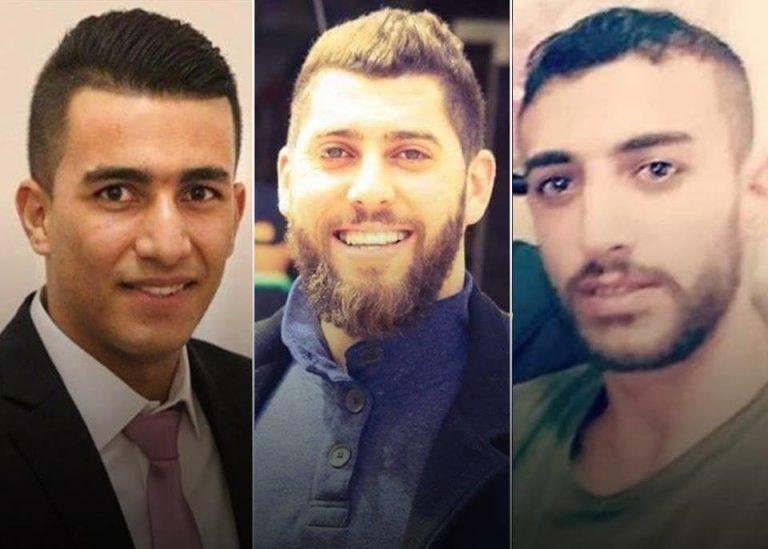
Ashraf Na’alwa, Saleh Barghouthi, Majd Mteir (l-r). Graphic: Quds News
Samidoun Palestinian Prisoner Solidarity Network | December 13, 2018
On 13 December 2018, Israeli occupation forces shot down four Palestinians, including several resistance fighters who had evaded their pursuit for months. Ashraf Na’alwa, 23, was killed by occupation forces who attacked the home where he was staying in Askar refugee camp near Nablus. He had been pursued by occupation forces since he carried out an armed resistance operation on 7 October in the illegal colonial settlement of Barkan in the northern West Bank of occupied Palestine in which two settlers were killed.
Na’alwa, a Palestinian worker at a factory in the colonial settlement, evaded occupation forces for months. During that time, his entire family was repeatedly harassed and attacked by occupation forces. His mother, sister, brother and father were all repeatedly detained and interrogated, while his home village of Shweika near Tulkarem was subjected to ongoing attacks, raids and intensive surveillance. Many of his family members remain behind bars as we remember him today. Occupation forces ordered his family home demolished, a tactic of collective punishment that the Israeli occupation continued from the former British colonial mandate over Palestine.
Israeli sources reported that Na’alwa’s location was finally revealed under “harsh interrogation,” usually a euphemism for torture under interrogation. The occupation forces deliberately aimed to kill Na’alwa, who resisted until the last moment; indeed, Israeli headlines bragged about “eliminating” the “terrorist.” Occupation forces reportedly chased Na’alwa through the camp for hours before surrounding him in the building. Around the bloody scene, occupation forces seized more Palestinians, accusing them of “providing aid” to the “wanted” resistance fighter.
The extrajudicial execution of Ashraf Na’alwa did not come alone today. Saleh Omar Barghouthi, 29, the son of former Palestinian prisoner Omar Barghouthi, who served 25 years in Israeli prisons, was shot dead near the village of Sarda near Ramallah. Barghouthi, from Kobar village, carried out an armed resistance action at Ofra illegal colonial settlement on Sunday, 9 December, wounding seven settlers. Occupation forces attacked the taxi he drove, seized him and shot him dead, according to Palestinian witnesses at the scene.
Barghouthi is also the nephew of Nael Barghouthi, one of the longest serving Palestinian prisoners, with 39 years in Israeli prison. Saleh’s brother, Asem, has spent 10 years in Israeli occupation prisons, while another uncle, Jacir, was deported to Gaza when released from Israeli prison.
Also on Thursday morning, Israeli occupation forces in Jerusalem shot Majd Mteir, 26, a Palestinian refugee from Qalandiya camp, ten to twelve times in a row. Witnesses said that Mteir was left lying on the ground bleeding for 40 minutes before his death. Occupation forces accused him of attempting to stab Israeli armed “border police” in Jerusalem.
These killings were carried out in a coordinated fashion, alongside the arrest of dozens of Palestinians on the same night. Clearly, these were intended to be a deadly blow not only against these strugglers, but also the Palestinian resistance as a whole.
Nevertheless, ensuing events made clear that the military power of the occupation and its extrajudicial executions would only inflame Palestinian resistance further. Three Israeli soldiers at the illegal colonial settlement of Givat Asaf were shot dead by unknown Palestinian resistance fighters, who left the scene, withdrawing from the area, later on Thursday morning. This response indicated that Palestinian resistance forces did not accept that the blood of these young strugglers should be spilled casually and without cost to the colonial occupier.
The assassination raids recall previous attacks, like those on Basil al-Araj and Moataz Washaha, Palestinian strugglers targeted for Israeli “elimination.” The policy of extrajudicial killings and assassinations by the Israeli state stretches back years and beyond borders, targeting resistance strugglers, local organizers and national leaders: Ghassan Kanafani, Abu Ali Mustafa, Sheikh Ahmad Yassin, Khaled Nazzal, Fathi Shiqaqi, Abu Jihad, Abdel-Aziz Rantisi and many others, including some of the Palestinian people’s brightest writers, poets and emissaries to the world. Despite decades of assassinations and killings, the Palestinian resistance has not been crushed. Instead, it has continued to adapt, survive and grow, resisting a brutal, colonial occupation and its imperialist sponsors despite vast disparities in wealth and resources.
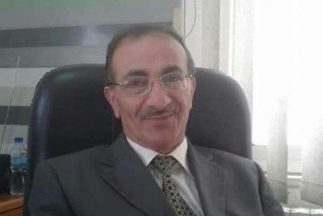
Photo: Hamdan Arda. Credit: Raya News
Israeli occupation forces have imposed a harsh siege on Ramallah and the surrounding villages. They shot dead 60-year-old Hamdan Arda, originally from the village of Arraba near Jenin, in his vehicle near el-Bireh, accusing him of attempting to run over soldiers. Arda was returning home from his aluminum factory when he was shot. As he lay inside his car, the soldiers refused to allow the Red Crescent ambulance to reach him and provide treatment. The killing of Arda came alongside attacks by soldiers and settlers on Palestinian cities and villages. Six Palestinians were wounded in el-Bireh, shot by live ammunition and rubber-coated metal bullets. Illegal colonial settlers attacked Palestinians and their vehicles in cities and towns throughout the West Bank of occupied Palestine, while Palestinians took to the streets in protest.
Palestinian political parties, including Hamas, Islamic Jihad, the Popular Front for the Liberation of Palestine, the Democratic Front for the Liberation of Palestine and even Fateh called for mobilization inside and outside Palestine to confront the escalating occupation attacks. Meanwhile, Palestinian Authority President Abu Mazen attempted to distance himself from “violence,” while leaving the PA’s security coordination with the Israeli occupation intact.
These events come only a week after the latest effort by Israel and the United States at the United Nations to attack and criminalize Palestinian resistance. An attempt to pass a General Assembly resolution against Palestinian resistance actions in Gaza failed. This was only the latest attempt to redefine international principles in the interests of imperialism, seeking to undermine the position expressed in UN General Assembly resolution 34/43 (1982). This document supporting Palestinian rights as well as those of African peoples fighting colonization and apartheid “Reaffirm[ed] the legitimacy of the struggle of peoples for independence, territorial integrity, national unity and liberation from colonial and foreign domination and foreign occupation by all available means, including armed struggle… Strongly condemn[ed] those Governments that do not recognize the right to self-determination and independence of all peoples still under colonial and foreign domination and alien subjugation, notably the peoples of Africa and the Palestinian people.”
Samidoun Palestinian Prisoner Solidarity Network highlights the importance of global solidarity with the Palestinian people, their liberation movement and their resistance. We remember and honor Ashraf Na’alwa, Saleh Barghouthi, Majd Mteir and Hasan Arda, as we remember the over 200 martyrs of today’s intifada, the Great March of Return in Gaza.
As we look back on 31 years of the First Intifada and see its spirit reflected today throughout occupied Palestine, we urge people of conscience around the world to organize protests and actions to stand with Palestinians confronting occupation, colonization and imperialism. We also urge communities, municipalities, university groups and trade unions to escalate the boycott of Israel, including economic, academic and cultural boycott – and especially a military embargo of the occupation state.
The lives of these strugglers shall not be lost in vain, but will live on as symbols of resistance and the ability of an indigenous people to struggle by all means despite the most challenging odds and the most disadvantageous balance of power. From the river to the sea, Palestine will be free!
Israeli forces demolish Palestinian primary school in al-Khalil
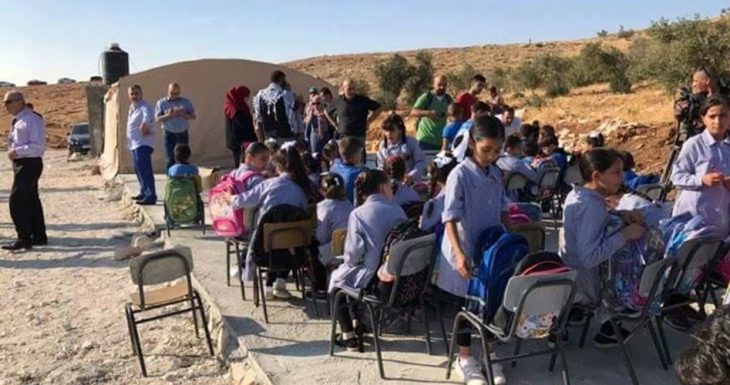
IMEMC News | December 5, 2018
Israeli soldiers invaded, Wednesday, the Sammoa’ town, south of Hebron, in the southern part of the occupied West Bank, and demolished a Palestinian school.
Media sources in Hebron said the soldiers surrounded Seemia area, north of the Sammoa’ town, and declared it a closed military zone, preventing the Palestinians from entering it.
They added that the soldiers then used their armored bulldozers to demolish the Tahadi 13 small school of several classrooms and their facilities.
The school was sponsored by the Palestinian Ministry of Education through European funding, with a total cost of 40,000 Euros, and was supposed to open in two days.
The Ministry of Education denounced the ongoing Israeli violations, targeting educational facilities and students, and added that the school is located in Area C of the West Bank, under full Israeli military and administrative control.
The school was built to make it easier for students in that area to reach it, especially due to Israeli military roadblocks and restrictions imposed by the military in various areas of Hebron.
It is worth mentioning that the soldiers have demolished many Tahadi schools in that same area, and other parts of the West Bank, as part of Israel’s illegal attempts to confiscate the lands to use them for military purposes and colonialist activities.
Featured Video
Houthis Keep Advancing as the Red Sea Crisis Deepens
or go to
Aletho News Archives – Video-Images
From the Archives
Clash of Civilization, Iran Part II
By Jamal Kanj – Intifada-Palestine.com – January 14, 2011
Israel’s survival kit is: perpetuate conflict, insecurity to rationalize collective hate and finally playing victim.
Devoid of conflict, Israel implodes internally; without hate, Zionism loses its justification; and playing eternal victim to continue blackmailing the West. Absence of this holy trinity, Israel ceases to exist. … continue
Blog Roll
 Aletho News
- Macgregor: We Haven’t Seen the Worst of the Iran War Yet
- ‘We are not like everyone else’ laws that bind other nations do not apply to Israel, says Likud lawmaker
- Report: Saudi Arabia seeks allies’ assistance as missiles deplete amid war on Yemen
- Fuel Crisis Deepens: Pakistan Warns Tanker Attack in Red Sea Would Be an ‘Act of War’
- ‘Bucha massacre’ a false flag orchestrated by UK – Moscow
- China Rejects Outside Pressure on Trade Ties After New US Russia Sanctions Bill
- Houthis Keep Advancing as the Red Sea Crisis Deepens
- Iran spent $1 million to wipe out $30 billion in data center plans, and take down Amazon in the ME
- Zionist billionaire pressure to silence Macklemore sparks exodus from Ed Sheeran tour
- House Votes to End Iran War for Third Time
- If Americans Knew
- Biden’s Genocide Accomplices Targeted by New Accountability Campaign
- AIPAC’s Network Has Already Spent $67.2 Million to Shape the Midterm Elections
- Jewish Supremacist Manufacturing a Civilizational Threat to License Bigotry
- US bans Palestinian president from speaking at the UN
- Israeli Forces Detain Journalist Alaa al-Rimawi amid Widespread West Bank Raids
- Even a pro-Israel Congress member has put a hold on 40,000 one-ton bombs to Israel
- As Gaza crumbles, Israel preps new ground invasion – Daily Update
- ‘We are not like everyone else’ laws that bind other nations do not apply to Israel, says Likud lawmaker
- Trump’s govt makes ‘treasonous’ claim of weapons shortages
- Palestinian-American Journalist Naqaa Hamed Imprisoned by Israeli Forces After Settlers Targeted Her
- No Tricks Zone
- New Study: ‘Global Drought Shows No Detectable Recent Acceleration Under Climate Warming’
- Economic Masterminds: German Socialists Suggest Taxing Productivity Gains Stemming From Using AI
- The South China Sea Has Not Been Cooperating With The Climate Change Narrative
- Energy Crisis: Germany Enters Heating Season With Historically Low Gas Reserve Fill Levels
- New Study: The Antarctic Ice Sheet Gained Mass From 2020-2024 Due To Staggering Snow And Ice Accumulation
- Study: Ocean Heating Rates From Thousands Of Years Ago ‘Dwarf’ Modern Ocean Heating Rates
- Climate Extremists Target, Attack Large-Scale Power Grid Infrastructure In Germany!
- New Study: Antarctic Ice Melt Has Contributed Less Than 1 Centimeter To Sea Level Rise In The Last 30 Years
- Fear Of Debate: Alarmist German Climate Scientist Calls On Mainstream Media To Discredit Skeptic Voices
- End-Of-August Arctic Sea Ice Extent Hasn’t Fallen In 20 Years, Official Data Show!
 Aletho News