Despite settler arson confession dismissed by Israel, Dawabsheh family persevere
MEMO | June 21, 2018
An Israeli court on Tuesday threw out a confession given by a teenage settler – who cannot be named for legal reasons – in which he admitted his participation in an arson attack on a Palestinian home that killed three people.
The court ruled that the confession had been obtained under duress and was inadmissible in court, but that the confession given by primary suspect Amiram Ben-Uliel was valid. Ben-Uliel admitted firebombing the house and his involvement in six other racially motivated attacks targeting Palestinian villages after the “necessary investigations” conducted by Shin Bet police.
The unnamed minor had also been accused of taking part in the attack on the Dawabsheh family home on 31 July 2015 in the West Bank village of Duma, which killed toddler Ali Saad Dawabsheh and parents Riham and Saad Dawabsheh.
Omar Khamaisi, a lawyer for the family, told MEMO that despite the confession being overruled, the prosecution still had sufficient evidence of the minor’s involvement.
“The minor was not accused of murder, but prior planning and plotting. His confessions and statement [referring] to “Tag Mehir” or “Paying the price” and the activities of revenge, of burning and sabotaging Palestinian properties were taken and accepted.”
Khamaisi also said that the family would take the case further if a verdict of murder was not handed down to the guilty parties:
“The Dawabsheh case joins other cases and [queries] that the Palestinian Authority is trying to [take to] the International Criminal Court (ICC) and the ICC prosecutor.”
The Dawabsheh family has experienced ongoing harassment as the case is heard in court, with another family home in Duma firebombed by settlers last month, causing severe damage.
Earlier this week, as the family’s uncle and grandfather Nasr and Hussein Dawabsheh walked out of the courtroom accompanied by MKs Ahmad Tibi and Ayman Odeh, right wingers taunted the family chanting: “Where is Ali? Ali’s dead” and “Ali’s on the grill”.
Israel has also refused to pay compensation to the family and five year-old Ahmad, the only surviving member of the attack, who sustained severe burns in the fire. Israeli Defence Minister Avigdor Lieberman said last year that the Palestinian child did not qualify as a “terror victim” and does not hold Israeli citizenship and therefore is not entitled to compensation.
The UN has previously expressed concern at the slow progression of the case, with Special Envoy to the Middle East Nikolay Mladenov calling on Israeli authorities “to move swiftly in bringing the perpetrators of this terrible crime to justice”.
Israeli Authorities Demolish Graves at Historic Palestinian Cemetery
Sputnik – June 11, 2018
Israeli authorities were caught on video excavating portions of the historic Bab al-Rahma cemetery next to Al-Aqsa mosque in occupied East Jerusalem. The cemetery is believed to contain the final resting places of two companions of Islam’s Prophet Muhammad.
Video from June 5 shows about a dozen men, presumably members of Israel’s Nature and Parks Authority, at a work site in the Bab al-Rahma cemetery, through which Israel is planning to build a national park trail.
The cemetery sits adjacent to Al-Aqsa mosque, the third holiest site in Islam. It is believed to hold the graves of Ubada ibn as-Samit and Shadad ibn Aus, two of the Prophet Muhammad’s companions. The cemetery has remained in use for more than 1,000 years.
Israel plans to seize about 40 percent of the cemetery for the national park under murky legal pretexts, Sputnik News recently reported. The plan has supposedly been in place since 2015, but Palestinian lawyers and conservation activists claim Israel is jumping the gun, as court cases over the fate of the cemetery remain pending.
Israeli authorities have recently resumed work on the park and have been seen digging up and marking graves, removing trees and fencing off areas to halt future burials. During the first weekend of June, several Palestinians were injured and arrested while protesting the desecration of the cemetery.
Outside of Jerusalem proper, in the West Bank, authorities are also clearing the way for a new settlement over the village of al-Khana Ahmar, a village mostly inhabited by Bedouin refugees who were expelled from southern Israel in 1952. In 2009, an Italian aid organization constructed a school there, but Israel ordered it to be demolished one month after it opened. After that, residents in neighboring Israeli settlements petitioned the courts to demolish the community, which has been slated for destruction since February 2010. In 2015, authorities confiscated solar panels that provided the only source of electricity to the village.
Israel plans to relocate them yet again, this time north to a village called An-Nuway’imah, allowing Jewish settlers to claim the strategically significant spot. Building an Israeli settlement there would allow the government to connect the urban Israeli settlement of Ma’ale Adumim to Jerusalem and to control the gateway between northern and southern parts of the West Bank.
Abu Khamiss, a spokesman for the current Khan al-Ahmar villagers, told France 24 in 2014 that “the place where Israel wants us to ‘relocate’ would be like a prison for us. We’d be surrounded by Israeli settlements, a checkpoint and military training camps.”
The demolition is expected to begin any day now. Already, Israeli authorities have been accused of poisoning locals’ dogs under cover of night, robbing the villagers of the “faithful shepherds.”

© REUTERS / Mussa Qawasma
For Palestinian children living in the West Bank, getting to school is an incredibly difficult task because of their scarcity and the difficulty of traveling due to the abundance of Israeli checkpoints that control movement around the territory and can take hours to pass through. Israel is slated to destroy the Palestinian school in al-Khana Ahmar as well, a move the United Nations Relief and Works Agency for Palestine Refugees in the Near East said in 2011 “would effectively deny the children of the community their education and jeopardize their future.”
According to a January report from the the UN Office for the Coordination of Humanitarian Affairs, at least 61 schools in the West Bank and East Jerusalem have pending demolition orders or stop work orders against them from the Israeli government.
See Also:
Israel’s Demolishing of West Bank Schools May Amount to Int’l Crime – Watchdog
Israeli Army Closes Probe into the Murder of Palestinian Teen

Mahmoud Raafat Badran, 15, shot dead by Israelis. They say they mistook him for a stone-throwing “terrorist.”
Palestine Chronicle | June 12, 2018
The Israeli military has closed an investigation into the tragic death of a 15-year-old Palestinian, who was killed two years ago after the soldiers mistakenly opened fire on a car full of West Bank teens.
In June 2016, Israeli forces shot and killed 15-year-old Mahmoud Raafat Badran after “showering” a car on Route 443, a major West Bank highway, with live fire.
Four other Palestinian teens, who were returning from a nearby swimming pool, were also injured in the incident, which unfolded as the Israeli soldiers tried to quell Palestinian youths in the vicinity but “misidentified” the suspects’ vehicle.
The four injured were Mahmoud’s two brothers – 16-year-old Amir and 17-year-old Hadi – as well as Daoud Abu Hassan, 16, and Majdi Badran, 16.
Following a comprehensive investigation into the incident, the Military Advocate General ordered the closure of the probe, admitting that the Israeli Army had “mistakenly” identified the teens as a group of Palestinian youths who had earlier assaulted Israeli cars with stones and Molotov cocktails.
While noting there were “professional failings” during the incident, the Advocate General found opening fire on the car was justified and the mistake was “earnest and reasonable.”
According to the Israeli Human Rights group B’Tselem, the shooting of the 15-year-old Palestinian boy was “deliberate, entirely unjustified and a direct result of military policy”.
Palestinians refuse to terminate social welfare for victims of Israeli aggression
MEMO | June 12, 2018
The Palestinian Authority has sent a defiant message to Israel over Tel Aviv’s attempt to freeze tax money used by the PA to pay victims of Israeli violence.
“There is no force in the world that can cause us to renounce our prisoners and the martyrs”, Yusuf Al-Mahmoud, spokesman for the PA government said, regarding Israel’s attempt to freeze Palestinian tax revenue.
Al-Mahmoud claimed that Israel bore full responsibility for violence in the region and said that it was “stealing their [Palestinian] money on the pretext of offsetting tax revenues”.
His comments follow repeated attempts by the Israeli government to use Palestinian tax revenue to gain political concession. The tax collection regime in the occupied territory, which grants Israel the right to collect tax on behalf of the Palestinians and then distribute it, is one of the many oddities to come out of the Oslo Accords.
The Knesset is currently discussing a bill to impound tax revenue that would have been handed to families and victims of violence perpetrated by the Israeli army. Protesters killed and injured in Gaza would be eligible for these payments, which Netanyahu is trying to block.
Israeli sources reported that last week Prime Minister Benjamin Netanyahu instructed Meir Shabbat, chief of Israel’s National Security Council, to deduct money from the taxes collected by Israel on behalf of the Palestinian Authority in order to pay for the damage from fires caused by “rioter-terrorists” in Gaza sending kites attached to firebombs into Israeli territory.
“The martyr’s fund”, as it is known, has become a highly contentious issue. While Palestinians feel they have every right to use their own funds to provide welfare and social security to families of injured or deceased protesters resisting Israel’s brutal occupation, Israel feels it can exploit the tax situation to pile further pressure on the PA.
In addition to the bill discussed at the Knesset, senior members of the Israeli government have conditioned future negotiations on the PA suspending its welfare programme. Commentators have pointed out that this was another crude attempt to blame the victims. Insisting on the PA conceding on an issue that is a red line in the eyes of Palestinians is an attempt to shift the blame for the ongoing conflict away from Israel, and possibly stymie any future negotiations.
Read Also:
The international community should not stand by as Israel abuses Palestinians
The international community should not stand by as Israel abuses Palestinians

Security Council meeting on the situation in the Middle East including the Question of Palestine at the United Nations Headquarters in New York, United States on 1 June, 2018
By Ramzy Baroud | MEMO | June 12, 2018
What is taking place in Palestine is not a ‘conflict’. We readily utilise the term but, in fact, the word ‘conflict’ is misleading. It equates oppressed Palestinians with Israel, a military power that stands in violation of numerous United Nations Resolutions.
It is these ambiguous terminologies that allow the likes of United States UN Ambassador, Nikki Haley, to champion Israel’s ‘right to defend itself’, as if the militarily occupied and colonised Palestinians are the ones threatening the security of their occupier and tormentor.
In fact, this is precisely what Haley has done to counter a draft UN Security Council Resolution presented by Kuwait to provide a minimum degree of protection for Palestinians. Haley vetoed the draft, thus continuing a grim legacy of US defence of Israel, despite the latter’s ongoing violence against Palestinians.
It is no surprise that out of the 80 vetoes exercised by the US at the UNSC, the majority were unleashed to protect Israel. The first such veto for Israel’s sake was in September 1972 and the latest, used by Haley, was on 1 June.
Before it was put to the vote, the Kuwaiti draft was revised three times in order to ‘water it down’. Initially, it called for the protection of the Palestinian people from Israeli violence.
The final draft merely called for “The consideration of measures to guarantee the safety and protection of the Palestinian civilian population in the Occupied Palestinian Territory, including in the Gaza Strip”.
Still, Haley found the language “grossly one-sided”.
The near consensus in support of Kuwait’s draft was met with complete rejection of Haley’s own draft resolution which demanded Palestinian groups cease “all violent provocative actions” in Gaza.
The ‘provocative actions’ being referred to in Haley’s draft is the mass mobilisation by tens of thousands of Palestinians in Gaza, who have been peacefully protesting for weeks, hoping that their protests will place the Israeli siege on Gaza back on the UN agenda.
Haley’s counter draft resolution did not garner a single vote in favor, save that of Haley’s own. But such humiliation on the international stage is hardly of essence to the US, which has wagered its international reputation and foreign policy to protect Israel at any cost, even from unarmed observers whose job is merely to report on what they see on the ground.
The last such ‘force’ was that of 60 – later increased to 90 – members of the Temporary International Presence in Hebron (TIPH).
TIPH was established in May 1996 and has filed many reports on the situation in the Occupied Palestinian city, especially in Area H-2, a small part of the city that is controlled by the Israeli army to protect some of the most violent illegal Jewish settlers.
Jan Kristensen, a retired lieutenant colonel of the Norwegian army who headed TIPH had these words to say following the completion of his one-year mission in Hebron in 2004:
“The activity of the settlers and the army in the H-2 area of Hebron is creating an irreversible situation. In a sense, cleansing is being carried out. In other words, if the situation continues for another few years, the result will be that no Palestinians will remain there.”
One can only imagine what has befallen Hebron since then. The army and Jewish settlers have become so emboldened to the extent that they execute Palestinians in cold blood with little or no consequence.
One such episode became particularly famous, for it was caught on camera. On 24 March 2015 an Israeli soldier carried out a routine operation by shooting in the head an incapacitated Palestinian.
The execution of Abd Al-Fattah Al-Sharif, 21, was filmed by Imad Abushamsiya. The viral video caused Israel massive embarrassment, forcing it to hold a sham trial in which the Israeli soldier who killed Al-Sharif received a light sentence; he was later released to a reception fit for heroes.
Abushamsiya, who filmed the murder, however, was harassed by both the Israeli army and police and received numerous death threats.
The Israeli practice of punishing the messenger is not new. The mother of Ahed Tamimi, Nariman, who filmed her teenage daughter confronting armed Israeli soldiers was also detained and sentenced.
Israel has practically punished Palestinians for recording their own subjugation by Israeli troops while, at the same time, empowering these very soldiers to do as they please; it is now in the process of turning this everyday reality into actual law.
A bill at the Israeli Knesset was put forward late May that prohibits “photographing and documenting (Israeli occupation) soldiers”, and criminalising “anyone who filmed, photographed and/or recorded soldiers in the course of their duty”.
The bill, which is supported by Israeli Defence Minister Avigdor Lieberman, demands a five-year imprisonment term for violators.
The bill practically means that any form of monitoring Israeli soldiers is a criminal act. If this is not a call for perpetual war crimes, what is?
Just to be sure, a second bill is proposing to give immunity to soldiers suspected of criminal activities during military operations.
The bill is promoted by deputy Defence Minister, Eli Ben Dahan, and is garnering support at the Knesset.
“The truth is that Ben Dahan’s bill is entirely redundant”, wrote Orly Noy in the Israeli +972 website.
Noy cited a recent report by the Israeli human rights organisation Yesh Din which shows that “soldiers who allegedly commit crimes against the Palestinian population in the Occupied Territories enjoy near-full immunity”.
Now, Palestinians are more vulnerable than ever before, and Israel, with the help of its American enablers, is more brazen than ever.
This tragedy cannot continue. The international community and civil society organisations – independent of the US government and its shameful vetoes – must undertake the legal and moral responsibility to monitor Israeli action and to provide meaningful protection for Palestinians.
Israel should not have free reign to abuse Palestinians at will, and the international community should not stand by and watch the bloody spectacle as it continues to unfold.
[Photo credit – Atılgan Özdil/Anadolu Agency]
Israel seals Palestinian family’s home with them inside
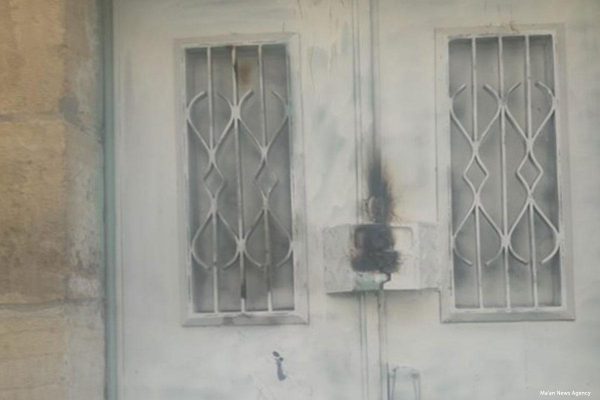
Front door of the Zahida family home
Ma’an – June 7, 2018
HEBRON – A Palestinian family was trapped inside their home and forced to leave through a broken window after Israeli forces welded their front door shut and temporarily detained them inside their home in the southern occupied West Bank district of Hebron on Thursday morning.
The incident took place on the al-Shuhada street in the Old City of Hebron, one of the most heavily militarized streets in the occupied West Bank.
Samer Yusri Zahida told Ma’an that Israeli forces broke into his brother’s house at 8 a.m. on Thursday, forcing him and his three other family members into one room in the house.
After detaining the family for a brief period of time, Israeli forces broke one of the windows in the house and exited through it, allegedly telling the family that if they want to leave the house they must also exit through the window. Israeli forces then sealed the front door to the family’s home.
Zahida noted that the window that was broken did not lead to the main road, but to the neighbor’s house.
Coordinator of the Human Rights Defenders Association in Hebron, Imad Abu Shamsieh, told Ma’an that Israeli forces have been trying to force out the family since they moved in two weeks ago, in what he said was an “attempt to empty the al-Shuhada street of all Palestinian residents and provide it to Israeli settlers as a new residence.”
Palestinian residents of Hebron’s Old City face a large Israeli military presence on a daily basis, with at least 20 checkpoints set up at the entrances of many streets, as well as the entrance of the Ibrahimi Mosque itself.
Additionally, Palestinians are not allowed to drive on al-Shuhada street, have had their homes and shops on the street welded shut, and in some areas of the Old City, are not permitted to walk on certain roads.
Meanwhile, some 800 notoriously violent Israeli settlers in Hebron move freely on the street, drive cars, and carry machine guns.
Israel Supreme Court told that settlements law violates apartheid convention
MEMO | June 4, 2018
Israel’s Supreme Court heard a petition yesterday against a law that allows the expropriation of privately-owned Palestinian land for Israeli settlers, reported AFP.
The court, meeting in an expanded panel of nine justices, has been petitioned by Israeli and Palestinian rights groups, on behalf of 17 Palestinian villages.
The law was passed by the Knesset in February 2017. In August, the court issued a restraining order against the law’s implementation, pending its ruling.
According to AFP, the petition “argues that by giving preference to Jewish settlers over the rights of Palestinian landowners it [the law] breaches an international convention on Apartheid”.
“The clear, declared purpose of the law, which seeks to privilege the interests of one group on an ethnic basis and leads to the dispossession of the Palestinians, leaves no doubt that this law involves crimes under the convention,” it says.
Attorney Harel Arnon “argued in defence of the legislation in place of attorney-general Avichai Mandelblit, who has warned the government the law could be unconstitutional and risked exposing Israel to international prosecution for war crimes”, AFP reported.
Arnon told the court that striking down the law would be “abetting a coup against this administration”. It would be “the dismemberment of the sovereignty of the Knesset”, he added.
It was not known yeserday when the court would deliver its ruling, AFP noted.
The law is designed to retroactively “legalise” dozens of settlement outposts and thousands of settler homes across the occupied West Bank, homes built on privately-owned Palestinian land.
Under international law, including as reflected in United Nations Security Council resolutions, all Israeli settlements in the West Bank, and East Jerusalem, are illegal.
Israeli forces detain activist who filmed fatal shooting of Hebron man
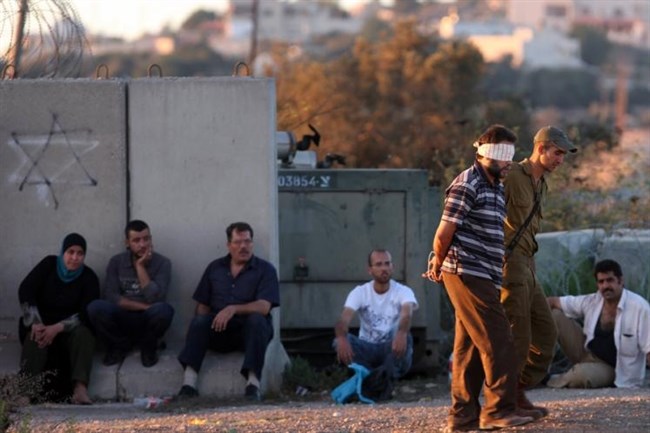
File Photo
Ma’an – | June 2, 2018
HEBRON – Israeli soldiers on Saturday briefly detained a local activist who filmed the fatal shooting of a Palestinian worker earlier in the morning in the southern occupied West Bank city of Hebron.
Locals told Ma’an that Israeli forces detained Aaref Jaber, who filmed the moment when Israeli forces shot and killed Rami Sabarneh, 36, and that Jaber taken into the Kiryat Arba settlement in Hebron.
Official Palestinian Authority (PA)-owned Wafa news agency reported that Israeli forces confiscated Jaber’s phone.
The Israeli army alleged that Sabarneh, who worked in construction in the area, attempted to run soldiers over with a bulldozer. However, no injuries were reported among the soldiers.
Jaber denied the Israeli army’s account, saying that “Sabarneh was driving a Bobcat excavator while another worker walked next to him, Israeli soldiers asked them to stop when he was at least 10 meters away from them, the walking worker stopped, but Sabarneh apparently did not hear the soldiers and continued his way so they opened fire at him until he was killed.”
Last week, Israeli lawmakers proposed a new bill in the Israeli Knesset that would criminalize the photographing or recording of Israeli soldiers while on duty.
The bill was proposed with the support of right-wing Israeli Defense Minister Avigdor Lieberman, and if passed, those found in violation of the law could face a prison sentence of up to five years.
UN Officials Call on Israel to Halt Khan Al-Ahmar Demolition
IMEMC | June 1, 2018
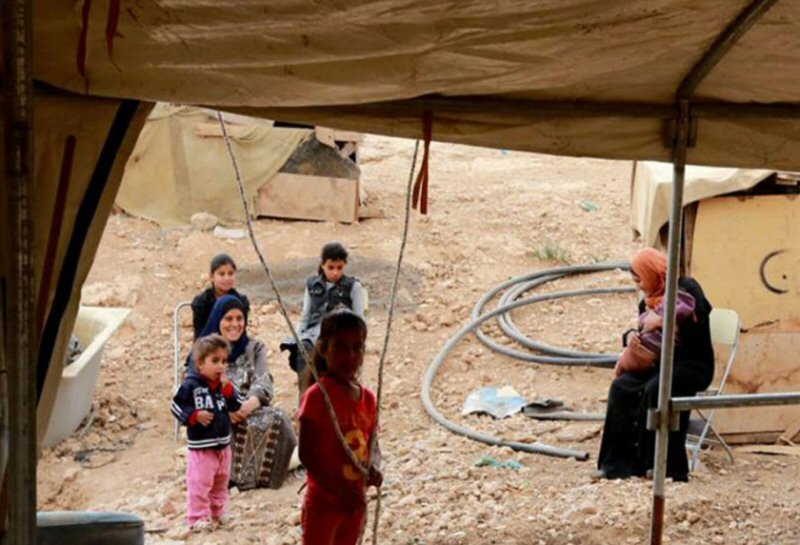
United Nations officials, on Friday, called on Israel to abandon plans to demolish the Palestinian community of Khan al-Ahmar, east of Jerusalem.
Humanitarian Coordinator, Jamie McGoldrick, and United Nations Relief and Works Agency for Palestine Refugees (UNRWA) Director of Operations in the West Bank, Scott Anderson, joined others in the international community in calling on the government of Israel to cease its plans to carry out the mass demolition and transfer of the Palestinian Bedouin community of Khan al Ahmar – Abu al Helu, located on the outskirts of East Jerusalem in the occupied West Bank.
“Like many Palestinians in Area C, the residents of Khan al Ahmar – Abu al Helu have fought for years to live with dignity, to protect their children, their homes, and their community,” said McGoldrick. “They have struggled in the face of tremendous daily pressure and are asking for the continued support of the international community to prevent the demolition of their homes.”
Following the Israeli Supreme Court’s May 24 rejection of the community’s petition to prevent the demolitions, marking an end to years-long legal efforts and leaving virtually no legal options to protect the community, nearly all of Khan al Ahmar – Abu al Helu’s structures are now at immediate risk of demolition by the Israeli authorities, including the school, initially built with donor support. The school serves some 170 students from the community and four surrounding ones. The proposed transfer seeks to move the rural livestock-dependent community to an urban site unsuitable for Bedouin livelihood, culture and traditions and is likely to increase their level of humanitarian need.
“After nine years of legal battle, this refugee community now faces the demolition of their homes, the loss of traditional livelihoods and the imminent risk of forcible transfer should the demolitions be conducted and the community be compelled to relocate, which would be a grave breach of the Geneva Convention,” said Anderson. “Many already displaced from the [Naqab] as a result of the 1948 conflict; they now face being displaced for a second time. As we have seen in similar circumstances in the past, the transfer of rural Bedouin to the urban setting of Jabal West, proposed by the Israeli state, will likely prove socially and economically devastating,” he concluded, according to WAFA.
Khan al Ahmar – Abu al Helu is one of 18 communities located in or next to an area slated in part for the E1 settlement plan, aimed at creating a continuous built-up area between the Maale Adumim settlement and East Jerusalem. This week, the Israeli authorities approved a planning scheme providing for the construction of 92 new housing units and an educational institution in the Kfar Adumim settlement, immediately adjacent to Khan al Ahmar; this settlement has also petitioned the High Court for the implementation of the outstanding demolition orders against the community.
“Israel’s obligations as an occupying power to protect the residents of Khan al Ahmar are clear,” said McGoldrick. “Should the Israeli authorities choose to implement the outstanding demolition orders in the community and force the people to leave, they would not only generate significant humanitarian hardship but also commit one of the grave breaches of international humanitarian law,” he concluded.
Israel bill to limit Palestinians’ access to High Court passes first reading
MEMO | May 29, 2018
Israeli politicians waved through a bill that would limit Palestinians’ access to the High Court last night, according to the Jerusalem Post.
The bill would prevent many cases, including those of housing demolitions and Israeli land grabbing offences, from reaching the High Court, instead redirecting them to district courts in the occupied West Bank.
Right-wing politicians stated that the bill would reduce the number of complaints pertaining to land ownership that are often filed by Palestinians and left-wing organisations in the aftermath of settler occupation.
Justice Minister Ayelet Shaked, a supporter of the bill, rejoiced in its passing of the first reading.
“The move will also reduce the heavy burden imposed on the High Court of Justice,” she said adding that the High Court “handles more than 2,000 petitions each year, and should reject many of them outright.”
Critics however argued that the bill was a step towards annexation of the West Bank, by expanding the power of district courts outside of Israeli sovereignty.
Zionist Union MK Tzipi Livni expressed concern that the move would strengthen the argument that Palestinians should have the right to vote in Israel, as has been suggested as part of the one-state solution.
Shaked defended the bill, stating that in the case of land ownership claims, it would place the burden of proof on the Palestinians filing the case, not the Israeli settlers.
The bill will also refer other issues to the lower court, such as restraining orders and Israel entry permits.
Israel has long sought to annex the occupied West Bank to preserve the illegal settlements in the area, but has struggled with what the fate of Palestinians would be.
Earlier this month, Israel’s deputy defence minister, MK Rabbi Eli Ben-Dahan, claimed that Israel could annex the entirety of the occupied West Bank, without giving its Palestinian residents the right to vote.
“The clear and absolute thing is that we are here in the Land of Israel and we are not afraid of any attempts to frighten us,” he said. “They want to scare us that maybe soon we will not be a majority and therefore we have to abandon Judea and Samaria [the West Bank]. This is a grave mistake.”
Read also:
Palestinians call to save their homes from Israeli demolition orders
Palestinians call to save their homes from Israeli demolition orders
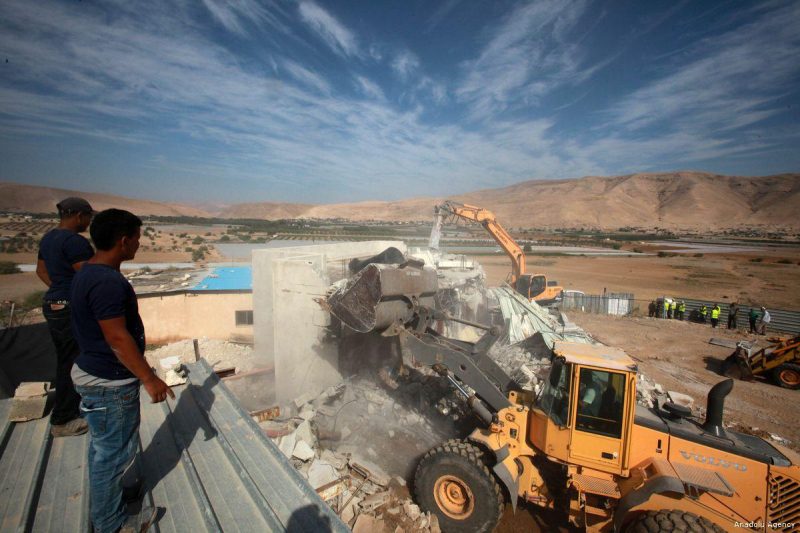
Palestinians watch the demolition of their home in the West Bank on 7 November 2017 [Nedal Eshtayah/Anadolu Agency]
MEMO | May 28, 2018
Palestinian families in the village of Aqaba, north of the West Bank, on Sunday called on Palestinian human rights organizations and the government to save their homes from the Israeli demolition orders.
The Israeli authorities have recently issued orders to demolish the homes of 20 families in the village of Aqaba under the pretext of being built in Area C.
The head of Aqaba village council, Sami Sadiq said the decision was issued by the Israeli Defence Ministry and ordered the all houses built during the past six months in Area C to be demolished if they were not inhibited by their owners.
He added that the village council has been trying to contact human rights organizations and the media in an attempt to stop the decision and protect the homes.
In an interview with Turkey’s Anadolu news agency, he pointed out that the houses are built on land owned by their owners who have owner documents.
Ibrahim Yusuf Jaber, the owner of one of the houses threatened with demolition said the decision stipulates to demolish the house within 60 days if I do not move in, but 40 days have already passed while we received the orders only two days ago.
Watch: Video of about Al Aqaba village
Award-winning photographer shot by Israel soldier in the West Bank

Internationally-acclaimed and award-winning photographer, Tanya Habjouqa [Happeningarts/Twitter]
MEMO | May 17, 2018
An internationally-acclaimed, award-winning photographer was shot by an Israeli soldier in the occupied West Bank on Tuesday, reports the Art Newspaper.
Tanya Habjouqa, who won the 2014 World Press photo award, was struck in the leg by a rubber-coated metal bullet fired by Israeli occupation forces during a protest near Bet El checkpoint.
Habjouqa told the paper that she was some 40 metres from Palestinian protesters “when Israeli soldiers in the distance started shooting rubber bullets and tear gas in several directions”.
“She also saw soldiers aim at a Palestinian gas station where there were no protesters, just people filling up their gas tanks,” the report added.
“I was on the side with my camera at the beginning of the protest with cameras around my neck, so I feel I was definitely targeted though thankfully they chose not to aim for my head,” Habjouqa tells us. “It hurts like hell and the bruise is spreading front and back.”
Habjouqa is a founder of Rawiya, the first all-female photo collective in the Middle East, as well as a member of the Noor Photography collective, a Magnum Foundation grantee, and the author of the photo book Occupied Pleasures that the Smithsonian named one of the best photo books of 2015.
Her work is in the permanent collections of the Carnegie Museum of Art, the Museum of Fine Arts in Boston and the Institut du Monde Art in Paris.
Read also:
Media freedom watchdog warns of more Israel attacks on journalists in Gaza
Featured Video

Houthis Keep Advancing as the Red Sea Crisis Deepens
or go to
Aletho News Archives – Video-Images
From the Archives
Clash of Civilization, Iran Part II
By Jamal Kanj – Intifada-Palestine.com – January 14, 2011
Israel’s survival kit is: perpetuate conflict, insecurity to rationalize collective hate and finally playing victim.
Devoid of conflict, Israel implodes internally; without hate, Zionism loses its justification; and playing eternal victim to continue blackmailing the West. Absence of this holy trinity, Israel ceases to exist. … continue
Blog Roll
 Aletho News
- Macgregor: We Haven’t Seen the Worst of the Iran War Yet
- ‘We are not like everyone else’ laws that bind other nations do not apply to Israel, says Likud lawmaker
- Report: Saudi Arabia seeks allies’ assistance as missiles deplete amid war on Yemen
- Fuel Crisis Deepens: Pakistan Warns Tanker Attack in Red Sea Would Be an ‘Act of War’
- ‘Bucha massacre’ a false flag orchestrated by UK – Moscow
- China Rejects Outside Pressure on Trade Ties After New US Russia Sanctions Bill
- Houthis Keep Advancing as the Red Sea Crisis Deepens
- Iran spent $1 million to wipe out $30 billion in data center plans, and take down Amazon in the ME
- Zionist billionaire pressure to silence Macklemore sparks exodus from Ed Sheeran tour
- House Votes to End Iran War for Third Time
- If Americans Knew
- Biden’s Genocide Accomplices Targeted by New Accountability Campaign
- AIPAC’s Network Has Already Spent $67.2 Million to Shape the Midterm Elections
- Jewish Supremacist Manufacturing a Civilizational Threat to License Bigotry
- US bans Palestinian president from speaking at the UN
- Israeli Forces Detain Journalist Alaa al-Rimawi amid Widespread West Bank Raids
- Even a pro-Israel Congress member has put a hold on 40,000 one-ton bombs to Israel
- As Gaza crumbles, Israel preps new ground invasion – Daily Update
- ‘We are not like everyone else’ laws that bind other nations do not apply to Israel, says Likud lawmaker
- Trump’s govt makes ‘treasonous’ claim of weapons shortages
- Palestinian-American Journalist Naqaa Hamed Imprisoned by Israeli Forces After Settlers Targeted Her
- No Tricks Zone
- New Study: ‘Global Drought Shows No Detectable Recent Acceleration Under Climate Warming’
- Economic Masterminds: German Socialists Suggest Taxing Productivity Gains Stemming From Using AI
- The South China Sea Has Not Been Cooperating With The Climate Change Narrative
- Energy Crisis: Germany Enters Heating Season With Historically Low Gas Reserve Fill Levels
- New Study: The Antarctic Ice Sheet Gained Mass From 2020-2024 Due To Staggering Snow And Ice Accumulation
- Study: Ocean Heating Rates From Thousands Of Years Ago ‘Dwarf’ Modern Ocean Heating Rates
- Climate Extremists Target, Attack Large-Scale Power Grid Infrastructure In Germany!
- New Study: Antarctic Ice Melt Has Contributed Less Than 1 Centimeter To Sea Level Rise In The Last 30 Years
- Fear Of Debate: Alarmist German Climate Scientist Calls On Mainstream Media To Discredit Skeptic Voices
- End-Of-August Arctic Sea Ice Extent Hasn’t Fallen In 20 Years, Official Data Show!
 Aletho News