Israeli plan to isolate four Palestinian villages from Bethlehem
Palestine Information Center – August 11, 2018
BETHLEHEM – The Israeli occupation government has embarked on carrying out a massive settlement project that will lead to the isolation of four Palestinian villages from Bethlehem in the West Bank as a prelude to annexing them as Israeli state land.
The new plan is aimed at turning the villages of Battir, Wadi Fukin, Nahalin and Husan, which are located in the west of Bethlehem province, into communities under Israel’s sovereignty after isolating them from Bethlehem.
The area where those villages are located is called locally Arqoub villages and there are about 20,000 Palestinian citizens living there.
According to the plan, Israel intends to expand Road 60 that lead to the illegal settlement of Beitar Illit, which was built on annexed land in Bethlehem, and connect it with roads between these villages to make this new expanded road available only for Jewish settlers.
On the ground, Israeli engineers and surveyors started to put up signs and numbers in the heart of Nahalin town to prepare for the plan.
Israel celebrates 40 years of illegal settlement

MEMO | August 10, 2018
Two thousand Israelis yesterday gathered to celebrate the 40th anniversary of the illegal West Bank settlement of Shiloh, south of Nablus.
The celebration was attended by Israel’s Agriculture Minister, Uri Ariel, who is a member of the Religious-Zionist Jewish Home party. According to Arutz Sheva, the head of Israel’s “Binyamin Regional Council”, the group which oversees 42 of Israel’s illegal settlements and outposts in the occupied West Bank, also attended. Israeli Prime Minister, Benjamin Netanyahu, sent a letter of congratulations to the illegal settlers, claiming historic links between the Bible and the modern-day occupied Palestinian territory.
Uri Ariel has a long history of pro-settlement activity, previously serving as head of Beit El council, an illegal Israeli settlement situated north east of Ramallah. Ariel was also previously secretary general of the Yesha council.
In July it emerged that Uri Ariel had previously approved plans to demolish Khan Al-Ahmar, the Palestinian Bedouin village that has been slated for demolition. The plans, which were made in the late 1970s, proposed a “Jewish corridor” of illegal settlements be built on some 100,000 to 120,000 dunams (25,000 to 30,000 acres) of Palestinian land, including the villages of Hizme, Anata, Al-Azariya and Abu Dis on the outskirts of Jerusalem. Demolishing these villages would make way for expanding two illegal settlements – Ma’ale Adumim and Kfar Adumim – situated on the Jerusalem-Jericho road.
Shiloh was one of the first locations targeted for illegal Israeli settlement as early as 1974 by Gush Emunim, the orthodox right-wing settlement movement that rose to prominence in the wake of the 1973 War. Gush Emunim was later succeeded by the Yesha council that Uri Ariel previously affiliated with. During the Oslo Accords of the early 1990s, Shiloh was identified as an example of an area that should be returned to Palestinian control given the high density of Palestinians living in the area.
Illegal settlement in the West Bank has been pursued as a policy by the State of Israel since it occupied the territory in the 1967 Six Day War, along with the Gaza Strip, Jerusalem, the Golan Heights and the Sinai Peninsula. Israeli human rights organisation B’Tselem states that, as of the end of 2015, there were 127 Israeli government-sanctioned settlements in the West Bank (not including occupied East Jerusalem and Hebron). When combined with 100 non-recognised outposts and 15 Israeli neighbourhoods inside the Jerusalem Municipality, these settlements are inhabited by approximately half a million illegal settlers.
‘Farmer terrorism’ is the new Jewish settler slogan justifying the destruction of crops

By Ramona Wadi | MEMO | August 7, 2018
In less than three months, Jewish settlers have destroyed over 2,000 trees and grapevines in the occupied West Bank. Rights group B’Tselem has issued a detailed report on this destruction, including testimony from Palestinian farmers. Bales of hay and barley fields were also destroyed. The destruction wrought by Israel’s settler-colonists equates Palestinian agriculture to terrorism; slogans sprayed on Palestinian property following the destruction included “No to farmer terrorism”.
The personal testimonies show that Israel has once again refused to act in order to deter settler violence against Palestinians and their land. Ultimately, the aim is to displace Palestinians forcibly by terrorising those seeking access to their own land. “This process has erected invisible walls throughout the West Bank, which Palestinians know crossing will expose them to violence and even danger to their lives,” says B’Tselem.
Israel is using complementary forms of violence: direct destruction by targeting crops and using the same destruction to levy a psychological threat against the colonised population. In the documented cases, the destruction was so severe that new plants have to be cultivated, thus having a negative impact on the sliver of economic independence that Palestinians can gain from agriculture. There is an outcome of resilience mingled with imposed resignation; the farmers will still tend to their fields yet the threat of another round of settler violence fuelled by impunity is always imminent. No matter how well rights organisations document the violations, though, the Palestinians have no recourse other than awareness. This is partly because Israel has moved ahead in terms of normalising colonial expansion.
Hassan ‘Issa discovered that 168 out of 250 grapevines in his fields had been destroyed by settlers. “What happened to my vines feels like a terrible injustice, and I feel incredibly frustrated and sad.” It is painful to read this. Compare the vagueness of ‘Issa’s statement — made in the knowledge that there are no rights for the colonised in apartheid Israel — with the threat left by the settlers: “No to farmer terrorism.” The value of people and land is misplaced to set the accelerated pace for forced displacement and a re-enactment of the image of Palestine being barren, one of the false premises behind Palestine’s colonisation by Israel. The only difference is that Israel now prefers sustained acts of violence that are documented and discussed almost routinely.
“Farmer terrorism” is, of course, a complete falsehood, yet it is on such premises that expansion has been facilitated. The more that Israel utilises such absurd claims, the further it is removed from reprimand by the international community. This lends Israel ample time and space — and total immunity — to construct its variety of “terror” narratives to make such purported threats endemic to its settler-colonial presence. Why would anyone even seek to challenge the notion of “farmer terrorism”? At first glance, it is void of any logic; a second reading flaunts its depravity, embodied by state and settlers alike.
Palestinian resilience has always laid bare the Zionist myths. Having no other means to sustain itself, Israel is eager to create the conditions for myths to become a manifested reality, even if it means acknowledging Palestinian existence through accusations which serve to embellish its purported “security concerns”. Nothing, though, justifies the wanton destruction of crops by illegal Jewish settlers or anyone else.
Barred Entry of Foreign Academics Hindering Palestinian Education
IMEMC News & Agencies | August 3, 2018
The Campaign for the Right to Enter the Occupied Palestinian Territory, Thursday, expressed deep concern at the rise in Israeli denial, of work or stay visa applications, for foreign nationals seeking to enter the occupied territories, saying this measure is hurting Palestinian education.
The group said, in a press release, that, in June, seven international faculty members at Birzeit University (BZU) — one-third of the international staff at the university — were refused visa extensions by the Israeli authorities; several others have already been obliged to leave the country, according to WAFA.
This policy, it added, “has severely diminished opportunities for development of faculty, courses, and research programs at Palestinian institutes of higher education.”
The Campaign said that, while international academics seeking to enter or work in the occupied Palestinian territory have long faced obstacles, the situation has dramatically worsened, over the past year. Since 2017, foreign nationals wishing to maintain a presence in the occupied territories, whether for reasons of work or family unity, have faced an alarming escalation in the rejection of visa extension requests and in the frequency and range of arbitrary demands and conditions imposed by Israeli authorities.
“Palestinian educational institutions have been hard hit by Israeli denials or restrictions on entry and presence in the occupied Palestinian territories,” it said, explaining that this has caused serious disruption to the academic programs and administration of these institutions, and “has undermined Palestinian universities’ ability to attract further external expertise as foreign academics are deterred from accepting teaching and research posts by the arbitrary rejections and destructive restrictions imposed by the Israeli authorities.”
The Campaign called for an immediate halt to Israel’s practices and “arbitrary and abusive practice of denying entry to foreign nationals traveling to the occupied Palestinian territories to promote educational development,” urging the international community to “stand with us in protecting the Palestinian people’s right to education.”
20 Freedom Flotilla sailors still held in Israeli jail; Italian artists deported from Palestine
Samidoun Palestinian Prisoner Solidarity Network – July 30, 2018
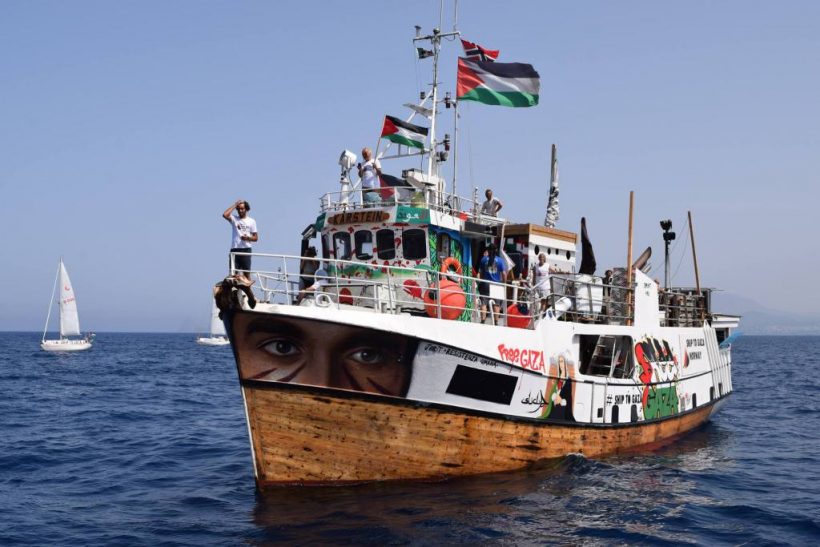
Twenty international solidarity activists on board the Freedom Flotilla to Gaza are being held in Israeli prisons, report the Freedom Flotilla Coalition. The first boat in the flotilla, “Al-Awda,” was hijacked by Israeli occupation forces in international waters on Sunday, 29 July. The next boat in the flotilla, the “Freedom,” is still on the approach to Gaza. The Flotilla aims to break the Israeli naval siege on Gaza, Palestine.
Two activists with Israeli citizenship on the boats, Zohar Chamberlain Regev and Yonatan Shapira, were released on bail and charged with attempting to enter Gaza and conspiracy to commit a crime. The 20 international solidarity activists remain detained in Givon prison and were scheduled to begin meeting with their lawyer on Monday.
The Freedom Flotilla Coalition noted that:
“Although the Israeli Occupation Forces (IOF) claim that the capture of our vessel happened ‘without exceptional incident’, eye-witness Zohar Chamberlain Regev reports that at the time of boarding: ‘People on board were tasered and hit by masked IOF soldiers. We did not get our passports or belongings before we got off the boat. Do not believe reports of peaceful interception.’ We urgently need to know the details of who was injured and how seriously, and what treatment they are receiving, if any. A military attack on a civilian vessel is a violent act and a violation of international law. Taking 22 people from international waters to a country which is not their destination constitutes an act of kidnapping, which is also unlawful under the international Convention of the Law of Sea.”

Mural on Apartheid Wall by artist Jorit Agoch.
In addition, two Italian artists, including well-known muralist Jorit Agoch, were ordered deported from Palestine on Monday, 30 July after they were seized by Israeli occupation forces for painting a large mural of Ahed Tamimi, 17, on the Apartheid Wall. The 13-foot-high painting was part of the celebration of Ahed’s release from over seven months in Israeli prison on Sunday, 29 July, along with her mother, Nariman.
The portrait was the focus of global media attention before the artists and the Palestinian driver who accompanied them were seized by occupation forces as they completed work on the portrait. The Palestinian man was reportedly released, as were the two artists, after their tourist visas were cancelled and they were ordered to leave the country within 72 hours. They were also banned from entering occupied Palestine for 10 years, much like other activists who have been denied entry to Palestine at Ben-Gurion airport or the Karameh/Allenby crossing.
Warm welcome greets Ahed and Nariman Tamimi upon their release from Israeli prison
Ahed and Nariman upon their release
Samidoun Palestinian Prisoner Solidarity Network – July 29, 2018
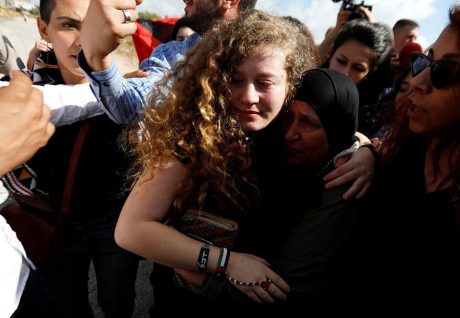
Palestinian teen Ahed Tamimi, 17, and her mother, Nariman Tamimi, were released from Israeli occupation prisons in the morning of Sunday, 29 July 2018 after serving eight-month prison sentences. Ahed and her mother were arrested on 19 December 2017 after a video of Ahed confronting occupation soldiers on the family’s land in the village of Nabi Saleh, including slapping one soldier, went viral on social media. Ahed and her family are leaders in the anti-colonial indigenous land defense movement in Nabi Saleh, where the village’s land and even springs are targeted for confiscation and theft by the neighboring illegal, Jewish-only settlement of Halamish.
A crowd of friends and family awaited the Tamimis’ release as the Israeli occupation repeatedly changed the designated location, from the Jabara checkpoint to Rantees to Jabara again, leaving them to travel the one-hour distance between the locations repeatedly. Ahed and Nariman were greeted with joy upon their actual release; they will hold a press conference at 4:00 pm in their village of Nabi Saleh.
One day before Ahed’s release, Israeli occupation forces arrested three artists involved in the painting of a massive mural on the Apartheid Wall saluting the teen’s struggle and celebrating her liberation.
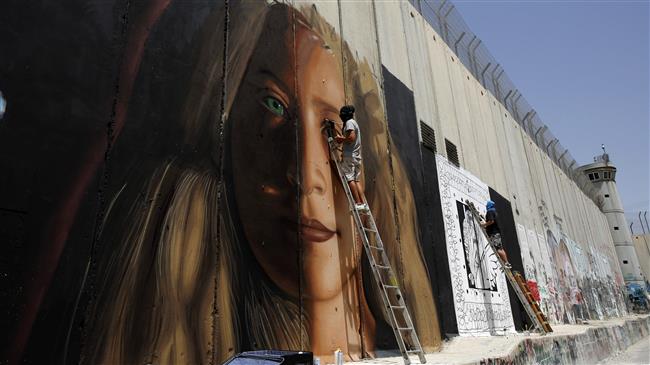
Two of the detained artists are Italian and one Palestinian, including the lead artist, Jorit Agoch (Agostina Chirwin) a street artist from Naples known around the world for his massive, realistic murals.
An occupation spokesperson accused them of having “damaged and defaced the defense barrier in the Bethlehem area.” The Wall is well-known as a location for a number of famous graffiti murals saluting the Palestinian struggle. The mayor of Naples, Luigi de Magistris, called for the artists’ immediate release, saying that this was a matter of freedom that concerned everyone.
As the Tamimi family and Palestinians celebrate Ahed’s release, their joy is, of course, not complete – among the over 6,000 Palestinians held in Israeli jails is Ahed’s 21-year-old brother, Wa’ed, seized in May by the Israeli occupation and accused of “participation in popular terror activities” such as organizing demonstrations. A number of Ahed’s cousins, including Mohammed and Osama Tamimi, are also behind bars, targeted for their involvement in the defense of Palestinian land from confiscation, theft and colonization. The village of Nabi Saleh itself was closed by occupation forces last Thursday, preventing inhabitants from entering or leaving.
***
Samidoun Palestinian Prisoner Solidarity Network salutes, congratulates and welcomes Ahed and Nariman Tamimi upon their release. They are not only symbols of protest, but leaders in an anti-colonial, indigenous movement to defend their land from occupation, colonization and confiscation. Ahed’s case drew the attention and support of thousands – indeed millions – of people around the world, with protests in global cities and over 1.5 million people signing a petition demanding her freedom. That support had an important role to play in the freedom of Ahed and Nariman today. It also reminds us how critical it is to escalate our organizing for the freedom of all Palestinian political prisoners.
There are over 6,000 Palestinian prisoners in Israeli jails, including over 450 jailed without charge or trial under administrative detention. There are over 350 Palestinian children in Israeli jails and 60 Palestinian women and girls. They are leaders, teachers, organizers, workers, farmers, students and beloved family members, and they represent the true leadership of the Palestinian people targeted by the Israeli occupation for isolation. Of course, there are also prisoners of the Palestinian struggle in imperialist jails around the world – from the Holy Land Five in the United States to Georges Ibrahim Abdallah, jailed for 34 years in French prisons. Their freedom is critical to achieving the goal for which they struggle and sacrifice – freedom for the land and people of Palestine.
Free all Palestinian prisoners! Free Palestine!
Female Palestinian writer deprived of sleep in Israeli interrogation
Ma’an – July 25, 2018
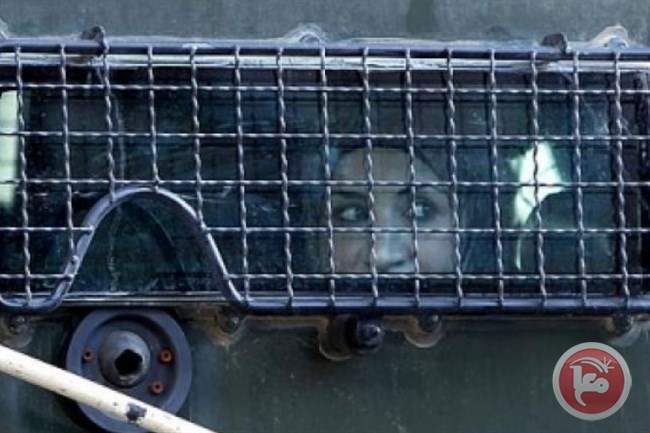
A lawyer of the Palestinian Prisoner’s Society (PPS) said that prisoner, Lama Khater, 42, is being subjected to harsh and intensive interrogation at the Ashkelon Israeli prison, on Wednesday.
Lawyer Firas al-Sabbah, who visited Khater in prison, said that Israeli forces detained and removed Khater from her home in the southern occupied West Bank district of Hebron on predawn Tuesday to the illegal Israeli settlement of Kiryat Arba, where she was held until 7 a.m.
Khater was then transferred to the Ashkelon prison.
Khater told her lawyer that she was handcuffed to a chair throughout the entire interrogation; she also pointed out that interrogators deprived her of sleep and continued to curse and shout at her.
Lawyer al-Sabbah confirmed that a court hearing will be held this Thursday, 26th of July, 2018.
Khater is a Palestinian female writer and a mother of five children, who was detained for unknown reasons from her home during predawn raids carried out by the Israeli forces.
According to prisoners rights group Addameer, there are 5,900 Palestinian prisoners being held in Israeli prisons, 60 of whom are female prisoners.
Israel sentences rights activist to 8 years in prison
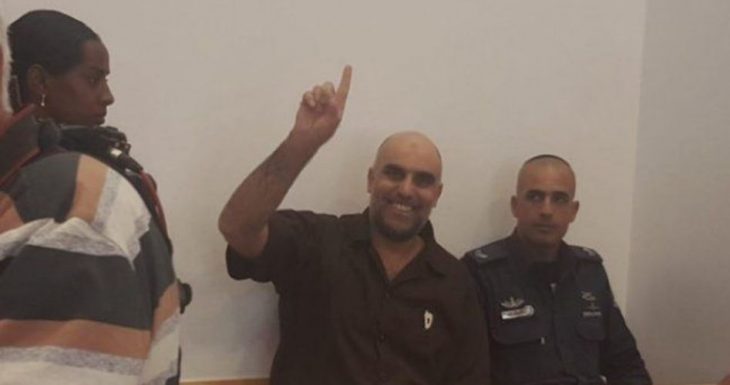
Firas al-Omari
Palestine Information Center – July 9, 2018
NAZARETH – The Israeli Central Court in Beersheba sentenced on Sunday the rights activist Firas al-Omari, 46, to eight years imprisonment.
Al-Omari, from northern Israel’s Arab town of Sandala, is an activist in the Islamic Movement (the northern branch) and head of Yusuf Al-Siddiq Foundation for prisoners’ affairs.
He was arrested in March 2017 for being allegedly affiliated to a banned organization.
The Israeli security authorities have embarked on arresting activists from the northern branch of the Islamic Movement following the right-wing government’s decision to classify it as a banned group in November 2015.
The northern branch of the Islamic Movement and its members are known for peacefully defending Jerusalem and the Aqsa Mosque against Israel’s violations.
Khan al-Ahmar: tragedy and outrage

Residents and activists sit inside a bulldozer shovel in order to stop the demolition of Bedouin village Khan al Ahmar.
By Kathryn Shihadah | If Americans Knew | July 5, 2018
After years of threats and court battles, push has come to shove in the West Bank Bedouin village of Khan al Ahmar. Israeli soldiers with bulldozers have arrived to demolish every building. The world strenuously objects, but Israel doesn’t seem to notice.
Diplomats from 12 European countries came on Thursday 5 July to visit the tiny Bedouin village of Khan al Ahmar in the occupied West Bank. They echo the global outcry against Israel’s plan to demolish the village.
5 countries issued “an urgent official protest” against the demolition plan.
Around 180 Bedouin, who raise sheep and goats, live in shacks in Khan al Ahmar. Half of the residents are children.
International attention was drawn to the village when, on Wednesday, 4 July, Israeli occupation forces with bulldozers assaulted Bedouins and activists who were protesting the demolition.
According to the Red Crescent, 35 protesters and residents were injured. Several police officers were lightly injured; 11 protesters were arrested.
Police reported that some of those present threw stones.
The area around Khan al Ahmar is closed to the general public as Israeli authorities begin construction on a road to enable the eviction to take place. An IDF source indicated that the actual demolition will not take place for a few days or weeks.
These actions by Israel – forcible transfer of population and confiscation or destruction of private property – are prohibited by international humanitarian law and violate basic human rights.

BACKGROUND
The people of Khan al Ahmar were ethnically cleansed from their previous homes in the Negev desert in 1951, and resettled in their current location near Jerusalem, in Israeli-controlled Area C.
Since 1967, Israel has been appropriating land in the vicinity in order to build and expand 2 nearby illegal settlements, Ma’ale Adumim and Kfar Adumim. Khan al Ahmar is squeezed between them, and if the village is demolished, Israel will be able to link the settlements and take over a large swath of the West Bank.

Dwellings belongings to Bedouin are seen in al-Khan al-Ahmar village near the West Bank city of Jericho February 23, 2017. (photo credit: REUTERS )
On 5 March 2017, every structure in the village of Khan al Ahmar – including the school, mosque, clinic, and every home – was placed under demolition orders. The villagers were given 7 days to demolish their own village.
Thanks to a court injunction, the process was put on hold for over a year.
But in May 2018, Israel’s High Court of Justice approved the demolition of the village, citing illegal construction of buildings. As is the case all over Area C, Palestinians who apply for construction permits are routinely denied permission and therefore are compelled to build illegally. Even applications to build a school and a clinic were rejected.

Worldwide condemnation
The Palestinian Ministry of Foreign Affairs strongly condemned “the ethnic cleansing of Palestinians by the occupation authorities in the designated areas (C) and in the occupied city of Jerusalem and its environs.”
Liz Throssell, spokesperson for the UN High Commissioner for Human Rights, released a statement calling upon Israel not to demolish Khan al-Ahmar; the statement emphasized that the forced removal of its residents and destruction of private property are violations of international law.
The European Union also condemned Israel’s actions, declaring that the demolition, and the subsequent plans to extend illegal settlement , undermine hopes for a viable peace in the context of a two-state solution.
Apparently no comment has been made about the issue by either Donald Trump or anyone in his administration.
Unacceptable alternative
Israeli authorities they have offered villagers an alternative site about 7 miles away, but the residents of Khan al-Ahmar are not interested. The new site is next to a landfill and an IDF camp; it does not provide enough space for their animals to graze.
Palestinians in Khan al-Ahmar vowed to never abandon their land.
Faisal Abu Dawoud, a 43-year-old resident, explains: “We have been living here since 1951. My grandfather, my father and me… It is impossible for us to leave this place. Even if they arrest all of us and force us out, we will return.”
“I was born here and will not move anywhere else,” said Feisal Abu Dahok, 45. “If they destroy the village, we will build it again here or nearby.”

A Palestinian Jahalin Bedouin youth tends his flocks in the West Bank village of Khan Al-Ahmar in the Jordan Valley desert east of Jerusalem, June 8, 2012.
The entire village is under demolition order and threat of displacement by Israeli authorities.
Strong words from Hanan Ashrawi
Palestinian Liberation Organization Executive Committee Member Dr. Hanan Ashrawi stated that “the protection of the people of Palestine is long overdue. Seventy years after the creation of Israel and the dispossession and displacement of Palestinians continues.”

Hanan Ashrawi is a Palestinian legislator, activist, and scholar. She was a protégée and later colleague and close friend of Edward Said.
“The expulsion of Palestinian families then and now and the forcible transfer of our indigenous population to a state of homelessness and despair is completely unacceptable.”
Ashrawi stressed that the plan to demolish an entire village for the sole purpose of expanding an illegal West Bank settlement is outrageous and inhumane.
She called on the Israeli government to cancel its “unlawful plans” immediately.
Ashrawi continued, “words of warning to Israel are not enough. If there is no serious intervention from the international community towards the Israeli government and its belligerent military occupation, other villages will be next, and more Palestinian men, women and children will be displaced for another 70 years to come.”
“Justice for the Palestinian people can no longer wait.”
See also:
Israeli demolition of entire Palestinian villages continues with no end in sight (includes videos)
UN humanitarian aid coordinator statement on Israeli destruction of schools
Pro-Israel group loses ‘anti-Semitism’ case against Leicester council
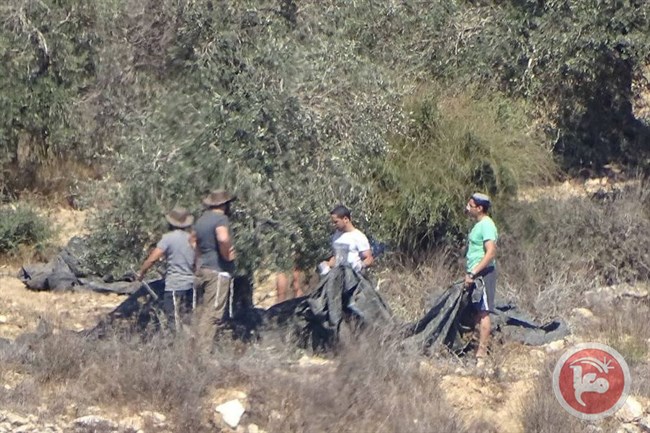
Jewish colonists stealing Palestinian olives in the West Bank
MEMO | July 4, 2018
Leicester City Council has “won its long-running legal battle” against a pro-Israel advocacy group over a motion backing a boycott of Israeli settlement produce, reported the Leicester Mercury.
In a ruling issued Tuesday, the Court of Appeal rejected the arguments brought by Jewish Human Rights Watch (JHRW), who had taken legal action against the 2014 council motion.
As reported by the local paper, “JHRW challenged a High Court judge’s previous decision to reject the pressure group’s attempt to force the council to rescind the boycott”, arguing that “the council had breached its own equalities rules and had acted in a discriminatory manner”.
The council, however, won yesterday’s case, and “JHRW has indicated it will not pursue the matter further”. In addition, “JHRW is now likely to have to pay the council’s legal costs.”
The council’s barrister, Kamal Adatia, said after the case: “The High Court originally dismissed the claims of discrimination made by this group back in June 2016, and now the Court of Appeal has emphatically thrown out their appeal.”
“The ruling totally endorses Leicester’s approach to handling this motion, and has made no change whatsoever to the way in which councils can pass such motions in future.”
“The judgement is a landmark – not for organisations like JHRW, but for all local councils. It recognises their fundamental right to pass motions of this nature and makes it clear that they can, like Leicester, fully comply with their equality duties when doing so.”
City Mayor Sir Peter Soulsby said: “Their argument has been trounced in the judge’s decision.”
“I strongly resent the implication it is not possible to criticise the Israeli government without being anti-Semitic.”
The motion backing a boycott of goods made in internationally-condemned Israeli settlements in the occupied Palestinian territory was, Soulsby said, “never anticipated to have a major impact (on our purchasing)”, but rather “was a powerful gesture to show support for the plight of the Palestinians”.
In a bizarre press release, Jewish Human Rights Watch spun defeat as victory, claiming that despite their appeal being rejected, the ruling “made a number of very important changes to the law”.
Israeli court orders PA to compensate collaborators
MEMO | June 30, 2018
An Israeli court has ordered the Palestinian Authority to compensate Palestinians detained by its security services over suspicions that they have collaborated with the occupation authorities, local media reported on Friday. According to the Times of Israel, the court has ordered the PA to pay a total of NIS13.2m ($3.5 million) in compensation to 52 collaborators.
The PA occasionally detains Palestinians in the occupied West Bank who are suspected of collaborating with the Israeli security services. Israel Hayom reported that five lawsuits involving dozens of plaintiffs have been filed against the authority over its crackdown on collaborators, noting that the oldest dates from 2004.
“We welcome the court’s landmark ruling,” said lawyers acting for the collaborators. “The judge saw the plaintiffs’ disabilities [resulting from torture], understood their distress and decided to grant them partial compensation immediately.”
The Palestinian Authority calls its own collaboration with the Israeli occupation authorities “security cooperation”. PA President Mahmoud Abbas has described this as “sacred”. Critics insist that the PA security services were created solely to protect Israel and its occupation, not the people of Palestine.
Featured Video
Houthis Keep Advancing as the Red Sea Crisis Deepens
or go to
Aletho News Archives – Video-Images
From the Archives
Clash of Civilization, Iran Part II
By Jamal Kanj – Intifada-Palestine.com – January 14, 2011
Israel’s survival kit is: perpetuate conflict, insecurity to rationalize collective hate and finally playing victim.
Devoid of conflict, Israel implodes internally; without hate, Zionism loses its justification; and playing eternal victim to continue blackmailing the West. Absence of this holy trinity, Israel ceases to exist. … continue
Blog Roll
 Aletho News
- Macgregor: We Haven’t Seen the Worst of the Iran War Yet
- ‘We are not like everyone else’ laws that bind other nations do not apply to Israel, says Likud lawmaker
- Report: Saudi Arabia seeks allies’ assistance as missiles deplete amid war on Yemen
- Fuel Crisis Deepens: Pakistan Warns Tanker Attack in Red Sea Would Be an ‘Act of War’
- ‘Bucha massacre’ a false flag orchestrated by UK – Moscow
- China Rejects Outside Pressure on Trade Ties After New US Russia Sanctions Bill
- Houthis Keep Advancing as the Red Sea Crisis Deepens
- Iran spent $1 million to wipe out $30 billion in data center plans, and take down Amazon in the ME
- Zionist billionaire pressure to silence Macklemore sparks exodus from Ed Sheeran tour
- House Votes to End Iran War for Third Time
- If Americans Knew
- Biden’s Genocide Accomplices Targeted by New Accountability Campaign
- AIPAC’s Network Has Already Spent $67.2 Million to Shape the Midterm Elections
- Jewish Supremacist Manufacturing a Civilizational Threat to License Bigotry
- US bans Palestinian president from speaking at the UN
- Israeli Forces Detain Journalist Alaa al-Rimawi amid Widespread West Bank Raids
- Even a pro-Israel Congress member has put a hold on 40,000 one-ton bombs to Israel
- As Gaza crumbles, Israel preps new ground invasion – Daily Update
- ‘We are not like everyone else’ laws that bind other nations do not apply to Israel, says Likud lawmaker
- Trump’s govt makes ‘treasonous’ claim of weapons shortages
- Palestinian-American Journalist Naqaa Hamed Imprisoned by Israeli Forces After Settlers Targeted Her
- No Tricks Zone
- New Study: ‘Global Drought Shows No Detectable Recent Acceleration Under Climate Warming’
- Economic Masterminds: German Socialists Suggest Taxing Productivity Gains Stemming From Using AI
- The South China Sea Has Not Been Cooperating With The Climate Change Narrative
- Energy Crisis: Germany Enters Heating Season With Historically Low Gas Reserve Fill Levels
- New Study: The Antarctic Ice Sheet Gained Mass From 2020-2024 Due To Staggering Snow And Ice Accumulation
- Study: Ocean Heating Rates From Thousands Of Years Ago ‘Dwarf’ Modern Ocean Heating Rates
- Climate Extremists Target, Attack Large-Scale Power Grid Infrastructure In Germany!
- New Study: Antarctic Ice Melt Has Contributed Less Than 1 Centimeter To Sea Level Rise In The Last 30 Years
- Fear Of Debate: Alarmist German Climate Scientist Calls On Mainstream Media To Discredit Skeptic Voices
- End-Of-August Arctic Sea Ice Extent Hasn’t Fallen In 20 Years, Official Data Show!
 Aletho News