Apartheid illustrated: Israeli soldier shoots another soldier in Hebron
International Solidarity Movement | July 6, 2017
Hebron, occupied Palestine – On Tuesday, 4th July 2017, Israeli forces were conducting a ‘military training’ in a civilian Palestinian neighborhood near Gilbert checkpoint in Tel Rumeida in occupied al-Khalil (Hebron). The result of this ‘military training’ was a fatal shot by one Israeli soldier to the other. The injured commander was immediately evacuated to hospital by an Israeli ambulance, and was later confirmed dead. The Israeli forces immediately closed the whole area to Palestinians by closing all the checkpoints, collectively punishing the civilian Palestinian population. The army, after the incident, announced that these ‘military trainings’ will be suspended in al-Khalil.
The whole incident, though, needs to be contextualized: an occupying army conducted a ‘military training’ near a checkpoint installed for the control and humiliation of the occupied population, in a civilian residential neighborhood. Immediate medical assistance to the injured occupying soldier, with an ambulance that, without any problems, was granted immediate access to the injured.
Military trainings, under international humanitarian law, are prohibited in civilian areas. The Israeli occupying army in al-Khalil, and all over the occupied territories, though, conducts trainings in civilian areas. This serves two functions: for one, it is more ‘real’, a training in the area where the perceived ‘enemy population’ is living, and second, the intimidation of the population. Israeli forces in al-Khalil are sometimes seen ‘practicing’ the ‘neutralization’, as it is called in Israeli rhetoric, of Palestinians at checkpoints. In those cases, a Palestinian that allegedly carries a knife is seen as a threat to the life of the heavily armed and armored occupation forces – and thus has to be shot and, as documented in so many cases, left to bleed to death on the ground without any medical assistance. The idea is always to shoot to kill.
Whereas an Israeli soldier or settler from the illegal settlements would immediately receive medical assistance, as Israeli ambulances are free to pass, Palestinian ambulances, and actually any Palestinian vehicles (often including donkeys and bicycles) are not allowed to drive on one of the (primary artery) roads in al-Khalil – which conveniently connects the settlements in down-town al-Khalil with the Kiryat Arba settlement on the outskirts of the city. Palestinian ambulances, as they are not allowed on this street, instead, are often detained by Israeli forces at the checkpoints, denied to pass and thus denied access to give first aid.
Immediately after the incident, the Israeli forces closed all the checkpoints in the area, effectively putting the area under curfew – for Palestinian residents. Any Palestinian civilian inside the area, thus, was prevented from leaving, and anyone outside trying to reach their homes, was prevented from coming back home. This is clearly collective punishment of the Palestinian civilians, who are not involved in the incident at all – other than living in an area that the Israeli forces are trying hard to rid of any Palestinian presence. Whereas Palestinian movement was completely restricted and Palestinians trying to film the incident and it’s aftermath were stopped and harassed by soldiers. Settlers, however, from the illegal settlements, were allowed to move around freely. In a separate incident, a settler beat up a Palestinian young man, causing his face to be unrecognizable as it was covered in blood. The settler though, can be sure that he’ll enjoy full impunity under the protection of the Israeli forces.
These kinds of military trainings in the aftermath were declared ‘suspended’ in the city of al-Khalil. However, only because a soldier was killed, not because of their illegal nature in civilian areas or a possible threat to the occupied population.
This incident illustrates the apartheid system installed by the Israeli occupying forces in al-Khalil, and all over the occupied Palestinian territories. An apartheid-strategy that aims to displace the Palestinian population from their homeland in favor of illegal settlements.
Israel’s attorney general okays controversial 1967 settlement order

Israeli Attorney General Avichai Mendelblit
Press TV – July 2, 2017
A newly released report says Israeli attorney general Avichai Mendelblit approved last year the use of a controversial 1967 order to legalize settler units built on private Palestinian land.
During a meeting attended by several Israeli judicial officials, Mendelblit said the “Order Concerning Government Property,” which was issued in July 1967, could be invoked to expropriate Palestinian land, the Israeli newspaper Haaretz reported on Sunday.
Clause 5 of the order states that “any transaction concluded in good faith between the authorities and another person … will not be struck down and is valid, even if it is proven that the asset was not government property at the time of its purchase.”
Mendelblit’s office said in a document that the clause had rarely been used in almost five decades, but “the need to make use of it has arisen now.”
It further set out a number of conditions for invoking the clause, such as purchase in good faith, the existence of a contract and payment having been made for the land.
“The use of Clause 5 should be limited as a rule to the built residential boundaries of the community, and to actual construction done before the parties to the transaction became aware that this was in fact not government property,” the document added.
Back in February, the Israeli parliament, known as the Knesset, passed a law on the expropriation of privately-owned Palestinian land in the West Bank, where Israeli settlements or outposts have been constructed.
However, Palestinians filed petitions to the Israeli High Court against the law.
Mendelblit proposed that the Israeli parliament suspend the land garb law until the court rules on the petitions and the Knesset accepted the bid.
Dror Etkes, Israeli anti-settlement activist, said the document by Mendelblit’s office seems to be “a parallel path being prepared … for the day after the High Court tosses the [expropriation] law into the garbage.”
“The purpose of this legal construction, rotten from the foundation, is to raise the claim of ‘good faith’ wherever Israel has stolen private Palestinian land and given it to settlers,” he said. “This is a situation in which lies, denial, violence and manipulation prevail – that is, everything except good faith.”
About 600,000 Israelis live in over 230 settlements built illegally since the 1967 occupation of the Palestinian territories.
The continued expansion of Israeli settlements is one of the major obstacles to the establishment of peace in the Middle East.
In recent months, Tel Aviv has stepped up its settlement construction activities in the occupied Palestinian territories in a blatant violation of international law and in defiance of United Nations Security Council Resolution 2334.
The resolution, which was passed last December, states that Israel’s establishment of settlements in the occupied territories, including East Jerusalem al-Quds, “had no legal validity” and urges the regime to immediately and completely cease all its settlement activities.
Israel abducts Palestinian lawmaker on security allegations
Press TV – July 2, 2017
 Israeli military forces have abducted a Palestinian legislator and a senior member of the Popular Front for the Liberation of Palestine (PFLP) during separate raids across the occupied West Bank.
On Sunday morning, a large number of Israeli troopers raided the home of 55-year-old Khalida Jarrar in the central West Bank city of Ramallah, located 10 kilometers (six miles) north of Jerusalem al-Quds, and arrested her.
Her husband, Ghassan said Israeli forces seized computers during the raid.
Israel’s internal spy agency, Shin Bet, announced in a statement that Jarrar was arrested along with a Palestinian activist for “promoting terror activities,” without providing any further information.
Jarrar is one of the most outspoken critics of the Israeli occupation and has repeatedly slammed the Tel Aviv regime’s atrocities against Palestinians.
The Israeli regime has been denying the lawmaker the right to travel outside the occupied Palestinian territories since 1988. She campaigned for months in 2010 before receiving the permission to travel to Jordan for medical treatment.
In August 2014, Jarrar received a “special supervision order” from the Israeli military, instructing her to leave Ramallah to the West Bank city of Ariha (Jericho).
However, she set up a protest tent outside the Palestinian Legislative Council in Ramallah, where she lived and worked, until the controversial order was overturned later in September that year.
Israeli soldiers last arrested the Palestinian lawmaker on April 2, 2015 after storming her house in Ramallah. She was released from prison on June 3, 2016 on a suspended sentence of 12 months within a five-year period.
According to reports, a total of 13 Palestinian lawmakers are currently imprisoned in Israeli detention facilities.
Nine of them are being held without trial under the so-called administrative detention, which is a policy according to which Palestinian inmates are kept in Israeli detention facilities without trial or charge. Some Palestinian prisoners have been held in administrative detention for up to 11 years.
Palestinian MK enters prison with “pride”
Meanwhile, a Palestinian member of the Knesset (parliament) has headed to prison with “pride” as he began a two-year sentence on charges of giving cellphones and SIM cards to Palestinian prisoners in Israeli jails.
Basel Ghattas of the Joint List, a political alliance of four Arab-dominated parties in Israel, said he was entering prison with his “head held high” and with “support from my people.”

File photo shows Palestinian member of Knesset (Israel’s parliament) Basel Ghattas at his office at the Knesset in Jerusalem al-Quds
More than 6,500 Palestinians are reportedly held at Israeli jails. Hundreds of the inmates have apparently been incarcerated under the practice of administrative detention.
The Palestinian inmates regularly go on hunger strike in protest against the administrative detention policy and their harsh prison conditions.
Israeli authorities approve budget for controversial ‘Apartheid road’ in West Bank
Ma’an – June 27, 2017
BETHLEHEM – Israel has reportedly approved a budget for the construction of the so-called Eastern Ring Road in the occupied West Bank, known by activists and rights groups as the “Apartheid road.”
The road, part of Israel’s plans of developing the controversial E1 corridor, has been denounced as an attempt to further expand illegal Israeli settlement construction in the occupied Palestinian territory, while deepening the separation between Palestinian communities on opposite sides of Israel’s separation wall.
According to a statement released by Israeli rights group Ir Amim on Monday, the development of the road is “one of several developments necessary for preparing the ground for E1.”
The reports emerged from Israeli media outlet Israel Hayom, which stated that the road is expected to be opened to Israeli traffic in the next 10 months.
According to rights groups, settlement construction in E1 would effectively divide the West Bank and make the creation of a contiguous Palestinian state — as envisaged by the internationally backed two-state solution to the Palestinian-Israeli conflict — almost impossible.
Israeli activity in E1 has attracted widespread international condemnation, and Palestinian President Mahmoud Abbas has in the past said that “E1 is a red line that cannot be crossed.”
However, the Eastern Ring Road was proposed by former Israeli Prime Minister Ariel Sharon as a plan to apparently solve the issue of bifurcating the West Bank, by facilitating “navigation from Ramallah to Bethlehem for Palestinians but without any access to Jerusalem.”
Following the second Palestinian intifada and Israel’s construction of the separation wall that has disjointed Palestinian territory, Palestinians from the “West Bank side” of the separation barrier have been forced to obtain Israeli-issued permits in order to access occupied East Jerusalem, which some Palestinians and the international community still consider to be the future capital of an independent Palestinian state.
A map released by Ir Amim shows the expected route of the road. According to the group, the road would “ease access” for Israeli settlers residing around Ramallah in contravention of international law, as settlers have “long exerted pressure to open the road, complaining about traffic jams and delays.”
Ir Amim pointed out that Israel’s plan would enable further expansions of Israel’s illegal settlements around Ramallah.
The road is also planned to connect with Road 1 that connects the mega settlement Maale Adumim with Jerusalem, and would also link to the Mount Scopus Tunnel Road through the Zeitim interchange, another controversial E1 related project that Israeli authorities had begun construction on several months ago, according to Ir Amim.
According to an earlier report released by Ir Amim, the Zeitim interchange is located between Jerusalem and Maale Adumim, and would connect the Eastern Ring Road in the northern West Bank to road 417, leading to the south.
The group highlighted in the report that connecting these roads is “a crucial part in realizing the E1 plans,” as Israeli settlement construction in the E1 corridor would prevent Palestinians in the West Bank from using road 437, which “connects to road 417 and enables Palestinian traffic between the northern and southern West Bank.”
The plans aim to replace road 437 with the northern section of the Eastern Ring Road, which would divert Palestinian traffic away from road 437 and the E1 area” and would establish separate lanes for Israeli and Palestinian traffic, thus its label as an “apartheid road.”
Israel’s plans in E1 have long been denounced by rights groups and the international community since its approval in 1999, in the wake of the Oslo Accords which expected the area of E1 to be transferred to the Palestinian Authority (PA) within an interim period of five years.
Another central aspect of Israel’s development plans in the area includes the full eviction and relocation of Bedouin communities residing in E1, near Maale Adumim.
This plan was furthered earlier this year when Israeli authorities delivered demolition notices to every single home in the Bedouin village of Khan al-Ahmar, including the village’s elementary school. The village is located on the site of planned Israeli settlement development and on the Israeli side of the planned route of Israel’s separation barrier.
Rights groups and Bedouin community members have sharply criticized Israel’s relocation plans for the Bedouin residing near Maale Adumim, claiming that the removal would displace indigenous Palestinians for the sake of expanding Israeli settlements.
Bedouin villages in the area also face routine demolitions by Israeli forces.
Since the E1 corridor is part of Area C — the more than 60 percent of the West Bank under full Israeli military control and where Israel’s settlements are planned, the Palestinians living there face routine attempts by Israeli authorities to push them off the land.
Khan al-Ahmar is one of 46 villages comprising of a population of 7,000 — 70 percent of whom are Palestinian refugees — in the central West Bank that are considered by the UN as being at risk of forcible transfer by Israeli authorities to alternative sites, in violation of international law.
In addition, Israeli rights group B’Tselem has noted in the past that plans to develop the E1 corridor would also further isolate Palestinians straddled between the “West Bank side” of the separation barrier and those in occupied East Jerusalem, by “enclosing East Jerusalem from the East and linking it up with Israeli neighborhoods built north of the Old City.”
As East Jerusalem used to be the primary urban center for Palestinians in the West Bank, the E1 plans would further exacerbate a Palestinian-Palestinian separation that has wreaked havoc on Palestinian economic, social, and political life.
Israel refuses entry to UNESCO group expected to visit Hebron’s Old City

Ma’an – June 26, 2017
BETHLEHEM – Israeli authorities have refused to grant entry visas for a United Nations Educational, Scientific and Cultural Organization (UNESCO) investigative team scheduled to conduct a field visit to the Old City in the southern occupied West Bank district of Hebron in advance of an upcoming vote next month to consider the area an endangered world heritage site, Israeli media reported on Sunday.
While Palestinian authorities had planned to introduce the site for consideration on UNESCO’s World Heritage List for 2018, they decided to fast track the site’s application owing to routine Israeli violence in the Old City, which Palestinians have claimed threatens the integrity of the site, and instead propose the area as an endangered site.
A Palestinian delegation to UNESCO had reportedly expressed the “alarming details about the Israeli violations in Al-Khalil/ Hebron, including the continuous acts of vandalism, property damage, and other attacks,” in a letter to the World Heritage Center.
Since Israel took over the West Bank in 1967 and began advancing Israeli settlements across Palestinian territory in violation of international law, Hebron has been a flashpoint for Israeli settler violence on Palestinians and their properties.
The Ibrahimi Mosque, known to Jews as the Cave of the Patriarchs, in the Old City where the Prophet Abraham is believed to be buried has been a focal point of such violence for decades, as the site is holy to both Muslims and Jews and has been a prime site for Israeli settler activities in the area.
The UNESCO team’s visit is aimed at assessing whether or not the Old City of Hebron is actually endangered, and would submit these findings to the International Council on Monuments and Sites (ICOMOS), a body that provides recommendations to UNESCO involving sites that could be considered on the World Heritage in Danger list.
According to The Jerusalem Post, other protected sites in the occupied Palestinian territory, including the Church of Nativity in Bethlehem, the ancient terraces of Battir, and the pilgrimage route in Bethlehem, had also been fast tracked by Palestinian authorities in previous years to include them on UNESCO’s World Heritage in Danger list.
Israel’s Ambassador to UNESCO Carmel Shama Hacohen reportedly said that the UNESCO group was being rejected entry into Israel owing to the fact that ICOMOS had advised against considering the previous sites in the occupied territory as endangered and instead recommended that Palestinian authorities continue with the normal process.
UNESCO, however, had rejected these recommendations by ICOMOS for the Church of Nativity and Battir. Hacohen said that due to these past decisions by UNESCO to ignore recommendations made by ICOMOS, it would be “a shame to waste the time and money” of the committee.
He went on to denounce what he considered “Palestinian political moves under the guise of culture and heritage,” and added that UNESCO’s consideration of the site represented “lies that plot against the state of Israel as well as the history and the connection of the Jewish people to this important holy site.”
The Old City, which is under full Israeli military control, is home to some 30,000 Palestinians and around 800 Israeli settlers who live under the protection of Israeli forces.
UNESCO is scheduled to decide on the status of the Old City during a conference in Krakow, Poland from July 2-12. The vote is expected to include a clause rejecting Israeli sovereignty over occupied East Jerusalem, which Israel annexed in 1980 in a move never recognized by the international community.
Meanwhile, Israeli media site Ynet reported that Israeli authorities have been scrambling to collect the seven votes needed to block the motion.
Ynet also said that in the “context of a peace process,” the inclusion of Hebron’s Old City into UNESCO’s World Heritage List would “impose limits on Israeli construction, the protection and development of the site and on specific areas in the vicinity,” and expressed worry that Israel would “be condemned each time it erects a security checkpoint or conducts work in the area on the grounds that is is damaging a world heritage site.”
However, Israeli activities in Hebron and the rest of occupied Palestine have long been condemned by rights groups and the international community as human rights abuses against the Palestinian people and a threat to any future peace agreements, while the some 500,000 to 600,000 Israeli settlers in the occupied West Bank are residing there in contravention of international law.
Israel has accused the United Nations and its respective bodies of being “anti-Israel” for its stances against the now half-century occupation of the Palestinian territory, including East Jerusalem.
Such allegations have escalated following the passing of UN Resolution 2334, which condemned Israel’s settlement building in Palestinian territory. The US had taken Israel by surprise at the time by abstaining from the vote, in a split from its typical objections to such moves.
Earlier this month, US Ambassador to the United Nations Nikki Haley said that the UN could no longer “bully” Israel over its violations of international law, and said that “we are not going to let that happen anymore.”
US President Donald Trump had also denounced the UN resolution, and even warned in a Twitter post last year that “things will be different” following his inauguration.
Earlier this year, the US House of Representatives even passed a resolution confirming US commitment as a diplomatic ally to the Israeli government, and demanded that the US government dismiss any future UN resolutions they deemed “anti-Israel.”
Life imprisoned in a ‘closed military zone’. “Daily Life”?
International Solidarity Movement | June 26, 2017
Hebron, occupied Palestine – Israeli forces at Shuhada checkpoint in occupied al-Khalil (Hebron) have put up yet another sign ‘instructing’ the Palestinian residents on their behavior at the checkpoint. The bright-red sign with pictures clearly prohibits any kind of supposedly ‘dangerous’ materials like guns, knives and scissors. Just like when you attempt to cross security in any airport. Whereas those objects have long been prohibited and most Palestinians wouldn’t dare bring any of those to any checkpoint, as they’d have to fear for their lives, the signs also illustrate something else: life for the Palestinians living in this area is immensely restricted.
At an airport, most people can at least attempt to grasp why those objects aren’t allowed. But now consider this checkpoint is on your daily way to your house. Your own home. Not an airport, you have to cross this checkpoint all the time. That’s what it is like for Palestinians living in the Israeli forces declared ‘closed military zone’ in Tel Rumeida and on Shuhada Street. Those restrictions, newly illustrated with little images, restrict daily tasks such as cooking and studying, doing arts, and even such mundane things as cutting your nails. No Palestinian is allowed to bring any kind of knife, so unless you have a big stack of sharp knifes – you won’t be cutting either your fruit, nor meat, nor vegetables. If you break a pair of scissors, your children will not be doing arts anymore, and no matter how often they ask for new ones, the parents are prohibited to bring scissors, even non-sharp children’s-scissors, into this area.
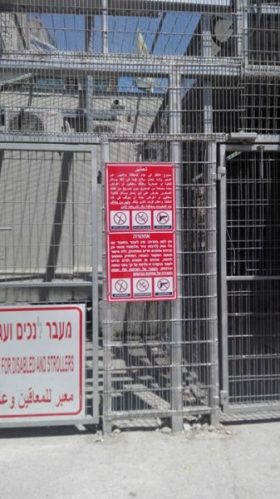
Newly installed sign illustrating the daily restrictions enforced solely for Palestinians
Doing so against the warning, you’d most likely pay with your life. A sentence on the sign says that a ‘permit’ can be applied for to bring any of the mentioned items. But even if that would be successful – assuming a Palestinian wouldn’t just be arrested for just applying for such a permit – or refused like so many Palestinians applying for building permits, it would cost a lot of bravery to actually show up at the checkpoint with any of those items. Bringing ‘banned items’ to the checkpoint, and then telling the heavily-armed soldier: “I’m bringing a knife”. It’s debatable whether that conversation would ever go beyond that point, or rather be cut short by gunshots from a heavily-armed occupation force.
In stark contrast to airports, where the measures are [at least purportedly] for security, in this context they are merely and deliberately solely for humiliation. In international law, a praxis like this is called ‘creating a coercive environment’ in order to facilitate ‘forced displacement’. And that’s what it is about: in an area that so conveniently connects all the illegal settlements within the city center of al-Khalil and on its outskirts, Palestinians are merely considered a nuisance. The attempts to drive them out are thus ever more enforced by the occupying army.
Lieberman: Not a single Palestinian refugee will return to their lands in Israel
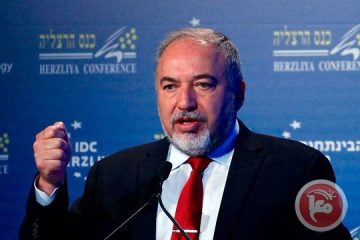
Ma’an – June 23, 2017
BETHLEHEM – During a speech at Israel’s Herzliya conference, aimed at discussing the country’s national policies, ultraright Israeli Defense Minister Avigdor Lieberman rejected the possibility of Palestinian refugees from historic Palestine, which Israel was built on, being able to return to their lands within the 1967 borders, a right that is upheld by United Nations Resolution 194.
“We will not agree to the return of a single refugee to within the ‘67 borders,” Lieberman reportedly said. “There will never be another Prime Minister who makes propositions to Palestinians like Ehud Olmert did,” he added, referring to a 2008 peace proposal introduced by the former prime minister.
The right of return for Palestinian refugees is a central demand among Palestinians and their leadership. The demand also represents a powerful symbolic connection to their lands and homes they were displaced from, as many Palestinians still possess original keys to their homes that were consumed by the state of Israel 69 years ago.
According to Israeli media, Lieberman also said that an end to the decades-long Israeli-Palestinian conflict would “not solve the problems – it will make them worse,” and noted that Israel should first “reach a regional agreement with moderate Sunni states, and only then an agreement with the Palestinians.”
He also went on to question the legitimacy of Palestinian citizens of Israel being part of the Israeli parliament, the Knesset, noting that the Joint List political bloc — representing parties led by Palestinian citizens of Israel in the Knesset — refused to acquiesce to Zionist ideologies.
“The only place they don’t want to leave is Israel. Why? Because it’s good for them here,” he said, referring to Palestinian citizens of Israel, making up approximately 20 percent of the population, whose families lived on the lands of historic Palestine before the creation of the state of Israel.
According to the Palestinian Central Bureau of Statistics (PCBS), 66 percent of Palestinians who were living in British-Mandate Palestine in 1948 were expelled from historic Palestine and displaced from their homes and lands during the creation of Israel, referred to as the Nakba, or catastrophe, among Palestinians.
On the topic of Gaza, Lieberman reportedly said “I don’t think we need to get into it. It won’t end soon,” before calling the dire humanitarian situation in the besieged Palestinian territory an “intra-Palestinian crisis,” echoing statements made by US Ambassador to the UN Nikki Haley who placed full blame of the dire humanitarian situation in the besieged Gaza Strip on Hamas, and absolved Israel of any responsibility for the ongoing crisis.
Lieberman also accused Palestinian President Mahmoud Abbas of attempting to influence Hamas to go to war with Israel by exacerbating the crisis in Gaza by cutting Palestinian Authority (PA) payments for electricity supplied to Gaza from Israel.
“Abbas is going to increase cuts and soon stop the payment of salaries in Gaza and the transfer of fuel to the strip as a two-pronged strategy: Hurt Hamas and drag it to war with Israel,” he reportedly said.
Lieberman’s statements came amid an attempted renewal of the Israeli-Palestinian peace process by right-wing US President Donald Trump.
Most recently, on Wednesday evening, a meeting was held between Abbas and Trump’s son-in-law and senior advisor Jared Kushner in the central occupied West Bank city of Ramallah to discuss reviving peace talks with Israel.
Executive Committee Member of the Palestine Liberation Organization (PLO) Wasel Abu Yousif said in statement at the time that reviving a political process requires certain determinants based on international law: a time limit for ending the 50-year Israeli occupation of the Palestinian territory must be set to establish a Palestinian state along the 1967 borders with East Jerusalem as its capital, and Palestinian refugees must be granted the right of return to the homes and villages from which they were expelled.
However, Israeli leaders have been public on their rejection of the Palestinian Authority (PA) taking over East Jerusalem, which was officially annexed by Israel in 1980, and have regularly voiced their opposition to the return of Palestinian refugees or even the halting of illegal Israeli settlement expansions in the occupied Palestinian territory.
Naftali Bennett, Israel’s right-wing education minister, has also introduced a bill in the Israeli parliament that would prevent any future divisions of Jerusalem, by mending Israel’s Basic Law on Jerusalem to necessitate the approval of 80 of the 120 Knesset members to make any changes to the law, instead of the regular majority vote.
“The purpose of this law is to unify Jerusalem forever,” Bennett reportedly said, adding that his legislation would make it “impossible” to divide Jerusalem.
While the PA and the international community do not recognize the legality of the occupation of East Jerusalem, Gaza, and the West Bank since 1967, many Palestinians consider that all historic Palestine has been occupied since the creation of the state of Israel in 1948.
A growing number of activists have criticized a two-state solution to the Israeli-Palestinian conflict as unsustainable and unlikely to bring durable peace given the existing political context, proposing instead a binational state with equal rights for Israelis and Palestinians.
Israel revisits Qalqilya expansion plan

Image of an Israeli military bulldozer demolishing a Palestinian home in Qalqilya, West Bank [Apaimages]
MEMO June 19, 2017
Israel’s Channel 2 said the Israeli government will reconsider a previous decision to allow the expansion of the occupied Palestinian city of Qalqilya in the north of the West Bank.
The plan would see 14,000 new apartments built on 2,500 dunams (2.5 square kilometres) in Israeli-controlled Area C surrounding the city and would potentially double the city’s population from 50,000 to 110,000.
The Israeli Prime Minister’s Office said the plan was proposed during the visit of US President Donald Trump to the region in May.
Qalqilya, which is surrounded by illegal Israeli settlements, is overcrowded.
Channel 2 reported that the plan has stirred widespread controversy in Tel Aviv, especially among settlers who claimed it would “harm the settlers’ quality of life and security”.
The area owned by the people of Qalqilya is classified as Area C under the Oslo agreement signed between Israel and the PLO in 1992. Under this classification, the land is under Israeli security and administrative control.
Read: Israel to approve 2,500 new settlement units in occupied West Bank
Three Prominent Palestinian Organizers, Journalists Ordered to Further Imprisonment without Charge or Trial
Samidoun Palestinian Prisoner Solidarity Network – June 8, 2017
Three prominent Palestinian activists were ordered to additional periods of administrative detention, imprisonment without charge or trial. Palestinian journalist Hasan Safadi, youth organizer Hassan Karajah and leftist community leader Rami Fadayel, all of Ramallah, were ordered to further imprisonment without charge or trial by Israeli military courts.
Fadayel, 37, has been imprisoned for 18 months under administrative detention; this is the fourth time the order against him has been renewed. He has spent over seven years in total in Israeli prisons and was ordered to another four months of imprisonment without charge or trial. He was hit with another four-month detention order on Wednesday, 7 June.

Rami Fadayel
Haneen Nassar, Fadayel’s wife and an organizer with the Palestinian Prisoners’ Committee, a popular organization in Palestine that works to support the prisoners’ struggle and demand their freedom, said that she and her husband have never been able to enjoy a free and safe life since their marriage. Fadayel has been arrested repeatedly; they marked their engagement while he was imprisoned. She noted that their daughter, Mays, 10, has not seen her father in their home for nearly half of her life.
Fadayel is well-known in Ramallah as a leader in the Popular Front for the Liberation of Palestine, the Palestinian leftist political party. Nasser noted that his administrative detention has been repeatedly renewed under the pretext of a “secret file;” all of the appeals of his lawyer have been rejected.
Palestinians held without charge or trial under administrative detention orders can be detained indefinitely; these one- to six-month orders can be repeatedly renewed on the basis of so-called “secret evidence.” There are currently over 500 Palestinian administrative detainees imprisoned by the Israeli occupation. Some Palestinians have spent years at a time under administrative detention on the basis of this so-called secret evidence. Over 50,000 administrative detention orders have reportedly been issued since 1967; the practice dates from the colonial British mandate over Palestine and was re-imposed by the Israeli occupation.

Hasan Safadi
Meanwhile, Hasan Safadi, Palestinian journalist and the Arabic media coordinator of Addameer Prisoner Support and Human Rights Association was also ordered on 8 June 2017 to another six months in administrative detention by an Israeli occupation military court. He had been scheduled for release on 8 June, but was instead hit with another arbitrary detention renewal.
Safadi, 26, has been imprisoned since 1 May 2016, when he was seized by Israeli occupation forces as he crossed the Karameh/Allenby bridge between Jordan and Palestine, returning from an Arab youth conference organized in Tunisia. After 40 days of interrogation in the Moskobiyeh interrogation center, he was ordered to administrative detention without charge or trial, which has since been renewed twice. His new administrative detention order is scheduled to expire on 8 December 2017.

Hassan Karajah
Hassan Karajah, a prominent youth activist with the Stop the Wall Campaign and a boycott, divestment and sanctions (BDS) activist, was seized by Israeli occupation forces on 12 July 2016 at a military checkpoint west of Ramallah. He has been held under administrative detention without charge or trial since that time; his detention was also renewed on 7 June 2017 for the third time for a four-month period.
Karajah was previously arrested on 23 January 2013 and freed on 19 October 2014, accused of participation in a prohibited organization and contact with an enemy state, an allegation frequently used to target Palestinians who travel to conferences and events in Lebanon and other Arab countries.
These orders came after the Ofer military court confirmed even more administrative detention orders on Wednesday, 7 July. The military court approved six-month detention orders against Raed Abd al-Admu of al-Khalil, Tayseer Maher Hamed, Mohammed Badr al-Alouneh, Islam Fayeq Nimer of Ramallah and Suhaib Ahmed Mohammed of Tulkarem. It approved four-month imprisonment orders against Nidal Hashim Abdel Hadi and Yousef Ahmed Nasser of Jenin and Khalil Hassan Hamed, Ayman Naim Hamed, Hamza Ibrahim Zahran and Omar Mohammed Abu Latifa of Ramallah. It also affirmed a two-month detention order against Rabie Mohammed Musallah of Jenin.
Remembering the Naksa

Image of Israeli soldiers interrogating Palestinians during the 1967 Gaza war [Miren Edurne/facebook]
By Nasim Ahmed | MEMO | June 5, 2017
Fifty years ago this month, Israel launched a war against its neighbours and took control of the parts of Palestine which it had failed to capture during its 1948 “War of Independence”.
What: The Palestinian Naksa (“Setback”)
When: 5 June 1967
Where: Palestine
What Happened?
On 5 June 1967, Israel launched a pre-emptive strike against Egypt, Jordan, Iraq and Syria. After knocking out the air defences of these countries, it occupied East Jerusalem, the West Bank and the Gaza Strip, as well as the Syrian Golan Heights and Egypt’s Sinai Peninsula. Thus, it had taken control of the final 22 per cent of historic Palestine that it wasn’t able to occupy in 1948.
Nearly 400,000 Palestinians were added to the hundreds of thousands of refugees displaced in 1948 and their homes and villages were razed to the ground by the Israelis. Around half were being displaced for the second time in less than 20 years. Israel’s ethnic cleansing of Palestine was ongoing (as it is to this day).
The number of Palestinian refugees in the camps operated by the UN Relief and Works Agency (UNRWA) in the West Bank, Gaza Strip, Jordan, Syria and Lebanon grew.
The Naksa commemorates this tragic setback in the Palestinian struggle for freedom and self-determination.
What Happened Next?
The outcome of the war launched by Israel was, for many of its citizens and supporters, the fulfilment of God’s promise. Adding 44 per cent of the territory allocated by the 1947 UN Partition Plan for a Palestinian state, to the 56 per cent set aside for a Jewish state, marked a new beginning for both Israel and stateless Palestinians.
Within 20 years of being recognised as an independent state, Israel began an occupation that would become the longest in modern history, at 50 years and counting. Palestinians in the “occupied Palestinian territories” were subjected to a brutal Israeli military occupation as well as the activities of armed, right-wing Jewish settlers, for whom Israel’s victory was God’s handiwork and a licence to colonise the land which they believed was promised to them and them alone.
Israel’s already repressive military rule over Palestinians living within its undeclared borders was transferred to the West Bank and Gaza. Very soon, a matrix of control and domination, that included checkpoints, permits and home demolitions, was imposed on the lives of millions of Palestinians under Israeli occupation.
For the Palestinians, the combination of the Arab defeat during the “Six-Day War”, the repeated failure of the international community to protect their human rights, and Israel’s total colonisation of Palestine, prompted a serious re-evaluation of their situation. Having witnessed the futility of relying on others to end the indignity from which they had suffered for decades, they began to organise politically in an attempt to reverse the losses of 1948 and end their misery and statelessness.
In the years following the Naksa, Palestinian communities in the refugee camps and diaspora began to organise themselves politically and socially. A number of setbacks against the Palestine Liberation Organisation (PLO) did not deter them. Such civil society activities led to the formation of the Islamic Resistance Movement (Hamas) in the late eighties; the popular uprising now known as the First Intifada; and the PLO under the control of the secular Fatah movement gaining recognition by Israel and its allies as the “sole representative of the Palestinian people”. This phase of the political process ended with the signing of the Oslo Accords in 1994, providing the Palestinians in the West Bank and Gaza Strip with “interim self-governing arrangements”.
Featured Video

Houthis Keep Advancing as the Red Sea Crisis Deepens
or go to
Aletho News Archives – Video-Images
From the Archives
15 Saudi ‘hijackers’ were CIA agents working for US: Scholar
Press TV – April 13, 2016
Fifteen of the 9/11 “hijackers” from Saudi Arabia were CIA agents working for the United States government, which was seeking to destroy the Middle East for Israel and to double the American military budget, says Dr. Kevin Barrett, an American academic who has been studying the events of 9/11 since late 2003…. continue
Blog Roll
 Aletho News
- Russia Just Struck the Eyes of NATO’s War Machine in Ukraine
- Russia summons UK charge d’affaires over Kiev drone support
- NATO member warns bloc seeking pretext for war with Russia
- Macgregor: We Haven’t Seen the Worst of the Iran War Yet
- ‘We are not like everyone else’ laws that bind other nations do not apply to Israel, says Likud lawmaker
- Report: Saudi Arabia seeks allies’ assistance as missiles deplete amid war on Yemen
- Fuel Crisis Deepens: Pakistan Warns Tanker Attack in Red Sea Would Be an ‘Act of War’
- ‘Bucha massacre’ a false flag orchestrated by UK – Moscow
- China Rejects Outside Pressure on Trade Ties After New US Russia Sanctions Bill
- Houthis Keep Advancing as the Red Sea Crisis Deepens
- If Americans Knew
- US welcomes Israeli, Iranian delegations to UN, but not Palestinians – Daily Update
- Biden’s Genocide Accomplices Targeted by New Accountability Campaign
- AIPAC’s Network Has Already Spent $67.2 Million to Shape the Midterm Elections
- Jewish Supremacist Manufacturing a Civilizational Threat to License Bigotry
- US bans Palestinian president from speaking at the UN
- Israeli Forces Detain Journalist Alaa al-Rimawi amid Widespread West Bank Raids
- Even a pro-Israel Congress member has put a hold on 40,000 one-ton bombs to Israel
- As Gaza crumbles, Israel preps new ground invasion – Daily Update
- ‘We are not like everyone else’ laws that bind other nations do not apply to Israel, says Likud lawmaker
- Trump’s govt makes ‘treasonous’ claim of weapons shortages
- No Tricks Zone
- New Study: ‘Global Drought Shows No Detectable Recent Acceleration Under Climate Warming’
- Economic Masterminds: German Socialists Suggest Taxing Productivity Gains Stemming From Using AI
- The South China Sea Has Not Been Cooperating With The Climate Change Narrative
- Energy Crisis: Germany Enters Heating Season With Historically Low Gas Reserve Fill Levels
- New Study: The Antarctic Ice Sheet Gained Mass From 2020-2024 Due To Staggering Snow And Ice Accumulation
- Study: Ocean Heating Rates From Thousands Of Years Ago ‘Dwarf’ Modern Ocean Heating Rates
- Climate Extremists Target, Attack Large-Scale Power Grid Infrastructure In Germany!
- New Study: Antarctic Ice Melt Has Contributed Less Than 1 Centimeter To Sea Level Rise In The Last 30 Years
- Fear Of Debate: Alarmist German Climate Scientist Calls On Mainstream Media To Discredit Skeptic Voices
- End-Of-August Arctic Sea Ice Extent Hasn’t Fallen In 20 Years, Official Data Show!
 Aletho News