5 injured, 2 critically as Israeli forces fire on Kafr Qaddum march
Ma’an – June 12, 2015
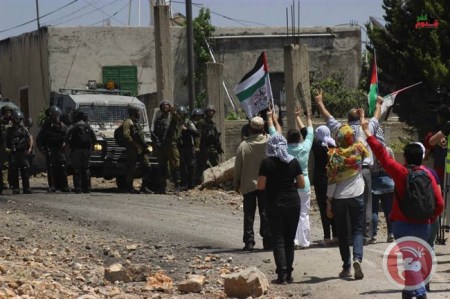
QALQILIYA – Five Palestinians were injured, two critically, when Israelis forces opened live fire on the Kafr Qaddum weekly march Friday.
A coordinator for the village’s popular resistance committee, Murad Shtewi, said that Muhammad Majid, 20, had been shot in the stomach and chest with live rounds and is in critical condition.
Ibrahim Mousa, 35, is also in critical condition after he was shot in the abdomen while in his house.
Shtewi also said that Muhammad Nidal, 20, and Mouiz Khader had been shot in the leg, and Ayman Farouq, 38, in the hand.
Dozens others suffered from excessive tear gas inhalation.
Israeli forces had closed down the village’s entrance since the early morning after they declared it a closed military zone. As a result, those injured had to be evacuated from the village in private cars using dirt roads.
An Israeli army spokeswoman contacted by Ma’an said she would look into it.
Israeli forces routinely suppress weekly marches by violent means.
In Kafr Qaddum, they also regularly declare the village a closed military zone in order to prevent the weekly march from taking place.
The march is carried out to protest the Israeli separation wall and Israeli settlement activity, both illegal under international law.
The internationally recognized Palestinian territories of which the West Bank and East Jerusalem form a part have been occupied by the Israeli military since 1967.
Norwegian pension fund divests from Israeli occupation
MEMO | June 12, 2015
Norway’s largest pension fund has excluded two companies “on the grounds of their exploitation of natural resources in occupied territory on the West Bank.”
KLP, which manages a US$70 billion investment portfolio, formally excluded Heidelberg Cement and Cemex on June 1, following a period of investigation and engagement. The combined worth of KLP’s shareholdings in both Heidelberg Cement and Cemex was approximately $5 million.
Heidelberg Cement and Cemex, leading global suppliers of building materials, operate quarries in the West Bank through their respective Israeli subsidiaries. According to KLP, “the companies pay licence fees and royalties to the state of Israel” while “the products deriving from the quarries are sold primarily for use in Israel’s domestic construction market.”
Based on “a review of applicable international law”, which the company explained in a separate document, KLP concluded that “the companies’ operations are associated with violations of fundamental ethical norms.”
Citing a previous similar case in Western Sahara, KLP noted that the quarries in question were opened after 1967, when Israel’s occupation began. “The opening of a quarry in occupied territory”, KLP said, “is in all probability incompatible with Article 55 of the Hague Regulations.”
The fund, which manages the retirement assets of Norwegian public sector workers, also excluded a further eight companies on the grounds of their income from coal-based operations, corruption, environmental damage, and the production of tobacco.
Photographer barred from treatment after being shot by Israeli forces
AFP – June 11, 2015
JERUSALEM – Israel has barred a Palestinian photographer allegedly shot in the eye by Israeli forces from entering occupied East Jerusalem for specialist treatment, the injured photographer told AFP on Wednesday.
Nidal Shtayyeh, who works for Chinese news agency Xinhua, was wounded while covering a small demonstration at Huwarra checkpoint near the northern West Bank city of Nablus on May 16.
As he was covering the rally, Shtayyeh was hit in the face by a rubber bullet which entered his eye, causing serious damage, he told AFP.
“The march was peaceful and no stones were thrown, no photographers were taking any pictures,” he said, accusing soldiers of firing sound bombs at the photographers without any provocation.
“I raised my camera to my right eye to take a picture, but a soldier shot me in my left eye with his rifle, and the rubber bullet went through my gas mask’s glass eye cover and into my eye.”
An Italian camerawoman was also injured during the same demonstration which came as Palestinians commemorated 67 years since the “Nakba,” or “catastrophe,” when an estimated 760,000 Palestinians fled or were expelled from their homes during the establishment of the state of Israel in 1948.
At the time, Israeli forces said at least 100 Palestinians had been throwing stones and petrol bombs, and that the forces had responded with “riot dispersal means.”
Shtayyeh’s injury comes as rights groups criticize Israel for disproportionate use of force against unarmed civilians during such demonstrations.
While crowd control weapons are intended to be non-lethal, many methods used by Israeli forces can cause death, severe injury, and damage to property, according to Israeli rights group B’Tselem.
Shtayyeh was rushed to Rafidiya hospital in Nablus for initial treatment but was prescribed specialist help at St John’s eye hospital in occupied East Jerusalem.
Israel annexed East Jerusalem in 1967 in a move considered illegal by the international community, and Palestinians living in the West Bank, are often barred by Israel from crossing into the city, which they consider their capital.
As a Palestinian living in the West Bank, Shtayyeh had to apply for an Israeli permit to enter, however Israeli authorities turned down his request.
He tried again two more times — once through the Red Cross and once through a private Israeli lawyer. But both requests were rejected.
A spokesman for the Shin Bet internal security agency did not have an immediate response.
Shtayyeh’s lawyer, Itai Matt, told AFP that his client had been informed it was the Shin Bet preventing his entry, despite his having been granted such permission in the past.
According to Matt, Israeli security services “regularly bar entry to anyone wounded by the army”.
“They even bar entry to wounded children seeking treatment in Jerusalem, because they are worried that anyone wounded will try and take revenge after their treatment,” he said.
Xinhua did not respond to AFP’s requests for a comment on the incident.
Shtayyeh is one of nearly 1,000 Palestinians to be injured by Israeli forces since the start of 2015, according to the UN Office for the Coordination of Humanitarian Affairs.
Israeli military courts rarely prosecute members of Israeli forces who cause injury or death . From 2000-2012, only 117 of 2,207 investigations opened by the Military Police Criminal Investigations Division were indicted, about 5% of the total files opened, according to Israeli human rights group Yesh-Din.
Shtayyah’s injury and inability to access treatment comes as groups Foreign Press Association and Reporters Without Borders have alleged that Israeli forces deliberately target press covering demonstrations.
Ma’an staff contributed to this report.
Time is running out for Abu Nowwar
MEMO | June 11, 2015
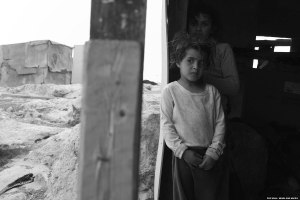
Construction of the new planned townships that will house Palestinians displaced by Israel’s E1 plan is already well underway although the demolition of the current villages has not yet been implemented. The E1 plan will displace thousands of Palestinian Bedouin from the Jerusalem periphery area.
Within this colonial project – that has received significant criticism from across the ‘international community’ – the story of the village of Abu Nowwar is in many ways seen as a test case.
The residents of Abu Nowwar are themselves already refugees, as are the majority of all Bedouin in the West Bank, having been originally displaced in the early 1950’s from their ancestral lands in the Naqab. The more than 100 family homes in the village are all slated for demolition.
In early May, residents were told by the Israeli authorities that they must sign documents by May 31st stating that they agreed to being transferred to one of the planned new townships – a site known as al-Jabal – alongside a large Jerusalem Municipality landfill site. The community was told that anybody who refused to sign would have their houses immediately demolished. Yet the community resisted.
For now a legal challenge in the Israeli Supreme Court has delayed the promised demolitions, but time is short. Many people believe that the case of Abu Nowwar, if won by the State in the Supreme Court, will set a legal precedent that will allow E1 to be quickly implemented. None of the planned demolitions of entire communities in this latest phase of E1 have yet been implemented but this legal precedent, if granted, could set a swift and dangerous ball rolling.
Despite the widespread criticism that the E1 project has received internationally, no action has yet been taken to prevent this major advance within Israel’s settler-colonial project. E1 will link Ma’ale Adumim and other Israeli West Bank settlements in a contiguous ring to and around Jerusalem.
‘Forcible transfer’, which is an inherent aspect of the E1 plan, is a breach of the Geneva Conventions, and is recognised by both the Nuremberg Charter and the International Criminal Court as a ‘war crime’.
Image by MEMO Photographer Rich Wiles.
5 Palestinian children have been arrested by Israel every day for the past 48 years
MEMO | June 10, 2015
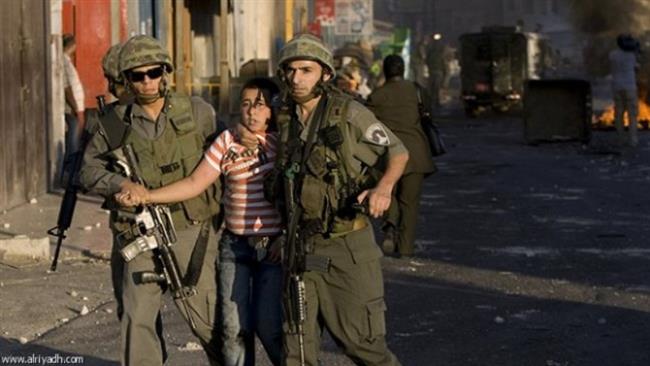
Data provided by the Israeli military and the UN has revealed that since martial law was imposed on the occupied West Bank in 1967, around 95,000 Palestinian children have been arrested by Israel, an average of more than 5 children per day. Almost 60,000 are believed to have been subjected to some form of physical abuse whilst in detention.
The details were revealed this week in a report submitted by rights group Military Court Watch (MCW) to the UN Special Rapporteur on Torture and other Cruel, Inhuman or Degrading Treatment or Punishment. Over 300 pages of evidence relating to the treatment of Palestinian children held in Israeli military detention were included in the report.
MCW pointed out that the evidence included details of 200 minors detained by the Israeli military in the West Bank between January 2013 and May 2015. The submission confirmed an earlier finding by UNICEF that “the ill-treatment of children, who come in contact with the military detention system, appears to be widespread, systematic and institutionalised.”
According to the rights group, this finding is based on recent evidence that shows that intimidation, threats, verbal abuse, physical violence and the denial of basic legal rights are still commonplace within the system. “Based on the evidence, the submission also drew a link between this industrial scale abuse and the maintenance of Israeli settlements in the West Bank,” added MCW. “It concluded that in order to enable 370,000 Israeli settlers to live in the West Bank in violation of international law without serious interference, the military is required to adopt a strategy of mass intimidation and collective punishment.”
Poll: Hamas popularity up in Gaza, West Bank
MEMO | June 10, 2015
Recent polls suggest that there has been a rise in Hamas’s popularity in the Gaza Strip and the West Bank, Arabi21 reported yesterday.
Head of the Palestinian Centre for Policy and Survey Research, Dr Khalil Shikaki, who conducted the poll, said that 39 per cent of the respondents in Gaza would vote for Hamas if elections were held, compared to 32 per cent a year ago.
Meanwhile, 32 per cent of the respondents in the occupied West Bank, where there are tens of illegal Israeli settlements, would vote for Hamas, compared to 27 per cent three months ago.
The poll, which was conducted earlier this month, showed a decline in the popularity of Fatah, the movement headed by Palestinian Authority President Mahmoud Abbas. It showed that 36 per cent of respondents would vote for Fatah, compared to 41 per cent three months ago.
At the same time, the poll showed that the evaluation of Abbas’s performance has decreased from 50 per cent to 44 per cent following the announcement of the unity government last year.
Speaking to journalists, Shikaki said that the residents of the Gaza Strip are feeling depressed more than ever before. “About 50 per cent of the residents are thinking of emigrating,” he said.
The Gaza Strip has suffered following three destructive Israeli offensives since 2008, in addition to an eight-year siege. The most recent offensive took place last summer and reconstruction efforts have been stifled by Israel’s unwillingness to allow construction materials in to the Strip.
Israel placed Gaza under siege after Hamas won an overwhelming majority in parliamentary elections in 2006.
Israeli forces shoot, kill Palestinian in Jenin camp
Ma’an – June 10, 2015
JENIN – Israeli forces shot dead a young Palestinian man in the Jenin refugee camp in the northern West Bank early Wednesday morning, Palestinian security officials say.
Izz al-Din Walid Bani Gharra, 21, was shot in the chest during clashes with Israeli forces who raided the camp at dawn. He was evacuated to the public hospital in Jenin where he died shortly after, sources told Ma’an.
Israeli police, in a statement on the incident, said a border police force was in the refugee camp to carry out arrests.
“Upon leaving the camp, the force identified a suspect trying to throw an explosive device at them,” it said.
One of the border police shot him and wounded him, the statement said, adding that the device probably exploded near the suspect.
In an online statement attributed to the Jenin branch of Hamas, the group appeared to claim Ghora as a member.
“Hamas bids farewell to its heroic martyr… and urges the Palestinian Authority and its security forces to stop their security coordination” with Israel, it said, referring to an unpopular agreement under the 1993 Oslo autonomy accords.
Gharra is the twelfth Palestinian to be killed by Israeli forces in occupied East Jerusalem, West Bank, and Gaza since the start of 2015, according to UN Office for the Coordination of Humanitarian Affairs, with over 900 injured, not including injuries resulting from settler violence.
One Israeli has been killed in the same time period.
Search and arrest raids are regular practice by Israeli forces, who have conducted a weekly average of 86 raids this year, up from 75 a week in 2014, according to a May report by the UN Special Coordinator (UNSCO).
Such raids often result in what rights groups argue is excessive use of force by Israeli soldiers against locals, who often throw rocks and bottles at the forces.
Since 2000, Israeli security forces have killed over 8,896 Palestinians, over 1,900 of whom have been children, according to rights group Defense for Children International.
A court of non-convictions for Israeli felons
By Yossi Gurvitz | Yesh Din | June 8, 2015
Does everyone get his or her day in court? Not if they are Palestinian.
Every year Yesh Din publishes data about police investigative failures regarding offenses carried out by Israelis towards Palestinians in the West Bank. They are usually quite similar: the police fail to investigate approximately 85 percent of complaints of Palestinians who report being harmed by Israelis. The rate becomes much higher when it comes to the destruction of Palestinian trees by Israeli civilians: then the police failure rate grows to 97.4 percent.
The average Israeli may not be surprised that the police failure rates are so high, but he or she still has some expectations of the courts. After all, we are told time and again that Israel is governed by the rule of law.
Okay, says the average citizen to himself, yes, we seem to have a problem when it comes to investigations, and naturally if the investigation is a mess we are not likely to get to court. But once we step into the halls of justice, everything should be fine.
Or not.
Our latest data sheet, which was released in tandem with an exhaustive report on the failure of law enforcement in the West Bank, examines for the first time what happens to the cases we follow once they leave the limbo of the prosecution and make it to court. The situation, to put it mildly, is not “okay.”
To begin with, the chance that a complaint by a Palestinian victim will bloom into a an indictment against an Israeli felon stands at a mere 7.4 percent. This means that the chances an Israeli felon will appear in court for a crime he is suspected of committing is about 1:14. Most often, cases are closed due to police investigative failures; in a majority of the cases, the specific reason is the inability of the police to find a suspect – what is known as the the unknown perpetrator clause.
The fact that a case makes it to court does not, of course, mean it will end in a conviction. The defendants have the right to representation and have access to attorneys — as a human rights organization we entirely support this. The problem lies elsewhere.
In 10.5 percent of the cases, the defendants are convicted of all charges; in 22.8 percent of the cases, only some of the defendants are convicted, or they are convicted of some of the charges – sometimes reduced charges as part of a plea bargain. The rate of acquittals is high relative to other cases in Israeli courts (8.8 percent). But what is truly high is the rate of “non-conviction” (24.6 percent) and the rate of indictment withdrawal (22.8 percent).
What is a non-conviction? It is a relatively rare practice, in which the court believes there is reason to avoid tarring him/her with a criminal conviction for one reason or another — despite the fact that the felon has been found guilt of the charges. This almost never happens in the Israeli courts: the percentage of defendants in the magistrates courts found guilty without conviction is 5.3 percent; in district courts the number stands at only 1.2% percent. This is true unless the victim is a Palestinian; then the rare of non-conviction jumps to 24.6 percent. That’s four times that of magistrates courts, and almost 20 times that of the district courts. What a coincidence.
In many of the cases in which indictments against Israelis charged with harming Palestinians were withdrawn, the reason was, once again, investigative failure. The prosecution re-examined the evidence, apparently after the response of the defendants’ attorneys, and reached the conclusion that it did not have enough evidence for a conviction. And that, we note, is a perfectly legitimate decision.
But in many of the indictment withdrawal cases, one of the reasons given was that the defendants did not even bother to show up for the hearings. In most of the cases the government took the required steps – a fine, issuing warrants for arrest and subpoenas – but the indictments were frozen until the defendant was found. In one of the cases, the prolonged freezing caused the police prosecution to say that the evidence has been degraded, to the point of cancelling the indictment.
At the end of the day, the chance that a Palestinian who lodged a complaint about being harmed by an Israeli civilian will see a conviction is only 1.9 percent. Again, most of the blame for this lies with the police – but the courts have their share, as seen by the unusual rate of non-conviction.
Rule of law? Rule of the violent.
AL-KHALIL (HEBRON): A week in photos 24-30 May 2015
CPTnet | June 8,2015

STONED BY SETTLERS
Pictured here: A Mexican tourist in Hebron was struck in the head with a rock, thrown from the Beit Romano settlement. The Red Crescent ambulance responded. (30/05/2015)

RESISTANCE STARTS EARLY
Pictured here: A young Palestinian girl looks through the wall of the soldiers. The weekly settler tour restricts freedom of movement for Palestinians in Hebron’s old city. (30/05/2015)

ARMED FOR PRAYER
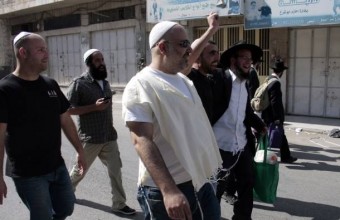
Pictured here: Despite the heavy military presence to protect them, some Israeli settlers walk to the Sanctuary of the Patriarchs armed with their own machine guns. No civilian is supposed to be allowed in with a weapon, yet every Shabbat armed settlers can be seen on their way to the sanctuary in Hebron. (29/05/2015)

UNPUNISHED ARSONISTS
Pictured here: ِAbu Shamsiyeh, a Palestinian resident of Tel Rumeida, is explaining to a CPTer the violent attack he and his family suffered from settlers on Saturday night. Around midnight, settlers set fire to a couch at his front entrance. It took a long time to extinguish the flames. The Israeli police haven’t charged anyone for the crime. The Abu Shamsiyeh family is one of the main targets of settler violence in Tel Rumeida, which almost always goes unpunished. (30/05/2015)

SOLDIERS ON THE ROOF
Pictured here: Israeli soldiers on top of a Palestinian rooftop in the Old City of Hebron. Soldiers also entered one house while providing escort for about 100 settlers and their visitors while they made a tour in the souq (old Market). (30/05/2015)

END OF SCHOOL YEAR
Pictured here: Last week was the end of the school year in Palestine. On the last morning of school, our Kindergarten friends sang for us. These children who are filled with joy, also brought us a lot of joy. (27/05/2015)

KINDNESS AMIDST TENSION
Pictured here: We are greeted with such warmth and kindness every day from this juice vendor in Hebron’s old city. (30/05/2015)
CEO: Orange in Israel ‘for good’
AFP – June 6, 2015
PARIS – The chairman of Orange told AFP on Saturday that he “sincerely” regretted a “controversy” over the French telecoms group’s relations with Israel, saying, the Orange Group “is in Israel to stay.”
Stephane Richard denied that the company’s decision to end its brand-licensing agreement with Partner, Israel’s second largest mobile operator, “as soon as possible from a contractual point of view,” in any way implied that Orange was seeking to withdraw.
Richard touched off a firestorm of criticism on Wednesday when he told reporters in Cairo he was ready to “withdraw Orange brand from Israel.”
“Our intention is to withdraw from Israel. It will take time,” but “for sure we will do it,” Richard said during an interview with Egyptian newspaper Daily News earlier this week.
Partner, which has a license from the French company to use its brand, has been attacked by rights groups for operating in illegal Jewish-only settlements in the occupied West Bank.
At the end of May, five non-governmental organizations and two unions in France asked Orange to state publicly its willingness to sever its ties with Partner and denounce “attacks on human rights” allegedly carried out by the Israeli firm.
Despite this, Richard said at the time it was a purely business decision, not political, that Orange does not license its brand.
The comments touched a raw nerve in Israel, which is growing increasingly concerned about global boycott efforts and the impact on its image abroad.
A furious Israeli Prime Minister Benjamin Netanyahu slammed the decision by Orange, which is part state-owned, as “miserable.”
The fresh Franco-Israeli spat comes after a high-profile diplomatic row in December when French lawmakers voted in favor of recognizing Palestine as a state.
France’s top diplomat Fabius also said that Paris and the European Union “have a consistent policy on settlement-building that is known to all.”
In addition to drawing criticism from the BDS movement, Partner’s servicing of settlements throughout the West Bank also point to larger inequalities between residents in Jewish-only settlements throughout the West Bank and neighboring Palestinian locals.
While Partner’s business activities allegedly contributing to the economic viability of illegal settlements, Israeli policies regarding mobile service itself in the occupied West Bank have been criticized by rights groups.
As countries across the Middle East graduate to 4G mobile service, service providers in the West Bank are unable to provide even 3G mobile data due to a refusal by Israel to grant the Palestinian Authority the bandwidth necessary.
As a result, Palestinians are forced to choose between outdated 2G service or buying contracts with Israeli companies servicing settlers illegally residing throughout the West Bank.
Despite rejection by French leadership of the potential break of Orange from Israel’s Partner, the BDS movement has gained momentum in France in recent years, with French corporate giant Veolia selling nearly all of its business activity in Israel last month.
~
Ma’an staff contributed to this report.
Nablus activists to deploy on hilltops to prevent settlement expansion
Ma’an – June 3, 2015
NABLUS – Palestinian activists in the Nablus area of the northern West Bank are preparing to launch what they describe as the largest campaign against settlement expansion in the area.
Palestinian official Ghassan Daghlas, who monitors settlement related activities in the northern West Bank, told Ma’an Wednesday that the activists plan to install movable houses on hilltops in 35 villages and towns across Nablus district under threat of confiscation by Israeli authorities.
The move comes amid an ongoing takeover of private Palestinian land in the hills surrounding Nablus, where several Jewish-only settlements have been established throughout the area over the years.
After small groups of Israeli settlers claim the land and gradually grow outwards with the protection of the Israeli military, private Palestinian land is confiscated through legal processes, according to Israeli human rights group B’Tselem.
There are currently 12 illegal settlements and 27 settlement outposts in the Nablus area housing around 23,000 of the “most extremist settlers in the Palestinian Territory,” according to Daghlas.
The settlements and outposts surrounding Nablus have gained such reputation largely due to high rates of violent acts by settlement residents against local Palestinians, including uprooting and burning olive trees, vandalism against private property, in addition to violent physical attacks.
Last week, residents from the illegal Yitzhar settlement expanded onto local Palestinian land near the village of Huwwara.
Israeli security forces estimated that the majority of incidents during a 2014 wave of anti-Palestinian hate crimes were carried out by Yitzhar residents, Israeli media reported at the time.
The hilltop campaign, added Daghlas, is a preemptive move to protect Palestinian land from the ongoing settlement expansion especially as the newly-formed rightist Israeli government begins to fulfill promises made to the settler bloc in the run up to the March elections.
The activity was organized by the Nablus district Committee Against Settlements in cooperation with the Fatah movement’s recruitment commission headed by Mahmoud al-Aloul.
Israeli forces demolish 3 houses in East Jerusalem

Ma’an – June 2, 2015
JERUSALEM – Israeli forces demolished three Palestinian homes in the Silwan neighborhood and Salah al-Din street in occupied East Jerusalem early Tuesday morning, the owners told Ma’an.
They were told that the houses were demolished because they had been built without necessary licenses from the municipal council.
Nidal Abu Rmeila said bulldozers under Israeli army escort had demolished two apartments, totaling 140 square meters, that he had been building in Silwan near the Moroccan Gate of the Al-Aqsa mosque compound.
Abu Rmeila said he had not been able to obtain a license from the Jerusalem municipality as the building was located close to the Al-Aqsa compound in an area he claimed the Israeli antiquities authority is “greedily” interested in.
He began construction in late 2014, after which the municipality inspectors ordered him to stop, issuing a demolition order.
Abu Rmeila said the order was postponed several times, adding that bulldozers had arrived two weeks ago to demolish the house, but left after it became clear they were too big to access the building.
Tuesday’s demolition was only possible, he said, after the Israelis “used a lift to carry small excavators and bring them close to the site.”
Abu Rmeila said Israeli troops had assaulted members of his family when they evacuated the home before the demolition.
He said that relatives Hashim Abu Rmeila, Izz al-Din Abu Rmeila and Nur al-Din Abu Rmeila sustained bruises, while his 70-year-old mother was injured when soldiers fired tear gas canisters into the house.
Separately on Tuesday, Israeli forces demolished the upper story of a house on Salah al-Din Street near the Old City belonging to Rafiq al-Salayma.
A relative of the owner Abu Jabir al-Salayma told Ma’an that Israeli troops raided the house at 6 a.m. and forcibly evacuated the family before workers set about demolishing the upper floor.
The family house was built long ago, al-Salayma said, but “because the house was too small” they had added a new floor and roofed it with clay tiles.
The demolitions come less than a week after another house was demolished in Silwan.
Silwan is one of many Palestinian neighborhoods in occupied East Jerusalem witness to an influx of Israeli settlers at the cost of ongoing demolition of Palestinian homes and eviction of Palestinian families.
While Jewish residents frequently take over Palestinian buildings with the protection of Israeli forces, government policies make it nearly impossible for Palestinian residents to obtain building permits, according to Israeli rights group the Association for Civil Rights in Israel.
Featured Video

ARE PATIENTS BEING PROPERLY INFORMED ABOUT OZEMPIC?
or go to
Aletho News Archives – Video-Images
New Book
Breast Cancer: Before You Consent
A new Unbekoming paperback
Lies are Unbekoming | September 18, 2026
Peter Gøtzsche reviewed every randomised mammography screening trial ever conducted for the Cochrane Collaboration. Cochrane’s headline is that, assuming a 15% mortality reduction, one woman in 2000 avoids dying of breast cancer over ten years. Ten are overdiagnosed and treated. Two hundred experience false alarms.
But that headline assumes the reduction. When Gøtzsche looked only at the trials with adequate randomisation — the higher-quality ones — the reduction disappeared. No effect on breast cancer mortality. No effect on all-cause mortality.
This is the Cochrane finding, published in the establishment’s own database of systematic reviews.
No woman being asked to consent to a mammogram this week knows it.
That is why the new Unbekoming paperback exists. … continue
Blog Roll
 Aletho News
- The Truth About the Trump Shootings with Ken Silva
- ARE PATIENTS BEING PROPERLY INFORMED ABOUT OZEMPIC?
- US lawmaker blocks $2.8 billion weapons sale to Israel: Report
- Yemeni army claims responsibility for strikes on sensitive sites in Saudi capital, Aramco facilities in Yanbu
- Iran Judiciary issues indictments against 159 US, Israeli officials for assassination of Leader, commanders
- Turkiye revokes Iranian bank license under US sanctions campaign
- US-Denmark Agreement on Greenland Is ‘PR Stunt’ Ahead of Midterms
- Araghchi: Military intervention cannot create security; coercion cannot bring peace
- Fraud Squared
- Breast Cancer: Before You Consent
- If Americans Knew
- Inside Gaza’s death trap of collapsing, bombed-out buildings
- The everyday items Israel bans from Gaza every day
- Inside the siege, the ruined buildings of Gaza – Daily Update
- Debunking The Claim That Macklemore Has A “History Of Antisemitism”
- CPJ demands release of arrested Palestinian-US journalist near Bethlehem
- Robert Kraft: The Billionaire Friend of Netanyahu Pulling The Strings Behind the Macklemore/Ed Sheeran Blow Up
- Columbia Administered Fund Gives Big Money to Pro-Israel Groups
- Deportation Case of Palestinian Activist Salah Sarsour Tests First Amendment
- ‘We Will Not Forget’: Palestinians Mark 44 Years since Sabra and Shatila
- Why do we let Zionists decide what we can and can’t say?
- No Tricks Zone
- New Study: ‘Global Drought Shows No Detectable Recent Acceleration Under Climate Warming’
- Economic Masterminds: German Socialists Suggest Taxing Productivity Gains Stemming From Using AI
- The South China Sea Has Not Been Cooperating With The Climate Change Narrative
- Energy Crisis: Germany Enters Heating Season With Historically Low Gas Reserve Fill Levels
- New Study: The Antarctic Ice Sheet Gained Mass From 2020-2024 Due To Staggering Snow And Ice Accumulation
- Study: Ocean Heating Rates From Thousands Of Years Ago ‘Dwarf’ Modern Ocean Heating Rates
- Climate Extremists Target, Attack Large-Scale Power Grid Infrastructure In Germany!
- New Study: Antarctic Ice Melt Has Contributed Less Than 1 Centimeter To Sea Level Rise In The Last 30 Years
- Fear Of Debate: Alarmist German Climate Scientist Calls On Mainstream Media To Discredit Skeptic Voices
- End-Of-August Arctic Sea Ice Extent Hasn’t Fallen In 20 Years, Official Data Show!
 Aletho News