Israeli Forces Kill 9 Palestinians, Kidnap 650, in November
IMEMC News & Agencies | December 01, 2014
In a report issued on Monday, by Ahrar Center for Detainees’ Studies and Human Rights, Israeli occupation forces were said to have killed 9 Palestinians and detained 650 others, over the month of November.
According to Al Ray, the report noted that 42 out of 650 people taken from the occupied West Bank, Gaza and Jerusalem, were minors, in addition to 17 women. 30 of the minors were taken from Jerusalem.
The report also mentioned that six journalists and two cameramen were taken from Jerusalem, as well, while lawyer Ibrahim Nawaf Al Amer was abducted from the city of Nablus, after a raid on his family’s home.
Fuad Khafsh, director of Ahrar, said that Israeli forces storm the cities of the occupied West Bank when and wherever they please, every day and night.
He noted that the reported numbers are documented by the center, and that it was possible for there to be other cases which could not be documented by the center.
See PCHR reports on Israeli violations in the oPt for further documentation.
Illegal settlement agriculture in the Jordan Valley – The case of Carmel Agrexco
Alhaqhr | December 1, 2014
Illegal settlement agriculture in the Jordan Valley – The case of Carmel Agrexco
Virtual Field Visit: Illegal quarrying in the West Bank – The case of Hanson
UN General Assembly: Israel’s actions in Jerusalem are null and void
MEMO | November 27, 2014
The United Nations General Assembly adopted six resolutions regarding Israeli occupied territories through a recorded vote last night, addressing the areas of Jerusalem and the Syrian Golan.
In terms of Jerusalem, the Assembly voted on a resolution confirming that all legislative and administrative measures taken by Israel to change the legal status of the Holy City of Jerusalem are null and void.
The decision was supported by a recorded vote of 144 countries in favour, six countries opposed, namely Canada, Israel, Marshall Islands, Micronesia, Palau and United States, while ten countries abstained from the vote (Australia, Cameroon, Central African Republic, Madagascar, Panama, Papua New Guinea, Paraguay, Togo and Tonga and Vanuatu).
The Assembly also adopted a resolution that stressed the need for Israel, the occupying power, to withdraw from the occupied Palestinian territories, and demanded the complete cessation of all Israeli settlement activity and Israel’s compliance with its obligations under international law.
The Assembly’s decision also outlined the need for delivering humanitarian and medical aid to the Palestinians.
Another decision was implemented regarding the Syrian Golan Heights as a result of the Assembly’s concern for Israel’s lack of compliance with Resolution 497 (issued in 1981) calling on Israel to withdraw its forces from the Golan Heights which have been illegally occupied since 1967. The decision was supported by 99 countries, rejected by six, while 57 (mostly European) countries abstained from the vote.
Israeli soldiers shoot Italian in the chest at Kafr Qaddum rally
Al-Akhbar | November 29, 2014
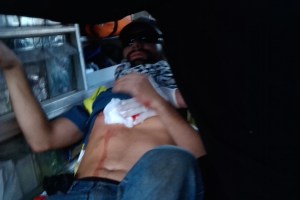
A pro-Palestinian Italian activist was shot and seriously wounded by Israeli gunfire during a Friday protest in the northern West Bank, medics and the activist’s organization said.
Palestinian security sources said Patrick Corsi, a 30-year-old member of the International Solidarity Movement (ISM), was shot during the weekly demonstration at Kafr Qaddum, west of Nablus.
Eyewitnesses said Corsi, who had participated in last week’s protest as well, had been documenting the event with a camera.
ISM, an activist group whose members frequently attend Palestinian protests to monitor the actions of Israeli soldiers, confirmed the shooting in a statement.
“The Italian activist, known as Patrick, was wearing a yellow high visibility jacket when he was shot with .22 live ammunition,” the statement said.
The statement added that 10 Palestinian protesters were wounded by rubber-coated steel bullets at the protest, in addition to 18-year-old Sami Jumma who was struck by live fire.
“We were standing with a group of Palestinian demonstrators when Patrick was shot. The military had fired three rounds of tear gas, and then a shot rang out and Patrick stumbled back. There was between five and ten minutes from the last tear gas canister fired and the bullet that shot Patrick.”
“He was just standing there, peacefully protesting, wearing a hi-viz jacket, he wasn’t doing anything and they just decided to shoot him,” the statement quoted an ISM volunteer at the scene as saying.
“The bullet entered Patrick’s chest near a main blood vessel, but thankfully did not puncture it. If God forbid it had, the lengthened journey to the hospital because of the closed road could have cost Patrick his life,” ISM media coordinator Ally Cohen was quoted in the statement as saying.
Due to an Israeli closure of Kafr Qaddum’s main road to Nablus, the travel time to the nearest hospital is around 30 minutes instead of 10.
Khaldoun Ishtewi, media coordinator for public campaigns in Kafr Qaddum, told Ma’an news agency that the Italian national was taken to the Rafidia Public Hospital in Nablus for treatment.
Ishtewi added that several Palestinians suffered from excessive tear-gas inhalation as a result of canisters fired by Israeli soldiers during the clashes.
An Israeli military spokesman did not immediately return a request for comment.
Palestinian Minister of Health Jawad Awwad told Ma’an that “shooting live fire at the upper part of the bodies of protesters is directly targeting them and is a deliberate attempt at murder.”
“Israel does not differentiate between foreign solidarity activists, Palestinians, or even journalists,” he added.
An Israeli army spokesman described the event as a “riot” during which 100 Palestinians allegedly hurled rocks at troops and burnt tires.
After failing to disperse people and “due to increased violence,” soldiers “fired small caliber rounds toward main masked instigators,” the spokesman said.
In the West Bank at the Qalandiya crossing between Jerusalem and Ramallah, Israeli border policemen “fired small caliber rounds toward two main instigators’ lower extremities” during a violent clash with some 150 Palestinians, the spokesman said.
There was no immediate report on their condition.
Protests are held every Friday in Kafr Qaddum against Israel’s closure of a main road linking the village to its nearest city, Nablus, as well as against the Israeli occupation more generally.
The West Bank and annexed East Jerusalem have been occupied by the Israeli military since 1967.
(AFP, Ma’an, Al-Akhbar)
Photo credit – ISM
Israel transforms Jerusalem’s suburbs into a “big prison”
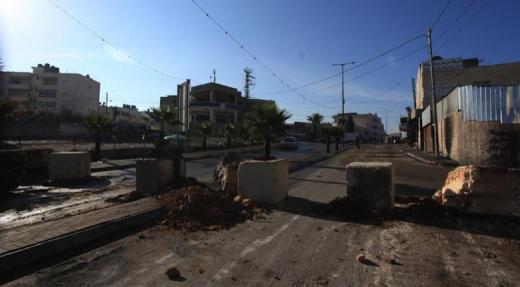
Concrete blocks are placed by Occupation security forces at the entrances to the Palestinian village of al-Ram, northeast of Jerusalem on November 19, 2014. Issam Rimawi – Anadolu Agency
By Mohammed Abdel Fattah | Al-Akhbar | November 26, 2014
Perhaps Israeli prisons can not accommodate more Palestinians, and so Israeli authorities have now chosen to imprison Palestinians inside their villages, especially in the suburbs of Jerusalem. That is part of the collective punishment inflicted on villages, whose residents dared to rise up against the occupation and the discriminatory policies it imposes on Palestinians – such as preventing them from praying at al-Aqsa Mosque, repeatedly storming the mosque, and turning a blind eye on violence and murder of Palestinians at the hands of fanatical Israeli settlers.
Occupied Jerusalem – The Israeli response to a village that revolts is to surround it with concrete barriers and military checkpoints, in addition to using weapons of all types and sizes against young demonstrators. Recently, the occupation forces began to seal off the villages of Hay al-Thawri, Sur Baher and al-Ram in the Jerusalem district after a series of protests against the killing of Ghassan and Uday Abu Jamal, both of whom carried out the recent Knesset operation. Before sealing off these villages, the Israelis encircled and sealed off the village of al-Issawiya, but the concrete barriers were later removed from its entrances following a protest by hundreds of its residents.
Sur Baher, located south of occupied Jerusalem, continues to be closed, hemming in its 27,000 residents. The Israelis tightened the noose around the village by closing its entrances with concrete barriers, leaving only one route for its residents. The people of Sur Baher enter and leave the village through that road, where an Israeli military checkpoint manned by abusive Israeli soldiers regularly mistreat anyone who passes by on foot or in a vehicle. Going in and out of the village presently takes an hour, while Israeli soldiers search every single person from head to toe and search cars from the hood to the trunk.
Students are forced to step out of cars and buses to cross the checkpoint on foot in order to get to school even if that means arriving half an hour late.
The director of the company Sur Baher Buses for Public Transportation, Raafat Nimr, complained that now they have to leave an hour before it is time to pick up students from outside the village to be able to drop them off at school somewhat on time.
He said his and other bus companies have suffered from closing the village and restricting access in and out to one checkpoint as it cut the number of trips buses take from the village in half. This will force the company to close down soon because the cost of “loading passengers increased and there is no longer a large number of trips to make up for it,” he said.
People who do not have a business to take care of outside the village have decided not to leave the village so that they won’t get upset and agitated. For example, Hamza Umaira has not left Sur Baher for a week. Besides, Israeli soldiers at the checkpoint regularly prevent him from going to Jerusalem to pray at al-Aqsa Mosque.
In Hay al-Thawri, where the family of Moataz Hijazi lives, the martyr who carried out the assassination attempt on the life of the extremist rabbi, Yehudah Glick, the situation is as bad as the rest. Like Sur Baher, the Israeli occupation sealed the village twice. The first time after killing Hijazi and the second time after the operation carried out by Ghassan and Uday Abu Jamal. The difference with this neighborhood to others is that it has been encircled with concrete barriers without military checkpoints. This prompts people to take bypass roads, delaying workers and students.
The town facing the worst mistreatment is al-Ram, whose closure affects the residents of the nearby Qalandia refugee camp as they go to and from Ramallah and Jerusalem. In addition to closing the northern entrance to the town with concrete blocks, the closure affects the revenue of businesses located along the road to the northern entrance. The Israeli authorities also closed the Jabaa road adjacent to the town, thereby creating a suffocating traffic jam that takes people two hours to get out of.
Just like the average citizen suffers, medical services suffer too. Turning the Palestinian villages surrounding Jerusalem into “large prisons” obstructs ambulances and prevents them from reaching areas where sick and wounded people need to be taken to hospitals.
Palestinian Red Crescent official, Amin Abu Ghazaleh, said that Israeli occupation forces deal with Red Crescent ambulances as though they are part of the young people’s uprising against them, especially after Israeli ambulances refused to enter Arab areas.
He pointed out that Israeli soldiers did not make it easy for ambulances to enter confrontation areas, treat the injured there or transfer them to hospitals. Instead, they refused to remove any barriers, which increases the rate of field medical treatment.
Residents of the villages facing closure believe that this policy will add to the tension in the city because most of their villages lack basic facilities, such as hospitals and markets.
For his part, political analyst, Fadel Tahboub argues that “Israelis do not want to calm the situation down in Jerusalem, so they continue to close villages and settlers continue to storm al-Aqsa Mosque.”
“The goal of the Israeli occupation is to isolate the Palestinian villages from Jerusalem in order to reduce the Arab population in the city, and to pave the way for annexing them to the West Bank at a later time, completely disconnecting them from occupied Jerusalem,” he concluded.
Israeli Authorities Prevent 100 Tons of Vegetables from Exporting out of Gaza
IMEMC News & Agencies | November 24, 2014
At Kerm Abu Salem crossing Israeli occupation authorities have barred ten truckloads of agricultural products from leaving the war-torn and economically besieged Gaza Strip, due to an alleged dispute between the Israeli army and the Ministry of Agriculture.
The dispute is preventing the trucks and their cargo from passing, and being exported to Saudi Arabia and West Bank, according to Al Ray Palestinian Media Agency.
Israeli website Walla reported, on Monday, that allowing the export of the agricultural products comes in the framework of “facilities” granted for Gaza residents in the wake of the last summer’s assault on the region, by Israel. Israeli authorities had agreed on the passage of ten truckloads per day.
Walla added that this shipment of vegetables weighs 100 tons, and has been held back since Sunday morning.
According to the Israeli system, after the truckloads pass to the military checkpoint on the Palestinian side of the crossing, they should be inspected and, then, loaded again onto Israeli trucks to pass to their planned route.
The office of the Coordinator of Government Activities in the occupied territories claims that the trucks are still stuck in the crossing because the Israeli Ministry of Health did not yet inspect them in accordance with regularities, with the Ministry itself citing a lack of staff to do that.
At this time, it is not clear when the shipment will pass.
Zionist Settlers Torch Palestinian Home in West Bank
Al-Manar | November 23, 2014
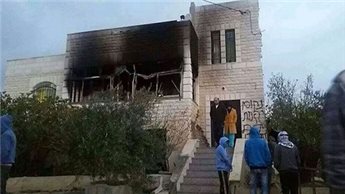 Zionist extremists firebombed a house in a Palestinian village in the occupied West Bank early on Sunday.
The mayor of Khirbet Abu Falah, Masud Abu Mura, reported the attack, saying: “At 4:00 am (0200 GMT), settlers came and threw molotov cocktails at a house which partly burned down.”
Four women were inside the house at the time, but they all escaped unharmed, the mayor of the village which lies northeast of Ramallah said.
Near the house, the assailants scrawled “Death to Arabs” in Hebrew.
Mohammad Abdelkarim Hamayel, whose aunt and two female cousins live in the house, said the assailants were believed to be from the Shilo settlement, a few kilometers to the north of the village.
“In the middle of the night, my aunt woke up when she heard voices speaking Hebrew. Someone knocked on the door but she didn’t answer because she was afraid,” he told AFP.
“They threw a tear gas canister and several molotov cocktails at the balcony which caught fire.”
Israeli occupation police also confirmed the attack, with its spokesman Luba Samri saying: “It is a two-storey house and the fire caused major damage to the ground floor.”
On November 12, Zionist settlers also torched a mosque in the neighboring village of Al-Mughayir.
Source: AFP
“Security” In the West’s Client States
By ANDRE VLTCHEK | CounterPunch | November 21, 2014
Perhaps you thought that the security at the Atlanta or Newark, or Dallas airports is bad, obnoxious, the worst in the world… Think twice… Of course it all began there, in the United States, from the first glory days of that hypocritical and deranged “War On Terror”: the humiliation of people, especially Arabs, especially Muslims, especially all those who are not white, but eventually everybody, at least to some degree.

But it did not just stay there. The allies joined in almost immediately, and then the ‘client’ states jumped on the bandwagon, competing in tactics and strategies of how most to humiliate those confused and helpless passengers, by censoring internet sites, digging into emails, monitoring mobile phone communications, and relentlessly spying on both citizens and foreigners.
I have travelled all over the world, to some of the most imaginable and unimaginable places. All the while being monitored and harassed, threatened and periodically attacked, even physically, I have also spread many counter-punches: I have observed, recorded, and published, who does what to whom, who is the most diligent, methodical, and ruthless bully?
Unsurprisingly, the toughest surveillance comes from Western allies and ‘client’ states, all over the world – from places that Washington, London and Paris routinely call ‘thriving democracies’.
Countries that have collapsed socially strive to impress their Western neo-colonial masters, by imposing increasingly harsh security and surveillance measures against their own people. At the same time, they are full-heartedly and enthusiastically signing up to the bizarre, ‘War on Terror’. It gives the local rulers many privileges. If they play it right, their gross human rights violations, and even their killing of the opposition, is not scrutinized.
***
When I recently worked in South Africa, I was told that the country is now one of the freest on earth. It has nothing to hide and it is not particularly afraid of scrutiny.
“You can photograph here, whatever you want, and nobody will tell you anything”, many of my South African friends explained to me, in Cape Town, Pretoria, Johannesburg, as well as by those living abroad.
It is true. In fact, after few days there, you can easily forget that there are any restrictions, like a ban on filming or photographing police stations or navy ships. Nobody would ever stop you from taping, for instance, battleships at the Simon’s Town base.
South Africa is a proud BRICS country, a left-wing beacon on the African continent and, together with neighboring Zimbabwe, a target of an aggressive negative Western propaganda campaign.
Just as in South Africa, not once was I stopped from filming or photographing in Zimbabwe. And not once was I intimidated, harassed or humiliated by their immigration or customs at the airports.
That is in stark contrast with the West’s allies on the continent – Rwanda, Uganda, Djibouti, Kenya, Ivory Coast or Senegal, to name just a few.
It is not just that ‘everything is forbidden’ there, but ‘violators’ can easily be arrested, harassed, even ‘disappeared’.
When making my film, “Rwanda Gambit”, about Paul Kagame’s monstrous regime, and about the genocide it had been committing (on behalf of the Western powers) in the Democratic Republic of Congo, I tried to film with a small Leica, at the border between Rwanda and DR Congo, at the Gisenyi/Goma crossing. Within a few seconds later, an enormous Congolese soldier grabbed me and began pulling me towards the border post. I have been arrested in Goma once before, and I knew what it amounts to – what it is to rot in the underground intelligence bunker cut off from the outside world.
I was almost certain that, that time, I would not make it out alive. And so I screamed for help in the direction of the Rwandese soldiers who were watching the scene from the other side of the borderline. It is not that they were really eager to help, but the disappearance of a US citizen, an investigative journalist at that, would be an extra, and unnecessary ‘annoyance’. And so they went to work, grabbing my free hand and pulling me back towards Rwanda. The enormous Congolese man in the end lost, and I survived.
All of this over just a few shots! Nobody would ever even think about preventing me from filming on, say the border between Argentina and Chile, or Vietnam and China!
In Rwanda itself, absolutely everything is forbidden, and everybody snitches on everybody. It is forbidden to photograph the streets, the hospitals, and museums, even the genocide memorial! It is strictly banned to photograph or to film their villages, In order to film military installations or prisons, I had to attach a Drift camera to the undercarriage of my car.
In Rwanda and Uganda, everything is under the surveillance. Walls have ears and eyes, so to speak. It is not like surveillance in London, done with high-tech cameras (although these are also beginning to appear); people simply spy on each other, at an unimaginable rate, and the security apparatus appears to be present absolutely everywhere, omnipresent.
But for the West, that is all fine. Both Rwanda and Uganda are plundering DR Congo of Coltan and uranium. The 10 million lives lost there, appears to be just a token price, and the horrors that are occurring in these countries are just some tiny inconvenient episodes not even worth mentioning in the mainstream press.
Security is ‘needed’, in order to maintain ‘order’ – our order.
The humiliation of travellers at Kigali, Kampala or Nairobi airports is indescribable. It is not about security at all, but about a power game, and plain sadism. In Kigali, there are at least 8 ‘security checks’, in Nairobi 6 to 7, depending on the ‘mood’ at the airport.
Three years ago, on behalf of the West (mainly US, UK and Israel), Kenya attacked the oil-rich part of Somalia, where it is now committing atrocities. Its state apparatus also perpetrated several attacks against its own civilian targets, blaming all of them on the al-Qaida linked movement, al-Shabaab. It was done in order to justify the ‘security measures’.
Now there are metal detectors in front of every department store, hotel or office-building in Nairobi. When I, earlier this year, photographed the entrance to a prison, I was literally kidnapped, thrown into the jail and informed: “We will treat you as a terrorist, as an al-Shabaab member, unless you prove that you are not.”
The slightest argument with the Kenyan military forces, or with the corrupt and outrageously arrogant police, leads to detention. And there are cases of people being harassed, sexually molested, even tortured and killed in detention.
The security forces in East Africa cooperate, as the security forces cooperated in the dark years of the fascist military dictatorships in South America.
As I was walking with my friends through Kampala, a huge lone figure slowly walked towards us.
“That is one of the butchers and he comes from Kenya”, I was told. “He tortures and kills people that pose a danger to this regime… He does things no local person would dare to do. Our countries exchange the most sadistic interrogators; ours go to Kenya, Kenyans come here.”
I recalled that even Paul Kagame, now the President of Rwanda, used to serve as the Chief of the Military Intelligence in Uganda.
Yes, the Newark and Houston airport security is bad, and the surveillance in the West is outrageous, but it is being taken to insane extremes in the ‘colonies’.
In Djibouti, which is basically a military enclave of the French Legionnaires, the US air force and other European armed forces (Somalia, Yemen, Eritrea and Ethiopia are all just a stone-throw away), I once complained at the airport that my passport was being checked twice within a distance of 10 feet. As a result, a huge soldier grabbed me, tore my shirt, threw me against the wall, and then smashed my professional camera against a concrete wall. All this happened in front of the horrified passengers of Kenya Airways. That, I found somehow intolerable. It pissed me off so much that I got up, ready to confront the soldier, no matter what. But the horrified voice of a Kenya Airways’ manager stopped me: “Sir, please leave it at this… They can just kill you, and nothing will happen to them. They can do anything they want!”
In Ivory Coast (Côte d’Ivoire), which is yet another French military dependency, and generally a loyal servant to Western interests in West Africa, ‘security’ is the main excuse for keeping undesirable elements, like myself, away from the country. Earlier this year I embarked on a journey there to investigate the chocolate empire activities of the Ukrainian President Poroshenko. Ivory Coast is the biggest producer of cocoa in the world, and ‘the Chocolate King’ is apparently involved in many unsavory practices there.
The authorities were tipped off in advance that I was coming, and the charade began from the moment I landed. I was ordered to produce my yellow fever certificate, which was inside my bag. As I began searching for it, I was roughly ushered into a small room full of sick people quarantine – and informed that I was to be vaccinated again. I found the certificate just a few seconds later, and went out to present it to the authorities. “Back!” they shouted at me. Wait inside for your turn, and tell the doctor that you have found it. The wait turned out to be 2 hours long. Later, I was told that a visa on arrival is no longer available. For days I had to go to the immigration office, from morning to the evening. For days I was fingerprinted and photographed. I clearly saw that wires were disconnected from their computer, every time my turn came round. “Your fingers are not good for fingerprinting! Go to the hospital and bring a certificate that they are not good!” Going there costs US$100 a time, and another wasted day in Abidjan. The hospital said that my fingers were just fine. I had to bribe them to write that they were not.

The US embassy was clearly aware of what was happening. They even sent an officer to ‘assist me’. I showed him that the wires had been pulled out from the computer. “We cannot interfere in other country’s internal affairs”, he explained.
Then, on the last day, when my visa was finally issued, a lady from the US embassy whispered into the phone: “Well, if you write what you do, you must be ready for the consequences”. ‘Honest person’, I thought.
I am almost ‘embarrassed’ to write this, but I have driven on many occasions, all over China (PRC), around at least 8,000 kilometers, but have never been prevented from photographing or filming anything. I have hours and hours of footage and thousands of photographs from many corners of the nation.
A stark, almost grotesque contrast is India, the ‘largest democracy on earth’, according to the Western assessment.
There, nothing is allowed. Forget about filming the battleships near Mumbai (even the Soviet Union does not care – they would put their battleships on the Neva river in Leningrad during celebrations, for everyone to admire and to photograph them, which I did, as a child, when visiting my grandmother). You cannot even photograph that idiot Clive, inside the Victoria Monument in Calcutta.
In India, surveillance is everywhere. It is the perfect police state.
You need a local SIM card in Beijing? Even in the middle of the night, you just go to any kiosk and buy one, no questions asked, no paperwork.
In India, to get a SIM card is one tremendous saga, monstrous bureaucracy, spiced by demands for all sorts of documents and information.
You want to use the internet at New Delhi airport? You have to provide your name, your telephone number, and your email address! I invent names, like Antonio Mierdez or Amorsita Lopez; sometimes it works, sometimes not. In China, you just stick the front page of a passport onto a scanner, and get password within ten seconds. In South Africa, there is not even need for that – the internet is open and free.
And then, those legendary, those epic security checks in India!
The Indian state appears to be thoroughly paranoid, scared of anyone trying to document the reality.
It has developed an allergy to writers, investigative journalists, film-makers and photographers, especially those that happen to be ‘independent’, therefore ‘unpredictable’ and potentially capable of challenging the clichés fabricated in Washington, London and New Delhi, that depict the country as the ‘largest democracy on earth’.
To fight against such threatening elements, the Indian regime, which consists of the moneyed elites, feudal lords, religious fanatics and the military brass, have become pathologically obsessed with security, with surveillance, with relentless checking on things, and people. I have never witnessed such security zeal, even in countries that are under a direct threat from the West: such as Cuba or China.
Even domestic flights in India, from smaller cities like Varanasi or Jaipur, require an entire chain of security steps. Your passport or ID is checked on at least 10 occasions. As you enter the airport, a few steps later, before you are allowed to check in, when you are checking in, as you are entering the departure area, when you are in the departure area (that one is grand – you are forced to step on a platform and everything is checked), when you are entering the departure gate and when you are leaving it for the plane door. Sometimes there are additional checks. It is all, mostly, very rude.

In Turkey, everything is censored. From my official website to ‘Sitemeter’, even the Hong Kong MTR and Beijing and Shenzhen subway maps (maybe just in case someone wants to compare those pathetic subway developments in Istanbul and Ankara, to those in China).
When I called the guest relations supervisor at the four star ‘Kalyon Hotel’ in Istanbul, where I was staying in November 2014, I was told that she “does not know what internet provider is used by the hotel”, but that censorship is actually part of a “security program”, which in turn is part of “the hotel policy”, or vice versa.
How honest!
She actually kindly suggested that I bring my Mac ‘downstairs’, so the IT manager could “do something with it”. I very politely, declined, remembering an experience two years earlier, at the Sheraton in Istanbul, where the ‘IT manager’ actually installed some spy wear, which totally and immediately corrupted my computer, my email addresses, turning my operating system into something that has since been insisting on functioning almost exclusively in the Turkish language. When I complained over the phone, he, the IT manager, went upstairs, kicked my door, rolled up his sleeves and he let me know that this matter could be settled most effectively, outside the hotel, most likely in the street.
***
It may sound bizarre, but in the countries literally besieged by hostility from the Empire, like Cuba or even North Korea, security appears to be much more lax than in the nations where the elites are terrified of their own poor majority.
I don’t remember going through any security, in order to enter a theatre or a hotel in Havana. In Pyongyang, North Korea, there are no metal detectors at entrances to shopping centers, or subway stations.
It goes without saying that one is monitored more closely by the security cameras and armies of cops in London or New York, than in Hanoi or Beijing.
The most common mode of modern communication – the mobile phone – is regulated much less or monitored in Vietnam, China or Venezuela, than in India, Japan, or Europe. In fact, Japan recently even discontinued the sale of pre-paid SIM cards; every number has to be meticulously registered and issued only after signing an elaborate contract.
As I keep reporting, the world is full of stereotypes and clichés. Countries are not judged by rational analyses and comparisons, but by chimeras created by commercial mass media, especially those in the West.
Three countries in Latin America are still living the nightmare of the ‘Monroe Doctrine’: Honduras, Paraguay and Colombia. In Paraguay and Honduras, the West basically managed to overthrow progressive governments and installed fascist regimes, not unlike those that reigned all over the continent during Ronald Reagan and Otto Reich’s days. Colombia has been, for decades, a US ‘client’ state.

Surveillance in all three countries is monstrous, and so are gangs and death-squads.
But you would not guess it. If you read Western reports, including those produced by Reporters Without Borders, you would think that the true villains are actually countries like Venezuela and Cuba. But then, you look closely, and see who organizations like Reporters Without Borders are playing with… And surprise-surprise: you will discover names like Otto Reich among them!
When Thailand, another staunch ally of the West and a shamelessly servile state, began photographing people at the airports and borders, I asked an immigration officer in Bangkok, where all the data goes. She answered, without any hesitation: “To your country!” That is, to the United States.

Malaysia and its immigration used to be quite different – relaxed and easy. But then, earlier this year, Obama came aboard his diplomatic tank. I landed in Kuala Lumpur just an hour after his Air Force One had touched town. What did I encounter? A fingerprinting machine at KLIA! Obama left, but the machines are still there. To spy on people, to fingerprint and photograph them, is apparently one of the conditions of being a good friend of the West. That would never have happened in the era of Dr. M!
Even Japan now photographs and fingerprints people arriving from abroad! Japan where one can even easily and freely photograph combat air force bases (some of them, including those in Okinawa, have viewing terraces for tourists, all around them) is now also spying on people! That is, obviously, one of the rules laid down by the gang that is ruling the world.
Of course the Western allies of the United States are not much better.
Do you still remember how Europeans were bitching about having to take of their shoes at US airports? What has happened now? They do it, without protesting, at their own airports, in London, Paris, Munich, everywhere.
In fact, the most repulsive security I have ever encountered in the West was at CDG, in Paris. I was taking a night flight on Asiana Airlines, from Paris to Seoul. The flight was full of Korean tourists in their seventies and eighties. The tables were set up, sadistically, far away from the X-ray machines, so the poor old people had to carry their bags and belongings quite a long distance. Security personnel were yelling at them, insulting them. I protested, on behalf of the Koreans. A tough French dude came up to me and began insulting me. I asked for his name. He turned around and mooned me, in public. He took down his pants and showed me his hairy ass. “My name is Nicolas Sarkozy”, he said. In a way he was right…
Once I arrived very early in the morning, in Darwin, Australia, after working in East Timor. My electronic travel authorization was for ‘tourism’. The unfriendly immigration officer was clearly on her power trip: “What are you going to do in Australia?” I told her I would be meeting some of my academic friends in Sydney.” “That is work, academic exchange!” she barked at me. “You requested a tourist permit.” I explained that we would just have dinner together, perhaps get pissed”. That was the typical Aussie-type of tourism, I thought. The interrogation began and went on for 2 hours. As the sun was rising, I had had enough: “Then deport me!” Of course she did not. Humiliating people was simply a form of entertainment, or how to kill a couple of boring hours. Or how to show people where they really belong!
How free and proud one should feel entering that great world of Western democracies!
One has to lie, of course. Once I was held for 4 hours by the Canadian immigration services, entering from the US by car. Why? I told the truth, that I was coming to interview Roma (Gypsy) people fleeing from persecution in the Czech Republic (a staunch ally of the West).
Leaving Israel is beyond anything that I have ever experienced elsewhere in the world. Especially once Mossad realized that I had come to trash Israel for its treatment of Palestinian people, and for its foreign policy.
We commonly end up discussing my grandparents, my books, and my films. I have already commented: no woman in my life, not even my own mother, wanted to know so much about all the details of my existence, as Mossad agents at the airport! And none of them has ever listened so attentively!

I am totally exhausted from all that freedom given to me by the West and its allies.
My email addresses are corrupted and I don’t even know which publication or television network is actually receiving my stuff. There is absolutely no way to tell. I have no idea which immigration service will screw me next, and how.
I have already got buggered about by the security in Colombia, Canada, Indonesia, Kenya, Djibouti, Ivory Coast, DR Congo, Kenya, the US (entering from Mexico), Bahrain and Australia… I can hardly remember, there is much more…
It is all turning into a game of Russian roulette.
My African, Indian, Arab and Latin American friends and colleagues are, of course, going through much deeper shit.
The question that I keep asking myself is very simple: “What are they all so afraid of?” I don’t mean the US and Europe – those are control freaks and they simply don’t want to lose their control of the world… There, it is all transparent and clear.
But it is not as clear elsewhere: what about those regimes in India and Turkey, in Honduras and Kenya, in Indonesia (you have to show your passport or the national ID, even to board a long distance train!) and Bahrain?
What are they fighting for or against? Who is their enemy?

They are fighting against their own people, aren’t they?
Their ‘War on Terror’ is their war against the majority. The majority are the terror. The West is the guarantee of the status quo.
They – the elites and their masters in the West – watch in panic that in many parts of the world, the people are actually winning.
That is why the security in the West’s ‘client’ states is on the increase. The war against the people goes on. This war is one of the last and brutal spasms of feudalism and imperialism.
Check everything and spy on everybody, so nothing changes, nothing moves. But things are moving, and fast! And all those lies, and surveillance cameras, fingerprints and the ‘disappearing’ of people will not be able to prevent progress. They will never manage to smash the people’s dreams of living in societies free of fear!
Three shot with live ammunition during Nabi Saleh protest
International Solidarity Movement | November 22, 2014
Nabi Saleh, Occupied Palestine – Israeli forces shot and injured three Palestinians participating in a weekly Friday demonstration in the village of Nabi Saleh. Soldiers fired .22 caliber bullets, a form of live ammunition which has maimed and killed many Palestinians, even as Israel continues to claim it as a “less lethal” way of assaulting demonstrators.
Yesterday at noon between forty and fifty Palestinians, Israelis, international activists and journalists marched down from the center of Nabi Saleh towards a water spring stolen by a nearby illegal settlement. The Israeli forces awaited them down the road with two military jeeps and a police jeep. Some youths threw stones towards the military vehicles. Soldiers and police fired tear gas canisters and rubber-coated steel bullets at demonstrators as the group walked down the road.
 After a brief period of calm, a police jeep equipped with a tear gas dispenser drove up and down the road, firing tear gas at protesters. A few suffered from excessive tear gas inhalation, including a boy under the age of ten.
In addition to continuing to fire rubber coated steel bullets and tear gas, soldiers also began to shoot .22 live ammunition. Two seventeen-year-old boys were shot while throwing stones, one in the thigh and one in both the hand and foot. One Israeli soldier fired at a child under the age of twelve as the boy was running away up the hill beside the road.
Nariman Tamimi, a thirty-eight-year-old woman from the village, was shot in the thigh at close range with a .22 bullet. Israeli soldiers shot her in front of her children and family, driving away and leaving her in the road. She was taken away for medical treatment, where she underwent surgery, and currently remains in hospital.
Israeli soldiers protect Jewish settlers attacking Palestinian village
Yesh Din | November 20, 2014
Israeli occupation forces did nothing to stop Jewish settlers from attacking Palestinian villagers, according to videos released by the Yesh Din rights group, showing soldiers pointing guns at Palestinians while Israelis are throwing stones from behind the soldiers.
The soldiers appear to be protecting the masked and armed Jewish settlers from Yitzhar during their attack on Palestinians in the village of Urif in the West Bank on Tuesday.
“IDF soldiers have the obligation, based on international law and High Court of Justice rulings, to protect Palestinian residents from violence, and IDF soldiers have the authority to detain suspects, including Israeli suspects, until the police arrive,” Yesh Din said in a statement.
“The disturbing video footage demands vigorous investigation and the immediate prosecution of the soldiers involved. An examination must also be carried out of whether the soldiers’ commanders bear liability for the conduct of their subordinates,” attorney Emily Schaeffer Omer-Man, legal advisor to Yesh Din’s said.
Palestinians repair thoroughfare in nonviolent action
CPTnet | November 15, 2014
 SOUTH HEBRON HILLS — On Saturday, 15 November 2014 the South Hebron Hills Popular Committee (a nonviolent Palestinian organisation resisting occupation in the South Hebron Hills region), coordinated an action to develop the road that connects the city of Yatta to At-Tuwani and surrounding villages located in the area Israel has designated Firing Zone 918. Under the watchful eyes of the Israeli military and police, the action was attended by members of the South Hebron Hills Popular Committee, residents of At-Tuwani, Israeli peace activists from Ta’ayush, and internationals from Christian Peacemaker Teams (CPT), International Solidarity Movement (ISM) and EAPPI.
The unpaved road that runs between villages and the town of Yatta is the access route that Palestinians travel for employment, education, water, healthcare, and other necessities of life. Surrounded by the tarmacked roads developed by the Israeli state for the settlers living illegally in the area, the rubble and holes in the Palestinian roads illustrate the stark inequalities of power that characterise the Israeli occupation, and the specific context of the South Hebron Hills and Firing Zone 918.
Because Israel bans Palestinian construction with tractors and other machines in the area without rarely-given Israeli permits, busy hands set about with buckets and hoes attempting to remove rubble and stones and fill in the many potholes on the road.
A member of the South Hebron Hills Popular committee from At-Tuwani explained, “This road serves all the people from Yatta and around… This is a very bad road – the school bus can’t [travel on it] and when people need to bring something by tractor, it is very difficult. This road is also not good if you need to use an ambulance to take people to the hospital. Ten years ago it was an asphalt road, but at the start of the Al Aqsa intifada (in 2002), Israel demolished the road.”
He also said, “we need to build a channel for rain water… Last year with the snow, all this is closed with water…You need a machine to fix this road but the DCO asks us for a permit, but will not give one to us to use a machine to work here… Now every week we try to fix it with small things, with our hands, before the rain comes.”
The racial politics of occupation are clear in his statement that “if a Palestinian comes alone to work here, the army and the police would arrest him quickly and stop him working, but it helps having international people and cameras to film everything.”
Despite the slow progress made with hands, buckets and hoes, six Israeli police and military jeeps arrived. They told the Palestinians they could not carry the work out without a permit, and a soldier declared such work a supposed ‘health and safety’ hazard, an ironic statement given the ‘health and safety’ hazards of the current state of the road, not to mention the myriad physical and psychological effects of occupation.
Legal issues surrounding the firing zone and the South Hebron Hills are complex, with numerous bureaucratic intricacies through which it is nigh impossible for Palestinians to gain a permit for construction. Members of the South Hebron Hills Popular Committee asserted the unlikelihood of gaining such a permit demanded by the military, and managed to converse with soldiers until the action ended at the time initially planned by the committee.
Featured Video

Chinese jet fuel and the myth of energy independence
or go to
Aletho News Archives – Video-Images
Book Review
Former Insiders Criticize Iran Policy as U.S. Hegemony
By GARETH PORTER | CounterPunch | February 27, 2013
“Going to Tehran” arguably represents the most important work on the subject of U.S.-Iran relations to be published thus far.
Flynt Leverett and Hillary Mann Leverett tackle not only U.S. policy toward Iran but the broader context of Middle East policy with a systematic analytical perspective informed by personal experience, as well as very extensive documentation.
More importantly, however, their exposé required a degree of courage that may be unparalleled in the writing of former U.S. national security officials about issues on which they worked. They have chosen not just to criticise U.S. policy toward Iran but to analyse that policy as a problem of U.S. hegemony. … continue
Blog Roll
 Aletho News
- NATO’s Slow Fracture: How Trump’s Iran War Exposed the Instrument of Hegemony
- Chinese jet fuel and the myth of energy independence
- Ukraine Sea Drone Fired From Libya Hit Russian Tanker in Mediterranean
- IRGC: Iranian forces launched no attacks during ceasefire hours
- Trump Administration Moves To Automate U.S. Military Draft Registration
- Spain orders reopening of Tehran embassy, condemns Israel’s carpet bombing of Lebanon
- Israel faces ‘unsustainable’ strategic crisis following 40-day war against Iran: Analyst
- Iran restricts Hormuz access to 15 vessels per day under ceasefire terms: Report
- The ‘Opposition Party’ Has Done Nothing to Stop the Iran War and Much to Goad Trump Into Continuing It
- Moscow backs Tehran on status of Lebanon in US-Iran deal
- If Americans Knew
- Amnesty: Urgent – Protect Lebanese civilians from brutal escalation in Israeli attacks
- Is The War Against Iran Over?
- Inside the Israeli army’s propaganda wing
- Hundreds of Gaza Amputees Stranded in Legal Limbo
- The gallows law: Israel moves toward executing Palestinian children
- Tucker Carlson: The Path to Peace requires ending ‘special alliance’ with Israel
- This is ceasefire? Israel’s biggest massacre yet in Lebanon, another journalist killed in Gaza – Daily Update
- Tucker Carlson on Israel: This Is the Behavior of an Ally? Really?
- Gazans face a triple crisis: severe shortages of water and bread, healthcare in tatters
- NY Times reports how Netanyahu took the US into Iran War
- No Tricks Zone
- An Inconvenient Tree: Uncovered In Alps… Europe Much Warmer Than Today 6000 Years Ago
- New Study Reports A 60% Slowdown In Greenland’s Ice Loss Rate In The Last Decade
- Low Intensity Tornado Wrecks Major Solar Farm, Creating A Potential Toxic Dump
- New Study Finds Warming Saves Lives…Cold Temperatures 12 Times More Deadly Than Excess Heat
- German Science Blog Accuses PIK Climate Institute Of Hallucinating Climate Tipping Points
- Devastating Assessment Of Comirnaty Vaccine By Former Senior Pfizer Europe Toxicologist
- New Study: CO2 Is ‘Effectively Negligible’ As An Explanatory Climate Change Factor Since 2000
- Former Pfizer Toxicologist Dr. Helmut Sterz Tells Bundestag Hearing Pfizer Vaccine Should Have Never Been Approved
- Energy Expert: Germany’s Nuclear Phaseout Was A “500 Billion Euro Mistake”
- New Research: South Australia’s Mid-Holocene Sea Surface Temperatures Were 4°C Warmer Than Today
 Aletho News