Hamas: Israeli announcement of names of kidnappers an attempt to cover its failure
MEMO | June 27, 2014
Hamas has described Israel’s announcement of the names of some of those it accuses of kidnapping the three settlers in Hebron as “an attempt to cover up its utter failure in finding them”, Anadolu news agency reported a Hamas official as saying.
Spokesman for the movement Sami Abu-Zuhri said yesterday: “The Israeli announcement of some of the names it accuses of implementing the Hebron operation reflects its continued state of confusion and an attempt to cover up its utter failure in finding them.”
The Israeli General Security Service, Shin Bet accused two Hamas activists from Hebron, in the south of the West Bank, “of kidnapping three Israeli settlers two weeks ago”.
An Israeli military spokeswoman confirmed reports that troops were seeking Marwan Kawasme and Amar Abu Aysha, members of Hamas in Hebron, both of whom have served time in Israeli prisons in the past.
Israel’s Prime Minister, Benjamin Netanyahu said in a statement: “A short time after the kidnapping, I said that those who perpetrated this activity were terrorists of Hamas, and indeed today the security services of Israel published the names of two of the perpetrators of this heinous crime.”
He added: “I now expected President Abbas, who said important things in Saudi Arabia, to stand by those words and to break his pact with the Hamas terrorist organization that kidnaps children and calls for the destruction of Israel.”
Since the disappearance of three settlers from the south of the West Bank, the Israeli army has arrested nearly 571 Palestinians, mostly leaders and activists in the Hamas movement.
No Palestinian party has claimed responsibility for the abduction, but Netanyahu held Hamas responsible, an accusation the movement has rejected, without confirming or denying the charges.
Israeli forces invade Madama
International Solidarity Movement | June 25, 2014
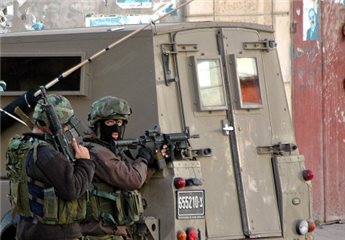
Madama, Occupied Palestine – At 12:30 a.m. on June 22, 2014, approximately 50 Israeli soldiers invaded the village of Madama.
Madama, which is located 10 km southwest of Nablus, in the northern part of the West Bank, has approximately 2000 residents. The soldiers raided close to 100 homes and took 80 men to the local elementary school, where they held them for several hours. The men were blindfolded, and their arms were tied behind their backs with handcuffs.
The soldiers released all of the men at 5 a.m.
At 1:00 a.m., the soldiers invaded the house of Nizar Abdullah Sadaq Ziyaada in Madama. They asked Ziyaada about the whereabouts of his money and proceeded to ransack the house. They drilled holes into the walls and threatened to destroy his home. They found a total of roughly 200,000 shekels underneath a cupboard and in various hiding places throughout the house. Finally, the soldiers took all of the money, two laptops, and several mobile phones before leaving.
The reasons for the theft of Ziyaada’s money are unclear.
Ziyaada had worked in Israel until the year 2000 and kept all of his earnings from that time in his house in Madama. It is likely that the Israelis knew about this money, as they asked him about it as soon as they entered his house.
Hany Ziyaada’s house was invaded by 15 Israeli soldiers the same night at 1 a.m. They broke down the door, but Hany asked them to wait a few minutes, so that the women of the house could get dressed. The soldiers swore at him, and he responded in kind. They proceeded to kick him in the back and stomach for several minutes and dragged him to their jeep, where they continued to beat him. They blindfolded and handcuffed him and took him to the school, where they held him by the throat, forced his arms back and drove their knees into his back. At 4 a.m. they allowed him to go home.
“Why do they not respect human rights?,” Hany asked an ISM activist. “I’m a policeman, and I know about human rights. Why don’t they?”
Palestinian prisoners assaulted before being detained

Ma’an – 24/06/2014
RAMALLAH – A Palestinian Prisoner’s Society lawyer reported Monday from Palestinian detainees at Etzion detention center that many of them were assaulted and beaten before they were detained.
Prisoner Faraj Ghaith, 57, told the lawyer that three settlers raided his house, assaulted him and his family before the Israeli police detained him and his two sons Ahmad and Omar.
Ghaith lives near the Israeli settlement of Kiryat Arbaa.
Jaclyn Fararjeh said that bruises were still clear on the prisoners’ bodies.
Prisoner Ashraf al-Jaaidi, 30, from Bethlehem, said that he threw up blood since he was detained, and that he was beaten with butts of the riffles when he was detained from his house in Duheisha refugee camp last Friday.
Farajeh highlighted that al-Jaaidi requested to be examined by a doctor but the prison service refused.
PPS’ lawyer Fararjeh visited prisoners Yasser Banat, Muhammad al-Hreini, Taha al-Hur, Bassam al-Natsheh, Ismail Jabariya, Muath Muhammad, Rabee Izriqat, Issa Shalaldeh, Yahya al-Huroub, Munthir al-Shurouf, Youssif Tartour, Tariq Gharib, Muhammad Hmeideh, Youssif Awawdeh and Murad Abu Muhye.
Jewish Settlers Attack Funeral Of Slain Palestinian In Ramallah

By Saed Bannoura | IMEMC & Agencies | June 22, 2014
Sunday evening a number of fanatic Israeli settlers attacked the funeral of a Palestinian, killed by the Israeli army in al-Biereh, near the central West Bank city of Ramallah, wounding one Palestinian.
The Palestinians were participating in the funeral procession of resident Mohammad at-Tareefi, 30, in Jabal at-Tawil neighborhood, when settlers of the Psagot illegitimate settlement opened fire on them, wounding one resident.
Several minutes later, dozens of soldiers arrived at the scene, and fired live ammunition at the residents, and several homes, in al-Biereh.
The Israeli military attack pushed dozens of residents to advance towards Psagot settlements, and hurl stones at it.
The soldiers chased the residents in Dahiat Jabal at-Tawil and al-Jinan area, while firing dozens of rounds of live ammunition, gas bombs, concussion grenades, and rubber-coated metal bullets.
The funeral procession started in front of the Palestine Medical Center in Ramallah, heading towards the home of the slain Palestinian in Betunia, before advancing towards the Jamal Abdul-Nasser Mosque in al-Biereh city.
At-Tareefy was shot by a live round in his chest during Sunday dawn clashes with Israeli soldiers invading Ramallah.
Israel’s military offensive in different parts of the occupied West Bank started ten days ago, following the disappearance of three Israeli settlers from Gush Etzion settlement, near Bethlehem.
Although Israel said Hamas is behind the “abduction”, Hamas denied the claim.
The ongoing Israeli military invasion led to the abduction of more than 400 Palestinians, many of them are children, and the soldiers invaded and searched more than 1000 areas in the West Bank.
The army alleged uncovering dozens of tunnels under Palestinian homes in the West Bank, and that the soldiers “located underground labs used for the production of explosives”.
The army said Israel had no prior information about the alleged labs and tunnels, but uncovered them during the extensive searches of homes and property.
In a Sunday report by the Palestinian Center for Human Rights, the center said Israeli soldiers shot and killed four Palestinians in the last ten days. Two of them were killed Sunday.
At least 38 Palestinians have been kidnapped by the Israeli army on Sunday, in different parts of the occupied West Bank.
The army also shot and wounded dozens of Palestinians in the ongoing offensive.
Israeli settlers shoot at Palestinians near Ramallah
Ma’an – 22/06/2014
RAMALLAH – Israeli settlers opened fire at Palestinians northwest of Ramallah late Sunday in the second such incident in hours, locals said.
Two settlers shot at nine men who were working in a quarry near the village of al-Mazraa al-Gharbiya, without causing injuries, the workers told Ma’an.
They said they noticed the settlers sneaking into the quarry and fled the scene as settlers opened fire with an automatic rifle.
After being chased for nearly two miles, the workers reached al-Mazraa al-Gharabiya unscathed, they told Ma’an.
The Palestinians identified themselves as Ismail al-Rajabi, 25, Momen Idriss, 24, Anas Idriss, 18, Yacoub Idriss, 20, Bilal Idriss, 20, Ahmad Jaber, 27, Wael al-Shalaldeh, 32, Mohammad Jaber, 23, and 10-year-old Abd al-Rahman Jaber.
An Israeli army spokeswoman did not immediately return calls seeking comment.
Earlier, a Ma’an reporter said that Israeli settlers opened fire at Palestinians in al-Bireh near Ramallah, injuring one as mourners gathered for the funeral of Muhammad Tarifi.
Tarifi was one of two Palestinians killed by Israeli forces early Sunday.
The Siege on Hebron
By Matthew Vickery and Sheren Khalel | MEMO | June 22, 2014
As the lockdown on Hebron enters its tenth day, the atmosphere in the city is tense and restless, with people living under a state of erratic checkpoints and military closure for the past week. On the streets of the city, there is only talk of what will happen if the three missing Israeli settlers are not found, or the mystery around their disappearance is not resolved. Every day since their disappearance Israel has imposed ever-increasing restrictions on the West Bank, but residents of Hebron, near the original location of the teens’ disappearance, are feeling the brunt of the crackdown.
The road through Halhul to Hebron is usually a simple route to negotiate, but now the streets of Halhul are besieged with Israeli soldiers, jeeps, and checkpoints making travel through the small city arduous. Halhul is within the Hebron governorate and like the majority of cities and towns in Hebron, the past week has been filled with a series of difficulties and tragedies. Residents face the daily reality of being locked down— restricted to their small area, unable to travel due to imposed Israeli military restrictions, as well as having armed soldiers positioned outside on throughways, often in great numbers. Houses are repeatedly and unpredictably raided, leaving homes in a state of chaos.
“There are so many soldiers and army jeeps here now, it feels like a thousand are here in Halhul” Mohammed Rabah, a resident of the city told Middle East Monitor. “The soldiers are breaking houses down, raiding them at night, arresting people and kicking people out because they are searching for the three settlers. It has become a very bad situation.”
Over 300 Palestinians in the West Bank have been detained so far this week by Israel, almost all during these night raids. While the majority of those arrested have an affiliation to Hamas, Hamas has denied responsibility for the missing Israeli teens. However three small groups in the occupied West Bank have claimed responsibility, Ahrar al-Khalil, the Islamic State of Iraq in the Levant (ISIL), and Al-Aqsa Martyrs Brigades.
On Friday, these now regular night raids, clashes and arrests in the Hebron area resulted in the death of a 14 year old boy who was shot in the chest by the Israeli forces in the early morning. By the afternoon, clashes were already occurring in Hebron’s city centre, as young men faced off against Israeli forces near the entrance to the illegal Israeli settlement situated in the along Shuhada Street.
During the demonstration, a 23-year-old Palestinian man was shot in the ankle by Israeli forces after four hours of clashes, with what his friends and fellow demonstrators said was a live round. Four young men quickly dragged him out of the line of fire and carried him to a car that screeched up to the protest after realizing someone had been shot.
“The bullet is lodged in his ankle for sure,” One of the protestors who helped carry the young man to the car told MEMO. “We are throwing rocks, and they are shooting bullets. Where else in the world is like this?”
A ten-year-old boy was also arrested during the protest.
According to protestors and bystanders, this demonstration was more intense than any they’d experienced before, as the recent Israeli crackdown on the city in search for the three missing Israeli settlers continues.
Previously the Israeli government had announced that the Israeli forces were permitted to use “all measures” to help find the missing settlers. MEMO contacted the Ministry of Defense several times for further comment on what all measures may involve, but the Ministry declined to return these phone calls or emails.
Earlier this week Israeli human rights NGO B’Tselem released a press release urging the Israeli government and Israeli forces “to refrain from meting out collective punishment on the local population,” while carrying out their hunt for the missing Israelis.
With the demonstration in the background and speaking to MEMO under terms of anonymity, many of the young men at the protest spoke of increasing aggressive actions by the army and their belief that they had to respond to it.
While clashes continued into the late afternoon, the streets of Hebron’s city centre were deserted, an increasingly common site. Stores were closed and tourist spots were desolate. The Ministry of Tourism’s information office in the heart of the souk didn’t bother opening for business.
“Two weeks ago, it was very good with tourists who came to Hebron, but because of the problems with the Israeli here, there isn’t anything,” Shadi Sider, who runs a tour group and souvenir shop in Hebron said. “There isn’t work here in Hebron now, the work is just enough to take food in the house—no work, no food.”
The head of the Palestinian businessmen forum in Hebron, Mohammad Nafeth al-Herbawi, said the district of Hebron is losing $10 million a day during the siege on the area. While laborers are facing up to $2 million in losses, according to Ma’an News Agency.
While Sider is one of those who is severely impacted by the lack of business prospects during the siege, he says the problems he faces at home are more worrying. Sider’s home, positioned beside Shuhada Street where an illegal Israeli settlement is situated, is surrounded by illegal settlers. His house has been raided, and his roof annexed a number of times throughout the past week. Due to the proximity of the settlement to his home, Sider is rather used to living life surrounded by soldiers, but this week has been more punishing.
“Thereares more soldiers than there has ever been before. The soldiers come here in my house, and they go on my roof to see, to guard, to make problems,” Sider said. “For the last week since the kidnappings it has been much worse, there are so many soldiers here.”
While Israel’s increased military presence focused on Hebron during the beginning of the search for the missing settlers, it is quickly expanding. Houses have been raided and people arrested through the greater West Bank, and injuries from Israeli forces have been reported in almost every district. Already five Palestinians have been shot dead since the search began including the 14 year old in Dura, a 22 year old in Qalandiya refugee camp, a 20 year old in Ramallah’s al-Jalazun refugee camp, and last night a 35 year old in Nablus and a 30 year old in Ramallah’s city center.
Collective punishment in Palestine
International Solidarity Movement | June 22, 2014
Occupied Palestine – On Thursday 12th of this month, three settler youth disappeared while hitchhiking in the Hebron area of the West Bank. No Palestinian group or organisation has taken responsibility for the disappearance.
15-year-old Mohammad Dudeen was murdered in the early hours of Friday morning (20th) after he was shot with live ammunition by the Israeli military. This was during a raid on his home village of Dura, near the city of Hebron.

Mohammed was not the only youth killed on Friday. The Israeli military raided Qalandiya refugee camp (south of Ramallah) and shot three youths with live ammunition. Mustafa Hosni Aslan, 22-years-old, was shot in the head and died of his wounds later the same day.

A Palestinian man in his sixties died of a heart attack on Saturday, 21st, after the Israeli military invaded his home. Hajj Jamil Ali Jaber Souf was at his home in Hares village, near Salfit, when the Israeli military violently broke in and attacked him. One of his nephews stated that the soldiers prevented the family from moving Jabber to a local clinic to receive medial treatment.
The Israeli army invaded the city of Nablus last night at approximately 2AM. The youth took to the streets and clashes ensued as they attempted to drive the soldiers out of the city. Many stun grenades were used throughout the night and a final barrage of tear gas was fired on the youths as the were leaving the city centre at approximately 5AM.
An ISMer in al-Khalil (Hebron): “For the past week in Hebron, there has been a heavy military presence. Solders from the Israeli military have been taking over Palestinian homes for their own use and harassing people in the streets with body searches. Many people have been detained, beaten, and arrested.
Settlers from the illegal settlements walk around armed and have been attacking Palestinians on the streets. Today the Israeli army attacked the residents of the Qeitun neighbourhood in Hebron. They entered several times during the day, but this evening the solders attacked an 11-year-old boy by hitting him on the mouth. They arrested two Palestinians and searched the locals for no reason. The solders continued the violence with property damage, ripping apart a local car under the guise of a ‘search’.”

Last night Israel’s army invaded Ramallah district from three directions – Qalandia, Beituniya and Beit El, reaching as deep as Arafat Square inside the city. Pal Media offices in Baloa’ were raided. In Burj al-Sheikh, the army raided the office of a prisoner that was released in the Shalit exchange deal, and used it as a firing post against youths attempting to repel them from the area. The youths sustained multiple injuries from rubber coated steel bullets. In Batn al-Hawa the army raided a charity building and confiscated computers.

These are just some examples of life in Palestine over the last nine days. According to Maan News, approximately 370 Palestinians have been arrested since last Thursday. The Israeli military have been brutal in their tactics of collectively punishing the citizens of Palestine for the disappearance of three Israeli youths. All over the West Bank, in villages, towns, and cities, Palestinian homes and offices have been raided, cities have been held under siege, people have been injured, arrested, and executed.
In Gaza, Israeli warplanes have targeted several locations and caused extensive property damage and injuries, spreading panic among Palestinian civilians.
The Fourth Geneva Convention, Article 33, states that: “No protected person may be punished for an offence he or she has not personally committed. Collective penalties and likewise all measures of intimidation or of terrorism are prohibited. Pillage is prohibited. Reprisals against protected persons and their property are prohibited.”
Israeli forces demolish structures, road pavement in South Hebron Hills
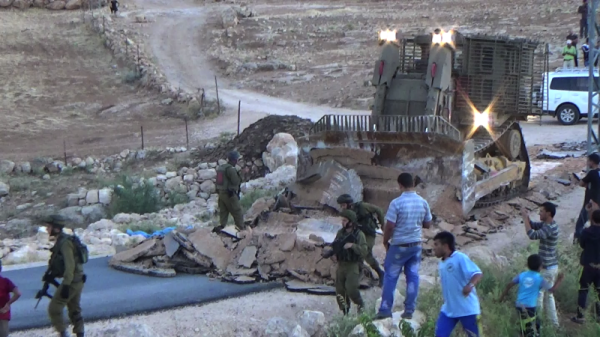
Photo by Operation Dove
Operation Dove | June 20, 2014
Khallet Forem, Occupied Palestine – On June 18th, the Israeli army, along with border police officers and DCO (District Coordination Office) officers entered in the Palestinian village of Khallet Forem, in South Hebron Hills, and demolished seven houses, a bathroom, and a shelter.
No demolition orders were delivered for these structures.
According to Palestinian witnesses, a woman was injured by the soldiers during the operation.
The seven houses, the shelter, and the bathroom were owned by the Abu Dahar family. These demolitions involved at least 26 people, 12 of them are children.
In the same day, Israeli forces demolished the main road of Ar Rifa’Iyya Ad Deirat and built a roadblock in order to prevent the access from that road to the bypass road 356.
According to PHROC (The Palestinian Human Rights Organizations Council), the recent wave of demolitions, arrests, attacks, killings, and total closure of large parts of the West Bank following the disappearance of three Israeli settlers is a form of collective punishment against the Palestinian people. This is in direct violation of Article 33 of the Fourth Geneva Convention that forbid reprisals against protected persons and their property, as well as collective punishment.
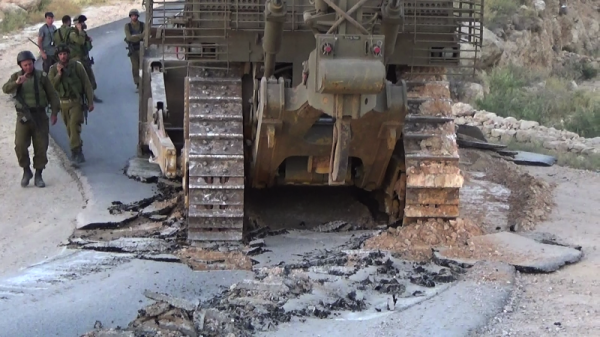
Photo by Operation Dove
Palestinian dies of heart attack as Israeli troops raid home
Ma’an – 21/06/2014
 SALFIT – An elderly Palestinian man died early Saturday of heart attack during a heated argument with Israeli troops who broke into his house in the village of Haris in Salfit district in the northern West Bank.
Palestinian security sources said Israeli soldiers refused to allow family members of Jamil Ali Abed Jabir to take him to hospital for treatment after he suffered a heart attack and eventually died at home. The victim was in his 60s.
The sources explained that dozens of Israeli soldiers stormed Haris village, ransacked several homes and assaulted residents.
Jawad Muhammad Dawood suffered a hand fracture after Israeli troops brutally attacked him and his brother Jawdat during a raid on their home. In addition, seven family members inhaled tear gas after Israeli forces fired a canister in their home.
No detentions were reported in the village.
The Qwasmeh Family Story
CPTnet | June 17, 2014
The public so far knows very little outside of the alleged time that Gilad Shaar, Naftali Frenkel, and Eyal Yifrach were kidnapped. But what we do know is the absolute mayhem the Israeli military has spread throughout the Hebron district among innocent families. Additionally, routine night raids, day patrols, confiscation of public property for military outposts, and the blockades on all but two access points into Hebron have suffocated the livelihood of Hebronites.
Soldiers raided the home and took possession of the Al Awewe family home in Aqbet Taffuh for six hours on Sunday. Over fifty troops had occupied the home while three adults, four young girls, and a young boy were in the home. The Israeli military would not allow a one-year-old baby to leave the house and her mother had to sit outside helplessly wondering about the safety of her daughter, who was still nursing. The soldiers found no suspects connected to the kidnapping in the home.
In that same area on Monday morning, the IDF confiscated the security camera equipment the al-Natshe family had installed around their house for their protection, along with video footage the cameras had recorded.
Further down the road in the Aqbet Taffuh area, approximately fifty-five Israeli soldiers left the hilltop area of the Palestinian municipality, occupied several homes, questioned families, tore down a private Palestinian fence and occupied the neighborhood for several hours.
Throughout the afternoon, northeast of Bab i-Zaweyah, just outside of the H1/H2 intersection, a brigade of more than forty soldiers stationed themselves in four different homes and a supermarket within a two hour period, leaving families frightened and unsure of their intentions.
On 15 June at around 9:30 p.m., an Israeli raid on a Palestinian home ended with a seven-year-old Palestinian boy hospitalized after the Israeli military used an explosive device to blow open the front door of the Akram Al Qawasmeh home. The subsequent powerful blast shattered the tempered reinforced glass, shearing off the decorative steel and sending pieces of shrapnel into all corners of the home, which severely injured Akram Al Qawasmeh’s son.
After the explosion, Israeli soldiers did not allow Akram Al Qawasmeh to see his son, and according to reports, the military initially stopped medical personal from treating the victim. CPT arrived the following day and found a home turned upside down. (See video below.) Children’s belongings were spread and broken around the house. Israeli soldiers demolished the kitchen, smashing fruits, vegetables, and other food items on the floor, and left feces on a rug in the basement.
These are just a few of the incidents that CPTers were able to report on directly. Other human rights organizations have also reported an increase in settler violence against Palestinians who live near the Hebron area settlements.
Historically, Palestinian violence has been the justification for settlement expansion in Hebron. Currently, the Hebron Rehabilitation Committee has identified over twenty-two locations of pending settlement expansion and settler activity. The behavior of the Israeli military and settlers in Hebron suggests the government may use the case of the three young kidnapped boys as an excuse to expand these settlements in the Hebron area or elsewhere in the West Bank while the international community is distracted.
See previous release, AL-KHALIL (HEBRON): Hijacking a kidnapping, Part I
Featured Video

ARE PATIENTS BEING PROPERLY INFORMED ABOUT OZEMPIC?
or go to
Aletho News Archives – Video-Images
From the Archives
Trans ‘milk’ as good as the real thing – NHS
RT | February 18, 2024
The drug-induced nipple secretions of trans women are as good as mothers’ breast milk for babies, the University of Sussex Hospitals NHS Trust claimed in a letter to campaigners made public in a report by British think tank the Policy Exchange on Sunday.
The healthcare trust’s medical director, Rachel James, argued that the off-label prescription drug cocktail men transitioning to female take in order to produce milk was “similar to the natural hormones which encourage lactation to develop when the baby is newly born.”
“The evidence which is available demonstrates that the milk is comparable to that produced following the birth of a baby,” James wrote in the letter, sent to Children of Transitioners last August.
Biological men who wish to lactate must first take hormones to grow milk glands and then take high doses of either domperidone or metoclopramide to stimulate milk production. Neither drug is approved for this use, though they are occasionally prescribed off-label to biological women who have trouble lactating.
However, domperidone’s own manufacturer, Janssen, warns patients the drug “may cause unwanted side effects affecting the heart in a breastfed baby” and “should be used during breastfeeding only if your physician considers this clearly necessary.” … continue
Blog Roll
 Aletho News
- How Real Is the Impact of Western Sanctions on Israel?
- France, You Are Guilty: How Paris Turned Western Sahara into the Maghreb’s Powder Keg
- 2025 Nature Paper Claiming Worsening Global Drought Gets RETRACTED …Heavily Flawed
- Your Milk Is Not the Problem
- The Truth About the Trump Shootings with Ken Silva
- ARE PATIENTS BEING PROPERLY INFORMED ABOUT OZEMPIC?
- US lawmaker blocks $2.8 billion weapons sale to Israel: Report
- Yemeni army claims responsibility for strikes on sensitive sites in Saudi capital, Aramco facilities in Yanbu
- Iran Judiciary issues indictments against 159 US, Israeli officials for assassination of Leader, commanders
- Turkiye revokes Iranian bank license under US sanctions campaign
- If Americans Knew
- Salah Sarsour’s Legal Team Says DHS Has Not Met Its Burden to Prove He Is Deportable
- An analysis of tax forms by The Intercept show Kraft’s charity and LLC have donated to Friends of the IDF and AIPAC’s super PAC.
- Israeli attacks kill four Palestinians in Gaza – Daily Update
- Inside Gaza’s death trap of collapsing, bombed-out buildings
- The everyday items Israel bans from Gaza every day
- Inside the siege, the ruined buildings of Gaza – Daily Update
- Debunking The Claim That Macklemore Has A “History Of Antisemitism”
- CPJ demands release of arrested Palestinian-US journalist near Bethlehem
- Robert Kraft: The Billionaire Friend of Netanyahu Pulling The Strings Behind the Macklemore/Ed Sheeran Blow Up
- Columbia Administered Fund Gives Big Money to Pro-Israel Groups
- No Tricks Zone
- 2025 Nature Paper Claiming Worsening Global Drought Gets RETRACTED …Heavily Flawed
- New Study: ‘Global Drought Shows No Detectable Recent Acceleration Under Climate Warming’
- Economic Masterminds: German Socialists Suggest Taxing Productivity Gains Stemming From Using AI
- The South China Sea Has Not Been Cooperating With The Climate Change Narrative
- Energy Crisis: Germany Enters Heating Season With Historically Low Gas Reserve Fill Levels
- New Study: The Antarctic Ice Sheet Gained Mass From 2020-2024 Due To Staggering Snow And Ice Accumulation
- Study: Ocean Heating Rates From Thousands Of Years Ago ‘Dwarf’ Modern Ocean Heating Rates
- Climate Extremists Target, Attack Large-Scale Power Grid Infrastructure In Germany!
- New Study: Antarctic Ice Melt Has Contributed Less Than 1 Centimeter To Sea Level Rise In The Last 30 Years
- Fear Of Debate: Alarmist German Climate Scientist Calls On Mainstream Media To Discredit Skeptic Voices
 Aletho News