Israeli soldiers invade more Palestinian homes in Hebron
International Solidarity Movement | June 18, 2014
Hebron, Occupied Palestine – Yesterday the Israeli army invaded a family house in the H1 area, supposedly under full Palestinian Authority civil and security control, of al-Khalil (Hebron). The father of the family is very ill with heart disease; the family was forced in to one room and was not allowed to leave. The eight Israeli soldiers used the house as an unofficial army post, both to rest and to view the area. The soldiers stayed there overnight, terrifying the family, as they had no idea when the soldiers would leave. At approximately 11:00 am, the soldiers left the house, however they informed the family that they would return.
The soldiers then entered the next house, relatives of the same family, with four young children. First they searched the house, and then occupied the children’s room on the second floor. They moved the children’s beds to get more space and placed a black blanket to cover the doorway.
The soldiers took shifts, sitting in front of the room watching the family, while the rest were sleeping, eating, and viewing the area. The family told the ISMers present that the soldiers also took showers. The soldiers seemed very uncomfortable with the ISM volunteers in the house, and behaved very aggressively towards them, and the family members who were taking photos.
The family offered the soldiers to use the roof instead of the children’s room, but they refused.
The military presence in the house caused a lot of fear for the family, they were unable to carry out their daily routines, and the children were very upset that they could not enter their room; they were afraid the soldiers would take their belongings and break their toys.
After five hours the family convinced the military to leave, as they left, it was witnessed them joining with a much larger group of soldiers.
Since last Friday, there has been a large increase in home invasions all over the West Bank. This is part of the collective punishment inflicted on the Palestinian population, since the disappearance of three Israeli settler youth on Thursday.
Palestinian kidnapped by Israeli forces in Awarta

Sameer Abu Shayb
International Solidarity Movement | June 16, 2014
Awarta, Occupied Palestine – At approximately 2:00 AM on the 15th June, Israeli soldiers conducted a night raid in the village of Awarta near Nablus, which was one of a series of raids and closures carried out by Israeli forces, following the disappearance of three Israeli settler youth close to al-Khalil (Hebron). Palestinian witnesses state that over 50 Israeli solders surrounded the village.
During the operation around 20 Israeli military personnel forced entry to, and stormed the home of Sameer Abu Shayb. Palestinian residents state that the soldiers were aggressive and had their faces covered. Sameer was then handcuffed and interrogated at his home over the phone by a commanding officer, for approximately 15 minutes. Sameer was not accused of any offence, but was then taken outside, blindfolded, and abducted by Israel forces.
This is the sixth time that Sameer has been imprisoned in recent years, totalling approximately 6 months.
He has never been formally accused of an offence and has never been presented with any evidence to justify his repeated detentions. Sameer formerly ran a graphic design shop but was forced to close due to this harassment. Three and a half years ago Israeli soldiers broke into his office, stole a PC and camera, and broke a printer and other merchandise. The property has never been returned, nor has he received compensation.
During the the night over 80 Palestinians were abducted by Israeli forces throughout the West Bank, in an operation that has been described by the Palestinian Authority as a form of collective punishment.
Israel arrests 80 Palestinians, locks down Hebron in search for missing teens

Al-Akhbar | June 15, 2014
Israel on Sunday broadened the search for three Israeli teenagers believed kidnapped by militants, arresting 80 Palestinians overnight and imposing a tight closure on the southern West Bank city of Hebron.
It was the biggest arrest operation in years and came after Prime Minister Benjamin Netanyahu ordered security forces to “use all tools at their disposal” to find the three teenagers he said had been “kidnapped by a terror organization.”
Most of those arrested belonged to the Islamist movement Hamas, and included several members of the Palestinian parliament, Israeli press reports said.
“In a combined… effort to return the three abducted Israeli teenagers, approximately 80 Palestinian suspects were detained in a widespread overnight operation,” an army statement said, with a spokesman warning troops would leave no stone unturned.
“Palestinian terrorists will not feel safe, will not be able to hide and will feel the heavy arm of the Israeli military capabilities,” Lieutenant Colonel Peter Lerner said.
As the massive manhunt for the missing teens entered its third day, the defense ministry imposed a complete lockdown on the southern city of Hebron and the surrounding area, as well as a closure on the Gaza Strip.
The closure on the Hebron district began at midnight, a defense ministry statement said indicating that access to Gaza via the Erez crossing would be limited to humanitarian cases only, while only fuel would be allowed in through the southern goods crossing.
Inside Hebron, the West Bank’s largest city, Israeli paratroopers fanned out across the streets, and no cars were allowed in or out of the city, an AFP correspondent said.
Following late-night consultations with his security cabinet, which ended close to midnight, Netanyahu was to convene the weekly cabinet at his office at the defense ministry in Tel Aviv, his office said.
“Our young people have been kidnapped by a terror organisation… there is no doubt about that,” Netanyahu told reporters in Tel Aviv late on Saturday.
The teens, one of whom also holds a US passport, are believed to have been snatched Thursday night from the Gush Etzion settlement bloc between Bethlehem and Hebron, reportedly while hitchhiking.
The missing teenagers, who study at two Jewish seminaries in the West Bank, have been identified as Gilad Shaer, 16, from Talmon settlement near Ramallah, Naftali Frenkel, 16, from Nof Ayalon in Israel, and Eyal Ifrach, 19, from Elad near Tel Aviv.
Netanyahu said he placed responsibility for their safe return on the shoulders of Palestinian Authority president Mahmoud Abbas and his government, saying they must do “whatever necessary to help the hostages get home safely.”
The suspected abductions occurred 10 days after a new Palestinian unity government was sworn in, pieced together with the Hamas movement.
Israel has vowed to boycott all contact with the new government, whose emergence has ended seven years of divided rule between the West Bank and Gaza, with Netanyahu insisting Abbas be held responsible for all acts of violence emanating from anywhere in the Palestinian territories.
Israeli and Palestinian officials confirmed Palestinian security services were assisting in the search for the youths, who are believed to be “still alive,” Defense Minister Moshe Yaalon said on Saturday.
Israel’s air force also hit three targets in the southern and central Gaza Strip overnight on Saturday, the second consecutive night of strikes.
(AFP, Al-Akhbar)
Violence in Ni’lin
International Solidarity Movement | June 14, 2014
Ni’lin, Occupied Palestine – A Red Crescent paramedic, present at the Ni’lin demonstration last week, spoke to ISM about the protest last Friday, 6th June. He explained that the demonstration began as the protesters marched towards the apartheid wall, with Israeli soldiers firing tear gas canisters and rubber-coated steel bullets.
 After just 15 minutes, a 41-year-old Palestinian protester was shot in the leg with a 0.22 live ammunition bullet. The soldiers had been hiding in the olive trees next to the apartheid wall and were unseen by the demonstrators. When a Red Crescent volunteer tried to give the wounded protester medical treatment, after placing a bandage on the bleeding wound, he was attacked by the Israeli soldiers. The soldiers kicked the volunteer and used their guns to beat his face, after the demonstration he was taken to the hospital to receive treatment.
The 41-year-old who was shot by the Israeli military was then arrested and held for two hours, before being ‘handed back’ to the Red Crescent ambulance at the Ni’lin checkpoint. He had received some medical treatment from the Israeli paramedics, but this wasn’t immediate, and he also had wounds, including a cut on his head that required one stitch, where the Israeli forces had beaten him while he was arrested.
The protester is now slowly recovering, the 0.22 bullet fractured his tibia [a bone in his lower leg], and it will be another month before he is healed.
The demonstration yesterday was fortunately less violent, there were no injuries or arrests. However, before the protest could begin, the military moved a long way out from the apartheid wall, pushing the demonstrators deep into their own olive trees. The military fired many tear gas grenades and canisters and some of the protesters suffered from tear gas inhalation, requiring support from Red Crescent paramedics. At least twice during the demonstration, Israeli forces fired tear gas canisters directly at protesters, both highly dangerous and in contravention to Israeli military procedure, which is shooting them up into an arch to lower the impacted velocity.
Ni’lin began demonstrating in 2008, against the apartheid wall’s construction. The protests continued after the wall was completed, and since 2008, five villagers from Ni’lin have been murdered by Israeli forces.
Journalists lament PA silence as Israel bans Gaza papers
Ma’an – 13/06/2014
GAZA CITY – Palestinian journalists on Thursday urged the newly-formed national unity government to respond to Israel’s decision to prohibit the printing and distribution of Gaza-based newspapers in the West Bank.
“Do we need an Israeli presidential decree to be able to print newspapers in territories controlled by the Palestinian Authority?” editor-in-chief of al-Risalah newspaper wrote on Thursday in exasperation over the lack of PA response.
On May 28, Israeli soldiers raided the Ramallah offices of the PA-affiliated al-Ayyam newspaper, telling managers that Israel would not allow them to distribute the Hamas-affiliated Falastin, Al-Risalah, and Al-Istiqlal newspapers in the West Bank.
The Israeli raid undermined an inter-Palestinian deal that aimed to ensure freedom of press by facilitating the sale of Gaza newspapers in the West Bank and vice-versa.
Political analyst Wisam Afifa criticized the Palestinian national consensus government for its unwillingness to stand up to Israel’s attack on Palestinian free speech.
“We consider that by remaining silent, the government actually accepts the Israeli decision to ban the printing of Gaza newspapers,” he told Ma’an.
He highlighted that managers of the Gaza newspapers had contacted the Palestinian government spokesperson Eyhab Bseso over the issue, but nothing had been done.
“So far, there has been no comment on the prohibition, and we expect a serious and real response to these violations, especially from President Abbas,” added Afifa.
Similarly, the editor-in-chief of al-Istiqlal newspaper criticized the Palestinian Authority and the national consensus government for not taking any action against Israel’s decision to ban Gaza newspapers in the West Bank.
Tawfiq al-Sayyid Salim has said that he views the Israeli decision to ban Gaza newspapers as a humiliation to President Abbas himself, belittling his authority.
In December, the Foreign Press Association accused the Israeli army of “deliberately targeting” journalists after soldiers fired rubber bullets and threw stun grenades at photojournalists clearly identified as press.
The Tel Aviv-based group, which represents journalists of all foreign media, said troops had directly targeted a group of photographers covering clashes at the Qalandia checkpoint between Jerusalem and Ramallah.
A 2013 report by Palestinian Center for Development and Media Freedoms counted 151 violations of Palestinian freedom of speech by Israeli authorities, including incidents of “physical assault, detention, arrest, prevention from coverage, travel bans, interrogation, threat, raiding, closing and blocking, trial, and confiscation of equipment.”
The report also mentioned 78 violations by Palestinian authorities, primarily in the Gaza Strip, though these numbers are believed to be improving particularly since the the agreement to form a national unity government was made at the end of April.
3 journalists injured in Bilin protest
Ma’an – June 13, 2014
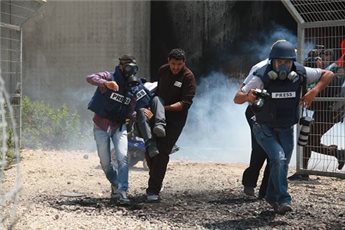
RAMALLAH – Three journalists were injured and dozens suffered from excessive tear gas inhalation as Israeli forces dispersed a weekly protest in Bilin village near Ramallah.
Israeli forces fired rubber-coated steel bullets, stun grenades, and tear gas at protesters as they neared their lands near the wall, injuring photographer Abbas al-Momini with a rubber-coated steel bullet in the pelvis, and Palestine TV cameraman Shamekh Jagoub and photographer Haitham Khatib with tear-gas canisters in the abdomen.
Participants raised Palestinian flags and posters of prisoners as they marched throughout the village chanting songs for unity and in support of prisoners.
Protesters wore prisoner uniforms and played football in front of the prison.


Omar – Film Review by Gilad Atzmon
The Tragedy of Omar
by Gilad Atzmon | June 6, 2014
One of the most important Palestinian feature films ever, Omar, is the deepest expose of the diabolical nature of the Israeli occupation and the inhuman situation imposed on Palestinians by the Jewish State. It also throws light on the tragic and depressing Palestinian struggle against a sophisticated, demonic enemy — an on-going battle that so far has led nowhere.
In his latest film, Palestinian director Hany Abu Assad sets Omar (Adam Bakri), a young freedom fighter in an impossible, yet common, Palestinian dilemma, caught in a devastating triangle between his patriotic commitment, romance and the omnipresent Jewish State – a brutal, Orwellian, Big Brother that sees everything, knows everything, sets people against each other and controls everything through a network of collaborators even within the resistance.
Once captured by the IDF and being subject to some horrendous physical and mental torture by Israeli intelligence, Omar is set into a hellish scenario. He eventually manages to buy the Israeli’s trust, he lets them believe that he is willing to cooperate. At that moment Omar pretty much seals his fate. He is destined to lose everything.
Though we, comfortable in our cinema seats, know that he never compromised his commitment to his people, one by one, the Palestinians around him, led to believe he is a traitor, they turn their backs on him. Losing the love of his life to his friend — clearly a collaborator — he is ostracised by fellow warriors and their families. Omar, a Palestinian patriot, becomes a pawn in an evil Israeli game. As his situation deteriorates and his tragedy unfolds in front of our eyes, he remains aware of it all, and we, who witness this emerging tragedy, also can see no way out.
Agent Rami (Waleed Zuaiter), the veritable ‘good cop’ is the Israeli intelligence operator who recruits Omar. He appears to be humane, he never uses physical pressure, he also has his own family matters to handle, wife, kid etc’. But all those ‘humane’ symptoms are there to cover a deeply sinister and hideous character. Rami is in fact a cold blood Israeli monster who shatters the lives of others in a mass scale. He systematically makes empathy and human affection into a highly functional instruments of total abuse.
One hardly need to say that Rami, like Omar, is a symbol of his people and indeed, there is a clear cultural and ideological continuum between Rami, Shimon Peres and the entire Jewish Left. I refer here to the deceitful nature embedded in contemporary Jewish political culture, that intention to present empathy and humanism only to conceal a sinister, self-centric agenda that cares only for the members of the tribe.
At the start of this film we meet a young, handsome and joyful, Palestinian patriot who leaps over the gigantic Israeli Wall and who, against all odds, lays claim to his land. Ninety minutes later, the same man is a defeated soul. Physically and mentally tortured, Omar simply can no longer climb the wall and bridge the divide imposed on his people by the Jewish State.
By the end of the film, Omar, like Palestine itself, is a tormented and defeated soul. For him, there is no hope but martyrdom.
No Jews allowed
International Solidarity Movement | June 5, 2014
Hebron, Occupied Palestine – My plan for the morning was pretty simple, I wanted to enter the souq (market) and buy some bread for breakfast, and then walk home. That was it. As I made my way towards the souq entrance I was stopped by two Israeli border police officers and asked for my religion. This is not an unusual experience in this city, the military are a common sight and as well as the regular checkpoints, they can and often do stop you at any time, demanding your identification, asking your religion, and any other questions they desire to ask.
I am neither ashamed nor proud of my religion. It is part of who I am in the same way my hair colour is a part of me. It is also a question I have been asked before and, as in the past, I told the truth.
“I’m Jewish,” I said.
The two border police officers spoke to each other in Hebrew, a language I have very little understanding of.
“Where are you going?” They asked.
“The souq,” I said. “I just want to go to the market.”
“No, you can’t go in. No Jews allowed.”
I wasn’t completely shocked, this has also been something stated to me before.
“Come on, I’ve been in there a thousand times, is it illegal for me to enter?”
“You can’t go in, you’re Jewish, it’s not allowed, it’s dangerous.”
I wanted to laugh, I may well have done. “It’s not dangerous, I have many friends in there, just let me go.”
This continued on for a few more minutes, the blood heating in my face as I tried to argue my case to no avail. The real irony was instead of walking through the market to go home, I was forced to walk Shuhada street, a perfect example of the apartheid that exists within this military occupation, a street where Palestinians have been barred from walking since the year 2000, where many people lost their homes and livelihoods after they were forced to leave and never return. Only the Israeli military, settlers, and internationals are allowed to walk Shuhada Street, it is often christened “Ghost Town” by the Palestinians, and indeed the sight of so many closed shops and houses, is haunting. It is also a street where I have been assaulted twice by settlers, so the idea that this was a safer alternative for me than the market, is laughable.
I have been fortunate enough to live in Palestine for several months, mainly living in the city of al-Khalil (Hebron). Al-Khalil is a city with many problems, mostly due to the illegal settlement in the heart of the city [all settlements in occupied territory are illegal under international law], and the huge Israeli military presence there to enable the settlers.
The Israeli military commits terrible crimes against the Palestinian people. I have seen them arresting and detaining adults and children for no reason, physically and verbally harassing the people of the city, using their military weapons against adults, youths and children, as well as a hundred and one other injustices that impact the daily lives of Palestinians in al-Khalil.
The settlers in al-Khalil are above the law. They attack Palestinians and steal their land and property on a regular basis. The Israeli military not only does nothing to stop this, but in many cases they condone and encourage it. I have seen settler youth throwing stones at Palestinian homes, while Israeli soldiers watched on. When we asked the soldiers to do something to stop this, they replied they would do nothing, as they are “children”. However Israeli soldiers have no qualms in using violence against Palestinian children. I have come to al-Khalil as a solidarity activist; one of the activities I participate in almost daily is ‘school checkpoint watch’. This is where I would assist in monitoring a specific checkpoint the children of the city are forced to go through on their way to school. I have witnessed Israeli soldiers harassing and searching children as they go through the checkpoint, firing tear gas and stun grenades at them and into their schools, and detaining children, some as young as six-years-old.
After the two border police officers denied me entry into the market in the morning, I tried again several hours later. The result was the same. I was angry, and I was upset, and while I am in Palestine as a solidarity activist, all I wanted to do was to go through the souq and visit one of my friends.
However, I have no intention of writing that I now “understand” what the Palestinians experience due to the military occupation, and the complete control that exists over their freedom of movement. My experience today was frustrating, and also unfair, but it is nothing compared to what the Palestinian people experience on a regular basis.
Due to the colour of my skin, and my nationality, I am incredibly aware of the privilege I have in Palestine, and all over the world. The very fact that I am able to enter Palestine is a huge privilege within itself; so many Palestinians in the diaspora were forced away from their homeland and have never seen it again. The fact that, if I so wish, I can travel to Yaffa, and one of my closest friends, a Palestinian woman whose family is originally from the city, can never see her home.
I have never been denied entry to any area due to my religion by Palestinians, or any other time in my life. It is telling that the first time this happens is by the Israeli military, under the façade of my ‘safety’. Unless Israeli soldiers or settlers enter, which they frequently do, the most dangerous thing that could happen to me in the souq is that I could overdose on tea, forced on me by my friends.
Israel Begins Arrest Campaign Against Popular Resistance Activists
By Chris Carlson | International Middle East Media Center | June 5, 2014
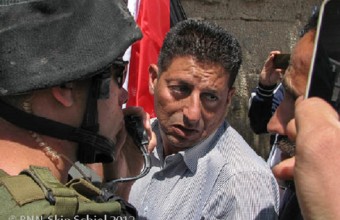
Yesterday, at 4:30 am, Popular Resistance activist Mahmoud Zwahre was again arrested by the Israeli army, at his house in Al Ma’asara, just southwest of Bethlehem.
An attempt to arrest Zwahre was made previously during the weekly Friday protest in the village. This week, on Wednesday, a large group of Israeli soldiers raided Zwahre’s home, just before dawn.
Mahmoud Zwahre, according to the Palestinian News Network (PNN), is an activist and coordinator for the Popular Committee Against the Wall and the Settlements in Al Ma’asara. Soldiers surrounded the Zwahre residence and declared it a closed military zone, as they proceeded to tear through the contents of the house, terrorizing the children and abusing Mahmoud in front of his family.
He was arrested, blindfolded, and taken to an unknown destination — essentially, and by all rights, amounting to a kidnapping.
(Al Ma’asara is a small Palestinian village located in Area B of the central occupied West Bank. Though Area B is officially recognized to be under joint Israeli-Palestinian security control, the 1967 Israeli occupation of the West Bank, Gaza Strip and East Jerusalem has yet to be granted legitimacy by the international community.)
Munther Amira, director of the board of the Popular Struggle Coordination Committee Against the Wall and the Settlements (PSCC) in the Palestinian territories, explained in an interview with the PNN that the Israeli occupation increasingly targets activists of Popular Resistance and their activities:
The activities of Popular Resistance are peaceful and designed to highlight the suffering of the Palestinian people through the Israeli occupation practices of racism and violation of international law. Nevertheless, the PSCC has documented the rough and violent reactions by Israeli soldiers against the protests and marches organized by the Popular Struggle Committees in the various provinces of the country.
The committee denounces the arrest of its coordinator Mahmoud Zwahre, and calls for his release.
Family of man killed by Israeli forces denies he shot at police
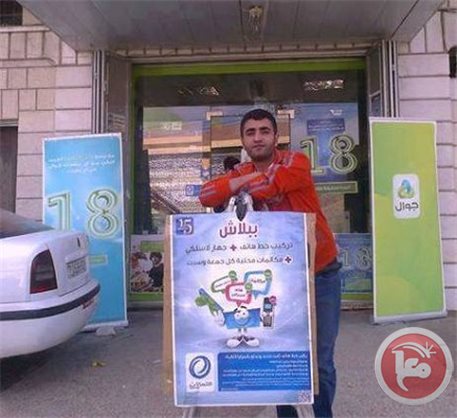
Audah pictured in front of the cell phone store he owned
Ma’an – 03/06/2014
NABLUS – The family of a man killed by Israeli soldiers near Nablus late Monday have denied Israeli claims that he opened fire at forces.
They identified the man as Alaa Muhammad Awad Audah, 30, from the town of Huwwara south of Nablus.
According to the Israeli army, Audah approached the Zaatara checkpoint late Monday and opened fire at an Israeli policeman, lightly wounding him in the leg. Soldiers responded by shooting and killing Audah.
But his family told Ma’an Tuesday that the 30-year-old arrived at the checkpoint in order to receive a shipment of cell phones for a store he owned.
In order to avoid traffic, Audah decided to cross the checkpoint and retrieve his package on foot while his taxi driver waited nearby, family member Jumaah Omran said.
Soldiers shot and killed him as he approached the checkpoint, Omran added.
Locals told Ma’an that the shooting occurred as Israel army chief of staff Benny Gantz was visiting Joseph’s Tomb nearby.
Audah left behind a wife and two children. His village, Huwwara, has announced three days of mourning.
His body has yet to be delivered to his family.
Israeli forces have killed 12 Palestinians in the West Bank since the start of 2014, according to AFP figures.
It Is about the Charter of Rights and Freedoms Mr. Ambassador!
By Shawn Robinson and Rana Abdulla | Palestine Chronicle | June 2 2014

The exhibit is an opportunity for Canadians to view imagery that captures the humanity of a real situation (Public ART/Facebook)
The woman behind the exhibit is artist Rehab Nazzal, a Canadian citizen born in Jenin, an historic town located in Palestine in a territory under occupation since 1967. Nazzal’s exhibit of 1700 photographic images along with four short videos, were collected by her over the fourteen years. Segments of these images depict life in the experience of occupation.
Nazzal’s premise of this collection is based on the idea that people leave traces of their existence and the traces in this case are part of the collective memory of occupied Palestine. Not being the first time this collection has been exhibited, it was also featured in Toronto at the Scotiabank CONTACT Photography Festival 2013.
 Stumbling across the exhibit at Ottawa’s City Hall in the Karsh-Masson Gallery, the Israeli Ambassador to Canada felt that such an exhibit should prohibited. The Ambassador operating outside of his mission, met with Mayor Jim Watson and Deputy City Manager Steven Kanellakos of the City of Ottawa, to demand closure of the exhibit, stating it “glorified terrorism”. Somehow in the unidentified 1700 images and four videos, the Ambassador was able to single out seven individuals he described as terrorists.
The 4th Geneva Convention that Israel and Canada are signatories as well as the Hague Regulations, provides that people under occupation have the right to resist their occupiers. Palestinians are in a situation where they are resisting occupation. The Israeli government and their representatives dispute this occupation in spite of the presence of its military. Terrorism terminology by Israel has become so common and so pervasive that many inside and outside of Israel perceive Palestinians as terrorists – a racist generalization that is pejorative and isolating.
Nazzal’s work reveals human cost of military violence and war, and it is not a call for more human loss, contrary to the Ambassador’s allegations. It is a catalog of Palestinian history, creativity and expression for Forgotten Survivors; a lament for their homeland; and sadness for those who have died in a long hopeless conflict. Her work is a strong counter-narrative articulated creatively using visual vocabulary, transforming the oppressive tools of Israel and its discriminatory policies into elements of hope and life. Her political art communicates messages of dignity and liberation and has undoubtedly inspired many, not just Arabs but non-Arabs as well. The strong media attention certainly indicates that her message is worthy of consideration and appreciation.
Not satisfied with the responses from the Canadian public and City of Ottawa, the Ambassador has escalated his inflammatory language including allegations of “blood libel” and descriptors such as “child murderers”. Is this the role of a foreign diplomat to Canada? His call on Jewish groups to demand action is of great concern. Individuals who have yet to see the exhibit but have read the Ambassador’s false and inflammatory statements, are responding through promotion of these false allegations in blogs, emails to City Hall and online comments. Canadians are being presented with a bias that perpetuates this terrorism label.
The Israeli suppression of the Palestinian narrative appears to now be officially part of the Canadian art and political stream of understanding. It has no place nor is it appropriate. Instead of approaching the situation as an ethnic denial of people, that would appear racist to Canadians, the Ambassador of Israel instead invokes falsely the understandably reactionary term – terrorist.
 Censorship of art, especially political art has a history associated with oppressive regimes. Artists in Canada of all faiths, backgrounds and cultures have the full right to artistic expression as granted by the Canadian Charter of Rights and Freedoms. Therefore uncensored artists are able to explore difficult themes; which is a victory for democracy and freedom of expression.
Realizing that Mayor Watson and his staff have stood by the Charter, the Ambassador requested that Mayor Watson review the process of selecting future art exhibitions at the Karsh-Masson Gallery. This is also censorship. Does this mean future exhibitions could be at risk? That the City of Ottawa should influence the selection panel of professional artists? Do we want elected politicians interfering with these processes, and especially at the behest of a foreign country and its diplomatic body?
The situation is of concern to Palestinian, Arab, Muslim and other ethnic minority artists who may not be featured by galleries across Canada due to the fear of facing the public wrath of Jewish groups and/or the Israeli government. As Canadians, we don’t want to be controlled in how our art is expressed.
 We know from the history of others, that when governments and special interest groups control the message of art, that in many cases, target groups who are censored are in danger of future marginalization. In Europe in the 1930’s a number of countries excelled in this practice further legitimizing their hateful actions against minorities, including Roma and Jews. For some countries this was the beginning of their marginalization process against an ethnic minority. Canada must uphold its values for this reason as our laws and freedoms are for everybody, and not to be denied for a specified group, especially under pressure from an outside country.
The exhibit created by Nazzal is an opportunity for Canadians to view imagery that captures the humanity of a real situation. People are not exploited in their suffering or celebrations, they are living an experience that is untold by the media and has been for as much as four decades.
To be Palestinian is not anti-Jewish or anti-Israeli. In actuality it is a culture that is centuries old in its cuisine, dance, literature, art, architecture, music, costume and other elements we all embrace in our own.
Canada, a country of hundreds of cultures, cannot be part and parcel of this type of denial, and should not be afraid in embracing its citizens. Removing this show would set a precedence that would allow one group at odds with another group to demand censorship in the Canadian milieu. Influencing selection committees of art galleries, are creating the environment of fearing to present a Palestinian artist would also be an act of censorship and stifling our right to the freedom of expression. This is not a Canada we want.
– Rana Abdulla is a Canadian professional accountant, living in Winnipeg, Manitoba. Shawn Robinson is a Canadian artist in graphic design and creative writing. She lives in Ottawa.
~
~
~
For full version of these videos, please contact: info@vtape.org OR info@rehabnazzal.com
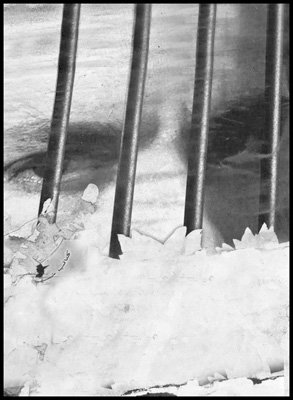

You are missed
© 2012, Rehab Nazzal
Featured Video

The Truth About the Trump Shootings with Ken Silva
or go to
Aletho News Archives – Video-Images
From the Archives
Trans ‘milk’ as good as the real thing – NHS
RT | February 18, 2024
The drug-induced nipple secretions of trans women are as good as mothers’ breast milk for babies, the University of Sussex Hospitals NHS Trust claimed in a letter to campaigners made public in a report by British think tank the Policy Exchange on Sunday.
The healthcare trust’s medical director, Rachel James, argued that the off-label prescription drug cocktail men transitioning to female take in order to produce milk was “similar to the natural hormones which encourage lactation to develop when the baby is newly born.”
“The evidence which is available demonstrates that the milk is comparable to that produced following the birth of a baby,” James wrote in the letter, sent to Children of Transitioners last August.
Biological men who wish to lactate must first take hormones to grow milk glands and then take high doses of either domperidone or metoclopramide to stimulate milk production. Neither drug is approved for this use, though they are occasionally prescribed off-label to biological women who have trouble lactating.
However, domperidone’s own manufacturer, Janssen, warns patients the drug “may cause unwanted side effects affecting the heart in a breastfed baby” and “should be used during breastfeeding only if your physician considers this clearly necessary.” … continue
Blog Roll
 Aletho News
- How Real Is the Impact of Western Sanctions on Israel?
- France, You Are Guilty: How Paris Turned Western Sahara into the Maghreb’s Powder Keg
- 2025 Nature Paper Claiming Worsening Global Drought Gets RETRACTED …Heavily Flawed
- Your Milk Is Not the Problem
- The Truth About the Trump Shootings with Ken Silva
- ARE PATIENTS BEING PROPERLY INFORMED ABOUT OZEMPIC?
- US lawmaker blocks $2.8 billion weapons sale to Israel: Report
- Yemeni army claims responsibility for strikes on sensitive sites in Saudi capital, Aramco facilities in Yanbu
- Iran Judiciary issues indictments against 159 US, Israeli officials for assassination of Leader, commanders
- Turkiye revokes Iranian bank license under US sanctions campaign
- If Americans Knew
- Salah Sarsour’s Legal Team Says DHS Has Not Met Its Burden to Prove He Is Deportable
- An analysis of tax forms by The Intercept show Kraft’s charity and LLC have donated to Friends of the IDF and AIPAC’s super PAC.
- Israeli attacks kill four Palestinians in Gaza – Daily Update
- Inside Gaza’s death trap of collapsing, bombed-out buildings
- The everyday items Israel bans from Gaza every day
- Inside the siege, the ruined buildings of Gaza – Daily Update
- Debunking The Claim That Macklemore Has A “History Of Antisemitism”
- CPJ demands release of arrested Palestinian-US journalist near Bethlehem
- Robert Kraft: The Billionaire Friend of Netanyahu Pulling The Strings Behind the Macklemore/Ed Sheeran Blow Up
- Columbia Administered Fund Gives Big Money to Pro-Israel Groups
- No Tricks Zone
- 2025 Nature Paper Claiming Worsening Global Drought Gets RETRACTED …Heavily Flawed
- New Study: ‘Global Drought Shows No Detectable Recent Acceleration Under Climate Warming’
- Economic Masterminds: German Socialists Suggest Taxing Productivity Gains Stemming From Using AI
- The South China Sea Has Not Been Cooperating With The Climate Change Narrative
- Energy Crisis: Germany Enters Heating Season With Historically Low Gas Reserve Fill Levels
- New Study: The Antarctic Ice Sheet Gained Mass From 2020-2024 Due To Staggering Snow And Ice Accumulation
- Study: Ocean Heating Rates From Thousands Of Years Ago ‘Dwarf’ Modern Ocean Heating Rates
- Climate Extremists Target, Attack Large-Scale Power Grid Infrastructure In Germany!
- New Study: Antarctic Ice Melt Has Contributed Less Than 1 Centimeter To Sea Level Rise In The Last 30 Years
- Fear Of Debate: Alarmist German Climate Scientist Calls On Mainstream Media To Discredit Skeptic Voices
 Aletho News