The Lockdown Advocacy of Devi Sridhar
By Jeffrey A. Tucker | Brownstone Institute | June 20, 2022
The Covid era gave rise not only to popular mania but also to astonishing intellectual pretension. The experts were everywhere. They had all the answers. They knew for certain that a path never tried in anyone’s lifetimes was the certain way to go in order to control a virus. And this fanatical attachment to one goal caused all other considerations to be pushed aside.
The end of the story was baked in from the start. The experts were proven to have massively exaggerated their prowess and understanding of events. On point after point, their models blew up. The epidemic would end the way they always have, through acquired immunity and endemicity. Nowhere did the methods of the vaunted experts achieve the goal; at best they delayed the end point and created tremendous destruction along the way.
Now there is a problem: how to dial it all back without admitting profound error. This is a particular problem for those who wrote books before the story was complete. And by complete I am referring especially to the tremendous waves of infections that came 20 months after lockdowns were first imposed.
A paradigmatic case is Devi Sridhar, professor and chair of global public health at the University of Edinburgh, Scotland. During the pandemic, she became a ubiquitous presence on television for two years both in the UK and the US. Her main message was to advocate and defend lockdowns, masking, mandates, and the entire apparatus of compulsion that characterized the pandemic response in nearly every country in the world. Her message was always geared toward what is called eliminationism or zero Covid.

As a Rhodes scholar in a high prestige position, she was well positioned to be this messenger. She has a compelling way and presents well in the medium. Plus, the message she delivered was the one that earned an official stamp of approval from all mainstream media. She was also a pro at delivering an attitude of disdain toward anyone who dared question the zero Covid story.
Now she has a book out that further elaborates on her point of view. It has the right title: Preventable: How a Pandemic Changed the World and How to Prevent the Next One. It’s a pretentious title, presuming that she knows for certain that the pandemic was preventable and therefore she should be trusted to tell us what to do next time.
What’s striking is the contrast between the certitude of the body of the book in which she is an unapologetic defender of China-style lockdowns and the afterword, which must have been written only days before the book went to print. Here we have a very different tone, discussed toward the end of this review.
Sadly for her, the book came out just before a wave of new lockdowns came to China that wrecked the lives and liberties of hundreds of millions of people and made an enormous mess of the entire economic mission of the country. She must not have had time to revise the manuscript.
Of China, her book says:
The way China set about eliminating SARS-CoV-2 could be described as draconian. It undertook house-to-house testing and removed individuals to quarantine facilities if they tested positive (sometimes against their will); it used tracking technology to trace 99–100 per cent of those who had had contact with the infected; it locked down entire buildings so individuals could not leave their flats or have free movement; and it constructed completely new hospitals within days…
The Chinese government understood well that the virus moves when people move. So it stopped people moving internally…
The efforts to contain the spread within Wuhan were effective and focused on reducing the R number…
These measures to contain spread worked…
[China showed that] containment strategies (however draconian) could be effective at stopping this respiratory pathogen…
The evidence in February 2020 showed that containment was successful…
Within the span of three months, China had eliminated the virus fully within its borders…
This is the same message she delivered to millions day after day for two years.
We could just stop this review here, observing that none of the above turns out to be true. Currently, China faces an enormous problem. If we are to believe the data, vast swaths of China’s population still lack acquired immunity to Covid. Millions or billions need the exposure, and, as with all places in the world, the result for nearly everyone moderately healthy and not elderly will be recovery. This will happen with or without lockdowns.
President Xi Jinping, however, became convinced either by virtue of his ego or his circle of sycophants that his lockdowns two and a half years ago were his greatest achievement. He was celebrated by the World Health Organization and nearly every country in the world copied his brutal methods of virus suppression. He regarded it then as evidence that the CCP was destined to rule the future, by virtue of its masterful social, economic, and now medical management of society.
So of course the CCP cannot turn back now. He has stated repeatedly that there will be no compromise of the zero Covid stance that both he and Dr. Sridhar have long advocated. He must now either continue to threaten and enact lockdowns or figure out some clever way to back away from the position without admitting past error. He may in fact figure it out at some point.
After all, nearly every other government in the world has finally figured it out. Even under the best of assumptions that lockdowns offer some contribution to mitigate the ill-effects of a pathogen, the costs far outweigh those benefits. And those costs not only include economic, educational, and nutritional ones but also costs in terms of deaths from overdoses, despair, and self-harm from the inevitable demoralization from being treated like a prisoner or lab rat.
So I did read Dr. Sridhar’s book in search of some insight as to why she could have made such a profound error. All I found was a relentless and single-minded attachment to a zero Covid agenda, or some version of it, a genuine belief that the right deployment of human force could somehow make a virus go away. It truly boggles the mind.
The rest of the narrative is utterly predictable.
Countries that locked down are good, especially New Zealand and Australia. Countries that did not are bad, especially Sweden but also the UK and the US after reopening. Countries that kept lockdowns longer are good. Countries that opened up too soon are corrupt and rejecting “the science.” The Great Barrington Declaration is bad. Ramdesivir is good while Ivermectin is bad. And so on.
Her hard-core bias extends even to a rousing defense of Rebekah Jones, the low-level data employee in Florida who wrongly accused the Governor’s office of manipulating data in a case that was later tossed out.
The book is so partisan that she sometimes lets her politics even race ahead of her epidemiological position. For example, and this probably won’t surprise you, she comes to the defense of the George Floyd protests even in the midst of lockdowns:
In late May 2020, I was asked whether protesters were wrong to take to the streets. I replied that racism is also a pandemic, and one that Black Americans feel can’t be swept under the carpet any longer. While clearly mass gatherings during a pandemic are risky, I could understand that people were willing to take this risk in order to effect change for their children and the children of their children. This is how the civil rights movement has attempted to progress racial equality over decades.
In any case, you get the point here. She has a tribe and she wants to be its messenger. Still, I struggled through the entire text to see if I could find insight. This one jumped out at me:
While WHO was at the forefront of press briefings and leading technical and normative guidance to the pandemic, the World Bank had the financial power to help governments respond with key policies, whether through building up health systems and testing, putting in place economic packages to support lockdown measures, or in acquiring and distributing vaccines.
There we go: the World Bank subsidized lockdowns. Fascinating. That I did not know. This is a serious problem that needs to be fixed. How many millions face malnutrition as a result?
So much for the body of the book.
Probably the most telling part of the book is the afterword, written January 2022. Here our author jumps in with the latest information, namely that China had not in fact eradicated the virus and now keeps locking down, which she says is due to inferior vaccines. Within a few paragraphs, she – for the first time in the book – recognizes that even the best vaccines do not stop infection and do not stop the spread..
Whoops. Is she willing to rewrite the entire book in light of this last-minute realization that lockdown eliminationism and even mass vaccination cannot achieve the goal? No. Is she willing to rethink? Perhaps a bit but not enough.
While some say we should adapt normal social relations and mixing for the foreseeable future, I struggle with this line of thought. Humans are social: we need to hug, talk, dance, sing, kiss and be around others. We’re not bears or rhinos or other solitary creatures. We like seeing each other’s faces. And we know that a sense of community and connection are vital to wellbeing too. A holistic approach to public health is vital, and this includes not just people’s mental health but also their ability to pay rent, feed their family, stay warm through the winter and have a meaningful role in society, be that going to church or being part of a glee club. For a certain period of time, altering these made sense, so that we could avoid preventable illness and deaths; allow vaccines to be created, trialled and distributed in 2020 and into 2021; allow clinicians to better understand how to treat COVID-19; and allow a better understanding of transmission and risk.
Again, very interesting, especially because the change in tone from the rest of the book is so sharp. She doesn’t come close to repudiating her entire book – and she still believes that totalitarian measures somehow make sense for a “period of time” – but she does say that she is tired and exhausted and perhaps ready for some rethinking.
“I’ve taken a step back from media work… I’ve been testing several times a week, and, while I cautiously avoid crowded spaces, and wear masks on public transport and in shops, I continue to go to the gym and to hot yoga and to see friends outside or in small groups. I’ve found a sustainable way to live alongside COVID-19 for now… You’ve heard enough from me.
These are hopeful signs. It’s possible that even Devi Sridhar might eventually come to see the error of her ways. Or perhaps like most of the exalted experts who assisted in driving the world into the greatest calamity of the modern era, she will quietly disappear from the op-ed pages and television screens and go back to her prior life as a public health professor with degrees in anthropology. At some point, too, she will get Covid and discover with millions of others that it is part of the human experience to get sick and get well and become stronger as a result.
We will wait in vain for any sort of extended literary mea culpas. Not even the pensive afterword comes close. After all, when the next great health crisis presents itself, the WHO pushes for lockdowns again, and the major media empires need some great excuse to order people back home to be glued to the screen, the expertise of these compelling pundits – now with real media experience – will need to be called upon again.
Jeffrey A. Tucker is Founder and President of the Brownstone Institute and the author of many thousands of articles in the scholarly and popular press and ten books in 5 languages, most recently Liberty or Lockdown.
African Governments to Western Eco-Imperialists Who Tell Them Not to Drill Their Own Oil and Gas – Get Lost
By Chris Morrison | The Daily Sceptic | May 5, 2022
It was never going to work. Telling African countries to stop developing their economies by banning cheap, reliable fossil fuel is little more than an eco-imperialist dream. Writing in Monday’s Daily Telegraph, Uganda President Yoweri Museveni lauded the discovery of oil in Lake Albert, but noted it was a battleground for the green NGOs and activists who claim that Armageddon is nigh at every opportunity.
“We are accustomed to these lectures, but we are tired of hearing them,” he added.
For the last decade, the West through the IMF and the World Bank has imposed a moratorium on support for African fossil fuel development – initially coal and more recently oil and gas as well. Museveni notes that in Africa the population is set to double by 2050, “and it is becoming increasingly clear that our energy needs cannot be met with a sudden shift to more expensive and less reliable solar and wind alone”.
Rich Western eco elites, of course, argue that the world must rid itself of fossil fuel as soon as possible. They believe the world is facing climate breakdown, although as articles in the Daily Sceptic show on a regular basis, that belief is backed by surprisingly few scientific facts. These Western elites effectively seek a command-and-control economy based on Net Zero, and a neo-pagan return to ancient Gaia goddess worship that elevates nature as sacred and denigrates humanity as destructive of it.
It might all play better in Africa if so-called global warming could be detected.
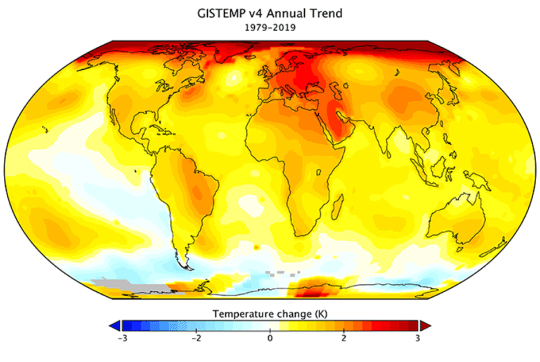
Atmospheric warming over the last 40 years has been more pronounced over the northern hemisphere, despite regular scare stories appearing about equatorial regions becoming uninhabitable. The GISS temperature database is run by NASA, and as with similar datasets it has been subject to considerable recent modifications, with the past cooled and later results warmed. Without these retrospective data adjustments, global recorded warming ran out of steam nearly two decades ago. Nevertheless, the contrast between the north, painted in fiery red, and most of Africa is clear from the GISS map (above).
The Lake Albert project is going ahead following a $10bn investment from the China National Offshore Oil Corporation and Total Energies of France. It includes the building of a 900 mile pipeline to the port of Tanga. According to Real Clear Energy, the project will provide $48.5m in annual payments to Ugandan employees living in one of the least developed countries in the world. But opposition is fierce. Writing in the New York Times the local green agitator Vanessa Nakate of StopEACOP said the project would bring “poverty and destruction to the people of Africa”. It is claimed by her activist group that building the East African crude oil pipeline would tip the world closer to “full blown climate catastrophe”.
It is comments such as these which mostly surface in mainstream media, rather than those of the President of Uganda. It might also be thought that most Africans are less impressed with other solutions advanced in the West to solve any problems caused by growing populations. Sir David Attenborough is on record as stating humans are a plague on the Earth, and it was “barmy” to send food to Ethiopia to solve the famine crisis. In Attenborough’s view, sending flour bags to under-developed countries was pointless.
In public in the West, many African politicians pay lip service to the aims of COP, not least because plenty of aid cash is on offer. Others take a more challenging and outspoken view. N.J. Ayuk is the Executive Chairman of the African Energy Chamber and he recently called the idea that you could develop Africa with handouts, “preposterous and sickening”.
He continued: “You cannot take people of any colour and exempt them from the requirements of civilisation – including work, free markets, behavioural standards, personal responsibility, fossil fuels, financial literacy and all the other basic things that the clever intelligentsia disdain – without ruinous consequences to them and society at large.”
In his view, no country has ever been developed by fancy wind and green hydrogen. Africans see oil and gas as a path to success and a solution to their problems. “The demonisation of oil and gas companies will not work,” he added.
Writing in 2015, the former Chancellor of the Exchequer Nigel Lawson commented that something deep inside the human psyche makes it receptive to apocalyptic warnings. By a cruel irony, he said, too many climate scientists and their hangers-on have become the high priests of a new age of unreason. Asking developing countries to abandon the cheapest available sources of energy is, at the very least, asking them to delay the conquest of malnutrition, to perpetuate the incidence of preventable diseases and to increase the number of premature deaths.
“Global warming orthodoxy is not merely irrational. It is wicked,” he concluded.
Ukraine requests $50bn in aid
Samizdat | April 17, 2022
Ukrainian economic adviser Oleh Ustenko has requested $50 billion in financial support from the G7 countries to cover the budget deficit created by the military conflict with Russia in a television address on Sunday. He said Kiev is also considering issuing 0% coupon bonds to bridge the fiscal gap.
In the meantime, the World Bank is preparing a $1.5 billion support package for Ukraine. The loan will include a $1-billion payment from the development lender’s fund for the poorest countries. The funding comes on top of about $923 million in fast-disbursing financing approved by the World Bank last month.
The US and NATO have also been sending billions of dollars Ukraine’s way, although in the form of military aid rather than cash. The Biden administration just this week approved yet another $800 million in weapons, ammunition, and other military assistance including artillery systems, rounds, armored personnel carriers, and helicopters. It comes less than a month after the Biden administration sent an $800 million bundle of anti-aircraft systems, firearms, ammo, and body armor Kiev’s way on March 16.
Washington’s contribution has been matched by that of the European Union and several individual member states, including Germany and Sweden, some of which have violated their own long-standing policies of not supplying lethal aid to countries at war by flooding Ukraine with anti-tank weapons, Stinger missiles, and armored vehicles, among other military equipment.
However, even amid a constant stream of military aid by the US and NATO allies, Ukrainian President Volodymyr Zelensky tweeted a video calling for the rest of the world to #ArmUkraineNow – complete with a very specific grocery list of desired equipment. Should countries fail to deliver, the Ukrainian leader claimed, Poland, Moldova, Romania, and the Baltic states would quickly fall under the tank treads of the Russian army.
Russia attacked the neighboring state in late February, following Ukraine’s failure to implement the terms of the Minsk agreements, first signed in 2014, and Moscow’s eventual recognition of the Donbass republics of Donetsk and Lugansk. The German and French brokered protocols were designed to give the breakaway regions special status within the Ukrainian state.
The Kremlin has since demanded that Ukraine officially declare itself a neutral country that will never join the US-led NATO military bloc. Kiev insists the Russian offensive was completely unprovoked and has denied claims it was planning to retake the two republics by force.
Russia has repeatedly stated it has no plans to even occupy Ukraine, let alone invade neighboring nations, but the talking point has become a favorite for Zelensky. The president has likened the invasion of his country to various events in World War II, including Pearl Harbor and the Holocaust, as well as the September 11th terror attacks in his efforts to convince the rest of the world to open their hearts as well as their bank accounts to the plight of his country.
Africans Deflect Biden’s Demand To End Fossil Fuel Use
By Duggan Flanakin ~ PA Pundits – International ~ April 17, 2021
As the merger of climate change and COVID panic materializes in front of our eyes, “global leaders” have found plenty developing world voices to join the crusade to “save the planet” from carbon (dioxide) “pollution.” But like their Chinese and Indian counterparts, many Africans, from heads of state to captains of industry and beyond, intend to expand, not shrink, reliance on fossil fuels to build their economies.
According to Oxford University researcher Galina Alova, “Africa’s electricity demand is set to increase significantly as the continent strives to industrialise and improve the well-being of its people,” but those who hope for rapid decarbonization in Africa will likely be disappointed.
Alova’s research found that Africa is likely to double its electricity generation by 2030, with fossil fuels providing two-thirds of the total, hydroelectric another 18 percent, and non-hydro renewables providing less than 10 percent.
Such an energy mix flies in the face of the firm commitment from the fledgling Biden Administration to demand an end to all international financing of fossil fuel based energy projects. Biden climate envoy John Kerry won a strong endorsement from 450 organizations worldwide after telling World Economic Forum members of the “plan for ending international finance of fossil fuel projects with public money.”
The Biden plan, which comports with the Paris climate agreement, echos the call by European Union foreign ministers for an end to financing fossil fuel projects abroad (which means in Africa). Secretary of State Antony Blinken explained that “development finance is a powerful tool for addressing the climate crisis” that the U.S. will use to “help drive investment toward climate solutions.” [Translation: “We intend to ram decarbonization down their throats!”]
Many Africans feel the need to placate their self-appointed betters and accept the climate change tenets.
World Bank veteran Ede Ijjasz and Africa Growth Initiative Director Aloysius Ordu claim that Africans must take advantage of the COVID pandemic to initiate a “great reset” of Africa’s economies according to the UN’s Sustainable Development Goals and the principles of the Paris agreement. The world, they claim, cannot afford to give Africa a pass on decarbonization (though China and India get a pass).
Others prefer a more temperate approach.
In late March, investment professional Tariye Gbadegesin challenged President Biden to prioritize African nations as part of his global climate initiative. While admitting that Africa’s urban centers are swelling, “threatening more emissions,” she asserted that striking a balance between this ongoing development and its climate impact must be a global priority. For example, Nigeria could build a hybrid grid using plentiful natural gas and solar energy. But, Gbadegesin implied, such a hybrid grid would not meet the Biden-EU financing guidelines.
In early April, the African Development Bank (AfDB), the Global Center for Adaptation, and the Africa Adaptation Initiative held a virtual Leaders Dialogue in response to the State of the Climate in Africa 2019 report. Over 30 heads of state and other global leaders committed to prioritize actions that will help African countries both adapt to the presumed impacts of “climate change” and overcome widespread energy poverty. African Union chair Felix Tshisekedi listed “nature-based solutions, energy transition, an enhanced transparency framework, technology transfer, and climate finance” as critical areas for adaptation.
During the meeting, AfDB president Dr. Akinwumi Adesina noted the group intends to mobilize $25 billion in financing for the success of the Africa Adaptation Acceleration Program. “It is time,” he affirmed, “for developed countries to meet their promise of providing $100 billion annually for climate finance. And a greater share of this should go to climate adaptation.”
This African response to the Biden-EU decarbonization initiative – relying on adaptation and balance, not prohibition and eternal poverty, to achieve sustainability — reflects on the 1987 Brundtland Commission report, “Our Common Future.” In the report, the World Commission on Environment and Development defined sustainable development” as development that “meets the needs of the present without compromising the ability of future generations to meet their own needs.”
Commission Chair Gro Harlem Brundtland acknowledged that, “A world in which poverty is endemic will always be prone to ecological and other catastrophe.” In her view, “Meeting essential needs requires not only a new era of economic growth for nations in which the majority are poor, but an assurance that those poor get their fair share of the resources required to sustain that growth.”
Sadly, U.S. and EU (and the UN) climate “monarchs” have long ignored Brundtland’s promises. The UN’s 20-year assessment of the document did not even mention “poverty” or “Africa.” CFACT reported that year that sub-Saharan Africa was “in very short supply of energy and power, especially electricity, and overland trade [was] greatly hindered by an almost total lack of infrastructure.” Worse. curable diseases ran rampant as people relied on toxic dung and wood for heating and cooking.
At the 2011 UN climate conference in Durban, South Africa, nuclear physicist (and CFACT advisor) Kelvin Kemm reported that the African representatives were not happy. “Their general feeling,” he recounted, “was that the First World is trying to push Africa around, bully African countries into accepting its opinions, and, even worse, adopting its supposed ‘solutions’.”
That feeling remains. Responding to the Biden-EU renewables-only energy financing plan, W. Gyude Moore, a senior fellow at the Center for Global Development and former Liberian minister of public works, mused that, “There’s this idea that because Africa is lacking in legacy infrastructure, it’s a good canvas to paint the energy future. But no African country has volunteered itself for that.”
With nearly 600 million Africans lacking access to electricity, Moore added, “it seems immoral to restrict options for energy sources” for the world’s poorest continent. Later, Moore, with Vijaya Ramachandran of The Breakthrough Institute, wrote that a ban on oil and gas projects in Africa would stifle economic growth and thus make poor populations even more vulnerable to climate change impacts.
Moore and Ramachandran explained that the top priority in most African countries is economic growth, first in agriculture, then in industry and services. For most Africans, worries of an increased carbon footprint generated from economic growth are a weak second to worries that growth may not happen at all. In their view, people in poverty don’t just need to power a single lightbulb at home; they need abundant, affordable energy at work too.
Overall, Moore and Ramachandran noted, Africa’s needs are too great to be met solely with current green energy technologies. Its finances too stretched to be able to afford the cost of carbon-neutral energy. Keeping Africa poor to fight climate change will do nothing to help the people most affected by it. But President Biden, his EU allies, and the “green 450” disagree.
This arrogance makes it quite clear that “Our Common Future” is still in the future, if at all.
The difference is that, today, Africans are no longer waiting for the UN, the International Monetary Fund, the World Bank, or even the African Development Bank to finally invest in sorely needed African infrastructure.
By hook or by crook, Africans are committed to using available resources to do the job.
Duggan Flanakin is the Director of Policy Research at the Committee For A Constructive Tomorrow. A former Senior Fellow with the Texas Public Policy Foundations, Mr. Flanakin authored definitive works on the creation of the Texas Commission on Environmental Quality and on environmental education in Texas.
World Bank approves $250m loan to Morocco
MEMO | December 16, 2020
The World Bank has agreed to grant Morocco $250 million to support local agricultural, as part of a joint operation with the French Development Agency.
This came in a statement issued by the World Bank on Wednesday, after its executive board approved the loan on Tuesday.
The loan aims to support the Generation Green programme, a government strategy for developing agriculture.
The statement announced: “The funding will also support the country’s economic response to the coronavirus pandemic.”
The loan will finance entrepreneurship and training programmes for villages’ youth, with a view to attracting private investments into the agricultural food products sector, and removing regulatory and financing obstacles to stimulate the creation of job opportunities.
According to official statistics, the agricultural sector contributes about 14 per cent of the gross domestic product (GDP). It presents an important source of employment for 75 per cent of the country’s villagers.
Sorry, Google and World Bank, but Middle Eastern Crops Keep Thriving
By H. Sterling Burnett | ClimateRealism | November 4, 2020
Google News today is promoting articles (see the Google-promoted PhysOrg article here, for example) about a speculative World Bank “study” claiming climate change is threatening crop production in the Middle East. The World Bank study is full of speculation but short on facts. Real-world data show crop yields per acre and total crop production are consistently and dramatically rising in each of the Middle East countries examined by the World Bank study.
In its study, titled “Water in the Balance,” the World Bank says, “[w]hile information about water scarcity at present and in the future is available there is little knowledge of what this increasing scarcity means for Middle Eastern … food security. Agriculture will suffer because of climate change and water scarcity….”
In particular the World Bank asserts water scarcity caused by climate change will reduce farm production in Iran, Iraq, Jordan, Lebanon, Syria, and Turkey. The available evidence strongly suggests that will not happen.
Had the study’s authors examined real-world data concerning crop production in the Middle Eastern countries, they would have found, even amidst substantial strife in the region, crop yields and overall production have increased dramatically. More food is being produced even as thousands of acres of agricultural lands have been abandoned during regional conflicts.
Data from the U.N. Food and Agriculture Organization show during the period of modest warming since 1989:
- Cereal crop production in Iraq increased 91 percent, even as the acreage being harvested fell 5 percent.
- Cereal crop production in Iran increased 187 percent, while the acreage harvested increased by just 2.6 percent.
- Cereal Crop production in Jordan increased 15 percent, even as the acreage harvested declined 30 percent.
- Cereal Crop production in Lebanon increased 115 percent, while acreage harvested increased 30 percent.
- Cereal Crop production in Syria increased 22 percent, even as acreage harvested declined 66 percent.
- Cereal Crop production in Turkey increased 46 percent, even though acreage harvested declined 19 percent.
It is clearly good news – and not a climate crisis – that Middle Eastern countries have increased crop production despite the fact that many of them have been embroiled in internal political strife, outright civil warfare, and external conflicts. That good news is ignored in the World Bank’s doom-and-gloom report.
Global warming lengthens growing seasons, reduces frost events, and makes more land suitable for crop production. Also, carbon dioxide is an aerial fertilizer for plant life. In addition, crops also use water more efficiently under conditions of higher carbon dioxide, losing less water to transpiration. The latter fact should have allayed the World Bank’s concern about climate change induced water shortages leading to crop failure.
The benefits of more atmospheric carbon dioxide and a modestly warming world have resulted in 17 percent more food being available per person today than there was 30 years ago, even as the number of people has grown by billions. Indeed, the last 20 years have seen the largest decline in hunger, malnutrition, and starvation in human history.
Sorry, World Bank, Google, and PhysOrg, but that does not equate to a climate crisis.
H. Sterling Burnett, Ph.D. is managing editor of Environment & Climate News and a research fellow for environment and energy policy at The Heartland Institute. Burnett worked at the National Center for Policy Analysis for 18 years, most recently as a senior fellow in charge of NCPA’s environmental policy program. He has held various positions in professional and public policy organizations, including serving as a member of the Environment and Natural Resources Task Force in the Texas Comptroller’s e-Texas commission.
Sudan to Compensate Families of USS Cole Victims
teleSUR | February 13, 2020
The new Sudanese government has agreed to compensate the families of sailors killed in an Al-Qaeda attack on the USS Cole warship 20 years ago, state news agency SUNA said on Thursday, part of government efforts to remove the country from a list of state sponsors of terrorism.
The report said the settlement had been signed on Feb. 7. It did not mention the amount paid in compensation, but a source with knowledge of the deal, speaking on condition of anonymity, said that Sudan had agreed to settle the case for $30 million.
The 17 sailors were killed, and dozens of others injured, in the attack on Oct. 12, 2000, when two men in a small boat detonated explosives alongside the Navy guided missile destroyer as it was refueling in the southern Yemeni port of Aden.
Khartoum agreed to settle “only for the purpose of fulfilling the condition set by the U.S. administration to remove Sudan from its list of state sponsors of terrorism”, SUNA said, citing the justice ministry.
Being designated as a state sponsor of terrorism makes Sudan ineligible for desperately needed debt relief and financing from lenders such as the International Monetary Fund and World Bank.
Removal from the list potentially opens the door for foreign investment.
“The government of Sudan would like to point out that the settlement agreement explicitly affirmed that the government was not responsible for this incident or any terrorist act,” the justice ministry said in its statement, cited by SUNA said.
The announcement comes two days after Khartoum and rebel groups agreed that all those wanted by the International Criminal Court for alleged war crimes and genocide in the Darfur region should appear before the tribunal. The list includes Sudan’s ousted president Omar al-Bashir.
The U.S. sailors’ relatives had sued Sudan under the 1976 Foreign Sovereign Immunities Act, which generally bars suits against foreign countries except those designated by the United States as a sponsor of terrorism, as Sudan has been since 1993.
Sudan did not defend against the claims in court. In 2014, a trial judge found that Sudan’s aid to al Qaeda “led to the murders” of the 17 Americans and awarded the families about $35 million, including $14 million in punitive damages.
Sudan then tried to void the judgment, arguing the lawsuit was not properly served on its foreign minister, violating notification requirements under U.S. and international law.
The U.S. Supreme Court turned down the bid by the families last year.
Nicaragua’s Sandinista Achievements Baffle World Bank, IMF
teleSUR | August 31, 2017
No one can take at face value any report, governmental or quasi non-governmental, coming out of the imperialist bureaucracy in Washington. Ideological bias and institutional self-justification prevent these reports from giving a true account of virtually anything.
The latest World Bank report on Nicaragua is no exception.
The implicit but unstated truth in this report is that President Daniel Ortega and the Sandinista National Liberation Front have achieved an unprecedented economic turnaround in just seven years, starting in 2010.
Reading the report, it is impossible to ignore the tension between latent ideological and political imperatives and the obligation to report the facts. Put another way, mild conflict clearly prevails between the World Bank’s Washington head office and its reality based local officials. From Washington, the tendency is both to minimize Ortega’s achievement and also to cover up the World Bank’s own lamentable history in Nicaragua. On the other hand, in Nicaragua, local World Bank staff dutifully report the facts as they see them.
A total of 71 people contributed to the report. Supposing those 71 people each worked for a month to prepare the research and say their average salary was about US$80,000, then pro rata a month’s work by that team cost over US$500,000, a very conservative guess. Even so, in summary, that money bought policy recommendations for Nicaragua’s development amounting to little more than better infrastructure; better basic services; more private business investment; more efficient government; better targeted social policies. That’s it, for US$500,000 or more.
In general, the report recognizes Nicaragua’s achievements in reducing poverty and inequality, raising productivity, diversifying economic activity and promoting security and stability. The report’s 130 or so pages include, among the economic and sociological analysis, many self-confessed guesses to fill in “knowledge gaps” and much gerrymandered history to cover up what Harold Pinter in his 2005 Nobel prize winning address justly called “the tragedy of Nicaragua.”
Pinter himself might have remarked the report is almost witty in its audacious, glib omissions. It acknowledges the catastrophic destructive effects of the 1980s war in Nicaragua, but carefully omits the U.S. government’s deliberate role in that destruction, now repeated against Syria and Venezuela.
The report talks about a “democratic transition” starting in 1990. In fact, the Sandinistas organized the first free and fair democratic elections ever in Nicaragua in 1984, but the U.S. government ordered the main Nicaraguan opposition to boycott them. Despite the war, Ortega and the Sandinistas won with 67 percent of the vote, very similar to the most recent presidential elections in 2016.
The heavy ideological bias also explains the World Bank’s curious dating of when Nicaragua’s economic turnaround began, placing it firmly in the neoliberal era prior to 2007. But at just that time, the World Bank was cutting back the public sector as much as they could, pushing, for example, to privatize Nicaragua’s public water utility and its education system.
Back then, Nicaragua’s neglected electrical system collapsed through 2005 and 2006, incapable of generating even 400 megawatts a day, plunging swathes of Nicaragua back into 19th-century darkness for 10 to 12 hours at a time, day after day. That was the World Bank and IMF’s gift to Nicaragua after 17 years of so-called “democratic transition.” That period included Hurricane Mitch, devastating Nicaragua to the tune of 20 percent of its GDP, only for the corrupt neoliberal government at the time to misuse hundreds of millions of dollars in disaster relief. The only structurally significant economic achievement of the neoliberal era in Nicaragua was substantial foreign debt relief.
When Ortega took office in January 2007, he faced four years of domestic crisis with an opposition controlled legislature persistently sabotaging his government’s programs. From 2007 to 2008, Nicaragua and the whole region struggled in vain to contain a balance of payment deficits against oil prices reaching US$147 a barrel in 2008.
That disaster was compounded by the collapse of the Western financial system in late 2008 to 2009, a year when Nicaragua’s economy suffered a 3 percent contraction. Only in 2010, did the Nicaraguan government finally enjoy domestic and international conditions stable enough to be able to consolidate and improve its social programs, improve infrastructure investment, democratize and diversify the economy, extend basic services, and attract foreign investment, among other things.
If that sounds suddenly familiar, it should. It is exactly the development recipe offered up by this latest World Bank report, essentially an embellished review of policies the Nicaraguan government has already been implementing for a decade. Put positively, the government’s National Human Development Plan and other relevant documents suggest that the World Bank’s engagement with the Nicaraguan government has been one of mutual learning. So much so, that the current country program is likely to continue and may even expand.
The political opposition in Nicaragua has seized on parts of the report to try and discredit the Sandinista government’s outstanding achievements. In fact, for 17 years under neoliberal governments implementing World Bank and IMF policies, areas criticized like, for example, access to drinking water and adequate sanitation, or education, suffered chronic lack of investment, compounded by egregious waste and corruption. Now, the World Bank hypocritically criticizes Nicaragua’s government for intractable policy difficulties the IMF and the World Bank themselves originally provoked.
Similarly, when the World Bank report criticizes the targeting of social programs, they omit the unquestionable success of the government’s Zero Usury micro credit program and the Zero Hunger rural family support program, both prioritizing women. These programs have lifted tens of thousands of families out of poverty and, along with unprecedented support for Nicaragua’s cooperative sector, radically democratized Nicaragua’s economy, especially for previously excluded rural families and women. That supremely important national process is entirely absent from the World Bank report.
In its discussions of almost all these issues, the report makes more or less detailed contributions, mostly already identified by the government itself. In every case, the underlying cause of problems or lack of progress, for example, on land titling or social security, has been the legacy of neoliberal governments between 1990 and 2007, that reinstated elite privilege, rolled back the revolutionary gains of the 1980s and failed to guarantee necessary investment.
The World Bank and the IMF were enthusiastic ideological partners in that endeavor. They would have continued their ideological offensive had not Ortega and his government dug in their heels in 2007 and 2008, backed by investment support for social and productive programs from Venezuela as part of the Bolivarian Alliance of the Americas.
Since then, the World Bank, as this report suggests, seems, at least for the moment, to have learned two key lessons from the Sandinistas. In a world dominated by corporate elite globalization, their report implicitly recognizes the importance, firstly, of a mixed economy under a strong central government and, secondly, the crucial role of broad dialogue and consensus, across all sectors of society, to promote and sustain national stability. Essentially, the World Bank has acknowledged the undeniable success of the Sandinista Revolution’s socialist inspired, solidarity based policies, decisively prioritizing the needs of people over corporate profit and demonstrating the systemic inability of capitalism to meet those needs.
Protests in Western Sahara against solar and wind plant construction
MEMO |November 8, 2016
Protests erupted yesterday in the Western Sahara over the construction of renewable energy plants without the permission of the Sahrawi people.
The protests, which took place in the capital Laayoune, coincided with the United Nation’s COP22 conference on climate change yesterday in Marrakech.
Siemens and Enel are building solar and wind plants in the region
“Siemens should not back Morocco’s occupation of Western Sahara through energy infrastructure,” the Western Sahara Resource Watch (WRSW) said on social media.
Siemens has constructed 22 new renewable energy plants in the Western Sahara, which power over 95 per cent of mineral extraction plants in the Sahrawi region.
The World Bank, the European Investment Bank, and the European Union have previously refused to finance development projects in Western Sahara.
“If we support those investments, it would look like we are supporting the Moroccan position. We are neutral regarding that conflict,” a banker told Reuters.
The contested region has recently been engrossed in tensions between Morocco and the Sahrawi Polisario Front which has been ongoing since 1975.
How the Australian, British, and US Governments Shamelessly Helped Kill Countless People in Indonesia in 1965
Asia-Pacific Research – July 23, 2016
The Hague-based International People’s Tribunal has ruled that the Indonesian regime that replaced Indonesian President Sukarno committed crimes against humanity in 1965. The governments of Australia, Britain, and the United States have also been pronounced guilty as complicit partners in the massacre of 500,000 to 1000,000 people or more in Indonesia. People were murdered in Indonesia due to their principles, political ideology, ethnic backgrounds, and opposition to foreign influence. Albeit the ruling is an important historical acknowledgment, the assistance that the Australian, British, and US governments provided to the coup and played in the massacres is not a secret.
Asia-Pacific Research presents these excerpts from the Australian journalist John Pilger’s book The New Rulers of the World, which was published by Verso in 2002, in the interest of providing the historical background about the massacres that took place in Indonesia. Reading them will educate one on the despicable and criminal roles that Australia, Britain, and the US played. ”There were bodies being washed up on the lawns of the British consulate in Surabaya, and British warships escorted a ship full of Indonesian troops down the Malacca Straits so that they could take part in this terrible holocaust,” for example Pilger writes. In his work John Pilger also notes that the US was directly involved in the operations of the death squads and helped compile the lists of people to be murdered while the Australian, British, and US media were used as propaganda tools to whitewash the coup and bloodbaths in Indonesia. A key point, however, that is emphasizes is that the underlying economic motivations and plunder hidden behind the ideological discourse of the Cold War that really motivated the massacres in Indonesia. – Mahdi Darius Nazemroaya, Asia-Pacific Research Editor, 22 July 2016.

Indonesians preparing to die in a mass grave
Excerpts from The New Rulers of the World (Verso)
John Pilger, 2002
… according to a CIA memorandum, Prime Minister Harold Macmillan and President John Kennedy had agreed to ‘liquidate President Sukarno, depending on the situation and available opportunities’. The CIA author added, ‘It is not clear to me whether murder or overthrow is intended by the word liquidate.’
Sukarno was a populist, the founder of modern Indonesia and of the non-aligned movement of developing countries, which he hoped would forge a genuine ‘third way’ between the spheres of the two superpowers. In 1955, he convened the ‘Asia-Africa Conference’ in the Javanese hill city of Bandung. It was the first time the leaders of the developing world, the majority of humanity, had met to forge common interests: a prospect that alarmed the western powers, especially as the vision and idealism of nonalignment represented a potentially popular force that might seriously challenge neo-colonialism. The hopes invested in such an unprecedented meeting are glimpsed in the faded tableaux and black-and-white photographs in the museum at Bandung and in the forecourt of the splendid art deco Savoy Hotel, where the following Bandung Principles are displayed:
I – Respect for fundamental human rights and the principles of the United Nations Charter.
2 – Respect for the sovereignty and territorial integrity of all nations.
3 – The recognition of the equality of all peoples.
4 – The settlement of disputes by peaceful means.
Sukarno could be a democrat and a demagogue. For a time, Indonesia was a parliamentary democracy, then became what he called a ‘guided democracy’. He encouraged mass trade unions and peasant, women’s and cultural movements. Between 1959 and 1965, more than 15 million people joined political parties or affiliated mass organisations that were encouraged to challenge British and American influence in the region. With 3 million members, the PKI was the largest communist party in the world outside the Soviet Union and China. According to the Australian historian Harold Crouch, ‘the PKI had won widespread support not as a revolutionary party but as an organisation defending the interests of ‘the poor within the existing system’. It was this popularity, rather than any armed insurgency, that alarmed the Americans. Like Vietnam to the north, Indonesia might ‘go communist’ .
In 1990, the American investigative journalist Kathy Kadane revealed the extent of secret American collaboration in the massacres of 1965-66 which allowed Suharto to seize the presidency. Following a series of interviews with former US officials, she wrote, ‘They systematically compiled comprehensive lists of communist operatives. As many as 5,000 names were furnished to the Indonesian army, and the Americans later checked off the names of those who had been killed or captured.’ One of those interviewed was Robert J Martens, a political officer in the US embassy in Jakarta. ‘It was a big help to the army,’ he said. ‘They probably killed a lot of people and I probably have a lot of blood on my hands, but that’s not all bad. There’s a time when you have to strike hard at a decisive moment.’ Joseph Lazarsky, the deputy CIA station chief in Jakarta, said that confirmation of the killings came straight from Suharto’s headquarters. ‘We were getting a good account in Jakarta of who was being picked up,’ he said. ‘The army had a “shooting list” of about 4,000 or 5,000 people. They didn’t have enough goon squads to zap them all, and some individuals were valuable for interrogation. The infrastructure [of the PKI] was zapped almost immediately. We knew what they were doing . . . Suharto and his advisers said, if you keep them alive you have to feed them.’
Having already armed and equipped much of the army, Washington secretly supplied Suharto’s troops with a field communications network as the killings got under way. Flown in at night by US air force planes based in the Philippines, this was state-of-the-art equipment, whose high frequencies were known to the CIA and the National Security Agency advising President Johnson. Not only did this allow Suharto’s generals to co-ordinate the killings, it meant that the highest echelons of the US administration were listening in and that Suharto could seal off large areas of the country. Although there is archive film of people being herded into trucks and driven away, a single fuzzy photograph of a massacre is, to my knowledge, the only pictorial record of what was Asia’s holocaust.
The American Ambassador in Jakarta was Marshall Green, known in the State Department as ‘the coupmaster’. Green had arrived in Jakarta only months earlier, bringing with him a reputation for having masterminded the overthrow of the Korean leader Syngman Rhee, who had fallen out with the Americans. When the killings got under way in Indonesia, manuals on student organising, written in Korean and English, were distributed by the US embassy to the Indonesian Student Action Command (KAMI), whose leaders were sponsored by the CIA.
On October 5, 1965, Green cabled Washington on how the United States could ‘shape developments to our advantage’. The plan was to blacken the name of the PKI and its ‘protector’, Sukarno. The propaganda should be based on ‘[spreading] the story of the PKI’s guilt, treachery and brutality’. At the height of the bloodbath, Green assured General Suharto: ‘The US is generally sympathetic with and admiring of what the army is doing.” As for the numbers killed, Howard Federspiel, the Indonesia expert at the State Department’s Bureau of Intelligence and Research in 1965, said, ‘No one cared, as long as they were communists, that they were being butchered. No one was getting very worked up about it.’
The Americans worked closely with the British, the reputed masters and inventors of the ‘black’ propaganda admired and adapted by Joseph Goebbels in the 1930s. Sir Andrew Gilchrist, the Ambassador in Jakarta, made his position clear in a cable to the Foreign Office: ‘I have never concealed from you my belief that a little shooting in Indonesia would be an essential preliminary to effective change.’ With more than ‘a little shooting’ under way, and with no evidence of the PKI’s guilt, the embassy advised British intelligence headquarters in Singapore on the line to be taken, with the aim of ‘weakening the PKI permanently’ .
Suitable propaganda themes might be: PKI brutality in murdering Generals and [Foreign Minister] Nasution’s daughter . . . PKI subverting Indonesia as agents of foreign Communists . . . But treatment will need to be subtle, e.g. (a) all activities should be strictly unattributable, (b) British participation or co-operation should be carefully concealed.
Within two weeks, an office of the Foreign Office’s Information Research Department (IRD) had opened in Singapore. The IRD was a top-secret, cold war propaganda unit headed by Norman Reddaway, one of Her Majesty’s most experienced liars. It would be salutary for journalists these days to study the critical role western propaganda played then, as it does now, in shaping the news. Indeed, Reddaway and his colleagues manipulated the press so expertly that he boasted to Gilchrist in a letter marked ‘secret and personal’ that the story he had promoted – that Sukarno’s continued rule would lead to a communist takeover – ‘went all over the world and back again’ . He described how an experienced Fleet Street journalist agreed ‘to give exactly your angle on events in his article … . i.e. that this was a kid glove coup without butchery.’
Roland Challis, the BBC’s South-East Asia correspondent, was a particular target of Reddaway, who claimed that the official version of events could be ‘put almost instantly back to Indonesia via the BBC’. Prevented from entering Indonesia along with other foreign journalists, Challis was unaware of the extent of the slaughter. ‘It was a triumph for western propaganda,’ he told me. ‘My British sources purported not to know what was going on, but they knew what the American plan was. There were bodies being washed up on the lawns of the British consulate in Surabaya, and British warships escorted a ship full of Indonesian troops down the Malacca Straits so that they could take part in this terrible holocaust. It was only much later that we learned the American embassy was supplying names and ticking them off as they were killed. There was a deal, you see. In establishing the Suharto regime, the involvement of the IMF and the World Bank was part of it. Sukarno had kicked them out; now Suharto would bring them back. That was the deal.’
With Sukarno now virtually powerless and ill, and Suharto about to appoint himself acting president, the American press reported the Washington-backed coup not as a great human catastrophe, but in terms of the new economic advantages. The massacres were described by Time as ‘The West’s Best News in Asia’. A headline in US News and World Report read: ‘Indonesia: Hope . . . where there was once none’. The renowned New York Times columnist James Reston celebrated ‘A gleam of light in Asia’ and wrote a kid-glove version that he had clearly been given. The Australian Prime Minister Harold Holt, who was visiting the US, offered a striking example of his sense of humour: ‘With 500,000 to a million communist sympathisers knocked off,’ he said approvingly, ‘I think it’s safe to assume a reorientation has taken place.’
Holt’s remark was an accurate reflection of the complicity of the Australian foreign affairs and political establishment in the agony of its closest neighbour. The Australian embassy in Jakarta described the massacres as a ‘cleansing operation’. The Australian Ambassador, KCO Shann, enthused to Canberra that the Indonesian army was ‘refreshingly determined to do over the PKI’, adding that the generals had spoken approvingly of the reporting on Radio Australia, which he described as ‘a bit dishonest’.’ In the Prime Minister’s Department, officials considered supporting ‘any measures to assist the Indonesian army … cope with the internal situation’.
In February 1966, [British] Ambassador Gilchrist wrote a report on the scale of the massacres based on the findings of the Swedish Ambassador, who had toured central and eastern Java with his Indonesian wife and had been able to speak to people out of earshot of government officials. Gilchrist wrote to the Foreign Office: ‘The Ambassador and I had discussed the killings before he left [on the tour] and he had found my suggested figure of 400,000 quite incredible. His enquiries have led him to reconsider it a very serious under-estimate. A bank manager in Surabaya with twenty employees said that four had been removed one night and beheaded . . . A third of a spinning factory’s technicians, being members of a Communist union, had been killed … The killings in Bali had been particularly monstrous. In certain areas, it was felt that not enough people [emphasis in the original] had been killed.’
On the island of Bali, the ‘reorientation’ described by Prime Minister Holt meant the violent deaths of at least 80,000 people, although this is generally regarded as a conservative figure. The many western, mostly Australian, tourists who have since taken advantage of cheap package holidays to the island might reflect that beneath the car parks of several of the major tourist hotels are buried countless bodies.
The distinguished campaigner and author Carmel Budiardjo, an Englishwoman married to a tapol and herself a former political prisoner, returned to Indonesia in 2000 and found ‘the trauma left by the killings thirty-five years ago still gripping many communities on the island’. She described meeting, in Denpasar, fifty people who had never spoken about their experiences before in public. ‘One witness,’ she wrote, ‘who was 20 years old at the time calmly told us how he had been arrested and held in a large cell by the military, 52 people in all, mostly members of mass organisations from nearby villages. Every few days, a batch of men was taken out, their hands tied behind their backs and driven off to be shot. Only two of the prisoners survived . . . Another witness, an ethnic Chinese Indonesian, gave testimony about the killing of 103 people, some as young as 15. In this case, the people were not arrested but simply taken from their homes and killed, as their names were ticked off a list.’
[…]
‘In the early sixties,’ he said, ‘the pressure on Indonesia to do what the Americans wanted was intense. Sukarno wanted good relations with them, but he didn’t want their economic system. With America, that is never possible. So he became an enemy. All of us who wanted an independent country, free to make our own mistakes, were made the enemy. They didn’t call it globalisation then; but it was the same thing. If you accepted it, you were America’s friend. If you chose another way, you were given warnings, and if you didn’t comply, hell was visited on you. But I am back; I am well; I have my family. They didn’t win.’
Ralph McGehee, a senior CIA operations officer in the 1960s, described the terror in Indonesia from 1965 – 66 as a ‘model operation’ for the American-run coup that got rid of Salvador Allende in Chile seven years later. ‘The CIA forged a document purporting to reveal a leftist plot to murder Chilean military leaders,’ he wrote, ‘[just like] what happened in Indonesia in 1965.’ He says Indonesia was also the model for Operation Phoenix in Vietnam, where American-directed death squads assassinated up to 50,000 people. ‘You can trace back all the major, bloody events run from Washington to the way Suharto came to power,’ he told me. ‘The success of that meant that it would be repeated, again and again.’
[…]
Indonesia, once owing nothing but having been plundered of its gold, precious stones, wood, spices and other natural riches by its colonial masters, the Dutch, today has a total indebtedness estimated at $262 billion, which is 170 per cent of its gross domestic product. There is no debt like it on earth. It can never be repaid. It is a bottomless hole.
Copyright © Asia-Pacific Research, Asia-Pacific Research, 2016
Featured Video

America Racing to Strategic Defeat in Iran
or go to
Aletho News Archives – Video-Images
From the Archives
Should Europeans ‘Thank’ the Americans for Destroying Nord Stream?
By Robert Bridge | Strategic Culture Foundation | September 29, 2022
With an investigation continuing into the destruction of the Nord Stream gas pipeline that provided energy supplies to Europe from Russia, there appears to be just one prime suspect, and that should surprise nobody.
Following the sabotage of the Nord Stream 1 and 2 gas pipelines, former Polish Foreign Minister Radoslaw Sikorski already seemed to know the identity of the perpetrator when he tweeted out: “Thank you, USA.”
At first glance, it seemed that Sikorski was speaking sarcastically, berating Washington for carrying out an attack that will have severe repercussions for the people of Europe. After all, how could anyone see any good coming from the termination of Europe’s primary source of gas reserves with winter just around the corner? It was Sikorski’s homeland of Poland, after all, that urged its citizens to collect firewood in the face of dwindling gas reserves.
In fact, the Polish diplomat was speaking one-hundred percent literally… continue
Blog Roll
 Aletho News
- Growing insecurity, soaring prices fuel protests in north as regime bans evacuation: Sources
- Iran denies responsibility for ‘depraved’ attack on Kuwait desalination plant
- Bring The Troops Back. End This War Now!
- Can we please stop calling Israel the ‘only democracy in the Middle East’ now?
- US should start removing its troops for Germany, proposes AfD co-leader Chrupalla
- Iran Red Crescent: 600 educational centers attacked in US-Israeli ‘war crimes’
- Russian Oil Tanker Arrives in Cuba Amid U.S. Blockade
- America Racing to Strategic Defeat in Iran: Lt Col Daniel Davis
- FTC Warns Visa, Mastercard, PayPal, Stripe Over Political Debanking
- Russian tanker approaches Cuba despite US oil blockade
- If Americans Knew
- Israeli police block Catholic cardinal from entering Church of the Holy Sepulchre on Palm Sunday
- Israel is assassinating journalists again, more than any other nation, anywhere, ever – Not a ceasefire Day 170
- Over 300 US service members wounded, majority have brain injuries – Not a ceasefire Day 169
- Researchers at Human Rights Watch Resign Over Blocked Report on Palestinian Refugee Return
- Jewish Groups Are Backing a War Americans Don’t Want
- Eric Fingerhut Thinks He’s the President of the Jews
- Top Jewish Philanthropists, Rabbis Urge Israeli President to Take Action Against ‘Jewish Extremists’
- Don’t Be Fooled. Zionist Leaders Have Always Wanted to Control Southern Lebanon
- Israel’s widespread use of torture is a core element of its genocide against the Palestinian people
- In Israel’s War on Iran, Many Middle East US Bases Rendered “All But Uninhabitable”
- No Tricks Zone
- New Study Finds Warming Saves Lives…Cold Temperatures 12 Times More Deadly Than Excess Heat
- German Science Blog Accuses PIK Climate Institute Of Hallucinating Climate Tipping Points
- Devastating Assessment Of Comirnaty Vaccine By Former Senior Pfizer Europe Toxicologist
- New Study: CO2 Is ‘Effectively Negligible’ As An Explanatory Climate Change Factor Since 2000
- Former Pfizer Toxicologist Dr. Helmut Sterz Tells Bundestag Hearing Pfizer Vaccine Should Have Never Been Approved
- Energy Expert: Germany’s Nuclear Phaseout Was A “500 Billion Euro Mistake”
- New Research: South Australia’s Mid-Holocene Sea Surface Temperatures Were 4°C Warmer Than Today
- Storing Green Energy To Last Germany 10 Days Would Require A 60-Million Tonne Battery
- New Studies: UK Sea Levels Were 4 Meters Higher Than Today During The Mid-Holocene
- Destructive Green New Deal: German Energy And Metal Group Warns Of Drastic Crisis
 Aletho News