Israel’s destruction of Gaza’s sewage system triggers algal bloom, shutting down Israeli desalination plants

The Cradle | September 5, 2026
Israel’s destruction of Gaza’s water and sewage infrastructure has backfired into a domestic water emergency, with five of Israel’s six desalination plants supplying over 80 percent of Israeli drinking water shut down after an enormous algal bloom choked the coastline, Haaretz reported on 3 September.
Scientists cite two aggravating factors behind the algae – elevated sea temperatures and nutrient loads from Gaza’s sewage – which has poured untreated into the Mediterranean since Israeli bombardment deliberately destroyed the besieged enclave’s sanitation network.
The algae originated as microalgae in the Nile Delta and traveled east on sea currents, according to the satellite imagery firm Satalize, which recorded dense chlorophyll readings in the water as far north as Tel Aviv and lighter traces up to Caesarea.
With flow through the national supply lines weakening, the Israel Water Authority ordered local councils to curb consumption for farming, gardening, and other public use, while the Israeli government completely shut off external water supplies to Gaza.
The self-inflicted blowback comes after nearly three years of Israeli bombardment left close to 90 percent of Gaza’s water and sanitation infrastructure damaged or destroyed throughout the genocide in the strip, including desalination units, wells, reservoirs, and distribution networks.
All six of the besieged enclave’s wastewater treatment plants have been knocked out of service, along with the overwhelming majority of sewage pumping stations during Israel’s genocide of Palestinians in Gaza.
Roughly 40,000 cubic meters of untreated waste now empties into the sea every day, with a further 15,000 cubic meters draining into the ground through cesspits and broken lines.
The collapse has poisoned Gaza’s coastal aquifer and driven cholera and other water-borne diseases through a population already facing starvation and lacking proper healthcare due to Israel’s genocide, with the rainy season set to deepen the contamination.
Israeli blockade on fuel, spare parts, and equipment classed as dual-use has strangled every attempt to repair the ruined facilities.
Israel’s targeting of Gaza’s water and sewage systems was a deliberate campaign to manufacture the conditions for the spread of disease throughout the enclave, and render life unbearable for its almost 2 million residents by stripping them of the basic requirements for survival.
German sponsorship of Zionist settlements exposed
By Kit Klarenberg | Al Mayadeen | September 5, 2026
Exploiting academic institutions as a cover, between 2017 – 2021 the German government surreptitiously funnelled millions into a highly discriminatory project facilitating expansion of Zionist settlements in the occupied West Bank. Under its auspices, public money and knowledge production were committed to an inherently unlawful, immoral enterprise in flagrant breach of Berlin’s international legal obligations, and domestic restrictions on academic research efforts. The unknown scandal is just one component of how, in plain sight, Germany covertly assists Zionist settlement expansion, and Palestine’s total erasure.
These are the shocking findings of a collaborative investigation by a cluster of German student Palestine solidarity organisations, including Not In Our Name, and Academic Opposition. Their report is a groundbreaking effort, critically examining German state-sponsored water research in conjunction with Zionist entity institutions. It’s a silent conspiracy vast in scope, involving multiple state and quasi-state entities in Berlin and Tel Aviv financing academic research in seemingly innocuous fields, which directly abets Zionist ethnic cleansing and land seizure in the West Bank and beyond.
The investigation focuses on a single project to emerge from the dark alliance between German and Israeli academia, known as MedWater. For four years, Berlin funded a consortium coordinated by the Technical University of Berlin, alongside Göttingen and Würzburg universities, to the tune of €1,818,348. Their successfully fulfilled objective was to develop a tool modelling the impact of adding or removing water wells. That feature, defined in direct conjunction with “Israel’s” water authorities, was then transferred to Tel Aviv’s national water company.
Specifically, the tool identifies ideal areas for construction of new wells, in a territory where Palestinian water sources are systematically demolished, and Palestinians are refused permits to drill new ones. Known as the Western Mountain Aquifer, it’s the largest and most productive groundwater body shared between “Israel” and the occupied West Bank. Palestinians were completely absent from working sessions convened in Al-Quds [Jerusalem] related to MedWater, and there is no apparent way in which Palestinians will, or even can, benefit from the effort in any way.
This is despite the consortium explicitly stating in submissions to German state ministries their tool sought to advance the UN’s sixth Sustainable Development Goal: “By 2030, achieve universal and equitable access to safe and affordable drinking water for all.” The completed MedWater system was unveiled in October 2020, at a Berlin conference. Its public demonstration included calculating the impact of adding four new wells to the West Bank’s Al-Khalil [Hebron] Governorate. Only Zionist settlers could realise that vision on-the-ground, of which the consortium was well-aware.
Even more damningly, at the project’s end the tool was contracted to “Israel’s” national water company Mekorot, which manages wells in Zionist settlements throughout the West Bank. By contrast, the Palestinian Water Authority, officially named as a MedWater partner, was not provided a subcontract and is not publicly listed among its beneficiaries today. Unreported at the time, and tacitly concealed from view ever since, it’s just one way Germany has been unaccountably supporting a genocidal Zionist enterprise begun back in 1967.
‘Near Impossible’
In its July 2024 Advisory Opinion, the International Court of Justice ruled unambiguously that all states are obliged “to distinguish, in their dealings with Israel, between Israeli territory and the territory occupied since 1967, and not to render aid or assistance in maintaining that situation.” A decade earlier, Berlin seemingly enshrined a codified commitment to this principle in its dealings with Zionist entity academic institutions. Under the so-called Territorial Clause, Germany won’t fund, and Tel Aviv won’t solicit, research projects outside the entity’s pre-1967 borders.
However, when asked how Mekorot’s MedWater contract was remotely compatible with the Clause, Berlin’s ministry of research argued its terms merely limit where research partners may be headquartered. As Mekorot is based in Tel Aviv, there was in fact no legal, regulatory or ethical impediment to the project’s German government funding, despite the company’s well-documented criminal conduct in the West Bank since 1982, when Zionist Occupation Forces handed management of all local water infrastructure it controlled in the territory to Mekorot.
The Territorial Clause is evidently replete with gaping loopholes, which we can assume have been resultantly exploited to provide arm’s length German state sponsorship to completely illegal Zionist settlement expansion all along. Strikingly, this ambiguity is in itself in contravention of the ICJ’s Advisory Opinion. The Court specifically honed in on the Zionist entity’s life-threatening restriction of Palestinian water access within the Occupied Territories, as inconsistent with Tel Aviv’s obligations under international law. This may explain why MedWater, while formally undisguised, remained effectively secret.
To get to the bottom of the project, investigators drew on an enormous, disparate corpus of information. This included MedWater reports filed with Germany’s Education and Research Ministry – some not intended for public view, and released in redacted form – presentation materials from numerous project conferences throughout its development, since-memoryholed websites, and peer-reviewed publications by German and Israeli participants. No mainstream outlet has hitherto reported not merely on MedWater, but any illegal German state investment in academic research projects expediting settlement expansion.
An initiative to better manage water resources anywhere in the world may seem benign. But MedWater was born in a context of methodical, longstanding Zionist denial of Palestinian access to water, and a segregationist legal apparatus explicitly assisting Jewish settlement, particularly in regard to vital natural resources like water. In August 1967, two months after the West Bank’s occupation began, Zionist Occupation Forces issued Military Order 92, seizing total control of water resources in territory they illegally controlled.
Three months later, Military Order 158 further prohibited Palestinians throughout the West Bank from constructing new water installations and/or associated infrastructure, without first obtaining a permit from the ZOF. Amnesty International judges such permissions “near impossible to obtain.” Deliberately intended to deprive Palestinians of water, Zionists are not subject to equivalent constraints. Meanwhile, Mekorot has over the past four-and-a-half decades deliberately sabotaged Palestinian wells while tapping occupied West Bank springs to supply the entity, and illegal settlers, with water.
This in itself produces an apartheid in daily water consumption. Zionists, including settlers, use an average of 247 litres of water a day per person – three times that of Palestinians in the West Bank, at 82.4 litres. Palestinian water consumption collapses to just 26 litres per capita on average daily, in communities unconnected to the water grid. Such consumption is comparable to active disaster zones. Mekorot also routinely shuts off supply to Palestinian communities when reserves run low, such as during summer.
‘European DNA’
The Zionist strategy is gruesomely simple – neutralise Palestinian control over the West Bank’s water resources and progressively diminish their access, creating an environment in which the territory is literally uninhabitable and they’re forced to leave. Research jointly published by the UN and Germany’s federal institute for geosciences and natural resources indicates 212 million cubic metres of water flows from the West Bank to Israel annually. The report explicitly records how since 1967, Palestinians “have not been authorised to drill a single well” locally.
All along, discriminatory laws and ratcheting settler land grabs have increasingly deprived Palestinians of access to other basic fundamentals of existence too. An ever-expanding network of ZOF checkpoints and roadblocks, combined with prejudicial and arbitrary restrictions on movement, vandalism and demolition of farming machinery, greenhouses, and roads, and savage Occupation Force and settler violence makes it progressively dangerous, if not impossible, for farmers to tend crops or rear livestock. Palestine’s agricultural industry is all but decimated, with Zionists literally harvesting the pestilential spoils.
That these genocidal machinations have endured untrammelled for so many decades is a testament to the impunity with which “Israel” is permitted to act by its international partners – Germany being a particularly perverse example. Proudly, it is the only country to make public remembrance of its criminal past the cornerstone of its collective national identity. But Berlin’s much-vaunted “memory culture” has only ever atoned for historic sins by encouraging and undergirding comparable contemporary crimes, as long as they’re committed by the Zionist entity.
WaterMed is a minor fragment within a much wider, silent framework of German state-supported repression and erasure of Palestinians, sustained via unadvertised academic partnerships and joint research efforts with Zionist entity-based institutions. A new initiative, Academic Complicity, exposes how dozens of German universities have over many years conducted projects large and small, one way or another justifying and aiding never ending settlement expansion. One might hope this triggers accountability and consequences for Berlin, given its domestic and international legal obligations.
However, the bonds between Germany and the Zionist entity are so deep and cohering, it transcends trivial considerations of law. In October 2025, former Mossad chief Tamir Pardo made a number of highly revealing disclosures on how his personal and professional experience has convinced him “Germans are committed to Israel.” After all, “our DNA is much closer to the European DNA than the American one,” as “most of the Jews who settled in Israel came from Europe…not North America”:
“European history is part of our identity in terms of family connections, culture, even politics. Europe’s borders resulting from wars were constantly shifting, and Europeans wandered throughout the continent, settling in one place before moving on to the next. In that sense, and in terms of depth, discourse, and history, this is all very familiar to us, and is something that manifests itself in every interaction I have with German partners.”
Two Palestinians killed, others injured in Israeli attacks on Gaza
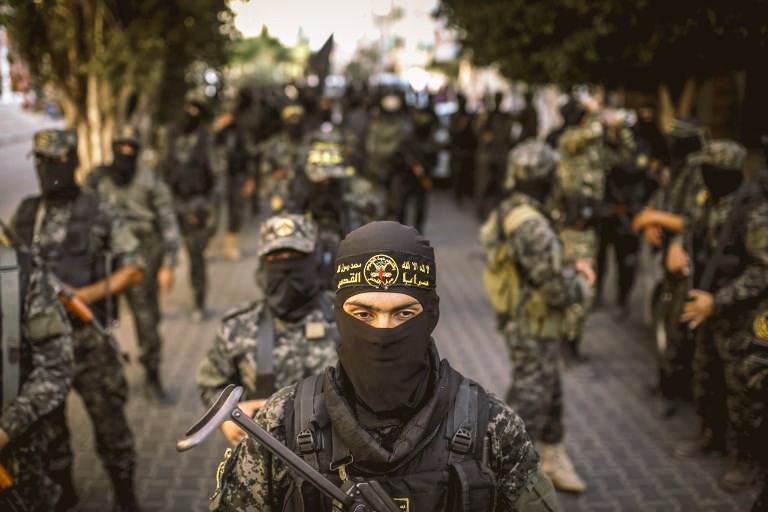
Palestinian Information Center – September 4, 2026
GAZA – Two Palestinians were killed and several others injured on Friday as Israeli forces continued attacks across the Gaza Strip, including airstrikes, artillery shelling and gunfire, amid ongoing violations of the ceasefire.
An ambulance and emergency services source said one Palestinian was killed and others were injured in an Israeli drone strike west of Khan Younis in the southern Gaza Strip.
The Al-Quds Brigades, the military wing of Palestinian Islamic Jihad, announced that one of its fighters, Fadi Ali Saeed Al-Abadla, a member of the Al-Qarara Battalion in the Khan Yunis Brigade, was killed.
Providing details of the incident, the Brigades said that at around 3:30 a.m. Friday, a force belonging to what it described as “collaborator militias,” backed by Israeli drones, advanced towards Al-Jumeiza Street in the Al-Qarara area north of Khan Yunis in an attempt to abduct one of its fighters.
The Al-Quds Brigades said its fighters detected the infiltrating force during the attempted abduction and engaged it at point-blank range with grenades and medium weapons, saying that several members of the force were killed or wounded.
The Brigades said Israeli drones then intervened to provide cover for the force’s withdrawal. It added that members of the force shot and killed Al-Abadla, leaving his body at the scene before withdrawing with their dead and wounded.
Three Palestinians, including a girl, were also injured by Israeli fire near Hamad City, north of Khan Younis.
Israeli artillery shelled areas east of Khan Yunis, while Israeli military vehicles opened heavy fire near the Al-Matahin area north of the city.
Israeli military vehicles also opened heavy fire towards northern areas of the Bureij refugee camp.
Israeli airstrikes, artillery shelling hit Gaza City
In Gaza City, an Israeli warplane carried out an airstrike near Mushtaha Street in the Al-Shuja’iyya neighborhood, east of the city, as Israeli artillery simultaneously shelled eastern areas.
Israeli military vehicles and drones also opened fire toward Palestinian homes in the Al-Tuffah neighborhood, northeast of Gaza City, while Israeli forces fired illumination flares over the eastern part of the neighborhood.
A local source reported heavy gunfire from Israeli tanks near the Al-Sanafour area, east of Gaza City, as an Israeli Apache helicopter opened fire toward eastern parts of the city.
In the Al-Zaytoun neighborhood, southeast of Gaza City, an Israeli quadcopter drone opened fire, while another quadcopter fired east of the Sheikh Radwan neighborhood in northern Gaza City.
Since the ceasefire took effect on Oct. 10, 2025, 1,338 Palestinians have been killed and 4,429 others injured, while 815 bodies have been recovered, according to the latest figures.
The cumulative death toll since the start of the Israeli assault on the Gaza Strip on Oct. 7, 2023, has risen to 73,474 Palestinians killed, while 174,540 others have been injured.
Ex-Pentagon official: US ‘intentionally targeting Iranian civilians’
Press TV – September 3, 2026
A former senior Pentagon official has said that the United States is deliberately killing civilians in Iran after a US missile strike hit a wedding ceremony in Hormozgan Province, which led to the martyrdom of five civilians, including a four-year-old child, and injured more than 70 others.
Wes J. Bryant, who served as the Pentagon’s chief of civilian harm assessments and now works as a war crimes analyst, told Al Jazeera on Thursday that the attack on the wedding in Kouhestak, Sirik County, exposes the real moral and legal standards of the War Department and the Trump administration.
“Is the US intentionally targeting civilians in Iran? It is,” Bryant said. He rejected US Central Command’s claim that American forces never attack civilians, arguing that Washington is “recklessly and negligently endangering and killing civilians” in its war against the Islamic Republic.
Bryant said every target location is recorded at multiple levels of the chain of command. Comparing Tuesday’s wedding massacre with the February US strike on the Shajareh Tayyebeh school in Minab, he said the US military would have been able “to report within hours” whether a school or a wedding had been hit. Washington has still not produced a transparent accounting of the Minab slaughter.
No sitting American official has condemned the Kouhestak attack. Vice President JD Vance said only that Washington was “investigating” the reports while declaring himself “extremely skeptical” of Iranian accounts. CENTCOM spokesman Captain Tim Hawkins repeated the stock line that the US military “never targets civilians, unlike the IRGC.” President Donald Trump described the same night’s bombardment as “large and powerful.”
The US military struck the wedding at the home of fisherman Ali Mallahi around 8 to 9:30 p.m. on Tuesday as families gathered for his daughter’s ceremony. Hormozgan authorities named the martyred as four-year-old Amir Ali Karimi, 16-year-old Mohammad Mallahi, 43-year-old Kolsoum Mallahi and Zarkhatoun Taheri. State television later said a fifth victim, a 22-year-old woman, died in hospital; nearly 70 others were wounded, most of them women and children.
Mallahi told state television that those inside were ordinary civilians. Videos from the scene showed a collapsed roof, blood-soaked carpets and guests being treated in Minab, the same city where US missiles destroyed a primary school on the first day of the US-Zionist war.
US senator calls for a full investigation and accountability of US strike
US Senator Chris Van Hollen wrote that Secretary of War Pete Hegseth treats civilian casualties as an afterthought, cuts personnel responsible for preventing them, & boasts that there will be “no stupid rules of engagement.”
“There must be a full investigation & accountability for this strike. And we must end this disastrous war now,” he added.
Defence experts identified munition fragments consistent with a US AGM-84K SLAM-ER cruise missile. The house stood more than 100 meters from a telecommunications tower also hit in the barrage.
Iran’s Foreign Ministry spokesman Esmaeil Baghaei called the strike a war crime and part of America’s “catalogue of atrocities” against the Iranian nation, linking it to earlier massacres in Minab, Lamerd and Qeshm.
Parliament Speaker Mohammad Bagher Ghalibaf said a power that “picks targets like Satan and kills like Satan” is Satan. The Iranian Red Crescent wrote to the International Criminal Court demanding an independent investigation. Iran’s UN mission sent a formal letter to the secretary-general and the Security Council describing the bombing of a wedding as a grave breach of international humanitarian law.
IRGC Commander Ahmad Vahidi, in a message to the victims’ families on Thursday, said the blood of those killed in Kouhestak “will never go unanswered” and would “catch up with those who ordered and carried out this heinous crime.”
He said the Islamic Revolution Guards Corps and Iran’s armed forces would continue to guard the sanctity of the martyrs of the second and third US-Zionist-imposed wars, particularly the Battle of Hormuz.
Mourners buried the dead on Thursday in the coastal village, tossing petals over flag-draped coffins. Iran answered the latest US assault with missiles and drones against American bases in the region.
Sanctioning a Ghost: Europe’s Empty Gesture Against Iran
By Larry C. Johnson | SONAR21 | September 3, 2026
US Treasury Secretary Scott Bessent announced today that the European Union has “officially joined” the American sanctions campaign against Iran — Operation Economic Outcast — and framed Tehran’s choice in the usual absolutes: complete global isolation and a subsistence economy, or a path back to normalcy. It made a commanding headline. It is a hollow one. You cannot embargo a trading partner you have already stopped trading with, and in economic substance that is precisely what Europe did years ago. Today it merely issued a press release about it.
The trade Europe is threatening to withdraw barely exists
One number frames the entire affair. In 2025 the whole of the European Union traded about €3.7 billion in goods with Iran — roughly $4 billion — against Iran’s total foreign trade of some $182.6 billion. Europe therefore accounts for about 2 percent of Iran’s commerce. That is the sum of the leverage now being brandished: a rounding error dressed up as a thunderbolt.
And it is a hollow 2 percent, because the flow runs almost entirely one way. Europe still sells Iran a little machinery, chemicals, and pharmaceuticals — about €3 billion, or 4 to 5 percent of Iran’s import bill. It buys almost nothing back: EU imports from Iran were €0.76 billion, under 1 percent of Iran’s exports, since Europe no longer takes meaningful Iranian oil. Germany, Italy, and the Netherlands make up nearly two-thirds of even this remnant. Withdraw it in full and you bruise a few exporters in Stuttgart and Milan far more than you trouble the treasury in Tehran.
Europe’s leverage was spent years ago
The collapse Europe is now formalizing already happened, slowly, over more than a decade. EU–Iran trade topped €27 billion in 2011 and reached €20.7 billion in 2017, during the nuclear-deal window — a period when Europe genuinely was a major Iranian partner, on the order of 15 to 20 percent of Tehran’s trade. The 2018 US withdrawal began bleeding it out; the trend never reversed; a fresh EU sanctions package in January 2026 drained it further. By 2025 it stood at €3.7 billion. Europe dismantled its own bridge to Iran plank by plank across seven years, and Iran long since built new ones — to China above all, which takes the bulk of its oil, and to the UAE, Turkey, and Iraq for the rest. The marginal Iranian barrel is priced in Shandong, not Rotterdam. There is nothing left in Europe’s hand to take away.
Sanctioning from a sickbed
Here is what makes the gesture worse than empty: Europe is declaring economic war on Iran at the precise moment its own major economies can least afford one — and while they are being bled by the very war Europe is now underwriting.
The eurozone crawled through the first quarter of 2026 at 0.1 percent growth, its weakest in nearly a year, with the composite PMI stuck in contraction and energy inflation running near 11 percent. That last figure is the tell, because it is a direct transmission of this war: the Iran shock and the throttling of the Strait of Hormuz sent fuel prices surging into economies that, unlike the United States, import their energy. The European Central Bank has warned that a prolonged conflict could tip Germany and Italy into technical recession by year’s end.
The particulars are grim. Germany — Iran’s largest European trading partner, and thus the country with the most of that thin trade to forfeit — is also the continent’s biggest casualty. It has already endured two straight years of recession, its manufacturing base has shrunk some 15 percent from its 2017 peak in what economists now call outright deindustrialization, its automotive crown jewel is shedding tens of thousands of jobs, and unemployment sits at a twelve-year high. A recession in 2026 would be its fourth in four years, an outcome with no post-war precedent. France is paralyzed in parallel — a deficit near 5.1 percent of GDP, its fifth prime minister in two years, growth downgraded toward 0.4 percent. Italy limps along near 0.5 percent, its consumers acutely exposed to exactly the energy swings this war is producing.
So the tableau is this: a bloc whose largest economy is deindustrializing under an energy shock, whose second-largest is fiscally ungovernable, and whose third is one bad quarter from recession, has volunteered to prolong the conflict driving its energy bill — by forgoing a trickle of trade that costs Tehran almost nothing and its own exporters rather more. Germany torches a bridge it could use while standing in a house that also is burning.
The one caveat, and why it fails too
In fairness, Operation Economic Outcast was never really about Europe’s own thin trade with Iran. It is a secondary-sanctions weapon — the threat to bar any firm or nation dealing with Iran from the dollar system — and Europe’s theoretical value lies not in the goods it stops selling but in the financial and shipping chokepoints it controls: euro clearing, European banks, the reinsurance and protection-and-indemnity clubs that underwrite tankers. But that leverage aims at Iran’s trade with third countries, chiefly China — and Bessent has conspicuously declined to say whether Washington will actually sanction Chinese banks, because everyone understands what that would cost. Iran, meanwhile, has spent seven years rebuilding its commerce on Chinese banks, yuan settlement, barter, and a shadow tanker fleet engineered to be untouchable by European paperwork. The US naval blockade ostensibly has done more to choke Iranian exports this year than any designation list will. Europe adding its signature raises the compliance risk for the handful of European firms still tempted by Iran. It does essentially nothing to the Chinese refiners who are the actual market.
A sanction is worth what it denies a target that the target cannot easily replace. By that measure Europe’s hand is all but empty: its direct trade with Iran has withered to roughly 2 percent of Tehran’s commerce, in goods Iran already sources from China, Turkey, and the Gulf, and the one channel where Europe might still matter points at a Beijing that Washington will not confront. What makes the move not merely futile but faintly self-destructive is that Europe is making it from a sickbed — its industrial engine stalling, its energy costs inflated by this very war — in order to prolong the fight that is inflating them. The announcement signals Western unity and puts the EU on the record. As a blow against Iran, it is a spent cartridge fired from a trembling hand.
A proposal seeks to exploit Americans’ debt to force them into wars against Israel’s enemies
MEMO | September 3, 2026
The debt of Americans should be exploited to force them to fight in wars against Israel’s enemies, a Jerusalem Post commentator has argued, proposing that indebted young Americans be offered full debt forgiveness in exchange for military service.
Writing in the Israeli newspaper, security analyst AJ Jaff said a “federally administered debt-forgiveness enlistment program” that discharges Americans’ student loan, credit card and other debts after 24 or 36 months of service “would produce voluntary enlistment at scale”.
Jaff, described by the paper as “a senior strategic security strategist and analyst with 20 years of experience across corporate security, military, and geopolitical intelligence”, wrote that “the war with Iran will not be won through airstrikes” and that a ground invasion would require between 750,000 and 1.5 million American troops, against a current active US Army of 452,000.
The article proposed debt relief as the way to fill that gap. “The economics of the indebted American 20- and 30-something make this the most efficient conversion mechanism available,” said Jaff while explaining that “states generate the soldiers they need through the incentives that work on the population they have”.
The proposal has been condemned as confirmation that Israel expects Americans to fight and die in wars fought on its behalf. The Mises Institute, a US think tank, said the article amounted to a call for more Americans “to enlist – to die for Israel”, adding: “The whole point being to further subsidize the state of Israel.”
Users on social media described the proposal as an attempt “to exploit the crippling debt young Americans are carrying by offering them a chance at forgiveness if they’re willing to go die for Israel in the Persian Gulf.”
Responding to the plan, prominent American commentator Glenn Greenwald said: “ Israel pays scummy US politicians in both parties and DC vultures in the lobbying firms to ensure that Americans are forced to send billions to Israel. Then they argue that the debt of Americans should be exploited to force them to fight in wars against Israel’s enemies”.
The proposal to exploit the debt of Americans to fight wars against Israel’s enemies follows a string of remarks by senior Israeli officials suggesting they see US military power as a tool to be wielded on their behalf, while Israel itself stays out of the fighting. Finance Minister Bezalel Smotrich told the Katif Conference for National Responsibility on 21 July that a US war against Iran fought without Israeli participation was “the best for us”, adding, “Israel has no interest in joining the campaign.”
Prime Minister Benjamin Netanyahu, meanwhile, boasted on Israel’s Channel 14 on 30 August that he had used “close to a thousand hours” on American television and his “influence in the United States” over almost 40 years to persuade Washington to take military action against Iran, saying, “It took a long time to bring the US in.” The US had launched military action against Iran on 28 February, an escalation Netanyahu had reportedly been pressing Washington to undertake for months.
Blair directed PA to eliminate mention of ‘Palestine’ from textbooks, former UK envoy reveals
Press TV – September 2, 2026
Former UK Prime Minister Tony Blair has been tasked by a body set up by US President Donald Trump to approach the Palestinian Authority (PA) and propose removing the term “Palestine” from school textbooks, replacing it with the Jewish name “Samaria.”
Jeremy Greenstock, who served as Britain’s ambassador to the UN from 1998 to 2003, said on Wednesday that Blair sought to influence the Palestinian Authority.
He stated that if the PA wished to be recognized by the so-called Board of Peace as a legitimate partner capable of negotiating a resolution with Israel to conclude the genocidal war in Gaza, the term “Palestine” should be removed from educational materials.
Greenstock said in an extensive interview on the David Hearst Podcast that Palestinian Authority President Mahmoud Abbas rejected the request.
Greenstock further noted that his former superior was facing “challenges” in his new position managing the postwar administration of Gaza for the board.
“He recently, I understand, was asked by the Board of Peace to go to Ramallah and ask to remove from the Palestinian curriculum any mention of the word Palestine if they were to be treated by the Board of Peace as capable of coming to an agreement with Israel to end the current conflict that had stemmed from October 7 onwards,” Greenstock said, adding that the information was obtained from a source at the ministerial level.
“President Mahmoud Abbas said he would do no such thing,” he said.
“But the very fact that the Board of Peace could ask for that to be done in the Palestinian educational curriculum makes me wonder what principles the Board of Peace is working on, and what understanding they have of justice, of the sense of fairness, of the history of all of this,” Greenstock added.
A spokesperson for Blair refuted the claim that the former UK prime minister made such a request. “This is not true and a complete fabrication.”
Blair is known to have travelled to the Israeli-occupied territories in mid-August alongside Jared Kushner, Trump’s son-in-law, and Nickolay Mladenov, the high representative for the so-called Board of Peace.
The trio engaged in intense discussions with Israeli prime minister Benjamin Netanyahu, who has dismissed the proposed roadmap for Gaza. They then proceeded to Cairo, where they met with a Palestinian technocratic group expected to assume control of Gaza, along with representatives from the Hamas resistance movement.
During the interview, Greenstock was critical of Blair’s current role in the Board of Peace, saying he did not think Blair could engage with both sides with the same level of respect.
“Because of his record on Iraq and on Palestine since he left government, he will be seen as prejudiced. So I think he will have, and is having, difficulties.”
Greenstock, who left government service in March 2004, called the Board of Peace an “abstract and arbitrary committee” whose composition would not have any real effect on the ground with either Israel or the Arab side to the question of Palestine.
“I don’t think the Board of Peace is a strong enough construct to bear the weight of the difficult decisions that are going to have to be made about the future of the Palestinian territories.”
As part of an international campaign, Israel and its allies have been amplifying their endeavors to remove the word Palestine from educational materials and museums.
On Tuesday, Israeli authorities began imposing their curriculum on more than 45,000 Palestinian students in state-run schools in East al-Quds, as part of a wider crackdown on education in the occupied territory.
A revised curriculum is reported to be circulating privately for consultation in the occupied Palestinian territories.
Is Israel paving streets with Gaza rubble containing bodies – and is the Board of Peace funding it?
By Kathryn Shihadah | If Americans Knew | September 2, 2026
Muhammad Shehada (@muhammadshehad2) – the journalist at the center of this story – is an accomplished reporter and political analyst, a visiting fellow at the European Council on Foreign Relations and contributing writer to the London Review of Books, Newsweek, Al Jazeera English, Zeteo, The New Arab, Israeli media 972Mag and Ha’aretz, and others.
Shehada tweeted on August 26 and 27:
EU diplomats told me last week Israel has been quietly moving hundreds of thousands of tons of rubble mixed with dead bodies out of Gaza to bury evidence of its genocide.
When the EU asked Israel why or whether they filter human remains out of the rubble, no answer ever came!
I’ve been informed Trump’s Board of Peace is paying the expenses of the IDF’s covert transfer of rubble (mixed with dead bodies) out of Gaza. The money is taken from Gaza’s reconstruction funds!
The Board of Peace official X account replied on August 28:
This is categorically farcical and unfounded — total fake news. At a minimum, we would expect such an “intrepid” reporter to reach out to us for comment or clarification before recklessly spreading lies based on anonymous sources who have erroneously “informed” you.
Shehada responded the same day:
Dear Board of Peace,
1- I have a tender issued under your name on 20 May 2026 that includes “leveling & compacting” work in occupied Gaza, do you deny that document?
2- Is the Israeli company Terra Firma NOT doing “rubble clearance” in Gaza allegedly with machines that take rubble & spit out dust while the IDF is doing road-paving work (specifically near Erez)?
3- Are you NOT in any way paying, compensating, subsidizing or aiding Israeli companies, contractors, individuals, the Israeli army or government for rubble removal & road paving in Gaza?
4- If you are involved, can you explain whether any effort is being made to separate human remains from rubble or detect potential mass graves under the roads being paved? The Israeli government is silent on this.
5- I have satellite images that show clear & significant rubble removal work in East Gaza in the months of May & June. Do you deny any involvement in this?
6- Do you have anything to say on Israel killing over 1,200 Palestinians under your watch since your ceasefire started?
How about Israel restricting humanitarian aid and preventing prosthetic limbs from going to largest cohort of child amputees in modern history?
How about Israel preventing repairs of basic infrastructure (water, electricity, sewage, hospitals, bakeries), or releasing all children & women still in detention without trial or charges?
All of those unfulfilled commitments were part of phase one of President Trump’s 20-point plan!
Remarkable how none of Israel’s violations of your ceasefire ever caught your attention once in 323 days, but my sole tweet did in mere hours.
The Board of Peace account has yet to reply.
Excavation equipment for me, but not for thee
United Nations figures indicate that about 200,000 buildings – 82% of the structures in Gaza – are damaged or destroyed. Buried beneath these buildings, thousands of Palestinians await retrieval and dignified burial.
Israel has hundreds of pieces of heavy engineering machinery, and is spending a fortune demolishing what is left in the roughly 70% of Gaza under its control. Ha’aretz reports that a single piece of equipment may be rented for $1,500 a day; the operator may collect $400 a day. Nearly $1 million a day is spent on fuel.
But while part of Gaza is being demolished with massive quantities of equipment, at unprecedented speed and cost, the rest is moving slowly with primitive tools. Only a handful of excavators in Gaza are working at all – the rest were targeted by Israel, or in some cases simply wore out – Israel has blocked the entrance of spare parts. Fuel costs are prohibitive anyway.
Palestinians work long hours with shovels, wheelbarrows, and their hands to dig out the remains of their loved ones, or clear debris from what is left of the roads or their homes as legions of bulldozers demolish neighborhoods nearby.
(The IDF said, in response to the Ha’aretz report cited above, “According to army orders, property destruction is only carried out when there is an operational basis that requires it, and the IDF has never had a policy that allows for the deliberate destruction of civilian property.” It added, “The IDF is taking various measures to minimize damage to civilian structures as much as possible.” The reader can decide whether the IDF’s statement rings true.)
The Wall Street Journal placed the quantity of rubble in Gaza at 68 million tons, and the number of dead bodies buried beneath the rubble at 10,000.
EuroMed Human Rights Monitor estimates that Israeli civilian companies are operating “400 heavy pieces of excavation, demolition, crushing, and transport machinery” to demolish remaining structures, crush the rubble, and load the debris onto trucks.
The rubble is reportedly taken to “undisclosed sites” in Israel and the West Bank. Israeli authorities have neither revealed details nor permitted independent groups to observe the procedure. This lack of transparency does not imply innocence.
If the Israeli company Terra Firma is indeed doing “rubble clearance” in Gaza as Muhammad Shehada alleges, in the same areas where the IDF is paving roads, the similarity to accusations against the Nazis is eerie, to say the least.
If the Board of Peace is indeed bankrolling an effort to hide incriminating evidence about genocide, it would be no exaggeration to say Trump and the rest of the board are covering up a genocide.
What do we know about the Board of Peace?
The so-called Board of Peace is a pay-to-play group of wealthy and powerful Israel supporters, dictators, and authoritarians, as well as Israeli prime minister and war criminal Benjamin Netanyahu and two Israeli real estate tycoons – but no Palestinians. In fact, the organization’s charter makes no reference to Gaza.
The lower-tier technocratic committee, made up of Palestinians, will do the grunt work in Gaza – if and when Israel allows the group to enter the Strip.
BoP is problematic in multiple ways, not the least of which is its tendency to view the world through a real estate lens, rather than human rights, justice, or humanitarianism.
SCO leaders sign Bishkek Declaration against ‘western unilateralism’
The Eurasian bloc condemned the US war on Iran as Washington widens secondary sanctions on Tehran’s trading partners
The Cradle | September 1, 2026
Leaders of the Shanghai Cooperation Organization (SCO) adopted the Bishkek Declaration on 1 September, marking the organization’s 25th anniversary and setting out a joint position on West Asia, global security, and economic cooperation.
The 10-member Eurasian bloc used the anniversary text to press for a “representative, democratic, and equitable multipolar world order,” rejecting bloc-based and confrontational approaches to international affairs.
Member states opposed unilateral coercive measures, such as banking restrictions, asset freezes, and secondary sanctions on third-country firms, that contradict the UN Charter and World Trade Organization (WTO) rules. They also condemned the unlimited buildup of global missile defense systems, calling attempts to secure one state at the expense of others unacceptable.
The declaration reiterated the bloc’s condemnation of the unprovoked US-Israeli attacks on Iranian territory, which have stretched on for 6 months and caused significant economic damage and disruption to global energy and shipping markets.
Member states called the attacks a violation of international law and the UN Charter that created “serious risks to international peace, security and stability.”
On Palestine, the declaration stated that a comprehensive and just settlement of the Palestinian question is the only possible route to peace and stability in the region.
Member states committed to expanding the use of national currencies in mutual settlements and backed reforms of the International Monetary Fund (IMF) and the World Bank to increase developing-country representation.
The declaration noted progress toward establishing an SCO Development Bank during Kyrgyzstan’s chairmanship, with leaders also supporting Iran’s expedited entry into the SCO Interbank Consortium.
Eight of the 10 SCO member states – Belarus, Iran, Kazakhstan, Kyrgyzstan, Pakistan, Russia, Tajikistan, and Uzbekistan – reaffirmed support for China’s Belt and Road Initiative (BRI), while India declined to join the statement.
Chinese President Xi Jinping called on members to build “universal security” and prevent external interference in the internal affairs of states.
Meeting Russian President Vladimir Putin on the sidelines, Xi said unpredictability in the international situation had risen sharply and that Beijing was ready to work with Moscow to advance a multipolar order and reform of global governance.
Putin told the summit that national currencies now account for more than 98 percent of Russia’s trade payments with SCO partners, and named expanded intra-bloc trade as a priority.
Kyrgyz President Sadyr Japarov opened the meeting, saying member states account for over 40 percent of the world’s population and about a quarter of global GDP, and that the organization had grown from a border security mechanism into a global actor.
The summit convened six months into the US war on Iran, and four and a half years into the war in Ukraine, with Washington also pursuing trade disputes with China and India, and threatening to impose secondary sanctions on any country or company trading with Tehran.
Beijing, the main purchaser of Iranian crude, said it would firmly defend its interests.
Trump Censorship Machine Loses Again in Court
By James Bovard | Mises Wire | August 31, 2026
The Trump administration’s crusade to crush campus criticism took another wallop on Friday in a California courtroom. Federal judge Noël Wise ruled that the Trump administration’s “ideological-deportation policy” brazenly violated the US Constitution.
The Stanford Daily—one of the best-known college student newspapers in the nation—sued the Trump administration for changing its “immigration policy and pattern of enforcement, namely by arresting, detaining, and deporting students with F-1 visas when those students use their freedom of speech to express opinions that the government does not like.” It asserted that the Trump administration’s “actions have specifically impacted Stanford Daily by decreasing the quantity and diversity of opinion pieces The Stanford Daily is able to publish on the conflict between Israel and Palestine.” Foreign students who had written on the issue requested that their previous articles be deleted, and other foreign students were no longer willing to comment on hot issues.
The Trump administration claims unlimited discretion to silence foreign students by deporting those whose opinions it disapproves of. Judge Wise wrote, “The language of the [First] Amendment makes clear that it is not the government that gives freedom of speech to the people. Instead, that freedom is imbued in the people. . . . It is not the government’s to take.” This is a notion that conservatives instinctively understand when it comes to the Second Amendment and the right of self-defense. But many people fail to recognize the same right for freedom of speech. Conor Fitzpatrick—the chief supervising attorney at the Foundation for Individual Rights and Expression (FIRE)—which represented the student newspaper, declared, “Today’s ruling proves that free speech isn’t a privilege, but the inalienable right of every man, woman, and child.” FIRE president Greg Lukianoff clarified the scope of the ruling:
This ruling does NOT say the government must admit anyone, issue anyone a visa, or grant anyone citizenship. It says that once a person is lawfully here, the government cannot deport them because they engaged in protected speech. The government cannot tell a legal immigrant: An American is free to say this, but if you say it, you’re out.
George Porteous—Editor in Chief of Stanford Daily—hailed the decision: “The reporters in our newsroom shouldn’t have to fear that writing a story will result in their deportation. Today’s victory means they won’t have to.” But it remains to be seen whether this latest judicial rebuff slows the Trump censorship juggernaut.
When former president Donald Trump was campaigning to get elected as president in 2024, he openly promised at a campaign event, “One thing I do is, any student that protests, I throw them out of the country. You know, there are a lot of foreign students. As soon as they hear that, they’re going to behave.” This was a linchpin of the promise on Trump’s campaign website to “make our college campuses safe and patriotic again.”
Trump presumed that non-citizens have zero right to free speech and his appointees have enforced that policy with an iron fist. On March 25, 2025, masked ICE agents seized Rumeysa Ozturk—a Turkish graduate student—off the streets outside Boston. Ozturk was locked up for 45 days and her student visa covertly canceled because she co-authored an op-ed criticizing Tufts University for failing to divest from Israel in response to the genocide in Gaza. Secretary of State Marco Rubio vilified her as a “lunatic” and implied that the feds had ample evidence of her crimes and abuses. Rubio later justified targeting Ozturk because she met the standard of “people that are supportive of movements that run counter to the foreign policy of the United States.” (Ironically, a large majority of Americans now oppose Trump’s foreign policy regarding his war on Iran). A leak to the Washington Post revealed that the feds had nothing on her—except that op-ed. Federal Judge William Sessions ordered Ozturk released because her arrest “potentially chills the speech of the millions and millions of people in this country who are not citizens.” But that was the whole point.
Last September, in a case similar to the Stanford Daily case, federal judge William Young ruled that the Trump’s administration’s implementation of the Executive Orders (on foreign students),
. . . was targeted intentionally at specific viewpoints in order to chill speech. The evidence presented at trial included the Public Officials’ many public statements suggesting that they wished to staunch public protest related to Israel’s treatment of Palestinians, including the President’s campaign promise that he would put an end to the student protests on this issue by kicking out protestors.
A Trump Executive Order interpreted “support” for terrorists “to be centered on core First Amendment speech and expressive conduct, such as attending public protests, leading such protests, or even publishing op-eds.” Judge Young declared that he “saw virtually no evidence that anyone along the way [any Trump official] seriously questioned whether pure political speech in support of Palestine or against Israel could be construed as support for terrorism.” Instead, that was the self-evident truth driving the crackdown.
The Stanford Daily case vivified how far the Trump administration will go to snuff dissent. A New York Times headline captured the essence of the case: “Judge Rules Trump Unlawfully Targeted Foreign Students Who Criticized Israel.” If a foreign student engaged in violence at a protest, that would be sufficient to deport them regardless of their opinions. But the Trump administration cast a far wider net, relying heavily on a list of 5,000 foreign students provided by the Canary Mission, which, according to Wikipedia, is “an Israel-based anonymously-run doxing website established in 2014 that publishes the personal information of students, professors, and organizations that it describes as anti-Israel or antisemitic.”
Judge Wise’s decision included stunning examples of how far the Trump administration stretched its definition of terrorist support or antisemitism to justify deporting aliens. John Armstrong—the chief of the Department of State’s Bureau of Consular Affairs—carried out Secretary Rubio’s crackdown on non-citizens. During legal proceedings, Armstrong was asked if a “statement calling for limiting military aid to Israel could be covered” (i.e., sufficient to deport). He answered, “[i]n my opinion, yes.” When did foreign aid become sacred?
Judge Wise concluded her 90-page ruling by declaring that the strength of American democracy,
. . . is diminished when members of our society—citizens and noncitizens alike—must self-censor and “behave” or suffer the government’s retaliation. In March 2025, that retaliation was directed at those engaged in pro-Palestine and anti-Israel speech. In September 2025, caught in the government’s net were people critical of Charlie Kirk. In May 2026, it potentially included “weighing in on a peace deal that’s being negotiated” in Iran regarding the Strait of Hormuz. Tomorrow, or perhaps even today, targets may include anyone in the United States who exercises their freedom of speech to simply express opinions the government does not like.
That warning reverberates as the Trump administration further decimates the privacy of Americans returning from abroad, claiming the right to seize and copy all the contents on their cell phones. The Trump administration proposed that foreign visitors will have to surrender their social media passwords before getting a visa to visit here. How long will it be until the same policy is imposed on American citizens?
Judge Wise declared, “Free speech, including the freedom to criticize the government and its leaders, is not a sign of our democracy’s fragility. It is evidence of its strength.” But is that “strength” increasingly a mirage in the United States? And how many other illegal actions has the Trump administration taken to suppress dissent that Americans have not yet heard about?
Final question: Is the Trump administration seeking to vindicate every leftist stereotype about conservatives and Republicans being intolerant authoritarians?
James Bovard is an American libertarian author and lecturer whose political commentary targets examples of waste, failures, corruption, cronyism and abuses of power in government. He is a USA Today columnist and is a frequent contributor to The Hill.
Greece inks $3.5bn arms deal with Israel for ‘multi-layered’ air defenses
The Cradle | August 31, 2026
Israel and Greece signed on 31 August an air defense agreement worth $3.5 billion, which will see Tel Aviv beef up Athens’ defenses and build a “multi-layered” system for the country.
According to the Israeli War Ministry, it is the largest-ever defense export deal with Greece and one of the biggest in Israeli history.
It has been dubbed the “Achilles Shield” agreement, referencing the Greek mythological figure Achilles.
It will see Israel export several air defense systems, including its David Sling, SPYDER, and BARAK MX, the War Ministry said.
It is the “largest defense export deal in the history of Israel-Greece relations, and one of the largest in the history of the State of Israel,” the War Ministry statement added, while also declaring that this marked the first time Israel supplied another state with a “complete defense array against a wide range of threats.”
These threats include ballistic missiles and drones, according to the Israeli ministry.
The agreement was signed at the War Ministry headquarters in Tel Aviv by Ministry Director General Amir Baram and his Greek counterpart Ioannis Bouras.
“Under the deal, Israel will build Greece a comprehensive, multi-layered air defense array, drawing entirely on Israeli-made systems and on the extensive operational experience Israel’s defense establishment has gained during the war,” the Israeli War Ministry stressed.
Greece said the deal marked the “greatest reform of its armed forces in its history.”
Security and economic cooperation between Greece, Cyprus, and Israel continues to expand.
Earlier this month, the Israeli military announced a meeting between army Chief of Staff Eyal Zamir and his Greek counterpart, Dimitrios Choupis.
The meeting “highlights the strategic importance and relevance of the military relationship already in place between Israel and Greece,” the Israeli army announced.
A private diplomatic conference held in Athens in May laid bare Greek, Cypriot, and Israeli plans to capitalize on the Iran war by deepening their ties into a “formal strategic alignment.”
“This cooperation must deepen into a formal strategic alignment focusing on energy, infrastructure, joint defense efforts, and economic innovation – acting as a crucial pillar of stability in the region,” said Averof Neophytou, a prominent Cypriot MP and former president of the Democratic Rally of Cyprus, during that conference.
He also called on Israel to “finish the job” in Iran.
Israeli, Greek, and Cypriot ties have accelerated in recent years. According to reports from last year, the three states have considered the formation of a joint “rapid-response” military force in the eastern Mediterranean.
In late 2025, Tel Aviv, Athens, and Nicosia signed a trilateral military “action plan” for 2026, said to be aimed at confronting Turkish influence and strengthening defense cooperation.
Featured Video

Iran’s Next Strike May Not Explode. It Could Shut You Down
or go to
Aletho News Archives – Video-Images
From the Archive
Zionism’s Violent Legacy
By Donald Neff | Washington Report On Middle East Affairs | January 1996
On January 4, 1948, Jewish terrorists drove a truck loaded with explosives into the center of the all Arab city of Jaffa and detonated it, killing 26 and wounding around 100 Palestinian men, women and children.[1] The attack was the work of the Irgun Zvai Leumi – the “National Military Organization,” also known by the Hebrew letters Etzel – the largest Jewish terrorist group in Palestine. The Irgun was headed by Revisionist Zionist Menachem Begin and had been killing and maiming Arabs, Britons and even Jews for the previous ten years in its efforts to establish a Jewish state.
This terror campaign meant that at the core of Revisionist Zionism there existed a philosophical embrace of violence. … continue
Blog Roll
 Aletho News
- Trump’s Iran war is on an Israeli leash
- Saudi oil boss issues global supply warning
- Riyadh Says Its Oil System Is Intact. The Numbers Say Otherwise.
- Trump and Netanyahu Want to “Finish the Job” on Iran
- US ‘one-sided dictation’ not Iran’s beliefs makes rational talks impossible: Baghaei
- Iran’s Next Strike May Not Explode. It Could Shut You Down /Col Doug Macgregor
- Iran: US political targets legitimate if assassinations return
- Iraq shuts key border crossing with Iran under US pressure: Report
- Undersea Internet cables could be targeted in retaliation for attacks on Iran: IRGC deputy chief
- EU sending ‘biased’ observers to interfere in Serbian election – president
- If Americans Knew
- The Israel Lobby’s Changing Fortunes
- AIPAC has become such a political liability that it’s shifting to a more “nimble” approach to buying politicians
- At least 160 Israeli settler attacks in 2 weeks
- Will Gaza’s Ancient Christian Community Disappear Forever?
- Israel’s vision of regional security rests on keeping Arab states weak
- Heidi Levine recounts how Palestinian youths helped save her in settler attack
- DAILY UPDATE: Latest essential news on Palestine, Israel, & region
- Trump’s Intensifying Sabotage of the ICC, for Israel’s Sake
- Israeli military detain US and UK volunteers in West Bank including Democratic NY politician Brad Lander
- Americans at National Conservatism Conference held in Israel this year criticize Israel
- No Tricks Zone
- E-Cars Reduce CO2 Emissions By Only 41% Compared To Internal Combustion Engine Vehicles
- Predictions Made By Renowned Climate Professor Over Past Decades Have Been Proven To Be Poor
- New Study Suggests Large Regions Of The Pacific Ocean Have Been Cooling For The Last 80 Years
- Germany’s Green Energy Debacle: High Energy Costs Force Kahla Porzellan to Close After 182 Years!
- New Study: 50 Years Of The Most Aggressive ‘Net Zero’ Policies Can Only Affect The Global Climate By 0.03°C
- US September “Heat” Was No Record…Many Records Set Decades Ago
- Latest European Green Energy Debacle; Portugal’s Largest Flagship Solar Park Insolvent!
- Green Energy Debacle: German Expert Professor Fritz Vahrenholt Warns Of Severe Economic And Social Consequences
- Two More Paleo Reconstructions Affirm Meters-Higher Sea Levels Across Ireland, Brazil 7000-6000 Years Ago
- New Study: Earth And Venus Surface Warmth Largely Explained By Convection And Lapse Rate, Not CO2 Or Radiation

