Russia ready to facilitate US-Iran negotiations – Kremlin
RT | March 4, 2025
Russia is ready to broker talks between the US and Iran, including on Tehran’s nuclear program and its regional proxy network, Kremlin spokesman Dmitry Peskov told Bloomberg on Tuesday.
Trump expressed interest in talking to Iran about those issues, both in his phone call to Putin in February and via representatives at the high-level US-Russian meeting in Riyadh just days later, the news agency wrote, citing anonymous officials.
“Russia believes that the United States and Iran should resolve all problems through negotiations,” Peskov told Bloomberg when asked about such contact.
Moscow “is ready to do everything in its power to achieve this,” he added.
US President Donald Trump returned to his “maximum pressure” campaign on Iran last month, just weeks after Moscow and Tehran signed a landmark strategic partnership agreement. Trump’s executive order said that Washington would ramp up sanctions on Iran, aiming to disrupt its nuclear program, conventional missile deployment, and network of regional proxy groups.
The Iranian Foreign Ministry has said the country is building up its defenses, citing regular threats from US ally Israel.
“The Israeli regime’s FM and other officials keep threatening Iran with military action while the West continues to blame Iran for its defense capability. This is outrageous & irrational,” Iranian Foreign Ministry spokesman Esmaeil Baqaei said last week. Given that Israel is “addicted to aggression and lawless behavior,” it is “responsible and essential to maximize our defense capabilities,” he stressed.
The day before, Israeli Foreign Minister Gideon Saar warned that a “military option” should be on the table to stop the potential weaponization of Tehran’s nuclear program.
Israel and the West have long seen Iran’s uranium enrichment activities as a secret attempt to develop nuclear weapons – allegations that Tehran has repeatedly denied.
While Trump has touted harsher sanctions, he has also signaled that he is interested in signing a “verified nuclear peace agreement” with Tehran.
Iranian Supreme Leader Ayatollah Ali Khamenei has stressed that talks with the US are unlikely to bear fruit, citing the prior nuclear deal Trump unilaterally left during his first presidency.
Russia’s Resurgence and the Evolving US-Russia Relations
By Abbas Hashemite – New Eastern Outlook – March 4, 2025
Since World War II, Russia and the US have been fierce rivals, but with Donald Trump’s re-election and Russia’s rise as a superpower, the US is now shifting toward fostering cordial ties.
Russia’s Resurgence and the Evolving US-Russia Relations
The Cold War resulted in the collapse of the Soviet Union, creating a unipolar world order led by the United States. Since the culmination of the Cold War, the US has been following a more hardline foreign policy towards its rivals and allies, tarnishing its soft image around the globe. However, its economic and military supremacy helped it to sustain its position as the sole superpower of the world for almost 3 decades. The United States has been alluring third-world countries through economic aid to achieve its geopolitical interests in different regions. It also coerced weak countries militarily to support its foreign policy interests.
Nonetheless, the rapid rise of Russia and China has provided third-world countries with new military and economic giants, transforming the global geopolitical landscape. Russia’s influence is rapidly rising among the Muslim and African countries. It is also known as the leading country of the BRICS organization. Moscow is also leading the de-dollarization movement under the banner of the BRICS. Global oil trade in non-US dollar currencies has already reached 20 percent in 2020-23 from a mere 2 percent in 2000-2010. More than 40 countries are demonstrating their interest in the BRICS membership, signaling the decline of the US-led unipolar world order. The rise of BRICS has significantly enhanced Russia’s diplomatic influence. Most third-world countries seek to establish cordial relations with Moscow due to its policy of noninterference and its inclusive foreign policy.
The Strain in US-Israel Relations and Russia’s Global Stature
On the other hand, the US support to Israel in its war crimes in Gaza and its veto of the UN ceasefire resolutions have ruptured its international image. Israel has been the largest recipient of US aid since its creation. Despite all international condemnations and appeals, the Biden administration provided billions of dollars of US aid, both military and financial, to Israel. It also provided diplomatic support to Israel, further deepening the international resentment against the United States. Meanwhile, the Putin administration proved to be a staunch supporter of human rights and justice by speaking for the rights of Palestinian citizens. In the past few years, President Putin has become one of the strongest voices against Islamophobia.
Due to his vision, Russia has regained its position as the superpower of the world. Russia’s soft image has risen to an unprecedented level under his presidency. Moreover, the failure of the US sanctions to bankrupt Russia is often attributed to his leadership skills. It is also due to his leadership that the United States has been unable to isolate Moscow diplomatically. The Biden administration’s policy of weakening Russia by ensnaring it in an invincible conflict with Ukraine also seems to be collapsing due to the victories of the Russian forces.
US and Russia’s Changing Relations
The incumbent US President Donald Trump has always admired the leadership skills and personality of President Putin. He has consistently criticized Ukraine’s unwarranted provocation of Russia. President Trump is aware that the U.S. is not in a position to defeat or compete with Russia’s rise. The recent summit between Sergei Lavrov, the Secretary of State of Russia, and his American counterpart, to lay a foundation for the meeting of the leaders of the two countries and Trump’s aggressive rhetoric towards Ukrainian President Volodymyr Zelensky is a big diplomatic win for Moscow. President Trump has also praised President Putin for his seriousness to end the Russia-Ukraine conflict. All these developments have further elevated the diplomatic stature of Russia internationally.
In a surprising move, the United States voted against a Ukrainian resolution, blaming Moscow for its invasion, in the United Nations, marking a significant shift in the US policy under President Trump. Instead, the U.S. introduced a new resolution, titled The Path to Peace, which featured neutral language and called for a lasting peace. This sent a chill down the spines of the European leaders, as they knew that Ukraine could not win against Russia without the US support. This development holds immense significance and can be seen as a diplomatic win for Russia and Washington’s acceptance of defeat as a global hegemon. It is this sense of defeat that encourages the US to foster ties with Moscow.
Although President Trump has repeatedly threatened the BRICS nations about the de-dollarization campaign, the growing interest of the middle powers in the BRICS membership and their tilt towards Russia indicates that the US needs to establish cordial ties with Moscow to avoid isolation in the new multipolar world order. Washington stood victorious in the first Cold War, but the current developments demonstrate that it has already lost the Cold War 2.0. Russia, as always, seems to be open to diplomatic negotiations with the United States and is also ready for a peaceful solution to its conflict with Ukraine, but it will never compromise on its sovereignty and territorial integrity.
Hamas explained why it attacked Israel on October 7, 2023
If Americans Knew | March 3, 2025
On January 20, 2024 Hamas, the Palestinian Resistance Movement, issued a 16-page document entitled “Our Narrative–Operation Al-Aqsa Flood” that explains their plans and actions.
This helps to answer the question some Americans ask: Why did Hamas launch the attack?
As Americans read and consider the following, perhaps they will consider an equally important question: Why did we allow our government to enable Israel’s violent, decades-long ethnic cleansing project against Palestinians?
To see the full document and its images, click the PDF here. Below is the document’s text (IAK has bolded some portions and added a few editor’s notes).
TEXT:
In the Name of Allah, the Most Gracious, the Most Merciful
Our steadfast Palestinian people,
The Arab & Islamic nations;
The free peoples worldwide and those who advocate for freedom, justice and human dignity
In light of the ongoing Israeli aggression on the Gaza Strip and the West Bank, and as our people continue their battle for independence, dignity and breaking-free from the longest-ever occupation during which they have drawn the finest displays of bravery and heroism in confronting the Israeli murder machine and aggression. We would like to clarify to our people and the free peoples of the world the reality of what happened on Oct. 7, the motives behind, its general context related to the Palestinian cause, as well as a refutation to the Israeli allegations and to put the facts into perspective.
Why Operation Al-Aqsa Flood?
1. 1- The battle of the Palestinian people against occupation and colonialism did not start on Oct. 7, but started 105 years ago, including 30 years of British colonialism and 75 years of Zionist occupation. In 1918, the Palestinian people owned 98.5% of the Palestine land and represented 92% of the population on the land of Palestine.
While the Jews, who were brought to Palestine in mass immigration campaigns in coordination between the British colonial authorities and the Zionist Movement, managed to seize control of not more than 6% of the lands in Palestine and to be 31% of the population prior to 1948 when the Zionist Entity was announced on the historic land of Palestine. [Editor’s note: See this]
At that time, the Palestinian people were denied from the right to self- determination and the Zionist gangs engaged in an ethnic cleansing campaign against the Palestinian people aimed at expelling them from their lands and areas. As a result, the Zionist gangs seized control by force of 77% of the land of Palestine where they expelled 57% of the people of Palestine and destroyed over 500 Palestinian villages and towns, and committed dozens of massacres against the Palestinians which all culminated in the establishment of the Zionist Entity in 1948. Moreover, in continuation of the aggression, the Israeli forces in 1967 occupied the rest of Palestine including the West Bank, the Gaza Strip and Jerusalem in addition to Arab territories around Palestine.
2. 2- Over these long decades, the Palestinian people suffered all forms of oppression, injustice, expropriation of their fundamental rights and the apartheid policies. The Gaza Strip, for example, suffered as of 2007 from a suffocating blockade over 17 years which turned it to be the largest open-air prison in the world. The Palestinian people in Gaza also suffered from five destructive wars\ aggressions all of which “Israel” was the offending party.
The people in Gaza in 2018 also initiated the Great March of Return demonstrations to peacefully protest the Israeli blockade, their misery humanitarian conditions and to demand their right-to-return. However, the Israeli occupation forces responded to these protests with brutal force by which 360 Palestinians were killed and 19,000 others were injured including over 5,000 children in a matter of few months. [Editor’s note: See this]
3. According official figures, in the period between (January 2000 and September 2023), the Israeli occupation killed 11,299 Palestinians and injured 156,768 others, the great majority of them were civilians. Unfortunately, the US administration and its allies did not pay attention to the suffering of the Palestinian people over the past years but provided cover to the Israeli aggression.
They only lamented the Israeli soldiers who were killed on Oct. 7 even without seeking the truth of what happened, and wrongfully walked behind the Israeli narrative in condemning an alleged targeting of Israeli civilians. The US administration provided the financial and military support to the Israeli occupation massacres against the Palestinian civilians and the brutal aggression on the Gaza Strip, and still the US officials continue to ignore what the Israeli occupation forces commit in Gaza of mass killing. [Editor’s note: see this.]
4. The Israeli violations and brutality were documented by many UN organizations and international human rights groups including Amnesty International and Human Rights Watch, and even documented by Israeli human rights groups. [See this.]
However, these reports and testimonies were ignored and the Israeli occupation is yet to be held accountable. For example, on Oct. 29, 2021, Israel’s Ambassador to the UN Gilad Erdan insulted the UN system by tearing up a report for the UN Human Rights Council during an address at the General Assembly, and threw it in a dustbin before leaving the podium. Yet, he was appointed in the following year – 2022 – to the post of vice-president of the UN General Assembly.
5. The US administration and its western allies have always been treating Israel as a state above the law; they provide it with the needed cover to maintain prolonging the occupation and cracking down the Palestinian people, and also allowing “Israel” to exploit such situation to expropriate further Palestinian lands and to Judaize their sanctities and holy sites. Despite the fact that the UN had issued more than 900 resolutions over the past 75 years in favor of the Palestinian people, “Israel” rejected to abide by any of these resolutions, and the US VETO was always present at the UN Security Council to prevent any condemnation to “Israel’s” policies and violations. That’s why we see the US and other western countries complicit and partners to the Israeli occupation in its crimes and in the continued suffering of the Palestinian people. [See this.]
6. As for “the peaceful settlement process”. Despite the fact that the Oslo Accords signed in 1993 with the Palestine Liberation Organization (PLO) stipulated the establishment of a Palestinian independent state in the West Bank and the Gaza Strip; “Israel” systematically destroyed every possibility to establish the Palestinian state through a wide campaign of settlements’ construction and Judaization of the Palestinian lands in the occupied West Bank and Jerusalem. The backers of the peace process after 30 years realized that they have reached an impasse and that such process had catastrophic results on the Palestinian people.
The Israeli officials confirmed at several occasions their absolute rejection to the establishment of a Palestinian state. Just one month before Operation Al-Aqsa Flood, Israeli Prime Minister Benjamin Netanyahu presented a map of a so-called “New Middle East,” depicting “Israel” stretching from the Jordan River to the Mediterranean Sea including the West Bank and Gaza. The entire world at that – UN General Assembly’s – podium were silent towards his speech full of arrogance and ignorance towards the rights of the Palestinian people.
7. After 75 years of relentless occupation and suffering, and after failing all initiatives for liberation and return to our people, and also after the disastrous results of the so-called peace process, what did the world expect from the Palestinian people to do in response to the following:
♦ The Israeli Judaization plans to the blessed Al-Aqsa Mosque, its temporal and spatial division attempts, as well as the intensification of the Israeli settlers’ incursions into the holy mosque.
♦ The practices of the extremist and right-wing Israeli government which is practically taking steps towards annexing the entire West Bank and Jerusalem into the so-called “Israel’s sovereignty” amid plans on the Israeli official table to expel Palestinians from their homes and areas.
♦ The thousands of Palestinian detainees in Israeli jails who are experiencing deprivation of their basic rights as well as assaults and humiliations under direct supervision of the Israeli fascist minister Itamar Ben-Gvir.
♦ The unjust air, sea, and land blockade imposed on the Gaza Strip over 17 years.
♦ The expansion of the Israeli settlements across the West Bank in an unprecedented level, as well as the daily violence perpetrated by settlers against Palestinians and their properties.
♦ The seven million Palestinians living in extreme conditions in refugee camps and other areas who wish to return to their lands, and who were expelled 75 years ago.
♦ The failure of the international community and the complicit of superpowers to prevent the establishment of a Palestinian state.
What was expected from the Palestinian people after all of that? To keep waiting and to keep counting on the helpless UN! Or to take the initiative in defending the Palestinian people, lands, rights and sanctities; knowing that the defense act is a right enshrined in international laws, norms and conventions.
Proceeding from the above, Operation Al-Aqsa Flood on Oct. 7 was a necessary step and a normal response to confront all Israeli conspiracies against the Palestinian people and their cause. It was a defensive act in the frame of getting rid of the Israeli occupation, reclaiming the Palestinian rights and on the way for liberation and independence like all peoples around the world did.
Second
The events of Operation Al-Aqsa Flood and responses to the Israeli allegations
In light of the Israeli fabricated accusations and allegations over Operation Al-Aqsa Flood on Oct. 7 and its repercussions, we in the Islamic Resistance Movement – Hamas clarify the following:
1. Operation Al-Aqsa Flood on Oct. 7 targeted the Israeli military sites, and sought to arrest the enemy’s soldiers to pressure on the Israeli authorities to release the thousands of Palestinians held in Israeli jails through a prisoners exchange deal. Therefore, the operation focused on destroying the Israeli army’s Gaza Division, the Israeli military sites stationed near the Israeli settlements around Gaza.
2. Avoiding harm to civilians, especially children, women and elderly people is a religious and moral commitment by all the Al-Qassam Brigades’ fighters. We reiterate that the Palestinian resistance was fully disciplined and committed to the Islamic values during the operation and that the Palestinian fighters only targeted the occupation soldiers and those who carried weapons against our people. In the meantime, the Palestinian fighters were keen to avoid harming civilians despite the fact that the resistance does not possess precise weapons. In addition, if there was any case of targeting civilians; it happened accidently and in the course of the confrontation with the occupation forces. [Editor’s note: when the barrier that had been imprisoning Gaza for over 20 years was breached, many people not part of Hamas’ trained fighters, including other armed groups not under Hamas, also escaped.]
Since its establishment in 1987, the Hamas Movement committed itself to avoiding harm to civilians. After Zionist criminal Baruch Goldstein in 1994 committed a massacre against Palestinian worshippers in the Al-Ibrahimi Mosque in occupied Hebron City, the Hamas Movement announced an initiative to avoid civilians the brunt of fighting by all parties, but the Israeli occupation rejected it and even did not give any comment on it. The Hamas Movement also repeated such calls several times, but received by a deaf ear from the Israeli occupation which continued its deliberate targeting and killing of Palestinian civilians.
[Editor’s note: The precursor to Hamas was different from extremist groups that we think of today, like Al-Qaeda or ISIS. It started out by focusing on social welfare programs, providing education, food and other social services to Palestinians. It eventually began to engage in resistance activities against the Israeli occupation and expanded land theft, such as attacks on military posts and capturing Israeli soldiers. After an extremist Israeli killed 29 Palestinians while they were praying, Hamas also began targeting civilians. See this and this and this and this.]
3. Maybe some faults happened during Operation Al-Aqsa Flood’s implementation due to the rapid collapse of the Israeli security and military system, and the chaos caused along the border areas with Gaza.
As attested by many, the Hamas Movement dealt in a positive and kind manner with all civilians who have been held in Gaza, and sought from the earliest days of the aggression to release them, and that’s what happened during the week-long humanitarian truce where those civilians were released in exchange of releasing Palestinian women and children from Israeli jails. [Editor’s note: For how this was reported to Americans see this.]
4. What the Israeli occupation promoted of allegations that the Al-Qassam Brigades on Oct. 7 were targeting Israeli civilians are nothing but complete lies and fabrications. [Editor’s Note: See this] The source of these allegations is the Israeli official narrative and no independent source proved any of them. It is a well-known fact that the Israeli official narrative had always sought to demonize the Palestinian resistance, while also legalizing its brutal aggression on Gaza.
Here are some details that go against the Israeli allegations:
♦ Video clips taken on that day – Oct. 7 – along with the testimonies by Israelis themselves that were released later showed that the Al-Qassam Brigades’ fighters didn’t target civilians, and many Israelis were killed by the Israeli army and police due to their confusion. [See this.]
♦ It has also been firmly refuted the lie of the “40 beheaded babies” by the Palestinian fighters, and even Israeli sources denied this lie. Many of the western media agencies unfortunately adopted this allegation and promoted it.
♦ The suggestion that the Palestinian fighters committed rape against Israeli women was fully denied including by the Hamas Movement. A report by the Mondoweiss news website on Dec. 1, 2023, among others, said there is lack of any evidence of “mass rape” allegedly perpetrated by Hamas members on Oct. 7 and that Israel used such allegation “to fuel the genocide in Gaza.” [See this.]
♦ According to two reports by the Israeli Yedioth Ahronoth newspaper on Oct. 10 and the Haaretz newspaper on Nov. 18, many Israeli civilians were killed by an Israeli military helicopter especially those who were in the Nova music festival near Gaza where 364 Israeli civilians were killed. The two reports said the Hamas fighters reached the area of the festival without any prior knowledge of the festival, where the Israeli helicopter opened fire on both the Hamas fighters and the participants in the festival. The Yedioth Ahronoth also said the Israeli army, to prevent further infiltrations from Gaza and to prevent any Israelis being arrested by the Palestinian fighters, struck over 300 targets in areas surrounding the Gaza Strip.
♦ Other Israeli testimonies confirmed that the Israeli army raids and soldiers’ operations killed many Israeli captives and their captors. The Israeli occupation army bombed the houses in the Israeli settlements where Palestinian fighters and Israelis were inside in a clear application of the Israeli army notorious “Hannibal Directive” which clearly says that “better a dead civilian hostage or soldier than taken alive” to avoid engaging in a prisoners swap with the Palestinian resistance.
♦ Furthermore, the occupation authorities revised the number of their killed soldiers and civilians from 1,400 to 1,200, after finding that 200-burnt corpses had belonged to the Palestinian fighters who were killed and mixed with Israeli corpses. This means that the one who killed the fighters is the one who killed the Israelis, knowing that only the Israeli army possesses military planes that killed, burned and destroyed Israeli areas on Oct. 7.
♦ The Israeli heavy aerial raids across Gaza that led to the death of nearly 60 Israeli captives also prove that the Israeli occupation does not care about the life of their captives in Gaza.
5. It is also a matter of fact that a number of Israeli settlers in settlements around Gaza were armed, and clashed with Palestinian fighters on Oct. 7. Those settlers were registered as civilians while the fact is they were armed men fighting alongside the Israeli army.
6. When speaking about Israeli civilians, it must be known that conscription applies to all Israelis above the age of 18 – males who served 32 months of military service and females who served 24 months – where all can carry and use arms. This is based on the Israeli security theory of an “armed people” which turned the Israeli entity into “an army with a country attached.”
7. The brutal killing of civilians is a systematic approach of the Israeli entity, and one of the means to humiliate the Palestinian people. The mass killing of Palestinians in Gaza is a clear evidence of such approach.
8. The Al Jazeera news channel said in a documentary that in one month of the Israeli aggression on Gaza, the daily average killing of Palestinian children in Gaza was 136, while the average of children killing in Ukraine – in the course of the Russian-Ukrainian war – was one child every day.
9. Those who defend the Israeli aggression do not look at the events in an objective manner but rather go to justify the Israeli mass killing of Palestinians by saying there would be casualties among civilians when attacking the Hamas fighters. However, they would not use such assumption when it comes to the Al-Aqsa Flood event on Oct. 7.
10. We are confident that any fair and independent inquiries will prove the truth of our narrative and will prove the scale of lies and misleading information in the Israeli side. This also includes the Israeli allegations regarding the hospitals in Gaza that the Palestinian resistance used them as command centers; an allegation that was not proven and was refuted by reports of many western press agencies. [See this]
Third
Towards a transparent international investigationrd
1. Palestine is a member-state of the International Criminal Court (ICC) and it acceded to its Rome Statute in 2015. When Palestine asked for investigation into Israeli war crimes committed on its territories, it was faced by Israeli intransigence and rejection, and threats to punish the Palestinians for the request to ICC. It is also unfortunate to mention that there were great powers, which claim to be holding values of justice, completely sided with the occupation narrative and stood against the Palestinian moves in the international justice system. These powers want to keep “Israel” as a state above the law and to ensure it escapes liability and accountability.
2. We urge these countries, especially the US administration, Germany, Canada and the UK, if they are meant for justice to prevail as they claim, they are ought to announce their support to the course of the investigation in all crimes committed in occupied Palestine and to give full support for the international courts to effectively do their job.
3. Despite having doubts from these countries to stand by justice, we still urge the ICC Prosecutor and his team to immediately and urgently come to occupied Palestine to look into the crimes and violations committed there, rather than merely observing the situation remotely or being subject to the Israeli restrictions.
4. In Dec. 2022, when the UN General Assembly passed a resolution seeking opinion of the International Court of Justice (ICJ) on the legal consequences of “Israel’s” illegal occupation of Palestinian territories, those (few) countries who back “Israel” announced their rejection to the move that was approved by nearly 100 countries. And when our people – and their legal and rights groups – sought to pursue prosecutions against the Israeli war criminals in front of the European countries courts – through the system of universal jurisdiction – the European regimes obstructed the moves in favor of the Israeli war criminals to remain running free.
5. The events of Oct. 7 must be put in its broader context, and that all cases of struggle against colonialism and occupation in our contemporary time be evoked. These experiences of struggle show that in the same level of oppression committed by the occupier; there would be an equivalent response by the people under occupation. [See this.]
6. The Palestinian people and peoples across the world realize the scale of lies and deception these governments that back the Israeli narrative practice in their attempts to justify their blind bias and to cover the Israeli crimes. These countries know the root causes of the conflict which are the occupation and the denial of the right of the Palestinian people to live in dignity on their lands. These countries show no interest towards the continuation of the unjust blockade on millions of Palestinians in Gaza, and also show no interest towards the thousands of Palestinian detainees in Israeli jails held under conditions where their basic rights are mostly denied.
7. We hail the free people of the world from all religions, ethnicities and backgrounds who rally in all capitals and cities worldwide to voice their rejection to the Israeli crimes and massacres, and to show their support for the rights of the Palestinian people and their just cause.
Fourth
A reminder to the world, who is Hamas?
1. The Islamic Resistance Movement “Hamas” is a Palestinian Islamic national liberation and resistance movement. Its goal is to liberate Palestine and confront the Zionist project. Its frame of reference is Islam, which determines its principles, objectives and means. Hamas rejects the persecution of any human being or the undermining of his or her rights on nationalist, religious or sectarian grounds.
2. Hamas affirms that its conflict is with the Zionist project not with the Jews because of their religion. Hamas does not wage a struggle against the Jews because they are Jewish but wages a struggle against the Zionists who occupy Palestine. Yet, it is the Zionists who constantly identify Judaism and the Jews with their own colonial project and illegal entity.
3. The Palestinian people have always stood against oppression, injustice, and the committing of massacres against civilians regardless of who commit them. And based on our religious and moral values, we clearly stated our rejection to what the Jews were exposed to by the Nazi Germany. Here, we remind that the Jewish problem in essence was a European problem, while the Arab and Islamic environment was – across history – a safe haven to the Jewish people and to other peoples of other beliefs and ethnicities. The Arab and Islamic environment was an example to co-existence, cultural interaction and religious freedoms. The current conflict is caused by the Zionist aggressive behavior and its alliance with the western colonial powers; therefore, we reject the exploitation of the Jewish suffering in Europe to justify the oppression against our people in Palestine.
4. The Hamas Movement according to international laws and norms is a national liberation movement that has clear goals and mission. It gets its legitimacy to resist the occupation from the Palestinian right to self-defense, liberation and self-determination. Hamas has always been keen to restrict its fight and resistance with the Israeli occupation on the occupied Palestinian territory, yet, the Israeli occupation did not abide by that and committed massacres and killings against the Palestinians outside Palestine.
5. We stress that resisting the occupation with all means including the armed resistance is a legitimized right by all norms, divine religions, the international laws including the Geneva Conventions and its first additional protocol and the related UN resolutions e.g. The UN General Assembly Resolution 3236, adopted by the 29th session of the General Assembly on Nov. 22, 1974 which affirmed the inalienable rights of the Palestinian people in Palestine, including the right to self-determination and the right to return to “their homes and property from where they were expelled, displaced and uprooted.” [See this.]
6. Our steadfast Palestinian people and their resistance are waging a heroic battle to defend their land and national rights against the longest and brutalist colonial occupation. The Palestinian people are confronting an unprecedented Israeli aggression that committed heinous massacres against Palestinian civilians, most of them were children and women. In the course of the aggression on Gaza, the Israeli occupation deprived our people in Gaza of food, water, medicines and fuel, and simply deprived them from all means of life. In the meantime, the Israeli warplanes savagely struck all Gaza infrastructures and public buildings including schools, universities, mosques, churches and hospitals in a clear sign of ethnic cleansing aimed at expelling the Palestinian people from Gaza. Yet, the backers of the Israeli occupation did nothing but kept the genocide ongoing against our people. [See this.]
7. The Israeli occupation’s use of the “self-defense” pretext to justify its oppression against the Palestinian people is a process of lie, deception and turning the facts. The Israeli entity has no right to defend its crimes and occupation but the Palestinian people who have such right to oblige the occupier to end the occupation. In 2004, the International Court of Justice (ICJ) gave an advisory opinion in the case concerning the “Legal Consequences of the Construction of a Wall in the Occupied Palestinian Territory” which stated that “Israel” – the brutal occupying force – cannot rely on a right of self-defense to build such wall on the Palestinian territory. Furthermore, Gaza under the international law is still an occupied land, thus, the justifications for waging the aggression on Gaza is baseless and lacks its legal capacity, as well as lacks the essence of the self-defense idea.
Fifth
What is needed?
Occupation is occupation no matter how it describes or names itself, and remains a tool to break the will of the peoples and to keep oppressing them. On the other side, the experiences of the peoples\nations across history on how to break away from occupation and colonialism confirm that the resistance is the strategic approach and the only way to liberation and ending the occupation. Have any nation been liberated from occupation without struggle, resistance or sacrifice?
The humanitarian, ethical and legal imperatives necessitate all countries around the world to back the resistance of the Palestinian people not to collude against it. They are supposed to confront the occupation crimes and aggression, as well as to support the struggle of the Palestinian people to liberate their lands and to practice their right to self-determination like all peoples across the globe. Based on that we call for the following:
1. The immediate halt of the Israeli aggression on Gaza, the crimes and ethnic cleansing committed against the entire Gaza population, to open the crossings and allow the entry of the humanitarian aid into Gaza including the reconstruction tools.
2. To hold the Israeli occupation legally accountable for what it caused of human suffering towards the Palestinian people, and to charge it for the crimes against civilians, infrastructure, hospitals, educational facilities, mosques and churches.
3. The support of the Palestinian resistance in the face of the Israeli occupation with all possible means as a legitimized right under the international laws and norms.
4. We call upon the free peoples across the world, especially those nations who were colonized and realize the suffering of the Palestinian people, to take serious and effective positions against the double standard policies adopted by powers\countries that back the Israeli occupation. We call on these nations to initiate a global solidarity movement with the Palestinian people and to emphasize the values of justice and equality and the right of the peoples to live in freedom and dignity.
5. The superpowers, especially the US, the UK and France among others, must stop providing the Zionist entity with cover from accountability, and to stop dealing with it as a country above the law. Such unjust behavior by these countries allowed the Israeli occupation over 75 years to commit the worst crimes ever against the Palestinian people, land and sanctities. We urge the countries across the globe, today and more than before, to uphold their responsibilities towards the international law and the relevant UN resolutions that call for ending the occupation.
6. We categorically reject any international or Israeli projects aimed at deciding the future of Gaza that only serve to prolong the occupation. We stress that the Palestinian people have the capacity to decide their future and to arrange their internal affairs, and thus no party in the world has the right to impose any form of guardianship on the Palestinian people or decide on their behalf.
7. We urge for standing against the Israeli attempts to cause another wave of expulsion – or a new Nakba – to the Palestinians especially in the lands occupied in 1948 and the West Bank. We stress that there will be no expulsion to Sinai or Jordan or any other place, and if there is any relocation to the Palestinians, it will be towards their homes and areas they were expelled from in 1948, as affirmed by many UN resolutions.
8. We call for keeping the popular pressure around the world until ending the occupation; we call for standing against the normalization attempts with the Israeli entity and for a comprehensive boycott to the Israeli occupation and its backers.
Israel deliberately targeted archaeological sites in Gaza, Palestinian minister says
MEMO | March 3, 2025
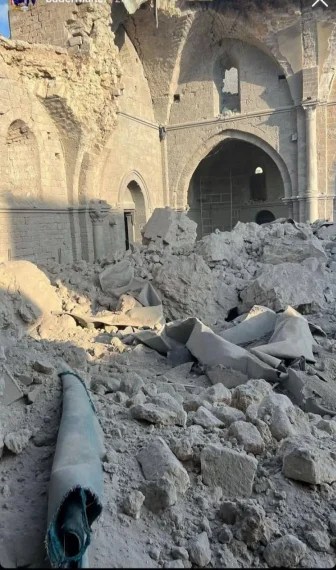 Israel “deliberately” targeted archaeological sites in Gaza during more than 15 months of war, Palestinian Minister of Tourism and Antiquities, Hani Al-Hayek, said yesterday. He went on to describe Israel’s actions as a genocide.
His remarks came during the closing session of a training workshop in Cairo, organised by the Palestinian Centre for Cultural Heritage Preservation (CCHP) in cooperation with the Egyptian Heritage Rescue Foundation (EHRF), according to the official Palestinian news agency, Wafa.
During the workshop, Al-Hayek pointed out that “more than 226 archaeological and historical sites in Gaza have suffered severe damage,” adding that work is underway to develop a comprehensive action plan to rescue and restore the cultural heritage in the region.
He added: “The Israeli occupation deliberately targeted archaeological sites in Gaza, but we are determined to rebuild and restore them. These sites are an important part of the history of the Palestinian people on this land, and it is our duty to return them to their former state.”
On 6 February, French archaeologist Simon Brelaud warned that the Israeli occupation army had destroyed most of Gaza’s historical landmarks, stressing that this “puts the future of archaeology in the region at risk.”
Gaza is an ancient region that has witnessed several civilisations, including the Pharaonic, Greek, Roman, Byzantine, Canaanite, Phoenician and finally, Islamic.
Arrest of activist Yves Engler and unchecked growth of Zionist network in Canada
By Ivan Kesic | Press TV | March 3, 2025
Attempts to harass and intimidate pro-Palestine voices through fabricated and politically-motivated legal cases have intensified in the West, further revealing the dangerous tactics and mechanisms adopted by the organized Zionist network.
Numerous such cases have emerged recently, including in recent weeks, involving prominent journalists and activists such as Ali Abunimah in Switzerland, Richard Medhurst in Austria, David Miller in England, and Yves Engler in Canada.
What is common between these cases is a pattern of prolonged detentions, often lasting hours or even days, on false charges or vague suspicions. Those targeted are treated as criminals, subjected to incoherent interrogations, and in many instances, thrown in jails.
Press TV recently published firsthand accounts from Medhurst and Miller, both longtime contributors to Iran’s leading international news network, detailing their experiences.
Miller emphasized that activists and journalists are prime targets of the Zionist lobby, which exerts pressure to harass or detain pro-Palestine voices across Western countries.
This was further corroborated by the recent case of Yves Engler in Canada, where the prominent author and activist was detained for five days.
Engler, who occasionally appears on Press TV as a commentator, in a statement posted on his website outlined the methods employed by Zionist lobbyists to intimidate people like him.
Based in Montreal, Engler has been an outspoken critic of the Israeli regime and its lobbyists. He has authored 13 books on Canadian history and foreign policy, including Canada and Israel: Building Apartheid, which exposes Canada’s longstanding support for the Israeli regime.
Legal harassment of Yves Engler
On February 18, Engler received a call from a Montreal police officer named Crivello, who instructed him to appear at the downtown police station two days later, where he would be charged with harassment and indecent communication.
The officer explained that a complaint had been filed against him months earlier by a legal firm representing Dahlia Kurtz, a well-known Zionist rabble-rouser and outspoken supporter of the 16-month-long genocide in Gaza.
Engler had previously criticized Kurtz’s racist and violent anti-Palestinian posts on X in a polite and measured manner. He recalled her first – and only – reaction.
“Tomorrow the Montreal police will arrest me for posting to social media against Israel’s genocide in Gaza,” Engler wrote in an article police reached out to him over Kurtz’s complaint.
Pointing out that he had “responded to Kurtz’s racist, violent, anti-Palestinian posts on X”, Engler said he had not harassed the influencer, who “supports killing Palestinian children” and “openly calls for state violence against those challenging Canadian complicity in genocide.”
“I’ve never met Kurtz. Nor have I messaged or emailed her. Nor have I threatened her. I don’t even follow her on X (Twitter’s algorithm puts her posts in my feed).”
In early July 2024, Kurtz quoted one of his posts and wrote: “Hello, Engler Yves. I’m advising you in this one message only that you are harassing me. You’re threatening and you’re making me afraid for my safety. You must stop this harassment – and communication with me. Stop now.”
His statements that she referenced, posted a few days earlier, read: “Racist Dahlia supports killing Palestinian children. 20,000 is not enough, she wants even more Palestinian blood spilled.”
Her response was a blatant lie. Engler had never threatened, harassed, or contacted her—neither publicly nor privately via messages or emails—nor was he following her on X.
Despite this, her exaggerated claims of victimhood escalated beyond false public accusations to the extent of hiring a law firm to pursue criminal charges against him.
On the morning of February 20, Engler was taken into custody at the police station, where an officer informed him that he would be detained overnight or until he was brought before a judge.
Citing the alleged risk of recidivism, authorities held him in custody for a total of five days.
Public support for Engler
Engler’s imprisonment drew widespread anger and outrage among pro-Palestinian and human rights activists, who staged protests outside the police station and courthouse for several days.
A day before his arrest, an article on his website in which he detailed the situation, prompted the Canadian Foreign Policy Institute to launch an email campaign.
In response to his initial call, over 4,000 people emailed Montreal police inspector Crivello, demanding the charges be dropped. Soon after, more than 6,000 others sent emails to the Montreal police chief and mayor, echoing the same demand.
Organizations such as PEN Canada and PEN America, Canadian Senator Yuen Pau Woo, and journalists Ali Abunimah, Glenn Greenwald, Caitlin Johnstone, and Aaron Maté all spoke out about the case, either through statements or articles, expressing deep concern over the charges.
Singer David Rovics composed the song “What’s Going On Here, Montreal?” in response to Engler’s imprisonment and Kurtz’s violent anti-Palestinian rhetoric.
Musician Roger Waters created a short social media clip on Engler’s arrest over pro-Palestine advocacy, which garnered hundreds of thousands of views.
According to Engler, the presence of protesters during the final hours of his detention may have influenced the judicial decision to acquit him and order his release.
He also suggested that their activism contributed to more respectful treatment from the guards.
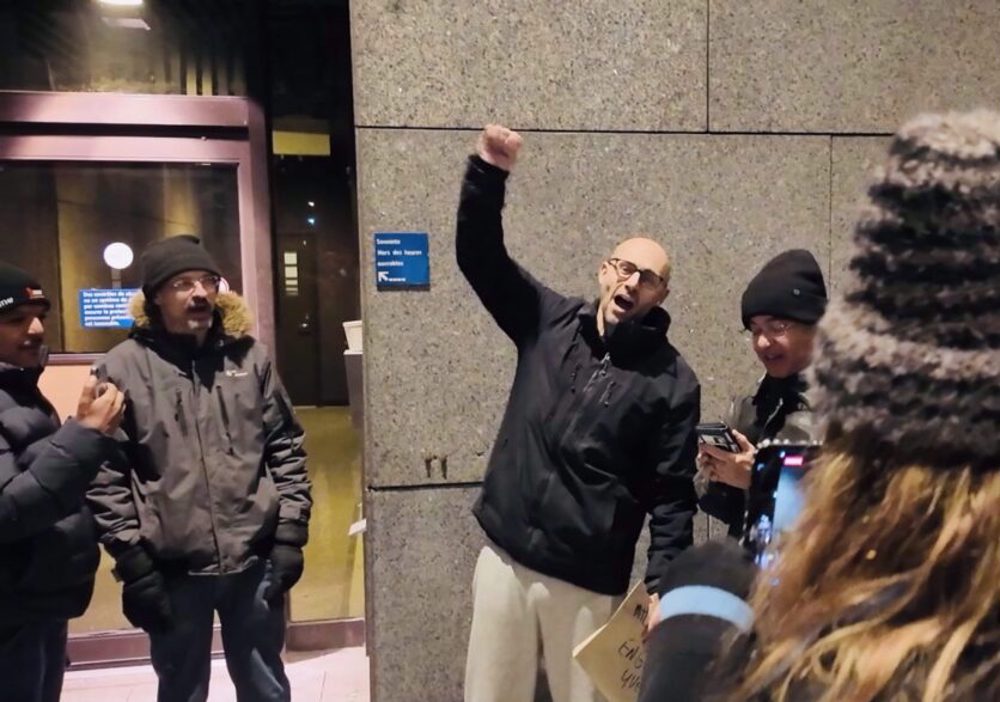
Yves Engler celebrates his release
Key Zionist rabble-rousers
After his release, Engler expressed gratitude to his supporters for their consistent backing and shared further details about the legal manipulations he encountered during his five-day detention.
He emphasized that his brief imprisonment was insignificant compared to the suffering of thousands of Palestinian abductees languishing in Israeli jails, some of whom endure incarceration for decades.
When questioned by police investigator Crivello, Engler did not deny that he had referred to Kurtz on the X platform as a “genocide supporter” and a “fascist”, labels he asserted were accurate based on their relevant definitions.
He further clarified that he had never met Kurtz nor communicated directly with her via text or email, suggesting that her claims of receiving “threats” and fearing for her safety were outright fabrications.
As a condition of his release, the investigator required him to agree to cease all interaction with Kurtz, a condition Engler stated he was willing to accept to regain his freedom.
In other words, he would no longer reference her content on social media, critique her chauvinistic outbursts and insults toward individuals or groups, or expose her attempts to play the victim.
Additionally, the investigator asked Engler’s lawyer, John Philpot, to agree that Engler would refrain from discussing the case – a request he believed was intended to shield the police, Kurtz, and her legal team from public scrutiny and embarrassment.
However, it appeared that the primary objective of the Zionist network was to completely silence Engler and apply similar tactics to other uninformed pro-Palestinian activists.
Engler had already rejected this condition before his detention, calling it “a flagrant violation of his freedom of expression” and stating he was willing to remain incarcerated until a judge ruled on whether such a restriction was legally permissible.
After spending five days in detention, he was released on February 24 without any restrictions on his ability to discuss the charges against him for his anti-Zionist activism.
He described this as “a small win for free expression and Palestine campaigning.”
“In court, the judge effectively forced the Crown to drop its bid to prevent me from mentioning arch anti-Palestinian Dahlia Kurtz. The Crown [government] sought to restrict my ability to name the Jewish supremacist who instigated a police complaint against me,” he said.
Rather than granting them anonymity, he publicly exposed those suing him, the legal firm they hired, their methods, and all related details – boldly refusing to be silenced.
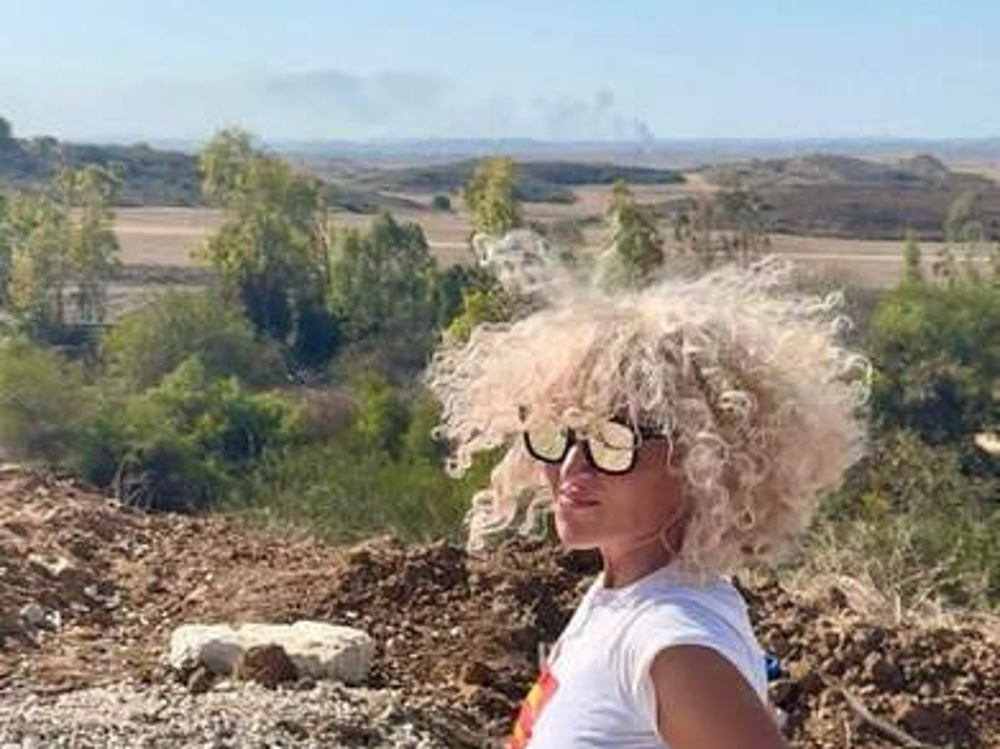
Dahlia Kurtz proudly poses in the occupied territories as columns of smoke from Israeli bombing rise over Gaza Strip
Who is Dahlia Kurtz?
Dahlia Kurtz is a Canadian Jewish Zionist hate-monger who positioned herself as the leading advocate for the Israeli regime in Canada during the West-backed Israeli genocidal war against Gaza.
She unconditionally defends all Israeli military actions and has never condemned their crimes against Palestinians, instead dismissing their suffering as if it does not exist.
Yet, she has been seen proudly posing in the occupied Palestinian territories with plumes of smoke rising from an Israeli bombing on the Gaza Strip in the background.
On her website, Kurtz openly flaunts these images and reveals that she was on a “media mission” to the occupied territories, where she met with Israeli officials, implying direct ties to the regime’s vast propaganda apparatus.
She has organized events where she trained Zionist settlers and other lobbyists to operate according to a specific six-point plan she obtained during these visits.
Her social media rhetoric is saturated with Israeli disinformation, fact distortion, manipulative techniques, and the dehumanization and demonization of Palestinians. Yet she has never faced legal consequences for her actions.
Among the countless examples, she has claimed that Palestinians “know only terror,” suggested that there are no innocent Palestinians even in images of thousands of gathered Gazans, and mocked Palestinian children suffering from hunger and freezing temperatures – calling their parents “genocidal” and “obese,” among other remarks.
Following the ceasefire, she declared, “Gaza is still standing. The world has never witnessed such restraint” – a statement completely at odds with UN reports documenting destruction of civilian infrastructure on an unprecedented scale.
Regarding Jewish anti-Zionist protesters outside the Canadian Parliament, she claimed they “love Gaza too much,” using quotation marks to suggest they were fake Jews, and added that she would personally fund their deportation to Gaza.
Kurtz aggressively cultivates a victimhood narrative, frequently emphasizing that she is a short, weak woman, allegedly the granddaughter of Holocaust survivors, and an independent actor. She presents herself as the ultimate symbol of the “victim” while branding critics and dissenters as “threateners.”
As Engler highlights, her image-building and propaganda efforts are bolstered by certain Canadian media outlets and politicians who seek to persuade the public that Canadian Jews are the real victims, with Kurtz positioned as a heroic figure pushing back against Canada’s so-called Jew-hate problem.
She also receives direct legal support from the Montreal-based law firm Spiegel Sohmer, particularly from litigation lawyer Neil Oberman, who is involved in Engler’s case.
Despite her claims of acting independently and financing her efforts on her own, all evidence suggests that she is merely the visible face of a well-organized Zionist network.
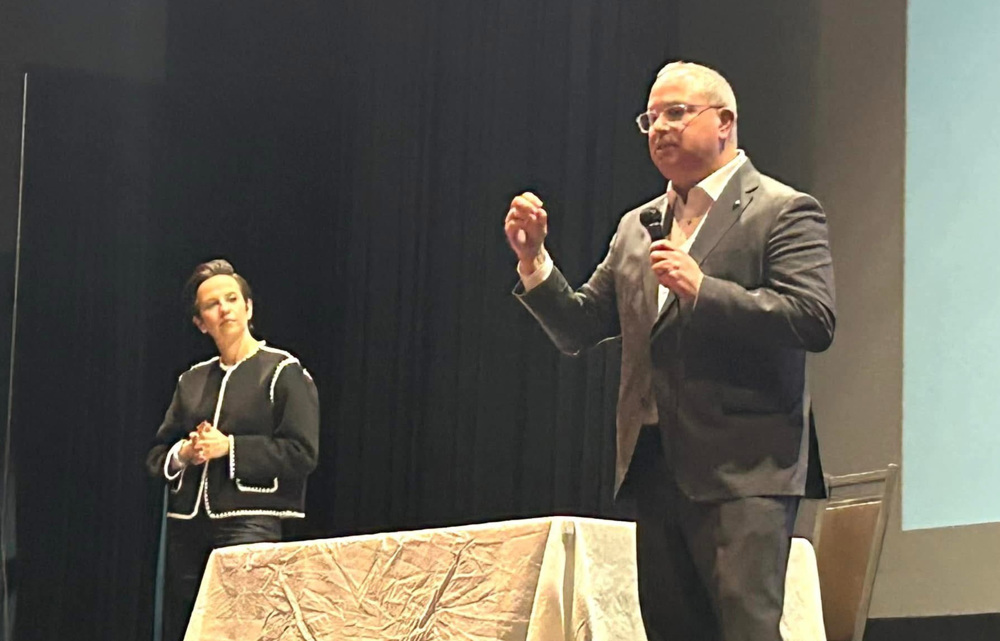
Neil Oberman (right) gives a political speech
Who is Neil Oberman?
Neil G. Oberman is not just a randomly selected lawyer to sue Engler. He is a key figure in the Zionist network, with deep ties to the Israeli regime and its lobby groups in Canada.
A Canadian Jewish Zionist like Kurtz, Oberman is a founding member of the Quebec Jewish Legal Alliance (QJLA), an organization that has recently made headlines for its desperate attempts to suppress local pro-Palestinian protests.
The QJLA works closely with Federation CJA, the Centre for Israel and Jewish Affairs (CIJA), and other Zionist advocacy groups, engaging in numerous pro-Israeli initiatives and programs.
Oberman has personally delivered pro-Israeli lectures, instructing audiences on strategic positioning, activism tactics, and the politicians and universities to target.
He is also a board member of Technion Canada, the Canadian branch of the Haifa-based university long criticized by international Boycott Divestment and Sanctions (BDS) activists for its collaboration with the Israeli military and leading arms manufacturers.
Since last year, Oberman has been the Conservative Party of Canada’s candidate for the Mount Royal riding in the upcoming federal election.
His campaign is backed by former Prime Minister Stephen Harper and Hampstead Mayor Jeremy Levi, two of Canada’s most fervent Zionists, who reportedly helped raise $200,000 for his campaign late last year.
Engler notes that he is merely Oberman’s latest target, as the lawyer has already launched a series of lawsuits in recent months against various institutions and individuals who oppose Israel’s genocidal policies against Palestinians in the occupied territories.
Oberman’s legal targets
Among his first individual targets in late 2023 was journalist Max Blumenthal, whom he threatened with a frivolous lawsuit on behalf of Lauren Wise – a Zionist author who notoriously wished for a woman to be “raped and dragged in the streets in front of her kids” for flying a Palestinian flag.
In the first six months of Israel’s genocidal war on Gaza, Oberman and the QJLA actively worked to suppress pro-Palestinian protests in Montreal, sending legal threats to Mayor Valérie Plante and denouncing her for allowing what he called “hate festivals.”
He also attempted to dismantle a pro-Palestinian encampment at McGill University through various legal maneuvers, but a Quebec Superior Court judge rejected an injunction request filed by two Zionist students represented by Oberman.
However, he did secure an injunction banning protests at a Jewish community building and synagogue and later expanded the ruling to include two dozen institutions for six months.
Oberman also issued legal warnings to Concordia University regarding pro-Palestinian rallies, but after being rebuffed, he lashed out at the institution, declaring: “You don’t know Neil Oberman, you don’t know the Alliance [QJLA], and you don’t know what’s coming next. This is a war!”
Frustrated by his failure to impose a 100-meter protest ban around 154 university buildings, he and other Zionists went so far as to accuse Iran of orchestrating the demonstrations at a Canadian university.
In November 2024, he collaborated with pro-Israeli pressure groups to block a visit by UN Special Rapporteur Francesca Albanese at McGill Law School. Despite their efforts, she delivered a speech commending pro-Palestinian students.
On this occasion, Oberman openly acknowledged his cooperation with several Zionist organizations, including the Jewish Law Students Association (JLSA), Israel on Campus, Students Supporting Israel (SSI), and UN Watch.

Neil Oberman (right), UN Watch’s head Hillel Neuer (center) and Hamstead Mayor Jeremy Levi (left) campaigning against Francesca Albanese’s speech at McGill University
Engler confronts Oberman
Engler personally confronted Oberman in order to question him about Israeli genocidal crimes against Palestinians in Gaza – a moment he documented on the X platform.
Oberman initially tried to evade the exchange by falsely claiming that Engler was addressing the “wrong person.” However, when Engler pressed him about the 15,000 Palestinian children killed by the Canada-backed regime, Oberman snapped aggressively, ordering him to back off and threatening to sue.
According to Engler’s lawyer, John Philpot, Oberman played a crucial role in Engler’s five-day detention. Kurtz’s original complaint from last summer had been dismissed by police, and charges were only pursued after Oberman intervened.
Philpot noted that in a minor case like Engler’s, the standard police response would typically be to instruct the accused to avoid contacting the complainant.
However, the authorities imposed additional conditions on Engler, including an unusual demand that he refrain from revealing the identity of those suing him.
The latest victim of false accusations from Kurtz and Oberman is Canadian Senator Yuen Pau Woo, known for his vocal criticism of the Tel Aviv regime and advocacy for Palestinian rights.
As in Engler’s case – where Woo had publicly expressed support during his detention – Kurtz now alleges that Woo “incited hate, aggression, and violence” against her through a series of X posts.
The Zionist modus operandi
The duo’s actions, legal maneuvers, and overall conduct illustrate the broader strategy used by the Zionist network to suppress pro-Palestinian and anti-Zionist voices.
In an April 2023 lecture to pro-Israeli agents, Oberman urged them to rethink their approach to advocacy, warning: “If you act like sheep, you’re going to get treated like a sheep. If you don’t want to be a sheep, be a wolf. Stand up and be heard. You have to be heard, and to be heard, you have to take action.”
Oberman exemplified this doctrine when confronted by Engler about the mass murder of Palestinian children, refusing to address the issue and instead resorting to intimidation and legal threats.
Kurtz follows a similar pattern. Despite being publicly called out hundreds of times for glorifying Israeli crimes, she consistently ignores the criticism, sticking to her narrative.
Justifying the killing of tens of thousands of Palestinian civilians is both demanding and time-consuming. Instead, Zionist advocates and their allies in Western media often opt to ignore these atrocities altogether, pretending they do not exist.
When a dissenter gains too much visibility and disrupts their propaganda efforts, they shift tactics –playing the victim, issuing veiled threats, and ultimately resorting to baseless legal action.
Both Kurtz, online, and Oberman, in person, portrayed themselves as victims – falsely implying that Engler had privately threatened them, when in reality, they were the ones harassing him.
The charges they file have no real legal merit and serve purely as intimidation tactics. However, they still drain their targets’ time, resources, and mental energy.
These lawsuits are also leveraged in parallel smear campaigns, with media headlines falsely implying that Engler was arrested for harassment.
For activists, filing counter-charges for false accusations, a lesser offense legally, requires hiring a lawyer and securing financial resources. Meanwhile, well-funded Zionist legal groups face no such obstacles.
The attempt to condition Engler’s release on refraining from criticizing Zionist activists or discussing the lawsuit, according to observers, is a clear indication that the Zionist network in Canada has a premeditated strategy to silence other pro-Palestinian activists in the same manner.
Pro-Israel Think Tank WINEP Outed as ‘Dark Money’ Operation Driving US Wars
By Robert Inlakesh | MintPress News | February 26, 2025
The AIPAC-aligned Washington Institute for Near East Policy (WINEP), which often refers to itself simply as The Washington Institute, was recently outed as a “dark money” think tank for its lack of transparency on donors and is continuing to push the United States to engage in conflicts overseas to Israel’s benefit. Its case raises questions about how the Israel Lobby functions through think tanks across the board, shaping U.S. foreign policy behind closed doors.
WINEP has a long history of shaping U.S. foreign policy. It was deeply involved in the neoconservative push for regime change in Iraq, joining calls for the Clinton administration to topple Saddam Hussein as early as 1998. They also pushed for U.S. military intervention and helped justify the eventual invasion in 2003.
At the beginning of the year, the Quincy Institute for Responsible Statecraft unveiled the “Think Tank Funding Tracker,” a one-of-a-kind project that examined the funding sources of the top 50 U.S. think tanks since 2019 and rated their transparency from 0 to 5. WINEP and 16 others—including the neoconservative Foundation for Defense of Democracies (FDD)—received a zero transparency rating, exposing its reliance on “dark money” contributions.
While WINEP claims “to be funded exclusively by U.S. citizens” on its website, it does not publicly disclose its donor list. Its AIPAC roots were first exposed in 2006 by Stephen Walt and John Mearsheimer in The London Review of Books, where they described WINEP as an AIPAC cutout advancing Israel’s agenda under the guise of independent research. The pair wrote at the time that “The Lobby created its own think tank in 1985, when Martin Indyk helped found WINEP. Although WINEP plays down its links to Israel and claims instead that it provides a “balanced and realistic” perspective on Middle East issues, this is not the case. In fact, WINEP is funded and run by individuals who are deeply committed to advancing Israel’s agenda.”
This claim that AIPAC created WINEP was later corroborated by former AIPAC official MJ Rosenberg, who wrote in HuffPost : “How do I know? I was in the room when AIPAC decided to establish WINEP.” The now-deceased WINEP co-founder, Martin Indyk, was also the head of the Saban Center for Middle East Studies, funded by Israeli-American billionaire Haim Saban.
Recent U.S. foreign policy developments have only strengthened WINEP’s influence. The Biden administration’s unwavering support for Israel’s war on Gaza, including a $14 billion emergency military aid package, aligns with WINEP’s long-standing push to ensure that U.S. military assistance to Israel remains untouchable. WINEP actively shaped public discourse as the war progressed, with Executive Director Robert Satloff praising Biden’s refusal to support an early ceasefire, calling it “correct and courageous.”
When House lawmakers convened hearings in late 2023 to attack the administration’s Iran policy, their rhetoric mirrored WINEP’s narratives, particularly opposition to any sanctions relief. Witnesses from WINEP-adjacent institutions like FDD and JINSA were brought in to reinforce the case for a more aggressive posture toward Iran. Meanwhile, WINEP continues to push for U.S. military leverage in post-Assad Syria, another key policy area where the Biden administration has quietly followed its recommendations by maintaining a military foothold and targeting Iranian assets with airstrikes.
WINEP’s revolving-door relationship with the U.S. government does little to shed its reputation for shaping policy. In May 2023, National Security Advisor Jake Sullivan delivered a keynote address at WINEP’s annual Soref Symposium, praising Satloff’s “extraordinary work.” Sullivan’s participation wasn’t just symbolic—it reinforced WINEP’s position as an informal but essential policy hub. This is evident from the administration’s embrace of the Abraham Accords, another WINEP priority.
Former WINEP fellow Dan Shapiro was appointed the State Department’s senior advisor for regional integration, carrying out the think tank’s long-standing vision for Arab normalization with Israel. WINEP is currently led by Michael Singh, Robert Satloff, Dennis Ross, and Dana Stroul. Stroul, who serves as WINEP’s Research Director, returned to the position after serving as the Biden administration’s deputy assistant secretary of defense for the Middle East from 2021 to 2024. During her tenure, she played a central role in Washington’s anti-Iran initiatives, the response to the Gaza war, and shaping U.S. Syria policy.
Beyond WINEP, the broader issue of think tank influence is now facing increasing scrutiny. In 2023, lawmakers introduced the Think Tank Transparency Act, which requires policy organizations to disclose foreign government funding and contractual agreements. While WINEP does not receive direct funding from Israel, watchdogs have highlighted that its pro-Israel agenda is sustained through wealthy American donors closely linked to AIPAC. Using domestic contributions to advance a foreign policy agenda has enabled WINEP to operate without falling under the scrutiny of foreign lobbying laws, even as its “scholars” shape U.S. positions on Iran, Syria, and the Israel-Palestine conflict.
Currently, the two primary issues on WINEP’s agenda are how to best leverage American influence to shape outcomes in post-Assad Syria and how to assure regime change in Iran. Indicative of the think tank’s influence is that not only was its hardline Syria strategy the exact model used by the U.S. to aid regime change in Damascus, but its chief researcher was taken on as a senior official by the previous administration.
As demonstrated by the Quincy Institute’s new report, the lack of transparency over who exactly finances the AIPAC lobby’s “cutout” think tank presents serious questions about who is actually shaping U.S. foreign policy and to whose benefit.
Hamas decries as ‘war crime’ Israeli suspension of humanitarian aid to Gaza
The Cradle | March 2, 2025
Israel has accepted a proposal brought by US envoy Steve Witkoff to extend the first phase of the Gaza ceasefire and prisoner exchange agreement for another 42 days, facing rejection from the Hamas movement.
As a result of Hamas’s rejection – which stems from the resistance movement’s insistence on abiding by the terms of what was initially agreed upon – Israel announced on 2 March that it halted the entry of aid and supplies into the Gaza Strip.
“With the end of the first stage of the prisoner swap deal and following Hamas’ rejection of Witkoff’s proposal to continue negotiations – which Israel agreed to – Prime Minister Netanyahu has decided to halt all imports of goods and supplies to the Gaza Strip as of today,” said the office of Israeli Prime Minister Benjamin Netanyahu in a statement.
“Israel will not allow a ceasefire without the release of its prisoners. If Hamas continues to refuse, there will be further consequences,” the premier’s office added.
The extension deal agreed to by Netanyahu calls for the release of half of the estimated 22 living captives in Gaza, in exchange for Palestinian prisoners.
According to Netanyahu, the Witkoff plan gives Israel the right to resume the war after the 42-day extension if talks do not progress. Israel’s Channel 12 reported that the prime minister has approved a potential call-up of 400,000 reserve soldiers.
“The decision we made last night to completely halt the entry of humanitarian aid into Gaza until Hamas is destroyed or surrenders completely and all our hostages are returned is an important step in the right direction— ‘standing at the gates of hell,’” said Israeli Finance Minister Bezalel Smotrich.
“Now, we must open these gates as quickly and as lethally as possible against the cruel enemy until absolute victory,” he added.
Israeli opposition leader Yair Lapid blasted the government’s decision.
“The prisoner exchange deal has been halted. Humanitarian aid to Gaza has been stopped. The government has approved the mobilization of 400,000 reserve soldiers. What is the goal? What objective has Israel set for itself? Has the government decided to abandon the prisoners, and if so, why? For what greater national purpose? If we return to war, what is the objective of the war? Who will replace Hamas in the end?” Lapid said.
“Once again, the government is acting without a plan, without a vision. We can only hope things turn out okay—because that seems to be the extent of their planning.”
Phase one of the Gaza ceasefire was due to end on Saturday. Israel has been pushing for the extension in recent days and has continuously delayed the start of negotiations for the second phase, violating the original ceasefire agreement.
“The statement issued by the office of the terrorist occupation Prime Minister Netanyahu, regarding his approval of American proposals to extend the first phase of the agreement under arrangements that violate the ceasefire agreement in Gaza is a blatant attempt to evade the agreement and avoid entering negotiations for its second phase,” Hamas said in a statement.
“Netanyahu’s decision to halt humanitarian aid is a form of blackmail, a war crime, and a blatant violation of the agreement,” it went on to say.
Since the morning of 2 March, Israeli attacks on Gaza have killed at least four Palestinians. Israel has been violating the ceasefire daily since it was reached in January, carrying out deadly attacks and consistently holding up the entry of aid and essentials into Gaza.
Israel pushes for six week ‘extension’ of Gaza ceasefire’s phase one
The Cradle | February 28, 2025
An Israeli delegation in Cairo is negotiating with mediators a potential extension for the first phase of the Gaza ceasefire agreement, according to Egyptian security officials cited by Reuters on 28 February.
“Hamas opposes the extension and insists on proceeding to the second phase of the deal as originally agreed,” the sources said. They added that Tel Aviv seeks to extend the first phase for another 42 days.
Israeli sources had previously told the British news outlet that Tel Aviv sought an extension and the release of three Israeli captives per week in exchange for Palestinian prisoners held in Israeli prisons.
According to a military source cited by Times of Israel, Tel Aviv “still prioritizes dismantling Hamas’s ability as an authority in Gaza.”
Hamas released a statement on Friday confirming “its full commitment to implementing all the terms of the agreement in all its stages and details.”
“We call on the mediators, guarantors, and the international community to pressure the Zionist occupation to fully commit to its role in the agreement and immediately enter the second phase of it without any hesitation or evasion,” it added.
US envoy to the region, Steve Witkoff, is expected to travel to Israel on Sunday to negotiate an extension of the first phase of the ceasefire deal, which ends on 2 March. Tel Aviv has continuously delayed talks for phase two of the agreement.
Israel recently imposed new conditions on the Gaza ceasefire agreement, demanding a full disarmament of Hamas’s military wing.
According to reports, Israel is looking to violate the deal by maintaining its military presence along the Philadelphi Corridor on southern Gaza’s border with Egypt.
Israel’s Defense Minister, Israel Katz, said on Thursday that the corridor will remain “a buffer zone just as the case is in Lebanon and Syria.” Tel Aviv is also reportedly planning for a resumption of its brutal war against Gaza
A recent report by Haaretz says that “as far as [Israeli Prime Minister Benjamin] Netanyahu is concerned, there is no second stage” of the deal.
The report says Israeli Minister of Strategic Affairs Ron Dermer recently told Witkoff that Netanyahu’s plan is to secure the release of all captives in a single stage, and that Hamas will receive prisoners in exchange. Otherwise, “Israel will return to intense warfare” and reimplement a “version” of the Generals’ Plan – which saw the expulsion of hundreds of thousands of Palestinians from north Gaza, the killing of thousands, and the destruction of the Gaza health sector.
Euro-Med Monitor documents ‘shocking’ crimes, torture against Palestinian prisoners
Press TV – February 28, 2025
An independent Geneva-based human rights organization says the tragic and shocking health condition of the Palestinian prisoners recently freed under the multistage ceasefire agreement with Hamas shows the Tel Aviv regime’s “ongoing use of torture to terrorize and persecute” them.
The Euro-Med Human Rights Monitor said in a statement on Thursday that the traces of torture were evident on the prisoners’ frail bodies, reflecting the extent of the systematic crimes and inhumane treatment they endured, which exceeded all moral and legal boundaries.
“All evidence indicates that Israel continues to use torture as a weapon to intimidate and persecute prisoners and detainees and to break their will until the last moments of their detention,” the organization said.
The Switzerland-based group noted that its field team documented serious injuries among the prisoners and detainees, including amputations and severe swelling resulting from torture, in addition to extreme weakness and fatigue.
It added that the released prisoners revealed that they had been subjected to brutal beatings, abuse, and continuous threats right up to the last moments before their release, despite the lack of any specific charges against the majority of them.
The organization stressed that the brutal torture and deliberate medical neglect faced by prisoners and detainees have reached shocking levels that surpass all moral and legal limits.
It noted that Israel’s ongoing use of brutal torture and deliberate medical neglect against Palestinian prisoners and detainees proves its systematic intent to intimidate them and break their will.
The rights group emphasized that such actions constitute blatant war crimes and crimes against humanity, as reliable information has indicated the death of dozens of prisoners inside Israeli prisons and detention centers, while Israel continues to hide any data related to them.
It called on all concerned countries and organizations to take immediate and decisive action to stop these systematic crimes, underlining the need to intensify human rights and media efforts to highlight the suffering of Palestinian prisoners and detainees, and to work towards holding the occupiers accountable and forcing them to end these ongoing violations.
Israeli authorities released 641 Palestinian prisoners in the “Flood of Freedom” deal early on Thursday, as part of the ceasefire and prisoner exchange agreements with Hamas, after delaying their release for almost a week.
The physical status of the released prisoners showed that they had been deprived of adequate food throughout their detention, with testimonies confirming that they received minimal amounts of food, while some were denied food and sleep as a form of harsh and deliberate punishment.
How UK counter-terror police colluded with Zionists to detain me after Beirut trip
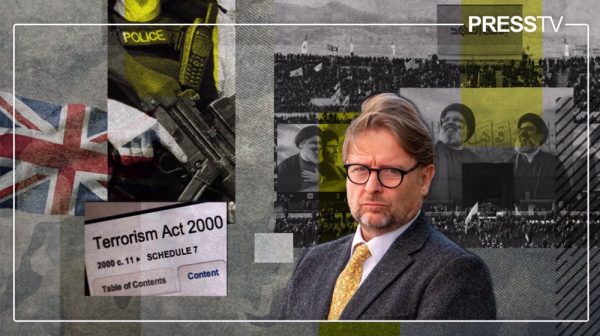
By David Miller – Press TV – February 27, 2025
At 21.32 local time on the evening of Monday, 24 February, I stepped off a plane from Istanbul to Heathrow and into the terminal building.
In front of me were a wide circle of people evidently waiting for someone, perhaps for a number of passengers. I knew right away one of them was me.
One of the SO15 (formerly special Branch) plain clothes officers of the Counter Terrorism Command, for it was them, asked for my passport and whether I had started my journey in Istanbul.
Of course I knew that they knew this was not the case. In any case, I had done nothing wrong in – as I said to them – visiting Beirut to cover the funeral of Hezbollah leaders Sayyed Hassan Nasrallah and Sayyed Hashem Safieddine.
This was my first taste of Schedule 7. They started to explain what Schedule 7 was and I said yes, I know about it. From being stopped before? No, because I am a researcher who studies terrorism legislation.
About then, on the moving walkway, I realised that the circle of people had only been waiting for me. I looked round and counted them out loud. I know I’m a big lad, I said, (I am over 6 foot) but did you really need eight officers to detain me?
So, we got to the interrogation room, which is, as past detainees will know, immediately behind passport control. Anyone coming out of that door is SO15 or a detainee.
For those who may face this experience in the future, it is worth explaining how the process goes. It’s a bureaucratic procedure.
There is a guidance hand book dictating how the process should be handled. First they have to read out the relevant extract from the Terrorism Act. It’s a whole page (see below) and they give you a copy, which they ask you to sign.
The essential bit is that you are being ‘detained’ as opposed to arrested in order that the ’Examining Officer’ can determine if you ‘appear’ to be a person ‘concerned in the commission, preparation or instigation of acts of terrorism’.
A couple of other details are of relevance. They can’t hold you for more than 6 hours after the time they first apprehend you. You are not under criminal investigation or under arrest and as a result ‘you do not have the right to remain silent’. If they do change their minds and arrest you, you do at that point have the right to remain silent and you should do so.
You have to participate in the process, answer questions and to accept being searched. You don’t have to answer questions that you think they are asking and only need to answer what they actually ask. There is no need to be unduly long winded!
The other point to note is that nothing you say can be used ‘in evidence in criminal proceedings’. (The only exceptions are that if you do not comply, that can be used in evidence and if you later rely on something in court which is ‘inconsistent’ with what you say, then the contents of your interview can be used).
You have the right to contact a next of kin/friend and a lawyer and you should exercise that right. The rules state that if you ask for a solicitor you cannot be questioned until your solicitor has consulted you.
And your solicitor can participate in the questioning either on the phone or in person, if you can get them out of bed to come to wherever you are detained!
Once in the room both I and my luggage were searched. They found little of interest. No devices. The only thing that they brightened at was a very small USB drive, which I had forgotten was in there.
I confirmed that I thought it had no security protection and they took it away. Later it was returned, much to my surprise. What was on it I asked? Only some teaching notes they said in disappointment.
Later, at home I checked. Hilariously there was only one file on the drive: a Powerpoint presentation on the ‘Zionist movement’.
And so we got to the actual interrogation. I estimate that mine started about 23.00, so there was a long period of silence while we waited for the solicitor to call back.
This was partly due to the police deciding that they could not call my first nominated solicitor because he wasn’t on their list, though he should not have needed to be.
Anyway, after I talked to my solicitor, we were off.
What followed was around two hours of questioning about my trip to Beirut. Why did I go, what did I do when I was there, did I support Hezbollah, and many other similar questions.
There is not space to tell it all blow by blow but here are some highlights which might be of use to others who like me are manifestly not involved in the commission of acts of terrorism, as everybody knows.
First, they wanted to know why I went. As I had already intimated when they first stopped me, I was there to cover the funeral as a journalist. As is public knowledge, I work as a journalist on a freelance basis.
I produce a TV show called Palestine Declassified for Press TV, and write for a variety of other publications such as Electronic Intifada, Mintpress, TRT World and Mayadeen English. I mentioned this as well as mentioning that I used to work at the university of Bristol until I was sacked.
They asked about that. I summarised the story including the four occasions on which I was exonerated of ‘antisemitism’ at Bristol (internal enquiry, two external QC reports and the internal appeal), followed by the ‘landmark’ victory at the Employment Tribunal in February 2024.
We went on to discuss my trip to Lebanon. What did I do there? I recounted that I had visited the southern village of Maroun El Ras which is within a mile of the border of occupied Palestine, high on a hill overlooking the colonial settlements of Avivim and Yir’on.
I went with a number of other foreign guests including from Ireland, Yemen, Brazil and various other countries. What was there I was asked? I replied (truthfully) that there was nothing in the village since almost all 600 houses had been destroyed.
The officer seemed confused: why would I want to visit then? Precisely because it had been destroyed by the Zionists, obviously.
We got fairly quickly to the question of whether I supported Hezollah as a proscribed organisation. I referred back to my Employment Tribunal at which similar questions had been asked somewhat ineffectually by the University of Bristol’s counsel Chris Milsom.
There I had said the same thing as I now stated: I ‘support’ the right as given in international law for the Palestinians (and indeed others under occupation) to resist including by armed force.
In case officers in SO15 or other actors need reminding of this, the relevant text is from the UN General Assembly resolution 38/17 of 1983, which states that it
“Reaffirms the legitimacy of the struggle of peoples for their independence, territorial integrity, national unity and liberation from colonial domination, apartheid and foreign occupation by all available means, including armed struggle”.
They went on to see if they could entice me into saying I specifically supported proscribed organisations like Hamas and Hezbollah. So, I obviously went on to say that it was not only a question of Hezbollah and Hamas, but also Palestinian Islamic Jihad and the PFLP-GC, which is of course not the same as the PFLP itself, which is not proscribed. It was instructive that my interrogator appeared not to know about PIJ and the PFLP-GC, asking me to repeat each name.
We also visited the topic of deproscription. The officer wanted to know why I thought that all of the four, groups should be de-proscribed.
It seemed like he thought this was a valuable concession from me. But, as he is, presumably, aware, the Terrorism Act (year) specifically notes that it is not illegal to call for de-proscription.
I include a table from the Home Office website which gives a list of the charges that can relate to proscribed organisations.
And then we were on to the question of terrorism. Did that mean that I thought they were not terrorist. At which point I am afraid I referred back to my decades long record of research on the question of terrorism and its role in propaganda including my early work on the struggle to decolonise the north of Ireland.
As if the sentiments encoded in the proscribed list or the Western use of the term ‘terrorism’ itself are necessarily subscribed to even by most British citizens, never mind the rest of the world. Let’s not forget that the way in which we use the term ‘terrorism’ in the west – in particular ‘Islamic terrorism’, has it origin in Zionist propaganda operations as has been shown by, for example, Remi Brulin.
At one point, apparently out of the blue I was asked: Are you a practising Muslim? I expressed some surprise at this question. In his defence my interrogator said that I had earlier noticed and asked about whether the small pile of folded prayer mats in the cupboard was in fact a small pile of folded prayer mats.
I had noted them earlier and wanted to check that’s what they were. Only the best for the predominantly Muslim ‘guests’ of the room! As the Guardian reports only 20% of Schedule 7 detentions are of white people (that’s including ‘white Irish’, and others stopped, like me for their solidarity activities, so it’s likely that the proportion of white ‘far right’ suspects stopped is lower than 20%)
The officer seemed mystified about my attendance at an event in which everyone must have been a supporter of Hezbollah. As if reporting on events and supporting those events is the same thing. He asked if everyone there supported Hezbollah.
I replied that I didn’t feel able to report any great knowledge on the consciousness of perhaps the million people there. But it is certainly the case that there were very many Hezbollah flags.
I did also note that there was a largish contingent from the Syrian Social Nationalist Party and made the point that the sheer numbers present suggested that Nasrallah has something of a larger reputation than just among party members and core supporters.
As we talked the officer started asking about Press TV, for which I work on a freelance basis. He evidently had not known what Press TV was as it took a long time for him to understand – after I told him that it was the English Language TV channel of the Iranian government – the equivalent of the BBC world Service.
Then he wanted to know about whether the people I work with at Press TV are extremists or have extreme opinions. Obviously I had to press him to explain what he meant by extremism. Given the British government abandoned its efforts to define the term in any legally robust way, he fared no better.
So he asked something about how many were opposed to western society. I was not impressed by this, since, as I said, most people in the world are opposed to the West, and many of them are British citizens.
And then; does Press TV support the recent ‘terrorism’ in this country?! Which terrorism, I enquired. And do you know what he said? He only said the Southport attack. That was not terrorism I said. Even his colleague butted in and agreed with me!
So we were back to finding specific examples and – put on the spot – he came up with the stabbing and car at Parliament in 2017. That, of course, was carried out by an individual who had made multiple trips to Saudi Arabia and appeared to have been inspired by an ISIS related ideology.
Before we got any further I was asked if Press TV covered incidents like this. The implication, of course, being that covering such activities might be tantamount to ‘supporting’ them.
Obviously, being a news service Press TV does cover political violence of many types, as does every other news organisation in the world.
But moving on I replied that in fact Press TV is opposed to those kind of attacks. I was on the verge of going on to say that this of course was different to the position of their colleagues in MI6 and in the government and indeed the BBC who are only too happy to collaborate in supporting ISIS/Al Qaeda in Syria if it suits their perception of British foreign interests. But I let that lie.
By now we were winding down and it was pretty clear they were about to release me, even if I had taken their claim that it would be over soon with the requisite heap of salt. At the end they asked if I had anything to ask, like we were coming to the end of a job interview.
I made one statement which was that it was abundantly clear to everyone in the room that I was not a person who was concerned in the ‘commission, preparation or instigation’ of acts of terrorism.
By way of defence of the detention the officer attempted to justify it in term of a British citizens attendance at the funeral of a terrorism leader, a defence which of course worked to deny that they had effectively been instructed by others to stop me. With that we were done and I was released at 1am too late to get home except via a prohibitively expensive taxi.
It appeared abundantly clear that SO15 did not have any real idea of who I was and had not prepared any case against me. It was just a normal Schedule 7 stop.
Except of course, it wasn’t. I had openly announced on X that I was in Lebanon for the funeral and had reported from my visit to Maroun El Ras and the Iran garden, on its outskirts both of which had been totally destroyed by Zionist bombardment.
I also posted a clip of my visit to Kfar Kila showing mass destruction of civilian infrastructure wreaked by the Zionists and my discovery of a US arms firm manufactured detonation wire used in blowing up civilian houses.
I also posted on the funeral itself, including while I was stuck in traffic on the way, as I arrived in the ‘nick of time’ and as the ceremony started.
Of course all of this was very triggering for the genocidal Zionists who track any deviation for the authorised position of pretending that the genocide is not happening and that those that resist are simply ‘terrorists’.
A wide range of anonymous trolls and Zionist regime assets started mass reporting the Met Police calling for me to be arrested and jailed. I know they say that the Zionists don’t have much power, but bouncing the Met into detaining a journalist on assignment seems like power of some sort.
Here is a select list of Zionist agents and assets who called for me to be arrested:
- Gary Spedding the Zionist asset who poses as being pro-Palestine – 23 February 1.44pm
- Sabrina Miller, Daly Mail journalist and former student at Bristol University – 23 February 2.09pm
- Labour Against Anti Semitism (LAAS) – 23 February 7.41 pm
- Campaign Against Antisemitism (CAA) – 24 February 1.15pm
All of the above were involved in one way or another in the campaign to have me sacked at Bristol, a decision that the Employment Tribunal found was flawed and unjustified, in its ‘landmark’ decision.
This was all topped off by reports on Monday in the Mail (published at 5 to one in the morning just as Monday 24th began) and later (at 5.25 pm) in the Telegraph. This latter report cited the fanatical Zionist Robert Jenrick, the shadow justice secretary, who was reported as saying: “David Miller isn’t even bothering to hide his anti-Semitism any more.
He’s now openly boasting of his support for a proscribed terrorist group. It’s shocking that for so long he held a senior position at Bristol University.” Of course no actual ‘antisemitism’ was on display, and I said no words capable of being construed as ‘openly boasting’ of ‘support’ for Hezbollah.
Jenrick has form a far as I am concerned in that he has in the past spent a not inconsequential amount of time trying to have me sacked from my post at Bristol. For example, when he was Housing minister he directly bullied the University of Bristol over my case.
The report ended by saying that the paper had (like the Mail claimed too) contacted me for comment. The facts are that I have had no such query from the Telegraph or from the Mail.
I must say that I did enjoy the column the next day by Stephen Pollard who presided over a significant number of libel defeats in his role as editor of the Jewish Chronicle. ‘Opening a communication from’ me back then he says was like ‘ingesting poison’. My parents would be proud.
What, self-evidently, happened in this instance was that the Zionist pressure worked its way through and an order to detain was issued. As to whether it came from the top of the counter Terrorism Command, the Home Office or elsewhere, we don’t know as yet.
But it is very much of a piece with the general picture post October 7 2023, which is that there is intense Zionist pressure on the counter terrorism and policing apparatus to weaponise both hate crime laws and terrorism legislation.
It is perfectly plain, as I have shown elsewhere that this pressure from Zionist lobby and intimidation groups and pressure from Zionist aligned politicians like Michael Gove, Suella Braverman, Stuart Polak, Robert Halton and the aforementioned Robert Jenrick, more than adequately explains all of the alleged rise in ‘antisemitism’ as well as almost all of the uses of the many Terrorism Acts on the statute books to oppress and repress those who will stand with the Palestinians in virtually any way.
And in recent months the attacks have widened to journalists, who’s historically recognised craft implies that they can report on all events without being attacked directly by the state.
But now, after Richard Medhurst, Sarah Wilkinson, Asa Winstanley and most recently Ali Abunimah, it is clear that journalists too are direct targets of the Zionists operating as they do via the allegedly sovereign justice apparatus of Western states.
David Miller is the producer and co-host of Press TV’s weekly Palestine Declassified show. He was sacked from Bristol University in October 2021 over his Palestine advocacy.
US official vows to imprison pro-Palestine protesters for years

Press TV – February 27, 2025
An official with the US Department of Justice (DOJ) says student protesters who took part in pro-Palestine protests could face years in prison.
Leo Terrell, head of the DOJ task force on anti-Semitism, announced his plans for lengthy prison punishments for those who protested against Israel during its genocide in Gaza.
“We are going to put these people in jail—not for 24 hours, but for years,” Terrell told Israeli broadcaster Channel 12.
Terrell also vowed to “financially attack” the universities where such demonstrations took place.
The announcement came as students at Columbia University began fresh pro-Palestinian protests after two students were expelled for their anti-genocide activism.
The decision to imprison anti-Israel students comes despite the fact that US President Donald Trump declared his intention to “stop all government censorship” and “bring back free speech to America” during his inauguration speech.
One X user responded to the announcement by calling it the “death of the 1st amendment for a foreign nation of Israel.”
“The 1st Amendment in this country ends where Israel begins” stated another.
In the past years, numerous laws have been passed in America that punish criticism of Israel and Zionism.
These include numerous state laws that punish public workers for refusing to buy Israeli products, or the Anti-Semitism Awareness Act which has faced criticism for chilling free speech.
During the previous academic year, US universities and colleges emerged as a focal point for student-led pro-Palestinian protests, igniting a significant wave of demonstrations at universities throughout the world, where hundreds of students called on their universities to divest from companies that have ties to the Israeli regime.
In the spring, after pro-Palestinian students set up tents at Columbia University and school officials brought in city police to clear the demonstration, similar encampments began to emerge at colleges nationwide.
Protests erupted at prominent universities such as Harvard, Yale, MIT, and the University of California, frequently intensifying into clashes between opposing groups’ factions and increasing tensions within the campus environment.
The US police arrested more than 3000 students, professors, and faculty members after accusing the involved activists of “anti-Semitism” and “terrorism” and school administrators threatened some protest leaders with suspension and academic probation.
Featured Video

AIDS Inc. by Gary Null (2007)
or go to
Aletho News Archives – Video-Images
From the Archives
Clash of Civilization, Iran Part II
By Jamal Kanj – Intifada-Palestine.com – January 14, 2011
Israel’s survival kit is: perpetuate conflict, insecurity to rationalize collective hate and finally playing victim.
Devoid of conflict, Israel implodes internally; without hate, Zionism loses its justification; and playing eternal victim to continue blackmailing the West. Absence of this holy trinity, Israel ceases to exist.
From its inception, the house of Zion has mastered exploiting adversarial powers to advance Israel’s cause. For instance, their influence over the Democratic Party in the US began with President Truman’s bid for 2nd term election in 1948.
Responding to strong opposition from Secretary of State General George Marshall and Department experts urging against recognition of Israel, President Truman replied: “I’m sorry gentlemen but I have to answer to hundreds of thousands [Jewish voters] who are anxious for the success of Zionism. I do not have hundreds of thousands of [voting] Arabs among my constituents”
Zionists influence over liberal American politics was matched with the doctrinal school of Conservative theoreticians aligning the Republican Party’s platform with Israel’s objectives. The Neoconservative Zionists, coined Zioncons, invented the “Clash of Civilization” concept to fight Israel’s wars. … continue
Blog Roll
 Aletho News
- Merck Virologists Admitted to Falsely Certifying Vaccine Efficacy
- Mandatory Folic Acid for every man, woman & child
- Pro-Palestine protesters arrested outside UK’s ruling Labour Conference in Liverpool
- Mauritius denies landing permit to flight from Israel, forcing cancellation: Tour operator
- Israeli finance minister calls for genocidal war on West Bank, annexation of south Lebanon
- 12 Things Your Psychiatrist Was Trained Not to Tell You
- From Unipolar Universalism to Multipolar Civilizational Distinctiveness
- RSF military group defects, joins Sudanese army: State media
- Ireland goalkeeper refuses to play ‘Israel’ as squad weighs boycott
- China pushes back against US on Cuba, Iran
- If Americans Knew
- Israel forces Gazans to live in constant peril – Daily Update
- Deconstructing Netanyahu’s pants-on-fire UN rant – Daily Update
- Trump betrayed voters with his campaign lies and prioritized a foreign country once he took office
- Netanyahu calls Israel’s war in Gaza ‘opposite of genocide’ in UN speech to near-empty hall
- Settler Kidnappings: Torture, Sexual Abuse and Terrorisation of Palestinian Abductees as Israel Deepens Annexation of West Bank
- Gaza winter nears as 162,000 tents become unusable, raising fears of humanitarian crisis
- Netanyahu says, “It’s the opposite of genocide”; UN says Gaza economy is world’s ‘most severe crisis on record’ – Daily Update
- Israel’s US-Backed Assault on Gaza Has Created the ‘World’s Most Severe Economic Crisis on Record’: UN
- ‘Protecting U.S. Citizens’… From Israel
- ‘This is where I live now, the back of a truck’: a day in the life of a grandmother in Gaza
- No Tricks Zone
- New Study: Earth And Venus Surface Warmth Largely Explained By Convection And Lapse Rate, Not CO2 Or Radiation
- 2025 Nature Paper Claiming Worsening Global Drought Gets RETRACTED …Heavily Flawed
- New Study: ‘Global Drought Shows No Detectable Recent Acceleration Under Climate Warming’
- Economic Masterminds: German Socialists Suggest Taxing Productivity Gains Stemming From Using AI
- The South China Sea Has Not Been Cooperating With The Climate Change Narrative
- Energy Crisis: Germany Enters Heating Season With Historically Low Gas Reserve Fill Levels
- New Study: The Antarctic Ice Sheet Gained Mass From 2020-2024 Due To Staggering Snow And Ice Accumulation
- Study: Ocean Heating Rates From Thousands Of Years Ago ‘Dwarf’ Modern Ocean Heating Rates
- Climate Extremists Target, Attack Large-Scale Power Grid Infrastructure In Germany!
- New Study: Antarctic Ice Melt Has Contributed Less Than 1 Centimeter To Sea Level Rise In The Last 30 Years

