Iran launches unprovoked attack on country that committed year-long genocide and threatened to destroy it
Laura and Normal Island News | October 1, 2024
In harrowing scenes, Iran has launched a salvo of hypersonic missiles at Israel that have rendered the iron dome useless and caused explosions across the country. This unprovoked attack came after Israel peacefully committed a year-long genocide, bombed an embassy, destroyed schools, universities and hospitals, starved 2.1 million civilians, carried out multiple assassinations, murdered 162 journalists and 222 UN workers, built a centre dedicated to the rape and torture of prisoners, launched large-scale terror attacks in Beirut, and invaded Lebanon. Why is Iran like this?
Among Iran’s targets were military installations located in densely-populated areas of Tel Aviv. Outrageously, Israel has been accused by the worst people of using civilians as human shields. What kind of monster would use such insensitive language when people are dying? Please show some compassion.
In a horrific attack, a large number of Israeli civilians were gunned down in Tel Aviv earlier today. Every decent person should condemn this violence towards civilians, and every decent person has. Even the people who laughed when Lebanese children lost their eyeballs in the pager attack have condemned this violence.
Israelis are understandably terrified, having endured for one day what Palestinians have endured for one year. Everyone knows only Palestinians, and maybe Lebanese, should endure this level of suffering. We couldn’t just have… peace.
As all the sensible people keep telling us, a peace deal wouldn’t achieve peace, only this would: World War III. If you don’t understand this, it’s because you’re an idiot and a terrorist lover.
Thankfully, the newspapers have found their ability to name the attacker, now that someone who is not Israel is firing rockets. For a moment, I was worried they were going to describe this terrorism as “mysterious explosions in militant strongholds” and urge restraint from Israel.
Netanyahu was understood to be in good spirits in his luxury bunker as World War III got underway because sure, millions of innocent people around the world are going to die, but this is his best chance of avoiding those corruption charges. And that’s what matters, isn’t it?
Reassuringly, I’m told the prime minister has now been airlifted out of Israel and returned to the safety of his home country, Poland. This is how much Mileikowsky loves his people.
Israel’s de-escalation through escalation strategy is going well, isn’t it? So well, in fact, that I’m having an end of world party tonight. I mean why not? Personally, I think this is much better than the alternative which was not selling arms to Israel. If we’d done that, we wouldn’t have had the pleasure of 12 months of genocide, would we? Thank god the moderates made the right decision!
Anyway, who else can’t wait to be conscripted and used as a meat shield for Israel? If you’re worried you’re too old for conscription, at least your children can be called up. I hope you’re not too attached to them! At least they’ll be sacrificed for the best possible reason: the political career of someone everyone hates.
Netanyahu has reassured us that when Israel loses the war he didn’t start, he is going to push that nuclear button because the tens of thousands he’s killed so far, and the millions he’s about to kill, just aren’t enough. Might as well eradicate every multicellular lifeform on the planet. It’s either that or international arrest warrants and the Hague. I know what I’d choose in his position.
J.D. Vance, Israel Firster
By Adam Dick | Peace and Prosperity Blog | October 2, 2024
Donald Trump likes to talk about how he puts America first. Last night, Trump’s presidential race running mate J.D. Vance made it clear that Vance has other priorities. In answer to the first question of the vice-presidential debate, Vance asserted that his allegiance is to Israel first. Indeed, he suggested that America does not even come in second.
Here is how Vance responded to debate moderator Margaret Brennan’s question of if Vance would “support or oppose a preemptive strike by Israel on Iran”:
Now, you asked about a preemptive strike, Margaret, and I want to answer the question. Look, it is up to Israel what they think they need to do to keep their country safe, and we should support our allies wherever they are when they are fighting the bad guys. I think that’s the right approach to take with the Israel question.
Vance here supports the US acting as Israel’s devoted servant in support of whatever “fighting” Israel decides to pursue against Iran. According to Vance, the decision-making is all at the discretion of the Israel government. The US just tags along, providing unwavering support.
Note also the use of the plural “allies” by Vance. To how many other foreign governments is Vance supporting US servitude to advance their fights against “bad guys”? Is Vance for America third, twelfth, twenty-fifth? Who knows? What is his current list of allies that he puts before America?
Iran Showed Restraint for Two Months Amid Israeli Attacks – Russian UN Envoy
Sputnik – 02.10.2024
Iran has shown “exceptional” restraint for two months amid Israeli attacks, Russia’s UN envoy Vassily Nebenzia told a special meeting of the UN Security Council.
“A new victim of the Israeli war machine is Lebanon,” Nebenzia said. “After intense shelling of Lebanese cities, its southern neighbor launched a ground operation in that country.”
He added that Iran only took military action “after a series of political liquidations, including the assassination of Hamas Executive Council Head Haniyeh, Hezbollah Secretary General Nasrallah and a number of other leaders of movements opposing Israel,” and showed “exceptional restraint” for two months.
The Russian diplomat noted that statements from Western countries give the impression that “the only problem facing the Council is the response to Iran’s missile strike.”
“It is hard to imagine what role in the diplomatic process with such an assessment of the situation one can count on. It’s as if this all happened ‘in a vacuum’,” Nebenzia added. “As if nothing is happening and did not happen in Lebanon, Gaza, Syria, Yemen, which led to a new most dangerous round of the growing Middle East conflict.”
There is a strong impression that the US is negotiating the release of hostages held in Gaza and a ceasefire in the enclave with itself, the envoy noted.
“For the sake of its Middle East ally, Washington has already used its veto power five times in the Security Council and since the beginning of July has been deliberately trying to lead us all around by the nose,” Nebenzia charged, “publicizing its notorious ‘plan Biden’ and its quiet diplomacy to broker a deal between Hamas and Israel.”
“Frankly speaking, all this gives the impression that Washington is conducting these indirect negotiations with itself,” he added.
The UN Security Council may consider adopting new resolutions on Lebanon amid the escalating conflict in the region, and given the non-implementation of the 2006 resolution 1701 that was meant to keep the peace following Israel’s last invasion of the country.
“Right after the meeting, we will hold informal consultations and see what documents can be proposed by the members,” Nebenzia told reporters later.
When asked whether Tehran had warned Moscow before Israel’s attack, Nebenzia stressed that Iran is a sovereign state that makes its own decisions.
Iran missile attack: what we learned last night
Mindless march to World War 3 may have hit a brick wall yesterday
Alex Krainer’s TrendCompass | October 2, 2024
During the night of 2nd October 2024, Iran unleashed their operation “True Promise 2,” launching between 200 and 400 ballistic missiles into Israel. As the video footage coming from Israel has shown, many of these missiles reached their targets inflicting extensive damage on the ground. Apparently, some offshore gas platforms were also struck. Claims and counterclaims are a bit all over the place at the moment: Israelis have claimed that the Iranian attack failed and that most of the missiles were intercepted. Netanyahu’s aide Hananya Naftali even tweeted a “BRAVO” to Israel’s aerial defence systems for intercepting “nearly all the missiles.”
But the footage from last night gives a very different impression; it corroborates those who claimed that many missiles hit their targets. A few of the videos also confirm that the Iranians do indeed possess hypersonic missiles. We also know now that these have a long range and seem accurate enough. This lesson alone could be a game changer.
Why hypersonic missiles are a game changer
Hypersonic missiles can’t be intercepted. The most advanced Western air defence systems can shoot down incoming projectiles flying at up to mach 3. So far as the Patriot Missiles are concerned, their success rate is very poor even at that. Nothing in Western powers’ arsenal can defend against hypersonic missiles and this certainly got the Pentagon’s attention. The implication is that all US Navy assets and military bases in the Middle East are defenceless, and that Iran has the capability to strike them.
During yesterday’s attack, two U.S. destroyers in the eastern Mediterranean launched twelve SM-3 ballistic missile interceptor rockets, their most advanced air defence system. The problem is that the current production rate of SM-3s is down to zero! Thus, even if SM-3s are effective, Western air defence systems are not for the long haul and will deplete rapidly in case of further escalation.
At the same time, Iran has many thousands of missiles ready. Here’s what CSIS says about Irans’ arsenal:
“Iran possesses the largest and most diverse missile arsenal in the Middle East, with thousands of ballistic and cruise missiles, some capable of striking as far as Israel and southeast Europe. For the past decade, Iran has invested significantly to improve these weapons’ precision and lethality. Such developments have made Iran’s missile forces… a credible threat to U.S. and partner military forces in the region.”
Hezbollah can shoot 3,000 missiles a day?
Then there’s Hezbollah. According to a 130-page report titled, “The Most Deadly War of All,” compiled by a group of six Israeli think-tanks and based on three years of research and the opinions of over 100 Israeli defence experts and IDF commanders, war on Hezbollah would be, as the report’s title suggests, the most deadly war of all for Israel. According to the report, Hezbollah would be capable of launching 2,500 to 3,000 missiles per day, a combination of long-range precision guided and unguided rockets.
The barrages would be launched toward specific targets in Israel with the potential of destroying the Iron Dome air-defence capability. IDF’s reserves of Iron Dome and David’s Sling interceptor missiles would likely be depleted within a few days from the start of a full-scale war with Hezbollah, leaving Israel exposed to thousands of missiles and drones launched by Hezbollah. This all could result in thousands of casualties and widespread panic among the settlement populations (already an estimated 200,000 settlers have abandoned their settlements in the north of Israel since the start of hostilities).
Not to mention, both Iran and Hezbollah have been preparing for this outbreak for over two decades now, and the Iranians now promised a much more painful strike if Israel decides to escalate further. Western powers won’t be able to stem the tsunami that Netanyahu is working to unleash, any more than the Operation Prosperity Guardian in the Red Sea has been able to restrain the Ansarallah in Yemen. But therein lies the good news, I think.
The good news, inshallah!
Certain political factions in Israel and in the West have been working overtime to provoke a major war and draw in both Iran and the United States. Some of the pro-Israel voices are utterly rapturous about the prospect; the things they say sound utterly deranged and surreal. It’s as though they convinced themselves that Israel is somehow endowed with superpowers and that it can instantly turn anyone they wish into a smoldering heap of ashes. They also seem to think that by killing Hassan Nasrallah, Israel eliminated Hezbollah. They ignore the fact that Hezbollah is a very extensive military and political organization. If the Israelis bombed the Vatican tomorrow and killed the pope, that wouldn’t be the end of Catholic Church.
Indeed, very childish and dangerous delusions gripped the most fanatical cohort of Israel supporters and saner heads must by now be aware of the extremely reckless adventure they’re dragging us all into. If a wider war erupts, all of US, UK and NATO assets in the Middle East are sitting ducks and will be destroyed or expelled from the region.
Furthermore, an interruption of crude oil traffic from the Persian Gulf would inflict a devastating blow to G7 economies at a time when they least need it. In addition, all of this could be hitting the proverbial fan just ahead of the elections, and they haven’t even managed to assassinate Trump yet! It is all reckless in the extreme; the odds of victory (which is yet to be defined) are slim to none, while a cataclysmic failure is nearly certain.
I may be succumbing to wishful thinking myself, but I believe that we will shortly see leaders in the West pull hard on the handbrake and effect the quickest 180 degree turn yet! In the end, perhaps they will arrive at the calculation that sacrificing Benjamin Netanyahu and allowing Israel a break so they can sober up and reassess their predicament is a much better deal than following the unhinged fanatics and committing a collective suicide. We’ll know soon enough. Who knows, maybe we can avoid World War 3.
Yemeni Armed Forces struck deep into ‘Israel’ with Quds-5 cruise missiles
Al Mayadeen | October 2, 2024
The missile force of the Yemeni Armed Forces (YAF) struck military sites deep into the Israeli occupation entity using three Quds-5 cruise missiles that successfully reached their targets, YAF spokesperson Brigadier General Yahya Saree announced on Wednesday.
Saree pointed out that the Israeli occupation authorities remain tight-lipped about the outcomes of the latest operation, adding that it comes in support of the Palestinian and Lebanese peoples and in solidarity with their Resistance.
He extended the YAF’s congratulations on Iran’s Operation True Promise 2 against the Israeli occupation entity and affirmed their readiness to participate in any joint military operations in support of the Palestinian and Lebanese peoples, as well as in response to any Israeli aggression targeting support fronts.
The spokesperson warned that the continued American and British support for “Israel” places US and British interests in the region under fire.
The Brigadier General also underlined that the YAF will not hesitate to expand their military operations against “Israel” and those backing it until the aggression on Gaza ceases and the blockade imposed on the Strip is lifted and the aggression on Lebanon is ended.
Quds-5; one of Yemen’s advanced missiles
The Quds-5 cruise missile has entered service and is part of the long-range Quds system, a senior Yemeni military source told Al Mayadeen on Wednesday.
According to the source, Quds-5 is capable of traveling more than 2,000 kilometers and enjoys high stealth and maneuverability features.
It is also considered one of Yemen’s advanced missiles, designed for surface-to-surface strikes against military and vital targets.
The senior military source emphasized that the Quds-5 is characterized by its high speed, immense destructive power, and ability to penetrate all types of air defenses deployed in the region.
“The enemy was previously taken by surprise with the Quds-3 missile, and we say today that the fifth generation [of this missile] has entered the battlefield.”
“More is yet to come,” they added.
The latest top-tier attack comes a day after Saree announced that the YAF’s naval, missile, and UAV forces carried out three military operations in the Red Sea and the Indian Ocean.
The first operation targeted the Cordelia Moon British oil tanker in the Red Sea using eight ballistic and cruise missiles, a drone, and an uncrewed surface boat, resulting in severe damages.
The second and third operations targeted the Marathopolis tanker in the Indian Ocean with a cruise missile and a drone for violating the maritime ban imposed by the YAF on ships sailing in the designated operations zone toward the occupied ports of Palestine, Saree said.
Earlier, the spokesperson confirmed that the YAF’s UAV force struck an Israeli military target in occupied Yafa (Eilat) using a Yafa-type drone, as well as other military targets in occupied Umm al-Rashrash (Eilat) with four Samad-4 drones, pointing out that the two operations achieved their objectives precisely.
Hezbollah kills over a dozen Israeli soldiers attempting to invade south Lebanon
The Cradle | October 2, 2024
Israeli forces continued to take heavy losses during their attempts at infiltrating southern Lebanon on 2 October, forcing them to retreat a number of times.
Lebanon’s Armed Forces (LAF) confirmed on Wednesday afternoon that an Israeli force withdrew from the Blue Line back to the Israeli side of the border after penetrating 400 meters into Lebanon’s territory.
“While an Israeli enemy force was trying to encircle the town of Yaroun from the forest side, the Islamic Resistance fighters surprised them at 2:00 pm on Wednesday 10/2/2024 by detonating a special explosive device, killing and wounding all members of the force,” Hezbollah said on Wednesday afternoon.
“In defense of Lebanon and its people, the Islamic Resistance is engaging in clashes with the Israeli enemy soldiers who have infiltrated the town of Maroun al-Ras from the eastern side, inflicting several casualties among them, and the clashes are still ongoing,” it said earlier.
Video footage showed Israeli forces carrying several dead or wounded soldiers in order to evacuate them via helicopter.
According to Israeli sources cited by Sky News Arabia, 14 soldiers have been killed so far by Hezbollah fighters since Wednesday morning. Al-Arabiya and Al-Hadath previously reported that four have been killed and around 20 others injured.
Among those killed by Hezbollah fighters is Lieutenant Eitan Oster from Israel’s elite Egoz unit. Israel admitted his death as the “first” killed in clashes with Hezbollah.
Early on Wednesday morning, Hezbollah thwarted an attempt by Israeli soldiers to penetrate Lebanese territory via the town of Odaisseh, targeting them and forcing them to retreat after inflicting casualties.
“The number of enemy casualties in today’s battles is very large, and there is a media blackout imposed by the enemy,” the head of Hezbollah’s media relations office, Mohammad Afif, said on 2 October.
The Israeli army claims its ground operation aims to push Hezbollah away from the border and return tens of thousands of Israeli settlers evacuated from the northern settlements as a result of the Lebanese resistance’s operations, which began on 8 October last year.
In his last speech prior to his sudden assassination last week, Secretary-General Hassan Nasrallah promised that any ground invasion of Lebanon would be “hell” for Israel and that the settlers “will not return” to the north.
‘Iron Dome Proved to Be a Bust’: Iran Strikes Israel in Retaliation for Assassinations
By John Miles – Sputnik – October 2, 2024
Iran launched a significant retaliatory attack against Israel late Tuesday night, ending months of speculation about how or whether the country would strike back after its provocative killing of Hamas leader Ismail Haniyeh in Tehran.
The United States reportedly provided Iran with assurances after the attack against Haniyeh in July that Israel and the US would move constructively towards the establishment of a Palestinian state, ending Israel’s military aggression against its neighbors and Palestinians in the Gaza Strip, where over 42,000 have died according to figures reported by the territory’s health ministry. Tel Aviv’s deadly attack against Hezbollah chief Hassan Nasrallah in Lebanon last week dashed hopes of a cessation of violence as Israel claims it is preparing for a broader invasion of Lebanon.
“I’ve seen the videos and you can see the missiles continue to rain down and hit targets. Israel is imposing a news blackout,” former CIA analyst Larry Johnson said. “They don’t want the knowledge out there about what happened. But Iran made sure that it was not going to hit and run the risk of killing hundreds or thousands of Israeli civilians.”
“They were not going to act like the Israelis,” the analyst claimed. “They really consider themselves, if you will, more humane, more honorable, and by virtue of their action, I think they can make that case.”
Johnson claimed Iran was forced to strike Israel after false assurances from the United States that Israel would cease attacks on its neighbors after its killing of Haniyeh. Iran previously launched a retaliatory attack on Israel in April after Tel Aviv’s bombing of the Iranian embassy in Damascus, Syria killed two Iranian generals. The codename Operation True Promise was announced for the strike.
Iran’s Tuesday attack, dubbed Operation True Promise II, appears significantly more substantial than April’s strike in which the vast majority of Iranian missiles, rockets and drones were intercepted by Israel’s Iron Dome. Iran was reportedly able to successfully strike Israeli military targets Tuesday, including an Israeli air base where multiple US-provided F-35 aircraft were hit. Johnson claimed Israel’s attack against Nasrallah would’ve been launched from an F-35; the fighter jet would be key to any Israeli invasion of Lebanon.
The commentator compared Israel’s Iron Dome to the US Patriot missile system, claiming the US is unable to replenish the defense system rapidly enough to allow Israel to fight a long war of attrition.
“Lockheed Martin… can make about one and a half, one and a quarter [missiles] a day,” said Johnson. “I think Israel’s in a similar situation… [Iran] put Israel on notice, ‘If you launch any further strikes against us in any retaliation, we’re going to hit you harder next time and with more lethality.’ So this right now has a chance to really get out of control.”
“I cannot rule out that Israel is going to try to launch some conventional weapons at Iran, but I think they’re going to be defeated,” Johnson claimed.
“Israel may be tempted to try to use a nuclear device against an Iranian target,” he warned. “If that happens then we’re going to really be into another dimension, and this is going to get very, very serious. It’s already a serious situation, but it will get absolutely dangerous.”
The analyst suggested Israel would not be able to support military engagement against multiple enemies, even with the United States backing it up.
“Israel is not in a position to fight a multi-front war and it does not have the strategic depth to fight wars of attrition. And that’s exactly what it’s got itself into now,” Johnson pointed out. “It’s not going to be able to finish off Hezbollah in a week. It couldn’t even finish off Hamas in 12 months. It’s not going to be able to finish off Syria, finish off the Houthis or finish off Iran… That’s what Israel fails to understand. It does not have the ability to sustain itself in these kinds of operations for an extended period of time.”
“If US ships are involved that are off the coast of Iran, then we’ll see Iran react and they may even end up attacking some US ships,” he continued. “But they’ll certainly retaliate against Israel. Israel is not out of the woods at all, despite all the delusional nonsense that the extreme Zionist supporters are saying when they say, ‘oh, Iran didn’t touch us, Iran didn’t hurt us at all.’ Nonsense.”
The development comes as Democrats attempt to hold onto the White House in November’s presidential election, with former President Donald Trump casting himself as a defender of Israel. Vice President Kamala Harris will attempt to do the same, Johnson claimed, while also trying to prevent a regional conflagration in the Middle East before the election.
“The politics are going to dictate a lot of strategic military decisions, unfortunately,” said Johnson.
Explainer: Which Israeli military and intel bases did Iran hit in ‘Op. True Promise-II’?
By Ivan Kesic – Press TV – October 2, 2024
On Tuesday evening, Iranian armed forces launched a massive retaliatory operation against Israeli-occupied territories using hundreds of ballistic missiles.
According to the Islamic Revolution Guard Corps (IRGC), 90 percent of missiles struck the targets – military and intelligence sites in Tel Aviv and other occupied areas – evading air defense systems.
Among the main targets were the “Tel Nof” airbase near Tel Aviv, the “Nevatim” airbase that houses F-35 warplanes, the “Ramon” airbase, and the “Hatzerim” airbase among others.
Chief of staff of the Iranian armed forces, Major General Mohammad Bagheri, in a statement after the operation offered details and lauded the heroic efforts of the country’s military forces.
“Tonight, the IRGC’s aerospace force took revenge for many Zionist crimes with its heroic operations,” he said, appreciating the seamless coordination between the Islamic Revolution Guard Corps (IRGC), the Iranian army and the ministry of defense in carrying out the successful operation.
Major General Bagheri emphasized that the IRGC chose three locations as primary targets of ‘Operation True Promise II’, specifically the Mossad headquarters, Nevatim Airbase and Hatzerim Airbase.
The first was chosen because the spy center has been found responsible for several assassinations, the second because F-35 jet fighters are stationed there, and the third because it was used to assassinate Hezbollah leader Sayyed Hassan Nasrallah in a devastating attack in Beirut on Friday.
He further underscored that the economic and industrial centers of the Israeli regime and the people in the occupied territories were not targeted in this operation, although this was completely possible.
He added that the IRGC and the armed forces of the Islamic Republic of Iran are ready for any scenario and that in the case of any violation of territorial integrity and sovereignty of Iran, the missile operation will be repeated on a larger scale, and that they will target the entire enemy infrastructure.
Mossad headquarters
Centers linked to the Israeli spy agency Mossad were correctly assumed to be the target of a retaliatory strike in a Press TV website report from mid-August following the assassination of Hamas leader Ismail Haniyeh in an Israeli airstrike in Tehran.
Among one of these mentioned centers was the operational headquarters of military intelligence unit 8200 at the Glilot Mizrah Interchange, located in the north of Tel Aviv, near the city of “Herzliya.”
In this military intelligence complex the collected information is processed and further forwarded to military strategists and other Israeli intelligence agencies, including Mossad.
This location was hit by several Iranian ballistic missiles on Tuesday night, as evidenced not only by official statements but also by private video recordings that appeared on social networks.
At least two such videos, the first taken from a balcony on Arik Einstein Street in Herzliya and the second taken from Route 482 near Ayalon Mall in Bnei Brak, show a direct hit to the compound.
Many videos verified by social media users showed the impact of Iranian strikes at the Mossad headquarters with some even documenting the crater following the attack.
Airbases
Nevatim, Hatzerim and Tel Nof airbases were also correctly identified as potential targets of a retaliatory operation in a Press TV website report from both April and August, with the explanation that the planes that attacked the Iranian consulate in Damascus in April took off from there.
This huge airbase with four runways covers about 50 square kilometers and is located in the Negev desert, 15 km east of Beersheba and 12 km north of Dimona.
It hosts three squadrons of US-made F-35 stealth fighter jets, the 140th, 116th and 117th, as well as C-130 transport aircraft, Boeing 707 tanker aircraft and other reconnaissance aircraft.
At least seven different videos show direct hits from 20 to 30 Iranian ballistic missiles, which caused extensive damage to the base and, according to some sources, destroyed over 20 jet fighters.
A video from Beersheba also showed strikes on Hatzerim air base, with reports of destroyed F-15 jet fighters, and another three direct strikes on Tel Nof air base with secondary explosions, possibly a weapons depot or air defense system.
The attack on Nevatim airbase, according to military analysts, was “one of the heaviest documented so far” as it showed plumes of smoke and fire in dark sky.
Many users posted videos verifying the attack on Nevatim and other Israeli military bases.
Iran’s Foreign Minister on Missile Strike on Israel: Tehran Warned US Not to Interfere
Sputnik – 02.10.2024
TEHRAN – Tehran has sent Sweden a message for Washington saying that Iran’s missile attack on Israel on October 1 was Iran’s right to self-defense, while the Iranian side has separately warned the US not to interfere, Iranian Foreign Minister Abbas Araghchi said on Wednesday.
On Tuesday, Iran launched several hundred ballistic missiles toward Israel in response to the killings of Hezbollah chief Hassan Nasrallah, Hamas political leader Ismail Haniyeh, and senior IRGC commander Abbas Nilforoushan. Iranian President Masoud Pezeshkian said that his government was not seeking a war with Israel but would confront any threat in a resolute manner.
“An exchange of messages does not mean [the existence] of agreements, and before the response [of Iran to Israel’s actions in the region] there was no exchange of messages. After the response, a warning was issued to Sweden to pass it on to the United States, and it was said [in this message] that this [missile attack against Israel] was our right to self-defense, and we have no intention of continuing [the strikes]. We also issued a warning to the United States to step aside and not to interfere,” Araghchi was quoted as saying by the Tasnim news agency.
There is a possibility of conflict in the Middle East, but Tehran believes that the situation in the region will stabilize in the coming days, Iranian Foreign Minister Abbas Araghchi said on Wednesday.
“I see the coming days as bright. The possibility of conflict exists, but our forces are fully prepared. Last night, we only hit military and security targets and, unlike the Israeli side, did not affect the civilian sphere. We believe that we will see a kind of gradual stabilization of the situation in the region in the coming days,” Araghchi was quoted as saying by the Tasnim news agency.
Iran’s armed forces are ready for any possible actions of Israel, Iranian Foreign Minister Abbas Araghchi said on Wednesday.
“Our armed forces are prepared for possible actions by the Israeli regime. If any new steps are taken by the [Israeli] regime and those who support it, they will face a tougher response from Iran,” Araghchi was quoted as saying by the Tasnim news agency.
Possible Escalation Scenarios
Iran has prepared hundreds of missiles that it could use if Israel or the United States decide to strike back, The New York Times reported, citing two members of Iran’s Islamic Revolutionary Guard Corps familiar with the matter.
Iran is ready to launch these missiles from western borders, the newspaper said.
Israel may strike oil production facilities inside Iran and other strategic targets within days in response to Tehran’s massive missile attack and will consider other options, including hitting its nuclear facilities, if Tehran attacks again, the Axios news portal reported, citing Israeli officials.
At the same time, Israel has not yet decided on specific steps to respond to Iran’s missile strike, as it wants to coordinate these measures with the US, the news portal reported.
According to a US official, Washington has made it clear to Israel that it supports its intention to respond to Iran’s shelling, but believes the response must be measured, Axios said.
US warships in the Mediterranean Sea shot down a handful of missiles during Iran’s attack on Israel, The Washington Post reported.
On Tuesday, the IRNA news agency reported that US Navy ships failed to intercept missiles fired by Iran towards Israel.
Flights Cancellation
All flights in Iran have been canceled until Thursday morning in connection with the situation in the Middle East, Jafar Yazerlu, a spokesperson for Iran’s Civil Aviation Organization, said on Wednesday.
On Tuesday, the spokesperson said that Iran had grounded all flights until Wednesday morning over security concerns.
“In order to maintain flight safety and [taking into account] the situation in the region, all flights throughout the country are canceled until 5 a.m. [local time, 01:30 GMT] tomorrow,” Yazerlu was qouted as saying by the Tasnim news agency.
Words kill: Why Israel gets away with murder in Gaza and Lebanon

By Ramzy Baroud | MEMO | October 1, 2024
The official Israeli army version of why it targeted civilian areas during the intense and deadly bombardment of southern Lebanon on 20 September is that the Lebanese are hiding long-range missile launchers in their homes. This official explanation was meant to justify the killing of 492 people and the wounding of 1,645 in a single day of Israeli air strikes.
This off-the-shelf explanation will be repeated throughout the Israeli war in Lebanon, however long it takes. Israeli media is now citing these claims and, as usual, US and western media are parroting the same narrative. Keep this in mind as you reflect on earlier statements made by Israeli President Isaac Herzog on 13 October last year when he argued that there are no civilians in Gaza, and that, “There is an entire nation out there that is responsible [for 7 October ].”
Israel does this in every war it launches against the Palestinians or any Arab nation.
Instead of removing civilians and civilian infrastructures from its target bank, it immediately turns the civilian population into the main targets for its bombs.
A quick glance at the number of civilians killed in the ongoing war and genocide in Gaza should be enough to demonstrate that Israel targets ordinary people as a matter of course. According to the Palestinian Health Ministry in Gaza, children and women constitute the largest percentage of the war’s victims at 69 per cent . If we factor in the number of adult males who have been killed — including doctors and other medical staff, civil defense workers and numerous other categories — it will be obvious that the vast majority of all of Gaza’s victims of Israeli brutality were civilians.
Only Israeli media, and their allies in the west, continue to find justifications for killing Palestinian and now Lebanese civilians in large numbers.
Compare the following two statements, which received much attention in the media, by Israeli military spokesperson Daniel Hagari regarding both Gaza and Lebanon: “Hamas systematically uses hospitals to wage war and consistently uses the people of Gaza as human shields,” said Hagari on 25 March. Then he claimed on September 27, “Hezbollah’s terror headquarters was intentionally built under residential buildings in the heart of Beirut, as part of Hezbollah’s strategy of using human shields.”
For those who routinely give Hagari and other Israeli spokespeople the benefit of the doubt, just review what has taken place in Gaza in the past year. For example, Israel claimed that the massacre at Al-Ahli Baptist Hospital was not of its doing, and that it was a Palestinian rocket that killed the nearly 500 displaced refugees and wounded hundreds more on 17 October 2023. All evidence, including investigations by well -respected rights groups, concluded the opposite. However, the false Israeli claims still dominated the media headlines.
The Baptist Hospital episode was repeated with other lies on numerous occasions. In fact, the lies started on 7 October, not 17 October, when Israel made claims about decapitated babies and mass rape. Even though much of that has been proven conclusively to be wrong, some in the media, and pro-Israel officials, continue to speak of it as if it is a proven fact.
Moreover, although no Hamas headquarters were ever found under Al-Shifa Hospital, the unsubstantiated Israeli claims continued to be repeated as if they were the full truth of the matter, and thus justified the death and destruction at Gaza’s main medical facility.
The same logic is now being applied to Lebanon, where Israel claims that it does not target civilians and, when civilians are killed, that it is the Lebanese themselves who should be blamed for supposedly using civilians as human shields.
The Gaza playbook is now the Lebanon playbook.
Of course, many are playing along, not because they are irrational or unable to reach proper conclusions based on the obvious evidence. They do so because they are happy to be part of the Israeli narrative, not neutral storytellers or honest journalists.
Even the BBC plays its part within that narrative, as it uses Israeli claims as the starting point of any conversation on Palestine or Lebanon. “Israel has said it carried out a wave of pre-emptive strikes across southern Lebanon to thwart a large-scale rocket and drone attack by Hezbollah,” reported the corporation on 26 August. That’s just one example of many.
Israel gets away with its lies pertaining to the mass killings in Gaza, and now in Lebanon, because Israeli propaganda is welcomed, in fact, embraced by western officials and journalists. Thus, when US National Security Advisor Jake Sullivan described the 20 September air strikes on Lebanon as “justice served”, he was telling mainstream media that its coverage should remain committed to that official assessment.
Imagine the outrage if the tables were turned, and Israeli civilians were slaughtered in their own homes by Lebanese bombs. There would be no need to have to explain the reactions of the US or western media, as they would be obvious to anyone who is paying attention.
Lebanon is a sovereign Arab state. Gaza is an occupied territory, and its people are protected under the Fourth Geneva Conventions. Neither Lebanese nor Palestinian lives are without worth, and their mass murder should not be allowed to take place for any reason, especially based on lies communicated by an Israeli military spokesperson and repeated by complicit media.
Perpetuating Israeli lies is dangerous, not only because truth-telling is a virtue, but also because words kill. Dishonest reporting can, in fact, succeed in justifying genocide, which is why Israel gets away with murder in Gaza and Lebanon.
Israel struck with hypersonic missiles – Iran
RT | October 1, 2024
Iran used hypersonic missiles for the first time during its strikes on Israel on Tuesday, the Islamic Revolutionary Guard Corps (IRGC) has announced.
Iran launched several salvos of missiles in what the IRGC called a response to the recent Israeli killings of the heads of Hamas and Hezbollah, as well as an Iranian general who was in Lebanon.
Fattah-2 hypersonic missiles were used in the attack to bypass the Israeli radars, Iranian media reported on Tuesday evening, citing the IRGC.
The Guard claimed that 80-90% of the missiles used in ‘Operation Honest Promise 2’ struck their targets, among which were the Tel Nof air base near Tel Aviv and the Netsarim area near Gaza, where they said “a large number of Israeli tanks” was destroyed.
Iran also claimed to have destroyed a number of Israeli F-35 fighters at the Nevatim air base, located halfway between Beersheba and the Dead Sea.
The Israel Defense Forces estimated the number of incoming missiles at 180 and acknowledged that “a few hits” have been recorded. According to the IDF, the majority of the missiles were successfully intercepted. The only reported casualty on the ground is a Palestinian man, who was killed by a falling missile fragment near Jericho in the West Bank.
Tuesday’s attack was bigger in size and scope than the April strike, the first-ever such attack by Iran, in which scores of ballistic missiles and drones bombarded Israel in reprisal for an airstrike on the Iranian consulate in Damascus.
Hypersonic missiles fly anywhere from five to 25 times the speed of sound. Iran unveiled its first such missile, the Fattah-1, last June. The Fattah-2 version was revealed to the public in November. Neither had been used in combat before.
According to Tehran, the missile attack was the response to the assassination of Ismail Haniyeh, the political leader of the Palestinian militant group Hamas, who was killed in Tehran back in July. Iran also cited the killings of Hezbollah leader Hassan Nasrallah and IRGC Major General Abbas Nilforoshan in Lebanon last week.
Israel has vowed to strike back, while Iran has warned that any further attacks will be met with further force.
Jerusalem Post deletes article claiming Lebanon is part of Israel’s ‘promised land’
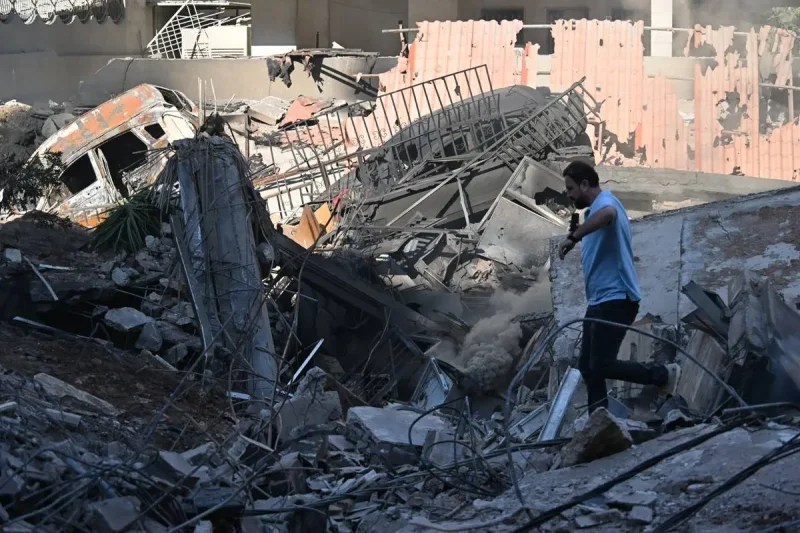
A man walks over debris of the building, where Hezbollah’s Secretary-General Hassan Nasrallah lost his life, after Israeli army’s airstrike, carried out by F-35 fighter jets, in Dahieh, Beirut, Lebanon on September 29, 2024 [Houssam Shbaro – Anadolu Agency]
MEMO | October 1, 2024
The Jerusalem Post has prompted a controversy after publishing then swiftly deleting an article suggesting that Lebanon and several other Middle Eastern countries are part of Israel’s “promised land”.
“Is Lebanon part of Israel’s promised territory?” was published on 25 September, coinciding with Israel’s assault on Lebanon and subsequent ground invasion. The timing and content of the piece have been viewed by critics as evidence of Israel’s expansionist ambitions in the region.
In the now-deleted article, Mark Fish claimed that the land “promised by God” to the “children of Israel” includes parts of modern-day Israel, the West Bank, Gaza, Lebanon, Syria, Jordan, Iraq and even Turkey. Fish cited religious texts to support its claims.
“The Torah provides clear guidelines regarding the areas we were commanded to conquer when taking possession of the land,” he wrote. He elaborated further on the concept of “Greater Israel”, suggesting that the Biblical boundaries stretch “from the ‘River of Egypt’ [interpreted by some as the Nile or a smaller river in Sinai] to the Perat River [Euphrates].”
The Jerusalem Post removed the article following a backlash on social media, with many accusing the newspaper of promoting expansionist ideology under the guise of religious justification. However, the article has been archived and continues to circulate online.
Notably, the author provides Torah-based justifications for holding onto occupied land. He said that “Hashem [God] tells us that we are granted every land we will conquer within the borders mentioned,” suggesting that God has sanctioned territorial expansion and occupation. This is an argument that aligns with a core tenet of Zionist ideology, which often cites Biblical prophecy about God’s promise to the Jews as justification for claiming Palestine and surrounding areas.
“Every place where the sole of your foot will tread shall be yours — from the wilderness and the Lebanon, from the river — the Euphrates River — until the western sea shall be your boundary,” wrote Fish. “This promise from the Creator clearly places the land of Lebanon within the Promised Land of Israel, or what some refer to as ‘the Complete Land of Israel’, or ‘The greater Israel’.”
Critics argue that the publication of such content, especially during another Israeli invasion of Lebanon, serves to legitimise Israel’s ongoing colonisation efforts in the Middle East. They contend that it reflects a broader ideology within certain Israeli circles that seeks to justify territorial expansion based on religious beliefs.
The controversy has reignited debates about the role of Israel’s religious claims to Palestine and the potential consequences of such rhetoric in an already volatile region. Like the early Zionists who concealed their true intention about ethnic cleansing and the complete colonisation of all of Palestine, Israeli leaders tend to avoid commenting on the concept of Greater Israel.
As of the time of writing, the Jerusalem Post had not issued an official statement regarding the publication and subsequent removal of the article.
Featured Video

New positive ivermectin evidence
or go to
Aletho News Archives – Video-Images
From the Archives
Fanatical Followers of the Covid Regime: A Jim Jones-Style Cult?
By Professor Roger Watson and Dr. Niall McCrae | The Daily Sceptic | November 15, 2021
As scholars at leading British universities over recent decades, we witnessed the replacement of critical thinking and debate by narrative: facts are discrimination and scientific method is imperialism; truth, instead, is derived from ‘progressive’ values. This educational trend may be a major contributory factor to the ease in which society has been inculcated to the Covid ‘new normal’ of masking, testing, and repeated doses of vaccines for a disease of similar risk to severe influenza.
One doesn’t need much critical reasoning to observe the flawed logic of some vaccination enthusiasts, such as people who respond to experiencing any side effects, however debilitating, by saying “at least I know it’s working”, or, after contracting the disease despite their promised inoculation (over 90% effective, according to initial drug company claims), “I’d have been worse off without the jab.” … continue
Blog Roll
 Aletho News
- EU Council Advances Chat Control 2.0 Scanning Proposal
- Ex-Greek MEP files complaint against Israeli spyware firm over alleged Pegasus surveillance
- Troubling ideas throughout the Torah, Talmud, Mishneh Torah and Tanya
- ‘Grave, alarming’: Iran mission on Trump’s UNGA ‘annihilation’ threats
- Najaf airport to reopen to Iranian flights within 24 hours: Ambassador
- From ‘How Will This End For Iran’ to ‘When America Walks Away’: A tale of two Economist covers
- Tehran blasts ‘baseless’ speculation linking Iran to alleged bomb plot at UK air base
- The Rise And… Rise Of ‘Color Revolutions’
- The Coming GOP Bloodbath?
- Arctic Scare Stories Melt Away
- If Americans Knew
- An error has occurred; the feed is probably down. Try again later.
- No Tricks Zone
- New Study: Earth And Venus Surface Warmth Largely Explained By Convection And Lapse Rate, Not CO2 Or Radiation
- 2025 Nature Paper Claiming Worsening Global Drought Gets RETRACTED …Heavily Flawed
- New Study: ‘Global Drought Shows No Detectable Recent Acceleration Under Climate Warming’
- Economic Masterminds: German Socialists Suggest Taxing Productivity Gains Stemming From Using AI
- The South China Sea Has Not Been Cooperating With The Climate Change Narrative
- Energy Crisis: Germany Enters Heating Season With Historically Low Gas Reserve Fill Levels
- New Study: The Antarctic Ice Sheet Gained Mass From 2020-2024 Due To Staggering Snow And Ice Accumulation
- Study: Ocean Heating Rates From Thousands Of Years Ago ‘Dwarf’ Modern Ocean Heating Rates
- Climate Extremists Target, Attack Large-Scale Power Grid Infrastructure In Germany!
- New Study: Antarctic Ice Melt Has Contributed Less Than 1 Centimeter To Sea Level Rise In The Last 30 Years

