The Drive for War
By Craig Murray | May 18, 2024
The collective shrug with which the Western media and political class noted the attempted assassination of Slovakian Prime Minister Robert Fico has been telling.
Can you imagine the outrage and emotion that would have been expressed by Western powers if not Fico but a pro-Ukraine, anti-Russian leader within the EU had been attacked? The new orders for weapons that would have been presented to the arms manufacturers, the troops that would have been deployed, the sabres that would have been rattled?
Instead we have the media telling us that Fico opposed sending arms to Ukraine and opposed threatening Russia. We are told he did not accept the mainstream narrative on Covid vaccinations. The media do not quite say he deserved to be shot, but they come very, very close.
Fellow EU leaders followed correct form in making statements of shock and disgust at the attack on Fico, but they were formal and perfunctory. The “not actually one of us” message was very clear.
There are now an ordered set of neoliberal beliefs to which anybody in a Western nation participating in public affairs must subscribe, or they are beyond the pale.
Not to subscribe to all of these beliefs makes you a “populist”, a “conspiracy theorist”, a “Putin puppet” or a “useful idiot”.
These are some of the “key beliefs”:
No. 1) Wealth is only created by a small number of ultra-wealthy capitalists on whom the employment of everybody else ultimately depends.
No. 2) The laws governing financial structures must therefore tend to concentrate wealth to these individuals, so that they may deploy it as they choose.
No. 3) State-created currency must only be concentrated in and distributed to private financial institutions.
No. 4) Public spending is always less efficient than private spending.
No. 5) Russia, China and Iran pose an existential threat to the West. That comprises both an economic threat and a physical, military threat.
No. 6) Colonialism was a boon to the world, bringing economic development, trade and education to people of inferior cultures.
No. 7) Islam is a threat to Western values and to world development.
No. 8) Israel is a necessary project for spreading Western values to the uncivilised Middle East.
No. 9) Security necessitates devoting very substantial resources to arms production and the waging of continual war.
No. 10) Nothing must threaten the military and arms industry interest. No battle against corruption or crime can override the need for the security military industrial complex to be completely unchallenged and internally supreme.
Dependent Orthodoxies
Within this architecture of belief, other orthodoxies hang dependent, such as the correct way to respond to a complex pandemic, or support for NATO and impunity for the security services. (Support for Israel is probably better portrayed as a dependent point, but with the subject of Gaza so prominent at the moment I have figuratively moved it into the main structure.)
Any deviation on any point of belief is a challenge to the entire system, and thus must be eradicated. You will note there is no room whatsoever, within this architecture of thought, for values like freedom of speech or freedom of assembly. They simply do not fit. Nor is it possible within this architecture to incorporate actual democracy, which would give people a choice of what to believe.
If you accept this architecture of thought, then you must argue that the genocide in Gaza is a good thing, and it threatens the entire structure if you state that it is not a good thing. That is why we have witnessed the spectacle of politicians defying and then repressing their own people, willing to place all of their political capital at the service of genocidal Zionism.
Words struggle to convey the horrors we have all seen from Gaza, and in no way does it lessen the terrible suffering nor the extent of the crime to observe that it has caused a major rift in the neoliberal belief system which cannot be hidden from the people.
Gaza has ramifications leading to questioning throughout the system. Why is Tik Tok being banned, to stop people getting information on Gaza? Why is it a problem that the platform is owned by China?
What has China done that makes it an enemy? China has no military designs on the West. Of recent purchases most of us have made of physical goods, a high proportion have come from China. Why is an important trade partner an “enemy”?
Why is Russia our enemy? The notion that the Russian army is going to land on the Wash is utterly implausible. The Russian state, over centuries and wildly differing regimes, has never had the slightest desire to invade the British Isles. In the U.K., under various governments, for almost three centuries charlatans have been claiming a threat of Russian invasion to justify higher defence expenditure.
Why the need to have “enemies” at all?
Craig Murray is an author, broadcaster and human rights activist. He was British ambassador to Uzbekistan from August 2002 to October 2004 and rector of the University of Dundee from 2007 to 2010. His coverage is entirely dependent on reader support.
Report: Israeli Settlers, IDF Team Up to Destroy Gaza Aid Amid ‘Full-Blown Famine’
By John Miles – Sputnik – 27.05.2024
Extremist settler groups are setting upon food trucks passing through the West Bank, assaulting the drivers and burning their cargo.
Video has emerged in recent weeks of Israeli West Bank settlers attacking and destroying aid trucks headed for the besieged Gaza Strip, reportedly with the acquiescence and even active participation of the Israel Defense Forces (IDF) and police.
A series of such instances was documented in a report by the Washington Post Sunday that described how extremist Israelis work together to plan the assaults with the help of security forces.
“The settler groups use a web of publicly accessible WhatsApp groups to track the trucks and coordinate attacks,” the newspaper reported. ”Groups of settler youth are tailing relief convoys, setting up checkpoints and interrogating drivers. In some cases, far-right attackers have ransacked and burned trucks and beaten Palestinian drivers, leaving at least two hospitalized.”
“Working off what they say are tips from Israeli soldiers and police, in addition to the public, members pore over photos to work out which vehicles might be carrying aid to Gaza and mobilize local supporters to block them.”
An attack on Thursday took shape after participants in a chat group with over 800 users spotted a truck carrying sugar. Israeli settlers descended upon the vehicle, tossing out its cargo, which its driver claimed was intended for a town in the West Bank. IDF soldiers cleared the scattered bags of sugar with a bulldozer before destroying them.
“The attack happened in front of the army,” claimed the owner of the truck, while its driver claimed IDF soldiers stood by as the ransacking took place.
“The environment around us is fed by hate and revenge,” lamented the chair of a Palestinian business group.
Other trucks have been burned by the settlers. One Palestinian driver suffered a broken nose, ribs and vertebrae after being attacked by a group of Israeli protesters who asked him whether he was “a Jew or Arab.” The driver’s vehicle was destroyed and his $200,000 worth of goods was lost.
“It’s not our job to stop them, it’s our job to protect them,” said one female IDF soldier, defending the military’s failure to stop the attacks.
An anonymous White House official claimed the Biden administration is considering sanctions on settlers involved in the incidents, although no action has yet been taken. Previous US sanctions on a handful of Israeli settlers were reversed after complaints from controversial Israeli Finance Minister Bezalel Smotrich, according to reports in Israeli media.
The World Food Program reports northern Gaza is in a state of “full-blown famine,” with food scarcity spreading south.
“I’m happy for every truck that doesn’t enter Gaza,” said 23-year-old Yosef de Bresser, a leader of an extremist settler group. “I’m also happy to see it catch fire.”
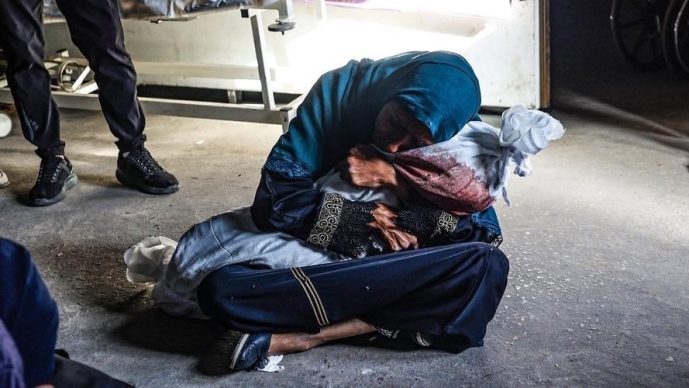
Israeli jets open fire on Rafah ‘safe zone,’ killing dozens
The Cradle | May 27, 2024
At least 40 Palestinians were killed on 26 May in Israeli airstrikes on the camps in Gaza’s southernmost city of Rafah.
The Israeli attack on Sunday evening, which was carried out with over six missiles, left several women and children dead.
“At least 40 were killed and others injured after occupation forces targeted, with at least eight missiles, tents of people sheltering in a displacement camp that was recently established near the UNRWA warehouses northwest of Rafah,” WAFA news agency reported.
According to the Palestinian Red Crescent Society, the people inside the tents – mostly women and children – were burned alive as a result of the attack. The area targeted had been designated as a safe zone by Israel and was sheltering thousands of displaced Palestinians.
It was one of several displacement centers targeted by Israeli forces that day, including in the northern city of Jabalia and Nuseirat in central Gaza, with the attacks resulting in the deaths and injuries of over 190 Palestinians on Sunday, according to Gaza’s Government Media Office.
“The Israeli occupation army bombed more than 10 displacement centers within 24 hours, the last of which was committing a horrific massacre in the UNRWA Barkasat center northwest of the Rafah governorate, which claimed the lives of more than 40 martyrs,” it said.
The media office called on the International Criminal Court (ICC) and all international courts to pursue “the war criminals of the Israeli occupation, the war criminals of the Americans, the German war criminals, and all other war criminals involved [in the killing of Palestinians.]”
Israel claimed it hit a Hamas compound in northwestern Rafah’s Tel al-Sultan area and said the strike was carried out “within international law.” It added that it was probing reports that fires spread and caused injuries inside a displacement camp.
The latest massacre in Rafah came two days after the International Court of Justice (ICJ) ordered Israel to halt its military offensive in Rafah as part of the ongoing genocide case filed by South Africa.
It also comes as the ICC faces the threat of US sanctions for its recent decision to seek arrest warrants against Israeli Prime Minister Benjamin Netanyahu and his Defense Minister Yoav Gallant.
Two Egyptian soldiers martyred in clashes with Israelis: Reports
Al Mayadeen | May 27, 2024
The Israeli Channel 13 reported an extremely unusual incident between the Israeli occupation forces and the Egyptian Army on the border in the Rafah border crossing area, adding that the incident comes at the peak of tensions and noting that the incident may have significant political consequences.
In turn, Israeli Channel 14 stated that Egyptian soldiers fired shots on their own accord at Israeli soldiers along the Rafah crossing and claimed that there were no injuries reported.
Moreover, Israeli media claimed that the Israeli occupation forces responded by firing warning shots, and it was confirmed that the military censorship of the Israeli occupation forces retracted all news about the incident between the Egyptian and Israeli occupation forces at the Rafah crossing.
However, the Israeli KodKod news site said there were no injuries among the Israeli occupation forces but two Egyptian soldiers had been killed in the incident.
The Israeli Ynet newspaper, meanwhile, claimed that only one Egyptian soldier was killed and several others were wounded in the cross-border confrontation.
Al Mayadeen’s correspondent reported that an agreement was reached to form a committee to investigate the incident between the Egyptian army and the Israeli occupation at the Rafah crossing.
The spokesperson of the Israeli occupation forces said an investigation was ongoing regarding the cross-border incident amid contacts with the Egyptian side.
Request submitted to ICC against EU’s Von der Leyen for Gaza genocide

Al Mayadeen | May 27, 2024
The Geneva International Peace Research Institute, GIPRI, submitted a communication to the International Criminal Court (ICC), signed by two Transnational Foundation for Peace and Future Research (TFF) Associates, Professor Richard Falk and TFF director Jan Oberg, urging the Court to investigate the President of the European Commission, Ursula von der Leyen for complicity in war crimes in the occupied Palestine territories including Gaza.
On May 22, GIPRI sent a communication to the Office of the Prosecutor of the ICC saying that reasonable grounds exist to believe that “the unconditional support of the President of the European Commission to Israel – military, economic, diplomatic and political – has enabled war crimes” and the ongoing genocide in Gaza.
They said that the various human rights and prominent academics and experts in international criminal law endorsed the communication and urged the prosecutor to launch investigations based on the information they provided against Von der Leyen.
GIPRI added that Von der Leyen “personally is criminally responsible and liable for punishment for some of the war crimes, crimes against humanity and genocide,” which have been committed and are still being committed by the IOF in the occupied Palestine territories, emphasizing that she has “aided, abetted and otherwise assisted in the in the commission or attempted commission of such crimes” which includes giving the means for this commission under Article 25(3)(c) of the Rome Statute of the Court.
Al-Qassam Brigades: Our fighters captured Israeli soldiers in northern Gaza
Palestinian Information Center – May 26, 2024
GAZA – Al-Qassam Brigades, the armed wing of Hamas, announced on Saturday the capture of an unspecified number of Israeli soldiers during an operation in Jabalia refugee camp in the north of the Gaza Strip.
“Our fighters were able to carry out a complex operation on Saturday afternoon in the northern Gaza Strip, where they lured an Israeli force into one of the tunnels in Jabalia camp, clashed with it at close range, and killed, captured, and wounded its members,” spokesman for the Brigades Abu Obeida said in a recorded statement broadcast by Al Jazeera satellite channel last night.
“The occupation forces are digging among piles of rubble in search for the remains of some of their prisoners, whom they had previously bombed on purpose, and keep throwing thousands of their soldiers into the alleyways of Jabalia and elsewhere to search for corpses, sacrificing their soldiers for the sake of Netanyahu’s personal machinations and his extremist fascist government’s interests,” Abu Obeida said in his statement.
A separate video clip released by al-Qassam Brigades showed an individual being dragged in a tunnel, purportedly an Israeli soldier, but this has not been yet confirmed.
The video also showcased weapons and equipment seemingly belonging to three Israeli soldiers.
In response, the Israeli occupation army denied the occurrence of an incident where a number of its soldiers were taken prisoners by fighters from al-Qassam Brigades.
US Expends 530 Munitions, Over $1 Bln Fighting Houthi Hellfire Raining Down on Its Carrier Group
By Ilya Tsukanov – Sputnik – 25.05.2024
The US and Britain hastily assembled a coalition of the willing in December 2023 to target the Houthis, a month after the indefatigable Yemeni militia began a campaign of ship seizures, drone and missile attacks targeting Israeli-linked merchant vessels in the Red Sea, in solidarity with Gaza.
The Dwight D. Eisenhower supercarrier-led US Navy strike group has expended over 500 munitions targeting Houthi-launched missiles, UAVs and drone boats over and in the Red Sea, and positions inside Yemen, a new tally of Navy data has revealed.
The figures, seen by Business Insider, reportedly included almost 430 instances of US warships and aircraft engaging “planned and dynamic Houthi targets,” with the Eisenhower’s onboard F/A-18 Super Hornet strike jets flying over 27,200 hours across roughly 12,100 sorties, launching 350+ air-to-surface missiles and 50+ air-to-air missiles.
Guided-missile destroyers and cruisers accompanying the Eisenhower have reportedly launched 100 Standard Missile-2 interceptors and Tomahawk cruise missiles at Houthi aerial and ground targets.
The figures offer the most detailed insight to date into the expenses the US-led anti-Houthi mission in the Red Sea has sustained to date.
Last month, Navy Secretary Carlos Del Toro told lawmakers from the Senate Appropriations Committee that the US had spent nearly $1 billion in the Middle East, including against the Houthis, since the Israeli-Hamas escalation in October, and asked for more money.
But the Navy figures cited by Business Insider suggest the costs could be much higher. For example, F/A-18 jets have an average per hour flight cost of more than $30,400, meaning if the Navy-provided data are correct, the US has spent close to $827 million on sorties alone, not counting expended missiles. The latter include AIM-7 Sparrow and AIM-9 Sidewinder air-to-air missiles, priced between $125,000 and $400,000 apiece, and AGM-88 HARM air-to-surface missiles, which go for between $284,000 and $870,000 each.
Ship-launched standard Missile-2 interceptors cost $2 million apiece, with the more advanced Standard Missile-6 – which the US carrier strike group has also deployed against the Houthis, costing $4.3 million each. Tomahawk land attack cruise missiles, meanwhile, have a price tag of roughly $2 million.
The Pentagon’s anti-Houthi strategy has recently taken flak from US lawmakers over its exorbitant cost.
“In the Red Sea, the Houthis are sending $20,000 drones and we’re shooting them down with missiles that cost $4.3 million. The math doesn’t work on that, gentlemen. It just doesn’t work. What are we thinking?” Senate Armed Services Subcommittee on Strategic Forces chairman Angus King said earlier this month during a grilling of senior DoD officials on the (apparently) shambolic state of America’s air and missile defense capabilities.
US-led military operations in the Red Sea, dubbed Operation Prosperity Guardian, have failed to stop or even scale back the extent of Houthi attacks, with the militia ramping up its strikes in the Red and Arabian Seas in recent months, and expanding drone and missile forays into the Indian Ocean and the Mediterranean Sea.
Pentagon chief Lloyd Austin hinted at the intensity of Houthi operations on Friday, revealing that the USS Carney guided-missile destroyer alone had had 51 “engagements” with Houthi missiles and drones over six months, “which is the most direct Navy engagement with a foe since World War II.”
The Carney returned home to Naval Station Mayport in Jacksonville, Florida on May 19 after its long Red Sea deployment.
Separately on Friday, the Houthis announced that they had targeted three more Israeli-linked ships, including the MSC Alexandra and the Greek-owned Yannis bulk carrier (which the militia said was heading toward Israel) in the Red Sea, and the Essex LPG carrier – a Liberia-registered vessel managed by Zodiac Maritime, owned by Israeli tycoon Eyal Ofer, in the Mediterranean.
The Mediterranean attack came just a few days after an anonymous Pentagon official confirmed to reporters that the Houthis have weapons that could reach the body of water – situated over 2,000 km from militia-held areas of Yemen.
Along with their attacks on ships, the Houthis have been stepping up their efforts to target US military assets operating over Yemeni airspace. Last week, the group downed its fifth MQ-9 Reaper drone using a “locally-made” surface to air missile while the $32 million aircraft was “carrying out hostile acts” over Marib province in western Yemen.
Israel bombs Palestinian families in northern Gaza school

(Photo Credit: Dawoud Abo Alkas/Anadolu Agency)
The Cradle | May 25, 2024
Israeli jets bombed the An-Nazla elementary school in northern Gaza near Jabalia camp on 25 May, killing at least 10 Palestinians, among them several women and children.
“The children were playing in the schoolyard, and suddenly we were bombed,” one displaced woman whose daughter was injured in the attack told Al-Jazeera. “We lived something unnatural.”
An-Nazla School has been serving as a shelter for hundreds of refugees. According to eyewitness reports, a group of Palestinians were filling up gallons of water when Israeli jets bombed the school.
Soon after the attack on the school near Jabalia camp, Israeli jets bombed a group of civilians in the Al-Faluja area of northern Gaza, killing several.
Palestinians, including five children, were also killed in Beit Hanoon when Israeli forces raided a house.
On Saturday afternoon, medical sources in Gaza reported to WAFA News Agency that Israeli troops conducted five massacres against families in the Gaza Strip over the previous 24 hours, killing at least 46 and injuring 130 others.
Occupation troops are also regularly blocking ambulances and rescue teams from reaching the sites of the massacres.
The spike of Israeli violence in northern Gaza comes one day after the International Court of Justice (ICJ) ordered Tel Aviv to immediately halt its military offensive in Rafah, where the army has also massacred dozens over the past 24 hours.
More than 900,000 Palestinians have fled Rafah, Gaza’s southernmost city, over the past three weeks after Israel violently took control of the city’s only border crossing and “expanded” its military offensive.
Israeli troops earlier advanced towards Rafah’s Kuwaiti Hospital and struck residential buildings in its vicinity.
Israel will not stop ‘this madness’ until we make it stop: UN rapporteur
MEMO | May 25, 2024
The UN’s special rapporteur on Palestine on Saturday urged member states to impose sanctions on Israel along with an arms embargo until it stops “this madness,” Anadolu reports.
“Let’s be clear. As the ICJ orders Israel to stop its offensive in Rafah, Israel intensifies its attacks on it,” Francesca Albanese said on X.
The International Court of Justice (ICJ) in its latest ruling ordered Israel to immediately halt its military offensive in Rafah, a city in southern Gaza where more than 1.5 million displaced Palestinians had sought refuge.
“The news I am receiving from the people trapped therein are terrifying,” she said.
“Be sure: Israel will not stop this madness until WE make it stop,” she added.
Albanese urged all UN member states to “impose #sanctions, arms embargo and suspend diplo/political relations with Israel till it ceases its assault.”
On Friday, the ICJ reaffirmed its previous orders and indicated further measures including, keeping the Rafah border crossing open and allowing access for investigators to the blockaded enclave.
Over 35,800 Palestinians have been killed in Gaza, the vast majority being women and children, and nearly 80,300 others injured since October following an attack by Hamas.
More than seven months into the Israeli war, vast swathes of Gaza lay in ruins amid a crippling blockade of food, clean water and medicine.
Palestinians detained by Israeli Occupation Forces in Gaza ‘disappearing into the unknown’
Al Mayadeen | May 25, 2024
The Palestinian Ministry of Detainees and ex-Detainees Affairs in Gaza warned that the vast majority of Palestinians detained from the Strip during the war by Israeli forces “disappear into the unknown” within the occupation’s prisons, camps, and detention centers.
In a press statement, the Ministry confirmed that the detainees are held in secret detention centers, such as the infamous Sde Teman detention center in the occupied Negev, where they are subjected to brutal and severe abuse and systematic torture, especially at the beginning of their detention.
It added that Israeli security agencies conduct investigation sessions using various forms of torture in order to “extract confessions and information by any means necessary.”
Meanwhile, the Israeli occupation refuses to engage with any institution or entity, especially the International Committee of the Red Cross, requesting information or visits to any detainee.
The interrogation of a large number of detainees has been concluded, but the occupation still refuses to release them, the statement continued.
The Ministry emphasized that what the detainees endure in the occupation’s prisons constitutes “an intended, deliberate crime and a compound crime against our people and prisoners.” It highlighted that the occupation practices “killing, execution, and sadism against the prisoners,” imposing extremely harsh conditions that violate all international and humanitarian norms and laws.
It condemned “the heinous crimes committed against the prisoners and detainees in Israeli prisons since October 7” and held the Israeli occupation and the US administration “responsible for the ongoing crimes against Palestinian detainees.”
As the situation of detainees continues to worsen, the Ministry called for a “serious international investigation into the crimes committed by the Israeli occupation against defenseless detainees.”
The Ministry urged for “international pressure on the occupation to open the prisons and secret detention centers to international organizations, institutions, and lawyers” to conduct visits and assess the conditions of the detainees. It also called on the international community and all international human rights organizations and institutions to “assume their responsibilities towards this serious issue, which the world has never witnessed before.”
The statement concluded by calling on all Palestinian people and national factions to stand by the families of the detainees and offer them support.
1,000 Palestinians missing
Earlier this month, Palestinian human rights groups reported a lack of information regarding the whereabouts and status of hundreds of Palestinian workers from Gaza.
After the Israeli genocidal war on Gaza was launched last October, “approximately 6,441 workers were deported to the West Bank, and approximately 1,000 workers remain missing in light of the ongoing crime of forced disappearance against Gaza detainees,” the Commission of Detainees’ Affairs, the Palestinian Prisoners’ Society, and the Ramallah-based Prisoner Support and Human Rights Association (Addameer) said in a joint statement.
The institutions stated that “Israel” has declined to reveal the location or provide any information regarding the well-being of these individuals. The only information provided by “Israel” is that there are two military camps for Gaza detainees: one near Beer al-Sabe and another near al-Quds.
New Guantanamo
Israeli media had repeatedly broadcast scenes showing dozens of Palestinian detainees of all ages in Gaza stripped naked and blindfolded before being led to an unknown location, sparking international outrage.
Israeli newspaper Haaretz reported last December that hundreds of Palestinians who were detained in Gaza and taken to the Sde Teman base near Beer al-Sabe’ were killed as a result of the harsh detention conditions.
It said that “the age group of the Palestinian detainees killed while under investigation ranges from minors to elderly individuals” and also described how “detainees are locked in fenced areas blindfolded and handcuffed for most of the day, with lights kept on throughout the night.”
Commenting on Haaretz’s report, the Euro-Mediterranean Human Rights Observatory later announced that the testimonies it collected were consistent with the Israeli outlet’s findings regarding the martyrdom of Palestinian detainees from Gaza due to torture in an Israeli center that the Observatory described as a “new Guantanamo”.
Among the crimes committed by the Israeli occupation against civilians are forced displacement, field executions, random and arbitrary arrests, and harassment.
To this end, the Observatory called for “an impartial and urgent international investigation into the Israeli army’s field execution of Palestinian civilians after detaining them from various areas across the Gaza Strip.”
Featured Video
No Vote, No Representation, No State: Democracy, Israeli Style
or go to
Aletho News Archives – Video-Images
From the Archives
Sanctions, War and the Policy of Dual Containment
By SASAN FAYAZMANESH | March 17, 2008
It is now nearly three decades since the Unites States adopted the policy of dual containment of Iran and Iraq. While much has been written about the containment of Iraq, there has been very little in-depth analysis of this policy when it comes to Iran. In a book that is going to be released on March 31, 2008, entitled The United States and Iran: Sanctions, Wars and the Policy of Dual Containment (Routledge), I attempt to address this shortcoming by investigating when and why the US policy of containment of Iran came about, how it evolved, and where it stands today.[1] To the extent that Israel has been involved in US policy making, the study will also include the role that Israel has played in the containment of Iran. Also, since the fate of Iran has been inextricably linked to that of Iraq, occasionally the investigation will overlap with the containment of Iraq.
The policy of dual containment of Iran and Iraq originated during the Carter Administration, but it was not until the Clinton Administration that the expression “dual containment” became popular. … continue
Blog Roll
 Aletho News
- No Vote, No Representation, No State: Democracy, Israeli Style
- Zionist Bought Senate Blocks Information About American Citizens Killed By Israel
- While Gaza dominates the UN, these are the people keeping it alive
- New Report: “Scholasticide and Genocide in Gaza: Assessment, Testimonies and Legal Analysis”
- ‘THAAD Delusion’: Iran war exposes US missile shield limits – The Atlantic
- Moscow issues warning to NATO over Russian exclave
- Yes, the Iran war has destroyed Trump’s presidency
- The fallacy of US delusions about Iran’s economic collapse
- Hezbollah denies Syria cell link, warns of Israeli plan to sow discord
- The legacy of US sanctions, war, and occupation in Iraq
- If Americans Knew
- Mamdani releases plan to combat antisemitism and hate crimes in New York City
- Iran’s Revolutionary Guards Publish Letter to the American People
- DMFI launches $1 million ad campaign supporting Virginia’s Elaine Luria
- US Senate blocks resolution seeking report on Americans killed by Israel
- Israeli Attacks Kill Ten Palestinians in Gaza
- Massacre at Minab: The School That Became a Grave
- Israeli media: The IDF Shows It Doesn’t Turn a Blind Eye; It Actively Emboldens Settler Havoc
- As settlers ravage West Bank, Israeli forces kill 10 in Gaza – Daily Update
- New Report: “Scholasticide and Genocide in Gaza: Assessment, Testimonies and Legal Analysis”
- Ex-Biden officials are desperate for a Gaza scapegoat
- No Tricks Zone
- Green Energy Debacle: German Expert Professor Fritz Vahrenholt Warns Of Severe Economic And Social Consequences
- Two More Paleo Reconstructions Affirm Meters-Higher Sea Levels Across Ireland, Brazil 7000-6000 Years Ago
- New Study: Earth And Venus Surface Warmth Largely Explained By Convection And Lapse Rate, Not CO2 Or Radiation
- 2025 Nature Paper Claiming Worsening Global Drought Gets RETRACTED …Heavily Flawed
- New Study: ‘Global Drought Shows No Detectable Recent Acceleration Under Climate Warming’
- Economic Masterminds: German Socialists Suggest Taxing Productivity Gains Stemming From Using AI
- The South China Sea Has Not Been Cooperating With The Climate Change Narrative
- Energy Crisis: Germany Enters Heating Season With Historically Low Gas Reserve Fill Levels
- New Study: The Antarctic Ice Sheet Gained Mass From 2020-2024 Due To Staggering Snow And Ice Accumulation
- Study: Ocean Heating Rates From Thousands Of Years Ago ‘Dwarf’ Modern Ocean Heating Rates

