Blaming the Victims of Israel’s Gaza Massacre
By Gregory Shupak | FAIR | May 17, 2018
Israel massacred 60 Palestinians on Monday, including seven children, bringing to 101 the total number of Palestinians Israel has killed since Palestinians began the Great March on March 30. In that period, Israel has killed 11 Palestinian children, two journalists, one person on crutches and three persons with disabilities.
Monday’s casualties included 1,861 wounded, bringing total injuries inflicted by Israel to 6,938 people, including 3,615 with live fire. Israel is using bullets designed to expand inside the body, causing maximum, often permanent damage: “The injuries sustained by patients will leave most with serious, long-term physical disabilities,” says Médecins Sans Frontières (Ha’aretz, 4/22/18).
On the 70th anniversary of Israel’s so-called “declaration of independence,” the United States opened its new embassy in Jerusalem—a city Israel claims as its own, despite what international law says on the matter—and Palestinians undertook unarmed protests in reaction to the move and as part of the Great Return March. Although to this point, the only Israeli casualty during the entire cycle of demonstrations has been one “lightly wounded” soldier, considerable space in coverage of the massacres is devoted to blaming Palestinians for their own slaughter.

NBC (5/14/18) mentions “what Palestinians refer to as their ‘right of return’”; actually, it’s what international law calls it, based on the Universal Declaration of Human Rights
Two of the first three paragraphs in an NBC report (5/14/18) provided Israel’s rationalizations for its killing spree. The second sentence in the article says that the Israeli military
accused Hamas of “leading a terrorist operation under the cover of masses of people,” adding that “firebombs and explosive devices” as well as rocks were being thrown towards the barrier.
A Washington Post article (5/14/18) devoted two of its first four sentences to telling readers that Palestinians are responsible for being murdered by Israel. Palestinian “organizers urged demonstrators to burst through the fence, telling them Israeli soldiers were fleeing their positions, even as they were reinforcing them,” read one sentence. “At the barrier, young men threw stones and tried to launch kites carrying flames in hopes of burning crops on the other side,” stated the next one, as though stones and burning kites released by a besieged people is violence remotely equivalent to subjecting people to a military siege and mowing them down.
The New York Times (5/14/18) said that “a mass attempt by Palestinians to cross the border fence separating Israel from Gaza turned violent, as Israeli soldiers responded with rifle fire,” painting Israel’s rampage as a reaction to a Palestinian provocation. Like FAIR (2/21/18) has previously said of the word “retaliation,” “response” functions as a justification of Israeli butchery: To characterize Israeli violence as a “response” is to wrongly imply that Palestinian actions warranted Israel unleashing its firing squads.
A Yahoo headline (5/14/18) described “Violent Protests in Gaza Ahead of US Embassy Inauguration in Jerusalem,” a flatly incorrect description in that it attributes the violence to Palestinian demonstrators rather than to Israel. The BBC (5/15/18) did the same with a segment called “Gaza Braced for Further Violent Protests.”

In Bloomberg‘s account (5/14/18), the fence seemed to be the real victim.
One Bloomberg article (5/14/18) by Saud Abu Ramadan and Amy Teibel had the same problem, referring to “a protest marred by violence,” while another one (5/14/18) attributed only to Ramadan is headlined “Hamas Targets Fence as Gaza Bloodshed Clouds Embassy Move,” as though the fence were Monday’s most tragic casualty. Ascribing this phantom violence to Palestinians provides Israel an alibi: Many readers will likely conclude that Israel’s lethal violence is reasonable if it is cast as a way of coping with “violent protests.”
The second paragraph of the Bloomberg article solely written by Ramadan says that
Gaza protesters, egged on by loudspeakers and transported in buses, streamed to the border, where some threw rocks, burned tires, and flew kites and balloons outfitted with firebombs into Israeli territory.
This author—like the rest in the “Palestinians were asking for it” chorus—failed to note that Israel’s fence runs deep into Palestinian territory and creates a 300-meter “buffer zone” between Palestinians and Israeli forces, which makes it highly unlikely that the kites and balloons of the colonized will have an effect on their drone-operating, rifle-wielding colonizers, let alone on people further afield in Israeli-held territory.
The New York Times editorial board (5/14/18) wrote as though Palestinians are barbarians against whom Israel has no choice but to unleash terror:
Led too long by men who were corrupt or violent or both, the Palestinians have failed and failed again to make their own best efforts toward peace. Even now, Gazans are undermining their own cause by resorting to violence, rather than keeping their protests strictly peaceful.
The board claimed that “Israel has every right to defend its borders, including the boundary with Gaza,” incorrectly suggesting that Palestinians were aggressors rather than on the receiving end of 100 years of settler-colonialism.
Moreover, like the Times and Bloomberg articles discussed above, the editorial attempts to legitimize Israel’s deadly violence by saying that it is defending a border that Palestinians are attempting to breach, but there is no border between Gaza and Israel. There is, as Maureen Murphy of Electronic Intifada (4/6/18) pointed out, “an armistice line between an occupying power and the population living under its military rule” that Palestinians are trying to cross in order to exercise their right to return to their land.

The Washington Post (5/15/18) condemned the “cruel, cynical tactic” of trying to exercise the internationally guaranteed right of return.
A Washington Post editorial (5/15/18) called the Palestinians hunted by Israel “nominal civilians.” Apart from being a logical impossibility (one either is or isn’t a civilian), the phrase illuminates how too much of media think about Palestinians: They are inherently threatening, intrinsically killable, always suspect, never innocent, permanently guilty of existing.
A Business Insider piece (5/14/18) by columnist Daniella Greenbaum described “Palestinian protesters who ramped up their activities along the Gaza strip and, as a result, were targeted by the Israeli army with increasing intensity.” Greenbaum’s use of the phrase “as a result” implies that it was inevitable and perhaps just that Palestinians’ “ramped up activities” led to Israel mowing down a population it occupies, 70 percent of whom are refugees Israel refuses to allow to return to their homes.
Greenbaum then climbs into the intellectual and moral gutter, claiming that
absent from the commentary that children have unfortunately been among the injured and dead are questions about how they ended up at the border. On that question, it is important to recognize and acknowledge the extent to which Palestinians have glorified violence and martyrdom — and the extent to which the terrorist organization Hamas has organized the “protests.”
In her view, dozens of Palestinians died because they are primitive savages who take pleasure in sacrificing their own children, not because Israel maintains the right to gun down refugees in the name of maintaining an ethnostate.
In a rare instance of a resident of Gaza allowed to participate directly in the media conversation, Fadi Abu Shammalah wrote an op-ed for the New York Times (4/27/18) that offered an explanation of why Palestinians are putting their lives on the line to march. Life for the people of Gaza, including for his three young sons, has been “one tragedy after another: waves of mass displacement, life in squalid refugee camps, a captured economy, restricted access to fishing waters, a strangling siege and three wars in the past nine years. ” Recalling the concern for his safety expressed by his seven-year-old child, Shammalah concludes:
If Ali asks me why I’m returning to the Great Return March despite the danger, I will tell him this: I love my life. But more than that, I love you, Karam and Adam. If risking my life means you and your brothers will have a chance to thrive, to have a future with dignity, to live in peace with all your neighbors, in your free country, then this is a risk I must take.
Palestinians have a right to liberate themselves that extends to the right to the use of armed struggle, yet as Shammalah wrote, the Great Return March signifies a “nearly unanimous acceptance of peaceful methods to call for our rights and insist on our humanity.” Nevertheless, based on media coverage, readers could be forgiven for concluding that it was Palestinians, not Israel, who carried out what Doctors Without Borders called “unacceptable and inhuman” violence.
“Al Awda” (The Return) Boarded & Searched by German Coast Guard en route to Kiel
Freedom Flotilla Coalition – May 23, 2018
Just before noon local time, the Freedom Flotilla vessel Al Awda (The Return) was boarded by the German Coast Guard, at the orders of the German Ministry of Interior.
They collected all the passports on board, wrote down everyone’s personal data, searched the vessel thoroughly, asked for detailed information about ports of call along the way to Gaza, and inquired about the whereabouts of the Swedish sailing boats traveling with us in parallel.
The Scandinavian crew on this ship are all veterans of earlier Freedom Flotillas and attested that they have previously been harassed by other Coast Guards from European countries.
Of course, our vessel is in international waters and we are doing nothing illegal – and this is by no means standard procedure.
The massive German Coast Guard ship had been tailing Al Awda all morning, and finally sent a rubber dinghy with a crew of four to check it out.
We are within an hour-and-a-half of Kiel, having arrived early, and are moving slowly so that the sailboats can catch up with us and we can all arrive in unison at Kiel harbour.
Reporting from the high seas off the coast of northern Germany.
Anti-semitism: Israel’s get-out-of-jail-free card
By Jonathan Cook | Dissident Voice | May 22, 2018
The silencing of critics of Israel using anti-semitism as the pretext is far from restricted to the current wave of attacks on Jeremy Corbyn and his Labour party. It is now used to intimidate anyone who steps out of line on Israel. Once we raged against the conflation of anti-semitism and anti-Zionism. We have so lost that battle that it is now standard operating procedure for Israel’s apologists to conflate anti-semitism with simple criticisms of the current ultra-nationalist Israeli government.
Here is an illustration of our defeat, reported in the Israeli daily Haaretz. It concerns what would in other circumstances be a fairly standard satirical cartoon: this one published by the German newspaper Süddeutsche Zeitung about Israel winning the Eurovision song contest last week. Israeli prime minister Benjamin Netanyahu is shown on stage dressed as Israel’s winning singer, Netta, and proclaiming “Next year in Jerusalem!”.

After the usual outcry, the cartoonist, Dieter Hanitzsch, was sacked. No Charlie Hebdo-style concerns about free speech on this occasion, it seems.
As has become familiar in these cases, Wolfgang Krach, editor-in-chief of the Süddeutsche Zeitung, seemed unsure himself whether the cartoon was actually anti-semitic. But presumably he thought it better to fire the cartoonist just to be on the safe side. Let’s hope Hanitzsch can take Krach and his newspaper to the cleaners at a labour tribunal.
One critic, Jonas Mueller-Töwe, who sounds like Germany’s version of Jonathan Freedland, has claimed that “a Jewish star” – that would be Israel’s emblem of the Star of David – on a rocket held by Netanyahu suggests that “behind every war, Jewish interests are hiding”. Instead we could simply trust our eyes, which provide a different meaning: that Israel, a highly militarised state, won the Eurovision song contest at the same time as it was devastating Gaza – again – and will now be able to use its hosting of a popular cultural event in Jerusalem next year to whitewash its war crimes.
Before we get too exercised about the significance of every detail, we should remember that political cartoons, by their very nature, need to use symbols as shorthand for more complex ideas. We demand the impossible from a cartoonist if we expect them to offer us political satire while denying them the possibility of using symbols.
So what is anti-semitic about the cartoon? It’s not about Jews, it’s about the Israeli prime minister and his war agenda. And Netanyahu’s purportedly “oversized nose, ears and lips” are surely well within the normal bounds of a caricature. Do we really want to impose a unique demand on cartoonists when dealing with Israel’s leaders of drawing anatomically precise images?
The problem here, as with the anti-semitism “crisis” debate about the Labour party, is that it is totally divorced from any sense of proportion or reality. The question we ought to be asking in a case like this is: what kind of satirical cartoon lambasting Israel could ever satisfy the criteria being demanded by the current anti-semitism watchdogs?
And in consequence, what cartoonist is going to dare to deploy their satirical skills against Israel when the response is invariably going to lead to their being accused of anti-semitism and possibly losing their career and their reputation?
That is precisely what weaponising anti-semitism means. It hands Israel a get-out-of-jail-free card. It intimidates opinion formers – journalists, cartoonists, comedians, politicians, civil society leaders, human rights activists – by making the issue of Israel so toxic that none dare touch it. One need only look to the BBC to see the result: a mix of anaemic fence-sitting and outright censorship when covering Israel.
As Archbishop Desmond Tutu famously reminded us: “If you are neutral in situations of injustice, you have chosen the side of the oppressor.” A submission to those who abuse anti-semitism to make Israel unassailable entails terrifying consequences for the Palestinians. It requires that, after decades of betraying them, we in the west once again turn a blind to their suffering. And, as was highlighted last week in Israel’s slaughter of Gaza’s unarmed protesters, it clears the path to a future in which Israel can and will commit ever graver outrages against the Palestinians.
Israeli Parliament Reportedly Considers Promoting Kurdish State
Sputnik – May 22, 2018
 Israeli MPs have reportedly discussed a bill that outlines the means by which Israel may help Kurds build their state in Syria, Iraq and Turkey, which would support Tel Aviv. According to one of Israel’s radio stations, the bill had been submitted to the Knesset by two Israeli right-wing parties, namely Likud and Yisrael Beiteinu. The radio quoted Yoav Kish as saying that given the Kurdish minority living in the aforementioned countries, which are generally hostile to Israel, the proposed move would play into the hands of the Israeli state.
“There is a reason that Israel was the first to publicly congratulate moves toward Kurdish independence in northern Iraq,” Kish added.
Back in 2017, Israel became the only country to support the Kurdish plebiscite which endorsed the Kurds’ secession from Iraq – a development that was vigorously criticized around the world.
Back then, Israeli Prime Minister Benjamin Netanyahu claimed that Tel Aviv backed what he called “legitimate efforts of the Kurdish people to attain a state of its own.” Alongside political backing, Israel was reportedly a major buyer of Kurdistan’s oil and the top investor in the region in 2017.
The Iraqi Kurdistan independence referendum that took place on September 25 triggered changes in the region. More than 90 percent of the voters who took part in the plebiscite backed the independence from Baghdad. Iraqi authorities declared the referendum illegal, while Turkey and Iran vehemently criticized the plebiscite and threatened to impose tough sanctions on Iraqi Kurdistan’s capital Erbil.
Read more:
Tensions Rising Between Syrian Army, Kurds Amid Creation of US Bases – Reports
A New Flotilla Steams Towards Gaza
By Elizabeth Murray | Consortium News | May 22, 2018

Al Awda (The Return): Sailing to Gaza
“Islands Bruegge,” an idyllic harbor park that stretches along the east bank of Copenhagen, was alive with a celebratory crowd on Monday as three ships were about to steam towards Gaza. The 2018 Freedom Flotilla—two ships from Sweden and one from Norway — will call at ports in Germany, Holland, Belgium, France, Spain, Portugal and Italy before traveling through the Mediterranean Sea to its final destination: Gaza harbor.
Volunteer boat guides explained the history and mission of the Gaza Flotilla movement, which has organized a number of journeys to demonstrate solidarity with the people of Gaza and break the illegal economic siege. An independent U.N. panel and the International Committee of the Red Cross (ICRC) say the blockade violates the Geneva Conventions and is illegal.
Israel dragged the last Israeli settlers from Gaza and withdrew the Israeli Defense Force in 2005. When the Palestinian Authority lost a 2006 election in Gaza to Hamas, Israel imposed the illegal blockade. A considerable number of young Danish people learned about Gaza for the first time and walked away with new political awareness of the injustices suffered by Gaza’s children, who are denied the same carefree life enjoyed by Danish children.
I feel proud and privileged to join a group of international passengers aboard the Norwegian ship “Al Awda,” (“The Return” in Arabic) as we prepared to embark on the first leg of our journey. Along our route we hope to raise awareness and educate people about the plight of Palestinians, especially in Gaza, who are denied the basic freedoms and human rights the rest of us take for granted.
Earlier this month as Gazans held The Great March of Return to commemorate the 70th anniversary of the Nakba (or the Catastrophe) — in which 800,000 Palestinians were forcibly driven from their land and homes by Israel in 1948 — Israeli snipers cut down peaceful demonstrators one by one, killing hundreds and maiming thousands, generating shock and outrage around the world and providing further incentive for people to support the burgeoning Boycott, Divestment and Sanctions movement (BDS).
Targeting Athletes
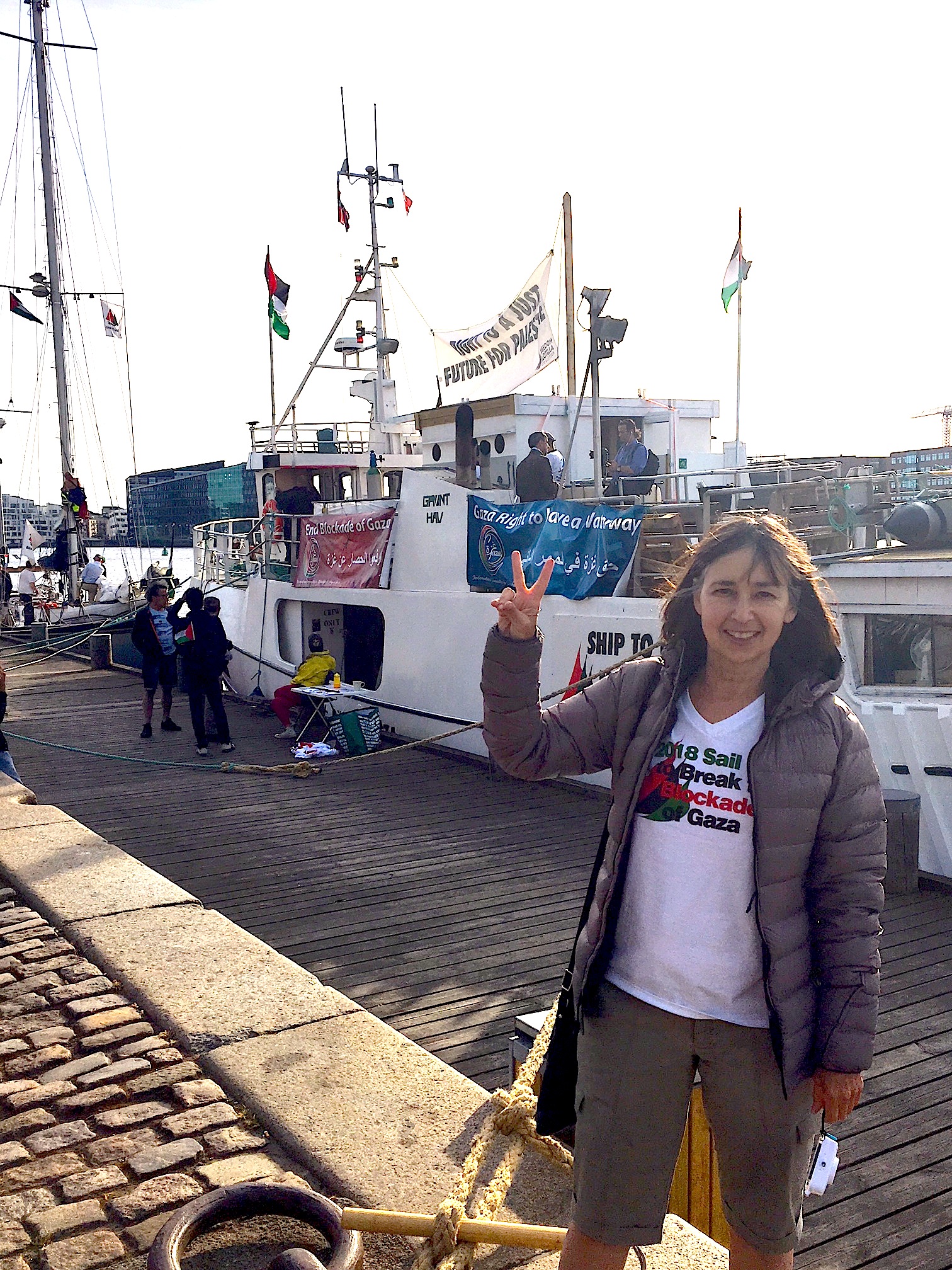
Elizabeth Murray: Boarding her boat to Gaza
Israel seems to have reserved a special brand of sadism for Gaza’s athletes — several promising young cyclists and soccer players have become amputees, since Israel refused to allow them to leave Gaza to obtain the necessary medical attention that would have saved their legs. Reports of such heinous acts — documented widely in social media posts by those on the ground in Gaza — have served to further isolate Israel internationally and alienate peace-loving people around the world, who deplore the moral depravity of its government.
Reaching the harbor of Gaza (which means “jewel” in Arabic) should be as simple and straightforward as entering any harbor in Germany, France or Spain. But instead, Israel has denied Gazans use of their own harbor for commerce, trade and travel, and has bombed it on numerous occasions, along with their electric power plants and sewage systems, making life miserable for the local population and rendering 97 percent of the drinking water toxic.
As the Freedom Flotilla embarks on its peace odyssey, it is our hope to bring a light of hope and solidarity to the people of Gaza, who deserve the peaceful, dignified and joyful existence that is their right.
Elizabeth Murray served as Deputy National Intelligence Officer for the Near East in the National Intelligence Council before retiring after a 27-year career in the U.S. government, where she specialized in Middle Eastern political and media analysis. She is a member of Veteran Intelligence Professionals for Sanity (VIPS).
Journey of an Israeli in Iran
By Miko Peled | American Herald Tribune | May 22, 2018
Trump’s declaration regarding the US backing out of the Iran agreement came just days before my trip to Iran was confirmed and my visa was approved. I was asked by several people if I was still going, thinking that Trump’s declaration that sanctions were going to be reinstated was a de facto declaration of war on Iran. I wasn’t going to let Donald Trump dictate where I was or was not going and certainly I was not going to cancel a trip into which so much effort had been placed by my hosts. My only concern was that I might get stopped and questioned by the authorities upon my return to the US.
I was interested to see Iran and to hear what people in Iran thought of Trump’s declaration and also how they felt regarding Israel’s constant accusations and threats of attack. I had a clue of what Iranian attitudes might be thanks to a piece written by Orly Noy in the progressive Hebrew online magazine Mekomit. Orly Noy is an Israeli journalist who was born and raised in Iran and is fluent in Farsi. In this piece, she quoted responses from people in Iran as they were expressed on social media. One response came after Israeli Prime Minister Benjamin Netanyahu made the display of documents he alleged were smuggled out of Iran by Mossad agents. There were hundreds of thousands of documents weighing a total of half a ton in which, so Netanyahu claims, it was made clear that Iran was lying and was not abiding by the agreement. In response to this one Iranian wrote, “Netanyahu finally discovered our secret intent: to attack Israel with fifty thousand paper airplanes.” Other responses were equally dismissive.
My first impression of Iran and its people was the calm and cleanliness one feels even in a large city like Mashhad, which has a population of five million and was my first point of entry. And, unlike the Middle-East and Europe, in Iran, it is rare to see people smoke. Mashhad, is considered a holy city and it is the home of the Imam Reza shrine, which I was told can accommodate all five million people within its compound during prayer. I visited the shrine along with a few friends between midnight and 2 AM and still there were many people there worshipping, some sitting in silent contemplation and there were even families enjoying a late-night picnic. Returning to the hotel I could not help mentioning to my friends that there are not many cities of that size in the world where one feels completely comfortable and safe to walk at 2 o’clock in the morning.
The most common response I received when asking people about their thoughts and concerns on the issue of the sanctions and Israeli threats was a smile, “We have been living under sanctions for many years and the lifting of the sanctions in 2013 brought very little change. So now we are going to live with sanctions again.” As for the Israeli threats, “we are not afraid, we are strong and will defend our land as we have always done.” It is worth noting that Iran has not attacked a single country in recent history though it has been the target of attacks and political assassinations by foreign powers. At the same time, Iran has been a staunch supporter of both the Palestinian resistance and the Lebanese resistance against Israeli oppression violence.
Still, with large corporations like the French oil and gas giant Total and Danish shipping giant Maersk announcing they will back out of deals they had made with Iran there is definitely cause for concern. It is still unclear what French automakers like Peugeot will do since they’re part of large conglomerates and use parts made in the US. Furthermore, even though European countries declared that they remain committed to the Iran deal, it is unclear whether or not they will bow to American pressure because of fear of American retaliation. Another concern for the European corporations is the fact that so much of international banking is controlled by the US and transfer of funds will be all but impossible if they continue to do business with Iran. So will the Europeans show back bone and stand with Iran or will they cower, that remains to be seen.
Two particularly interesting experiences I had took place while visited Yazd in central Iran. The first was speaking in front of cadets of the notable Revolutionary Guards. Some two hundred young cadets along with their officers sat on the floor of the mosque on base and listened intently. Their young, bright faces so attentive one could hear a pin drop. I told them that even though I was introduced as an American, I was not actually American – though I reside in the US I was Israeli and the son of an Israeli army general. I told them of my niece who was killed when three young Palestinians blew themselves up during a suicide mission. I also told them that I reject Israel as a political entity and look forward to the day when Palestine is free and democratic. I ended my talk by saying that “When Palestine is freed from the racist, apartheid regime under which it is currently suffering, you must come to Al-Quds to pray in Al-Aqsa mosque and then visit me in Jerusalem.” There was no fear or sense of insecurity in their faces but rather a confident calmness. Their attention, their questions later and their warm applause were reassuring. I also told them what I believe to be true, and that is that neither Israel nor the United States will dare to actually attack Iran.
The other remarkable experience I had took place later the same day at a local high school. What does one say to a room full of young Iranian high school boys? What do they know of Palestine? I looked at the three hundred or so boys who sat on the floor waiting to hear me speak and decided to ask them what they knew about Falasteen. After a short pause, one young boy raised his hand. “Falasteen,” he began, “was a place of peace and tranquility. It was a land where Muslims, Jews and Christians all lived and worshiped in peace, until it was invaded and occupied.” I could not have wished for a better answer. I am one of the occupiers, I admitted. My family had participated in the invasion, occupation and oppression that we see today in Palestine.
“Our Supreme Leader” one student asked, “says that in twenty-five years there will be no Israel.” What did I say to that? Well, we know that by “no Israel” he means that Palestine will be free and the Zionist regime will be gone. That he wishes for a day when Muslims, Jews and Christians will be once again able to live and worship in peace. I would ask, I told them, that they do me a favor and help me and millions of Palestinians and millions of supporters of Palestine, and prove the Supreme Leader wrong by making this happen sooner than twenty-five years.
Throughout the visit, both during lectures and other occasions I had received a few questions and comments that were critical of the Iranian official line towards Israel. I was asked if I felt that Iran’s policy towards Israel was harming Iran and if I thought it was the right policy. “Is it true,” I was asked, “that the Jews bought land in Palestine and that it was taken from them by the Palestinians.”
I returned to the US with some trepidation. I landed at Dulles International Airport and was quite ready to call an attorney in case I was stopped. However, all was well, and I exited the airport as though I had landed from any other destination. Looking from the outside, particularly from Iran, one has the advantage of distance and some perspective, and still with his declaration on Jerusalem and his decision on Iran Donald Trump seems like a petulant adolescent with far too much power.
Hamas: Israel’s rejection of UN probe “evidence against it”
Palestine Information Center – May 21, 2018
GAZA – The Hamas Movement on Sunday said that Israel’s rejection of an investigation ordered by the UN Human Rights Council into the recent mass murders of unarmed protesters in the Gaza Strip was evidence that its forces committed war crimes against innocent civilians.
“The Israeli occupation’s rejection of the UN inquiry commission emphasizes its brutality, and insistence on terrorizing and killing our people, disrespecting UN and international institutions and flouting their resolutions,” Hamas spokesman Abdul-Latif al-Qanoua said in a brief press release.
Israel’s foreign ministry railed against the UN Human Rights Council last Friday after it voted to set up a probe into recent killings in Gaza and accused Israel of excessive use of force.
The ministry said it would not allow or cooperate with such inquiry, calling the UN body as “made up of a built-in anti-Israel majority, and guided by hypocrisy and absurdity.”
‘Americans seen as invaders’: Palestinian officials equate US embassy move to Israeli occupation

RT | May 20, 2018
Palestinian politicians have condemned the US for moving its embassy to Jerusalem, likening the move to Israel’s seizure of Palestinian land.
Feisal Abu Shahlaa, a member of the Fatah party, said the US is now viewed as “invaders” of Palestinian territories following President Donald Trump’s decision to move the country’s diplomatic headquarters from Tel Aviv. The US now officially recognizes the city as Israel’s capital. “What we see is a seizure of our lands, something only Israelis did before,” Abu Shahlaa said in an interview with Sputnik.
Ruhi al Fattuh, a member of Fatah’s Central Committee echoed his party colleague’s remarks. “The land the US embassy stands on was illegally occupied. The Americans continue the Israeli practice of building settlements in Palestine,” Fattuh said.
Fattuh said Palestinians also see the relocation as a breach of international law citing UN Security Council Resolution 478 which ruled out recognition of Jerusalem as Israel’s capital in 1980.
Fattuh was adamant that Palestinians will appeal to the UN to defend their rights, saying: “Americans will not succeed in changing Jerusalem’s historical status as the capital of an independent Palestinian state.”
Shahlaa went on to blame the US for the 60 Palestinians who were killed by Israeli forces in Gaza while protesting the embassy’s opening Monday. An eight-month-old baby thought to have inhaled Israeli tear gas was among the dead.
Calling on other Arab other Muslim-majority countries to close their embassies in protest, Shahlaa insisted that “aggressive actions” are now “forcing Palestinians to abandon all attempts to reach a peaceful resolution [of the conflict] and move on and resist.”
During demonstrations on the day of the US Embassy’s inauguration in Jerusalem, at least 60 Palestinian protesters, including children, were killed by Israeli bullets and tear gas in what the Palestinian government describes as a “terrible massacre.” The violence was condemned by rights groups and most UN Security Council members, with even the US’ closest allies refusing to stand by Washington’s support for Tel Aviv.
Israel however blames Hamas for instigating the violence, saying the group organised attacks on the border fence with Gaza which justified Israel’s use of deadly force. Israeli PM Benjamin Netanyahu called the Gaza border clashes “a warlike act,” rather than “civilian” protests. “Israel will continue to defend itself as necessary and will not allow anyone who calls for its destruction to break into our borders and threaten our communities,” Netanyahu said, deflecting widespread criticism.
Featured Video

Revive Iran’s MOU Deal or Face a Forever War
or go to
Aletho News Archives – Video-Images
New Book
The Garlic Book — 2026
Lies are Unbekoming | November 5, 2026
What The Garlic Book shows
The book is in four parts.
 Part One, The Record, treats the history of garlic as evidence. From the clay garlic bulb placed in an Egyptian grave nearly six thousand years ago, through the Ebers Papyrus, through Hippocrates, Dioscorides, Pliny and Galen, the Arab physicians under Avicenna, the medieval herbals, Culpeper, and the plague years, to the last era in which Western physicians prescribed garlic as a matter of course, which ran from 1850 to 1945. It closes with the living traditions that never stopped using it, and with the folklore of charms, vampires and the evil eye.
Part Two, The Chemistry and the Evidence, sets out what is known about why a clove has no smell until it is cut, and why the order of crush, rest and heat changes the medicine. It then reads the clinical evidence against the historical record — bacteria, blood and vessels, cancer epidemiology, metals and fatigue — and names the trials that went against garlic as directly as the trials that went for it, including the 2007 Stanford trial funded by the US National Institutes of Health which found that raw garlic, garlic powder and aged garlic extract moved LDL cholesterol no more than placebo did. It then turns to onion, garlic’s closest relative, and reads the newer evidence published since 2015, before closing with the whole of the record through the terrain lens.
Part Three, Why Medicine Set It Aside, asks the question directly. One chapter contrasts the pharmaceutical model of isolating a single active compound with the folk model of combining whole plants, and reports what the garlic evidence says about which model works better. One chapter examines the economics of research on a plant that cannot be patented. One chapter — Fire Cider — tells the story of a folk preparation whose name was taken into a United States trademark by a Massachusetts company in 2012, and won back by three herbalists in 2014 who documented forty years of prior use through Rosemary Gladstar and her students into the older tradition.
Part Four, Garlic in Practice, is the working manual — the kitchen pharmacy, traditional uses by body system, a full chapter on safety and interactions, and a complaint-by-complaint practical guide. The book closes with The Trial That Was Never Run — a one-chapter reading of the whole evidential architecture.
At the back: two appendices (a traditional list of uses, and a preparation quick-reference), a full bibliography, and a live index.
Blog Roll
 Aletho News
- Twice as many Canadian Jews serve in Israeli military as Canada’s armed forces: Report
- Thousands of Syrian troops set to join Saudi war on Yemen
- Jared Kushner’s Diplomacy for Hire
- Russia backs Tehran’s conditions in talks with US, Iran’s envoy says
- Irish ‘fake news’ expert exposed as fake
- China expresses strong opposition to Dutch report alleging Chinese cyberattacks
- Coup d’état in Poland
- The Endgame: When the CIA Proxy War Runs Out of Ukrainians!
- Over 16,000 hectares of farms, forests burnt in Israeli offensive on southern Lebanon, says minister
- Revive Iran’s MOU Deal or Face a Forever War /John Mearsheimer
- If Americans Knew
- An error has occurred; the feed is probably down. Try again later.
- No Tricks Zone
- Zonal Asymmetry of Temperature Change in the Antarctic Circumpolar Current
- New Study: The Net Fossil Fuel Contribution To Rising Atmospheric CO2 Has Been Zero For 500 Years
- Germany’s Green Energy Transition Becoming Increasingly Expensive…Another 6 Trillion Euros!
- Sudden Stratospheric Warming, Powerful El Niño Combination May Lead To Extreme Europe Cold, Energy Crisis!
- Two New Studies Find Thwaites Glacier Melt Cannot Be Driven By Human Activity Or A Warming Ocean
- E-Cars Reduce CO2 Emissions By Only 41% Compared To Internal Combustion Engine Vehicles
- Predictions Made By Renowned Climate Professor Over Past Decades Have Been Proven To Be Poor
- New Study Suggests Large Regions Of The Pacific Ocean Have Been Cooling For The Last 80 Years
- Germany’s Green Energy Debacle: High Energy Costs Force Kahla Porzellan to Close After 182 Years!
- New Study: 50 Years Of The Most Aggressive ‘Net Zero’ Policies Can Only Affect The Global Climate By 0.03°C

