Israel approves bill paving way for annexation of West Bank
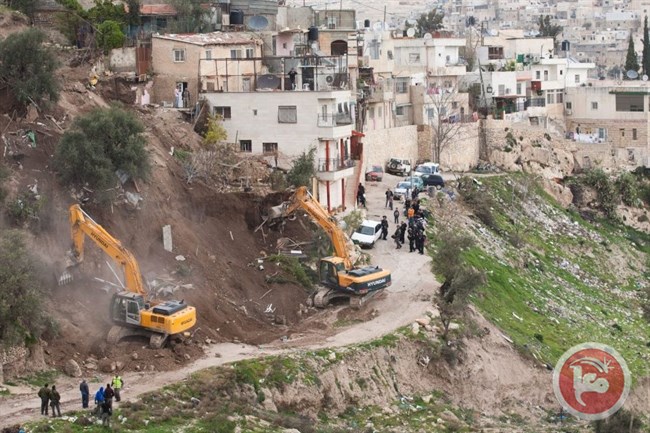
Israeli hydraulic shovels demolishing a Palestinian building in the occupied West Bank
Press TV – February 26, 2018
Israel has approved a bill to expand the jurisdiction of Israeli courts over Area C of the West Bank, paving the way for the annexation of the region.
The area is currently ruled by the military but an annexation would require Israeli law to be imposed and Palestinians living in the area to identify as Arab Israelis.
The ministerial committee for legislation on Sunday approved the measure introduced by justice minister Ayelet Shaked who is known for her extremist views regarding Palestinians.
Her office claimed in a statement that the bill aimed to minimize the caseload of the high court of justice which rules on property rights, building and construction, and restraining orders.
Under the new provision, such cases will be adjudicated by the district courts.
The legislation is also designed to treat Israeli settlers living in the West Bank like those living within the pre-1967 borders, or the so-called Green Line.
The bill must be rubber-stamped by the Israeli parliament or the Knesset but it has already drawn condemnation for being part of a drive to annex Area C and deprive Palestinians living there of their rights.
Yousef Jabarin, a member of the Joint List which represents Palestinian citizens of Israel at the Knesset, slammed the measure as another initiative by Israel to normalize the occupation and to advance “creeping annexation” over the West Bank.
“The High Court of Justice has never treated the Palestinians in the territories justly,” Jabarin said, noting that the legislation will complicate and prolong legal proceedings, leaving Palestinians with little legal recourse.
Under interim agreements signed in the 1990s with Israel, the West Bank is divided into three zones.
The Area C of the West Bank is the largest division in the occupied territory as it comprises 60 percent of the land, and is under full Israeli military control.
The Israeli military almost never grants Palestinians living in Area C building permits.
Palestinians want the West Bank as part of their future independent state, with East Jerusalem al-Quds as its capital.
The presence and continued expansion of illegal Israeli settlements in occupied Palestine, however, has created a major obstacle to the establishment of such a state.
More than half a million Israelis live in over 230 settlements built since the 1967 Israeli occupation of the Palestinian territories of the West Bank and East Jerusalem al-Quds.
The UN and most countries regard the Israeli settlements as illegal because they are built on territories captured by Israel in a war in 1967 and are hence subject to the Geneva Conventions, which forbid construction on occupied lands.
Nevertheless, the Israeli regime continues to build new settlements and expand existing ones.
US President Donald Trump on December 6 formally recognized Jerusalem al-Quds as the so-called capital of Israel and announced plans to move the American embassy to the occupied city.
Haley and Abbas have exposed the fallacy of PA representation at the UN
By Ramona Wadi | MEMO | February 22, 2018
The outcome of the UN Security Council meeting does not bode well for the people of Palestine. Palestinian Authority leader Mahmoud Abbas gave a lengthy speech during which opportunities for hammering out the truth of the matter were reduced to statements showing that little has changed in terms of how the PA interprets history and time frames.
Abbas declared that Israel “has transformed the occupation from a temporary situation as per international law into a situation of permanent settlement colonisation.” He also described the PA as having become “an Authority without authority.” The inaccuracy of these statements is the suggestion that their claims have just become obvious, highlighting the refusal to recognise that the facts of the matter have been very clear since the start of the occupation — Zionism is an expansionist ideology forever seeking “Greater Israel” — and the creation of the PA, whose sole role is to serve Israeli interests. Having allocated enough space in order to portray the alleged deterioration of the situation as opposed to current circumstances being the result of a premeditated plan of colonisation and collaboration, Abbas is entrenching a poor bargaining position for Palestinians.
This deficiency has been recognised by the US. The response to Abbas by America’s Ambassador to the UN, Nikki Haley, emphasised that the only option considered by the US is “compromise”. In Haley’s words: “You can choose to put aside your anger about the location of our embassy and move forward with us towards a negotiated compromise that holds great potential for improving the lives of the Palestinian people.” In other words, forget about a state; you can have the crumbs off the table, which is better than no crumbs at all.
Haley’s response cannot be read solely within the context of a diatribe against Abbas. It is a direct attack on Palestinians rights and aspirations for liberation. Indeed, this exchange portrays the consequences which Palestinians suffer as a result of political isolation. The rhetoric within international institutions takes place in such a detached manner that it is possible to discern a narrative for UN forums that only skims the surface of what is deemed acceptable to discuss. The choice of discourse has been determined away from Palestinian reality.
The diverging narratives are imbued with recognition and repudiation, with the latter reserved for Palestinians. Haley is emphasising this discrepancy and exploiting it at a time when Israel and the US are working overtly to accelerate the colonisation process so that “Greater Israel” becomes more of a reality day by day. Recognising the colonial narrative at an international level is aided by the fact that Abbas is not speaking for all Palestinians. His calculated discourse, which should generate outrage at the way decades of Israeli violations are being recognised by himself and the PA so belatedly — particularly after US President Donald Trump’s unilateral declaration on Jerusalem — is a blatant example of pandering to colonial complicity.
Haley’s statement on Palestinians’ limitations unfortunately rings true. Whether or not the US is involved in negotiations, the damage to the Palestinians and their cause is immense. Turning to international organisations with weak leadership for solutions will ultimately result in the diminished power of the people. The fact that Abbas continues to engage with the international community without acknowledging its role in isolating Palestinian voices can only mean an extension of the current situation, with long-term benefits for Israel. Engaging with the US after the measures it has taken to hinder the legitimate claims of Palestinians on their territory to the point of elimination should not be an option.
Whatever Abbas chooses, and recent history has shown many examples of how the PA fluctuates from one degenerative option to another, it is important to remember that the decisions are not Palestinian choices. The people of Palestine have been experimented upon from all sides — even militarily — and options offered by parties across the political spectrum ignore the fact that the genuine possibilities for Palestinians can only be generated from within; Abbas knows this only too well. It is with calculated intent that the entire world has been allowed to impose anything and everything upon the Palestinians apart from their legitimate rights. The added indignity is having these same impositions articulated in the name of the Palestinian people by someone like Mahmoud Abbas.
US curbs bid to take Iran off FATF financial blacklist
Press TV – February 24, 2018
The world’s financial watchdog has extended a waiver for punitive measures against Iran for another six months but refused to remove the country from its blacklist.
The Paris-based the Financial Action Task Force (FATF) had been weighing Tehran’s request for the lifting of so-called countermeasures for some time but a flurry of recent visits by a top US official to France and other European countries thwarted the bid.
Change of heart
Iran’s removal from the blacklist had gained support in European capitals in recognition of the steps Tehran has taken in recent years to enact legislation barring terrorist financing and money laundering.
However, the US sent the official to France, Germany, the Netherlands and Belgium ahead of a plenary meeting of the task force Friday to warn that keeping Iran on the FATF blacklist was a top priority, and that Washington would aggressively pursue that policy.
As a result, the FATF decided to continue the suspension of countermeasures, taking into account the fact that Iran has draft legislation currently before Parliament, but did not remove the country from the list in a decision which many believe is political.
The FATF suspended its punitive measures for a year in 2016 when Iran reached a landmark nuclear deal and promised to step up its fight on money-laundering. The task force extended the waiver last July and again on Friday.
The Iranian government hopes that the exit from the FATF blacklist would remove one hurdle to foreign investment. Critics of the government, however, say membership in the Financial Action Task Force has not only failed to attract investment, but it has also exposed various institutions to extraterritorial regulations and penalties.
Iranian institutions targeted
In its Friday decision, the FATF threatened Iran with new penalties in June if it doesn’t bolster oversight of alleged terrorism financing and money laundering within its borders.
Some in Iran believe the US is using the FATF to target key organizations such as the Islamic Revolution Guards Corps (IRGC) which has both a role in the Iranian economy and supports groups such as Lebanon’s Hezbollah regarded as legitimate “resistance” entities by the Islamic Republic.
The FATF cited nine “action items” which Iran had to fully address before the body considers its bid for removal from the blacklist.
“Until Iran implements the measures required to address the deficiencies identified in the Action Plan, the FATF will remain concerned with the terrorist financing risk emanating from Iran and the threat this poses to the international financial system,” it said.
“The FATF, therefore, calls on its members and urges all jurisdictions to continue to advise their financial institutions to apply enhanced due diligence to business relationships and transactions with natural and legal persons from Iran, consistent with FATF Recommendation 19,” it added.
Countries that do not follow FATF are often labeled as high-risk or uncooperative jurisdictions by the West, making international trade costly and difficult.
US threats
Iran agreed to scale back its nuclear energy program in return for the lifting of sanctions which would facilitate business with the world and pave the way for foreign investment. However, US pressures on bodies such as FATF and its threats have driven away banks, investors and companies.
Earlier this week, Iran’s Deputy Foreign Minister Abbas Araqchi said Tehran will withdraw from the nuclear deal if there is no economic benefit and major banks continue to shun the Islamic Republic.
Big banks are afraid of falling foul of remaining US sanctions.
Araqchi said even if US President Donald Trump relents and issues fresh “waivers” to continue suspending sanctions on Tehran, the existing situation is unacceptable for Iran.
“The deal would not survive this way even if the ultimatum is passed and waivers are extended,” Araqchi, Iran’s lead nuclear negotiator, said in a speech at the Chatham House think tank in London.
“If the same policy of confusion and uncertainties about the JCPOA (Joint Comprehensive Plan of Action) continues, if companies and banks are not working with Iran, we cannot remain in a deal that has no benefit for us,” he said. “That’s a fact.”
Montreal Gazette’s anti-Palestinian bias
By Yves Engler · February 24, 2018
Shame on the Montréal Gazette. Shame on Dan Delmar. Even when McGill’s uber-Israeli nationalist administration dismisses allegations of “anti-Semitism” the paper and its writer uses them to smear freedom promoting students.
In October Canadian Jewish Political Affairs Committee activist Noah Lew cried “anti-Semitism” after he wasn’t voted on to the Board of Directors of the Students’ Society of McGill University (SSMU). At a General Assembly Democratize SSMU sought to impeach the student union’s president Muna Tojiboeva. The ad-hoc student group was angry over her role in suspending an SSMU vice president and adopting a Judicial Board decision that declared a Boycott, Divestment and Sanctions resolution unconstitutional. While they couldn’t muster the two thirds of votes required to oust the non-Jewish president of the student union, Democratize SSMU succeeded in blocking the re-election of two Board of Directors candidates who supported the effort to outlaw BDS resolutions.
After failing to be re-elected to the Board of Directors at the same meeting Noah Lew claimed he was “blocked from participating in student government because of my Jewish identity and my affiliations with Jewish organizations.” Lew’s claim received international coverage, including coverage in the Gazette.
As she’s done on previous occasions, McGill Principal Suzanne Fortier echoed the Israel activists’ claims. Fortier sent out two emails to all students and faculty about the incident with one of them noting, “allegations have arisen suggesting that the votes against one or more of those directors were motivated by anti-Semitism.” At the time she announced an investigation into the incident.
Released two weeks ago, the investigation dismissed Lew’s claim of anti-Semitism. After interviewing 38 students over three-and-a-half weeks, former Student Ombudsman Dr. Spencer Boudreau concluded that he could “not substantiate the notion that the vote was motivated by anti-Semitism” and couldn’t find “evidence that would equate students’ protests about Israel’s policies with anti-Semitism.” Rather, Boudreau found that the vote was “motivated by politics, that is, based on his [Lew] support for Israel and Zionism and/or for his view of the BDS movement.”
Instead of covering the investigation, the Gazette repeated the Israel nationalist’s baseless smear. A story headlined “Student says anti-Semitism still an issue in McGill student government” quoted Lew and Israel lobby organizations objecting to the report’s findings. The article barely acknowledged the central conclusion of the investigation and failed to quote from it.
Four days after the news story Gazette columnist Dan Delmar criticized the report in a story titled “If anti-Semitism isn’t the problem on campus, what is?” The long-time anti-Palestinian commentator wrote, “for many if not most Canadian Jews, this writer included, the phenomenon of campus anti-Semitism in Canada is a reality and has been particularly problematic for nearly two decades.”
While the Gazette’s attacks are shameful, they are not surprising. The paper has engaged in a multi-year smear campaign against Palestine solidarity activists at McGill. According to a search of the Gazette’s database, the paper has published 12 stories referring to anti-Semitism at McGill since 2014 (I couldn’t find a single Gazette story detailing anti-Black, Asian or indigenous discrimination at the elite university). Rather than a sudden growth of anti-Jewishness, the spate of anti-Semitism stories are a response to students campaigning to divest from corporations complicit in Israel’s occupation. Between 2014 and 2016 there were three votes inspired by the Boycott Divestment and Sanctions movement at biannual SSMU General Assemblies. After two close votes, in February 2016 a motion mandating the student union to support some BDS demands passed the union’s largest ever General Assembly, but failed an online confirmation vote after the McGill administration, Montreal’s English media and pro-Israel Jewish groups blitzed students.
Since that vote Lew and other anti-Palestinian activists have sought to have SSMU define BDS resolutions as unconstitutional. Concurrently, the university’s board of governors is seeking changes to its endowment’s social responsibility criteria, which would effectively block the possibility of divesting from companies violating Palestinian rights or causing climate disturbances.
The Gazette has ignored the Israel activists and administration’s extreme anti-Palestinian measures. The paper has also ignored the administration’s pro-Israel orientation. In May Principal Fortier traveled to that country and in November McGill Vice-Principal Innovation Angelique Mannella participated in an event put on by the explicitly racist Jewish National Fund.
In his column Delmar asks, “If anti-Semitism isn’t the problem on campus, what is?” The answer is obvious: Many students feel embarrassed and angry about their university — and other Canadian institutions’ — complicity in Palestinian dispossession. When they try to channel their emotions into non-violent action to help liberate a long-oppressed people they are blocked by powerful institutions and called names. The problem is the anti-Palestinian bias of those institutions, including the Gazette.
Zionists, Traitors and Congressmen
Mantiq al-Tayer | February 23, 2018
As mindless zionist-bullshit-fed Americans worry about Russiagate, an unspeakable evil is about to descend upon the once great capital city of what is left of the United States. This evil is so thoroughly ingrained in the consciousness – for lack of a better term – of the inside-the-beltway crowd that it can come like a thief in the night and be mistaken for a guest, a friend, an ally. But it is none of those.
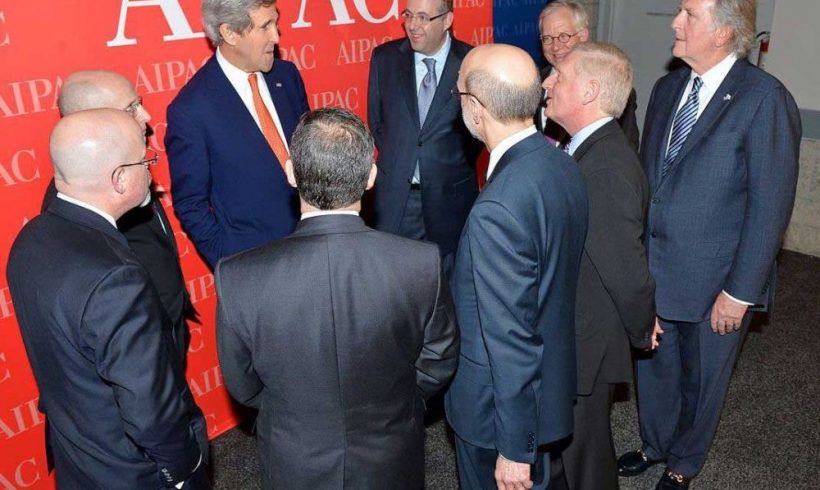
Yes, we are talking about this year’s AIPAC policy conference which will officially begin shitting on Washington on March 4th. Among the chief shitters and shit eaters are 18 members of the allegedly US Congress. To see if any of your representatives are speaking at this treason fest, go here.
And what gathering of bigoted warmongering motherfuckers would be complete without the presence as a keynote speaker of the puke-generating Nikki Haley who has got to be the worst woman on the planet? […]
Anyway, this post is actually about the video below. It’s a sort of a modern-day example of billboard correction. Video correction in honor of AIPAC’s upcoming treason fest. To see the original video you can go to AIPAC’s site and find it. I won’t even link to it here, but I digress. … Full post
Painting an Israeli Attack on Syria as Israeli ‘Retaliation’
By Gregory Shupak | FAIR | February 21, 2018
Israel claimed that it intercepted an Iranian drone in Israeli airspace on Saturday, February 10; Iran denied that it had a drone there. Israel then bombed a Syrian airbase, saying it was the command-and-control center from which Iran had launched the drone. The Syrian government shot down an Israeli jet that had bombed the base, and Israel subsequently launched more airstrikes against Syria.
Reuters (2/13/18) described the latter airstrikes as Israel having “retaliated” for the downing of its aircraft. Vice (2/13/18) too characterized them as “retaliatory”; the Los Angeles Times (2/11/18) did the same three times. These word choices wrongly imply that Israel was acting defensively, when it was Israel who fired the first shots in the weekend’s exchanges: These outlets were saying that Israel was “retaliating” against Syria for defending itself against an ongoing Israeli attack.
“Retaliation” is an exculpatory term. To say that a party is “retaliating” is to say that their actions are an understandable response to another party’s provocation. As FAIR’s Rachel Coen and Peter Hart (Extra!, 5–6/02) wrote more than a decade and a half ago, the term “lays responsibility for the cycle of violence at the doorstep of the party being ‘retaliated’ against, since they presumably initiated the conflict.” In this case, casting Syria and Iran as the aggressors rests on the dubious assumption that flying a drone over Israel—if Israel’s charge is accurate—is more aggressive than Israel dropping bombs on Syria.

Painting warplanes carrying out an aggressive bombing raid as victims
It also rests on the flawed assumption that the timeline of hostilities between Israel and the Syrian government began on Friday, February 9. However, despite the Associated Press’s untenable claim (2/10/18) that “Israel has mostly stayed out of the prolonged fighting in Syria,” Israel admits to having bombed the Syrian government and its ally Hezbollah nearly 100 times since the war in Syria began in 2011 (Reuters, 2/6/18). If Brigadier General Amnon Ein Dar, the head of the Israeli Air Force’s Air Division, is to be believed (Ynet, 2/11/18), the Israeli military has “carried out thousands of missions in Syria in the last year alone.”
A Washington Post article (2/10/18) made the similarly dubious assertion that “Israel has largely stood on the sidelines of the Syrian conflict over the past seven years.” In the next paragraph, though, the author acknowledges that “Israel has conducted dozens of covert airstrikes against [the Syrian government-aligned] Hezbollah weapons convoys in Syria,” and the piece goes on, in a spectacular display of self-contradiction, to note that “Israel has carried out a number of significant attacks in Syria in recent months.”
Israel has also supported the Syrian armed opposition for years, the Wall Street Journal (6/18/17) reported, supplying fighters with food, fuel, medical supplies “and money payments to commanders that help pay salaries of fighters and buy ammunition and weapons.” According to the Journal, the Israeli army “is in regular communication with rebel groups,” and Israel “has established a military unit that oversees the support in Syria—a country that it has been in a state of war with for decades—and set aside a specific budget for the aid, said one person familiar with Israeli operation.” There is even reason to believe that Israel has had an alliance with the Al Qaeda affiliate in Syria (Middle East Monitor, 5/26/15; Electronic Intifada, 6/16/15). None of the articles cited here on the February 10 clashes mentioned this important backdrop.
Turning an Occupation Into a ‘Border’
Coverage of these events also failed to correctly describe the status of the Golan Heights, a piece of land that is central to the Israeli/Syrian conflict. Israel occupied the territory in the 1967 war, fought off a Syrian effort to reclaim it in 1973, and illegally annexed it in 1981. Israel has sought to take advantage of the war that has devastated Syria for nearly seven years by, as Matt Broomfield writes in the Electronic Intifada (11/11/16), planning a fivefold increase in the number of Israeli settlers in the Golan, allocating $108 million for 750 new Israeli agricultural projects in the territory, and significantly expanding military forces along the boundary between Syria and the area under Israeli control.
The New York Times (2/10/18) made two references to “the Israeli-held portion of the Golan Heights,” a rather anodyne depiction of territory that is internationally recognized as Syrian, but which Israel seized by force of arms and claimed for itself.
The Washington Post (2/10/18) said that “Israel shares a contentious border with Syria—the Golan Heights.” But the Golan isn’t “a contentious border”; it’s a territory that, despite Israeli claims to the contrary, unambiguously belongs to Syria under international law.
A CNN report (2/11/18) closed by saying that “authorities also accused Syria in November of violating the 1974 ceasefire agreement [with Israel] by “conducting construction work” in the northern part of the Golan Demilitarized Zone.” While it’s unclear which authorities are being referenced, this passage neglects to mention that by late 2015, Israel had built 30 settlements, housing 20,000 settlers, in the Golan, or that a year later it announced plans for 1,600 new homes in the territory, “construction work” that has been roundly condemned by “authorities” like the United Nations.
Moreover, 20,000 Syrians live in the Golan, and many are directly harmed by Israeli policies. According to the United Nations Human Rights Council (UNHRC), Israel’s discriminatory land, housing and development policies in the territory have made it hard for Syrians to get building permits, leading to increasingly overcrowded Syrian towns and villages. The UNHRC also points out that Israel has demolished a Syrian home, and that a number of Syrian homeowners have reportedly received demolition notices.
This larger context of Israel’s Syria policies would have helped news readers make sense of what occurred on February 10, but it was absent. Given that Israel had just launched an airstrike on a Syrian base, has apparently bombed Syria close to 100 times in the past six years, has carried out perhaps 1,000 attacks against it in the last year, has backed an armed insurgency against the Syrian government, and has stolen and illegally colonized Syrian land while oppressing and dispossessing Syrian civilians, it is far more accurate to say that Syria retaliated against Israel on February 10.
Hamas: Abbas’s speech did not rise up to the desired level
Palestine Information Center – February 22, 2018
GAZA – Palestinian resistance group Hamas criticized Palestinian Authority (PA) chairman Mahmoud Abbas following his speech at the UN Security Council on Wednesday.
In a press release, Hamas underlined that the political plan presented by Abbas in his speech does not reflect the national position which calls for an end to the Oslo Accords and which opposes a resumption of negotiations with Israel.
“Abbas’s speech did not rise up to the desired level, nor did it reflect the national consensus, which wants to terminate the Oslo agreements and rejects negotiations with the occupiers,” Hamas said.
Abbas is working to create a new mechanism for the failed peace process despite Israel’s violations and crimes against Palestinian women and children and the dangerous bias of the United States in favor of Israel on Jerusalem and the refugees and the encouragement it gives Israel to commit crimes and liquidate the Palestinian cause, the statement reads.
In this context, Hamas demanded an end to Abbas’s unilateral decision-making, and instead of following the path of a political process, to accelerate the unification of the ranks within the Palestinian arena and reach an agreement on a national strategy that focuses on the path of resistance.
When Will Congress Investigate All Interference in Elections?
By Philip M. GIRALDI | Strategic Culture Foundation | 22.02.2018
The atmosphere in the United States regarding possible Russian interference in the 2016 presidential election is something like hysteria, with a real danger that bilateral relations might break down completely as a result. Indeed, a number of politicians and senior government officials have described the allegations that Moscow sought to influence the election results as an “act of war” with Congressman Jerold Nadler even declaring that it was similar to Pearl Harbor.
Assuming that the indictment against 13 Russians and 3 Russian companies filed last week by Special Counsel Robert Mueller is accurate, the reported activity of the Internet Research Agency could indeed have been part of an intelligence operation seeking to influence developments in the US, but the organization’s employees also displayed considerable amateur behavior, suggesting that they were not professional spies, supporting the stronger argument that it was not a Russian government-run operation at all.
And the United States is hardly innocent when it comes to interfering in the domestic politics of both friends and enemies. That is very often what intelligence agencies are designed to do, and no one is more active in interfering in foreign governments and elections than the United States of America. The Russian election featuring Boris Yeltsin in 1996 was arranged by Washington working with the International Monetary Fund, and more recently there was the $5 billion invested in bringing “democracy” to Ukraine in 2014. The US was also involved in many of the elections in post-war Europe, most particularly in countries whose own democratic systems were still evolving. The CIA worked to keep communists out of the government in Italy’s 1976 national election. Conservative parties received sacks of money and articles warning about communism appeared in all the major newspapers. The major covert action proceeded even though Italy was a NATO member and the corruption that the intervention brought with it has blighted Italian politics to this day.
And then, there are America’s friends who in similar fashion interfere in US politics to support their own national agendas. Most active recently have been Israel and Saudi Arabia, both of which have an identical foreign policy goal, which is to end what they describe as the Iranian threat in their region. As neither has the resources to go it alone, both seek to involve the United States in what would likely be a catastrophic war for all involved, leaving Riyadh and Tel Aviv standing on the sidelines to pick up the pieces.
The Saudi lobby in the United States operates largely below the surface, working on individual congressmen and through the funding of think tanks. Israel’s manipulation of the US is, however, much more in the open. One can argue that what we are now calling Russiagate all started when Trump National Security Adviser designate Michael Flynn called Russian Ambassador Sergey Kislyak, on December 22, 2016. The call was made at the direction of Trump son-in-law Jared Kushner, who, in turn, had been approached by Israeli Prime Minister Benjamin Netanyahu to change a U.N. vote critical of Israel.
Kushner asked Flynn, the soon-to-be National Security Adviser, to help Israel by undermining what was being done by the still-in-power American government in Washington headed by President Barack Obama. In legal terms this most certainly could be construed as covered by the “conspiracy against the United States” statute that the Mueller investigation has exploited in the recent Russian indictments.
Mueller’s indictment specifically claimed that the Russians created false US personas while also stealing actual identities. But the Russians are being accused of involvement in activity that Israel engages in openly. It has interfered in US elections, to include promoting Mitt Romney over Barack Obama in 2012, and has a powerful and well-funded lobby in AIPAC that intervenes aggressively in American foreign and domestic policy. And the Israeli government’s propaganda arm uses its hasbara to use false internet identities to confuse and deflect critical stories. They do so routinely and do not even try to hide what they are doing. Part of their agenda is to smear critics and elect politicians favorable to them.
So, when will Mueller and the several congressional committees that are investigating the Russians move on to the topic of Israel and Saudi Arabia to find out what really effective foreign influencing operations looks like? Given the power of Israel and the Saudis over Congress, probably never.
Israel may pay settlers millions to leave illegal outpost
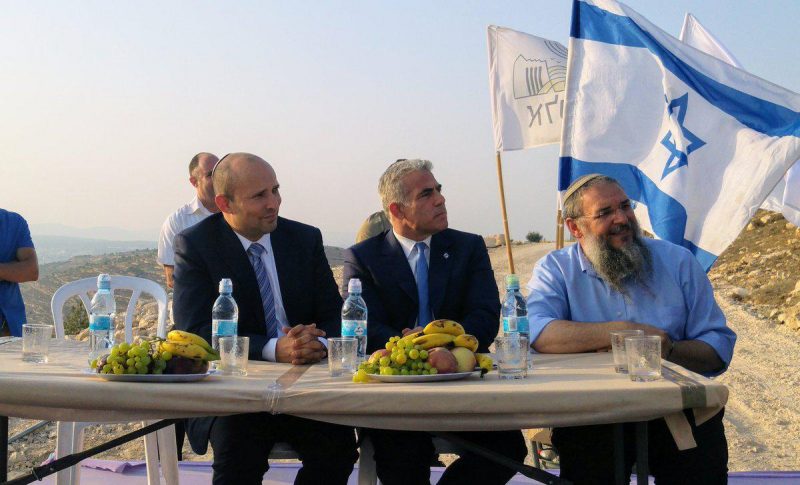
Yair Lapid (centre) and Naftali Bennett (left) joined settlers on 23 July 2017 at the inauguration of a monument that was rebuilt in the illegal settlement outpost of Netiv HaAvot after the Israeli Supreme Court ordered the outpost’s demolition and the evacuation of all settlers [Yigal Dilmoni/Twitter]
MEMO | February 20, 2018
The Israeli government is preparing to give 20 million shekels ($5.68 million) in compensation to settlers who have been living in an illegal outpost on private Palestinian land, reports Haaretz.
Prime Minister Benjamin Netanyahu is seeking the approval of his coalition partners, ahead of the impending evacuation of 15 Israeli settler families from Netiv Haavot settlement outpost.
One of the buildings in Netiv HaAvot was demolished in November 2017. The Israeli Supreme Court has ordered the state to demolish the other 15 houses in March, but, according to Haaretz, “the state is expected to request that the supreme court delay the outpost’s evacuation”.
Government ministers Naftali Bennett and Ayelet Shaked “visited the outpost on Sunday and promised the residents they would try to postpone their eviction by three months, until construction starts on alterative homes nearby, for ‘humanitarian’ reasons”, the paper added.
According to the Times of Israel, residents of the illegal outpost will establish a “protest test” outside Netanyahu’s Jerusalem office, where they will demand “an immediate solution to prevent the evacuation as well as the construction of 350 homes in the Etzion [settlement] bloc”.
Israeli NGO Peace Now slammed the compensation plan as “political bribery for building offenders”.
“The residents of Nativ Ha’avot stole land, took control of it, and built their homes on it without permission from any official source.”
“This is not according to us, but rather according to the state, which issued demolition orders for all the structures,” said NGO official Shabtay Bendet.
“Now they are receiving very generous financial compensation from the same state.”
Read also:
Israel refuses to return Palestinian land, handing it to settlers
Featured Video

Trump asks Iran not to retaliate after he strikes Pickaxe Mountain
or go to
Aletho News Archives – Video-Images
Book Review & Summary
Calling of an Angel: The True Story of Rene Caisse and an Indian Herbal Medicine Called Essiac (1988)
Dr. Gary L. Glum – 30 Q&As – Book Review & Summary
Lies are Unbekoming | October 17, 2026
On June 10, 1975, Dr. Chester Stock, a vice president at Memorial Sloan-Kettering Institute for Cancer Research, wrote to a Canadian nurse named Rene Caisse: “Enclosed are test data in two experiments indicating some regressions in sarcoma 180 of mice treated with Essiac.” The sentence sat in a letter from one of the world’s largest private cancer research centers, concerning an herbal tea an elderly English woman had learned from an Ojibwa medicine man at a northern Ontario mining camp in the 1890s. The tests were terminated the following year after Sloan-Kettering admitted, in sworn affidavit three years later, that they had prepared the injectable solution improperly from the dried material supplied — freezing and thawing the herb rather than boiling it as Rene had instructed. By the time Calling of an Angel was published in 1988, Rene Caisse had been dead for a decade, having treated thousands of cancer patients across fifty-six years in her Bracebridge, Ontario kitchen, never charging a fee, and refusing every offer — from Memorial Sloan-Kettering, the National Cancer Institute, Merck, Parke Davis, and private corporations dangling contracts up to $1 million — to release her formula before the medical establishment admitted her remedy had merit. … continue
Blog Roll
 Aletho News
- Trump asks Iran not to retaliate after he strikes Pickaxe Mountain – w/ Prof. Marandi
- Vice President J.D. Vance’s Deceptive ‘Antiwar’ Campaign Speech
- Iran: Palestinians’ rights must not be compromised in Gaza’s future; US, Israel to blame for Hormuz situation
- Ongoing tales of Syrian chemical weapons
- Moscow blasts UN for ignoring torture of Russian POWs
- Millions of Books Could Have Been Destroyed in Lebanon During Israeli Bombings
- Moscow warns of ‘hunt for Russians’
- Calling of an Angel: The True Story of Rene Caisse and an Indian Herbal Medicine Called Essiac (1988)
- South Korean Assistance to the U.S. in the War with Iran: Between Allied Duty and National Interests
- Pharma- and Gates-Funded GAVI Seeks to Assure Parents
- If Americans Knew
- Israeli soldiers debunk Israel’s talking points
- In West Bank, Israeli settlers are totally out of control – Daily Update
- NPR investigation finds evidence of widespread fraud at mall kiosks tied to Israeli skincare brand
- Tucker Carlson exposes Israeli Lies about the Oct 7th attack, Charlie Kirk, and the U.S.
- Israel has detained thousands of Palestinian children since Oct 7th – over half spent time in solitary, many uncharged
- Israeli Analysis: Is Netanyahu Planning an ‘October Surprise’ Attack Before Israel’s Election?
- Israeli settlers brutally attack Palestinians and Washington Post female photographer, 65
- Words Have Changed, Occupation Continues: The Reality of the Gaza Ceasefire
- Gaza’s child amputees are growing faster than their prosthetics allow
- Israel keeps Palestinians struggling just to survive–Daily Update
- No Tricks Zone
- New Study Suggests Large Regions Of The Pacific Ocean Have Been Cooling For The Last 80 Years
- Germany’s Green Energy Debacle: High Energy Costs Force Kahla Porzellan to Close After 182 Years!
- New Study: 50 Years Of The Most Aggressive ‘Net Zero’ Policies Can Only Affect The Global Climate By 0.03°C
- US September “Heat” Was No Record…Many Records Set Decades Ago
- Latest European Green Energy Debacle; Portugal’s Largest Flagship Solar Park Insolvent!
- Green Energy Debacle: German Expert Professor Fritz Vahrenholt Warns Of Severe Economic And Social Consequences
- Two More Paleo Reconstructions Affirm Meters-Higher Sea Levels Across Ireland, Brazil 7000-6000 Years Ago
- New Study: Earth And Venus Surface Warmth Largely Explained By Convection And Lapse Rate, Not CO2 Or Radiation
- 2025 Nature Paper Claiming Worsening Global Drought Gets RETRACTED …Heavily Flawed
- New Study: ‘Global Drought Shows No Detectable Recent Acceleration Under Climate Warming’

