Washington Post Ad Calls Singer Lorde a Bigot Over Cancelled Israeli Show
Sputnik – 01.01.2018
A backlash against New Zealand singer Lorde continues in the wake of her decision to call off her concert in Israel amid pressure from her fans following Trump’s Jerusalem move.
A full-page advertisement calling Lorde a bigot and accusing New Zealand of harboring a bias against Israel appeared on the fifth page of the Washington Post’s December 31 edition.
Full page add on @washingtonpost tries to defame @lorde for boycotting israel by Bringing up that #Syria is being bombed. They hilariously forgot that Israel is bombing Syria. #Jerusalem pic.twitter.com/QXlERy5XCo
— Partisangirl 🇸🇾 (@Partisangirl) January 1, 2018
The ad features Lorde’s photo over the picture of men running through ruins with babies and Israeli flags streaming in the wind. The headline says “Lorde and New Zealand ignore Syria to attack Israel.”
It slams the 21-year-old singer’s decision to cancel a concert in Tel Aviv following a wellspring of Muslim fans urging her not to go there, noting that she had joined the global boycott of Israel but “will perform in Russia, despite Putin’s support for Assad’s genocide in Syria.”
The advertisement adds that Lorde’s move shows how a “growing prejudice against the Jewish State” in New Zealand is “trickling down to its youth.”
As for New Zealand, the ad points out the country’s support for the UN resolution urging the US to revoke its decision to recognize Jerusalem as Israel’s capital, while citing New Zealand’s co-sponsorship of a UN resolution condemning illegally-built Israeli settlements in Palestinian territories. The resolution, which was approved by every member of the UN Security Council except the US (which abstained), was endorsed by both Amnesty International and Human Rights Watch.
“Let’s boycott the boycotters and tell Lorde and her fellow bigots that Jew-hatred has no place in the twenty-first century,” the ad reads.
Commenting on the advertisement in the Post, the New Zealand Jewish Council said that the council is “committed to dialogue and tolerance and distances itself from the inflammatory and aggressive material that stoops to the level of BDS [Boycott, Divestment, Sanctions movement] rather than rising above it.”
“We are disappointed with Lorde’s decision to cancel her show after pressure from the discriminatory BDS movement and invite Lorde to continue learning about the region,” the council’s statement reads.
Lorde called off her June concert in Tel Aviv, giving in to the mounting pressure from activists of the Boycott, Divestment, Sanctions movement (BDS), which aims “to end international support for Israel’s oppression of Palestinians and pressure Israel to comply with international law,” according to its official website.
She was also influenced by an open letter written by her fans from New Zealand, which stated that the show in Tel Aviv would demonstrate support for Israel’s occupation of Palestine.
“I’ve received an overwhelming number of messages & letters and have had a lot of discussions with people holding many views, and I think the right decision at this time is to cancel the show,” Lorde said, as quoted by Naranjah, the Israeli promoters of her show.
The decision was made after what the New Zealand pop star deemed as her “learning all the time” and “considering all options” available to her.
Syrian Army Thwarts Israeli Plan to Control Mutual Border
Sputnik – 30.12.2017
On Saturday buses arrived in the villages of Mugr al-Mir and Mazaria Beit Jinn in the so-called ‘Hernon Pocket’ to transport the fighters of al-Nusra Front to Idlib and Daraa governorates. The pocket extended into government-held territory southwest of Damascus from the Israeli-occupied Golan Heights. According to a Syrian Arab Army (SAA) military strategic analyst, Brig. Gen. Heitham Hassun, the move will help liberate the southwestern part of Syria from terrorists.
“This will allow [the SAA] to free the entire southwestern region of Damascus from terrorists,” Brig. Gen. Hassun told Sputnik Arabic. “It is especially important to take under the SAA’s control [the territories] north of the province of Quneitra, which the Israelis had planned to manage with the assistance of the militants. Now, by retaking Mugr al-Mir and Mazaria Beit Jinn, the army will be able to conduct an operation to liberate all the terrorist-controlled areas adjacent to the occupied Golan Heights.”
The local government managed to strike a deal with the al-Nusra jihadists through intermediaries on joining the program of reconciliation and establish a ceasefire regime in the area. The victories of the SAA, which allowed the government forces to gain control over the dominant terrain, contributed to the success of the talks.
According to the military analyst, residents of local villages are making every effort to facilitate the advancement of the Syrian government forces. For instance, they provide information to the SAA about the location and the numerical force of jihadists.
Brig. Gen. Hassun said that, for its part, Israel is providing the extremists with intelligence concerning Syrian government troops. Additionally, the Israelis continue to supply weapons to terrorist groups and provide fire support if necessary, the military analyst underscored. It appears that Syria’s southern neighbor is unwilling to give up its plans for this part of Syria, the brigadier general suggested.
The Golan Heights remain an apple of discord for Damascus and Tel Aviv, prompting tit-for-tat strikes in border areas. Israel’s occupation of the western two-thirds of the Golan Heights (known in Syria as Quneitra governorate) prevents the states from signing a peace treaty. The annexation of the disputed area started during the Six-Day War in 1967 and has been repeatedly condemned by the UN in 1981 and 2008.
The eastern Golan Heights, which remained in Syrian hands following the Six-Day War and 1973 Yom Kippur War, became the target of the al-Qaeda-affiliated al-Nusra Front, as well as Daesh terrorists and other Syrian opposition forces, during the ongoing war.
Meanwhile, according to Sputnik’s source, on Friday the Syrian government forces expelled terrorists from the Abu Dali settlement in the north-east of Hama province.
Located on the border between Hama and Idlib, the settlement was used by the terrorists to disrupt the supplies from one city to another.
The SAA continues to crack down on terrorists following Russia’s partial withdrawal from Syria after a two-year-long aerial campaign. The decision to pull out was announced on December 11 by Russian President Putin, who specified, however, that the bases in Tartus and Hmeymim, as well as the center for Syrian reconciliation, would continue to operate.
On December 26, Defense Minister Sergei Shoigu signaled that Russia has started to form a permanent group in Syria’s Tartus and Hmeymim. The Russian military contingent is armed with advanced weaponry systems including the cutting edge S-400 system, while S-300 surface-to-air missile systems, as well as the Bastion coastal missile systems with cruise missiles.
Israeli police close probe into January killing of Palestinian teacher
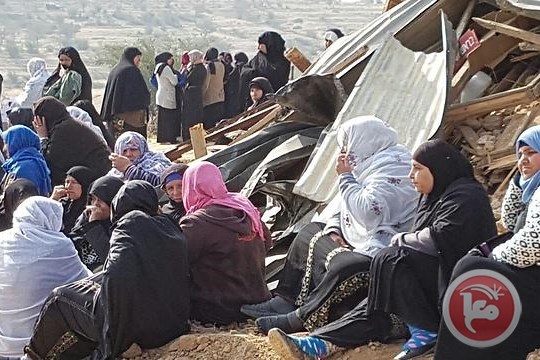
Palestinian women in Umm al-Hiran mourn death of Abu al-Qian in January
Ma’an – December 30, 2017
The Israeli Police Investigations Division (PID) has decided to close its probe into the January police killing of Palestinian math teacher Yaqoub Abu al-Qian, and to not hold any officers responsible for his death, Adalah – The Legal Center for Arab Minority Rights in Israel, said in a statement on Thursday.
Abu al-Qian, a 50-year-old math teacher from the Bedouin village of Umm al-Hiran in southern Israel’s Negev desert, was shot dead by Israeli police in January while he was driving at night, causing him to spin out of control and crash into Israeli officers, killing one policeman.
Abu al-Qian was driving through the village as dozens of Israeli forces were preparing for a large-scale home demolition in Umm al-Hiran. Israeli forces at the time claimed he was attempted to carry out a vehicular attack, though witness testimonies and video footage of the incident proved contradictory to police accusations.
Israeli police footage appeared to show police officers shooting at al-Qian as he was driving at a very slow pace, and only several seconds after the gunfire does his car appear to speed up, eventfully plowing through police officers.
The killing of Abu al-Qian sparked widespread outrage amongst Palestinian civilians and politicians, who claimed he was “extrajudicially executed.
After demands from his family and the community for police to conduct a probe into his killing, Adalah filed a request demanding the PID open an investigation into the death of Abu al-Qian.
“The closure of this investigation means the PID continues to grant legitimacy to deadly police violence against Arab citizens of Israel,” Adalah said in it’s statement.
“Though it was clear from day one that officers opened fire on a civilian without justification and in contravention of the police’s own open-fire regulations, it appears as if the PID is again whitewashing the most serious incidents. Just as the PID failed to hold any officers responsible for the October 2000 killings and the subsequent police killings of more than 50 Palestinian Arab citizens of Israel, this latest decision is further indication of the systemic failure of the PID.”
“The Israeli police and public security minister continue to propagate the same lie they initially promoted the day of the killing, according to which the incident was an intentional vehicular ramming attack against Israeli police officers. This lie was repeatedly refuted by multiple sources and video documentation of the incident,” Adalah added.
Abu al-Qian’s hometown of Umm al-Hiran is one of 35 Bedouin villages considered “unrecognized” by the Israeli state, and more than half of the approximately 160,000 Negev Bedouins reside in unrecognized villages.
The unrecognized Bedouin villages were established in the Negev soon after the 1948 Arab-Israeli war following the creation of the state of Israel.
Now more than 60 years later, the villages have yet to be recognized by Israel and live under constant threats of demolition and forcible removal.
Israeli Psychosis on Full Display

By Gilad Atzmon | December 29, 2017
In his attack on BDS activist Justine Sachs, Ynet writer Asaf Wohl performs every tribal morbidity. Sachs is apparently a Jewish pro-Palestinian woman who helped convince New Zealand singer Lorde to cancel her performance in Israel. Wohl accuses her of inciting ‘violence,’ ‘auto-anti-Semitsm,’ ‘siding with terrorists,’ effectively everything except child molesting.
Among my sins I am critical of some aspects of cultural BDS, but to interpret BDS as a violent act is rather over the top. If anything, BDS was designed to dilute Palestinian militant resistance. Furthermore, boycotting is a very Jewish practice, known as excommunication or herem in Hebrew. You would expect Wohl, an ardent Zionist, to be slightly more familiar with his own culture.
If you ever wonder what is the meaning of Judeo-centrism, Wohl provides the full scope. The Israeli settler really believes that he is the centre of this universe. “The difference between you and me, Justine, is that I’m an Israeli Jew and you’re a Jew. That’s it. You have no nationality. You live in a negligible, insignificant sheepfold stuck somewhere at the end of the universe (New Zealand).” For Wohl, Israel is the world’s capital and Israeliness is the ultimate embodiment of human as well as of Jewish existence.
Sachs is accused of “auto-anti-Semitism” which in Wohl’s words is a “drive towards human self-destruction.” And I wonder whether Wohl really thinks that Sachs persuading a singer not to perform in Tel Aviv points at self destructive or even suicidal inclinations?
Wohl writes that he feels “no need to take the side of a culture which hasn’t brought anything to the world apart from terror. The confidence I am given by the Israeli nationality allows me to pick the democratic, free side.” For Wohl, so it seems, Arabs and Muslims contributed nothing to the world but ‘terror’ yet Israel pretty much invented democracy and the Western ethos in general. Someone should remind this Israeli caricature that democracy is from Athens while state terror against the indigenous people of the land is actually Israel’s official policy.
Wohl seems to believe that the Jewish state is an exponent of Western values. Seemingly, Wohl doesn’t grasp that loving your neighbours is at the core of the Western civilisation’s ethos. Look how Wohl refers to his Palestinian neighbours. They are “the side which hijacks planes, the side which hangs gay people on electric poles, the side which rips out girls’ throats in honor killings, the side which has failed to establish any state or society which isn’t totalitarian, chauvinist, primitive and/or murderous.” Not a lot of Western compassion on Wohl’s part. And you may be left wondering: which side is Wohl on? The side of ardent Zionist Harvey Weinstein? Or maybe the side of people who plundered other people’s land and dropped white phosphorus on schools in Gaza? Wohl clearly sides with the people who made that strip of land into the biggest open air prison known to man. It is easy to grasp why Justine Sachs and a few other Diaspora Jews side with the Palestinians and oppose Israel. It is far more depressing to admit that the majority of them probably side with Wohl.
Clean Break II: Iran Hawks Decide to Burn It All Down
By Derek Davison and Jim Lobe | LobeLog | December 27, 2017
The 20th century was rife with partitions, many of them involving European powers carving up colonial possessions in Africa and the Middle East with what often appears to have been little or no concern for local realities. Perhaps the most famous of these free-hand attempts at state creation is the Sykes-Picot Line, whose legacy is very much still with us (and not for the better). But Sykes-Picot is far from the only example of European colonial borders that are still causing problems decades after they were drawn.
But who cares about all of that? It doesn’t seem to be an issue for at least some of America’s anti-Iran hawks. In response to Iran’s rising profile in the Middle East, fueled mostly by a war those neocons ardently championed and the striking ineptitude of the hawks’ new favorite Persian Gulf monarchy, the intellectual heirs to the men who drew those ill-fated borders are proposing, long after it might have done any good, to re-draw them.
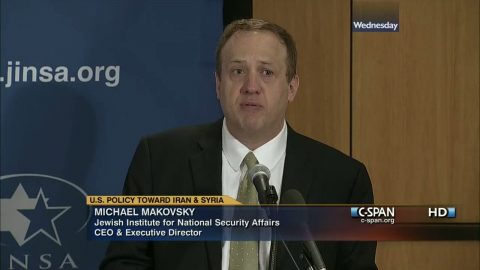
Writing for Fox News on December 25, Michael Makovsky—who is no fringe figure, being CEO of the neoconservative Jewish Institute for National Security Affairs (JINSA)—suggests just such a strategy for countering Iranian influence in the Middle East:
Maintaining Syria, Iraq, Lebanon and Yemen in their existing forms is unnatural and serves Iran’s interests. There is nothing sacred about these countries’ borders, which seem to have been drawn by a drunk and blindfolded mapmaker. Indeed, in totally disregarding these borders, ISIS and Iran both have already demonstrated the anachronism and irrelevance of the borders.
Syria, Iraq, Lebanon and Yemen are not nation-states as Americans understand them, but rather post-World War I artificial constructs, mostly created out of the ashes of the Ottoman Empire in a colossally failed experiment by western leaders.
With their deep ethno-sectarian fissures, these four countries have either been held together by a strong authoritarian hand or suffered sectarian carnage.
It is astonishing to read neoconservatives, who have done little else since the 1970s but lobby for exerting American hegemony in the Middle East, decry the results of the exertion of European hegemony in the Middle East. It reads like an artificial intelligence that just briefly verges on full self-awareness before pivoting and falling back to safer ground. It’s particularly rich for Makovsky, whose JINSA predecessors promoted the ouster of two of those “strong authoritarian hands” in former Iraqi leader Saddam Hussein and former Yemeni President Ali Abdullah Saleh, to bemoan one result of their ouster.
But let’s focus on the proposal Makovsky makes: redrawing borders in the Middle East, creating what he calls “loose confederations or new countries with more borders that more naturally conform along sectarian lines,” in order to counter Iran. The proposal strongly resembles recommendations found in “A Clean Break: A New Strategy for Securing the Realm,” a 1996 publication of the Jerusalem-based Institute for Advanced Strategic and Political Studies that was prepared in collaboration with several other neoconservative think tanks—including JINSA.
“A Clean Break,” the conclusion of a task force that included such Likudnik geniuses as Richard Perle, Douglas Feith, and David Wurmser, argued in part that Israel should work with friendly governments in Turkey and Jordan to contain regional threats, particularly coming from Syria. It concluded, among other things, that Israeli leaders should pursue “removing Saddam Hussein from power in Iraq-an important objective in its own right-as a means of foiling Syria’s regional ambitions.” “Syria” in this context serves as a stand-in for “Iran.” Long-term, the report envisioned the formation of a “natural axis” of Israel, Turkey, Jordan, and a “Hashemite” Iraq serving as “the prelude to a redrawing of the map of the Middle East, which could threaten Syria’s territorial integrity.”
Even a cursory glance at the state of the Middle East since the end of the Iraq War shows that ousting Saddam Hussein achieved the opposite of the report’s stated goals. The idea of a Hashemite restoration in Shia-majority Iraq was ridiculously far-fetched, and Iraq’s democratically-elected government has–justifiably–greatly improved the Baghdad-Tehran relationship. Makovsky, who wants to reverse this trend, argues that the United States should “declare our support and strong military aid for an eventual Iraqi Kurdish state, once its warring factions unify and improve governance. We could support a federation for the rest of Iraq.”
In Makovsky’s imagination, the new Kurd-less Iraqi federation would presumably wish Erbil well and send it on its way. In reality, another serious Kurdish move toward independence would probably lead to a civil war, as it nearly did in October over the status of Kirkuk. Iraqi Prime Minister Haider al-Abadi’s first foreign trip after his dramatic capture of Kirkuk was… to Iran. If the United States were to come out in full support of an independent Kurdistan, it would almost certainly push the rest of Iraq more firmly into Iran’s orbit. Speaking of Kirkuk, does Makovsky imagine that independent Kurdistan would be given the city and its surrounding oil fields? If yes, then that only increases the chances of a war with Baghdad. If no, then there are serious questions about whether that hypothetical Kurdish state would be economically viable.
For Syria, Makovsky says that “we could seek a more ethnically coherent loose confederation or separate states that might balance each other – the Iranian-dominated Alawites along the coast, the Kurds in the northeast, and the Sunni Arabs in the heartland.” He might want to check a recent map of Syria, because while “heartland” is obviously a subjective term, by almost any definition Syria’s “heartland” now belongs to President Basher al-Assad and his Russian and Iranian allies. This includes the country’s five largest (pre-war) cities: Aleppo, Damascus, Homs, Latakia, and Hama. How does Makovsky propose any of that territory be taken from Assad so as to be turned over to “Sunni Arabs,” even in a confederate sense? If the answer is “war,” then his Fox News thinkpiece is burying the lede to say the least.
Makovsky then recommends that the U.S. strengthen relations with Shia-majority Azerbaijan, in order to “demonstrate we are not anti-Shia Muslim.” Yes, that should do the trick. Of course, that’s not the only reason:
An added potential benefit of this approach could be a fomenting of tensions within Iran, which has sizable Kurdish and Azeri populations, thereby weakening the radical regime in Tehran.
You might even say that it could threaten Iran’s territorial integrity. Make a Clean Break, if you will.
The dangers of the United States trying to redraw Middle Eastern borders—Makovsky graciously allows that America “cannot dictate the outcomes” but should instead “influence” them—should be obvious. For one thing, there’s the immediate likelihood that attempting to draw new borders would intensify regional instability. For another, there’s little reason to expect that the United States would get the new borders any more “right” than Britain and France did a century ago, particularly not when the process is being managed by the same people who brought us the invasion of Iraq. For still another, the most recent example of such Western “influenced” partitioning isn’t exactly a positive one.
But we can’t leave Makovsky’s piece without mentioning its most jaw-dropping paragraph (emphasis ours):
Artificial states have been divided or loosened before with some success, such as the Soviet Union, Yugoslavia and Czechoslovakia, which are all post-WWI formations. Bosnia and Herzegovina have also managed as a confederation.
Czechoslovakia divided peacefully of its own accord. The Soviet Union more or less did likewise, though that dissolution hasn’t been quite so peaceful in recent years. As for Yugoslavia—well, maybe Dr. Makovsky’s definition of “success” is a bit different from most other people’s. To be fair, though, if the breakup of Yugoslavia is his template for the future of the Middle East, this piece makes a lot more sense.
But if Makovsky believes in federalizing existing Middle Eastern states along “ethno-sectarian” lines, why not start with Israel and the Occupied Territories, a notion that would seem logical to any 21st century mapmaker? After all, occupation of one people by another via a “strong authoritarian hand”—in this case the IDF—would seem to be a prescription for a “colossally failed experiment,” no? Perhaps Makovsky’s experience as a former West Bank settler may make it difficult for him to see the relevance.
Israeli settlers, soldiers raid Nablus-area school, injure Palestinian students
Palestine Information Center – December 28, 2017
 NABLUS – A Palestinian school student suffered a rubber bullet injury on Thursday morning after Israeli soldiers stormed Burin town in Nablus to provide protection for extremist Jewish settlers, who infiltrated into the town and clashed with local residents.
Eyewitnesses explained the Palestinian Information Center that at first, a horde of violent settlers entered the town and encircled the school of Burin before attempting to storm it to attack students and teachers, who were busy doing semester exams.
The settlers also caused damage to three parked cars outside the school, and brutalized and detained several teachers on the main road of the town.
Soon later, local residents rushed to the school to fend off the settlers and clashed with them before soldiers showed up and started to fire volleys of tear gas as well as rubber and live bullets randomly to protect the settlers.
Consequently, one student was injured and several others inside and outside the school suffered from their exposure to teargas fumes.
The administration of the school also had to postpone the exams and dismiss the students following the events.
In a separate incident, a large number of Israeli soldiers stormed Rujeib town, southeast of Nablus, amid intensive shooting of tear gas and stun grenades near homes.
Eyewitnesses reported that the soldiers detained some students on the streets of the town for a while and searched them before letting them go.
The soldiers also clashed with local young men during their campaign in the town and withdrew without making arrests.
Doctors urge mental health group not to meet in Israel

Israeli security forces take a Palestinian minor into custody in the West Bank on 20 December 2017 [Wisam Hashlamoun/Apaimages]
MEMO | December 28, 2017
Mental health experts have called on the International Association for Relational Psychoanalysis and Psychotherapy’s to reconsider its decision to hold its 2019 international meeting in Israel because of the latter’s aggression towards Palestinians.
A letter addressed to the IARPP, signed by renown Palestinian psychiatrist Samah Jabr and a number of American therapists, calls on the body to consider
the grave crisis posed by the Israeli occupation and its currently escalating attacks on the Palestinian people – attacks reflective of an overarching policy of ethnic cleansing and consequent seizure of land, restriction of freedom of movement, and control over natural resources.
They said they have “an added responsibility to make our voices heard … as mental health workers familiar with the impact of violence on both individual health and collective well-being.”
The doctors went on to highlight Israel’s reliance “upon intimidation, extrajudicial assassination, and torture of Palestinians – including the torture of children, often involving sexual assault.”
“To locate international conferences related to any professional domain in Israel, in our view, represents a tacit acceptance of the behaviour of the state of Israel,” they wrote, adding: “To hold such conferences cannot help but advance the interests of the state of Israel through the implication that Israel welcomes a free exchange of ideas.”
“It is particularly ironic and painful to see Israel chosen as the site of an international conference when the central theme of the particular organisation is the in-depth understanding of human relationships.”
Though there have previously been calls to allow Palestinian doctors to attend the meeting if it is held in Israel, the mental health experts said this is not a valid solution, not least because they “may find merely showing up at the conference to be impossible due to checkpoints, movement restrictions, blacklisting of activists, and other everyday experiences familiar to Palestinians”.
Flashback to 2011: Asma Assad: A Rose in the Desert

By Richard Edmondson | Fig Trees and Vineyards | December 27, 2017
The article below was initially published in Vogue Magazine in early 2011. I am re-posting it here as it provides a striking look back at Syria as it was just prior to the outbreak of the neocon-instigated regime-change war which so devastated the country.
Asma Assad, the wife of President Bashar Assad, is a woman of grace and beauty, and it’s probably not surprising that a fashion magazine would have decided to publish an article on her. But after the article appeared, Vogue, along with Joan Juliet Buck, the writer of the piece, were attacked by certain mainstream media outlets, such as The Atlantic, presumably for not sufficiently demonizing the Syrian government.
“Asma al-Assad has British roots, wears designer fashion, worked for years in banking, and is married to the dictator Bashar al-Assad, whose regime has killed over 5,000 civilians and hundreds of children this year,” wrote Max Fisher in a sarcastically-worded lead paragraph for The Atlantic.
Fisher also criticized Vogue’s “fawning treatment of the Assad family and its portrayal of the regime as tolerant and peaceful,” noting that this treatment had “generated surprise and outrage in much of the Washington foreign policy community.”
The article by Buck had appeared in Vogue’s February 2011 issue. The Syrian regime-change operation got underway in March, a month later, when protests broke out in Daraa. And the timing of the two probably was nothing more than coincidental.
But of course the neocons in the State Department would have already begun executing their scheme, and a media vilification campaign would have been deemed necessary, or at any rate helpful, in greasing the wheels–and the sudden appearance of the Vogue article (the magazine reportedly has over 11 million readers) probably was looked upon as something of a monkey wrench in the plans. You could think of it as one of the rare moments that a mainstream media organ stepped out of bounds.
Fisher, who now holds a position with the New York Times, went on to kvetch that “the glowing article praised the Assads as a ‘wildly democratic’ family-focused couple who vacation in Europe, foster Christianity, are at ease with American celebrities, made theirs the ‘safest country in the Middle East,’ and want to give Syria a ‘brand essence.’”
It is of course true that the Assads “foster Christianity,” as Fisher contemptuously puts it (indeed–you can go here to see a video I posted two years ago of the first couple attending a Christmas service at a church in Damascus in 2015), but of course it would not do to have this kind of information put out in the mainstream just before the launch of a long-planned regime change operation.
Other mainstream media attacks upon Vogue came from Gawker, where writer John Cook also accused the publication of “fawning”; the New York Times, which published a piece headlined “The Balance of Charm and Reality“; and Slate, whose writer, Noreen Malone, damned Vogue for paying “besotted compliments” to the Assads and for “unwittingly exacerbating” a “modern day Marie Antoinette problem.”
Buck should now be proud of the mainstream media attacks upon her work–but aside from this, her article, as I say, is important also in that it provides a valuable glimpse into life in the country just before the outset of the war.
Syria, she notes, was known as “the safest country in the Middle East.” Buck was roundly excoriated for making this observation, but certainly at the time, in 2011, it was true in spades: Syria was eminently safer than either US-occupied Iraq or Israeli-occupied Palestine.
Buck also notes that Syria is “a place without bombings, unrest, or kidnappings”–which would have run completely counter to the narrative of Assad being the ubiquitous “brutal dictator who kills his own people” and who serves as a “magnet to jihadis”–but perhaps most noteworthy of all are Buck’s revelations about programs set up for children in the country.
When I visited Syria in 2014, one of the things I heard about were Asma Assad’s charity efforts on behalf of children, so it was not surprising for me, upon reading the Vogue article, to learn of Massar, an organization founded by the First Lady and “built around a series of discovery centers,” or to learn that at these centers children and young adults, ages five to twenty-one, were taught “creative, informal approaches to civic responsibility.”
Buck also tells of Asma’s jaunts around the country visiting local schools and interacting with children in what seems to have been a very life-fulfilling manner.
All of this, of course, would have come to a dramatic halt, or a dramatic curtailment at any rate, when the nightmare began and the country suddenly found itself invaded by armies of US-backed terrorists.
Another fascinating aspect of the article is what it reveals regarding Asma’s contributions toward safeguarding Syria’s cultural heritage. While in Syria I attended, along with several members of the staff of Veterans Today, an anti-terrorism conference held at the Dama Rose Hotel in Damascus. Among the subjects discussed at the conference were the ongoing attacks upon cultural heritage sites. It was disclosed that at the outset of the conflict, the country’s Directorate General of Antiquities and Museums (DGAM), in anticipation of terrorist looting of cultural heritage sites, had begun securing priceless artifacts by placing them in secure storage sites around the country.
The effort was a herculean one, involving DGAM’s 2500 employees spanning out across the country, and while most of the credit has gone to Dr. Maamoun Abdulkarim, the director of DGAM, it would appear, if Buck’s article is any indication, that Asma Assad played a role in the effort as well:
There are 500,000 important ancient works of art hidden in storage; Asma al-Assad has brought in the Louvre to create a network of museums and cultural attractions across Syria, and asked Italian experts to help create a database of the 5,000 archaeological sites in the desert. “Culture,” she says, “is like a financial asset. We have an abundance of it, thousands of years of history, but we can’t afford to be complacent.”
The reference to works of art being “hidden in storage” would suggest that already at that time–February of 2011–Syrian officials had begun to anticipate the hellfire that was about to be unleashed upon their country.
One other thing I might mention is a small criticism I have of Buck’s piece. She speaks of “minders” who she claims accompanied her throughout her visit, commenting as well that “on the rare occasions I am out alone, a random series of men in leather jackets seems to be keeping close tabs on what I am doing and where I am headed.”
All I can say in response to this is that I never experienced anything of the like during my own visit to Syria. I stayed at the Dama Rose Hotel–the location where the conference was held–and while I occasionally went out for strolls through the neighborhood, I never once was followed by any “random series of men in leather jackets.” Yes–there were Syrian soldiers in the streets. But they were stationed at certain locations, busy street corners for instance, and they did not begin tailing me suspiciously after I had passed them by. They remained at their posts. Moreover, their presence, rather than threatening, was a comforting assurance I would not be attacked or kidnapped by terrorists, at least while the soldiers were around.
Lastly, I would also mention that Vogue succumbed to the withering barrage of criticism and removed Buck’s article from their website. Less than a year later, the only trace of it that remained on the Internet was at a pro-Syrian site called PresidentAssad.net–something which was made note of in a January 3, 2012 article by Fisher at The Atlantic.
The PresidentAssad.net site is still around, but for some reason the Vogue article seems to have gotten dropped over the years. However, it has re-surfaced–at Gawker. There you may find it (at least for the time being) along with a link back to the attack piece I mentioned above, written by Cook and posted in February of 2011.
***
Asma al-Assad: A Rose in the Desert
By Joan Juliet Buck
Asma al-Assad is glamorous, young, and very chic—the freshest and most magnetic of first ladies. Her style is not the couture-and-bling dazzle of Middle Eastern power but a deliberate lack of adornment. She’s a rare combination: a thin, long-limbed beauty with a trained analytic mind who dresses with cunning understatement. Paris Match calls her “the element of light in a country full of shadow zones.” She is the first lady of Syria.
Syria is known as the safest country in the Middle East, possibly because, as the State Department’s Web site says, “the Syrian government conducts intense physical and electronic surveillance of both Syrian citizens and foreign visitors.” It’s a secular country where women earn as much as men and the Muslim veil is forbidden in universities, a place without bombings, unrest, or kidnappings, but its shadow zones are deep and dark. Asma’s husband, Bashar al-Assad, was elected president in 2000, after the death of his father, Hafez al-Assad, with a startling 97 percent of the vote. In Syria, power is hereditary. The country’s alliances are murky. How close are they to Iran, Hamas, and Hezbollah? There are souvenir Hezbollah ashtrays in the souk, and you can spot the Hamas leadership racing through the bar of the Four Seasons. Its number-one enmity is clear: Israel. But that might not always be the case. The United States has just posted its first ambassador there since 2005, Robert Ford.
Iraq is next door, Iran not far away. Lebanon’s capital, Beirut, is 90 minutes by car from Damascus. Jordan is south, and next to it the region that Syrian maps label Palestine. There are nearly one million refugees from Iraq in Syria, and another half-million displaced Palestinians.
“It’s a tough neighborhood,” admits Asma al-Assad.
It’s also a neighborhood intoxicatingly close to the dawn of civilization, where agriculture began some 10,000 years ago, where the wheel, writing, and musical notation were invented. Out in the desert are the magical remains of Palmyra, Apamea, and Ebla. In the National Museum you see small 4,000-year-old panels inlaid with mother-of-pearl that is echoed in the new mother-of-pearl furniture for sale in the souk. Christian Louboutin comes to buy the damask silk brocade they’ve been making here since the Middle Ages for his shoes and bags, and has incidentally purchased a small palace in Aleppo, which, like Damascus, has been inhabited for more than 5,000 years.
The first lady works out of a small white building in a hilly, modern residential neighborhood called Muhajireen, where houses and apartments are crammed together and neighbors peer and wave from balconies. The first impression of Asma al-Assad is movement—a determined swath cut through space with a flash of red soles. Dark-brown eyes, wavy chin-length brown hair, long neck, an energetic grace. No watch, no jewelry apart from Chanel agates around her neck, not even a wedding ring, but fingernails lacquered a dark blue-green. She’s breezy, conspiratorial, and fun. Her accent is English but not plummy. Despite what must be a killer IQ, she sometimes uses urban shorthand: “I was, like. . . .”
Asma Akhras was born in London in 1975, the eldest child and only daughter of a Syrian Harley Street cardiologist and his diplomat wife, both Sunni Muslims. They spoke Arabic at home. She grew up in Ealing, went to Queen’s College, and spent holidays with family in Syria. “I’ve dealt with the sense that people don’t expect Syria to be normal. I’d show my London friends my holiday snaps and they’d be—‘Where did you say you went?’ ”
She studied computer science at university, then went into banking. “It wasn’t a typical path for women,” she says, “but I had it all mapped out.” By the spring of 2000, she was closing a big biotech deal at JP Morgan in London and about to take up an MBA at Harvard. She started dating a family friend: the second son of president Hafez al-Assad, Bashar, who’d cut short his ophthalmology studies in London in 1994 and returned to Syria after his older brother, Basil, heir apparent to power, died in a car crash. They had known each other forever, but a ten-year age difference meant that nothing registered—until it did.
“I was always very serious at work, and suddenly I started to take weekends, or disappear, and people just couldn’t figure it out,” explains the first lady. “What do you say—‘I’m dating the son of a president’? You just don’t say that. Then he became president, so I tried to keep it low-key. Suddenly I was turning up in Syria every month, saying, ‘Granny, I miss you so much!’ I quit in October because by then we knew that we were going to get married at some stage. I couldn’t say why I was leaving. My boss thought I was having a nervous breakdown because nobody quits two months before bonus after closing a really big deal. He wouldn’t accept my resignation. I was, like, ‘Please, really, I just want to get out, I’ve had enough,’ and he was ‘Don’t worry, take time off, it happens to the best of us.’ ” She left without her bonus in November and married Bashar al-Assad in December.

“What I’ve been able to take away from banking was the transferable skills—the analytical thinking, understanding the business side of running a company—to run an NGO or to try and oversee a project.” She runs her office like a business, chairs meeting after meeting, starts work many days at six, never breaks for lunch, and runs home to her children at four. “It’s my time with them, and I get them fresh, unedited—I love that. I really do.” Her staff are used to eating when they can. “I have a rechargeable battery,” she says.
The 35-year-old first lady’s central mission is to change the mind-set of six million Syrians under eighteen, encourage them to engage in what she calls “active citizenship.” “It’s about everyone taking shared responsibility in moving this country forward, about empowerment in a civil society. We all have a stake in this country; it will be what we make it.”
In 2005 she founded Massar, built around a series of discovery centers where children and young adults from five to 21 engage in creative, informal approaches to civic responsibility. Massar’s mobile Green Team has touched 200,000 kids across Syria since 2005. The organization is privately funded through donations. The Syria Trust for Development, formed in 2007, oversees Massar as well as her first NGO, the rural micro-credit association FIRDOS, and SHABAB, which exists to give young people business skills they need for the future.
And then there’s her cultural mission: “People tend to see Syria as artifacts and history,” she says. “For us it’s about the accumulation of cultures, traditions, values, customs. It’s the difference between hardware and software: the artifacts are the hardware, but the software makes all the difference—the customs and the spirit of openness. We have to make sure that we don’t lose that. . . . ” Here she gives an apologetic grin. “You have to excuse me, but I’m a banker—that brand essence.”
That brand essence includes the distant past. There are 500,000 important ancient works of art hidden in storage; Asma al-Assad has brought in the Louvre to create a network of museums and cultural attractions across Syria, and asked Italian experts to help create a database of the 5,000 archaeological sites in the desert. “Culture,” she says, “is like a financial asset. We have an abundance of it, thousands of years of history, but we can’t afford to be complacent.”
In December, Asma al-Assad was in Paris to discuss her alliance with the Louvre. She dazzled a tough French audience at the International Diplomatic Institute, speaking without notes. “I’m not trying to disguise culture as anything more than it is,” she said, “and if I sound like I’m talking politics, it’s because we live in a politicized region, a politicized time, and we are affected by that.”
The French ambassador to Syria, Eric Chevallier, was there: “She managed to get people to consider the possibilities of a country that’s modernizing itself, that stands for a tolerant secularism in a powder-keg region, with extremists and radicals pushing in from all sides—and the driving force for that rests largely on the shoulders of one couple. I hope they’ll make the right choices for their country and the region. ”
Damascus evokes a dusty version of a Mediterranean hill town in an Eastern-bloc country. The courtyard of the Umayyad Mosque at night looks exactly like St. Mark’s square in Venice. When I first arrive, I’m met on the tarmac by a minder, who gives me a bouquet of white roses and lends me a Syrian cell phone; the head minder, a high-profile American PR, joins us the next day. The first lady’s office has provided drivers, so I shop and see sights in a bubble of comfort and hospitality. On the rare occasions I am out alone, a random series of men in leather jackets seems to be keeping close tabs on what I am doing and where I am headed.
“I like things I can touch. I like to get out and meet people and do things,” the first lady says as we set off for a meeting in a museum and a visit to an orphanage. “As a banker, you have to be so focused on the job at hand that you lose the experience of the world around you. My husband gave me back something I had lost.”
She slips behind the wheel of a plain SUV, a walkie-talkie and her cell thrown between the front seats and a Syrian-silk Louboutin tote on top. She does what the locals do—swerves to avoid crazy men who run across busy freeways, misses her turn, checks your seat belt, points out sights, and then can’t find a parking space. When a traffic cop pulls her over at a roundabout, she lowers the tinted window and dips her head with a playful smile. The cop’s eyes go from slits to saucers.
Her younger brother Feras, a surgeon who moved to Syria to start a private health-care group, says, “Her intelligence is both intellectual and emotional, and she’s a master at harmonizing when, and how much, to use of each one.”
In the Saint Paul orphanage, maintained by the Melkite–Greek Catholic patriarchate and run by the Basilian sisters of Aleppo, Asma sits at a long table with the children. Two little boys in new glasses and thick sweaters are called Yussuf. She asks them what kind of music they like. “Sad music,” says one. In the room where she’s had some twelve computers installed, the first lady tells a nun, “I hope you’re letting the younger children in here go crazy on the computers.” The nun winces: “The children are afraid to learn in case they don’t have access to computers when they leave here,” she says.
In the courtyard by the wall down which Saint Paul escaped in a basket 2,000 years ago, an old tree bears gigantic yellow fruit I have never seen before. Citrons. Cédrats in French.
Back in the car, I ask what religion the orphans are. “It’s not relevant,” says Asma al-Assad. “Let me try to explain it to you. That church is a part of my heritage because it’s a Syrian church. The Umayyad Mosque is the third-most-important holy Muslim site, but within the mosque is the tomb of Saint John the Baptist. We all kneel in the mosque in front of the tomb of Saint John the Baptist. That’s how religions live together in Syria—a way that I have never seen anywhere else in the world. We live side by side, and have historically. All the religions and cultures that have passed through these lands—the Armenians, Islam, Christianity, the Umayyads, the Ottomans—make up who I am.”
“Does that include the Jews?” I ask.
“And the Jews,” she answers. “There is a very big Jewish quarter in old Damascus.”
The Jewish quarter of Damascus spans a few abandoned blocks in the old city that emptied out in 1992, when most of the Syrian Jews left. Their houses are sealed up and have not been touched, because, as people like to tell you, Syrians don’t touch the property of others. The broken glass and sagging upper floors tell a story you don’t understand—are the owners coming back to claim them one day?
The presidential family lives surrounded by neighbors in a modern apartment in Malki. On Friday, the Muslim day of rest, Asma al-Assad opens the door herself in jeans and old suede stiletto boots, hair in a ponytail, the word happiness spelled out across the back of her T-shirt. At the bottom of the stairs stands the off-duty president in jeans—tall, long-necked, blue-eyed. A precise man who takes photographs and talks lovingly about his first computer, he says he was attracted to studying eye surgery “because it’s very precise, it’s almost never an emergency, and there is very little blood.”
The old al-Assad family apartment was remade into a child-friendly triple-decker playroom loft surrounded by immense windows on three sides. With neither shades nor curtains, it’s a fishbowl. Asma al-Assad likes to say, “You’re safe because you are surrounded by people who will keep you safe.” Neighbors peer in, drop by, visit, comment on the furniture. The president doesn’t mind: “This curiosity is good: They come to see you, they learn more about you. You don’t isolate yourself.”
There’s a decorated Christmas tree. Seven-year-old Zein watches Tim Burton’s Alice in Wonderland on the president’s iMac; her brother Karim, six, builds a shark out of Legos; and nine-year-old Hafez tries out his new electric violin. All three go to a Montessori school.
Asma al-Assad empties a box of fondue mix into a saucepan for lunch. The household is run on wildly democratic principles. “We all vote on what we want, and where,” she says. The chandelier over the dining table is made of cut-up comic books. “They outvoted us three to two on that.”
A grid is drawn on a blackboard, with ticks for each member of the family. “We were having trouble with politeness, so we made a chart: ticks for when they spoke as they should, and a cross if they didn’t.” There’s a cross next to Asma’s name. “I shouted,” she confesses. “I can’t talk about empowering young people, encouraging them to be creative and take responsibility, if I’m not like that with my own children.”
“The first challenge for us was, Who’s going to define our lives, us or the position?” says the president. “We wanted to live our identity honestly.”
They announced their marriage in January 2001, after the ceremony, which they kept private. There was deliberately no photograph of Asma. “The British media picked that up as: Now she’s moved into the presidential palace, never to be seen again!” says Asma, laughing.
They had a reason: “She spent three months incognito,” says the president. “Before I had any official engagement,” says the first lady, “I went to 300 villages, every governorate, hospitals, farms, schools, factories, you name it—I saw everything to find out where I could be effective. A lot of the time I was somebody’s ‘assistant’ carrying the bag, doing this and that, taking notes. Nobody asked me if I was the first lady; they had no idea.”
“That way,” adds the president, “she started her NGO before she was ever seen in public as my wife. Then she started to teach people that an NGO is not a charity.”
Neither of them believes in charity for the sake of charity. “We have the Iraqi refugees,” says the president. “Everybody is talking about it as a political problem or as welfare, charity. I say it’s neither—it’s about cultural philosophy. We have to help them. That’s why the first thing I did is to allow the Iraqis to go into schools. If they don’t have an education, they will go back as a bomb, in every way: terrorism, extremism, drug dealers, crime. If I have a secular and balanced neighbor, I will be safe.”
When Angelina Jolie came with Brad Pitt for the United Nations in 2009, she was impressed by the first lady’s efforts to encourage empowerment among Iraqi and Palestinian refugees but alarmed by the Assads’ idea of safety.
“My husband was driving us all to lunch,” says Asma al-Assad, “and out of the corner of my eye I could see Brad Pitt was fidgeting. I turned around and asked, ‘Is anything wrong?’ ”
“Where’s your security?” asked Pitt.
“So I started teasing him—‘See that old woman on the street? That’s one of them! And that old guy crossing the road?
That’s the other one!’ ” They both laugh.
The president joins in the punch line: “Brad Pitt wanted to send his security guards here to come and get some training!”
After lunch, Asma al-Assad drives to the airport, where a Falcon 900 is waiting to take her to Massar in Latakia, on the coast. When she lands, she jumps behind the wheel of another SUV waiting on the tarmac. This is the kind of surprise visit she specializes in, but she has no idea how many kids will turn up at the community center on a rainy Friday.
As it turns out, it’s full. Since the first musical notation was discovered nearby, at Ugarit, the immaculate Massar center in Latakia is built around music. Local kids are jamming in a sound booth; a group of refugee Palestinian girls is playing instruments. Others play chess on wall-mounted computers. These kids have started online blood banks, run marathons to raise money for dialysis machines, and are working on ways to rid Latakia of plastic bags. Apart from a few girls in scarves, you can’t tell Muslims from Christians.
Asma al-Assad stands to watch a laborious debate about how—and whether—to standardize the Arabic spelling of the word Syria. Then she throws out a curve ball. “I’ve been advised that we have to close down this center so as to open another one somewhere else,” she says. Kids’ mouths drop open. Some repress tears. Others are furious. One boy chooses altruism: “That’s OK. We know how to do it now; we’ll help them.”
Then the first lady announces, “That wasn’t true. I just wanted to see how much you care about Massar.”
As the pilot expertly avoids sheet lightning above the snow-flecked desert on the way back, she explains, “There was a little bit of formality in what they were saying to me; it wasn’t real. Tricks like this help—they became alive, they became passionate. We need to get past formalities if we are going to get anything done.”
Two nights later it’s the annual Christmas concert by the children of Al-Farah Choir, run by the Syrian Catholic Father Elias Zahlawi. Just before it begins, Bashar and Asma al-Assad slip down the aisle and take the two empty seats in the front row. People clap, and some call out his nickname:
Two hundred children dressed variously as elves, reindeers, or candy canes share the stage with members of the national orchestra, who are done up as elves. The show becomes a full-on songfest, with the elves and reindeer and candy canes giving their all to “Hallelujah” and “Joy to the World.” The carols slide into a more serpentine rhythm, an Arabic rap group takes over, and then it’s back to Broadway mode. The president whispers, “All of these styles belong to our culture. This is how you fight extremism—through art.”
Brass bells are handed out. Now we’re all singing “Jingle Bell Rock,” 1,331 audience members shaking their bells, singing, crying, and laughing.
“This is the diversity you want to see in the Middle East,” says the president, ringing his bell. “This is how you can have peace!”
Featured Video

Trump asks Iran not to retaliate after he strikes Pickaxe Mountain
or go to
Aletho News Archives – Video-Images
Book Review
‘Why Fauci Must Rot in Prison’: A Tale of Two Diaries
By Jill Erzen | The Defender | October 13, 2026
Dr. Anthony Fauci’s private diary reveals a “mind-numbing” contradiction between what the former top U.S. infectious disease official knew about COVID-19 and what he told the public, senior White House adviser Peter Navarro, Ph.D., said last week on “American Thought Leaders.”
In his new book, “Why Fauci Must Rot in Prison,” due out Oct. 20, Navarro compares Fauci’s private entries to his own pandemic-era diary, and uses what he calls “a tale of two diaries” to argue that Fauci should face criminal prosecution.
“I show, actually, how a prosecution can and should happen … at the state level, most likely,” Navarro said. “He should wind up in prison, and we’ve got the receipts in this book to put him there.”
Navarro said Fauci repeatedly acknowledged important facts in private, then publicly pursued policies that contradicted those facts — with devastating consequences.
“What he says many times privately in his diary is so at odds with both his public behavior and public statements that it’s mind-numbing,” Navarro said.
Navarro examines the lasting damage caused by lockdowns and other pandemic policies, and the ongoing toll of long COVID.
His book also addresses questions about vaccine safety, including why healthy young people faced COVID-19 vaccination mandates despite concerns about myocarditis, and why women were not warned about miscarriage risks linked to the shots. … continue
Blog Roll
 Aletho News
- The mother of all propaganda: Why the hype over US MOAB strike against Iran is nothing but theater
- Iran says it possesses technology behind US 14-ton GBU bunker-buster
- Trump asks Iran not to retaliate after he strikes Pickaxe Mountain – w/ Prof. Marandi
- Vice President J.D. Vance’s Deceptive ‘Antiwar’ Campaign Speech
- Iran: Palestinians’ rights must not be compromised in Gaza’s future; US, Israel to blame for Hormuz situation
- Ongoing tales of Syrian chemical weapons
- Moscow blasts UN for ignoring torture of Russian POWs
- Millions of Books Could Have Been Destroyed in Lebanon During Israeli Bombings
- Moscow warns of ‘hunt for Russians’
- Calling of an Angel: The True Story of Rene Caisse and an Indian Herbal Medicine Called Essiac (1988)
- If Americans Knew
- Netanyahu’s spin on latest settler attack is laughable – Daily Update
- Israeli soldiers debunk Israel’s talking points
- In West Bank, Israeli settlers are totally out of control – Daily Update
- NPR investigation finds evidence of widespread fraud at mall kiosks tied to Israeli skincare brand
- Tucker Carlson exposes Israeli Lies about the Oct 7th attack, Charlie Kirk, and the U.S.
- Israel has detained thousands of Palestinian children since Oct 7th – over half spent time in solitary, many uncharged
- Israeli Analysis: Is Netanyahu Planning an ‘October Surprise’ Attack Before Israel’s Election?
- Israeli settlers brutally attack Palestinians and Washington Post female photographer, 65
- Words Have Changed, Occupation Continues: The Reality of the Gaza Ceasefire
- Gaza’s child amputees are growing faster than their prosthetics allow
- No Tricks Zone
- Predictions Made By Renowned Climate Proifessor Over Past Decades Have Been Proven To Be Poor
- New Study Suggests Large Regions Of The Pacific Ocean Have Been Cooling For The Last 80 Years
- Germany’s Green Energy Debacle: High Energy Costs Force Kahla Porzellan to Close After 182 Years!
- New Study: 50 Years Of The Most Aggressive ‘Net Zero’ Policies Can Only Affect The Global Climate By 0.03°C
- US September “Heat” Was No Record…Many Records Set Decades Ago
- Latest European Green Energy Debacle; Portugal’s Largest Flagship Solar Park Insolvent!
- Green Energy Debacle: German Expert Professor Fritz Vahrenholt Warns Of Severe Economic And Social Consequences
- Two More Paleo Reconstructions Affirm Meters-Higher Sea Levels Across Ireland, Brazil 7000-6000 Years Ago
- New Study: Earth And Venus Surface Warmth Largely Explained By Convection And Lapse Rate, Not CO2 Or Radiation
- 2025 Nature Paper Claiming Worsening Global Drought Gets RETRACTED …Heavily Flawed

