Saudi Arabia’s pressures on the Lebanese government to disarm the Hezbollah resistance movement are part of a scenario to wage war against the country, a former US government adviser says.
In a Friday interview with Press TV, Paul Larudee expressed concern over the implication of the latest remarks by Saudi Foreign Minister Adel al-Jubeir, who accused Hezbollah of “hijacking” Lebanon and called for disarming the resistance movement.
“This is a classic technique of building a case for invasion of any country, and in this case Lebanon. It is set up to make the invader appear like a liberator and to make the defenders of their country appear like the occupiers and the usurpers,” Larudee said.
“It is very worrisome that in fact this is on the table now that they are working up to a war in Lebanon,” he added.
Speaking at an international conference in the Italian capital city of Rome on Friday, Jubeir described the present situation in Lebanon as “tragic” and said, “Lebanon will only survive or prosper if you disarm Hezbollah.”
“As long as you have an armed militia, you will not have peace in Lebanon,” the Saudi foreign minister said.
Hezbollah is Lebanon’s de facto military power, and has been fighting off recurrent acts of Israeli aggression against the homeland. Riyadh, which reportedly maintains clandestine ties with Tel Aviv, however, has made no secret of its opposition to the group, and has been trying for more than a decade to weaken it.
Lebanon has repeatedly praised Hezbollah’s key role in the war against terrorism, with Lebanese President Michel Aoun defending the resistance movement’s possession of arms as essential to Lebanon’s security.
The accusations against the resistance movement come amid Lebanon’s ongoing political crisis.
On November 4, Lebanese Prime Minister Saad Hariri announced his resignation during a visit to Saudi Arabia, shocking the nation and plunging it into political uncertainty. He accused Iran and Hezbollah of sowing strife in the Arab world, an allegation rejected by both sides.
Shortly afterwards, President Aoun accused Riyadh of kidnapping Hariri. International heavyweights such as the European Union, France, and Germany also called on the kingdom to let him return.
The Lebanese PM then traveled back to Lebanon, and put his resignation on hold at Aoun’s request in favor of national dialog.
Hariri says he will resign from his position if Hezbollah refuses to remain “neutral” in the regional conflicts.
Sources close to Hariri said he had been forced to step down by the kingdom over his failure to “confront” Hezbollah.
The prime minister was also quoted by Lebanese sources as saying that he would keep to himself what happened in Saudi Arabia, implying that he did not feel free to expose what had actually transpired in the Arab kingdom.
From the earliest years of the Zionist project, the leaders of the movement which then morphed into the State of Israel understood that regional coalitions were crucial to its success. But Israel is a settler colonial project and therefor it was and still is very much hated by people in the region. Israel and its leaders invested in creating and promoting corrupt unprincipled despots to leadership in the countries around it, men who would control the Arab world by keeping its people poor, uneducated and without representation and would pose no threat to Israel and its policies of genocide and ethnic cleansing perpetuated against the people of Palestine. Israel has had some degree of success in this, especially with the reactionary monarchies. Countries who had leaders that resisted Israel ended up paying a heavy price. These were states like Syria, Iraq, Yemen and Libya which are now destroyed and so it can come as no surprise that the new Saudi Crown Prince is keen to take his regime’s relations with Israel to a new level, some say he even intends to establish diplomatic ties with Israel.
It is ironic that some of the greatest perpetrators and supporters of terrorism are those who talk of fighting terrorism. The latest unholy alliance between the US, Israel, Saudi Arabia and Egypt is a source of unspeakable terror which without fail is inflicted on innocent civilians but guarantees Israeli interests will be safe. The new boss calling the shots from Riyadh, Mohammad Bin Salman is for now at the center of this unholy alliance which in the short term will satisfy his hunger for power and influence but is sure to fail and in the meantime, will surely produce more misery in Yemen, Palestine, Lebanon and God only knows where else. But state terrorism like that perpetuated by Israeli military against Palestinians and the Saudis in Yemen is heralded by the weapons suppliers in the US and the UK as heroic while the people who fight for their rights are inevitably forgotten and left to die.
Two issues that have been brought to the forefront by the unholy alliance are Iran and its fictional threat to world peace and stability and its mythical support for terrorism. Iran which has invaded no one and attacked no one but supports Hezbollah and Hamas in their resistance against Israel is the favorite enemy in Tel-Aviv, Washington, DC and Riyadh. The new Saudi boss wants to consolidate regional power and he thinks he can do so by aligning with Israel and the US in order to weaken Iran. What he may not realize is that Iran is not a threat and cannot be threatened. While the Saudi monarchy gets its legitimacy from oil and money and from Israel and the US who supply it with weapons, Iranian legitimacy stems from its people, its long history and extraordinary culture. As for weakening Iranian influence in the region by weakening Hezbollah and Syria, that has been a colossal failure. Hezbollah is strong and well respected and is seen as the guarantee for stability in Lebanon. Furthermore, having been struck by Hezbollah might twice, Israel will not dare challenge it. And in Syria regardless of what one may think of the regime, it has clearly maintained the upper hand as a result of the support of Iran and Hezbollah.
What Israel wants however is legitimacy. It wants to continue the genocide of the Palestinian people uninterrupted, it wants to demonstrate to the world that it won on all fronts and it wants the US embassy to move to Jerusalem once and for all. And while Israel is being allowed to destroy Palestine and kill its people, the Jerusalem issue is a more complicated one and can only happen if ambitious yet ignorant and careless people are in power. And so it happens that at this moment in time there is precisely such a combination in place. With the new Saudi Crown Prince, Donald Trump and Benjamin Netanyahu, let the games begin. Interrupting the status quo regarding Jerusalem is so dangerous and has such destructive potential that even King Abdullah of Jordan, who himself owes his power to Israel and the US is warning the US to avoid meddling with it. Jerusalem has been a Muslim city with a minority of other religions who are living there for around fifteen hundred years. It was only the sheer brutality of the Israeli military and the ethnic cleansing campaign Israel has put in place that has somewhat changed the nature of the city. But no recognition was ever given to the Zionist conquest of Jerusalem and hard as they try, it will never be seen as legitimate. Although for seven decades Israel has maintained that Jerusalem is its capital, the rest of the world was not able to swallow this breach of international law and common sense. And even today after seven decades of destruction the city of Jerusalem still maintains its Muslim heritage and is considered to be an icon of Islam peppered with symbols of other religions which reside within it. If Mohamad Bin Salman, Trump and Netanyahu attempt to make change this, it will surely hasten the collapse of the unholy alliance but it is also sure to bring a great deal of misery and violence.
In the meantime, the three musketeers have a plan for the Palestinians. They are to give up their dignity, forgo their rights and swallow an indignation designed especially for them. With their land stolen, rights taken away, water denied and existence ignored at best and mostly destroyed, they should accept a small fraction of Palestine designated as Area A of what used to be the West Bank and the Gaza Strip as a Palestinian state. But what if they do not accept this indignation? The US is threatening to close down the PLO mission in Washington DC. The mission is not an embassy and in many ways its existence is in and of itself an indignation which the Palestinian Authority seems to be willing to swallow. Palestinians will be no worse off if it is closed and as was said by my friend Issa Amro, co-founder and leader of Youth Against Settlements in Hebron, recently, there are enough Palestinians in the US to represent the Palestinian voice proudly and truthfully until such time that a real ambassador of an actual Palestinian government presents credentials to the president of the United States.
Mohammad Bin Salman summoning the Lebanese Prime Minister Hariri and attempting to force him to discredit Hezbollah – a legitimate and stabilizing part of the Lebanese government – and the summoning of Mahmoud Abbas from Ramallah and ordering him to accept the new peace deal, is nothing more than a show of muscle by a new and inexperienced player. Even the praise Thomas Friedman heaped on him in the New York Times, and rather foolishly wrote that, “The most significant reform process underway anywhere in the Middle East today,” only shows that Bin Salman is over reaching and that he is too young and inexperienced to understand the Middle East. Having failed miserably in Yemen, Syria and Iraq, Saudi Arabia lost massive ground to the Iranians and he hopes that Trump and Netanyahu will come to his aid. But he is relying on some very weak allies: The very legitimacy of Netanyahu and the entire Zionist project are now being brought to question and Trump will be fortunate if he is able to see the end of his first term as president without being forced to resign. One hopes that with the inevitable collapse of this alliance a new one will rise, one that will support a free Palestine and a peaceful Middle East.
At long last, the non-scandal of Russiagate has fully blossomed into an actual scandal.
Israelgate is here and far from exposing that officials and family members of officials in the US government frequently and disproportionately lobby on behalf of the interests of a foreign power with illegal nuclear weapons, it merely confirms what is widely known, but frequently hushed up due to the money which drives the Israeli lobby to levels of power which are stratospheric compared with that of other foreign powers, including superpowers like Russia and China.
The scandal of US politicians bending over backwards to do the bidding of a foreign power called Israel, in an age when few US politicians are considered responsive to the needs of their own voters, is the perennial dead horse of US politics among those with open eyes and the invisible elephant in the room to those who are wilfully blind.
While I, like millions of others in the world, view the leaders of the Israeli regime as criminals due to their oppression of Palestine, illegal occupation of Syria, illegal bombings of Syria and frequent violations of Lebanese sovereignty, in the case of Mike Flynn, Israeli leaders simply did what anyone in their position would do.
When Benjamin Netanyahu asked Donald Trump’s son-in-law to send Mike Flynn to multiple foreign embassies with a begging cup, asking them to do Israel’s bidding at the United Nations, Netanyahu was merely taking advantage of a good situation–he wanted value for money and he got it.
Imagine for example if another nation whose nuclear weapons cause some consternation such as North Korea was able to use a powerful US based lobby in order to get powerful US officials to run to embassies begging countries to vote against UN resolutions condemning North Korea?
You can’t imagine that, because it would not happen. The reason it would not happen is because the US is guilty of a selective enforcement of its own laws, selective ethics and selective morals.
It has now been proved that members of the Trump administration colluded with Israel to try and influence not only US policy, but the policy of other countries, including Russia. Mr. Flynn found out the hard way, that Russian foreign policy isn’t for sale as easily as US policy is. This is a massive scandal, except for the fact that no one cares.
If on the contrary, Flynn was instructed to lobby world powers to vote against anti-Russian resolutions, the level of hell that would break loose, would be unprecedented in scale.
This should not be surprising in a country that forces RT and Sputnik to register as “foreign agents” while Al Jazeera and the BBC, two state-owned foreign broadcasters are allowed to operate without question on US soil.
This is the same United States, that calls Iran a threat to world peace when it has no nuclear weapons, while ignoring Israel’s illegal nuclear weapons which, according to most estimates, outnumber those of North Korea.
This is the same United States, where Bill Clinton is considered a kind of hero in spite of his obscene relationship with Miss. Lewinsky, but where the careers of celebrities can be ruined based on allegations of personal misconduct, even though these allegations have not been proved as factual in a court of law. So much for the legal presumption of innocence until proven guilty.
The lack of consistency in the US is a scandal upon a scandal. In a country that preaches equality abroad, the US is a country where domestically, there is one rule for some and other rules for others.
Mike Flynn now admits that he lied. It’s high time for those in the US who told millions of deadly lies about Yugoslavia, Iraq, Libya, Syria and North Korea to come clean about their lies.
It’s time for those who call RT a foreign agent but say nothing about Al Jazeera and the BBC to admit to their double standards.
It’s time for the US to admit that blind servitude to Israel is now as American as baseball and apple pie, while even consulting countries that are not Israel, including countries which themselves have healthy but not fawning relations with Israel, such as Russia, is a crime.
America has a consistency problem, an integrity problem and an honesty problem.
All of these problems are easily cured if more people would admit what Mike Flynn has admitted.
The United Nations General Assembly has voted to declare as null any Israeli measure to practice jurisdiction over Jerusalem al-Quds, days before US President Donald Trump decides whether he would relocate the US embassy to the occupied city.
In a rare show of unity against the Tel Aviv regime, 151 countries voted on Thursday to adopt a resolution that denounced Israel as the “occupying power” of the Jerusalem al-Quds, a city that is holy to Muslims, Christians, and Jews alike.
“Any actions taken by Israel, the occupying Power, to impose its laws, jurisdiction and administration on the Holy City of Jerusalem are illegal and therefore null and void and have no validity whatsoever,” read the resolution.
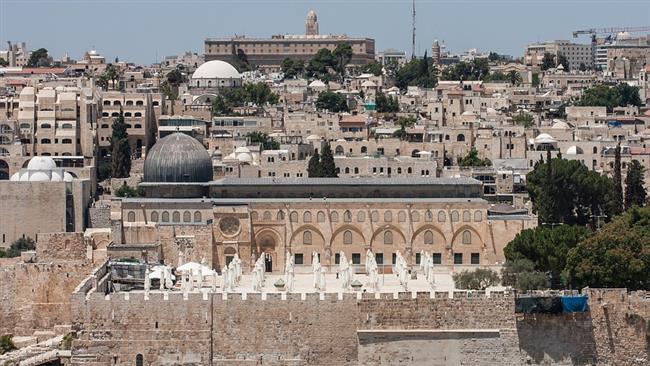
The UN members also urged Tel Aviv to show “respect for the historic status quo at the holy places of Jerusalem, including the Haram al-Sharif, in word and practice,” referring to a hill in Jerusalem al-Quds where the al-Aqsa Mosque is located.
Israel lays claim to the entirety of Jerusalem al-Quds as its “capital” while Palestinians want its eastern part as the capital of a future state for themselves.
The city has seen tensions since 2015, when the Israeli military introduced restrictions on the entry of Palestinian worshipers into the al-Aqsa Mosque — Islam’s third holiest site. Over 300 Palestinians have lost their lives at the hands of Israeli soldiers ever since.
Last year, it was reported that Israel has been omitting from the city’s maps significant Muslim and Christian holy sites and entire neighborhoods in the area while highlighting dozens of sites with dubious historical importance.
Only five countries — the US, Canada, the Marshall Islands, Micronesia and Nauru — opposed the Thursday resolution at the UN, which was also voted down by Israel’s UN envoy. Nine countries also abstained.
US embassy relocation
The strong-worded statement by the UN came days before Trump has to make up his mind over moving the US embassy from Tel Aviv to Jerusalem.
Since US Congress ruled in 1995 that the embassy be relocated from Tel Aviv, every president has deferred the tough decision. The act contains a clause that allows the president to renew a six-month waiver on the decision.
US Vice President Mike Pence says his boss, Donald Trump, is considering “when and how” to move the US embassy to Jerusalem al-Quds as a Friday deadline approaches.
Palestinians have warned that the potential relocation would fuel strong reaction in the region and deliver a death blow to any prospect of resolving the Israeli- Palestinian conflict.
While growing up in America during the 1950’s, one would sometimes encounter supermarket tabloid headlines asserting that Adolph Hitler had not died in May 1945 in the ruins of the Reich’s Chancellery. It was claimed that he had somehow escaped and was living under a false identity somewhere in South America, most probably in Argentina. Eventually, as the Fuhrer’s hundredth birthday came and went in 1989, the stories pretty much vanished from sight though the fascination with Hitler as the ultimate manifestation of pure evil persisted.
The transformation of Hitler into something like a historical metaphor means that his name has been evoked a number of times in the past twenty years, attached to Saddam Hussein, Moammar Gaddafi, Vladimir Putin and, most recently, to Ayatollah Ali Khamenei, the Supreme Leader of Iran. The attribution in the cases of Hussein and Gaddafi was essentially to create popular support for otherwise unjustifiable wars initiated by the United States and its European and Middle Eastern allies. Putin, meanwhile, received the sobriquet from an angry Hillary Clinton, who certainly knows a thing or two about both personalizing and overstating a case.
The Hitler designation of the Iranian spiritual leader, which appeared one week ago in a featured profile produced by Tom Friedman of The New York Times, is particularly ironic as it came from the de facto head of state of Saudi Arabia Crown Prince Mohammad bin Salman, whose country has long been regarded as cruel and despotic while also being condemned for its sponsorship of a particularly reactionary form of Islam called wahhabism. Bin Salman described the Iranian leader as “the new Hitler of the Middle East.”
Both Khamenei and bin Salman exercise power without a popular mandate. Khamenei was named to his position in 1989 by a so-called Assembly of Experts, which is a quasi-religious body, and bin Salman was appointed Crown Prince by his father King Salman in June. Both have considerable power over other organs of state, but the comparison largely ends there as Iran does have real elections for an actual parliament with enumerated powers and a president who is also serves as head of government.
Iran is also tolerant of long established religious minorities whereas Saudi Arabia, which is seen by most observers as a theocratic based autocracy that is a personal possession of the House of Saud, is hostile to them. In particular, Riyadh has been actively promoting hatred for Islam’s second largest sect, Shi’ism. The Saudis have also been assisting al-Qaeda, al-Nusra Front and ISIS, though denying the considerable evidence demonstrating those links, while Iran and its allies have been destroying those terrorists on the battlefield.
Crown Prince bin Salman has been preaching an anti-corruption drive of late, which includes torture of those arrested. Many observers believe it is actually a bid to shake down some billionaires while also diminishing the power exercised by some members of the extended Royal Family. The Prince has also suggested that he will be promoting a “more open and modern” form of Islam, which might reduce some beheadings and amputations as punishment. But the death penalty will still apply for heresy, which includes the Shi’ism practiced by Iran, Iraq, some Syrians and Hezbollah. Nor will it put an end to the current horrific slaughter by disease and starvation of Yemenis being implemented by Riyadh with some help from its friends in Tel Aviv and Washington.
Liberal journalists like Tom Friedman, who have editorially sided with the Saudis and Israelis against Iran, have largely bought into the anticorruption theme. The Times profile accepts at face value bin Salam’s claims to be a reformer who will somehow reshape both Saudi Arabia and Islam. Friedman, a passionate globalist, largely goes along for the ride because it is the kind of language a poorly-informed progressive hopes to hear from someone who walks around wearing a keffiyeh and sandals. It also serves Friedman’s other regular agenda justifying Israeli threats to go to war against its neighbors, starting with Lebanon. Make no mistake, the offerings of war abroad and repression at home being served up by Riyadh and Tel Aviv are not the birth pangs of a New Middle East. That died a long time ago. It is instead a fight over who will dominate the region, the same as it always is.
A new draft bill sponsored by members of Benjamin Netanyahu’s coalition would see activists who promote the Boycott, Divestment and Sanctions movement (BDS) campaign face criminal charges and jail time.
According to the proposal, reports Haaretz, “the crime in question, which already exists in the penal code, harms ‘Israel’s interests or Israel’s relations with a country, organization or institution’.”
The new element, backed by Likud MKs David Bitan (coalition whip), Anat Berko, and David Amsalem, as well as Kulanu lawmakers Yfat Shasha-Biton and Tali Plosko, is “including the promotion of anti-Israel boycotts as one of the acts that can result in indictment on this charge”.
The bill’s explanatory notes state that the law “is meant to apply to anyone who takes an active part in a movement that boycotts Israel or its products”.
“Anyone who lends a hand to a boycott that harms Israel’s economy or harms it in other ways, like an academic boycott, must be called to account for it”, it continues.
“This is the difference between legitimate criticism and an assault that is a thuggish act in itself (boycott) and causes harm Israel and its citizens”.
The bill states that “if a boycott activist caused intentional harm, he could be liable for a prison term of up to 10 years or, in certain cases, even life”.
At first, American officials couldn’t believe it. In 1993, the Israelis began pressuring the Clinton administration to view Iran as the greatest global threat. Only a short time earlier, in the 1980s, Israel had been cooperating with the Iranians militarily and selling them weapons to fight Iraq in the Iran-Iraq War.
Back then, the Israelis were Iran’s best lobbyists in Washington, pushing the Reagan administration to talk to Iran, to sell arms to Iran, and even to ignore Iran’s tough talk on Israel. In that process, Israel was aided by a group of staunchly pro-Israeli officials within the Reagan administration whom we now know as the neoconservatives.
In 1981, just months after Iran had held 52 American diplomatic personnel hostage for 444 days, senior State Department officials Robert McFarlane and Paul Wolfowitz were advocating on behalf of the Israeli desire to sell Iran weapons. That initiative, which was continued by McFarlane when he became President Reagan’s National Security Advisor, ultimately led to the Iran-Contra scandal of 1986 when Reagan’s secret approval of U.S. arms shipments to Iran became public.
Yet, even in the wake of that scandal and the end of the Iran-Iraq War in 1988, the neoconservatives who remained influential under Reagan’s successor, President George H.W. Bush, pressed ahead with the goal of getting the U.S. to warm its relations with Iran. Iraq’s defeat at the hands of the U.S. military and its allies in the Persian Gulf War of 1990-91 further reduced the Arab threat to Israel’s security and encouraged more thinking about a possible U.S.-Iranian détente.
The Bush-I administration’s 1991 “National Security Strategy of the United States” said the U.S. was open to “an improved relationship with Iran,” a country that a 1991 National Intelligence Estimate said was “turning away from revolutionary excesses . . . toward more conventional behavior.”
However, in 1993, with the Clinton administration in power, the Israelis changed their tune, urging the U.S. government to find Iran lurking behind every terrorist attack, every conflict and every threat.
There appear to have been several factors leading to this Israeli switch – from the fact that the Cold War was over and thus Arab states that had relied on Soviet weaponry were weakened; that Iran-backed Hezbollah was challenging Israel’s military occupation of southern Lebanon; and that Israel could no longer profit from Iran’s desperate need for weapons (with the war with Iraq over and Iran’s treasury depleted) while the Arab oil states offered a more lucrative opportunity for both geopolitical and financial gain.
Hooked on the Money
Israeli leadership had found the billions of dollars from arms sales to Iran useful in maintaining Israel’s large military/intelligence infrastructure as well as Israel’s development of Jewish settlements inside Palestinian territories on the West Bank. With that cash source gone, Israel began recalculating its longstanding Periphery Strategy, which had called for countering Arab pressure from close-in states by cultivating relations with non-Arab regional powers on the periphery, such as Iran and Turkey.
There were also two other seismic events that altered the geopolitical landscape. The Cold War was over and Saddam Hussein’s Iraq had been humiliated in the Persian Gulf War. While the Israelis saw both events as positive, there were unintended consequences. The end of the Cold War meant the exit of the Soviet Union from the Middle East: that left Israel’s traditional Arab enemies even more enfeebled and the U.S. government less worried about losing influence in the oil-rich region. Iran also emerged as relatively stronger than Iraq due to Iraq’s failed invasion of Iran and its catastrophic defeat after its invasion of Kuwait.
Israel’s 1992 elections also brought Yitzhak Rabin, Shimon Peres and the Labor Party to power, raising the possibility of finally reaching a peace accord with the Palestinians and thus the possibility of more normalized relations with the Arab world. In turn, that raised the potential for more lucrative arrangements with oil-rich sheikdoms by, in effect, renting out the Israel Lobby to the Sunni-ruled Gulf states so they could push their historic conflict with the Shiites whose power base was Iran.
“There was a feeling in Israel that because of the end of the Cold War, relations with the U.S. were cooling and we needed some new glue for the alliance,” Efraim Inbar of the Begin-Sadat Center told Trita Parsi. “And the new glue was radical Islam.”
But it was a very selective kind of radical Islam: not the kind Saudi Arabia was financing and exporting through Wahhabi fundamentalism and violent jihadists like those in Al Qaeda, but Iran’s radical Shiite Islam. Selling Iran as the number one global terror threat gave birth to a new Middle East enemy that replaced the Soviet Union and reinflated Israel’s value to the U.S. in the region. “Iran,” Inbar went on to explain, “was radical Islam.”
A New Alliance
For the first time, an alliance between Israel, Saudi Arabia and the United States became possible with Iran as the designated enemy. The Israeli-Saudi relationship has evolved mostly in secret over the past couple of decades but has popped into view in recent years as Prime Minister Benjamin Netanyahu and his inner circle have emphasized the common interests – especially animosity toward Iran – that they share with Saudi Arabia.
Netanyahu has recently referred to this Israeli-Saudi alliance when he said that Iran was driving Israel into cooperative arrangements with what he called “the modern Sunni states.” He referred to “a new alliance between Israel and Islamic states. … The good news is that the other guys are getting together with Israel as never before. It is something that I would have never expected in my lifetime.”
Nine months ago, Netanyahu delivered the same message when he said “for the first time in my lifetime, and for the first time in the life of my country, Arab countries in the region do not see Israel as an enemy, but, increasingly, as an ally.”
Though the Israeli-Saudi relationship is rarely spoken of out loud, Israeli Energy Minister Yuval Steinitz admitted recently that Israel “has ties that are . . . partly covert with many Muslim and Arab countries.” Saudi Arabia was the only one he specifically named. According to Reuters, he said those ties are fueled by “common concerns over Iran.”
But there are other foundations for this relationship. For years, Saudi Arabia sought to buy influence in Washington’s policy circles regarding the Middle East but was largely unsuccessful because Israel had cornered that market and Israel’s influential American supporters demonized lobbyists, academics and others who took Saudi money. Eventually, it became clear to Saudi Arabia that it made more sense to rent out Israel’s sophisticated lobbying apparatus rather than to fight it.
Investigative journalist Robert Parry reported that Saudi money helped seal this Israel-Saudi alliance, with the Saudis giving Israel billions of dollars and Israel reciprocating by giving Saudi Arabia added influence in Washington.
But Official Washington was surprised in the 1990s when Israel’s turnabout began — and Iran went from being a misunderstood nation tilting toward moderation to the world’s leading sponsor of terrorism. Despite some bewilderment, U.S. policymakers soon readjusted their rhetoric as the legendary Israeli influence operations carried the day. Shiite Iran became the new terror threat, even after the 9/11 attacks that were organized by Al Qaeda, a Sunni fundamentalist group associated with Saudi Arabia.
The Islamic State
The gap between the facts on the ground – the recognition that Al Qaeda and Islamic State remain the real chief terror threats from radical Islam – and the propaganda of principally blaming Iran for terrorism has led to a quandary for U.S./Israeli propagandists. They want to focus Americans’ fury on Iran and its allies, Syria and Hezbollah, but it is Saudi-and-Gulf-connected terror groups, such as Al Qaeda and Islamic State, that were chopping off heads of innocents and sponsoring terrorist attacks in the U.S. and Europe.
That disconnected reality explains why America’s response to the emergence of the Islamic State can best be characterized as confused and bizarre. Though the Obama administration claimed it was taken by surprise by the Islamic State’s emergence in Iraq and Syria, it really wasn’t. Rather, policymakers had sought to persuade the American public on the need for a “regime change” conflict in Syria, an Iranian ally. This strategy went back years.
A WikiLeaks-released cable dated Dec. 13, 2006, and written by the charge d’affaires of the U.S. embassy in Damascus to the Secretary of State recommended that the U.S. “coordinate more closely with” Egypt and Saudi Arabia in a policy to weaken President Bashar al-Assad’s government in Syria and “to play on Sunni fears of Iranian influence.” The cable also recognized that Islamist extremists were “certainly a long-term threat” to the Syrian government.
Over the years, there was little change in this inconvenient truth that jihadists were playing a crucial role in achieving these geopolitical goals. For instance, in a December 2009 cable, then Secretary of State Hillary Clinton stated that “Saudi Arabia remains a critical financial support base for al-Qaeda, the Taliban . . . and other terrorist groups.”
By Aug. 12, 2012, the U.S. government knew explicitly that Islamic extremists were the engine in the Syrian insurgency. A classified Defense Intelligence Agency Information Intelligence Report unambiguously declares that “The salafist [sic], the Muslim Brotherhood, and AQI [al-Qaeda in Iraq, later ISIS and the Islamic State] are the major forces driving the insurgency in Syria.”
Section 8.C. of the report astonishingly predicts that “If the situation unravels there is the possibility of establishing a declared or undeclared salafist principality in eastern Syria.” Section 8.D.1. of the report goes on specifically to say that “ISI could also declare an Islamic State through its union with other terrorist organizations in Iraq and Syria.”
So, the U.S. government knew that the Islamic extremists drove the Syrian insurgency that Washington and its regional allies were supporting. U.S. intelligence analysts also had a surprisingly good idea what the possible outcome of that support was.
Yet, to advance the regional goals of the Israeli-Saudi tandem – i.e., the overthrow of the Syrian government because of its ties to Iran – the U.S. government was, in effect, supporting the very terrorists the war on terror was meant to eradicate.
Selling Al Qaeda
At times, senior Israeli officials made clear their preferences for Sunni extremists over more moderate Arabs associated with Shiite-ruled Iran. For instance, in September 2013, then-Israeli Ambassador to the United States Michael Oren told the Jerusalem Post that Israel favored the Sunni extremists over Syria’s largely secular President Bashar al-Assad.
“The greatest danger to Israel is by the strategic arc that extends from Tehran, to Damascus to Beirut. And we saw the Assad regime as the keystone in that arc,” Oren said in the interview. “We always wanted Bashar Assad to go, we always preferred the bad guys who weren’t backed by Iran to the bad guys who were backed by Iran.” He said this was the case even if the “bad guys” were affiliated with Al Qaeda.
Oren reiterated this position in June 2014 at an Aspen Institute conference. Speaking as a former ambassador, Oren said Israel would even prefer a victory by the Islamic State, which was then massacring captured Iraqi soldiers and beheading Westerners, than the continuation of the Iranian-backed Assad in Syria.
“From Israel’s perspective, if there’s got to be an evil that’s got to prevail, let the Sunni evil prevail,” said Oren, who is now a member of the Knesset and part of Netanyahu’s government.
Other senior Israelis have expressed similar sentiments. Sima Shine, who is in charge of Iran for Israel’s Ministry of Strategic Affairs, urged Assad’s removal even if that might turn Syria over to extremists. “The ‘devil we know’ is worse than the devil we don’t,” she said in June 2013. “If Bashar remains in power, that would be a huge achievement for Iran.”
So, in 2014, when Islamic State jihadists advanced through Syria and Iraq and knocked on the door of Lebanon, their success should not have come as a surprise to President Obama and other U.S. policymakers. Today’s Iraq, Syria and Lebanon have in common that they are Iran’s three principal allies in the region.
In other words, the Islamic State’s interests largely corresponded to those of Israel, Saudi Arabia and the U.S.: isolating and weakening Iran. Only the Islamic State’s shocking excesses of videotaped beheadings of Americans and other captives – as well as its military successes inside Iraq – forced President Obama’s hand in committing U.S. forces to stop the Islamic State onslaught.
Obsessed with Assad
Still, America has long been bent on removing Assad from Syria. The coincidence of Islamic State and American interests in this regard is revealed in section 8.C of the DIA report: “there is the possibility of establishing a declared or undeclared salafist principality in eastern Syria (Hasaka and Der Zor), and this is exactly what the supporting powers to the opposition want, in order to isolate the Syrian regime, which is considered the strategic depth of the Shia expansion (Iraq and Iran).”
So, the Islamic State’s advance into this region was consistent with American (and more to the point, Israeli and Saudi) interests because these Sunni extremists would block the supply lines from Iran to Lebanon’s Hezbollah. Thus, initially at least, the U.S. government acquiesced to the Islamic State and Al Qaeda’s Nusra Front taking the lead in damaging or destroying Iran’s allies in Syria.
And Iran suspected as much. According to Iran expert Trita Parsi, the Iranians believed that the initial relaxed approach by the U.S. government toward the Islamic State and Al Qaeda’s Nusra Front was because those militants were the point of the spear against pro-Iranian Shiite influences in not only Syria but Iraq and Lebanon as well.
So, the Saudi government provided the “clandestine financial and logistic support to Isis and other radical groups in the region,” according to a leaked Hillary Clinton email on Sept. 17, 2014.
Less than a month later, on Oct. 2, 2014, Vice President Biden told a seminar at Harvard’s Kennedy School that “the Saudis, the emirates … poured hundreds of millions of dollars and tens of thousands of tons of military weapons into anyone who would fight against Assad except that the people who were being supplied were Al Nusra and Al Qaeda and the extremist elements of jihadis.”
The DIA report also named the Gulf States as among the “supporting powers” of the Syrian opposition. And at a May 2015 meeting between President Obama and the Princes of the Gulf Cooperation Council, according to David Ignatius of the Washington Post, “Obama and other US officials urged Gulf leaders who are funding the opposition to keep control of their clients, so that a post-Assad regime isn’t controlled by extremists from the Islamic State or al-Qaeda.”
However, with the Israel lobby redirecting Official Washington’s ire toward Iran, more political space was created for these Saudi-connected terror groups to carry out the regime change missions in Syria and elsewhere.
But the Syrian “regime change” strategy didn’t work. With help from Iran and Hezbollah and Russia’s intervention in 2015, Assad and his army not only survived but routed the Islamic State, Al Qaeda’s Nusra and other jihadists from major urban strongholds. Instead of Iran losing an ally in the region, Iran emerged with a stronger alliance and greater influence.
This setback, however, has not changed the Israeli-Saudi priorities; it has only made them more intense. As the outcome in Syria became more apparent, the anti-Iran gun sight pivoted to Lebanon. The recent confusing events in Lebanon, like the earlier ones in Syria, are best made sense of by looking through the gun barrel that is targeted on Iran.
On Nov. 4, after being summoned to Saudi Arabia, Lebanese Prime Minister Saad al-Hariri unexpectedly and mysteriously resigned. Hariri’s resignation came just one day after a meeting in Beirut with Ali Akbar Velayati, a senior foreign policy advisor to Iran’s Supreme Leader Ayatollah Khamenei, that was reportedly very positive. Velayati praised Hariri and reaffirmed Iran’s support for his coalition government.
Yet, a day later, speaking from Saudi Arabia, Hariri claimed his resignation was catalyzed by fear of an Iranian-Hezbollah assassination. But the Lebanese army said “it had not uncovered any plans for assassinations in Lebanon.” Neither had the army. So, why resign?
The clue may be provided by Saudi State Minister for Gulf Affairs, Thamer al-Sabhan, who expressed Saudi Arabia’s desire for “toppling Hizbullah.” He promised that “The coming developments will definitely be astonishing.” He said the desire was not just his own, and that people “will see what will happen in the coming days.”
The Saudis said Hariri resigned because Hezbollah had “hijacked” his coalition government. Al-Sabhan called Hezbollah “the Party of Satan.”
In Lebanon, there was the suspicion that Hariri was held under house arrest. On Nov. 10, President Aoun told a meeting of foreign ambassadors that Hariri had been “kidnapped.”
Now, having finally returned to Lebanon after a French intervention brought him to Paris, Hariri met with President Aoun who asked him “to temporarily suspend submitting [his resignation] and to put it on hold ahead of further consultations on the reasons for it.” Hariri agreed.
Israel seems to have applauded Saudi Arabia’s Lebanese action and reaffirmed the Iranian motivation behind it. Prime Minister Netanyahu said that “The resignation of Lebanese Prime Minister Hariri and his statements are a wake-up call for the international community to act against Iranian aggression.”
Netanyahu also made a rare public acknowledgement of the Israeli-Saudi alliance when he said that Iran was driving Israel into cooperative arrangements with what he called “the modern Sunni states,” referring to “a new alliance between Israel and Islamic states.” According to reporting by Israel’s Channel 10, a leaked classified cable from the Israeli foreign ministry to Israeli ambassadors reveals that Israel ordered them to support Saudi Arabia’s efforts and to rally support for Hariri’s resignation.
Iran has also suggested that President Trump and the United States approve of this Lebanese intervention. The resignation of the Lebanese Prime Minister came days after Trump’s son-in-law Jared Kushner visited Saudi Arabia on a trip that was not made known publicly.
Yemen’s Tragedy
While this new alliance took aim at Iran by targeting Assad in Syria and Hezbollah in Lebanon, it also has targeted a Shiite spin-off sect, the Houthis in Yemen. Since 2015, the Saudis have been bombing and blockading Yemen, the Middle East’s poorest country. But on Nov. 5, Saudi Arabia expressed outrage after intercepting a ballistic missile fired by Houthi forces in Yemen toward Riyadh. The Saudis accused Iran of providing the missile and ordering the attack – and called this an “act of war” by Iran and Hezbollah.
General Mohammad Ali Jafari, the commander of the Iranian Revolutionary Guards, called the charge against Iran “baseless,” as did Iran’s ambassador to the United Nations, Gholamali Khoshroo. Even Saudi officials were calling the missile a Yemeni Burqan 2H missile when it was intercepted. The Houthis said they fired the missile in response to the long-running Saudi bombardment that included a recent attack that killed 26 people.
Despite these denials of Iranian responsibility and the context of Saudi Arabia’s air war, U.S. Ambassador to the United Nations. Nikki Haley called on the U.N. to hold Iran accountable for violating U.N. Security Council resolutions by supplying the missile. She called on the U.N. to take “necessary action” against Iran.
The U.S. government has consistently rationalized the Saudi bombardment of Yemen as necessary to thwart Iranian influence in the Persian Gulf. U.S. accusations about Iran allegedly supplying the Houthis with weapons hang precariously on an “assessment” that Iran has used fishing boats to smuggle weapons into Yemen.
The Houthis also are allied with former President Ali Abdullah Saleh who maintains control over the army, so the Houthis could get all the weapons they need from local arms supplies, including military bases stocked with American-made weapons.
And just as Iran does not substantially arm the Houthis, so it does not control them. In fact, they have proven to be beyond Tehran’s efforts to influence them. In 2014, the Iranians specifically discouraged the Houthis from capturing the Yemeni capital, Sanaa. However, the Houthis captured the city anyway, demonstrating Iran’s lack of control.
A U.S. intelligence official told The Huffington Post that “It is wrong to think of the Houthis as a proxy force for Iran.” Yemen specialist Gabriele vom Bruck has called Iran’s influence over the Houthis “trivial.” She said the Houthis want to be independent, not controlled by Iran: “I don’t think the Iranians have influence in their decision-making.” To the extent that Iran is involved in Yemen at all, that involvement came as a result of the devastating Saudi air war.
Dating back to the Obama administration, the U.S. government has made the Saudi aerial bombardment of Yemen possible. The U.S. refuels the Saudi bombers in flight, supplies the bombs and provides targeting intelligence.
This U.S. complicity in what is widely regarded as a humanitarian catastrophe has continued into the Trump administration. A White House statement as recently as Nov. 24 reaffirmed U.S. support for Saudi Arabia, declaring: “We remain committed to supporting Saudi Arabia and all our Gulf partners against the Iranian Islamic Revolutionary Guard Corps’ aggression and blatant violations of international law. Backed by the Iranian Islamic Revolutionary Guard Corps, the Houthi rebels have used destabilizing missile systems to target Saudi Arabia.”
The statement again reveals, not only the alliance with Saudi Arabia and the silence about its devastating bombing attacks, but the strategy of turning Yemen’s human tragedy into another excuse to blame Iran. The Iranian foreign ministry said the White House statement “clearly and without question proves America’s participation and responsibility in the atrocities committed by Saudi Arabia in Yemen”.
Bahrain & Qatar
Washington’s Saudi-Israeli-supplied blinders on the Middle East carry over to other regional conflicts, too. For instance, in 2011, protesters in Bahrain demanded a true constitutional monarchy, the resignation of the Prime Minister, greater civil liberties and a real elected parliament. Though Bahrain has a parliament, it is actually governed by the U.S.-backed dictator, King Hamad ibn Isa Al Khalifa, whose family has ruled Bahrain for over 200 years. The prime minister, the king’s uncle, is the longest reigning prime minister in the world, in power now for nearly 40 years.
Bahrain’s population is about 70 percent Shiite, though the ruling family, the government, the army and the police are all Sunni. The Shia have long been victims of discrimination. And the government maintains its control through repression, including the use of torture. Bahrain is located between Sunni Saudi Arabia and Shiite Iran and is seen by the U.S. as a strategically located check on Iranian influence and power.
Though the Obama administration touted itself as a big proponent of the “Arab Spring” and its promised democratization, Washington sided with the Bahraini dictators against the majority of the Bahraini people.
Days after mass arrests and beatings of protesters, Chairman of the Joint Chiefs of Staff, Admiral Mike Mullen, went through with his planned visit to Bahrain where he reaffirmed the U.S.’s strong commitment to its military relationship with Bahrain and called Bahrain’s response to the protests “very measured.” Mullen stressed the U.S.-Bahrain “partnership” and “friendship.”
On the same day, Secretary of Defense Robert Gates also gave full support to the Khalifa dictatorship. The U.S. continued to support the regime and to call for “stability” and “reform”: two words that are code for standing by dictatorships.
To help put down the protests in Bahrain, 1,000 Saudi troops invaded Bahrain across a causeway that connects the countries. The Obama administration remained silent.
Qatar also has suffered under the new Saudi-Israeli alliance because Qatar has pursued a more independent foreign policy than Saudi Arabia likes and now faces a Saudi-led siege as a consequence. Former British diplomat Alastair Crooke explained that Qatar’s principal sin is seeking peaceful coexistence with Iran.
When Washington asked Saudi Arabia to make reasonable proposals for the termination of the siege, Saudi Arabia included the demand that Qatar break all ties with Iran.
In other words, many of the most important events of the past several years are best explained as attempts to weaken Iran by weakening its proxies or allies or by setting up situations that appear to implicate Iran to justify hostility toward Iran.
A problem, however, has been that the major terrorist groups that have infuriated the American public are not Iranian-linked Shiites but rather Saudi-connected fundamentalist Sunnis. Still, the claim that “Iran is the chief sponsor of terrorism” has become a rote and routine refrain from both Republicans and Democrats – as well as the U.S. mainstream media.
Much as Russia now gets blamed for every negative turn in Western democracies, Iran is the all-purpose villain whenever anything goes wrong in the Middle East. Yet, to understand these conflicts and crises, it is best to view them through the perspective of the hostility that the Saudi-Israeli alliance directs toward Iran and the acquiescence of U.S. governments, regardless of which party is in power.
The ultra Zionist settler outlet Israel National News reported yesterday that “Russian Jews slam ‘anti-Semitic myth’ that the country’s last tsar “was murdered by Jews for ritual purposes.”
Marina Molodtsova, a senior investigator for a special ministerial committee on the 1917 slaying of Nicholas II of Russia, said on Monday during a conference in Moscow that her committee will conduct “a psycho-historical examination” to find out whether the execution of the royal family was a ritual murder.
At the same event, Father Tikhon Shevkunov, a Russian Orthodox Church bishop, said that, according to “the most rigorous approach to the version of ritual murder, a significant part of the church commission [on Nicholas II’s killing during the Russian revolution of 1917] has no doubt that this murder was ritual.”
Far from being surprising the Jews are upset. “The Federation of Jewish Communities of Russia, a Chabad-affiliated group with more than 100 affiliated communities across Russia, called the suggestions a “shocking expression of an anti-Semitic myth” in a statement Monday.”
Interestingly enough, the Jewish bodies are not upset by the verdict of the committee; they are actually distressed by the idea that the Russians decided to look into their past.
“We all think of this as absolutely unacceptable,” the federation’s spokesperson, Boruch Gorin, lamented, and “shocked first and foremost by the sheer absurdity of the allegations.”
The Israeli outlet reports that, “claims that Nicholas was killed by Jews for ritual purposes had been limited before the conference to a fringe of zealous anti-Semites and promoters of unsophisticated conspiracy theories.” Seemingly, this is not the case anymore.
Israel National News explains, “amid rising nationalism and nostalgia for Tsarist times in Russia under President Vladimir Putin, a Russian court in 2010 ordered prosecutors to reopen an investigation into the murder of the Tsar and his family.”
I obviously have no opinion on the nature of the execution of the Tsar and his family. Like others I am looking forward to learning more, and will wait patiently for the investigating committee to deliver its study of the event. However, it is worth mentioning that not one historian questions the dominance of Jews within the Bolshevik revolution and the early communist leadership. Not many scholars of the era question the embarrassing fact that “Stalin’s Jews” as Israeli prominent writer Sever Plocker names them, were “some of (the) greatest murderers of modern times”
Spokesman Boruch Gorin, who is also a senior aide to Berel Lazar, a chief rabbi of Russia, told Israel National News that, “Nicholas II’s killers were obviously committed atheists who rejected any belief in any force – except their own”. However, the blaming of Jews for the Tsar’s death is “an absolutely anti-Semitic myth used in anti-Semitic propaganda for several decades, which is why the Jews view this with great concern.”
I will make an effort to educate Gorin. Since the European Jewish emancipation, Jews are drifting away from Judaism and their means of identification are varied. As a matter of fact, Judaism is, by now, just one Jewish religion amongst many. The Holocaust seems to be the most popular Jewish religion. Atheism is also a popular Jewish religion. Human Rights is a widespread Jewish religion, however, not as popular as Zionism.
Jewish religions are diverse and often contradict each other. But they have one thing in common– they all facilitate a sense of choseness – a clear vision of Jewish exceptionalism. Jewish religions all adhere to the strong belief in ‘The Jew.’ The Zionists who murdered Palestine were atheists. They adhered to the peculiar belief that Jews can celebrate their national aspirations at the expense of another people. They believed and still believe in their righteous cause. The many Jews who adhere to the Holocaust religion also believe in ‘The Jew,’ the one who, against all odds, survived the ashes, reinstated his/her power by means of national salvation. The ‘atheist’ Bolsheviks were no different; they believed themselves to be ‘better’ because they believed in equality. This force alone made them into a genocidal cult with no precedent in human history.
Were these Bolsheviks engaged in ritual killing? This is indeed a deep question with many aspects and layers. We will have to wait and see what the Russian committee has to say about it. However, the fact that Russian Jewish bodies are in a state of turmoil may as well be revealing.
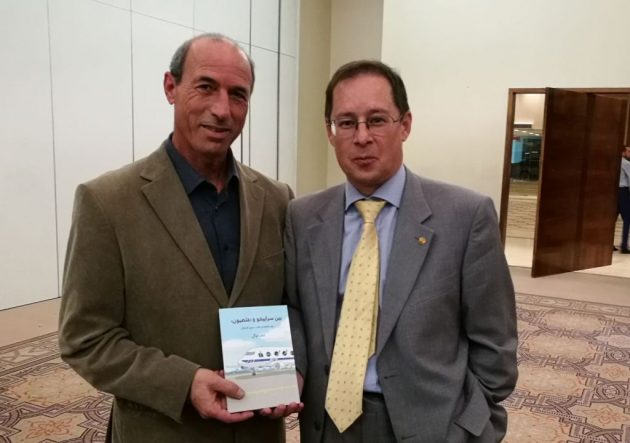
The arrest of Nazzal, a member of the General Secretariat of the Palestinian Journalists’ Syndicate and President of the Association of Democratic Journalists, sparked international protest, yet his imprisonment without charge or trial was renewed on multiple occasions. He was previously jailed in 1978 and 1988 and held in administrative detention without charge or trial; in 1986, Nazzal was held under house arrest for six months.
Issa Qaraqe, head of the Prisoners Affairs Commission, said that the book exemplifies the prisoners’ resistance to all attempts to destroy their will, spirit and national identity. A launch for the book will take place in Ramallah on Sunday, 26 November.
By Yassir Al Zaatara |The New Khalij | November 27, 2017
Leaked information about Donald Trump’s “deal of the century” varies in some details, but the one thing that is consistent is that there will be no more on offer than autonomy for parts of the West Bank, without Jerusalem. There will be no Palestinian sovereignty and no return of the refugees, not even compensation for them, although there will be talk about linking autonomous areas with Jordan in a federal arrangement. In the meantime, relations between Israel and Arab states will be formalised.
What will be discussed when marketing the “deal”, of course, is that this solution is not the end product, and that the so-called “final status” issues, especially Jerusalem, will be left for another time after the neighbours are more reassured about each other’s intentions. Meanwhile, everyone knows that the plan is based on making the status quo permanent in due course, because no one in Israel wants to give up Jerusalem, nor allow the return of any Palestinian refugees.
This reminds me of the paradox of former minister Tzipi Livni’s response to Saeb Erekat mentioned in the well-known negotiation leaks, when the Palestinian official told Livni that the then Israeli Prime Minister Ehud Olmert had agreed to the return of 10,000 refugees in what were called, rather euphemistically, “reunions”. She insisted that this was Olmert’s personal opinion and that the number of people who will return to Israel is nil.
The details of the deal are of no concern, but what is, is that those involved in marketing and supporting such a proposal — and pressing for its acceptance by Palestinians and Arabs — are in more need of advice than the others for two reasons. The first is that such an agreement will be practically impossible to pass, even though it might seem possible to get through some of its early stages; and second, their position will be harmful to them.
In the first context, keep in mind what Netanyahu said a few days ago about it being the Arab people who reject normalisation of relations with Israel, not the regimes; this is true to a large extent. The people generally do not approve of Israel’s existence in principle, even if they accept the Arab Initiative, which proposed giving the Israelis 78 per cent of historic Palestine. Things will get more difficult when discussing a much worse proposal which involves the effective abandonment of Jerusalem and Al-Aqsa Mosque.
The people’s position on normalisation means that the new game will not pass. The stance of the Egyptian people after nearly four decades of the Camp David Treaty is the best evidence of this; there is also the position of the Jordanians 25 years after signing the Wadi Araba peace deal with Israel.
That is not all. The Palestinian people will not be silent about eradicating their cause in such a miserable way, and they will rise again, and the Jordanians will not accept the federalism being spoken of. It all, in any case, assumes that the Palestinian resistance forces will agree to the new proposal, which they won’t, or at least the majority of them won’t. Those in the Arab world who try to market the Trump deal will clash with their people if they go ahead and back a proposal to wipe out the Palestinian cause.
As a backdrop to all of this, it is clear that America and Israel will continue to be keen on keeping the regional conflicts going so that only Israel will remain as a strong and cohesive state, which everyone then seeks to befriend. Will those involved in supporting the Trump plan reconsider their positions? I hope so.
The events currently occurring in the Palestinian arena, specifically the American vision for the Palestinian issue, are similar to a huge marketing campaign, as well as the sanctions that will be imposed on anyone who refuses the marketed product. This is despite the important fact that the product being marketed is not even ready yet.
The Israelis want to market a new idea, or rather, a new old idea. This idea suggests that there are various forms of sovereignty and that this could be proposed to the Palestinians. This is reminiscent of the Israelis’ past proposal of what they called functional sovereignty.
The American team responsible for the peace process is composed of a group of Zionists supporting settlements in the occupied West Bank. Therefore, it is not surprising that since the formation of the American administration we have been witnessing efforts to empty the settlement process of any content that includes any Israeli withdrawal or settlement dismantlement. Hence, this team is doing three things: buying time for the Israeli occupation and its settlement expansion, marketing ideas requiring the Palestinians to back down from the idea of an independent state, and thirdly, marketing the division of peace in the Middle East into two tracks: Arab-Israel peace and Palestinian-Israeli peace.
According to Al-Monitor, which operates mainly from Lebanon and publishes material in Arabic, Hebrew and English, the American Ambassador (a Jewish Zionist) to Tel Aviv, David Friedman, the American consulate in Jerusalem, in cooperation with the US Special Representative for International Negotiations, Jason Greenblatt, are making great efforts to propose a vision that has a regional context. What Benjamin Netanyahu is doing is trying to achieve normalised relations, as well as economic, political and military relations with Arab countries allowing him to establish Israeli influence in the region in the future. Of course, there is no reference or hints of this goal, but any amateur researcher in international relations who reads the Israeli theories, especially those of the Likud Party, and is familiar with the basics of international relations, especially the realism theory, would realise these are their goals.
Instead of announcing these goals, they announce the importance of an Arab-Israeli alliance against terrorism and Iran. According to Al-Monitor, which quoted Israeli diplomats, Netanyahu is currently looking into how he can pay the lowest price to market the idea of Arab-Israeli normalisation, along with other basic ideas, such as not withdrawing from the West Bank and maintaining full security control over it. Therefore, he proposed the idea of autonomy, but called it a different name, considering it another kind of sovereignty.
If the American initiative is ever announced, it will basically say: The Palestinians must accept the status quo in return for some facilitations in their living conditions and formal changes. The Palestinians declare their state on paper, and they can declare similar things, but will not have Israeli recognition, nothing will change on the ground, and it must be within restrictions that do not include requesting international recognition or prosecuting the Israelis in the International Criminal Court.
The Israelis raised the idea of ”functional sovereignty” in Jerusalem, during the Camp David and Taba negotiations of 2000 and 2001. It can basically be called “extensive administrative powers”, and nothing more. Nowadays, similar ideas are being marketed, but only in the West Bank.
We are not certain the Americans will reach the stage of declaring an initiative. If they do announce an initiative, it will be recognition of the Likud and Israeli initiatives for autonomy, as proposed in ideas raised in the 1970s during the Egyptian-Israeli negotiations.
Even if, for the sake of argument, we assume there are some Arab states that would accept these new ideas of an entity less than a Palestinian state and the return of the refugees, which is not yet certain, it will be the Palestinians who make the decision, specifically Palestinian President Mahmoud Abbas. Based on all past experiences, the Palestinians will not agree to any solution that does not include a Palestinian state, and Abbas will reject such a proposal.
There is much room for speculation about future scenarios, including holding the Palestinians responsible for the failure, reaching a temporary agreement (Oslo 2) that involves the beginning of Arab-Israeli normalisation and making minor changes to the status of the Palestinians, or new negotiations (which the Palestinians have rejected with[out] freezing settlement expansion). However, despite this, we are certain that the majority of the world superpowers are dealing with the possibility of reaching a final agreement as something far-fetched.
The Palestinians, more than anyone else, need a strategy that includes a hint to their alternative plan if a solution is not reached.
Egyptian authorities have criticised the Israeli Minister of Social Equality Gila Gamliel over her recent statements, in which she called for an alternative Palestinian state to be established in the Sinai Peninsula.
Egypt’s foreign minister, Sameh Shoukry, denounced today Gamliel’s statements stressing that Egypt firmly rejects any kind of “talk or thoughts” that undermine Egypt’s territorial sovereignty.
“The Egyptian domestic affairs should not be included in any statements by foreign parties most importantly when these statements touch Egyptian sovereignty,” Shoukry said in a press conference.
Shoukry noted that the Egyptian authorities have conveyed Cairo’s rejection on Gamliel’s statements to the Israeli ambassador in Cairo, adding that her comments “were made a long time ago.” He also denied summoning the Israeli ambassador.
“The Egyptian land in Sinai, which was watered with the blood of our sons and martyrs, is not something that can be given away or allowed to be attacked,” the Egyptian minister added.
An official source at the Egyptian foreign ministry told Quds Press that officials believe that the recent mosque attack is an Israeli attempt to empty Sinai from its original residents to build a Palestinian state in as an alternative for the two-state solution in the West Bank.
The Egyptian official noted that the Egyptian Embassy in Tel Aviv has asked Israel for clarifications on Gamliel’s comments, noting that the Israeli government had stressed that the statements “were personal comments and did not represent government policy.”
On his part, the Egyptian MP, Mostafa Bakry, told Quds Press that the Israeli statements were linked to the recent terrorist attack in Sinai.
Last week, Gamliel said during her visit to Cairo that “it is impossible to create a Palestinian state except in Sinai.”
Rejecting a Palestinian state in the West Bank, she noted that “a Palestinian State is a dangerous idea for the State of Israel,” she explained, stressing: “Between the River Jordan and the [Mediterranean] sea there cannot, and must not, arise a Palestinian state.”
“This call could be unacceptable to the international community and the Arab countries, which are neighbours to Israel, but it is based on our primary and historic right to the land of Israel,” the Israeli minister reiterated.
Dr. Anthony Fauci’s private diary reveals a “mind-numbing” contradiction between what the former top U.S. infectious disease official knew about COVID-19 and what he told the public, senior White House adviser Peter Navarro, Ph.D., said last week on “American Thought Leaders.”
“I show, actually, how a prosecution can and should happen … at the state level, most likely,” Navarro said. “He should wind up in prison, and we’ve got the receipts in this book to put him there.”
Navarro said Fauci repeatedly acknowledged important facts in private, then publicly pursued policies that contradicted those facts — with devastating consequences.
“What he says many times privately in his diary is so at odds with both his public behavior and public statements that it’s mind-numbing,” Navarro said.
Navarro examines the lasting damage caused by lockdowns and other pandemic policies, and the ongoing toll of long COVID.
His book also addresses questions about vaccine safety, including why healthy young people faced COVID-19 vaccination mandates despite concerns about myocarditis, and why women were not warned about miscarriage risks linked to the shots. … continue
This site is provided as a research and reference tool. Although we make every reasonable effort to ensure that the information and data provided at this site are useful, accurate, and current, we cannot guarantee that the information and data provided here will be error-free. By using this site, you assume all responsibility for and risk arising from your use of and reliance upon the contents of this site.
This site and the information available through it do not, and are not intended to constitute legal advice. Should you require legal advice, you should consult your own attorney.
Nothing within this site or linked to by this site constitutes investment advice or medical advice.
Materials accessible from or added to this site by third parties, such as comments posted, are strictly the responsibility of the third party who added such materials or made them accessible and we neither endorse nor undertake to control, monitor, edit or assume responsibility for any such third-party material.
The posting of stories, commentaries, reports, documents and links (embedded or otherwise) on this site does not in any way, shape or form, implied or otherwise, necessarily express or suggest endorsement or support of any of such posted material or parts therein.
The word “alleged” is deemed to occur before the word “fraud.” Since the rule of law still applies. To peasants, at least.
Fair Use
This site contains copyrighted material the use of which has not always been specifically authorized by the copyright owner. We are making such material available in our efforts to advance understanding of environmental, political, human rights, economic, democracy, scientific, and social justice issues, etc. We believe this constitutes a ‘fair use’ of any such copyrighted material as provided for in section 107 of the US Copyright Law. In accordance with Title 17 U.S.C. Section 107, the material on this site is distributed without profit to those who have expressed a prior interest in receiving the included information for research and educational purposes. For more info go to: http://www.law.cornell.edu/uscode/17/107.shtml. If you wish to use copyrighted material from this site for purposes of your own that go beyond ‘fair use’, you must obtain permission from the copyright owner.
DMCA Contact
This is information for anyone that wishes to challenge our “fair use” of copyrighted material.
If you are a legal copyright holder or a designated agent for such and you believe that content residing on or accessible through our website infringes a copyright and falls outside the boundaries of “Fair Use”, please send a notice of infringement by contacting atheonews@gmail.com.
We will respond and take necessary action immediately.
If notice is given of an alleged copyright violation we will act expeditiously to remove or disable access to the material(s) in question.
All 3rd party material posted on this website is copyright the respective owners / authors. Aletho News makes no claim of copyright on such material.

 Aletho News
