Israeli soldiers assault Hebron family; detain members
19/12/2009 16:15
Hebron – Ma’an – Israeli forces raided the home of the Abu Heikal family in the Tel Rumeida neighborhood of Hebron on Friday afternoon, detaining five of the men, one family member said.
Firyal Abu Heikal, who was in the home during the Israeli raid, said soldiers beat the men and women of the family. She identified those beaten as sisters Samah and Majd, noting that their aunt Ghadir was also beaten. Male relatives Mohamed and Murad were also injured, she said.
After several rooms were ransacked, Firyal said soldiers took 66-year-old Abdul-Aziz, 48-year-old Imad, 48-year-old Ratib, 24-year-old Fahd, and 19-year-old Sami. They were also beaten and removed from the home without explanation as to their alleged crimes or notification as to where they were being taken.
The Abu Heikal home is in an area of Hebron blocked off from the main street by several settler trailers housing large families of aggressive youth. The trailer-homes are guarded by dozens of Israeli soldiers, who have in many instances protected the settlers as they attacked the Abu Heikal family.
The neighborhood can only be accessed by the few Palestinian families who have not been driven out by settler violence, and members face constant harassment from soldiers as well as settlers.
Copenhagen climate summit: confusion as ‘historic deal’ descends into chaos
The “historic” climate change deal at the Copenhagen climate summit has descended into chaos after some developing nations rejected the plan for fighting global warming championed by US President Barack Obama.
By David Barrett and Louise Gray, in Copenhagen
The Telegraph | December 19, 2009

(From Left) European Commission President Barroso, German Chancellor Angela Merkel, Swedish Prime Minister Fredrik Reinfeldt, French President Nicolas Sarkozy, US President Barack Obama and British PM Gordon Brown Photo: STEFFEN KUGLER/AFP/Getty Images
An agreement to limit global warming to a 3.6F (2C) temperature rise, alongside a $100 billion (£62bn) a year in aid from 2020, were condemned as inadequate by some delegates and appeared to be in danger of unravelling.
Developing nations, including Venezuela, said they could not accept a text originally agreed by the United States, China, India, Brazil and South Africa as the blueprint of a wider United Nations plan to fight climate change.
Tempers flared during an all-night plenary session, held after most of 120 visiting world leaders had left.
Lumumba Stanislaus Di-Aping, the Sudanese negotiator, said the draft text asked “Africa to sign a suicide pact”.
One Saudi delegate said it was without doubt “the worst plenary I have ever attended.”
Ed Miliband, the Environment Secretary, warned delegates that the plan would have to be endorsed to unlock funds outlined in the deal, including $30 billion in “quick-start” aid from 2010-12, rising to $100 billion a year from 2020.
Apart from the original five nations supporting the scheme, European Union states, Japan and groups representing small island states, least developed nations and African countries spoke in favour of the plan during the overnight session.
The two-week summit ended late on Friday night after a row between the US and China overshadowed negotiations, yet its conclusions were initially hailed as a significant deal.
[…]
The accord declared that “deep cuts in emissions are required”. But instead of a detailed pledge to halve carbon emissions by 2050, leaders agreed only to the vague promise to limit the rise in global temperatures to 2C, with no specifics on how to achieve that.
The leaders also put off setting emissions targets for 2020, saying they would attempt to agree them by February… Full article
WHO ADVISER CONCEALS A DONATION OF MILLIONS FROM A PHARMACEUTICAL COMPANY
By Louise Voller & Kristian Villesen for the Danish daily newspaper, “Information”
10.12. 2009
A Finnish member of the WHO board, an advisor on vaccines, has received 46 million crowns (6 million euros) for his research centre from the vaccine manufactures, GlaxoSmithKline. WHO promises transparency, but this conflict of interests is not available for the public to see at WHO’s homepage.
Another ‘WHO’ vaccine advisor is withholding information concerning financial support from the pharmaceutical industry.
Professor Juhani Eskola is the director of the Finnish research vaccine programme (THL) and a new member of the WHO group, ‘Strategic Advisory Group of Experts’ (SAGE), which gives advice to the WHO Director-General, Margaret Chan. ‘SAGE’ also recommend which vaccines – and how many – member countries should purchase for the pandemic.
According to documents acquired through the Danish ‘Freedom of Information Act,’ Professor Juhani Eskola’s Finnish institute, THL, received almost 6.3 million Euro from GlaxoSmithKline (GSK) for research on vaccines during 2009.
This amount of money qualifies GlaxoSmithKline as THL’s main source of income.
GlaxoSmithKline produces the H1N1-vaccine ‘Pandemrix,’ which the Finnish government following recommendations from THL and WHO purchased for a national pandemic reserve stockpile.
These facts bring Professor Juhani Eskola in line with several other ‘WHO ’experts who play a double role by having financial ties to the pharmaceutical industry – a double role which notably is not published by WHO.
During November, the Danish daily, ‘Information’ has informed the public that several members of WHO’s expert group have also been secretly working for the pharmaceutical industry. Since revealing this information, a record of meetings and the conflict of interests of some of the experts have become accessible, but not all, including Juhani Eskola.
CONFLICT OF INTEREST
In Finland, Professor Juhani Eskola is at the centre of a national conflict of interest. The Finnish Minister of Health has become involved in this case and has asked for transparency concerning the researcher’s financial ties to the pharmaceutical industry. However, Professor Eskola doesn’t agree that there is a problem. He secures and protects his ‘WHO’ status, by offering a minor ‘consultative payment’ to the pharmaceutical company, ‘Novartis.’
“Why haven’t you informed the public about a research grant of six million Euros from GlaxoSmithKline?” Professor Eskola comments, “It is a contract my chief and GSK have made, and I am not a part of the study, which receives the money.”
Regarding ‘WHO’s declaration on conflicts of interest, ‘SAGE’ experts are obliged to inform on all kinds of financial research support, scholarships, payment for collaboration and sponsor support for the research unit, during the past three years. “We have 1,400 researchers at ‘THL’ and if I declare every economic transaction I am a involved in then it gets complicated.
My interpretation of the WHO-declaration was that I didn’t have to declare the agreement of collaboration with GSK, as I neither receive the money personally nor do my research team. ‘WHO’ has asked me, and now I wait to be informed, whether they agree with my interpretation. If they don’t, they should make their declaration more clear.”
You are chair of the department and during 2009, GSK is your greatest contributor. Don’t you see a conflict of interests in this matter?
“It is a discussion we have had with the Finnish Minister of Health during the past few weeks but it is the ministry, who has bought the vaccines, not our institute. Pandemrix was chosen as the best vaccine and could be available soon at the Finnish market. The decision had to be made at the beginning of June and in my mind, the ministry of health chose the right solution, namely Pandemrix.”
But do you recognize a conflict of interest? – “We are aware that there appears to be a conflict of interest” he says.
“VERY SERIOUS”
According to WHO, all SAGE-members are obliged to inform about all financial interests, inclusive financing from the pharmaceutical industry, consulting payments and other forms of professional employment. Meanwhile, WHO has rejected an invitation to be interviewed about why not all financial interests of the WH -experts has been declared.
But in a mail WHO spokesman Gregory Hartl writes as follows:
“WHO has recently learned, that the Finnish National Institute for Health and Welfare has a research contract with GSK. The contract concerns a research project about pneumococcal-vaccine in the Finnish vaccination programme. WHO will take suitable action according to everything, which must be considered as conflicts of interests in this case.”
The Danish journalists have reported on other cases involving SAGE experts with financial links to pharmaceutical companies, many of which have not been declared… – details
Nuoviso: “9/11 False Flag”
Purchase DVD: http://www.nuoviso.com
The world has changed after September 11th. Its changed because were no longer safe.
These words were used by the George W. Bush, elected President of the United States in 2000, to dictate the political direction for the 21st Century.
Whereas Americans launch attacks relatively quickly, first on Afghanistan and later on Iraq, using falsified evidence, doubts about the official version of the events of September 11th grows.
The speculations that surfaced on the internet directly after the attacks were considered to be just wild conspiracy theories until this now. Yet the circumstantial evidence and even the substantial evidence itself paints a clear picture. The responsibility for the terrible attacks seems to lie not with Islamic Terrorists but with several high-ranking members of the military and administration of the U.S. Government.
This documentary focuses on the inconsistencies in the official version of the events as well as on the evidence which has been suppressed regarding September 11th. In addition, it answers the questions of why we still know nothing about it to this day and why we are being deceived also in european countries.
“It is time for us to put an end to this occupation”
Hassan Mousa and Jody McIntyre writing from Nilin, occupied West Bank, Live from Palestine, 18 December 2009
 |
Hassan Mousa being arrested during a demonstration at the wall. (Activestills) |
Situated just west of Ramallah, the Palestinian village of Nilin has lost huge swathes of land to Israel’s settlements and its wall in the occupied West Bank. In a year and a half of resisting construction of the wall, five villagers have been murdered by the Israeli military while demonstrating. Hassan Mousa is a coordinator of the Nilin Popular Committee Against the Wall and Settlements and the uncle of Ahmed Mousa, an 11-year-old boy who was the first villager from Nilin to be killed by the Israeli army.
The following is Hassan Mousa’s story as told to The Electronic Intifada contributor Jody McIntyre:
On 29 July 2008, while the apartheid wall was still in the planning stages, there was an evening demonstration here in Nilin. We wanted to send a message to the Israeli settlers who were already living on and stealing our land, that this wall is being built at your request, so you must pressure your government to stop construction, and put an end to the suffering of the Palestinians living here. We knew that they were saying the wall was being built for security, but we believe that it is purely a land grab and an extension of the existing illegal settlements built on our land since 1967. So that was the message of the demonstration, that you can never have security while others are suffering.
At the time, there was no real presence of soldiers, just a single jeep parked far away from the place of the demonstrators. When they suddenly heard the sound of the demonstration coming toward the planned site of the wall, the jeep drove up very close. The young people started moving the children and old people back toward the village, as they were understandably concerned for their well-being.
As my nephew Ahmed was walking back his sandal slipped off his foot. He put his bag down to get it but the bullet was faster. According to eye-witnesses, three soldiers got out of the jeep; the first shot a sound bomb, the second shot a round of rubber-coated steel bullets, and the third shot directly at the head of my nephew with a live bullet. He was shot deliberately. The people nearby tried to rescue him — they said that while they were carrying him toward the ambulance, pieces of his brain slipped down onto their shoulders. It was a serious experience for them … they couldn’t understand how brutal and savage the soldiers had been, to kill a ten-year-old child.
Ahmed died immediately, but the paramedics needed to wait until they arrived at the hospital for an official confirmation. When the news of his death came out in the media, the Israeli army announced that there had been a case of killing in Nilin, but that it had been a result of internal conflict between families in the village. They actually said that he was killed by another Palestinian!
The Palestinian Authority decided to conduct an autopsy, and it was found that he was killed by a live bullet. After that, the army admitted to killing him, but didn’t bother to give a reason. We are in the process of taking the army to court now.
Ahmed was a very active person among his friends, and loved by all. He was helpful and obedient to his parents. He never harmed anybody. For me, he was my favorite nephew, and his parents knew that. I used to tell them not to shout at him, because he was so sweet. His death truly affected me, and I have his poster displayed in my house. But the image of Ahmed is in my heart.
 |
| Ahmed Mousa being carried through his funeral. (Activestills) |
Ahmed’s mother was especially hurt by his loss. She was pregnant at the time. She already had four sons, and was hoping that God would bless her with a daughter. After the medical checkup she was told, “Congratulations, you will have a daughter.” But after he died, she said “Oh God! I want a son so I can name him Ahmed.” I told all the nurses in the town to be close to her after Ahmed’s death so she could keep her baby. It was very difficult for her, and she would often faint, completely unaware of her surroundings. But thanks to the women around her, she managed to overcome the problems and give birth to a beautiful daughter.
The news came to his brothers as a huge shock, because they had been playing together in their uncle’s house just an hour earlier. Ahmed told them he wanted to go home to take something from the fridge, left the house, and went towards the demonstration.
It was very difficult for his brothers. Sometimes they make a mistake and call one another Ahmed, because they are so familiar with his name. At first they couldn’t enter his room. At night they would dream about him, and wake up in the morning to tell their father that they had seen Ahmed and he was happy.
Now that time has passed they have gotten used to the idea of his death, but they keep his pictures on the walls of their room and on the computer. If you go to his house, you feel as if Ahmed is still present. He was very dear to them.
At the funeral, I told the people that Ahmed’s blood planted the seeds for thousands of people to follow in his footsteps, and more than a year and a half later, this has been proven. Four more have died since, because they decided to follow in his footsteps.
Killing Ahmed did not suppress our demonstrations, it made our demonstrations stronger. The Israeli army soon realized that the murder of Ahmed was a very basic mistake in Nilin.
The second martyr, Yousif Amira, was from the same neighborhood as Ahmed, and on the morning of Ahmed’s funeral he asked the people, “If I am martyred, will you make a huge funeral for me as you did for Ahmed?” That same day he was killed near the entrance of Nilin. He spent three days brain-dead, and then died. We accomplished his wish of a huge funeral, with sweets thrown from rooftops as his body was carried through the streets.
The blood of Ahmed has aroused a patriotic passion in Nilin and awareness that the wall is illegal and we must resist it. I believe that the killing of Ahmed will be the start of our victory in Nilin.
Almost 18 months after his death, the wall in Nilin is now complete. According to the Israeli military’s plans, it was supposed to be completed within six months, but we succeeded in delaying construction for another six. In the past we could get to the bulldozers that were digging on our land and stand in front of them. Sometimes we would get them to move back, sometimes the guys from the villages would break the bulldozers with stones and stop work for a long time.
At first the wall was built as a mesh and barbed wire fence, but they soon realized that it was useless. Here in Nilin, we have a practical way of resisting the wall, so we would reach the fence and cut it in many parts every Friday. So, after the killing of Akil Srour in June of this year, the fifth person to be killed during our nonviolent demonstrations, the army decided that they would stop invading the town as they had done in the past. Before, we would find the soldiers waiting for us in the trees 300 to 400 meters away from the wall, just to stop us from getting there. Instead, they decided to change the wall from a fence to concrete blocks. Nilin became the first village in the West Bank to have these concrete blocks — the concrete version of the wall was previously built in the main population centers, but never before in a village.
Despite this, we managed to damage the concrete wall twice. The army was in a state of shock. What is happening here is unnatural. The people of Nilin are not ordinary, and that is because of the high price we have paid for our resistance, and the suffering we have seen. It is the Israeli army’s aggression, and Israeli crimes, that makes the people more united and more determined to resist.
Now, they have tied all the concrete blocks together with a huge strip of iron and massive screws … again, this is the first place this has happened. They don’t want us to pull the wall down again, but I am sure the people are going to discover many miracles here. We will invent a way to damage the wall again.
Our hope is that the model of nonviolent resistance practiced here in Nilin can spread across Palestine. At the moment, we feel the massive presence of soldiers in Nilin, but if other villages and towns were having one demonstration per week, the number of soldiers would be distributed. The army would be in a state of confusion. We Palestinians have come to the conclusion that the Israeli government does not want peace, so it is time for us to put an end to this occupation.
Jody McIntyre is a journalist from the United Kingdom, currently living in the occupied West Bank village of Bilin. Jody has cerebral palsy, and travels in a wheelchair. He writes a blog for Ctrl.Alt.Shift, entitled “Life on Wheels,” which can be found at www.ctrlaltshift.co.uk. He can be reached at jody.mcintyre AT gmail DOT com.
British Columbia: New terminal for LNG exports to China
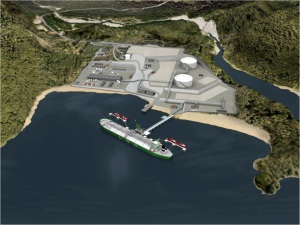 Picture – Horn River News

WSJ: Apache To Provide Natural Gas To Proposed Kitimat LNG Terminal For Export To Asia – Update
December 18, 2009
(RTTNews) – Sunday, according to The Wall Street Journal, oil and gas company Apache Corp. (APA) has agreed to provide natural gas to Canadian firm Kitimat LNG Inc. for export to Asia through Kitimat’s proposed liquefied-natural-gas or LNG export terminal in Kitimat, British Columbia. The construction of the $3-billion LNG export facility is set to begin in late 2009 or early 2010, with the LNG facility coming into operation 36 to 40 months later by 2013 or 2014. The companies are expected to announce an agreement on Monday.
Privately-owned Calgary-based Kitimat LNG is committed to build a state-of-the-art LNG terminal in Kitimat that would transport natural gas via a pipeline from the Western Canadian Sedimentary Basin to the Kitimat LNG Terminal, where the natural gas will be cooled to -160 degrees centigrade, condensed and liquefied in preparation for export via ship to Asian markets. In Asia, the LNG will undergo a regasification process and be transported through pipelines to its final destination.
Pursuant to an agreement, Kitimat LNG and Houston, Texas-based Apache would negotiate a definitive agreement under which Apache would supply specific quantities of the LNG facility’s 700 million cubic feet per day of natural gas feedstock. In mid-July, EOG Resources, Inc. (EOG) also signed a memorandum of understanding or MOU, to supply natural gas to Kitimat LNG’s proposed LNG export terminal.
In a statement while signing the EOG agreement, President of Kitimat LNG Rosemary Boulton said, “Kitimat LNG presents a compelling opportunity for producers to leverage growing natural gas reserves in Western Canada and sell into significant new international markets such as Asia.”
After EOG, Apache is the second major North American gas producer to have reportedly agreed to supply natural gas to Kitimat LNG. Kitimat LNG has also signed MOUs with leading LNG companies such as Korea Gas Corporation (KOGAS) and Gas Natural for the purchase of LNG produced at the terminal. However, there are other companies active in British Columbia, where the proposed project is situated, including EnCana Corp. (ECA, ECA.TO)), Devon Energy Corp. (DVN) and industry giant Exxon Mobil Corp. (XOM).
Kitimat LNG’s export terminal proposal is supported by natural gas market fundamentals that show growth in the supply of natural gas in Western Canada and strong, growing demand for natural gas in Asia. As a politically and economically stable country that is close to Asian markets, Canada offers a reliable, plentiful natural gas supply to customers in the Pacific Rim.
The project is expected to take advantage of the rising natural gas demand and the higher LNG prices in Asia, with prices Asian prices expected to continue to climb. The U.S. natural gas prices have been stuck at between US$7 and $9 per million British Thermal Units or BTU, for most of the year, while in Asia, LNG have been traded with increasing frequency at record spot prices of US$20 per million BTU.
The Kitimat project comprises of a 40-hectare LNG export terminal site with two storage tanks, marine jetty and berthing facility. It would have an annual LNG capacity of three to five million tons and would take about 36 to 40 months for completion. It would handle three to five shipments monthly and would target key potential markets like Japan, South Korea, China, and Taiwan. – source
World Depression: Regional Wars and the Decline of the US Empire

David Axelrod and Rahm Emanuel
By James Petras
Mar 26, 2009
Introduction
All the idols of capitalism over the past three decades crashed. The assumptions and presumptions, paradigm and prognosis of indefinite progress under liberal free market capitalism have been tested and have failed. We are living the end of an entire epoch: Experts everywhere witness the collapse of the US and world financial system, the absence of credit for trade and the lack of financing for investment. A world depression, in which upward of a quarter of the world’s labor force will be unemployed, is looming. The biggest decline in trade in recent world history – down 40% year to year – defines the future. The imminent bankruptcies of the biggest manufacturing companies in the capitalist world haunt Western political leaders. The ‘market’ as a mechanism for allocating resources and the government of the US as the ‘leader’ of the global economy have been discredited. (Financial Times, March 9, 2009) All the assumptions about ‘self-stabilizing markets’ are demonstrably false and outmoded. The rejection of public intervention in the market and the advocacy of supply-side economics have been discredited even in the eyes of their practitioners. Even official circles recognize that ‘inequality of income’ contributed to the onset of the economic crash and should be corrected. Planning, public ownership, nationalization are on the agenda while socialist alternatives have become almost respectable.
With the onset of the depression, all the shibboleths of the past decade are discarded: As export-oriented growth strategies fail, import substitution policies emerge. As the world economy ‘de-globalizes’ and capital is ‘repatriated’ to save near bankrupt head offices – national ownership is proposed. As trillions of dollars/Euros/yen in assets are destroyed and devalued, massive layoffs extend unemployment everywhere. Fear, anxiety and uncertainty stalk the offices of state, financial directorships, the office suites the factories, and the streets…
We enter a time of upheaval, when the foundations of the world political and economic order are deeply fractured, to the point that no one can imagine any restoration of the political-economic order of the recent past. The future promises economic chaos, political upheavals and mass impoverishment. Once again, the specter of socialism hovers over the ruins of the former giants of finance. As free market capital collapses, its ideological advocates jump ship, abandon their line and verse of the virtues of the market and sing a new chorus: the State as Savior of the System – a dubious proposition, whose only outcome will be to prolong the pillage of the public treasury and postpone the death agony of capitalism as we have known it.
Theory of Capital Crisis: The Demise of the Economic Expert
The failed economic policies of political and economic leaders are rooted in the operation of markets – capitalism. To avoid a critique of the capitalist system, writers are blaming the leaders and financial experts for their incompetence, ‘greed’ and individual defects.
Psychobabble has replaced reasoned analysis of structures, material forces and objective reality, which drive, motivate and provide incentives to investors, policy makers and bankers. When capitalist economies collapse, the gods drive the politicians and editorial columnists crazy, depriving them of any capacity to reason about objective processes and sending them into the wilderness of subjective speculation.
Instead of examining the opportunity structures created by enormous surplus capital and the real existing profit margins, which drive financial activity, we are told it was ‘the failure of leadership’. Instead of examining the power and influence of the capitalist class over the state, in particular the selection of economic policy-makers and regulators who would maximize their profits, we are told there was a ‘lack of understanding’ or ‘willful ignorance of what markets need’. Instead of looking at the real social classes and class relations – specifically the historically existing capitalist classes operating in real existing markets – the psycho-babblers posit an abstract ‘market’ populated by imaginary (‘rational’) capitalists. Instead of examining how rising profits, expanding markets, cheap credit, docile labor, and control over state policies and budgets, create ‘investor confidence’, and, in their absence, destroy ‘confidence’, the psychobabblers claim that the ‘loss of confidence’ is a cause for the economic debacle. The objective problem of loss of specific conditions, which produce profits, as leading to the crisis, is turned into a ‘perception’ of this loss.
Confidence, faith, hope, trust in capitalist economies derive from economic relations and structures which produce profits. These psychological states are derivative from successful outcomes: Economic transactions, investments and market shares that raise value, multiply present and future gains. When investments go sour, firms lose money, enterprises go bankrupt, and those prejudiced ‘lose confidence’ in the owners and brokers. When entire economic sectors severely prejudice the entire class of investors, depositors and borrowers, there is a loss of ‘systemic confidence.’
Psychobabble is the last resort of capitalist ideologues, academics, experts and financial page editorialists. Unwilling to face the breakdown of real existing capitalist markets, they write and resort to vague utopias such as ‘proper markets’ distorted by ‘certain mindsets’. In other words, to save their failed ideology based on capitalist markets, they invent a moral ideal the ‘proper capitalist mind and market’, divorced from real behavior, economic imperatives and contradictions embedded in class warfare.
The inadequate and shoddy economic arguments, which pervade the writing of capitalist ideologues parallels the bankruptcy of the social system in which they are embedded. The intellectual and moral failures of the capitalist class and their political followers are not personal defects; they reflect the economic failure of the capitalist market.
The crash of the US financial system is symptomatic of a deeper and more profound collapse of the capitalist system that has its roots in the dynamic development of capitalism in the previous three decades. In its broadest terms, the current world depression results from the classic formulation outlined by Karl Marx over 150 years ago: the contradiction between the development of the forces and relations of production.
Contrary to the theorists who argue that ‘finance’ and ‘post-industrial’ capitalism have ‘destroyed’ or de-industrialized the world economy and put in its place a kind of “casino” or speculative capital, in fact, we have witnessed the most spectacular long-term growth of industrial capital employing more industrial and salaried workers than ever in history. Driven by rising rates of profit, large scale and long-term investments have been the motor force for the penetration by industrial and related capital of the most remote underdeveloped regions of the world. New and old capitalist countries spawned enormous economic empires, breaking down political and cultural barriers to incorporating and exploiting billions of new and old workers in a relentless process. As competition from the newly industrialized countries intensified, and as the rising mass of profits exceeded the capacity to reinvest them most profitably in the older capitalist centers, masses of capital migrated to Asia, Latin America, Eastern Europe, and to a lesser degree, into the Middle East, Southern Africa.
Huge surplus profits spilled over into services, including finance, real estate, insurance, large-scale real estate and urban lands.
The dynamic growth of capitalism’s technological innovations found expression in greater social and political power – dwarfing the organization of labor, limiting its bargaining power and multiplying its profits. With the growth of world markets, workers were seen merely as ‘costs of production’ not as final consumers. Wages stagnated; social benefits were limited, curtailed or shifted onto workers. Under conditions of dynamic capitalist growth, the state and state policy became their absolute instrument: restrictions, controls, regulation were weakened. What was dubbed “neo-liberalism” opened new areas for investment of surplus profits: public enterprises, land, resources and banks were privatized.
As competition intensified, as new industrial powers emerged in Asia, US capital increasingly invested in financial activity. Within the financial circuits it elaborated a whole series of financial instruments, which drew on the growing wealth and profits from the productive sectors.
US capital did not ‘de-industrialize’ – it relocated to China, Korea and other centers of growth, not because of “falling profits” but because of surplus profits and greater profits overseas.
Capital’s opening in China provided hundreds of millions of workers with jobs subject to the most brutal exploitation at subsistence wages, no social benefits, little or no organized social power. A new class of Asian capitalist collaborators, nurtured and facilitated by Asian state capitalism, increased the enormous volume of profits. Rates of investments reached dizzying proportions, given the vast inequalities between income/property owning class and wageworkers. Huge surpluses accrued but internal demand was sharply constrained. Exports, export growth and overseas consumers became the driving force of the Asian economies. US and European manufacturers invested in Asia to export back to their home markets – shifting the structure of internal capital toward commerce and finance. Diminished wages paid to the workers led to a vast expansion in credit. Financial activity grew in proportion to the entrance of commodities from the dynamic, newly industrialized countries. Industrial profits were re-invested in financial services. Profits and liquidity grew in proportion to the relative decline in real value generated by the shift from industrial to financial/commercial capital.
Super profits from world production, trade, finances and the recycling of overseas earnings back to the US through both state and private financial circuits created enormous liquidity. It was far beyond the historical capacity of the US and European economies to absorb such profits in productive sectors.
The dynamic and voracious exploitation of the huge surplus labor forces in China, India, and elsewhere and the absolute pillage and transfer of hundreds of billions from ex-communist Russia and ‘neo-liberalized’ Latin America filled the coffers of new and old financial institutions.
Over-exploitation of labor in Asia, and the over-accumulation of financial liquidity in the US led to the magnification of the paper economy and what liberal economist later called “global disequilibrium” between savers/industrial investors/ exporters (in Asia) and consumers/financiers/importers(in the US). Huge trade surpluses in the East were papered over by the purchase of US T-notes. The US economy was precariously backed by an increasingly inflated paper economy.
The expansion of the financial sector resulted from the high rates of return, taking advantage of the ‘liberalized’ economy imposed by the power of diversified investment capital in previous decades. The internationalization of capital, its dynamic growth and the enormous growth of trade outran the stagnant wages, declining social payments, the huge surplus labor force. Temporarily, capital sought to bolster its profits via inflated real estate based on expanded credit, highly leveraged debt and outright massive fraudulent ‘financial instruments’ (invisible assets without value). The collapse of the paper economy exposed the overdeveloped financial system and forced its demise. The loss of finance, credit and markets, reverberated to all the export-oriented industrial manufacturing powers. The lack of social consumption, the weakness of the internal market and the huge inequalities denied the industrial countries any compensatory markets to stabilize or limit their fall into recession and depression. The dynamic growth of the productive forces based on the over-exploitation of labor, led to the overdevelopment of the financial circuits, which set in motion the process of ‘feeding off’ industry and subordinating and undermining the accumulation process to highly speculative capital.
Cheap labor, the source of profits, investment, trade and export growth on a world scale, could no longer sustain both the pillage by finance capital and provide a market for the dynamic industrial sector. What was erroneously dubbed a financial crisis or even more narrowly a “mortgage” or housing crisis, was merely the “trigger” for the collapse of the overdeveloped financial sector. The financial sector, which grew out of the dynamic expansion of ‘productive’ capitalism, later ‘rebounded’ against it. The historic links and global ties between industry and financial capital led inevitably to a systemic capitalist crisis, embedded in the contradiction between impoverished labor and concentrated capital.
The current world depression is a product of the ‘over-accumulation’ process of the capitalist system in which the crash of the financial system was the ‘detonator’ but not the structural determinant. This is demonstrated by the fact that industrial Japan and Germany experienced a bigger fall in exports, investments and growth than ‘financial’ US and England.
The capitalist system in crisis destroys capital in order to ‘purge itself’ of the least efficient, least competitive and most indebted enterprises and sectors, in order to re-concentrate capital and reconstruct the powers of accumulation – political conditions permitting. The re-composition of capital grows out of the pillage of state resources – so-called bailouts and other massive transfers from the public treasury (read ‘taxpayers’), which results from the savage reduction of social transfers (read ‘public services’) and the cheapening of labor through firings, massive unemployment, wage, pension and health reductions and the general reduction of living standards in order to increase the rate of profit.
The World Depression: Class Analysis
The aggregate economic indicators of the rise and fall of the world capitalist system are of limited value in understanding the causes, trajectory and impact of the world depression. At best, they describe the economic carnage; at worst, they obfuscate the leading (ruling) social classes, with their complex networks and transformations, which directed the expansion and economic collapse and the wage and salaried (working) classes, which produced the wealth to fuel the expansive phase and now pay the cost of the economic collapse.
It is a well-known truism that those who caused the crisis are also the greatest beneficiaries of government largesse. The crude and simple everyday observations that the ruling class ‘made’ the crisis and the working class ‘pays’ the cost, at a minimum, is a recognition of the utility of class analyses in deciphering the social reality behind the aggregate economic data. Following the recession of the early 1970s, the Western industrial capitalist class secured financing to launch a period of extensive and deep growth covering the entire globe. German, Japanese and Southeast Asian capitalists flourished, competed and collaborated with their US counterpart. Throughout this period the social power, organization and political influence of the working class witnessed a relative and absolute decline in their share of material income. Technological innovations, including the re-organization of work, compensated for wage increases by reducing the ‘mass of workers’ and in, particular, their capacity to pressure the prerogatives of management. The capitalist strategic position in production was strengthened: they were able to exercise near absolute control over the location and movements of capital.
The established capitalist powers – especially in England and the US — with large accumulations of capital and facing increasing competition from the fully recovered German and Japanese capitalists, sought to expand their rates of return by moving capital investments into finance and services. At first, this move was linked and directed towards promoting the sale of their manufactured products by providing credit and financing toward the purchases of automobiles or ‘white goods’. Less dynamic industrial capitalists relocated their assembly plants to low-wage regions and countries. The results were that industrial capitalists took on more the appearance of ‘financiers’ in the US even as they retained their industrial character in the operation of their overseas manufacturing subsidiaries and satellite suppliers. Both overseas manufacturing and local financial returns swelled the aggregate profits of the capitalist class. While capital accumulation expanded in the ‘home country’, domestic wages and social costs were under pressure as capitalists imposed the costs of competition on the backs of wage earners via the collaboration of the trade unions in the US and social democratic political parties in Europe. Wage constraints, tying wages to productivity in an asymmetrical way and labor-capital pacts increased profits. US workers were ‘compensated’ by the cheap consumer imports produced by the low-wage labor force in the newly industrializing countries and access to easy credit at home.
The Western pillage of the former-USSR, with the collaboration of gangster-oligarchs, led to the massive flow of looted capital into Western banks throughout the 1990s. The Chinese transition to capitalism in the 1980s, which accelerated in the 1990s, expanded the accumulation of industrial profits via the intensive exploitation of tens of millions of wageworkers employed at subsistence levels. While the trillion-dollar pillage of Russia and the entire former Soviet Union bloated the West European and US financial sector, the massive growth of billions of dollars in illegal transfers and money laundering toward US and UK banks added to the overdevelopment of the financial sector. The rise in oil prices and ‘rents’ among ‘rentier’ capitalists added a vast new source of financial profits and liquidity. Pillage, rents, and contraband capital provided a vast accumulation of financial wealth disconnected from industrial production. On the other hand, the rapid industrialization of China and other Asian countries provided a vast market for German and Japanese high-end manufacturers: they supplied the high quality machines and technology to the Chinese and Vietnamese factories.
US capitalists did not ‘de-industrialize’ – the country did. By relocating production overseas and importing finished products and focusing on credit and financing, the US capitalist class and its members became diversified and multi-sectoral. They multiplied their profits and intensified the accumulation of capital.
On the other hand, workers were subject to multiple forms of exploitation: wages stagnated, creditors squeezed interest, and the conversion from high wage/high skill manufacturing jobs to lower-paid service jobs steadily reduced living standards.
The basic process leading up to the breakdown was clearly present: the dynamic growth of western capitalist wealth was based, in part, on the brutal pillage of the USSR and Latin America, which profoundly lowered living standards throughout the 1990s. The intensified and savage exploitation of hundreds of millions of low-paid Chinese, Mexican, Indonesian and Indochinese workers, and the forced exodus of former peasants as migrant laborers to manufacturing centers led to high rates of accumulation.
The relative decline of wages in the US and Western Europe also added to the accumulation of capital. The German, Chinese, Japanese, Latin American and Eastern European emphasis on export-driven growth added to the mounting ‘imbalance’ or contradiction between concentrated capitalist wealth and ownership and the growing mass of low-paid workers. Inequalities on a world scale grew geometrically. The dynamic accumulation process exceeded the capacity of the highly polarized capitalist system to absorb capital in productive activity at existing high rates of profit. This led to the large scale and multiform growth of speculator capital inflating prices and investing in real estate, commodities, hedge funds, securities, debt-financing, mergers and acquisitions — all divorced from real value-producing activity. The industrial boom and the class constraints imposed on workers wages undermined domestic demand and intensified competition in world markets.
Speculator-financial activity with massive liquidity offered a ‘short-term solution’: profits based on debt financing. Competition among lenders fueled the availability of cheap credit. Real estate speculation was extended into the working class, as wage and salaried workers, without personal savings or assets, took advantage of their access to easy loans to join the speculator-induced frenzy – based on an ideology of irreversible rising home values. The inevitable collapse reverberated throughout the system – detonated at the bottom of the speculative chain. From the latest entrants to the real estate sub-prime mortgage holders, the crisis moved up the ladder affecting the biggest banks and corporations, who engaged in leveraged buyouts and acquisitions. All ‘sectors’, which had ‘diversified’ from manufacturing to finance, trade and commodities speculation, were downgraded. The entire panoply of capitalists faced bankruptcy. German, Japanese and Chinese industrial exporters who exploited labor witnessed the collapse of their export markets.
The ‘bursting’ financial bubble was the product of the ‘over-accumulation’ of industrial capital and the pillage of wealth on a world scale. Over-accumulation is rooted in the most fundamental capitalist relation: the contradictions between private ownership and social production, the simultaneous concentration of capital and sharp decline of living standards.
Capitalist Crisis: A Class Analysis
Indicators of the deepening depression in 2009 are found everywhere:
Bankruptcies rose by 14% in 2008 and are set to rise another 20% in 2009 (Financial Times, Feb. 25, 2009; p27).
The write-down of the Western big banks is running at 1 Trillion dollars and growing (according to the Institute for International Financing, the banking groups Washington lobby). (Financial Times , March 10, 2009 p.9).
And according to the Financial Times (ibid) the losses arising from banks having to mark their investments down to market prices stand at 3 Trillion dollars – equivalent to a year’s worth of British economic production. In the same report, the Asian Development Bank is quoted as having estimated that financial assets worldwide have fallen by more than $50 trillion – a figure of the same order as annual global output. For 2009, the US will run a budget deficit of 12.3% of gross domestic product…giant fiscal deficits…that will ultimately ruin public finances.
The world markets have been in a vertical fall:
The TOPIX has fallen from 1800 in mid-2007 to 700 in early 2009;
Standard and Poor from 1380 in early 2008 to below 700 in 2009;
FTSE 100 from 6600 to 3600 in early 2009;
Hang Seng from 32,000 in early 2008 to 13,000 at the start of 2009 (Financial Times, Feb 25, 2009; p27).
In the fourth quarter of 2008, GDP shrank at annualized rate of 20.8% in South Korea, 12.7% in Japan, 8.2% in Germany, 2.9% in the UK and 3.8% in the US (FT, Feb.25, 2009; p9).
The Dow Jones Industrial Average has declined from 14,164 in October 2007 to 6500 in March 2009.
Year on year declines in industrial output were 21% in Japan, 19% in South Korea, 12% in Germany, 10% in the US, and 9% in the UK (Financial Times, Feb.25, 2009; p.9.)
Net private capital flows to less developed capitalist countries from the imperial countries were predicted to shrink by 82% and credit flows by $30 billion USD (Financial Times, Feb. 25, 2009; p9).
The US economy declined by 6.2% in the last three months of 2008 and fell further in the first quarter of 2009 as a result of a sharp decline in exports (23.6%) and consumer spending (4.3%) in the final quarter of 2008 (British Broadcasting Corporation, Feb. 27, 2009).
With over 600,000 workers losing their jobs monthly in the first three months of 2009, and many more on short hours and scheduled for axing throughout 2009, real and disguised unemployment may reach 25% by the end of the year. All of the signs point to a deep and prolonged depression:
Automobile sales of General Motors, Chrysler and Ford were down nearly 50% year to year (2007-2008). The first quarter of 2009 saw a further decline of 50%.
Foreign markets are drying up as the depression spreads overseas.
In the US domestic market, durable goods sales are declining by 22% (BBC, Feb. 27, 2009).
Residential investments fell by 23.6% and business investment was down 19.1%, led by a 27.8% drop in equipment and software.
The rising tide of depression is driven by private business led disinvestment. Rising business inventories, declining investment, bankruptcies, foreclosures, insolvent banks, massive accumulative losses, restricted access to credit, falling asset values and a 20% reduction in household wealth (over 3 trillion dollars) are cause and consequence of the depression. As a result of collapse of the industrial, mining, real estate and trade sectors, there are at least $2.2 trillion USD of “toxic” (defaulting) bank debt worldwide, far beyond the bailout funds allocated by the White House in October 2008 and February and March 2009.
The depression is diminishing the worldwide economic presence of imperial countries and undermining the foreign capital-financed export strategies of Latin American, Eastern European, Asian and African regions.
Among almost all conventional economists, pundits, investment advisors and various and sundry experts and economic historians, there is a common faith that “in the long-run”, the stock market will recover, the recession will end and the government will withdraw from the economy. Fixed on notions of past cyclical patterns, historical ‘trends’, these analysts lose sight of the present realities which have no precedent: the world nature of the economic depression, the unprecedented speed of the fall, and the levels of debt incurred by governments to sustain insolvent banks and industries and the unprecedented public deficits, which will drain resources for many generations to come.
The academic prophets of ‘long-term developments” arbitrarily select trend markers from the past, which were established on the basis of a political-economic context radically different from today. The idle chatter of ‘post crisis’ economists overlooks the open-ended and constantly shifting parameters therefore missing the true ‘trend markers’ of the current depression. As one analyst noted, “any starting conditions we select in the historical data cannot replicate the starting conditions at any other moment because the preceding events in the two cases are never identical” (Financial Times, Feb. 26, 2009; p24). The current US depression takes place in the context of a de-industrialized economy, an insolvent financial system, record fiscal deficits, record trade deficits, unprecedented public debt, multi-trillion dollar foreign debt and well over $800 billion dollars committed in military expenditures for several ongoing wars and occupations. All of these variables defy the contexts in which previous depressions occurred. Nothing in previous contexts leading up to a crisis of capitalism resembles the present situation. The present configuration of economic, political and social structures of capitalism include astronomical levels of state pillage of the public treasury in order to prop up insolvent banks and factories, involving unprecedented transfers of income from wage and salaried taxpayers to non-productive ‘rent earners’ and to failed industrial capitalists, dividend collectors and creditors. The rate and levels of appropriation and reduction of savings, pensions and health plans, all without any compensation, has led to the most rapid and widespread reduction of living standards and mass impoverishment in recent US history.
Never in the history of capitalism has a deep economic crisis occurred without any alternative socialist movement, party or state present to pose an alternative. Never have states and regimes been under such absolute control by the capitalist class — especially in the allocation of public resources. Never in the history of an economic depression has so much of government expenditures been so one-sidedly directed towards compensating a failed capitalist class with so little going to wage and salaried workers.
The Obama regime’s economic appointments and policies clearly reflect the total control by the capitalist class over state expenditures and economic planning.
Obama and the Capitalist Crisis: A Class Analysis
The programs put forth by the US and West Europeans and other capitalist regions do not even begin to recognize the structural bases of the depression.
First, Obama is allocating $1 trillion dollars to buy worthless bank assets and over 40% of his $787 billion stimulus package to insolvent banks and tax breaks, rather than to the productive sector, in order to save stock and bond holders, while over 600,000 workers lose their jobs monthly.
Secondly, the Obama regime is channeling over $800 billion dollars to fund the wars in Iraq and Afghanistan to sustain military-driven empire building. This constitutes a massive transfer of public funds from the civilian economy to the military sector forcing tens of thousands of unemployed young people to enlist in the military (Boston Globe, March 1, 2009).
Thirdly, Obama’s commission to oversee the “restructuring” of the US auto industry has backed their plans to close scores of factories, eliminate company-financed health plans for retirees and force tens of thousands of workers to accept brutal reductions in employee health care and pensions. The entire burden for returning the privately owned auto industry to profits is placed on the shoulders of the wage, salaried and retired workers, and the US taxpayers.
The entire economic strategy of the Obama regime is to save the bondholders by pouring endless trillions of dollars into insolvent corporations and buying the worthless debts and failed assets of financial enterprises. At the same time his regime avoids any direct state investments in publicly owned productive enterprises, which would provide employment for the 10 million unemployed workers. While Obama’s budget allocates over 40% to military expenditures and debt payments, 1 out of every 10 Americans have been evicted from their homes, the number of Americans without jobs is rising to double digits, and the number of Americans on ‘food stamps’ to provide basic food needs is rising by the millions throughout 2009.
Obama’s ‘job creation’ scheme channels billions toward the privately owned telecommunication, construction, environmental and energy corporations, where the bulk of the government funds go to senior management and staff and provide profits to stock holders, while a lesser part will go to wage workers. Moreover, the bulk of the unemployed workers in the manufacturing and service areas are not remotely employable in the ‘recipient’ sectors. Only a fraction of the ‘stimulus package’ will be allocated in 2009. Its purpose and impact will be to sustain the income of the financial and industrial ruling class and to postpone their long-overdue demise. Its effect will be to heighten the socioeconomic inequalities between the ruling class and the wage and salaried workers. The tax increases on the rich are incremental, while the massive debts resulting from the fiscal deficits are imposed on present and future wage and salaried taxpayers.
Obama’s wholehearted embrace and promotion of military-driven empire building even in the midst of record-breaking budget deficits, huge trade deficits and an advancing depression defines a militarist without peer in modern history. Despite promises to the contrary, the military budget for 2009-2010 exceeds the Bush Administration by at least 4%. The numbers of US military forces will increase by several hundred thousands. The number of US troops in Iraq will remain close to its peak and increase by tens of thousands in Afghanistan, at least through 2009 (despite promises to the contrary). US-based miliary air and ground attacks in Pakistan have multiplied geometrically. Obama’s top foreign policy appointees in the State Department, Pentagon, Treasury and the National Security Council, especially in any capacity involving the Middle East, are predominantly militarist Zionists with a long history of advocacy of war against Iran and with close ties with the Israeli high command.
In summary, the highest priorities of the Obama regime are evidenced by his allocation of financial and material resources, his appointments of top economic and foreign policy-makers and in terms of which classes benefit and which lose under his administration. Obama’s policies demonstrate that his regime is totally committed to saving the capitalist class and the US empire. To do so, he is willing to sacrifice the most basic immediate needs and future interests, as well as the living standards, of the vast majority of working and home-owning Americans who are most directly affected by the domestic economic depression. Obama has increased the scope of military-driven empire building and enhanced the power position of the pro-Israeli warmongers in his administration. Obama’s ‘economic recovery’ and military escalation strategies are financially and fiscally incompatible; the cost of one undermines the impact of the other and leaves a tremendous hole in any efforts to counteract the collapse of social services, rising home foreclosures, business bankruptcies and massive layoffs.
The horizontal transfers of public wealth from the Obama governing elite to the economic ruling class does not “trickle down” into jobs, credit and social services. Attempting to turn insolvent banks into credit-lending, profitable enterprises is an oxymoron. The central dilemma for Obama is how to create conditions to restore profitability to the failed sectors of the existing US economy.
There are several fundamental problems with his strategy:
First, the US economic structure, which once generated employment, profits and growth, no longer exists. It has been dismantled in the course of diverting capital overseas and into financial instruments and other non-productive economic sectors.
Second, the Obama ‘stimulus’ policies reinforce the financial stranglehold over the economy by channeling great resources to that sector instead of ‘rebalancing’ the economy toward the productive sector. Even within the ‘productive sector’ state resources are directed toward subsidizing capitalist elites who have demonstrated their incapacity to generate sustained employment, foster market competitiveness and innovate in line with consumer preferences and interests.
Third, the Obama economic strategy of ‘top-down’ recovery squanders most of its impact in subsidizing failed capitalists instead of raising working class income by doubling the minimum wage and unemployment benefits, which is the only real basis for increasing demand and stimulating economic recovery. Given the declining living standards resulting from domestic decay and the expansion of military-driven empire, both embedded in the institutional foundation of the state, there are no chances for the kind of structural transformation that can reverse the ‘top-down’, empire-absorbing policies promoted by the Obama regime.
Recovery from the deepening depression does not reside in running a multi-trillion dollar printing operation, which only creates conditions for hyperinflation and the debasement of the dollar. The root cause is the over-accumulation of capital resulting from over-exploitation of labor, leading to rising rates of profit and the collapse of demand. The vast disparity between capital expansion and decline of worker consumption set the stage for the financial bubble.
The ‘rebalancing’ of the economy means creating demand (not from an utterly prostrate private productive sector or an insolvent financial system) via direct state ownership and long-term, large-scale investment in the production of goods and social services. The entire speculative ‘superstructure’, which grew to enormous proportions by feeding off of the value created by labor, multiplied itself in a myriad of ‘paper instruments’ divorced from any use value. The entire paper economy needs to be dismantled in order to free the productive forces from the shackles and constraints of unproductive capitalists and their entourage. A vast re-training program needs to be established to convert stockbrokers into engineers and productive workers. The reconstruction of the domestic market and the invention and the application of innovations to raise productivity require the massive dismantling of the worldwide empire. Costly and unproductive military bases, the essential elements for military-driven empire building, should be closed and replaced by overseas trade networks, markets, and economic transactions linked to producers operating out of their home markets. Reversing domestic decay requires the end of empire and the construction of a democratic socialist republic. Fundamental to the dismantling of empire is the end of political alliances with overseas militarist powers, in particular with the state of Israel and uprooting its entire domestic power configuration, which undermine efforts to create an open democratic society serving the interests of the American people.
Regional Impact of the Global Crisis
The worldwide depression has both common and different causes, affected by the interconnections between economies and specific socio-economic structures. At the most general-global level the rising rate of profits and the over-accumulation of capital leading to the financial-real estate-speculative frenzy and crash affected most countries either directly or indirectly. At the same time, while all regional economies suffered the consequences of the onset of the depression, regions were situated in the world economy differently and subsequently the effects varied substantially.
Latin America
Brazil with its free market policies in disarray and huge class divisions undermining any domestic recovery, its high velocity fall in exports and industrial production is heading toward a deep recession despite the boasts and claims of Wall Street and the White House favorite, President Lula da Silva.
In January 2009, industrial production fell 17.2% year to year. Gross domestic product contracted 3.6% in the last quarter of 2008 (Financial Times, March 11, 2009). All indications are that negative growth will persist and deepen during the rest of 2009. Foreign direct investment and export markets, the driving forces of past growth are in sharp retrenchment. Lula’s privatization policies have led to extensive foreign takeover of the financial sector, which has transmitted the crises from the US and EU. His ‘globalization’ policies increase Brazil’s vulnerability to the collapse of foreign trade.
Capital flows are strongly negative. Hundreds of thousands of workers lost their jobs between December 2008 and April 2009. The 5 million impoverished landless rural workers and the 10 million families living on a one dollar a day food-basket handout from the government are excluded from effective domestic demand as are the tens of millions of minimum wage workers living on $250 dollars a month. The purchasing power of highly indebted family farmers is no substitute for shrinking external demand. All sectors, rural and urban, of the capitalist class are freezing new investments as private credit evaporates, overseas investors flee and local consumer spending declines in the face of the deepening recession. Lula’s claims of ‘decoupling’ and his growth projections of 4% are seen as ‘seeding illusions’ to cover up the onset of a severe economic recession. Lula’s blind support for globalization and the ‘free market’ is a central determinant of Brazil’s deepening recession.
Brazil’s descent into negative GDP is the pattern throughout the region. Argentina is headed for minus 2% growth, Mexico –minus 3% and Chile 0% or less. Central America and the Caribbean, which are highly ‘integrated’ with the US and world economy are experiencing the full force of the world depression in skyrocketing unemployment resulting from the collapse of tourism, declining demand for primary commodities and a serious drop in remittances from overseas workers. There will be a sharp rise in extreme poverty, crime and a potential for popular social upheavals against the incumbent right and center-left governments.
The spread of imperial capital throughout the world, dubbed ‘globalization’ by its defenders (and imperialism by its critics), led to the rapid spread of the financial crisis and breakdown among those countries most closely linked to the US and European financial circuits. Globalization tied Latin American economies to world markets, at the expense of domestic markets, and increased their vulnerability to the vertical fall in demand, prices and credit witnessed today. Globalization, which earlier promoted the inflow of capital, now, with the onset of the depression, facilitates massive capital outflow. US, which is absorbing 70% of the world’s savings in its desperate effort to borrow and finance its monstrous trade and budget deficits, has squeezed out its Latin American trading partners from the global credit market.
The depression demonstrates with crystal clarity the pitfalls of imperial-centered globalization and the stark absence of any remedies for its collaborators in Latin America. The disintegration of the imperial-centered global economy is evident amidst rising protectionism and billions of dollars in state subsidies to prop up the imperial states’ own capitalists in the banking, insurance, real estate and manufacturing sectors. The world depression not only reveals the intrinsic fault lines of the globalized economy, but ensures its ultimate demise into a multiplicity of competing units: nations, each depending on their own treasuries and state sectors to pull them out of the deepening depression at the expense of their former partners. The world depression is spurring the return of the nation-state, as ‘de-globalization’ accelerates.
Parallel and intimately related to the demise of the world market is the rise of the capitalist state as the center-piece for salvaging the national treasury and exacting an exorbitant tribute from the pension, health and wage funds of billions of workers, pensioners and tax-payers. Growing ‘state capitalism’ in times of capitalist collapse only emerges to ‘save the capitalist system from capitalist failures’ as its promoters argue. In order to do so it exploits the collective wealth of the entire people. ‘Nationalization’ or ‘statification’ of insolvent banks and industries is the culmination of predator capitalism. Instead of individual enterprises or even sectoral exploitation of wage and salaried workers, it is the capitalist state that preys on the entire class of the producers of wealth.
Latin America’s options revolve around recognizing and accepting that globalization is dead, that only under popular democratic control can nationalization serve to generate wealth and create employment, instead of serving to channel and redistribute resources upward and outward to the failed, bankrupt capitalist class.
Eastern Europe and the ex-communist countries
The conversion from communism to capitalism in Eastern Europe followed a process of privatization, in many cases based on widespread pillage, the illegal seizures of public resources and the precipitous fall in domestic living standards and production during the first half of the 1990’s. Taking advantage of cheap labor, easy access to lucrative opportunities in all economic sectors, Western European and US capitalists took control of the manufacturing, mining, financial and communication sectors. At the same time as the barriers between East and West fell, there was a massive flow of skilled workers to Western Europe. The economic recovery and subsequent growth in Eastern Europe and the ex-communist countries was based on its dependency on the expansion of investment and credit from Western capitalism:
The relocation of manufacturing, the influx of speculative capital in finance and real estate, the access to expanding Western markets and especially debt financing of consumer expenditures spurred Eastern growth.
As a consequence, the region has been hit from two sides during the economic crisis:
A collapse engendered by unsustainable internal speculation and the impact of its dependency on a depressed Western Europe for capital, credit and markets. The capitalist economies of the Baltic States, Eastern Europe and Russia collapsed rapidly. As Western European credit markets shriveled and large-scale multi-national disinvestment set in, the local currencies were devalued and overseas markets disappeared. The entire pattern of ‘dependent development’ rooted in the disarticulation of local markets and inflows of capital undermined local efforts to counter the collapse. Their only choice was to seek massive infusions of financial aid from the IMF and banks on onerous terms, which limited options for any national fiscal stimulus plans.
The regions linkages with world markets, based on subordinate-dependent relations with Western capitalists, meant that first they lacked the internal markets and capital to cushion the fall and, secondly, that the drying up of external flows would deepen and extend the depression. From the Baltic to the Balkan states, from Eastern Europe to Russia the full force of the depression has led to large-scale, long-term unemployment, widespread bankruptcies of local satellite and subsidiary industries, services and banks. Popular movements have emerged calling into question the free market policies of governments, and, in some cases, rejecting the export-dependent capitalist model.
Asia: The End of the Illusions of De-coupling and Autonomous Growth
The Great Depression of 2009 has adversely affected every economy in Asia, dependent on the international, financial and commodity markets. Even the most dynamic countries, like Japan, China, India, South Korea, Taiwan and Vietnam have not escaped the consequences of drastic declines in trade, employment, investment and living standards. Two decades of dynamic expansion, high growth and rising profit margins, based on export markets and intense exploitation of labor, led to the over-accumulation of capital. Many Asian and Western pundits argued for a ‘new world order’, led and directed by the emerging Asian economic powers, especially China, where power would be increasingly based on their ‘regional autonomy’. In reality, China’s dynamic industrial growth was deeply embedded in a world commodity chain in which advanced industrial countries, like Germany, Japan, Taiwan and South Korea, provided precision tools, machinery and parts to China for assembly and subsequent export to US, European and Asian markets. ‘Decoupling’ was a myth.
Export-driven growth was fueled by savage exploitation of labor, the dismantling of vast areas of social services (namely free health care, pensions, subsidized food and lodging and education) and the vast concentration of wealth in a tiny elite of newly rich billionaires (Economic and Political Weekly – Mumbai, December 27, 2008 page 27-102). China and the rest of Asia’s growth was based on the contradiction between the dynamic expansion of the forces of production and the increasing polarization of the class relations of production. The high rates of profit led to the over-accumulation of capital – high rates of investment – leading into huge budget and trade surpluses, which spilled over into the financial sectors, overseas expansion (or money-laundering) and real estate speculation.
Asia’s economic edifice was precariously situated on the backs of hundreds of millions of laborers with virtually no consumer power and an increasing dependence on overseas export markets. The world crisis especially deflated the export markets, exposing the Asian economies’ vulnerabilities and causing a massive fall in trade, production and massive growth in unemployment. China and the other Asian countries’ efforts to counteract the collapse of the export markets by massive injections of public capital to stimulate financial liquidity and infrastructure development has been insufficient to stem the growth of unemployment and the bankruptcy of millions of export-linked enterprises.
The Asian capitalist class and its government elite are entirely incapable of ‘restructuring’ the economy and social structure toward substituting domestic demand as the external market collapses. To do so would mean several profound transformations in the class structure. These include the shift from investments based on high profitability toward low margin productive and social services for the hundreds of millions of low-income workers and peasants. It would require the transfer of capital from private real estate, stock markets and overseas bond purchases (like US Treasury Notes) to finance universal health care, education and pensions and the restoration of land to productive use rather than to dispossession and real estate speculation.
The entire dynamic growth of Asia, built around capital concentration, high profits and low wages, is trying to survive based on deepening the impoverishment of labor via massive firing of workers, huge reverse flows of migrant labor back to the devastated countryside and the growth of the surplus labor force. The expulsion of labor, the usual capitalist solution, merely re-located and intensifies the contradiction – heightening the conflict between urban-based industrial/finance capital and hundreds of millions of impoverished, unemployed and underemployed workers and peasants. The state’s injections of capital to stimulate the economy passes through the ‘filter’ of regional state elites and the capitalist class, which absorbs and uses the bulk of this capital to buttress faltering enterprises – with negligible impact on the mass of unemployed workers.
Private ownership and capitalist control over the state precludes the kind of social transformation, which can restart growth by expanding the domestic economy.
China’s ‘engine of growth-in-reverse’ has, by necessity, undermined its trading partners who depend on industrial and raw material exports to China. The collapse of demand from its Euro-American markets undermines the entire architecture of China’s export industries. The savage exploitation of labor and the power of China’s new bourgeoisie ensure that there are limited possibilities for any revival of domestic demand from the ‘interior’.
China’s economic recovery is dependent on a new socialist transformation, which makes mass domestic demand the real engine of growth.
The Middle East: Depression and Regional Wars
The key to the crisis and breakdown of the Middle East is rooted in the imperial-Zionist regional wars and the collapse of commodity prices.
The oil producing countries accumulated vast ‘rents’, which they re-cycled into large-scale finance, real estate and military purchases in and out of the region. Profits concentrated in the hands of billionaire absolutist rulers led to highly polarized class relationships: super-wealthy rentiers and low-paid immigrant laborers limited the size and scope of the domestic markets. To break out of the crisis of over-accumulation and falling profits, the ruling elites adopted two strategies that temporarily avoided the crisis: Dependence on large-scale export of capital to rent, interest and dividend-yielding sites throughout the world – first to the US and Europe and later to Asia and Africa. The second strategy was to recycle profits into pharaonic real estate, tourist and banking centers in the Gulf States…leading to an enormous real estate bubble.
The collapse of the Middle East ‘rentier (or non-productive) oligarchies’ was detonated by the frenzied commodity oil boom, between 2004-2008, which heightened the process of over-accumulation – and the over-extension of debt and labor importation. The result was the onset of a regional economic crisis, in which budget and trade surpluses are replaced by mounting deficits. At no point did the Middle East economies diversify from their foundation based on ‘rents’ and create a diversified economy centered on production and the creation of a dynamic mass-based regional market. The rentier ruling classes face a growing mass of unemployed immigrant and domestic workers, the massive flight of thousands of expatriate European financiers, real estate professionals and other non-productive hangers-on.
No longer the beneficiaries of the petro-dollar boom – as prices, profits and rents collapsed – and no longer the powerful bankers and holders of debt, the Gulf Arab ruling class has few external and internal resources and outlets to project a ‘recovery program.’
Worse still, in the midst of this emerging economic collapse, the militarist state of Israel serves as a regional destabilizing force projecting its power and colonial ambitions throughout the region. Through one of world history’s most unique configuration of power, the economically insignificant state of Israel, operating through the activity of several tens of thousands of strategically-placed, highly organized, disciplined and ideologically committed loyalists in the Diaspora, control key levels of political power in the US government.
Obama, The Zionist Power Configuration and the Middle East
In the worst economic crisis since the 1930’s ‘Great Depression’ and facing a $1.7 Trillion Dollar budget deficit and over 8.1 million unemployed workers in March 2009 (BBC News, March 6, 2009), numbers, which are expected to double by the end of the year, the Obama Administration has increased the open and hidden military expenditures to $800 billion-plus dollars, a 4% increase over the previous war-mongering regime of George W. Bush. The key target of US military expansion is the Middle East and South Asia, with a population that includes hundreds of millions of mostly Muslims, who are pro-Palestinian, oppose the colonial policies of Israel and the current US military occupation of Muslim countries in the region. The driving force behind US militarism in the Middle East is found in the Zionist/Jewish officials and advisers occupying strategic government positions. They are aided and encouraged by a multiplicity of major American Jewish political action and ‘civic’ organizations, an army of editors, academics, publishers, journalists and propagandists embedded in all the mass media who systematically promote the interests of the state of Israel.
A careful analysis of the Obama regime demonstrates the high level of Zionist penetration and provides an empirical basis for understanding US military escalation in the Middle East, despite the catastrophic condition of the domestic economy. Fighting Israel’s crusades against the Muslims takes precedence over the mass impoverishment of the US population. Nothing speaks to the overweening stranglehold of the Zionist Power Configuration (ZPC) than their ability to escalate a war agenda in the Middle East over the needs of 350 million Americans, the bankruptcy of its 500 Blue Chip corporations and its 5 leading banks, not to mention the over 50 million working Americans without access to health care.
Israel/Zionist Power Configuration and Regional Wars
The Israeli-Zionist stranglehold over Obama’s foreign policy, especially with regard to Middle East issues affecting Israel’s hegemonic ambitions, is evident in the run-up to his taking office and in the first months of power. An empirical survey of major Israeli positions and actions and the Obama regime’s response demonstrates the power of the US Zionist power configuration:
Israel’s savage invasion of Gaza, slaughtering well over a thousand civilians, mostly women and children and destroying a large proportion of the civilian infrastructure, as well as the brutal starvation blockade of the entire imprisoned population of over 1.5 million and the US response is a case in point. Obama’s regime and the entire Democratic Party leadership wholeheartedly endorsed the ongoing slaughter and refused to hold the military and civilian leadership of Israel to a minimal level of responsibility for its crimes. It refused to call for an end to the murderous Israeli land and sea blockade, which prevented the entry of basic foodstuffs, like rice, and critical items for any reconstruction. The Israeli leadership arrogantly dismissed US Secretary of State Clinton’s suggestion for a minor easing up of the blockade, without the least response from Obama. Israel’s continued military attacks on the people of Gaza have been supported by the Obama-Clinton-Gates regime.
Israel’s expansion of its illegal settlements in the occupied West Bank and the massive expropriation of homes and property in Arab East Jerusalem, as well as the ongoing destruction of Palestinian homes is another case. The US has merely reiterated its position for a ‘two-state’ solution.’ Clinton’s earlier very mild questioning of the expansion of colonial settlements in Israeli-occupied land met with the same dismissal from the Jewish State with no consequences to US-Israeli relation.
Israel condemned the international anti-racist conference in Durban, South Africa because of its critique of Israeli-Zionism as a brutal form of racism. When a sector of the Obama regime proposed sending an American delegation to the preparatory meeting to discuss the agenda, the ZPC immediately mobilized its activists and Obama capitulated. The US and several other European states withdrew their participants and condemned the Durban meeting as ‘anti-Semitic’, all parroting the Israeli position.
Israel and its American followers insisted that Obama appoint leading Zionists as his closest advisers and policymakers in strategic positions dealing with US negotiations with Syria and Iran, to ensure that the Israeli state’s own position was pursued. To this end they scuppered the announced appointment of retired Marine General Anthony Zinni because of his known independence from Israeli dictates.
The grotesque casting aside of General Zinni and the Administration’s appointment of Israel’s most ‘loyal’ US-Middle East agent, Dennis Ross, as US ‘negotiator’ with Iran, means that the Israeli war agenda of blockading and attacking Iran will dominate any decisions. Ross, also know as ‘Israel’s lawyer’ is highly distrusted by the governments of the Middle East and Iran because of his past position as a blatant partisan of Israel under the previous Clinton administration.
Even the fact that Ross had been working for an Israeli think-tank directed and funded by the Israeli government, and which made him an un-declared agent of the Jewish state, did not deter his appointment. Among the group of Zionists who inhabit the foreign polity apparatus of the Obama regime, Secretary of State Clinton has appointed Jeffery Feltman, Acting Secretary of State for Near East Affairs and Daniel Shapiro of the White House’s National Security Council to head up negotiations with Syria (BBC News, March 7, 2009).
Appointments of Zionists to top negotiating positions will ensure that very few moves necessary for reciprocal exchanges and concessions, which might conflict with Israel’s hegemonic regional ambitions, will ever happen under Obama. The Obama regime’s appointment of prominent pro-Israel Zionists and well known non-Jewish Israel-Firsters to all major policy and analysis positions, with the fleeting exception of Charles Freeman to head the National Intelligence Council (see below) – guarantees that US-Middle East policy will continue to be formulated in Tel Aviv.
Israeli policy in the Middle East has two vectors:
a. leverage its agents leading the 51 Major Jewish American Organizations to shape US policy toward militarily destroying Israel’s adversaries (like Iran), providing diplomatic and propaganda cover and military aid in its invasions and attacks on Syria, Lebanon and occupied Palestine (Gaza/West Bank), authoring and pursuing economic sanctions – amounting to deliberate acts of war – against Israel’s targets including Iran, Hamas, Hezbollah, Sudan and Somalia.
b. Dividing and conquering its adversaries via negotiations and diplomatic feints. In recent years, Israel, with US backing, has successfully split the Lebanese (the Beirut elite versus Hezbollah), Palestinians (PLO/PA versus Hamas), Iraqi (Kurds versus Arabs), Sudanese (Darfur secessionists versus Khartoum) and, not least of all, in the US (Israel-Firster elites versus the American people).
Unable to precipitate an American air strike against Iran or its collaboration with an Israeli first-strike, the Israeli government, directly and via its US supporters, has promoted a new policy, which involves a break-up of the Syria-Iran alliance. The Obama-Clinton regime, following Israel’s lead, has proceeded to talks with Damascus. The purpose of the US negotiators is to offer greater diplomatic recognition and economic concessions to Syria, in exchange for a Syrian break with Iran, Hezbollah and Hamas. To ensure that Israeli interests would be defended and no territorial concession (like Israel’s illegal colonial occupation of Syrian territory in the Golan Heights) would be addressed, the Obama regime appointed two prominent US Zionists, Feltman and Shapiro, to conduct the US ‘negotiations’. The Syrian diplomatic gambit, intermittently pursued ‘covertly’ by Israel, and now taken up by its US protégé, Secretary Clinton, has thus far failed – because of Israel’s unwillingness to make any territorial concessions in the face of its colonial settlers’ political power and its inability to open Western trade and investment opportunities. The Obama regime will pursue Israel’s goals of ‘neutralizing’ Syria as a political base of support for Hamas leaders and a logistical link between Iran and Hezbollah in Southern Lebanon.
The centerpiece for the most sustained large-scale political, mass media and military campaign, involving all the major Jewish organizations, Zionist lobbies, front groups, legislators and top official in the government has been and continues to be the weakening and destruction of Iran. The opposition to the Zionist power configuration’s confrontational policy is located in sectors of the government – including the intelligence services, the US military, career officials in the State Department and many former top officials. The Zionists have succeeded beyond their wildest dreams. The right-wing Zionist David Frum, (who wrote the most bellicose speeches for the former President Bush and included Iran as a leading member of the ‘Axis of Evil’), and fanatical Zionist Treasury official Stuart Levey have been and continue to be in the forefront of those enforcing and extending the economic sanctions and secondary boycotts against Iranian banking, trading and investment. Every aspect of US policy and legislation pertaining to Iran is closely overseen and often formulated by the Jewish pro-Israel lobby. As a result, efforts by US policy makers seeking to reach agreements with Iran on matters of strategic interest have been sabotaged exclusively by the Israel Firsters. The following is a case in point.
a. Right after September 11, 2001, Iran supported the US attack on the Taliban and played an important role in stabilizing the eastern half of Afghanistan, especially Herat; it supported the overthrow of Saddam Hussein, even as it opposed any long-term US military occupation of Iraq. Influential Zionist agents, inside and outside the Bush regime, rejected and effectively blocked any consideration in Washington of Iran’s offer for a mutual-security agreement. Despite statements from elements in the US military high command recognizing Iran’s critical role in facilitating the US invasions of Afghanistan and Iraq, there was not a single reciprocal concession offered to Iran.
Instead, the entire Zionist ‘State’ within the US State launched a series of punitive measures, echoing Israeli hostility to Iran, including the setting up and training of cross-border death squads to murder Iranian officials on both the Iraqi and Afghan-Pakistani borders. Israel called for harsh sanctions: the AIPAC authored legislation for severe sanctions and their puppets in the Congress co-signed and secured Congressional approval.
Zionists in the Treasury implemented the measures and Israel-First officials in the US State Department pressured European governments to do the same. The Israeli regime, through its worldwide network launched a successful campaign against Iran’s entirely legal and closely monitored nuclear energy program. The hysterical Zionist propaganda campaign was pursued with an intensity, which surpassed even its earlier aggressive blitz against Iraq. The entire Jewish-Zionist apparatus was hell bent on putting the US on a path toward another Middle East war by conflating Iran’s long-stated opposition to Israeli colonial massacres against the Palestinians and Lebanese with a threat to the very survival of the Jewish state and the security of US against an Iranian nuclear attack.
b. Sixteen US intelligence agencies published a report in November 2007 – the National Intelligence Estimate on Iran, which carefully and systematically refuted Israeli and Zionist charges against Iran’s nuclear power program. The report completely dismissed any allegation of ongoing, let alone advanced, Iranian nuclear weapon development. In response to the ‘heresy’ of the US intelligence establishment, the Zionist power configuration went into overdrive and, by the time of Obama’s election, had managed to convince the incoming administration into accepting Israeli fabrications on Iran’s ‘nuclear threat’ and created their own ‘revised’ National Intelligence Estimate (NIE) to fit their policy goals.
c. The Obama regime, facing an unsuccessful counter insurgency war in Afghanistan has, once again had to turn to Iran for support. To ensure that no meaningful negotiations involving reciprocal concessions take place, the lobby secured the appointment of pro-Israel fanatic Dennis Ross to head the team. In the summer of 2007, Ross co-authored an extraordinary ‘policy’ report on Iran, which advocated the harshest sanctions, including a total naval blockade, escalating into a land and air embargo and inevitable military attack. Under Zionist tutelage Obama extended severe economic sanctions against Iran on February 2009, ensuring that his highly publicized offer in March 2009 to open a new chapter in US-Iranian relations would not be taken seriously by Tehran (Financial Times, March 23, 2009). Whatever takes place (if anything) pro-forma between the US and Iran will automatically be conveyed, filtered, censored and subject for final Israeli approval.
Israel and its US policymakers and Congressional followers have been at the cutting edge of ferocious anti-Muslim and anti-Arab propaganda, ‘diplomacy’ and military aggression. The Obama regime reflects their pervasive influence. Despite the failed war in Afghanistan and increasing mass opposition in the region, despite a catastrophic domestic crisis, Obama has increased the military budget, increased the number of US troops (without any European support), and extended the war into Pakistani territory, with daily bombing of anti-US/ Pashtun villages in Pakistan. The ZPC and its Congressional delegation of fellow-travelers have blindsided millions of American citizens, especially Democrats, who voted for Obama as a ‘peace candidate’, and now face a prolonged large-scale presence of US troops in Iraq, an escalation in Afghanistan, US bombing inside Pakistan and US warships, aircraft carriers and nuclear submarines off the coast of Iran. Zionist power over-rode the entire US National Intelligence apparatus and the American voters on the issue of Iran and promises even greater confrontations with Dennis Ross in charge.
Israel is forcibly evicting thousands of Palestinians, generations-long residents, from Jerusalem in their drive to ‘Judanize’, ethnically cleanse and annex the entire city, contrary to the demands of the European Union, world opinion, international law and any ‘two-state solution’ proposed by every US President, including Obama, in the last three decades (The Guardian (London), March 7, 2009). Jewish wrecking crews were actively bulldozing the homes of Palestinian families while Secretary of State Hilary Clinton pledged unconditional support for Israel and, in passing, commented that ethnic cleansing and evictions were ‘not helpful’ (ibid). Obama/Clinton blatantly ignore the strong objections made by the leaders of Muslim and Christian religious congregations, representing many hundreds of millions of faithful. The major American Jewish organizations and the entire Congressional Zionist leadership, including the uber-Israel Firster Senator Joseph Lieberman, enthusiastically back the Obama regime’s endorsement of Israeli ethnic cleansing (Boston Globe, March 9, 2009).
Seeking total control over all possible or potential appointees who can enhance Israel’s positions, the Zionist Power Configuration successfully launched a massive, slanderous national campaign to block the appointment of veteran US diplomatic and intelligence official, Charles Freeman, one of the few non-Zionist (or Gentile, for that matter) to the position of head of the National Intelligence Council.
From the first moment that Zionist ‘insiders’ leaked the proposed appointment of Freeman, the ZPC launched a frontal attack: scurrilous articles were written attacking Freeman, a veteran officer who served successive US Administrations dating back to Richard Nixon, which were published in the major newspapers and magazines and broadcast by the main TV and radio programs. AIPAC approached its stable of Zionist Congress-people led by Congressman Eric Cantor to round up the usual herd of elected shills beholden to Zionist campaign financing. Ten US Representatives demanded that the Director of National Intelligence Inspector General, “Fully investigate Mr. Freeman’s past relationship with the Kingdom of Saudi Arabia and look into the contributors to the Middle East Policy Council (a Washington think-tank headed by Freeman)” (Financial Times (London), March 7, 2009 p. 3).
The entire Republican leadership led by the House ‘whip’ Cantor carried the ball for the ZPC in trashing Freeman and his supporters, who they also demanded be punished for their endorsement. Obama, faced with the Zionist onslaught, crumbled without even a whimper. “The White House made no comment.”(ibid) Zionist Power worked through both political parties. “Steve Israel (appropriately named!), a Democrat on the House Select Intelligence Oversight Panel, wrote to Mr. Maguire (the Inspector General) about the seemingly prejudicial public statements made by the proposed NIC Chairman (Charles Freeman)” (Financial Times, ibid). The ‘prejudicial public statement’ in question was Freeman’s criticism of Israel’s savage bombing of Lebanon during the summer of 2006 and their unending repression of Palestinians under their occupation.
Not a single area of government, not a single appointment, escapes the censorious eye of the Jewish pro-Israeli power structure in the US and its stable of compliant non-Jewish members of Congress. The Zionist success in purging Freeman from the appointment to head the National Intelligence Council is an effort to avoid a repeat of the major intelligence setback their anti-Iran propaganda in 2007. Back then, sixteen US intelligence agencies published their National Intelligence Estimate on Iran’s nuclear weapons program, completely undermining Israeli and US-ZPC claims that Iran was producing weapon-grade nuclear material and was ‘months’ away from producing a nuclear weapon. The NIE forced the ZPC to launch a furious assault on the findings and the professional intelligence agencies in order to sustain Israel’s campaign to push the US into a war with Iran.
The central purpose of the Zionist-led Congressional campaign against Freeman was to use the ‘investigation’ to harass and undermine his independent, professional expertise and advocacy of an ‘even-handed’ approach to the Middle East. By labeling him as pro-Arab, pro-Hamas (with the implication of links to terrorism) they forced the withdrawal of his appointment in favor of an official willing to manipulate intelligence to fit Israeli objectives.
The Culture of Calumny and the Degradation of Democratic Values
The ZPC’s successful blacklisting and purge of Charles Freeman from his appointment as chairman of the National Intelligence Council illustrates the stranglehold that it has on all appointments within the US Government. The Freeman purge reveals the ZPC tactics and methods, its web of power among different branches of government and their links with the leading Zionist Jewish American organization. The purge highlights the fact that loyalty to the state of Israel has become a condition for holding any significant office in the US government and that, conversely, any candidate for high office, no matter what their qualifications, who has criticized Israeli policy, is automatically banished. The application of the loyalty oath to Israel, which occurred in the purge of Charles Freeman, is a clear act of intimidation directed against the entire US political class: Criticize Israel, in any context, and write off your career forever! The purge of Freeman has vast present and future consequences for US politics, public debate and democratic freedom in America.
As is almost always the case when any issue or political appointment of interest to the state of Israel arises in the US, AIPAC seizes the initiative. In the case of the Freeman Purge, once the Director of National Intelligence, Dennis Blair, announced his appointment of Charles Freeman, AIPAC circulated a ‘dossier’ of lies, slanders and fabrications about the man and his positions, centered on his criticism of specific Israeli actions, namely their brutality in Gaza and Lebanon and their violations of human rights. The Zionist-Jewish onslaught was led by (none-other-than) Steve Rosen, the long-time AIPAC hatchet man and indicted felon, currently on trial for espionage – handing over classified US documents related to Iran policy to Israeli government agents.
Under AIPAC’s promotion, a tsunami of articles and commentaries attacking Freeman appeared in the major media, painting him as an ‘Arab tool’, ‘anti-Israel’ and worse. Parallel to the media campaign, the leading Jewish-Zionist Senators Schumer and Leiberman and Representative Cantor launched a virulent campaign in Congress, even though his nomination did not require Congressional approval. Schumer ensured White House complicity in the purge through direct communication with White House Chief of Staff and fellow Zionist Rahm Emmanuel who likely passed on the ‘line’ to fellow Zionist Axelrod, Obama’s chief adviser. Not a single official in the entire Obama regime at any time voiced a single word in support of Blair’s appointment of Freeman nor refute the lies and character assassination harangues by the likes of Lieberman, Schumer and their fellow travelers. Where the Obama regime was not openly complicit, the Zionist purge machinery cowed it into silent acquiescence.
The deep and insidious authoritarian and partisan character of the Zionist congressional leadership evident in the purge of Charles Freeman is consistent with Schumer and Lieberman’s support for Michael Hayden as Obama’s CIA Director, the key agent in implementing Bush’s illegal domestic espionage program and their support for the ultra-Zionist Michael Mukasey as Bush’s Attorney General, who condoned the use by American agents of water-torture on ‘suspects’.
What is striking about the Zionist-led Congressional purge of Freeman is the fact that its leaders openly stated that they killed his nomination in order to stifle any criticism of Israeli policy. New York Senator Schumer said:
“Charles Freeman was the wrong guy for this position. His statements against Israel were way over the top and severely out of step with the administration. I repeatedly urged the White House to reject him and I am glad they (sic) did the right thing.” (quoted by Glen Greenwald in “Charles Freeman Fails the Loyalty Test”, March 10, 2009)
The power and arrogance of the ZPC is such that Schumer openly boasted on how he brought the Director of National Intelligence, Dennis Blair to capitulate and force the resignation of his own appointee. In his widely published withdrawal statement, Freeman eloquently described the destructive power and operations of the Zionist Power Configuration:
“The libels on me and their easily traceable e-mail trails show conclusively that there is a powerful lobby determined to prevent any view other than its own from being aired.
“The tactics of the Israel lobby plumb the depths of dishonor and indecency and include character assassination, selective misquotation, the willful distortion of the record, the fabrication of falsehoods, and an utter disregard for the truth.
“The aim of this lobby is control of the policy process through the exercise of a veto over the appointment of people who dispute the wisdom of its views, the substitution of political correctness for analysis, and the exclusion of any and all options for decision by Americans and our government other than those that it favors.” ( quoted in Aljazeera, March 10, 2009)
By purging Freeman, the ZPC is in a position to influence future US intelligence directors and ensure that their reports do not contradict Israeli ‘intelligence’, especially its fabrications about Iran’s nuclear program. Schumer, Lieberman, AIPAC and the Presidents of the Major American Jewish Organizations have gained another vital lever of power in forcing US policy into a military confrontation with Iran in line with the dictates of Israel.
The power of the ZPC over the Obama regime has major consequences for US foreign policy, especially war policy in the Middle East and throughout the world where countries, regions, movements and people reject Israel’s militarist-colonialist state and racist Zionist ideology. The same politicians who ‘stand with Israel’ are also the ones who follow the line of military confrontation with Iran unless it capitulates to Israeli-US ultimatums to surrender their nuclear-energy policies and links to anti-colonial Muslim/Arab and other independent movements and governments.
‘Negotiations’ with Iran, Syria and Palestine, as proposed by Obama and with his Zionist appointees and the conditions, which they demand, are non-starters: They become automatic set-ups for resorting to a military confrontation, escalation of sanctions and for condoning Israeli land grabbing. The result is the Obama regime’s continued massive military build-up and expenditure in a time of catastrophic economic recession. The apparent irrationality of diverting scarce economic resources toward endless wars and military confrontations in which no US security interests are at stake can only be explained by the militarist interest of the state of Israel and the power of its US supporters to impose its definition of ‘security’ on the US government.
To empirically test our hypothesis about the scope and depth of the influence of the Zionist Power Configuration and its ability to subordinate Obama Administration’s policies to Israeli interest, we have examined 10 important issue areas. We stated Israeli positions and actions, particularly on vital issues of war and peace affecting US interests, key appointments and strategic relations. We have found that in almost all issue areas, the Israeli position was translated into US policy. This high level correlation in turn was explained by the intense activity of the Zionist Power Configuration and the high level of penetration of pro-Israeli functionaries of all relevant policy-making positions and their veto power over appointments exercised by the ZPC and its Congressional leaders.
The Zionist Power configuration
The Jewish Zionist Power Configuration (ZPC) openly organized and masterminded the withdrawal of veteran diplomat, Charles Freeman, from the leadership of the President’s National Intelligence Council. It is one of Israel’s biggest victories in its effort to control US foreign policy in the Middle East. The NIC is a worldwide apparatus, made up of 16 intelligence agencies with 100,000 employees and a $50 billion dollar budget. It is the ‘brains’ and ‘hands’ collecting the most confidential and important information used to analyze and formulate US policy and in running the clandestine operations of the entire US global empire. By their brazen purge of the top choice of Obama’s Intelligence Chief Admiral Blair, the ZPC has announced to the entire US political establishment, its allies and enemies, that the next appointment must have their vetting and approval, which means loyalty to Israeli policies.
Together with their dominant presence in the Executive branch, including the White House and the President’s closest advisers, their public display of total dominance over both houses of the legislature and their growing penetration into the civilian-military command in the Pentagon, their effective takeover of the top intelligence positions closes the circle of Zionist control, or better – stranglehold, over the entire US state. The result is the subordination of US national interests and policies to the militarist aims of Israel, including support for Israeli conquests and hegemony in the Middle East and elsewhere.
Zionists in Power
The ‘coincidence’ or correlation between Israel’s illegal, militarist policies and the Obama regime’s approval and compliance, even when it involves sacrificing electoral promises, national economic and security interests and world public opinion, can in large part be explained by the appointment of veteran Israel Firsters to decisive foreign policy and advisory positions. At the very center of the Obama regimes, in the most influential policy-making position is David Axelrod, Senior Adviser to the president, who was recently described in the New York Times as: “carrying more weight than most anyone else on the president’s payroll…There are few words that come across the president’s lips that have not been blessed Mr. Axelrod. He reviews every speech, studies every major policy position and works…to prepare responses to the crisis of the day.” (New York Times, March 9, 2009).
Axelrod’s longtime friend and fellow Zionist, the White House Chief of Staff, Israeli-American Rahm Emanuel, meet every morning to coordinate their agendas for the White House. The Zionist duet, the pizza-munching, herbal tea drinking Rasputins from Chicago, are the most direct and influential political Zionists ensuring the primacy of Israel’s interests in setting US-Middle East policy – from starving Gaza to attacking Iran.
No doubt, Axelrod and Emmanuel had their ‘input’ on the Obama-Clinton appointment of fellow-Zionist Jeffery Feltman and Daniel Shapiro as chief negotiators with Syria (BBC, March 7, 2009). Their agenda, Israel’s priorities, are certain to preclude any comprehensive settlement. The Zionist White House duet was strikingly silent, as their fellow Zionists skewered Charles Freeman’s appointment to lead Obama’s National Intelligence Council and ignored Israel’s humiliation of Secretary of State Clinton during her visit to Israel when the Jewish state bulldozed the homes of Palestinian families in Arab East Jerusalem on the very day of her arrival, repudiating Obama’s ‘two-state’ solution.
With the advise and consent of Zionist chief economic adviser, Lawrence Summers, the Obama regime appointed fellow Zionist and ex-Clintonite crony David Cohen to the top job of monitoring ‘terrorist financing’ (Financial Times, March 9, 2009 p.2). Cohen will be in a position to pursue several crucial tasks for the Israeli state, including persecuting any and all Muslim charities and Palestinian humanitarian organizations and pressuring US and overseas financial, export and investment funds to disinvest from Arab and Muslim countries critical of Israel. He can be expected to aggressively pressure European and Asian banks and exporters to cease trade and investment with Iran. While on paper a ‘secondary appointment’, in reality Cohen will play a key role in promoting the hard-line Israeli-Zionist economic sanctions against Iran and maintaining the blockade on Gaza.
The head of Obama’s nuclear non-proliferation agency is Gary Samore, who clearly established his Israel-First credentials in a speech in Israel on December 18, 2008 when he declared that he favored bombing Iran if it failed to shut down its uranium enrichment program – a program, which is legal under the International Non-Proliferation Treaty (Financial Times, February 24, 2009 p. 9). On February 24, 2009 the Obama regime appointed Dennis Ross as special adviser to Hilary Clinton for the Gulf Region. Ross in one of Israel’s top operatives in the Washington political establishment with long-term working relations with Israeli and US policy institutes linked to Israeli military, intelligence and foreign policy establishment. In November 2008, Ross signed off on a document advocating a military assault on Iran. Ross, as President Clinton’s envoy to the Israel-Palestine negotiations, contributed to the break down by embracing Israel’s non-negotiable positions and vilifying Yassar Arafat as the ‘stumbling block’.
The Zionist power configuration dominate all the key foreign policy committees in Congress, either directly through Jewish Zionists or elected representative who are in tow via financial contributions or threats of electoral retaliation and mass media smear campaigns. In the first weeks in office, the Zionist political machine has successfully blocked initiatives by some Obama advisers to attend the Durban anti-racism conference, and has deflected criticism of Israel’s starvation blockade against Gaza by two Congressmen who visited Gaza to view the destruction themselves. The ZPC has slandered and forced the withdrawal of Charles Freeman’s nomination as chief of the Intelligence Advisory Committee. It has openly endorsed Israel’s massive land grab in the West Bank and East Jerusalem. The Obama regime, in line with Israel, has effectively buried any pretence of peace negotiations with the Palestinians by shifting focus to a ‘regional settlement/negotiations’, in which Zionist envoys are directed to pressure Syria, Lebanon and Iran to isolate all Palestinian leaders who opposed Israel’s annexation of their land and expulsion of people.
The ZPC’s deep and extensive penetration of the Obama regime represents the greatest national security threat by a foreign-directed power since the founding of the American Republic. The scope and destructive consequences will be further detailed in the text (see: “Israel Asserting Middle East Supremacy: From Gaza to Tehran”).
The ZPC’s power is manifested in the judicial branch and best illustrated in the spy trial of two prominent leaders of AIPAC – the principle pro-Israel ‘lobby’. Steve Rosen and Keith Weissman. Both were arrested and indicted after they admittedly took classified US documents relating to US policy toward Iran and handed them over to an Israeli Mossad Intelligence operative assigned to the Israeli Embassy in Washington DC. The Federal Judge in the case, T.S. Ellis has made several rulings in favor of the spies – strengthening their contention that the act of handing classified documents to a foreign power is a ‘common practice’ in Washington and not espionage. The ZPC has been successful in mobilizing its entire mass media apparatus, Congressional followers and a broad swath of Jewish and Gentile progressives in defense of Rosen and Weissman in the name of ‘freedom of expression’ –perversely equating the stealing of classified official US documents relating to security matters and secretly passing them to an agent of a foreign government with investigative journalism’s use of government sources.
The numerous FBI arrests and quiet deportations of scores of Israeli spies without charge or trials, and the frequent complaint of former US officials that ‘orders from above’ blocked their prosecution attests to the power of highly placed Zionists or authorities under their control in securing impunity to Israeli-Jewish operative committing illegal and hostile acts against the security and economic interest of the United States. The presence of so many Zionists in positions of power in the Obama regime ensures that Israeli espionage operations in the US may now be suspended because Israel can obtain any documents or deliberations directly from officials in the Obama Administration. Even better Israelis can co-author some White House and US intelligence position papers themselves!
Zionists in power, means that the US empire will continue to energetically and aggressively pursue military confrontations and regional wars in the Middle East at the behest of Israel. At no point has the Zionist-dominated White House or Congress questioned the exorbitant costs of serving Israeli interests – even in the midst of a major economic depression. Virtually the entire major media establishment and all 51 Major American Jewish Organizations, which are pressing for blockades, sanctions and preemptive war against Iran, are free to ignore the tremendous loss and suffering that this diversion of billions of US tax dollars from domestic investment to wars for Israel has caused to the American people. Zionist control over White House Middle East policy ensures that the US will be mired in endless wars in the Persian Gulf and South Asia because Israel has an open-ended military agenda encompassing the entire region and an army of agents willing and able to impose this agenda on the American government.
Update:
“Global Imbalances” versus Internal Inequalities: Understanding the World Economy
The price of peace: Interview with detained activist
Kieron Monks writing from al-Essawaya, occupied West Bank, Live from Palestine, 18 December 2009
 |
Injuries that Sami sustained during interrogation. (Lazar Simeonov) |
Twenty-three-year-old Sami from al-Essawaya village near Nablus has always believed in peaceful coexistence with Israelis. However, he and his family have paid a dear price for his convictions.
“I worked for six years inside Israel,” he said, “just in supermarkets, any work I could find. Me and my friends would jump over the wall at Qalandiya because we were not allowed to pass through.” He describes himself as free of political affiliation: “not Fatah, not Hamas, just peace.” Through time spent working in Tel Aviv he became acquainted with members of the Sulha peace project, a group that works “rebuild trust, restore dignity and move beyond the political agenda.” Sami helped to distribute their literature and attended conferences, before being invited to a three-day retreat at the Latrun monastery in Jerusalem. Permits were obtained for him and ten friends, along with roughly 30 other Palestinians.
Daisy, a Jewish Israeli resident of Jaffa and long time Sulha member, describes the gathering and meeting Sami. She said that “It was like a mini festival, people sleeping outside, playing music and all eating together. There were people from all religions and nations, even a Buddhist monk sent by the Dalai Lama. The organizers arranged the paperwork for [the Palestinians], so that they could attend. When I met Sami for the first time he was so pleased to be there, showing his permit certificate to everyone and speaking Hebrew.”
After three enjoyable days, encouraged by the positive atmosphere, Sami felt confident enough to make a bold step. He invited Daisy and Tal, also from Jaffa, to visit al-Essawaya and spend a few nights in his home. Despite some apprehension, neither having stayed in a Palestinian village before, both accepted.
“They came for Eid one year ago,” Sami recalled. “They stayed in my family home for three days. We killed a sheep together, went for walks and they talked with people from the village. I told everyone the Israelis were for peace and nobody had a problem.” Daisy agreed, adding that “His family and the people I met were very welcoming and happy to see me, just on a human basis.”
After two days Sami’s brother received a call from a Palestinian policeman. “They asked him why an Israeli was in our house and he told them that I invited them. My brother passed me the phone and the policeman asked, ‘Why do you have them? Are you going to kill them? Are they hostages?’ I said no, it’s for peace and he put down the phone.” Sami believes a collaborator inside the village informed the police and gave them his brother’s number.
Daisy and Tal were shaken by the call and wanted to return home. “We thought to go somewhere so that Sami and his family would not get in trouble,” Daisy explained. “We drove together back towards Israel, with me driving. We were thinking to explain to someone at the checkpoint what had happened, that we had not been kidnapped, but we were scared.” On the way Daisy was called by an officer with the Shabak, Israel’s internal security agency also known as the Shin Bet, who identified himself as “Dan.” “He was very threatening. I told him nothing was wrong, we hadn’t been kidnapped and everything was OK. Sami asked to speak to him and tried to explain about the peace project but I could hear that he was being threatened.”
Their car was stopped at a checkpoint trying to enter Israel. Looking back Daisy regrets what she calls a “big mistake.” For Sami it was the beginning of a nightmare. “The soldier asked me: ‘Are you Sami?’ I said yes and he said to ‘go with him.’ I asked him, what is the problem. He said; ‘don’t talk, shut up’ and all of us were taken to a prison inside the Ariel settlement.”
Daisy and Tal were held for a day, facing many consecutive hours of interrogation by Shabak officers.
“They told me they were opening a file on me and impounded my car. They kept asking me why I was with Sami and calling me a whore. It was very intimidating; I was shocked at how I was treated.” The next day, without her car, Daisy was released and warned not to return. She asked what would happen to Sami, but the officers said only that it wasn’t her business.
Without informing his family or anyone else, the army had transferred Sami to the infamous Hadarim detention center which also houses Fatah leader Marwan Barghouti. Like many of the 11,000 Palestinians kept in Israeli jails, Sami was not formally charged but went through debilitating sessions of interrogation and torture.
“At first I was in isolation. I didn’t see anyone or talk with anyone. Then the guard began to ask me questions: Why do I want to kill Israelis? [Am I a] Hamas terrorist? I say I want only peace and he laughs and tells me I am lying.” A year later, Sami’s scars from sustained beatings are highly visible, with cigarette burns dotted all over his skin. He believes the officers knew he posed no threat, but they were softening him up for a different reason.
“After 12 days he told me that I can go if I can do some work for them. I say it’s not a problem, but what? He said, ‘just see what happens in your village and tell me.’ He showed me hundreds of dollars and said every month he can give me more, and a new house and whatever I want. I said, ‘I don’t want it, I don’t need money. Kill me if you want but I won’t be a spy for you. If I do the people from my village will know and they will kill me.’ He said, ‘if you don’t want to, the rest of your life you will be in jail.’ I said ‘I like jail, that’s not a problem.’ But in my heart I was very afraid. If he forgets me, what could I do? If he kills me, what can I do? If my mother asks, ‘where is Sami?’ she would never know.”
Meanwhile, Daisy returned to Jaffa. She explained that despite “many phone calls, talking with Sami’s family and calling every police station, it was impossible to find him. I wanted to see what they did to him, but the army told me he was not in any prison in Israel. Eventually I found out he was in Hadarim, when another prisoner called and told me to contact Sami.”
After speaking with Sami, she visited him in Hadarim.
“I was able to pass him some basic things, like clothes and cigarettes. I couldn’t get any information, but I could see the marks on his face. He said he needed a lawyer, but couldn’t afford one.”
After 20 days, Sami was told he could pay a bail fee of 500 shekels ($131), which confirmed his suspicion that they knew he was no threat. “Daisy paid the money and after they let me go,” Sami explained. “I returned to my home and that day my brother was called by the guard. He said, ‘If you talk I will kill both of you.'”
One month later, several Israeli army jeeps entered al-Essawaya in the middle of the night. Sami was woken at 3am when they broke down his door. He described the scene: “The soldier said ‘if you don’t want to work with us we will beat your family and your father will not be allowed to work in Israel.’ I said, ‘If you hurt my family I will kill myself,’ but they took my brother. They kept him in prison for a month and every day they beat him, so bad that he cannot have children. While he was there they broke into his office and did 16,000 shekels [$4,221] of damage to it. Nobody will give him that.”
After his brother was released he visited a doctor, who told him a course of hormones to restore his fertility would cost 300 shekels ($80) a day. The course would last five months, with fees totaling around 45,000 shekels ($11,873). “My brother is now 30,” Sami said sadly, “he says he doesn’t want money or anyone to repair his office. He just wants to marry and have children. I feel that I have broken his life.”
Since then his cousin has also been arrested and imprisoned, while a close friend who also attended the Sulha retreat has been in Hadarim for 10 months. Sami displayed a letter his friend sent and read an extract: “‘Don’t get in trouble, don’t try to make peace, because his eyes are everywhere.'”
Does the impact on his family make Sami question his commitment to peace activism? Do they blame him for their suffering? Does he regret anything? “I feel that it is now more important,” he explained. “After I got home from Hadarim my father asked me to stop. He said, ‘You’re not big or important enough for it.’ But I told him I need to do something, even if it’s not big. If everyone in Israel and Palestine does something small like me there can be peace. It’s not just me that wants to do this, I know people on both sides that want it also. Now my father understands and supports me, even my brother who cannot have children says it’s good. I am more committed now, my whole life is for this.” As testament to his conviction Sami continues to invite foreign nationals to stay with him, with his family’s blessing. Last month he hosted a Dutch activist, at the risk of more trouble from the police.
Sami remains confident that peace is inevitable. “I believe one day soon there will be peace, with all people living together in one state. Some days I talk with settlers, I ask why we cannot go to each other’s villages. I will invite them to my home. They say it is a nice idea.”
Sami intends to study political science and maintain links with more international peace groups and those inside Israel. “I’m happy with what I did and I will do it every time. People here are afraid to help because they will have problems, we know the police try to stop us from doing peace work. I know what I do makes problems for me but if you do something good it lasts forever. I want to die and sleep well.”
Kieron Monks is a freelance reporter from London, writing for Ma’an News, Palestine News Network and publications in Europe.
911-War Promises
Millions of people believe that evidence proves that Western intelligence services organized the hideous attacks on New York and Washington on 11 September 2001. Even the mainstream media have stopped defending the official version and now prefer to ignore the issue altogether.
Distrust in Western governments grows as the wars of aggression waged by the USA and NATO continue to be justified with these “false flag” operations. Ever harsher domestic laws are being passed to crush all outrage and resistance in Western populations; at the end of the day they aim to unleash the German military on German civilians, instead of allowing morality and ethics to flow into day-by-day policy-making.
That morality and ethics long ago stopped playing a part in political decision-making is shown by the use of internationally outlawed weapons in all the wars NATO has started. At best, one has heard of “depleted uranium” after seeing the film “Deadly Dust” by award-winning Frieder Wagner. But even that film is systemically blocked out and banished, although, or perhaps because, it shows the horrific consequences of the use of these uranium weapons.
Among those aghast at the actions of NATO and the complicity of Germany in such internationally illegal wars of aggression is Christoph Hörstel, for many years foreign correspondent and editorial head of the German public broadcasting network ARD. Of like mind is Giullietto Chiesa, a Member of the European Parliament, who slams the ignorance and disinterest of most of his fellow Members.
What they don’t know is explained in the film “War promises” by insiders and whistleblowers. Annie Machon was a spy with the British MI5 and reports on false flag operations, as do Andreas von Bülow and Jürgen Elsässer, who possess enormous insider knowledge from their membership of the parliamentary committee supervising the secret services, and want to bring it to the public.
Eight years after 9/11 millions of people have linked up through the Internet to jointly rebel against this criminal system. What was still dismissed as a wild conspiracy theory until just a few month ago is now regarded as proven, raising the question how we, the people, handle this situation, in which those who govern us have on their minds anything but our well-being.
Copenhagen: Bolivia, Sudan, Venezuela and S.A. set to humiliate Obama
 Update: Obama departs Copenhagen without a binding agreement
December 18, 2009 | Highlights from Politico.com
On Friday morning, Obama warned delegates that U.S. offers of funding for poor nations would remain on the table “if and only if” developing nations, including China, agreed to international monitoring of their greenhouse gas emissions. […]
Back home, senators critical to getting a climate bill through Congress have stressed that developing nations must submit to international monitoring — particularly if they want the U.S. to pay hundreds of billions to help combat the destructive impact of climate change.
“The only way we’ll be successful in America is for countries like China and India to make an equivalent commitment,” said Sen. Lindsey Graham (R-S.C.), who is crafting a bipartisan climate bill. “We’re not going to unilaterally disarm.”
While Obama emphasized the U.S. commitment to taking action on climate change, he did not set a deadline for specific Senate action on the climate bill. […]
Overnight reports that world leaders had agreed to a tentative final climate change deal in Copenhagen were greatly exaggerated — and the outcome of the COP-15 conference was still very much up in the air when Air Force One touched down at 9:01 a.m. local time. […]
After addressing the delegates, Obama met with Chinese Premier Wen Jiabao for close to an hour to discuss emissions goals, verification mechanisms and climate financing. The lack of agreement between China and the U.S. — the world’s two largest greenhouse gas emitters — has been a major stumbling block in the talks.
A White house official described the discussion as “constructive” and said that the two leaders asked their negotiators to get together one-on-one after the meeting. […]
One key sticking point: a demand by industrialized nations that the document produced here be legally binding, the so-called “operational” agreement Secretary of State Hillary Clinton spoke about yesterday.
… none of the several drafts circulating in Copenhagen represented even the bones of a final deal, with many key issues still in flux and time running out. Moreover, U.S. predictions that roadblocks could be thrown up by smaller countries seemed to be coming true, with last-minute objections voiced by Venezuela, Bolivia, Sudan and Saudi Arabia, according to people familiar with talks. […]
An official with a developing nation told Reuters that rich nations were offering to cut their carbon emissions by 80 percent by 2050, a proposal that had been rejected by developing nations. Developing nations have always insisted on the need for mid-term targets…
New EU Foreign Policy Chief Lambastes ‘Israeli Occupation’
17/12/2009 – Catherine Ashton on Tuesday leveled scathing criticism at the “Israeli occupation,” in her first speech as the European Union’s first high representative for foreign affairs and security policy.
The British stateswoman, who has also served as the Commissioner for Trade in the European Commission, said that in the EU’s view, “East Jerusalem is occupied territory, together with the West Bank.”
Ashton demanded that Israel immediately lift its blockade on the Gaza Strip, and reiterated that the union opposes the existence of the West Bank separation fence, as it opposes evictions of Palestinians from their homes in occupied East Jerusalem.
The stateswoman, whose full title is Baroness Ashton of Upholland, also only defined Israel’s partial freeze of West Bank settlement construction as a “first step,” as opposed to the warmer description of the move by EU foreign ministers, who last week took “positive note” of it.
In her address to MEPs in Strasbourg, Ashton, who was only recently appointed to the new position, said she had spoken with Israelis, Palestinians and the U.S. Secretary of State about the role the Quartet of international mediators, and that of its special envoy to the region, Tony Blair.
Ashton said she had told Blair personally that, “The Quartet [a special group set up by the U.S., EU, UN and Russia] must demonstrate that it is worth the money, that it is capable of being reinvigorated.”
Following her comments, a number of MEPs from the Liberal side of the house called for punitive measures against Israel, including the suspension of the EU’s Association Agreement. Irish centre-left member Proinsias De Rossa, who visited the West Bank last week, called Israel’s treatment of Palestinians a form of “apartheid.”
This time it was neither the “infamous” Swedish president who pulled the EU toward an anti-Israel resolution, nor a “daydreaming judge” in Britain who issued an arrest warrant against an Israeli foreign minister. Criticism of Israel has become the language of choice in European discourse.
When the Israeli government offers new benefits to settlers, and peace talks with the Palestinians are deadlocked, even the superpower’s long arm is helpless. Even former U.S. ambassador to Israel Martin Indyk, a devout Jew who serves as an external advisor to U.S. President Barack Obama, does not hide his chagrin with the settlements policy.
Indyk has recently told Haaretz in an interview that statements by figures like Minister without Portfolio Benny Begin, according to which settlement construction will continue despite the moratorium, are damaging to Israel’s interests. He said these comments, as well as the decision to pump funds into isolated settlements, strengthen the impression that the declaration of the freeze is not worth the paper it is written on. He warned that Israeli Prime Minister Benjamin Netanyahu will pay a political price for the move, without gaining the benefits which it was intended to grant Israel in the international arena.
Disappearing sunspots may signal end to global warming
By Kirk Myers | Seminole County Environmental News Examiner | December 16, 2009

Sunspot numbers are now at a 100-year low, a possible sign of a cooler climate ahead.
SOLARCYCLE24.com
Oh, where, oh where have all the sunspots gone?
The fiery orange ball overhead has quieted during the past three years. Quiet in the sense that there have been very few sunspots – those black blotches on the sun’s surface caused by intense magnetic activity.
But just how quiet is quiet? Well, so far during the recent solar minimum (a period of low activity during the sun’s typical 11-year solar cycle), we’ve seen 183 sun-spotless days in 2007, 266 in 2008 and 259 in 2009 (as of Dec. 16 2009). Earth hasn’t witnessed a similar three-year stretch (1911, 1912, 1913) of sun-spotless days since the early 1900s.
The blank sun has not gone unnoticed by the experts. “We’re experiencing a very deep solar minimum,” says solar physicist Dean Pesnell of the Goddard Space Flight Center.
“This is the quietest sun we’ve seen in almost a century,” agrees sunspot expert David Hathaway of the Marshall Space Flight Center.
So why are sunspots under the spotlight? Because, according to solar scientists, their declining numbers, significant even by solar-minimum standards, could be the harbinger of colder temperatures ahead.
If so, it won’t be the first time the earth shivered as sunspots numbers declined. In the 17th century, the sun experienced a sunspot drought, dubbed the Maunder Minimum, which lasted 70 years – from 1645 until 1715. Astronomers at the time counted only a few dozen sunspots per year, thousands fewer than usual.
As sunspots vanished temperatures fell. The River Thames in London froze, sea ice was reported along the coasts of southeast England, and ice floes blocked many harbors. Agricultural production nose-dived as growing seasons grew shorter, leading to lower crop yields, food shortages and famine.
Canadian author and National Post environmental columnist Lawrence Solomon describes the period:
“Glaciers advanced rapidly in Greenland, Iceland, Scandinavia and North America, making vast tracts of land uninhabitable. The Arctic pack ice extended so far south that several reports describe Eskimos landing their kayaks in Scotland. Finland’s population fell by one-third, Iceland’s by half, the Viking colonies in Greenland [yes, it was once green, with forests and pastureland] were abandoned altogether, as were many Inuit communities. The cold in North America spread so far south that, in the winter of 1780, New York Harbor froze, enabling people to walk from Manhattan to Staten Island.”
Is mankind headed for another cool-down or big freeze? Based on recent scientific findings, it might be a possibility. A Danish research team led by Henrik Svensmark, director of the Center for Sun-Climate Research at the Danish National Space Center in Copenhagen, has discovered a strong correlation between sunspot activity, galactic cosmic rays and variations in the earth’s climate, a theory (supported by experiments) that challenges the prevailing concept of human-induced climate change, popularly known as anthropogenic global warming.
Henrik and his team have discovered that increased solar activity in the form of sunspots, flares and other disturbances generate solar winds that strengthen the magnetic fields surrounding earth, creating a bubble that suppresses cosmic ray penetration, inhibiting cloud formation and causing warming.
Conversely, when solar activity diminishes, the protective magnetic bubble weakens and more cosmic rays penetrate the earth’s atmosphere. The high-energy particles serve as host nuclei around which water vapor can condense and form droplets, resulting in more cloud cover and precipitation. Temperatures begin to fall as the clouds reflect more sunlight back into space.
“Galactic cosmic rays carry with them radiation from other parts of our galaxy,” says Ed Smith, NASA’s Ulysses project scientist at the Jet Propulsion Laboratory in Pasadena, Calif. “With the solar wind at an all-time low, there is an excellent chance the heliosphere [earth’s protective bubble] will diminish in size and strength. If that occurs, more galactic cosmic rays will make it into the inner part of our solar system.”
If Svensmark and other climate scientists are correct, the decline in solar activity may be responsible for the recent fall in global temperatures. In 1998, global temperatures at the earth’s surface began leveling off and have actually declined slightly since 2001, despite an increase in CO2 levels, calling into question the accuracy of climate models that predict catastrophic global warming.
The decade-long cool-down is clearly visible in satellite temperature measurements, which are widely viewed as more accurate than land-based temperatures readings, according to Dr. David Evans, who was a researcher with the Australian Greenhouse Office from 1995 to 2005. Such readings, he says, are often skewed by what is called the “urban heat island” effect, which articially elevates temperatures.
“NASA reports only land-based data, and reports a modest warming trend and recent cooling,” says Evans. “The other three global temperature records use a mix of satellite and land measurements, or satellite only, and they all show no warming since 2001 and a recent cooling.”
As Svensmark observes:
“In fact, global warming has stopped and a cooling is beginning. No climate model has predicted a cooling of the Earth – quite the contrary. And this means that the [global warming] projections of future climate are unreliable.”
If what Svensmark and other researchers say is true, it is very likely that when the heated debate between global warmers and global-warming skeptics finally ends, cooler heads may ultimately prevail.
Featured Video

Iran Is Not Our Enemy
or go to
Aletho News Archives – Video-Images
Frlom the Archives
The 52 Major Jewish American Organizations and Israel Celebrate Passover with the Slaughter of 25 Muslim, Christian and Secular Palestinians
By James Petras • Unz Review • April 8, 2018
Introduction
As of April 7, nearly three thousand unarmed Christian, Muslim and secular Palestinians have been wounded, over three dozen are in critical condition and at least twenty-five unarmed protestors, including children have been assassinated by hundreds of Israeli snipers and heavily armed troops shooting tank shells into crowds of civilians protesting their decades of incarceration by the racist Israeli state.
The Israeli government praised the ‘restraint and morality’ of the IDF, as did the fifty-two Major Jewish American Organizations (MJAO) who largely control the US Congress. These grotesque massacres began during the Christian Holy Week on Good Friday and Easter, coinciding with the Jewish Passover. The self-righteous officials of the MJAO and their relatives and friends broke matzos at joyful Seders as the blood of Palestinians soaked into ground at the fence containing the largest open-air prison camp in history, Gaza.
While tribal loyalties bonded the Israeli and Jewish American leaders, the politicians of the Western oligarchic electoral regimes refrained from criticizing the shocking display of brute force and even defended Israel’s cold blood mass killings of Palestinian civilians in their Gaza prison.
This paper will discuss and analyze the reasons for Israel’s willing Western accomplices and the centrality of its fifth column in the United States. … continue
Blog Roll
 Aletho News
- Israeli Journalist Demands Tucker Carlson and Candace Owens Be Placed in WWII-Style Internment Camps
- No Liability, No Studies, No Accountability: The Vaccine System Aaron Siri Exposed in Federal Court
- No time for losers: Why the war meant to save Israel may destroy it
- Top US Counterterrorism Official Resigns in Protest of Operation Against Iran
- Just Get Out! Now!
- Unpacking glaring contradictions in US-Zionist justifications for war against Iran
- Iranian model of warfare bleeds US dry while Persian Gulf states watch and learn: Analyst
- IRGC orders ‘defeated’ US to evacuate industrial facilities in region
- Hegseth’s call for ‘no mercy’ to Iranians deemed war crime
- Iran War Exposes Limits of US Military Power – Journalist
- If Americans Knew
- Trump’s counterterrorism chief, whose own wife was killed by ISIS, quits over Iran War saying Tehran posed ‘no imminent threat’
- Here’s what US could fund instead of Bibi’s war on Iran
- Israel Killed Over a Dozen Lebanese Paramedics in Three Days, Now Claiming That Ambulances Are “Hezbollah” Targets
- War on Iran: These are the heritage sites devastated by US and Israeli attacks
- Four news stories from Israeli media that illustrate Israeli “justice”
- CIA Prepares Criminal Referral of Tucker Carlson, as Israel and Its Loyalists Demand His Arrest
- Top US counterterror advisor resigns in protest of “war manufactured by Israel” – Not a ceasefire Day 157
- ‘I Liked the House’: When Israeli Soldiers Turn Palestinian Homes into Barracks
- ‘They Were All I Had’: Lebanese Father Buries Parents, 4 Daughters Killed by Israeli Bombing
- Israel and its supporters are causing attacks on Jewish institutions. Case in point: Michigan synagogue tragedy.
- No Tricks Zone
- New Research: South Australia’s Mid-Holocene Sea Surface Temperatures Were 4°C Warmer Than Today
- Storing Green Energy To Last Germany 10 Days Would Require A 60-Million Tonne Battery
- New Studies: UK Sea Levels Were 4 Meters Higher Than Today During The Mid-Holocene
- Destructive Green New Deal: German Energy And Metal Group Warns Of Drastic Crisis
- New Study Documents A 20-Year Pause In Arctic Sea Ice Decline – Driven By Internal Variability
- Wake-up Call: Survey Shows Majority Of Germans Now Favor Postponing Climate Targets!
- Televised! Leading German Political Candidate Tells Schoolchildren CO2 Makes Sun Hotter!
- New Study: A Century Warming Of 1.1°C Is ‘Commonplace’ And ‘Not Unusual’ During This Interglacial
- New Study: ‘Internal Noise’ And Volcanic Forcing Can Trigger 10-15°C Warming Within Decades
- Glaciers Worldwide Are Suddendly Surging, Experts Blame Warming!
 Aletho News