If Iran wants to block Persian Gulf oil exports, it will do it publicly: Military chief
Press TV – June 17, 2019
Iran’s military chief says if the Islamic Republic decided to stop oil flow from the Persian Gulf, it will do it publicly and there will be nothing covert about it.
Chairman of the Chiefs of Staff of the Iranian Armed Forces Major General Mohammad Baqeri made the remarks during a military ceremony in Tehran on Monday, in reaction to charges leveled against Iran by the United States and some of its allies accusing Tehran of being behind recent attacks on two tanker ships in the Sea of Oman and a previous attack on several commercial vessels off the coast of the Emirati port city of Fujairah.
The Iranian military chief noted that “the US and its stooges” are using recent maritime incidents as grounds to incriminate Iran, saying, “They must be aware of the reality that if the Islamic Republic of Iran were determined to prevent export of oil from the Persian Gulf, that determination would be realized in full and announced in public, in view of the power of the country and its Armed Forces.”
Major General Baqeri added, “Iran will not take any covet or deceptive steps like the deceitful and terrorist US, which has made the world insecure, along with its regional and international stooges.”
One Japanese-owned and one Norwegian-owned tanker were struck by explosions near the strategic Strait of Hormuz on Thursday morning. Tokyo said both vessels were carrying “Japanese-related” cargo.
Shortly after the incidents, US Secretary of State Mike Pompeo blamed Iran, without offering any evidence.
“It is the assessment of the United States government that the Islamic Republic of Iran is responsible for the attacks that occurred in the Gulf of Oman today,” Pompeo told reporters in a brief appearance at the State Department in Washington, D.C.
Britain has also followed the US rhetoric over the attack and blamed Iran, warning Tehran that these actions were “deeply unwise.”
“This is deeply worrying and comes at a time of already huge tension. I have been in contact with Pompeo and, while we will be making our own assessment soberly and carefully, our starting point is obviously to believe our US allies,” British Foreign Secretary Jeremy Hunt said in a statement on Thursday.
Iranian Foreign Ministry Spokesman Abbas Moussavi on Friday said the US needed to stop playing a blame game through “suspicious” attacks on oil tankers in the Middle East, describing the American behavior as “worrying.”
“It seems that for Mr. Pompeo and other American statesmen, accusing Iran in the suspicious and unfortunate incident for tankers is the most convenient and simplistic job,” Moussavi said.
Tokyo has dismissed the US claim that Iran attacked the two oil tankers in the Sea of Oman, according to Japanese officials.
Japan’s Kyodo news agency cited informed state officials as saying Tokyo had demanded that Washington examine the case further, and that grainy video footage released by the US as supposed evidence was unclear and could not be used to prove anything.
Elsewhere in his remarks, Baqeri emphasized that the Islamic Republic is currently facing dishonest enemies that renege on their commitments, including the United States, and who mount pressure on the country on the one hand and speak about negotiations on the other hand.
The enemies exert pressure on Iran with the purpose of forcing the country into choosing from the two options of war or negotiations, Baqeri said, adding that the Islamic Republic has selected the path of resistance and defense and would firmly press ahead with it.
Ghassan Zawahreh boycotts Israeli occupation court at administrative detention hearing

Ghassan Zawahreh
Samidoun Palestinian Prisoner Solidarity Network – June 17, 2019
Palestinian prisoner Ghassan Zawahreh announced his boycott of the Israeli occupation courts after he was ordered to another six months in administrative detention, imprisoned without charge or trial. Zawahreh is a former long-term hunger striker and a prominent leftist activist in Dheisheh refugee camp; he was seized from his home in the pre-dawn hours of 10 December 2018, only months after he was released in July 2018 after over a year in administrative detention and a seven-month prison sentence.
He declared on 14 July that he would not appear before the occupation court to confirm his administrative detention order. Instead, he sent a letter to the court through his lawyer, declaring:
“Administrative detention is a heinous crime for the ages. What is even more criminal is the occupation’s attempts to mislead through mock courts and charades where the executioner and the ruler, dressed up in military suits, represent the Occupation and its crimes.
I will not be a part of this charade until administrative detention is ended once and and for all. I reject this court and refuse to be represented by anyone in it”.
He has spent over 14 years in total in Israeli prisons; his brother Moataz Zawahreh was murdered by Israeli occupation forces as he participated in a popular protest in Bethlehem in 2015. Moataz had actually returned home to Palestine from where he was studying in France to support Ghassan, who was engaged in a long-term hunger strike against his imprisonment without charge or trial.
Administrative detention orders are issued for up to six months at a time on the basis of secret evidence and are indefinitely renewable. There are currently approximately 500 Palestinians – out of over 5,200 total Palestinian prisoners in Israeli jails – held in administrative detention, and Palestinians have been jailed for years at a time without charge or trial under these repeated orders.
The Israeli occupation also turns to administrative detention to keep Palestinians jailed even after sentences imposed upon them by the military courts expire. For example, on Sunday, 16 June, Jafar Ezzedine, 47, from Jenin, was suddenly transferred to administrative detention under a three-month order, immediately following his planned release from Megiddo prison after serving a five-month sentence. While his family, including his wife and eight children, was waiting for his return home, he was instead once again thrown behind bars – with no charge and no trial.

Jafar Ezzedine, Photo: alasra.ps
Ezzedine has spent a total of five years in Israeli prison in the past, including several periods of administrative detention. He has engaged in multiple long-term hunger strikes while detained without charge or trial, including a 55-day strike in 2012 and a 93-day strike in 2013.
Ezzedine is not alone; Palestinian prisoner Malik Mohammed Abu Eisha, 34, from al-Khalil, was also ordered to four months in administrative detention after the end of his one-year sentence. Detained since May 2018, Abu Eisha was supposed to be released at the end of May 2019. Instead, his wife and three children were left waiting for him as he remains imprisoned without charge or trial. Two of his brothers are detained as well; his brother Abdel-Qader is serving an 11 year sentence that will end in 2019, while his brother Abdel-Hadi has been detained without charge or trial in administrative detention since May 2019.
In addition, Fidaa Mohammed Damas, 25, from Beit Ummar, currently the only Palestinian woman prisoner held without charge or trial under administrative detention, was once again ordered to two more months of arbitrary imprisonment on 12 June, only two days before her detention was to expire. Her detention was renewed for the fourth time in a row by the Israeli military court; she has now been imprisoned for over a year, since 29 May 2018. She was originally sentenced to 90 days in Israeli prison; on the day of her release, the university student in business administration was ordered to remain jailed without charge or trial under administrative detention for six months. Her detention was renewed in February and again on 12 June.

Fidaa Damas
Damas was previously seized by Israeli occupation forces on 28 January 2015 and sentenced to six months in prison; she was released in July 2015. She is currently held in Damon prison with the other women prisoners preparing for an open hunger strike on 1 July.
Congress Considering National Threat Assessment Program to Predict If You Pose a Threat
Tenth Amendment Center | May 28, 2019
It has been nearly two years since I reported on the dangers of creating a law enforcement run Mental Health Assessment (MHA) program. In Texas, police use MHA’s to “screen” every person they have arrested for mental illness.
But the TAPS Act, first introduced in January, would take law enforcement screenings to a whole new level. It would create a national threat assessment of children and adults.
In the course of six months, the Threat Assessment, Prevention and Safety (TAPS) Act (H.R. 838) has seen support grow to nearly 80 Congress members.
Politicians are master manipulators. What better way to garner public support for a national threat assessment program than to introduce it during National Police Week.
The politicians laid it on thick, as a KHTS article revealed.
“We do this first to honor the sacrifice of these men and women in blue, who put their life on the line every single day to protect us in the vital role that law enforcement plays in the safety and well-being of our communities and our districts,” said Rep. Brian Babin (R-Calif.) in his opening statement. “And secondly to highlight a bipartisan solution — that we all are working on — to protect our communities and schools from the terrible acts of violence that we have seen, and are getting to be almost routine.”
Taken at face value, the TAPS Act sounds like a noble attempt to stop school shootings but not all is as it seems.
Crystal Ball-Reading Police to Predict if You Pose a Future Threat
The TAPS Act would encourage law enforcement to give everyone a personal threat assessment (kids and adults) and single out those that they deem as future threats. (Click here to see how our homes receive threat assessments.)
“By bringing threat assessment experts together, and utilizing evidence-based behavioral threat assessment and management processes, we can bolster public safety by implementing strategies to identify and stop dangerous individuals before they can commit an act of violence. We have the expertise to combat the targeted violence plaguing our schools, places of worship, and public spaces, but we have yet to fully implement it to prevent attacks.”
The TAPS Act has all the earmarks of a paranoid police state that considers everyone a potential threat. It will create a “Joint Behavioral Threat Assessment and Management Task Force to identify individuals that exhibit patterns of dangerous behavior that MAY precede an act of targeted violence.”
According to Senators Marco Rubio, Kyrsten Sinemea and Thom Tillis, the TAPS Act will create a national behavioral threat assessment and management process for everyone.
Requires the Task Force’s recommendations for the development of the National Strategy to:
- Ensure consideration of the different needs and resources of communities across the country, and will not be construed as a national standard.
- Include recommendations for the most effective leveraging of existing Federal, State, local, and Tribal infrastructure, workforce, and experience.
- Include recommendations to increase collaboration between government agencies and private entities that focus on public safety responsibilities.
- Include recommendations on training programs to disseminate to State and Local entities.
- Include recommendations for a Behavioral Threat Assessment and Management School Violence Prevention Program to train and support a multi-disciplinary and multi-jurisdictional behavioral threat assessment and management process for educational entities.
Bills like this mean, America has joined paranoid governments like China and Switzerland who consider kids to be potential threats.
Didn’t we learn anything from incarcerating Japanese Americans and the war against Communism?
The never-ending war on terror and the National Threat Assessment program should not be used as an excuse to destroy our Bill of Rights.
No new defense contracts with Venezuela, Bolton’s words are ‘fiction’ – Russia’s envoy
RT | June 16, 2019
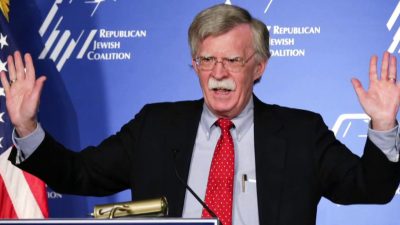 Moscow did not sign any new contracts with Caracas recently, Russia’s Ambassador to Venezuela, Vladimir Zaemsky said, dismissing the Sunday claim by the US National Security Advisor John Bolton.
Bolton claimed on Twitter that Venezuela’s President Nicolas Maduro “grossly mismanaged Venezuela’s resources” and that he inked a new $209-million defense contract with Russia in May, while “hundreds of thousands of Venezuelans went hungry.”
“This is another fiction, which Bolton apparently needs to maintain the illusion that Venezuela is an imaginary threat, and Russia, of course, is to blame,” Zaemsky said.
The US has repeatedly urged Moscow to “get out” of Venezuela and stop military cooperation with the country. Russia, however, rejected such threats, stating that the cooperation with Caracas has been going on for years, and is only set to expand.
‘Japan dismisses US claim that Iran attacked tankers’
Press TV – June 16, 2019
Japanese officials say Tokyo has dismissed a claim by the United States that Iran attacked two oil tankers — both of them carrying “Japanese-related” cargo — in the Sea of Oman.
Japan’s Kyodo news agency cited informed state officials as saying Tokyo had demanded that Washington examine the case further, and that grainy video footage released by the US as supposed evidence was unclear and could not be used to prove anything.
One official said the Japanese government was not convinced by the material, which the official called “nothing beyond speculation.”
The official said Japan’s Foreign Minister Taro Kono had in a Friday phone conversation with US Secretary of State Mike Pompeo demanded more data in the case.
The Japanese-owned Kokuka Courageous and Norwegian-owned Front Altair oil tankers were struck by explosions near the strategic Strait of Hormuz on Thursday morning. Japan’s government said both vessels were carrying “Japanese-related” cargo.
Shortly after the two tankers were hit by the explosions, Pompeo blamed Iran. A day later, US President Donald Trump made a similar claim. Neither offered any evidence, and the footage that was released was said by US officials to show Iranian personnel removing an “unexploded” mine.
Iran has rejected the allegations.
Experts have said the explosions could have been false flags to implicate Iran at the time of a historic visit by Japanese Prime Minister Shinzo Abe to Iran, a first of its kind in more than 40 years. Prime Minister Abe was meeting with Leader of the Islamic Revolution Ayatollah Seyyed Ali Khamenei when the explosions happened.
According to Kyodo, a source close to Prime Minister Abe also said that the footage did not prove an Iranian attack.
Separately, a Japanese Foreign Ministry source said the attack being sophisticated was no reason to blame Iran. Such a characteristic, according to the source, could also implicate the US and Israel — Iran’s main adversaries.
The Japanese operator of one of the tankers also said it had been hit by “a flying object,” not a mine.
A short while after the incident, Iranian rescue officials picked up a distress signal sent by the tankers and scrambled a vessel, which then safely removed the crew from the waters around their burning ships.
‘The video means nothing!’
Independent intelligence experts have expressed doubts about whether the footage released by the US incriminates Iran, as US officials have claimed.
William Church, a former military investigator for the United Nations Security Council, told Newsweek on Saturday that the US had doctored evidence before.
“The US track record on ginning up evidence for war is not good,” he said. “It lied in the run-up to the Vietnam war [by inventing a North Vietnamese attack on a US Navy ship in the Gulf of Tonkin in 1964], and it lied about WMD (weapons of mass destruction) before the Iraq war. So when these tanker attacks happen, we have to ask why and what’s the motivation in addition to examining the evidence.”
Church said much more needed to be known.
“The video means nothing. We need to know how it was taken, when was it taken, what was the total sequence. Then you’d have to talk to the people in the video to get their view of what happened. I would check to see if the video was doctored. You would need to do everything that a trained investigator would do,” he said.
Ayham Kamel, the head of Middle East analysis for the Eurasia Group, an international risk analysis consultancy, suggested that Saudi Arabia might have carried out attacks on the tankers to blame them on Iran because Riyadh was increasingly under pressure from retaliatory strikes by Yemeni Houthis, whom the Saudis claim are Iranian-backed.
“The Saudis are alarmed [by the retaliatory Yemeni strikes,” Kamel said. “Their response is going to be to try to pressure the US into action.”
Anthony Cordesman, a strategic analyst at the Center for Strategic and International Studies, also raised the possibility that Riyadh, or Abu Dhabi or Daesh, could have been behind the incidents.
“One has to keep asking the question, well, if it isn’t Iran, who the hell is it?” he said. “You come up with the possibility that ISIS (Daesh) carried out the attack as trigger to turn two enemies — the United States and Iran — against each other. Or you’re watching Saudi Arabia and the United Arab Emirates create an incident that they can then use to increase the pressure on Iran.”
“The truth of the matter is either you have evidence, or you don’t,” he added. “Is there hard evidence that Iran is guilty? The answer is no.”
Pearl Harbor Unmasked
Book review by J. Alfred Powell • Unz Review • June 16, 2019
Robert B. Stinnett, Day of Deceit: The Truth about FDR and Pearl Harbor (New York, Free Press, 2000)
A Second World War Navy radioman turned journalist, Robert Stinnett was in the National Archives in Belmont, California, researching a campaign-year picture book on George Bush’s South Pacific wartime navy career in aerial reconnaissance — George Bush: His World War II Years (Washington, D.C., Brassey’s, 1992) — and encountered unindexed duplicate copies of Pearl Harbor radio intercept records of Japanese Navy code transmissions — documentary evidence of what actually happened at Pearl Harbor and how it came about. After eight years of further research and a prolonged case at law under the Freedom of Information Act to obtain partial release of these materials, Stinson published Day of Deceit (2000). A Japanese translation appeared within a year, understandably.

Stinnett demonstrates, on the basis of extensive incontrovertible factual evidence and self-evidently accurate analysis that President Roosevelt oversaw the contrivance and deployment of a closely-guarded secret plan to goad the Japanese into attacking Pearl Harbor and monitor them while they did it. Stinnett hypothesizes that Roosevelt did this in order to precipitate an unwilling American public into supporting intervention in the Second World War, but whatever the motives or purposes, the facts are now abundantly clear. Stinnett establishes and proves his case with voluminous documentary evidence, including forty-seven pages of Appendices [p. 261-308] presenting photographic reproductions of key official records, as well as numerous others reproduced in the body of the text, and 65 pages [309-374] of closely detailed reference notes. This evidence proves Stinnett’s factual assertions, arguments and conclusions. His research files and notes are deposited at the Hoover Institute library at Stanford. Day of Deceit is exemplary documentary historiography. It presents the material testimony on which its analysis and conclusions are based. Its validity will be clear to any fair-minded reader. Stinnett’s book settles and resolves rational, candid, honest, fact-based discussion and debate about the background of the attack on Pearl Harbor.
As Stinnett shows, the plan that eventuated in the Japanese attack on Pearl Harbor was set in motion in early October 1940 based on an “eight-action memo, dated October 7, 1940 … by Lieutenant Commander Arthur H. McCollum, head of the Far East desk of the Office of Navy Intelligence.” Of course, it is unlikely that McCollum drafted it on his own initiative, but this is where Stinnett’s paper trail starts. “Its eight actions call for virtually inciting a Japanese attack on American ground, air, and naval forces in Hawaii, as well as on British and Danish colonial outposts in the Pacific region….” [p. 6-8; the memorandum is reproduced on 261-267]:
A. Make an arrangement with Britain for use of British bases in the Pacific, particularly Singapore.
B. Make an arrangement with Holland for the use of base facilities and acquisition of supplies in the Dutch East Indies [now Indonesia].
C. Give all possible aid to the Chinese government of Chiang Kai-shek.
D. Send a division of long-range heavy cruisers to the Orient, Philippines, or Singapore.
E. Send two divisions of submarines to the Orient.
F. Keep the main strength of the US Fleet, now in the Pacific, in the vicinity of the Hawaiian islands.
G. Insist that the Dutch refuse to grant Japanese demands for undue economic concessions, particularly oil.
H. Complete embargo all trade with Japan, in collaboration with a similar embargo imposed by the British Empire.
As the plan unfolded its development was closely monitored through decoded intercepts of Japanese diplomatic and naval radio communications. “McCollum oversaw the routing of communications intelligence to FDR from early 1940 to December 7, 1941 and provided the President with intelligence reports on Japanese military and diplomatic strategy. Every intercepted and decoded Japanese military and diplomatic report destined for the White House went through the Far East Asia section of ONI, which he oversaw. The section served as a clearinghouse for all categories of intelligence reports…. Each report prepared by McCollum for the President was based on radio intercepts gathered and decoded by a worldwide network of American military cryptographers and radio intercept operators…. Few people in America’s government or military knew as much about Japan’s activities and intentions as McCollum.”[8] Knowledge of the plan was closely held, limited to 13 Roosevelt administration members and chief military officers and 21 members of Naval Intelligence and related operations [listed in Appendix E 307-308]. Item C was already US policy when McCollum wrote his memo. Item F was set in motion on October 8, Items A, B and G on October 16, 1940, Item D and E by November 12, 1940. [Chap. 1 n. 8 p. 311-312; 120 ff. etc.].
Meanwhile, also in the fall of 1940, campaigning for a third term in Boston on October 30, President Roosevelt said: “I have said this before, but I shall say it again and again and again: Your boys are not going to be sent into any foreign wars.” On November 1 in Brooklyn he said “I am fighting to keep our people out of foreign wars. And I will keep on fighting.” At Rochester on the 2nd he said “Your national government … is equally a government of peace — a government that intends to retain peace for the American people.” The same day in Buffalo he asserted “Your President says this country is not going to war,” and in Cleveland on the next he declared “The first purpose of our foreign policy is to keep our country out of war.” [William Henry Chamberlin, “How Franklin Roosevelt Lied America Into War,” in Harry Elmer Barnes, Perpetual War for Perpetual Peace (Caldwell, Idaho, Caxton, 1953), Chapter Eight, p. 485-491].
Admiral Richardson, commander of the Pacific Fleet, opposed Roosevelt’s orders [Item F] to station the fleet at Pearl Harbor as putting the fleet at risk, so he was replaced with Admiral Kimmel, with Admiral Anderson of ONI as Kimmel’s third in command at Pearl Harbor, to supervise the radio intercept operation there, unbeknownst to Kimmel. [10-14; 33-34] “Anderson was sent to Hawaii as an intelligence gatekeeper”[36]. When he arrived he established his personal housing well away from Pearl Harbor, out of range of the coming attack. Though he was commander of the seven battleships which bore the brunt of the attack with the loss of over two thousand lives, Admiral Anderson was safe at home on the other side of the mountain when the attack came. [36-37; 244, 247] Meanwhile, the commanders in Hawaii, “Admiral Husband Kimmel and Lieutenant General Walter Short, were deprived of intelligence that might have made them more alert to the risks entailed in Roosevelt’s policy, but they obeyed his direct order of November 27 and 28, 1941: ‘The United States desires that Japan commit the first overt act.’” [6-8] Afterward, they were scape-goated.
In early January 1941 the Japanese decided that in the event of hostilities with the US they would commence with a surprise attack on Pearl Harbor. American intelligence learned of this plan on January 27 [30-32]. On July 21, 1941 Lieutenant Commander McCollum’s Item H lit the fuse. Up through late November the White House continued to block concerted attempts by Japanese diplomats to discuss an accommodation. [On this diplomatic history see Charles Beard , American Foreign Policy in the Making (1946) and President Roosevelt and the Coming of the War (1948); Frederic Rockwell Sanborn, Design For War (1951); and Charles Tansill, Back Door To War (1952).]
Beginning November 16, 1941, radio intercepts revealed the formation of the Japanese fleet near the Kurile Islands north of Japan and from November 26 through the first week of December tracked it across the Pacific to Hawaii [41-59 etc.]. Chief of Naval Operations Admiral Stark (one of the 34 informed participants) ordered Kimmel to dispatch his aircraft carriers with a large escort fleet to deliver planes to Wake and Midway Islands. “On orders from Washington, Kimmel left his oldest vessels inside Pearl Harbor and sent twenty-one modern warships, including his two aircraft carriers, west toward Wake and Midway… With their departure the warships remaining in Pearl Harbor were mostly 27-year-old relics of World War I.” That is, the battleships sunk at Pearl Harbor with their crews were employed as decoys [152-154]. On 22 November 1941, a week after the Japanese fleet began to assemble and four days before it sailed for Oahu, Admiral Ingersoll issued a “Vacant Sea” order that cleared its path of all shipping and on 25 November he ordered Kimmel to withdraw his ships patrolling the area from which the aerial attack would be staged [144-145]. FDR kept close tabs on the plot’s final unfolding while radio intercepts continued to track its voyage toward Hawaii [161-176].
Stinnett comments: “Pearl Harbor’s Battleship Row and its old dilapidated warships presented a mouth-watering target. But it was a major strategic mistake for the Empire. Japan’s 360 warplanes should have concentrated on Pearl Harbor’s massive oil stores … and destroyed the industrial capacity of the Navy’s dry docks, machine shops, and repair facilities”[249]. Six months later, at the battles of Coral Sea (May 4-8, 1942) and Midway (June 4-7), the warships of the Pacific Fleet which were at sea when the attack on Pearl Harbor occurred permanently destroyed the offensive capacity of the Japanese Navy to operate in the eastern Pacific and permanently crippled its defensive capacity in the western Pacific. Thereafter, as informed observers understood, a Japanese attack or invasion of the West Coast of America was a total logistical impossibility. Nevertheless, two months later, the internment of West Coast Japanese American citizens began in August 1942.
The Pearl Harbor coverup began immediately afterward with the court marshals of Admiral Kimmel and General Short, continued through eight Congressional investigations during and after the war, with the purging and withholding of documents and false testimony by participants and others [253-260 & passim; 309-310] and persisted through the Congressional hearings chaired by Strom Thurmond in 1995 [257-258]. At the date of publication (2000) numerous documents were still withheld from Stinnett or released in extensively censored form. But his case is conclusively proven on the basis of the evidence he presents, as any fair-minded reader can see. The only way to refute or debunk it would be to establish that his documentary evidence is forged, and prove it. In face of the character of this evidence, the idea is nonsensical.
A key break for Stinnett’s research was his discovery of duplicate copies of reports of Japanese naval code transmissions from the Pearl Harbor radio-intercept station routed after the war to the Belmont (California) National Archives, and still there long after the copies in the Washington, D.C. archive files had been disappeared. Recent writers pretending to debunk Stinnett’s evidence have resurrected claims that the Japanese naval codes had not been deciphered and that the Japanese fleet maintained radio silence — claims that have been refuted repeatedly for decades. Famously, the radio operator of the American liner Mariposa intercepted repeated signals from the Japanese fleet steaming toward Hawaii and relayed its progressive bearings to the Navy. This was well-known during the war to American seamen of the Pacific merchant marine and is mentioned in published accounts.
The pretense that the Japanese naval and diplomatic codes had not been deciphered was first refuted in a federal court in Chicago in 1943. As her biographer Ralph G. Martin recounts, Cissy Patterson, managing editor of the Washington Times-Herald on December 7, 1941 (and for decades before and after) was opposed to American intervention in another world war — like over 80% of her fellow Americans, including her brother Joe Patterson, publisher of the New York News, and her cousin Robert McCormick, publisher of the Chicago Tribune. Serving in France as a battlefield officer, Robert was wounded, twice gassed, and decorated for valor. His Chicago Tribune, like his cousins’ newspapers and numerous others, especially off the east coast, was vocally anti-interventionist — until Pearl Harbor.
In Cissy (New York, Simon & Schuster, 1979) Martin writes: “As the news of the disaster [at Pearl Harbor] kept coming in [to the Times-Herald’s newsroom], Cissy bitterly asked [her Sunday Editor] Roberts about Roosevelt, ‘Do you suppose he arranged this?’ Later when she learned that American cryptographers had broken the Japanese codes before Pearl Harbor, she was convinced that Roosevelt had known in advance that the Japanese intended to attack”[418]. “The Chicago Tribune, the Times-Herald, and two dozen other papers later printed an article by a Tribune war correspondent which indicated that the United States had prevailed [at Midway] because the Japanese codes had been broken…. The Department of Justice decided to file charges that the Tribune and the Times-Herald had betrayed U.S. military secrets…. Attorney General Francis Biddle felt the disclosure of this breakthrough had been tantamount to treason because it gave the Japanese the chance to change their codes. Waldrop [Times-Herald editor] was called to Chicago to testify before a grand jury… In the middle of the testimony, the Navy disclosed that a Navy censor had passed the Tribune article. Forced to drop the case, Biddle said he ‘felt like a fool.’” [431-432] He wasn’t the only one.
Kushner as a Colonial Administrator: Let’s Talk About The ‘Israeli Model’
By Ramzy Baroud | teleSUR | June 13, 2019
In a TV interview on June 2, on the news docuseries “Axios” on the HBO channel, Jared Kushner opened up regarding many issues, in which his ‘Deal of the Century’ was a prime focus.
The major revelation made by Kushner, President Donald Trump’s adviser and son-in-law, was least surprising. Kushner believes that Palestinians are not capable of governing themselves.
Not surprising, because Kushner thinks he is capable of arranging the future of the Palestinian people without the inclusion of the Palestinian leadership. He has been pushing his so-called ‘Deal of the Century’ relentlessly while including in his various meets and conferences countries such as Poland, Brazil and Croatia, but not Palestine.
Indeed, this is what transpired at the Warsaw conference on ‘peace and security’ in the Middle East. The same charade, also led by Kushner, is expected to be rebooted in Bahrain on June 25.
Much has been said about the subtle racism in Kushner’s words, reeking with the stench of old colonial discourses where the natives were seen as lesser, incapable of rational thinking beings who needed the civilized ‘whites’ of the western hemisphere to help them cope with their backwardness and inherent incompetence.
Kushner, whose credentials are merely based on his familial connections to Trump and family friendship with Israeli Prime Minister, Benjamin Netanyahu, is now poised to be the colonial administrator of old, making and enforcing the law while the hapless natives have no other option but to either accommodate or receive their due punishment.
This is not an exaggeration. In fact, according to leaked information concerning Kushner’s ‘Deal of the Century,’ and published in the Israeli daily newspaper, Israel Hayom, if Palestinian groups refuse to accept the US-Israeli diktats, “the US will cancel all financial support to the Palestinians and ensure that no country transfers funds to them.”
In the HBO interview, Kushner offered the Palestinians a lifeline. They could be considered capable of governing themselves should they manage to achieve the following: “a fair judicial system … freedom of the press, freedom of expression, tolerance for all religions.”
The fact that Palestine is an occupied country, subject in every possible way to Israel’s military law, and that Israel has never been held accountable for its 52-year occupation seems to be of no relevance whatsoever, as far as Kushner is concerned.
On the contrary, the subtext in all of what Kushner has said in the interview is that Israel is the antithesis to the unquestionable Palestinian failure. Unlike Palestine, Israel needs to do little to demonstrate its ability to be a worthy peace partner.
While the term ‘US bias towards Israel’ is as old as the state of Israel itself, what is hardly discussed is the specific of that bias, the decidedly condescending, patronizing and, often, racist view that US political classes have of Palestinians – and all Arabs and Muslims, for that matter; and the utter infatuation with Israel, which is often cited as a model for democracy, judicial transparency and successful ‘anti-terror’ tactics.
According to Kushner a ‘fair judicial system’ is a condition sine qua non to determine a country’s ability to govern itself. But is the Israeli judicial system “fair” and “democratic”?
Israel does not have a single judicial system, but two. This duality has, in fact, defined Israeli courts from the very inception of Israel in 1948. This de facto apartheid system openly differentiates between Jews and Arabs, a fact that is true in both civil and criminal law.
“Criminal law is applied separately and unequally in the West Bank, based on nationality alone (Israeli versus Palestinian), inventively weaving its way around the contours of international law in order to preserve and develop its ‘(illegal Jewish) settlement enterprise’,” Israeli scholar, Emily Omer-Man, explained in her essay ‘Separate and Unequal’.
In practice, Palestinians and Israelis who commit the exact same crime will be judged according to two different systems, with two different procedures: “The settler will be processed according to the Israeli Penal Code (while) the Palestinian will be processed according to military order.”
This unfairness is constituent of a massively unjust judicial apparatus that has defined the Israeli legal system from the onset. Take the measure of administrative detention as an example. Palestinians can be held without trial and without any stated legal justification. Tens of thousands of Palestinians have been subjected to this undemocratic ‘law’ and hundreds of them are currently held in Israeli jails.
It is ironic that Kushner raised the issue of freedom of the press, in particular, as Israel is being derided for its dismal record in that regard. Israel has reportedly committed 811 violations against Palestinian journalists since the start of the ‘March of Return’ in Gaza in March 2018. Two journalists – Yaser Murtaja and Ahmed Abu Hussein – were killed and 155 were wounded by Israeli snipers.
Like the imbalanced Israeli judicial system, targeting the press is also a part of a protracted pattern. According to a press release issued by the Palestinian Journalists Union last May, Israel has killed 102 Palestinian journalists since 1972.
The fact that Palestinian intellectuals, poets and activists have been imprisoned for Facebook and other social media posts should tell us volumes about the limits of Israel’s freedom of press and expression.
It is also worth mentioning that in June 2018, the Israeli Knesset voted for a bill that prohibits the filming of Israeli soldiers as a way to mask their crimes and shelter them from any future legal accountability.
As for freedom of religion, despite its many shortcomings, the Palestinian Authority hardly discriminates against religious minorities. The same cannot be said about Israel.
Although discrimination against non-Jews in Israel has been the raison d’être of the very idea of Israel, the Nation-State Law of July 2018 further cemented the superiority of the Jews and inferior status of everyone else.
According to the new Basic Law, Israel is “the national home of the Jewish people” only and “the right to exercise national self-determination is unique to the Jewish people.”
Palestinians do not need to be lectured on how to meet Israeli and American expectations, nor should they ever aspire to imitate the undemocratic Israeli model. What they urgently need, instead, is international solidarity to help them win the fight against Israeli occupation, racism and apartheid.
EU Blasted for Ever Closer Co-Operation with Terror Regime in Israel
By Stuart Littlewood | American Herald Tribune | June 13, 2019
155 European Researchers and academics have delivered a stinging rebuke to Federica Mogherini, High Representative of the European Union for Foreign Affairs & Security Policy and Vice-President of the European Commission, and Carlos Moedas, European Commissioner for Science, Research & Innovation.
In a beautifully crafted letter they express the outrage felt throughout the world, and especially in European countries including the UK, at the EU’s policy of rewarding the war crimes and crimes against humanity committed by Israel. Each new act of unspeakable brutality, each new onslaught of disproportionate force against civilians brings fresh privileges, fresh co-operation, fresh embraces from an enthusiastic EU elite.
Perhaps the most shameful thing about Europe’s relations with Israel is the EU-Israel Association Agreement which came into force in 2000. This is about special trading and other privileges and its purpose is to promote (1) peace and security, (2) shared prosperity through, for example, the creation of a free trade zone, and (3) cross-cultural rapprochement. It governs not only EU-Israel relations but Israel’s relations with the EU’s other Mediterranean partners, including the Palestinian National Authority.
To enjoy the Association’s privileges Israel undertook to show “respect for human rights and democratic principles” as set out as a general condition in Article 2, which says: “Relations between the Parties, as well as all the provisions of the Agreement itself, shall be based on respect for human rights and democratic principles, which guides their internal and international policy and constitutes an essential element of this Agreement.”
“Essential” being the operative word. Respecting human rights and democratic principles is not optional. Article 2 allows steps to be taken to enforce the contractual obligations regarding human rights and to dissuade partners from pursuing policies and practices that disrespect those rights. The Agreement also requires respect for self-determination of peoples and fundamental freedoms for all.
Well, that’s a joke for a start. Given Israel’s contempt for such principles the EU, had it been an honourable group, would have enforced Article 2 and not let matters slide. They would have suspended Israel’s membership until the regime fully complied. Israel relies heavily on exports to Europe so the EU could by now have forced an end to the brutal occupation of the Holy Land instead of always rewarding it.
The signatories to the letter to Mogherini and Moedas aptly quote the warning by Israel’s own human rights group B’Tselem: “If the international community does not come to its senses and force Israel to abide by the rules that are binding to every state in the world, it will pull the rug out from under the global effort to protect human rights in the post-WW2 era.”
Here is that excellent letter:
To Ms. Federica Mogherini – High Representative of the European Union for Foreign Affairs and Security Policy
To Mr Carlos Moedas – European Commission, DG for Research and Innovation
Brussels, June 4, 2019
Re: Letter from European researchers and academics concerning Israel’s participation in Horizon Europe
Dear Ms. Federica Mogherini, Dear Mr. Moedas,
We researchers and academics from Europe are writing to you in order to express our deep concern about the participation of Israel and its military companies in EU Research Programs. While we write, new Israeli raids flare up and the smoldering remnant of Gaza protesters of the Great March of Return, already forgotten and forsaken. More than 270 unarmed civilians were killed during the March of return, including women, children and persons with disabilities and thousands more were injured [28.939, of whom 7.247 by live fire]. They were only demanding their rights enshrined in international law: end of the illegal blockade and for the right of return to their ancestral homes from which they were expelled.
A report of the United Nation’s Independent Commission of Inquiry published earlier this year concluded that the Israeli army might have committed war crimes and crimes against humanity by indiscriminately killing health workers, journalists and unarmed protesters who did not pose any imminent threats to the soldiers.
Relentless violence rages again after 11 years of inhumane siege and three military assaults that shattered the fabric of normal life. Gaza is declared to be uninhabitable by 2020 according to a report by the UN, but this “environmentally defined” deadline reflects only the intentionality of an imposed series of emergencies, followed each time by a further decrease in health, energy, food independence and commerce after each episode of armed aggression since 2007.
The hermetic siege combined with the systematic large scale military destruction is slowly strangling nearly the two million inhabitants of Gaza. None of the basic civilian infrastructure such as hospitals and power plants, was ever sufficiently rebuilt after each of the three military assaults due to severe restrictions by the blockade. Electricity is available only a few hours a day, 98% of water is not drinkable, and many hospitals periodically stop functioning due to lack of medication, spare parts of machinery, electricity and fuel. Permission for patients to leave in order to receive life-saving treatment elsewhere has been continually declining in time. Tools for education, number of teachers, and rebuilding of schools are severely impaired. The inhabitants of Gaza have been consistently denied basic human rights and human dignity.
The disproportionate use of force on the civilians amounting to war crimes has also been systematic throughout all, long and short term, military operations, including the almost daily assaults to fishermen and agricultural workers.
These facts have been meticulously documented in authoritative reports by the UN and human rights organizations and widely condemned by the international community. Yet Israel’s policies of aggression and repression have continued.
This ongoing impunity is allowing Gaza, the world’s largest open air prison, to be used as a military testfield. In each offensive Israel deployed, tested and perfected new high-tech military weapons and surveillance systems. These new cutting edge high-tech products are exhibited and sold as “battle-tested”, an exclusive label Israeli home land security industry boasts. Israel became the world’s top arms exporter per capita.This grave violation of human rights is thus highly profitable for Israel’s war industry disclosing another side of the claim of “only self-defense” and the interests beyond the lack of measure in the aggressions on Palestinians of Gaza.
Nonethelss, in spite of continual and serious breaches of international law and violation of human rights, and regardless of the commitment for upholding human rights of European countries, Israel enjoys an exceptionally privileged status in dealing with Europe also through the Association Agreement and has been receiving grants from the European Commission in the area of research and innovation (FP7 and its successor Horizon 2020).
Funds are granted even to Israeli arms producers such as Elbit Systems and Israel Aerospace Industries Ltd. (IAI), the producers of lethal drones that were used in the Gaza military assaults against civilians, together with numerous academic institutions that have close ties with Israeli military industry.
We appeal to the European Union to impose a comprehensive military embargo on Israel, as long as Israel continues to blatantly violate human rights. We are deeply disturbed that public funds contributed by European tax payers are channeled to a country that not only disregards human rights but also uses most advanced knowledge and technology for the very violation of human rights. We believe that knowledge and innovation should serve progress in humanity and society, not to develop dual use or military research of a country that has a record history of grave human rights violations. This is not compatible with the values Europe upholds.
In 2017 more than 150 European trade unions, political parties, human rights organizations and faith groups from over 16 European countries issued a call urging the EU to uphold its legal responsibilities and exclude Israeli military companies from EU Framework Programs.
We support Amnesty International call for a military embargo on Israel issued last year following the attacks on the unarmed protesters of the Great March of Return using maiming bullets and brutal means by the Israeli army, unnecessary in that context.
Youth of Gaza appealed to you to stop funding Israeli manufacturers of weapons and surveillance system that guard their open-air prison, maimed them and destroyed their future. In support of their outcry we call upon European Union and European Commission to suspend the Association Agreement with Israel and exclude Israel as an eligible partner for Horizon Europe (successor of Horizon 2020), as long as it refuses to comply with the rules of international law. We also share the concern of B’Tselem, Israeli human rights organization, which stated “If the international community does not come to its senses and force Israel to abide by the rules that are binding to every state in the world, it will pull the rug out from under the global effort to protect human rights in the post-WWII era.”
Signatories*:
1.Dr. Nozomi Takahashi, Center for Inflammation Research, VIB-Ghent University, Belgium
2.Prof. Marc Van Ranst,Department of Microbiology, Immunology and Transplantation, KU Leuven,Belgium
3.Dr. Leander Meuris, Medical Biotechnology, VIB-Ghent University, Belgium
4.Prof. Tarek Meguid,
5.Prof. Em. John Dugard, Universities of Leiden and the Witwatersrand (UN Special Rapporteur onthe human rights situation in the Occupied Palestinian Territory 2001-2008)
6.Prof. Em. Herman De Ley, Ghent University, Belgium
7.Dr. Andrea Balduzzi, Università di Genova, Italy
8.Prof.Giuliano Donzellini, University of Genua, Italy
9.Prof.Sergio Morra,University of Genua, Italy
10.Prof. Paolo Bartolini, University of Genua, Italy
11.Dr.Angela Waldegg, Austria
12.Prof. Salvatore Palidda,University of Genua, Italy
13.Andrea Sbarbaro,office worker (psychologist),University of Genua, Italy
14.Prof.Marcello Maneri, University of Milano-Bicocca, Italy
15.Dr.Syksy Räsäne, University of Helsinki, Finland
16.PhD. Prof. Haseeb Shehadeh, University of Helsinki, Finland
17.Paola Manduca, Former Associate Professor Genetics,University of Genoa, Italy
18.Prof. Em.Giorgio Forti, Unuversità degli Studi di Milkano, Italy
19.Adjunct Professor Pertti Multanen, University of Tampere, Finland
20.Dr. Angela Flynn, University College Cork, Ireland
21.Docente ordinario Giuseppe Mosconi, Università di Padova, Italy
22.Prof.Anna Boato, Uniiversità di Genova, Italy
23.Dr. Ronit Lentin, Trinity College Dublin, Ireland,
24.Mathias Urban, Desmond Chair of Early Childhood Education, Dublin City University, Ireland
25.Prof. Sancia Gaetani, Già Istituto Nazionale Nutrizione, Italy
26.James Roche, Lecturer,Technoligical University Dublin, Ireland
27.Prof. Angelo Baracca,University of Florence, Italy
28.Prof.Giorgio M. Giallocosta, University of Genoa, Italy
29.Prof PhD Alessandro Bianchi, Department Informatics – Univ. Bari, Italy
30.Em. Prof Elisabetta Donini, University of Turin, Italy
31.Prof. Luca Queirolo Palmas,University of Genoa, Italy
32.Rosella Franconi, Senior scientist, Italy
33.Pediatric surgeon Bruno Cigliano, University “Federico II” Naples-Italy
34.Prof. Vittorio Agnoletto,University of Milan, Italy
35.Em. Prof.Andrea Frova, Università di Roma “La Sapienza”, Physics Dept, Italy
36.Em. Prof. Mariapiera Marenzana, Ministry of Education, Italy
37.Massimo Di Rosa, Italy
38.Prof. Iain Chambers, University of Naples, “Orientale”, Italy
39.Dr. Paola Rivetti, Dublin City University, Ireland
40.Prof. Lidia Curti, University of Naples, Italy
41.Phd. Kati Juva, Helsinki University Central Hospital, Finland
42.Hessel Christiane, Epouse de l’Ambassadeur de France Stéphane Hessel, France
43.Phd. Bruno Lapauw, Ghent University, Belgium
44.Prof. Matthieu Lenoir, Ghent University, Belgium
45.Prof. Stef Craps, Ghent University, Belgium
46.Prof. Dr. De Baerdemaeker Luc, Ghent University, Belgium
47.Ana Cabal, University of Antwerp, Belgium
48.Dr. Kristina Mercelis, Belgium
49.Arch assistant. Geert Pauwels, Vrije Universiteit Brussel, Belgium
50.R. Van Laere, Royal academy for Archaeology of Belgium
51.Prof. Karel Arnaut, KU Leuven – IMMRC, Belgium
52.Prof. Dr.Willie van Peer, University of Munich, Austria
53.Prof. Dr. Em. Frans Daems,University of Antwerp, Belgium
54.Omar Jabary Salamanca, Ghent University, Belgium
55.Prof. Jan Delrue, KU Leuven University, Belgium
56.Em. Prof. Christian Kesteloot, KU Leuven University, Belgium
57.Prof. Em. Aviel Verbruggen, University of Antwerp, Belgium
58.Medical student Serhat Yildirim,Ghent University , Belgium
59.Prof. Emer. Piet Mertens, KU Leuven, Belgium
60.Associate Professor Nadia Fadil, KU Leuven, Belgium
61.Em. Prof. Dr. Patric Jacobs, Ghent University, Geology Deparment, Belgium
62.Honourary Professor Michel Vanhoorne, Ghent University, Belgium
63.Docent Jan Wyns, Belgium
64.Em. Prof. Marc David, Universiteit Antwerpen, Belgium
65.Prof. Pieter Rombouts, Ghent University, Belgium
66.Mireille Gleizes, Belgium
67.Dr. Barbara Van Dyck, University of Sussex, UK
68.Em. Prof. Claude Veraart, University of Louvain (UCL), Belgium
69.Professeur Honoraire Pierre Gillis, Université de Mons, Belgium
70.Researcher Patrick Italiano, University of Liege, Belgium
71.Professeur Ordinaire Honoraire André Gob, Université de Liège, Belgium
72.Researcher Jacques Moriau, ULB, Belgium
73.Philosopher Marc Vandepitte, Technische Scholen Mechelen, Belgium
74.Abdessalam Faraj, Belgium
75.PhD Gillet S. University of Namur, Belgium
76.Em. Prof. Mateo Alaluf, Université Libre de Bruxelles, Belgium
77.Prof. Em. Biesemans Monique, Vrije Universiteit Brussel, Belgium
78.Em. Prof. Fred Louckx, Vrije Universiteit Brussel, Belgium
79.Prof. Marc Jacquemain, University of Liege, Belgium
80.Prof. Germain Marc, Université de Lille, France
81.Professeur-chercheur Lucienne Strivay, Université de Liège, Belgium
82.Prof. Gilles-Maurice de Schryver, Ghent University, Belgium
83.Researcher Andrew Crosby, Université libre de Bruxelles, Belgium
84.Prof. Bert Cornillie, KU Leuven, Belgium
85.Docent Dario Giugliano, Accademia di Belle Arti di Napoli, Italy
86.Prof. de Beer Daniel, Université Saint-Louis, Belgium
87.Researcher M Louise Carels, Université de Liège, Belgium
88.Prof. Victor Ginsburgh, Université libre de Bruxelles, Belgium
89.Em. Prof. Heinz D. Hurwitz, Université Libre de Bruxelles, Belgium
90.M.A. Maria Aurora De Angelis, SOAS University of London, UK
91.Dr. Jef Peeters, KU Leuven, Belgium
92.Em. Prof. Magda Devos, University of Ghent, Belgium
93.Em. Prof. Norbert Van den Bergh, Gent University, Belgium
94.Em. Prof. Stefan Kesenne, University of Antwerp, Belgium
95.Prof. Dr. Em. Madeline Lutjeharms, Vrije Universiteit Brussel, Belgium
96.Marie Scheirlinck, Belgium
97.Koen Verrept, VUB, Belgium
98.Prof. Roberto Beneduce, University of Turin, Italy
99.Prof. Patricia Willson, Université de Liège, Belgium
100.Em. Prof. Christiane Schomblond, Université Libre de Bruxelles, Belgium
101.Em. Prof. Florimond De Smedt, Vrije Universiteit Brussel, Belgium
102.Professeur Honoraire Mormont Marc, Université de Liège, Belgium
103.Dr. Zahidi, University of Antwerpen, Belgium
104.PhD Leena Saraste, Finland
105.Em. Prof. P. Marage, Université Libre de Bruxelles, Belgium
106.Em. Prof. Michel Gevers, Université catholique de Louvain, Belgium
107.Senior Research Associate Giselle Corradi, Ghent University, Belgium
108.Tiziana Terranova, Italy
109.Honorary Prof. Albert Martens, Katholieke Universiteit Leuven, Belgium
110.Em. Prof. Vandermotten Christian, Université Libre de Bruxelles, Belgium
111.Prof. Jean-Claude Gregoire, Université libre de Bruxeles, Belgium
112.Researcher Xavier May, Université Libre de Bruxelles, Belgium
113.Dr. Duez Colette, University of Liege, Belgium
114.Phd Tanneke Herklots, the Netherlands,
115.Em. Prof. Marc De Meyere, Gent University, Belgium
116. Researcher Antonio Mazzeo, Italy
117. Prof. Michele Carducci, UniSalento – Lecce, Italy
118. Prof. Carine Defoort, KU Leuven, Belgium
119. Dr. Chiara Cardelli, Institute for Quantum Optics and Quantum Information Vienna, Austria
120. Prof. Em. Pieter Saey, Gent University, Belgium
121. Independent scholar Celeste Ianniciello, Italy
122. Em. Prof. Jonathan Rosenhead, London School of Economics, UK
123. Prof. Dr. Em. Erik Van der Straeten, Belgium
124. Prof. James Dickins, University of Leeds, UK
125. Dr. Tajul Islam, University of Leeds, UK
126. Dr. Barry Heselwood, University of Leeds, UK
127. Patrik Lasure, Pax Christi Vlaanderen, Belgium
128. Wim Nerinckx, Belgium
129. René Weemaels, Belgium
130. André Posman, Belgium
131. Technician Kelly Lemeire, University of Ghent, Belgium
132. Em. Prof. Schomblond Christiane, Université Libre de Bruxelles, Belgium
133. Dr. Gie Van Den Berghe, University Gent, Belgium
134. Rasha Soliman, University of Leeds, UK
135. Simona Antonova, UMC Utrecht, the Netherlands
136. PhD Michail Mamantopoulos, Belgium
137. Dr. Tom Moerenhout, Graduate Institute of International and Development Studies, Switzerland
138. Prof. Dirk Vandermeulen, KU Leuven, Belgium
139. Em. Prof. Heinz Hurwitz, Université Libre Bruxelles, Belgium
140. Sénateur Honoraire Galand Pierre, Belgium
141. Prof. Megan Povey, University of Leeds, UK
142. Branch President UCL UCU Sean Wallis, University College London, UK
143. Dr. M Akhtar, University of Leeds, UK
144. Tom Hickey, University of Brighton, UK
145. Dr. Karen Evans, University of Liverpool, UK
146. Dr. Anne Alexander, University of Cambridge, UK
147. Dr Anandi Ramamurthy, Sheffield Hallam University, UK
148. Prof. Franco Montanari, University of Genoa, Italy
149. Dr. Stephanie Kourula, Belgium
150. Em. Prof. Chris Roberts, University of Manchester, UK
151. Researcher- PhD student Ainhoa Ruiz Benedicto, Centre Delàs d’Estudis per la Pau, Spain
152. Tica Font, Centre Delàs d’Estudis per la Pau, Spain
153. Researcher Edgard Vega, Centre Delàs d’Estudis per la Pau, Spain
154. Ph Dr. Retired Assistant Professor Xavier Bohigas, Uinversitat Politècnica de Catalunya, Catalonia-Spain
155. Prof. Jan Dumolyn, University of Ghent, Belgium
* Institutions are added for identification purposes only. All signatories have signed the letter in a personal capacity
An Electronic Engineer in Orwell’s Britain
By Eve Mykytyn | June 13, 2019
Dr. Ali was dismissed from his job at the University of Essex for alleged anti Semitism. The charges stemmed from his opposition to a new campus society, a branch of the Zionist organization, the Union of Jewish Students (UJS) and from four of the many posts Dr Ali has made to Facebook over the last ten years. For more: SEE. Dr. Ali’s story makes plain that although the University claimed to dismiss him for anti Semitism, in fact he was dismissed for anti Zionism. The following interview with Dr Ali will be one of the first articles in which he will be able to tell his side of the story, which differs in important ways from the story told in the British press.
EM: Can you give us a brief bio, including where you grew up and your academic background?
MA: My family moved to London from the then newly independent country of Bangladesh in 1975 when I was seven,. We came as refugees, we had lost 22 members of our family including my elder brother who was murdered when he was barely thirteen. My father was a Professor of History and a Barrister (Lincoln’s Inn).
I grew up in the eastern suburbs of London and was educated at Chigwell School in Essex. I earned my PhD in Electronic Engineering at King’s College London. I have spent most of my career as a university lecturer in the UK.
EM: How did you get involved in the debate over the new Jewish society? Were you opposed to the formation of any Jewish group?
MA: At the University of Essex, student union members are invited by email to vote on any new student society, and a favorable vote by a majority is required for formation. Before a vote, the proposed society must clearly state its aims and objectives.
I read UJS’s manifesto and did not agree with their zealous promotion of Zionism and the state of Israel. That was my only concern. I was not voting against Jews, Judaism or their culture. When I was a student, I voted against the formation of political Islamic societies even though I am a Muslim.
The same concerns regarding the political Zionist basis of the UJS were raised by Student Union Committee Members, the University Amnesty Society, the University Palestinian Solidarity Group and 240 other students. I would like to stress that I did not and would not vote against the formation of a Jewish Society that was not politically Zionist.
EM: Did any of your students complain of anti-Semitism? Did the issue ever come up in one of your classes?
MA: I never discuss religion or politics in my lectures nor have the issues of Zionism or anti Semitism ever come up in any of my classes during my career. There has never been any complaint made against me by any student at the University or at any university at which I have taught.
Two former students, one a 50+ year old ex-British soldier, wrote a letter to Human Resources at the University defending me and stating that I was always inclusive, never discussed religion or politics and that I was an excellent lecturer. The other, a woman who is an ex- US marine who heard about my case, wrote to the Vice Chancellor directly. Neither letter was taken into consideration by the University.
EM: Why do you think you were singled out? Were there other opponents of the UJS?
MA: I made a comment on the University Palestinian Solidarity Facebook page that Zionists were trying to create a society at our University. Someone asked why I was against Jews. I replied that I was not against Jews, their religion or their culture. I was opposed to the Zionist ideology presented in the society’s manifesto. In my 10 years on Facebook, I have never posted anything supporting the destruction of the state of Israel.
Obviously, I was singled out. The media falsely portrayed me as a ringleader of the 240 students who voted against the UJS. I did not urge these students to vote ‘no.’ I am a part-time Bangladeshi lecturer without powerful connections, and a bearded Muslim Asian – I was a useful scapegoat for their witch hunt.
The media failed to report that the vote was cancelled because of the 240 ‘no’ votes. After that, the UJS changed their manifesto and softened their wording regarding Israel and Zionism. They denied making this change, even though some students had screenshots of the two different manifestos.
I was asked to be part of a second vote, but I declined and did not vote. Part way thorough the second vote, the Vice Chancellor cancelled the election and created UJS as a “University” society. Later on, the Student Union revealed that ‘“some” of the 600 votes in favor of the UJS had been cast “externally” by non-students.
The University tribunal charged me based on the UJS’s second less political manifesto, to which I never objected nor even voted on. Despite my vehement objection the University failed to take notice that it was the first manifesto to which I and others objected.
EM: So all you did was post an objection to the UJS based on their first, more extreme manifesto and then vote against it?
MA: Yes
EM: What about the Facebook posts they claimed were anti Semitic?
MA: The tribunal considered six posts and dismissed two of them. Until the tribunal no one had ever complained about a post of mine and Facebook never warned or took any action against me. The posts they considered were as follows.
1. A post from smoloko.com I made four years ago that a French police officer allegedly killed in terror attacks in Paris was actually a Mossad agent. There are many such theories about the 2015 attacks and I posted it for discussion purposes.
2. In 2016 I posted that 50,000 Jews in New York protested Israel’s policies and that the event was not really covered by the media. In the tribunal, I pointed out that my post clearly distinguished between Jews and Zionists
3. Posted on 1 August 2018 and clearly labeled as ‘revisionist history’ was a quote from Edgar Steele that the number of Holocaust survivors receiving pensions exceeded the number of Jews in Europe before the Holocaust.
4. A post on 17 January 2019 stating that the Jews put Palestinians in concentration camps. The Tribunal said I was comparing Jews to Nazis by the use of the word “concentration.” My Jewish Union rep. objected, pointing out that it was the British who originated the term ‘concentration camp’ when they used them in South Africa.
EM: You are not anti Semitic but you do have problems with the behavior of the state of Israel? Who defended you and what procedure did the University follow in making its decision?
MA: I am not anti-Semitic and the investigation and the tribunal both found that I, as a person, was not anti-Semitic. I do have problems with all kinds of oppression; against humans, animals or the environment. As I told the tribunal, I have criticised almost all governments. The tribunal brushed aside my criticism of Israel’s oppressive activities. My opinions were backed up by reports from the UN, the Red Cross, Israeli human rights organisations and newspapers like Haaretz.
I was defended personally by one University Union member, a Professor who is Jewish, but who has not given me permission to reveal his name. He told the tribunal that he believed that neither I nor my posts were anti-Semitic even though he did not agree with some of the posts.
Prominent Jewish voice for Peace (JVP) member, Prof. Haim Bresheeth, an Israeli-British film maker and a Professor at the University of London, wrote to the Vice Chancellor on my behalf. He made clear the distinction between Zionism and Judaism and wrote that opposing Zionism or criticizing Israel is not anti Semitism. In addition, renowned Professor, Norman Finkelstein, wrote a letter of support for me.
The University claimed my case had been investigated by “independent” investigator Nigel Youngman. My objections to the lack of actual investigation by Mr. Youngman were totally disregarded by the tribunal. He did not interview any of the key witnesses, not the 240 students who voted no, not a single member of the University’s Amnesty Society or Palestinian Society, and not members or staff at the Student Union. Youngman never asked anyone why he objected to the first manifesto or why there were two manifestos. When he spoke to the tribunal he read from the second less extreme manifesto as if that was the one to which I had objected, although I had repeatedly told him that my reaction was to the first manifesto.
The University’s rules provided me the right to present a witness. I informed the tribunal that I intended to bring Prof. Bresheeth, and although I followed their procedural rules, the tribunal denied me my right to a witness claiming only a certain date was available as the tribunal was to be attended by “very important” people.
I knew as soon as the tribunal began that the University intended to dismiss me. They followed their procedures only to the extent that they would not affect the preordained outcome. For example, Prof. Andrew Le Sueur, who acted as prosecutor, instructed the tribunal to ignore the letters from Prof Finkelstein and Prof Bresheeth and not to take JVP’s statement against Zionism into consideration. That made it clear the tribunal was a farce, intended to allow them to dismiss me while pretending to the media that I had been given ‘due process.’
The major problem I faced was that the University treated Zionism as just a harmless Jewish belief. I do not know why they are so ignorant. The University would not listen when I tried to explain that there is a difference between Judaism and Zionism and that many people, including Jews, object to Israel’s actions but are not anti Semitic. I am happy that there were many Jews from JVP who came to my defense.
EM: The University advised you not to speak to the press. Do you now think that advice was for your benefit?
MA: I should not have listened to them since I believe the decision to dismiss me was made well before the hearing. From the beginning, I wanted to set the record straight and explain that I was not at all the person the media portrayed. I had written a careful apology to the University and, contrary to my expectations, the University did not share either my position or my apology.
EM: What have been the other effects of the dismissal? Will you be able to get another academic job in the UK?
MA: I have been dismissed from all my other part-time positions, including my work for St John Ambulance. When St John first investigated the allegations, I was found not to be anti Semitic. After the University dismissed me, St John fired me.
I have lost all sources of income, a financial loss I am not in a position to cover. It seems this is the penalty imposed upon opponents of Zionism.
I am not sure if I can find another job in the UK let alone an academic job. I could only be employed by someone who is willing to stand up to Zionist bullying and intimidation.
EM: Did you receive any hate mail?
MA: Yes I received a barrage of xenophobic, Islamophobic hate emails, threatening death to my family and me. Careful examination revealed that all the emails originated from only 14 unique email addresses. The British police are currently investigating these threatening emails.
In addition, there was a smear campaign against me as nearly all the 65 pages of British newspaper and online articles were essentially copied from an unfavorable and inaccurate article in the Jewish Chronicle.
EM: Was a police complaint or legal action filed against you?
MA: No police action has been taken against me, even though some of the hate emails claimed that I was being reported to the police for hate crimes and anti Semitism.
EM: Has your family faced discrimination in the UK? Is there is a double standard?
MA: Yes, my children have faced terrible discrimination. Some boys at his school threw my eldest son on the ground and tried to force feed him pork. He was called many horrible names including ‘terrorist.’ His school took no action against the boys who assaulted my son.
There is a clear double standard at the University of Essex. Two examples:
A Muslim Bangladeshi staff member was threatened by his immediate boss, a Latvian, who said any Muslim who came to his country would be murdered by him. He was reported but the University has done nothing in response to the threat.
A Muslim woman, a student, was harassed by her flatmate, a staff member of the University’s Law School. He told her: “your religion will make you bomb a building.” In front of a witness he said, “I can do whatever I want with you and I will not be punished for it.” She suffered death threats, physical abuse, and eventually left the school. A police lawsuit was shelved for lack of evidence despite a witness and a bruised arm. The University did not see that he breached any code of conduct, instead the University is doing everything to protect this staff member and have threatened a lawsuit if his name is revealed. More information can be found at this link: https://www.facebook.com/516992240/posts/10157873235557241?sfns=mo
The University of Essex that claims to have ‘zero tolerance to hate’ seems to apply that standard based upon who the victim is.
Featured Video

No Threat Can Force Iran’s Surrender /Trita Parsi & Lt Cl Daniel Davis
or go to
Aletho News Archives – Video-Images
From the Archives
What is the Israeli Lobby in Australia Doing in Interfaith Dialogue?
By Ali Kazak | Dissident Voice | October 11, 2015
For years Israel and its lobby around the world have been trying to normalise their relations with Arabs and Muslims without solving the Palestine Question.
One of the methods they resorted to in the last few years is using human rights and community organizations such as interfaith dialogue and Multiculturalism to achieve this objective and to: isolate the Palestinians, marginalise the Palestine question, end Israel’s isolation, and prevent criticism of Israel, knowing that these organisations will be the first to stand against Israel’s violations, racial and religious discrimination.
The group responsible for this task in Australia is The Australia/Israel & Jewish Affairs Council (AIJAC); its Director of International & Community Affairs, Jeremy Jones is in charge of lobbying religious community organizations, specifically Muslims and Christians. Consequently he convened the Faith Communities for Reconciliation, founding participant in the Australian Partnership of Religious Organisations and the Australian National Dialogue of Christians, Muslims & Jews.
AIJAC is a private political propaganda group. It is recognised as the main Israeli lobby in Australia. It coordinates its activities and works intimately with the Israeli embassy in Canberra and different institutions in Israel. It is privately funded by some Jewish businessmen. It monitors closely Australian politicians, the media, ethnic and religious groups, (especially Arabs and Muslims), unions and academics on their stands towards Israel and the Palestine question. … continue
Blog Roll
 Aletho News
- ‘Economic terrorism’: Steel facilities hit again in US-Israeli strike
- ‘War Crime’: Iran condemns attacks on Arak, Ardakan nuclear sites
- Two-thirds of Americans want quick end to Iran war even if goals unmet
- Trump to Give “Important Update on Iran” Wednesday in Prime-Time Speech
- Theodore Postol: Iran’s Missiles & Drones Were Underestimated
- Iran To Target Military Industrial-Tech Complex That Facilitated Gaza Genocide
- Collapsing Empire: The Resistance Disarms ‘Israel’
- Suicide Should Not Be a Government Service
- Rethinking America’s greatest threat: Iran vs. Israel-Firsters
- Iran accuses adversaries of false flags to strain Turkey ties
- If Americans Knew
- Ann Coulter Rips Into Fox News for Iran War Coverage
- Joe Kent Urges Americans To Call White House and Congress To Object To Sending Troops Into Iran
- DNC Resolution to Reject AIPAC Funding Puts Democratic Leaders in the Hot Seat
- Swedish foundation to build 400 schools as over 650,000 Gaza children remain without education for 2 years
- Israeli army admits photshopping image of slain Lebanese journalist
- This is how Israel is systematically killing health workers under the cover of war in Lebanon
- Carrying life under fire: Israeli invasion of Lebanon leaves pregnant women facing deadly risks
- Champagne all around for the new death penalty (for Palestinians) law – Not a ceasefire Day 172
- Why are Palestinian books struggling to be seen on Amazon?
- The Line Between Affinity and Conspiracy
- No Tricks Zone
- New Study Finds Warming Saves Lives…Cold Temperatures 12 Times More Deadly Than Excess Heat
- German Science Blog Accuses PIK Climate Institute Of Hallucinating Climate Tipping Points
- Devastating Assessment Of Comirnaty Vaccine By Former Senior Pfizer Europe Toxicologist
- New Study: CO2 Is ‘Effectively Negligible’ As An Explanatory Climate Change Factor Since 2000
- Former Pfizer Toxicologist Dr. Helmut Sterz Tells Bundestag Hearing Pfizer Vaccine Should Have Never Been Approved
- Energy Expert: Germany’s Nuclear Phaseout Was A “500 Billion Euro Mistake”
- New Research: South Australia’s Mid-Holocene Sea Surface Temperatures Were 4°C Warmer Than Today
- Storing Green Energy To Last Germany 10 Days Would Require A 60-Million Tonne Battery
- New Studies: UK Sea Levels Were 4 Meters Higher Than Today During The Mid-Holocene
- Destructive Green New Deal: German Energy And Metal Group Warns Of Drastic Crisis
 Aletho News