Energy Affordability: The Issue Everyone Is Ignoring
By Irina Slav | Oilprice.com | April 4, 2022
The U.S.-EU deal for the import of an additional 15 billion cubic meters of liquefied natural gas this year made headlines earlier this month, with both sides praising their own political prowess and quick action. What nobody talked about was how much this LNG would cost.
Meanwhile, another piece of news that grabbed headlines was the House hearing of half a dozen U.S. and international oil executives on allegations of price-gouging and not helping regular Americans “to relieve pain at the pump, instead lining their pockets with one hand while sitting on the other,” according to two legislators.
These two events are indicative of something that no politician in power would want to admit openly but is nevertheless happening: the cost of living in Europe and the United States is rising. And the root cause of this is not the war in Ukraine. It’s high energy costs.
It was the energy minister of the UAE who shone a light on the problem earlier this week. Speaking to CNBC at the World Government Summit in Dubai, Suhail al Mazrouei said that politicians are focusing too much on geopolitics and ignoring the issue of energy affordability, which is affecting both developed and developing economies.
If they continue to ignore this issue, he said, politicians risk seeing large parts of the world plunged into energy poverty, which would, in turn, lead to economic slowdown for much of the world and global stagnation.
Noting that OPEC+ was doing its best to provide a reliable supply of energy to global markets, Al Mazrouei said, “For that to happen, we need resources – financial resources – we need to invest and we need to decouple politics from energy availability and energy affordability.”
By “politics”, the Emirati official likely means energy transition agendas in Europe and the United States. These depend on lower investment in oil and gas production, and the European gas crunch was the first clear sign what the consequences of this approach could be, because, in all fairness, the European cost of living crisis began a lot earlier than the war in the Ukraine.
In November last year, for instance, six in ten Britons said they had seen an increase in their cost of living. This month, this has risen to eight out of ten as energy costs continue higher. From next month the number could rise further after the energy market regulator introduces the new energy price cap by close to $1,000 per household for some 22 million households.
In Germany, inflation is seen accelerating to 6.1 percent this month, from 5.1 percent in February, according to the Ifo Institute. Soaring energy costs are at the root of this inflation trend, with the Ukraine war now adding inflationary pressure on some food staples as both Ukraine and Russia are big producers. According to Ifo, Germans could lose more than $6 billion in purchasing power by the end of this month alone.
In France, the rising cost of living has boosted the election chances of far-right candidate Marine Le Pen, who is betting strongly on messaging that addresses the purchasing power concerns of French citizens who, like their fellow EU-members in Germany and Britons in newly “exited” UK, have been struggling with rising costs of living.
In the United States, the Fed is preparing for an aggressive push into rate hikes to rein in inflation, which has led several economists, among them Mohamed El-Erian, to warn that such an aggressive step could lead to a cost-of-living crisis. Meanwhile, the White House has announced yet another release of oil from the strategic petroleum reserve in an attempt to cool prices at the pump.
Right now, politicians on both sides of the Atlantic are happily blaming everything on Russia’s President Vladimir Putin. However, sooner or later, the dust will settle, and people will start asking why even though the war is over, energy is still more expensive than it was before. That would be one tough question to answer unless those who may have to answer it heed the warning made by the UAE’s Al Mazrouei.
UK growth falters amid historic cost-of-living surge
Samizdat | April 11, 2022
The UK is facing the biggest decline in living standards since comparable records began in the 1950s, according to an independent forecast.
The London-based Centre for Economics and Business Research (CEBR) released a report on Monday, saying that the “cost of living crisis” has “well and truly” arrived in the UK. CEBR cites the recent uprating of the energy price cap – reflecting the global rise in energy costs – as the reason, saying that average UK households will be paying a whopping 73% more for their energy bill than compared to a year ago. In addition, petrol prices are up by 30% on the year and diesel prices are 36% higher, the report says.
According to the consultancy, in the coming months the consumer price inflation will far outstrip wage growth, jumping by a further 2.5% from its February level of 6.2%, which was the highest in 30 years. While most forecasts expect the UK economy to grow in each quarter of 2022, the energy price crisis will still see the households notably worse off, CEBR notes.
The Bank of England warned in March that inflation in the country is set to hit a 40-year high of 8.7% at the end of the year due to a rise in global energy prices over the past few months. The governor of the Bank of England, Andrew Bailey, also said last month that Britain was heading for the biggest single shock from energy prices since the 1970s, with the economy set to suffer a growth slowdown.
If Hospitals Are Currently Under Pressure, They Only Have Themselves to Blame
By In-house doctor | The Daily Sceptic | April 10, 2022
There follows a guest post by our in-house doctor, a former senior NHS medic, who says the latest ‘perfect storm’ causing pressure on the health service in parts of the country is more a self-induced squall.
In the middle of last week, several NHS Trusts issued warnings about the acute strain their services were under. The South Central Ambulance Service went so far as to declare a critical incident – normally reserved for a situation in which demands on the service exceed the capacity to manage those demands. I was surprised that so many NHS bodies spread over a wide geographical area issued public warnings about their failure to cope at the same time. Statements referred to high demand on services (hardly news) and lacked any specific detail about critical capacity constraints. Accordingly, the Daily Sceptic asked me to interrogate the available data to work out the extent to which a Covid resurgence might be responsible for the latest ‘perfect storm’ to hit the NHS.
Graph 1 shows daily admissions of Covid positive patients from the community. Admissions have risen in the last few weeks, but seem to be tailing off. Data from Graph 1 have been the subject of hysterical articles in the mainstream press implying the latest Omicron BA.2 subvariant may be triggering a new wave of acute Covid infections. It’s not sensible to interpret Graph 1 as a stand-alone figure without considering contextual information from other datasets.
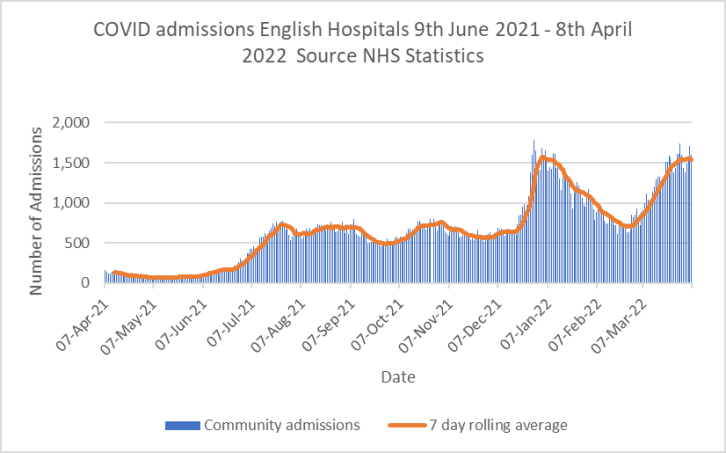
Graph 1
Graph 2 for example shows information from the Primary Diagnosis dataset. Regular readers will recall this set shows the numbers of patients admitted suffering from acute Covid compared to the patients testing positive for Covid but admitted for another condition. The grey line shows the ratio is gradually falling – in other words the headline figures in Graph 1 are misleading, because nearly 60% of those patients are not actually ill with Covid but admitted for other reasons.
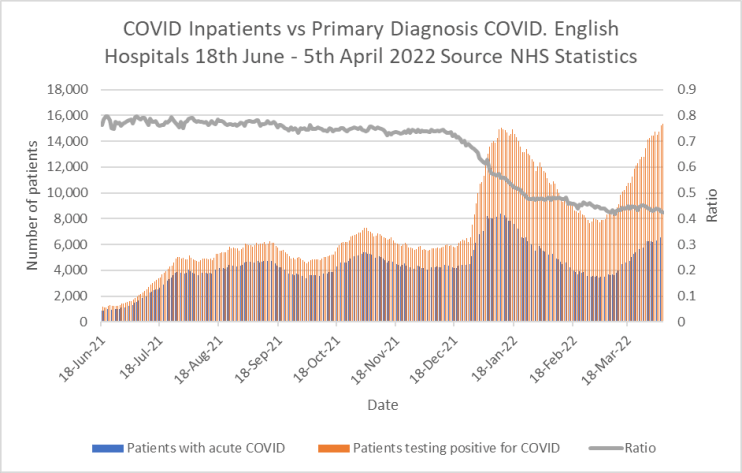
Graph 2
Graph 3 shows the numbers of patients testing positive for Covid in intensive care departments. The rise in cases seen in Graph 1 since the beginning of March 2022 is absent – so although there are more hospital inpatients testing positive for Covid than at the end of February, they are not ending up in critical care. Further, the data from the most recent ICNARC report reveal that the latest tranche of Covid ICU patients have lower oxygen requirements and better respiratory ratios than the cohort from this time last year – in other words, they are not as acutely ill.
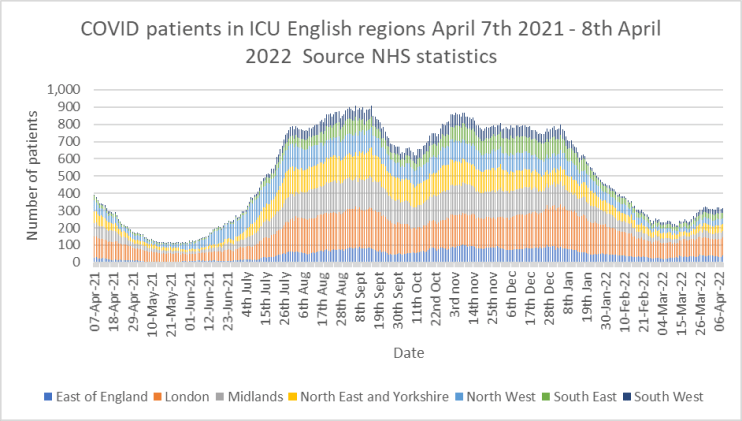
Graph 3
Graph 4 is very instructive. It shows the average length of stays of Covid patients up to the end of December 2021. This data was released in March and unfortunately is only complete up to the end of 2021, but it is reasonable to infer that current length of stay is unlikely to be worse now than in December of 2021, due to increased availability of new monoclonal antibody drugs which reduce disease severity for the highest risk patients. Graph 4 expresses average length of stay as the mean average (blue bars) and the median average (orange bars). Both these averages are steadily reducing with the median length of stay being down to four days by the end of December 2021. For the information of statistically curious readers, the median average in this case is probably more representative of the situation as the mean average can easily be skewed to the upside by a small number of very long-stay patients.
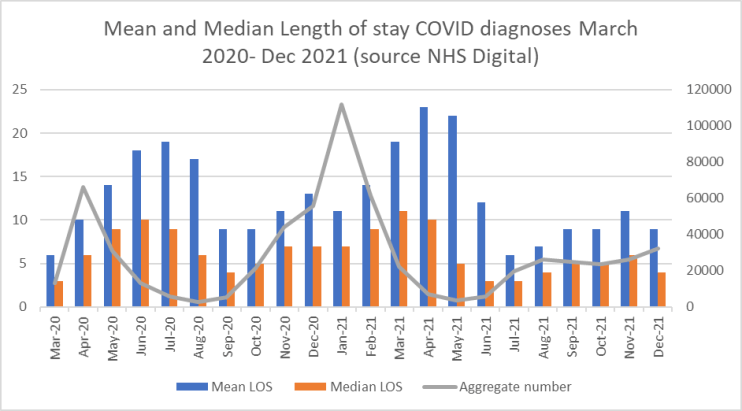
Graph 4
Overall, from the available Covid-specific patient data, we see a rise in total positive Covid tests on admission from the community, but fewer than half of these patients are symptomatic for Covid. Very few patients are ill enough to need ICU care and the length of stay for acutely ill Covid patients continues to fall. The vast majority require a few days of supplementary oxygen, intravenous steroids and monoclonal antibody infusion (or other adjunctive therapies) before being fit to discharge. So where is the problem?
Last week Saffron Cordery, deputy CEO of NHS providers, commented that staff absences played a part in the current crisis. Graph 5 shows the data for Covid related staff absences up to March 2nd (the latest figures released) – they don’t seem to have changed much lately and were on a downward trend since the turn of the year. It’s possible they may have started to increase again, but the figures are not yet released for public scrutiny.
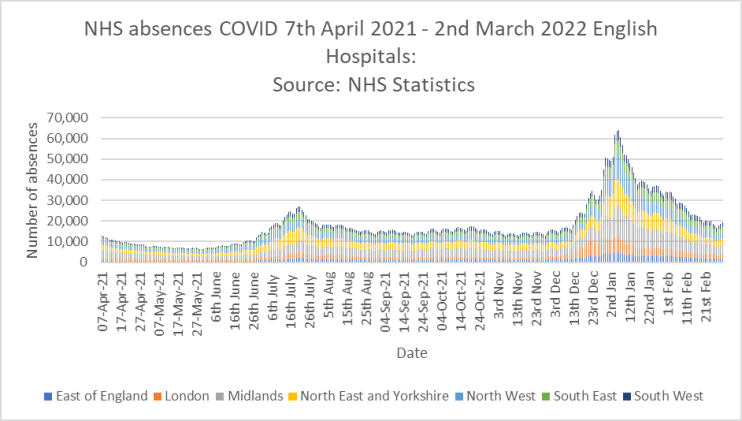
Graph 5
My personal suspicion is that Graph 6 shows the main issue causing trouble in hospitals. Graph 6 shows the number of patients in hospitals deemed medically fit for discharge. It is shown as a stacked bar chart, so the blue bar represents the patients who actually were discharged and the orange bar shows patients who were fit for discharge but had to remain in hospital for administrative reasons (often referred to as ‘bed blocking’). Readers will readily notice the ‘weekend effect’ in the figures, and that about 11,000 patients per day are in hospital when they are fit to be discharged – about 10% of the total NHS bed stock.
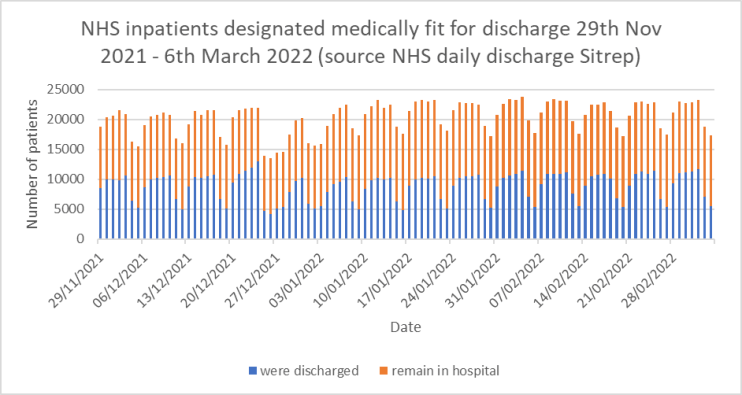
Graph 6
Over two years into the pandemic, the NHS does not yet seem to have solved fundamental administrative problems in relation to patient flow through the system. I am also aware from personal communication with colleagues that most NHS trusts are still imposing unnecessary Covid protocols which add to the time taken to complete basic episodes of care such as routine operations. This reduces efficiency still further in a healthcare system not renowned for operational efficiency in the first place.
Speaking about the latest crisis, Mark Ainsworth, Director of Operations at the South Central Ambulance Service, said declaring a critical incident meant it could focus its resources on the neediest patients.
Discharging medically fit patients from hospital and exercising a modicum of common sense when compiling Standard Operating procedures might achieve the same effect.
Putting Big Pharma on Trial in the COVID-19 Era, Part 4
The Hypocrisy of “Misinformation”
By Rebecca Strong · February 16, 2022
I find it interesting that “misinformation” has become such a pervasive term lately, but more alarmingly, that it’s become an excuse for blatant censorship on social media and in journalism. It’s impossible not to wonder what’s driving this movement to control the narrative. In a world where we still very clearly don’t have all the answers, why shouldn’t we be open to exploring all the possibilities? And while we’re on the subject, what about all of the COVID-related untruths that have been spread by our leaders and officials? Why should they get a free pass?
Fauci, President Biden, and the CDC’s Rochelle Walensky all promised us with total confidence the vaccine would prevent us from getting or spreading COVID, something we now know is a myth. (In fact, the CDC recently had to change its very definition of “vaccine ” to promise “protection” from a disease rather than “immunity”— an important distinction). At one point, the New York State Department of Health (NYS DOH) and former Governor Andrew Cuomo prepared a social media campaign with misleading messaging that the vaccine was “approved by the FDA” and “went through the same rigorous approval process that all vaccines go through,” when in reality the FDA only authorized the vaccines under an EUA, and the vaccines were still undergoing clinical trials. While the NYS DOH eventually responded to pressures to remove these false claims, a few weeks later the Department posted on Facebook that “no serious side effects related to the vaccines have been reported,” when in actuality, roughly 16,000 reports of adverse events and over 3,000 reports of serious adverse events related to a COVID-19 vaccination had been reported in the first two months of use.
One would think we’d hold the people in power to the same level of accountability — if not more — than an average citizen. So, in the interest of avoiding hypocrisy, should we “cancel” all these experts and leaders for their “misinformation,” too?
Vaccine-hesitant people have been fired from their jobs, refused from restaurants, denied the right to travel and see their families, banned from social media channels, and blatantly shamed and villainized in the media. Some have even lost custody of their children. These people are frequently labeled “anti-vax,” which is misleading given that many (like the NBA’s Jonathan Isaac) have made it repeatedly clear they are not against all vaccines, but simply making a personal choice not to get this one. (As such, I’ll suggest switching to a more accurate label: “pro-choice.”) Fauci has repeatedly said federally mandating the vaccine would not be “appropriate” or “enforceable” and doing so would be “encroaching upon a person’s freedom to make their own choice.” So it’s remarkable that still, some individual employers and U.S. states, like my beloved Massachusetts, have taken it upon themselves to enforce some of these mandates, anyway. Meanwhile, a Feb. 7 bulletin posted by the U.S. Department of Homeland Security indicates that if you spread information that undermines public trust in a government institution (like the CDC or FDA), you could be considered a terrorist. In case you were wondering about the current state of free speech.
The definition of institutional oppression is “the systematic mistreatment of people within a social identity group, supported and enforced by the society and its institutions, solely based on the person’s membership in the social identity group.” It is defined as occurring when established laws and practices “systematically reflect and produce inequities based on one’s membership in targeted social identity groups.” Sound familiar?
As you continue to watch the persecution of the unvaccinated unfold, remember this. Historically, when society has oppressed a particular group of people whether due to their gender, race, social class, religious beliefs, or sexuality, it’s always been because they pose some kind of threat to the status quo. The same is true for today’s unvaccinated. Since we know the vaccine doesn’t prevent the spread of COVID, however, this much is clear: the unvaccinated don’t pose a threat to the health and safety of their fellow citizens — but rather, to the bottom line of powerful pharmaceutical giants and the many global organizations they finance. And with more than $100 billion on the line in 2021 alone, I can understand the motivation to silence them.
The unvaccinated have been called selfish. Stupid. Fauci has said it’s “almost inexplicable” that they are still resisting. But is it? What if these people aren’t crazy or uncaring, but rather have — unsurprisingly so — lost their faith in the agencies that are supposed to protect them? Can you blame them?
Citizens are being bullied into getting a vaccine that was created, evaluated, and authorized in under a year, with no access to the bulk of the safety data for said vaccine, and no rights whatsoever to pursue legal action if they experience adverse effects from it. What these people need right now is to know they can depend on their fellow citizens to respect their choices, not fuel the segregation by launching a full-fledged witch hunt. Instead, for some inexplicable reason I imagine stems from fear, many continue rallying around big pharma rather than each other. A 2022 Heartland Institute and Rasmussen Reports survey of Democratic voters found that 59% of respondents support a government policy requiring unvaccinated individuals to remain confined in their home at all times, 55% support handing a fine to anyone who won’t get the vaccine, and 48% think the government should flat out imprison people who publicly question the efficacy of the vaccines on social media, TV, or online in digital publications. Even Orwell couldn’t make this stuff up.
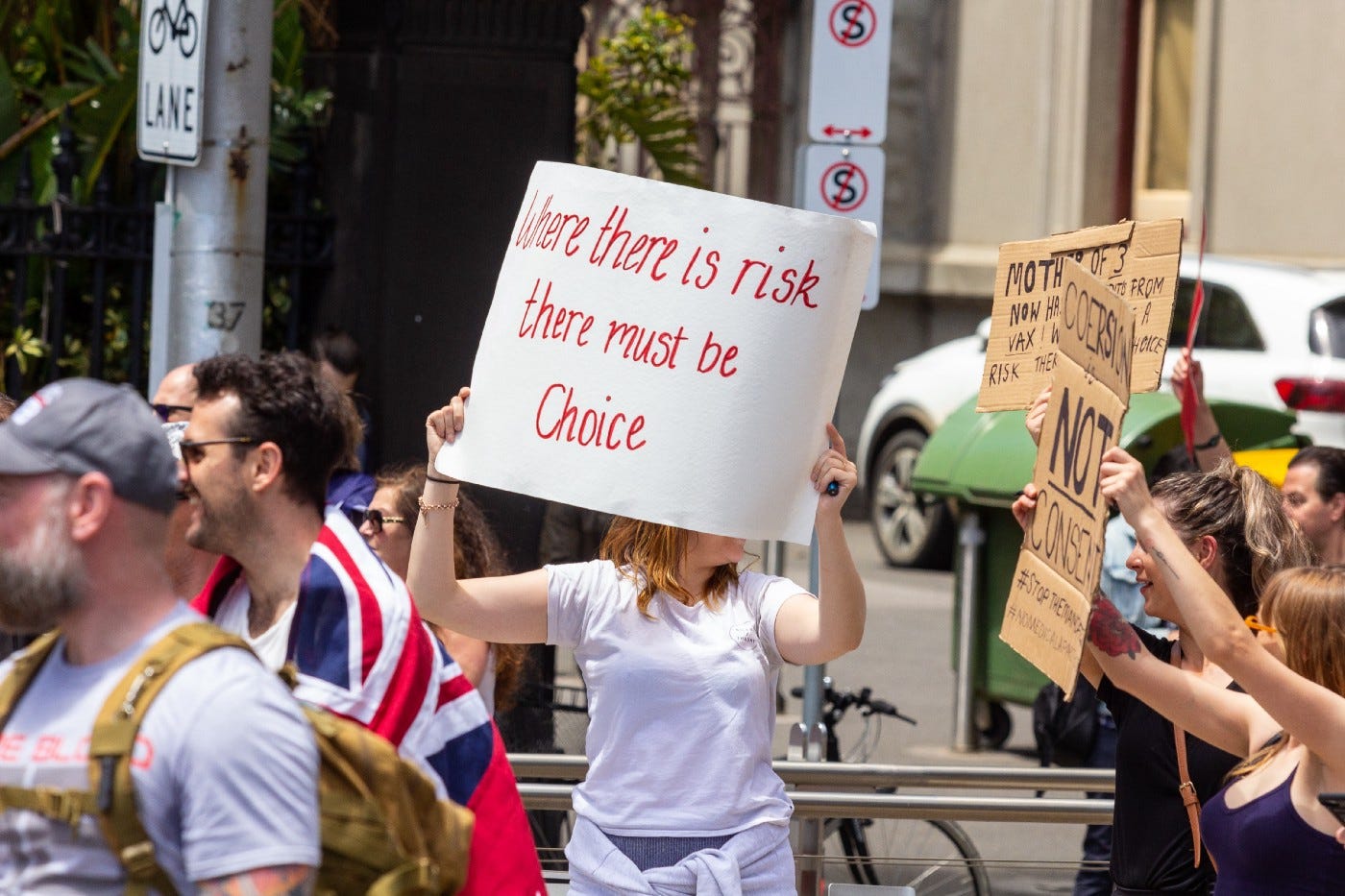
Photo credit: DJ Paine on Unsplash
Let me be very clear. While there are a lot of bad actors out there — there are also a lot of well-meaning people in the science and medical industries, too. I’m lucky enough to know some of them. There are doctors who fend off pharma reps’ influence and take an extremely cautious approach to prescribing. Medical journal authors who fiercely pursue transparency and truth — as is evident in “The Influence of Money on Medical Science,” a report by the first female editor of JAMA. Pharmacists, like Dan Schneider, who refuse to fill prescriptions they deem risky or irresponsible. Whistleblowers, like Graham and Jackson, who tenaciously call attention to safety issues for pharma products in the approval pipeline. And I’m certain there are many people in the pharmaceutical industry, like Panara and my grandfather, who pursued this field with the goal of helping others, not just earning a six- or seven-figure salary. We need more of these people. Sadly, it seems they are outliers who exist in a corrupt, deep-rooted system of quid-pro-quo relationships. They can only do so much.
I’m not here to tell you whether or not you should get the vaccine or booster doses. What you put in your body is not for me — or anyone else — to decide. It’s not a simple choice, but rather one that may depend on your physical condition, medical history, age, religious beliefs, and level of risk tolerance. My grandfather passed away in 2008, and lately, I find myself missing him more than ever, wishing I could talk to him about the pandemic and hear what he makes of all this madness. I don’t really know how he’d feel about the COVID vaccine, or whether he would have gotten it or encouraged me to. What I do know is that he’d listen to my concerns, and he’d carefully consider them. He would remind me my feelings are valid. His eyes would light up and he’d grin with amusement as I fervidly expressed my frustration. He’d tell me to keep pushing forward, digging deeper, asking questions. In his endearing Bronx accent, he used to always say: “go get ‘em, kid.” If I stop typing for a moment and listen hard enough, I can almost hear him saying it now.
People keep saying “trust the science.” But when trust is broken, it must be earned back. And as long as our legislative system, public health agencies, physicians, and research journals keep accepting pharmaceutical money (with strings attached) — and our justice system keeps letting these companies off the hook when their negligence causes harm, there’s no reason for big pharma to change. They’re holding the bag, and money is power.
I have a dream that one day, we’ll live in a world where we are armed with all the thorough, unbiased data necessary to make informed decisions about our health. Alas, we’re not even close. What that means is that it’s up to you to educate yourself as much as possible, and remain ever-vigilant in evaluating information before forming an opinion. You can start by reading clinical trials yourself, rather than relying on the media to translate them for you. Scroll to the bottom of every single study to the “conflicts of interest” section and find out who funded it. Look at how many subjects were involved. Confirm whether or not blinding was used to eliminate bias. You may also choose to follow Public Citizen’s Health Research Group’s rule whenever possible: that means avoiding a new drug until five years after an FDA approval (not an EUA, an actual approval) — when there’s enough data on the long-term safety and effectiveness to establish that the benefits outweigh the risks. When it comes to the news, you can seek out independent, nonprofit outlets, which are less likely to be biased due to pharma funding. And most importantly, when it appears an organization is making concerted efforts to conceal information from you — like the FDA recently did with the COVID vaccine — it’s time to ask yourself: why? What are they trying to hide?
In the 2019 film “Dark Waters” — which is based on the true story of one of the greatest corporate cover-ups in American history — Mark Ruffalo as attorney Rob Bilott says: “The system is rigged. They want us to think it’ll protect us, but that’s a lie. We protect us. We do. Nobody else. Not the companies. Not the scientists. Not the government. Us.”
Words to live by.
Report on the FDA’s 4/6/22 Advisory Committee (VRBPAC) meeting on the selection of future boosters
While the committee got nowhere on the choice of next boosters, there were a few very important reveals
By Meryl Nass, MD | April 10, 2022
Authorizing vaccine for the 6 months to 5 year old group was never mentioned. Can it be that FDA is finally grappling with the awful data, the longterm risks of vaccination, and will turn away from unleashing these vaccines on our youngest kids? Or is there simply too much money at stake, too many promised school mandates, too many done deals behind closed doors?
Important takeaways
1. Many members and presenters agreed that antibody levels (aka titers) are not a valid measure of immunity (they are not a correlate of protection, and there is currently NOTHING measurable in the blood that is considered a valid reflection of immunity). This admission is HUGE, as it reveals that neutralizing antibody titers can no longer be used to authorize or approve COVID vaccines.
2. Therefore the only way to determine vaccine effectiveness is a clinical trial.
3. No one at the meeting (nearly 30 people) ventured a guess as to what strain might cause the next COVID wave. All seemed to agree there would be another wave, but this was just a guess. However, without a variant you can’t make a vaccine and you can’t conduct a clinical trial to see if the vaccine works. And you can’t possibly do this by June, to make vaccine available for the fall, when FDA and the VRBPAC expect it will be needed.
4. Dr. Peter Marks, the director of the FDA’s vaccine division, CBER, admitted that the 4th booster dose authorized last week was a “stopgap measure”– in other words, he claims it was to kick the waning vaccine efficacy can down the road.
5. Claims were repeatedly made that vaccine still protects against severe outcomes and death, but FDA’s lead scientist for this presentation, Doran Fink, admitted that efficacy is also waning for severe outcomes. I’ll say it is.
6. NO data was presented at all regarding strain choice/prediction of what to use as the antigen(s) for a newer vaccine. It was as if everyone just got the idea to begin thinking about this yesterday.
7. It appeared that neither CDC, FDA nor the VRBPAC advisors wanted to take any initiative or responsibility in figuring out what kind of a vaccine comes next (with the exception of Dr. Kim, who did show initiative about prescribing a way forward). I am not sure any of them wanted to find a way forward.
8. Was everyone dancing around the strain/variant choice because in fact no one really wants a newer vaccine, or because no one wanted to be responsible for picking a loser? I could not tell whether this was a deliberate slow-roll as a means of squeezing out of the COVID vaccine disaster, or whether we were watching an agency and advisors who are highly risk-averse but have no problems with the vaccines.
9. The Public Comments from about 1:30 pm to 2:30 pm (about 5 hours into the meeting) were evidence of outstanding work by independent scientists and heart-rending testimonies by the vaccine injured. There were only 2 people who favored vaccines in the group, one a top Moderna scientist (Dr. Rita Das) who did not actually belong there… had FDA begged Moderna to find someone to speak in favor of boosters?
10. The word transparency was used a lot. Which was peculiar since FDA’s COVID vaccine data, deliberations and decisions have been anything but transparent. Even the reason for today’s meeting is murky.
The link below is to my live blog of the all day meeting.
https://live.childrenshealthdefense.org/admin/fda-advisory-committee/fullscreen-chat
———————-
Of course, what the FDA needs to say, no doubt in some slowly unrolling, self-serving fashion, is that:
- The mRNA platform was the best we could do under the circumstances, but it didn’t actually work out that well.
- Coronaviruses are mutating or lab-tating too quickly to be able to vaccinate effectively against them.
- While we still have contracts for 5 or 10 doses per person, we are going to cancel them and try early treatments.
What they won’t way is that these vaccines sickened many thousands, or millions, and the US will now establish clinics to evaluate and treat the injured Americans who did what their government asked of them, cover their medical expenses and pay them disability.
PS. When the Japanese found that the HPV vaccines caused similar severe injuries, about 8 or 10 years ago, clinics were established to take care of the injured.
Unless FullFact.org Says So Then It’s Not True, The UK Government Advises
By Rhoda Wilson – The Exposé – April 7, 2022
Most of us are aware that it’s not only online but also things published by corporate media that aren’t always what they seem. However, a major difference between government or corporate media reports and independent or citizen reports shared online, is the latter allows for public discourse and open debate, providing they are not censored, while corporate media and their fact-checking services do not – they prefer a top-down “above all” approach.
Denying public debate negates the all-important diversity of thought in a liberal and democratic society. Silencing counterarguments that challenge their preferred storyline enables governments and corporate media to create a one-sided narrative. A narrative that, left unchallenged, moves further and further away from the truth. But here’s a fact that you will not find on either GOV.UK or Full Fact: a lie cannot become truth, no matter how often it is repeated.
The SHAREChecklist attempts to provide advice on what to share and what not to share apparently for the good of others. Information that does not originate from their sources could be “harmful to share with our friends and families,” the UK government claims.
It’s important to understand that we, the people, are in the midst of an information war. One which began in earnest at the start of 2020. A battle in the public space for complete and truthful information while governments and their advisors attempt to manipulate our perceptions and behaviours so we obey their instructions, without question, even when those instructions prove to be harmful.
Even the most trusting know that governments and politicians hide the truth, manipulate the truth and even outright lie – it’s merely the extent that varies. We know that governments use mass media – television, radio and online – as tools to roll out their narratives to the public en masse. Additional government tools include initiatives such as their SHAREChecklist campaign.
At the very least corporate media is biased but as they sink deeper into an ever-narrowing storyline it is becoming apparent that reports are being manufactured and that they are activists seeking to implement an agenda, they are not journalists.
Fact-checking services do not provide facts they provide opinions. Last year, Facebook admitted in court that its “fact checks” are nothing more than statements of opinion. Not experts’ opinions but those of the “fact-checkers.” And self-described “fact-checkers” are not independent. They are dependent on donations from large corporations, the same corporations that work to craft a narrative and silence public debate through censorship.
The SHAREChecklist
As we work through the checklist what will become apparent is that in no way does the government advise, or even so much as hint at encouraging: critical thinking, comparing a variety of sources, open dialogue or debate. The checklist leads readers along a path to following a narrative set by a centralised coterie – the government or whoever is “advising” them.

The Government’s first bit of advice is to “make sure information comes from a trusted source.” This is common sense and something we should all be doing, and most likely instinctively are. What each of us believes are “trusted sources” is decisive.
A source that has been proven to lie without remorse is not a source to be trusted. Any source that consistently and persistently promotes Covid injections as “safe and effective” and so roll up your sleeve for another shot, for example, is not to be trusted. Within these sources, the lies are pathological and systemic. Such a source – the BBC, SAGE or UK government, for example – does not suddenly and inexplicably switch from being wanton liars to being truthful.

The second bit of advice the Government has to offer is to read beyond the headline – yet more common sense. A headline cannot contain all the substantive information that an article contains.
Additionally, clickbait headlines, for example, are common practice in all forms of media. To avoid a knee jerk response to the attention-seeking text we should not take an article, or post online, at its headline. Corporate media, as with marketing agencies, are particularly adept at clickbait headlines, texts and thumbnails. And, of course, the UK government has SPI-B and the Nudge Unit to advise them on how to use psychology to maximise public “engagement” and “cooperation.” The checkmark or tick symbol incorporated into the SHAREChecklist logo is an example of typical Nudge Unit behavioural psychology.

Again, in its third bit of advice, the Government advises some additional common sense: “check the facts.” What is notable about this point is that, according to the UK government, there are a limited number of sources that provide these “facts.” Actually, there are only two: themselves, of course, and “fact-checkers,” namely Full Fact.
The BBC frequently and repeatedly tells its viewers that it is a trusted source, bringing you the all facts. Yet, SHAREChecklist does not recommend them as a source to “check the facts.” This may or may not be an indication of how the Government views BBC’s “fact-based” reporting or, possibly, recognition that the public has, by and large, lost its trust in the BBC.
Taking on board the first two bits of advice – “trusted source” and “read beyond the headline,” in this case the Government’s headline – we take a brief look at the Government recommended “fact-checker” Full Fact later in this article.

The fourth bit of the Government’s advice is as true for images and videos shared online as it is for images and videos shown on television. There have been many examples of dubious images and videos published by corporate media over the past two years that deserve to be questioned. There is no source of information, “official” or unofficial, that we should not test for accuracy and reliability. Stay sceptical. Criticism is not only legitimate, it is necessary.

The final bit of advice the Government gives is that typos could be an indication that the information is false. How are those with dyslexia or learning difficulties supposed to feel reading that? For those who find it hard to express their thoughts and ideas in writing, you’re in good company. While Albert Einstein loved mathematics and science, he disliked grammar and had problems with spelling.
After singling out typos, then comes the sneaky bit: “official guidance” – in other words, the Government’s or the centralised coterie’s guidance – has been “carefully checked” presumably for spelling and grammatical errors. So naturally, the Government’s typo-free publications must be true – of course! On that basis, if you want to avoid being censored download Grammarly now!
Who Is Full Fact?

Full Fact’s website states: “We’re developing world-leading technology and new research to spot repeated claims, and find out how bad information can be tackled at a global scale. And we campaign for change that will make bad information rarer and less harmful.”
Who are the people and organisations behind Full Fact? Who are they campaigning for? Who is determining what information is “bad”?
In 2012, UK Column published an article about Full Fact, ‘Faux Facts – The disturbing Truth About fullfact.org’, digging a little deeper into “this interesting little non-profit company, headed by Tory Party donor and Anne Freud Centre Chairman Michael Samuel.”
In 2019 Daily Mail wrote that Full Fact was at the centre of an election row with the Tories and was forced to defend its credibility after it stepped into a social media war after an election debate between Jeremy Corbyn and Boris Johnson. Daily Mail quoted Dominic Raab: “Who said Final Fact is the final arbiter of what the public gets to see as the truth? There’s no god-given right, set in law.”
“Foundations set up by eBay creator Pierre Omidyar and left-wing investor George Soros have also joined tech giants in giving six-figure sums to London-based Full Fact along with thousands of unnamed individual donors paying between £25 and £5,000 each,” Daily Mail reported.
A 2021 article published in The Critic noted the board of trustees included Labour peer Baroness Janet Royall, Lib-Dem peer Lord John Sharkey and former Conservative Party member Lord Richard Inglewood. These three peers are still trustees and Michael Samuel is still chairman.
The Critic article goes on to note that Full Fact is a charity with a small output of research compared to its size, funded primarily by big-tech and staffed to a large extent by former public sector workers or ex-reporters from left-wing media. “Full Fact’s website reports that they were paid £1.1 million by Facebook and £206,500 by Google in 2019, plus a monthly payment of £7,300 worth of free advertising by the search giant. The funding by big-tech in 2019 makes up roughly 70% of their declared funding for the year,” The Critic wrote.
As you can see for yourself in the table below Full Fact is still predominantly funded, and so their opinions are influenced, by the notorious online censor organisations – Facebook, which includes WhatsApp, and Google, which includes YouTube. In 2021, almost 40% of Full Fact’s “donations” came from Facebook and Google.

Full Fact Funders 2021
Full Fact does not pass the government’s SHAREChecklist test and, according to UK government advice, their articles may be “harmful” if shared with friends and families – do not share them.
| Full Fact Funding 2021 retrieved 6 April 2022 | ||
| £305,119.64 | Third Party Fact Checking programme | |
| £116,352.14 | Framework for collaboration during misinformation crises | |
| £59,634.83 | Health fellowship | |
| Hundreds of individual donors and gift aid | £370,148.00 | Core funding |
| Mohn Westlake Foundation | £250,000.00 | Core funding |
| Google AI for Good Impact Challenge | £235,222.77 | Automated fact checking |
| Nuffield Foundation | £100,000.00 | Fact checking and annual report |
| Luminate | £75,789.87 | Core funding |
| Esmée Fairbairn Foundation | £68,333.33 | Core funding |
| £61,809.84 | WhatsApp fact checking service | |
| International Fact Checking Network & WhatsApp | £53,737.20 | Vaccine Grant Program |
| Baillie Gifford | £50,000.00 | Core funding |
| John Ellerman Foundation | £50,000.00 | Core funding |
| Joseph Rowntree Charitable Trust | £50,000.00 | Core funding |
| The Buchanan Programme | £49,801.68 | Core funding |
| The Dulverton Trust | £35,000.00 | Core funding |
| Gill Family Foundation | £30,000.00 | Core funding |
| James Padolsey | £30,000.00 | Core funding |
| International Fact Checking Network & National Endowment for Democracy | £26,576.58 | Fact-Checkers Working Together Research Program |
| Colefax Charitable Trust | £25,000.00 | Core funding |
| The M J Samuel Charitable Trust | £17,500.00 | Core funding |
| International Fact Checking Network & YouTube | £17,064.56 | Fact Checking Development Grant |
| Highway One Trust | £10,000.00 | Policy team |
| William de Winton | £10,000.00 | Core funding |
| Reed Foundation | £9,000.00 | Core funding |
| Good Thinking Society | £8,000.00 | Core funding |
| Dorothy Bishop | £6,000.00 | Core funding |
| Cecil Pilkington Charitable Trust | £5,000.00 | Core funding |
| Tinsley Charitable Trust | £5,000.00 | Core funding |

Facebook is accused of censoring criticism of Black Lives Matter spending
By Didi Rankovic | Reclaim The Net | April 10, 2022
Facebook is being accused of censoring any information that paints the Black Lives Matter (BLM) movement in a negative light – and doing that regardless of the merit and accuracy of those reports.
BLM rose to prominence in the wake of the killing of George Floyd in 2020, when many Americans chose to donate money to this organization as a way of supporting initiatives geared towards strengthening racial justice.
The movement was raising money with that promise. But reports have in the meantime suggested that not all of the $66.5 million in donations received by October 2020 was actually used for that purpose.
On Monday, the New York Post ran a story, based on an Intelligencer report, about BLM leaders using these donation funds to buy a $6 million house in California. Facebook’s reaction was to censor the article, preventing it from being shared, and slap the “abusive” label on it.
The real estate listing said it was a 6,500-square-foot home with more than six bedrooms and bathrooms, a pool and parking for more than 20 cars, and it was purchased in October 2020 by BLM co-founder Patrisse Cullors’ consulting firm’s financial manager Dyane Pascall.
The ownership of the property was transferred to an LLC in Delaware, ensuring that “the ultimate identity of the property’s new owner was not disclosed to the public,” the report said.
The house was seen in the background of a video Cullors and two other BLM leaders posted on the anniversary of Floyd’s death last June. The video shows Cullors complaining of being “in survival mode” because of a previous report into yet more BLM real estate purchases – the Post’s April article said Cullors had bought four high-end houses worth $3.2 million.
Reason writes that it’s unclear why Facebook is trying to hide this information – “unless it sees its role as merely running interference for political allies, hiding credible journalism when it’s damning to them.”
The New York Post has been no stranger to suppression of its reporting over the years – on Facebook, and other giant social networks like Twitter. Their stories about the possibility that the Covid pandemic was the result of a lab leak, and the Hunter Biden laptop reporting both faced various forms of censorship on these platforms – only to later be vindicated.
Mexican president updates position on Ukraine conflict

Samizdat | April 10, 2022
Mexican President Andres Manuel Lopez Obrador has denounced “Russia’s invasion of Ukraine” after weeks of trying to remain neutral on the conflict. However, he managed to do so while reminding the world that some of Moscow’s fiercest critics have previously invaded his own country.
“We do not accept Russia’s invasion of Ukraine because we have suffered from invasions,” Lopez Obrador said on Saturday in a video message. Mexico has at various times been on the receiving end of invasions by the US, France and Spain.
Lopez Obrador issued his video statement to be included in Saturday’s ‘Stand Up for Ukraine’ fundraising event, a campaign that organizers claim seeks to raise money for humanitarian relief to Ukrainian refugees. The Mexican president declined Canadian Prime Minister Justin Trudeau’s invitation to attend the event, but he agreed to release a statement speaking out against the “Russian invasion.”
Lopez Obrador’s comments likely weren’t as pointed as some of his critics would have liked. He stopped short of accusing Russia of war crimes, as Trudeau and US President Joe Biden have done, and he gave no indication that Mexico would join in imposing sanctions against Moscow. He spoke more in generalities about his opposition to war, rather than condemning specific actions by Russia.
“We are in favor of a peaceful solution to the conflict between Russia and Ukraine,” he said. “Peace must be reached so that neither the people of Ukraine nor the people of Russia nor any other nation in the world continues to suffer from such absurdity because wars are disgraceful and must never be sought.”
Lopez Obrador’s comments come amid political turmoil at home. He faces a vote on Sunday over whether he should stay in office for the three years remaining on his term – the first such referendum in Mexico’s history. He called for the vote himself in order to confirm democratic support for his policies, a move that opponents criticized as a costly political stunt.
The Ukrainian Conflict Is a U.S./NATO Proxy War, but One Which Russia Is Poised to Win Decisively – Scott Ritter
By Finian Cunningham – Strategic Culture Foundation – April 9, 2022
Scott Ritter is a former U.S. Marine Corps intelligence officer who has gained international respect for his independence and integrity as a commentator on conflicts and foreign relations.
Question: Do you think that Russia has a just cause in launching its “special military operation” in Ukraine on February 24?
Scott Ritter: I believe Russia has articulated a cognizable claim of preemptive collective self-defense under Article 51 of the UN Charter. The threat posed by NATO expansion, and Ukraine’s eight-year bombardment of the civilians of the Donbass fall under this umbrella.
Question: Do you think Russia has legitimate concerns about the Pentagon sponsoring biological weapons programs in laboratories in Ukraine?
Scott Ritter: The Pentagon denies any biological weapons program, but admits biological research programs on Ukrainian soil. Documents captured by Russia have allegedly uncovered the existence of programs the components of which could be construed as having offensive biological warfare applications. The U.S. should be required to explain the purpose of these programs.
Question: What do you make of allegations in Western media that Russian troops committed war crimes in Bucha and other Ukrainian cities? It is claimed that Russian forces summarily executed civilians.
Scott Ritter: All claims of war crimes must be thoroughly investigated, including Ukrainian allegations that Russia killed Ukrainian civilians in Bucha. However, the data available about the Bucha incident does not sustain the Ukrainian claims, and as such, the media should refrain from echoing these claims as fact until a proper investigation of the evidence is conducted, either by the media, or unbiased authorities.
Question: Do you think the alleged Russian bombing of a hospital and an art theater in Mariupol were false-flag provocations?
Scott Ritter: Both locations are available for detailed forensic examination that would either confirm or refute Ukrainian allegations that these locations were struck by Russian aerial bombs. Other data, such as the existence of any NATO radar data that would put Russian aircraft over these two locations at the time of the alleged attack, should be collected. A detailed forensic examination of each site would go a long way in proving or disproving the Ukrainian claims through the collection of weapons fragments and the evaluation of environmental samples which would show the chemical composition of any explosive used, thereby allowing a better idea of what weapon or explosive was used to destroy the sites.
Question: Western governments and mainstream media have denigrated Russian objectives to “demilitarize and deNazify” Ukraine. The West says Russia has invented or grossly exaggerated these problems as a pretext for invasion. Do you think this Western denialism is because it doesn’t want to acknowledge that Russia may indeed have legitimate concerns, and secondly that to acknowledge would mean admitting that the West is part of the problem in the current war?
Scott Ritter: The irony is that the West had thoroughly documented the extent of the Nazi ideology in Ukraine’s civil, political, and military structures during and after the 2014 Maidan coup. This documented reality was deliberately obscured by the same sources that had previously documented its existence once the Russian invasion occurred. To acknowledge the existence of this odious ideology by NATO would require NATO to acknowledge the role it played in training and equipping Azov regiment personnel since 2015. The Russian documentation of its ongoing de-Nazification effort in Ukraine is a source of continual embarrassment to NATO, as it exposes the scope and scale of NATO’s role in empowering the militarization of Nazi ideology in Ukraine.
Question: For about four months before the Russian intervention in Ukraine, the Biden administration was asserting non-stop that Moscow was planning an invasion. Do you think this is a case of great intelligence on the part of Washington or the culmination of provocation by Washington resulting in Russian military action in Ukraine?
Scott Ritter: We now know that the U.S. intelligence community under the Biden administration is committed to a policy of haphazardly “declassifying” intelligence for the purpose of shaping public opinion (so-called “getting ahead of the story”). There is no evidence that the intelligence regarding potential Russian military action was based upon anything other than politicized speculation derived from a crude analysis of Russian military dispositions void of any context. Any genuine intelligence assessment regarding the timing of any Russian military action would have incorporated the domestic political imperative of getting Duma [Russian parliamentary] approval for the deployment of Russian forces outside the borders of Russia, which carries with it the requirement of a cognizable justification for this military action under the UN Charter. This required political steps such as Donetsk and Lugansk declaring independence, and then petitioning the Russian parliament to recognize this independence, so that Russia could legitimately invoke Article 51. None of these factors was knowable when the Biden administration was issuing its warnings of imminent attack, thereby certifying the “intelligence” as being derived from fact-free speculation, and not intelligence at all.
Question: The Western media are reporting that the Russian military operation in Ukraine is floundering because it has not over-run Ukraine entirely. As a military expert, how do you see the Russian operation proceeding?
Scott Ritter: Russia is fighting a very difficult campaign hampered by its own constraint designed to limit civilian casualties and damage to infrastructure and the fact that Ukraine possesses a very well-trained military that is well led and equipped. Russia deployed some 200,000 troops in support of this operation. They are facing some 600,000 Ukrainian forces. The first phase of the Russian operation was designed to shape the battlefield to Russia’s advantage while diminishing the size and capacity of the Ukrainian ability to wage large-scale conflict. The second phase is focused on destroying the main Ukrainian force concentration in eastern Ukraine. Russia is well on its way to accomplishing this task.
Question: Do you see danger from Ukraine being turned into a proxy war by the United States and NATO partners against Russia in a way that attempts to repeat the West’s covert war in Syria or the Afghanistan war (1979-89) with the Soviet Union? There are reports of foreign legions being sent to Ukraine via NATO countries. Do you think there is a Western plan to embroil Russia in a proxy war that is aimed at sapping Russia politically, economically, and militarily?
Scott Ritter: The Ukrainian conflict is a proxy war, but one which Russia is poised to win decisively. While there appears to be a NATO/western plan to embroil Russia in a “new Afghanistan”, I don’t see any risk of this conflict dragging on for more than a few more weeks at the most before Russia accomplishes a strategic victory over Ukraine.
Question: There is an arrogant assumption among Western governments that they can impose crippling economic sanctions on Russia in a similar way to what they did on Iran, Venezuela, and North Korea among others. But would you agree that if Russia begins to impose its own counter-sanctions by restricting oil and gas exports then the Western states may end up reaping a whirlwind that is devastating to their societies?
Scott Ritter: Russia was warned well in advance about the scope and scale of U.S.-led sanctions that would be imposed if Russia were to invade Ukraine. Russia has prepared its own counter-sanction strategy which will not only defeat the Western sanctions but further strengthen Russia’s economy by decoupling it from the West and Western control/influence. We see evidence of the effectiveness of this counter-campaign as the Russian ruble is strengthened, the Russian stock market enjoys positive traction, and Europe and the U.S. flounder economically. The West has sown the wind in sanctioning Russia; Russia will not reap the whirlwind.
oscow denies the claims, as have other independent analysts who point to evidence that the incident was a false-flag provocation perpetrated by NATO-backed Ukrainian Nazi regiments to undermine Russia internationally and bolster Western objectives. It is a foreboding sign of the times that Ritter should be banned for daring to question dubious narratives. (He was later reinstated following a public outcry against censorship.)
Scott Ritter is a critical commentator on U.S. conflicts and foreign relations. He is a former Marine Corps intelligence officer who served in the Soviet Union implementing nuclear arms control treaties, in the Persian Gulf during Operation Desert Storm, and as a UN inspector in Iraq (1991-98) overseeing the disarmament of weapons of mass destruction. He is the author of Scorpion King: America’s Suicidal Embrace of Nuclear Weapons from FDR to Trump (Clarity Press, 2020).
Ukraine ‘seizes foreign ships’
Samizdat | April 10, 2022
The Donetsk People’s Republic (DPR) said on Sunday that Ukrainian fighters seized two foreign ships in the Azov Sea port of Mariupol and are holding their crews hostage.
DPR forces backed by Russia have been fighting with Ukrainians for control of the port since late February. Mariupol is part of the Donetsk region and has been controlled by Ukrainian forces since 2014.
According to DPR military spokesman Eduard Basurin, “a group of retreating Ukrainian nationalists” from the Azov Battalion boarded two foreign ships, the Lady Augusta and the Tsarevna.
Basurin said the fighters are firing mortars, grenade launchers, and small arms from the vessels while “holding the crews hostage.” He added that DPR forces and Russian troops are trying to rescue the trapped sailors, and that it is unclear if there are any casualties among the crews.
According to tracking website vesselfinder.com, the Lady Augusta is a Jamaican-flagged cargo ship, and the Tsarevna is a Maltese-flagged bulk carrier.
Bulgarian Prime Minister Kiril Petkov announced this week that security officials were dispatched to Mariupol to rescue the country’s sailors stranded on the Tsarevna. The PM said the group was in contact with both Russian and Ukrainian commanders.
World food prices hit new high – UN
Samizdat | April 10, 2022
Global food prices surged to a historic high last month on grain and edible oil supply woes brought about by the conflict in Ukraine, the UN Food and Agriculture Organization (FAO) said on Friday.
“World food commodity prices made a significant leap in March to reach their highest levels ever, as war in the Black Sea region spread shocks through markets for staple grains and vegetable oils,” the FAO said in a statement.
The FAO’s food price index rose by 12.6% to a record 159.3 points in March against February’s high of 141.4 points, “making a giant leap to a new highest level since its inception in 1990.” The index represents a measure of the monthly change in international prices of a basket of food commodities.
The current surge includes new all-time highs for vegetable oils, cereals, and meats, the agency said, noting that prices of sugar and dairy products “also rose significantly.”
The FAO also recently warned that food and feed prices could further jump by up to 20% as a result of the Russian-Ukrainian conflict and lead to a surge in global malnourishment.
Russia and Ukraine are the globe’s largest exporters of wheat, corn, barley, and sunflower oil. Ukrainian exports have been stalled, and sanctions placed on Russia may affect its own deliveries as Black Sea ports used to ship grain remain blocked. Industry analysts fear the planting season in Ukraine may also be affected by the current crisis.
The situation could lead to famine and food rioting in poor countries, especially in Africa, the head of the World Trade Organization (WTO), Ngozi Okonjo-Iweala, warned earlier this month. She specified that food imports from the Black Sea region were crucial for the survival of 35 African nations.
Meanwhile, the FAO also lowered the projection of global wheat production in 2022 to 784 million tons from last month’s forecast of 790 million, citing the possibility that at least 20% of Ukraine’s winter crop area would not be harvested. It also cut its forecast of global cereals trade in the current marketing year due to disruptions in Black Sea exports. The agency noted, however, that larger exports from India, the EU, Argentina and the US could somewhat offset the trend.
Featured Video
New positive ivermectin evidence
or go to
Aletho News Archives – Video-Images
From the Archives
Fanatical Followers of the Covid Regime: A Jim Jones-Style Cult?
By Professor Roger Watson and Dr. Niall McCrae | The Daily Sceptic | November 15, 2021
As scholars at leading British universities over recent decades, we witnessed the replacement of critical thinking and debate by narrative: facts are discrimination and scientific method is imperialism; truth, instead, is derived from ‘progressive’ values. This educational trend may be a major contributory factor to the ease in which society has been inculcated to the Covid ‘new normal’ of masking, testing, and repeated doses of vaccines for a disease of similar risk to severe influenza.
One doesn’t need much critical reasoning to observe the flawed logic of some vaccination enthusiasts, such as people who respond to experiencing any side effects, however debilitating, by saying “at least I know it’s working”, or, after contracting the disease despite their promised inoculation (over 90% effective, according to initial drug company claims), “I’d have been worse off without the jab.” … continue
Blog Roll
 Aletho News
- ‘Grave, alarming’: Iran mission on Trump’s UNGA ‘annihilation’ threats
- Najaf airport to reopen to Iranian flights within 24 hours: Ambassador
- From ‘How Will This End For Iran’ to ‘When America Walks Away’: A tale of two Economist covers
- Tehran blasts ‘baseless’ speculation linking Iran to alleged bomb plot at UK air base
- The Rise And… Rise Of ‘Color Revolutions’
- The Coming GOP Bloodbath?
- Arctic Scare Stories Melt Away
- Wrong, Euronews: Climate Change Has Not Created a Food, Energy, and Economic “Meta-Crisis”
- New positive ivermectin evidence
- Met Office Caught Fabricating Daily Temperature Record Claims
- If Americans Knew
- Netanyahu Asked UAE Leader to Deny Report on Oct. 7 Warning in Secret Visit, Sources Say
- CNN Chief Int’l Correspondent Clarissa Ward on Journalists in Gaza
- Democratic Party Consultants Surround Troy Jackson with Pro-Israel Donors
- Christian Leader Responds To Netanyahu’s Claims Regarding Palestinian Christians
- In Gaza, ‘Whoever Survives the Bombing Won’t Survive the Rubble’
- Israel kills more Palestinians, amid push to resettle Gaza – Daily Update
- Israel forces Gazans to live in constant peril – Daily Update
- Deconstructing Netanyahu’s pants-on-fire UN rant – Daily Update
- Trump betrayed voters with his campaign lies and prioritized a foreign country once he took office
- Netanyahu calls Israel’s war in Gaza ‘opposite of genocide’ in UN speech to near-empty hall
- No Tricks Zone
- New Study: Earth And Venus Surface Warmth Largely Explained By Convection And Lapse Rate, Not CO2 Or Radiation
- 2025 Nature Paper Claiming Worsening Global Drought Gets RETRACTED …Heavily Flawed
- New Study: ‘Global Drought Shows No Detectable Recent Acceleration Under Climate Warming’
- Economic Masterminds: German Socialists Suggest Taxing Productivity Gains Stemming From Using AI
- The South China Sea Has Not Been Cooperating With The Climate Change Narrative
- Energy Crisis: Germany Enters Heating Season With Historically Low Gas Reserve Fill Levels
- New Study: The Antarctic Ice Sheet Gained Mass From 2020-2024 Due To Staggering Snow And Ice Accumulation
- Study: Ocean Heating Rates From Thousands Of Years Ago ‘Dwarf’ Modern Ocean Heating Rates
- Climate Extremists Target, Attack Large-Scale Power Grid Infrastructure In Germany!
- New Study: Antarctic Ice Melt Has Contributed Less Than 1 Centimeter To Sea Level Rise In The Last 30 Years

