Farewell, Christian Drosten: May You Podcast No More Forever
eugyppius | April 4, 2022
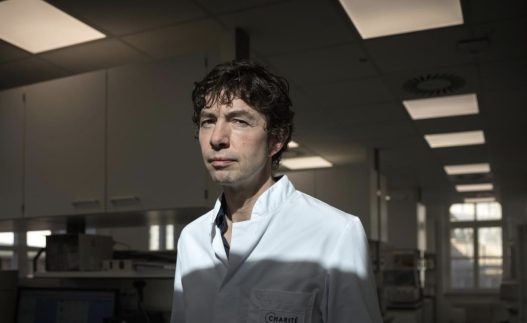
On Tuesday, 29 March, virologist and foremost German Corona astrolger Christian Drosten went on indefinite hiatus from Coronavirus Update, his noxious state media podcast. The show was introduced on 26 February 2020, with Drosten as its centre. He starred in about 80 of its 113 episodes; from September 2020, he began alternating appearances with virologist Sandra Ciesek. Lest the oracular pronouncements of these luminaries be lost to history, Norddeutsche Rundfunk lovingly transcribed their utterances into a downloadable 1446-page document. There is every reason to fear that, one day, this monstrosity will be issued in print for the Scientific Faithful as a boxed set.
I confess that I’ve only listened to about 20 episodes of this bizarre exercise in propaganda. I can’t imagine how anybody could handle more than that. Probably never before in history, has there been a radio show so heavily promoted by the national media, that is simultaneously so devoid of content, and also so destructive to the cult of expertise, as something that can ever exist outside of politics or culture. For in all the ponderous hours that I listened, I never heard Drosten say anything that fashion-forward Twitter accounts, media pundits´and Tomas Pueyo hadn’t already said a little bit earlier.
Drosten was initially agnostic about the wisdom of closures, but after Merkel bought into containment, he preached the necessity of non-pharmaceutical interventions at every opportunity. In the earliest days, he didn’t think children and schools were all that important to infection dynamics; when school closures became policy, he developed a deep obsession with the virus spreading of children. No sooner had Germans elected a new, more containment-hesitant government in September 2021, than Drosten discovered a fresh interest in naturally acquired immunity, and suggested that infections in the vaccinated would be essential to building more robust immune protection.
Plainly, Drosten’s celebrity has been little more than a publicity exercise, arranged to provide scientific endorsement of whatever pandemic policies the German government alights upon. This what, in the end, all that following the science amounts to: Governments get to do whatever they want, so long as they first find some well-credentialed scientists to say that whatever they’re doing is what the science demands. This turns out to be a lot easier than securing popular or parliamentary support for policies.
Now, for follow-the-science government, not just any scientist will do. You need an especially authoritative Media Scientist, who meets public and journalistic preconceptions of how scientific authority is enacted and embodied. Thus, the German press has spared no effort in establishing Drosten in the minds of the regime faithful as one of the world’s most eminent scientists. A deceptively worded paragraph in Zeit, for example, gave rise to the pervasive myth that Drosten discovered the SARS virus in 2003:
Drosten completed his training at the Hamburg Tropical Institute, where he managed a scoop in spring 2003: In Frankfurt, a virologist friend gave him cell material from a doctor in Singapore who had contracted SARS. Drosten raced back to Hamburg in his old Opel Omega with the cell culture in a salt block and worked for 14 days, on hardly more than three hours of sleep per night, to identify the previously unknown coronavirus – thus making it possible to fight the deadly lung disease.
Drosten did not discover SARS. He thought the pathogen was a metapneumovirus; by the time he worked out he was wrong, American scientists at the CDC had published an electron micrograph of the coronavirus responsible. He was left to create primers for PCR tests to identify the new virus. Drosten mysteriously reprised his role as test developer in January 2020, when he developed the first PCR test for the novel Coronavirus responsible for viral pneumonia cases in Wuhan – precisely as China needed infection statistics that Westerners would find credible. This shady work laid the foundations for mass testing in the West, and remains his most significant contribution to science around the pandemic. He has also loudly resisted suggestions of a lab leak, going so far as to co-author an openly misleading paper about the likelihood that the furin cleavage site in SARS-2 originated naturally.
Like many people granted an artificial renown, Drosten has proved unworthy of it, and over the past two years he has given us many odd moments.
Very early, for example, he confessed to a strange fear of draft beer; to avoid viruses, he said, you should stick to bottles. More recently, he revealed a bizarre lack of metaphorical aptitude, claiming that anyone who believes he can train his immune system with infection, must necessarily also believe that he can train his digestive tract by eating steak.
In May 2020, he threw together a sloppy study arguing that children are just as infectious as adults. The purpose was to provide Merkel’s government with some “research” that would speak against reopening schools, but the paper was so bad, it drew critique from other virologists as well journalists at BILD, and couldn’t be formally published for a full year. As the controversy unfolded, Drosten avoided any open exchange with his critics and defended himself dishonestly on sympathetic media platforms.
Some months later, Drosten was invited to give the Schillerrede, a speech on the occasion of Friedrich Schiller’s birthday, where he embarrassed himself anew, claiming that Schiller would’ve been an avid mask wearer; and proposing, in an awkward allusion to Kant’s Categorical Imperative, a Pandemic Imperative, according to which everyone should live his life as if he had just tested positive for Corona and all his contacts are old and vulnerable.
While Drosten is a state media scientist who will say almost anything, on a few points he has been constant. Nothing has angered this small man more, than the Great Barrington Declaration, drafted by Martin Kulldorff, Sunetra Gupta and Jay Bhattacharya. In the year and a half since its publication, he has resorted to various slurs, not always veiled, on the qualifications and abilities of its authors. His last tweet, posted on the day he recorded his final podcast episode, equates its publication with sabotage. Given the relative unimportance of the GBD, and its failure to end the catastrophic policies that Drosten and the other Corona astrologers have supported, his animus seems strange. I can only imagine that when you have been paid to lie, it is a humiliating experience, to find yourself confronted by more honourable colleagues, who can afford to speak the truth.
Now, Drosten will not podcast anymore. He says it is because he needs time for his research. I incline to the optimistic interpretation, that he is being deliberately retired from public view, lest he persist any longer as an eternal advocate of lockdowns and vaccination mania whenever the Corona news takes a turn for the worse. Whatever the case, it can be no accident that this happens precisely as most of the other restrictions Germans have endured for the past two years have come to an end. Masking, green passes, closures, and Drosten too – all of them were part of the same political program, the same system of social, cultural and intellectual strangulation, from which we have now been released.
Fake news in Kiev heralds cruel April
BY M. K. BHADRAKUMAR | INDIAN PUNCHLINE | APRIL 4, 2022
An indignant Moscow has angrily demanded a United Nations Security Council meeting on Monday over the allegations of atrocities by Russian troops in areas around Kiev through the past month. Prima facie, this allegation is fake news but it can mould misperceptions by the time it gets exposed as disinformation.
A Tass report says: “The Russian Defense Ministry said on Sunday that the Russian Armed Forces had left Bucha, located in the Kiev region, on March 30, while “the evidence of crimes” emerged only four days later, after Ukrainian Security Service officers had arrived in the town. The ministry stressed that on March 31, the town’s Mayor Anatoly Fedoruk had confirmed in a video address that there were no Russian troops in Bucha. However, he did not say a word about civilians shot dead on the street with their hands tied behind their backs.”
Even more surprising is that within minutes of the “breaking news”, western leaders — heads of state, foreign ministers, former politicians — popped up with statements duly kept ready and only based on the videos, seconds-long videos and a clutch of photos, ready to pour accusations. No expert opinion was sought, no forensic work was done, no opportunity given to the accused to be heard.
French President Emmanuel Macron broke his election campaign where he’s in a dead heat with Marine Le Pen for reelection in next Sunday’s poll to brand the alleged Russian atrocities as “war crime”. So did German Chancellor Olaf Scholz who is in big trouble too as Germany is posting inflation at +7.3 percent in March.
There’s nothing unusual about beleaguered politicians catching hold of bogeymen. Intelligent minds like Macron and Scholz’s must be realising by now their flawed policies leading inexorably to such a strategic defeat at the hands of Russia. But the big question is: Why such theatrics just at this point?
The fake news surfaced even as the Phase 2 of Russia’s special operation is slated to begin within the week in the eastern Donbass region. Something like 60-80000 Ukrainian troops, rated to be the best units of the armed forces, have been encircled in Donbass.
The Russian feint paid off in pinning down the Ukrainian forces in Kiev through past month. By the time the truth dawned on the Kiev set-up (and their western “advisors), the damage was done. The enormity of the resultant situation needs some explanation.
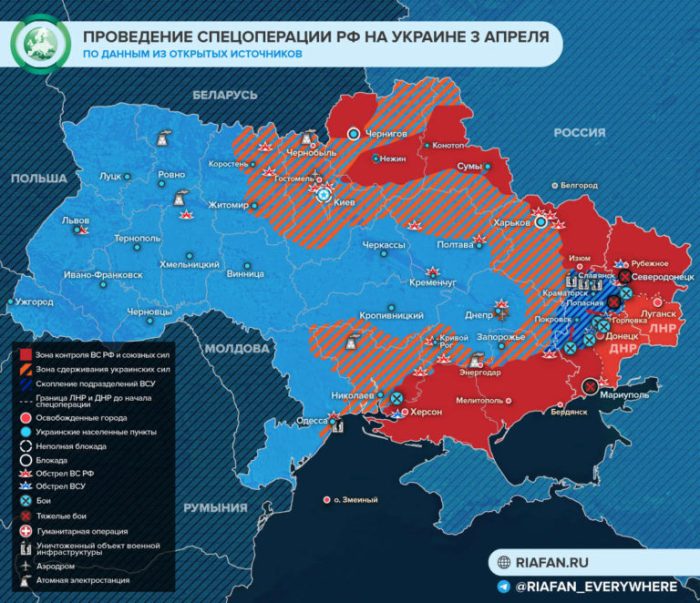
The above map reproduced from the Novosti (unfortunately, in Russian language) on the exact ground situation as of April 3 and the commentary by Ivan Andreev, an experienced war correspondent who covered the Russian operations in Syria, gives the salience of the cauldron in Donbass where the crème de la crème of the Ukrainian forces numbering several divisions are entrapped, isolated by opposing forces from their logistical base and other friendly forces.
The cauldron is fairly large, marked in blue and black stripes on the map in the upper reaches of the Donbass region in the direction of Kharkiv. The massive Russian column that retreated from the Kiev region a week ago is manoeuvring in a big arc toward that cauldron bypassing Chernihiv in the north and the cities of Sumy and Kharkiv (near the Russian border in the northeast).
The Ukrainian forces are well-armed and have fortified themselves heavily but are unable to escape from the entrapment. Nor is it feasible for Kiev to send reinforcements as the countryside to the west consists of largely open farmlands (all the way to the Dniepr River). The Russians have air supremacy and it is impossible to hide any enemy movements from their roving eyes.
The Russian forces have put out of action all nearby airports and destroyed the nearby Ukrainian oil reserves systematically through Phase 1 of the operation. As I wrote in a previous blog, three days ago, Russian forces dealt a devastating blow: “Notably, the Mirgorod military airfield in central Poltava Region, a strategically important hub, has been taken out of action and several Ukrainian combat helicopters and aircraft found in its camouflaged car parks, as well as fuel and aviation weapons depots have been destroyed.”
Equally, Kharkiv has been surrounded and “in a high-precision strike with the Iskander operational-tactical missiles on the defence headquarters in the city on Thursday, more than 100 nationalists and mercenaries from Western countries were confirmed as killed.”
Nonetheless, the Ukrainian forces are expected to put up a good fight rather than surrender — although surrounded, without air cover, and having no scope to rotate forces or enough fuel to engage in maneuver warfare and with ammunition running out.
To be sure, a major battle is approaching, the most decisive in the entire Russian special operation so far. The catch is, the cauldron also has plentiful settlements of ethnic Russian population (including Russian passport holders) and the offensive will be a long grind patiently executed to avoid civilian casualty or destruction of civilian infrastructure.
That is to say, Phase 2 may last anywhere up to a month or so to be completed. Make no mistake, the Russians have to win here (which they will) as they will also be breaking the back of the Ukrainian armed forces. Despite all the bluster by Zelensky, Kiev will realise the enormity of the defeat and his western mentors will see the writing on the wall too.
To be sure, a whole month lies ahead where the western strategy will be to incessantly manufacture fake news, intensify the information war. Even some false flag operation may be staged under the supervision of western intelligence operatives.
In a worst case scenario, Kiev may even play its last card — chemical weapons. Russia has publicised details of locations where Ukraine has kept stockpiles of chemical weapons. The US is known to have supplied as military aid special gear (gas masks, protective clothing, etc.) to cope with chemical weapons and given special training for collective protection.
The alacrity with which Macron and Scholz consumed the fake news is a harbinger of a new phase in the information war. Succinctly put, there is a sober awakening in Paris and Berlin that the Russian operation is successfully meeting the set objectives.
“April”, TS Eliot wrote in his masterpiece The Wasteland, “is the cruellest month, breeding Lilacs out of the dead land, mixing Memory and desire, stirring Dull roots with spring rain.” But the dark irony of this year’s “Aprilness” is going to be that the fecundity and renewal here will be about Russia’s regeneration in a world of both history and the myths spawned by quarantined western minds.
Berlin Physician Estimates Cases Of Severe Side Effects At 3%… Projected One Million Affected In Germany
By P Gosselin – No Tricks Zone – 3. April 2022
While Germany’s Health Minister Karl Lauterbach continues to insist the mRNA technology vaccines are “more or less free of side effects”, German commentary site achgut.com here reports how vaccine injuries have exploded across Germany.
Waiting list grows to 800
The site reports “the Marburg University Hospital has set up a special outpatient clinic for patients with side effects after the Corona vaccination, and the waiting list has grown to about 800 patients.”
Recently a number of doctors have been warning about the risks of the vaccines at achgut.com: Dr. Gunter Frank, Dr. Jochen Ziegler and Dr. Andreas Zimmermann.
“Virtually overrun” by patients
Dr. Jochen Ziegler wrote Germany could have “a real socio-medical emergency” that would also even result in “a fundamental crisis of confidence in the state and its institutions”.
Slowly, and ever so hesitantly, the first major media outlets like Austrian Servus TV and Germany’s ARD plusminus, have reported on vaccine side effects. Most recently the Berliner Zeitung reported on physician Erich Freisleben, whose practice is virtually “overrun” by patients with vaccination side effects.
Potentially 1 million affected
According to Achgut.com, Dr. Freisleben “estimates the cases of severe vaccine side effects at three percent. That would affect a projected one million people in Germany alone.”
According to Freisleben: “I’ve seen maybe five or six side effects with vaccines before in 35 years of practicing medicine. For the novel vaccines, I have now counted 96. That’s out of proportion.”
Ignoring history
Achgut.com comments that “we are dealing here with a completely new vaccination technology” and: “We do not yet know what the new mRNA vaccines will do to our immune system.”
Freisleben warns against compulsory vaccination and that a “softening of the Basic Law would mean not having understood the lessons of history.”
“Compulsory vaccination would open the door wide to abuse,” the Berlin physician adds.
Russia demands UN Security Council meeting over Bucha massacre
Samizdat | April 3, 2022
Moscow will convene an extraordinary meeting of the UN Security Council over the incident in the Ukrainian town of Bucha, Russia’s deputy permanent representative with the organization, Dmitry Polyansky said Sunday. Ukraine has accused Russia of massacring civilians in the town, while Moscow dismissed the incident as staged by the Kiev forces.
“In light of the blatant provocation by Ukrainian radicals in Bucha, Russia has demanded a meeting of the UN Security Council to be convened on Monday, April 4. We will bring to light the presumptuous Ukrainian provocateurs and their Western patrons,” Polyansky said in a Telegram post.
Graphic footage from Bucha, a town to the northwest of Kiev, emerged over the weekend, showing multiple bodies clad in civilian clothing scattered around. Kiev was quick to blame Russian military for the incident, with Ukrainian foreign minister Dmytro Kuleba alleging it was a “deliberate massacre”.
“The Bucha massacre was deliberate. Russians aim to eliminate as many Ukrainians as they can. We must stop them and kick them out. I demand new, devastating G7 sanctions NOW,” Kuleba said on Twitter.
Top Western politicians were quick to back and amplify Kiev’s claims, with NATO chief Jens Stoltenberg branding the incident “a brutality against civilians we haven’t seen in Europe for decades.”
“And it’s horrific, and it’s absolutely unacceptable that civilians are targeted and killed, and it just underlines the importance of, that this war must end. And that is President Putin’s responsibility, to stop the war,” Stoltenberg told CNN.
Similar stance has been voiced by many other officials, with some explicitly pinning the blame for the ‘massacre’ on Moscow. French President Emmanuel Macron said, for instance, that “Russian authorities will have to answer for these crimes”.
Moscow, however, has firmly rejected any involvement, accusing Kiev of staging the whole affair to frame Russian troops. The country’s Defense Ministry said that Russian troops pulled out of the town on March 30, with local mayor confirming it in a video address a day after without mentioning “any local residents laying shot in the streets.” The purported “evidence” of the incident emerged only four days after the withdrawal, when Ukrainian intelligence and “representatives of Ukrainian television arrived in the town,” the military added, stressing that multiple inconsistencies show that the affair “has been staged by the Kiev regime for Western media.”
Google to demonetize sites that “dismiss” the Russia-Ukraine war
By Cindy Harper | Reclaim The Net | April 3, 2022
On YouTube channels, apps, and websites, Google will no longer run ads on content that condones or dismisses the ongoing Russian invasion of Ukraine.
The move is in line with Google’s policy that says it wants to prevent the monetization of content that denies tragic events and incites violence.
“We can confirm that we’re taking additional steps to clarify, and in some instances expand our monetization guidelines as they relate to the war in Ukraine,” a Google spokesperson said.
In an email to publishers, obtained by Reclaim The Net, Google said it would not run ads alongside content with “claims that imply victims are responsible for their own tragedy or similar instances of victim blaming, such as claims that Ukraine is committing genocide or deliberately attacking its own citizens.”
Russia has been accusing western media and online platforms of spreading fake news about the war, which it calls a “special military operation.”
On Wednesday, Russian media reported that internet watchdog Roskomnadzor had blocked Google News, for spreading fake news.
In early March, Google said it had stopped the sale of online ads in Russia.
UK plans to designate Yemen’s Houthis as terrorists risk disaster warns aid agencies
MEMO | April 3, 2022
The British government’s plans to designate Yemen’s Houthi movement as a terrorist group risk worsening the humanitarian crisis in the country, leading aid agencies have warned in a letter to cabinet ministers.
According to a report yesterday by The Guardian, 11 British aid agencies, including Save the Children, Care, the International Rescue Committee and Islamic Relief sent the letter upon being informed that Home Secretary Priti Patel was pushing for the designation under the Terrorism Act as part of a review of British policy in Yemen.
There are fears that the move, described as a “blunt tool” could hamper aid efforts in the country, already on the brink of famine, as international banks and companies that import food, medicines and fuel could be impacted by terrorism laws, especially as the Houthi-led, de-facto government based in Sanaa control the most densely populated areas in the north.
“The likely ‘chilling effect’ on banks and other commercial actors could prove catastrophic for the millions of Yemenis already at risk from hunger, conflict and disease,” the letter stated.
“Grain importers and banks told humanitarian agencies they are unsure if they will be able to continue supplying Yemen if the UK proceeds with proscription of Ansar Allah,” the aid agencies explained, referring to the formal name of the Houthi group.
“[If] banks were to refuse transfers because of UK proscription, this would likely have a serious impact on remittances, which are a lifeline for 500,000 Yemeni families. Up to one in 10 Yemenis rely on remittances to meet their essential needs. They are the biggest source of foreign exchange into the country, making up 20% of the country’s GDP. More than 100,000 Yemenis living in the UK would no longer be able to support their loved ones.”
However, the plans have received the support of some of the Gulf states, especially Saudi Arabia and the UAE who have been hit by cross-border attacks by the Houthis. Both are joint-leaders of the Arab coalition which militarily intervened in the country in 2015 at the request of the internationally-recognised Yemeni government following the fall of Sanaa to the Houthi forces and their military allies the year before.
Last year the Houthis were listed as a Foreign Terrorist Organisation towards the end of former US President Donald Trump’s administration, which was condemned by human rights groups at the time who warned it could further exacerbate the humanitarian crisis. However, President Joe Biden formally delisted the movement amid announcements that the US would end its support for the Saudi-led war. Earlier this year, Biden said he would consider relisting the Houthis as a terrorist group and it has become a source of tensions between Washington and its Gulf allies, Saudi and the UAE.
NATO reveals scale of its involvement in training Ukrainian troops
Samizdat | April 3, 2022
Several NATO states have been providing military training to the Ukrainian army “for years” prior to Russia’s military campaign against the eastern European country, the alliance’s secretary general has said.
Speaking to CNN’s Dana Bash on Sunday, Jens Stoltenberg said that “NATO allies have supported Ukraine for many, many years,” adding that military aid has been “stepped up over the last weeks since the invasion.” The official clarified that “NATO allies like the United States, but also the United Kingdom and Canada and some others, have trained Ukrainian troops for years.”
According to Stoltenberg’s estimates, “tens of thousands of Ukrainian troops” had received such training, and are now “at the front fighting against invading Russian forces.” The secretary general went on to credit the Brussels-based alliance with the fact that the “Ukrainian armed forces are much bigger, much better equipped, much better trained and much better led now than ever before.”
In fact, Stoltenberg’s remark came after the host asked him to comment on recent reports that the alliance was allegedly planning to provide Ukraine with “Soviet-era tanks,” despite French President, Emmanuel Macron last month describing such a move as a “red line” which could potentially make NATO a “co-belligerent in the war.” When asked the same question again directly, the NATO chief refused to either confirm or deny the claims, adding that it would be unwise for him to go into detail regarding the kind of military aid the alliance was supplying Ukraine with.
Stoltenberg simply noted that “allies provide support with modern advanced weapons systems,” which are “making a difference on the battlefield every day.” The official emphasized that it was thanks to the “systems they receive from NATO allies” that the Ukrainian military was “able to take out Russian armored vehicles, Russian planes.” He also noted that NATO member states had confirmed, during the March 24 summit in Brussels, their commitment to providing support to Kiev.
Since February 24, when Russian forces crossed the Ukrainian border, several NATO member states, including the US, UK, Germany and a few others, have been delivering large amounts of ammunition and lethal weapons to Ukraine, including anti-tank and anti-aircraft missile systems.
Following the coup in 2014, several consecutive administrations in Kiev had pronounced NATO membership as one of the key foreign-policy objectives of Ukraine. The country’s military has participated in a number of joint military drills with alliance forces.
Russia considers the prospect of NATO military bases popping up on its border as a threat to its security.
Ukraine has now apparently given up on its NATO aspirations, as members of both Russian and Ukrainian negotiating teams have revealed that the two warring nations agreed in principle to a future neutral status for Ukraine, akin to those of Austria and Sweden.
Accusations of Bucha massacre by Russian forces are fake news: Moscow
Samizdat | April 3, 2022
The Russian military has firmly denied accusations of mass killings of civilians in Bucha, a Ukrainian town northwest of Kiev. The claims have been raised by Ukraine itself, some Western media outlets and human rights groups, after Moscow had withdrawn its troops from the outskirts of Ukraine’s capital.
“All photographs and video materials published by the Kiev regime, allegedly showing some kind of “crimes” by Russian military personnel in the town of Bucha, Kiev region, are yet another provocation,” the Russian Ministry of Defense said Sunday.
Russian troops had been pulled out from the area on March 30, the military said, pointing out that “the so-called ‘evidence of crimes’ in Bucha appeared only on the fourth day” after the withdrawal, when Ukrainian intelligence and “representatives of Ukrainian television arrived in the town.”
“Moreover, on March 31 the mayor of Bucha, Anatoly Fedoruk, confirmed in his video address that there was no Russian military in the town, but did not even mention any local residents laying shot in the streets with their hands tied,” the Russian military also pointed out.
“It’s particularity concerning that all the bodies of people whose images were published by the Kiev regime, after at least four days, have not stiffened, do not have characteristic cadaveric spots, and have fresh blood in their wounds,” the military noted, adding that all these inconsistencies show that the whole Bucha affair “has been staged by the Kiev regime for Western media, as was the case with the [fake news from the] Mariupol maternity clinic.”
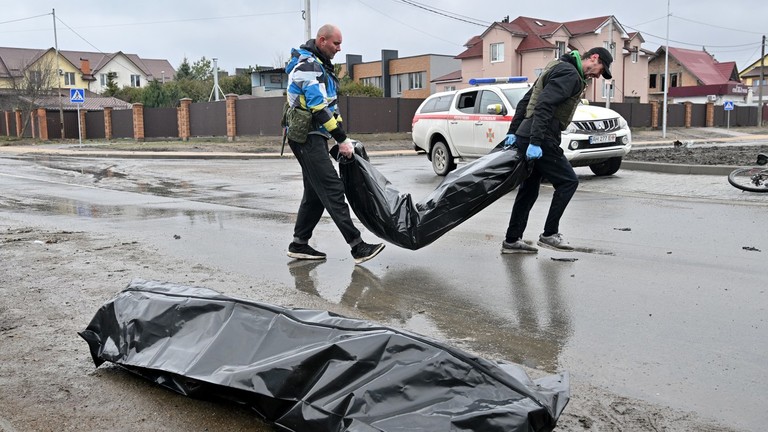
Graphic footage from Bucha shows multiple bodies in civilian clothing lying in the middle of a street. Some of the dead apparently had their hands tied, while others were white armbands, commonly used by Russian forces and civilians in areas under Russian control.
Kiev has blamed the Bucha killings on Moscow, with Ukrainian foreign minister Dmytro Kuleba claiming it was a “deliberate massacre” by Russian troops.
“The Bucha massacre was deliberate. Russians aim to eliminate as many Ukrainians as they can. We must stop them and kick them out. I demand new, devastating G7 sanctions NOW,” Kuleba wrote on Twitter.
Top Western politicians have backed Kiev’s assessment of Bucha, with some explicitly pinning the blame for the killings on Moscow as well. “Russian authorities will have to answer for these crimes,” French President Emmanuel Macron said.
A similar stance was voiced by the UK, with Foreign Secretary Liz Truss stating that such “indiscriminate attacks” on civilians should be probed as war crimes. “We will not allow Russia to cover up their involvement in these atrocities through cynical disinformation,” she said.
Moscow launched a large-scale offensive against its neighbor in late February, following Ukraine’s failure to implement the terms of the Minsk agreements signed in 2014, and Russia’s eventual recognition of the Donbass republics in Donetsk and Lugansk. The German- and French-brokered protocols had been designed to regularize the status of those regions within the Ukrainian state.
Russia has now demanded that Ukraine officially declare itself a neutral country that will never join the US-led NATO military alliance. Kiev insists the Russian offensive was completely unprovoked and has denied claims it was planning to retake the two rebel regions by force.
European energy crisis looms amid Russia-Ukraine tensions
Global Times | April 3, 2022
With Russia’s ruble payment for natural gas taking effect on Friday, the clock is ticking for Europe to grapple with the looming gas cutoff threat which would not only make the bloc face an unprecedented full-blown energy crisis but could also create a ripple effect throughout its manufacturing, logistics, and other services sectors, undercutting European GDP by about 1 to 2 percent and even lead to a political crisis, analysts predicted.
Moscow said gas will continue flowing with payments for supply from April 1 due to be paid by the end of the month or early May, giving respite to Europe whose leaders insist they will not comply with the ruble payment decree by Russian President Vladimir Putin. Analysts said the choices left for the bloc are limited, as the alternative LNG shipment from the US cannot cover demand in the short term and Europe is also severely lacking in LNG-receptive infrastructures.
These dire consequences seem to be very ironic, as Washington stands to pocket huge profits from the Russia-Ukraine conflict, while the interests of its European allies are compromised or even sacrificed, observers said, pointing out that Europe could become one of the biggest victims of the US advancing its global hegemony.
Putin announced that the ruble payment for natural gas purchases for “unfriendly” countries took effect on Friday. Under the new rule, foreign buyers will need to open special ruble and foreign currency accounts with Russia’s Gazprombank JSC to handle payments.
If account payments are not made, Russia will consider it a default on the part of buyers, and halt supply, Reuters reported.
European leaders have rejected paying with the ruble, which they said violates existing contracts. While Baltic country Lithuania said on Saturday that it has fully abandoned Russian gas imports, other European countries have yet to make clear what their stance or back-up plans are.
According to a Bloomberg report, European buyers are “looking for clarity on how the new system will work.” The German government was reportedly studying details, Denmark condemned the move, and French Ecology Minister Barbara Pompili said she didn’t see the request as a breach of contract as companies would still be able to pay in euros.
While the political wrestling would linger and European leaders may align to bolster their hard political stance against Russia, analysts predicted that there may be some easement on actual practices.
For example, some European countries may apply for exemptions via the EU mechanism, or there may be “some difference” between governments’ tough stance and how EU energy firms handle the payment, Cui Hongjian, director of the Department of European Studies at the China Institute of International Studies, told the Global Times on Sunday.
Looming energy crisis
Russia accounts for over 40 percent of Europe’s total natural gas supply and 50 percent of the coal supply used in Europe. The European natural gas price reportedly jumped 34 percent after the ruble payment decree.
Analysts warned that a further hike in natural gas prices could drive up living costs for ordinary Europeans, further heaping up inflation pressure and even intensifying political crises.
According to Investec Bank, the UK’s cap on energy prices could spike by another 50 percent in October to more than 3,000 pounds per household, driven by fears about disruptions to the European gas supply.
EU economic heavyweight Germany, which relies heavily on Russian energy imports, has seen its March energy price rise 129.5 percent than that of February. In March, German consumers’ spending for household energy and fuels grew by 22.5 percent year-on-year, according to data released by the Federal Statistical Office of Germany.
Germany declared an early warning in its national gas emergency plan on Wednesday, urging its people to cut their energy consumption. The country’s energy-intensive sectors including steelmaking, papermaking, and logistics have reportedly felt the pinch. Some operations have had to be suspended as they cannot afford the skyrocketing energy price.
According to media reports, there are three stages in Germany’s emergency plan, and the final stage is only activated when “there is exceptionally high demand for gas or significant disruption to gas supply, with all market-based measures implemented and supply still insufficient.”
“When the final stage is triggered as energy crisis snowballs, energy consumption will prioritize civilian use, and supply for industrial use could be totally halted in that case, exerting a devastating effect not only on Germany but also the European economy – which has been battered by the pandemic,” Cui warned, while estimating that such energy crises could erase Europe’s GDP expansion by around 1 to 2 percentage points.
It is projected that the EU economy will grow by 4 percent in 2022, according to a report issued by European Commission on February 10, before signs of an energy crisis manifested.
Cui said a curb on industrial production also weighs on fiscal government income, which matters to social welfare, resulting in a vicious circle that may even threaten the European bloc’s political stability.
No way out
A possible alternative to Russia’s natural gas is to import LNG from the US. Lin Boqiang, director of the China Center for Energy Economics Research at Xiamen University, told the Global Times on Sunday that US LNG shipment is not “an immediate solution” as the plan cannot be implemented within the next few months due to soaring gas price and limited facilities to accommodate shipment.
In March, the US and Europe struck a major LNG deal, under which the US will provide the EU with at least 15 billion additional cubic meters of LNG by the end of the year. “From a realistic point of view, US LNG shipments are also unable to fully cover the gap left by Russia’s natural gas imports, not to mention higher logistical costs,” Lin said.
US exporters have shipped record volumes of LNG to Europe for three consecutive months, as prices increased10 times more than a year ago, another Reuters report said.
According to a study by energy research institute Aurora Energy Research, it would cost between 60 and 100 billion euros filling up gas shortage from non-Russian sources.
Donbass still remains key battleground
BY M. K. BHADRAKUMAR | INDIAN PUNCHLINE | APRIL 3, 2022
The Russian General Staff gave an in-depth briefing on March 30 on the military strategy behind the special operation in Ukraine culminating in the decision to decrease the military activities in the Kiev and northern Chernihiv regions.
Broadly, the MOD messaging is that the twin objectives have been realised — namely, pinning down Ukrainian forces and military assets to the Kiev region and, secondly, preventing the transfer of Ukrainian forces from the western and central regions to the east by “using the absolute air dominance” and also by deploying modern high-precision weapons.
The MOD spokesman said: “All major lines of communication, supply and reserve approach are taken under full control. Ukraine’s air defence systems, airfield infrastructure, major military depots, training and mercenary concentration centres have been destroyed… Thus, all the main tasks of the Russian Armed Forces in Kiev and Chernigov directions have been completed.”
Clearly, the western analysts and media largely lost the plot from Day 1 by branding the Russian special operation a “failure.” They erred basically in prejudging it to be a “Russian invasion”, whereas, Moscow was very precise in giving the rubric of “special operation” to its offensive.
An invasion demands quantifiable, visible results, whereas special operation has a dynamic of its own where the outcome becomes an amalgam of the Donbass region’s restoration to its original boundaries, the security and welfare of the Russian population, the systematic elimination of the neo-Nazi forces who were on rampage in that part of Ukraine through the past 8-year period with the support of the state and encouragement from the western intelligence and complicity of the authorities in Kiev — and all the while, not taking the eye off the the wearing down of Ukraine’s military assets and fighting capabilities as a whole.
What emerges today is that there is a better understanding of the “special operation” — and it goes all the way to the NATO chief Jens Stoltenberg and the US President Joe Biden. The Russian operation’s focus (as of now at least) is almost entirely on the eastern Donbass region where in Luhansk, over 93% of the territory has been “liberated”, while in Donetsk close to 60% of the territory is under control of Russian forces and the residual resistance in Mariupol port city is expected to be mopped up within the week.
The above characterisation is of course with reference to the liberation of entire territories that originally belonged in the pre-2014 period to the Donbass republics (which had shrunk by two-thirds through the past 8-year period of security operations ordered from Kiev.)
A variety of factors made this operation an uphill task — principally, a high concentration of Ukrainian forces in Donbass with neo-Nazi elements embedded in all military units, blockaded settlements, use of “human shields” of ethnic Russians, etc.
Above all, the Ukrainian forces themselves were in a state of combat readiness with some of their best units deployed in the region already when the Russian operation began on February 24, with their own secret plan drawn up for launching offensive actions by strike groups in the Donbass region by the end of the month.
To be sure, the Ukrainian forces continue amassing forces in the area. The Russian military is also continuing its precise strikes on military targets, which are intended to prevent reinforcements reaching the Ukrainian forces as a major battle looms ahead in Donbass where tens of thousands of Ukrainian forces are facing encirclement.
Thus, during April 2, the Russian operational-tactical aviation hit 28 military assets of the Ukrainian Armed Forces, including 2 depots of missile and artillery weapons and ammunition, as well as 23 areas of concentration of Ukrainian weapons and military equipment.
Notably, the Mirgorod military airfield in central Poltava Region, a strategically important hub, has been taken out of action and several Ukrainian combat helicopters and aircraft found in its camouflaged car parks, as well as fuel and aviation weapons depots have been destroyed.
Equally, Maj. Gen. Igor Konashenkov, spokesman for the Russian Ministry of Defense, announced yesterday that in a high-precision strike with the Iskander operational-tactical missiles on the defence headquarters in the city of Kharkiv on Thursday, “more than 100 nationalists and mercenaries from Western countries” were confirmed as killed.
In general, the Russian operation is currently concentrating on regrouping and resupplying their units in Donbass. The next stage of the Russian advance in the eastern region is linked to the full liberation of Mariupol. The liquidation of the residual resistance in Mariupol is crucial as it will free significant forces for redeployment in the upcoming offensive in Donbass.
The resistance has shrunk to three main centres in Mariupol: the central district, the Azovstal plant and the port area. The neo-Nazi forces are largely confined to the Azovstal plant, which is one of Europe’s biggest iron and steel plants, with military headquarters, warehouses and barracks. Repeated attempts to evacuate the Neo-Nazi commanders by helicopter have been thwarted — Russian forces shot down two helicopters yesterday.
Chechen forces deployed near the Azovstal are preparing for an assault. The head of Chechnya Republic, Ramzan Kadyrov has given an ultimatum to the remnants of the Azov regiment: “I suggest that they soberly assess their remaining resources and give up. You can give up today. If this does not happen, tomorrow, April 2, all the militants will be destroyed.”
Overall, the receding frontline near Kyiv and Chernihiv signals the regrouping of Russian forces. The Russian side was not planning to storm Kyiv city itself in the near future. This redeployment of forces may be seen as the run-up to the upcoming intensification of offensive operations in the east.
On Wednesday, Maj. Gen. Igor Konashenkov said the Russian forces were regrouping in order to “intensify operations in priority areas and, above all, to finish the operation for the complete liberation of Donbass.” To be sure, the upcoming phase of special operation holds profound implications for the eventual conclusion of a peace agreement.
Featured Video
New positive ivermectin evidence
or go to
Aletho News Archives – Video-Images
From the Archives
Fanatical Followers of the Covid Regime: A Jim Jones-Style Cult?
By Professor Roger Watson and Dr. Niall McCrae | The Daily Sceptic | November 15, 2021
As scholars at leading British universities over recent decades, we witnessed the replacement of critical thinking and debate by narrative: facts are discrimination and scientific method is imperialism; truth, instead, is derived from ‘progressive’ values. This educational trend may be a major contributory factor to the ease in which society has been inculcated to the Covid ‘new normal’ of masking, testing, and repeated doses of vaccines for a disease of similar risk to severe influenza.
One doesn’t need much critical reasoning to observe the flawed logic of some vaccination enthusiasts, such as people who respond to experiencing any side effects, however debilitating, by saying “at least I know it’s working”, or, after contracting the disease despite their promised inoculation (over 90% effective, according to initial drug company claims), “I’d have been worse off without the jab.” … continue
Blog Roll
 Aletho News
- EU Council Advances Chat Control 2.0 Scanning Proposal
- Ex-Greek MEP files complaint against Israeli spyware firm over alleged Pegasus surveillance
- Troubling ideas throughout the Torah, Talmud, Mishneh Torah and Tanya
- ‘Grave, alarming’: Iran mission on Trump’s UNGA ‘annihilation’ threats
- Najaf airport to reopen to Iranian flights within 24 hours: Ambassador
- From ‘How Will This End For Iran’ to ‘When America Walks Away’: A tale of two Economist covers
- Tehran blasts ‘baseless’ speculation linking Iran to alleged bomb plot at UK air base
- The Rise And… Rise Of ‘Color Revolutions’
- The Coming GOP Bloodbath?
- Arctic Scare Stories Melt Away
- If Americans Knew
- Netanyahu Asked UAE Leader to Deny Report on Oct. 7 Warning in Secret Visit, Sources Say
- CNN Chief Int’l Correspondent Clarissa Ward on Journalists in Gaza
- Democratic Party Consultants Surround Troy Jackson with Pro-Israel Donors
- Christian Leader Responds To Netanyahu’s Claims Regarding Palestinian Christians
- In Gaza, ‘Whoever Survives the Bombing Won’t Survive the Rubble’
- Israel kills more Palestinians, amid push to resettle Gaza – Daily Update
- Israel forces Gazans to live in constant peril – Daily Update
- Deconstructing Netanyahu’s pants-on-fire UN rant – Daily Update
- Trump betrayed voters with his campaign lies and prioritized a foreign country once he took office
- Netanyahu calls Israel’s war in Gaza ‘opposite of genocide’ in UN speech to near-empty hall
- No Tricks Zone
- New Study: Earth And Venus Surface Warmth Largely Explained By Convection And Lapse Rate, Not CO2 Or Radiation
- 2025 Nature Paper Claiming Worsening Global Drought Gets RETRACTED …Heavily Flawed
- New Study: ‘Global Drought Shows No Detectable Recent Acceleration Under Climate Warming’
- Economic Masterminds: German Socialists Suggest Taxing Productivity Gains Stemming From Using AI
- The South China Sea Has Not Been Cooperating With The Climate Change Narrative
- Energy Crisis: Germany Enters Heating Season With Historically Low Gas Reserve Fill Levels
- New Study: The Antarctic Ice Sheet Gained Mass From 2020-2024 Due To Staggering Snow And Ice Accumulation
- Study: Ocean Heating Rates From Thousands Of Years Ago ‘Dwarf’ Modern Ocean Heating Rates
- Climate Extremists Target, Attack Large-Scale Power Grid Infrastructure In Germany!
- New Study: Antarctic Ice Melt Has Contributed Less Than 1 Centimeter To Sea Level Rise In The Last 30 Years

