US must cut military, intelligence assistance to Israel to protect Iran deal: Ex-Trump official
Press TV – June 15, 2026
A former official in US President Donald Trump’s administration says cutting US assistance to Israel could help strengthen the agreement between Tehran and Washington, amid the Tel Aviv regime’s continuous attempts to sabotage regional peace.
Joe Kent, who left the administration after disagreements over the United States’ joint unprovoked aggression against Iran alongside the regime, made the remarks in a post on X on Monday.
He welcomed the prospect of the conclusion of a memorandum of understanding between Tehran and Washington that could be followed by an agreement.
Kent said the durability of any agreement with Iran could be improved if the United States reconsidered its military and intelligence support for the regime, saying that Israeli officials have opposed efforts to achieve a diplomatic settlement.
The former Trump administration official said Washington should seek to eliminate factors that could prompt the US to resume the aggression “on Israel’s terms.”
A day earlier, Iran’s Foreign Ministry had announced that the MoU had been finalized and would be officially signed in Switzerland on Friday.
On April 7, Trump announced a ceasefire in the aggression, which had begun targeting the Islamic Republic on February 28 amid widely-reported Israeli instigation.
The announcement came amid decisive and successful Iranian retaliation and after the Islamic Republic announced closure of the Strait of Hormuz to enemies and their allies.
Following the announcement, though, the Israeli regime would keep violating another ceasefire in Lebanon, despite Tehran’s insistence that cessation of aggression should encompass all fronts.
Kent also advocated reducing the US military footprint at bases in the Persian Gulf’s littoral states.
“We should also quietly get our troops out of the bases in the [Persian] Gulf that can be reached by Iran,” he wrote.
Iran’s retaliation featured strikes on American outposts in the Persian Gulf’s coastal states that had allowed their territories to be used as launchpads for attacks on the Islamic Republic.
Iran deputy FM says MoU with US finalized, to be signed in Geneva on Friday

Press TV – June 14,2026
Iran’s Deputy Foreign Minister for Legal and International Affairs has announced that the memorandum of understanding (MoU) between Iran and the United States has been finalized and will be officially signed on Friday in Switzerland, while also declaring the immediate end of the US naval blockade and the permanent cessation of war on all fronts.
In remarks carried by Iranian media on Sunday, Kazem Gharibabadi confirmed that the text of the Islamabad MoU has been finalized.
“The official signing of the Islamabad memorandum of understanding will take place on Friday in Switzerland,” he said.
“Starting tonight, the US naval blockade against Iran will be terminated,” Gharibabadi added, declaring “the immediate and permanent end of the war and military operations on various fronts, including Lebanon.”
The announcement follows weeks of intensive negotiations mediated by Pakistan, with support from Qatar, Saudi Arabia and Turkey.
The finalization of the MoU brings an end to the US-Israeli war of aggression against Iran, which began on February 28.
With one strike, Netanyahu tries to kill two peace deals
Netanyahu knew exactly what he was doing when he defied Trump’s red line and struck Beirut this morning
By Trita Parsi | June 14, 2026
It’s important to understand that, contrary to Donald Trump’s quip to Barak Ravid that Netanyahu has “no f***ing judgment,” the Israeli Prime Minister knows exactly what he is doing: With a set of strikes at the Dahiyeh neighborhood in Beirut, he is trying to kill both the pending US-Iran peace deal and the fragile peace between Israel and Lebanon that would come with it.
There is a further strategic dividend. Netanyahu is also seeking to preempt Iran’s attempt to establish a new regional deterrence equation—one in which attacks on Beirut, and potentially on Lebanon more broadly, would trigger a direct Iranian response against Israel. By striking now, he is not merely targeting an adversary; he is challenging the emergence of a regional order that would constrain Israel’s freedom of military action.
Netanyahu even posted a video on his Twitter bragging about the attack.
The exchange of fire between Israel and Iran last week was about far more than retaliation. After Israel defied President Trump and struck Beirut’s Dahiyeh neighborhood, Iran responded by attacking Israel directly—the first time Tehran had launched strikes on Israel in response to an Israeli attack on Lebanon. Israel defied Trump once more and retaliated against Iran, prompting another Iranian response, after which Israel confined its next strike to southern Lebanon rather than Beirut.
The cycle reflected Iran’s attempt to establish a new regional equation: that attacks on Lebanon would no longer be cost-free for Israel, but would carry the risk of direct Iranian retaliation. For the first time in decades, a major regional power was seeking to place hard-power constraints on Israel’s freedom of military action beyond its borders.
Having reestablished its own deterrence, Tehran was now attempting to establish extended deterrence to its partners as part of a broader effort to rebuild its forward-defense posture. Israel, unsurprisingly, viewed this as a direct challenge to its long-standing freedom of maneuver and moved quickly to prevent the new doctrine from taking hold.
Of course, extended deterrence can not be established through a single exchange of fire. At a minimum, it would require several rounds of action and reaction before either side accepted it as a new reality. And even then, it would never be foolproof. Tehran understands that its purpose cannot simply be to eliminate Israeli strikes on Lebanon, but to force Israeli leaders to think twice before authorizing them by attaching a new and significant cost: the likelihood of direct Iranian retaliation.
It was therefore clear that Netanyahu had not abandoned the fight. Yet for several days, even as Hezbollah and Israel continued to exchange fire, he refrained from striking Beirut’s southern suburbs and testing Iran’s new red line.
But today, just hours before President Trump was expecting Iran to sign a memorandum that would end the U.S.-Iran war and reopen the Strait of Hormuz, Netanyahu crossed both Tehran’s and Trump’s red line: keeping Beirut out of the conflict.
Netanyahu clearly timed this for maximum impact. With a single set of strikes, Netanyahu may have advanced two goals at once—torpedoing Trump’s peace deal and preventing the emergence of a new deterrence equation that would impose meaningful constraints on Israel’s military operations in Lebanon.
A diplomat involved in the talks told Fox News that: “This is a clear attempt by Israel to sabotage the President’s deal and drag the United States back into war.”
Trump, meanwhile, is once again reportedly “pissed off” at Netanyahu. In a Truth Social post, the president declared that the strike on Beirut “should not have happened,” while pointedly questioning whether it was a proportionate response to Hezbollah’s latest attack on Israel.
“Israel has the right to defend itself against threats,” Trump wrote, “but the attack it was responding to was very small and meaningless. Nobody was hurt, injured, or killed, and it should not disrupt this important process.”
The statement was notable not merely for its criticism of Netanyahu, but for what it implied: that Israel’s strike was neither militarily necessary nor diplomatically prudent at a moment when a potential breakthrough with Iran appeared within reach.
Washington is frustrated by Tehran’s insistence that Trump rein in Israel, even as American officials believe Iran has failed to similarly restrain Hezbollah. It is equally frustrated that a deal it urgently wants with Iran is now being held hostage by Israel, ironically at the request of the Iranians, since it is Tehran that insists that any ceasefire must be region-wide and prevent Israel from having the ability to restart the war.
That frustration is understandable. But Washington must also recognize a basic reality: the only way to delink a U.S.-Iran agreement from the Israel-Lebanon conflict is to delink the United States itself from Israel’s recurring resort to military escalation.
As long as Israel retains the capacity to drag the United States back into conflict, Tehran will see little reason to separate diplomacy with Washington from the wars Israel chooses to start and pull the US into.
Indeed, the principal reason Tehran insists on a region-wide ceasefire is to deny Israel the ability to draw the United States into yet another war with Iran itself.
If Trump were to clearly establish that the United States would neither participate in nor defend an unjustified Israeli military escalation, Tehran might no longer see the need to link a U.S.-Iran accord to the Israel-Lebanon front.
Such a calculated distancing from Israel would serve American interests in any case. But the need for it has rarely been more apparent than it is today.
Iran warns ‘no point’ in deal with US if Israel remains unrestrained
The Cradle | June 14, 2026
Iran’s Parliament Speaker Mohammad Bagher Ghalibaf warned in a statement on 14 June that there is “no point” in continuing efforts to reach a deal with Washington if Tel Aviv remains unrestrained, a few hours after a new Israeli attack on Lebanon’s capital.
“The Zionists’ aggression against the southern suburb [of Beirut] once again demonstrated that the US either lacks the will to uphold its commitments or lacks the ability to do so,” Ghalibaf said.
“You cannot gain concessions by giving the [Israeli] regime a green light. The ‘good cop, bad cop’ game has grown old. If you lack the will and the ability to fulfill your commitments, then there is no point in speaking about continuing down this path,” the parliament speaker added.
Meanwhile, Brigadier General Mohammad Jafar Asadi, deputy commander and deputy inspector of the Iranian military’s Khatam al-Anbiya Central Headquarters, said Israel’s attack on Beirut’s southern suburb will not go unanswered.
“If you seek an agreement or understanding, you must discipline the Zionist regime. If this rabid dog is not controlled, it will bite your leg before the ink is dry on the agreement,” said Ebrahim Rezaei, spokesperson for the Iranian parliament’s Foreign Policy and National Security Committee.
The latest Israeli airstrike on the Lebanese capital took place earlier on Sunday afternoon. The attack hit a building in the southern suburb’s Ghobeiry area.
According to the Lebanese Civil Defense, three people were killed and six others injured.
The Israeli army claimed it bombed a “command center belonging to the Hezbollah terrorist organization in Beirut.”
“The targeted command center was being used by Hezbollah operatives to advance terrorist plans against the citizens of the State of Israel,” the Israeli military added, calling its deadly attack on Beirut a “precise strike.”
The new attack on Beirut coincides with intensive Pakistani mediation to secure a Memorandum of Understanding (MoU) between the US and Iran.
Among Tehran’s terms is a full ceasefire in Lebanon and an end to Israel’s wars, attacks, and occupation across the region.
Following an Israeli attack on Beirut earlier this month, Iran carried out a ballistic missile attack on an Israeli air base and vowed harsher retaliation in response to any new attacks on the Lebanese capital.
Ukraine as a laboratory of ‘techno-fascism’
By Dmitri Kovalevich | Al Mayadeen | June 14, 2026
In June 2026, the Russian military continues its slow advances against the Ukrainian military in the Donbass region and elsewhere in the former eastern Ukraine, amidst the NATO proxy war being waged against the Russian Federation. Russian forces are grinding down the dwindling ranks of the Ukrainian Armed Forces.
For its part, the government in Kiev, whose mandate has expired, is focusing on drone strikes against oil refineries and shipping terminals in Russia. This fits into the overall strategy of the Western, NATO powers to deprive their economic competitors of oil supply in the struggle to maintain global hegemony. This can also be seen further in the continued, debilitating attacks and sanctions aimed against the peoples of Iran, the Middle East as a whole, and Venezuela and Cuba.
In late May, Ukrainian President Volodomyr Zelenskyy issued a five-page, open letter to US President Donald Trump dated May 26, requesting that more missiles be supplied as soon as possible. As noted by the Ukrainian analytical Telegram channel Rubicon on May 30, “While arms deliveries were previously discussed rather privately, now everything is taking the form of public appeals of ‘Donald, help us, and fast!’.
Rubicon writes, “The goal of this move by Zelensky is not only to needle Trump’s pride but also to elegantly shift blame onto the White House for recent missile and drone strikes by Russia on military sites in and around the Ukrainian capital. Washington has been slow to condemn these attacks and slow to continue its supply of missiles to Ukraine’s armed forces.”
A former lawmaker from Zelensky’s party-machine, Alexander Dubinsky, wrote on Telegram May 31 that overall, Zelensky’s letter amounts to an ode to himself, as in: ‘I allow you to touch my greatness and become part of it by allocating more money and missiles.’
The US government did not respond publicly to Zelensky’s letter. The Ukrainian opposition Telegram channel Kartel comments on May 31, referencing the high-profile corruption scandal involving Zelensky’s friend who has since fled to “Israel”: “Let us recall that Zelenskyy’s friend Timur Mindich stole over $1 billion allocated for weapons production, as uncovered by NABU [National Anticorruption Bureau] investigations. So it’s no surprise that after exposures of such corruption, the Americans would choose to ignore Zelensky’s outburst.”
Zelensky’s letter also demands that the US grant licenses for the production of Patriot missiles in Ukraine. But the US military has been proven unwilling to share production of its known and tested military technologies. It has shown willingness to share new weapons systems, evidently as part of ‘testing’ programs.
The letter by Zelensky criticizes the slow pace of Patriot missile production in the US itself, adding that this could lead to crises in various other parts of the world. According to the letter, Ukraine-produced weaponry could help protect US allies in the Middle East. In other words, the man is proposing that the US also continue selling or supplying missiles and other weapons to “Israel” and the United Arab Emirates for use against Iran.
Despite Trump’s various, so-called peace initiatives to end the war in Ukraine, voiced for several years now, Victoria Fedosova, deputy director of the Institute for Strategic Studies and Forecasting at the Peoples’ Friendship University of Russia, believes that Trump is merely proposing a high-profile display of negotiations between Moscow and Kiev that would lead nowhere. In the meantime, Washington continues to supply Kiev with weapons and intelligence, some of which are being used against the civilian population of Russia. During the night of May 23 (Ukraine time), US-made Hornet drones struck a teacher college dormitory for women and girls in the town of Starobelsk in the Lugansk People’s Republic, which was annexed by Russia, killing 21 and wounding dozens more.
Despite all of Trump’s ostentatious rhetoric, there is no sign he intends to pressure Zelenskyy to end the proxy war against Russia. Moreover, Chinese media reported on June 2 that he has also asked Chinese leader Xi Jinping to pressure the Russian president to end the war; that is, end Russia’s responses to the NATO proxy war on the West’s terms.
Pete Hegseth, the US Secretary of War, has also stated that Washington will continue to find a way to help Ukraine ‘defend itself’ (code language for waging NATO’s proxy war). He made this remark at a meeting on Asian security issues in Singapore, according to Clash Report on Telegram on May 30. (Clash Report is an online news platform aligned with the views of the Turkish government.)
Hegseth also noted that the US continues to study and learn from Ukraine’s experience with the use of drones on the battlefield. He says it is vastly increasing its investments in this area. In other words, the continuation of the conflict in Ukraine benefits the US by serving as a laboratory to test new types of weapons and study the reactions by the Russian army, even though these often pose a threat to Ukrainians themselves.
As the Ukrainian Institute of Politics notes in this regard, Pete Hegset’s statements are particularly telling when viewed against the backdrop of earlier remarks by Donald Trump. In March of this year, following the escalation of the conflicts in West Asia, Trump claimed that the US had no need for Ukrainian expertise in the field of drones. However, “Judging by the current rhetoric of the U.S. Secretary of War, the situation has changed: Washington effectively recognizes the value of Ukrainian experience and is ready to scale it up in its own defense policy.
“This US approach fits directly into Trump’s business logic—war as a market where Washington ramps up production, sells weapons, and simultaneously strengthens its own technologies. In this model, Ukraine is already an asset that generates knowledge, tests technologies, and creates demand for the American defense industry,” writes the Ukrainian institute.
Ukrainian opposition blogger Myroslav Oleshko notes that Ukrainian drone dealer Oleksiy Babenko has openly stated on television that he wants the war to continue until 2030. He claims that drone manufacturers fear the onset of peace. Babenko heads Vyriy Industries, a company whose profits reach tens of millions of US dollars annually.
Ukrainian economist Oleksiy Kushch writes in a lengthy comment on Telegram on June 1 that until 2022, all military simulations were purely theoretical and flawed. Now, he writes, the interaction between satellite communications, AI-powered combat control systems, and massive deployments of ‘swarms’ of drones of all types (using machine vision) is being tested in real time. He emphasizes that Western military strategy was built on air superiority and expensive, high-precision weapons. The war in Ukraine has shown that a cheap FPV (First Person View) drone can destroy a costly, $10 million tank, while a relatively cheap missile can deplete expensive air defense reserves.
“The war in Ukraine is generating terabytes of unique data for AI projects. During the war, Ukraine has become the world’s largest ‘oil field’ of information for the global development of AI projects in the military industry,” writes the economist, emphasizing that it is now vital for Western, transnational corporations that this war continue.
Kushch goes on to argue that transnational corporations cannot give up physical oil in West Asia, but they also cannot give up virtual ‘oil’ in the form of information for the development of their AI projects. Therefore, major Western defense companies (Palantir, Rheinmetall, Shield AI) are currently seeking technological solutions and testing them in Ukraine, as they have no other ‘laboratory.’
“All such information must be translated into new NATO defense standards and then into new lines of weapons production. Ending the war now would freeze the Western defense industry at an intermediate stage of such development,” the economist believes.
Kushch believes that “the technological conclusion of the war is not possible before 2028–2030.” However, in his view, a political end to the war is possible if a political leadership in Ukraine were to decide to stop turning the country into a military laboratory.
American company Palantir, mentioned by Kushch, was behind the ‘brain’ controlling US-made or assisted drones, which killed the teenage girls and women at the aforementioned college in Starobelsk. The drones that were used were made in Ukraine, but Russian media reported on May 24 that pieces of Starlink satellite terminals were found among the wreckage. Starlink is the Elon Musk-owned satellite internet constellation used by Ukraine, with the approval of the Pentagon, to locate targets. Such atrocities can be expected to continue, because it is profitable for Western companies to test their technologies in live situations.
“Why doesn’t the conflict in Ukraine end? Because AI development companies are reaping superprofits and gaining the opportunity to advance technologically very quickly. Who would turn that down? They’re doing everything they can to keep the war going; they don’t care about people’s lives. Unfortunately, AI is increasingly playing the role of a human killer,” said Yuri Knutov, a Russian expert in air defense, on the Baltnews video news channel in late May.
One of the founders of Palantir, which has ties to “Israel”, is Peter Thiel, an uber-wealthy, far-right friend and ally of Trump. Artificial intelligence was also blamed for the US military strike on a girls’ school in Minab, Iran, on February 28 at the outset of the current US-Israeli war against Iran. The strike killed over 160 civilians, most of them schoolgirls. Mariana Bezuhla, a Ukrainian legislator from Zelensky’s team, notes also that Palantir’s technology is being used by “Israel” to kill members of the Hezbollah defense forces in Lebanon.
Another Palantir co-founder, Alexander Karp, visited Ukraine in May. He subsequently stated that the Ukrainian Armed Forces use his company’s technology as an “operating system for war”.
Karp recently published a book in which he called for universal military conscription in the United States, and the militarization of Germany and Japan. He also claimed in the book that artificial intelligence could replace the factor of nuclear deterrence. Among his key ideas are a claimed need for the active involvement of the tech elite in strengthening national defense, and rejection of the policies of “equality of all cultures” and “empty pluralism”.
The Ukrainian publication Strana writes that Karp and Palantir as a whole represent a group of businesspeople whom their opponents have dubbed “techno-fascists”. Strana believes the practical implementation of their plans for ‘deterrence’ is highly doubtful, since the deterrent effect of nuclear weapons will always remain in place. “[Nuclear weapons deterrence] exists and nullifies any ideas of achieving (or maintaining) global dominance by military means, because if techno-fascist policy options create enormous threats to Russia and China, then the two countries will likely turn to nuclear weapons for sheer survival, threatening the Western powers with wars of mutual destruction,” writes Strana.
The publication emphasizes that the increase in U.S. military spending, as promoted by the likes of Palantir, along with the militarization of Japan and Germany amid rising public debt and low industrial competitiveness, will not serve as a stimulus for the Western economy. They will instead serve as its funeral march.
Furthermore, the cuts in social spending that are inevitably accompanying increases in military spending threaten to cause internal instability in Western countries. Social protests and riots will be suppressed using methods that are utterly inhumane, as was the case in the early 20th century, when live ammunition was routinely used to suppress strikes and other protests by working classes and other exploited social classes including peasants and farmers. Just as 20th-century classical fascism emerged as a reaction to political and social threats to Western capitalist and imperialist domination, so too will 21st-century ‘techno-fascism’ be a reaction to similar threats.
All that said, Ukrainian analysts at Strana believe the Western powers are not yet ready to shift into ‘war mode’ against their own populations—neither morally, nor politically, nor financially and economically. In this regard, many among the ruling classes in the West would like to see a normalization of relations with Russia, and this threatens Kiev with a loss of foreign support that could lead to defeat.
To prevent this, Strana writes, certain efforts are actively underway in Ukraine. These include deliberately provoking escalation of tensions in the relations between Europe and Russia, to the point of provoking a direct conflict that could escalate into a nuclear conflict. In other words, the goal of Zelensky and his lobbyists in the West is to provoke a global conflict—even if only to ensure their own survival while living in bunkers.
Desperate Starmer choosing piracy as distraction over UK crime crisis – Putin envoy

RT | June 14, 2026
Kremlin envoy Kirill Dmitriev has accused UK Prime Minister Keir Starmer of using the seizure of a supposed Russian-linked vessel to distract from domestic problems.
In a post on X on Sunday, Starmer announced that UK forces intercepted a tanker involved in ‘shadow fleet’ operations, which allegedly help Russia bypass Western sanctions on oil exports.
The Smyrtos was reportedly transiting the English Channel before it was boarded by UK marines. The UK Defense Ministry said it will be held and monitored off the south coast while its operations are investigated.
Starmer boasted that he personally directed the interception, calling it a “successful operation” that delivered “yet another blow to Russia.” He later posted footage purportedly showing armed marines boarding the vessel.
Dmitriev suggested that the operation was not about security or enforcing sanctions, but to manufacture a confrontation and distract the public from immigration problems and crime.
“Desperate Starmer, instead of intercepting HIS immigrants who rape, mutilate and behead British people, attempts to DISTRACT the UK with an escalation,” he wrote on X.
The UK faces tensions over immigration following a number of attacks and high-profile murder and rape cases involving migrants in recent years. This week, a 17-year-old girl was stabbed in the neck in northwest England by a 30-year-old man of Pakistani heritage. The most persistent issue remains migrants crossing the English Channel in small boats from France, with successive governments repeatedly promising and failing to reduce the arrivals.
Ukraine’s Western backers have long accused Russia of using a ‘shadow fleet’ to maintain oil exports, which they seek to restrict in order to weaken Russia amid the conflict with Ukraine. Russia has denied that it operates a shadow fleet and has condemned the seizure of vessels on the high seas.
The UK has been among the loudest advocates of tougher action against ships carrying Russian oil, while previously avoiding direct involvement. In March, however, London claimed that a legal review cleared UK troops to board the vessels. The Russian Embassy in London called it a “deeply hostile step,” accusing the UK of preparing “acts of piracy.”
Russia has long considered Britain a key force behind the Ukraine conflict, accusing it of directly assisting Ukrainian long-range strikes on Russian territory with UK-supplied weapons. Moscow has also accused Western governments of demonizing Russia to justify increased defense spending and to distract the public’s attention from domestic problems.
The Crusades – colliding narratives
Ashes of Pompeii | June 13, 2026
They say history is written by the victors, but the Crusades offer an interesting historical contrast: a two-century collision that produced not one history, but two parallel, irreconcilable realities. The dates and the battles are identical in both accounts, but the moral axis is entirely flipped.
In the traditional Western narrative, the Crusades are framed as a heroic, if tragic, epic. The First Crusade is a pious pilgrimage; the knights are romanticized figures of chivalry in shining armor, bravely holding the line in a hostile, exotic land. The eventual loss of the Holy Land is mourned as the “fall of Outremer,” a tragic retreat of European civilization. In this telling, the East is often reduced to a passive backdrop, its inhabitants viewed through a lens of mystique or backwardness, mere obstacles to a divine mandate.
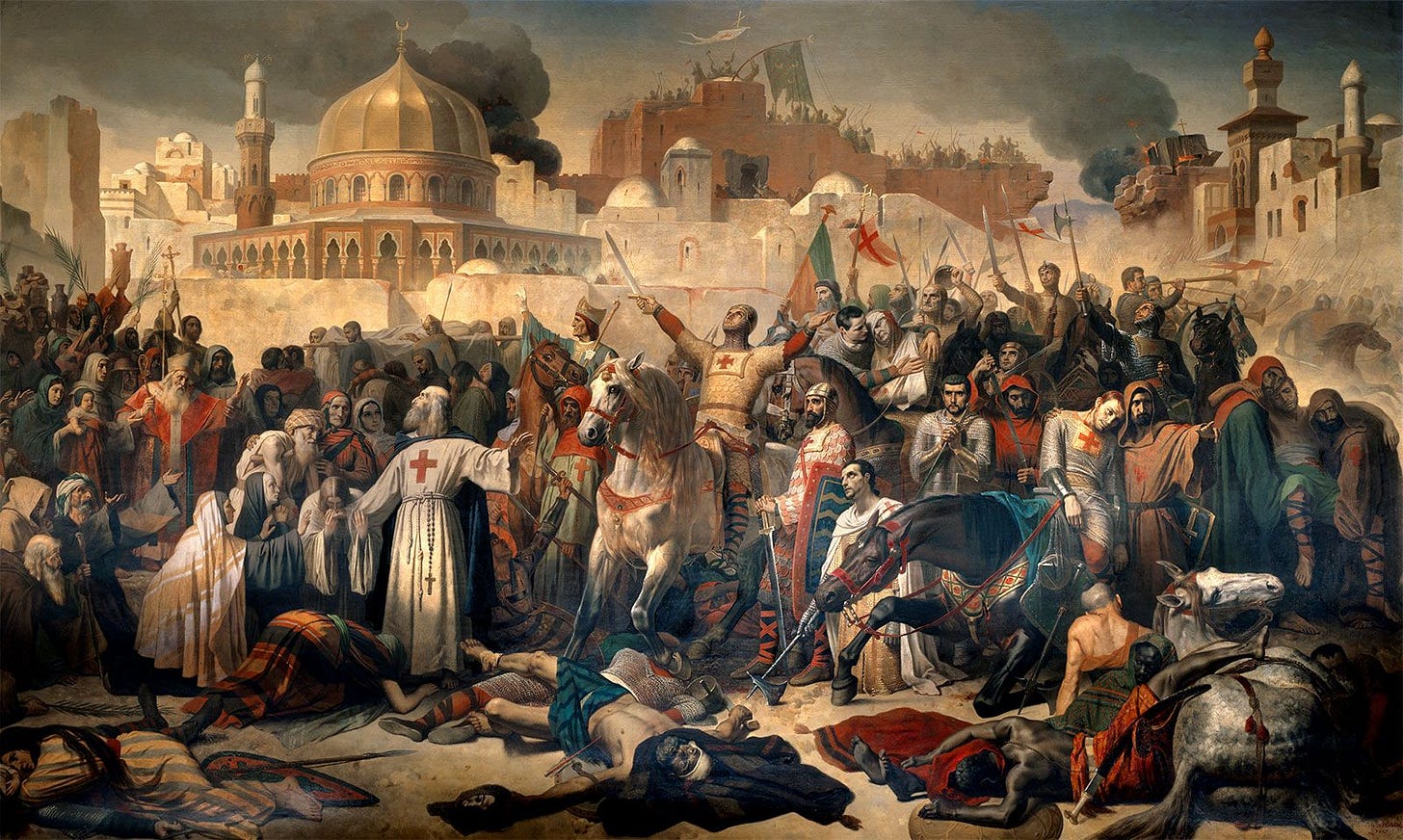
But cross the Mediterranean, and the exact same timeline reads like a chronicle of foreign invasion and eventual, hard-won restoration against the barbarous northerners. The dates do not change, but the adjectives do. Here is the history as it is remembered in the Levant:
When the Frankish armies breached Jerusalem in 1099, they imposed a martial culture utterly alien to the region. Accustomed to northern forests, the crusaders relied on heavy wool, salted provisions, and isolated stone keeps. To the local Muslim inhabitants, this was a stark contrast to a society built around sun-washed courtyards, communal public baths, and markets vibrant with fresh flatbreads, olives, and citrus. The invaders carved out the fragile states of Outremer, but beneath their rule, the region’s sophisticated urban rhythms, complete with organized hospitals and regulated water systems, quietly endured.
For much of the twelfth century, an uneasy coexistence defined the borderlands. The crusader hold was always tenuous, a reality first exposed in 1144 when Imad ad-Din Zengi reclaimed the County of Edessa, shattering the myth of Frankish invincibility. In the decades that followed, daily life became a complex tapestry of friction and exchange. Frankish knights governed from damp, drafty fortresses, yet they increasingly depended on local markets for sugar, glass, and silk. Truces allowed merchants to cross lines, but the cultural divide remained visible: while the crusader elite often struggled with Levantine heat and basic sanitation, local communities maintained their traditions of regular ablutions, scholarly study in madrasas, and shared, herb-rich meals.
The political tide turned decisively in 1187. At the Horns of Hattin, the fragmented crusader armies were outmaneuvered, leading to Salah ad-Din’s recapture of Jerusalem. For the local population, this was not merely a military victory, but a restoration of civic order. Mosques and “bimaristans” (hospitals) reopened, and the region’s administrative heartbeat resumed. Though the Third Crusade saw Richard the Lionheart besiege Acre, he could not retake the holy city. The ensuing century of negotiated truces only highlighted the resilience of local society, which continued to thrive on its established foundations of public hygiene and civic welfare.

By the mid-thirteenth century, the crusader presence was a relic waiting to be cleared. After the newly established Mamluk dynasty halted the Mongol advance at Ain Jalut in 1260, securing the region’s eastern flank, they turned their disciplined, centralized power toward the coastline. Sultan Baybars initiated a systematic dismantling of the crusader strongholds. Antioch fell in 1268, and the formidable fortress of Krak des Chevaliers surrendered in 1271. The contrast was laid bare: as crusader outposts decayed into isolated, supply-starved enclaves, Mamluk cities flourished, repairing irrigation canals and expanding vibrant, clean urban centers.
The end came methodically. In 1291, Mamluk forces besieged and captured Acre, the last major crusader capital, driving the remaining defenders into the sea. A final, tiny garrison clinging to the island of Arwad was swept away by the Mamluk navy in 1302, erasing the last physical foothold of the crusades.
The crusaders left behind crumbling, hollow castles, silent monuments to a foreign experiment. Yet, the echoes of that era have never truly faded. Today, the very same soil remains a stage for competing historical claims, where distant powers still invoke ancient rights and civilizational mandates to justify their presence.
In the West, 1291 is often romanticized as a tragedy of lost glory, recounted in medieval verse and modern films. But in the Levant, it is simply the day the northern barbarians were finally vanquished. For those who still walk these sun-washed streets, it remains a timeless cautionary tale of foreign invaders, resiliance and ultimate redemption.
Trita Parsi: Iran War Ends Today? Threats of Deporting Trita Parsi
Glenn Diesen | June 13, 2026
Trita Parsi discusses the efforts to have him deported for criticising the Iran War, and also comments on Pakistan’s Prime Minister arguing a peace agreement will be signed within the next 24 hours.
Parsi is the co-founder and Executive Vice President of the Quincy Institute for Responsible Statecraft.
Follow the Substack of Trita Parsi: https://tritaparsi.substack.com/
Follow Prof. Glenn Diesen:
- Substack: https://glenndiesen.substack.com/
- X/Twitter: https://x.com/Glenn_Diesen
Patreon:  / glenndiesen
Support the research by Prof. Glenn Diesen:
- PayPal: https://www.paypal.com/paypalme/glenn…
- Buy me a Coffee: buymeacoffee.com/gdieseng
- Go Fund Me: https://gofund.me/09ea012f
What Is SIDS?
An Essay on the Diagnostic Category Built to Receive What Cannot Be Officially Named
Lies are Unbekoming | June 9, 2026
Sudden Infant Death Syndrome is officially defined as “the sudden death of an infant under one year of age, which remains unexplained after a thorough case investigation, including performance of a complete autopsy, examination of the death scene, and review of the clinical history.”¹
By its own definition, it is a non-explanation. A baby cannot be diagnosed with SIDS while alive. SIDS cannot kill a baby. The category exists to receive deaths whose cause cannot be officially acknowledged.
Before 1969, this category did not exist. Before organized vaccination programs expanded in the 1960s, what was then called crib death was so rare that it was not mentioned in infant mortality statistics.² The term Sudden Infant Death Syndrome was created in 1969 in response to a rise in unexplained infant deaths that coincided with expanded vaccination campaigns. By 1972, SIDS had become the leading cause of post-neonatal mortality in the United States, the leading cause of death between 28 days and one year of age.³ A category that had not existed three years earlier had become the dominant verdict on dead infants.
There are 130 official ways for an infant to die, as categorized in the International Classification of Diseases. There is no official way to die from a vaccine. That classification was removed in 1979.⁴ Medical examiners working since then have been given a manual that contains every imaginable cause of infant death except the one that the public record, the manufacturer’s own clinical trial data, and a half-century of clustering evidence all point to.
Before SIDS Existed
The 1967 Pediatrics review by Maria Valdes-Dapena examined the world literature on sudden unexpected infant deaths from 1954 to 1966. The review documented a rising phenomenon in industrialized nations, with the author professing herself “woefully ignorant” of the cause.⁵ The deaths were already occurring. They had not yet been categorized.
A causal connection to vaccination was made early. Within fifteen years of the Valdes-Dapena review, William Torch presented findings at the 1982 American Academy of Neurology Conference identifying DPT vaccination as a potential cause of the deaths the new category had been created to receive.⁶ The category was new. The deaths were not. What was new was the schedule that produced them and the institutional naming that made them legible only as a syndrome of unknown origin.
In 1969, when the term Sudden Infant Death Syndrome was created, the United States was four years past the introduction of the measles vaccine and five years past the licensing of the oral polio vaccine. DPT was being administered at expanded coverage. Mumps and rubella vaccines had been licensed. The childhood schedule was growing rapidly. Pre-1969, organized vaccination of infants was limited; crib death was rare and unstratified.² The temporal alignment between the expansion of the schedule and the creation of the category to absorb the resulting deaths went unnoticed because nobody was looking. There was no institutional reason to look.
In 1973, the National Center for Health Statistics, operated by the CDC, created a new cause-of-death category specifically for SIDS.² Certifiers were required to use it. By the late 1970s, the institutional infrastructure was nearly complete. What remained was the elimination of the alternative.
The 1979 revision of the International Classification of Diseases eliminated all cause-of-death classifications associated with vaccination.⁴ Previous versions of the ICD had listed “prophylactic inoculation and vaccination” as a separate cause-of-death category, with subcategories for deaths caused by specific vaccines. The 1979 revision and every subsequent update removed these. Since 1979, medical certifiers have had no code to assign vaccine-related deaths to. They are required, by the structure of the manual they use, to assign the death to a different category.
The asymmetry this produces is striking. The same federal government that maintains the ICD code structure also operates the National Vaccine Injury Compensation Program, established by the National Childhood Vaccine Injury Act of 1986. As of May 2021, the Vaccine Injury Compensation Program had awarded more than $4.5 billion in compensation for vaccine injuries and deaths.⁷ The federal government, in one capacity, compensates families for deaths caused by vaccines. The same federal government, in another capacity, removes the cause-of-death code that would allow those deaths to be officially documented in mortality statistics. The compensation requires the cause; the mortality statistics deny it. Both are operated by the same institution.
This structure has been in place for forty-six years. Every infant death that has occurred in temporal proximity to vaccination since 1979 has been recorded under a different code than the one that would name what happened. SIDS, “accidental suffocation,” “unknown cause,” “unspecified viral disease,” “diseases of the blood,” “cardiac arrest,” and “shaken baby syndrome” are among the 130 categories that have absorbed these deaths.² The codes operate as containers. The volume of what they contain has grown as the schedule has grown.
The Pattern That Should Not Exist
The strongest single piece of evidence for what SIDS contains is the temporal distribution of infant deaths relative to vaccination. Neil Miller’s 2021 analysis of the Vaccine Adverse Event Reporting System database, published in Toxicology Reports, examined 2,605 infant deaths reported between 1990 and 2019.⁸ The findings were specific and statistically definitive.
Of all reported infant deaths, 58% occurred within three days of vaccination, and 78.3% occurred within seven days. For the subset of deaths labeled SIDS specifically, 51% occurred within three days and 75.5% within seven days. The highest single-day count was day two after vaccination, with 760 reported infant deaths. The expected count for any single day if the deaths were randomly distributed across the sixty-day post-vaccination window analyzed would be approximately 43. Day two showed a 69-fold elevation over chance.⁸
The statistical significance was p < 0.00001. The probability that the observed clustering occurred by chance is less than one in 100,000.
In concrete terms: each day represents 0.27% of the year, and a seven-day window represents 1.9% of the year. If infant deaths bore no temporal relationship to vaccination, the proportion of deaths falling within seven days of a vaccination event would approximate the proportion of days the window represents. The observed figure is 78.3%. That is forty-one times the baseline expectation. The biological mechanism describes how the deaths occur. The temporal density demonstrates that they occur because of the intervention they cluster around.
The pattern was identified before Miller’s analysis. In 1982, William Torch presented data on seventy SIDS cases reported in Nevada. 6.5% of infants died within twelve hours of DPT vaccination, 13% within twenty-four hours, 26% within three days, and 37%, 61%, and 70% within one, two, and three weeks respectively.⁶ The clustering was visible in 1982. It has been visible for forty-three years.
In 1987, Alexander Walker of the Boston University Medical Center and the Harvard School of Public Health published findings in the American Journal of Public Health on US children born between 1972 and 1983 who received the diphtheria-tetanus-whole cell pertussis vaccine. Infants weighing more than 2,500 grams at birth experienced 7.3 times more SIDS within three days of DTP vaccination than during a period starting thirty days after vaccination. The 95% confidence interval ranged from 1.7 to 31.⁹ The lead author was affiliated with Harvard and the finding was published in a major public health journal. The institutional reaction was silence.
The manufacturer’s own data confirms what the epidemiological data shows. A confidential GlaxoSmithKline clinical study report on the hexavalent vaccine, made publicly available by an Italian court, documented that 65 of 67 sudden infant deaths occurring during the trial (97%) occurred within the first ten days after vaccination. Just two deaths occurred in the next ten days.¹⁰ Across the manufacturer’s own data, 62.7% of sudden infant deaths occurred within three days of vaccination and 89.6% within seven days. Six of the eight sudden deaths in children during their second year of life occurred within three days of vaccination.¹⁰ The manufacturer concluded that the vaccine did not increase the risk of sudden death. European regulators accepted the conclusion.
Independent autopsy findings confirm the relationship at the level of individual cases. Zinka and colleagues, publishing in Vaccine in 2006, documented six cases of sudden infant death occurring within forty-eight hours of hexavalent vaccination. Autopsies showed unusual neuropathology in the brains of these infants. The authors calculated a 13-fold increase in the risk of sudden death after hexavalent vaccination compared with an earlier period before the multi-dose vaccine was available.¹¹ D’Errico and colleagues, in 2008, examined a three-month-old infant who died within twenty-four hours of hexavalent vaccination. They concluded that acute respiratory failure due to post-vaccination shock was the cause of death.¹² Ottaviani and colleagues, in Virchows Archiv in 2006, documented a separate case of sudden infant death shortly after hexavalent vaccination, identifying the vaccine as the likely trigger of the lethal outcome.¹³
In 1978 and 1979, eleven infants in Tennessee died within eight days of DPT vaccination. Five died within twenty-four hours. Nine of the eleven had received their vaccine from the same lot, Wyeth Lot #64201.² A subsequent investigation confirmed a greater-than-expected relationship between the lot and the deaths. The FDA initially stated that a causal relationship could not be totally excluded. Later statements walked this back to “experts did not find evidence of a cause-effect relationship.” The CDC ultimately classified the deaths as coincidence.² Internal memos from the manufacturer, surfaced afterward, revealed a new shipping policy: no geographical location would receive all of its DPT vaccine from a single lot, ensuring that any future clustering would be statistically diluted across regions. The structural ability to detect hot lots was deliberately broken.
In a 2017 case before the National Vaccine Injury Compensation Program, the Special Master awarded compensation to the parents of a four-month-old infant who died the day after receiving seven vaccines. The ruling concluded that vaccines “likely did play a critical role in this child’s death” by stimulating inflammatory cytokines that suppressed the respiratory system and prevented normal response to carbon dioxide accumulation.¹⁴ The vaccine court awarded the compensation. The death certificate listed something else.
The Brainstem and the Empty Autopsy
The clustering data demonstrates that the deaths occur. The mechanism explains how, and the convergence of two independent mechanistic accounts on the same anatomical target, the brainstem respiratory control region, also explains why the autopsy finds nothing.
The first account begins with what aluminum does in tissue. Aluminum adjuvants are present in multiple vaccines administered during the first eighteen months of life, including hepatitis B, DTaP, Hib (some formulations), pneumococcal conjugate, and hepatitis A.¹⁵ The total dose of injected aluminum received by a fully vaccinated child has approximately quadrupled since the 1980s, from around 1,000 micrograms by age eighteen months under the schedule in place before the 1986 NCVIA to over 4,000 micrograms today.¹⁵ Aluminum is biopersistent. Gherardi and colleagues, publishing in Frontiers in Neurology in 2015, documented that aluminum hydroxide particles persist at injection sites and undergo slow CCL2-dependent translocation from muscle to brain via macrophage transport.¹⁶ Christopher Exley’s work in 2018 documented elevated aluminum levels in the brain tissue of individuals diagnosed with autism, demonstrating that injected aluminum reaches and persists in the brain.¹⁷ Khan and colleagues in 2013 documented the mechanical pathway of this translocation: biopersistent particles taken up by phagocytes, transported through lymphatic and circulatory routes, deposited in distant tissues including the central nervous system.¹⁸ Yao and colleagues, in 2015, showed that hepatitis B vaccination of postnatal rats modulates hippocampal synaptic plasticity and produces a four-fold elevation in the inflammatory cytokine IL-6, demonstrating that the vaccines themselves, not just isolated aluminum, produce these effects in the developing brain.¹⁹
When an infant receives multiple aluminum-containing vaccines simultaneously, the inflammatory cascade is rapid and substantial. Microglia in the brainstem become activated. Activated microglia release glutamate and other excitotoxic compounds, along with pro-inflammatory cytokines, into the surrounding tissue.²⁰ The brainstem contains the respiratory control center. When microglial activation in this region releases excitotoxins, the infant’s breathing is suppressed. If the suppression is severe enough and sustained enough, the infant stops breathing. The neuropathologist Dr. Douglas Miller, in expert testimony cited in the Vaccine Injury Compensation Program ruling and Neil Miller’s 2021 analysis, described how vaccine-induced inflammatory cytokines act as neuromodulators in the infant medulla, producing an abnormal response to accumulating carbon dioxide and disorganizing respiratory control.⁸
This explains the first part of the autopsy’s silence. The pathologist who examines a baby that has died of inflammatory respiratory failure is looking for visible tissue damage: discrete lesions, hemorrhage, structural anomaly. The mechanism described does not produce visible damage in the timeframe required for death. Microglial activation triggers the excitotoxin release, the respiratory center fails, and the infant dies before any histological signature of the cytokine surge would form.²⁰ The pathologist sees a baby that has stopped breathing for no apparent reason. The cause is dispersed at a biochemical timescale the autopsy cannot resolve.
The second account begins from a different starting point and arrives at the same anatomical region. Andrew Moulden, a Canadian neurologist with PhD-level training in clinical-experimental neuropsychology, developed what he called the Moulden Anoxia Spectrum Syndromes framework.²¹ Moulden’s central observation was that injected substances disrupt the electrostatic stability of blood flow. Aluminum, which carries a positive trivalent charge, has approximately eighty-four times the agglomeration-inducing capacity of sodium. It is, in industrial terms, a flocculant, the same agent used in water treatment plants to cause suspended particles to clump and settle. Injected into human tissue and bloodstream, aluminum produces the same effect: red blood cells, white blood cells, and other formed elements clump together. The blood sludges.
The microcirculation in the brainstem (the network of capillaries supplying the respiratory control region) operates at a scale where red blood cells must pass through capillaries in single file. When the blood sludges, this single-file passage is obstructed. The result is microscopic ischemia: regions of tissue receiving insufficient oxygen because the blood cannot flow through the capillaries that supply them.²¹
The human body has blood pressure receptors. It does not have blood flow receptors.²¹ This anatomical fact is critical. When microcirculation fails at the capillary level but the larger arteries continue to maintain pressure, no warning signal is generated. The brainstem can be suffering ischemic damage in its watershed end-vascular territories (the most poorly supplied regions, including those controlling automatic respiration) while the body’s monitoring systems detect no problem. The damage is, in Moulden’s analysis, sub-clinical to the body itself.
This explains the second part of the autopsy’s silence. The damage Moulden described occurs at the level of the microcirculation, well below the resolution of conventional neuroimaging. There is no infarct visible on MRI. There is no hemorrhage to find. And in death, the body has no blood flow at all. The difference between sludged microcirculation in life and the post-mortem absence of circulation is not detectable by examination of the dead tissue. The lesion is invisible by structural design.
The two accounts converge on a single anatomical target, the brainstem respiratory control region, by different routes. The inflammatory pathway explains why activated microglia in this region kill the infant. The microcirculation pathway explains why ischemia in this region kills the infant. Both are caused by injected aluminum, both produce respiratory arrest, and neither leaves damage detectable at the resolution the autopsy uses to look.
When the official definition of SIDS requires that death “remain unexplained after a thorough case investigation, including performance of a complete autopsy,” the definition is describing a death that occurred via mechanisms structurally invisible to the investigation it requires. The autopsy comes up empty because the investigation tools cannot see what killed the baby. The verdict of “unexplained” is the predictable output of looking for the wrong kind of damage at a scale the instruments were never designed to resolve.
What Happens When You Remove the Cause
The convergent mechanism predicts a specific real-world outcome: if vaccinations are reduced, delayed, or interrupted, the deaths the SIDS category absorbs should decline. The historical and contemporary record contains multiple natural experiments testing this prediction. Each confirms it.
Japan, 1975. Between 1970 and 1974, Japanese authorities documented thirty-seven sudden infant deaths following pertussis vaccinations. In response, the Japanese government raised the age of DPT vaccination from three months to two years.²² The result, documented across the following decade, was dramatic.
Sudden vaccine-related deaths dropped from 1.47 per million doses to 0.15 per million doses, a 90% decline.²² The category of “sudden death” following vaccination, in the analysis of Cherry and colleagues published in Pediatrics, “disappeared following both whole-cell and acellular vaccines when immunization was delayed until a child was 24 months of age.”²² Japan’s overall infant mortality rate across all causes declined from 12.4 to 5.0 per 1,000 live births over the decade following the schedule change, a 60% improvement.²² The Task Force on Pertussis and Pertussis Immunization that produced the report concluded: “It is clear that delaying the initial vaccination until a child is 24 months, regardless of the type of vaccine, reduces most of the temporally associated severe adverse reactions.”²²
The Japanese experiment did not require a placebo group, randomization, or a controlled trial. It was a real-world intervention with a clear before-state and a clear after-state, with vaccination timing as the single variable change between them. The infant mortality decline cannot plausibly be attributed to anything else. The Japanese government delayed vaccination. Fewer babies died.
COVID lockdowns, 2020. During the early lockdown period of 2020, routine well-child visits were canceled or postponed across many jurisdictions, and childhood vaccination rates declined. An analysis comparing infant deaths in Oregon over the first six months of 2020 against the ten-year average documented a 42% drop in infant deaths during the period when lockdowns were in place and well-baby visits were canceled.²³ Similar patterns were documented elsewhere, alongside an unprecedented decline in premature births, which are themselves linked to vaccination during pregnancy.²⁴ The vaccine safety community had predicted, before the data became available, that the lockdowns would produce a once-in-a-generation natural experiment in reduced SIDS, because if vaccines are the cause, reduced vaccination should produce reduced deaths. The data confirmed the prediction.
Florida, 2021. In the year following the lockdown-driven decline in vaccination compliance, Florida’s childhood vaccination rate dropped from 93.4% to 79.3%. All-cause infant mortality under one year of age decreased by 8.93% during the same period, a reversal of the previous year’s trend.²⁵ The single largest variable that changed in Florida between 2020 and 2021 was vaccination compliance. The infant mortality figure moved in the direction the mechanism predicts.
International comparison. A 2011 study comparing infant mortality rates across the thirty-four nations with the lowest rates found a clear correlation between the number of required childhood vaccines and infant mortality.²⁶ The United States, with the largest childhood schedule among industrialized nations, also has among the highest infant mortality rates among industrialized nations.²⁷ A separate analysis comparing vaccine doses across developed nations found a strong association between dose counts and mortality rates.²⁸ Countries that vaccinate more, more often, earlier, lose more babies.
None of these experiments meets the design specifications of a randomized controlled trial. None of them needs to. Japan’s schedule change was real. The lockdowns were real. Florida’s compliance shift was real. The infant mortality figures are public record. Four independent natural experiments, three of them documented within the past five years, all moving in the direction the convergent mechanism predicts.
How the Category Has Mutated
The institutional response to the visible clustering pattern has been to mutate the category rather than investigate the relationship. The SIDS code was never the only container available. As the visibility of vaccine-induced infant death increased, the institutional pressure to disperse those deaths across multiple cause-of-death codes increased correspondingly.
In 1992, the American Academy of Pediatrics formally recommended that infants be placed supine rather than prone during sleep. The Back to Sleep campaign launched two years later, in 1994.²⁹ The campaign came eight years after the 1986 National Childhood Vaccine Injury Act, which had itself been passed in response to congressional hearings in which parents, including Donna Gary, linked DTP vaccination to infant deaths. The Back to Sleep campaign provided an alternative narrative: SIDS was caused by sleep position, not by what was injected into the infant before the sleep occurred.
The SIDS rate appeared to decline. Between 1992 and 2001, the post-neonatal SIDS rate dropped by an average annual rate of 8.6%.² This was presented as a vindication of the sleep-position hypothesis. The numbers told a different story when examined carefully. During the same period, the post-neonatal mortality rate from “suffocation in bed” (ICD-9 code E913.0) increased at an average annual rate of 11.2%.² Sudden, unexplained infant deaths that had been classified as SIDS before the campaign were now being classified as suffocation in bed. The deaths had not declined; the label on the certificate had changed.
The reclassification accelerated. From 1999 through 2015, the US SIDS rate declined 35.8% while infant deaths due to accidental suffocation increased 183.8%.² Approximately 90% of the apparent SIDS decline can be attributed to reclassification rather than reduction.² The category became more porous as institutional pressure to disperse the deaths intensified.
In 2012, the CDC introduced a new umbrella category: Sudden Unexpected Infant Death (SUID), which encompasses SIDS along with deaths attributed to suffocation and unknown causes.²⁹ The same year, the Back to Sleep campaign was rebranded as Safe to Sleep. The two institutional moves arrived together: a broader receiving category for the deaths, and a broader messaging framework for displacing their cause. Deaths that the SIDS code might have captured in isolation could now be distributed across three subcategories under the SUID umbrella, each of which can be reclassified independently as institutional preference dictates.
Safe to Sleep expanded the messaging beyond sleep position to a long list of parental responsibilities: avoidance of soft bedding, prohibitions on bed-sharing, recommendations on breastfeeding, pacifier use, smoke exposure, room temperature, swaddling. The messaging was directed disproportionately at African American communities, where SIDS rates are higher. A 2018 analysis of safe sleep public campaign messaging found that 60% of campaign messages used guilt-based framing, placing responsibility for the death on the parent’s behavior in the hours preceding it.²⁹ The campaign installed a moral framework. Parents who lost infants to sudden death were positioned within that framework as having failed it. The cause they had not been told about, the schedule they had complied with, did not appear in the framework anywhere.
In May 2025, the National Institutes of Health terminated the Safe to Sleep campaign.²⁹ The termination came after the 2020-2022 period documented a 12% rise in sudden infant deaths.²⁹ The campaign had operated in its two forms, Back to Sleep and Safe to Sleep, for over three decades without reducing SIDS deaths in any sustained way; the numbers showed reclassification rather than prevention. Its useful institutional life had ended.
The framework Safe to Sleep installed remained operational after the campaign itself was terminated. In June 2025, parents in Allentown, Pennsylvania were charged with felonies for placing their infants in unsafe sleep positions.³⁰ The Defender, reporting on similar cases, documented police charging parents with felonies after their babies died suddenly in their sleep, based on the parents’ alleged failure to follow supine sleeping guidance.³⁰ The guilt-based moral structure Safe to Sleep had installed in 2012 was now providing the legal basis for criminal prosecution in 2025. The criminalization of parents who have lost infants to deaths the system cannot explain has institutional precedent. Sally Clark, a British lawyer, was convicted in 1999 of murdering both of her infant sons, who had died unexpectedly weeks after receiving routine vaccinations. The conviction was overturned in 2003 after the statistical evidence underpinning the prosecution was discredited. She died of acute alcohol poisoning in 2007, in the aftermath.³¹ Her case is one documented historical instance. The June 2025 prosecutions are the contemporary instance of the same dynamic operating in real time.
The trajectory is consistent. Pre-1969, the deaths exist without a category to receive them. In 1969, the SIDS category is created. In 1979, the alternative cause-of-death code, vaccination, is removed from the ICD. In 1994, the Back to Sleep campaign provides a sleep-position narrative. From 1992 through 2025, deaths are reclassified into suffocation and unknown-cause codes as institutional preference shifts. In 2012, SUID broadens the receiving framework and Safe to Sleep broadens the messaging framework. In 2025, the campaign is terminated as its useful institutional life ends, and parents begin to be prosecuted under the framework the campaign installed.
At every stage, the institutional response has been to adjust the receiving infrastructure rather than investigate what is being received. The category mutates because the underlying deaths cannot stop. The schedule cannot be paused without admitting what it does, and the deaths cannot be officially named without admitting the cause. The mutation of the category is the visible trace of the institutional refusal to do either.
What SIDS Is
The official definition of SIDS describes a death that remains unexplained after thorough investigation. The definition is precise. What it describes is a death whose cause is structurally invisible to the investigation required to confirm the absence of explanation. The category exists to receive what the system cannot officially name.
The category did not exist before 1969. It was created in the same period that the childhood vaccination schedule expanded into the population of infants under one year of age. The 1979 ICD revision then eliminated the alternative cause-of-death code; the 1994 Back to Sleep campaign installed the sleep-position narrative; the 2012 SUID expansion broadened the receiving framework and the Safe to Sleep rebrand broadened the messaging framework alongside it. The 2025 campaign termination ended one phase of the construct, and the June 2025 felony prosecutions began another.
The mechanism is understood. Aluminum adjuvants reach the infant brainstem by macrophage transport and slow translocation. Microglia in the respiratory control region activate; excitotoxins release into the breathing center. The same aluminum, through electrostatic agglomeration, sludges the microcirculation supplying the same anatomical region, producing ischemia. Both pathways suppress the infant’s respiration and produce respiratory arrest. Neither leaves damage visible at the resolution the autopsy uses to look.
The infant who dies of SIDS dies of what was injected and what its body could not clear. The autopsy finds nothing because nothing visible was left to find; the death certificate names something else because the manual contains no code for what happened.
SIDS is the name the system gives to the deaths it has built itself not to see.
How to Explain It to a Six-Year-Old
Imagine grown-ups gave babies a medicine. Some of the babies got really sick after the medicine. A few of them died.
When the grown-ups looked at the babies, they couldn’t find anything wrong with them. The hurt inside was too tiny to see, like a scratch so small you’d need a special magnifying glass for ants to see it.
So the grown-ups said, “We don’t know what happened. It’s a mystery!” And they made up a special name for the mystery. The name was SIDS.
But here’s the thing. The grown-ups do know what happened. They’ve known for a long time. The medicine has something called aluminum in it. Aluminum is the same shiny stuff your sandwich wrap is made of. It’s okay on a sandwich. It’s not okay inside a baby.
The aluminum gets into the part of the brain that tells the baby to breathe. The brain stops working right. The baby stops breathing.
But the grown-ups don’t want to tell anyone, because lots of grown-ups get money from the medicine. So they keep calling it SIDS, the mystery.
When parents started to figure it out, the grown-ups changed the name. They called it “crib death.” Then “SIDS.” Then “SUID.” Now they say the babies suffocated, and sometimes the police take the mommies and daddies to jail, even though they didn’t do anything wrong.
Every time someone gets close to the truth, the grown-ups change the name.
The babies didn’t die from a mystery. They died from the medicine.
SIDS is the name grown-ups use when they don’t want to tell the truth about why a baby died.
References
- Standard definition of Sudden Infant Death Syndrome as adopted by the Institute of Medicine and used by the CDC, the American Academy of Pediatrics, and the National Institute of Child Health and Human Development; cited in de Becker, G. (2022). Forbidden Facts.
- Miller, N. Z. (2021). “Vaccines and Sudden Infant Death: An Analysis of the VAERS Database 1990–2019 and Review of the Medical Literature.” Toxicology Reports 8: 1324–1335. Historical context including the pre-1969 absence of the category and the post-1979 reclassification patterns.
- National Center for Health Statistics, CDC; cited in Miller (2021).
- International Classification of Diseases, 9th revision (1979); subsequent revisions ICD-10 and ICD-11; analysis in Miller (2021).
- Valdes-Dapena, M. A. (1967). “Sudden and unexpected death in infancy: a review of the world literature 1954–1966.” Pediatrics 39(1): 123–138.
- Torch, W. C. (1982). “Diphtheria-Pertussis-Tetanus (DPT) Immunization: A Potential Cause of Sudden Infant Death Syndrome.” Neurology 32(4). Conference abstract, American Academy of Neurology.
- Health Resources and Services Administration, National Vaccine Injury Compensation Program statistical data, as of May 2021.
- Miller, N. Z. (2021). Toxicology Reports 8: 1324–1335. Full statistical analysis including the day-by-day clustering, the 69-fold elevation on day two, and the p < 0.00001 significance.
- Walker, A. M., et al. (1987). “Diphtheria-Tetanus-Pertussis Immunization and Sudden Infant Death Syndrome.” American Journal of Public Health 77(8): 945–951.
- GlaxoSmithKline (2012). “Confidential Clinical Study Final Report: Study 113808 (ROTA-075).” Made publicly available by Italian court order.
- Zinka, B., Rauch, E., et al. (2006). “Unexplained cases of sudden infant death shortly after hexavalent vaccination.” Vaccine 24(31–32): 5779–5780.
- D’Errico, S., Neri, M., et al. (2008). “Beta-tryptase and quantitative mast-cell increase in a sudden infant death following hexavalent immunization.” Forensic Science International 179(2–3): e25–29.
- Ottaviani, G., Lavezze, A. M., Matturri, L. (2006). “Sudden infant death syndrome (SIDS) shortly after hexavalent vaccination: another pathology in suspected SIDS?” Virchows Archiv 448: 100–104.
- National Vaccine Injury Compensation Program ruling, 2017; cited in Miller (2021) and Thomas, P. (2022). Vax Facts.
- Thomas, P. (2022). Vax Facts. Handley, J. B. How to End the Autism Epidemic. Aluminum content data drawn from CDC Vaccine Information Statements and Mitkus, R. J., et al. (2011). “Updated aluminum pharmacokinetics following infant exposures through diet and vaccination.” Vaccine 29(51): 9538–9543.
- Gherardi, R., et al. (2015). “Biopersistence and Brain Translocation of Aluminum Adjuvants of Vaccines.” Frontiers in Neurology 6: Article 4.
- Mold, M., Umar, D., King, A., Exley, C. (2018). “Aluminium in brain tissue in autism.” Journal of Trace Elements in Medicine and Biology 46: 76–82.
- Khan, Z., et al. (2013). “Slow CCL2-dependent translocation of biopersistent particles from muscle to brain.” BMC Medicine 11: 99.
- Yao, Z., et al. (2015). Hepatitis B vaccination of postnatal rats modulating hippocampal synaptic plasticity and IL-6 elevation; cited in Handley, J. B. How to End the Autism Epidemic.
- Hedley, K., et al. (2022). “Alterations in Brainstem Respiratory Centers following Peripheral Inflammation.” Journal of Neuroimmunology 369. Hoogland, I. C. M., et al. (2015). “Systemic inflammation and microglial activation: systematic review of animal experiments.” Journal of Neuroinflammation 12: 114.
- Moulden, A. (2009). “What You Were Never Told About Vaccines.” Interview, VacTruth.com. BrainGuardMD.com archive. Analysis of the MASS framework, zeta potential, and microcirculation pathology.
- Cherry, J. D., et al., Task Force on Pertussis and Pertussis Immunization. Pediatrics. Cited in Miller (2021) and Fraser, H. (2010). The Peanut Allergy Epidemic.
- Snee, B., comment on A Midwestern Doctor (2022); Oregon infant death analysis comparing first six months of 2020 to the ten-year average.
- A Midwestern Doctor. “The Century of Evidence That Vaccines Cause Sudden Infant Deaths.” MidwesternDoctor.com.
- Florida Department of Health vaccination compliance data 2020–2021; CDC infant mortality data; analysis cited in A Midwestern Doctor (2022).
- Miller, N. Z., Goldman, G. S. (2011). “Infant mortality rates regressed against number of vaccine doses routinely given: is there a biochemical or synergistic toxicity?” Human and Experimental Toxicology 30(9): 1420–1428.
- CDC Childhood Immunization Schedule, comparative data 1983 and present; Thomas, P. (2022). Vax Facts; OECD infant mortality comparative data.
- “Neonatal, Infant, and Under Age Five Vaccine Doses Routinely Given in Developed Nations and Their Association With Mortality Rates.” Cureus.
- Children’s Health Defense (2025). “Media Slam NIH for Axing ‘Safe to Sleep’ Campaign — But Evidence Shows the Program Never Reduced SIDS Deaths.” American Academy of Pediatrics (1992). “Positioning and SIDS.” Pediatrics 89(6): 1120–1126. Salm Ward, T. C., Balfour, G. M. (2018). “Qualitative analysis of infant safe sleep public campaign messaging.” Pediatrics 43(2): 83–91.
- The Defender (June 6, 2025). “Their Babies Died Suddenly in Their Sleep. Police Are Charging the Parents With Felonies for Not Placing Infants on Their Backs.” WFMZ Allentown, PA (June 6, 2025). “Parents accused of putting their infants in unsafe sleep positions charged with felonies.”
- Sally Clark case (R v Clark, 2003 EWCA Crim 1020). Both sons died unexpectedly in infancy weeks after receiving routine UK childhood vaccinations; the conviction was overturned in 2003 after the statistical evidence presented by Sir Roy Meadow was discredited and previously withheld pathology evidence was disclosed.
DHS docs: Govt bracing for nationwide anti-AI riots, preparing to crack down on dissent
By Alan MACLEOD | MintPress News | June 11, 2026
New documents from government agencies such as the FBI and Department of Homeland Security show that Washington is preparing for widespread anti-A.I. riots, as the technology destroys communities and industries across the country. Ironically, the Trump administration is already using invasive A.I. technology to identify and suppress what it calls anti-A.I. “extremists,” in the process, sweeping the entire nation into its massive surveillance dragnet.
More than 1,000 pages of leaked documents reviewed by WIRED Magazine show that government agencies are anticipating a huge wave of domestic unrest in the coming years, as artificial intelligence upends American society. Automation-related job losses could shatter entire industries, while the building of gigantic data centers will remove water and electricity from public use, ramping up the price of what little remains.
As one report from the New York Intelligence and Counterterrorism Bureau notes:
“The chaotic atmosphere that may result from emergent A.I. technology in the next five years may fuel large-scale protests that devolve into civil unrest and anti-tech violent extremist activity, especially in large urban areas such as New York City.”
An Environmental and Health Catastrophe
Last year, the tech industry collectively spent around half a trillion dollars on the construction of new data centers. These buildings consume near insatiable amounts of energy and water. By 2030, they are expected to represent around 12% of total U.S. electricity consumption. One large data center consumes up to five million gallons of water per day – as much as a small city. It has been calculated that a single 100-word A.I. prompt to a chatbot like Claude or ChatGPT uses over half a liter of water, equivalent to one bottle.
When a data center moves into town, utility prices skyrocket. In this situation, wholesale electricity, for example, jumps by up to 267%. Ordinary Americans cannot compete with the likes of Amazon or Microsoft, and can be priced out of even the most basic necessities of life, causing widespread resentment.
Living near a data center can also be hazardous to human health. Thanks to the low-frequency noises they produce, residents often report chronic symptoms such as insomnia, vertigo, and nausea. Worse still, to meet their enormous energy demands, data centers often rely on gas or diesel generators, which emit high levels of nitrogen oxides, fine particular matter, and so-called “forever chemicals” into the air, further complicating the situation.
A.I. will also have a profound effect on employment. Goldman Sachs predicts that, over the next decade, 300 million jobs could be lost to A.I.-based automation. Sam Altman, CEO of ChatGPT’s parent company, OpenAI, has suggested that whole industries may be replaced by his product. “Entire classes of jobs will go away and not come back,” he confidently stated in 2019. Facing growing public anger, last month, he walked those statements back, assuring the public that there would be no “jobs apocalypse.”
But if these predictions are anything close to correct, it will cause massive economic disruption across America, and send towns and entire cities dependent on certain types of work into potentially permanent depressions. The latest news that Washington is preparing to treat this unrest as akin to terrorism should be of great concern to all Americans.
The Dark Side of A.I.
The public, as a whole, is highly skeptical of artificial intelligence. A recent poll found that only 5% trust A.I. a great deal, while 77% think it could pose a fundamental threat to humanity.
The U.S. national security state, however, has fully committed to A.I., and is using it to mass surveil the public and to identify those not sufficiently supportive of the new technology. In March, FBI director Kash Patel confirmed that the bureau is buying Americans’ personal online user data from brokers in order to track the public. The Department of Homeland Security has spent millions purchasing A.I. software that detects the sentiment and emotions of Americans’ online posts, and is using it to identify activists and other potential “threats.” It has also sent subpoenas to Google, Facebook, Instagram, Reddit, Discord, and other large social media apps demanding they share the personal information and identities of anonymous users who have criticized the actions of the Trump administration. Government officials confirmed to The New York Times that platforms have often complied with their requests.
A.I. giant Anthropic publicly pulled out of a deal with the U.S. Department of War to develop A.I. systems in “classified environments,” stating that they feared the technology would immediately be used to carry out mass domestic surveillance in the United States. “We cannot in good conscience accede to their request,” they said, explaining their decision. The company was immediately labeled a national security “supply chain risk” by the Trump administration, and the contract was fulfilled by OpenAI.
OpenAI co-founder Greg Brockman is one of Trump’s most generous donors, having channeled $25 million to the president’s super PAC, MAGA Inc. He has also poured $50 million into Leading the Future, a bipartisan super PAC aimed at promoting pro-A.I. legislation in Washington, D.C., and defeating and silencing lawmakers who wish to curb the influence and power of the new industry.
It remains to be seen to what extent A.I. will actually become a revolutionary technology, but what is clear is that the U.S. government is preparing for major economic and social disruption in its wake. Instead of creating economic bailout plans and social welfare programs to help those negatively affected, however, it is preparing an authoritarian response, looking to crush dissent. What makes this future even more ironically dystopian is that, to do so, it is using the very A.I. that is triggering the problem in the first place.
India signals rethink over West Asia
By M. K. BHADRAKUMAR | Indian Punchline | June 13, 2026
Make no mistake, Modi Government is squarely blaming the US for the attack on ships in Strait of Hormuz killing seven Indian sailors. Protests have been lodged with the US charge d’affaires twice in 3 days, the second demarche being in notably harsher tone despite the news trickling from the Persian Gulf region, Pakistan and US that an MOU has been all but negotiated for signature lifting the American naval blockade of Iranian ports.
The salience of the Indian demarche lies in the following directions:
1. The US was provoking Delhi, which has resolutely pushed back — Washington’s silence in rebutting the Indian accusation is deafening.
2. There is no interest whatsoever in Delhi to adopt a median line apportioning blame between DC and Tehran (contrary to what some Indian newspapers have prioritised).
3. Stemming from the above, it sands to reason that Delhi has begun a comprehensive review of its tilt toward the US-Israeli axis and the earlier short-sighted delusional thinking that Abraham Accords would be the gateway to peace in West Asia.
4. Conceivably, the door opens — now that it is a matter of time before sanctions against Iran are lifted — for a full-throttle engagement of Iran which is going to be a towering presence in the geopolitics of our region, that would, hopefully, correct the distortions that crept into India’s foreign policy strategies in West Asia during the past decade.
5. No doubt, this is a major diplomatic shift on India’s part. World media has taken note. The foreign policy establishment is adjusting with alacrity in real time — an extraordinary spectacle in itself, to put it mildly, considering the manifest reluctance to indulge in public diplomacy critical of American moves — to the new imperatives of conducting a ‘transactional relationship’ with the US that take into account not only the domestic sentiments but also the global situation as well as the humiliating defeat — arguably, the most far-reaching defeat in the modern history— of the Americans in West Asia.
6. Finally, most important, Opposition leader Rahul Gandhi’s stance on West Asian developments seeking a course correction to the illogical pro-US tilt in India’s foreign policies stands vindicated, which in turn would necessitate a jettisoning of unilateralism in foreign policy moves and a return to the process of consensus-making, which had served India’s interests historically and used to be integral to the country’s political culture and civilisational traits.
Featured Video
BRITAIN’S WARNING: PREPARE FOR WAR
or go to
Aletho News Archives – Video-Images
From the Archive
How Ukraine Tortured and Slaughtered Donbass
By Kit Klarenberg | Al Mayadeen | July 11, 2024
Almost immediately after the proxy war erupted, ISIS-tier footage of the torture and murder of Russians in Ukrainian custody emerged.
On July 6th, the New York Times published an astonishing investigation: In Ukraine, Killings of Surrendering Russians Divide an American-Led Unit. The article documents in grim detail how Chosen Company, an international volunteer battalion for Kiev, routinely executes Russian prisoners of war. It is the very first mainstream admission that this practice – a brazen breach of the Geneva Conventions, and a grave war crime – is widespread among Ukraine’s fighters, both foreign and homegrown. … continue
Blog Roll
 Aletho News
- Pentagon designates Chinese cultural centers national security threat
- Israel Demolishes Home Of Lebanese Journalist Whose Viral Film Exposed Pager Attack
- Record Oil, Empty Tanks: The UAE’s Miracle Recovery
- Burnham tackles Britain’s poverty with aggression in Yemen
- Peace in Ukraine: the easy way – or the hard way
- Trump & the Rrrrussians
- US taxpayer money laundered back through Ukraine – Musk
- Before COVID, an NIH lab chief proposed making a SARS-like bat virus more infectious
- Gates, Bourla on Trial in Netherlands Accused of ‘Great Reset’ Scheme at Vaccine Injury Hearing
- BRITAIN’S WARNING: PREPARE FOR WAR
- If Americans Knew
- An error has occurred; the feed is probably down. Try again later.
- No Tricks Zone
- Two New Studies Find Thwaites Glacier Melt Cannot Be Driven By Human Activity Or A Warming Ocean
- E-Cars Reduce CO2 Emissions By Only 41% Compared To Internal Combustion Engine Vehicles
- Predictions Made By Renowned Climate Professor Over Past Decades Have Been Proven To Be Poor
- New Study Suggests Large Regions Of The Pacific Ocean Have Been Cooling For The Last 80 Years
- Germany’s Green Energy Debacle: High Energy Costs Force Kahla Porzellan to Close After 182 Years!
- New Study: 50 Years Of The Most Aggressive ‘Net Zero’ Policies Can Only Affect The Global Climate By 0.03°C
- US September “Heat” Was No Record…Many Records Set Decades Ago
- Latest European Green Energy Debacle; Portugal’s Largest Flagship Solar Park Insolvent!
- Green Energy Debacle: German Expert Professor Fritz Vahrenholt Warns Of Severe Economic And Social Consequences
- Two More Paleo Reconstructions Affirm Meters-Higher Sea Levels Across Ireland, Brazil 7000-6000 Years Ago

