One Pfizer jab, 20 months of battling to keep hope alive
By Brian Howard | TCW Defending Freedom | January 23, 2023
It has been a very long 20 months since my one and only Pfizer vaccine. I was hesitant but seeing friends and family seemingly OK I decided to ‘do the right thing’ as we were told. The regret still lives on, of course, although over time you do begin to forgive yourself and recognise the huge pressures we were all under.
Within ten days it started. Pins and needles in the hands at night. Then numbness down the whole right side of my body. Then the constant muscle twitches all over the legs. Within a month the tremors started. By this stage I’d already been fobbed off by my GP and a private neurologist. They didn’t want to know or simply didn’t have a clue how to help. I’ll never forget another neurologist suggesting I even take the second jab. Trust in the system had gone at that point. The symptoms continued. Random jolty movements of the body, intense dizziness, headaches and head pressure, brain-shaking sensations, adrenaline rushes, some elevated heart rate episodes. By the six-month point I was rapidly losing hope. You try to stay positive but it really can be a battle. I was fortunate enough to be self-employed and able to work from home but I had to let jobs go as it became far too much, and the money spent on finding alternative therapies and supplements to fix the problem wiped out any savings I had left.
Eventually I started to see some glimmers of improvement, finding certain things that seemed to at least provide relief. It was slow but bit by bit I could sense some progress. At the 20-month point many of the symptoms are still there and I still have a daily battle with them but generally they are at a far more manageable level. The relapses send you backwards, but you get used to them. It feels odd sometimes to say I’ve got used to any of this. I was perfectly healthy before. Never had any prior issues but when this happens you are forced to adapt pretty quickly. You start to forget what it felt like before all of this.
Beyond the physical, all of us have experienced the gaslighting from the medical profession, the online hatred of the vaccine-injured, the censorship by Big Tech. Whether you like it or not it forces you to see the world very differently.
There are positives. For me that comes from the amazing communities of vaccine-injured who have united to help each other, to listen to each other with an openness and compassion that gives me a great deal of hope for the future. To see what a group of people from all over the country and all over the world can do when they simply come together is quite something. The connections you make and communities you become a part of are like a beacon of light.
That’s why we must keep talking. We know there are more of us out there and they need to know that they are not alone.
Brian is a member of UK CV Family, a vaccine injured support group, that can be contacted here. https://www.ukcvfamily.org
Document Specials: Dr. Peter McCullough about mRNA-vaccine death
Dr. Peter McCullough | July 27, 2023
Death counts were very important for government and public institutions during the Covid-19 pandemic and yet again death is being used as fearporn to scare people into accepting climate change, whilst sudden death, an increase in hospitalizations and an increase in diseases somehow never seemed to interest governments nor the public institutions. Why? Because it’s all connected to the “safe and effective” mRNA-products.
Dr. Peter McCullough, cardiologist and president of the McCullough Foundation, has yet again experienced censorship as the medical journal The Lancet removed a study written by Dr. McCullough and his colleague, within the first 24 hours of it being published. Dr. McCullough and his colleagues found that 74 percent of 325 autopsies of people who died after covid vaccination, were caused by the vaccine.
In this interview Dr. McCullough fills us in on the study, why it was removed and also what was found in the Danish study, which shows that the Pfizer vaccine was an experiment with peoples lives.
Welcome to Document Specials.
Follow Dr. Peter McCullough:
Website, www.petermcculloughmd.com
President, McCullough Foundation, www.mcculloughfnd.org
Author, Courage to Face COVID-19, www.couragetofacecovid.com
Radio Show, www.americaoutloud.com/author/dr-peter-mccullough/
Substack, petermcculloughmd.substack.com/
Follow our Document News Rumble channel where all our international broadcasts are streamed and uploaded.
Mask Indoctrination is Strong in Boston
The Naked Emperor’s Newsletter | July 28, 2023
Boston.com, a regional website providing news and information about the Boston, Massachusetts region, posted an article a few days ago that reads as if it was from 2021.
Many businesses in the Greater Boston area have decided to continue requiring masks in stores because they are concerned about the 745 confirmed Covid cases! With that in mind, Boston.com asked their readers whether they agree with the businesses who still require masks. 87% of 2,300 readers who responded agreed that wearing masks is the right thing to do.
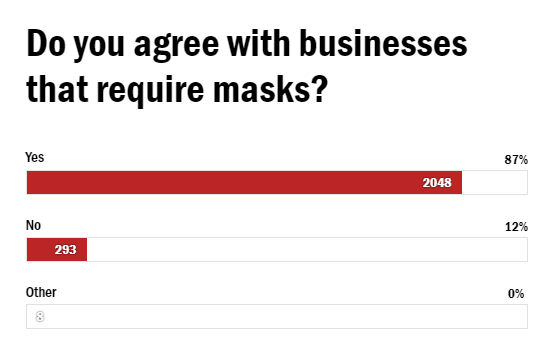
One of the main reasons given for masking was to protect the immunocompromised and vulnerable. Great if that worked or made a difference, but it doesn’t.
Sammie H. from Boston says that wearing masks to stop the spread can show that one cares about others.
“Preventing spread of illness shows that you care about others around you,” she said. “Masking is one small way to do just that. You might even save some lives, like the lives of those who are immunocompromised.”
Readers also decided masking was the correct course of action to prevent Long Covid.
“[Long COVID] took out myself, my partner, and many people I know with fatigue, lung issues, cold like symptoms and weird stuff like stomach issues. Masks help limit the spread and save people years of pain for a few minutes of minor discomfort, like a seatbelt,” said reader Berinthia from Somerville.
Many readers still think that preventative measures are needed for good now that Covid is endemic and will always be around.
“Nothing has changed, there is still a virus circulating that has killed millions and is continuing to do so, as well as disabling countless more,” she said. “When we all wear masks, we are all protected. It’s good for business and it’s good for people’s health.”
Other reasons given included:
- “I think essential services, especially medical settings, and transportation should still require masks so they are safe for people who can’t avoid them, and I applaud any businesses that choose to require masks — it reduces community spread and helps everybody.”
- “It would be much more physically safe for me, both as a retail employee and as a customer, if masks were still required in businesses around town.”
- “I want to stay alive and want others to be alive too.”
- “Because I care about keeping others safe(r) from COVID and other airborne disease. And because ‘high risk’ people (which include people who’ve been infected with COVID once or more) deserve to have access to spaces that are too high risk if everyone is unmasked. “
- “We should follow the science, not the latest fashions of political fanaticism. Wearing a mask is a minor inconvenience; long COVID or death is not.”
- “COVID-19 is still very much with us — killing and disabling a mass amount of people every day. Masks are an effective way to protect yourself and others, especially the most vulnerable. I want those that I know and love, and even those that I don’t, to live a long, long time.”
- “Business owners who require masks are doing community service by keeping themselves safe (thus able to stay healthy enough to continue operations) and our communities safer by reducing viral spread.”
The brainwashing is strong in Boston.
Military intervention against Niger would be a declaration of war against Burkina Faso and Mali
RT | July 31, 2023
In the first-ever joint communique on Monday, the military governments in Mali and Burkina Faso warned the West and other African states against intervening in the neighboring Niger. Bamako and Ouagadougou would consider any such move as an attack on their own countries, they said.
“Any military intervention against Niger would amount to a declaration of war against Burkina Faso and Mali,” said point four of the joint communique, which a Burkinabe military spokesman deliberately repeated three times during a state television broadcast.
In case of such an intervention, the two countries would withdraw from the Economic Community of West African States (ECOWAS) and “adopt self-defense measures in support of the armed forces and the people of Niger,” according to the statement.
A military intervention against Niger “could destabilize the entire region, as had the unilateral NATO intervention in Libya, which was at the root of the expansion of the terrorism in the Sahel and West Africa,” the two governments said.
France currently has 1,500 troops and a drone base in Niger, while the US has 1,100 troops and two drone bases, according to Financial Times.
Nigerien soldiers, led by General Abdourahamane Tchiani, ousted President Mohamed Bazoum last Wednesday. The African Union denounced the coup on Friday and gave the junta in Niamey 15 days to stand down or face “punitive measures.” ECOWAS issued its own ultimatum on Sunday, at the emergency meeting in Abuja, Nigeria, saying that it would “take all measures necessary to restore constitutional order in the Republic of Niger,” including the use of force, if Bazoum is not restored within a week.
Mali and Burkina Faso condemned the sanctions ECOWAS announced on Saturday as “illegal, illegitimate and inhumane.” They also expressed “fraternal solidarity” with the Nigerien people, “who have decided to take their destiny into their own hands and to assume before history the fullness of their sovereignty,” according to their joint communique.
The military governments of the two former French colonies have sought to sever their ties to Paris and rebuild their statehood with Russian assistance. Moscow has denounced the coup in Niger as an “anti-constitutional act,” however, and the Russian Foreign Ministry called on all parties to refrain from using force.
On Sunday, General Tchiani’s government announced it would suspend the export of uranium and gold to France, to the accolades of some of the local population.
“We have uranium, diamonds, gold, oil, and we live like slaves? We don’t need the French to keep us safe,” one pro-government demonstrator told the local news portal Wazobia Reporters.
Niger is the world’s seventh-largest producer of uranium, accounting for 4% of the global output. A French company controls about two thirds of the country’s output.
Wildfires in Syria used as a weapon of war
By Steven Sahiounie | Mideast Discourse | July 30, 2023
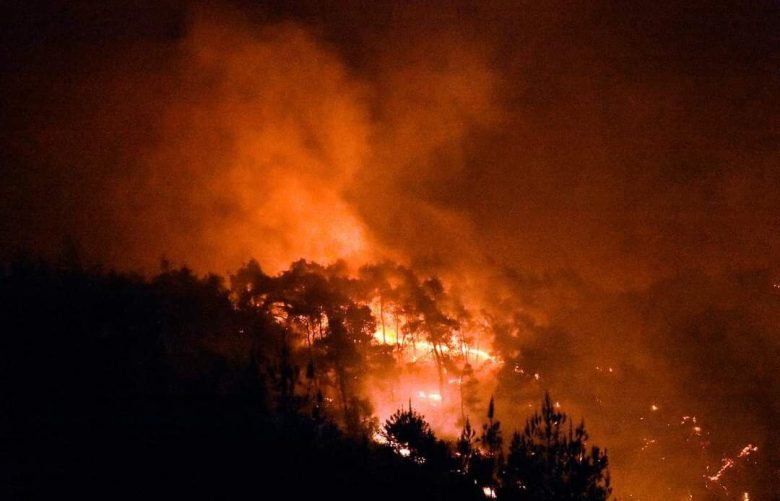
Wildfires broke out on July 25 in Latakia province in northwest Syria and are still burning amid new fires being started. The fires spread quickly by a sudden unusual wind which whipped up. The whole country, and the adjacent Mediterranean region, is in a heat-wave which sets the stage for such a devastating fire burning crops, forests and homes. However, this was not a chance wildfire, but was an act of terrorism.
General Jalal Dawoud, Head of the Fire Department in Latakia, says the fire was man-made. This was determined because the origin of the fire was not in one place, but was started in scattered areas all at the same time in daylight hours.
After the security forces began their investigation, it was found that the fires were started by drones originating from Idlib, under the occupation of Hayat Tahrir al-Sham, formerly Jibhat al-Nusra, the Al Qaeda affiliate in Syria.
Turkey is illegally occupying Idlib as they protect the terrorists under the command of Mohammed Jolani, formerly allied with Abu Baker Al Baghdadi, the head of ISIS who was killed in Idlib by President Trump.
The terrorists have been attacking the fire fighters and vehicles. Bassem Bakar, a water tanker driver, was killed when the terrorists targeted his vehicle near Deir Hanna and Rabiah. Two other men with him were injured.
Turkey is well known for the manufacture of drones, and has been selling drones to Ukraine recently.
On July 25, a fire department vehicle drove over a previously planted mine on Zgharo Mountain, near the town of Maskita, but without injuries. This area was occupied by the terrorists now in Idlib during the 2015 period before they were driven east to Idlib.
The Mayor of Latakia, Amer Hallal, said fire depratments from many areas came to fight the fires, and a Russian water tanker airplane came to battle the fires. Civilians were evacuated from homes and farms and taken to a safe area where they were given humanitarian aid.
The fire raged in Rabiah which sits on a road that connects directly to Idlib. Other areas burning are Ghamam, Sarsekiah, Ein Zarkha, Deir Hanna, Jib Alahmar, Sed Bradoon, and Jebal al Zahra.
A young soldier who volunteered to fight the fires, Mounif Sebry Hassoun, died while fighting the fire due to suffocation in Meshkita. He is from village of Wadi Khelah, in the suburb of Jeblah
The Syrian government, Syrian Red Crescent are coordinating efforts to put out the fires and assisting the humanitarian needs of the affected civilians. Local restaurants have been donating meals to the fire fighters. The Syrian Arab Army (SAA) and the Syrian Red Crescent are putting out fires in Rabiah, which is the front line against the terrorists in Idlib.
The foreign policy of the US and EU have kept the status quo in Idlib. 3 million civilians there are kept as human shields by Hayat Tahrir al-Sham. Turkey prevents the SAA and the Russian military from freeing the civilians kept as hostages to an international game of chess played by America.
International aid organizations, such as the UN, Doctors Without Borders, Save the Children and others deliver all the humanitarian aid to the civilians, while Jolani and his terrorists receive all the aid and distribute it to their cronies first, and sell whatever they horde in a huge shopping mall Jolani and partners built.
Idlib is an agricultural province with farmers and terrorists selling olives and olive oil to Turkish businesses.
The US, EU and UN are enablers of Jolani and the terrorists under his command. Recently, Jolani hung people in Idlib that he perceived were enemies. He and his men oppress women by not allowing social programs directed at women’s issues. The terrorists rule under Islamic Law and in the case of a rape, a woman must present the court with three men who are witnesses to the rape in order to get a conviction. In this situation, rapes go unreported as there is no chance for justice.
Drones can be used for humanitarian purposes, for example: delivering medicines to a remote village. However, drones can also deliver a deadly payload in a war, or attack, and now in Syria they are being used to start wildfires in the heat of summer amid dry winds which spread the deadly fires.
The world responded to the massive 7.8 earthquake on February 6 in Syria and Turkey. Humanitarian aid poured in from Arab countries mainly, with the US boycotting all aid to Syria, with the sole exception of Idlib and the occupying terrorists there.
The earthquake aid has long ago stopped, and although many friends of Syria have asked the US and EU to lift the sanctions which prevent all rebuilding and recovery in Syria from years of war and the earthquake, still there has been no move to lift any sanctions.
Recently, a list of the world’s poorest nations was unveiled with Syria tying for the worse place along with Yemen and Afghanistan. 12 years of armed conflict, the COVID-19 pandemic, the 7.8 earthquake of the century, and now wildfires being delivered by terrorists supported by the US and NATO.
Jolani and his US supported terrorists have no red lines they cannot cross. They are heartless criminals holding the northwest of Syria in fear of their next move.
UAE, Bahrain sour on Israeli normalization
The Cradle | July 31, 2023
Two of the signatories of the Abraham Accords – the UAE and Bahrain – have “soured” on the 2020 normalization agreement, according to sources in the know who spoke with US outlet Bloomberg.
“The [UAE] has expressed frustration in high-level contacts with Israel about the outcome of the 2020 Abraham Accords,” Bloomberg reported on 30 July. Bahrain has also “outlined its disappointment” with Tel Aviv, mainly out of concerns about Israel’s ongoing human rights violations against Palestinians and their unchecked expansion of illegal settlements in the West Bank.
According to the report, the tense situation is “likely to complicate” Washington’s efforts to see Saudi Arabia join the Abraham Accords, which also include Morocco and Sudan.
In the months after the Gulf kingdom inked a historic rapprochement deal with Iran under the auspices of China, the White House has deployed a charm offensive to convince Saudi Crown Prince Mohammed bin Salman (MbS) to normalize ties with Israel before the 2024 US elections.
Publicly, Saudi Arabia maintains Israel must first implement the 2002 Arab Peace Initiative to establish a Palestinian state before a normalization deal can be signed. Privately, however, Riyadh is demanding that the US sweeten the deal by providing firm defense guarantees, access to cutting-edge weaponry, and assistance in developing a nuclear energy program, including domestic uranium enrichment.
While the White House remains hesitant to accept these demands, US President Joe Biden told a gathering of donors to his 2024 re-election campaign last week, “There’s a rapprochement maybe underway.”
Israeli Prime Minister Benjamin Netanyahu echoed this claim on Sunday when announcing the construction of a $27 billion rail expansion connecting Israel’s outlying areas to metropolitan Tel Aviv.
“In the future, we will be able to transport cargoes of goods by train from Eilat to our ports in the Mediterranean Sea, and we will also be able to connect Israel by train to Saudi Arabia and the Arabian Peninsula. We are working on that too,” Netanyahu said.
Earlier this month, Yedioth Ahronoth reported that Washington was promoting a plan to build a railway connection from the Gulf to Israel and Europe.
Interpreting Russia’s Official Response To The Nigerien Coup
BY ANDREW KORYBKO | JULY 31, 2023
Last week’s patriotic military coup in Niger could be a game-changer in the New Cold War as was explained here, though this analysis here argues that it might be nipped in the bud if Nigeria ultimately does the West’s bidding by leading an ECOWAS invasion force aimed at reinstalling the ousted president. Those who aren’t already aware of the insight shared in those analyses should at least skim them in order to be brought up to speed and thus better understand Russia’s official response to this event.
Russian Foreign Minister Sergey Lavrov said on 27 July that “We believe the coup is an anti-constitutional act. We always occupy a clear position in such cases…We reaffirm our position that it is necessary to restore the constitutional order in Niger.” One day later on 28 July, his country joined its fellow permanent UNSC members in issuing a joint statement that “strongly condemned the efforts to unconstitutionally change the legitimate Government of the Republic of Niger on 26 July 2023.”
They also “expressed support for the efforts of the Economic Community of West African States (ECOWAS) and the African Union…(and) underscored the urgent need for the restoration of constitutional order in Niger in accordance with the ECOWAS Protocol on Democracy and Good Governance and expressed their support for regional and continental mediation efforts.” Two days later on 30 July, the AU and ECOWAS gave the junta a two-week and one-week ultimatum respectively.
If President Mohamed Bazoum isn’t reinstalled by then, they warned of “punitive measures” that could include the “use of force”. This sequence of events shows that the AU-ECOWAS duopoly is exploiting the UNSC joint statement as the pretext for invading Niger in order to secure their Western patrons’ interests there. None of this is surprising, however, which is why some might wonder why Russia agreed to the same statement that’s being taken advantage of to legitimize its rivals’ regional power play.
For starters, Russia always officially condemns anti-constitutional seizures of power, with this being more symbolically important than ever after Ukraine’s Western-backed and fascist-driven “EuroMaidan” coup in spring 2014. That said, this stance and its associated support of peaceful means for restoring the constitutional order in countries that experience these sorts of regime changes don’t automatically equate to it endorsing Western-encouraged invasions to this end.
It’s important to note that neither the AU nor its West African-Sahel ECOWAS enforcers put forth their ominous ultimatums by the time that Russia agreed to the UNSC joint statement on Niger. Even though it should have been foreseeable that these threats would follow, the fact that they hadn’t yet officially been made meant that there wasn’t any diplomatic pretext for Russia to break with precedent. For that reason, it supported the UNSC joint statement, which promoted mediation efforts.
The next point to make is that the West has been fearmongering that the Kremlin had a hidden hand in previous military coups in the West Africa-Sahel Region so it would have come off as very suspicious if Russia was reluctant to condemn this latest coup. That approach would have likely fueled an even more intense round of information warfare falsely alleging that Moscow was behind this regime change, thus justifying the planned Western-encouraged ECOWAS-led invasion on an urgent anti-Russian pretext.
And finally, since it can’t be taken for granted that the Nigerien junta will successfully repel this invasion in the likely scenario that it’s commenced sometime after the AU’s two-week ultimatum expires, it doesn’t make sense for Russia to signal support for what might very well be a doomed cause. Doing so would be detrimental to its soft power interests since the collapse of that junta could then be spun as a joint Western-African victory over Russia in the New Cold War.
None of this is to suggest that Russia is seriously opposed to the junta becoming an interim/transitional government, however, since precedent shows that it has no problem cultivating mutually beneficial relations with military rulers in the region like Mali’s and Burkina Faso’s. If the likely scenario of a French-backed ECOWAS-led invasion doesn’t materialize, yet without the coup leaders capitulating to pressure to reinstall Bazoum, then Niger will probably become Russia’s next strategic partner in the region.
Ukraine Receives $1.25Bln in US Grant Funds for Paying Wages, Social Assistance
Sputnik – 31.07.2023
Ukraine has received a new grant from the United States worth $1.25 billion to reimburse state budget expenses, including wages for state employees and social benefits, the Ukrainian Finance Ministry said on Monday.
“The State Budget of Ukraine received a grant from the United States of America in the amount of USD 1.25 billion through the Multi-donor Trust Fund of the World Bank,” the ministry said in a statement.
The grant was provided as part of the fifth additional financing under the World Bank’s Public Expenditures for Administrative Capacity Endurance in Ukraine (PEACE in Ukraine) project, which seeks to partially cover state budget expenditures, including for social and humanitarian purposes.
“The involved grant funding will be aimed at reimbursing state budget expenditures, in particular, to pay wages for government employees and payments under certain state social assistance programs (IDPs [internally displaced persons], people with disabilities, low-income families and housing, utility subsidies) and other social payments,” the ministry said.
Ukraine has received $8.45 billion in US grants to support the state budget in 2023 alone, while as much as $20.4 billion has been disbursed since February 2022.
Last week, the chairwoman of the Ukrainian parliament’s budget committee, Roksolana Pidlasa, said the state budget received $25.3 billion from international partners in 2023, accounting for 49.1% of all state budget revenues.
Ukrainian Finance Minister Serhiy Marchenko said in May that the country’s budget has been running a deficit of about $5 billion a month since the military conflict began, with two-thirds of the money coming from foreign loans and grants and three-quarters spent on military needs.
Calls to ban Russian aluminum ‘expose EU market manipulation’ – industry association
RT | July 31, 2023
Five EU-based business associations representing aluminum consumers have called on the London Metal Exchange (LME) to reject demands for sanctions on Russian primary metal, describing the pressure as “obvious market manipulations,” according to a statement by the Federation of Aluminium Consumers in Europe (FACE) released on Friday.
Last week, Norwegian producer Norsk Hydro urged the LME, the world’s largest and oldest market for industrial metals, to reconsider a decision made in March not to ban Russian aluminum from its warehouse network. Norsk Hydro argued that Russian aluminum, which is subject to US sanctions, dominates the LME warehouse stock and poses risks to the market.
According to the letter sent to the LME on Friday by the Belgium-based FACE along with four associations from Germany and Italy, the calls to ban Russian aluminum are “obvious market manipulations by vested interests,” as they were made by major metal producers who are direct competitors of Russian manufacturer Rusal.
Such a ban would be “suicidal” in the current context of the “huge metal deficit” in Europe, high energy prices, and inflation, the FACE statement claimed.
Calls for sanctions “seem one more oligopolistic attempt to easily eliminate a competitor with non-market practices and to turn Europe into a captive market, with full knowledge of the devastating impact any restriction of Russian metal supplies will have on the EU aluminum industry value-chain”, said Mario Conserva, FACE’s secretary general.
He pointed out that small and medium-sized businesses represent 90% of the EU aluminum industry workforce and 70% of its output, but their interests are not taken into account when trade and supply policy decisions are made.
Earlier this month, Reuters reported that EU industry group European Aluminium had warned against placing sanctions on Rusal “due to its strategic importance on the global aluminum market.”
According to FACE, the EU is dependent on other countries for nearly 90% of its primary aluminum needs. Rusal accounts for about 12% of the bloc’s current demand, the association said. The industry body described Rusal’s output as competitive and fairly priced, and claimed that it helps decrease the carbon footprint of the entire European aluminum industry.
The Russian aluminum industry has increasingly become a target for Western restrictions. In February, the US imposed 200% duties on imports of Russian-made aluminum products, while the following month Canada banned imports of Russian aluminum and steel. In May, the UK also revealed plans to ban imports of Russian aluminum. The EU has so far restricted imports of only a limited number of specific aluminum products from Russia.
The ‘Scandal Implosion’ Stratagem: Will It Work for Ukraine?
By Alastair Crooke | Strategic Culture Foundation | July 31, 2023
Biden: “Putin has already lost the war … Putin has a real problem: How does he move from here? What does he do?” Secretary Blinken repeats ad infinitum the same mantra: ‘Russia has lost’. So does the head of MI6, and Bill Burns, the head of CIA, opines, (replete with snide asides) at the Aspen Security Conference, that not only has Putin ‘lost’, but further, that Putin is failing to keep a hold on a fragmenting Russian state, entering upon a likely death-spiral disintegration.
What is going on? Some suggest a psychic disorder or groupthink has seized the White House Team, resulting in the formation of a pseudo-reality, severed from the world, but unobtrusively shaped around wider ideological ends.
The parroting of dubious narrative however, morphs for the informed world into seeming western delusion – the world as the ‘Team’ imagines it to be, or more to the point, would like it to be.
This tight parroting though is clearly no ‘coincidence’. A clutch of high officials speaking to script and in concert are not deluded. They are mounting a new narrative. The ‘Russia has lost’ mantra defines the mega-narrative that has been decided. It is the prelude to an intense ‘blame game’: Project Ukraine ‘is failing because the Ukrainians are not implementing the doctrines received from NATO trainers – yet despite this, the war has shown that Putin has ‘lost’ too: Russia too, is weakened’.
This is another exemplar of the current western fixation on the idea that ‘narratives win wars’, and that set-backs in the battle space are incidentals. What matters is to have a thread of unitary narrative articulated across the spectrum, asserting firmly that the Ukraine ‘episode’ now is closed and should be ‘book-ended’ by the demand that we all ‘move on’.
The gist of it is that ‘We’ control the narrative; us ‘winning’ and Russia losing, therefore, becomes inevitable. The flaw to this hubris is firstly that it puts the Administration ‘high priests’ at war with reality, and secondly, that the public long ago lost trust in mainstream media.
Jonathan Turley, a recognized legal scholar and Professor at Georgetown, who has written extensively in areas ranging from constitutional law to legal theory, draws attention to: “the last ditch effort of the members of Congress and the media to get the public to just ‘move on’ from the Biden corruption scandal”. The message, he writes, “is clear … Everybody needs to back off! … [However] as evidence and public interest increase, it is a bit late for spin or shiny objects”.
“This week, the scandal is likely to be even more serious for the Bidens and the country. The media is increasingly taking on the appearance of Leslie Nielsen in Naked Gun yelling that there is “nothing to see here” in front of a virtual apocalyptic scene of fire and destruction.”
What is the link to Ukraine? Well, a year ago, Professor Turley wrote that the political and media establishment would likely use a ‘scandal implosion’ approach to the corruption allegations as the evidence mounted. There would be an attempt to ‘cap off’ the scandal with Turley suggesting that the Justice Department would secure a ‘light plea’ by Hunter Biden on a couple of tax counts, with little or no jail time.
Well, that’s exactly what has occurred one year later. Then came the predicted ‘scandal implosion’: Hunter pleaded guilty to having delayed due tax payments – to a chorus of House members and the media shrugging off all other corruption allegations, and firmly declaring the scandal ‘closed’, together with the demand to “move on”. Turley notes however, “the media’s desire to “move on” from the scandal is reaching an almost frantic level, as millions in foreign payments and dozens of corporate shell companies are revealed – and incriminating emails are released”.
It is not clear that the stratagem will work. It is already in trouble.
The key elements to the ‘implosion stratagem’ are revealed as outright, unflinching denial that there is any ‘problem’ at all, and an obstinate refusal to concede even a scintilla to the notion of there being any type of failure. No need to look in the mirror.
This too was the modus operandi in respect to the Nordstream débacle (the destruction of the gas pipeline to Germany): Admit to nothing, and get the CIA to rustle up a ‘scandal implosion’ scenario. In this case, a nonsense diversionary story of a yacht with a few nefarious sub-aqua divers descending to 80-90 metres, without special equipment or using specialised gases, to lay and detonate explosive devices. No real investigation; ‘Nothing to see here’.
But as events in Germany indicate, the story is not believed; the coalition in Berlin is in deep trouble.
And now, the stratagem is being applied to Ukraine: The ‘Chorus’ cries out, ‘Putin has lost’, in spite of Ukraine messing up its chance to weaken Russia decisively. The hope is plain – that ‘Team Biden’ can steal away, undamaged, from devastating defeat, with ‘a scandal implosion’ mechanism already being primed (for after NATO’s summer ‘deadline’ to achieve a ‘win’):
‘We gave them everything – yet, the Ukrainians turned ‘their back’ on our expert advice for how to ‘win’ – and consequently have achieved nothing.
“Ukraine’s counter-offensive is failing to make progress because its army is not fully implementing training it has received from NATO, according to a leaked German intelligence assessment … Ukrainian soldiers trained by the West are showing “great learning success”; but they are let down by commanders who have not been through the [NATO] boot camps, it adds … the Ukrainian military favours promoting soldiers with combat experience, over those who have received NATO-standard instruction”.
Well, well? Like Afghanistan?
The war in Afghanistan was a sort of crucible, too. In very real terms, Afghanistan was turned into a testbed for every single innovation in NATO technocratic project management – with each innovation heralded as precursor to a game-changing future. Funds poured in; buildings were thrown up; and an army of globalised technocrats arrived to oversee the process. Big data, AI and the real-time utilization of ever expanding sets of technical surveillance and reconnaissance were to topple old ‘stodgy’ military doctrines. It was to be a showcase for technical managerialism. It presumed that a properly technical and scientific way of war clearly would prevail.
But technocracy as the only means of constructing a functional NATO-style military birthed instead, in Afghanistan, something thoroughly rotten – “data-driven defeat”, as one U.S. Afghan veteran described it, that it collapsed in a matter of days. In Ukraine, its forces were caught between Scylla and Charybdis: neither the armoured fist thrust taught by NATO to break the Russian defences, nor the alternative light infantry attacks were successful. Ukraine is suffering rather, a NATO-driven defeat.
Why then, opt to take reality ‘head-on’, with the snide insistence that Putin ‘has lost’? We do not, of course, know ‘the Team’s’ internal rationale. However, to open negotiations with Moscow in the hope of obtaining a ceasefire or a frozen conflict (to bolster the ‘Narrative’) would likely disclose a ‘Moscow’ as insistent only on Kiev’s full capitulation. And that would sit awkwardly with the ‘Putin losing story’.
Perhaps the calculus is to hope that between now and winter, public interest in Ukraine would have been so diverted by other events that the public might have ‘moved on’, and with blame clearly hung around the necks of Ukrainian Commanders showing “considerable deficiencies in leadership” which lead to “wrong and dangerous decisions” – by ignoring NATO-standard instruction.
Professor Turley concludes,
“None of this is going to work, of course. The public has lost trust in the media. Indeed, the “Let’s Go, Brandon” movement is as much a mocking of the media – as [it] is a targeting of Biden”. “Polls show that the public is not “moving on” [from the Hunter allegations] and now view this as a major scandal. A majority believes that Hunter has received special protection in the investigation. While the media can continue to suppress the evidence and allegations within their own echo-chambered platforms – truth like water has a way of finding a way out”.
In effect, ‘events’ are marching forward – with or without the media.
And here is the crux: To the degree that Turley estimates the Biden affair constitutes a putative ‘apocalyptic site of domestic U.S. destruction’, so the West faces a yet more strategic defeat segueing out from its Ukraine project – for that defeat encompasses not just that of the Ukrainian battle-ground – It has destroyed the myth of NATO omnipotence. It has upended the story of ‘magical’ western weaponry. It has burst the image of western competence.
The stakes were never higher. Yet did the ruling-class think this through when they so lightly embarked on this ill-fated Ukraine ‘project’? Did the possibility of ‘failure’ even enter to their consciousness?
UK businesses ignoring anti-Russia sanctions
RT | July 31, 2023
British manufacturers have been supplying Russia with key industrial equipment despite Western sanctions, The Times reported on Monday, citing statistics from investigative group Data Desk.
The outlet’s analysis of trade data showed that despite the British government’s claims to have implemented the “most severe economic sanctions ever imposed on a major economy,” UK companies have still been permitted to export equipment important for Russia’s fuel and mining industries.
Export data showed that a subsidiary of construction company Hill & Smith continues to supply pipes that are installed on gas pipelines in Russia. Hill & Smith said last year it had “no direct customers or suppliers” in Russia, the report noted.
Many other companies based in the UK are also allowed to supply Russia with equipment for key areas of the mineral extraction industry, The Times wrote.
Following the start of the conflict in Ukraine, the UK stepped up sanctions against Russia, banning new investment in the country and restricting imports of Russian oil, coal, and gold, and exports of key industrial goods, among other measures. London has also frozen £26 billion ($33.4 billion) in assets and reserves belonging to the Russian state since the beginning of the conflict, according to the Bank of Russia.
Russia has won the oil war
The West doesn’t seem too keen to enforce its $60 price cap on Russian crude
BY PÉTER G. FEHÉR | MAGYAR HÍRLAP | JULY 31, 2023
Moscow’s leadership may not have been cheering loudly, but they probably still celebrated quietly within the walls of the Kremlin. After all, Russia has won the oil war. The news has been widely reported among economists and even in Western press, but it cannot be said to have come as a surprise shock. Those involved in the global oil business knew that they could not win such a war against Russia.
The United States and the European Commission’s measures to reduce Russian energy exports aimed to produce problems for the Russian treasury by reducing its revenues. However, it seems that the punitive measures introduced without any impact assessment have been seriously misguided, especially on the part of the EU. Rather, the EU has punished itself by foregoing cheap Russian gas and being forced to buy expensive U.S. natural gas.
Strange as it may sound, the Brussels officials knew exactly that this would be the consequence of the sanctions they imposed. It is worth looking to Russia expert Christopher Davis, professor at Oxford University: Davis has claimed nothing less than that the European Commission only began to address the impact of the punitive measures after the sanctions against Russia were introduced. At that time, it produced a secret study that was not shared with EU citizens. It said that the decisions were taken too quickly and that they were taken under political pressure without any prior economic impact assessment. The EU thus did not look into the potential impacts of sanctions; it was in essence an abrupt and thoughtless decision.
Moscow, meanwhile, looked for other buyers of its black gold, which was also predictable, and China was one of the first to come forward. Moscow has now built infrastructure to handle the increased traffic between Russia and Asia. Before the war in Ukraine, China was buying 1.5 million barrels of oil a day from Russia. Today, it takes in 2.5 million barrels a day.
Now, publications such as the Wall Street Journal are acknowledging that Russia has achieved a real global victory in the oil wars. The price of the Russian Ural blend oil has for the first time exceeded the $60 cap per barrel imposed by the U.S. and its allies last December. Although this happened just last Thursday, there is no sign that anyone is willing to enforce the sanction.
It is now no longer a mere assumption that the EU and the U.S. have made spontaneous sanctions decisions against Russia with unforeseen consequences. It is understandable that the European Commission does not want to publicly admit the consequences of such clumsy measures.
The question has to be asked again, for the umpteenth time: Why are there no consequences for a disastrous decision taken by the European Commission that once again went over the heads of the member states without even consulting them?
***
Featured Video

“Historic Russia”: The Land Putin Will Not Give Back
or go to
Aletho News Archives – Video-Images
Book Review
Why the War on Conspiracy Theories Is Bad Public Policy
By Kevin Barrett • Unz Review • February 1, 2019
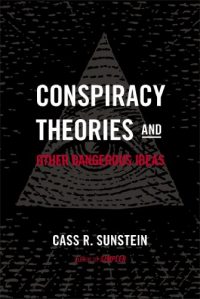 A Review of Conspiracy Theories and Other Dangerous Ideas by Cass Sunstein (based on an earlier paper co-authored with Adrian Vermeule); In Defense of Troublemakers: The Power of Dissent in Life and Business by Charlan Nemeth; and Conspiracy Theories and the People Who Believe Them, edited by Joseph E. Uscinski
On January 25 2018 YouTube unleashed the latest salvo in the war on conspiracy theories, saying “we’ll begin reducing recommendations of borderline content and content that could misinform users in harmful ways—such as videos promoting a phony miracle cure for a serious illness, claiming the earth is flat, or making blatantly false claims about historic events like 9/11.”
At first glance that sounds reasonable. Nobody wants YouTube or anyone else to recommend bad information. And almost everyone agrees that phony miracle cures, flat earthism, and blatantly false claims about 9/11 and other historical events are undesirable.
But if we stop and seriously consider those words, we notice a couple of problems. First, the word “recommend” is not just misleading but mendacious. YouTube obviously doesn’t really recommend anything. When it says it does, it is lying. … continue
Blog Roll
 Aletho News
- “Historic Russia”: The Land Putin Will Not Give Back
- How the Cambridge Analytica scandal still haunts Mark Zuckerberg
- The Ongoing Cancellation Campaign Against a Dissenting Academic in Norway
- Yemen and ‘the Houthis’: Challenging Sami Hamdi’s Narrative
- No, Christians did not invent Zionism
- AIPAC-led lobbying network opens branches in Cypriot, Greek parliaments
- Araghchi blasts ‘parasitic’ alliance as US taxpayers pay for Israel’s war on Iran
- Easy fix for Europe’s chaos? Stop fueling war against Russia
- Putin’s key remarks on peace talks and Europe’s ‘schizophrenia’
- Trita Parsi: Israel Set a Trap for Total War in the Region
- If Americans Knew
- An error has occurred; the feed is probably down. Try again later.
- No Tricks Zone
- Two New Studies Find Thwaites Glacier Melt Cannot Be Driven By Human Activity Or A Warming Ocean
- E-Cars Reduce CO2 Emissions By Only 41% Compared To Internal Combustion Engine Vehicles
- Predictions Made By Renowned Climate Professor Over Past Decades Have Been Proven To Be Poor
- New Study Suggests Large Regions Of The Pacific Ocean Have Been Cooling For The Last 80 Years
- Germany’s Green Energy Debacle: High Energy Costs Force Kahla Porzellan to Close After 182 Years!
- New Study: 50 Years Of The Most Aggressive ‘Net Zero’ Policies Can Only Affect The Global Climate By 0.03°C
- US September “Heat” Was No Record…Many Records Set Decades Ago
- Latest European Green Energy Debacle; Portugal’s Largest Flagship Solar Park Insolvent!
- Green Energy Debacle: German Expert Professor Fritz Vahrenholt Warns Of Severe Economic And Social Consequences
- Two More Paleo Reconstructions Affirm Meters-Higher Sea Levels Across Ireland, Brazil 7000-6000 Years Ago

