Anti-NATO protests hit France

RT | February 26, 2023
Multiple mass protests against France’s NATO membership and its continued support of Kiev were held on Sunday in the capital Paris and at other locations across the country.
The demonstrations, taking place for the second consecutive weekend, were organized by the right-wing Les Patriotes party, led by Florian Philippot, who personally attended the rally in Paris.
The politician claimed the event on Sunday, dubbed National March for Peace, attracted even more participants than last week, when some 10,000 showed up for a rally in the French capital. According to Philippot, smaller-scale anti-NATO protests were held at some 30 other locations across France as well.
Protesters marched through the streets of Paris, carrying a large banner reading “For Peace.” The marchers called for the withdrawal of France from both the US-led NATO and from the EU, and urged a halt to supplying Ukraine with weaponry. The protesters also took jabs at the incumbent French President Emmanuel Macron, chanting “Macron get out!” – a slogan commonly used by assorted anti-government protesters throughout his presidency.
Following the march, the protesters held a rally led by Philippot, who was filmed defacing NATO and EU flags alongside his supporters. Footage of the event was shared by the politician himself on social media.
The politician has been actively staging protests against French membership in NATO and the EU since last fall, while arguing against the supply of weapons to Ukraine. Between 2012 and 2017, Philippot was the deputy head of the biggest opposition party in France, the National Rally, led until last year by Marine Le Pen. After leaving the National Rally, the 41-year-old politician established his own right-wing party, Les Patriotes.
France has been among the top supporters of Kiev in the ongoing conflict with Russia, which broke out a year ago. While Macron has repeatedly called for a diplomatic settlement of the hostilities, Paris has actively supplied assorted weaponry to Ukraine, including armored vehicles and advanced self-propelled howitzers.
German Green Ministers Emitting The Most With Government Flights… Minister Baerbock 5000 Tonnes CO2!

By P Gosselin | No Tricks Zone | February 24, 2023
Recall how climate activists demand that ordinary citizens, i.e. “useless consumers”, limit their annual CO2 emissions to just a single measly tonne per person. Currently the average CO2 emissions per person in Europe are about 8 tonnes.
German government ministries run by the Green Party emit by far the most CO2 when it comes to government flights. AI generated symbol image, dall.e 2.
Climate activists, like the German Greens, you’d think, would thus themselves be practicing what they preach, at least limiting their emissions to some extent in order to set an example for the rest of us.
To find out whether or not the leading German Greens are preaching water and actually drinking it themselves, economics expert Tilman Kuban of Germany’s opposition Christian Democratic Union (CDU), asked the current Socialist-Green government to provide a breakdown of how many flights were made by the government ministries using the German Armed Forces’ Special Air Mission Wing during the current legislative period (December, 2021 to January, 2023).
For the sake of a political overview, there are basically major 6 parties active in Germany. From left spectrum to right: Die Linke, The Greens, The Socialists SPD, The Free Democrats FDP, the Christian Democratic Union CDU and the Alternativ für Deutschland AfD. Currently a leftist coalition made up of the SPD, FDP and Greens make up the government.
Germany’s online BILD daily crunched the numbers on the number of flights and the CO2 emitted by the different ministries and the people who head them.
62% of all CO2 emissions by government flights were generated by the Greens alone
According to the official government data, most of the 11,234 tonnes of CO2 for flights by government ministries so far in the current legislative period are attributable to the Greens: 6,900 tonnes of CO2. That is over 60 percent of the CO2 emissions of all ministerial flights.
Top frequent flyer/emitter: Annalena Baerbock
Number 1 among all the ministers is Foreign Minister Annalena Baerbock (Green Party) with 67 flights, 5000 tonnes of CO2 and costs of around 7.6 million euros.
Second place goes Robert Habeck, Minister of Economics and Climate Protection (Green Party) with almost 1900 tonnes of C02 emitted on 32 flights (costing around 3.2 million euros).
In total, 250 flights were taken by the government ministries.
The government’s biggest CO2 emitter is Chancellor Olaf Scholz (SPD) himself (not a minister). According to BILD daily: “The Chancellor’s office took 114 flights that emitted almost 7200 tons of CO2. Cost: more than 11.2 million euros.”
Showdown in Ukraine
Hobbled US Turns to War to Preserve its Waning Primacy
BY MIKE WHITNEY • UNZ REVIEW • FEBRUARY 26, 2023
The future of humanity will be decided on a battlefield in Ukraine. That’s no exaggeration. The conflict between the United States and Russia will determine whether global economic integration will expand within an evolving multi-polar system or if the “rules-based order” will succeed in crushing any opponent to its Western-centric model. This is what’s taking place in Ukraine today, in fact, all of the recent government-prepared documents related to national security identify Russia and China as the greatest threats to US hegemony. For example, take a look at this brief clip from the 2021 Congressional Research Service Report titled Renewed Great Power Competition: Implications for Defense—Issues for Congress:
The U.S. goal of preventing the emergence of regional hegemons in Eurasia… is a policy choice reflecting two judgments: (1) that given the amount of people, resources, and economic activity in Eurasia, a regional hegemon in Eurasia would represent a concentration of power large enough to be able to threaten vital U.S. interests….
From a U.S. perspective on grand strategy and geopolitics, it can be noted that most of the world’s people, resources, and economic activity are located not in the Western Hemisphere, but in the other hemisphere, particularly Eurasia. In response to this basic feature of world geography, U.S. policymakers for the last several decades have chosen to pursue, as a key element of U.S. national strategy, a goal of preventing the emergence of regional hegemons in Eurasia.” (“Renewed Great Power Competition: Implications for Defense—Issues for Congress”, US Congress)
That sums up US foreign policy in a nutshell; “prevent the emergence of a regional hegemon” at all cost. Now check out this summary of the 2022 US National Defense Strategy by Andre Damon at the World Socialist Web Site :
These documents, which were not seriously discussed in the US media, make clear the fundamental falsehood that the massive US military buildup this year is a response to “Russian aggression.” In reality, in the thinking of the White House and Pentagon war planners, the massive increases in military spending and plans for war with China are created by “dramatic changes in geopolitics, technology, economics, and our environment.”
These documents make clear that the United States sees the economic rise of China as an existential threat, to be responded to with the threat of military force. The United States sees the subjugation of Russia as a critical stepping stone toward the conflict with China.” (“Pentagon national strategy document targets China”, Andre Damon, World Socialist Web Site )
These two excerpts are by no means a comprehensive summary of US foreign policy objectives, but they are a pretty effective thumbnail sketch. Bottom line: The war in Ukraine is not about Ukraine. America’s clearly articulated strategic objectives are as follows: To weaken Russia, topple its leader, take control of its vast natural resources and move on to containing China. Simply put, Washington’s escalating aggression in Ukraine is a Hail Mary pass aimed at containing emerging centers of economic power in order to preserve its waning position in the global order.
This is the geopolitical chess match that is being played behind the cover of “a war against Russia’s unprovoked aggression.” People should not be hoodwinked by that absurd deception. This war was concocted as a desperate attempt for the United States to defend its flickering global hegemony. That’s what Ukraine is really all about. It’s a clash between the warmongering western oligarchs who have a stranglehold on the US media and political establishment and the emerging economies that are using the market system to link their resources and manufactured goods to countries around the world through “high-speed” infrastructure and cooperative development.
So, the question everyone must ask themselves is this: Do you want to see more economic integration, lower prices, more shared prosperity and less war or another 80 years of onerous and arbitrary sanctions, color-coded revolutions, regime change operations, genocidal interventions and bioweapon warfare (Covid-19)? Which do you want?
Perhaps, you are one of the millions of Americans who believe that China is an enemy of the United States. Perhaps, you are also unaware of the role the US played in creating modern China. Here’s a question for you: Did the US and western corporations move their operations en masse to China to escape the high costs of production in the US?
answer– Yes, they did.
And, did they betray US workers because they didn’t want a fair wage to interfere with their excessive profit-making?
answer– Yep.
And, did they offshore their businesses, outsource their product manufacturing and do everything in their power to make themselves winners while robbing American workers of the opportunity of making a decent wage so they could put food on the table?
answer– They sure did.
Then who is actually responsible for the rise of China?
answer– Western corporations are responsible. If Americans want to blame someone, blame them!
But now the corporate mandarins and other elites are unhappy with China because China will not allow them to take control over their markets, financial system and currency as they have in America. So now these same cutthroat corporations want us to fight a war with the monster that they created?
Can you see that? Can you see that the relentless provocations against China have nothing to do with US national security or US interests. We are being led by the nose to fight and die for the cadres of voracious western oligarchs who have settled on China as the next target of their grand looting operation.
But let’s forget the past for a minute and focus on the future, after all, that’s what really matters, right?
Well then, which country has a more “positive vision” for the future: China or the United States?
Have you ever heard of China’s Belt and Road Initiative, the massive, multi trillion-dollar infrastructure plan that is the centerpiece of China’s foreign policy? It is the biggest infrastructure program in history and more 150 countries have invested in the plan already. It is a development-oriented project aimed at increasing connectivity through high-speed rail, shipping lanes and ports, skyscrapers, railroads, roads, bridges, airports, dams, power stations, and railroad tunnels. By increasing the speed of travel, China’s products and merchandise will get to markets faster generating greater prosperity for itself and for the other countries involved. And, keep in mind, the BRI will link countries around the world in a high-speed system that will not require its participants to follow a specific economic model dictated by Beijing. In other words, the Belt and Road Initiative is free market economics without the politics. It’s a “win-win” situation for everyone, a guarantee of mutual prosperity absent political manipulation, coercion or exploitation.

The venal oligarchs that run the US can’t even imagine a project of this scale or potential. In fact, they can’t even pony-up enough money to keep the trains on the rails in America. The profits these billionaire parasites extract from their activities invariably come from stock buybacks, tax evasion, and other sleight-of-hand, debt-layering ponzi-scams that benefit no one and merely shift more of the nation’s wealth into their own bulging bank accounts. Of course, ripping off the country would be bad enough, but now we see how this same class of miscreants have settled on public health as a means for amplifying their political power so they can impose repressive, police-state measures that greatly curtail the freedom of the entire population. In short, they want absolute social control and they aren’t going to let-up until they get it.
Where is the “positive vision” in this behavior?
There isn’t one. America used to be a country of ideas, ideals and vision. Now it is an oligarch-run detension center in which all hope for the future has been ruthlessly extinguished by a handful of mercenary billionaires.
At least, in the case of China, we can imagine a better, more prosperous world that is interconnected and more accessible to everyone. But what about the United States? Are we supposed to believe that fighting a war in eastern Europe is going to improve our lives? Are we supposed to believe that the only way “we can stay on top” is by pushing everyone else down? Are we expected to hate China and Russia even while our own government demonizes 80 million of us for voting for the wrong presidential candidate or for not supporting the terrorists who burn and loot our cities or for believing that the people in East Palestine are more deserving of our support and assistance than the Nazi stormtroopers in Kiev?
The fact is, our leaders cannot imagine devoting public resources to a giant interconnected infrastructure project like BRI, because that would mean less lucre for themselves. So, they’ve decided to destroy it just like they destroyed Nord Stream. Just read the press reviews on this groundbreaking project. Western journalists can’t find a ‘good word’ to say about it. A vast area in the center of America was fiendishly nuked with vinyl chloride, butyl acrylate and isobutylene, but the western media would rather criticize China’s ambitious BRI project than hold their paymasters accountable. Go figure.
The same rule applies to Russia. The Biden team and their wealthy allies don’t want closer relations between Germany and Russia because closer relations mean more prosperity for both countries, and Washington can’t have that, which is why they blew up the pipeline that was Germany’s lifeline to cheap fuel. That’s how Washington solved the problem. It pushed Germany and Russia down so the US could remain on top. Who doesn’t see this?
In contrast, the Belt and Road Initiative provides a positive vision for the future, which is an idea that the majority of the world supports. It puts us on a path to an interconnected world in which people can raise their standards of living, make a meaningful contribution to their communities, and enjoy their own culture and traditions without fear of being sanctioned, incarcerated or bombed to death. This is an excerpt from China’s Global Times :
The China-proposed Belt and Road Initiative (BRI) has already become a well-received international public good and an important platform for international cooperation…
“BRI transcends the outdated mentality of geopolitical games, and created a new model of international cooperation. It is not an exclusive group that excludes other participants but an open and inclusive cooperation platform. It is not just China’s solo effort, but a symphony performed by all participating countries….
Since the Belt and Road Initiative (BRI) was proposed in 2013, the initiative has always been development-oriented, and consistent efforts have been made to ensure that it is high-standard, sustainable and people-centered….
By August, China’s goods trade with countries participating in the BRI had reached around $12 trillion and the country’s non-financial direct investment in those countries surpassed $140 billion. … By the end of 2021, Chinese enterprises had invested $43 billion in the construction of economic and trade cooperation zones in BRI countries, creating more than 340,000 local jobs, official data showed…
China is open to other countries’ and regions’ participation in the BRI and is considering connecting with infrastructure initiatives proposed by other nations to provide more good-quality public goods for the world…. China hopes to join hands with all partners to advance the high-quality development … stressing that China aims to strive for global connection rather than fragmentation, for mutual opening-up rather than shutting doors, for mutual integration rather than zero-sum games. (“BRI remains open, inclusive for all, transcends the outdated mentality of geopolitical games“, Global Times )
What is the American-led project that rivals the Belt and Road Initiative?
There isn’t one. The US allocates over $1 trillion per year for lethal weaponry and war-making, and trillions more to bail out the Wall Street banksters, and trillions more to shut down all the businesses across the country that were forced to comply with the diktats of billionaire elites who wanted to inject the population with their toxic slurry, but zero for any global infrastructure project that would peacefully bring the world’s people closer together through commerce and recreation.
No one is saying that China is perfect, at least, I’m not. Nor do I want to live in China. I don’t. I’m an American and I plan to die here.
But I’m not blind. It’s easy to see that this war with Russia has nothing to do with “unprovoked aggression.” That is merely a smokescreen that’s being used to conceal the real objective, which is to preserve America’s global hegemony. What we need to do now, is honestly analyze ‘what is happening’; try to understand ‘why it is happening’, and, then, figure out what the outcome will be if the United States prevails. In other words, do we want to perpetuate an oligarch-controlled system that crushes Russia, contains China, starves Europe of the energy it needs, sabotages the Belt and Road infrastructure plan and reinforces the same failed policies that brought us Afghanistan, Libya, Syria and Iraq?
Do we want that? Do YOU want that?
The American people want their government to cooperate with other nations in order to create a more prosperous and peaceful world. They don’t want a new world order and they certainly don’t want a Third World War.
China Compellingly Appears To Be Recalibrating Its Approach To The NATO-Russian Proxy War
By Andrew Korybko | February 26, 2023
If the military-strategic dynamics decisively shift in NATO’s favor due to the bloc dispatching more modern arms to Kiev at the expense of its members’ minimum national security needs like Stoltenberg implied might happen, then peace would be ruled out and Russia’s defeat would become possible. In that scenario, China might arm Moscow in order to maintain its balance of power with NATO despite the maximum sanctions this could prompt the West to impose against it in order to avert the worse scenarios of nuclear escalation or Russia’s “Balkanization”.
State Of Affairs
China has hitherto done its utmost to remain completely away from the NATO-Russian proxy war that’s being waged between them in Ukraine, yet a fast-moving spree of developments over the past few days compellingly suggests that it’s recalibrating its approach to the New Cold War’s top conflict. The present analysis will begin by highlighting those aforesaid events before explaining the larger context in which they’re occurring, which should show the reader that something big is going on behind the scenes.
Diplomatic Developments In This Direction
Director of the Office of the Foreign Affairs Commission of the Communist Party of China (CPC) Central Committee Wang Yi met with Russian President Putin in the Kremlin last week after visiting several countries and participating in the Munich Security Conference. Their talks were significant since the Russian leader rarely meets with anyone who isn’t his counterpart, and he wouldn’t have made an exception to his informal rule simply to discuss the details of President Xi’s upcoming springtime visit.
China then unveiled its 12-point peace plan for resolving the Ukrainian Conflict on the one-year anniversary of Russia’s special operation. It was predictably praised by Russia, but what few expected is that it also piqued Zelensky’s interest – who said he’s eager to meet with President Xi to discuss it– despite Biden rubbishing it. On the same day, the Wall Street Journal (WSJ) then reported that France, Germany, and the UK are considering a NATO-like pact with Kiev to encourage it to resume peace talks.
Less than 24 hours afterwards on Saturday, it was announced that Belarusian President Lukashenko will be traveling to China from 28 February-2 March, following which French President Macron said that he plans to go there too sometime in early April. This fast-moving spree of developments proves that China is serious about negotiating at least a ceasefire to the Ukrainian Conflict, to which end President Xi will likely share his views on this with his two aforementioned counterparts during their visits.
Speculation About Chinese Arms Shipments To Russia
At the same time, however, American officials began warning that China is supposedly seriously considering the dispatch of lethal aid to Russia. Secretary of State Blinken was the first to make this claim after meeting with Director Wang in Europe. Biden and CIA chief Burns then said the same on Friday, the one-year anniversary of Russia’s special operation, though the first said he doesn’t anticipate it happening while the second didn’t dismiss that scenario.
It’s difficult to discern the veracity of those accusations, but America is adamant about convincing everyone that this is a real possibility, which is why it’s considering publicly sharing related intelligence according to the WSJ in a report that they published on Thursday. While it’s unclear whether the information that they might release would be purely facts, artificially manufactured falsehoods, or a combination thereof, an intriguing development on Saturday sheds some light into Chinese thinking.
The Scandal Surrounding The G20 Finance Ministers’ Joint Statement
China sided with Russia in rejecting the third and fourth paragraphs of the G20 Finance Ministers’ joint statement after their meeting in Bangaluru. These two parts of that document – which referenced anti-Russian UNGA Resolutions, the difference of opinion over the Ukrainian Conflict within this group, and upholding the principles of the UN Charter – were taken from the G20 Bali Leaders’ Declaration that they previously agreed to in mid-November.
Russian Foreign Ministry spokeswoman Zakharova said in a statement that she condemned the efforts of the US, EU, and the rest of the G7 in attempting to destabilize the G20’s work by including those two paragraphs in that joint statement, which is why only a summary and outcome document was released. Moscow’s stance on opposing the spirit of the same text that it earlier agreed to just a quarter-year ago suggests that it did the latter because it couldn’t count on anyone else to support its refusal at the time.
The “New Détente” & Its Unexpected Derailment
In order to not appear “isolated” and prompt speculation about the future of its strategic partnership with China, Russia went along with India’s compromise solution that the White House Press Secretary later praised Prime Minister Modi for pioneering. Beijing couldn’t be relied upon back then for jointly resisting that deliberately ambiguous (but well-intended from Delhi’s perspective) wording since President Xi used that event as the opportunity to initiating a “New Détente” with the West.
Readers can learn more about everything that China and the US did in pursuit of exploring a series of mutual compromises aimed at establishing a “new normal” in their ties from then up until the eve of the balloon incident in early February by reviewing the preceding hyperlink embedded above. It’s beyond the scope of the present piece to explain that concept at length but simply enough in this context to reference it so that folks understand why Russia didn’t object to the last G20 document’s wording.
The unexpected derailing of the “New Détente” brought about by the aforementioned balloon incident, which readers can learn more about in detail here and here, appears in hindsight to have decisively shifted China’s “deep state” dynamics in the direction of more confidently challenging the US. Regardless of whoever one believes was responsible for that black swan event, it abruptly worsened bilateral ties and suddenly placed them on the trajectory of seemingly inevitable intense competition.
Stoltenberg’s Statement Of Relevance To China’s Changing Calculations
While work on China’s peace plan far predated the balloon incident, the latter appears to have inspired Beijing to do its utmost in ensuring that this document lays the basis for a tangible process instead of remaining a public relations stunt like it otherwise might have been if the “New Détente” was still viable. Two statements in between that incident and the unveiling of its peace plan from NATO Secretary General Stoltenberg and Zelensky added a sense of urgency to China’s efforts in this respect.
Regarding the first, he belatedly admitted that his bloc is in a so-called “race of logistics”/“war of attrition” with Russia, which suggested that the US-led West’s Golden Billion might seriously consider dispatching even more arms to Kiev at the expense of their own minimum national security needs. They can’t sustain the pace, scale, and scope of their armed support to that proxy army without doing so, but NATO might take this risk in order to avert the scenario of Russia soon dealing a decisive defeat to Kiev.
If NATO dispatches more modern arms to its proxies at the expense of its members’ own minimum national security needs, then it could shift the military-strategic dynamics away from Russia’s favor where they’ve recently been for the past few months. The scenario of Russia’s ultimate defeat and subsequent “Balkanization” like former President Medvedev warned would happen in that case couldn’t be ruled out then, thus spiking the chances of a dramatic escalation (including nuclear) to avert that.
For its part, China wants to avert the scenario of either side becoming desperate enough that they dramatically escalate the conflict in order to stave off the scenario of their crushing defeat, hence why it’s very serious about promoting its peace plan at this precise moment in time. If it’s unsuccessful in doing so, then Beijing might actually dispatch lethal aid to Russia in order to restore the balance of power between it and NATO, which would raise the odds of a stalemate instead.
Zelensky’s Statement Of Relevance To China’s Changing Calculations
This possibility directly leads to what Zelensky said around a week after Stoltenberg’s belated acknowledgement of the true military-strategic dynamics of this proxy war that the Golden Billion had tried to cover up until that point. The Ukrainian leader declared that “if China allies itself with Russia, there will be a world war”, which coincided with Blinken introducing this scenario into the global information ecosystem.
Large parts of Zelensky’s country, both that which his side still controls as well as what it lost to Russia but still claims, have already been destroyed by this conflict. He knows very well that the rest of it would suffer a similar fate in the event that this proxy war rages on, which he likely expects to happen if Russia isn’t decisively defeated by NATO’s potential influx of modern arms that might soon be dispatched out of desperation at the expense of its members’ own minimum national security needs.
From his perspective, the only way that Russia wouldn’t lose in this scenario is if China starts dispatching lethal aid to its strategic partner irrespective of whether it’s equivalent in pace, quality, scale, and/or scope to what NATO could soon give Kiev. Nevertheless, after the unexpected derailing of the Sino-American “New Détente” due to the balloon incident black swan, Zelensky might have assessed this as more likely than ever since Russia’s possible loss could directly lead to China’s maximum “containment”.
His ominous prediction might have been interpreted by the People’s Republic as signaling a desire to seriously explore a peaceful solution for averting this scenario that would likely result in his country’s further destruction, however, which could have emboldened Beijing to double down on its peace plan. Behind-the-scenes diplomacy between them in the run-up to China’s unveiling of its 12-step proposal might have in hindsight been responsible for Zelensky’s interest in it and in meeting with President Xi.
After all, the Ukrainian leader’s reaction was completely unexpected for most observers, which instead predicted that he’d dismiss China’s peace plan outright just like Biden did. Seeing as how Belarus previously hosted last spring’s talks that were sabotaged by the UK at the US’ behest, it makes greater sense why Lukashenko announced a day after Zelensky’s interest in this proposal that he’ll be visiting Beijing next week to discuss the “international situation” according to his country’s official media.
The Possible Convergence Of French/European & Chinese Interests
Macron’s interest in China’s peace plan directly stems from Zelensky’s, without whose potential participation nothing of tangible substance can be accomplished, but also from his country’s national interests too. If the People’s Republic dispatches lethal aid to Russia and thus averts the scenario of its strategic partner’s defeat in the event that NATO first sends a lot of modern arms at the expense of its members’ minimum national security needs as was earlier explained, then the EU could seriously suffer.
A protracted conflict risks further retarding its already very slow economic recovery and could potentially even plunge it into a full-blown recession, which might possibly entail far-reaching socio-political consequences, especially from the existing elite. This strategic assessment also helps explain the WSJ’s recent report about the French-German-British NATO-like security pact that they’re considering extending to Kiev to encourage it to resume peace talks likely to avert that aforesaid scenario.
That said, the timing of his planned trip sometime in early April reveals a lot about how China and the EU view the evolution of the military-strategic dynamics in this conflict. NATO-backed Kiev and Russia are both reportedly planning large-scale offensives, which are each expected to commence sometime in the weeks preceding Macron’s visit to Beijing. By then, all parties will have a clearer idea of whether the military-strategic dynamics have shifted or if the stalemate appears likely to remain.
From there, France can either lead the EU’s efforts to encourage Zelensky to seriously entertain China’s peace plan or eschew doing so, whether unilaterally, due to US pressure, or because Beijing decided to dispatch lethal aid to Russia in the event that the military-strategic dynamics decisively shifted against it. In the best-case scenario that Macron decides to support President Xi’s proposals, the latter might then soon embark on a trip to Moscow and Kiev to meet with his Russian and Ukrainian counterparts.
Bullet Point Review
A lot of insight has thus far been shared in the present analysis, which might understandably be overwhelming for most readers, hence the need to summarize everything to enhance comprehension. What will thus follow are two bullet point lists, with the first chronologically ordering the many events that were touched upon in this analysis, while the second will detail the gradual recalibration of China’s approach to the NATO-Russian proxy war. A six-paragraph wrap-up will then conclude the analysis.
———-
* 15-16 November: President Xi initiates his envisaged “New Détente” by meeting with his American and other Western counterparts at the G20 Summit in Bali to discuss repairing their troubled ties.
* 2-4 February: The balloon incident, which actually began in late January, becomes public and abruptly derails the “New Détente” after Blinken indefinitely postpones his planned trip to Beijing in response.
* 13 February: NATO chief Stoltenberg belatedly acknowledges that his bloc is engaged in a so-called “race of logistics”/“war of attrition” with Russia.
* 14-22 February: Director Wang travels to Europe and Russia to promote China’s forthcoming 12-point peace plan for ending the Ukrainian Conflict.
* 19 February: Blinken introduces the scenario of China dispatching lethal aid to Russia into the global information ecosystem.
* 20 February: Zelensky ominously builds upon Blinken’s narrative by predicting that China arming Russia could trigger World War III.
* 22 February: Director Wang meets with President Putin at the Kremlin, which represents one of the extremely rare instances where the Russian leader hosted someone who wasn’t his counterpart.
* 23 February: The WSJ keeps Blinken’s narrative alive by reporting that the US might publicly share related intelligence alleging proving that China is seriously considering sending lethal aid to Russia.
* 24 February: China unveils its peace plan; Russia praises it; Zelensky signals interest; the WSJ reports on leading EU states’ NATO-like pact proposal with Kiev; and Biden & Burn speculate on Chinese arms.
* 25 February: Lukashenko announce that he’ll travel to Beijing next week; Macron says that he’ll follow in early April; and China joins Russia in rejecting part of the G20 Finance Ministers’ joint statement.
———-
Now here’s how the abovementioned sequence of events shifted China’s strategic calculus:
* True Neutrality: The latest phase of the New Cold War that began after Russia was provoked into launching its special operation saw China initially take a truly neutral stance towards it.
* “New Détente”: The combination of globalization’s consequent destabilization, growing US “containment” pressure, and economic slowdown at home inspired China to reach out to the US.
* Uncertainty: The unexpected derailing of the “New Détente” after the balloon incident prompted uncertainty about Sino-US ties, thus leading China to wait for signals from the US before proceeding.
* Peacemaker: Anti-Chinese hardliners’ rising influence convinced Beijing that the “New Détente” is dead while the NATO chief’s “race of logistics” quip convinced it to seek peace in Ukraine pronto.
* Anti-NATO Ally?: If its peace efforts fail, China might evolve into Russia’s anti-NATO ally by arming the latter to avert its defeat and preempt it from escalating (including via nuclear means) in that event.
———-
Concluding Thoughts
China assesses that NATO might dispatch more modern arms to Kiev at the expense of its members’ minimum national security needs out of desperation to prevent its proxy’s defeat after the conflict’s military-strategic dynamics shifted towards Russia’s favor over the past months. That could decisively flip the aforesaid dynamics in NATO’s favor, thus risking the scenario of Russia’s defeat, its “Balkanization”, China’s further “containment”, and Moscow’s possible escalations to preempt this.
The unexpected derailing of the “New Détente” after the balloon incident, which led to anti-Chinese hardliners exerting more influence over the US’ policy formulations, convinced China that it’ll never succeed in negotiating a series of mutual compromises aimed at establishing a “new normal”. Realizing that NATO’s possibly successful “containment” of Russia will inevitably lead to that bloc and its collection of “Balkanized” proxy states focusing on China in that scenario, Beijing decided to act first.
Director Wang promoted his country’s 12-point peace plan during his latest European trip, including in a rare private meeting with President Putin, while other Chinese diplomats operated behind the scenes to brief Zelensky about it and ensure that he doesn’t publicly dismiss it outright after its unveiling. The Ukrainian leader’s unexpected interest in this proposal directly led to Macron announcing his upcoming trip to Beijing in early spring, which follows Lukashenko’s next week.
The time between these two visits will almost certainly see Russia and NATO-backed Kiev’s reportedly planned large-scale offensives commencing, which will in turn provide greater clarity about the state of military-strategic affairs between them, particularly whether they decisively shifted or not. A continued stalemate or decisive Russian advance could convince Zelensky to seriously consider a ceasefire, after which President Xi might soon thereafter visit Moscow and Kiev to help negotiate this right away.
If the military-strategic dynamics decisively shift in NATO’s favor due to the bloc dispatching more modern arms to Kiev at the expense of its members’ minimum national security needs like Stoltenberg implied might happen, then peace would be ruled out and Russia’s defeat would become possible. In that scenario, China might arm Moscow despite the maximum sanctions this could prompt the West to impose against it in order to avert the worse scenarios of nuclear escalation or Russia’s “Balkanization”.
China truly doesn’t want to become a party to the Russian-NATO proxy war, but it’ll practically have no choice if its strategic partner faces the credible scenario of defeat since the People’s Republic would have to preemptively ensure its national security needs related to averting Russia’s “Balkanization”. It’s impossible to predict how else the Golden Billion might react in that scenario apart from imposing maximum sanctions against China, but it would definitely lead to clearer divisions in the New Cold War.
Putin reveals Moscow’s main issue with US
RT | February 26, 2023
Moscow is striving to create a multipolar world rather than one that is centered around the US, Russian President Vladimir Putin has said. In an interview with Rossiya-1 TV channel on Sunday, he argued that Washington was trying to mold the world exclusively to fit its own agenda.
Putin suggested that America’s “satellite states” are also well aware of these “egoistic” intentions. However, for the time being, they have chosen to turn a blind eye to this due to “various reasons connected first and foremost with huge dependence in the economic sphere and defense,” the Russian leader said.
Some of Washington’s allies also see confrontation with Russia as a unifying cause, eclipsing any differences between them and the US, he added.
As an example, Putin cited the US government’s efforts to attract European businesses to American soil, as well as a submarine deal last summer, which saw Canberra abruptly exit a contract with a French manufacturer in favor of a US competitor. That incident was humiliating for Paris, the president said.
Putin emphasized that Moscow “cannot and will not behave like this.”
“In the end, such a stance – the fight for a multipolar world, for respect for each and everyone in the international arena, for taking into account everyone’s interests – I don’t have the slightest doubt, will prevail.”
Putin also claimed that Western elites will only be satisfied and prepared to “admit us into the so-called family of civilized nations” if Russia disintegrates into several independent states. In such a scenario, he said, the West would “place [the resulting countries] under its control.” He added that the disintegration of Russia in such circumstances would call into question the existence of the Russian people in its current form.
Commenting on his decision earlier this week to suspend Russia’s participation in the New START Treaty – the last remaining nuclear accord between Moscow and Washington – Putin argued that the move was required to safeguard Russia’s security as well as its “strategic stability.”
According to the Russian president, he opted for this course of action in light of a more aggressive NATO, which “has announced as its prime goal” Russia’s strategic defeat.
Putin Says NATO Countries Indirectly Involved in Ukraine’s Crimes Against Civilians

Sputnik – 26.02.2023
MOSCOW – Weapon supplies to Ukraine free-of-charge by NATO countries makes them an accomplice, albeit indirectly, to crimes committed by Kiev against civilians in the regions that broke away from it in the east, Russian President Vladimir Putin said on Sunday.
“It is not a simple military cooperation, as they [NATO countries] do not get money in return. They are unilaterally supplying weapons [to Ukraine], which means that they are involved — at least indirectly — in the crimes committed by the Kiev regime, including the shelling of residential areas in Novorossiya and Donetsk,” Putin said on national television.
The president also said that Russia should keep an eye on NATO member states’ nuclear potentials because the alliance had declared a strategic defeat of Russia as its main goal.
Western countries have been supplying Ukraine with various types of weapon systems, including air defense missiles, multiple launch rocket systems, tanks, self-propelled artillery, and anti-aircraft guns since Russia launched its special military operation in Ukraine a year ago.
U.S. Government Has Paid $0 in COVID Vaccine-Injury Claims Despite $11 Trillion in Spending on Pandemic Response
By Jefferey Jaxen | February 25, 2023
The Counter Measures Injury Compensation Program (CICP) is a string of words most Americans have never heard of. A program described as a ‘black hole’ where people disappear alternatively called ‘the payer of last resort.’
Its existence, and its negligence, is the biggest story left to be told throughout the failed Covid response. A ‘safety net’ only activated during emergencies to compensate Americans for injuries and deaths experienced from the use of countermeasures such as vaccines and anti-virals.
A broken promise of transparency from federal agencies during a rushed vaccine development and rollout sans any real semblance of safety testing gave way to a billion-dollar full-court pressure campaign from every conceivable angle. Get the shots in arms at any cost, double down on mistakes along the way was the unofficial motto of agencies like the CDC and FDA.
“Take the shot” commanded Biden through his trademark whisper and distressed face struggling to read his loaded teleprompter.
262,908,216 million Americans have walked blindly into another medical experiment unlikely to ever have full knowledge or informed consent to the medical procedure they agreed to.
Their only redress is at the mercy of an admittedly antiquated Vaccine Adverse Event Reporting System (VAERS) well-known for over a decade to vastly underreport true injuries and deaths from vaccination. In fact, HHS has known from an analysis by Harvard Pilgrim that less than 1% of adverse events occurring after vaccination are reported to VAERS.
The statute of limitations to file an injury or death claim is one year for CICP. Harms from the vaccines are still being discovered years after the first shot went into an American arm. Doesn’t matter in the CICP. Another barrier to claim fulfillment is stated on HRSA’s website:
“Temporal association between the administration or use of the covered countermeasure and onset of the injury (i.e., the injury occurs a certain time after the administration or use) is not sufficient, by itself, to prove that an injury is the direct result of a covered countermeasure.”
You read that right. Having an injury after the shot isn’t enough. What other obstacle is one up against when filing a claim? Aaron Siri, lead lawyer for the Informed Consent Action Network told Reuters :
“The CICP is not a court,” he said, noting that it’s part of the “same federal health department that licensed, recommended, and mandated Covid-19 vaccines, and then sits as an investigator and ‘judge’ of any CICP claim. That is a mockery of the term justice.”
Simply put, it’s a place you don’t want to find yourself. You versus the government – no courts, no public attention, and no transparency. Up against the very same well-funded bureaucratic apparatus that has only doubled down on warp-speeding shots into bodies as the science to justify it evaporates and the safety signal compound.
Now let’s investigate CICP’s funding. Keep in mind that a total of $11 trillion has been distributed in the form of federal spending, tax cuts, loans, grants, and subsidies authorized in the wake of the coronavirus pandemic and economic crisis. A Freedom of Information Act Request (FOIA) from author and researcher Wayne Rohde uncovered these numbers regarding CICP’s funding:
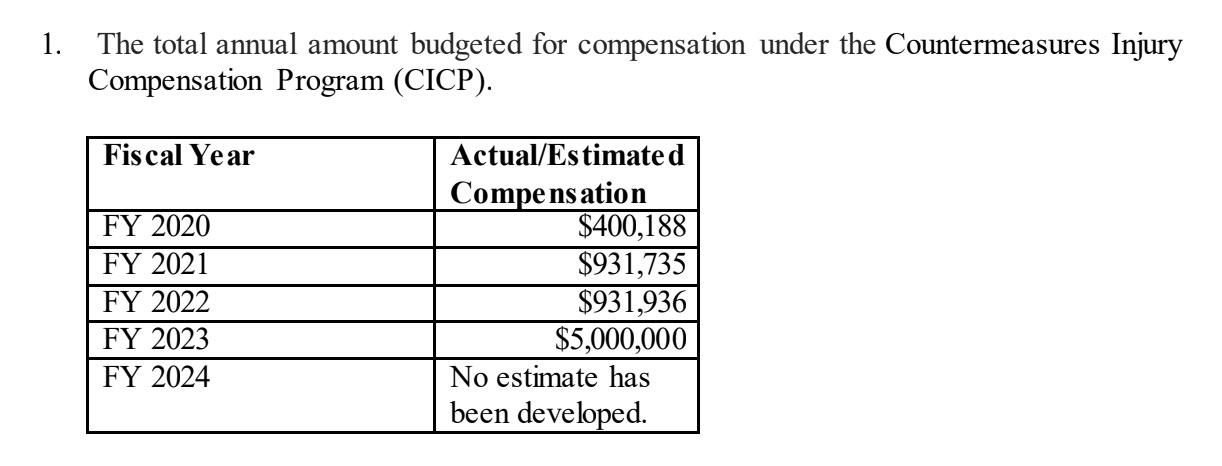
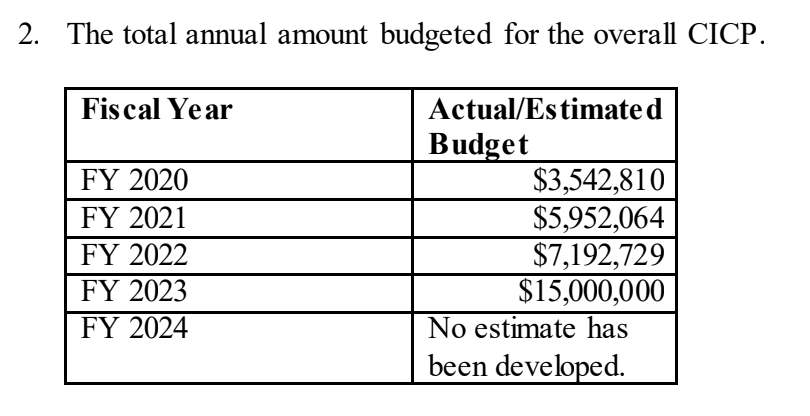
A total of $20M was set aside for claim compensation and budget when it was all said and done for the fiscal year 2023 or 0.00018% of government spending during the failed COVID response. For an unproven product rushed through safety testing and aggressively targeting, often through unconstitutional mandates, every adult, adolescent, child, and infant.
Rohde’s FOIA also uncovered that the CICP estimated that the allotted $15M would “be used to initiate the review of an estimated 1,500 medical reviews of claims and provide compensation to eligible individuals for injuries and deaths directly resulting from the use of covered countermeasures.” In other words, they expected 1,500 injury claims. What did they actually receive?
The latest update from the U.S. Health Resources & Services Administration, which administers the CICP, shows the following numbers:
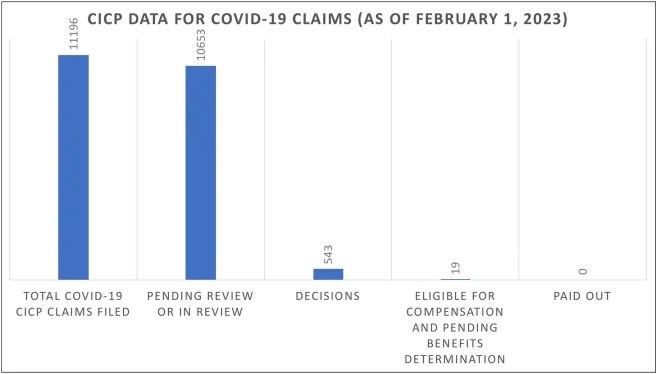
[SOURCE: Aggregate Data from HRSA as of February 1, 2023]
Expected 1,500 claims…received 11,196…in an underreported system. Yet that’s not the most shocking piece of information. For nearly 3 years, HRSA has paid out zero claims. Not a penny to Covid vaccine-injured Americans waiting for assistance.
To get an idea of the potential backlog we are talking about, we go to VAERS where the first records of possible vaccine injuries are recorded before potentially moving onto a CICP claim. Here are the most recent number and types of reports filed after Covid shots:


From past behavior and current trajectory, the U.S. government will try at all costs to avoid taking accountability, financially, ethically, and legally, for the vast amounts and types of injuries caused by the rushed Covid shots. It is up to the media, politicians, and people everywhere to keep this story front and center in an effort to seek justice for those harmed.
China Actually Has A Decent Chance Of Negotiating A Russian-Ukrainian Ceasefire
By Andrew Korybko | February 25, 2023
Most observers are convinced that the Russian-NATO proxy war in Ukraine will be a protracted struggle due to each side’s polar opposite envisaged end game in this conflict, yet China actually has a decent chance of negotiating a Russian-Ukrainian ceasefire after the positive reaction to its official peace plan. It was expected that Moscow would praise Beijing’s pragmatic 12-step proposal yet few could have foreseen that Kiev would also be interested in it too.
Zelensky reacted by saying that “China started talking about Ukraine, and I think this is a good thing. But it actually begs the question, what will these words be followed with? The steps next are important”, after which he announced that he has plans to meet with Chinese President Xi in the coming future. Approximately 24 hours later, his Belarusian counterpart Lukashenko disclosed that he’ll be traveling to the People’s Republic on a state visit from 28 February-2 March.
It can’t be known for sure, but it compellingly appears as though he’ll discuss reviving the peace talks that his country hosted last spring but which were ultimately sabotaged by the UK at the US’ behest. Should that be the partial purpose behind his trip at this particular point in time, it would likely then be the case that President Xi might soon visit Eastern Europe in an attempt to personally encourage his Russian and Ukrainian counterparts to resume this process or at least reach a ceasefire.
The Chinese leader was invited by President Putin late last year to visit Russia sometime this spring, and its top diplomat’s latest trip to Moscow last week was interpreted as paving the way for that event, especially after he met with his country’s host in the Kremlin. In light of Zelensky’s unexpected interest in China’s peace plan and his announcement that he intends to meet with President Xi, the latter would likely visit Kiev during the same regional sojourn and might also make a pit stop in Minsk too.
The fast-moving sequence of diplomatic events that followed the release of China’s peace plan on Friday – Russia’s praise of it, Zelensky’s unexpected interest, his announcement that he hopes to soon meet President Xi, and then Lukashenko’s trip to Beijing next week – extends credence to this prediction. The very fact that the Ukrainian leader didn’t dismiss it outright like his American counterpart and other Western ones did is worthy of explanation since it defied many observers’ predictions.
Zelensky might seriously be concerned about his Golden Billion patrons’ military-industrial reliability amidst the NATO chief’s belated admission that this de facto New Cold War bloc is in a “race of logistics”/”war of attrition” with Russia. In that scenario, it makes sense why he might intend to diversify from his near total dependence on its US leader by gradually engaging China, which is also occurring in the context of France, Germany, and the UK reportedly offering Ukraine a defense pact.
The Wall Street Journal (WSJ) broke the story on Friday, which was the one-year anniversary of Russia’s special operation and the same day that the previously mentioned sequence of diplomatic events began rapidly unfolding. This adds another dimension to everything since that development could serve as a compromise for allaying Kiev’s fears, both in the substantive but also soft power sense, that seriously exploring a ceasefire would amount to a tacit admission of defeat that’ll only embolden Moscow.
Europe has been the second-most directly affected party to the Ukrainian Conflict other than the former Soviet Republic itself within which this Russian-NATO proxy war is being fought so there’s a certain logic to its three most powerful countries coordinating their own possible peace plan. The US successfully reasserted its unipolar hegemony over the EU at the expense of the bloc’s objective interests, but while the UK immediately benefited from this, it too risks blowback over the long-term.
The combination of the collective Franco-German-British security pact with Kiev and China’s peace proposal could create the optics required for Zelensky to comparatively climb down from his absolutist-maximalist demands of Russia with a view towards pragmatically negotiating a ceasefire. Of course, this probably wouldn’t happen until both their reportedly planned offensives have been launched and there’s more clarity about their success or lack thereof, but it appears to be a credible scenario.
In that event, the Ukrainian leader might remain reluctant to recognize the ground realities that Russia demands as the condition for resuming the peace process, but President Xi’s diplomatic intervention in the coming future, should he ultimately visit Kiev, could greatly increase the chances of a ceasefire. He wouldn’t meet with Zelensky just for a photo-op, especially since the Chinese leader has only traveled abroad on three occasions and only in just the last half-year since the pandemic began three years ago.
The only reason why President Xi would visit Kiev to meet with Zelensky is if the latter is serious about there being a tangible outcome to this trip in terms of de-escalating his country’s conflict with Russia. The Ukrainian leader’s interest in China’s peace plan and the announcement that he plans to meet with his counterpart, which occurred against the backdrop of a reportedly proposed collective Franco-German-British security pact to Kiev and Lukashenko’s upcoming trip to Beijing, makes this possible.
To be clear, no prediction is being put forth confidently stating that this fast-moving sequence of diplomatic developments will successfully result in a Russian-Ukrainian ceasefire, but just that it nevertheless can’t be ruled out right now for the reasons that were explained. A lot can still happen and the US can always attempt to sabotage this process, which it’ll likely try to do (potentially even via a false-flag provocation) if a breakthrough appears imminent, so nobody should get their hopes up.
Featured Video

Broke Princes: Saudi Arabia’s Powder Keg
or go to
Aletho News Archives – Video-Images
From the Archives
Registered Israeli foreign agent driving contrived campus antisemitism crisis
By Wyatt Reed | The Grayzone | December 17, 2023
Lawsuits accusing top US universities of harboring antisemitism all originate from one source: a corporate law firm that fielded the pro-settler ex-US ambassador to Israel, and which was registered as a foreign agent of an Israeli principal as recently as 2021.
The firm now represents professional Israel lobby activists posing as victimized “Jewish students” and seeking to crush the free speech rights of Palestine solidarity activists. … continue
Blog Roll
 Aletho News
- How Iran defeated Trump’s Israel First GOP
- De-escalating the conflict: What the OSCE, the UN, and Europe are (not) doing to prevent war
- Desperate For A Renewed Iran War, Israel Dusts Off The WMD Deception.
- US Elections Offer Choice Between ‘Bad and Worse’ as Both Parties Serve War Lobby – ex-UN Expert
- Ghalibaf warns US government not to betray voters who rejected war
- Broke Princes: Saudi Arabia’s Powder Keg
- Albania’s Crisis: Rama, Israeli Investments and the Demand for Accountability
- Hezbollah Categorically Denies Syrian Accusations: We Aim at Confronting Israeli Enemy, Not Undermining Syria’s Stability
- Trump claims funding to Israel ending in 2026 as merger of Israeli–US armies looms
- Iran Weathering The Storm, But Saudi Arabia Is Sinking
- If Americans Knew
- An error has occurred; the feed is probably down. Try again later.
- No Tricks Zone
- New Study: The Net Fossil Fuel Contribution To Rising Atmospheric CO2 Has Been Zero For 500 Years
- Germany’s Green Energy Transition Becoming Increasingly Expensive…Another 6 Trillion Euros!
- Sudden Stratospheric Warming, Powerful El Niño Combination May Lead To Extreme Europe Cold, Energy Crisis!
- Two New Studies Find Thwaites Glacier Melt Cannot Be Driven By Human Activity Or A Warming Ocean
- E-Cars Reduce CO2 Emissions By Only 41% Compared To Internal Combustion Engine Vehicles
- Predictions Made By Renowned Climate Professor Over Past Decades Have Been Proven To Be Poor
- New Study Suggests Large Regions Of The Pacific Ocean Have Been Cooling For The Last 80 Years
- Germany’s Green Energy Debacle: High Energy Costs Force Kahla Porzellan to Close After 182 Years!
- New Study: 50 Years Of The Most Aggressive ‘Net Zero’ Policies Can Only Affect The Global Climate By 0.03°C
- US September “Heat” Was No Record…Many Records Set Decades Ago

